REVISITING DIGITAL
MEDIA & INTERNET
RESEARCH ETHICS
A Process Oriented Approach
NELE HEISE, M.A. | @NELEHEISE
WORKSHOP ”RESEARCH ETHICS FOR DATA AND DIGITAL METHODS”
NOVEMBER 29, 2016 | DATA SCHOOL UTRECHT
Hello.
 Media Researcher at the University of Hamburg +
Graduate School Media and Communication Hamburg;
 forms, practices and conditions of media participation in
the digital age, as well as ethics of online communication
and digital media, e.g. Big Data, algorithms
 Master thesis: »Ethics of Internet Research« (2011)
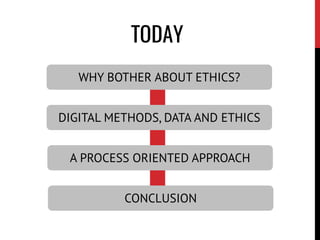
TODAY
DIGITAL METHODS, DATA AND ETHICS
A PROCESS ORIENTED APPROACH
CONCLUSION
WHY BOTHER ABOUT ETHICS?
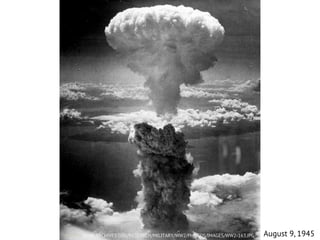
August 9, 1945HTTP://WWW.ARCHIVES.GOV/RESEARCH/MILITARY/WW2/PHOTOS/IMAGES/WW2-163.JPG
»The social sciences can […] have a
tremendous impact on society, even to
the point of revolutionizing our
conceptions of human nature, society,
and culture.«
DIENER & CRANDALL [1978: 195]
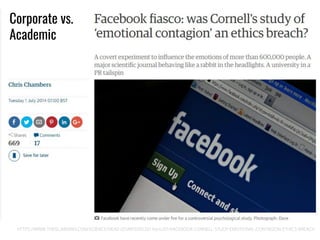
HTTPS://WWW.THEGUARDIAN.COM/SCIENCE/HEAD-QUARTERS/2014/JUL/01/FACEBOOK-CORNELL-STUDY-EMOTIONAL-CONTAGION-ETHICS-BREACH
Corporate vs.
Academic
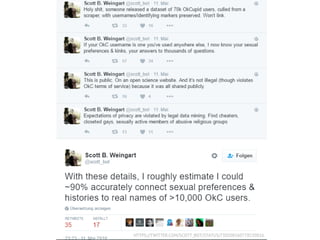
HTTP://MOTHERBOARD.VICE.COM/READ/70000-OKCUPID-USERS-JUST-HAD-THEIR-DATA-PUBLISHED
»The data may be ‘public’
(though it must require login
and agreement to a [terms of
service]) but that does not
absolve anyone from an
ethical responsibility.«
R. Munksgaard
HTTPS://TWITTER.COM/SCOTT_BOT/STATUS/730508560778530816
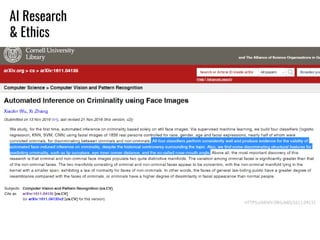
HTTPS://ARXIV.ORG/ABS/1611.04135
AI Research
& Ethics
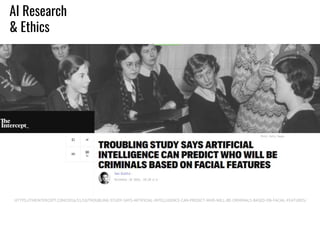
HTTPS://THEINTERCEPT.COM/2016/11/18/TROUBLING-STUDY-SAYS-ARTIFICIAL-INTELLIGENCE-CAN-PREDICT-WHO-WILL-BE-CRIMINALS-BASED-ON-FACIAL-FEATURES/
AI Research
& Ethics
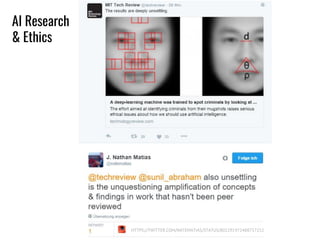
AI Research
& Ethics
HTTPS://TWITTER.COM/NATEMATIAS/STATUS/802291972488757252
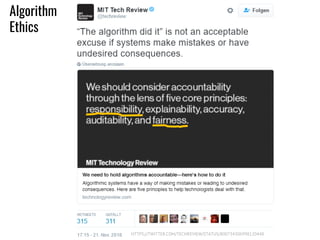
HTTPS://TWITTER.COM/TECHREVIEW/STATUS/800734306998120448
Algorithm
Ethics
HTTPS://TWITTER.COM/TECHREVIEW/STATUS/800734306998120448
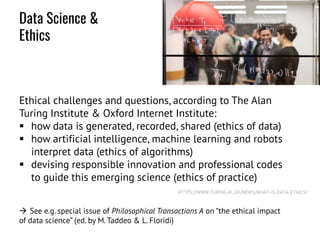
Ethical challenges and questions, according to The Alan
Turing Institute & Oxford Internet Institute:
 how data is generated, recorded, shared (ethics of data)
 how artificial intelligence, machine learning and robots
interpret data (ethics of algorithms)
 devising responsible innovation and professional codes
to guide this emerging science (ethics of practice)
 See e.g. special issue of Philosophical Transactions A on “the ethical impact
of data science” (ed. by M. Taddeo & L. Floridi)
HTTPS://WWW.TURING.AC.UK/NEWS/WHAT-IS-DATA-ETHICS/
Data Science &
Ethics
SOME BASICS
RESEARCH ETHICS: KEY ELEMENTS
Ethics are guidelines and principles that help us to
uphold our values – to decide which goals of research are
most important and to reconcile values and goals that
are in conflict. Ethical guides are not simply prohibitions;
they also support our positive responsibilities.
DIENER/CRANDALL [1978: 3]
(shared) valuesdecision-making responsibility
LEVELS OF ETHICAL REASONING
cf. STROHM KITCHENER & KITCHENER [2009]
critical-evaluative
immediate-situational
Meta-Ethics
Ethical Theories
Ethical Principles
Ethical Rules
»ordinary moral sense«
 Ethics as safeguard for good scientific practice,
based on trust, scientific freedom, …
 responsibilities regarding
 employees, colleagues, team members, peers,
scientific community, … [internal]
 participants, society, clients etc. [external]
ETHICAL PRINCIPLES & STANDARDS
 Core principles:
 Human Dignity,Autonomy (self-determination, agency)
& Respect for Persons
 maximization of benefits and minimization of harms
(Nonmalificence & Beneficence), Justice
 Protection, Safety & Fidelity
 Research standards in regard to participants
– Voluntariness, informed consent
– Anonymity, Privacy & Confidentiality
– »Do no harm« (avoidance of potential risks)
DIGITAL METHODS,
DATA AND ETHICS
»virtual worlds, as sites for
meaningful social interaction, also
tend to be sites where meaningful
ethical harm can occur […].«
VANACKER & HEIDER [2012: 83]
»Internet research encompasses inquiry that:
a) utilizes the internet to collect data or information, e.g., through online interviews,
surveys, archiving, or automated means of data scraping;
b) studies how people use and access the internet, e.g., through collecting and
observing activities or participating on social network sites, listservs, web sites,
blogs, games, virtual worlds, or other online environments or contexts;
c) utilizes or engages in data processing, analysis, or storage of datasets, databanks,
and/or repositories available via the
d) studies software, code, and internet technologies
e) examines the design or structures of systems, interfaces, pages, and elements
f) employs visual and textual analysis, semiotic analysis, content analysis, or other
methods of analysis to study the web and/or internet-facilitated images, writings,
and media forms.
g) studies large scale production, use, and regulation of the internet by governments,
industries, corporations, and military forces.«
MARKHAM & BUCHANAN [2012: 3f.]
CHALLENGES OF DIGITAL RESEARCH METHODS
 De-contextualization (space/time) and global reach
of research and data
 Data structures: networked, persistent, searchable, …
 Informational constraints: disembodiment,
communicative distance, degree of social presence,
anonymity (verification/authentication)
 Blurring boundaries of publicity and privacy (data,
spaces) and hybrid roles of the researcher
 Legal gray areas and insecurities (no best practices)
e. g. frictionless sharing and »contextual integrity« [NISSENBAUM: 2004]
[DE-]CONTEXTUALIZATION
STAKEHOLDERS, ACTORS, RELATIONS
Codes/Guidelines
Intermediaries
MCKEE & PORTER [2009: 17]
 personal rights (of others) and handling of
personal identifiable information; right to
informational self-determination (in Germany)
 data security and privacy (national, EU)
 scientific freedom; science/education related laws
 third parties and providers, e.g. Terms of Use
LEGAL CONTEXT
Many ethical conflicts in online / digital
media research occur due to violations of
communication norms and principles (e.g.
reciprocity, authenticity, personhood)
online research = communication
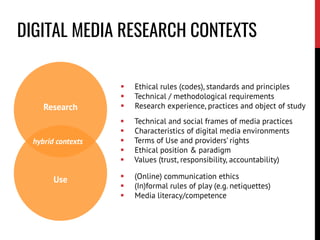
Research
 Ethical rules (codes), standards and principles
 Technical / methodological requirements
 Research experience, practices and object of study
Use  (Online) communication ethics
 (In)formal rules of play (e.g. netiquettes)
 Media literacy/competence
 Technical and social frames of media practices
 Characteristics of digital media environments
 Terms of Use and providers’ rights
 Ethical position & paradigm
 Values (trust, responsibility, accountability)
hybrid contexts
DIGITAL MEDIA RESEARCH CONTEXTS
CONTEXTUAL DETAILS MATTER
 Object(s) of analysis: texts, aggregated bits of information,
or the persons themselves?
 use expectations of the online site and participants?
 sensitivity of the information collected?
 ages, geo-cultural-political affiliations, and/or
technological expertise of the online participants?
 In what form are the researchers collecting data, and in
what forms are they re-distributing it?
 Is the researcher using real names or real user/avatar
names, quoting passages, taking screenshots, etc.?
 And where will this material appear and to whom will it be
accessible?
MCKEE & PORTER [2009: 7F.]
 Type of Data
 Type of Venues
and/or Contexts
 set of questions to
reflect and evaluate
ethical practice
AoIR Guidelines [2012]
PRACTICAL JUDGEMENT
IN SPECIFIC CONTEXTS
[›PHRONESIS‹]
HTTP://S2.QUICKMEME.COM/IMG/2C/2CF739C4AAC76C9EFF549E105
390EB22B899CBF161784E671A1F50AD6E63040F.JPG
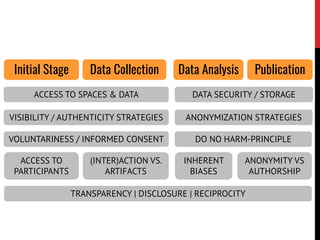
A PROCESS ORIENTED APPROACH
HTTP://CT.FRA.BZ/OL/FZ/SW/I54/5/10/3/FRABZ-ONE-DOES-NOT-SIMPLY-START-THE-PROJECT-WITHOUT-CONSIDERING-ETHICS-9E0B60.JPG
»Different ethical issues become salient as the
researcher develops research questions, seeks
and gains access to individuals and/or
information, manages and protects personally
identifiable information, selects analytical
tools, and represents the data through
dissemination, in published reports,
conference presentations, or other venues.«
MARKHAM & BUCHANAN [2012: 4]
HTTPS://WWW.FLICKR.COM/PHOTOS/LLAMNUDS/8543376308/
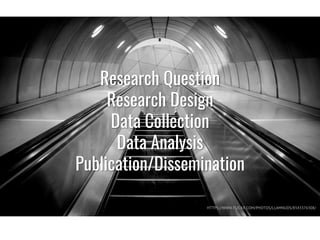
Research Question
Research Design
Data Collection
Data Analysis
Publication/Dissemination
Initial Stage Data Collection Data Analysis Publication
ACCESS TO SPACES & DATA
ACCESS TO
PARTICIPANTS
VISIBILITY / AUTHENTICITY STRATEGIES
ANONYMITY VS
AUTHORSHIP
ANONYMIZATION STRATEGIES
(INTER)ACTION VS.
ARTIFACTS
VOLUNTARINESS / INFORMED CONSENT
DATA SECURITY / STORAGE
DO NO HARM-PRINCIPLE
TRANSPARENCY | DISCLOSURE | RECIPROCITY
INHERENT
BIASES
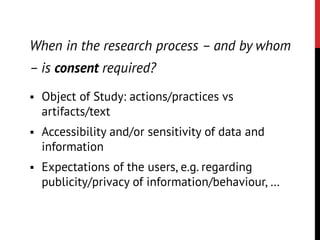
When in the research process – and by whom
– is consent required?
 Object of Study: actions/practices vs
artifacts/text
 Accessibility and/or sensitivity of data and
information
 Expectations of the users, e.g. regarding
publicity/privacy of information/behaviour, …
OBTAINING INFORMED CONSENT
Visual heuristic to support ethical decision-making; in: MCKEE & PORTER [2009: 132/136]
»it is not only […] a technology, an infrastructure, which
is simply there–it is appropriated and has a specific
meaning to us. If you are going to MySpace you do
different things than on Facebook […] these are very
different spaces or Lebenswelten, with different
functions and meanings. Once you acknowledge that […]
we as researchers have to take a certain position: not to
sniff around and observe everything because it is easily
accessible, but instead to be aware of the fact that these
spaces are made by people for themselves.«
PhD Candidate studying self-representation in SNS; in: HEISE [2013]
USERS’ PERSPECTIVES
 Goal: protecting individual/group privacy and
personal identifiable information
 Potential risks: de-anonymization due to
traceability of data, …
 Possible approaches: »Data Fabrication«
[MARKHAM 2012], »visual paraphrases«, word
clouds etc.
Which degree of anonymization is required?
PUBLICATION OF RESULTS / DATA
in: HEISE & SCHMIDT [2014]
CONCLUSION
»There cannot be a blanket,
whole cloth approach to Internet
Research ethics.«
MCKEE & PORTER [2009: 7]
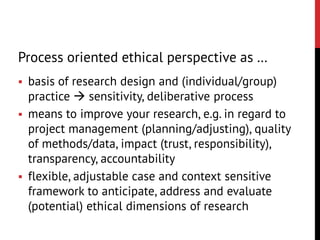
Process oriented ethical perspective as …
 basis of research design and (individual/group)
practice  sensitivity, deliberative process
 means to improve your research, e.g. in regard to
project management (planning/adjusting), quality
of methods/data, impact (trust, responsibility),
transparency, accountability
 flexible, adjustable case and context sensitive
framework to anticipate, address and evaluate
(potential) ethical dimensions of research
RESOURCES
Guidelines
 MARKHAM/BUCHANAN [2012]: AoIR Recommendations (aoir.org)
 NESH [2015]: Ethical Guidelines for Internet Research (etikkom.no)
 ESOMAR/GRBN [2015]: Online Research Guideline (esomar.org)
 BRITISH PSYCHOLOGICAL SOCIETY [2013]: Ethics Guidelines for Internet-
mediated Research
Literature
 ALIM [2014]: Ethics & automated data retraction from Social Media
 ZIMMER [2010]: Ethics & Facebook, private/public data, publication
 MCKEE/PORTER [2009]: Ethics of Internet Research (case based approach)
 MARKHAM/BAYM [2009]: qualitative Internet methodology (challenges)
 HEISE/SCHMIDT [2014]: ethics of online research [GER]
 DZEYK [2001]: ethical dimensions of online research [GER]
 RIVERS/LEWIS [2014]: Ethical research standards in a world of big data.
Nele Heise, M.A.
University of Hamburg | Journalism and Mass
Communication Studies
Graduate School Media & Communication Hamburg
@neleheise
nele.heise@wiso.uni-hamburg.de
THANK YOU.
ADM (2014). Richtlinie für Untersuchungen in den und mittels der Sozialen Medien (Soziale Medien Richtlinie). https://www.adm-
ev.de/fileadmin/user_upload/PDFS/R11_D.pdf.
ALIM, S. (2014). An initial exploration of ethical research practices regarding automated data extraction from online social media user
profiles. First Monday, 19(7). http://dx.doi.org/10.5210/fm.v19i7.5382.
BORGATTI, S. P.; MOLINA, J.L. (2002). Ethical and Strategic Issues in Organizational Social Network Analysis. The Journal of Applied Behavioral
Science, 39(3), 337-349. http://www.analytictech.com/borgatti/papers/ethics.pdf.
BOYD, D.; CRAWFORD, K. (2012). Critical questions for Big Data. Information, Communication & Society, 15(5), 662–679.
http://dx.doi.org/10.1080/1369118X.2012.678878.
BRITISH PSYCHOLOGICAL SOCIETY (2013). Ethics Guidelines for Internet-mediated Research.
http://www.bps.org.uk/system/files/Public%20files/inf206-guidelines-for-internet-mediated-research.pdf.
BURGESS, J.; BRUNS, A. (2012): Twitter Archives and the Challenges of ›Big Social Data‹ for Media and Communication Research. M/C
Journal, 15 (5). http://journal.media-culture.org.au/index.php/mcjournal/article/viewArticle/561.
CAPURRO, R.; PINGEL, C.: (2002). Ethical issues of online communication research. Ethics and Information Technology, 4(2002), 189-194.
DIENER, E.; CRANDALL, R. (1978). Ethics in Social and Behavioral Research. Chicago/London: University of Chicago Press.
DÖRING, N. (1999). Sozialpsychologie des Internet: die Bedeutung des Internet für Kommunikationsprozesse, Identitäten, soziale Beziehungen und
Gruppen. Göttingen u.a.: Hogrefe.
DZEYK, W. (2001). Ethische Dimensionen der Online-Forschung. Kölner Psychologische Studien 6(1), 1-30. http://kups.ub.uni-
koeln.de/2424/1/ethdimon.pdf.
ELGESEM, D. (2002). What is special about the ethical issues in online research? Ethics and Information Technology 4(3), 195–203.
ESS, C.(2007). Internet research ethics. In: Joinson, A.; Mckenna, K.; Postmes, T.; Reips, U. (Eds.): The Oxford handbook of Internet psychology
(pp. 91–107). Oxford: University Press.
EYNON, R.; SCHROEDER, R.; FRY, J. (2009). New Techniques in Online Research. Challenges for Research Ethics. 21st Century Society 4 (2),
187-199.
FRAAS, C.; MEIER, S.; PENTZOLD, C. (2012). Online-Kommunikation. Grundlagen, Praxisfelder und Methoden. Wien: Oldenbourg Verlag.
HAMILTON, R. J.; BOWERS, B. J. (2006). Internet Recruitment and E-Mail Interviews in Qualitative Studies. Qualitative Health Research, 16 (6),
821-835.
HEISE, N. (2013). “Doing it for real”. Authentizität als kommunikationsethische Voraussetzung onlinebasierter Forschung. In: Emmer, M.;
Filipovic, A.; Schmidt, J.-H.; Stapf, I. (Eds.): Authentizität in der computervermittelten Kommunikation (pp. 88-109). Weinheim: Juventa.
References
HEISE, N. (2015). Big Data – small problems? Ethische Dimensionen der Forschung mit Online-Kommunikationsspuren. In: A. Maireder, J.
Ausserhofer, C. Schumann, M. Taddicken (Eds.): Digitale Methoden in der Kommunikationswissenschaft (pp. 39-58). Berlin.
http://dx.doi.org/10.17174/dcr.v2.3.
HEISE, N.; SCHMIDT, J.-H. (2014). Ethik der Onlineforschung. In: M. Welker, M. Taddicken, J.-H. Schmidt, N. Jackob (Eds.): Handbuch Online-
Forschung (pp. 519-539). Köln: Herbert von Halem Verlag.
MCKEE, H.; PORTER, J. (2009). The Ethics of Internet Research. A Rhetorical, Case-Based Process. New York u.a.: Peter Lang.
MARKHAM, A. (2012). Fabrication as ethical practice: Qualitative inquiry in ambiguous internet contexts. Information, Communication &
Society, 15 (3), 334-353.
MARKHAM, A.; BUCHANAN, E. (2012). Ethical Decision-Making and Internet Research: Recommendations from the AoIR Ethics Working
Committee (version 2.0). http://aoir.org/reports/ethics2.pdf.
NESH (2015). Ethical Guidelines for Internet Research. https://www.etikkom.no/en/ethical-guidelines-for-research/ethical-guidelines-for-
internet-research/.
NISSENBAUM, H. (2004). Privacy as contextual integrity. Washington Law Review, 79(1), 119-157.
RIVERS, C.M.; LEWIS, B.L. (2014). Ethical research standards in a world of big data. F1000Research, 3(38).
http://f1000research.com/articles/3-38/v2.
ROBARD, B. (2013). Friending Participants: Managing the Researcher–Participant Relationship on Social Network Sites. Young, 21(3),
217–235.
SCHMIDT, J.-H. (2009). Braucht das Web 2.0 eine eigene Forschungsethik? Zeitschrift für Kommunikationsökologie und Medienethik 11(2),
38-42.
STROHM KITCHENER, K.; KITCHENER, R. F. (2009). Social Research Ethics. Historical and Philosophical Issues. In: Mertens, Donna M.;
Ginsberg, Pauline E. (Eds.): The handbook of social research ethics (pp. 5-22). Thousand Oaks: SAGE Publications.
TREVISAN, F.; REILLY, P. (2012). Ethical Dilemmas in Researching Social Media Campaigns on Sensitive Personal Issues. Paper presented at
the 4th European Communication Conference, October 2012, Istanbul.
VIS, F. (2013). A critical reflection on Big Data: Considering APIs, researchers and tools as data makers. First Monday, 10.
http://dx.doi.org/10.5210%2Ffm.v18i10.4878.
WILLIAMS, F.; RICE, R.; ROGERS, E. M. (1988). Research methods and the new media. New York u.a.: Free Press.
ZIMMER, M. (2010). “But the data is already public”: on the ethics of research on Facebook. Ethics and Information Technology, 12(4), 313-
326.
References

Revisiting Digital Media and Internet Research Ethics. A Process Oriented Approach

  • 1.
    REVISITING DIGITAL MEDIA &INTERNET RESEARCH ETHICS A Process Oriented Approach NELE HEISE, M.A. | @NELEHEISE WORKSHOP ”RESEARCH ETHICS FOR DATA AND DIGITAL METHODS” NOVEMBER 29, 2016 | DATA SCHOOL UTRECHT
  • 2.
    Hello.  Media Researcherat the University of Hamburg + Graduate School Media and Communication Hamburg;  forms, practices and conditions of media participation in the digital age, as well as ethics of online communication and digital media, e.g. Big Data, algorithms  Master thesis: »Ethics of Internet Research« (2011)
  • 3.
    TODAY DIGITAL METHODS, DATAAND ETHICS A PROCESS ORIENTED APPROACH CONCLUSION WHY BOTHER ABOUT ETHICS?
  • 5.
  • 6.
  • 7.
    »The social sciencescan […] have a tremendous impact on society, even to the point of revolutionizing our conceptions of human nature, society, and culture.« DIENER & CRANDALL [1978: 195]
  • 8.
  • 9.
    HTTP://MOTHERBOARD.VICE.COM/READ/70000-OKCUPID-USERS-JUST-HAD-THEIR-DATA-PUBLISHED »The data maybe ‘public’ (though it must require login and agreement to a [terms of service]) but that does not absolve anyone from an ethical responsibility.« R. Munksgaard
  • 10.
  • 11.
  • 12.
  • 13.
  • 14.
  • 15.
    Ethical challenges andquestions, according to The Alan Turing Institute & Oxford Internet Institute:  how data is generated, recorded, shared (ethics of data)  how artificial intelligence, machine learning and robots interpret data (ethics of algorithms)  devising responsible innovation and professional codes to guide this emerging science (ethics of practice)  See e.g. special issue of Philosophical Transactions A on “the ethical impact of data science” (ed. by M. Taddeo & L. Floridi) HTTPS://WWW.TURING.AC.UK/NEWS/WHAT-IS-DATA-ETHICS/ Data Science & Ethics
  • 17.
  • 18.
    RESEARCH ETHICS: KEYELEMENTS Ethics are guidelines and principles that help us to uphold our values – to decide which goals of research are most important and to reconcile values and goals that are in conflict. Ethical guides are not simply prohibitions; they also support our positive responsibilities. DIENER/CRANDALL [1978: 3] (shared) valuesdecision-making responsibility
  • 19.
    LEVELS OF ETHICALREASONING cf. STROHM KITCHENER & KITCHENER [2009] critical-evaluative immediate-situational Meta-Ethics Ethical Theories Ethical Principles Ethical Rules »ordinary moral sense«
  • 20.
     Ethics assafeguard for good scientific practice, based on trust, scientific freedom, …  responsibilities regarding  employees, colleagues, team members, peers, scientific community, … [internal]  participants, society, clients etc. [external]
  • 21.
    ETHICAL PRINCIPLES &STANDARDS  Core principles:  Human Dignity,Autonomy (self-determination, agency) & Respect for Persons  maximization of benefits and minimization of harms (Nonmalificence & Beneficence), Justice  Protection, Safety & Fidelity  Research standards in regard to participants – Voluntariness, informed consent – Anonymity, Privacy & Confidentiality – »Do no harm« (avoidance of potential risks)
  • 22.
  • 23.
    »virtual worlds, assites for meaningful social interaction, also tend to be sites where meaningful ethical harm can occur […].« VANACKER & HEIDER [2012: 83]
  • 24.
    »Internet research encompassesinquiry that: a) utilizes the internet to collect data or information, e.g., through online interviews, surveys, archiving, or automated means of data scraping; b) studies how people use and access the internet, e.g., through collecting and observing activities or participating on social network sites, listservs, web sites, blogs, games, virtual worlds, or other online environments or contexts; c) utilizes or engages in data processing, analysis, or storage of datasets, databanks, and/or repositories available via the d) studies software, code, and internet technologies e) examines the design or structures of systems, interfaces, pages, and elements f) employs visual and textual analysis, semiotic analysis, content analysis, or other methods of analysis to study the web and/or internet-facilitated images, writings, and media forms. g) studies large scale production, use, and regulation of the internet by governments, industries, corporations, and military forces.« MARKHAM & BUCHANAN [2012: 3f.]
  • 25.
    CHALLENGES OF DIGITALRESEARCH METHODS  De-contextualization (space/time) and global reach of research and data  Data structures: networked, persistent, searchable, …  Informational constraints: disembodiment, communicative distance, degree of social presence, anonymity (verification/authentication)  Blurring boundaries of publicity and privacy (data, spaces) and hybrid roles of the researcher  Legal gray areas and insecurities (no best practices)
  • 26.
    e. g. frictionlesssharing and »contextual integrity« [NISSENBAUM: 2004] [DE-]CONTEXTUALIZATION
  • 27.
  • 28.
     personal rights(of others) and handling of personal identifiable information; right to informational self-determination (in Germany)  data security and privacy (national, EU)  scientific freedom; science/education related laws  third parties and providers, e.g. Terms of Use LEGAL CONTEXT
  • 29.
    Many ethical conflictsin online / digital media research occur due to violations of communication norms and principles (e.g. reciprocity, authenticity, personhood) online research = communication
  • 30.
    Research  Ethical rules(codes), standards and principles  Technical / methodological requirements  Research experience, practices and object of study Use  (Online) communication ethics  (In)formal rules of play (e.g. netiquettes)  Media literacy/competence  Technical and social frames of media practices  Characteristics of digital media environments  Terms of Use and providers’ rights  Ethical position & paradigm  Values (trust, responsibility, accountability) hybrid contexts DIGITAL MEDIA RESEARCH CONTEXTS
  • 31.
    CONTEXTUAL DETAILS MATTER Object(s) of analysis: texts, aggregated bits of information, or the persons themselves?  use expectations of the online site and participants?  sensitivity of the information collected?  ages, geo-cultural-political affiliations, and/or technological expertise of the online participants?  In what form are the researchers collecting data, and in what forms are they re-distributing it?  Is the researcher using real names or real user/avatar names, quoting passages, taking screenshots, etc.?  And where will this material appear and to whom will it be accessible? MCKEE & PORTER [2009: 7F.]
  • 32.
     Type ofData  Type of Venues and/or Contexts  set of questions to reflect and evaluate ethical practice AoIR Guidelines [2012]
  • 33.
    PRACTICAL JUDGEMENT IN SPECIFICCONTEXTS [›PHRONESIS‹] HTTP://S2.QUICKMEME.COM/IMG/2C/2CF739C4AAC76C9EFF549E105 390EB22B899CBF161784E671A1F50AD6E63040F.JPG
  • 34.
  • 35.
  • 36.
    »Different ethical issuesbecome salient as the researcher develops research questions, seeks and gains access to individuals and/or information, manages and protects personally identifiable information, selects analytical tools, and represents the data through dissemination, in published reports, conference presentations, or other venues.« MARKHAM & BUCHANAN [2012: 4]
  • 37.
  • 38.
    Initial Stage DataCollection Data Analysis Publication ACCESS TO SPACES & DATA ACCESS TO PARTICIPANTS VISIBILITY / AUTHENTICITY STRATEGIES ANONYMITY VS AUTHORSHIP ANONYMIZATION STRATEGIES (INTER)ACTION VS. ARTIFACTS VOLUNTARINESS / INFORMED CONSENT DATA SECURITY / STORAGE DO NO HARM-PRINCIPLE TRANSPARENCY | DISCLOSURE | RECIPROCITY INHERENT BIASES
  • 39.
    When in theresearch process – and by whom – is consent required?  Object of Study: actions/practices vs artifacts/text  Accessibility and/or sensitivity of data and information  Expectations of the users, e.g. regarding publicity/privacy of information/behaviour, …
  • 40.
    OBTAINING INFORMED CONSENT Visualheuristic to support ethical decision-making; in: MCKEE & PORTER [2009: 132/136]
  • 41.
    »it is notonly […] a technology, an infrastructure, which is simply there–it is appropriated and has a specific meaning to us. If you are going to MySpace you do different things than on Facebook […] these are very different spaces or Lebenswelten, with different functions and meanings. Once you acknowledge that […] we as researchers have to take a certain position: not to sniff around and observe everything because it is easily accessible, but instead to be aware of the fact that these spaces are made by people for themselves.« PhD Candidate studying self-representation in SNS; in: HEISE [2013] USERS’ PERSPECTIVES
  • 42.
     Goal: protectingindividual/group privacy and personal identifiable information  Potential risks: de-anonymization due to traceability of data, …  Possible approaches: »Data Fabrication« [MARKHAM 2012], »visual paraphrases«, word clouds etc. Which degree of anonymization is required?
  • 43.
    PUBLICATION OF RESULTS/ DATA in: HEISE & SCHMIDT [2014]
  • 44.
  • 45.
    »There cannot bea blanket, whole cloth approach to Internet Research ethics.« MCKEE & PORTER [2009: 7]
  • 46.
    Process oriented ethicalperspective as …  basis of research design and (individual/group) practice  sensitivity, deliberative process  means to improve your research, e.g. in regard to project management (planning/adjusting), quality of methods/data, impact (trust, responsibility), transparency, accountability  flexible, adjustable case and context sensitive framework to anticipate, address and evaluate (potential) ethical dimensions of research
  • 47.
    RESOURCES Guidelines  MARKHAM/BUCHANAN [2012]:AoIR Recommendations (aoir.org)  NESH [2015]: Ethical Guidelines for Internet Research (etikkom.no)  ESOMAR/GRBN [2015]: Online Research Guideline (esomar.org)  BRITISH PSYCHOLOGICAL SOCIETY [2013]: Ethics Guidelines for Internet- mediated Research Literature  ALIM [2014]: Ethics & automated data retraction from Social Media  ZIMMER [2010]: Ethics & Facebook, private/public data, publication  MCKEE/PORTER [2009]: Ethics of Internet Research (case based approach)  MARKHAM/BAYM [2009]: qualitative Internet methodology (challenges)  HEISE/SCHMIDT [2014]: ethics of online research [GER]  DZEYK [2001]: ethical dimensions of online research [GER]  RIVERS/LEWIS [2014]: Ethical research standards in a world of big data.
  • 48.
    Nele Heise, M.A. Universityof Hamburg | Journalism and Mass Communication Studies Graduate School Media & Communication Hamburg @neleheise nele.heise@wiso.uni-hamburg.de THANK YOU.
  • 49.
    ADM (2014). Richtliniefür Untersuchungen in den und mittels der Sozialen Medien (Soziale Medien Richtlinie). https://www.adm- ev.de/fileadmin/user_upload/PDFS/R11_D.pdf. ALIM, S. (2014). An initial exploration of ethical research practices regarding automated data extraction from online social media user profiles. First Monday, 19(7). http://dx.doi.org/10.5210/fm.v19i7.5382. BORGATTI, S. P.; MOLINA, J.L. (2002). Ethical and Strategic Issues in Organizational Social Network Analysis. The Journal of Applied Behavioral Science, 39(3), 337-349. http://www.analytictech.com/borgatti/papers/ethics.pdf. BOYD, D.; CRAWFORD, K. (2012). Critical questions for Big Data. Information, Communication & Society, 15(5), 662–679. http://dx.doi.org/10.1080/1369118X.2012.678878. BRITISH PSYCHOLOGICAL SOCIETY (2013). Ethics Guidelines for Internet-mediated Research. http://www.bps.org.uk/system/files/Public%20files/inf206-guidelines-for-internet-mediated-research.pdf. BURGESS, J.; BRUNS, A. (2012): Twitter Archives and the Challenges of ›Big Social Data‹ for Media and Communication Research. M/C Journal, 15 (5). http://journal.media-culture.org.au/index.php/mcjournal/article/viewArticle/561. CAPURRO, R.; PINGEL, C.: (2002). Ethical issues of online communication research. Ethics and Information Technology, 4(2002), 189-194. DIENER, E.; CRANDALL, R. (1978). Ethics in Social and Behavioral Research. Chicago/London: University of Chicago Press. DÖRING, N. (1999). Sozialpsychologie des Internet: die Bedeutung des Internet für Kommunikationsprozesse, Identitäten, soziale Beziehungen und Gruppen. Göttingen u.a.: Hogrefe. DZEYK, W. (2001). Ethische Dimensionen der Online-Forschung. Kölner Psychologische Studien 6(1), 1-30. http://kups.ub.uni- koeln.de/2424/1/ethdimon.pdf. ELGESEM, D. (2002). What is special about the ethical issues in online research? Ethics and Information Technology 4(3), 195–203. ESS, C.(2007). Internet research ethics. In: Joinson, A.; Mckenna, K.; Postmes, T.; Reips, U. (Eds.): The Oxford handbook of Internet psychology (pp. 91–107). Oxford: University Press. EYNON, R.; SCHROEDER, R.; FRY, J. (2009). New Techniques in Online Research. Challenges for Research Ethics. 21st Century Society 4 (2), 187-199. FRAAS, C.; MEIER, S.; PENTZOLD, C. (2012). Online-Kommunikation. Grundlagen, Praxisfelder und Methoden. Wien: Oldenbourg Verlag. HAMILTON, R. J.; BOWERS, B. J. (2006). Internet Recruitment and E-Mail Interviews in Qualitative Studies. Qualitative Health Research, 16 (6), 821-835. HEISE, N. (2013). “Doing it for real”. Authentizität als kommunikationsethische Voraussetzung onlinebasierter Forschung. In: Emmer, M.; Filipovic, A.; Schmidt, J.-H.; Stapf, I. (Eds.): Authentizität in der computervermittelten Kommunikation (pp. 88-109). Weinheim: Juventa. References
  • 50.
    HEISE, N. (2015).Big Data – small problems? Ethische Dimensionen der Forschung mit Online-Kommunikationsspuren. In: A. Maireder, J. Ausserhofer, C. Schumann, M. Taddicken (Eds.): Digitale Methoden in der Kommunikationswissenschaft (pp. 39-58). Berlin. http://dx.doi.org/10.17174/dcr.v2.3. HEISE, N.; SCHMIDT, J.-H. (2014). Ethik der Onlineforschung. In: M. Welker, M. Taddicken, J.-H. Schmidt, N. Jackob (Eds.): Handbuch Online- Forschung (pp. 519-539). Köln: Herbert von Halem Verlag. MCKEE, H.; PORTER, J. (2009). The Ethics of Internet Research. A Rhetorical, Case-Based Process. New York u.a.: Peter Lang. MARKHAM, A. (2012). Fabrication as ethical practice: Qualitative inquiry in ambiguous internet contexts. Information, Communication & Society, 15 (3), 334-353. MARKHAM, A.; BUCHANAN, E. (2012). Ethical Decision-Making and Internet Research: Recommendations from the AoIR Ethics Working Committee (version 2.0). http://aoir.org/reports/ethics2.pdf. NESH (2015). Ethical Guidelines for Internet Research. https://www.etikkom.no/en/ethical-guidelines-for-research/ethical-guidelines-for- internet-research/. NISSENBAUM, H. (2004). Privacy as contextual integrity. Washington Law Review, 79(1), 119-157. RIVERS, C.M.; LEWIS, B.L. (2014). Ethical research standards in a world of big data. F1000Research, 3(38). http://f1000research.com/articles/3-38/v2. ROBARD, B. (2013). Friending Participants: Managing the Researcher–Participant Relationship on Social Network Sites. Young, 21(3), 217–235. SCHMIDT, J.-H. (2009). Braucht das Web 2.0 eine eigene Forschungsethik? Zeitschrift für Kommunikationsökologie und Medienethik 11(2), 38-42. STROHM KITCHENER, K.; KITCHENER, R. F. (2009). Social Research Ethics. Historical and Philosophical Issues. In: Mertens, Donna M.; Ginsberg, Pauline E. (Eds.): The handbook of social research ethics (pp. 5-22). Thousand Oaks: SAGE Publications. TREVISAN, F.; REILLY, P. (2012). Ethical Dilemmas in Researching Social Media Campaigns on Sensitive Personal Issues. Paper presented at the 4th European Communication Conference, October 2012, Istanbul. VIS, F. (2013). A critical reflection on Big Data: Considering APIs, researchers and tools as data makers. First Monday, 10. http://dx.doi.org/10.5210%2Ffm.v18i10.4878. WILLIAMS, F.; RICE, R.; ROGERS, E. M. (1988). Research methods and the new media. New York u.a.: Free Press. ZIMMER, M. (2010). “But the data is already public”: on the ethics of research on Facebook. Ethics and Information Technology, 12(4), 313- 326. References