Lesson 6: Principles in the
Assessment of Learning
Methods of Assessment
Republic of the Philippines
MINDANAO STATE
UNIVERSITY
COLLEGE OF EDUCATION
Fatima, General Santos City
Presented to:
Dr. Ava Clare Marie O. Robles
Class Schedule: TFr 9:00 – 10:30
Presented by:
Abbygale Jade P. Delos Reyes
OBJECTIVES
Discuss the Guiding Principles
in the Assessment of Learning
Apply the guiding principles in
the assessment of learning.
Determine the Assessment
Methods
Curpos, Brenda & Salandanan, Gloria (2015) Principles of Teaching 1
Assessment of learning is an
integral part of the teaching –
learning process.
Curpos, Brenda & Salandanan, Gloria (2015) Principles of Teaching 1
Assessment tool should match
with performance objective.
Curpos, Brenda & Salandanan, Gloria (2015) Principles of Teaching 1
The results of assessment must
fed back to the learners.
Curpos, Brenda & Salandanan, Gloria (2015) Principles of Teaching 1
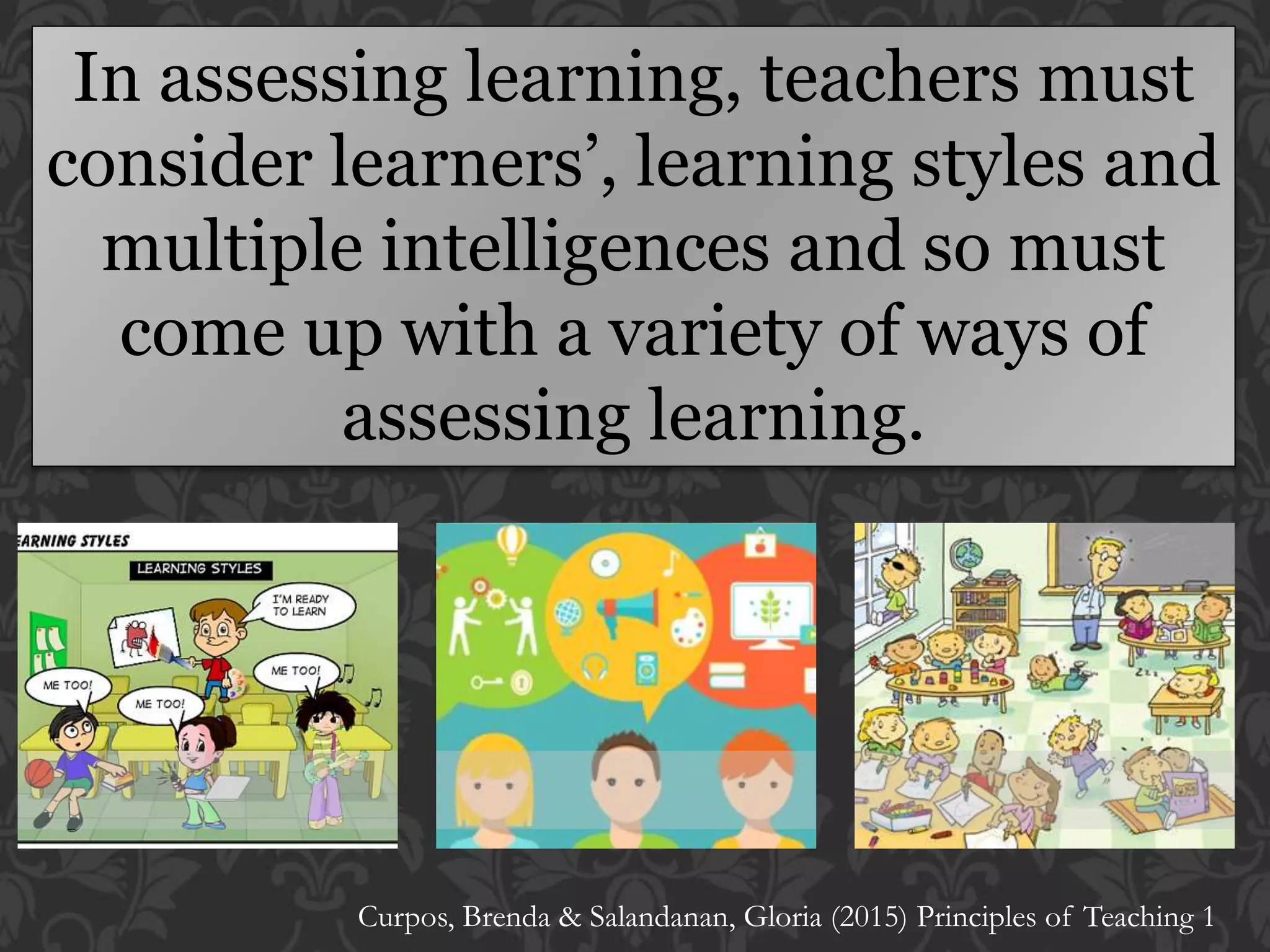
In assessing learning, teachers must
consider learners’, learning styles and
multiple intelligences and so must
come up with a variety of ways of
assessing learning.
Curpos, Brenda & Salandanan, Gloria (2015) Principles of Teaching 1
To contribute to the building of
culture of success in the school, we
give some positive feedback along
with not so good ones.
Curpos, Brenda & Salandanan, Gloria (2015) Principles of Teaching 1
Emphasize on self-assessment.
Curpos, Brenda & Salandanan, Gloria (2015) Principles of Teaching 1
Assessment of learning should
never be used as punishment or as a
disciplinary measure.
Curpos, Brenda & Salandanan, Gloria (2015) Principles of Teaching 1
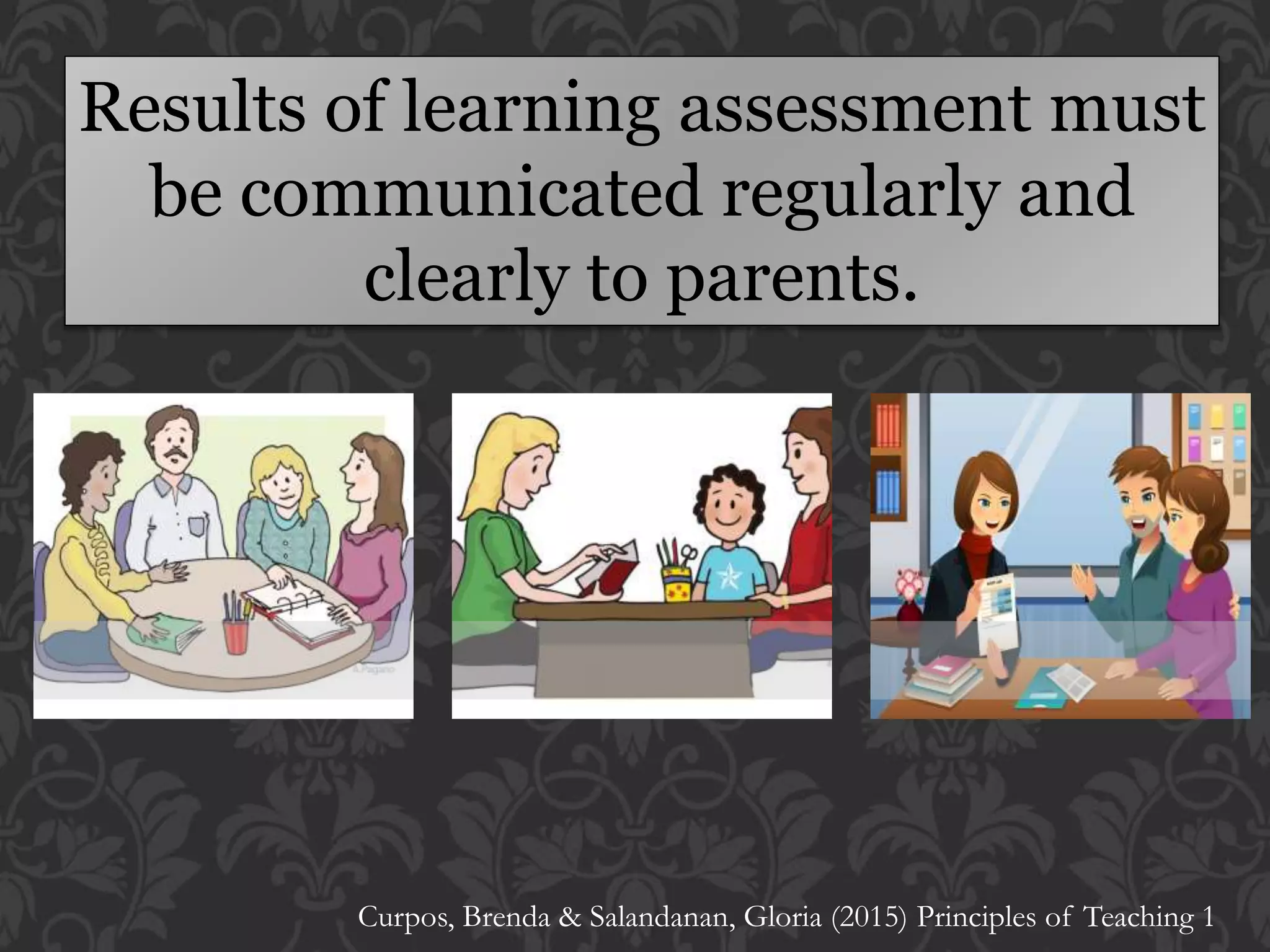
Results of learning assessment must
be communicated regularly and
clearly to parents.
Curpos, Brenda & Salandanan, Gloria (2015) Principles of Teaching 1
To ensure learning, do formative
assessment.
Curpos, Brenda & Salandanan, Gloria (2015) Principles of Teaching 1
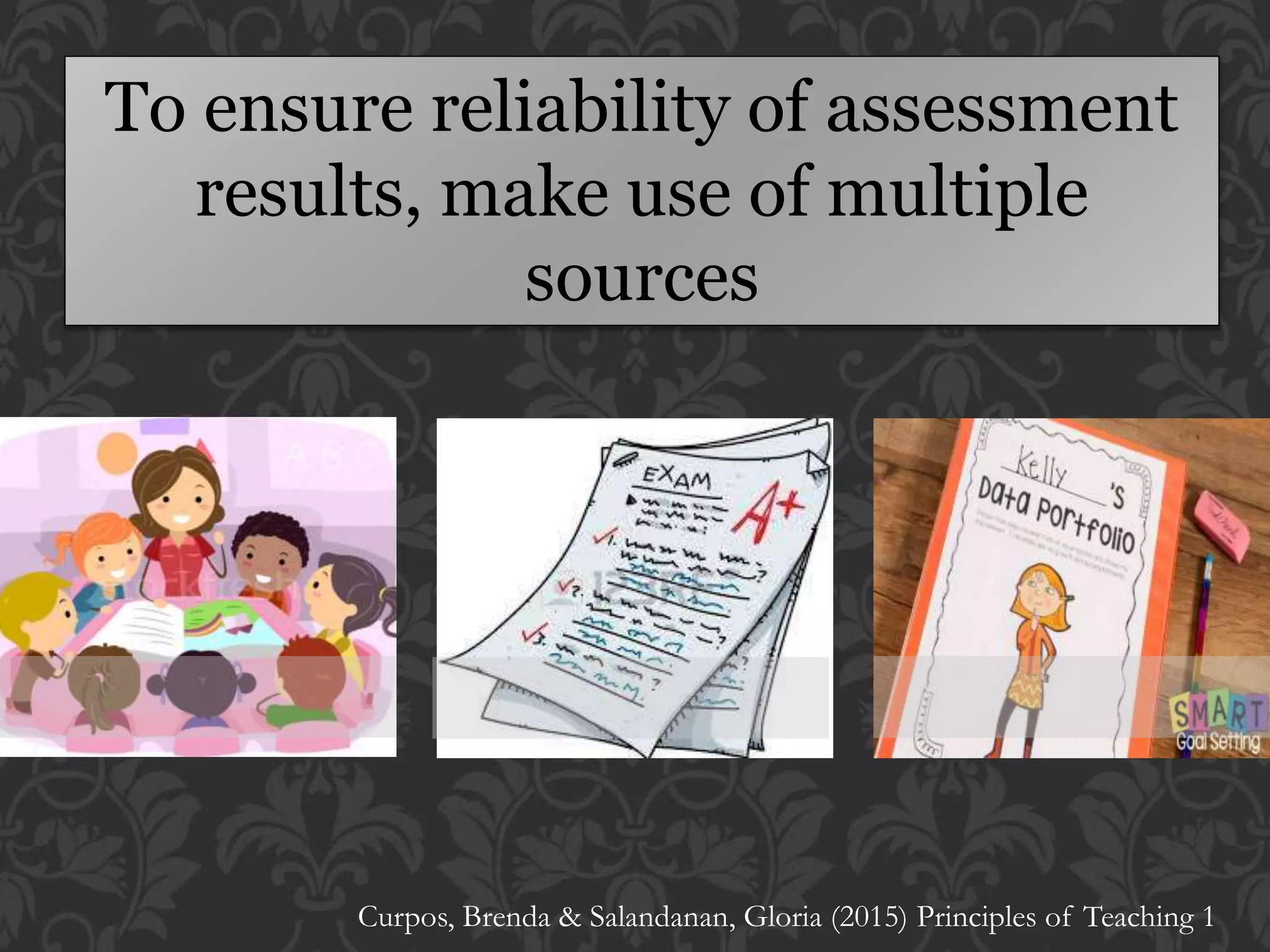
To ensure reliability of assessment
results, make use of multiple
sources
Curpos, Brenda & Salandanan, Gloria (2015) Principles of Teaching 1
If we believe that our task as
teachers is to teach all
pupils/students, and that it is
possible that all students, even
those from limited backgrounds,
will have access to opportunities
and therefore can achieve, then the
bell curve mentality must be
abandoned
Curpos, Brenda & Salandanan, Gloria (2015) Principles of Teaching 1
Why assess? Assessing answers
questions:
• 1. What should our students be learning?
• 2. What are our students actually learning?
• 3. What can we do to help our student learn? What types
of changes can we make (to assignments, activities,
materials) to increase actual student learning?
https://www.wssu.edu/assessment-and-research/assessmentmethods.pdf
Assessment Methods
What are assessment methods?
Assessment methods are the
strategies, techniques, tools and
instruments for collecting information
to determine the extent to which
students demonstrate desired learning
outcomes.
https://www.wssu.edu/assessment-and-research/assessmentmethods.pdf
Direct
Indirect
VS.
Direct methods of assessment
ask students to demonstrate
their learning. Tests, essays,
presentations, etc. are
generally direct methods of
assessment.
Indirect methods ask
students to reflect on
their learning. It include
surveys and interviews.
https://www.wssu.edu/assessment-and-research/assessmentmethods.pdf
Direct Methods …
Require students to display their
knowledge and skills as they respond to
the instrument itself.
Look at student work products or
performances that demonstrate level of
learning.
Are tangible, visible, self-explanatory
evidence of exactly what students have
and haven’t learned.
https://www.wssu.edu/assessment-and-research/assessmentmethods.pdf
Indirect Methods …
Ask students to reflect on their learning
rather than demonstrate it.
Capture students’ perceptions of their
learning and the educational
environment that supports learning.
Provide signs that students are probably
learning, but the evidence of exactly what
they are learning is less clear.
https://www.wssu.edu/assessment-and-research/assessmentmethods.pdf

ED 107

  • 1.
    Lesson 6: Principlesin the Assessment of Learning Methods of Assessment Republic of the Philippines MINDANAO STATE UNIVERSITY COLLEGE OF EDUCATION Fatima, General Santos City Presented to: Dr. Ava Clare Marie O. Robles Class Schedule: TFr 9:00 – 10:30 Presented by: Abbygale Jade P. Delos Reyes
  • 2.
    OBJECTIVES Discuss the GuidingPrinciples in the Assessment of Learning Apply the guiding principles in the assessment of learning. Determine the Assessment Methods
  • 3.
    Curpos, Brenda &Salandanan, Gloria (2015) Principles of Teaching 1
  • 4.
    Assessment of learningis an integral part of the teaching – learning process. Curpos, Brenda & Salandanan, Gloria (2015) Principles of Teaching 1
  • 5.
    Assessment tool shouldmatch with performance objective. Curpos, Brenda & Salandanan, Gloria (2015) Principles of Teaching 1
  • 6.
    The results ofassessment must fed back to the learners. Curpos, Brenda & Salandanan, Gloria (2015) Principles of Teaching 1
  • 7.
    In assessing learning,teachers must consider learners’, learning styles and multiple intelligences and so must come up with a variety of ways of assessing learning. Curpos, Brenda & Salandanan, Gloria (2015) Principles of Teaching 1
  • 8.
    To contribute tothe building of culture of success in the school, we give some positive feedback along with not so good ones. Curpos, Brenda & Salandanan, Gloria (2015) Principles of Teaching 1
  • 9.
    Emphasize on self-assessment. Curpos,Brenda & Salandanan, Gloria (2015) Principles of Teaching 1
  • 10.
    Assessment of learningshould never be used as punishment or as a disciplinary measure. Curpos, Brenda & Salandanan, Gloria (2015) Principles of Teaching 1
  • 11.
    Results of learningassessment must be communicated regularly and clearly to parents. Curpos, Brenda & Salandanan, Gloria (2015) Principles of Teaching 1
  • 12.
    To ensure learning,do formative assessment. Curpos, Brenda & Salandanan, Gloria (2015) Principles of Teaching 1
  • 13.
    To ensure reliabilityof assessment results, make use of multiple sources Curpos, Brenda & Salandanan, Gloria (2015) Principles of Teaching 1
  • 14.
    If we believethat our task as teachers is to teach all pupils/students, and that it is possible that all students, even those from limited backgrounds, will have access to opportunities and therefore can achieve, then the bell curve mentality must be abandoned Curpos, Brenda & Salandanan, Gloria (2015) Principles of Teaching 1
  • 15.
    Why assess? Assessinganswers questions: • 1. What should our students be learning? • 2. What are our students actually learning? • 3. What can we do to help our student learn? What types of changes can we make (to assignments, activities, materials) to increase actual student learning? https://www.wssu.edu/assessment-and-research/assessmentmethods.pdf
  • 16.
    Assessment Methods What areassessment methods? Assessment methods are the strategies, techniques, tools and instruments for collecting information to determine the extent to which students demonstrate desired learning outcomes. https://www.wssu.edu/assessment-and-research/assessmentmethods.pdf
  • 17.
    Direct Indirect VS. Direct methods ofassessment ask students to demonstrate their learning. Tests, essays, presentations, etc. are generally direct methods of assessment. Indirect methods ask students to reflect on their learning. It include surveys and interviews. https://www.wssu.edu/assessment-and-research/assessmentmethods.pdf
  • 18.
    Direct Methods … Requirestudents to display their knowledge and skills as they respond to the instrument itself. Look at student work products or performances that demonstrate level of learning. Are tangible, visible, self-explanatory evidence of exactly what students have and haven’t learned. https://www.wssu.edu/assessment-and-research/assessmentmethods.pdf
  • 19.
    Indirect Methods … Askstudents to reflect on their learning rather than demonstrate it. Capture students’ perceptions of their learning and the educational environment that supports learning. Provide signs that students are probably learning, but the evidence of exactly what they are learning is less clear. https://www.wssu.edu/assessment-and-research/assessmentmethods.pdf