Assessment
Practices for
Effective
Learning
SCHOOL LEARNING ACTION
CELL:
We will talk about
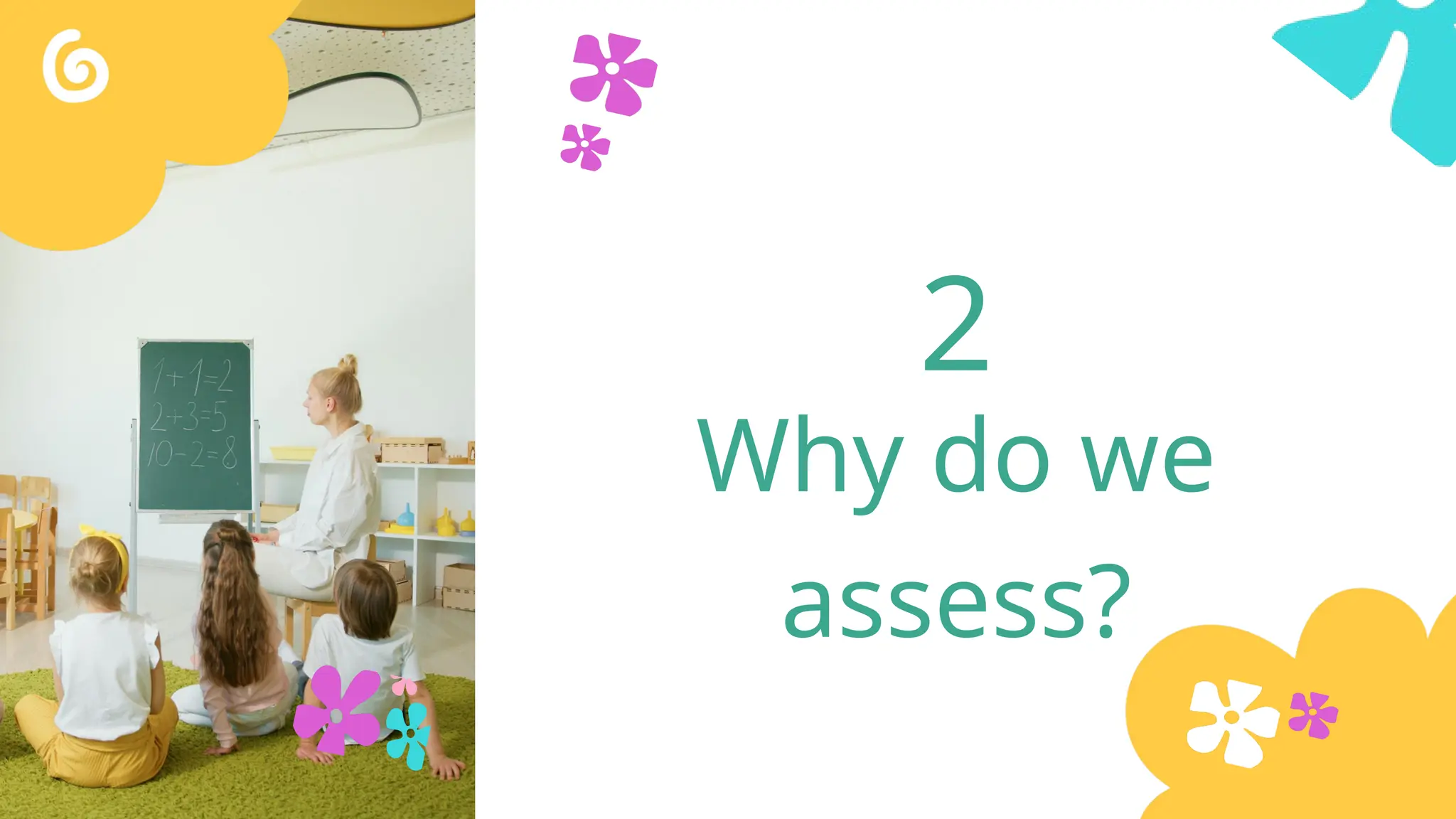
Why do we
assess?
What is
Assessment?
How do we
assess?
1 2 3
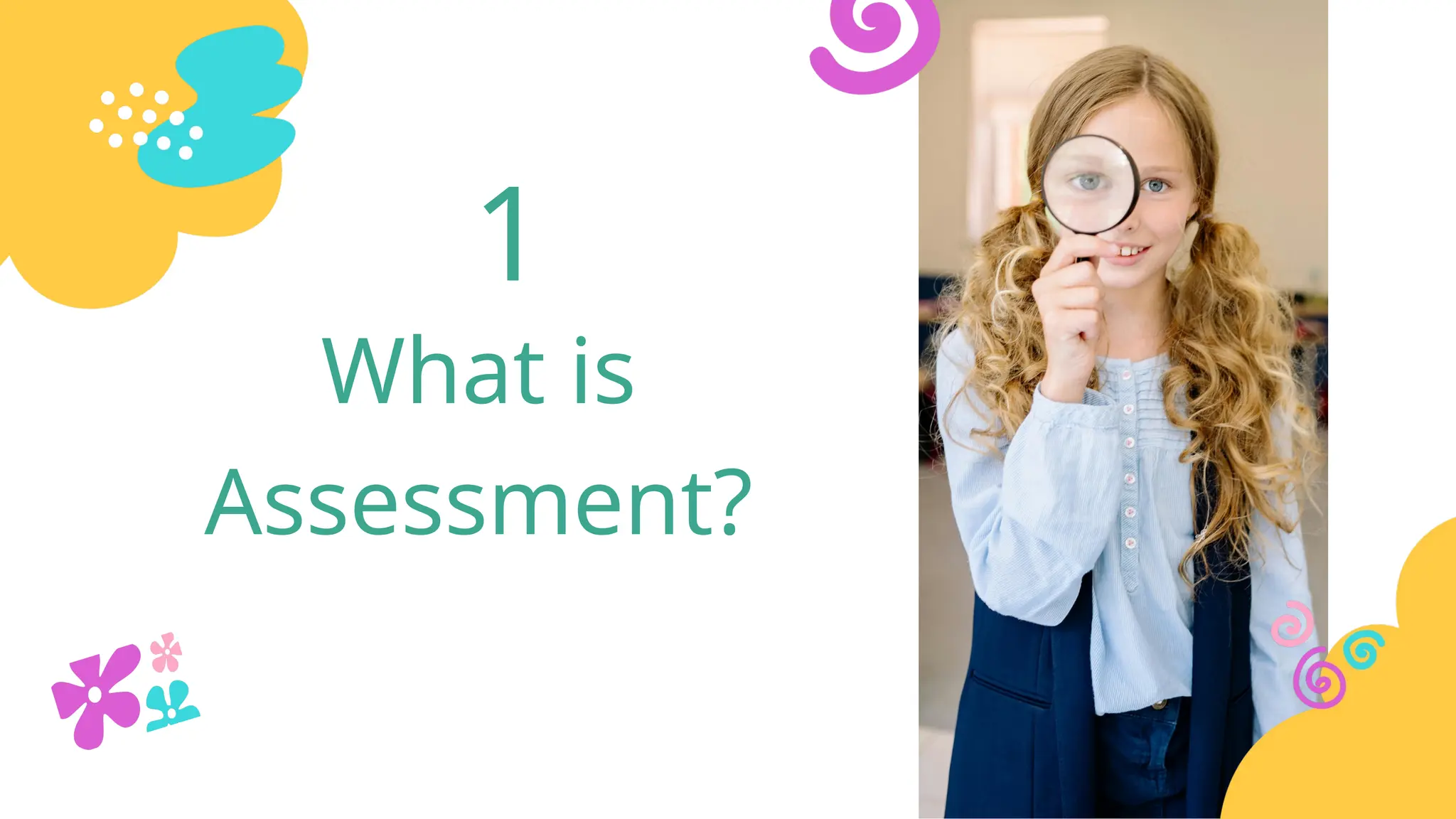
What is
Assessment?
1
Assessment
the evaluation or
estimation of the nature,
quality, or ability of
someone or something
Assessment of Learning
is an approach to teaching and learning
that creates feedback which is then
used to improve students'
performance. Students become more
involved in the learning process and
from this gain confidence in what they
are expected to learn and to what
standard.
Why do we
assess?
2
We assess because…..
Identify the trouble
spots in learning
Identify excellence
We assess because…..
Identify the gaps in
learning process
To encourage and
support learning
We assess because…..
Identify the gaps in
learning process
To measure learning
and improve learners
We assess because…..
To prepare learners
for the next step
To enhance and
improve teaching
strategies
How do we
assess?
3
Learners can be assess
through…..
Indirect
Direct
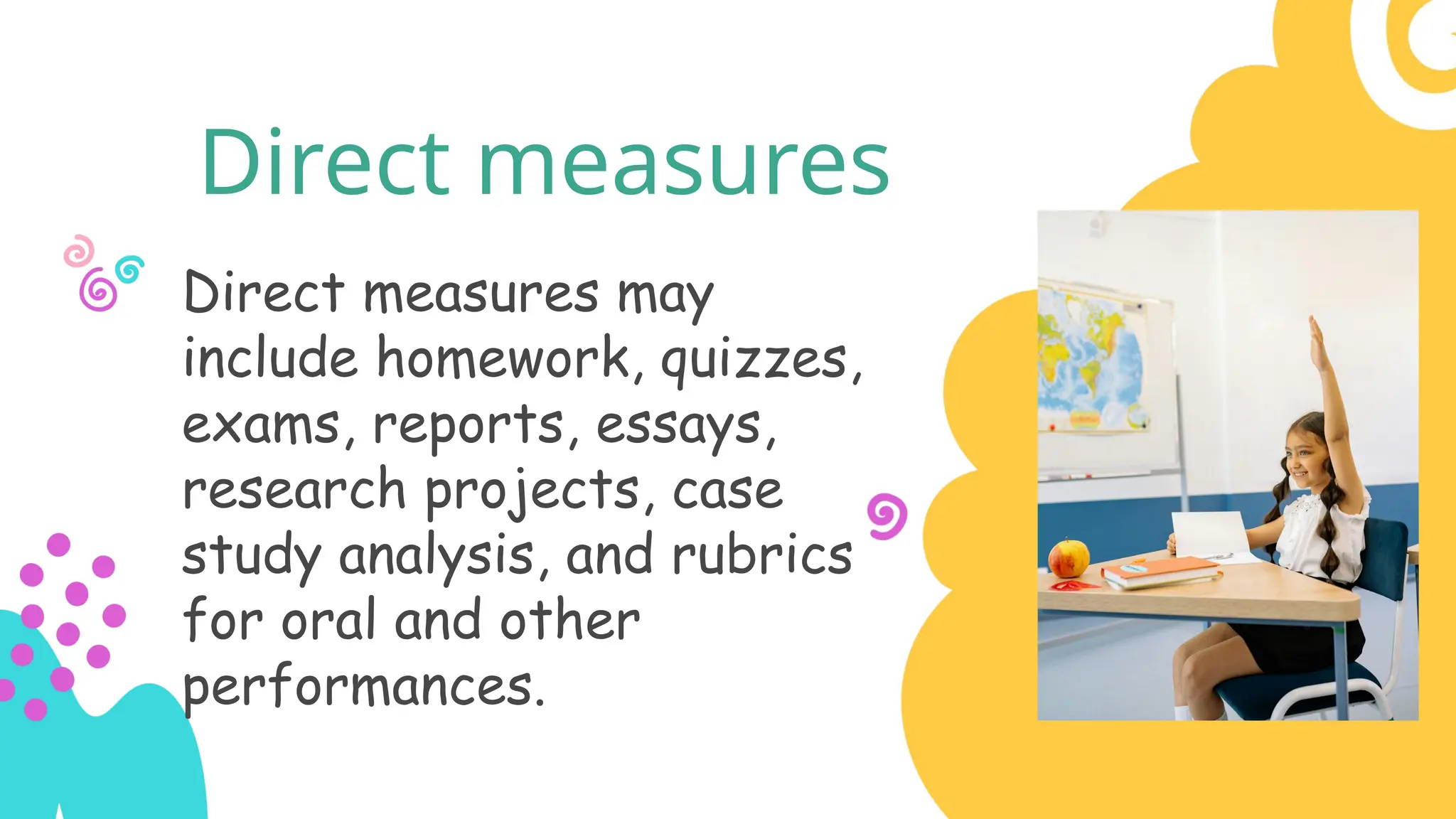
Direct measures
Direct measures may
include homework, quizzes,
exams, reports, essays,
research projects, case
study analysis, and rubrics
for oral and other
performances.
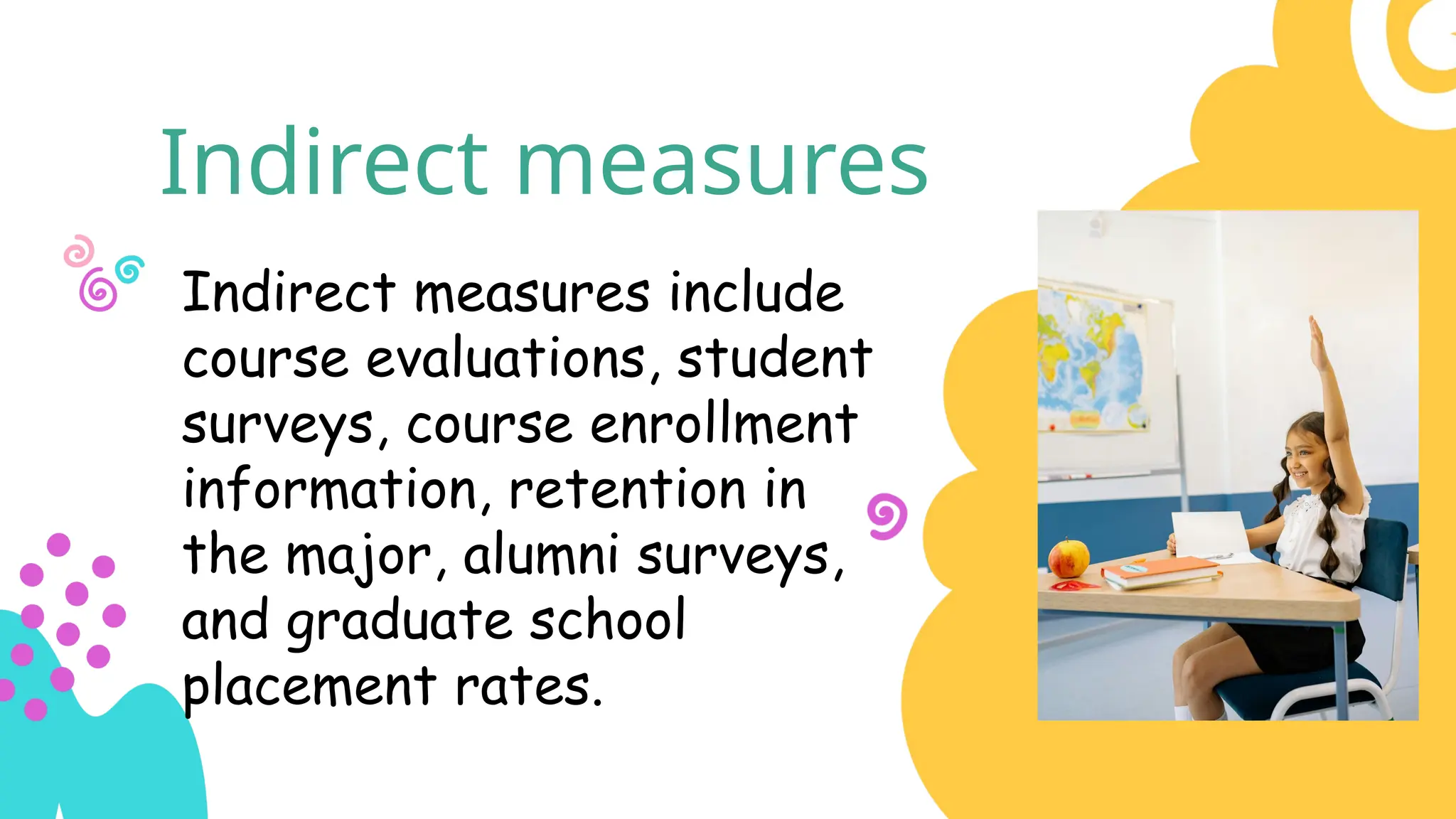
Indirect measures
Indirect measures include
course evaluations, student
surveys, course enrollment
information, retention in
the major, alumni surveys,
and graduate school
placement rates.
Types of
Assessment
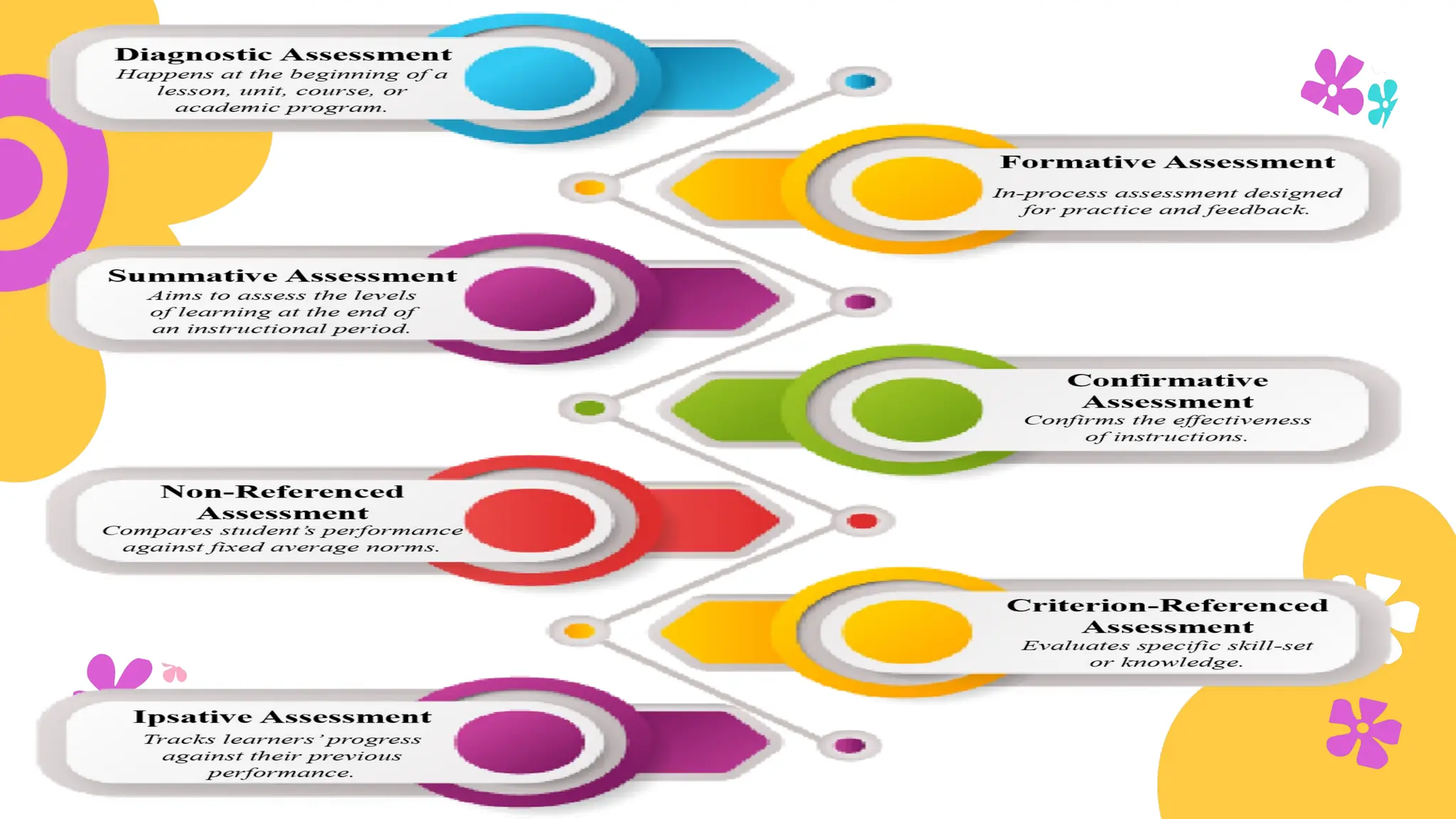
Diagnostic
Diagnostic or pre-assessments happen before
the beginning of a lesson, unit, course, or any
academic program. They are useful for
collecting information about the strengths,
weaknesses, skills, and knowledge the
learners possess. Instructions are designed
thereafter as per the learners’ requirements.
Formative
These are the in-process assessments that support learning. A
teacher administers formative assessment multiple times during
a unit, lesson, or course. They are particularly designed for
practice. Additionally, the most important function of formative
assessment is to monitor learning and provide feedback to
modify instructions.
It acts as a form of continuous learning, covering small content
areas while also monitoring the learning process. However, such
types of evaluations do not assign ranks and grades.
Summative
This type of assessment aims to assess the learning levels
at the end of an instructional period. It attempts to
measure the effectiveness of learning, the student’s
proficiency, and their success. For this, this method uses
tests, assignments, and projects for specific grading and
ranking of students.
Moreover, it measures the knowledge, skills, and attitude of
the learners in the long run. Hence, it gives an insight into
the students’ performance as well as the effectiveness of
a teacher’s instructions.
Confirmative
As the name suggests, confirmative assessment is a
way to confirm the effectiveness of instructions a
year after the end of an instructional period. The
ultimate goal here is to check whether the employed
instructional strategies are still successful and that
the teaching is accurate. Therefore, they are, most
importantly, an extensive form of summative
assessment.
Norm-Reference
In this assessment, teachers compare a student’s
performance against certain fixed average national
norms. For instance, the average grade in English
state-wise.
Moreover, it compares the students’ performance
with their peers in a competitive environment. Here,
the average grade comparison is with the entire school.
Hence, this assessment is also referred to
as Group/Demographic Assessment.
Norm-Reference
Non-referenced assessment examples also
include various subject—and skill-based tests
organized in learning institutions—to determine
the relative performance of learners. These
tests determine eligibility for promotion to the
next learning level or demotion to a previous
level. (Phil-IRI, EGRA,CRLA,MCPAN)
Criterion-Reference
Criterion-referenced tests evaluate specific
skill-set or knowledge against pre-determined
criteria of learning. It checks the learning
requirements and abilities of the students at a
particular learning stage. These tests evaluate
the students on specific goals, objectives, or
standards. In other words, it evaluates the
entire course curriculum.
Ipsative
Ipsative assessment tests track the learners’
progress against their previous performance. The
learners attempt to improve through comparison with
previous results.
This type of assessment considers the fact that
comparison with peers is not always a good idea as it
might affect their self-confidence. However,
comparing with personal previous results helps
improve the overall knowledge and personality of the
learners.
What should you put
into consideration in
conducting an
assessment?
The Do’s and Don’t’s
Reflecting on the following dos and don’ts of
effective assessment creation can help
educators begin to explore the purpose of each
assessment and provide tips to create
assessments that will continue the learning
process. When creating meaningful
assessments, consider the following:
The Do’s
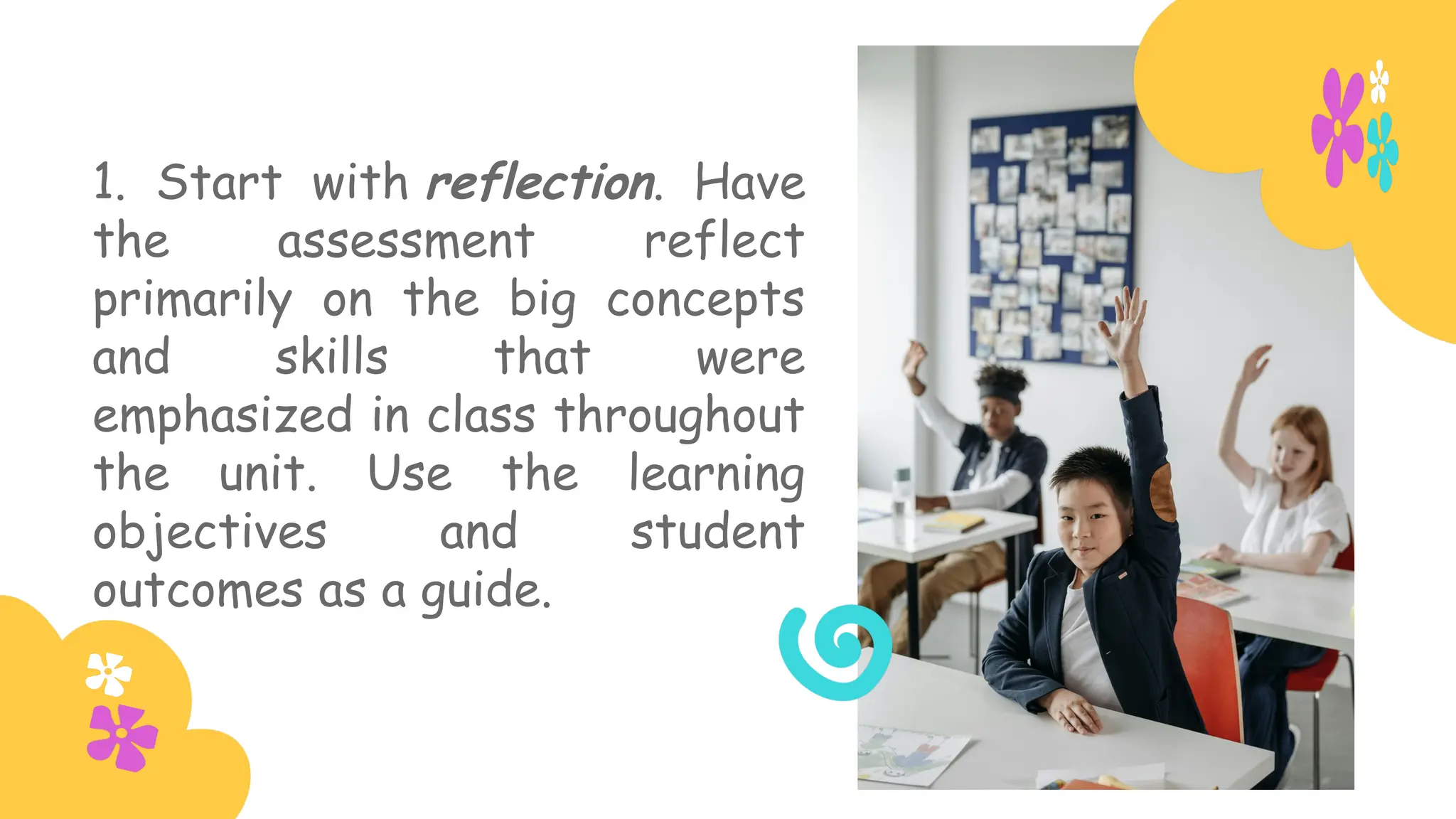
1. Start with reflection. Have
the assessment reflect
primarily on the big concepts
and skills that were
emphasized in class throughout
the unit. Use the learning
objectives and student
outcomes as a guide.
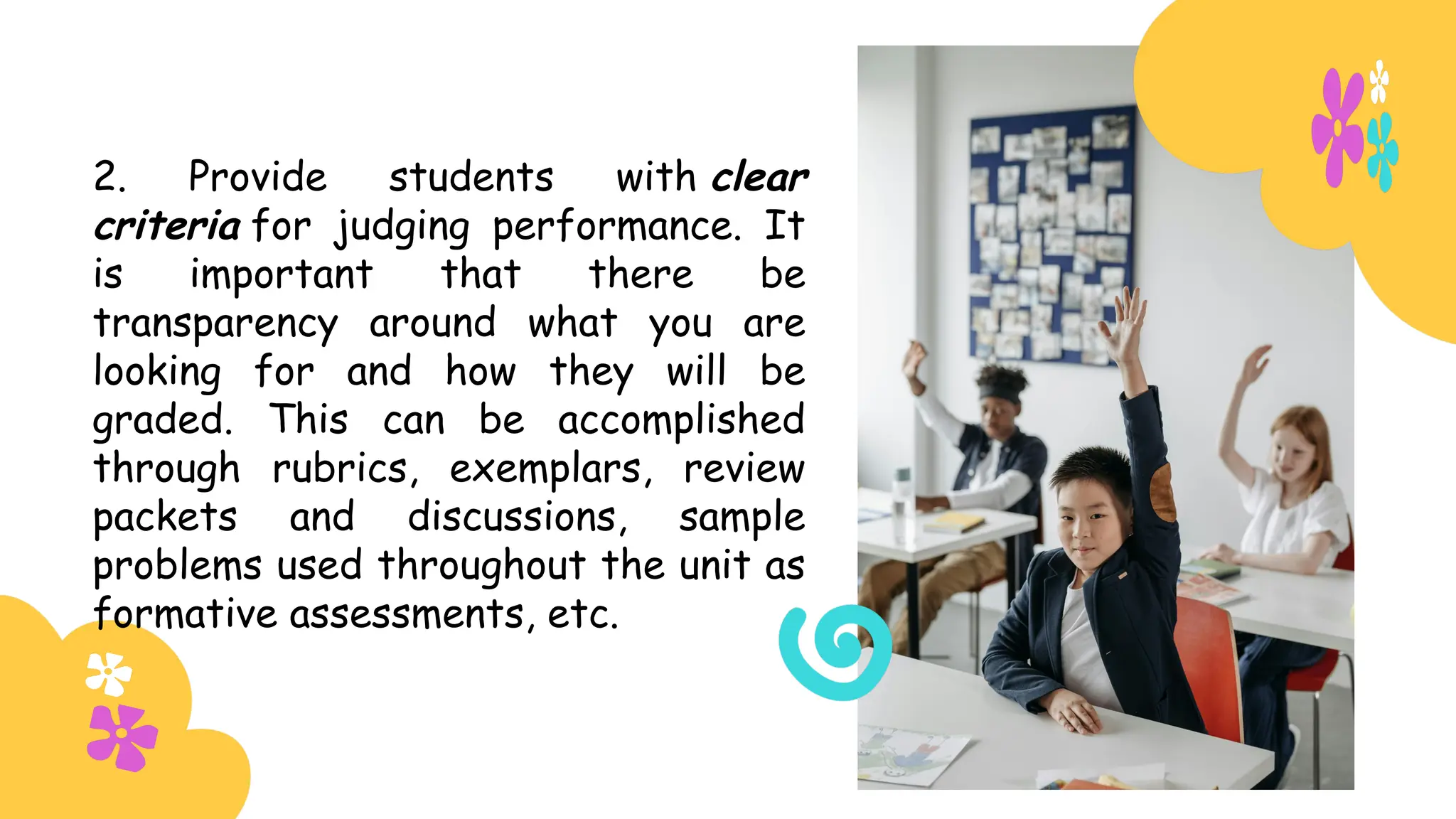
2. Provide students with clear
criteria for judging performance. It
is important that there be
transparency around what you are
looking for and how they will be
graded. This can be accomplished
through rubrics, exemplars, review
packets and discussions, sample
problems used throughout the unit as
formative assessments, etc.
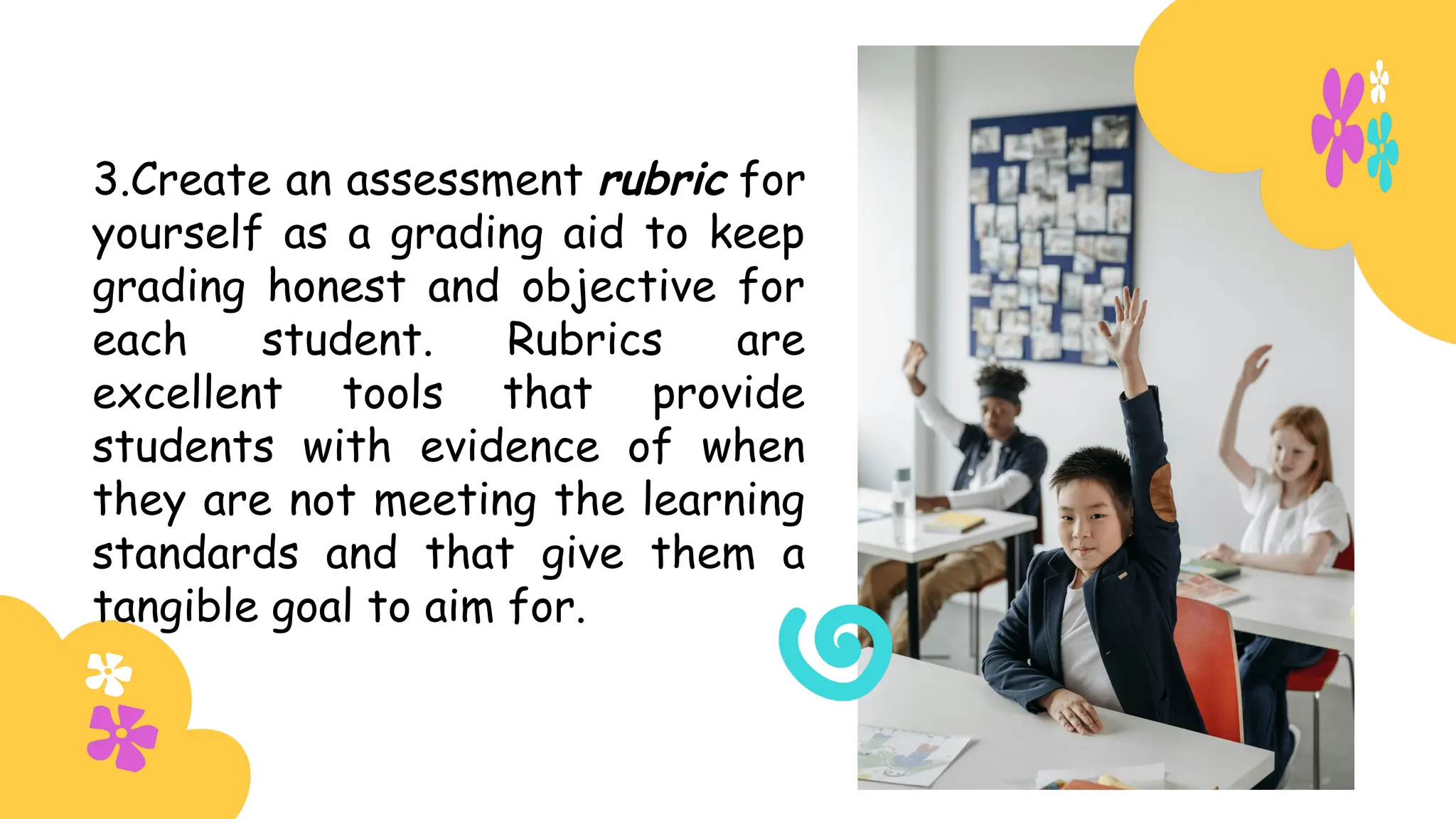
3.Create an assessment rubric for
yourself as a grading aid to keep
grading honest and objective for
each student. Rubrics are
excellent tools that provide
students with evidence of when
they are not meeting the learning
standards and that give them a
tangible goal to aim for.
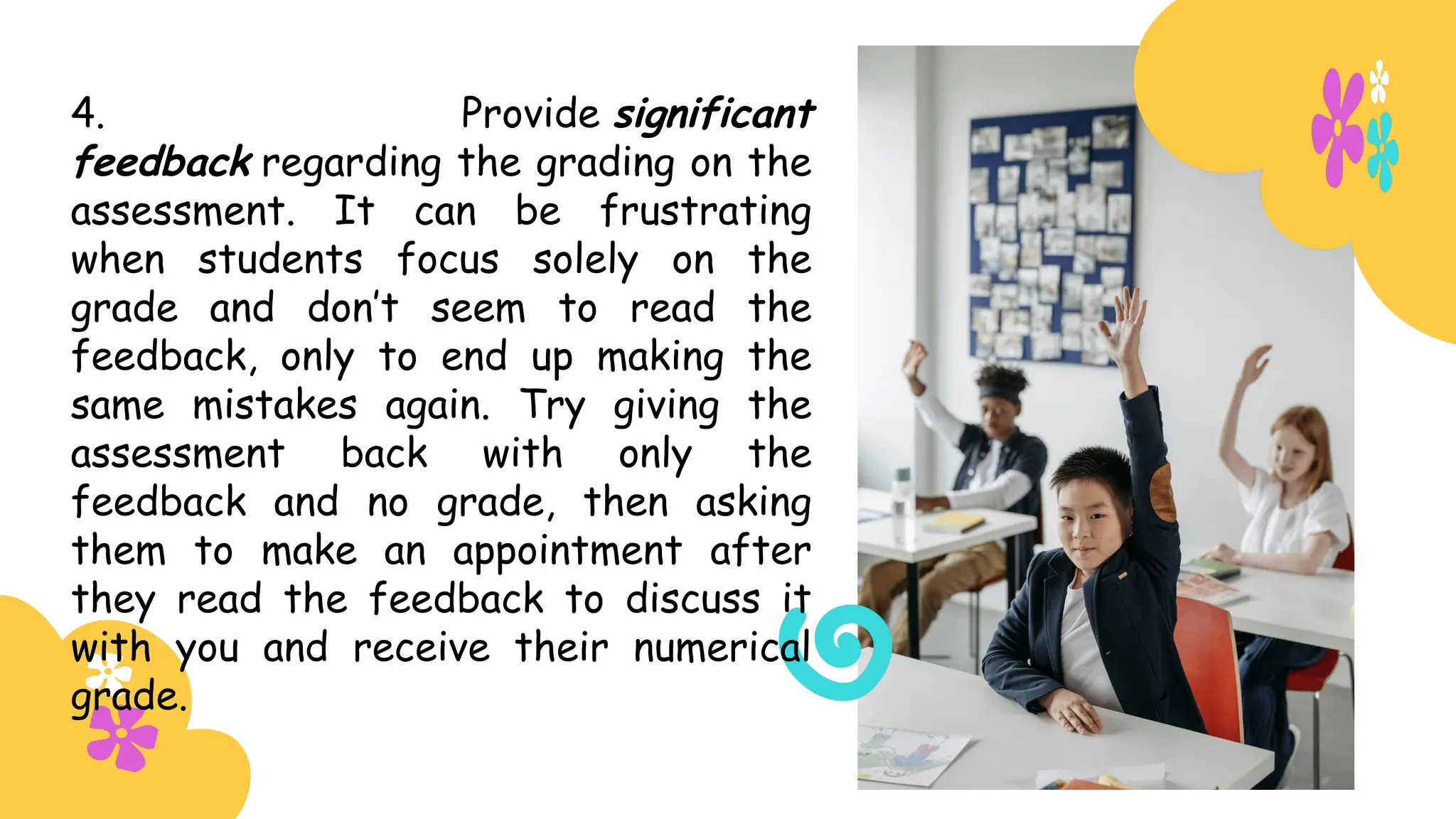
4. Provide significant
feedback regarding the grading on the
assessment. It can be frustrating
when students focus solely on the
grade and don’t seem to read the
feedback, only to end up making the
same mistakes again. Try giving the
assessment back with only the
feedback and no grade, then asking
them to make an appointment after
they read the feedback to discuss it
with you and receive their numerical
grade.
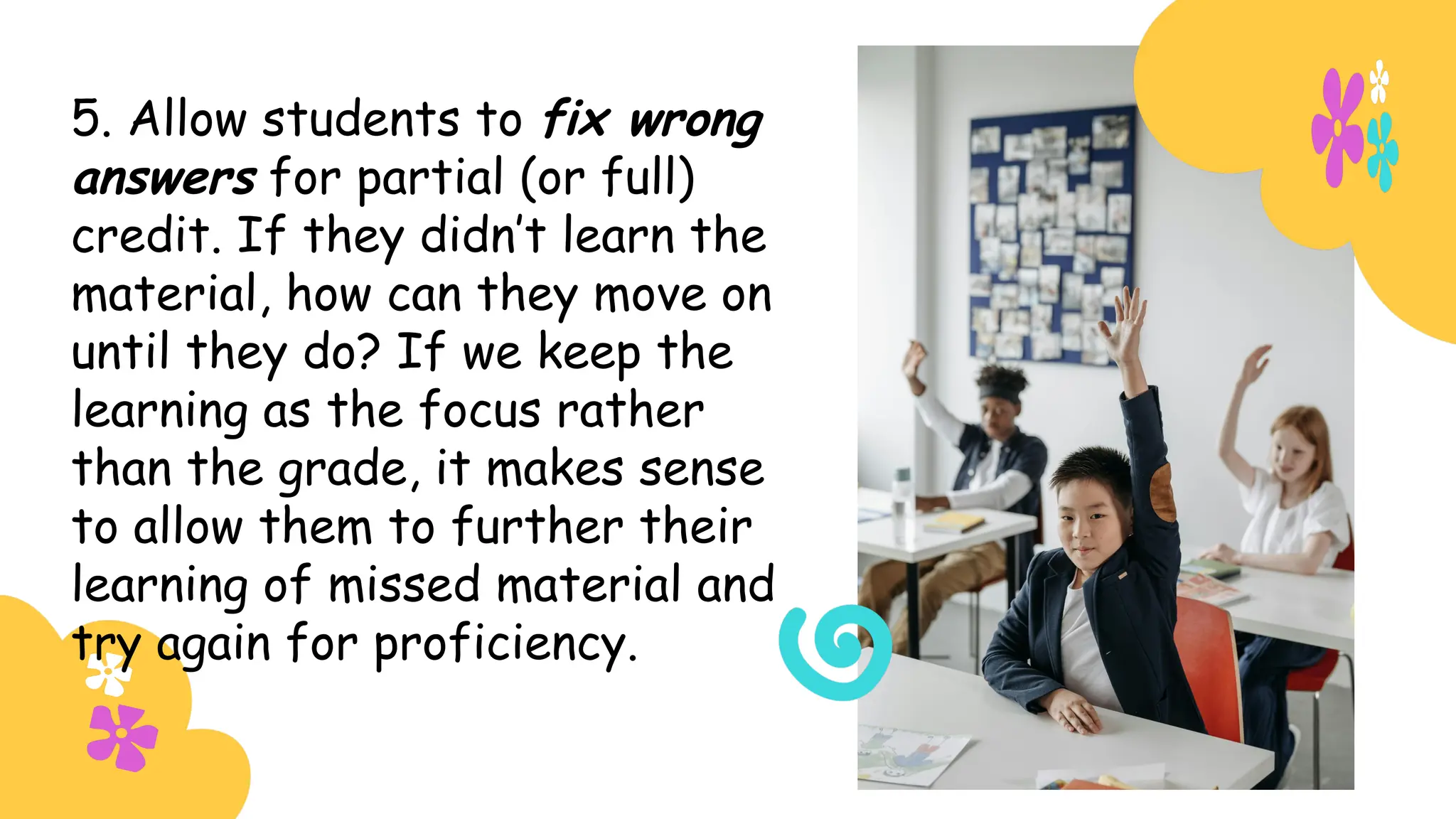
5. Allow students to fix wrong
answers for partial (or full)
credit. If they didn’t learn the
material, how can they move on
until they do? If we keep the
learning as the focus rather
than the grade, it makes sense
to allow them to further their
learning of missed material and
try again for proficiency.
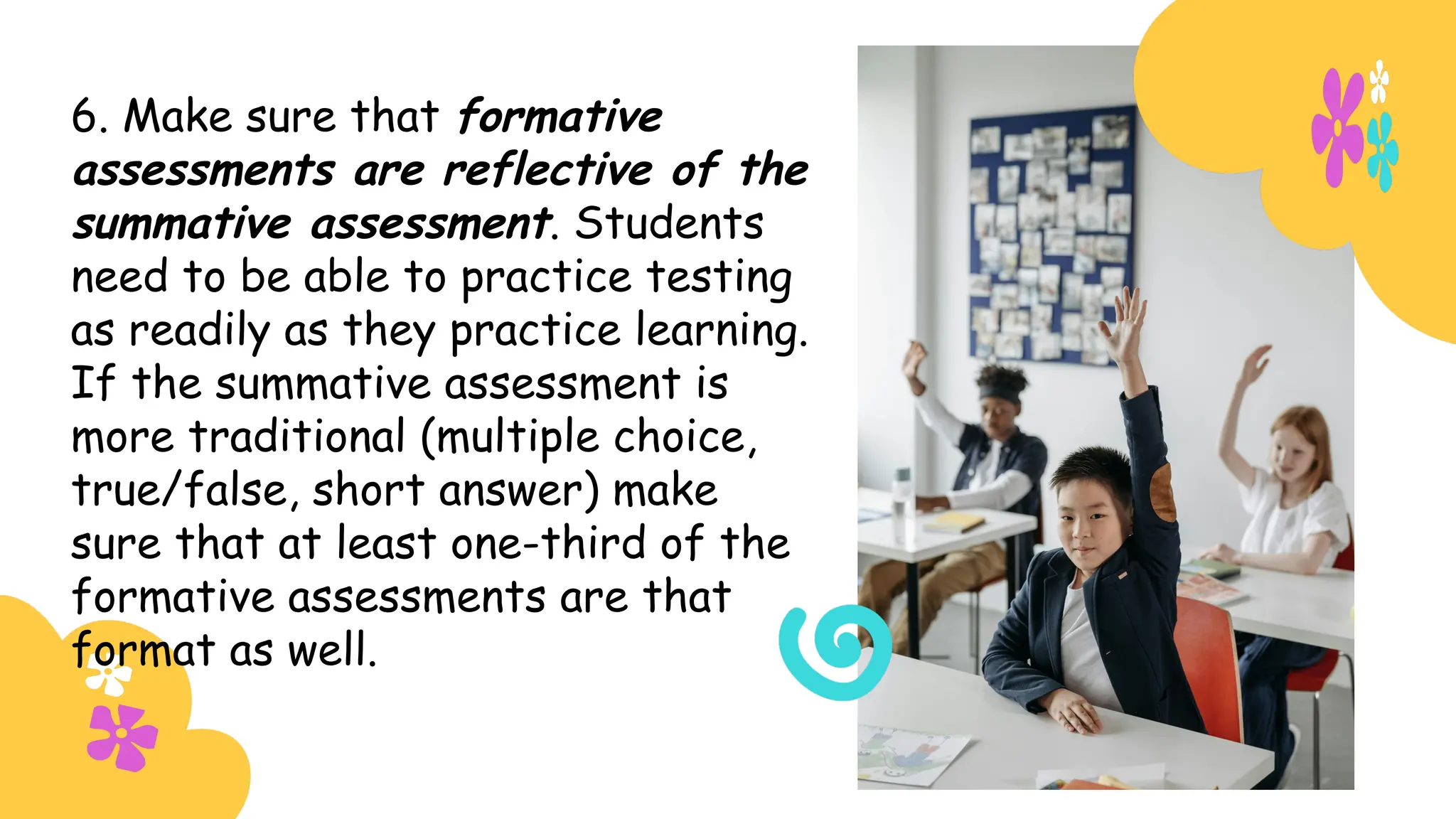
6. Make sure that formative
assessments are reflective of the
summative assessment. Students
need to be able to practice testing
as readily as they practice learning.
If the summative assessment is
more traditional (multiple choice,
true/false, short answer) make
sure that at least one-third of the
formative assessments are that
format as well.
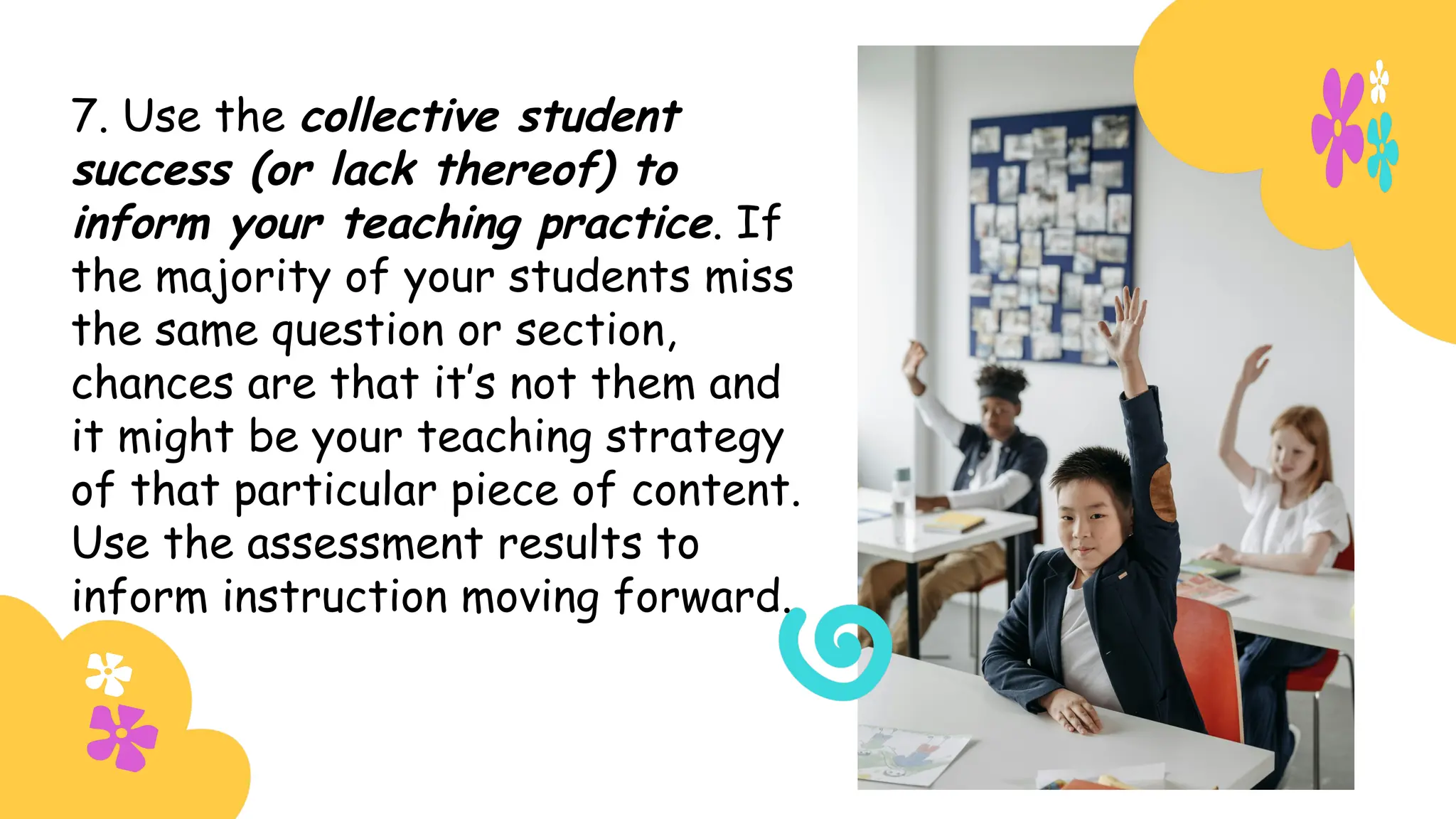
7. Use the collective student
success (or lack thereof) to
inform your teaching practice. If
the majority of your students miss
the same question or section,
chances are that it’s not them and
it might be your teaching strategy
of that particular piece of content.
Use the assessment results to
inform instruction moving forward.
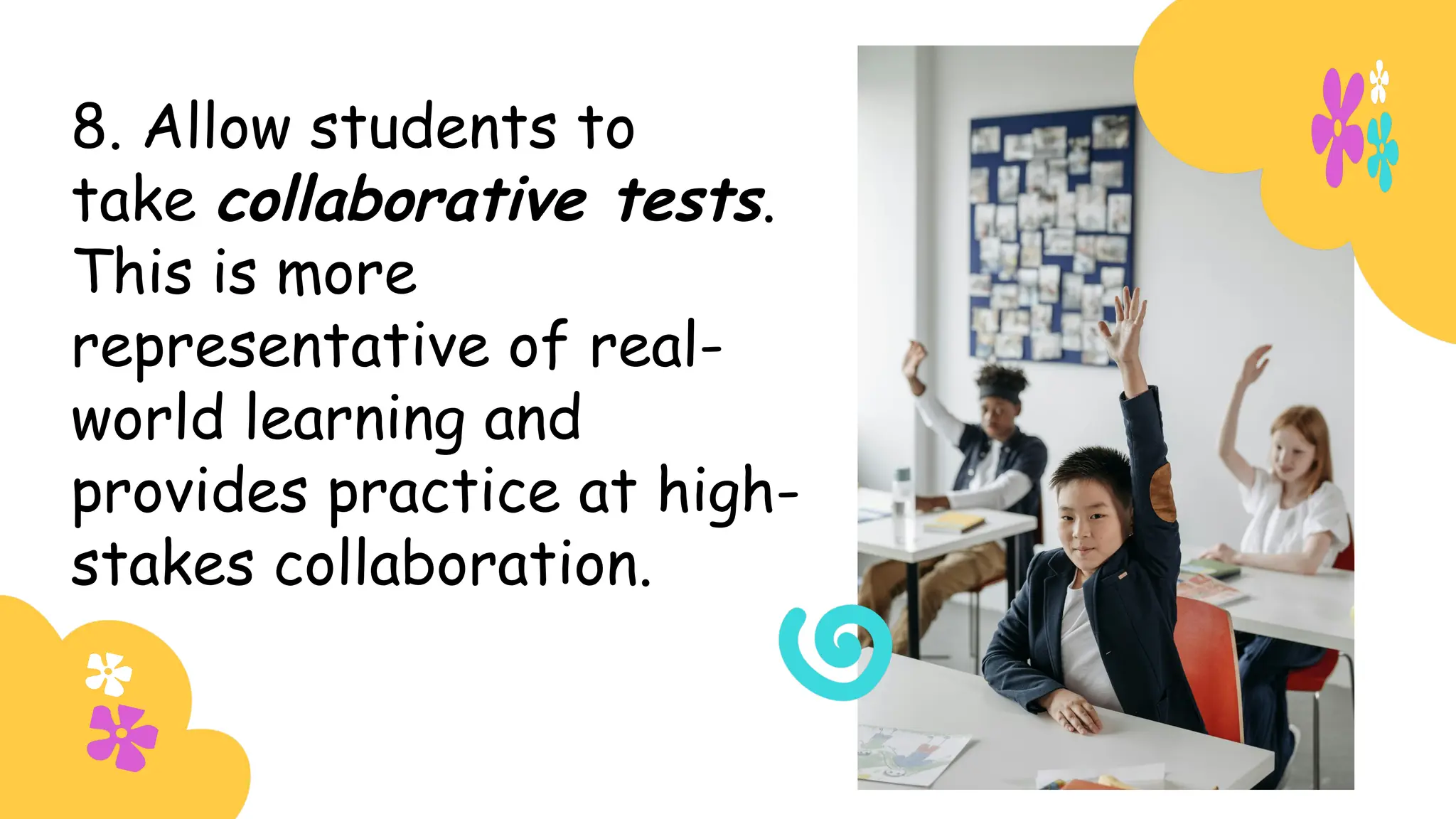
8. Allow students to
take collaborative tests.
This is more
representative of real-
world learning and
provides practice at high-
stakes collaboration.
9. Use exemplars.
Modeling a range of
exemplars from poor to
excellent for students
will help them better
understand what quality
work looks like.
10. Always provide opportunities
for reflection for students. Include a
section of self-assessment at the end of
each summative unit test. For example, “On
a scale of 1 to 5, this unit helped me to
further develop my critical thinking skills.”
Follow this question with, “Provide three
pieces of evidence to support your answer.”
When asking students to be self-reflective
or peer-reflective, always ask for multiple
pieces of evidence to support their opinions
as they may be seeing things about their
work and development differently than you
do. These pieces of evidence can serve as a
starting point for discussion.
11. Use authentic
assessments whenever possible.
Every assessment doesn’t have
to be traditional in nature.
Authentic assessments might
look like reports, journals,
speeches, videos, or student
interviews. Allow yourself to be
creative with the assessment
format and be willing to try
something new.
The Dont’s
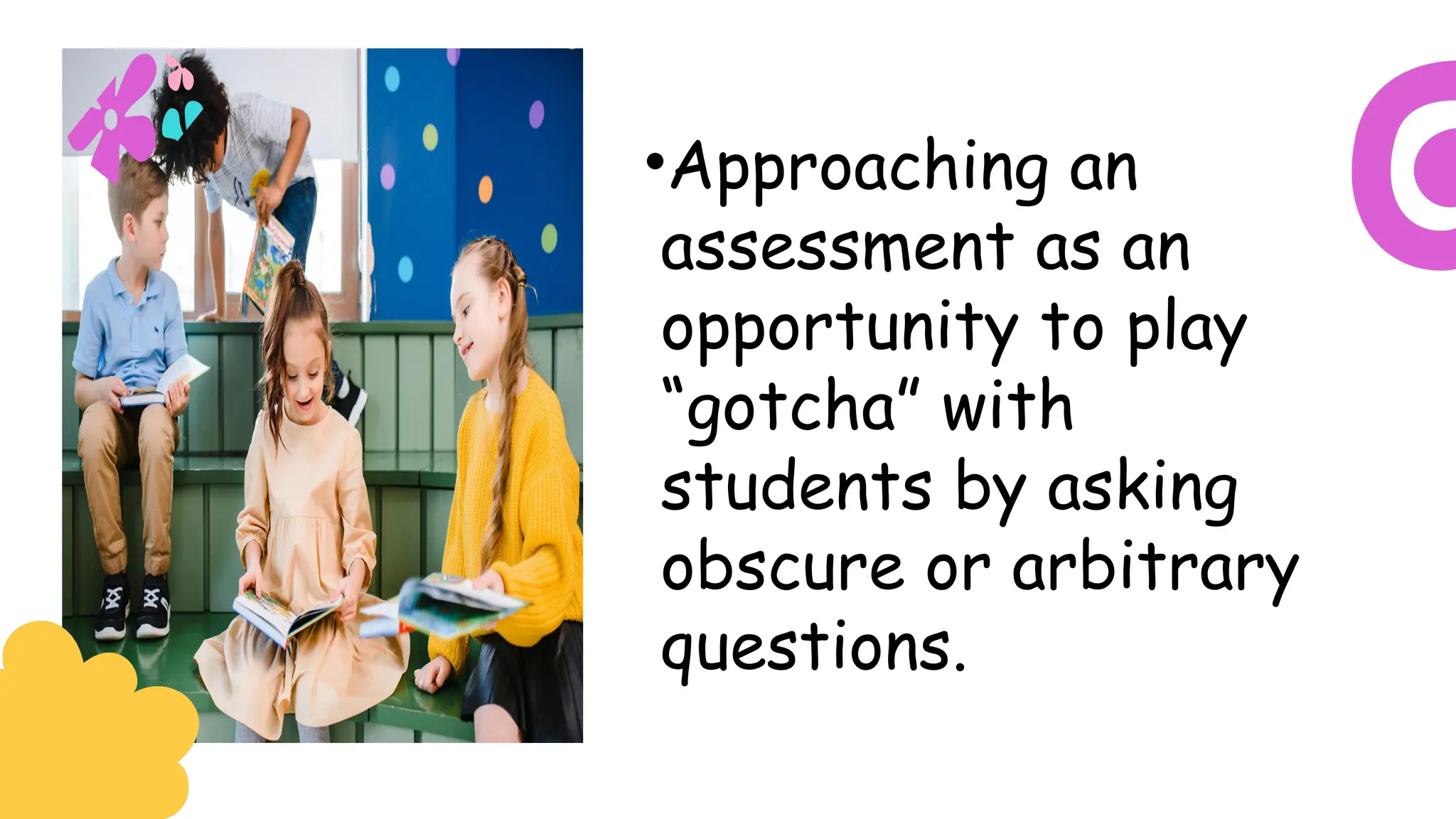
•Approaching an
assessment as an
opportunity to play
“gotcha” with
students by asking
obscure or arbitrary
questions.
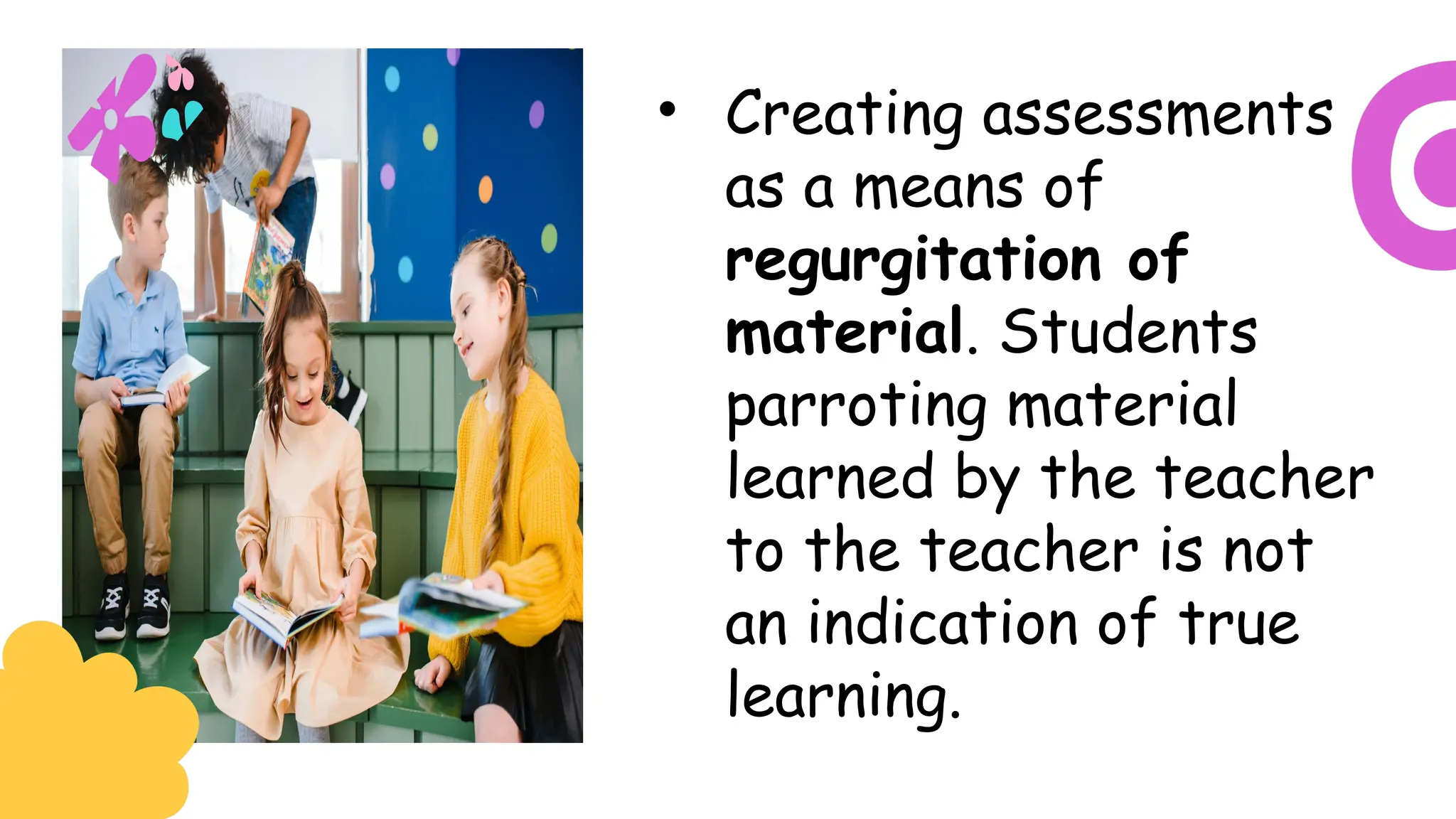
• Creating assessments
as a means of
regurgitation of
material. Students
parroting material
learned by the teacher
to the teacher is not
an indication of true
learning.
•Making questions that
are “Googleable.” If a
student can Google the
answer of an assessment
question, the question
itself is too basic and
does not dive into true
comprehension.
• Surprising students with
assessments, either with
the timing of them (pop
quiz) or with the material
on the test itself.
• Testing students on
material that was not
significant during the unit
unless you are scaffolding
and using the assessment
as a way to reinforce
previous learning.
• Deducting points for
things that are irrelevant
to content learning (i.e.,
not putting their name on
the top of the paper
correctly, turning in the
paper late, incorrect
formatting, messy
handwriting, etc).
Ultimately, we assess our
students’ learning to know
where they are as students and
where we are as teachers.
Assessment of Learning in Classroom and others

  • 1.
  • 2.
    We will talkabout Why do we assess? What is Assessment? How do we assess? 1 2 3
  • 3.
  • 4.
    Assessment the evaluation or estimationof the nature, quality, or ability of someone or something
  • 5.
    Assessment of Learning isan approach to teaching and learning that creates feedback which is then used to improve students' performance. Students become more involved in the learning process and from this gain confidence in what they are expected to learn and to what standard.
  • 6.
  • 7.
    We assess because….. Identifythe trouble spots in learning Identify excellence
  • 8.
    We assess because….. Identifythe gaps in learning process To encourage and support learning
  • 9.
    We assess because….. Identifythe gaps in learning process To measure learning and improve learners
  • 10.
    We assess because….. Toprepare learners for the next step To enhance and improve teaching strategies
  • 11.
  • 12.
    Learners can beassess through….. Indirect Direct
  • 13.
    Direct measures Direct measuresmay include homework, quizzes, exams, reports, essays, research projects, case study analysis, and rubrics for oral and other performances.
  • 14.
    Indirect measures Indirect measuresinclude course evaluations, student surveys, course enrollment information, retention in the major, alumni surveys, and graduate school placement rates.
  • 15.
  • 17.
    Diagnostic Diagnostic or pre-assessmentshappen before the beginning of a lesson, unit, course, or any academic program. They are useful for collecting information about the strengths, weaknesses, skills, and knowledge the learners possess. Instructions are designed thereafter as per the learners’ requirements.
  • 18.
    Formative These are thein-process assessments that support learning. A teacher administers formative assessment multiple times during a unit, lesson, or course. They are particularly designed for practice. Additionally, the most important function of formative assessment is to monitor learning and provide feedback to modify instructions. It acts as a form of continuous learning, covering small content areas while also monitoring the learning process. However, such types of evaluations do not assign ranks and grades.
  • 19.
    Summative This type ofassessment aims to assess the learning levels at the end of an instructional period. It attempts to measure the effectiveness of learning, the student’s proficiency, and their success. For this, this method uses tests, assignments, and projects for specific grading and ranking of students. Moreover, it measures the knowledge, skills, and attitude of the learners in the long run. Hence, it gives an insight into the students’ performance as well as the effectiveness of a teacher’s instructions.
  • 20.
    Confirmative As the namesuggests, confirmative assessment is a way to confirm the effectiveness of instructions a year after the end of an instructional period. The ultimate goal here is to check whether the employed instructional strategies are still successful and that the teaching is accurate. Therefore, they are, most importantly, an extensive form of summative assessment.
  • 21.
    Norm-Reference In this assessment,teachers compare a student’s performance against certain fixed average national norms. For instance, the average grade in English state-wise. Moreover, it compares the students’ performance with their peers in a competitive environment. Here, the average grade comparison is with the entire school. Hence, this assessment is also referred to as Group/Demographic Assessment.
  • 22.
    Norm-Reference Non-referenced assessment examplesalso include various subject—and skill-based tests organized in learning institutions—to determine the relative performance of learners. These tests determine eligibility for promotion to the next learning level or demotion to a previous level. (Phil-IRI, EGRA,CRLA,MCPAN)
  • 23.
    Criterion-Reference Criterion-referenced tests evaluatespecific skill-set or knowledge against pre-determined criteria of learning. It checks the learning requirements and abilities of the students at a particular learning stage. These tests evaluate the students on specific goals, objectives, or standards. In other words, it evaluates the entire course curriculum.
  • 24.
    Ipsative Ipsative assessment teststrack the learners’ progress against their previous performance. The learners attempt to improve through comparison with previous results. This type of assessment considers the fact that comparison with peers is not always a good idea as it might affect their self-confidence. However, comparing with personal previous results helps improve the overall knowledge and personality of the learners.
  • 25.
    What should youput into consideration in conducting an assessment?
  • 26.
    The Do’s andDon’t’s Reflecting on the following dos and don’ts of effective assessment creation can help educators begin to explore the purpose of each assessment and provide tips to create assessments that will continue the learning process. When creating meaningful assessments, consider the following:
  • 27.

  • 28.
    1. Start withreflection. Have the assessment reflect primarily on the big concepts and skills that were emphasized in class throughout the unit. Use the learning objectives and student outcomes as a guide.
  • 29.
    2. Provide studentswith clear criteria for judging performance. It is important that there be transparency around what you are looking for and how they will be graded. This can be accomplished through rubrics, exemplars, review packets and discussions, sample problems used throughout the unit as formative assessments, etc.
  • 30.
    3.Create an assessmentrubric for yourself as a grading aid to keep grading honest and objective for each student. Rubrics are excellent tools that provide students with evidence of when they are not meeting the learning standards and that give them a tangible goal to aim for.
  • 31.
    4. Provide significant feedbackregarding the grading on the assessment. It can be frustrating when students focus solely on the grade and don’t seem to read the feedback, only to end up making the same mistakes again. Try giving the assessment back with only the feedback and no grade, then asking them to make an appointment after they read the feedback to discuss it with you and receive their numerical grade.
  • 32.
    5. Allow studentsto fix wrong answers for partial (or full) credit. If they didn’t learn the material, how can they move on until they do? If we keep the learning as the focus rather than the grade, it makes sense to allow them to further their learning of missed material and try again for proficiency.
  • 33.
    6. Make surethat formative assessments are reflective of the summative assessment. Students need to be able to practice testing as readily as they practice learning. If the summative assessment is more traditional (multiple choice, true/false, short answer) make sure that at least one-third of the formative assessments are that format as well.
  • 34.
    7. Use thecollective student success (or lack thereof) to inform your teaching practice. If the majority of your students miss the same question or section, chances are that it’s not them and it might be your teaching strategy of that particular piece of content. Use the assessment results to inform instruction moving forward.
  • 35.
    8. Allow studentsto take collaborative tests. This is more representative of real- world learning and provides practice at high- stakes collaboration.
  • 36.
    9. Use exemplars. Modelinga range of exemplars from poor to excellent for students will help them better understand what quality work looks like.
  • 37.
    10. Always provideopportunities for reflection for students. Include a section of self-assessment at the end of each summative unit test. For example, “On a scale of 1 to 5, this unit helped me to further develop my critical thinking skills.” Follow this question with, “Provide three pieces of evidence to support your answer.” When asking students to be self-reflective or peer-reflective, always ask for multiple pieces of evidence to support their opinions as they may be seeing things about their work and development differently than you do. These pieces of evidence can serve as a starting point for discussion.
  • 38.
    11. Use authentic assessmentswhenever possible. Every assessment doesn’t have to be traditional in nature. Authentic assessments might look like reports, journals, speeches, videos, or student interviews. Allow yourself to be creative with the assessment format and be willing to try something new.
  • 39.
  • 40.
    •Approaching an assessment asan opportunity to play “gotcha” with students by asking obscure or arbitrary questions.
  • 41.
    • Creating assessments asa means of regurgitation of material. Students parroting material learned by the teacher to the teacher is not an indication of true learning.
  • 42.
    •Making questions that are“Googleable.” If a student can Google the answer of an assessment question, the question itself is too basic and does not dive into true comprehension.
  • 43.
    • Surprising studentswith assessments, either with the timing of them (pop quiz) or with the material on the test itself.
  • 44.
    • Testing studentson material that was not significant during the unit unless you are scaffolding and using the assessment as a way to reinforce previous learning.
  • 45.
    • Deducting pointsfor things that are irrelevant to content learning (i.e., not putting their name on the top of the paper correctly, turning in the paper late, incorrect formatting, messy handwriting, etc).
  • 46.
    Ultimately, we assessour students’ learning to know where they are as students and where we are as teachers.