
ECTOBAL


REVITALIZATION MATERIAL
NERVOUS SYSTEM FUNCTIONS

Sensation

Monitors changes/events occurring in and outside the body. Such
changes are known as stimuli and the cells that monitor them are
receptors.


Integration

The parallel processing and interpretation of sensory information to
determine the appropriate response


Reaction

Motor output.
The activation of muscles or glands (typically via the release of
neurotransmitters (NTs)


Nervous System can be divided into these main parts.


The Central Nervous System
The Peripheral Nervous System


                                                                       2
CENTRAL NERVOUS SYSTEM


Central Nervous System Central Nervous System consists of brain and
spinal cord


PERIPHERAL NERVOUS SYSTEM


The Peripheral Nervous System consists of the nerves, which leave brain
and spinal cord


There are two types of nerves in Peripheral Nervous System


Cranial Nerves
12 pairs of cranial nerves emerging from the brain


Spinal Nerves
There are 31 pairs of spinal nerves emerging from the vertebral column


                                                                         3
NEURONS

•The functional and structural unit of the nervous system
•Specialized to conduct information from one part of the body to another
•There are many, many different types of neurons but most have certain
structural and functional characteristics in common


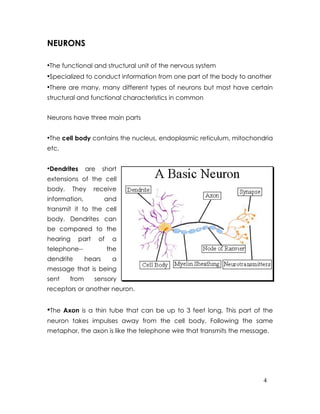
Neurons have three main parts


•The cell body contains the nucleus, endoplasmic reticulum, mitochondria
etc.


•Dendrites are short
extensions of the cell
body.     They    receive
information,            and
transmit it to the cell
body. Dendrites can
be compared to the
hearing    part     of    a
telephone--              the
dendrite        hears     a
message that is being
sent     from      sensory
receptors or another neuron.


•The   Axon is a thin tube that can be up to 3 feet long. This part of the
neuron takes impulses away from the cell body. Following the same
metaphor, the axon is like the telephone wire that transmits the message.


                                                                       4
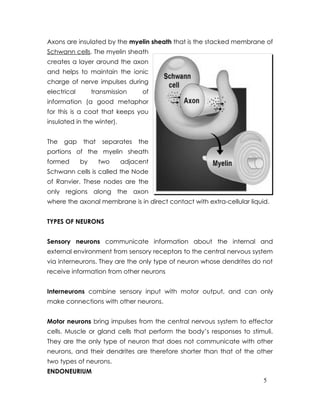
Axons are insulated by the myelin sheath that is the stacked membrane of
Schwann cells. The myelin sheath
creates a layer around the axon
and helps to maintain the ionic
charge of nerve impulses during
electrical        transmission    of
information (a good metaphor
for this is a coat that keeps you
insulated in the winter).


The   gap    that    separates   the
portions of the myelin sheath
formed       by     two     adjacent
Schwann cells is called the Node
of Ranvier. These nodes are the
only regions along the axon
where the axonal membrane is in direct contact with extra-cellular liquid.


TYPES OF NEURONS


Sensory neurons communicate information about the internal and
external environment from sensory receptors to the central nervous system
via interneurons. They are the only type of neuron whose dendrites do not
receive information from other neurons


Interneurons combine sensory input with motor output, and can only
make connections with other neurons.


Motor neurons bring impulses from the central nervous system to effector
cells. Muscle or gland cells that perform the body’s responses to stimuli.
They are the only type of neuron that does not communicate with other
neurons, and their dendrites are therefore shorter than that of the other
two types of neurons.
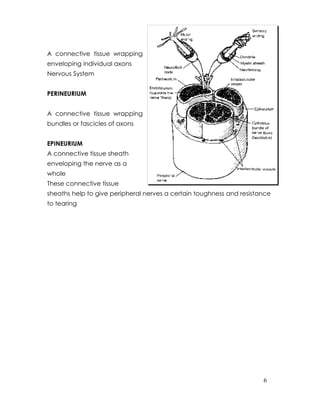
ENDONEURIUM
                                                                        5
A connective tissue wrapping
enveloping individual axons
Nervous System


PERINEURIUM


A connective tissue wrapping
bundles or fascicles of axons


EPINEURIUM
A connective tissue sheath
enveloping the nerve as a
whole
These connective tissue
sheaths help to give peripheral nerves a certain toughness and resistance
to tearing


                                                                      6
NEUROPATHY

The term Neuropathy is used in referring to any degenerative or
inflammatory changes in peripheral nerves. Sometimes, the term neuritis is
used.


When many nerves are involved, the condition is described as
polyneuropathy     or   polineuritis,   if   one   nerve   is   involved,   as
mononeuropathy or mononeuritis


Peripheral nerves respond to injury in only a small number of ways. Three
classic patterns of nerve injury are discussed


   — Wallerian degeneration
   — Axonal degeneration and
   — Segmental demyelination


Wallerian degeneration


When an axon is abruptly cut (as by trauma, inflammation, surgical
mishap, etc.
The myelin sheath, in turn, rapidly disintegrates, forming oval fragments of
myelin and cellular debris


Axonal degeneration


Axonal degeneration differs from wallerian degeneration in pace. Axonal
degeneration typically occurs slowly


This pattern is common in some hereditary neuropathies and is the
predominant pattern in adult onset diabetes mellitus
Nervous System

                                                                            7
Segmental demyelination


When the myelin sheath or the normal function of Schwann cells are
disturbed, demyelination results


With subsequent re-myelination, the distance between nodes of Ranvier
become irregular and the thickness of myelin coats are noticeably
decreased


Symptoms of nerve damage depend on the type of nerve(s) affected
One or more types of nerve may be damaged


   — Paresis (partial paralysis)
   — Paralysis (complete loss of voluntary muscle function in the
      part of the body.)
   — Hypotonia (changes in muscle tone)
   — Sensitivity Disturbances:
   — Anesthesia (loss of sensation)
   — Analgesia (loss of ability to feel pain)
   — Hyperesthesia
   — Hyperpathia (painful sensations abnormally severe and
      modified)
   — Paresthesia (spontaneously occurring abnormal sensation e.g.
      numbness etc)
   — Pain


                                                                    8
ECTOBAL

Mode Of Action:


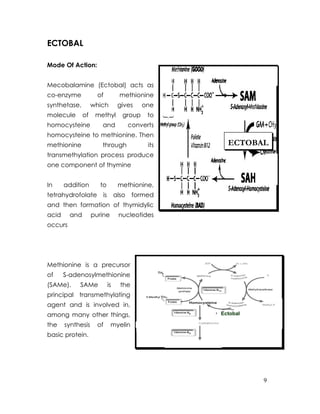
Mecobalamine (Ectobal) acts as
co-enzyme             of           methionine
synthetase,         which         gives     one
molecule       of    methyl         group     to
homocysteine           and              converts
homocysteine to methionine. Then
methionine             through                its     ECTOBAL
transmethylation process produce
one component of thymine


In     addition        to         methionine,
tetrahydrofolate       is        also    formed
and then formation of thymidylic
acid     and        purine        nucleotides
occurs


Methionine is a precursor
of     S-adenosylmethionine
(SAMe).     SAMe            is     the
principal transmethylating
agent and is involved in,
among many other things,                            Ectobal

the    synthesis      of     myelin
basic protein.


                                                              9
ECTOBAL is necessary for the synthesis of thymidylate, which is the
characteristic base of DNA.


ECTOBAL plays a biochemical role in the maintenance of myelin in the
nervous system.


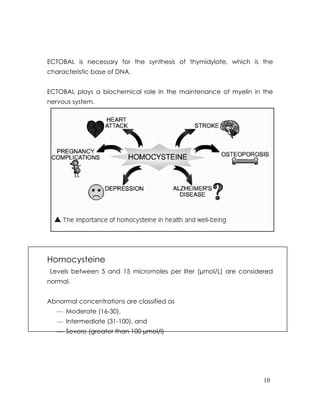
Homocysteine
Levels between 5 and 15 micromoles per liter (µmol/L) are considered
normal.


Abnormal concentrations are classified as
   — Moderate (16-30),
   — Intermediate (31-100), and
   — Severe (greater than 100 µmol/l)


                                                                 10
Indications

•Peripheral Neuropathy
•Drug Induced Neuropathy
•Diabetic Neuropathy
•Hyperthesia
•Peripheral Facial Palsy
•Megaloblastic Anemia


•Paresthesia
•Tingling
•Numbness
•Lumbago
•Low Back Pain
•Sciatic Pain


                           11

Ectobal revitalization

  • 1.
  • 2.
    NERVOUS SYSTEM FUNCTIONS Sensation Monitorschanges/events occurring in and outside the body. Such changes are known as stimuli and the cells that monitor them are receptors. Integration The parallel processing and interpretation of sensory information to determine the appropriate response Reaction Motor output. The activation of muscles or glands (typically via the release of neurotransmitters (NTs) Nervous System can be divided into these main parts. The Central Nervous System The Peripheral Nervous System 2
  • 3.
    CENTRAL NERVOUS SYSTEM CentralNervous System Central Nervous System consists of brain and spinal cord PERIPHERAL NERVOUS SYSTEM The Peripheral Nervous System consists of the nerves, which leave brain and spinal cord There are two types of nerves in Peripheral Nervous System Cranial Nerves 12 pairs of cranial nerves emerging from the brain Spinal Nerves There are 31 pairs of spinal nerves emerging from the vertebral column 3
  • 4.
    NEURONS •The functional andstructural unit of the nervous system •Specialized to conduct information from one part of the body to another •There are many, many different types of neurons but most have certain structural and functional characteristics in common Neurons have three main parts •The cell body contains the nucleus, endoplasmic reticulum, mitochondria etc. •Dendrites are short extensions of the cell body. They receive information, and transmit it to the cell body. Dendrites can be compared to the hearing part of a telephone-- the dendrite hears a message that is being sent from sensory receptors or another neuron. •The Axon is a thin tube that can be up to 3 feet long. This part of the neuron takes impulses away from the cell body. Following the same metaphor, the axon is like the telephone wire that transmits the message. 4
  • 5.
    Axons are insulatedby the myelin sheath that is the stacked membrane of Schwann cells. The myelin sheath creates a layer around the axon and helps to maintain the ionic charge of nerve impulses during electrical transmission of information (a good metaphor for this is a coat that keeps you insulated in the winter). The gap that separates the portions of the myelin sheath formed by two adjacent Schwann cells is called the Node of Ranvier. These nodes are the only regions along the axon where the axonal membrane is in direct contact with extra-cellular liquid. TYPES OF NEURONS Sensory neurons communicate information about the internal and external environment from sensory receptors to the central nervous system via interneurons. They are the only type of neuron whose dendrites do not receive information from other neurons Interneurons combine sensory input with motor output, and can only make connections with other neurons. Motor neurons bring impulses from the central nervous system to effector cells. Muscle or gland cells that perform the body’s responses to stimuli. They are the only type of neuron that does not communicate with other neurons, and their dendrites are therefore shorter than that of the other two types of neurons. ENDONEURIUM 5
  • 6.
    A connective tissuewrapping enveloping individual axons Nervous System PERINEURIUM A connective tissue wrapping bundles or fascicles of axons EPINEURIUM A connective tissue sheath enveloping the nerve as a whole These connective tissue sheaths help to give peripheral nerves a certain toughness and resistance to tearing 6
  • 7.
    NEUROPATHY The term Neuropathyis used in referring to any degenerative or inflammatory changes in peripheral nerves. Sometimes, the term neuritis is used. When many nerves are involved, the condition is described as polyneuropathy or polineuritis, if one nerve is involved, as mononeuropathy or mononeuritis Peripheral nerves respond to injury in only a small number of ways. Three classic patterns of nerve injury are discussed — Wallerian degeneration — Axonal degeneration and — Segmental demyelination Wallerian degeneration When an axon is abruptly cut (as by trauma, inflammation, surgical mishap, etc. The myelin sheath, in turn, rapidly disintegrates, forming oval fragments of myelin and cellular debris Axonal degeneration Axonal degeneration differs from wallerian degeneration in pace. Axonal degeneration typically occurs slowly This pattern is common in some hereditary neuropathies and is the predominant pattern in adult onset diabetes mellitus Nervous System 7
  • 8.
    Segmental demyelination When themyelin sheath or the normal function of Schwann cells are disturbed, demyelination results With subsequent re-myelination, the distance between nodes of Ranvier become irregular and the thickness of myelin coats are noticeably decreased Symptoms of nerve damage depend on the type of nerve(s) affected One or more types of nerve may be damaged — Paresis (partial paralysis) — Paralysis (complete loss of voluntary muscle function in the part of the body.) — Hypotonia (changes in muscle tone) — Sensitivity Disturbances: — Anesthesia (loss of sensation) — Analgesia (loss of ability to feel pain) — Hyperesthesia — Hyperpathia (painful sensations abnormally severe and modified) — Paresthesia (spontaneously occurring abnormal sensation e.g. numbness etc) — Pain 8
  • 9.
    ECTOBAL Mode Of Action: Mecobalamine(Ectobal) acts as co-enzyme of methionine synthetase, which gives one molecule of methyl group to homocysteine and converts homocysteine to methionine. Then methionine through its ECTOBAL transmethylation process produce one component of thymine In addition to methionine, tetrahydrofolate is also formed and then formation of thymidylic acid and purine nucleotides occurs Methionine is a precursor of S-adenosylmethionine (SAMe). SAMe is the principal transmethylating agent and is involved in, among many other things, Ectobal the synthesis of myelin basic protein. 9
  • 10.
    ECTOBAL is necessaryfor the synthesis of thymidylate, which is the characteristic base of DNA. ECTOBAL plays a biochemical role in the maintenance of myelin in the nervous system. Homocysteine Levels between 5 and 15 micromoles per liter (µmol/L) are considered normal. Abnormal concentrations are classified as — Moderate (16-30), — Intermediate (31-100), and — Severe (greater than 100 µmol/l) 10
  • 11.
    Indications •Peripheral Neuropathy •Drug InducedNeuropathy •Diabetic Neuropathy •Hyperthesia •Peripheral Facial Palsy •Megaloblastic Anemia •Paresthesia •Tingling •Numbness •Lumbago •Low Back Pain •Sciatic Pain 11