1
EDELMAN INTELLIGENCE
Experian College Graduate
Survey Report
April 2016
2
WHO HOW MANY ACCURACY WHEN HOW
Soon-to-Be
College Graduates
(College students
ages 18-25
graduating in the
next 6 months)
n=1,000 Margin of Error =
+/- 3.1%
Data Collection
Occurred
April 11-19, 2016
Online Survey
RESEARCH OBJECTIVE:
Better understand soon-to-be college graduates’ experiences, knowledge and
perceptions related to personal finance and credit and debt management
Research Methodology
3
Key Findings
Soon-to-be
college
graduates feel
“stressed” and
“worried”
about their
current
financial status
They expect
their financial
stability to
improve after
graduation but
still feel the
odds are
stacked against
them
Majorities wish
they had taken
on less student
loan debt and
already expect
to defer
payments on
student loans
Students say
that their
colleges did
not prepare
them to
manage credit,
and most have
questions
about credit
scores
CURRENT FINANCE
PERCEPTIONS
5
Many college students do not feel financially
secure, driven by low earnings and reliance on
student loans
Excellent Very good Good
Current Financial Security
40%
Rate their
CURRENT financial
security as
POOR/FAIR
14%
16%
20%
23%
36%
40%
42%
42%
43%
49%
Work study doesn't pay enough
Relying on credit cards
Not earning any money
Pressure to spend beyond means
Not putting money into savings
Not enough to spend beyond…
Relying on my parents
Expenses as a student are too…
Relying on student loans
Don't earn enough at part-time job
Reasons for Current Financial Insecurity
Q3. Thinking about your life while enrolled in college, how would you rate your financial security?
Q4: Why did you rate your financial security while enrolled in college as [poor/fair]? (Asked if rated current financial security as poor/fair;
n=403)
6
Those with student loan debt are especially
concerned about their current financial security
Subgroups More Likely to
Rate their Current Financial
Security as “POOR/FAIR”
Subgroups More Likely to
Rate their Current Financial
Security as
“EXCELLENT/VERY GOOD”
TOTAL 40% TOTAL 29%
Those with $20K+ in student loans 54% Those with no student loans 45%
Those with any student loans 46% Those without any type of debt 44%
Women 45% Men 34%
Those who do not know their credit
score
45%
Those who do know their credit
score
32%
Q3. Thinking about your life while enrolled in college, how would you rate your financial security?
7
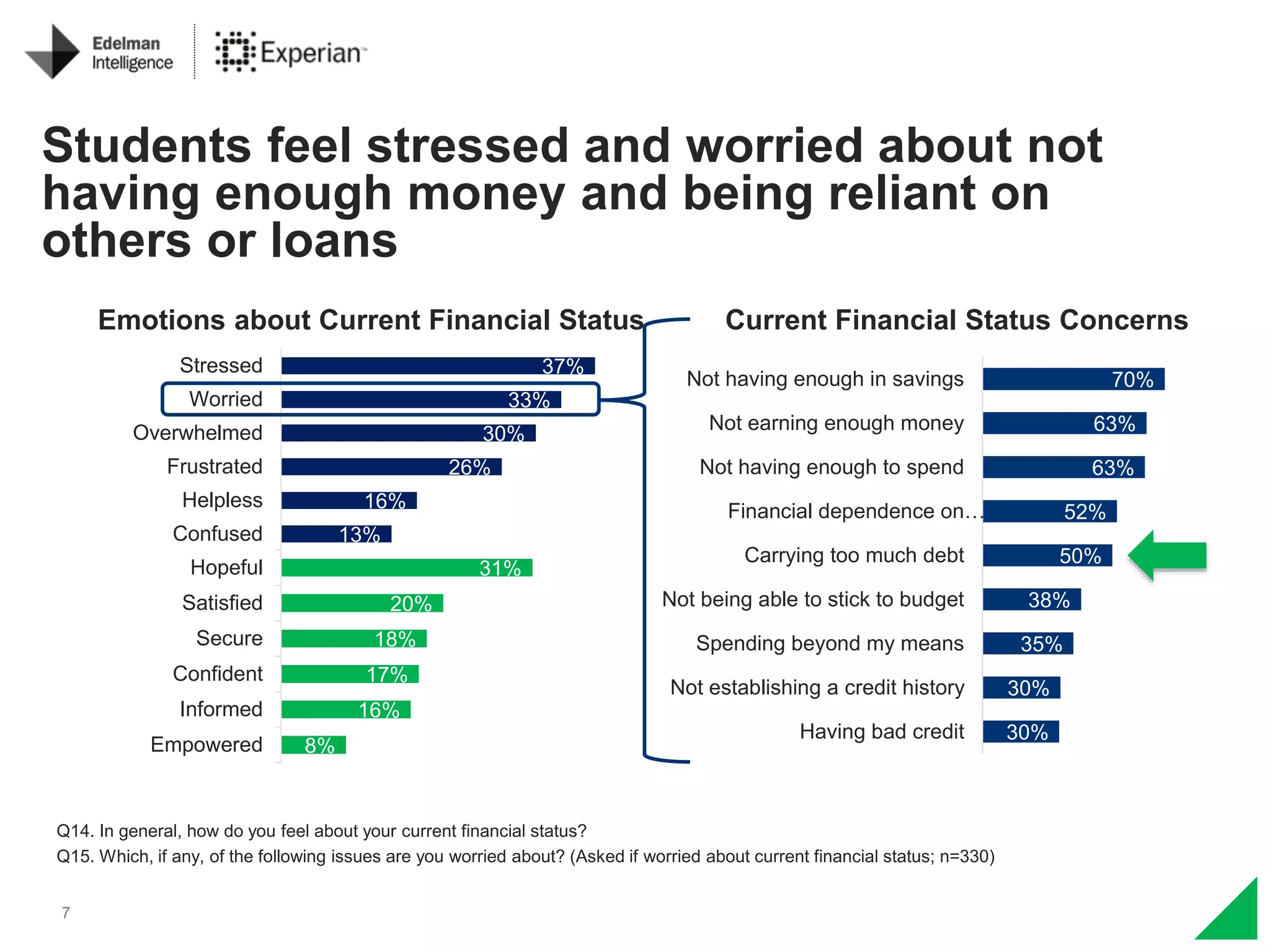
Q14. In general, how do you feel about your current financial status?
Q15. Which, if any, of the following issues are you worried about? (Asked if worried about current financial status; n=330)
Students feel stressed and worried about not
having enough money and being reliant on
others or loans
Emotions about Current Financial Status
8%
16%
17%
18%
20%
31%
Empowered
Informed
Confident
Secure
Satisfied
Hopeful
13%
16%
26%
30%
33%
37%
Confused
Helpless
Frustrated
Overwhelmed
Worried
Stressed
Current Financial Status Concerns
30%
30%
35%
38%
50%
52%
63%
63%
70%
Having bad credit
Not establishing a credit history
Spending beyond my means
Not being able to stick to budget
Carrying too much debt
Financial dependence on…
Not having enough to spend
Not earning enough money
Not having enough in savings
FUTURE FINANCE
PERCEPTIONS
9
* Nets may not add up due to rounding
Q1. In general, how do you feel when thinking about your life after graduation?
Q3. Thinking about your life while enrolled in college, how you would rate your financial security?
Q5. Thinking about your life after graduation, how do you anticipate rating your financial security?
Students are excited about life after graduation
and expect their financial security to improve
Financial Security Pre- and Post-Graduation
11%
5%
30%
22%
30%
34%
17%
23%
11%
14%
Pre-Graduation
Post-
Graduation
Poor Fair Good Very good Excellent
Emotions about Life Post-Graduation
40%
POOR/FAIR*
27%
POOR/FAIR
10
College major and amount of student loan debt
are factors in graduates’ feelings of future
financial security
Q5. Thinking about your life after graduation, how do you anticipate rating your financial security?
Subgroups More Likely to Rate their
Future Financial Security as
“POOR/FAIR”
Subgroups More Likely to Rate their
Future Financial Security as
“EXCELLENT/VERY GOOD”
TOTAL 27% TOTAL 37%
Those majoring in social sciences /
services
34% Those majoring in business 44%
Those with $20K+ in student loans 34% Those majoring in S.T.E.M. 44%
Those who do not know their credit score 33% Those who do know their credit score 43%
Private university graduates 32% Those with no student loans 42%
Women 30% Those majoring in health and medicine 42%
Those majoring in arts & humanities 29% Men 40%
Those with student loans 29% Those with < $20K in student loans 39%
11
Q6. Why do you anticipate rating your financial security after graduation as poor/fair? (Asked rated current financial security as poor/fair; n=267)
Q7. Which of the following best describes where you are in your employment search? (Asked if planning to get a job after graduation; n=844; Shown off
total base)
Student loan debt is a major concern among
those who feel insecure about their post-
graduate financial status
Reasons for Post-Graduation Financial Insecurity
(Shown: Top 10 Reasons for Rating Post-Graduation Financial Security as Poor/Fair)
25%
25%
25%
27%
31%
47%
47%
52%
54%
55%
Will have to pay off other debt
May need to take out additional loans
No high-paying jobs for my degree
Plan to continue my education post-grad
May have to move back home
May not earn enough to support myself
May not earn enough to spend beyond basics
May not earn enough to add to savings
May not have a full-time job lined up
Will have to start paying off my student loans
Just 16%
of soon-to-
be
graduates
already have
a job lined
up
12
53%
47%
When it comes to my
finances, I feel like the odds
are stacked against me.
My finances will hold me
back from pursuing my life
goals after graduation.
Financial Perceptions
(Shown: % Agree)
Despite general optimism, many feel that
achieving financial security will be an uphill
battle
Q18. To what extent do you agree or disagree with each of the following statements?
Q19. What life goals do you think your finances will hold you back from pursuing after graduation? (Asked if
agree that finances will hold back from pursuing life goals after graduation; n=468)
25%
32%
38%
39%
41%
50%
59%
63%
Changing careers
Starting a business
Going back to school
Getting married
Having children
Buying a car
Traveling the world
Buying a home
Life Goals Hindered by Finances
13
Ultimately, many are hopeful about their
financial future, but worried about salaries and
loan payments
Concerns about Financial FutureEmotions about Financial Future
Q16. Generally, how do you feel when thinking about your financial future?
Q17. Which, if any, of the following issues are you worried about? (Asked if worried about financial future;
n=270)
27%
43%
45%
53%
55%
61%
66%
66%
68%
73%
Protecting my identity
Being able to support my parents
Being able to establish good credit
Being able to support a family
Saving enough money to retire
Finding a job
Being able to own a home
Being able to pay off my debt
Becoming financially independent
Earning enough to live comfortably
FINANCIAL SNAPSHOT
15
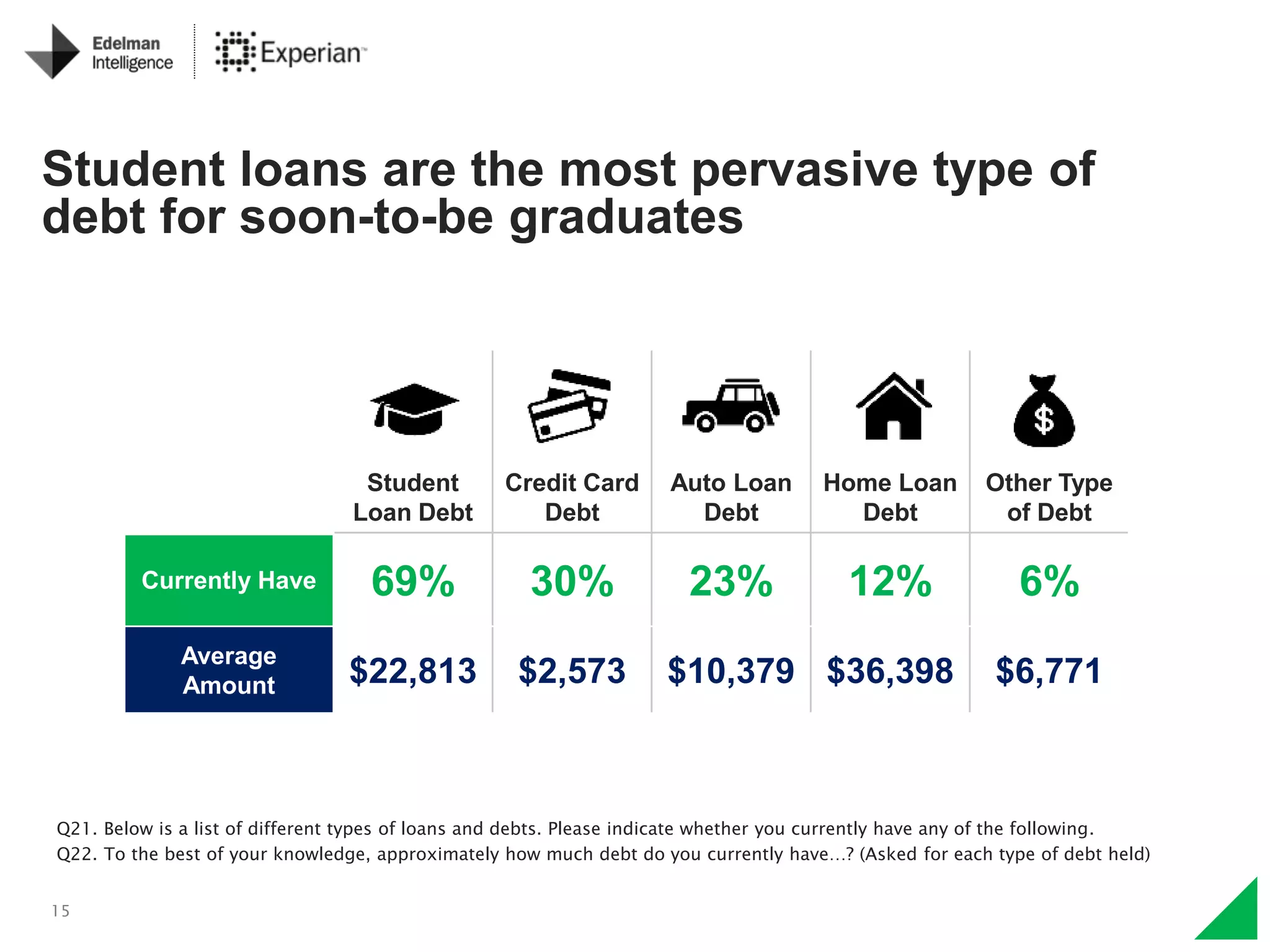
Q21. Below is a list of different types of loans and debts. Please indicate whether you currently have any of the following.
Q22. To the best of your knowledge, approximately how much debt do you currently have…? (Asked for each type of debt held)
Student loans are the most pervasive type of
debt for soon-to-be graduates
Student
Loan Debt
Credit Card
Debt
Auto Loan
Debt
Home Loan
Debt
Other Type
of Debt
Currently Have 69% 30% 23% 12% 6%
Average
Amount $22,813 $2,573 $10,379 $36,398 $6,771
16
Familiar Heard the term Unfamiliar Unsure
Q28. Prior to this survey, were you familiar with the concept of co-signing?
Q29. To the best of your knowledge, have you ever needed a co-signer for any of the following types of contracts? Please select all
that apply.
Many college students have personal experience
with cosigning, specifically for student loans
77%
Familiar with
co-signing
Cosigning Familiarity
9%
12%
16%
22%
26%
30%
Home loan
Legal agreement for
credit card
Car lease
Car loan
Home/apartment lease
Loan for tuiton
Personal Cosigning Experiences
68%
Have
needed a
co-signer
17
Q23. Which of the following statements comes closest to your opinion?
Q25. In general, how concerned are you about paying back your debt? (Asked if have debt; n=838)
College grads are split on whether being “debt
free” is attainable; most are concerned about
loan payments
Debt Perceptions Concern about Repaying Debt
72%
Concerned
about paying
back debt
53%
Being “debt
free” is an
attainable goal
47%
Debt is a
necessary evil
In today’s economy…
VS.
Those with < $20K
in student loans:
69%
Those with $20K+
in student loans:
81%
18
Q27. Which, if any, of the following concerns about debt are a source of anxiety for you personally? (Asked if have debt;
n=838)
They worry about about how long they will be
paying back their debt and potential impacts on
their future
31%
31%
32%
33%
42%
47%
59%
My debt will hold me back from getting another loan
My debt will hold me back from continuing my
education
My debt will hold me back from starting a family
I don’t fully understand all of my payment options
My debt will negatively affect my credit score
My debt will hold me back from making a big
purchase
I will be paying back my debt for a long time
Concerns about Debt
Those with $20K+
in student loans:
60%
19
Most wish they had taken out less in student
loans, and more than half are likely to defer
payment
Student Loan
Perceptions
Likelihood to Defer
Student Loans
54%
Likely to
defer student
loans
43%
I am comfortable
with the amount
of my student
loan debt
57%
I wish I had
taken on less
student loan
debt
Q33. Which of the following statements comes closest to your opinion? (Asked if have student loans; n=690)
Q32. How likely are you to need to defer payment on your student loans? (Asked if have student loans; n=690)
VS.
74% among
those with $20K+
in student loans
20
Q33. Which of the following statements comes closest to your opinion? (Asked if have student loans; n=690)
Q32. How likely are you to need to defer payment on your student loans? (Asked if have student loans; n=690)
Those getting a degree in business or S.T.E.M.
feel most comfortable with their student loan debt
Place
holder
Arts &
Humanities
Social
Sciences &
Services
Health &
Medicine S.T.E.M. Business
n=124 n=165 n=136 n=157 n=184
Likely to Defer
Student Loans 52% 71% 53% 50% 52%
Comfortable
with Student
Loan Debt
34% 39% 38% 53% 49%
Wish I Had
Taken on Less
in Student
Loans
66% 61% 62% 47% 51%
21
Personal
Experiences
with Credit Cards
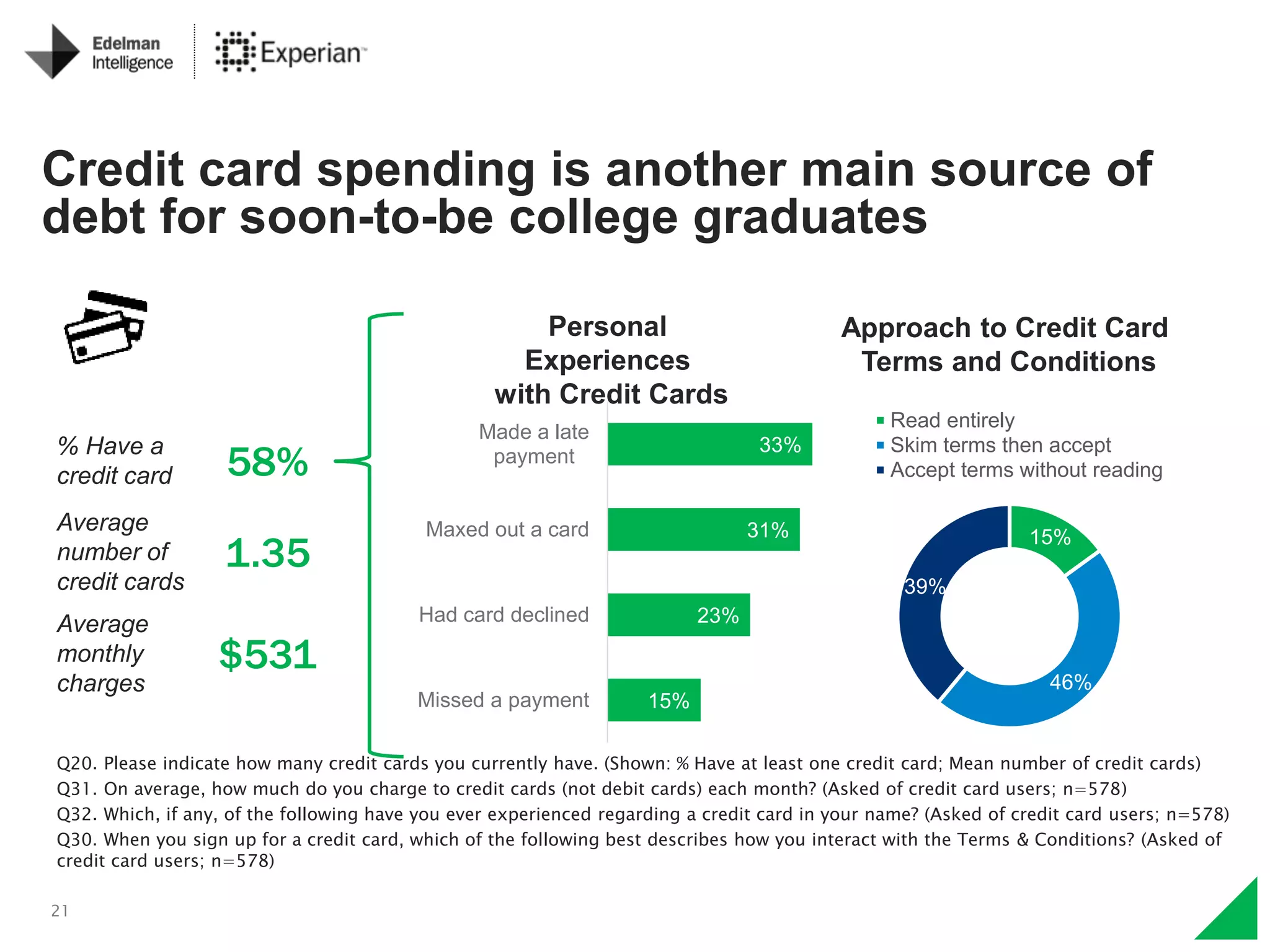
Q20. Please indicate how many credit cards you currently have. (Shown: % Have at least one credit card; Mean number of credit cards)
Q31. On average, how much do you charge to credit cards (not debit cards) each month? (Asked of credit card users; n=578)
Q32. Which, if any, of the following have you ever experienced regarding a credit card in your name? (Asked of credit card users; n=578)
Q30. When you sign up for a credit card, which of the following best describes how you interact with the Terms & Conditions? (Asked of
credit card users; n=578)
Credit card spending is another main source of
debt for soon-to-be college graduates
15%
23%
31%
33%
Missed a payment
Had card declined
Maxed out a card
Made a late
payment
Approach to Credit Card
Terms and Conditions
15%
46%
39%
Read entirely
Skim terms then accept
Accept terms without reading
% Have a
credit card 58%
Average
number of
credit cards
1.35
Average
monthly
charges
$531
CREDIT & DEBT
EDUCATION
23
Q9. While you were enrolled in college, how would you rate your…?
Students feel that colleges provide them with
subpar opportunities to learn about credit and
personal finance
Excellent Very good Good Fair Poor
48%
Rate their access
to information on
credit & finance as
POOR/FAIR
Access to Information about
Credit & Personal Finance
Excellent Very good Good Fair Poor
50%
Rate their
opportunities to learn
about credit & finance
as POOR/FAIR
Opportunities to Learn More
about Credit & Personal
Finance
24
Q12-13. Which of the following sources have you used in the past for information about personal finance/credit & debt
management?
Q18: To what extent do you agree or disagree with each of the following statements? “When it comes to my finances I feel like
I’m going it alone.”
Instead, they look to their parents or search
engines for this information; many feel they are
“going it alone”
70%
45%
39%
38%
27%
21%
21%
17%
16%
16%
55%
27%
17%
23%
20%
13%
15%
11%
12%
11%
My parents
An internet search
FAFSA
My friends
A bank representative
A mobile application
My spouse / significant other
A financial advisor
My social network
My coworkers
Personal Finance
Info
Information Sources
(Shown: Top 10 Information Sources)
Agree Disagree
55%
When it comes to
my finances I feel
like I’m going it
alone
Finance Perceptions
25
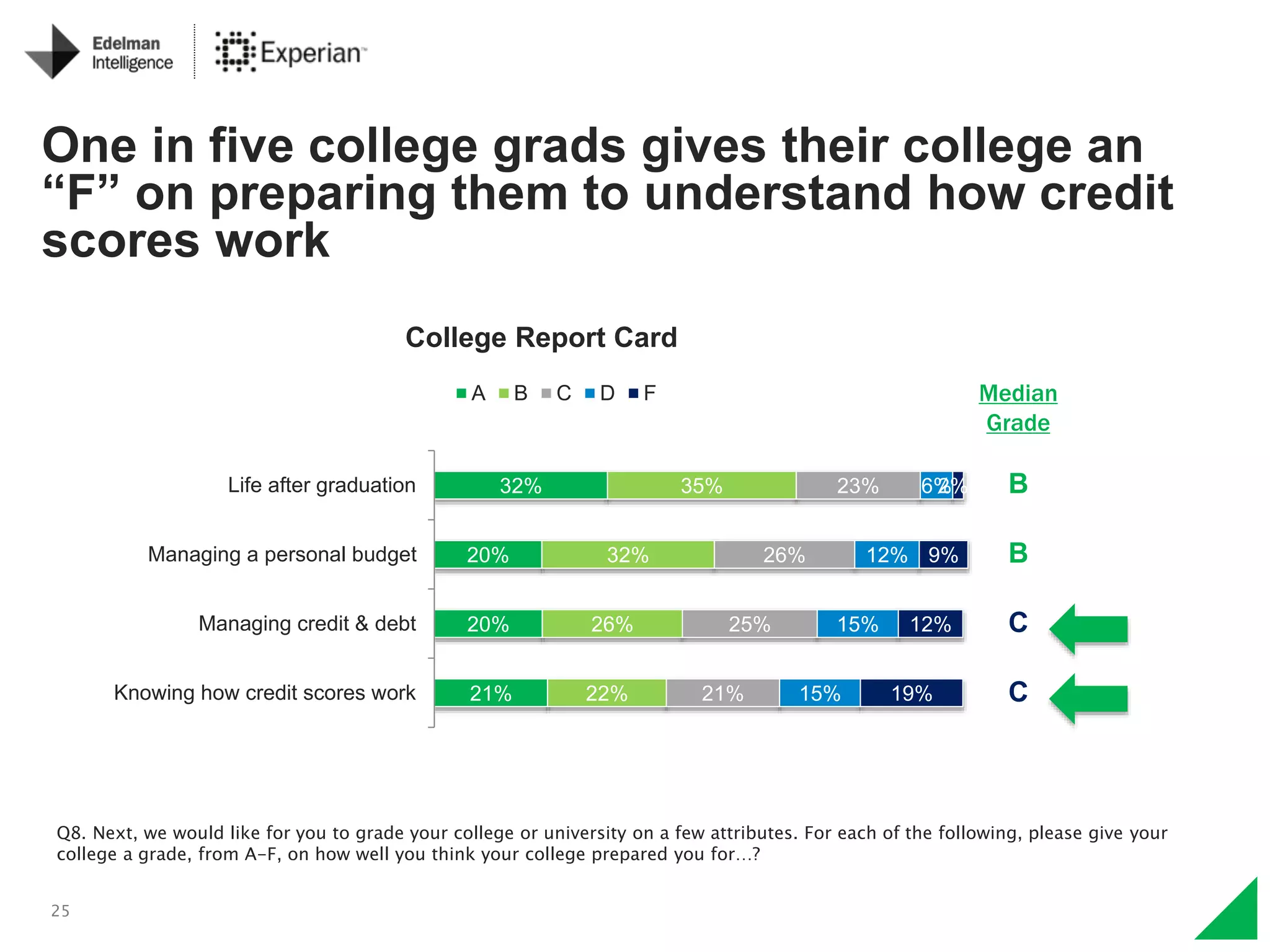
Q8. Next, we would like for you to grade your college or university on a few attributes. For each of the following, please give your
college a grade, from A-F, on how well you think your college prepared you for…?
21%
20%
20%
32%
22%
26%
32%
35%
21%
25%
26%
23%
15%
15%
12%
6%
19%
12%
9%
2%
Knowing how credit scores work
Managing credit & debt
Managing a personal budget
Life after graduation
College Report Card
A B C D F Median
Grade
B
B
C
C
One in five college grads gives their college an
“F” on preparing them to understand how credit
scores work
26
40%
38% 38%
31% 29%
26% 24%
21%
31%
25%
34%
29%
36%
41%
37%
27%
Personal
budgeting
Interest rates Investment &
savings
Banking &
lending
Credit & debt
management
Tax
preparation
Credit scores
& reports
Identity
protection
Learned about in college… Wish I had been able to take a college course in…
Q10. Which, if any, of the following topics did you learn about in college?
Q11. Which, if any, of the following topics do you wish that you had been able to take a college course in? (Asked for each subject
not learned about in college)
Students have an appetite for college courses
on credit scores, reports and overall
management
Teaching Financial Literacy in College
(Shown: % Learned in College, % Wish I had Learned in College)
27
69%
67%
67%
65%
59%
I understand which financial factors are currently
helping or hurting my credit
My credit history could affect my ability to get a
good interest rate
I have questions about the different types of credit
scores
My credit history could affect my ability to get a
loan
I have questions about what my credit score
means
Credit Understanding Statement Agreement
(Shown: % Agree)
Q38. Below is a series of statements about credit. To what extent do you agree or disagree with each of the following statements?
While they may overstate their credit savvy,
most acknowledge they have questions about
credit scores
28
Q35. To the best of your knowledge, have you ever seen your…?
Q36. Do you know your credit score?
Q37. And, do you think your credit status is…?
Most soon-to-be grads have never seen their
credit report and do not know their credit score
11%
37%
46%
58%
43%
Credit score Credit report
Yes No Unsure
Ever Seen Credit
Score or Report
Perceived
Credit Status
8%
24%
29%
21%
10%
7%
Exceptiona
l
Very good
Good
Yes No Unsure
47%
Know their
credit score
Know Their
Credit Score
DEMOGRAPHICS
30
Category Subcategory %
Gender
Male 40%
Female 60%
Age
18-19 8%
20-21 26%
22-23 37%
24-25 29%
Region
Northeast 20%
South 36%
West 22%
Midwest 21%
Race/Ethnicity
White 63%
African American 14%
Hispanic/Latino 11%
Asian American 7%
Other/Multi-racial 5%
Category Subcategory %
Know Credit Score
Yes 47%
No 43%
Unsure 10%
Perceived Credit
Score
Exceptional 8%
Very good 24%
Good 29%
Average 21%
Poor 10%
Unsure 7%
2-Year vs. 4-Year
College
2-Year 29%
4-Year 71%
Public vs. Private
College
Public 72%
Private 26%
Unsure 2%
Anticipated
Graduation Date
In the next 3 months 62%
In the next 4-6 months 38%
Student Loan Debt
Yes 69%
No 31%
Demographics
Respondent Demographics
Totals may not add up to 100 due to rounding
THANK YOU

Ecs college graduate survey report final

  • 1.
    1 EDELMAN INTELLIGENCE Experian CollegeGraduate Survey Report April 2016
  • 2.
    2 WHO HOW MANYACCURACY WHEN HOW Soon-to-Be College Graduates (College students ages 18-25 graduating in the next 6 months) n=1,000 Margin of Error = +/- 3.1% Data Collection Occurred April 11-19, 2016 Online Survey RESEARCH OBJECTIVE: Better understand soon-to-be college graduates’ experiences, knowledge and perceptions related to personal finance and credit and debt management Research Methodology
  • 3.
    3 Key Findings Soon-to-be college graduates feel “stressed”and “worried” about their current financial status They expect their financial stability to improve after graduation but still feel the odds are stacked against them Majorities wish they had taken on less student loan debt and already expect to defer payments on student loans Students say that their colleges did not prepare them to manage credit, and most have questions about credit scores
  • 4.
  • 5.
    5 Many college studentsdo not feel financially secure, driven by low earnings and reliance on student loans Excellent Very good Good Current Financial Security 40% Rate their CURRENT financial security as POOR/FAIR 14% 16% 20% 23% 36% 40% 42% 42% 43% 49% Work study doesn't pay enough Relying on credit cards Not earning any money Pressure to spend beyond means Not putting money into savings Not enough to spend beyond… Relying on my parents Expenses as a student are too… Relying on student loans Don't earn enough at part-time job Reasons for Current Financial Insecurity Q3. Thinking about your life while enrolled in college, how would you rate your financial security? Q4: Why did you rate your financial security while enrolled in college as [poor/fair]? (Asked if rated current financial security as poor/fair; n=403)
  • 6.
    6 Those with studentloan debt are especially concerned about their current financial security Subgroups More Likely to Rate their Current Financial Security as “POOR/FAIR” Subgroups More Likely to Rate their Current Financial Security as “EXCELLENT/VERY GOOD” TOTAL 40% TOTAL 29% Those with $20K+ in student loans 54% Those with no student loans 45% Those with any student loans 46% Those without any type of debt 44% Women 45% Men 34% Those who do not know their credit score 45% Those who do know their credit score 32% Q3. Thinking about your life while enrolled in college, how would you rate your financial security?
  • 7.
    7 Q14. In general,how do you feel about your current financial status? Q15. Which, if any, of the following issues are you worried about? (Asked if worried about current financial status; n=330) Students feel stressed and worried about not having enough money and being reliant on others or loans Emotions about Current Financial Status 8% 16% 17% 18% 20% 31% Empowered Informed Confident Secure Satisfied Hopeful 13% 16% 26% 30% 33% 37% Confused Helpless Frustrated Overwhelmed Worried Stressed Current Financial Status Concerns 30% 30% 35% 38% 50% 52% 63% 63% 70% Having bad credit Not establishing a credit history Spending beyond my means Not being able to stick to budget Carrying too much debt Financial dependence on… Not having enough to spend Not earning enough money Not having enough in savings
  • 8.
  • 9.
    9 * Nets maynot add up due to rounding Q1. In general, how do you feel when thinking about your life after graduation? Q3. Thinking about your life while enrolled in college, how you would rate your financial security? Q5. Thinking about your life after graduation, how do you anticipate rating your financial security? Students are excited about life after graduation and expect their financial security to improve Financial Security Pre- and Post-Graduation 11% 5% 30% 22% 30% 34% 17% 23% 11% 14% Pre-Graduation Post- Graduation Poor Fair Good Very good Excellent Emotions about Life Post-Graduation 40% POOR/FAIR* 27% POOR/FAIR
  • 10.
    10 College major andamount of student loan debt are factors in graduates’ feelings of future financial security Q5. Thinking about your life after graduation, how do you anticipate rating your financial security? Subgroups More Likely to Rate their Future Financial Security as “POOR/FAIR” Subgroups More Likely to Rate their Future Financial Security as “EXCELLENT/VERY GOOD” TOTAL 27% TOTAL 37% Those majoring in social sciences / services 34% Those majoring in business 44% Those with $20K+ in student loans 34% Those majoring in S.T.E.M. 44% Those who do not know their credit score 33% Those who do know their credit score 43% Private university graduates 32% Those with no student loans 42% Women 30% Those majoring in health and medicine 42% Those majoring in arts & humanities 29% Men 40% Those with student loans 29% Those with < $20K in student loans 39%
  • 11.
    11 Q6. Why doyou anticipate rating your financial security after graduation as poor/fair? (Asked rated current financial security as poor/fair; n=267) Q7. Which of the following best describes where you are in your employment search? (Asked if planning to get a job after graduation; n=844; Shown off total base) Student loan debt is a major concern among those who feel insecure about their post- graduate financial status Reasons for Post-Graduation Financial Insecurity (Shown: Top 10 Reasons for Rating Post-Graduation Financial Security as Poor/Fair) 25% 25% 25% 27% 31% 47% 47% 52% 54% 55% Will have to pay off other debt May need to take out additional loans No high-paying jobs for my degree Plan to continue my education post-grad May have to move back home May not earn enough to support myself May not earn enough to spend beyond basics May not earn enough to add to savings May not have a full-time job lined up Will have to start paying off my student loans Just 16% of soon-to- be graduates already have a job lined up
  • 12.
    12 53% 47% When it comesto my finances, I feel like the odds are stacked against me. My finances will hold me back from pursuing my life goals after graduation. Financial Perceptions (Shown: % Agree) Despite general optimism, many feel that achieving financial security will be an uphill battle Q18. To what extent do you agree or disagree with each of the following statements? Q19. What life goals do you think your finances will hold you back from pursuing after graduation? (Asked if agree that finances will hold back from pursuing life goals after graduation; n=468) 25% 32% 38% 39% 41% 50% 59% 63% Changing careers Starting a business Going back to school Getting married Having children Buying a car Traveling the world Buying a home Life Goals Hindered by Finances
  • 13.
    13 Ultimately, many arehopeful about their financial future, but worried about salaries and loan payments Concerns about Financial FutureEmotions about Financial Future Q16. Generally, how do you feel when thinking about your financial future? Q17. Which, if any, of the following issues are you worried about? (Asked if worried about financial future; n=270) 27% 43% 45% 53% 55% 61% 66% 66% 68% 73% Protecting my identity Being able to support my parents Being able to establish good credit Being able to support a family Saving enough money to retire Finding a job Being able to own a home Being able to pay off my debt Becoming financially independent Earning enough to live comfortably
  • 14.
  • 15.
    15 Q21. Below isa list of different types of loans and debts. Please indicate whether you currently have any of the following. Q22. To the best of your knowledge, approximately how much debt do you currently have…? (Asked for each type of debt held) Student loans are the most pervasive type of debt for soon-to-be graduates Student Loan Debt Credit Card Debt Auto Loan Debt Home Loan Debt Other Type of Debt Currently Have 69% 30% 23% 12% 6% Average Amount $22,813 $2,573 $10,379 $36,398 $6,771
  • 16.
    16 Familiar Heard theterm Unfamiliar Unsure Q28. Prior to this survey, were you familiar with the concept of co-signing? Q29. To the best of your knowledge, have you ever needed a co-signer for any of the following types of contracts? Please select all that apply. Many college students have personal experience with cosigning, specifically for student loans 77% Familiar with co-signing Cosigning Familiarity 9% 12% 16% 22% 26% 30% Home loan Legal agreement for credit card Car lease Car loan Home/apartment lease Loan for tuiton Personal Cosigning Experiences 68% Have needed a co-signer
  • 17.
    17 Q23. Which ofthe following statements comes closest to your opinion? Q25. In general, how concerned are you about paying back your debt? (Asked if have debt; n=838) College grads are split on whether being “debt free” is attainable; most are concerned about loan payments Debt Perceptions Concern about Repaying Debt 72% Concerned about paying back debt 53% Being “debt free” is an attainable goal 47% Debt is a necessary evil In today’s economy… VS. Those with < $20K in student loans: 69% Those with $20K+ in student loans: 81%
  • 18.
    18 Q27. Which, ifany, of the following concerns about debt are a source of anxiety for you personally? (Asked if have debt; n=838) They worry about about how long they will be paying back their debt and potential impacts on their future 31% 31% 32% 33% 42% 47% 59% My debt will hold me back from getting another loan My debt will hold me back from continuing my education My debt will hold me back from starting a family I don’t fully understand all of my payment options My debt will negatively affect my credit score My debt will hold me back from making a big purchase I will be paying back my debt for a long time Concerns about Debt Those with $20K+ in student loans: 60%
  • 19.
    19 Most wish theyhad taken out less in student loans, and more than half are likely to defer payment Student Loan Perceptions Likelihood to Defer Student Loans 54% Likely to defer student loans 43% I am comfortable with the amount of my student loan debt 57% I wish I had taken on less student loan debt Q33. Which of the following statements comes closest to your opinion? (Asked if have student loans; n=690) Q32. How likely are you to need to defer payment on your student loans? (Asked if have student loans; n=690) VS. 74% among those with $20K+ in student loans
  • 20.
    20 Q33. Which ofthe following statements comes closest to your opinion? (Asked if have student loans; n=690) Q32. How likely are you to need to defer payment on your student loans? (Asked if have student loans; n=690) Those getting a degree in business or S.T.E.M. feel most comfortable with their student loan debt Place holder Arts & Humanities Social Sciences & Services Health & Medicine S.T.E.M. Business n=124 n=165 n=136 n=157 n=184 Likely to Defer Student Loans 52% 71% 53% 50% 52% Comfortable with Student Loan Debt 34% 39% 38% 53% 49% Wish I Had Taken on Less in Student Loans 66% 61% 62% 47% 51%
  • 21.
    21 Personal Experiences with Credit Cards Q20.Please indicate how many credit cards you currently have. (Shown: % Have at least one credit card; Mean number of credit cards) Q31. On average, how much do you charge to credit cards (not debit cards) each month? (Asked of credit card users; n=578) Q32. Which, if any, of the following have you ever experienced regarding a credit card in your name? (Asked of credit card users; n=578) Q30. When you sign up for a credit card, which of the following best describes how you interact with the Terms & Conditions? (Asked of credit card users; n=578) Credit card spending is another main source of debt for soon-to-be college graduates 15% 23% 31% 33% Missed a payment Had card declined Maxed out a card Made a late payment Approach to Credit Card Terms and Conditions 15% 46% 39% Read entirely Skim terms then accept Accept terms without reading % Have a credit card 58% Average number of credit cards 1.35 Average monthly charges $531
  • 22.
  • 23.
    23 Q9. While youwere enrolled in college, how would you rate your…? Students feel that colleges provide them with subpar opportunities to learn about credit and personal finance Excellent Very good Good Fair Poor 48% Rate their access to information on credit & finance as POOR/FAIR Access to Information about Credit & Personal Finance Excellent Very good Good Fair Poor 50% Rate their opportunities to learn about credit & finance as POOR/FAIR Opportunities to Learn More about Credit & Personal Finance
  • 24.
    24 Q12-13. Which ofthe following sources have you used in the past for information about personal finance/credit & debt management? Q18: To what extent do you agree or disagree with each of the following statements? “When it comes to my finances I feel like I’m going it alone.” Instead, they look to their parents or search engines for this information; many feel they are “going it alone” 70% 45% 39% 38% 27% 21% 21% 17% 16% 16% 55% 27% 17% 23% 20% 13% 15% 11% 12% 11% My parents An internet search FAFSA My friends A bank representative A mobile application My spouse / significant other A financial advisor My social network My coworkers Personal Finance Info Information Sources (Shown: Top 10 Information Sources) Agree Disagree 55% When it comes to my finances I feel like I’m going it alone Finance Perceptions
  • 25.
    25 Q8. Next, wewould like for you to grade your college or university on a few attributes. For each of the following, please give your college a grade, from A-F, on how well you think your college prepared you for…? 21% 20% 20% 32% 22% 26% 32% 35% 21% 25% 26% 23% 15% 15% 12% 6% 19% 12% 9% 2% Knowing how credit scores work Managing credit & debt Managing a personal budget Life after graduation College Report Card A B C D F Median Grade B B C C One in five college grads gives their college an “F” on preparing them to understand how credit scores work
  • 26.
    26 40% 38% 38% 31% 29% 26%24% 21% 31% 25% 34% 29% 36% 41% 37% 27% Personal budgeting Interest rates Investment & savings Banking & lending Credit & debt management Tax preparation Credit scores & reports Identity protection Learned about in college… Wish I had been able to take a college course in… Q10. Which, if any, of the following topics did you learn about in college? Q11. Which, if any, of the following topics do you wish that you had been able to take a college course in? (Asked for each subject not learned about in college) Students have an appetite for college courses on credit scores, reports and overall management Teaching Financial Literacy in College (Shown: % Learned in College, % Wish I had Learned in College)
  • 27.
    27 69% 67% 67% 65% 59% I understand whichfinancial factors are currently helping or hurting my credit My credit history could affect my ability to get a good interest rate I have questions about the different types of credit scores My credit history could affect my ability to get a loan I have questions about what my credit score means Credit Understanding Statement Agreement (Shown: % Agree) Q38. Below is a series of statements about credit. To what extent do you agree or disagree with each of the following statements? While they may overstate their credit savvy, most acknowledge they have questions about credit scores
  • 28.
    28 Q35. To thebest of your knowledge, have you ever seen your…? Q36. Do you know your credit score? Q37. And, do you think your credit status is…? Most soon-to-be grads have never seen their credit report and do not know their credit score 11% 37% 46% 58% 43% Credit score Credit report Yes No Unsure Ever Seen Credit Score or Report Perceived Credit Status 8% 24% 29% 21% 10% 7% Exceptiona l Very good Good Yes No Unsure 47% Know their credit score Know Their Credit Score
  • 29.
  • 30.
    30 Category Subcategory % Gender Male40% Female 60% Age 18-19 8% 20-21 26% 22-23 37% 24-25 29% Region Northeast 20% South 36% West 22% Midwest 21% Race/Ethnicity White 63% African American 14% Hispanic/Latino 11% Asian American 7% Other/Multi-racial 5% Category Subcategory % Know Credit Score Yes 47% No 43% Unsure 10% Perceived Credit Score Exceptional 8% Very good 24% Good 29% Average 21% Poor 10% Unsure 7% 2-Year vs. 4-Year College 2-Year 29% 4-Year 71% Public vs. Private College Public 72% Private 26% Unsure 2% Anticipated Graduation Date In the next 3 months 62% In the next 4-6 months 38% Student Loan Debt Yes 69% No 31% Demographics Respondent Demographics Totals may not add up to 100 due to rounding
  • 31.