“It’s a future question,
not a now question”
OUTLINE
• Jillian Hull – Introduction
• Students’ financial literacy – uneven
knowledge
• Jeffrey Black - Introduction
• Our target
• Jillian – Attitudes and Behaviours
• Consequences of Default
• Problem – Opportunity - Proposal
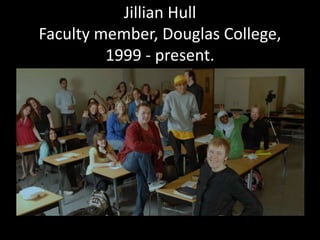
Jillian Hull
Faculty member, Douglas College,
1999 - present.
• Award-winning instructor - have developed online
curriculum and managed several online projects
including video-based modules for Online
Learning Centre; also developed several student-
centred, online projects such as “Candid
Transitions”
• Prior to joining the college I was a print and radio
journalist. Won numerous national awards for my
work.
Jillian Hull
• At Douglas: Student Success 1100:
Introduction to College Studies is one of the
few credit courses in B.C. with curriculum
devoted to financial competency. We see
financial competency as an essential skill for
successful educational outcomes, but also an
essential skill for the work force.
• Increasing frustration with being able to
reach only a few hundred students per term.
On course evaluations, 99% of students rate
the credit/debt education portion of the
course as “Most valuable”.
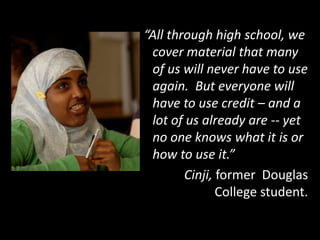
“All through high school, we
cover material that many
of us will never have to use
again. But everyone will
have to use credit – and a
lot of us already are -- yet
no one knows what it is or
how to use it.”
Cinji, former Douglas
College student.
How can we educate post-secondary
students to be financially literate on
a system-wide basis?
What do students really know about
credit and student loans?
• It depends if you ask a general question or a
specific one...
• But to more specific questions...
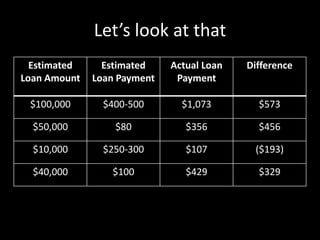
Let’s look at that
Estimated
Loan Amount
Estimated
Loan Payment
Actual Loan
Payment
Difference
$100,000 $400-500 $1,073 $573
$50,000 $80 $356 $456
$10,000 $250-300 $107 ($193)
$40,000 $100 $429 $329
Jeffrey Black, BFA, B. Ed., MBA
• Background in pension and
mutual fund investment
• Former partner at Phillips, Hagar
& North Investments Ltd
• Former partner at TAL
Investment Management Ltd
• Interest in working to
strategically develop educational
materials on financial
competency for dedicated
populations
Through working in investments, I am
constantly surprised by how people view
money and how they make decisions.
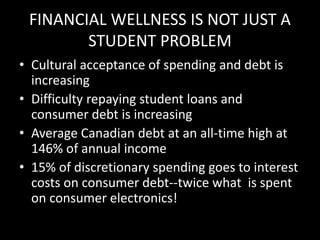
FINANCIAL WELLNESS IS NOT JUST A
STUDENT PROBLEM
• Cultural acceptance of spending and debt is
increasing
• Difficulty repaying student loans and
consumer debt is increasing
• Average Canadian debt at an all-time high at
146% of annual income
• 15% of discretionary spending goes to interest
costs on consumer debt--twice what is spent
on consumer electronics!
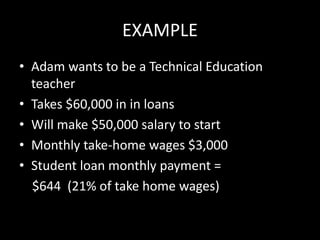
EXAMPLE
• Adam wants to be a Technical Education
teacher
• Takes $60,000 in in loans
• Will make $50,000 salary to start
• Monthly take-home wages $3,000
• Student loan monthly payment =
$644 (21% of take home wages)
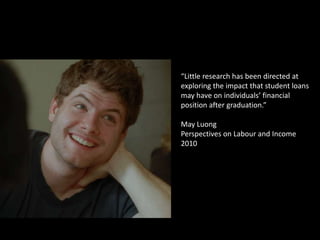
“Little research has been directed at
exploring the impact that student loans
may have on individuals’ financial
position after graduation.”
May Luong
Perspectives on Labour and Income
2010
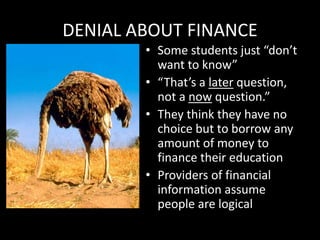
DENIAL ABOUT FINANCE
• Some students just “don’t
want to know”
• “That’s a later question,
not a now question.”
• They think they have no
choice but to borrow any
amount of money to
finance their education
• Providers of financial
information assume
people are logical
Starting with a budget
• “Eighty-one percent of students polled said it’s
important to set a budget to manage finances,
but fewer than half of them had actually done
so, according to the Leger Marketing survey
conducted in September [2010] for Bank of
Montreal.”
The Vancouver Sun, October 6, 2010.
Consequences
• Mixed messages
• Poor understanding of the short- and long-
term consequences
• Poor understanding of their choices
• Barely thinking about the repercussions of
their choices
PROBLEM
– OPPORTUNITY –
PROPOSAL
PROBLEM
Financial planning a low priority to students.
PROBLEM
• 12.5% default rate (nationally)
• Ostrich phenomena
• An adult issue
• Family values difficult to overcome
• Students are overwhelmed by the demands of the
post-secondary experience
• Their needs are very particular and current models
are not able to personalize responses
RECENT IMPROVEMENTS
• National entrance and exit surveys
• “Train the Trainer”
• The Repayment Assistance Plan
• National Task Force on Financial Literacy
• “Perspectives”
THE OPPORTUNITY
If we get students to
understand issues
and consequences
around credit, they’ll
be more responsible
about default.
THE OPPORTUNITY
The Opportunity – Why?
• Broad impact
• Deliver information in a more interactive way
• The web allows more individual attention
delivered on a mass scale –students no longer
want to be passive consumers of education
THE SOLUTION
• Develop a system-wide
project.
• Expand how information is offered: video,
problem-based learning, Moodle, etc.
• Appeal to multiple learning styles
• Help encourage students’ long-term goal setting
• Build in sustained program for students to learn
about credit/debt – expand on entrance/exit
survey.
“Financial competency is a now
question, not a later question.”
• Loans affect life choices
STUDENT LOAN AND FINANCIAL AID
• Progress made on improving headline default
rates
• Has been a very benevolent environment
SOLUTION
• Develop a series of self-assessments and quizzes
that can identify the level of financial awareness
students have and direct them to information
that they still need to learn
• Embed these assessments and quizzes into the
province's financial aid application
• Increase information about credit, debt,
budgeting, and money management as students
progress through their programs
GOALS
• Reaching as many students as possible
• Providing a relatively simple, cost-effective
way to offer financial literacy at a time when
this information is likely to have traction with
students (at time of loan application)
• Ensuring that students know enough that they
do not inadvertently erect more barriers to
their future success.
• Embedding financial literacy education on a
system-wide basis through the Financial Aid
application
POOR FINANCIAL CHOICES MAKES LIFE
HARDER
• Student debt is going to increase in an
environment of poor job growth and rising
interest rates
• “With interest rates expected to rise in coming
years, the $15-billion in outstanding student debt
will become much more expensive for students to
service, and for Ottawa to administer, Mr. Usher
said.”
From “Ottawa Raises Cap at 11th Hour to Keep
Student Loans Flowing,” The Globe and Mail,
September 5, 2010
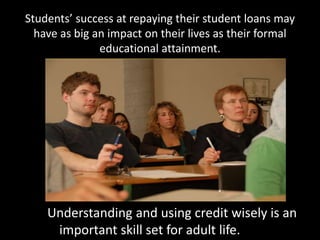
Students’ success at repaying their student loans may
have as big an impact on their lives as their formal
educational attainment.
Understanding and using credit wisely is an
important skill set for adult life.
DEBT PROBLEMS
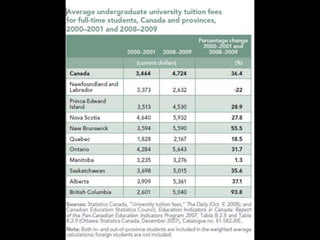
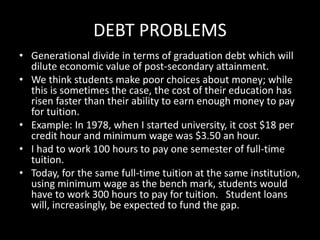
• Generational divide in terms of graduation debt which will
dilute economic value of post-secondary attainment.
• We think students make poor choices about money; while
this is sometimes the case, the cost of their education has
risen faster than their ability to earn enough money to pay
for tuition.
• Example: In 1978, when I started university, it cost $18 per
credit hour and minimum wage was $3.50 an hour.
• I had to work 100 hours to pay one semester of full-time
tuition.
• Today, for the same full-time tuition at the same institution,
using minimum wage as the bench mark, students would
have to work 300 hours to pay for tuition. Student loans
will, increasingly, be expected to fund the gap.
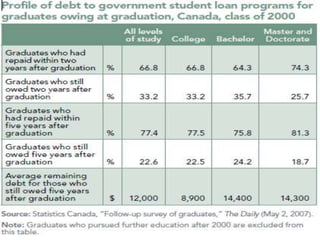
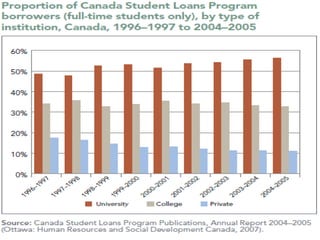
TYPES OF BORROWERS
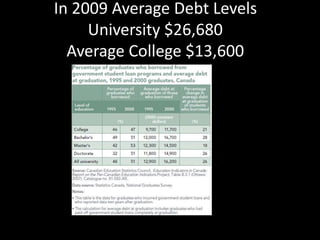
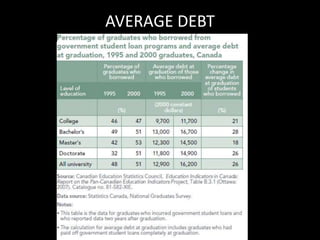
In 2009 Average Debt Levels
University $26,680
Average College $13,600
AVERAGE DEBT
• Who gets to see their credit report?
• Students do not realize who gets to see their
credit report: Everyone from future landlords
to credit-card companies to creditors
• Failure to repay student loans can close doors
for students who want to continue with their
education
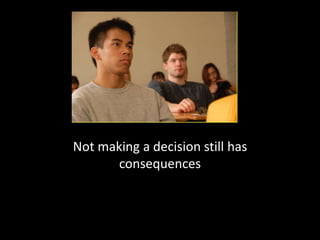
Not making a decision still has
consequences
• Credit score

Financial aid presentation power point final

  • 1.
    “It’s a futurequestion, not a now question”
  • 3.
    OUTLINE • Jillian Hull– Introduction • Students’ financial literacy – uneven knowledge • Jeffrey Black - Introduction • Our target • Jillian – Attitudes and Behaviours • Consequences of Default • Problem – Opportunity - Proposal
  • 4.
    Jillian Hull Faculty member,Douglas College, 1999 - present.
  • 5.
    • Award-winning instructor- have developed online curriculum and managed several online projects including video-based modules for Online Learning Centre; also developed several student- centred, online projects such as “Candid Transitions” • Prior to joining the college I was a print and radio journalist. Won numerous national awards for my work. Jillian Hull
  • 6.
    • At Douglas:Student Success 1100: Introduction to College Studies is one of the few credit courses in B.C. with curriculum devoted to financial competency. We see financial competency as an essential skill for successful educational outcomes, but also an essential skill for the work force. • Increasing frustration with being able to reach only a few hundred students per term. On course evaluations, 99% of students rate the credit/debt education portion of the course as “Most valuable”.
  • 7.
    “All through highschool, we cover material that many of us will never have to use again. But everyone will have to use credit – and a lot of us already are -- yet no one knows what it is or how to use it.” Cinji, former Douglas College student.
  • 8.
    How can weeducate post-secondary students to be financially literate on a system-wide basis?
  • 9.
    What do studentsreally know about credit and student loans? • It depends if you ask a general question or a specific one...
  • 11.
    • But tomore specific questions...
  • 15.
    Let’s look atthat Estimated Loan Amount Estimated Loan Payment Actual Loan Payment Difference $100,000 $400-500 $1,073 $573 $50,000 $80 $356 $456 $10,000 $250-300 $107 ($193) $40,000 $100 $429 $329
  • 16.
    Jeffrey Black, BFA,B. Ed., MBA • Background in pension and mutual fund investment • Former partner at Phillips, Hagar & North Investments Ltd • Former partner at TAL Investment Management Ltd • Interest in working to strategically develop educational materials on financial competency for dedicated populations
  • 17.
    Through working ininvestments, I am constantly surprised by how people view money and how they make decisions.
  • 18.
    FINANCIAL WELLNESS ISNOT JUST A STUDENT PROBLEM • Cultural acceptance of spending and debt is increasing • Difficulty repaying student loans and consumer debt is increasing • Average Canadian debt at an all-time high at 146% of annual income • 15% of discretionary spending goes to interest costs on consumer debt--twice what is spent on consumer electronics!
  • 20.
    EXAMPLE • Adam wantsto be a Technical Education teacher • Takes $60,000 in in loans • Will make $50,000 salary to start • Monthly take-home wages $3,000 • Student loan monthly payment = $644 (21% of take home wages)
  • 21.
    “Little research hasbeen directed at exploring the impact that student loans may have on individuals’ financial position after graduation.” May Luong Perspectives on Labour and Income 2010
  • 22.
    DENIAL ABOUT FINANCE •Some students just “don’t want to know” • “That’s a later question, not a now question.” • They think they have no choice but to borrow any amount of money to finance their education • Providers of financial information assume people are logical
  • 23.
    Starting with abudget • “Eighty-one percent of students polled said it’s important to set a budget to manage finances, but fewer than half of them had actually done so, according to the Leger Marketing survey conducted in September [2010] for Bank of Montreal.” The Vancouver Sun, October 6, 2010.
  • 25.
    Consequences • Mixed messages •Poor understanding of the short- and long- term consequences • Poor understanding of their choices • Barely thinking about the repercussions of their choices
  • 29.
  • 30.
    PROBLEM Financial planning alow priority to students.
  • 31.
    PROBLEM • 12.5% defaultrate (nationally) • Ostrich phenomena • An adult issue • Family values difficult to overcome • Students are overwhelmed by the demands of the post-secondary experience • Their needs are very particular and current models are not able to personalize responses
  • 32.
    RECENT IMPROVEMENTS • Nationalentrance and exit surveys • “Train the Trainer” • The Repayment Assistance Plan • National Task Force on Financial Literacy • “Perspectives”
  • 33.
    THE OPPORTUNITY If weget students to understand issues and consequences around credit, they’ll be more responsible about default.
  • 34.
  • 35.
    The Opportunity –Why? • Broad impact • Deliver information in a more interactive way • The web allows more individual attention delivered on a mass scale –students no longer want to be passive consumers of education
  • 36.
    THE SOLUTION • Developa system-wide project. • Expand how information is offered: video, problem-based learning, Moodle, etc. • Appeal to multiple learning styles • Help encourage students’ long-term goal setting • Build in sustained program for students to learn about credit/debt – expand on entrance/exit survey.
  • 37.
    “Financial competency isa now question, not a later question.”
  • 38.
    • Loans affectlife choices
  • 40.
    STUDENT LOAN ANDFINANCIAL AID • Progress made on improving headline default rates • Has been a very benevolent environment
  • 41.
    SOLUTION • Develop aseries of self-assessments and quizzes that can identify the level of financial awareness students have and direct them to information that they still need to learn • Embed these assessments and quizzes into the province's financial aid application • Increase information about credit, debt, budgeting, and money management as students progress through their programs
  • 42.
    GOALS • Reaching asmany students as possible • Providing a relatively simple, cost-effective way to offer financial literacy at a time when this information is likely to have traction with students (at time of loan application) • Ensuring that students know enough that they do not inadvertently erect more barriers to their future success. • Embedding financial literacy education on a system-wide basis through the Financial Aid application
  • 43.
    POOR FINANCIAL CHOICESMAKES LIFE HARDER • Student debt is going to increase in an environment of poor job growth and rising interest rates • “With interest rates expected to rise in coming years, the $15-billion in outstanding student debt will become much more expensive for students to service, and for Ottawa to administer, Mr. Usher said.” From “Ottawa Raises Cap at 11th Hour to Keep Student Loans Flowing,” The Globe and Mail, September 5, 2010
  • 44.
    Students’ success atrepaying their student loans may have as big an impact on their lives as their formal educational attainment. Understanding and using credit wisely is an important skill set for adult life.
  • 46.
    DEBT PROBLEMS • Generationaldivide in terms of graduation debt which will dilute economic value of post-secondary attainment. • We think students make poor choices about money; while this is sometimes the case, the cost of their education has risen faster than their ability to earn enough money to pay for tuition. • Example: In 1978, when I started university, it cost $18 per credit hour and minimum wage was $3.50 an hour. • I had to work 100 hours to pay one semester of full-time tuition. • Today, for the same full-time tuition at the same institution, using minimum wage as the bench mark, students would have to work 300 hours to pay for tuition. Student loans will, increasingly, be expected to fund the gap.
  • 47.
  • 48.
    In 2009 AverageDebt Levels University $26,680 Average College $13,600
  • 49.
  • 50.
    • Who getsto see their credit report? • Students do not realize who gets to see their credit report: Everyone from future landlords to credit-card companies to creditors • Failure to repay student loans can close doors for students who want to continue with their education
  • 51.
    Not making adecision still has consequences
  • 52.