Confidentiality notice: This document is confidential and contains proprietary information and intellectual property of Arrow Global Limited. None of the
information contained herein may be reproduced or disclosed under any circumstances without the express written permission of Arrow Global Limited.
“TICKING THE BOX ON PROBLEM
DEBT – SO JOB DONE THEN?”
Zach Lewy, Founder and Executive Director, Arrow Global
19 November 2014
ProprietaryandConfidential
2
JOB EXTREMELY FAR FROM DONE!
Approximately 8.8 million people in UK are
over-indebted (18% of the UK adult
population)
(Source: Indebted lives: the complexities of life in debt, November 2013)
1 in 5 lie to partners about debt
(Source: This is Money articlebased on Legal & General research, 13 November
2014 )
7% of parents in problem debt split up
as a result.
(Source: The Debt Trap – Exposing the impact of problem debt on Children, May 2014)
ProprietaryandConfidential
…to me, problem debt is where financial stress
impedes a customer’s ability to enjoy a
sustainable lifestyle.
3
HOW DO YOU DEFINE PROBLEM DEBT?
9 out of 10 parents in problem debt
have cut back on essential items for
their children within the last year so
they could keep up payments on debts.
(Source: The Debt Trap – Exposing the impact of problem debt on Children, May 2014)
ProprietaryandConfidential
4
UNDERSTANDING THE PROBLEM
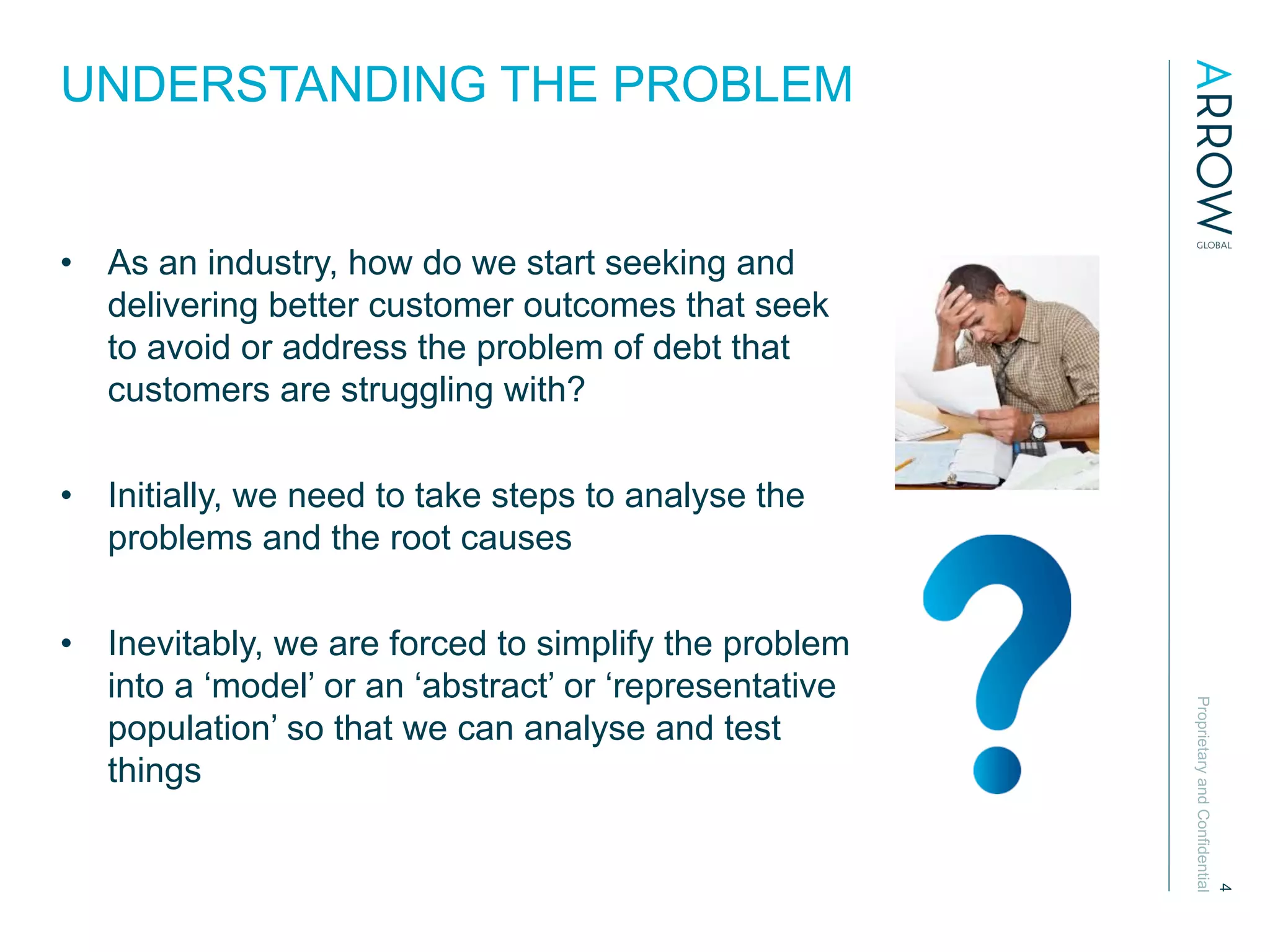
•  As an industry, how do we start seeking and
delivering better customer outcomes that seek
to avoid or address the problem of debt that
customers are struggling with?
•  Initially, we need to take steps to analyse the
problems and the root causes
•  Inevitably, we are forced to simplify the problem
into a ‘model’ or an ‘abstract’ or ‘representative
population’ so that we can analyse and test
things
ProprietaryandConfidential
5
ENSURING THE BEST CUSTOMER
OUTCOME
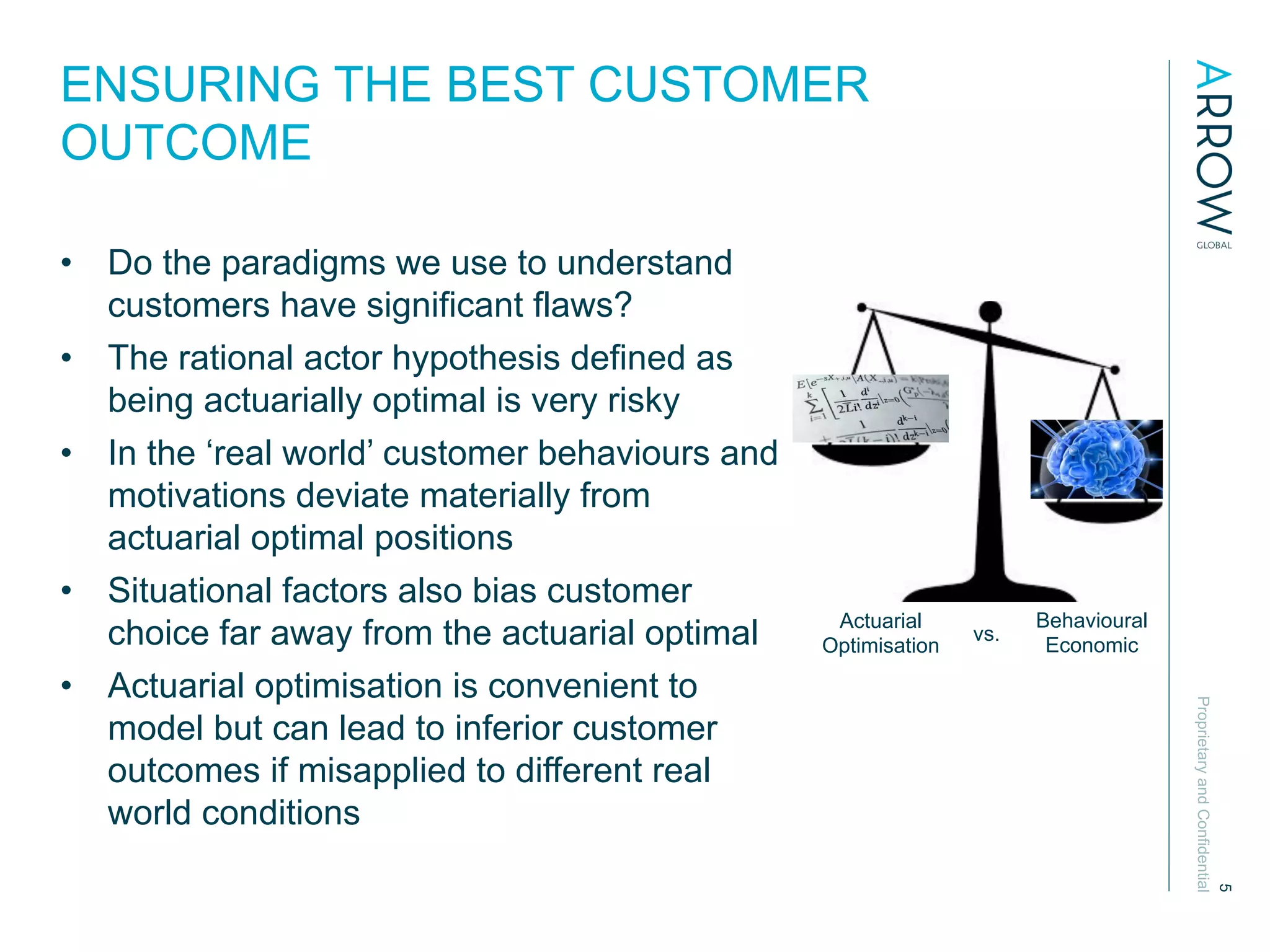
vs.
Actuarial
Optimisation
Behavioural
Economic
•  Do the paradigms we use to understand
customers have significant flaws?
•  The rational actor hypothesis defined as
being actuarially optimal is very risky
•  In the ‘real world’ customer behaviours and
motivations deviate materially from
actuarial optimal positions
•  Situational factors also bias customer
choice far away from the actuarial optimal
•  Actuarial optimisation is convenient to
model but can lead to inferior customer
outcomes if misapplied to different real
world conditions
ProprietaryandConfidential
6
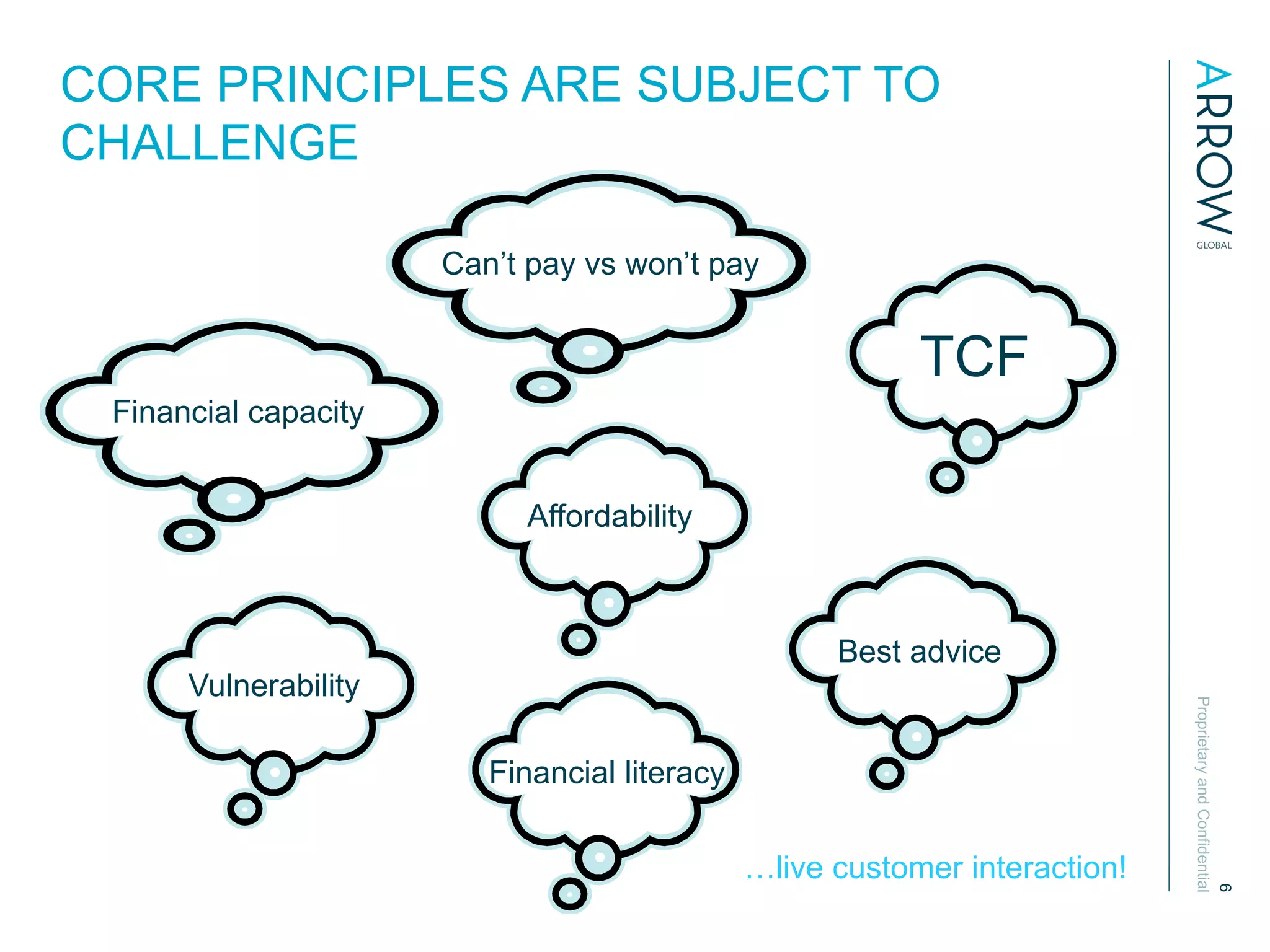
CORE PRINCIPLES ARE SUBJECT TO
CHALLENGE
Financial literacy
Financial capacity
Can’t pay vs won’t pay
Affordability
TCF
Best advice
Vulnerability
…live customer interaction!
ProprietaryandConfidential
7
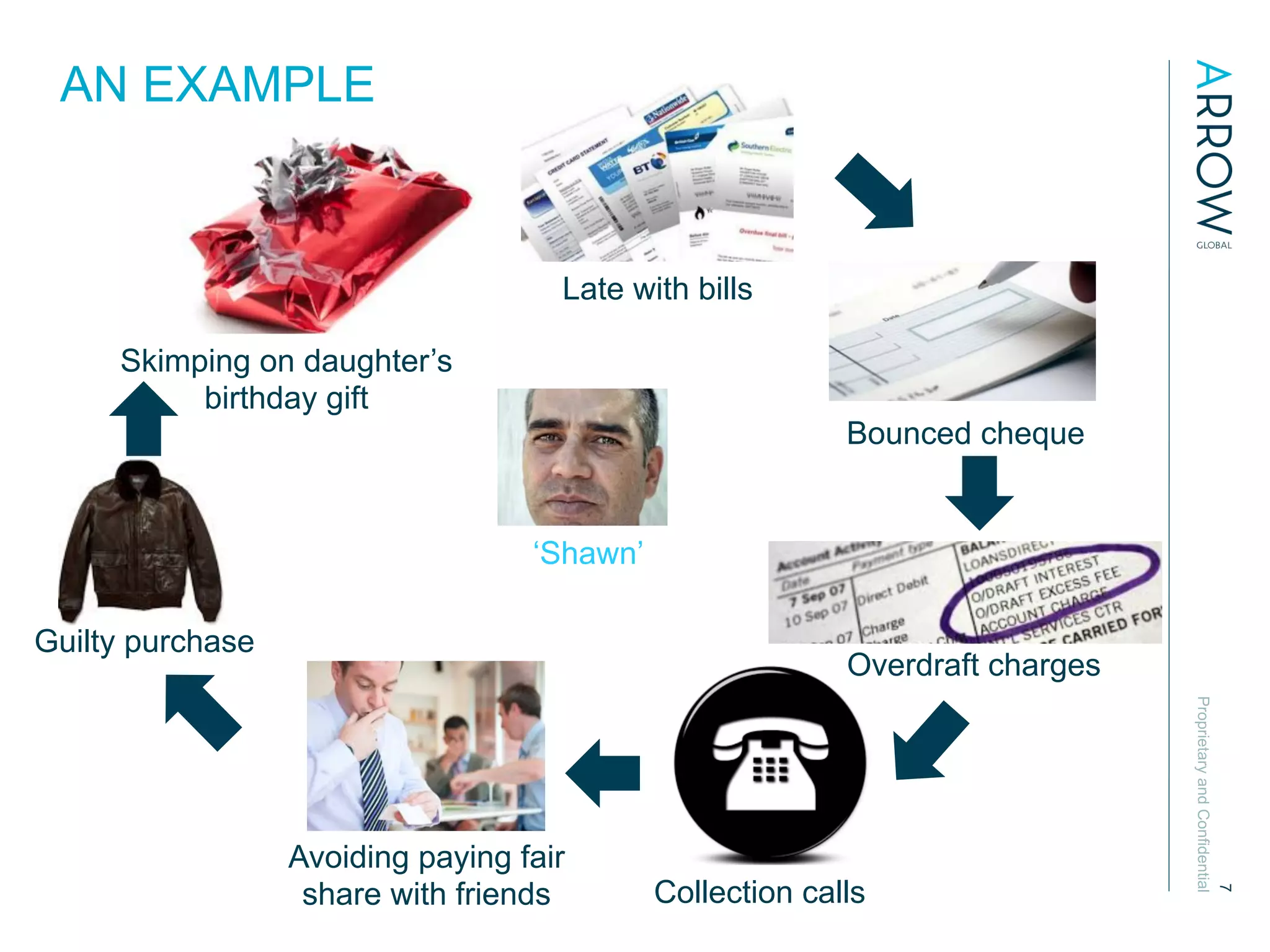
AN EXAMPLE
‘Shawn’
Late with bills
Bounced cheque
Overdraft charges
Collection calls
Avoiding paying fair
share with friends
Guilty purchase
Skimping on daughter’s
birthday gift
ProprietaryandConfidential
8
CIRCUMSTANCES ARE ENOUGH TO
ADVERSELY AFFECT CAPACITY
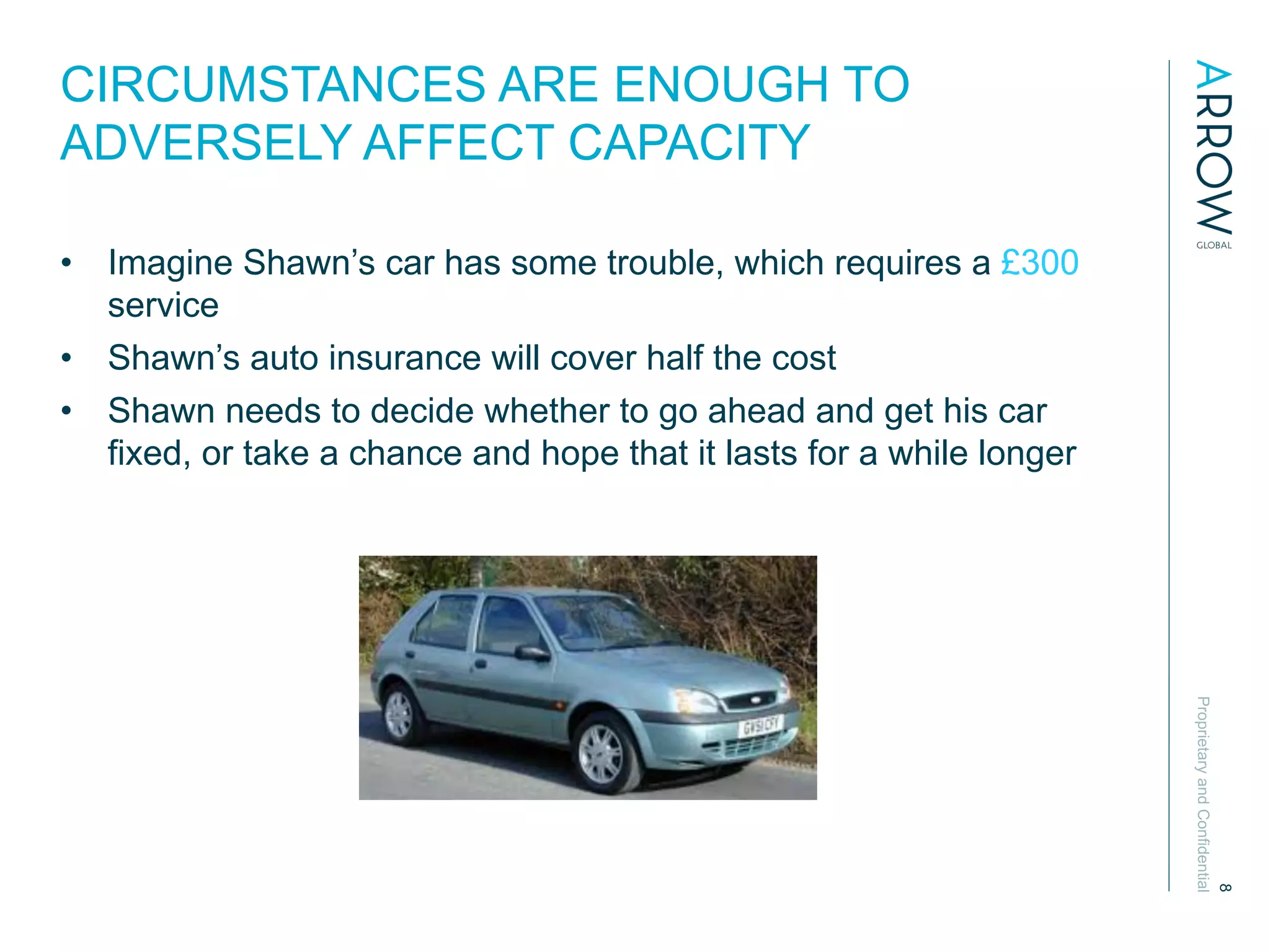
•  Imagine Shawn’s car has some trouble, which requires a £300
service
•  Shawn’s auto insurance will cover half the cost
•  Shawn needs to decide whether to go ahead and get his car
fixed, or take a chance and hope that it lasts for a while longer
ProprietaryandConfidential
•  Imagine that your car has some trouble, which requires an
expensive £3,000 service
•  Your auto insurance will cover half the cost. You need to decide
whether to go ahead and get the car fixed, or take a chance and
hope that it lasts for a while longer
•  Customer solves problem by terminating insurance that he
benefited from. This improves his affordability and liquidity in the
short term but reduces shock buffers to many future challenges
including problem debts
•  If this were not the actuarially correct answer, who bears
responsibility and obligation for such circumstances?
•  This problem is compounded if customers suffer reduced
capacities due to problem debt conditions
9
CIRCUMSTANCES ARE ENOUGH TO
ADVERSELY AFFECT CAPACITY
ProprietaryandConfidential
10
DELIVERING BETTER CUSTOMER
OUTCOMES
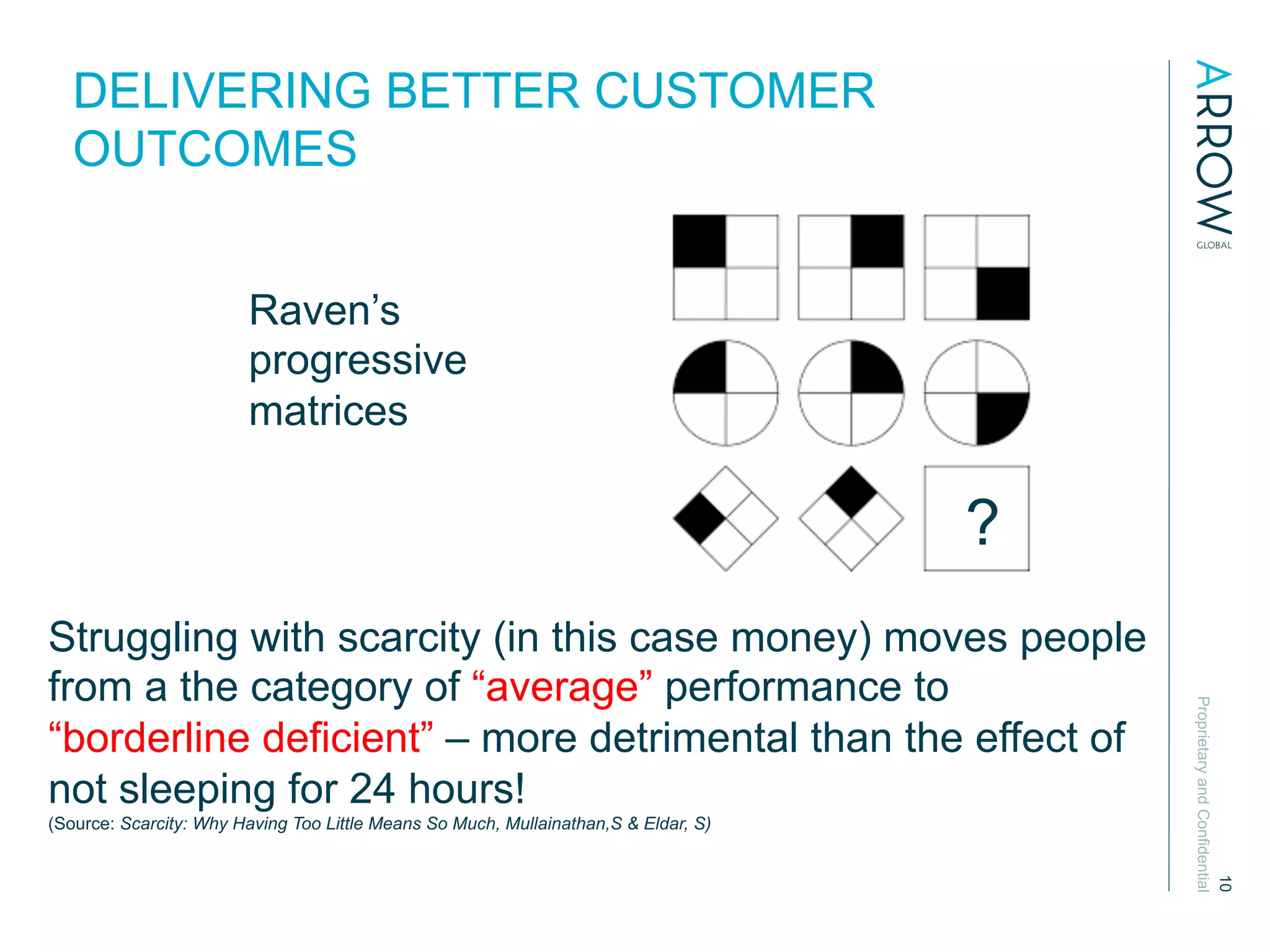
?
Raven’s
progressive
matrices
Struggling with scarcity (in this case money) moves people
from a the category of “average” performance to
“borderline deficient” – more detrimental than the effect of
not sleeping for 24 hours!
(Source: Scarcity: Why Having Too Little Means So Much, Mullainathan,S & Eldar, S)
ProprietaryandConfidential
11
SITUATIONAL IMPACTS ON BEHAVIOUR
“Your heritage is being vandalized every day by theft losses of petrified wood of 14 tons a year,
mostly a small piece at a time.”
Example 1: Arizona National Park
Example 2: Famous UK creditor’s website
Creditor 1 will take ‘enforcement action’ to get the money - you may be able to avoid this if you
contact them.
There are a number of enforcement actions creditor 1 can take to get the tax you owe. They
can:
• collect what you owe through your earnings or pension
• ask debt collection agencies to collect the money
• take things you own and sell them (if you live in England, Wales or Northern Ireland)
• take you to court
• make you bankrupt or close down your business
If you don’t pay on time, you’ll probably have to pay interest on the outstanding amount. You
may also have to pay a penalty or surcharge.
ProprietaryandConfidential
12
RELEVANT ALTERNATIVE APPROACH
EXAMPLES
•  First meetings are relationship
outreach and not trained financial
advice sessions
•  What would happen if you sent a
handwritten thank you note to a test
population of customers who had just
established payment arrangements?
•  Would that population outperform a
control population that was not
personally thanked?
ProprietaryandConfidential
13
DO WE APPROACH KEY ISSUES IN THE
RIGHT WAY?
•  Is an I&E the right place to start? Do we need to start on a more
personal relationship level?
•  What is the interplay between customer confidence and positive
customer outcomes – particularly in the long term?
•  What is the impact on creditor business models from customers
who ‘fully’ recover versus those who ‘limp along’? How does
that improvement impact compare to the path dependent
negative cycles that certain creditor and advisor behaviour
creates?
•  How many customers don’t seek financial advice because the
market makes it emotionally hard to access?
•  How many unhelpful social behaviours do we create or
perpetuate by applying the incorrect can’t pay / won’t pay
paradigm
•  How do we best help problem debt customers?
ProprietaryandConfidential
14
WHOSE PROBLEM IS IT?
Problem debt costs society £8.3 billion.
(Source: StepChange )
Pay growth outstrips inflation for first
time in five years
(Source: Telegraph article based on data from Office for National Statistics, 12 November
2014)
Families in the red ‘pose threat the
UK recovery’ as household debt
more than quadruples since 1990
(Source: This is Money article based on information from financial research firm Verum,
14 August 2014)

#MALG14 Keynote Address - Zach Lewy, Arrow Global - Slideset

  • 1.
    Confidentiality notice: Thisdocument is confidential and contains proprietary information and intellectual property of Arrow Global Limited. None of the information contained herein may be reproduced or disclosed under any circumstances without the express written permission of Arrow Global Limited. “TICKING THE BOX ON PROBLEM DEBT – SO JOB DONE THEN?” Zach Lewy, Founder and Executive Director, Arrow Global 19 November 2014
  • 2.
    ProprietaryandConfidential 2 JOB EXTREMELY FARFROM DONE! Approximately 8.8 million people in UK are over-indebted (18% of the UK adult population) (Source: Indebted lives: the complexities of life in debt, November 2013) 1 in 5 lie to partners about debt (Source: This is Money articlebased on Legal & General research, 13 November 2014 ) 7% of parents in problem debt split up as a result. (Source: The Debt Trap – Exposing the impact of problem debt on Children, May 2014)
  • 3.
    ProprietaryandConfidential …to me, problemdebt is where financial stress impedes a customer’s ability to enjoy a sustainable lifestyle. 3 HOW DO YOU DEFINE PROBLEM DEBT? 9 out of 10 parents in problem debt have cut back on essential items for their children within the last year so they could keep up payments on debts. (Source: The Debt Trap – Exposing the impact of problem debt on Children, May 2014)
  • 4.
    ProprietaryandConfidential 4 UNDERSTANDING THE PROBLEM • As an industry, how do we start seeking and delivering better customer outcomes that seek to avoid or address the problem of debt that customers are struggling with? •  Initially, we need to take steps to analyse the problems and the root causes •  Inevitably, we are forced to simplify the problem into a ‘model’ or an ‘abstract’ or ‘representative population’ so that we can analyse and test things
  • 5.
    ProprietaryandConfidential 5 ENSURING THE BESTCUSTOMER OUTCOME vs. Actuarial Optimisation Behavioural Economic •  Do the paradigms we use to understand customers have significant flaws? •  The rational actor hypothesis defined as being actuarially optimal is very risky •  In the ‘real world’ customer behaviours and motivations deviate materially from actuarial optimal positions •  Situational factors also bias customer choice far away from the actuarial optimal •  Actuarial optimisation is convenient to model but can lead to inferior customer outcomes if misapplied to different real world conditions
  • 6.
    ProprietaryandConfidential 6 CORE PRINCIPLES ARESUBJECT TO CHALLENGE Financial literacy Financial capacity Can’t pay vs won’t pay Affordability TCF Best advice Vulnerability …live customer interaction!
  • 7.
    ProprietaryandConfidential 7 AN EXAMPLE ‘Shawn’ Late withbills Bounced cheque Overdraft charges Collection calls Avoiding paying fair share with friends Guilty purchase Skimping on daughter’s birthday gift
  • 8.
    ProprietaryandConfidential 8 CIRCUMSTANCES ARE ENOUGHTO ADVERSELY AFFECT CAPACITY •  Imagine Shawn’s car has some trouble, which requires a £300 service •  Shawn’s auto insurance will cover half the cost •  Shawn needs to decide whether to go ahead and get his car fixed, or take a chance and hope that it lasts for a while longer
  • 9.
    ProprietaryandConfidential •  Imagine thatyour car has some trouble, which requires an expensive £3,000 service •  Your auto insurance will cover half the cost. You need to decide whether to go ahead and get the car fixed, or take a chance and hope that it lasts for a while longer •  Customer solves problem by terminating insurance that he benefited from. This improves his affordability and liquidity in the short term but reduces shock buffers to many future challenges including problem debts •  If this were not the actuarially correct answer, who bears responsibility and obligation for such circumstances? •  This problem is compounded if customers suffer reduced capacities due to problem debt conditions 9 CIRCUMSTANCES ARE ENOUGH TO ADVERSELY AFFECT CAPACITY
  • 10.
    ProprietaryandConfidential 10 DELIVERING BETTER CUSTOMER OUTCOMES ? Raven’s progressive matrices Strugglingwith scarcity (in this case money) moves people from a the category of “average” performance to “borderline deficient” – more detrimental than the effect of not sleeping for 24 hours! (Source: Scarcity: Why Having Too Little Means So Much, Mullainathan,S & Eldar, S)
  • 11.
    ProprietaryandConfidential 11 SITUATIONAL IMPACTS ONBEHAVIOUR “Your heritage is being vandalized every day by theft losses of petrified wood of 14 tons a year, mostly a small piece at a time.” Example 1: Arizona National Park Example 2: Famous UK creditor’s website Creditor 1 will take ‘enforcement action’ to get the money - you may be able to avoid this if you contact them. There are a number of enforcement actions creditor 1 can take to get the tax you owe. They can: • collect what you owe through your earnings or pension • ask debt collection agencies to collect the money • take things you own and sell them (if you live in England, Wales or Northern Ireland) • take you to court • make you bankrupt or close down your business If you don’t pay on time, you’ll probably have to pay interest on the outstanding amount. You may also have to pay a penalty or surcharge.
  • 12.
    ProprietaryandConfidential 12 RELEVANT ALTERNATIVE APPROACH EXAMPLES • First meetings are relationship outreach and not trained financial advice sessions •  What would happen if you sent a handwritten thank you note to a test population of customers who had just established payment arrangements? •  Would that population outperform a control population that was not personally thanked?
  • 13.
    ProprietaryandConfidential 13 DO WE APPROACHKEY ISSUES IN THE RIGHT WAY? •  Is an I&E the right place to start? Do we need to start on a more personal relationship level? •  What is the interplay between customer confidence and positive customer outcomes – particularly in the long term? •  What is the impact on creditor business models from customers who ‘fully’ recover versus those who ‘limp along’? How does that improvement impact compare to the path dependent negative cycles that certain creditor and advisor behaviour creates? •  How many customers don’t seek financial advice because the market makes it emotionally hard to access? •  How many unhelpful social behaviours do we create or perpetuate by applying the incorrect can’t pay / won’t pay paradigm •  How do we best help problem debt customers?
  • 14.
    ProprietaryandConfidential 14 WHOSE PROBLEM ISIT? Problem debt costs society £8.3 billion. (Source: StepChange ) Pay growth outstrips inflation for first time in five years (Source: Telegraph article based on data from Office for National Statistics, 12 November 2014) Families in the red ‘pose threat the UK recovery’ as household debt more than quadruples since 1990 (Source: This is Money article based on information from financial research firm Verum, 14 August 2014)