Multi-sensor Improved Sea-Surface
Temperature for IOOS
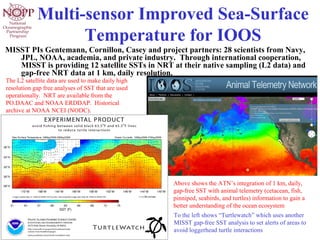
MISST PIs Gentemann, Cornillon, Casey and project partners: 28 scientists from Navy,
JPL, NOAA, academia, and private industry. Through international cooperation,
MISST is providing 12 satellite SSTs in NRT at their native sampling (L2 data) and
gap-free NRT data at 1 km, daily resolution.
The L2 satellite data are used to make daily high
resolution gap free analyses of SST that are used
operationally. NRT are available from the
PO.DAAC and NOAA ERDDAP. Historical
archive at NOAA NCEI (NODC).
Above shows the ATN’s integration of 1 km, daily,
gap-free SST with animal telemetry (cetacean, fish,
pinniped, seabirds, and turtles) information to gain a
better understanding of the ocean ecosystem
To the left shows “Turtlewatch” which uses another
MISST gap-free SST analysis to set alerts of areas to
avoid loggerhead turtle interactions
http://www.camilleseaman.com/Art
ist.asp?
ArtistID=3258&Akey=WX679BJN
&ajx=1#!P118975_I2_1543930
http://www.camilleseaman.com/Art
ist.asp?
ArtistID=3258&Akey=WX679BJN
&ajx=1#!P118975_I2_1543930
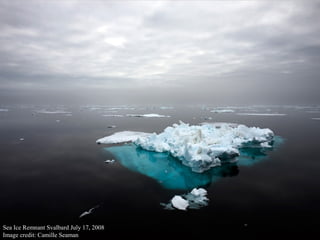
Sea Ice Remnant Svalbard July 17, 2008
Image credit: Camille Seaman
Multi-sensor Improved Sea Surface Temperature: continuing the
GHRSST partnership & improving Arctic data
PI: Chelle L. Gentemann, Earth and Space Research
Co-I: Peter Minnett, University of Miami
Co-I: Michael Steele, University of Washington
16 partners in :
Industry: Richard Jenkins (Saildrone), Jean-Francois Cayula
(Vencore)
Academia: Sandra Castro (U.Colorado), Peter Cornillon (U.Rhode
Island), Dale Robinson (UC Santa Cruz), Andy Harris (U. Maryland)
Governmental: NASA: Edward M. Armstrong (JPL/Caltech), Toshio
Mike Chin (JPL/Caltech), Jorge Vazquez (JPL/Caltech), Vardis Tsontos
(JPL/Caltech)
Governmental: NOAA: Kenneth Casey (NCEI), Edward Cokelet
(NOAA/PMEL), Eileen Maturi (NOAA/NESDIS/STAR), Gary Wick
(NOAA/OAR/ESRL), Cara Wilson (NOAA/NMFS/SWFSC)
Governmental: ONR: Charlie Barron (NRL/SSC)
New Project 2018 - 2023
Project objectives
1) Coordinate and integrate new SST observations (e.g.
GOES-R, VIIRS); improve data access; management and
interoperability; and maintain and strengthen
international collaboration.
2) Explore improving SST products through improved or
expanded in situ SST observations in the Arctic
3) Focus on improving accuracy and uncertainty estimates
of SSTs at high-latitudes
4) Explore improving SST products particularly in marginal
ice zones through research into high latitude air-sea-ice
interactions and regional ocean-atmosphere-ice feedbacks
Data
1) Coordinate and integrate new SST observations (e.g.
GOES-R, VIIRS); improve data access; management and
interoperability; and maintain and strengthen
international collaboration.
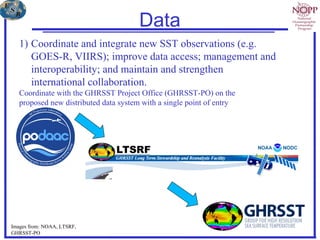
Coordinate with the GHRSST Project Office (GHRSST-PO) on the
proposed new distributed data system with a single point of entry
Images from: NOAA, LTSRF,
GHRSST-PO
2) SST algorithm development
https://icdc.cen.uni-
hamburg.de/fileadmin/user_upload/
icdc_Dokumente/MODIS/kilpatric
ketal_AdecadeofSeaSurfaceTemper
aturefromMODIS_RSE_165_27-
41_2015.pdf
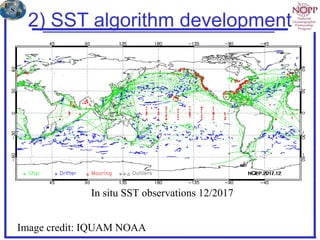
Image credit: IQUAM NOAA
In situ SST observations 12/2017
More in situ data
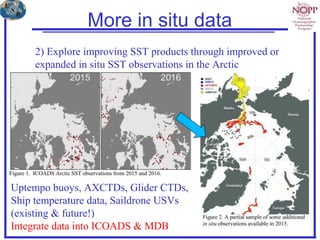
2) Explore improving SST products through improved or
expanded in situ SST observations in the Arctic
Uptempo buoys, AXCTDs, Glider CTDs,
Ship temperature data, Saildrone USVs
(existing & future!)
Integrate data into ICOADS & MDB
5 Arctic Cruises
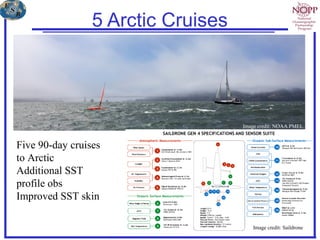
Five 90-day cruises
to Arctic
Additional SST
profile obs
Improved SST skin
Image credit: NOAA PMEL
Image credit: Saildrone
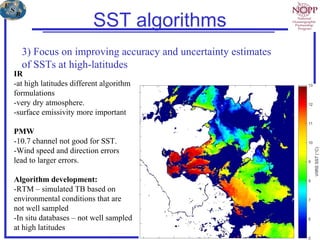
SST algorithms
3) Focus on improving accuracy and uncertainty estimates
of SSTs at high-latitudes
IR
-at high latitudes different algorithm
formulations
-very dry atmosphere.
-surface emissivity more important
PMW
-10.7 channel not good for SST.
-Wind speed and direction errors
lead to larger errors.
Algorithm development:
-RTM – simulated TB based on
environmental conditions that are
not well sampled
-In situ databases – not well sampled
at high latitudes
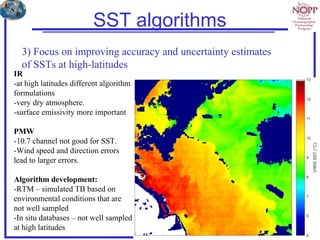
SST algorithms
3) Focus on improving accuracy and uncertainty estimates
of SSTs at high-latitudes
IR
-at high latitudes different algorithm
formulations
-very dry atmosphere.
-surface emissivity more important
PMW
-10.7 channel not good for SST.
-Wind speed and direction errors
lead to larger errors.
Algorithm development:
-RTM – simulated TB based on
environmental conditions that are
not well sampled
-In situ databases – not well sampled
at high latitudes
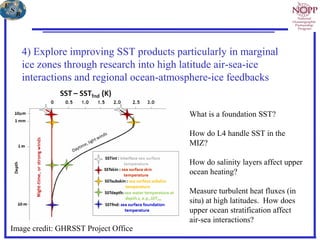
4) Explore improving SST products particularly in marginal
ice zones through research into high latitude air-sea-ice
interactions and regional ocean-atmosphere-ice feedbacks
Image credit: GHRSST Project Office
What is a foundation SST?
How do L4 handle SST in the
MIZ?
How do salinity layers affect upper
ocean heating?
Measure turbulent heat fluxes (in
situ) at high latitudes. How does
upper ocean stratification affect
air-sea interactions?
http://www.camilleseaman.com/Art
ist.asp?
ArtistID=3258&Akey=WX679BJN
&ajx=1#!P118975_I2_1543930
http://www.camilleseaman.com/Art
ist.asp?
ArtistID=3258&Akey=WX679BJN
&ajx=1#!P118975_I2_1543930
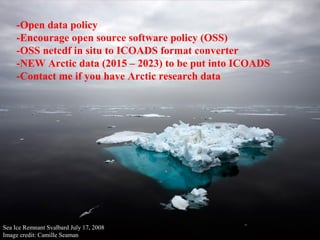
Sea Ice Remnant Svalbard July 17, 2008
Image credit: Camille Seaman
-Open data policy
-Encourage open source software policy (OSS)
-OSS netcdf in situ to ICOADS format converter
-NEW Arctic data (2015 – 2023) to be put into ICOADS
-Contact me if you have Arctic research data

Multi-sensor Improved Sea Surface Temperatures Project

  • 1.
    Multi-sensor Improved Sea-Surface Temperaturefor IOOS MISST PIs Gentemann, Cornillon, Casey and project partners: 28 scientists from Navy, JPL, NOAA, academia, and private industry. Through international cooperation, MISST is providing 12 satellite SSTs in NRT at their native sampling (L2 data) and gap-free NRT data at 1 km, daily resolution. The L2 satellite data are used to make daily high resolution gap free analyses of SST that are used operationally. NRT are available from the PO.DAAC and NOAA ERDDAP. Historical archive at NOAA NCEI (NODC). Above shows the ATN’s integration of 1 km, daily, gap-free SST with animal telemetry (cetacean, fish, pinniped, seabirds, and turtles) information to gain a better understanding of the ocean ecosystem To the left shows “Turtlewatch” which uses another MISST gap-free SST analysis to set alerts of areas to avoid loggerhead turtle interactions
  • 2.
  • 3.
    Multi-sensor Improved SeaSurface Temperature: continuing the GHRSST partnership & improving Arctic data PI: Chelle L. Gentemann, Earth and Space Research Co-I: Peter Minnett, University of Miami Co-I: Michael Steele, University of Washington 16 partners in : Industry: Richard Jenkins (Saildrone), Jean-Francois Cayula (Vencore) Academia: Sandra Castro (U.Colorado), Peter Cornillon (U.Rhode Island), Dale Robinson (UC Santa Cruz), Andy Harris (U. Maryland) Governmental: NASA: Edward M. Armstrong (JPL/Caltech), Toshio Mike Chin (JPL/Caltech), Jorge Vazquez (JPL/Caltech), Vardis Tsontos (JPL/Caltech) Governmental: NOAA: Kenneth Casey (NCEI), Edward Cokelet (NOAA/PMEL), Eileen Maturi (NOAA/NESDIS/STAR), Gary Wick (NOAA/OAR/ESRL), Cara Wilson (NOAA/NMFS/SWFSC) Governmental: ONR: Charlie Barron (NRL/SSC) New Project 2018 - 2023
  • 4.
    Project objectives 1) Coordinateand integrate new SST observations (e.g. GOES-R, VIIRS); improve data access; management and interoperability; and maintain and strengthen international collaboration. 2) Explore improving SST products through improved or expanded in situ SST observations in the Arctic 3) Focus on improving accuracy and uncertainty estimates of SSTs at high-latitudes 4) Explore improving SST products particularly in marginal ice zones through research into high latitude air-sea-ice interactions and regional ocean-atmosphere-ice feedbacks
  • 5.
    Data 1) Coordinate andintegrate new SST observations (e.g. GOES-R, VIIRS); improve data access; management and interoperability; and maintain and strengthen international collaboration. Coordinate with the GHRSST Project Office (GHRSST-PO) on the proposed new distributed data system with a single point of entry Images from: NOAA, LTSRF, GHRSST-PO
  • 6.
    2) SST algorithmdevelopment https://icdc.cen.uni- hamburg.de/fileadmin/user_upload/ icdc_Dokumente/MODIS/kilpatric ketal_AdecadeofSeaSurfaceTemper aturefromMODIS_RSE_165_27- 41_2015.pdf Image credit: IQUAM NOAA In situ SST observations 12/2017
  • 7.
    More in situdata 2) Explore improving SST products through improved or expanded in situ SST observations in the Arctic Uptempo buoys, AXCTDs, Glider CTDs, Ship temperature data, Saildrone USVs (existing & future!) Integrate data into ICOADS & MDB
  • 8.
    5 Arctic Cruises Five90-day cruises to Arctic Additional SST profile obs Improved SST skin Image credit: NOAA PMEL Image credit: Saildrone
  • 9.
    SST algorithms 3) Focuson improving accuracy and uncertainty estimates of SSTs at high-latitudes IR -at high latitudes different algorithm formulations -very dry atmosphere. -surface emissivity more important PMW -10.7 channel not good for SST. -Wind speed and direction errors lead to larger errors. Algorithm development: -RTM – simulated TB based on environmental conditions that are not well sampled -In situ databases – not well sampled at high latitudes
  • 10.
    SST algorithms 3) Focuson improving accuracy and uncertainty estimates of SSTs at high-latitudes IR -at high latitudes different algorithm formulations -very dry atmosphere. -surface emissivity more important PMW -10.7 channel not good for SST. -Wind speed and direction errors lead to larger errors. Algorithm development: -RTM – simulated TB based on environmental conditions that are not well sampled -In situ databases – not well sampled at high latitudes
  • 11.
    4) Explore improvingSST products particularly in marginal ice zones through research into high latitude air-sea-ice interactions and regional ocean-atmosphere-ice feedbacks Image credit: GHRSST Project Office What is a foundation SST? How do L4 handle SST in the MIZ? How do salinity layers affect upper ocean heating? Measure turbulent heat fluxes (in situ) at high latitudes. How does upper ocean stratification affect air-sea interactions?
  • 12.
    http://www.camilleseaman.com/Art ist.asp? ArtistID=3258&Akey=WX679BJN &ajx=1#!P118975_I2_1543930 http://www.camilleseaman.com/Art ist.asp? ArtistID=3258&Akey=WX679BJN &ajx=1#!P118975_I2_1543930 Sea Ice RemnantSvalbard July 17, 2008 Image credit: Camille Seaman -Open data policy -Encourage open source software policy (OSS) -OSS netcdf in situ to ICOADS format converter -NEW Arctic data (2015 – 2023) to be put into ICOADS -Contact me if you have Arctic research data