Masters of CX 
Winning Hearts 
in Real-Time 
♥ By Jay Baer 
New York Times 
bestselling author 
Published by Econsultancy in association with Offerpop
Winning Hearts in Real-Time / Jay Baer 
Customers are 
facing an invitation 
avalanche... 
Companies of all sizes and descriptions ask them to like, share, comment, 
follow, click and view. Combined with the constant barrage of messages 
inherent in an always-on world, it’s easy to see why fatigue sets in, and 
consumers simply tune out. 
The way for businesses to succeed in this exhausting, hyper-competitive environment is to 
stop trying to be amazing, and start being useful. After all, we crave useful things. 
In the book Contagious, Wharton Business School professor Jonah Berger describes a 
research project he and his class undertook whereby they analyzed every New York Times 
article (online edition) for a six-month period. They found that useful articles were forwarded 
30% more than average. Of course they are! Everyone wants to be useful. Our friends are 
useful (for the most part). Your company can be useful in the same way, and use that as a 
competitive differentiator. 
That’s the core premise of my book Youtility: Why Smart Marketing is about Help not Hype.
There are many ways that companies 
can be useful, but one of the optimal 
approaches is be useful in real-time. 
Smart companies are improving customer 
experiences by providing on-the-fly 
assistance and offers that don’t feel like 
marketing, but rather like a helping hand. 
We must recognize that ultimately, great 
customer experiences are great because 
they are relevant. 
When you provide a customer experience 
that is disproportionately useful or delightful 
or cherished or worthy of praise, those 
outcomes are because that customer 
experience is hyper-relevant and valuable. 
Interacting with customers in real-time, often 
through mobile and out-of-home, may be 
the best way to produce that differentiating 
relevancy. 
Many companies of all shapes and sizes 
across the B2B and B2C spectrums are 
experimenting with real-time relevancy and 
Youtility. Here we’ll focus on four variations 
of these programs: Reactive Relevancy, 
Circumstantial Relevancy, Behavioral 
Relevancy, and Location Relevancy. 
Reactive Relevancy – 
Conversational Usefulness 
The concept of reactive relevancy is a 
relatively new one, given that its viability is 
largely driven by Twitter and other social 
venues where questions can be posed and 
answers provided in a near-synchronous 
fashion. Certainly, discussion boards, forums, 
and even review sites like TripAdvisor, have 
some of the same underpinnings but they 
lack the speed and “hey, I didn’t expect that” 
nature of truly reactive relevancy. 
To engage in reactive relevancy, companies 
(or individuals) closely monitor social media 
for particular keywords and phrases and then 
tactfully jump in to proactively assist people 
making inquiries. At its core, this is strategic 
eavesdropping. And it works. 
Holli Beckman is the Vice President of 
Marketing and Leasing Operations for WC 
Smith, a Washington, D.C. headquartered 
real estate developer and property 
management firm that oversees more than 
10,000 units in the region. 
Holli also owns Apartminty.com, an 
apartment-hunting consultancy that helps 
locate apartments for clients across the 
United States. Holli writes a comprehensive 
and useful blog on Apartminty about all things 
apartments. 
She knows the apartment locating business, 
and realizes that it’s far from easy. 
“Everyone complains about apartment 
hunting,” says Holli. “If you just type that 
search term into Twitter, you’ll see. It’s 
incredible. No one’s enjoying the experience.” 
Recognizing that if someone was taking the 
time to complain about apartments on Twitter, 
their need was both acute and present, Holli 
set out to take as much pain as possible out 
of the process, and generated more than 100 
leads for Apartminty within 30 days, all from 
Twitter. 
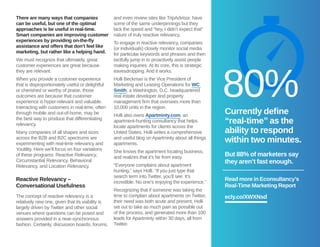
80% 
Currently define 
“real-time” as the 
ability to respond 
within two minutes. 
But 88% of marketers say 
they aren’t fast enough. 
Read more in Econsultancy’s 
Real-Time Marketing Report 
ecly.co/XWXNsd
Twitter response stats 
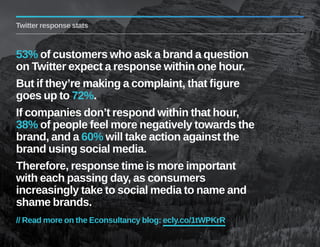
53% of customers who ask a brand a question 
on Twitter expect a response within one hour. 
But if they’re making a complaint, that figure 
goes up to 72%. 
If companies don’t respond within that hour, 
38% of people feel more negatively towards the 
brand, and a 60% will take action against the 
brand using social media. 
Therefore, response time is more important 
with each passing day, as consumers 
increasingly take to social media to name and 
shame brands. 
// Read more on the Econsultancy blog: ecly.co/1tWPKrR
“In two months, we generated six confirmed leases 
from my interactions on Twitter. Total lease amounts 
of approximately $144,000” 
Holli Beckman, 
Vice President of Marketing and Leasing Operations, WC Smith 
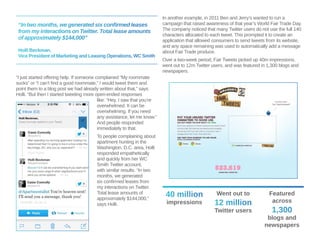
“I just started offering help. If someone complained “My roommate 
sucks” or “I can’t find a good roommate,” I would tweet them and 
point them to a blog post we had already written about that,” says 
Holli. “But then I started tweeting more open-ended responses 
like: “Hey, I saw that you’re 
overwhelmed. It can be 
overwhelming. If you need 
any assistance, let me know.” 
And people responded 
immediately to that. 
To people complaining about 
apartment hunting in the 
Washington, D.C. area, Holli 
responded empathetically 
and quickly from her WC 
Smith Twitter account, 
with similar results. “In two 
months, we generated 
six confirmed leases from 
my interactions on Twitter. 
Total lease amounts of 
approximately $144,000,” 
says Holli. 
In another example, in 2011 Ben and Jerry’s wanted to run a 
campaign that raised awareness of that year’s World Fair Trade Day. 
The company noticed that many Twitter users do not use the full 140 
characters allocated to each tweet. This prompted it to create an 
application that allowed consumers to send tweets from its website, 
and any space remaining was used to automatically add a message 
about Fair Trade produce. 
Over a two-week period, Fair Tweets picked up 40m impressions, 
went out to 12m Twitter users, and was featured in 1,300 blogs and 
newspapers. 
40 million 
impressions 
Went out to 
12 million 
Twitter users 
Featured 
across 
1,300 
blogs and 
newspapers
Circumstantial Relevancy – When 
You Need It, You Need It 
There is no courtship, ramp up, or slow 
build with real-time relevancy. You’re either 
sufficiently useful at any given moment, and 
can connect with the customer, or you’re not. 
It’s customer experience in the blink of an 
eye. 
Once you have new glasses, your ability 
to get questions about them answered by 
Warby Parker (the e-tailer that is disrupting 
the optical business partially by answering 
customer questions instantly on Youtube and 
Twitter) becomes 
a less-fulfilling 
proposition. 
Until, one day, 
you need new 
glasses again, 
and then you’ll 
know where to 
turn. Meanwhile, 
they have your 
money from the 
first purchase 
and are patiently 
waiting for your 
needs to re-align with their usefulness. 
Like an endless game of informational hide 
and seek, circumstantial real-time relevancy 
consists of popping out from behind a tree to 
assist when necessary, then fading back into 
the woods waiting for the next opportunity. 
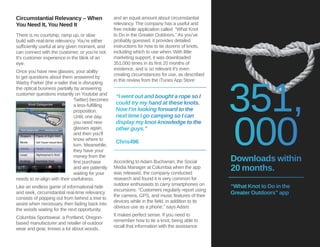
Columbia Sportswear, a Portland, Oregon-based 
manufacturer and retailer of outdoor 
wear and gear, knows a lot about woods, 
and an equal amount about circumstantial 
relevancy. The company has a useful and 
free mobile application called “What Knot 
to Do in the Greater Outdoors.” As you’ve 
probably guessed, it provides detailed 
instructions for how to tie dozens of knots, 
including which to use when. With little 
marketing support, it was downloaded 
351,000 times in its first 20 months of 
existence, and is so relevant it’s even 
creating circumstances for use, as described 
in this review from the iTunes App Store: 
“I went out and bought a rope so I 
could try my hand at these knots. 
Now I’m looking forward to the 
next time I go camping so I can 
display my knot-knowledge to the 
other guys.” 
Chris496 
According to Adam Buchanan, the Social 
Media Manager at Columbia when the app 
was released, the company conducted 
research and found it is very common for 
outdoor enthusiasts to carry smartphones on 
excursions. “Customers regularly report using 
the camera, GPS, and music features of their 
devices while in the field, in addition to its 
obvious use as a phone,” says Adam. 
It makes perfect sense. If you need to 
remember how to tie a knot, being able to 
recall that information with the assistance 
351, 
000 
Downloads within 
20 months. 
“What Knot to Do in the 
Greater Outdoors” app
of a mobile device is far more practical and 
reasonable than accessing that information 
through other methods. 
Of course even the merchant marines aren’t 
tying knots all the time. That’s what makes 
this program a circumstantially relevant 
customer experience. If you need to know 
how to tie a knot, Columbia Sportswear has 
a solution for you. If you’re not presently in 
knot-tying mode, that’s okay, the app will stay 
on your mobile device, ready to produce real-time 
helpfulness when you need it do so. 
What’s particularly interesting about the knot 
app, however, is that Columbia Sportswear 
doesn’t sell rope, or knots, 
or anything of the sort. 
But based on its research, 
Columbia understood the 
correlation between its 
outdoors-loving customers, 
and the need to tie a 
good knot now and again. 
And when you use that 
application, Columbia 
Sportswear is inserting 
its brand into your life in 
a circumstance where 
otherwise they probably 
would be wholly absent. 
This is the power of using 
real-time relevancy to 
transcend the transaction 
– to provide something 
of value that isn’t your 
products and services, 
per se. 
Behavioral Relevancy – Just Do It 
(So We Can Help You) 
Real-time relevancy that relies on behavior is 
perhaps the easiest way to construct a great 
customer experience because the behavior 
itself provides so many cues about intent and 
need and purpose. The behavior creates a 
temporal market segment called “people who 
are engaged in this action, right now.” And of 
course, mobile devices are one of the best 
ways to mine for behavior, because apps 
and certain elements of the mobile web are 
ONLY used during that particular behavior. 
People don’t check movie show times on 
a phone unless they are pretty far into the 
consideration set for going to the movies. The 
behavior creates a targeted audience, and 
mobile is the segmentation cleaver. 
But, behavioral relevancy is also the most 
difficult form of real-time relevancy with which 
to actually make an impact on customer 
experience. This is because customers are 
usually already accustomed to performing 
these actions in a particular way, and 
anything that tries to be inserted into that 
routine needs to be a far, far better customer 
experience to be bothered with at all. 
Behavioral relevancy must cause behavior 
change during activities that may have 
become rote. You probably have a particular 
way that you look up movie show times on 
your mobile device (and there are about 20 
ways to do so). How could a company create 
a customer experience that would cause 
you to fundamentally shift your behavior, 
incorporating them into your flow? 
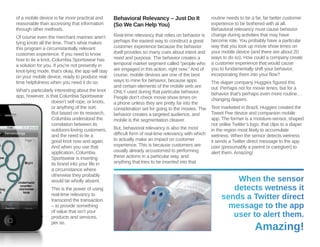
The diaper company Huggies figured this 
out. Perhaps not for movie times, but for a 
behavior that’s perhaps even more routine… 
changing diapers. 
Test marketed in Brazil, Huggies created the 
Tweet Pee device and companion mobile 
app. The former is a moisture-sensor, shaped 
not unlike Twitter’s logo, that clips to a diaper 
in the region most likely to accumulate 
wetness. When the sensor detects wetness 
it sends a Twitter direct message to the app 
user (presumably a parent or caregiver) to 
alert them. Amazing! 
When the sensor 
detects wetness it 
sends a Twitter direct 
message to the app 
user to alert them. 
Amazing!
But that’s not all. The system also tracks 
diaper usage and includes the ability to order 
more diapers from inside the app. 
While the Tweet Pee system has not been 
rolled out widely, it demonstrates how an 
app that adds real relevancy (real-time 
alerts and supply chain/ordering capabilities) 
could cause behavior change, even with a 
mundane and oft-repeated task like diaper 
changing. 
Location Relevancy – We Know 
Where You Are and What You Need 
Because mobile devices are consistently 
providing a steady stream of location 
information for use in mapping apps, weather 
apps, and even social media content 
creation (if geo-location features are turned 
on), location relevancy is perhaps the most 
pervasive form of real-time relevancy at 
present. 
Many brands seek to improve customer 
experiences by mining location and providing 
relevant information correspondingly. 
Charmin’s “Sit or Squat” mobile application 
recommends clean restrooms in the United 
States based on crowd-sourced data (which 
seems like a huge partnership opportunity 
with Tweet Pee). 
Not available on a mobile device, but still 
location-driven (by entering your postal code 
into a web application) is Achoo from Kleenex 
brand facial tissue, which uses your location 
and a Google data API to predict how likely 
you are to catch a cold or influenza within the 
next three weeks. 
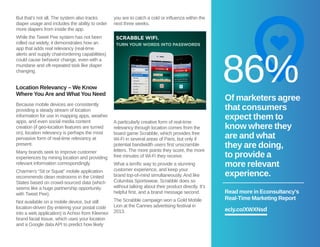
A particularly creative form of real-time 
relevancy through location comes from the 
board game Scrabble, which provides free 
Wi-Fi in several areas of Paris, but only if 
potential bandwidth users first unscramble 
letters. The more points they score, the more 
free minutes of Wi-Fi they receive. 
What a terrific way to provide a stunning 
customer experience, and keep your 
brand top-of-mind simultaneously. And like 
Columbia Sportswear, Scrabble does so 
without talking about their product directly. It’s 
helpful first, and a brand message second. 
The Scrabble campaign won a Gold Mobile 
Lion at the Cannes advertising festival in 
2013. 
♥ 
86% 
Of marketers agree 
that consumers 
expect them to 
know where they 
are and what 
they are doing, 
to provide a 
more relevant 
experience. 
Read more in Econsultancy’s 
Real-Time Marketing Report 
ecly.co/XWXNsd
It’s About Help Not Hype 
Today’s customers are being bombarded by 
messages and invitations and opportunities 
at an unprecedented rate. Internet advertising 
is set to increase its share of the ad market 
from 18% in 2012 to 23.4% in 2015, and 
overtake television spending by 2017. Yet 
54% of online ads are not even viewed by 
consumers. Brands that seek to succeed in 
this environment through sheer volume and 
by shouting ever louder are doomed to fail as 
consumers turn an increasingly deaf ear to 
those pleas and appeals. 
Instead we find more and more examples 
of brands embracing the paradox that the 
less you sell, the more you sell. Consumers 
respond to help, and relevance, and a truly 
great customer experience. Many of the best 
of these experiences are delivered in real-time 
(or nearly so). 
Brands have a choice. They can choose to 
engage in the pushy marketing approaches 
that have been stuffed down consumers’ 
throats for a century or choose instead to 
provide marketing that customers actually 
WANT to receive. 
Whether it’s Reactive, Circumstantial, 
Behavioral, or Location-based relevancy, the 
tools are there, today, to deliver something 
useful, even wonderful, to customers. 
I hope you have the courage and the support 
to try it in your own organization. 
// Jay Baer 
Internet advertising stats 
Internet advertising is set to 
increase its share of the ad market 
from 18% in 2012 to 23.4% in 2015, 
and overtake television spending 
by 2017. 
Yet 54% of online ads are not even 
viewed by consumers. 
// Read more in Econsultancy’s Advertising 
Statistics Compendium: ecly.co/1poocp0
About the Masters of CX Published by Econsultancy in association with Offerpop 
The Masters of CX series features true marketing thinkers 
and industry heavyweights, covering the issues surrounding 
your customer experience approach and strategy. 
These unique reports will be published between October 
and December 2014, along with two dedicated webinar 
sessions where you can gain first-hand insight from the 
authors on the key issues raised. 
We’re delighted to be working with some of the most 
influential authors within digital marketing. 
Reports in the series include: 
Winning Hearts in 
Real-time 
by Jay Baer 
Influence the Influencers 
- The Magic of Co-Created 
Content 
by Lee Odden 
Beyond the Sale: Building 
Customer Relationships 
for Life 
by Brian Clark 
Empower your Employees 
to Power your Customer 
Experience 
by Ted Rubin 
Customer Loyalty 
Lessons from Medieval 
Times 
by Mark Schaefer 
Why Brands are Stuck on 
Like and Failing at Love 
by Mitch Joel 
Find out more about the authors and reports at 
hello.econsultancy.com/masters-of-cx and 
join the discussion using #MastersofCX 
Econsultancy arms a global community of over half a million 
marketers and ecommerce professionals with the research, 
data, analysis, training, events and online resources they need to 
enable them (and their organizations) to succeed online. 
Digital doesn’t stand still and nor do we. We’re known for being 
at the forefront of the industry, with a renowned team of analysts, 
trainers and advisers who focus their digital knowledge and 
experience on helping our customers overcome their specific 
challenges. 
Find out more and register for a free account at 
econsultancy.com 
Offerpop is a digital marketing software-as-a-service platform 
transforming how global brands connect, engage and convert 
today’s mobile and social consumers into long-term loyal 
customers. Leading enterprises and agencies use Offerpop’s 
integrated platform to power campaigns, content and commerce, 
and provide marketers with rich consumer data for smarter 
marketing decisions. 
Offerpop is an ExactTarget Marketing Cloud partner, Facebook 
Preferred Marketing Developer, a Twitter Certified Product and 
has been highlighted as a recommended Instagram platform 
developer. 
Learn more at offerpop.com

Real Time CEX

  • 1.
    Masters of CX Winning Hearts in Real-Time ♥ By Jay Baer New York Times bestselling author Published by Econsultancy in association with Offerpop
  • 2.
    Winning Hearts inReal-Time / Jay Baer Customers are facing an invitation avalanche... Companies of all sizes and descriptions ask them to like, share, comment, follow, click and view. Combined with the constant barrage of messages inherent in an always-on world, it’s easy to see why fatigue sets in, and consumers simply tune out. The way for businesses to succeed in this exhausting, hyper-competitive environment is to stop trying to be amazing, and start being useful. After all, we crave useful things. In the book Contagious, Wharton Business School professor Jonah Berger describes a research project he and his class undertook whereby they analyzed every New York Times article (online edition) for a six-month period. They found that useful articles were forwarded 30% more than average. Of course they are! Everyone wants to be useful. Our friends are useful (for the most part). Your company can be useful in the same way, and use that as a competitive differentiator. That’s the core premise of my book Youtility: Why Smart Marketing is about Help not Hype.
  • 3.
    There are manyways that companies can be useful, but one of the optimal approaches is be useful in real-time. Smart companies are improving customer experiences by providing on-the-fly assistance and offers that don’t feel like marketing, but rather like a helping hand. We must recognize that ultimately, great customer experiences are great because they are relevant. When you provide a customer experience that is disproportionately useful or delightful or cherished or worthy of praise, those outcomes are because that customer experience is hyper-relevant and valuable. Interacting with customers in real-time, often through mobile and out-of-home, may be the best way to produce that differentiating relevancy. Many companies of all shapes and sizes across the B2B and B2C spectrums are experimenting with real-time relevancy and Youtility. Here we’ll focus on four variations of these programs: Reactive Relevancy, Circumstantial Relevancy, Behavioral Relevancy, and Location Relevancy. Reactive Relevancy – Conversational Usefulness The concept of reactive relevancy is a relatively new one, given that its viability is largely driven by Twitter and other social venues where questions can be posed and answers provided in a near-synchronous fashion. Certainly, discussion boards, forums, and even review sites like TripAdvisor, have some of the same underpinnings but they lack the speed and “hey, I didn’t expect that” nature of truly reactive relevancy. To engage in reactive relevancy, companies (or individuals) closely monitor social media for particular keywords and phrases and then tactfully jump in to proactively assist people making inquiries. At its core, this is strategic eavesdropping. And it works. Holli Beckman is the Vice President of Marketing and Leasing Operations for WC Smith, a Washington, D.C. headquartered real estate developer and property management firm that oversees more than 10,000 units in the region. Holli also owns Apartminty.com, an apartment-hunting consultancy that helps locate apartments for clients across the United States. Holli writes a comprehensive and useful blog on Apartminty about all things apartments. She knows the apartment locating business, and realizes that it’s far from easy. “Everyone complains about apartment hunting,” says Holli. “If you just type that search term into Twitter, you’ll see. It’s incredible. No one’s enjoying the experience.” Recognizing that if someone was taking the time to complain about apartments on Twitter, their need was both acute and present, Holli set out to take as much pain as possible out of the process, and generated more than 100 leads for Apartminty within 30 days, all from Twitter. 80% Currently define “real-time” as the ability to respond within two minutes. But 88% of marketers say they aren’t fast enough. Read more in Econsultancy’s Real-Time Marketing Report ecly.co/XWXNsd
  • 4.
    Twitter response stats 53% of customers who ask a brand a question on Twitter expect a response within one hour. But if they’re making a complaint, that figure goes up to 72%. If companies don’t respond within that hour, 38% of people feel more negatively towards the brand, and a 60% will take action against the brand using social media. Therefore, response time is more important with each passing day, as consumers increasingly take to social media to name and shame brands. // Read more on the Econsultancy blog: ecly.co/1tWPKrR
  • 5.
    “In two months,we generated six confirmed leases from my interactions on Twitter. Total lease amounts of approximately $144,000” Holli Beckman, Vice President of Marketing and Leasing Operations, WC Smith “I just started offering help. If someone complained “My roommate sucks” or “I can’t find a good roommate,” I would tweet them and point them to a blog post we had already written about that,” says Holli. “But then I started tweeting more open-ended responses like: “Hey, I saw that you’re overwhelmed. It can be overwhelming. If you need any assistance, let me know.” And people responded immediately to that. To people complaining about apartment hunting in the Washington, D.C. area, Holli responded empathetically and quickly from her WC Smith Twitter account, with similar results. “In two months, we generated six confirmed leases from my interactions on Twitter. Total lease amounts of approximately $144,000,” says Holli. In another example, in 2011 Ben and Jerry’s wanted to run a campaign that raised awareness of that year’s World Fair Trade Day. The company noticed that many Twitter users do not use the full 140 characters allocated to each tweet. This prompted it to create an application that allowed consumers to send tweets from its website, and any space remaining was used to automatically add a message about Fair Trade produce. Over a two-week period, Fair Tweets picked up 40m impressions, went out to 12m Twitter users, and was featured in 1,300 blogs and newspapers. 40 million impressions Went out to 12 million Twitter users Featured across 1,300 blogs and newspapers
  • 6.
    Circumstantial Relevancy –When You Need It, You Need It There is no courtship, ramp up, or slow build with real-time relevancy. You’re either sufficiently useful at any given moment, and can connect with the customer, or you’re not. It’s customer experience in the blink of an eye. Once you have new glasses, your ability to get questions about them answered by Warby Parker (the e-tailer that is disrupting the optical business partially by answering customer questions instantly on Youtube and Twitter) becomes a less-fulfilling proposition. Until, one day, you need new glasses again, and then you’ll know where to turn. Meanwhile, they have your money from the first purchase and are patiently waiting for your needs to re-align with their usefulness. Like an endless game of informational hide and seek, circumstantial real-time relevancy consists of popping out from behind a tree to assist when necessary, then fading back into the woods waiting for the next opportunity. Columbia Sportswear, a Portland, Oregon-based manufacturer and retailer of outdoor wear and gear, knows a lot about woods, and an equal amount about circumstantial relevancy. The company has a useful and free mobile application called “What Knot to Do in the Greater Outdoors.” As you’ve probably guessed, it provides detailed instructions for how to tie dozens of knots, including which to use when. With little marketing support, it was downloaded 351,000 times in its first 20 months of existence, and is so relevant it’s even creating circumstances for use, as described in this review from the iTunes App Store: “I went out and bought a rope so I could try my hand at these knots. Now I’m looking forward to the next time I go camping so I can display my knot-knowledge to the other guys.” Chris496 According to Adam Buchanan, the Social Media Manager at Columbia when the app was released, the company conducted research and found it is very common for outdoor enthusiasts to carry smartphones on excursions. “Customers regularly report using the camera, GPS, and music features of their devices while in the field, in addition to its obvious use as a phone,” says Adam. It makes perfect sense. If you need to remember how to tie a knot, being able to recall that information with the assistance 351, 000 Downloads within 20 months. “What Knot to Do in the Greater Outdoors” app
  • 7.
    of a mobiledevice is far more practical and reasonable than accessing that information through other methods. Of course even the merchant marines aren’t tying knots all the time. That’s what makes this program a circumstantially relevant customer experience. If you need to know how to tie a knot, Columbia Sportswear has a solution for you. If you’re not presently in knot-tying mode, that’s okay, the app will stay on your mobile device, ready to produce real-time helpfulness when you need it do so. What’s particularly interesting about the knot app, however, is that Columbia Sportswear doesn’t sell rope, or knots, or anything of the sort. But based on its research, Columbia understood the correlation between its outdoors-loving customers, and the need to tie a good knot now and again. And when you use that application, Columbia Sportswear is inserting its brand into your life in a circumstance where otherwise they probably would be wholly absent. This is the power of using real-time relevancy to transcend the transaction – to provide something of value that isn’t your products and services, per se. Behavioral Relevancy – Just Do It (So We Can Help You) Real-time relevancy that relies on behavior is perhaps the easiest way to construct a great customer experience because the behavior itself provides so many cues about intent and need and purpose. The behavior creates a temporal market segment called “people who are engaged in this action, right now.” And of course, mobile devices are one of the best ways to mine for behavior, because apps and certain elements of the mobile web are ONLY used during that particular behavior. People don’t check movie show times on a phone unless they are pretty far into the consideration set for going to the movies. The behavior creates a targeted audience, and mobile is the segmentation cleaver. But, behavioral relevancy is also the most difficult form of real-time relevancy with which to actually make an impact on customer experience. This is because customers are usually already accustomed to performing these actions in a particular way, and anything that tries to be inserted into that routine needs to be a far, far better customer experience to be bothered with at all. Behavioral relevancy must cause behavior change during activities that may have become rote. You probably have a particular way that you look up movie show times on your mobile device (and there are about 20 ways to do so). How could a company create a customer experience that would cause you to fundamentally shift your behavior, incorporating them into your flow? The diaper company Huggies figured this out. Perhaps not for movie times, but for a behavior that’s perhaps even more routine… changing diapers. Test marketed in Brazil, Huggies created the Tweet Pee device and companion mobile app. The former is a moisture-sensor, shaped not unlike Twitter’s logo, that clips to a diaper in the region most likely to accumulate wetness. When the sensor detects wetness it sends a Twitter direct message to the app user (presumably a parent or caregiver) to alert them. Amazing! When the sensor detects wetness it sends a Twitter direct message to the app user to alert them. Amazing!
  • 8.
    But that’s notall. The system also tracks diaper usage and includes the ability to order more diapers from inside the app. While the Tweet Pee system has not been rolled out widely, it demonstrates how an app that adds real relevancy (real-time alerts and supply chain/ordering capabilities) could cause behavior change, even with a mundane and oft-repeated task like diaper changing. Location Relevancy – We Know Where You Are and What You Need Because mobile devices are consistently providing a steady stream of location information for use in mapping apps, weather apps, and even social media content creation (if geo-location features are turned on), location relevancy is perhaps the most pervasive form of real-time relevancy at present. Many brands seek to improve customer experiences by mining location and providing relevant information correspondingly. Charmin’s “Sit or Squat” mobile application recommends clean restrooms in the United States based on crowd-sourced data (which seems like a huge partnership opportunity with Tweet Pee). Not available on a mobile device, but still location-driven (by entering your postal code into a web application) is Achoo from Kleenex brand facial tissue, which uses your location and a Google data API to predict how likely you are to catch a cold or influenza within the next three weeks. A particularly creative form of real-time relevancy through location comes from the board game Scrabble, which provides free Wi-Fi in several areas of Paris, but only if potential bandwidth users first unscramble letters. The more points they score, the more free minutes of Wi-Fi they receive. What a terrific way to provide a stunning customer experience, and keep your brand top-of-mind simultaneously. And like Columbia Sportswear, Scrabble does so without talking about their product directly. It’s helpful first, and a brand message second. The Scrabble campaign won a Gold Mobile Lion at the Cannes advertising festival in 2013. ♥ 86% Of marketers agree that consumers expect them to know where they are and what they are doing, to provide a more relevant experience. Read more in Econsultancy’s Real-Time Marketing Report ecly.co/XWXNsd
  • 9.
    It’s About HelpNot Hype Today’s customers are being bombarded by messages and invitations and opportunities at an unprecedented rate. Internet advertising is set to increase its share of the ad market from 18% in 2012 to 23.4% in 2015, and overtake television spending by 2017. Yet 54% of online ads are not even viewed by consumers. Brands that seek to succeed in this environment through sheer volume and by shouting ever louder are doomed to fail as consumers turn an increasingly deaf ear to those pleas and appeals. Instead we find more and more examples of brands embracing the paradox that the less you sell, the more you sell. Consumers respond to help, and relevance, and a truly great customer experience. Many of the best of these experiences are delivered in real-time (or nearly so). Brands have a choice. They can choose to engage in the pushy marketing approaches that have been stuffed down consumers’ throats for a century or choose instead to provide marketing that customers actually WANT to receive. Whether it’s Reactive, Circumstantial, Behavioral, or Location-based relevancy, the tools are there, today, to deliver something useful, even wonderful, to customers. I hope you have the courage and the support to try it in your own organization. // Jay Baer Internet advertising stats Internet advertising is set to increase its share of the ad market from 18% in 2012 to 23.4% in 2015, and overtake television spending by 2017. Yet 54% of online ads are not even viewed by consumers. // Read more in Econsultancy’s Advertising Statistics Compendium: ecly.co/1poocp0
  • 10.
    About the Mastersof CX Published by Econsultancy in association with Offerpop The Masters of CX series features true marketing thinkers and industry heavyweights, covering the issues surrounding your customer experience approach and strategy. These unique reports will be published between October and December 2014, along with two dedicated webinar sessions where you can gain first-hand insight from the authors on the key issues raised. We’re delighted to be working with some of the most influential authors within digital marketing. Reports in the series include: Winning Hearts in Real-time by Jay Baer Influence the Influencers - The Magic of Co-Created Content by Lee Odden Beyond the Sale: Building Customer Relationships for Life by Brian Clark Empower your Employees to Power your Customer Experience by Ted Rubin Customer Loyalty Lessons from Medieval Times by Mark Schaefer Why Brands are Stuck on Like and Failing at Love by Mitch Joel Find out more about the authors and reports at hello.econsultancy.com/masters-of-cx and join the discussion using #MastersofCX Econsultancy arms a global community of over half a million marketers and ecommerce professionals with the research, data, analysis, training, events and online resources they need to enable them (and their organizations) to succeed online. Digital doesn’t stand still and nor do we. We’re known for being at the forefront of the industry, with a renowned team of analysts, trainers and advisers who focus their digital knowledge and experience on helping our customers overcome their specific challenges. Find out more and register for a free account at econsultancy.com Offerpop is a digital marketing software-as-a-service platform transforming how global brands connect, engage and convert today’s mobile and social consumers into long-term loyal customers. Leading enterprises and agencies use Offerpop’s integrated platform to power campaigns, content and commerce, and provide marketers with rich consumer data for smarter marketing decisions. Offerpop is an ExactTarget Marketing Cloud partner, Facebook Preferred Marketing Developer, a Twitter Certified Product and has been highlighted as a recommended Instagram platform developer. Learn more at offerpop.com