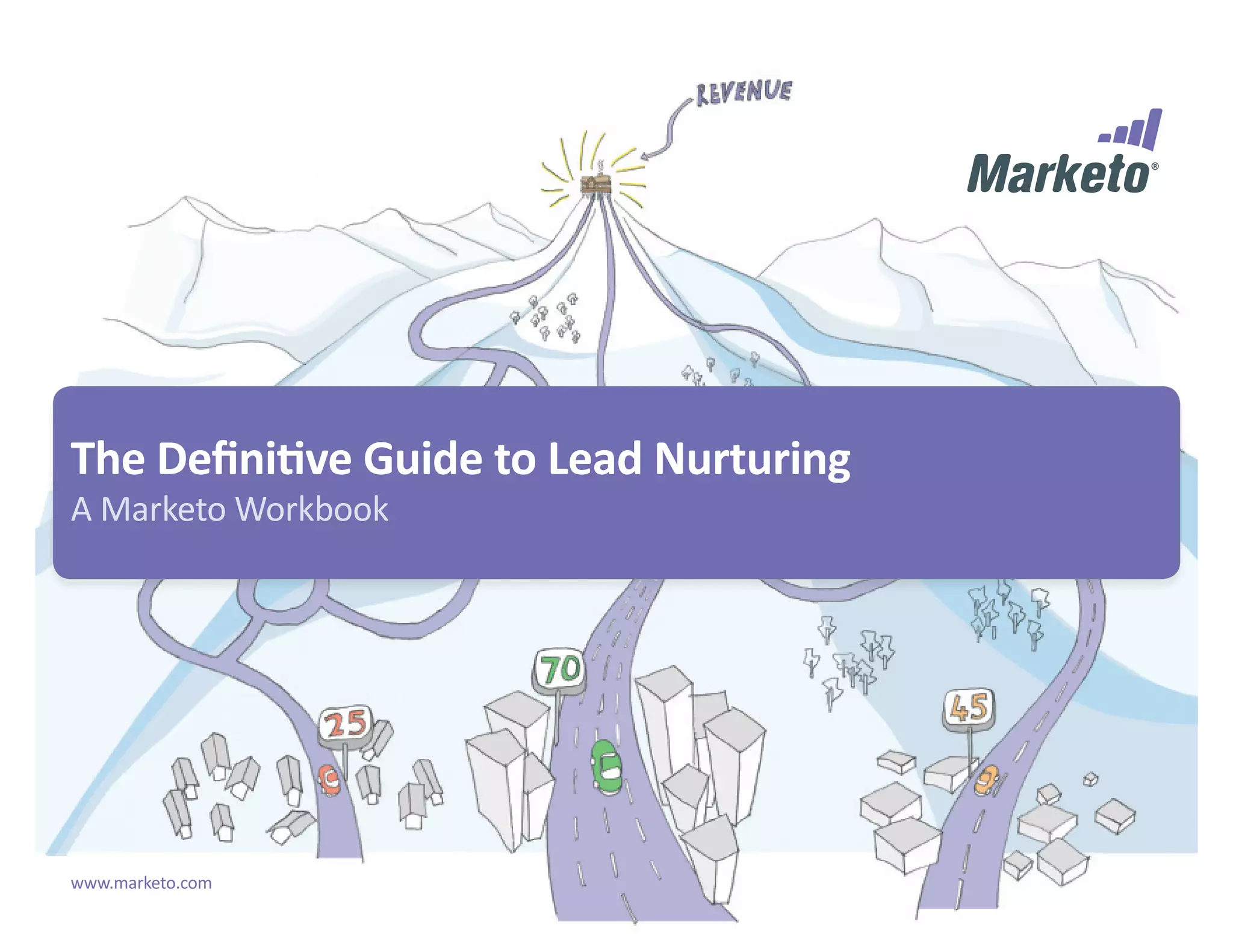
The Definitive Guide to Lead Nurturing 
A Marketo Workbook 
www.marketo.com
Why Should I Read The Definitive Guide to Lead Nurturing? 
Part One 
What is Lead Nurturing? 
Why Does My Business Need Lead Nurturing? 
The Importance of Lead Nurturing and Thought Leadership in Branding 
Marketing and Sales Collaboration: A Business Imperative 
Lead Nurturing for Existing Prospects 
The Return on Investment of Lead Nurturing 
Part Two 
Lead Nurturing Basics 
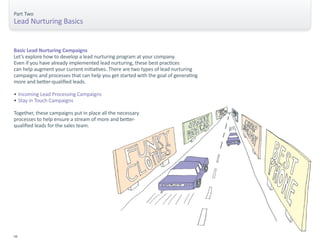
Basic Lead Nurturing Campaigns 
Incoming Lead Processing Campaigns 
Stay in Touch Campaigns 
Worksheet – Developing Your Stay in Touch Campaign Matrix 
Contents 
Part Three 
Advanced Lead Nurturing 
Accelerator Campaigns 
Lead Lifecycle Campaigns 
Part Four 
Calculating the ROI of Lead Nurturing 
Worksheet – The Impact of Lead Nurturing on Prospect-to-Lead Conversion 
and Cost Per Sales-Ready Lead 
Worksheet – Lead Nurturing Impact on Opportunities Won 
Conclusion 
Contact Us 
21 
23 
25 
29 
31 
34 
36 
37 
i 
01 
02 
04 
04 
05 
05 
07 
08 
09 
13 
17 
© 2009 Marketo, Inc. All rights reserved.
There’s no shortage of information on the topic of lead nurturing. 
Just plug the term into Google, and you’ll find pages of tips, tricks, and best practices 
designed to help B2B marketers better understand the concept and how to best 
implement it. While it’s exciting to see the plethora of lead nurturing best practices 
available today, it can also be somewhat overwhelming to process and difficult 
to identify which strategies are right for your business. 
The goal of this guide is to arm B2B marketers 
with the ultimate resource for lead nurturing, 
whether you’re just starting to think about 
lead nurturing in your business or are looking 
for ways to enhance and optimize your 
existing programs. 
The Definitive Guide is designed to be 
informative and practical. It offers useful, 
qualitative insight from today’s marketing 
thought leaders, basic and advanced best 
practices on must-have lead nurturing 
campaigns, and worksheets for calculating ROI 
and measuring the impact of lead nurturing 
done well. Use this guide as a workbook – 
take notes, highlight what you find 
inspirational, share what you learn with 
your colleagues, and start driving explosive 
revenue growth with lead nurturing. 
Why Should I Read The Definitive Guide to Lead Nurturing? 
i 
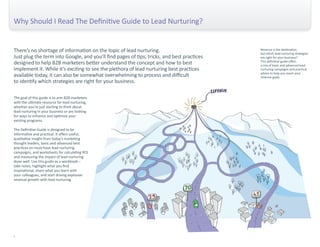
Revenue is the destination, 
but which lead nurturing strategies 
are right for your business? 
This definitive guide offers 
a mix of basic and advanced lead 
nurturing campaigns and practical 
advice to help you reach your 
revenue goals.
01 
Part One 
What Is Lead Nurturing? 
© 2009 Marketo, Inc. All rights reserved.
Part One 
What Is Lead Nurturing? 
If you’ve ever spent a single dollar on 
demand generation, you know first hand 
how expensive, time-intensive and challenging 
it is to make the most out of every lead you 
acquire. Many companies do a good job at 
generating leads — attracting prospects to 
a Web site or tradeshow booth, buying lists, 
etc. The problem is that most new leads are 
not yet ready to engage, so if a sales rep 
does try to contact a lead before he or she 
is ready, it reinforces the general impression 
that marketing-generated leads are no good. 
As a result, leads risk getting lost, ignored, 
or snatched up by competitors. 
To prevent this from happening, 
marketers should invest in lead nurturing — 
the process of building relationships with 
qualified prospects regardless of their timing 
to buy, with the goal of earning their business 
when they are ready. Building a relationship 
with a prospect is the same as with any long-term 
relationship — you can’t force someone 
to commit (to a purchase, in this case) — 
but you also cannot afford to lose individuals 
because their willingness to buy doesn’t 
match your readiness to sell. 
Most non-sales-ready leads will eventually 
be ready — and it is up to you to both 
provide them with relevant information 
and to be there when they are ready to 
make a buying decision. 
Why Does My Business Need Lead Nurturing? 
What Lead Nurturing isn’t – 
Pitfalls to Avoid 
Lead nurturing is about building 
relationships and trust with your 
prospects in a way that is both 
consistent and relevant. 
Lead nurturing is not: 
• Sending out an e-newsletter 
on a semi-regular basis 
• Randomly calling leads every 
six weeks to see if they are 
ready to buy 
• Blasting your entire database 
with a new case study 
• Offering content that promotes 
your company’s products 
and services and does not take 
into account your prospects’ 
interests or needs at their stage 
of buying 
How can you tell? 
Ask yourself if the information 
you’re providing will be useful 
to them even if they never buy 
from you. 
According to Brian Carroll, CEO of InTouch 
and author of Lead Generation for the 
Complex Sale, up to 95 percent of qualified 
prospects on your Web site are there to 
research and are not yet ready to talk with 
a sales rep, but as many as 70 percent of them 
will eventually buy a product from you — 
or your competitors. 
According to DemandGen Report, 
on average, nurtured leads produce 
a 20 percent increase in sales opportunities 
versus nonnurtured leads. 
02
03 
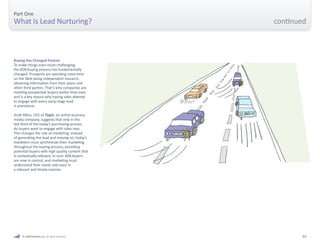
Buying Has Changed Forever 
To make things even more challenging, 
the B2B buying process has fundamentally 
changed. Prospects are spending more time 
on the Web doing independent research, 
obtaining information from their peers and 
other third parties. That’s why companies are 
meeting prospective buyers earlier than ever, 
and is a key reason why having sales attempt 
to engage with every early-stage lead 
is premature. 
Scott Albro, CEO of Tippit, an online business 
media company, suggests that only in the 
last third of the today’s purchasing process 
do buyers want to engage with sales reps. 
This changes the role of marketing; instead 
of generating the lead and moving on, today’s 
marketers must synchronize their marketing 
throughout the buying process, providing 
potential buyers with high quality content that 
is contextually relevant. In sum: B2B buyers 
are now in control, and marketing must 
understand their needs and react in 
a relevant and timely manner. 
Part One 
What Is Lead Nurturing? 
© 2009 Marketo, Inc. All rights reserved. 
continued
Part One 
What Is Lead Nurturing? 
When done well, lead nurturing plays 
a critical role in building your brand. 
B2B buyers are people too, and people 
are subject to emotional influence in their 
decision-making. Specifically, the more 
complex a decision, the more likely people 
are to use heuristics — experience-based 
techniques that help in problem solving, 
learning and discovery. Heuristics guide 
which options and information get considered, 
and they help us simplify complex decisions 
to their relevant core. That can be a good 
thing when the complexity of a B2B 
purchase is otherwise overwhelming. 
Emotions are heavily involved in the creation 
of heuristics. In B2B marketing, there is an 
asymmetry between the upside and downside 
of B2B purchases: the buyer may or may not 
be rewarded for making a good purchase, 
but a bad purchase can damage the buyer’s 
reputation and job security. 
As a result, fear and risk play large roles 
in B2B buying decisions. Organizational risk 
can be dealt with rationally, but personal 
risk is usually unstated and hidden from 
the rational process. Yet personal risk remains 
a huge factor in B2B buying. For example, 
if a board member mentions something 
negative about a potential vendor, 
the personal risk of choosing that vendor 
goes way up, and alternately, if he or she 
mentions something positive about a vendor 
not under consideration, that vendor may 
be “pre-wired” for success. 
The most important brand attributes for 
a B2B vendor are often credibility and trust 
– and unless you are a well known company 
like IBM, the best way to build credibility and 
trust is by sharing useful information. If you 
can help frame the discussion, your company 
will be seen as a trusted advisor and thought 
leader. If buyers believe that your company 
understands their problems and knows how 
to solve them, this helps reduce the feelings 
of fear and can make a big difference in being 
selected for consideration and purchase. 
The Importance of Lead Nurturing 
and Thought Leadership in Branding 
Marketing and sales alignment is a popular 
topic that is frequently discussed but not 
universally practiced in today’s B2B 
businesses. The basic principles of good 
lead nurturing are predicated on marketing 
and sales teamwork at every stage of what 
Marketo President and CEO Phil Fernandez 
calls a single Revenue Cycle. He refers to 
this fundamental change as ‘the last frontier 
in productivity.’ 
In today’s Web-centric world where buyers 
are reluctant to engage with sales until much 
later in the decision making process, there are 
at least three areas where marketing and sales 
collaboration becomes a business imperative: 
• The definition of a sales-ready lead derived 
from co-defined lead scoring values 
• The appropriate type of customer 
communication, associated cues 
and optimal timing 
• The lead profile and history that is most 
interesting and valuable to sales, especially 
for recycled leads 
Similar to the trusted advisor relationship 
your company is building with prospective 
customers, marketing and sales must share 
a common revenue goal, an interdependence 
that relies on earned trust and respect, 
and joint credit for revenue achievement. 
Marketing and Sales Collaboration: 
A Business Imperative 
04
05 
Part One 
What Is Lead Nurturing? 
A discussion on the value of lead nurturing 
would not be complete without exploring 
ROI. Let’s first take a look at these compelling 
statistics taken from research done by 
Marketo, Forrester, CSO Insights, and others. 
Companies that excel at lead nurturing: 
• Generate 50% more sales-ready leads 
at 33% lower cost per lead 
• Reduce the percent of marketing-generated 
leads that are ignored by sales 
(from as high as 80% to as low as 25%). 
• Raise win rates on marketing-generated 
leads (7% points higher) and reduce 
“no decisions” (6% points lower) 
• Have more sales representatives make 
quota (9% higher) and a shorter ramp up 
time for new reps (10% decrease) 
Additionally, anecdotal evidence suggests 
that nurtured prospects buy more, require 
less discounting, and have shorter sales cycles 
than prospects that were not nurtured. 
To calculate the ROI of lead nurturing at your 
company, please go to: Part Four: Calculating 
the ROI of Lead Nurturing (page 29). 
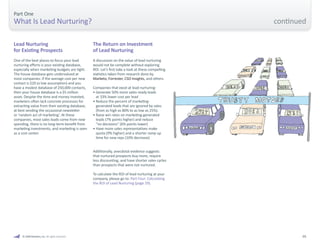
The Return on Investment 
of Lead Nurturing 
One of the best places to focus your lead 
nurturing efforts is your existing database, 
especially when marketing budgets are tight. 
The house database gets undervalued at 
most companies: if the average cost per new 
contact is $20 (a low assumption) and you 
have a modest database of 250,000 contacts, 
then your house database is a $5 million 
asset. Despite the time and money invested, 
marketers often lack concrete processes for 
extracting value from their existing database, 
at best sending the occasional newsletter 
or ‘random act of marketing’. At these 
companies, most sales leads come from new 
spending, there is no long-term benefit from 
marketing investments, and marketing is seen 
as a cost center. 
Lead Nurturing 
for Existing Prospects 
© 2009 Marketo, Inc. All rights reserved. 
continued
06
Part Two 
Lead Nurturing Basics 
© 2009 Marketo, Inc. All rights reserved. 07
Part Two 
Lead Nurturing Basics 
Basic Lead Nurturing Campaigns 
Let’s explore how to develop a lead nurturing program at your company. 
Even if you have already implemented lead nurturing, these best practices 
can help augment your current initiatives. There are two types of lead nurturing 
campaigns and processes that can help you get started with the goal of generating 
more and better-qualified leads. 
• Incoming Lead Processing Campaigns 
• Stay in Touch Campaigns 
Together, these campaigns put in place all the necessary 
processes to help ensure a stream of more and better-qualified 
leads for the sales team. 
08
© 2009 Marketo, Inc. All rights reserved. 09 
Part Two 
Lead Nurturing Basics 
Determine if Prospects are Ready 
to Engage with Sales 
For most marketers, the decision about which 
leads to nurture begins here. The process of 
defining what constitutes a “sales-ready” lead 
requires marketing and sales to agree upon 
the profile of an ideal customer and a lead 
scoring methodology. While the topic of lead 
scoring is not the focus of this guide, scoring 
methodologies should use a combination of: 
• Demographic attributes (company size, 
role, industry, etc.) 
• Lead source and offer 
• Budget, authority, need, and timeline 
(BANT) 
• Completeness of data profile (do you have 
enough of the above information) 
• Behavioral attributes (number of responses, 
overall engagement, etc.) 
Incoming Lead Processing Campaigns 
Lead nurturing is no different than building a long-term relationship — 
you need to foster respect and trust, be a good listener, and keep things 
interesting. Incoming Lead Processing campaigns are your chance to make 
a positive first impression – what you do and how you act when you first 
meet someone will affect how they perceive you from there on out. 
What should you be doing to lay the right foundation? 
Based on the above criteria, leads can be 
sorted in a variety of ways: bucketed into 
A, B, C, or D leads; “cold,” “warm,” or “hot” 
leads; ranked on a numerical scale; placed 
into lead stages, and so on. Depending on the 
sorting method you use, some new leads will 
be deemed “sales ready” and the others will 
need to remain in (or return to) marketing for 
further nurturing. 
Thanks to the rich functionality available 
in today’s marketing automation solutions, 
marketers can use technology to automate 
lead scoring and segmentation. Automation 
helps expedite the process and allows for 
more granular scoring rules – especially 
behavioral rules to measure engagement. 
Here are a few ideas to help you define what 
it means to be “sales ready”: 
• Does the prospect visit your Web site? 
If so, how often and which pages did he/she 
visit both before and after registering on 
your site? 
• What search terms did the prospect use 
to find more information about you? 
• Has the prospect visited “high-value” 
pages such as the pricing or contact 
information pages? 
• Have other prospects from the same 
company visited your Web site? 
• How has the prospect responded to your 
email campaigns or offers? 
• What interactions has your sales team 
had with the prospect and when? 
Regardless of how you choose to score 
and categorize your leads, implementing 
lead nurturing must begin by collaborating 
with all stakeholders to define a process for 
determining which leads get sent to sales 
and which leads get nurtured. 
How Marketo Does It 
At Marketo, all incoming leads 
are scored using a combination 
of demographics and lead source 
information, plus behavioral 
scores including all activity 
before registration. 
Demographic attributes can result 
in a score somewhere between 
0 points to 35 points. From there, 
each behavior is assigned a point 
value, anywhere from one point 
for each web page visited and 
email opened to 15 points for 
searching for “Marketo” on 
Google. Qualified leads with 
fewer than 65 points are called 
“Prospects” and receive further 
nurturing; people with more than 
65 points are called “Leads” and 
are sent to telesales for further 
qualification. This helps ensure 
that leads are prioritized and 
that telesales focuses on calling 
the most qualified, engaged, 
and educated leads. 
continued
Part Two 
Lead Nurturing Basics 
How to Establish Permission for Nurturing 
Incoming Lead Processing campaigns are 
also the time to ask prospects to opt in or opt 
out of your nurturing programs. The topic 
of permission marketing continues to garner 
much debate among marketers. At the most 
basic level, all marketers in the United States 
must comply with the CAN-SPAM Act, which 
requires that commercial email marketers 
avoid headers and subject lines that are 
“misleading” or “deceptive” and that they 
provide recipients with a clear way to opt out 
of receiving communications. The CAN-SPAM 
Act, however, does not require recipients 
to actually opt in to your communications. 
Following the CAN-SPAM Act is the bare 
minimum, and since lead nurturing thrives 
on relevancy, respect, and relationship 
building, many marketers will want to go 
further in establishing permission. The goal 
is to balance explicit permission with the 
need to rise above the noise of establishing 
permission in the first place. Many B2B 
companies have a privacy policy that simply 
adds everyone who registers on their Web 
site to their mailing list. While hard-core 
permission marketers may disagree, 
this policy is completely legal and is effective 
at many companies. 
Taking the “single opt-in” approach a step 
further, many experts recommend adding 
a checkbox to your registration forms 
(pre-checked of course) that establishes 
explicit permission to send additional 
information via email. Be sure to highlight 
the value of your nurturing content, so the 
prospective customer knows you won’t 
just be sending promotional material. 
The double opt-in approach is ideal: 
You send an email to a prospect that has 
already registered asking explicit permission 
to send additional emails. This is considered 
a best practice, since at the end of the day 
establishing permission is about beginning 
a relationship. The explicit double-opt in can 
be especially useful for leads you generate 
where the lead may not recognize you or 
your company. Examples of this include 
leads from content syndication sites and 
tradeshows that share the names of all 
attendees with sponsors. 
This is where automated campaigns can 
help: whenever you import a list, you can 
automatically launch a campaign to confirm 
permission. When recipients respond, you 
can then automatically add them to the 
appropriate nurturing program; if they don’t, 
you can either send them a “second chance”, 
or mark them as marketing suspended. 
Seth Godin’s Approach 
to Permission 
Seth Godin, creator of the 
concept of Permission Marketing, 
believes permission is creating 
a perceptible need or even 
hunger for your communications: 
“Real permission is different 
from presumed or legalistic 
permission. Just because 
you somehow get my email 
address doesn’t mean you 
have permission. Just because 
I don’t complain doesn’t mean 
you have permission. 
Just because it’s in the fine print 
of your privacy policy doesn’t 
mean it’s permission either. 
Real permission works like this: 
if you stop showing up, people 
complain, they ask where 
you went.” 
10
© 2009 Marketo, Inc. All rights reserved. 11 
Part Two 
Lead Nurturing Basics 
How to Establish Permission for Nurturing 
In other words, permission comes first 
and foremost from the quality of your content. 
For your company and B2B marketing 
organization, what is at stake here is your 
email reputation and deliverability rates. 
Deliverability is arguably one of the most 
important aspects of email marketing. 
George Bilbrey, CEO of ReturnPath, the world’s 
leading email services company, believes that 
permission is important, but “a confirmed 
opt-in does not automatically confer a good 
reputation.” However, he does believe that 
“permission influences complaints. Email 
recipients complain about email they don’t 
recognize. So, a confirmed opt-in process 
can be helpful, since recipients are less 
likely to mis-remember opting to receive 
your messages.” 
Here are the pros and cons for the 
methods we discussed here; you may 
end up using different approaches 
for different lead sources. 
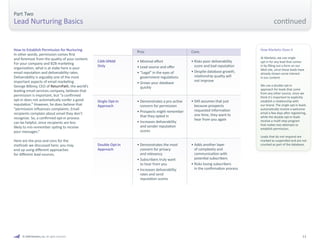
CAN-SPAM 
Only 
Single Opt-in 
Approach 
Double Opt-in 
Approach 
Pros Cons 
• Minimal effort 
• Lead source and offer 
• “Legal” in the eyes of 
government regulations 
• Grows your database 
quickly 
• Demonstrates a pro-active 
concern for permission 
• Prospects might remember 
that they opted in 
• Increases deliverability 
and sender reputation 
scores 
• Demonstrates the most 
concern for privacy 
and relevancy 
• Subscribers truly want 
to hear from you 
• Increases deliverability 
rates and send 
reputation scores 
• Risks poor deliverability 
score and bad reputation 
• Despite database growth, 
relationship quality will 
not improve 
• Still assumes that just 
because prospects 
requested information 
one time, they want to 
hear from you again 
• Adds another layer 
of complexity and 
communication with 
potential subscribers 
• Risks losing subscribers 
in the confirmation process 
How Marketo Does It 
At Marketo, we use single 
opt-in for any lead that comes 
in by filling out a form on our 
Web site, since these leads have 
already shown some interest 
in our content. 
We use a double opt-in 
approach for leads that come 
from any other source, since we 
think it’s important to explicitly 
establish a relationship with 
our brand. The single opt-in leads 
automatically receive a welcome 
email a few days after registering, 
while the double opt-in leads 
receive a multi-step program 
that makes two attempts to 
establish permission. 
Leads that do not respond are 
marked as suspended and are not 
counted as part of the database. 
continued
Part Two 
Lead Nurturing Basics 
How Marketo Does It 
As part of the welcome / opt-in 
emails that Marketo sends, 
we give prospects the option 
to “accelerate” the frequency 
of their communications, so they 
have control over how often they 
receive nurturing content from 
us. They also can mark which 
topics they are most interested 
in, which helps us tune their 
nurturing content. 
Determine Preferences 
Fine-tuning your nurturing approaches 
can often be as easy as directly asking 
prospects what they’d like to receive 
from you. Offering prospects the ability 
to customize their communications with 
you is a huge part of making your marketing 
more relevant — and marketing automation 
makes it easy to accomplish this. You might 
be pleasantly surprised at how receptive 
and willing people are to play an active role 
in helping you establish the basis for your 
permission marketing. 
Here are some questions that might be helpful 
in developing preferences for increasing 
relevancy: 
• How often would you like to receive 
communications from us? 
• Which types of communication would 
you like to receive? 
(e.g. email, direct mail, text messages, etc.) 
• What are your primary interests? 
(Offer multiple checkboxes that apply 
to your product or service offerings) 
12
© 2009 Marketo, Inc. All rights reserved. 13 
Part Two 
Lead Nurturing Basics 
Buyer Roles 
A good place to start is with the “Buying 
Committee” — the group of individuals 
that will be involved in the purchasing 
decision. In the Marketing News article 
It Takes a Committee to Buy into B-to-B, 
Tony Jaros, vice president of research 
at marketing and sales research firm 
SiriusDecisions, suggests that: 
“ Most of the people that you speak to at 
a company will fall under categories related 
to your marketing efforts, whether they 
have final say in the contract or not. 
The category designations may include 
the Champion, a user with purchasing 
authority; the Influencer, a person without 
the buying authority but with significant 
input, such as a consultant or middle 
manager or user; and the CXO, a member 
of the executive staff.” 
Stay in Touch Campaigns 
‘Stay in Touch’ campaigns are useful for all prospects that are not immediately 
ready to engage with sales. They form the backbone of your lead nurturing program 
by “dripping” out relevant content to prospects over time, helping to educate them 
and build trust and credibility for your company. By touching prospects regularly, 
they help keep your brand top of mind so that the prospect will contact you when 
they are ready to move to the next step. 
According to MarketingSherpa, even at small 
companies (100-500 employees), the average 
number of people involved in a decision 
is 6.8 — and that number goes as high as 21 
individuals on a buying committee at larger 
companies. Your nurturing content will need 
to speak to each of them and address their 
unique needs. 
Your roles will also vary based on the 
different audiences you serve, perhaps 
broken down by product line, company size, 
industry, or geography. Some companies 
will serve different size companies (e.g. 
small business, mid-market, and enterprise) 
with different information needs; yet other 
marketers will need to speak to different 
geographies, usually in different languages 
and with different cultural norms. The key 
is to understand your different audiences 
and ensure you have content for them. 
A buyer persona for an online bookstore 
might be the following: Jane, age thirty-eight, 
is a mother of three, a vice president of 
marketing, an avid fiction reader, and buys 
at least one book per month online. Buyer 
profiles are particularly relevant to lead 
nurturing — they help your campaigns target 
your most qualified segments and also add 
a “human” element to the relationship-building 
process. 
“ People want to do business with people. We’re human, 
and we crave interaction with people who know us. 
When you build content especially for your buyer personas, 
you build a relationship with people before you’ve even met them.” 
David Meerman Scott, Marketing Strategist and Author 
The New Rules of Marketing & PR 
To develop effective Stay in Touch 
campaigns, marketers should focus 
on four aspects: 
• Buyer Roles 
• Buying Stages 
• Content 
• Timing 
continued
Part Two 
Lead Nurturing Basics 
Buyer Roles 
As you’re developing your personas, keep 
in mind that they must work for the specific 
purpose of lead nurturing. Think about the 
characteristics of your audience that would 
help provide you with greater insight into 
how to best build a relationship with them. 
For instance, how do they prefer to receive 
communications from you (email, mobile 
phone, Twitter, etc.)? 
Finally, you need to identify which profile 
or role should apply to each new lead. 
You can use online forms and Incoming 
Lead Processing campaigns to find out this 
information, especially if you use techniques 
such as Progressive Profiling (e.g. the practice 
of modifying the fields on your forms to 
augment the information you already have). 
You can also observe where your prospects 
spend the majority of their time on your 
Web site. Together, these techniques will help 
you match the right role-based content with 
each prospect. 
Buyer Stages 
You will also want to define the stages 
a prospect goes through in buying your 
products or solutions, since the best lead 
nurturing is synchronized with the buyer’s 
process. Classically, there are four main 
stages; Awareness: Identify a business need; 
Consideration: Determine possible solutions; 
Research: Evaluate different solutions; 
and Purchase: Select a solution 
and negotiate purchase. 
Analyst firm SiriusDecisions presents a slightly 
different framework: 
• Stage 1 - Loosening of the Status Quo 
• Stage 2 - Committing to Change 
• Stage 3 - Exploring Possible Solutions 
• Stage 4 - Committing to a Solution 
• Stage 5 - Justifying the Decision 
• Stage 6 - Making the Selection 
Finally, B2B research firm Enquiro suggests 
that the buying process is not a simple logical, 
rational, and linear process where a prospect 
moves neatly from one stage to the next; 
rather, prospects move chaotically forward 
and backwards through the process as they 
balance rational decision making with the 
emotional impacts of fear and risk. Regardless, 
the better you understand the process your 
prospect goes through as they purchase your 
product or solution, the better you will be able 
to design your lead nurturing to facilitate — 
and perhaps accelerate — their purchase. 
14
© 2009 Marketo, Inc. All rights reserved. 15 
Part Two 
Lead Nurturing Basics 
Content 
Buyer roles and buying stages come together 
with your content. Lead nurturing is about 
maintaining an ongoing conversation 
with your prospects, and in this case, the 
conversation occurs in the marketing assets 
you use as well as the way in which your 
company communicates with prospects. 
Content plays a tremendous role in lead 
nurturing, as it often acts as a sales rep’s 
stand-in when a person is not yet sales ready. 
To ensure relevance, it is critical to focus 
your content on both the buyer role 
and the buying stage. 
Buyer role: Prospects find content targeted 
to their role or industry much more valuable 
than generic content. 
According to research firm MarketingSherpa: 
• 82% of prospects say content targeted 
to their specific industry is more valuable 
• 67% say content targeted to their job 
function is more valuable 
• 49% say the same for content targeted 
to their company size 
• 29% prefer content targeted 
to their geography 
Buying stage: The content someone would 
find relevant changes as they move through 
the process. 
For example: 
• Educational pieces work well during 
the early awareness stages. With these 
pieces, you are simply educating people 
and sharing best practices. 
• Industry-oriented pieces work well just 
as prospects start looking for a solution. 
Examples can be industry overviews, 
analyst reports, buyer’s guides, etc. 
• Solution-oriented and company-focused 
materials are appropriate for prospects 
engaged in an active buying cycle. 
Here are some additional best practices 
for developing content optimized for 
lead nurturing: 
Be sensitive to your prospect’s schedule 
and attention span — make your content 
easy to digest 
Just as the B2B buying process has changed, 
so have the ways that prospects interact 
with the content you provide. If you’re lucky 
enough to have them look at your content, 
you better make it engaging—which in most 
cases means it has to be short, sweet, 
and to the point. 
Make content valuable, not self-promotional. 
Before creating any piece of content, 
make sure you put your audience’s interests 
ahead of your own. People understand 
that if they’re reading a vendor-sponsored 
or vendor-written resource, the material 
probably alludes to what the vendor’s product 
or service can do. 
Use sales and marketing emails as a chance 
to get personal — not pushy 
The content or dialogue in your actual 
communications with prospects is an 
important consideration with lead nurturing. 
Use HTML emails to nurture leads, then follow 
up corporate emails with more personal, 
text-only emails from sales. 
Doug Kessler’s Definition 
of Content Marketing 
Doug Kessler, creative 
director at Velocity Partners 
and author of The B2B Content 
Marketing Workbook, provides 
succinct advice on how to 
turn organizational thinking 
into effective content based 
marketing campaigns. 
“ Thought Leadership is 
exploiting your unique position 
in your markets to generate 
valuable insight and advice 
on issues your customers 
and prospects care most about. 
Content Marketing is turning 
your insight and advice into 
campaigns that change people’s 
minds and incite action.” 
continued
Part Two 
Lead Nurturing Basics 
Timing 
Successful lead nurturing depends on 
getting the frequency of communication right. 
The timing of lead nurturing campaigns will be 
different for every company. As a very general 
guideline, contacting prospects more than 
once a week is too much and less than once 
a month is not enough. 
Here are some tips for determining the 
optimal frequency for your company: 
Consider the length of the buying process 
and the communication approaches used 
The timing of your lead nurturing programs 
are impacted by both the length of your 
average buying process as well as the 
approaches you use for lead nurturing 
(email, direct mail, phone, etc.). Direct mail 
and email could be considered less intrusive 
than a phone call, especially if the content 
of your communication is more educational 
than sales-oriented. In the following example, 
let’s assume a prospect downloads 
a whitepaper from your Web site, 
and your lead scoring methodology deems 
this individual a lead nurturing candidate. 
If the buying cycle for your product is three-months, 
your lead nurturing path might 
look like this: 
• Day 1 - Follow-up with introductory email 
• Day 10 - Email offering new content 
related to first download and subsequent 
Web site activity 
• Day 15 - Personal email from sales rep 
• Day 30 - Email best practices whitepaper 
• Day 45 - Call from sales rep to ‘check in’ 
• Day 60 - Email promoting webinar series 
• Day 75 - Personal email from sales rep 
offering a product demo 
• Day 85 - Call from sales rep to schedule 
in-person meeting 
• Day 90 - Send sales proposal via email 
There are two things to keep in mind here. 
First, notice that the communications become 
more frequent as the buying cycle progresses. 
Second, this is just one path a nurtured lead 
could take. 
Test the effects of frequency 
with multiple campaigns 
Testing is often confined to email subject lines 
and content, but B2B marketers can also use 
testing to optimize frequency and timing. 
When developing your automated nurturing 
campaigns, use the waiting period between 
triggers and actions as a test element to see 
if and how conversion rates are impacted 
by time period changes. 
Ask your prospects directly 
An underrated technique to improve 
lead nurturing is to just ask prospects 
how often they’d like to be contacted, 
and with what information. 
How Marketo Does It 
Marketo’s nurturing program 
has four main roles — marketing 
manager, marketing executive, 
sales rep, and agency — 
and three main buying stages: 
early stage awareness; middle-stage 
consideration; and late-stage 
evaluation. 
There are over 50 pieces of 
nurturing content spread across 
those roles and stages, so the 
typical prospect will receive 
between 10 and 30 total touches 
across the nurturing programs. 
By default, prospects will 
receive a nurturing campaign 
every two to three weeks, 
and slightly more frequently 
later in the buying cycle — 
though prospects have the 
option to “accelerate” and 
receive information more often.’ 
16
© 2009 Marketo, Inc. All rights reserved. 17 
Part Two 
Lead Nurturing Basics 
Buying Stages 
In this example, we’ll use the buying cycle stages outlined by SiriusDecisions. 
1 Loosening 
the Status Quo 
2 Committing 
to Change 
Stages 3 Exploring 
Possible Solutions 
4 Committing 
to a Solution 
5 Justifying 
the Decision 
6 Making 
the Selection 
A 
B 
C 
Your Turn 
Insert the stages of your company’s buying cycle here, adding or deleting columns as needed. 
The goal of this matrix is to provide you with 
an at-a-glance resource for determining the 
structure of your Stay in Touch campaigns. 
By completing this matrix, you’ll ensure that 
all of your campaign components — buyer 
profiles, buying stages, content and timing — 
are effectively aligned with each other so that 
you can communicate in the most relevant 
way with your prospects according to their 
buying stage. Each intersection of the matrix 
Stages 1 2 3 4 5 6 
A 
B 
C 
Developing Your Stay in Touch Campaign Matrix 
should map out the content to drip out, 
according to buyer profile and stage — 
ideally you want to fill out each grid box 
with multiple pieces of content over time. 
continued
Part Two 
Lead Nurturing Basics 
Buying Roles 
Insert Buyer Roles. Let’s use the roles suggested by SiriusDecisions. 
1 Loosening 
the Status Quo 
2 Committing 
to Change 
Stages 3 Exploring 
Possible Solutions 
4 Committing 
to a Solution 
5 Justifying 
the Decision 
6 Making 
the Selection 
Your Turn 
Insert the buyer roles of your company here, adding or deleting rows as needed. 
Champion 
User 
CXO 
IT 
Stages 1 2 3 4 5 6 
A 
B 
C 
D 
18
© 2009 Marketo, Inc. All rights reserved. 19 
Part Two 
Lead Nurturing Basics 
Content 
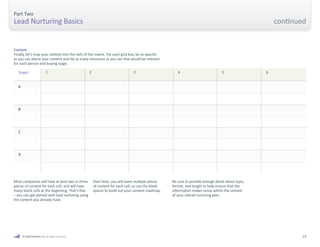
Finally, let’s map your content into the cells of the matrix. For each grid box, be as specific 
as you can about your content and list as many resources as you can that would be relevant 
for each person and buying stage. 
Stages 1 2 3 4 5 6 
A 
B 
C 
D 
Most companies will have at best two or three 
pieces of content for each cell, and will have 
many blank cells at the beginning. That’s fine 
– you can get started with lead nurturing using 
the content you already have. 
Over time, you will want multiple pieces 
of content for each cell, so use the blank 
spaces to build out your content roadmap. 
Be sure to provide enough detail about topic, 
format, and length to help ensure that the 
information makes sense within the context 
of your overall nurturing plan. 
continued
20
21 
Part Three 
Advanced Lead Nurturing 
© 2009 Marketo, Inc. All rights reserved.
Part Three 
Advanced Lead Nurturing 
In Part One, we defined lead nurturing — “the process of building relationships 
with qualified prospects regardless of their timing to buy, with the goal of earning 
their business when they are ready.” We discussed its vital role in enhancing brand, 
thought leadership and ROI results and we reviewed the importance of marketing 
and sales collaboration in today’s buyer-is-in-control world. 
In Part Two, we learned best practices in lead nurturing basics, practical advice 
from industry experts, and proven strategies for Incoming Lead Processing 
Campaigns and Stay in Touch Campaigns. 
With this foundation in place, we are now ready to examine the nuances 
and winning strategies for advanced lead nurturing: 
• Accelerator Campaigns 
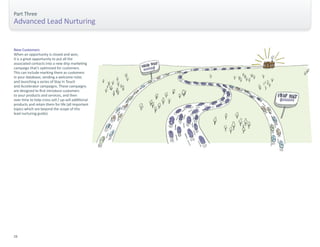
• Lead Lifecycle Campaigns 
22
23 
Part Three 
Advanced Lead Nurturing 
Unlike Stay in Touch campaigns in which 
nurturing “drips” are planned at pre-defined 
time intervals, Accelerator campaigns 
react to a variety of triggers — changes or 
updates in prospect profiles and behaviors — 
which then set off a specific type of action 
or set of actions. The triggers can be based 
on implicit behavioral data (e.g. opened 
email and visited “pricing” Web page) 
in combination with demographics. 
It’s easiest to think of triggers and their 
corresponding actions as programs that live 
outside your basic Stay In Touch campaigns 
and touch prospects orthogonally, or that 
affect the Stay In Touch campaigns by moving 
prospects between different tracks. 
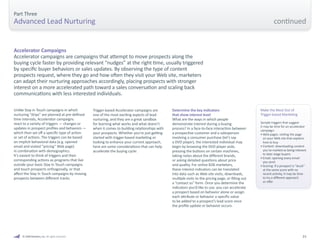
Accelerator Campaigns 
Accelerator campaigns are campaigns that attempt to move prospects along the 
buying cycle faster by providing relevant “nudges” at the right time, usually triggered 
by specific buyer behaviors or sales updates. By observing the type of content 
prospects request, where they go and how often they visit your Web site, marketers 
can adapt their nurturing approaches accordingly, placing prospects with stronger 
interest on a more accelerated path toward a sales conversation and scaling back 
communications with less interested individuals. 
Trigger-based Accelerator campaigns are 
one of the most exciting aspects of lead 
nurturing, and they are a great sandbox 
for learning what works and what doesn’t 
when it comes to building relationships with 
your prospects. Whether you’re just getting 
started with trigger-based marketing or 
looking to enhance your current approach, 
here are some considerations that can help 
accelerate the buying cycle: 
Determine the key indicators 
that show interest level 
What are the ways in which people 
demonstrate interest during a buying 
process? In a face-to-face interaction between 
a prospective customer and a salesperson 
involving a consumer purchase (let’s say 
a DVD player), the interested individual may 
begin by browsing the DVD player aisle, 
pressing the buttons on certain machines, 
taking notes about the different brands, 
or asking detailed questions about price 
and quality. For online B2B marketers, 
these interest indicators can be translated 
into data such as Web site visits, downloads, 
multiple visits to the pricing page, or filling out 
a “contact us” form. Once you determine the 
indicators you’d like to use, you can accelerate 
a prospect based on behavior alone or assign 
each attribute or behavior a specific value 
to be added to a prospect’s lead score once 
the profile update or behavior occurs. 
Make the Most Out of 
Trigger-based Marketing 
Sample triggers that suggest 
it may be time for an accelerator 
campaign: 
• Web pages: visiting the page 
on your Web site that explains 
how to buy 
• Content: downloading content 
you’ve marked as being relevant 
to later stage buyers 
• Email: opening every email 
you send 
• Scoring: If a prospect is “stuck” 
at the same score with no 
recent activity, it may be time 
to try a different approach 
or offer 
© 2009 Marketo, Inc. All rights reserved. 
continued
Part Three 
Advanced Lead Nurturing 
Develop multiple accelerator paths based 
on prospect interest level and buying stage 
Make sure that your prospects have 
a place to go if they show greater 
interest—but also if they begin to indicate 
disinterest through prolonged inactivity. 
Let’s say you have three main nurture 
paths, for early-stage buyers (A), mid-stage 
buyers (B), and late-stage buyers (C). 
Once early-stage prospects are deemed 
candidates for nurturing, they are placed 
on path A. If they begin to exhibit stronger 
interest, you can jump them to path B 
without finishing A, and when they are ready 
to engage with sales, they are accelerated 
to path C. On the other hand, if they fail 
to respond to multiple campaigns and 
demonstrate other signs of inactivity, 
you can send them back to path A or create 
a different path explicitly for those prospects. 
Start simple — don’t go overboard 
with multiple workflows or segments 
just because you can 
When it comes to structuring workflows 
for trigger campaigns, it may seem like the 
sky’s the limit, especially if there are a number 
of options for both triggers and actions. 
In the beginning, it’s best to resist this 
temptation. Start out by creating fairly 
straightforward workflows (e.g. if a prospect 
opens an email and visits a landing page but 
does not fill out the form, wait a few days 
and then send another email with a related 
offer). Once you’ve got a handle on basic 
workflows, consider varying the follow-up 
actions according to different behaviors 
(email open versus click-through) or different 
segments (the prospect had previous 
downloads or is part of an active opportunity). 
Give your campaigns room to evolve 
Remember that a lead nurturing campaign 
is more of an evolving conversation than 
a rigid, mapped-out process. When you’re 
creating campaigns, don’t get discouraged 
if prospects don’t respond as you expected — 
instead, use this data to create new segments 
or discover new ways to correlate buying 
stages with certain online behaviors. 
Your marketing automation solution 
should give you the flexibility to react 
quickly to new opportunities and revise 
your campaigns accordingly. 
Use campaigns as testing grounds for 
different nurturing components 
When we think of testing, we often focus 
on emails and landing pages. But you can 
also use campaigns to test other areas of 
lead nurturing, such as the impact of certain 
marketing assets on a specific segment, 
the ways that communication frequency 
can affect a prospect’s buying process, 
and more. Dedicate your early trigger 
campaigns to validate specific elements 
of your lead nurturing strategies, and apply 
what you learn to future efforts. 
How Marketo Does It 
At Marketo, we use Accelerator 
campaigns in two ways. 
First, when Prospects reach 
a specific threshold lead score 
that indicates interest but then 
stall out before making it all the 
way to becoming “sales ready”, 
we trigger a series of high 
value offers intended to spark 
re-engagement. Secondly, we 
watch for specific behaviors 
that indicate when we should 
move a prospect from Early 
Stage nurturing to Mid-Stage, 
or Mid-Stage nurturing to 
Late Stage. 
24
25 
Part Three 
Advanced Lead Nurturing 
Lead Lifecycle Campaigns 
Lead Lifecycle campaigns maximize marketing’s investment in lead generation by 
ensuring that leads will never grow stagnant or lost. As a general lead nurturing 
rule, there should be no place in the buying process where leads just “sit,” and you 
should have only one lead stage value for leads being nurtured. All other lead status 
values should have a time limit, and leads that sit idle past the deadline should be 
automatically recycled for further nurturing. In sum, Lead Lifecycle campaigns ensure 
movement and interaction with prospects, even if they are not ready to buy or sales 
does not engage. 
There are three important categories 
of Lead Lifecycle campaigns: 
• Lead Handoff 
• Lead Recycling 
• New Customers 
Lead Handoff 
When a lead becomes sales ready, an 
automated campaign to pass the lead 
to sales can make the difference between 
timely follow-up and no response. There are 
many ways to let sales know when a lead 
is ready for sales engagement: by loading 
it into the CRM system; changing the lead’s 
Status field; changing the owner or creating 
a task in the CRM system; or by sending an 
alert over email or SMS. Depending on your 
company’s organization and the “hotness” 
of the lead, you may choose a combination 
of these functions. 
You should also identify the date a lead 
is handed to sales. This lets you easily 
calculate how long a lead was nurtured 
and how quickly sales engages with the 
lead. It’s a good idea to establish a “service 
level agreement” in which sales commits 
to handling the lead in a timely fashion; 
any leads that are not moved forward 
in the process, or sent backward, within 
that timeframe should be automatically 
reassigned or recycled back to marketing. 
This ensures that leads continue to flow 
and nothing gets “stuck” or lost in the sales 
lead stage. 
© 2009 Marketo, Inc. All rights reserved. 
continued
Part Three 
Advanced Lead Nurturing 
Lead Recycling 
As you’ll recall, Incoming Lead Processing 
campaigns are used to determine if a lead 
is “sales ready” according to agreed-upon 
criteria from your marketing and sales teams. 
But what happens if, ‘sales-ready’ leads are 
not contacted or a rep decides that some 
of these leads were still not ready to engage? 
The importance of lead recycling becomes 
even more apparent when we consider that 
of all leads that enter the sales pipeline, 
almost 80% of them are lost or ignored by 
sales. What sort of real-world impact can 
this have on revenue? Brian Carroll, CEO 
of InTouch, offers a compelling case: 
“ We had a client that had passed about 
12,000 leads to its sales force in the year. 
But of those, about 2,500 were simply 
lost — nobody knew what happened 
to them… we found that a number had 
bought from a competitor or weren’t 
actively interested anymore. But we also 
found that 15%—about 375 contacts — 
were actually hot leads that indicated 
they were ready to talk to a salesperson. 
Of those, 7% actually bought, resulting 
in $1.2 million in added revenue.” 
In general, there are two types of lead 
recycling scenarios—one in which leads 
are automatically recycled according to a set 
of business rules and the other in which leads 
are manually recycled by sales. 
The goal of the recycling campaign is to 
reassign — and track — leads that for any 
reason cannot be pursued by sales in a timely 
manner. Perhaps you received a flood of hot 
sales-ready leads from a specific campaign, 
making it impossible for reps to follow up 
with all qualified leads in a timely fashion. 
In this situation, marketing and sales must 
jointly set up ground rules regarding which 
leads will be automatically reassigned if they 
are not pursued within a certain time frame. 
After marketing and sales agree on an 
approach, marketing can set up automated 
campaigns to manage the lead recycling 
whenever the specific business rules 
or conditions are met. 
There will also be situations when leads 
should be manually recycled by sales. 
If, after contacting a group of leads, 
a rep determines that they are still not 
sales-ready, these prospects should be sent 
back to marketing. What makes this situation 
unique, however, is the fact that sales has 
already had a conversation with these leads 
and knows more about their buying intent 
than for leads without any sales interaction. 
Because of this added insight, sales should be 
able to manually recycle these leads back to 
marketing, provide added details about their 
interaction, and indicate how and when the 
leads should be moved back into sales. 
One option is to base sales re-engagement 
on a business rule such as a lead score change. 
For example, if a lead is determined to be not 
sales-ready, its score will be reset to 15 and it 
will not be passed back to sales until it reaches 
a score of 70. Alternatively, sales can use its 
knowledge of the leads’ buying interests to 
indicate a specific timeframe in which the lead 
should be re-engaged. 
26
27 
Part Three 
Advanced Lead Nurturing 
How Marketo Does It 
Sales reps can recycle leads 
back to marketing simply by 
clickinga button. When leads 
are recycled, they can mark 
one of two reasons: “Target 
Company But Did Not Connect” 
or “Target Company But No 
Active Evaluation”. If the latter 
is chosen, the rep can also select 
a timeframe: two weeks, one 
month, three months, six months, 
or Unknown. 
When a specific timeframe is 
chosen, the rep can be confident 
that the prospect will receive 
a customized nurturing path 
optimized for that time period — 
including personalized contacts 
from the rep — and that after the 
specified time, the lead will be 
sent back to the rep automatically 
for follow-up. 
Lead Recycling 
When leads are recycled, you can either 
put them back into one of your basic 
Stay in Touch campaigns, or even better, 
you can create a specialized version of 
the Stay in Touch campaign that is optimized 
for the specific information the rep collected 
during their interactions (e.g. interests 
and timing). Here are some tips for 
optimizing these strategies: 
Be extra sensitive to relevancy and timing 
Have reps add detailed notes about their 
interactions so far and why the lead is being 
recycled — and make sure that your nurturing 
approach accounts for this information. 
You may even want to work with sales 
to develop custom fields in your CRM 
and marketing automation solutions that 
will help you increase relevancy with these 
recycled leads. 
Consider different approaches when 
you know a prospect’s timeframe 
In many cases, leads will be recycled because 
they are still researching or their timeframe 
to buy falls outside of what your company 
considers sales ready. In other cases, the 
timeframe may be unknown. These variables 
may warrant the development of specific 
nurturing paths. 
For example, if you know a prospect’s 
timeframe to buy, you could increase 
the frequency of communications, provide 
high-value offers or promotions, or message 
more aggressively as his or her timing 
milestone approaches. On the other hand, 
if you don’t know the timeframe, you might 
be more conversational and educational 
in tone with your emails. 
However, even if the timeframe is unknown, 
you could still differentiate a recycled lead 
from a Stay in Touch campaign candidate by 
creating new lead formulas based on whether 
a prospect is recycled or not. For example, 
a Web page visit for a “normal” nurtured lead 
would garner two points, but a recycled lead 
might earn five points, since earlier the person 
demonstrated a higher level of interest. 
Don’t be afraid to incorporate phone outreach 
more than you normally would. In many cases, 
sales reps have already communicated with 
recycled leads by phone. Since a phone 
conversation is a coveted interaction when 
building a relationship, be sure to incorporate 
phone outreach with recycled leads more 
than you might with leads on other nurturing 
paths. But remember, a phone conversation 
does not necessarily mean greater 
commitment to a sale on the part of the 
prospect. Use these conversations as ways 
to increase trust and find out more about 
your prospects’ needs — rather than simply 
trying to “close a deal.” 
As we noted in our introduction to lead 
nurturing basics, marketing and sales 
collaboration is a best practice. In the case 
of Lead Lifecycle campaigns, it is a business 
imperative. When both marketing and sales 
have begun to build relationships with 
recycled leads, each team should be involved 
in and aware of the other’s activities, paying 
special attention to the campaigns and sales 
interactions that occurred before and after 
the lead was recycled. 
For example, if marketing wants to run a new 
email campaign to recycled leads more than 
three months old, it should collaborate with 
sales on special messaging that re-introduces 
the company and/or product appropriately. 
In the case of Lead Lifecycle campaigns, 
providing email templates for your sales team 
can promote messaging specifically tailored 
to re-engaging prospects. 
© 2009 Marketo, Inc. All rights reserved. 
continued
Part Three 
Advanced Lead Nurturing 
New Customers 
When an opportunity is closed and won, 
it is a great opportunity to put all the 
associated contacts into a new drip marketing 
campaign that’s optimized for customers. 
This can include marking them as customers 
in your database; sending a welcome note; 
and launching a series of Stay In Touch 
and Accelerator campaigns. These campaigns 
are designed to first introduce customers 
to your products and services, and then 
over time to help cross-sell / up-sell additional 
products and retain them for life (all important 
topics which are beyond the scope of this 
lead nurturing guide). 
28
29 
Part Four 
Calculating the ROI of Lead Nurturing 
© 2009 Marketo, Inc. All rights reserved.
Part Four 
Calculating the ROI of Lead Nurturing 
In Part One of the Definitive Guide to Lead Nurturing, we learned the value 
of lead nurturing done well, and in Parts Two and Three, we explored best 
practices for a range of lead nurturing strategies: 
• Incoming Lead Processing Campaigns 
• Stay in Touch Campaigns 
• Accelerator Campaigns 
• Lead Lifecycle Campaigns 
But how do you prove the ROI of lead nurturing in your own organization? 
• Show the ROI of lead nurturing by comparing “before” and “after” scenarios 
based on industry metrics. 
• Use this framework to calculate the potential ROI at your organization. 
For every step, you’ll see an “Example” followed by “Your Turn” in which you 
can try out the method using your own data. After completing the worksheet, 
you should have the information you need to bolster the case for lead nurturing 
at your organization. Or if you have already established lead nurturing programs, 
use this worksheet to compare your results to industry standards. 
30
31 
First, define the lead stages that matter to your organization 
Use as many stage definitions as necessary; the most important thing is consensus 
amongst marketing, sales, and the executive team about the each stage’s definition. 
In this example, marketing success metrics will be determined by the conversion 
rates from the stages of prospect to lead to opportunity. 
ROI Calculation One 
The Impact of Lead Nurturing on Prospect-to-Lead Conversion and Cost Per Sales-Ready Lead 
Part Four 
Calculating the ROI of Lead Nurturing 
Stages 
1 All Names 
2 Prospect 
3 Sales Lead 
4 Opportunity 
Stage Definition 
All individuals begin at this stage before being 
qualified in any way. 
An individual who meets the demographic 
requirements of the “qualified” customer 
profile. 
An individual who has a “qualified” customer 
profile AND has shown sufficient interest and 
engagement to be worthy of a sales contact, 
perhaps indicated by a high lead score.* 
A contact/account that a sales rep has 
confirmed as a potential sale and will now be 
accounted for in the sales forecast or pipeline. 
Your Turn 
Document your stage definitions here. 
*If you don’t have the ability to measure interest and engagement, let the sales team tell you which leads 
were “sales ready,” and count those. Since most leads take time to become sales ready, this will typically 
be just a subject of all the qualified prospects. 
© 2009 Marketo, Inc. All rights reserved. 
Stages 
1 
2 
3 
4 
Stage Definition 
continued
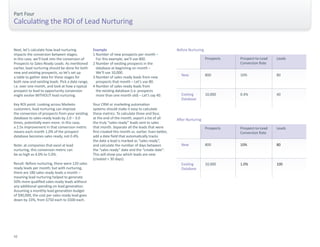
Next, let’s calculate how lead nurturing 
impacts the conversion between stages; 
in this case, we’ll look into the conversion of 
Prospects to Sales-Ready Leads. As mentioned 
earlier, lead nurturing should be done for both 
new and existing prospects, so let’s set up 
a table to gather data for these stages for 
both new and existing leads. Pick a date range, 
i.e. over one month, and look at how a typical 
prospect to lead to opportunity conversion 
might evolve WITHOUT lead nurturing. 
Key ROI point: Looking across Marketo 
customers, lead nurturing can improve 
the conversion of prospects from your existing 
database to sales-ready leads by 2.0 – 3.0 
times, potentially even more. In this case, 
a 2.5x improvement in that conversion metric 
means each month 1.0% of the prospect 
database becomes sales ready, not 0.4%. 
Note: at companies that excel at lead 
nurturing, this conversion metric can 
be as high as 4.0% to 5.0%. 
Result: Before nurturing, there were 120 sales 
ready leads per month; but with nurturing, 
there are 180 sales ready leads a month – 
meaning lead nurturing helped to generate 
50% more qualified sales-ready leads without 
any additional spending on lead generation. 
Assuming a monthly lead generation budget 
of $90,000, the cost per sales-ready lead goes 
down by 33%, from $750 each to $500 each. 
Part Four 
Calculating the ROI of Lead Nurturing 
New 
Existing 
Database 
Prospects 
800 
10,000 
Prospect-to-Lead 
Conversion Rate 
Leads 
10% 
0.4% 
80 
40 
Before Nurturing 
New 
Existing 
Database 
Prospects 
800 
10,000 
Prospect-to-Lead 
Conversion Rate 
Leads 
10% 
1.0% 
80 
100 
After Nurturing 
Example 
1 Number of new prospects per month – 
For this example, we’ll use 800. 
2 Number of existing prospects in the 
database at beginning on month – 
We’ll use 10,000. 
3 Number of sales-ready leads from new 
prospects that month – Let’s use 80. 
4 Number of sales-ready leads from 
the existing database (i.e. prospects 
more than one month old) – Let’s say 40. 
Your CRM or marketing automation 
systems should make it easy to calculate 
these metrics. To calculate three and four, 
at the end of the month, export a list of all 
the truly “sales-ready” leads sent to sales 
that month. Separate all the leads that were 
first created this month vs. earlier. Even better, 
add a date field that automatically tracks 
the date a lead is marked as “sales ready”, 
and calculate the number of days between 
the “sales ready” date and the “create date”. 
This will show you which leads are new 
(created < 30 days). 
32
33 
Part Four 
Calculating the ROI of Lead Nurturing 
New 
Existing 
Database 
Prospects Prospect-to-Lead 
Conversion Rate 
Leads 
Before Nurturing 
New 
Existing 
Database 
Prospects Prospect-to-Lead 
Conversion Rate 
Leads 
After Nurturing 
Your Turn 
Now it’s time to plug in your own numbers. 
Before Nurturing: Choose a specific 
data range, and in the first column, 
enter the number of prospects (or your 
term for individuals before they become 
sales-ready leads) for both new individuals 
and those existing in your house database. 
In the third column, enter the number 
of sales-ready leads you generated 
from both new and existing prospects, 
for your chosen date range. 
In the second column, calculate the current 
conversion rate between the two stages. 
After Nurturing: Now calculate the potential 
impact of lead nurturing on your current data. 
Keep the first row the same. In the second 
column, increase the conversion rate by 
2X-3X, and then calculate the new number 
of sales-ready leads in the third column. 
What is your new total? What is the resulting 
reduction in cost per sales-ready lead? 
© 2009 Marketo, Inc. All rights reserved. 
continued
ROI Calculation Two 
Lead Nurturing Impact on Opportunities Won 
Part Four 
Calculating the ROI of Lead Nurturing 
Most companies are pretty good at Before Nurturing 
identifying leads that want to engage 
with sales right away (i.e. fast-moving leads), 
but are less proficient at staying in touch with 
the remaining leads that need more time. 
As a result, many potential opportunities 
never get created because a prospect wasn’t 
ready to engage when they first met the 
company, and the company didn’t stay in 
touch so they did not remain top-of-mind 
when the lead was ready to move forward. 
For another ROI calculation, let’s look 
at all the ‘opportunities won’ generated 
by marketing over a given time period, 
say a year, and calculate how many came 
from fast-moving leads that were less than 
30 days old before being sent to sales vs. how 
many came from older leads in the database. 
At companies without lead nurturing, 
sometimes things are so bad that NO ‘won’ 
opportunities are derived from older leads, 
whereas at companies that excel at lead 
nurturing, as many as 1/2 (50%) of the ‘won’ 
opportunities and associated revenue come 
from older, nurtured leads. 
Let’s calculate the ratio at your 
company and see the potential ROI 
from improved nurturing. 
Example 
Before nurturing: For a given date range 
(say one year), we’ve collected the following 
information. At this company, 1/3 (33%) of 
the marketing-generated ‘won opportunities’ 
came from older leads. Not too bad. 
After nurturing: If this company could 
implement lead nurturing and get closer 
to the benchmark that half the ‘won’ 
opportunities should come from nurtured 
leads, we can expect the same number of 
‘won’ opportunities from the “fast moving 
leads” (200) but in this case, there would 
be an additional 100 ‘won’ opportunities. 
With lead nurturing, we see at least 
a 33% increase in total marketing-generated 
won opportunities. 
Won Opportunities from Leads 
Under 30 days old 
Won Opportunities from Leads 
Over 30 days old 
Won Opportunities 
Total Marketing-Generated 
200 
100 
300 
After Nurturing 
Won Opportunities from Leads 
Under 30 days old 
Won Opportunities from Leads 
Over 30 days old 
Won Opportunities 
Total Marketing-Generated 
200 
200 
400 
34
35 
Part Four 
Calculating the ROI of Lead Nurturing 
Your Turn 
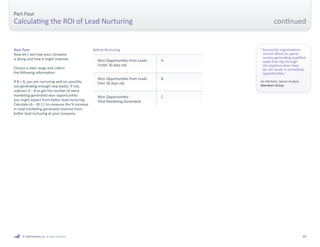
Now let’s see how your company 
is doing and how it might improve. 
Choose a date range and collect 
the following information: 
If B > A, you are nurturing well (or possibly 
not generating enough new leads). If not, 
subtract A – B to get the number of extra 
marketing-generated won opportunities 
you might expect from better lead nurturing. 
Calculate (A – B) / C to measure the % increase 
in total marketing-generated revenue from 
better lead nurturing at your company. 
“ Successful organizations 
cannot afford to spend 
money generating qualified 
leads that slip through 
the pipeline when they 
do not result in immediate 
opportunities.” 
Ian Michiels, Senior Analyst, 
Aberdeen Group 
© 2009 Marketo, Inc. All rights reserved. 
Before Nurturing 
Won Opportunities from Leads 
Under 30 days old 
Won Opportunities from Leads 
Over 30 days old 
Won Opportunities 
Total Marketing-Generated 
A 
B 
C 
continued
Conclusion 
Lead nurturing is the process of building relationships with qualified prospects 
regardless of their timing to buy, with the goal of earning their business when 
they are ready. Why? Because 95% of the prospects visiting your Web site today 
are there to research, but as many as 70% of them will eventually buy a product 
from you or from your competitor. Because today’s buyers prefer not to engage 
with sales until the last third (1/3) of the purchasing process, marketing and sales 
must collaborate throughout every stage in the revenue cycle to provide 
prospective customers with high quality information and content that is timely, 
relevant and responsive to their situation. 
The Definitive Guide to Lead Nurturing 
outlined the importance of lead nurturing 
and thought leadership in establishing 
your company’s brand and your customer’s 
trust. It provided exercises and worksheets 
on how to calculate return on investment 
(ROI) from lead nurturing on prospect-to-lead 
conversion, cost per sales-ready lead, 
and impact on opportunities won through 
lead nurturing. Need more evidence? 
Companies that excel at lead nurturing 
generate 50% more sales-ready leads 
at 33% lower cost per lead and boost sales’ 
acceptance of marketing-generated leads 
by at least 25%. 
For both novice and experienced practitioners, 
the Definitive Guide to Lead Nurturing offered 
advice, best practices and a summary of How 
Marketo Does It covering: 
• Incoming Lead Processing Campaigns, 
including lead scoring and permission 
for nurturing 
• Stay in Touch Campaigns, including buyer 
roles, buying stages and content based 
on timing and stage 
• Accelerator Campaigns, facilitated 
by triggered-based marketing 
• Lead Lifecycle Campaigns to increase 
the efficiency and effectiveness of lead 
handoff, lead recycling and continuing 
the dialog with new customers 
When you invest in lead nurturing, you make 
the most out of every dollar your organization 
spends on demand generation, and you can 
rekindle once-stagnant opportunities from 
your existing database. By using lead nurturing 
campaigns to interact with your prospects 
and understand their interest and behavior, 
you gain deeper insight into their buying 
intent, increase the relevancy of future lead 
nurturing campaigns, and ultimately benefit 
from more and higher quality sales leads, 
increased conversion rates and explosive 
revenue growth. 
36
© 2009 Marketo, Inc. All rights reserved. 37 
Call: 650-655-4830 
Email: info@marketo.com 
Visit our Web site: www.marketo.com 
To get The Definitive Guide to Lead Nurturing online, 
visit: www.marketo.com/dg2-lead-nurturing 
Visit our blog: blog.marketo.com 
About Marketo 
Marketo is the fastest growing provider 
of marketing automation and revenue-building 
best practices. 
Marketo’s uncompromising on-demand 
solutions enable marketing and sales 
teams to collaborate throughout the revenue 
cycle, from the earliest stages of demand 
generation and lead management to the 
pursuit of revenue and customer loyalty. 
Marketo Lead Management gives Marketing 
the power and flexibility to automate 
demand generation campaigns and deliver 
more high-quality leads with less effort, 
and Marketo Sales. 
Insight helps Sales understand, 
prioritize and interact with the hottest 
leads and opportunities to close more 
business faster. Known for providing 
the most innovative customer experience 
and the fastest time to value, Marketo 
was voted ‘Best Marketing Automation 
Application’ by Salesforce customers 
on the Force.com AppExchange. 
As of July 2009, more than 220 mid-market 
and enterprise companies in nine countries 
have selected Marketo. 
Contact Us 
Acknowledgements 
Marketo would like to thank the following 
thought leaders for contributing to the 
Definitive Guide to Lead Nurturing. 
Ian Michiels, Aberdeen Group 
CSO Insights 
DemandGen Report 
Enquiro 
Forrester Research 
Brian Carroll, In Touch 
Marketing Sherpa 
George Bilbrey, Return Path 
Tony Jaros, Sirius Decisions 
Scott Albro, Tippit 
Designed & illustrated by Velocity, 
the B2B marketing agency.
info@marketo.com 
www.marketo.com

Definitive guide-to-lead-nurturing

  • 1.
    The Definitive Guideto Lead Nurturing A Marketo Workbook www.marketo.com
  • 3.
    Why Should IRead The Definitive Guide to Lead Nurturing? Part One What is Lead Nurturing? Why Does My Business Need Lead Nurturing? The Importance of Lead Nurturing and Thought Leadership in Branding Marketing and Sales Collaboration: A Business Imperative Lead Nurturing for Existing Prospects The Return on Investment of Lead Nurturing Part Two Lead Nurturing Basics Basic Lead Nurturing Campaigns Incoming Lead Processing Campaigns Stay in Touch Campaigns Worksheet – Developing Your Stay in Touch Campaign Matrix Contents Part Three Advanced Lead Nurturing Accelerator Campaigns Lead Lifecycle Campaigns Part Four Calculating the ROI of Lead Nurturing Worksheet – The Impact of Lead Nurturing on Prospect-to-Lead Conversion and Cost Per Sales-Ready Lead Worksheet – Lead Nurturing Impact on Opportunities Won Conclusion Contact Us 21 23 25 29 31 34 36 37 i 01 02 04 04 05 05 07 08 09 13 17 © 2009 Marketo, Inc. All rights reserved.
  • 4.
    There’s no shortageof information on the topic of lead nurturing. Just plug the term into Google, and you’ll find pages of tips, tricks, and best practices designed to help B2B marketers better understand the concept and how to best implement it. While it’s exciting to see the plethora of lead nurturing best practices available today, it can also be somewhat overwhelming to process and difficult to identify which strategies are right for your business. The goal of this guide is to arm B2B marketers with the ultimate resource for lead nurturing, whether you’re just starting to think about lead nurturing in your business or are looking for ways to enhance and optimize your existing programs. The Definitive Guide is designed to be informative and practical. It offers useful, qualitative insight from today’s marketing thought leaders, basic and advanced best practices on must-have lead nurturing campaigns, and worksheets for calculating ROI and measuring the impact of lead nurturing done well. Use this guide as a workbook – take notes, highlight what you find inspirational, share what you learn with your colleagues, and start driving explosive revenue growth with lead nurturing. Why Should I Read The Definitive Guide to Lead Nurturing? i Revenue is the destination, but which lead nurturing strategies are right for your business? This definitive guide offers a mix of basic and advanced lead nurturing campaigns and practical advice to help you reach your revenue goals.
  • 5.
    01 Part One What Is Lead Nurturing? © 2009 Marketo, Inc. All rights reserved.
  • 6.
    Part One WhatIs Lead Nurturing? If you’ve ever spent a single dollar on demand generation, you know first hand how expensive, time-intensive and challenging it is to make the most out of every lead you acquire. Many companies do a good job at generating leads — attracting prospects to a Web site or tradeshow booth, buying lists, etc. The problem is that most new leads are not yet ready to engage, so if a sales rep does try to contact a lead before he or she is ready, it reinforces the general impression that marketing-generated leads are no good. As a result, leads risk getting lost, ignored, or snatched up by competitors. To prevent this from happening, marketers should invest in lead nurturing — the process of building relationships with qualified prospects regardless of their timing to buy, with the goal of earning their business when they are ready. Building a relationship with a prospect is the same as with any long-term relationship — you can’t force someone to commit (to a purchase, in this case) — but you also cannot afford to lose individuals because their willingness to buy doesn’t match your readiness to sell. Most non-sales-ready leads will eventually be ready — and it is up to you to both provide them with relevant information and to be there when they are ready to make a buying decision. Why Does My Business Need Lead Nurturing? What Lead Nurturing isn’t – Pitfalls to Avoid Lead nurturing is about building relationships and trust with your prospects in a way that is both consistent and relevant. Lead nurturing is not: • Sending out an e-newsletter on a semi-regular basis • Randomly calling leads every six weeks to see if they are ready to buy • Blasting your entire database with a new case study • Offering content that promotes your company’s products and services and does not take into account your prospects’ interests or needs at their stage of buying How can you tell? Ask yourself if the information you’re providing will be useful to them even if they never buy from you. According to Brian Carroll, CEO of InTouch and author of Lead Generation for the Complex Sale, up to 95 percent of qualified prospects on your Web site are there to research and are not yet ready to talk with a sales rep, but as many as 70 percent of them will eventually buy a product from you — or your competitors. According to DemandGen Report, on average, nurtured leads produce a 20 percent increase in sales opportunities versus nonnurtured leads. 02
  • 7.
    03 Buying HasChanged Forever To make things even more challenging, the B2B buying process has fundamentally changed. Prospects are spending more time on the Web doing independent research, obtaining information from their peers and other third parties. That’s why companies are meeting prospective buyers earlier than ever, and is a key reason why having sales attempt to engage with every early-stage lead is premature. Scott Albro, CEO of Tippit, an online business media company, suggests that only in the last third of the today’s purchasing process do buyers want to engage with sales reps. This changes the role of marketing; instead of generating the lead and moving on, today’s marketers must synchronize their marketing throughout the buying process, providing potential buyers with high quality content that is contextually relevant. In sum: B2B buyers are now in control, and marketing must understand their needs and react in a relevant and timely manner. Part One What Is Lead Nurturing? © 2009 Marketo, Inc. All rights reserved. continued
  • 8.
    Part One WhatIs Lead Nurturing? When done well, lead nurturing plays a critical role in building your brand. B2B buyers are people too, and people are subject to emotional influence in their decision-making. Specifically, the more complex a decision, the more likely people are to use heuristics — experience-based techniques that help in problem solving, learning and discovery. Heuristics guide which options and information get considered, and they help us simplify complex decisions to their relevant core. That can be a good thing when the complexity of a B2B purchase is otherwise overwhelming. Emotions are heavily involved in the creation of heuristics. In B2B marketing, there is an asymmetry between the upside and downside of B2B purchases: the buyer may or may not be rewarded for making a good purchase, but a bad purchase can damage the buyer’s reputation and job security. As a result, fear and risk play large roles in B2B buying decisions. Organizational risk can be dealt with rationally, but personal risk is usually unstated and hidden from the rational process. Yet personal risk remains a huge factor in B2B buying. For example, if a board member mentions something negative about a potential vendor, the personal risk of choosing that vendor goes way up, and alternately, if he or she mentions something positive about a vendor not under consideration, that vendor may be “pre-wired” for success. The most important brand attributes for a B2B vendor are often credibility and trust – and unless you are a well known company like IBM, the best way to build credibility and trust is by sharing useful information. If you can help frame the discussion, your company will be seen as a trusted advisor and thought leader. If buyers believe that your company understands their problems and knows how to solve them, this helps reduce the feelings of fear and can make a big difference in being selected for consideration and purchase. The Importance of Lead Nurturing and Thought Leadership in Branding Marketing and sales alignment is a popular topic that is frequently discussed but not universally practiced in today’s B2B businesses. The basic principles of good lead nurturing are predicated on marketing and sales teamwork at every stage of what Marketo President and CEO Phil Fernandez calls a single Revenue Cycle. He refers to this fundamental change as ‘the last frontier in productivity.’ In today’s Web-centric world where buyers are reluctant to engage with sales until much later in the decision making process, there are at least three areas where marketing and sales collaboration becomes a business imperative: • The definition of a sales-ready lead derived from co-defined lead scoring values • The appropriate type of customer communication, associated cues and optimal timing • The lead profile and history that is most interesting and valuable to sales, especially for recycled leads Similar to the trusted advisor relationship your company is building with prospective customers, marketing and sales must share a common revenue goal, an interdependence that relies on earned trust and respect, and joint credit for revenue achievement. Marketing and Sales Collaboration: A Business Imperative 04
  • 9.
    05 Part One What Is Lead Nurturing? A discussion on the value of lead nurturing would not be complete without exploring ROI. Let’s first take a look at these compelling statistics taken from research done by Marketo, Forrester, CSO Insights, and others. Companies that excel at lead nurturing: • Generate 50% more sales-ready leads at 33% lower cost per lead • Reduce the percent of marketing-generated leads that are ignored by sales (from as high as 80% to as low as 25%). • Raise win rates on marketing-generated leads (7% points higher) and reduce “no decisions” (6% points lower) • Have more sales representatives make quota (9% higher) and a shorter ramp up time for new reps (10% decrease) Additionally, anecdotal evidence suggests that nurtured prospects buy more, require less discounting, and have shorter sales cycles than prospects that were not nurtured. To calculate the ROI of lead nurturing at your company, please go to: Part Four: Calculating the ROI of Lead Nurturing (page 29). The Return on Investment of Lead Nurturing One of the best places to focus your lead nurturing efforts is your existing database, especially when marketing budgets are tight. The house database gets undervalued at most companies: if the average cost per new contact is $20 (a low assumption) and you have a modest database of 250,000 contacts, then your house database is a $5 million asset. Despite the time and money invested, marketers often lack concrete processes for extracting value from their existing database, at best sending the occasional newsletter or ‘random act of marketing’. At these companies, most sales leads come from new spending, there is no long-term benefit from marketing investments, and marketing is seen as a cost center. Lead Nurturing for Existing Prospects © 2009 Marketo, Inc. All rights reserved. continued
  • 10.
  • 11.
    Part Two LeadNurturing Basics © 2009 Marketo, Inc. All rights reserved. 07
  • 12.
    Part Two LeadNurturing Basics Basic Lead Nurturing Campaigns Let’s explore how to develop a lead nurturing program at your company. Even if you have already implemented lead nurturing, these best practices can help augment your current initiatives. There are two types of lead nurturing campaigns and processes that can help you get started with the goal of generating more and better-qualified leads. • Incoming Lead Processing Campaigns • Stay in Touch Campaigns Together, these campaigns put in place all the necessary processes to help ensure a stream of more and better-qualified leads for the sales team. 08
  • 13.
    © 2009 Marketo,Inc. All rights reserved. 09 Part Two Lead Nurturing Basics Determine if Prospects are Ready to Engage with Sales For most marketers, the decision about which leads to nurture begins here. The process of defining what constitutes a “sales-ready” lead requires marketing and sales to agree upon the profile of an ideal customer and a lead scoring methodology. While the topic of lead scoring is not the focus of this guide, scoring methodologies should use a combination of: • Demographic attributes (company size, role, industry, etc.) • Lead source and offer • Budget, authority, need, and timeline (BANT) • Completeness of data profile (do you have enough of the above information) • Behavioral attributes (number of responses, overall engagement, etc.) Incoming Lead Processing Campaigns Lead nurturing is no different than building a long-term relationship — you need to foster respect and trust, be a good listener, and keep things interesting. Incoming Lead Processing campaigns are your chance to make a positive first impression – what you do and how you act when you first meet someone will affect how they perceive you from there on out. What should you be doing to lay the right foundation? Based on the above criteria, leads can be sorted in a variety of ways: bucketed into A, B, C, or D leads; “cold,” “warm,” or “hot” leads; ranked on a numerical scale; placed into lead stages, and so on. Depending on the sorting method you use, some new leads will be deemed “sales ready” and the others will need to remain in (or return to) marketing for further nurturing. Thanks to the rich functionality available in today’s marketing automation solutions, marketers can use technology to automate lead scoring and segmentation. Automation helps expedite the process and allows for more granular scoring rules – especially behavioral rules to measure engagement. Here are a few ideas to help you define what it means to be “sales ready”: • Does the prospect visit your Web site? If so, how often and which pages did he/she visit both before and after registering on your site? • What search terms did the prospect use to find more information about you? • Has the prospect visited “high-value” pages such as the pricing or contact information pages? • Have other prospects from the same company visited your Web site? • How has the prospect responded to your email campaigns or offers? • What interactions has your sales team had with the prospect and when? Regardless of how you choose to score and categorize your leads, implementing lead nurturing must begin by collaborating with all stakeholders to define a process for determining which leads get sent to sales and which leads get nurtured. How Marketo Does It At Marketo, all incoming leads are scored using a combination of demographics and lead source information, plus behavioral scores including all activity before registration. Demographic attributes can result in a score somewhere between 0 points to 35 points. From there, each behavior is assigned a point value, anywhere from one point for each web page visited and email opened to 15 points for searching for “Marketo” on Google. Qualified leads with fewer than 65 points are called “Prospects” and receive further nurturing; people with more than 65 points are called “Leads” and are sent to telesales for further qualification. This helps ensure that leads are prioritized and that telesales focuses on calling the most qualified, engaged, and educated leads. continued
  • 14.
    Part Two LeadNurturing Basics How to Establish Permission for Nurturing Incoming Lead Processing campaigns are also the time to ask prospects to opt in or opt out of your nurturing programs. The topic of permission marketing continues to garner much debate among marketers. At the most basic level, all marketers in the United States must comply with the CAN-SPAM Act, which requires that commercial email marketers avoid headers and subject lines that are “misleading” or “deceptive” and that they provide recipients with a clear way to opt out of receiving communications. The CAN-SPAM Act, however, does not require recipients to actually opt in to your communications. Following the CAN-SPAM Act is the bare minimum, and since lead nurturing thrives on relevancy, respect, and relationship building, many marketers will want to go further in establishing permission. The goal is to balance explicit permission with the need to rise above the noise of establishing permission in the first place. Many B2B companies have a privacy policy that simply adds everyone who registers on their Web site to their mailing list. While hard-core permission marketers may disagree, this policy is completely legal and is effective at many companies. Taking the “single opt-in” approach a step further, many experts recommend adding a checkbox to your registration forms (pre-checked of course) that establishes explicit permission to send additional information via email. Be sure to highlight the value of your nurturing content, so the prospective customer knows you won’t just be sending promotional material. The double opt-in approach is ideal: You send an email to a prospect that has already registered asking explicit permission to send additional emails. This is considered a best practice, since at the end of the day establishing permission is about beginning a relationship. The explicit double-opt in can be especially useful for leads you generate where the lead may not recognize you or your company. Examples of this include leads from content syndication sites and tradeshows that share the names of all attendees with sponsors. This is where automated campaigns can help: whenever you import a list, you can automatically launch a campaign to confirm permission. When recipients respond, you can then automatically add them to the appropriate nurturing program; if they don’t, you can either send them a “second chance”, or mark them as marketing suspended. Seth Godin’s Approach to Permission Seth Godin, creator of the concept of Permission Marketing, believes permission is creating a perceptible need or even hunger for your communications: “Real permission is different from presumed or legalistic permission. Just because you somehow get my email address doesn’t mean you have permission. Just because I don’t complain doesn’t mean you have permission. Just because it’s in the fine print of your privacy policy doesn’t mean it’s permission either. Real permission works like this: if you stop showing up, people complain, they ask where you went.” 10
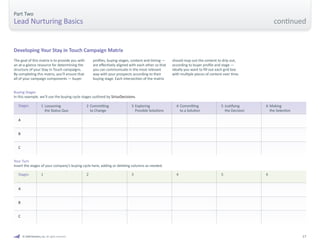
  • 15.
    © 2009 Marketo,Inc. All rights reserved. 11 Part Two Lead Nurturing Basics How to Establish Permission for Nurturing In other words, permission comes first and foremost from the quality of your content. For your company and B2B marketing organization, what is at stake here is your email reputation and deliverability rates. Deliverability is arguably one of the most important aspects of email marketing. George Bilbrey, CEO of ReturnPath, the world’s leading email services company, believes that permission is important, but “a confirmed opt-in does not automatically confer a good reputation.” However, he does believe that “permission influences complaints. Email recipients complain about email they don’t recognize. So, a confirmed opt-in process can be helpful, since recipients are less likely to mis-remember opting to receive your messages.” Here are the pros and cons for the methods we discussed here; you may end up using different approaches for different lead sources. CAN-SPAM Only Single Opt-in Approach Double Opt-in Approach Pros Cons • Minimal effort • Lead source and offer • “Legal” in the eyes of government regulations • Grows your database quickly • Demonstrates a pro-active concern for permission • Prospects might remember that they opted in • Increases deliverability and sender reputation scores • Demonstrates the most concern for privacy and relevancy • Subscribers truly want to hear from you • Increases deliverability rates and send reputation scores • Risks poor deliverability score and bad reputation • Despite database growth, relationship quality will not improve • Still assumes that just because prospects requested information one time, they want to hear from you again • Adds another layer of complexity and communication with potential subscribers • Risks losing subscribers in the confirmation process How Marketo Does It At Marketo, we use single opt-in for any lead that comes in by filling out a form on our Web site, since these leads have already shown some interest in our content. We use a double opt-in approach for leads that come from any other source, since we think it’s important to explicitly establish a relationship with our brand. The single opt-in leads automatically receive a welcome email a few days after registering, while the double opt-in leads receive a multi-step program that makes two attempts to establish permission. Leads that do not respond are marked as suspended and are not counted as part of the database. continued
  • 16.
    Part Two LeadNurturing Basics How Marketo Does It As part of the welcome / opt-in emails that Marketo sends, we give prospects the option to “accelerate” the frequency of their communications, so they have control over how often they receive nurturing content from us. They also can mark which topics they are most interested in, which helps us tune their nurturing content. Determine Preferences Fine-tuning your nurturing approaches can often be as easy as directly asking prospects what they’d like to receive from you. Offering prospects the ability to customize their communications with you is a huge part of making your marketing more relevant — and marketing automation makes it easy to accomplish this. You might be pleasantly surprised at how receptive and willing people are to play an active role in helping you establish the basis for your permission marketing. Here are some questions that might be helpful in developing preferences for increasing relevancy: • How often would you like to receive communications from us? • Which types of communication would you like to receive? (e.g. email, direct mail, text messages, etc.) • What are your primary interests? (Offer multiple checkboxes that apply to your product or service offerings) 12
  • 17.
    © 2009 Marketo,Inc. All rights reserved. 13 Part Two Lead Nurturing Basics Buyer Roles A good place to start is with the “Buying Committee” — the group of individuals that will be involved in the purchasing decision. In the Marketing News article It Takes a Committee to Buy into B-to-B, Tony Jaros, vice president of research at marketing and sales research firm SiriusDecisions, suggests that: “ Most of the people that you speak to at a company will fall under categories related to your marketing efforts, whether they have final say in the contract or not. The category designations may include the Champion, a user with purchasing authority; the Influencer, a person without the buying authority but with significant input, such as a consultant or middle manager or user; and the CXO, a member of the executive staff.” Stay in Touch Campaigns ‘Stay in Touch’ campaigns are useful for all prospects that are not immediately ready to engage with sales. They form the backbone of your lead nurturing program by “dripping” out relevant content to prospects over time, helping to educate them and build trust and credibility for your company. By touching prospects regularly, they help keep your brand top of mind so that the prospect will contact you when they are ready to move to the next step. According to MarketingSherpa, even at small companies (100-500 employees), the average number of people involved in a decision is 6.8 — and that number goes as high as 21 individuals on a buying committee at larger companies. Your nurturing content will need to speak to each of them and address their unique needs. Your roles will also vary based on the different audiences you serve, perhaps broken down by product line, company size, industry, or geography. Some companies will serve different size companies (e.g. small business, mid-market, and enterprise) with different information needs; yet other marketers will need to speak to different geographies, usually in different languages and with different cultural norms. The key is to understand your different audiences and ensure you have content for them. A buyer persona for an online bookstore might be the following: Jane, age thirty-eight, is a mother of three, a vice president of marketing, an avid fiction reader, and buys at least one book per month online. Buyer profiles are particularly relevant to lead nurturing — they help your campaigns target your most qualified segments and also add a “human” element to the relationship-building process. “ People want to do business with people. We’re human, and we crave interaction with people who know us. When you build content especially for your buyer personas, you build a relationship with people before you’ve even met them.” David Meerman Scott, Marketing Strategist and Author The New Rules of Marketing & PR To develop effective Stay in Touch campaigns, marketers should focus on four aspects: • Buyer Roles • Buying Stages • Content • Timing continued
  • 18.
    Part Two LeadNurturing Basics Buyer Roles As you’re developing your personas, keep in mind that they must work for the specific purpose of lead nurturing. Think about the characteristics of your audience that would help provide you with greater insight into how to best build a relationship with them. For instance, how do they prefer to receive communications from you (email, mobile phone, Twitter, etc.)? Finally, you need to identify which profile or role should apply to each new lead. You can use online forms and Incoming Lead Processing campaigns to find out this information, especially if you use techniques such as Progressive Profiling (e.g. the practice of modifying the fields on your forms to augment the information you already have). You can also observe where your prospects spend the majority of their time on your Web site. Together, these techniques will help you match the right role-based content with each prospect. Buyer Stages You will also want to define the stages a prospect goes through in buying your products or solutions, since the best lead nurturing is synchronized with the buyer’s process. Classically, there are four main stages; Awareness: Identify a business need; Consideration: Determine possible solutions; Research: Evaluate different solutions; and Purchase: Select a solution and negotiate purchase. Analyst firm SiriusDecisions presents a slightly different framework: • Stage 1 - Loosening of the Status Quo • Stage 2 - Committing to Change • Stage 3 - Exploring Possible Solutions • Stage 4 - Committing to a Solution • Stage 5 - Justifying the Decision • Stage 6 - Making the Selection Finally, B2B research firm Enquiro suggests that the buying process is not a simple logical, rational, and linear process where a prospect moves neatly from one stage to the next; rather, prospects move chaotically forward and backwards through the process as they balance rational decision making with the emotional impacts of fear and risk. Regardless, the better you understand the process your prospect goes through as they purchase your product or solution, the better you will be able to design your lead nurturing to facilitate — and perhaps accelerate — their purchase. 14
  • 19.
    © 2009 Marketo,Inc. All rights reserved. 15 Part Two Lead Nurturing Basics Content Buyer roles and buying stages come together with your content. Lead nurturing is about maintaining an ongoing conversation with your prospects, and in this case, the conversation occurs in the marketing assets you use as well as the way in which your company communicates with prospects. Content plays a tremendous role in lead nurturing, as it often acts as a sales rep’s stand-in when a person is not yet sales ready. To ensure relevance, it is critical to focus your content on both the buyer role and the buying stage. Buyer role: Prospects find content targeted to their role or industry much more valuable than generic content. According to research firm MarketingSherpa: • 82% of prospects say content targeted to their specific industry is more valuable • 67% say content targeted to their job function is more valuable • 49% say the same for content targeted to their company size • 29% prefer content targeted to their geography Buying stage: The content someone would find relevant changes as they move through the process. For example: • Educational pieces work well during the early awareness stages. With these pieces, you are simply educating people and sharing best practices. • Industry-oriented pieces work well just as prospects start looking for a solution. Examples can be industry overviews, analyst reports, buyer’s guides, etc. • Solution-oriented and company-focused materials are appropriate for prospects engaged in an active buying cycle. Here are some additional best practices for developing content optimized for lead nurturing: Be sensitive to your prospect’s schedule and attention span — make your content easy to digest Just as the B2B buying process has changed, so have the ways that prospects interact with the content you provide. If you’re lucky enough to have them look at your content, you better make it engaging—which in most cases means it has to be short, sweet, and to the point. Make content valuable, not self-promotional. Before creating any piece of content, make sure you put your audience’s interests ahead of your own. People understand that if they’re reading a vendor-sponsored or vendor-written resource, the material probably alludes to what the vendor’s product or service can do. Use sales and marketing emails as a chance to get personal — not pushy The content or dialogue in your actual communications with prospects is an important consideration with lead nurturing. Use HTML emails to nurture leads, then follow up corporate emails with more personal, text-only emails from sales. Doug Kessler’s Definition of Content Marketing Doug Kessler, creative director at Velocity Partners and author of The B2B Content Marketing Workbook, provides succinct advice on how to turn organizational thinking into effective content based marketing campaigns. “ Thought Leadership is exploiting your unique position in your markets to generate valuable insight and advice on issues your customers and prospects care most about. Content Marketing is turning your insight and advice into campaigns that change people’s minds and incite action.” continued
  • 20.
    Part Two LeadNurturing Basics Timing Successful lead nurturing depends on getting the frequency of communication right. The timing of lead nurturing campaigns will be different for every company. As a very general guideline, contacting prospects more than once a week is too much and less than once a month is not enough. Here are some tips for determining the optimal frequency for your company: Consider the length of the buying process and the communication approaches used The timing of your lead nurturing programs are impacted by both the length of your average buying process as well as the approaches you use for lead nurturing (email, direct mail, phone, etc.). Direct mail and email could be considered less intrusive than a phone call, especially if the content of your communication is more educational than sales-oriented. In the following example, let’s assume a prospect downloads a whitepaper from your Web site, and your lead scoring methodology deems this individual a lead nurturing candidate. If the buying cycle for your product is three-months, your lead nurturing path might look like this: • Day 1 - Follow-up with introductory email • Day 10 - Email offering new content related to first download and subsequent Web site activity • Day 15 - Personal email from sales rep • Day 30 - Email best practices whitepaper • Day 45 - Call from sales rep to ‘check in’ • Day 60 - Email promoting webinar series • Day 75 - Personal email from sales rep offering a product demo • Day 85 - Call from sales rep to schedule in-person meeting • Day 90 - Send sales proposal via email There are two things to keep in mind here. First, notice that the communications become more frequent as the buying cycle progresses. Second, this is just one path a nurtured lead could take. Test the effects of frequency with multiple campaigns Testing is often confined to email subject lines and content, but B2B marketers can also use testing to optimize frequency and timing. When developing your automated nurturing campaigns, use the waiting period between triggers and actions as a test element to see if and how conversion rates are impacted by time period changes. Ask your prospects directly An underrated technique to improve lead nurturing is to just ask prospects how often they’d like to be contacted, and with what information. How Marketo Does It Marketo’s nurturing program has four main roles — marketing manager, marketing executive, sales rep, and agency — and three main buying stages: early stage awareness; middle-stage consideration; and late-stage evaluation. There are over 50 pieces of nurturing content spread across those roles and stages, so the typical prospect will receive between 10 and 30 total touches across the nurturing programs. By default, prospects will receive a nurturing campaign every two to three weeks, and slightly more frequently later in the buying cycle — though prospects have the option to “accelerate” and receive information more often.’ 16
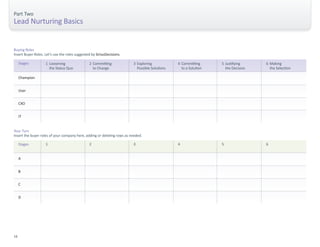
  • 21.
    © 2009 Marketo,Inc. All rights reserved. 17 Part Two Lead Nurturing Basics Buying Stages In this example, we’ll use the buying cycle stages outlined by SiriusDecisions. 1 Loosening the Status Quo 2 Committing to Change Stages 3 Exploring Possible Solutions 4 Committing to a Solution 5 Justifying the Decision 6 Making the Selection A B C Your Turn Insert the stages of your company’s buying cycle here, adding or deleting columns as needed. The goal of this matrix is to provide you with an at-a-glance resource for determining the structure of your Stay in Touch campaigns. By completing this matrix, you’ll ensure that all of your campaign components — buyer profiles, buying stages, content and timing — are effectively aligned with each other so that you can communicate in the most relevant way with your prospects according to their buying stage. Each intersection of the matrix Stages 1 2 3 4 5 6 A B C Developing Your Stay in Touch Campaign Matrix should map out the content to drip out, according to buyer profile and stage — ideally you want to fill out each grid box with multiple pieces of content over time. continued
  • 22.
    Part Two LeadNurturing Basics Buying Roles Insert Buyer Roles. Let’s use the roles suggested by SiriusDecisions. 1 Loosening the Status Quo 2 Committing to Change Stages 3 Exploring Possible Solutions 4 Committing to a Solution 5 Justifying the Decision 6 Making the Selection Your Turn Insert the buyer roles of your company here, adding or deleting rows as needed. Champion User CXO IT Stages 1 2 3 4 5 6 A B C D 18
  • 23.
    © 2009 Marketo,Inc. All rights reserved. 19 Part Two Lead Nurturing Basics Content Finally, let’s map your content into the cells of the matrix. For each grid box, be as specific as you can about your content and list as many resources as you can that would be relevant for each person and buying stage. Stages 1 2 3 4 5 6 A B C D Most companies will have at best two or three pieces of content for each cell, and will have many blank cells at the beginning. That’s fine – you can get started with lead nurturing using the content you already have. Over time, you will want multiple pieces of content for each cell, so use the blank spaces to build out your content roadmap. Be sure to provide enough detail about topic, format, and length to help ensure that the information makes sense within the context of your overall nurturing plan. continued
  • 24.
  • 25.
    21 Part Three Advanced Lead Nurturing © 2009 Marketo, Inc. All rights reserved.
  • 26.
    Part Three AdvancedLead Nurturing In Part One, we defined lead nurturing — “the process of building relationships with qualified prospects regardless of their timing to buy, with the goal of earning their business when they are ready.” We discussed its vital role in enhancing brand, thought leadership and ROI results and we reviewed the importance of marketing and sales collaboration in today’s buyer-is-in-control world. In Part Two, we learned best practices in lead nurturing basics, practical advice from industry experts, and proven strategies for Incoming Lead Processing Campaigns and Stay in Touch Campaigns. With this foundation in place, we are now ready to examine the nuances and winning strategies for advanced lead nurturing: • Accelerator Campaigns • Lead Lifecycle Campaigns 22
  • 27.
    23 Part Three Advanced Lead Nurturing Unlike Stay in Touch campaigns in which nurturing “drips” are planned at pre-defined time intervals, Accelerator campaigns react to a variety of triggers — changes or updates in prospect profiles and behaviors — which then set off a specific type of action or set of actions. The triggers can be based on implicit behavioral data (e.g. opened email and visited “pricing” Web page) in combination with demographics. It’s easiest to think of triggers and their corresponding actions as programs that live outside your basic Stay In Touch campaigns and touch prospects orthogonally, or that affect the Stay In Touch campaigns by moving prospects between different tracks. Accelerator Campaigns Accelerator campaigns are campaigns that attempt to move prospects along the buying cycle faster by providing relevant “nudges” at the right time, usually triggered by specific buyer behaviors or sales updates. By observing the type of content prospects request, where they go and how often they visit your Web site, marketers can adapt their nurturing approaches accordingly, placing prospects with stronger interest on a more accelerated path toward a sales conversation and scaling back communications with less interested individuals. Trigger-based Accelerator campaigns are one of the most exciting aspects of lead nurturing, and they are a great sandbox for learning what works and what doesn’t when it comes to building relationships with your prospects. Whether you’re just getting started with trigger-based marketing or looking to enhance your current approach, here are some considerations that can help accelerate the buying cycle: Determine the key indicators that show interest level What are the ways in which people demonstrate interest during a buying process? In a face-to-face interaction between a prospective customer and a salesperson involving a consumer purchase (let’s say a DVD player), the interested individual may begin by browsing the DVD player aisle, pressing the buttons on certain machines, taking notes about the different brands, or asking detailed questions about price and quality. For online B2B marketers, these interest indicators can be translated into data such as Web site visits, downloads, multiple visits to the pricing page, or filling out a “contact us” form. Once you determine the indicators you’d like to use, you can accelerate a prospect based on behavior alone or assign each attribute or behavior a specific value to be added to a prospect’s lead score once the profile update or behavior occurs. Make the Most Out of Trigger-based Marketing Sample triggers that suggest it may be time for an accelerator campaign: • Web pages: visiting the page on your Web site that explains how to buy • Content: downloading content you’ve marked as being relevant to later stage buyers • Email: opening every email you send • Scoring: If a prospect is “stuck” at the same score with no recent activity, it may be time to try a different approach or offer © 2009 Marketo, Inc. All rights reserved. continued
  • 28.
    Part Three AdvancedLead Nurturing Develop multiple accelerator paths based on prospect interest level and buying stage Make sure that your prospects have a place to go if they show greater interest—but also if they begin to indicate disinterest through prolonged inactivity. Let’s say you have three main nurture paths, for early-stage buyers (A), mid-stage buyers (B), and late-stage buyers (C). Once early-stage prospects are deemed candidates for nurturing, they are placed on path A. If they begin to exhibit stronger interest, you can jump them to path B without finishing A, and when they are ready to engage with sales, they are accelerated to path C. On the other hand, if they fail to respond to multiple campaigns and demonstrate other signs of inactivity, you can send them back to path A or create a different path explicitly for those prospects. Start simple — don’t go overboard with multiple workflows or segments just because you can When it comes to structuring workflows for trigger campaigns, it may seem like the sky’s the limit, especially if there are a number of options for both triggers and actions. In the beginning, it’s best to resist this temptation. Start out by creating fairly straightforward workflows (e.g. if a prospect opens an email and visits a landing page but does not fill out the form, wait a few days and then send another email with a related offer). Once you’ve got a handle on basic workflows, consider varying the follow-up actions according to different behaviors (email open versus click-through) or different segments (the prospect had previous downloads or is part of an active opportunity). Give your campaigns room to evolve Remember that a lead nurturing campaign is more of an evolving conversation than a rigid, mapped-out process. When you’re creating campaigns, don’t get discouraged if prospects don’t respond as you expected — instead, use this data to create new segments or discover new ways to correlate buying stages with certain online behaviors. Your marketing automation solution should give you the flexibility to react quickly to new opportunities and revise your campaigns accordingly. Use campaigns as testing grounds for different nurturing components When we think of testing, we often focus on emails and landing pages. But you can also use campaigns to test other areas of lead nurturing, such as the impact of certain marketing assets on a specific segment, the ways that communication frequency can affect a prospect’s buying process, and more. Dedicate your early trigger campaigns to validate specific elements of your lead nurturing strategies, and apply what you learn to future efforts. How Marketo Does It At Marketo, we use Accelerator campaigns in two ways. First, when Prospects reach a specific threshold lead score that indicates interest but then stall out before making it all the way to becoming “sales ready”, we trigger a series of high value offers intended to spark re-engagement. Secondly, we watch for specific behaviors that indicate when we should move a prospect from Early Stage nurturing to Mid-Stage, or Mid-Stage nurturing to Late Stage. 24
  • 29.
    25 Part Three Advanced Lead Nurturing Lead Lifecycle Campaigns Lead Lifecycle campaigns maximize marketing’s investment in lead generation by ensuring that leads will never grow stagnant or lost. As a general lead nurturing rule, there should be no place in the buying process where leads just “sit,” and you should have only one lead stage value for leads being nurtured. All other lead status values should have a time limit, and leads that sit idle past the deadline should be automatically recycled for further nurturing. In sum, Lead Lifecycle campaigns ensure movement and interaction with prospects, even if they are not ready to buy or sales does not engage. There are three important categories of Lead Lifecycle campaigns: • Lead Handoff • Lead Recycling • New Customers Lead Handoff When a lead becomes sales ready, an automated campaign to pass the lead to sales can make the difference between timely follow-up and no response. There are many ways to let sales know when a lead is ready for sales engagement: by loading it into the CRM system; changing the lead’s Status field; changing the owner or creating a task in the CRM system; or by sending an alert over email or SMS. Depending on your company’s organization and the “hotness” of the lead, you may choose a combination of these functions. You should also identify the date a lead is handed to sales. This lets you easily calculate how long a lead was nurtured and how quickly sales engages with the lead. It’s a good idea to establish a “service level agreement” in which sales commits to handling the lead in a timely fashion; any leads that are not moved forward in the process, or sent backward, within that timeframe should be automatically reassigned or recycled back to marketing. This ensures that leads continue to flow and nothing gets “stuck” or lost in the sales lead stage. © 2009 Marketo, Inc. All rights reserved. continued
  • 30.
    Part Three AdvancedLead Nurturing Lead Recycling As you’ll recall, Incoming Lead Processing campaigns are used to determine if a lead is “sales ready” according to agreed-upon criteria from your marketing and sales teams. But what happens if, ‘sales-ready’ leads are not contacted or a rep decides that some of these leads were still not ready to engage? The importance of lead recycling becomes even more apparent when we consider that of all leads that enter the sales pipeline, almost 80% of them are lost or ignored by sales. What sort of real-world impact can this have on revenue? Brian Carroll, CEO of InTouch, offers a compelling case: “ We had a client that had passed about 12,000 leads to its sales force in the year. But of those, about 2,500 were simply lost — nobody knew what happened to them… we found that a number had bought from a competitor or weren’t actively interested anymore. But we also found that 15%—about 375 contacts — were actually hot leads that indicated they were ready to talk to a salesperson. Of those, 7% actually bought, resulting in $1.2 million in added revenue.” In general, there are two types of lead recycling scenarios—one in which leads are automatically recycled according to a set of business rules and the other in which leads are manually recycled by sales. The goal of the recycling campaign is to reassign — and track — leads that for any reason cannot be pursued by sales in a timely manner. Perhaps you received a flood of hot sales-ready leads from a specific campaign, making it impossible for reps to follow up with all qualified leads in a timely fashion. In this situation, marketing and sales must jointly set up ground rules regarding which leads will be automatically reassigned if they are not pursued within a certain time frame. After marketing and sales agree on an approach, marketing can set up automated campaigns to manage the lead recycling whenever the specific business rules or conditions are met. There will also be situations when leads should be manually recycled by sales. If, after contacting a group of leads, a rep determines that they are still not sales-ready, these prospects should be sent back to marketing. What makes this situation unique, however, is the fact that sales has already had a conversation with these leads and knows more about their buying intent than for leads without any sales interaction. Because of this added insight, sales should be able to manually recycle these leads back to marketing, provide added details about their interaction, and indicate how and when the leads should be moved back into sales. One option is to base sales re-engagement on a business rule such as a lead score change. For example, if a lead is determined to be not sales-ready, its score will be reset to 15 and it will not be passed back to sales until it reaches a score of 70. Alternatively, sales can use its knowledge of the leads’ buying interests to indicate a specific timeframe in which the lead should be re-engaged. 26
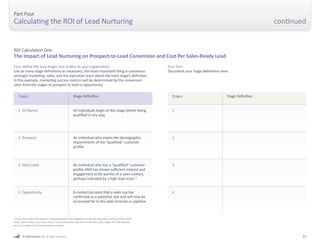
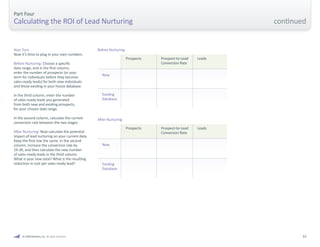
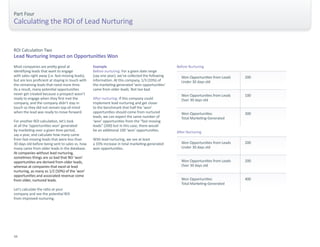
  • 31.
    27 Part Three Advanced Lead Nurturing How Marketo Does It Sales reps can recycle leads back to marketing simply by clickinga button. When leads are recycled, they can mark one of two reasons: “Target Company But Did Not Connect” or “Target Company But No Active Evaluation”. If the latter is chosen, the rep can also select a timeframe: two weeks, one month, three months, six months, or Unknown. When a specific timeframe is chosen, the rep can be confident that the prospect will receive a customized nurturing path optimized for that time period — including personalized contacts from the rep — and that after the specified time, the lead will be sent back to the rep automatically for follow-up. Lead Recycling When leads are recycled, you can either put them back into one of your basic Stay in Touch campaigns, or even better, you can create a specialized version of the Stay in Touch campaign that is optimized for the specific information the rep collected during their interactions (e.g. interests and timing). Here are some tips for optimizing these strategies: Be extra sensitive to relevancy and timing Have reps add detailed notes about their interactions so far and why the lead is being recycled — and make sure that your nurturing approach accounts for this information. You may even want to work with sales to develop custom fields in your CRM and marketing automation solutions that will help you increase relevancy with these recycled leads. Consider different approaches when you know a prospect’s timeframe In many cases, leads will be recycled because they are still researching or their timeframe to buy falls outside of what your company considers sales ready. In other cases, the timeframe may be unknown. These variables may warrant the development of specific nurturing paths. For example, if you know a prospect’s timeframe to buy, you could increase the frequency of communications, provide high-value offers or promotions, or message more aggressively as his or her timing milestone approaches. On the other hand, if you don’t know the timeframe, you might be more conversational and educational in tone with your emails. However, even if the timeframe is unknown, you could still differentiate a recycled lead from a Stay in Touch campaign candidate by creating new lead formulas based on whether a prospect is recycled or not. For example, a Web page visit for a “normal” nurtured lead would garner two points, but a recycled lead might earn five points, since earlier the person demonstrated a higher level of interest. Don’t be afraid to incorporate phone outreach more than you normally would. In many cases, sales reps have already communicated with recycled leads by phone. Since a phone conversation is a coveted interaction when building a relationship, be sure to incorporate phone outreach with recycled leads more than you might with leads on other nurturing paths. But remember, a phone conversation does not necessarily mean greater commitment to a sale on the part of the prospect. Use these conversations as ways to increase trust and find out more about your prospects’ needs — rather than simply trying to “close a deal.” As we noted in our introduction to lead nurturing basics, marketing and sales collaboration is a best practice. In the case of Lead Lifecycle campaigns, it is a business imperative. When both marketing and sales have begun to build relationships with recycled leads, each team should be involved in and aware of the other’s activities, paying special attention to the campaigns and sales interactions that occurred before and after the lead was recycled. For example, if marketing wants to run a new email campaign to recycled leads more than three months old, it should collaborate with sales on special messaging that re-introduces the company and/or product appropriately. In the case of Lead Lifecycle campaigns, providing email templates for your sales team can promote messaging specifically tailored to re-engaging prospects. © 2009 Marketo, Inc. All rights reserved. continued
  • 32.
    Part Three AdvancedLead Nurturing New Customers When an opportunity is closed and won, it is a great opportunity to put all the associated contacts into a new drip marketing campaign that’s optimized for customers. This can include marking them as customers in your database; sending a welcome note; and launching a series of Stay In Touch and Accelerator campaigns. These campaigns are designed to first introduce customers to your products and services, and then over time to help cross-sell / up-sell additional products and retain them for life (all important topics which are beyond the scope of this lead nurturing guide). 28
  • 33.
    29 Part Four Calculating the ROI of Lead Nurturing © 2009 Marketo, Inc. All rights reserved.
  • 34.
    Part Four Calculatingthe ROI of Lead Nurturing In Part One of the Definitive Guide to Lead Nurturing, we learned the value of lead nurturing done well, and in Parts Two and Three, we explored best practices for a range of lead nurturing strategies: • Incoming Lead Processing Campaigns • Stay in Touch Campaigns • Accelerator Campaigns • Lead Lifecycle Campaigns But how do you prove the ROI of lead nurturing in your own organization? • Show the ROI of lead nurturing by comparing “before” and “after” scenarios based on industry metrics. • Use this framework to calculate the potential ROI at your organization. For every step, you’ll see an “Example” followed by “Your Turn” in which you can try out the method using your own data. After completing the worksheet, you should have the information you need to bolster the case for lead nurturing at your organization. Or if you have already established lead nurturing programs, use this worksheet to compare your results to industry standards. 30
  • 35.
    31 First, definethe lead stages that matter to your organization Use as many stage definitions as necessary; the most important thing is consensus amongst marketing, sales, and the executive team about the each stage’s definition. In this example, marketing success metrics will be determined by the conversion rates from the stages of prospect to lead to opportunity. ROI Calculation One The Impact of Lead Nurturing on Prospect-to-Lead Conversion and Cost Per Sales-Ready Lead Part Four Calculating the ROI of Lead Nurturing Stages 1 All Names 2 Prospect 3 Sales Lead 4 Opportunity Stage Definition All individuals begin at this stage before being qualified in any way. An individual who meets the demographic requirements of the “qualified” customer profile. An individual who has a “qualified” customer profile AND has shown sufficient interest and engagement to be worthy of a sales contact, perhaps indicated by a high lead score.* A contact/account that a sales rep has confirmed as a potential sale and will now be accounted for in the sales forecast or pipeline. Your Turn Document your stage definitions here. *If you don’t have the ability to measure interest and engagement, let the sales team tell you which leads were “sales ready,” and count those. Since most leads take time to become sales ready, this will typically be just a subject of all the qualified prospects. © 2009 Marketo, Inc. All rights reserved. Stages 1 2 3 4 Stage Definition continued
  • 36.
    Next, let’s calculatehow lead nurturing impacts the conversion between stages; in this case, we’ll look into the conversion of Prospects to Sales-Ready Leads. As mentioned earlier, lead nurturing should be done for both new and existing prospects, so let’s set up a table to gather data for these stages for both new and existing leads. Pick a date range, i.e. over one month, and look at how a typical prospect to lead to opportunity conversion might evolve WITHOUT lead nurturing. Key ROI point: Looking across Marketo customers, lead nurturing can improve the conversion of prospects from your existing database to sales-ready leads by 2.0 – 3.0 times, potentially even more. In this case, a 2.5x improvement in that conversion metric means each month 1.0% of the prospect database becomes sales ready, not 0.4%. Note: at companies that excel at lead nurturing, this conversion metric can be as high as 4.0% to 5.0%. Result: Before nurturing, there were 120 sales ready leads per month; but with nurturing, there are 180 sales ready leads a month – meaning lead nurturing helped to generate 50% more qualified sales-ready leads without any additional spending on lead generation. Assuming a monthly lead generation budget of $90,000, the cost per sales-ready lead goes down by 33%, from $750 each to $500 each. Part Four Calculating the ROI of Lead Nurturing New Existing Database Prospects 800 10,000 Prospect-to-Lead Conversion Rate Leads 10% 0.4% 80 40 Before Nurturing New Existing Database Prospects 800 10,000 Prospect-to-Lead Conversion Rate Leads 10% 1.0% 80 100 After Nurturing Example 1 Number of new prospects per month – For this example, we’ll use 800. 2 Number of existing prospects in the database at beginning on month – We’ll use 10,000. 3 Number of sales-ready leads from new prospects that month – Let’s use 80. 4 Number of sales-ready leads from the existing database (i.e. prospects more than one month old) – Let’s say 40. Your CRM or marketing automation systems should make it easy to calculate these metrics. To calculate three and four, at the end of the month, export a list of all the truly “sales-ready” leads sent to sales that month. Separate all the leads that were first created this month vs. earlier. Even better, add a date field that automatically tracks the date a lead is marked as “sales ready”, and calculate the number of days between the “sales ready” date and the “create date”. This will show you which leads are new (created < 30 days). 32
  • 37.
    33 Part Four Calculating the ROI of Lead Nurturing New Existing Database Prospects Prospect-to-Lead Conversion Rate Leads Before Nurturing New Existing Database Prospects Prospect-to-Lead Conversion Rate Leads After Nurturing Your Turn Now it’s time to plug in your own numbers. Before Nurturing: Choose a specific data range, and in the first column, enter the number of prospects (or your term for individuals before they become sales-ready leads) for both new individuals and those existing in your house database. In the third column, enter the number of sales-ready leads you generated from both new and existing prospects, for your chosen date range. In the second column, calculate the current conversion rate between the two stages. After Nurturing: Now calculate the potential impact of lead nurturing on your current data. Keep the first row the same. In the second column, increase the conversion rate by 2X-3X, and then calculate the new number of sales-ready leads in the third column. What is your new total? What is the resulting reduction in cost per sales-ready lead? © 2009 Marketo, Inc. All rights reserved. continued
  • 38.
    ROI Calculation Two Lead Nurturing Impact on Opportunities Won Part Four Calculating the ROI of Lead Nurturing Most companies are pretty good at Before Nurturing identifying leads that want to engage with sales right away (i.e. fast-moving leads), but are less proficient at staying in touch with the remaining leads that need more time. As a result, many potential opportunities never get created because a prospect wasn’t ready to engage when they first met the company, and the company didn’t stay in touch so they did not remain top-of-mind when the lead was ready to move forward. For another ROI calculation, let’s look at all the ‘opportunities won’ generated by marketing over a given time period, say a year, and calculate how many came from fast-moving leads that were less than 30 days old before being sent to sales vs. how many came from older leads in the database. At companies without lead nurturing, sometimes things are so bad that NO ‘won’ opportunities are derived from older leads, whereas at companies that excel at lead nurturing, as many as 1/2 (50%) of the ‘won’ opportunities and associated revenue come from older, nurtured leads. Let’s calculate the ratio at your company and see the potential ROI from improved nurturing. Example Before nurturing: For a given date range (say one year), we’ve collected the following information. At this company, 1/3 (33%) of the marketing-generated ‘won opportunities’ came from older leads. Not too bad. After nurturing: If this company could implement lead nurturing and get closer to the benchmark that half the ‘won’ opportunities should come from nurtured leads, we can expect the same number of ‘won’ opportunities from the “fast moving leads” (200) but in this case, there would be an additional 100 ‘won’ opportunities. With lead nurturing, we see at least a 33% increase in total marketing-generated won opportunities. Won Opportunities from Leads Under 30 days old Won Opportunities from Leads Over 30 days old Won Opportunities Total Marketing-Generated 200 100 300 After Nurturing Won Opportunities from Leads Under 30 days old Won Opportunities from Leads Over 30 days old Won Opportunities Total Marketing-Generated 200 200 400 34
  • 39.
    35 Part Four Calculating the ROI of Lead Nurturing Your Turn Now let’s see how your company is doing and how it might improve. Choose a date range and collect the following information: If B > A, you are nurturing well (or possibly not generating enough new leads). If not, subtract A – B to get the number of extra marketing-generated won opportunities you might expect from better lead nurturing. Calculate (A – B) / C to measure the % increase in total marketing-generated revenue from better lead nurturing at your company. “ Successful organizations cannot afford to spend money generating qualified leads that slip through the pipeline when they do not result in immediate opportunities.” Ian Michiels, Senior Analyst, Aberdeen Group © 2009 Marketo, Inc. All rights reserved. Before Nurturing Won Opportunities from Leads Under 30 days old Won Opportunities from Leads Over 30 days old Won Opportunities Total Marketing-Generated A B C continued
  • 40.
    Conclusion Lead nurturingis the process of building relationships with qualified prospects regardless of their timing to buy, with the goal of earning their business when they are ready. Why? Because 95% of the prospects visiting your Web site today are there to research, but as many as 70% of them will eventually buy a product from you or from your competitor. Because today’s buyers prefer not to engage with sales until the last third (1/3) of the purchasing process, marketing and sales must collaborate throughout every stage in the revenue cycle to provide prospective customers with high quality information and content that is timely, relevant and responsive to their situation. The Definitive Guide to Lead Nurturing outlined the importance of lead nurturing and thought leadership in establishing your company’s brand and your customer’s trust. It provided exercises and worksheets on how to calculate return on investment (ROI) from lead nurturing on prospect-to-lead conversion, cost per sales-ready lead, and impact on opportunities won through lead nurturing. Need more evidence? Companies that excel at lead nurturing generate 50% more sales-ready leads at 33% lower cost per lead and boost sales’ acceptance of marketing-generated leads by at least 25%. For both novice and experienced practitioners, the Definitive Guide to Lead Nurturing offered advice, best practices and a summary of How Marketo Does It covering: • Incoming Lead Processing Campaigns, including lead scoring and permission for nurturing • Stay in Touch Campaigns, including buyer roles, buying stages and content based on timing and stage • Accelerator Campaigns, facilitated by triggered-based marketing • Lead Lifecycle Campaigns to increase the efficiency and effectiveness of lead handoff, lead recycling and continuing the dialog with new customers When you invest in lead nurturing, you make the most out of every dollar your organization spends on demand generation, and you can rekindle once-stagnant opportunities from your existing database. By using lead nurturing campaigns to interact with your prospects and understand their interest and behavior, you gain deeper insight into their buying intent, increase the relevancy of future lead nurturing campaigns, and ultimately benefit from more and higher quality sales leads, increased conversion rates and explosive revenue growth. 36
  • 41.
    © 2009 Marketo,Inc. All rights reserved. 37 Call: 650-655-4830 Email: info@marketo.com Visit our Web site: www.marketo.com To get The Definitive Guide to Lead Nurturing online, visit: www.marketo.com/dg2-lead-nurturing Visit our blog: blog.marketo.com About Marketo Marketo is the fastest growing provider of marketing automation and revenue-building best practices. Marketo’s uncompromising on-demand solutions enable marketing and sales teams to collaborate throughout the revenue cycle, from the earliest stages of demand generation and lead management to the pursuit of revenue and customer loyalty. Marketo Lead Management gives Marketing the power and flexibility to automate demand generation campaigns and deliver more high-quality leads with less effort, and Marketo Sales. Insight helps Sales understand, prioritize and interact with the hottest leads and opportunities to close more business faster. Known for providing the most innovative customer experience and the fastest time to value, Marketo was voted ‘Best Marketing Automation Application’ by Salesforce customers on the Force.com AppExchange. As of July 2009, more than 220 mid-market and enterprise companies in nine countries have selected Marketo. Contact Us Acknowledgements Marketo would like to thank the following thought leaders for contributing to the Definitive Guide to Lead Nurturing. Ian Michiels, Aberdeen Group CSO Insights DemandGen Report Enquiro Forrester Research Brian Carroll, In Touch Marketing Sherpa George Bilbrey, Return Path Tony Jaros, Sirius Decisions Scott Albro, Tippit Designed & illustrated by Velocity, the B2B marketing agency.
  • 42.