







FOR 2014
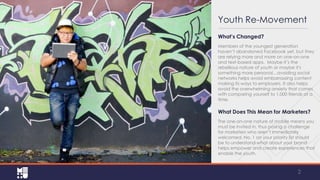
Youth Re-Movement
What’s Changed?
Members of the youngest generation
haven’t abandoned Facebook yet, but they
are relying more and more on one-on-one
and text-based apps. Maybe it’s the
rebellious nature of youth or maybe it's
something more personal…avoiding social
networks helps avoid embarrassing content
making its way to employers. It also helps
avoid the overwhelming anxiety that comes
with comparing yourself to 1,000 friends at a
time.

What Does This Mean for Marketers?
The one-on-one nature of mobile means you
must be invited in, thus posing a challenge
for marketers who aren’t immediately
welcomed. No. 1 on your priority list should
be to understand what about your brand
helps empower and create experiences that
enable the youth.

2
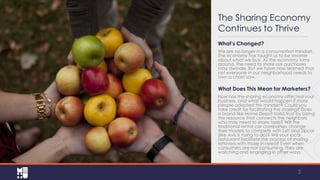
The Sharing Economy
Continues to Thrive
What’s Changed?
We are no longer in a consumption mindset.
The economy has taught us to be smarter
about what we buy. As the economy turns
around, the need to share our purchases
may dwindle. But we have now learned that
not everyone in our neighborhood needs to
own a chain saw.

What Does This Mean for Marketers?
How has the sharing economy affected your
business, and what would happen if more
people adopted this mindset? Could you
take credit for facilitating the sharing? Does
a brand like Home Depot build trust by being
the resource that connects the neighbors
who may need to share tools? Will the
traditional rental car companies change
their models to compete with Lyft and Zipcar
(like Avis is trying to do)? Will your local
restaurant facilitate the process of sharing
leftovers with those in need? Even when
consumers are not consuming, they are
watching and engaging in other ways.

3
Organic Search Data
Is MIA
What’s Changed?
Google recently announced that it will stop
publishing which search keywords are driving
traffic to your website, but will make the
information available to Google Search
advertisers. Yahoo! and Bing will likely follow
suit.

What Does This Mean for Marketers?
This will have a huge impact on online
publishing, media and certain blogger sites
because it limits the ability to optimize their
content for relevant keywords. Marketers
should revisit their paid media activities with
such networks. Marketers and agencies
need to double down on their natural search
efforts during this
transition period.

4
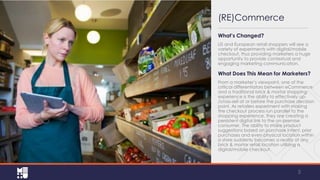
(RE)Commerce
What’s Changed?
US and European retail shoppers will see a
variety of experiments with digital/mobile
checkout, thus providing marketers a huge
opportunity to provide contextual and
engaging marketing communication.

What Does This Mean for Marketers?
From a marketer’s viewpoint, one of the
critical differentiators between eCommerce
and a traditional brick & mortar shopping
experience is the ability to effectively up/cross-sell at or before the purchase decision
point. As retailers experiment with making
the checkout process run parallel to the
shopping experience, they are creating a
persistent digital link to the on-premise
consumer. The ability to make product
suggestions based on purchase intent, prior
purchases and even physical location within
a store suddenly becomes a reality at any
brick & mortar retail location utilizing a
digital/mobile checkout.

5
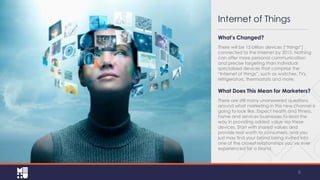
Internet of Things
What’s Changed?
There will be 15 billion devices (“things”)
connected to the Internet by 2015. Nothing
can offer more personal communication
and precise targeting than individual
specialized devices that comprise the
“Internet of things”, such as
watches, TVs, refrigerators, thermostats and
more.

What Does This Mean for Marketers?
There are still many unanswered questions
around what marketing in this new channel is
going to look like. Expect health and
fitness, home and services businesses to lead
the way in providing added value via these
devices. Start with shared values and
provide real worth to consumers, and you
just may find your brand being invited into
one of the closest relationships you’ve ever
experienced for a brand.

6
Shopping Is
Finally Social
What’s Changed?
In recent years, many brands have dabbled
with the integration of social and
eCommerce, however, it has never been as
easy as it is today. Brands like Starbucks and
Amazon have discovered ways to make the
shopping and gifting experience a social
experience as well.

What Does This Mean for Marketers?
The lines between social and commerce
have never been more blurred. Social
shopping isn’t just selling via social media.
It’s crowdsourcing ideas and feedback. It’s
finding the perfect outfit by seeing what is
most pinned. So, marketers must ask
themselves: What have we learned in social
through trending topics and re-pins to help
make the shopping experience more robust
for our retail shoppers? Are there any up and
coming fashion bloggers who we should
solicit to be guest merchandisers on our site?

7
Mobile Native
This needs to be of a mobile
device

What’s Changed?
Nielsen reports that smartphones now
comprise two-thirds of all phones in the US.

What Does This Mean for Marketers?
A new set of service-based apps—like Uber
and Vine—are showing us that the mobile
experience might be the only one that
really matters. In some cases, such as
Vine, it is almost impossible to fully interact
with others except via the mobile app. As
this trend grows, we may see a time when
a future generation doesn’t know what
http:// or www. means. Who needs that
when everything someone needs is
available via an app?

8
Home Automation
What’s Changed?
DIYers are becoming more accepting of,
and honestly, less creeped out by,
self-learning gadgets that adjust to their
habits, help them save money, and do the
heavy lifting at home.

What Does This Mean for Marketers?
The demand for a seamless, end‐to‐end
experience across services in the “smart
home” has arrived. Everything is an
interface now. Nest expanded from a
learning thermostat to a smoke and carbon
dioxide detector providing you information
whenever you want it. What could a major
player like Kraft do if it partnered with a
Samsung refrigerator to tell you exactly
what is in your fridge at any given time?

9
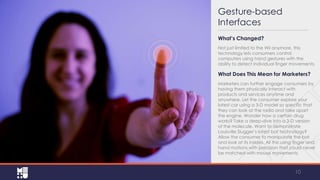
Gesture-based
Interfaces
What’s Changed?
Not just limited to the Wii anymore, this
technology lets consumers control
computers using hand gestures with the
ability to detect individual finger movements.

What Does This Mean for Marketers?
Marketers can further engage consumers by
having them physically interact with
products and services anytime and
anywhere. Let the consumer explore your
latest car using a 3‐D model so specific that
they can look at the radio and take apart
the engine. Wonder how a certain drug
works? Take a deep‐dive into a 3‐D version
of the molecule. Want to demonstrate
Louisville Slugger’s latest bat technology?
Allow the consumer to manipulate the bat
and look at its insides. All this using finger and
hand motions with precision that could never
be matched with mouse movements.

10
Email Is Not Dead,
Just Repurposed
What’s Changed?
Nothing really. A while back, email was
supposedly dead, but it’s more prominent
and more useful than ever.

What Does This Mean for Marketers?
While email hasn’t changed, its role has
changed substantially, and it is often being
successfully used as a way to curate or
surface a brand’s social channels or other
shareable content. For example, Brand
Central has a daily email with top
articles, then a weekly wrap-up of the ones
that were most viewed. Too many brands
and agencies ignore the power of email and
the role it can and should play in a bigger
social and digital ecosystem.

11
Content Curation
& Aggregation
What’s Changed?
Information overload. Too much content
available online has made curation more
valuable than ever.

What Does This Mean for Marketers?
Users know they don’t have time to access
the entire infinite Internet in search of what’s
valuable to them. Services like
Pinterest, Pulse.me and Flipboard have
become useful tools to enable users to
create their own experiences where content
they see as valuable comes to them.
Marketers can not only be content
generators, but can also serve as
experts, filterers and those who pass on
valuable information worth reading—even if
it’s not theirs.

12
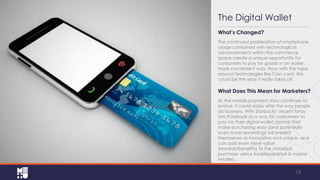
The Digital Wallet
What’s Changed?
The continued proliferation of smartphone
usage combined with technological
advancements within the commerce
space create a unique opportunity for
consumers to pay for goods in an
easier, more convenient way. Now with the
hype around technologies like Coin
card, this could be the year it really takes
off.

What Does This Mean for Marketers?
As the mobile payment story continues to
evolve, it could easily alter the way people
do business. With Starbucks’ recent foray
into Passbook as a way for consumers to
pay via their digital wallet, brands that
make purchasing easy (and potentially
even more rewarding) will present
themselves as innovative and unique, and
can add even more value
(rewards/benefits) to the standard
purchase versus traditional brick & mortar
retailers.

13
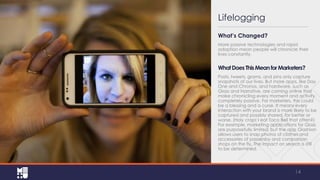
Lifelogging
What’s Changed?
More passive technologies and rapid
adoption mean people will chronicle their
lives constantly.

What Does This Mean for Marketers?
Posts, tweets, grams, and pins only capture
snapshots of our lives. But more apps, like Day
One and Chronos, and hardware, such as
Glass and Narrative, are coming online that
make chronicling every moment and activity
completely passive. For marketers, this could
be a blessing and a curse. It means every
interaction with your brand is more likely to be
captured and possibly shared, for better or
worse. (Holy crap! I eat Taco Bell that often?)
For example, marketing applications for Glass
are purposefully limited, but the app Glashion
allows users to snap photos of clothes and
accessories of passersby and comparison
shops on the fly. The impact on search is still
to be determined.

14
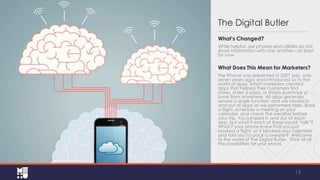
The Digital Butler
What’s Changed?
While helpful, our phones and utilities do not
share information with one another—at least
for now.

What Does This Mean for Marketers?
The iPhone was presented in 2007 (yes, only
seven years ago) and introduced us to the
world of apps. Smart marketers created
apps that helped their customers find
stores, order a pizza, or simply purchase a
book from anywhere. All apps generally
served a single function, and we moved in
and out of apps as we performed tasks. Book
a flight, schedule a meeting on your
calendar, and check the weather before
your trip. You jumped in and out of each
app, but what if each of these could “talk”?
What if your phone knew that you just
booked a flight, so it blocked your calendar
and told you to pack a sweater? Welcome
to the world of The Digital Butler. Think of all
the possibilities for your brand.

15
Our Authors
Rahul Purini

Robert Cevallos

Renee McKeon

Matt Smith

Matt Whitaker

Sarah Torrence

Shawn Staley

Megan Lee

Mary Ridgway

Jason Booker

Leslie Davis

Vadim Dolt

Sarah Marshall

Jason Shipp

Kristi Maynor

16
meplusyou.com
marketing@meplusyou.com
214.224.1000

14 Marketing Trends for 2014

  • 1.
  • 2.
    Youth Re-Movement What’s Changed? Membersof the youngest generation haven’t abandoned Facebook yet, but they are relying more and more on one-on-one and text-based apps. Maybe it’s the rebellious nature of youth or maybe it's something more personal…avoiding social networks helps avoid embarrassing content making its way to employers. It also helps avoid the overwhelming anxiety that comes with comparing yourself to 1,000 friends at a time. What Does This Mean for Marketers? The one-on-one nature of mobile means you must be invited in, thus posing a challenge for marketers who aren’t immediately welcomed. No. 1 on your priority list should be to understand what about your brand helps empower and create experiences that enable the youth. 2
  • 3.
    The Sharing Economy Continuesto Thrive What’s Changed? We are no longer in a consumption mindset. The economy has taught us to be smarter about what we buy. As the economy turns around, the need to share our purchases may dwindle. But we have now learned that not everyone in our neighborhood needs to own a chain saw. What Does This Mean for Marketers? How has the sharing economy affected your business, and what would happen if more people adopted this mindset? Could you take credit for facilitating the sharing? Does a brand like Home Depot build trust by being the resource that connects the neighbors who may need to share tools? Will the traditional rental car companies change their models to compete with Lyft and Zipcar (like Avis is trying to do)? Will your local restaurant facilitate the process of sharing leftovers with those in need? Even when consumers are not consuming, they are watching and engaging in other ways. 3
  • 4.
    Organic Search Data IsMIA What’s Changed? Google recently announced that it will stop publishing which search keywords are driving traffic to your website, but will make the information available to Google Search advertisers. Yahoo! and Bing will likely follow suit. What Does This Mean for Marketers? This will have a huge impact on online publishing, media and certain blogger sites because it limits the ability to optimize their content for relevant keywords. Marketers should revisit their paid media activities with such networks. Marketers and agencies need to double down on their natural search efforts during this transition period. 4
  • 5.
    (RE)Commerce What’s Changed? US andEuropean retail shoppers will see a variety of experiments with digital/mobile checkout, thus providing marketers a huge opportunity to provide contextual and engaging marketing communication. What Does This Mean for Marketers? From a marketer’s viewpoint, one of the critical differentiators between eCommerce and a traditional brick & mortar shopping experience is the ability to effectively up/cross-sell at or before the purchase decision point. As retailers experiment with making the checkout process run parallel to the shopping experience, they are creating a persistent digital link to the on-premise consumer. The ability to make product suggestions based on purchase intent, prior purchases and even physical location within a store suddenly becomes a reality at any brick & mortar retail location utilizing a digital/mobile checkout. 5
  • 6.
    Internet of Things What’sChanged? There will be 15 billion devices (“things”) connected to the Internet by 2015. Nothing can offer more personal communication and precise targeting than individual specialized devices that comprise the “Internet of things”, such as watches, TVs, refrigerators, thermostats and more. What Does This Mean for Marketers? There are still many unanswered questions around what marketing in this new channel is going to look like. Expect health and fitness, home and services businesses to lead the way in providing added value via these devices. Start with shared values and provide real worth to consumers, and you just may find your brand being invited into one of the closest relationships you’ve ever experienced for a brand. 6
  • 7.
    Shopping Is Finally Social What’sChanged? In recent years, many brands have dabbled with the integration of social and eCommerce, however, it has never been as easy as it is today. Brands like Starbucks and Amazon have discovered ways to make the shopping and gifting experience a social experience as well. What Does This Mean for Marketers? The lines between social and commerce have never been more blurred. Social shopping isn’t just selling via social media. It’s crowdsourcing ideas and feedback. It’s finding the perfect outfit by seeing what is most pinned. So, marketers must ask themselves: What have we learned in social through trending topics and re-pins to help make the shopping experience more robust for our retail shoppers? Are there any up and coming fashion bloggers who we should solicit to be guest merchandisers on our site? 7
  • 8.
    Mobile Native This needsto be of a mobile device What’s Changed? Nielsen reports that smartphones now comprise two-thirds of all phones in the US. What Does This Mean for Marketers? A new set of service-based apps—like Uber and Vine—are showing us that the mobile experience might be the only one that really matters. In some cases, such as Vine, it is almost impossible to fully interact with others except via the mobile app. As this trend grows, we may see a time when a future generation doesn’t know what http:// or www. means. Who needs that when everything someone needs is available via an app? 8
  • 9.
    Home Automation What’s Changed? DIYersare becoming more accepting of, and honestly, less creeped out by, self-learning gadgets that adjust to their habits, help them save money, and do the heavy lifting at home. What Does This Mean for Marketers? The demand for a seamless, end‐to‐end experience across services in the “smart home” has arrived. Everything is an interface now. Nest expanded from a learning thermostat to a smoke and carbon dioxide detector providing you information whenever you want it. What could a major player like Kraft do if it partnered with a Samsung refrigerator to tell you exactly what is in your fridge at any given time? 9
  • 10.
    Gesture-based Interfaces What’s Changed? Not justlimited to the Wii anymore, this technology lets consumers control computers using hand gestures with the ability to detect individual finger movements. What Does This Mean for Marketers? Marketers can further engage consumers by having them physically interact with products and services anytime and anywhere. Let the consumer explore your latest car using a 3‐D model so specific that they can look at the radio and take apart the engine. Wonder how a certain drug works? Take a deep‐dive into a 3‐D version of the molecule. Want to demonstrate Louisville Slugger’s latest bat technology? Allow the consumer to manipulate the bat and look at its insides. All this using finger and hand motions with precision that could never be matched with mouse movements. 10
  • 11.
    Email Is NotDead, Just Repurposed What’s Changed? Nothing really. A while back, email was supposedly dead, but it’s more prominent and more useful than ever. What Does This Mean for Marketers? While email hasn’t changed, its role has changed substantially, and it is often being successfully used as a way to curate or surface a brand’s social channels or other shareable content. For example, Brand Central has a daily email with top articles, then a weekly wrap-up of the ones that were most viewed. Too many brands and agencies ignore the power of email and the role it can and should play in a bigger social and digital ecosystem. 11
  • 12.
    Content Curation & Aggregation What’sChanged? Information overload. Too much content available online has made curation more valuable than ever. What Does This Mean for Marketers? Users know they don’t have time to access the entire infinite Internet in search of what’s valuable to them. Services like Pinterest, Pulse.me and Flipboard have become useful tools to enable users to create their own experiences where content they see as valuable comes to them. Marketers can not only be content generators, but can also serve as experts, filterers and those who pass on valuable information worth reading—even if it’s not theirs. 12
  • 13.
    The Digital Wallet What’sChanged? The continued proliferation of smartphone usage combined with technological advancements within the commerce space create a unique opportunity for consumers to pay for goods in an easier, more convenient way. Now with the hype around technologies like Coin card, this could be the year it really takes off. What Does This Mean for Marketers? As the mobile payment story continues to evolve, it could easily alter the way people do business. With Starbucks’ recent foray into Passbook as a way for consumers to pay via their digital wallet, brands that make purchasing easy (and potentially even more rewarding) will present themselves as innovative and unique, and can add even more value (rewards/benefits) to the standard purchase versus traditional brick & mortar retailers. 13
  • 14.
    Lifelogging What’s Changed? More passivetechnologies and rapid adoption mean people will chronicle their lives constantly. What Does This Mean for Marketers? Posts, tweets, grams, and pins only capture snapshots of our lives. But more apps, like Day One and Chronos, and hardware, such as Glass and Narrative, are coming online that make chronicling every moment and activity completely passive. For marketers, this could be a blessing and a curse. It means every interaction with your brand is more likely to be captured and possibly shared, for better or worse. (Holy crap! I eat Taco Bell that often?) For example, marketing applications for Glass are purposefully limited, but the app Glashion allows users to snap photos of clothes and accessories of passersby and comparison shops on the fly. The impact on search is still to be determined. 14
  • 15.
    The Digital Butler What’sChanged? While helpful, our phones and utilities do not share information with one another—at least for now. What Does This Mean for Marketers? The iPhone was presented in 2007 (yes, only seven years ago) and introduced us to the world of apps. Smart marketers created apps that helped their customers find stores, order a pizza, or simply purchase a book from anywhere. All apps generally served a single function, and we moved in and out of apps as we performed tasks. Book a flight, schedule a meeting on your calendar, and check the weather before your trip. You jumped in and out of each app, but what if each of these could “talk”? What if your phone knew that you just booked a flight, so it blocked your calendar and told you to pack a sweater? Welcome to the world of The Digital Butler. Think of all the possibilities for your brand. 15
  • 16.
    Our Authors Rahul Purini RobertCevallos Renee McKeon Matt Smith Matt Whitaker Sarah Torrence Shawn Staley Megan Lee Mary Ridgway Jason Booker Leslie Davis Vadim Dolt Sarah Marshall Jason Shipp Kristi Maynor 16
  • 17.

Editor's Notes

  • #3 As younger generations explore new ways of communicating, brands must constantly discover new ways of connecting.
  • #4 The recession and advancements in technology remind us that it’s nice to share. Brands should look for opportunities to ease this process.
  • #5 Get used to doing more with less and load up your SEM to help overcome your losses (both emotionally and financially).
  • #6 Experimentation and the re-creation of eCommerce-like experiences in physical spaces will offer marketers rich engagement opportunities.
  • #7 We can no longer worry about only connecting via mobile. Specialized devices now offer an intimate and unique way to connect with a brand.
  • #8 The lines between the social and physical world will continue to blur as shoppers hunt for the most pinned items, find ways to solicit feedback from the crowd, and make purchases via mobile/social devices.
  • #9 New generations of users may never experience the traditional desktop computer. Stop thinking mobile first. Start thinking mobile only.
  • #10 The smart home has finally arrived for mainstream America. Think of the opportunities available for real-time marketing.
  • #11 Mission Impossiblemeets your shopping experience. With a touch of a finger, you will be able to empower consumers to explore a product just as they would in-store.
  • #12 Email is still checked by many and should be treated as a smart curator that presents relevant and personalized content and drives consumers to other experiences.
  • #13 Information overload will drive consumers to new destinations to help filter and aggregate content. Brands must ensure that their content is part of the mix.
  • #14 Although questions of feasibility still abound, this may be the year where we finally see movement in mobile payments thanks to the promise of Coin Card and advancements made by others. (from Mary – same question – should this be “the Coin card”
  • #15 Look forward to more opportunities for your brand to be part of the sharing, both the good and bad.
  • #16 As devices start to share information between applications and the web, our smartphones will become even smarter. Brands should explore how to be more useful and create integrated experiences.