A statistical physics approach to
system biology
@SamirSuweis
CISM-UniUD joint course 2018
CISM-UniUD Joint course
coordinated by
PhD School in
Agricultural Science and Biotechnology
of the University of Udine
Udine September 3 - 7 2018
UniversityofUdine
InternationalCentreforMechanicalSciences
SYSTEMS BIOLOGY
ACADEMICYEAR
2018
@LIPh_Lab
www.Liphlab.com
System Biology
Systems biology is the computational and mathematical
modeling of complex biological systems. It is a biology-based
interdisciplinary field of study that focuses on complex
interactions within biological systems, using a holistic approach
(instead of the traditional reductionism) to biological research.
CLASSIC REDUCTIONISM (transistor in a computer)
– All we need to know is the behavior of the system elements
–  Particles in physics, molecules or proteins in biology.
– More complex systems are nothing but the result of the sum of
many systems elements (think to a pc)
– No new phenomena will emerge when we consider the entire
system
The Human Genome Project
Cell
Nucleus
Genes
DNA helix
Nucleotide pair
SNP
Individual 1
Individual 2
Individual 3
Individual 4
The human genome (or complete set of DNA) is contained within 22 nonsex
chromosomes plus the X and Y. We inherit one set of 23 chromosomes from each parent.
Chromosome
1 2 3 4 5 6 7 8 9 10 11 12
13 14 15 16 17 18 19 20 21 22 X Y
G G A G G A T C T G A G T C T G G T
The Logic behind Genome Studies
Much research into the genetic contributions to common diseases has started with the seemingly logical assumption that DNA variants occur-
ring frequently in the human population would be at fault. Some argue, though, that this reasoning is faulty.
The Starting Point
The Human Genome Project identified the sequence of nucleotide pairs, or DNA building blocks, in
the human genome, based on DNA from several volunteers.A single pair consists of a nucleotide
(A, C,T or G) on one strand of the DNA double helix and its complement on the opposite strand
(C always pairs with G; A with T). Related work revealed many single-nucleotide polymorphisms, or
SNPs—chromosomal locations where a nucleotide pair in one person can differ from that in
another person (below)—and it identified“common”SNPs, ones that vary in many people.
Single DNA strand
Nucleotide
G G A G G A T C T G A G T A T G G T
G G A G G A T C T G A G T C T G G T
Common
variant
strategy
October 2010, ScientificAmerican.com 63Illustration by Bryan Christie
Individual 4
Diseased
Diseased
Healthy
The Studies and Results
Investigators hoped that they could identify gene variants responsible
for major diseases by comparing nucleotides at common SNPs
throughout the genomes of people with and without a disease. SNP
variants, or“alleles,”and nearby protein-coding genes tend to be
inherited together, and so researchers expected that SNP alleles
occurring much more frequently in people with a disease would point
to common gene variants important to the illness.These genome-wide
association (GWA) studies uncovered many SNP alleles related to
specific diseases. So far, though, the variations found have typically
accounted for only a small fraction of disease risk.
Healthy
SNP allele associated with disease
Single DNA strand
Diseased
Nearby gene variant
G G A G G A T C T G A G T C T G G T
0Hall5p.indd 63 8/2
Revolution Postponed: Why the Human Genome Project Has Been
Disappoinyng (Scientfic American, 18.10.2010).
Evolvability and Robustness
A. Wagner
•  System	 properties	 emerge	 from	 interactions	 of	
components:	 the	 whole	 is	 more	 than	 the	 sum	 of	 the	
parts.	
–  B.	 Mandelbrot	 and	 others:	 Chaos	 and	 non-linear	 dynamical	
systems	
–  P.	Bak:	Self-Organized	Criticality	–	The	edge	of	chaos	
–  S.	Wolfram:	Cellular	Automata	
–  S.	Kauffman:	Random	Boolean	Networks	
–  J.	Holland:	Emergence	
–  Systems	Biology
How to study complex system?
Ferromagnetism
Emergent Properties Transitions
Stochastic Interacting Particle Models
Emerging Pattern in Ecosystems
The importance of Space: SAR
0.01 0.1 1 10 100 1000 10000
0
0.01
0.02
0.03
0.04
0.05
Panama
r (km)
F
0
(r)
within 50 ha plot
mean from pairs of single ha
theory
0.01
0.02
0.03
0.04
Yasuni
F0
(r)
within 25 ha plot
mean from pairs of single ha
theory
How to link micro and micro states
Statistical Physics
The link is probabilistic
Configuration space
Thermodynamic Limit N -> ∞
11 12 21 22 13 31 …. 16 61 34 43 25 52 … 66
macroscopic
state
microscopic
state
(FERRO)MAGNETS
ISING (1925)
FERROMAGNETISM
MAGNETIZATION
UNDER A CERTAIN TEMPERATURE!
magnetization
temperature
Magnetic dipoles
of its atomic spins
The Ising Model
(FERRO)MAGNETS
I wanna be like
you guys!
LOW TEMPERATURE
Spins can “feel” each other
Yeah!
DYNAMICS =
ALIGMENT VS RANDOMNES
HIGH TEMPERATURE
To much noise!!!
??
??
??
??
??
??
Introduce the Ising model
The energy of two neighboring spins is −J if the
spins are parallel, and +J if they are antiparallel
is the energy per spin
is the magnetization per spin
is the specific heat
is the magnetic susceptibility
i jJs s−
2
i j
ij
J s s
E
N
=
∑
i
i
H s
M
N
=
∑
( )22E
C E E
T T
β∂
= = −
∂
( )22M
M M
H
χ β
∂
= = −
∂
The Ising model has a lattice of
N sites i with a single, two-state
degree of freedom on each
site that may take values ±1.
The Hamiltonian for the Ising
model is
The notation <ij> indicates that
sites i and j are nearest
neighbors. J is the coupling
between these neighboring sites.
H is the external field.
is
i j i
ij i
J s s H s= − −∑ ∑
It is traditional to denote the
values as up and down,
or as two different colors.
1is = ±
H = J
X
hiji
sisj H
X
i
si
The Ising Model
e random thermal fluctuation from state to
em. In theory, sum over all possible states
he statistical mean values of a physical
ghing each state based on its Boltzmann
Heat Bath Algorithm
Local Update Algorithms Metropolis Algorithm
thod
Glauber Algorithm
model
Swendsen Wang Cluster
Cluster Algorithms
Wolff Cluster
−
−
Algorithms to simulate the Ising Model
and not only
Ordered (T<Tc)
Critical (T=Tc)
Disordered (T>Tc)
Special features AT criticality
●
Power law behavior and scale invariance
●
Diverging correlation length
●
Highly sensitive to external perturbations
States in the Ising Model
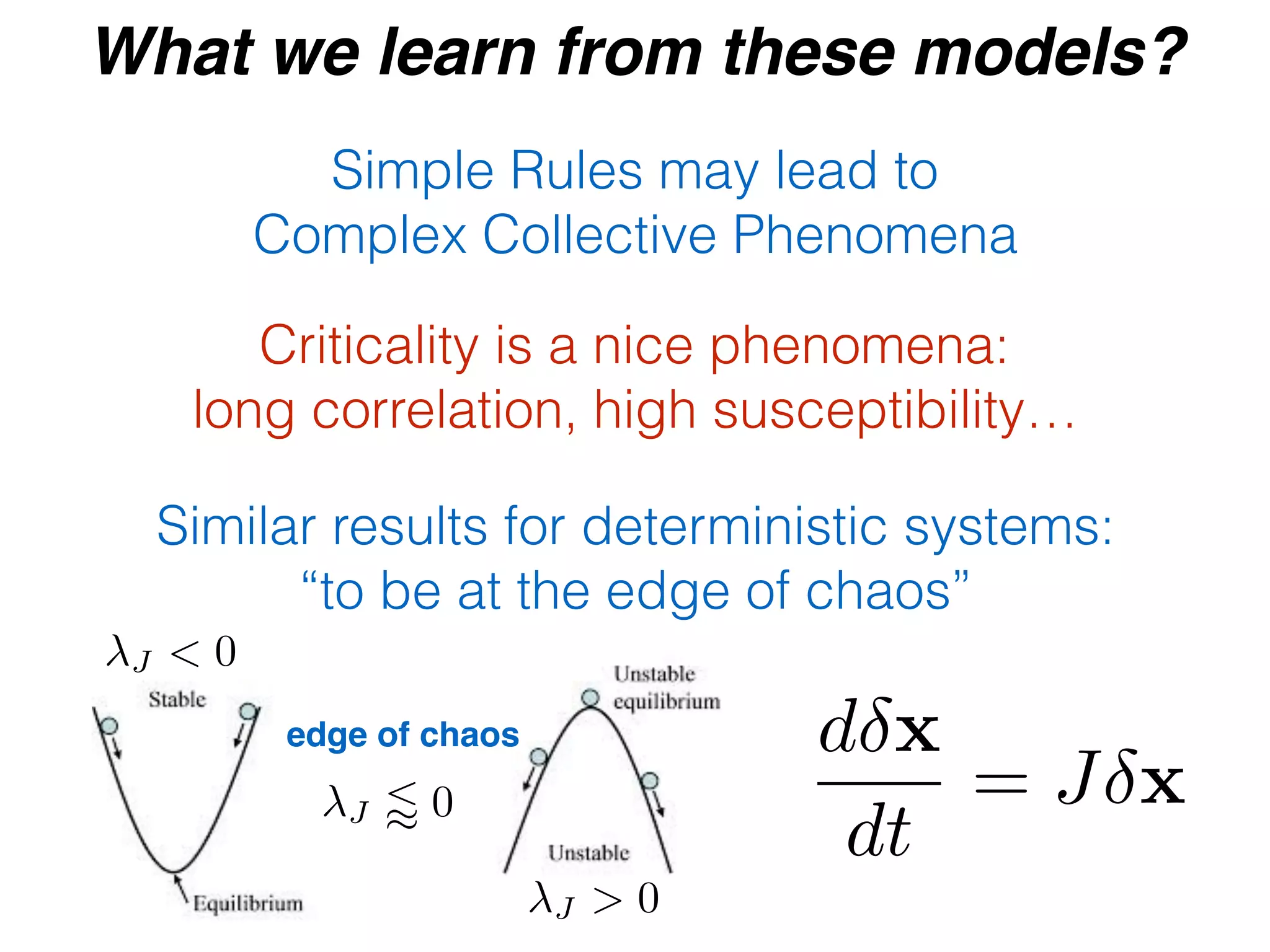
What we learn from these models?
Simple Rules may lead to
Complex Collective Phenomena
Criticality is a nice phenomena:
long correlation, high susceptibility…
Similar results for deterministic systems:
“to be at the edge of chaos”
d x
dt
= J x
edge of chaos
J < 0
J > 0
J / 0
- Collective motions in
ecosystem dynamics
- Foraging strategies,
Chemotaxis, movements
and communications
among microorganisms
- Scaling in ecological
communities
- Ecological networks
- Emergent Macro
Ecological patterns
Why should a physicist may be interested in ecology/biology?
should a physicist may be interested in ecology?
nderstanding an ecosystem is a
rmidable many-body problem. One
as an interacting system, made up of
dividuals of various species with
mperfectly known interactions and
haracterized by a wide range of spatial
nd temporal scales.
evertheless, some "general" emergent
atures characterize very complex and
fferent ecological systems. Figure: It is interesting to contemplate an entangled bank, clothed
with many plants of many kinds, with birds singing on the bushes,
with various insects fitting about, and with worms crawling through
the damp earth, and to reflect that these elaborately constructed forms,
so different from each other in so complex a manner, have been all
produced by laws acting around us. (Darwin, Origin of Species)
Criticality has been found
in many biological systems!
Biological systems may
bene>t from criticality??
FLOCKING BEHAVIOR
Moving entities
exhibit patterns of
COORDINATED behavior...
… in the absence of
any LEADER!!
The physicist approach
A. Einstein
“Make everything as simple as possible,
but not simpler.”
“You don’t really understand something unless you can
explain it to your grandmother.”
Starlings’ flocks behaviour
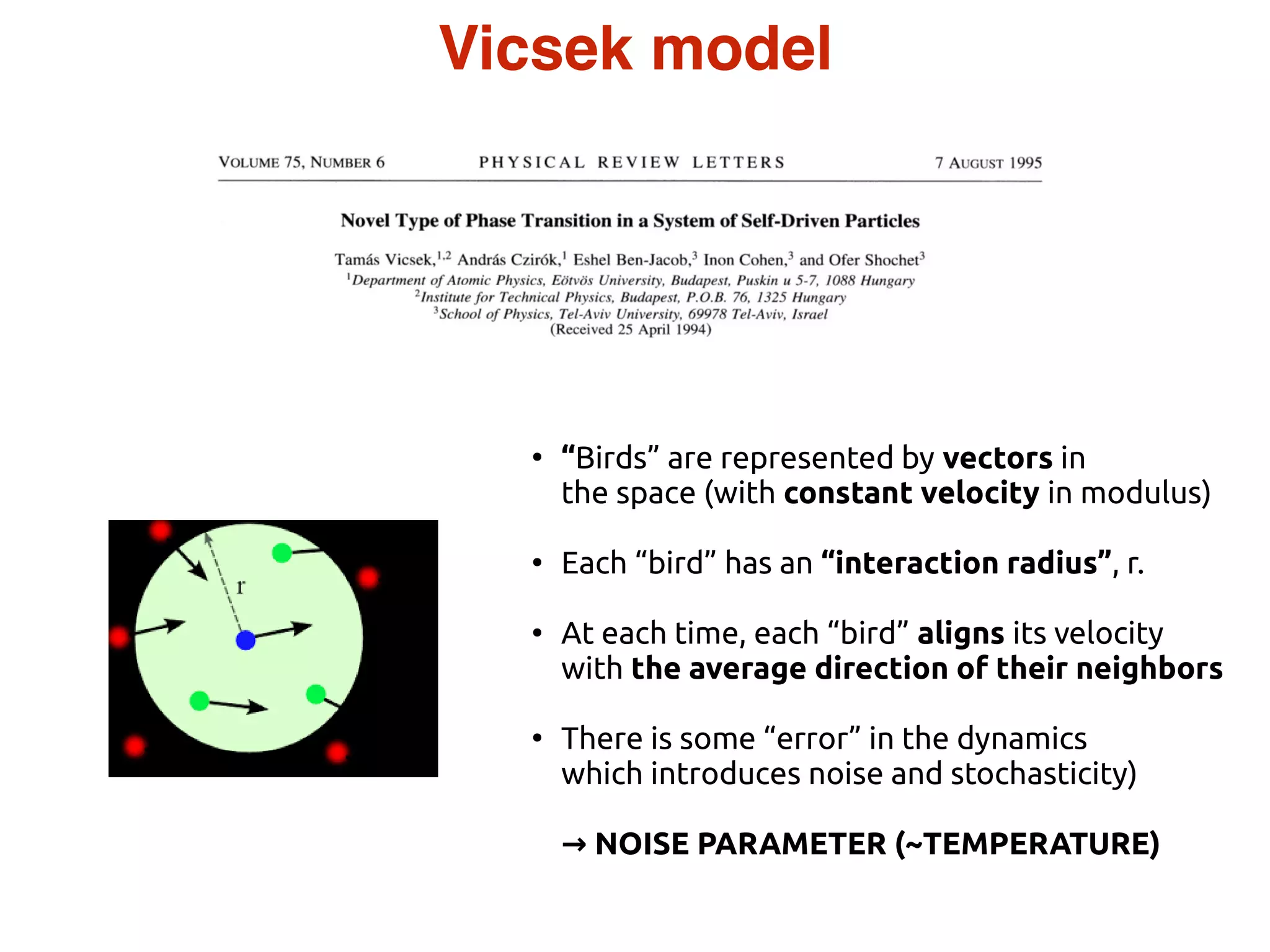
●
“Birds” are represented by vectors in
the space (with constant velocity in modulus)
●
Each “bird” has an “interaction radius”, r.
●
At each time, each “bird” aligns its velocity
with the average direction of their neighbors
●
There is some “error” in the dynamics
which introduces noise and stochasticity)
→ NOISE PARAMETER (~TEMPERATURE)
Vicsek model
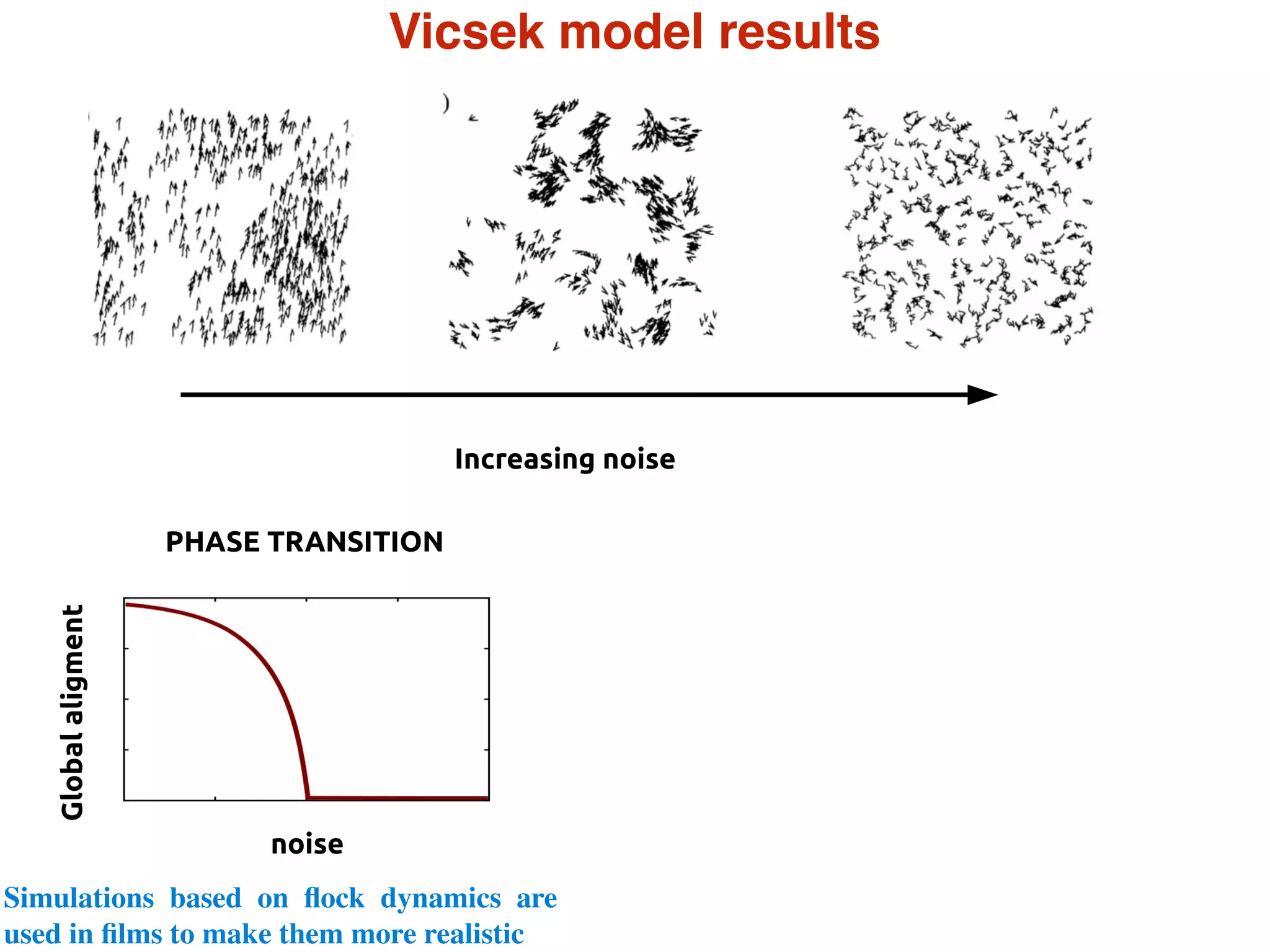
Increasing noise
Globalaligment
noise
PHASE TRANSITION
Vicsek model results
Simulations based on flock dynamics are
used in films to make them more realistic
Flocks of birds exhibit PROPERTIES akin to CRITICAL POINTS!
WHY???
Correlations among individuals
had not a characteristic length
(the larger the @ock,
the larger the correlation length)
From records of real @ocks
they were able to monitor each
Individual's movement
(similar experiments
with @ying insects years later)
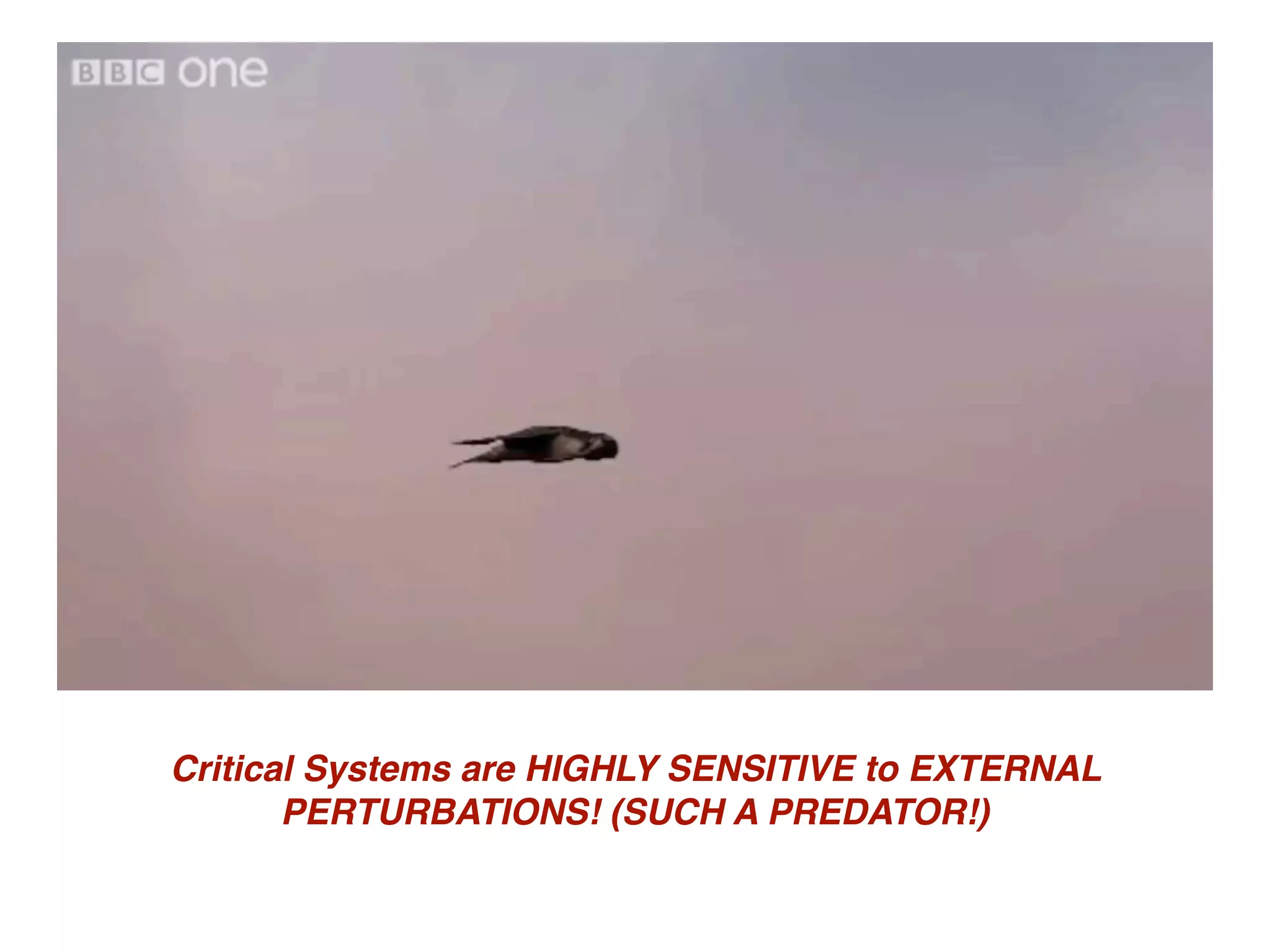
Critical Systems are HIGHLY SENSITIVE to EXTERNAL
PERTURBATIONS! (SUCH A PREDATOR!)
Biodiverse Ecosystems
0 2 4 6 8 10 0 2 4 6 8 10
2 4 6 8 10
0
5
10
15
0
5
10
15
20
25
0
5
10
15
20
0
5
10
15
20
25
30
2 4 6 8 10 0 12
Numberofspecies Coral Reefs
Tropical Forests
1 2 3 4 5 6 7 0 2 4 6
0 2 4 6 8 10 0 2 4 6 8 10
0
10
20
30
40
0
10
20
30
0
10
20
30
0
10
20
30
40 40 d2c2
40 b2a2
Numberofspecies
0 8
d1c1
b1a1
Abundance category
180 plots 45 plots
15 plots 5 plots
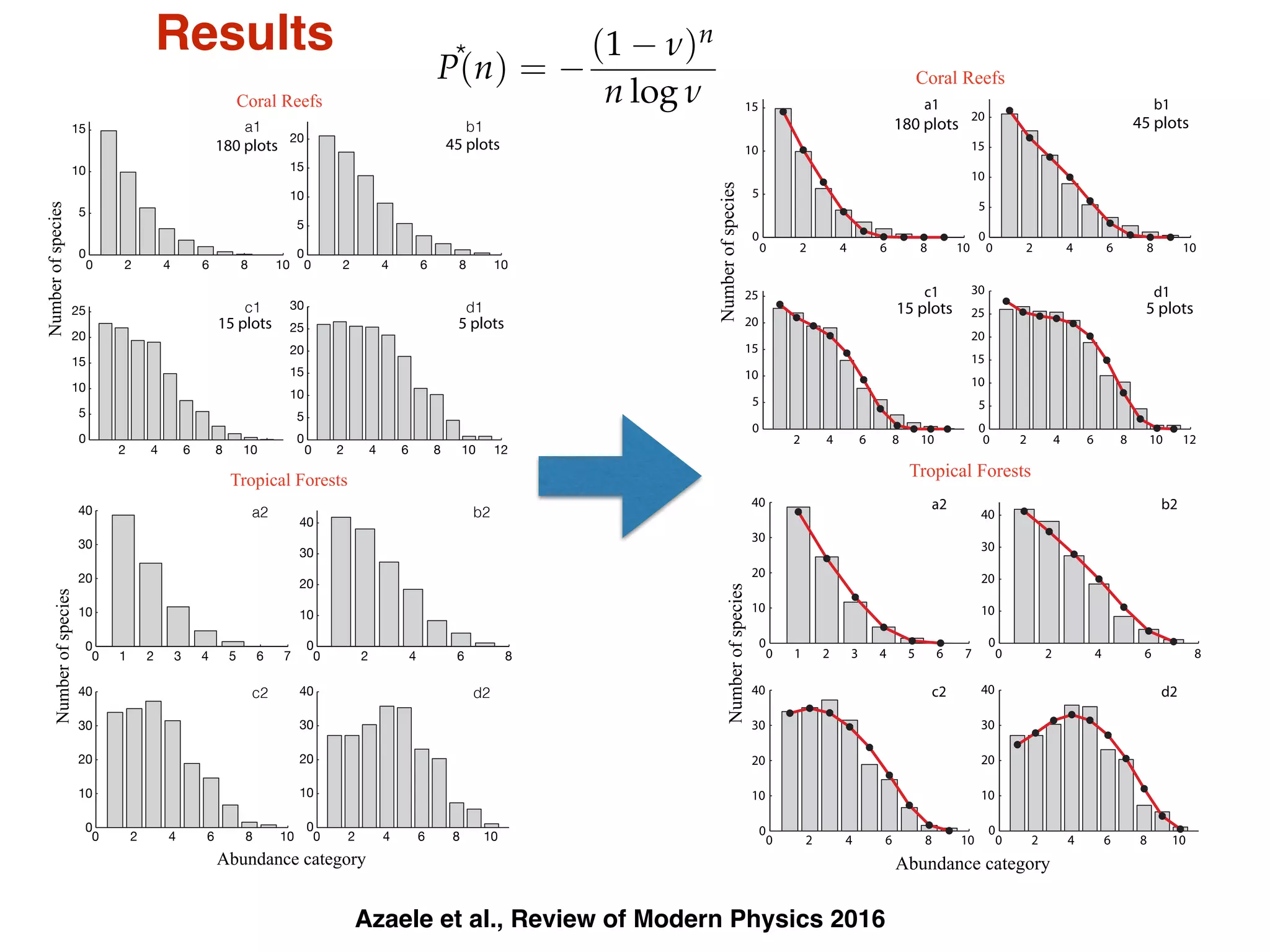
Emergent Pattern in Ecology: RSA
2D connectivty structure
networked connectivity structure
The Voter Model in Ecology
• Community of N individuals and
S species (colours)
• Pick at random an individual.
It dies.
• 1-m: replaced it by another
random individual in the system
• m: it is replaced by an individual
of a new species (migration)
dPn(t)
dt
= bn 1Pn 1(t) + dn+1Pn+1(t) (bn + dn)Pn(t)
Parameters: bn/dn and m = b0 Functional form of bn
Density dependent effectsIf m=0 -> absorbing state
1-m
m
ie e viene descritta dalla birth-deah master equation [8], che descrive la probabilità P(n, t)
data specie al tempo t di avere una popolazione di n individui
dP
dt
(n, t) = b(n 1) · P(n 1, t) [b(n) + d(n)] · P(n, t) + d(n + 1) · P(n + 1, t)
e b(n) e d(n) sono rispettivamente i parametri di nascita e morte, dati dalle seguenti
b(n) = (1 n) ·
n
J
J n
J 1
d(n) = (1 n) ·
n
J
J n
J 1
+ n ·
n
J
Notiamo che queste definizioni sono consistenti con le due regole della dinamica del V
del:
con probabilità 1 n si ha la morte di un individuo della comunità non appartenente
specie data (con probabilità J n
J ) accompagnata dalla nascita di un individuo della sp
scelta ( n
J 1 );
con probabiltà n
J si ha la morte di un individuo appartenente alla specie data accompag
ta o dalla migrazione di un individuo proveniente da una delle altre specie presenti
probabilità (1 n)
⇣
J n
J 1
⌘
) o dalla comparsa di una nuova specie (con probabilità n).
oluzione stazionaria o di equilibrio P⇤(n) per la (3.1) è la seguente [8]
escritta dalla birth-deah master equation [8], che descrive la probabilità P(n, t) per
al tempo t di avere una popolazione di n individui
) = b(n 1) · P(n 1, t) [b(n) + d(n)] · P(n, t) + d(n + 1) · P(n + 1, t) (3.1)
) sono rispettivamente i parametri di nascita e morte, dati dalle seguenti
b(n) = (1 n) ·
n
J
J n
J 1
(3.2)
d(n) = (1 n) ·
n
J
J n
J 1
+ n ·
n
J
(3.3)
e queste definizioni sono consistenti con le due regole della dinamica del Voter
bilità 1 n si ha la morte di un individuo della comunità non appartenente alla
a (con probabilità J n
J ) accompagnata dalla nascita di un individuo della specie
);
biltà n
J si ha la morte di un individuo appartenente alla specie data accompagna-
migrazione di un individuo proveniente da una delle altre specie presenti (con
à (1 n)
⇣
J n
J 1
⌘
) o dalla comparsa di una nuova specie (con probabilità n).
zionaria o di equilibrio P⇤(n) per la (3.1) è la seguente [8]
Ciascun nodo è un individuo rappresentato da un label che ne identifi
za. Denotiamo con C la collezione di tutti gli individui appartenenti a
~n = {n1, n2, . . . , nS} il vettore delle abbondanze per C, dove nj indica
della j-esima specie.
Ci poniamo nell’ensemble microcanonico, imponendo che ogni in
sostituito immediatamente da un altro della stessa o di un’altra specie
J =
S
Â
i=1
ni
La dinamica del mean field Voter Model a ogni istante di tempo è
selezionato casualmente muore e viene sostituito con un individuo di
probabilità n, mentre con probabilità 1 n il sito viene colonizzato d
presente su un nodo selezionato casualmente nella griglia. A differe
del Voter Model, dove l’interazione avveniva tra primi vicini, nel mode
con qualsiasi nodo della griglia, senza che però ci sia dispersione sulla
Il parametro n, detto diversification rate, gioca un ruolo fondamental
da che esso sia o meno nullo, la dinamica è completamente differente
parla di mean field Voter Model senza speciazione e in questo caso s
specie: in un tempo finito tutti i nodi saranno occupati da individui
popolazione dei votanti ha raggiunto un consenso). Se, invece, n > 0
Model con speciazione: in questo caso, in un tempo finito si raggiun
della distribuzione delle specie presenti.
P⇤
(n) = P(0)
n
’
z=1
b(z 1)
d(z)
(3.4)
e dedotta dalla condizione di normalizzazione
Â
n
P⇤
(n) = 1
esto risultato, imponiamo la condizione di equilibrio dP
dt (n, t) = 0 e notiamo
ere l’equazione come
I(n + 1) I(n) = 0 (3.5)
to
I(n) = d(n)P⇤
(n) b(n 1)P⇤
(n 1)
zione fisica che non si possa avere un numero di individui negativo, si ha che
quindi, I(0) = 0. Inoltre, supporre che quando una specie si estingue con-
na nuova la rimpiazza è equivalente a imporre condizioni al contorno riflet-
a ipotesi è ragionevole sulle scale temporali di nostro interesse. Sommando
otteniamo
1
[I(z + 1) I(z)] = I(n) I(0) = 0 =) I(n) = 0
La soluzione stazionaria o di equilibrio P⇤(n) per la (3.1) è la segue
P⇤
(n) = P(0)
n
’
z=1
b(z 1)
d(z)
dove P(0) può essere dedotta dalla condizione di normalizzazione
Â
n
P⇤
(n) = 1
Per arrivare a questo risultato, imponiamo la condizione di equ
che possiamo riscrivere l’equazione come
I(n + 1) I(n) = 0
dove abbiamo definito
I(n) = d(n)P⇤
(n) b(n 1)P⇤
(n 1
Imponendo la condizione fisica che non si possa avere un numero d
b( 1) = d(0) = 0 e, quindi, I(0) = 0. Inoltre, supporre che quan
temporaneamente una nuova la rimpiazza è equivalente a imporr
tenti alla (3.1): questa ipotesi è ragionevole sulle scale temporali d
Per arrivare a questo ri
che possiamo riscrivere l’e
dove abbiamo definito
Imponendo la condizione
b( 1) = d(0) = 0 e, quin
temporaneamente una nu
tenti alla (3.1): questa ipot
su tutti gli n la (3.5) ottenia
n 1
Â
z=0
[I(z +
da cui segue che P⇤(n) è ri
z=1
dove P(0) può essere dedotta dalla condizione di normali
Â
n
P⇤
(n) = 1
Per arrivare a questo risultato, imponiamo la condizio
che possiamo riscrivere l’equazione come
I(n + 1) I(n) = 0
dove abbiamo definito
I(n) = d(n)P⇤
(n) b(n 1)
Imponendo la condizione fisica che non si possa avere un
b( 1) = d(0) = 0 e, quindi, I(0) = 0. Inoltre, supporre c
temporaneamente una nuova la rimpiazza è equivalente
tenti alla (3.1): questa ipotesi è ragionevole sulle scale tem
su tutti gli n la (3.5) otteniamo
n 1
Â
z=0
[I(z + 1) I(z)] = I(n) I(0) = 0
e P(0) può essere dedotta dalla condizione di normalizzazione
Â
n
P⇤
(n) = 1
Per arrivare a questo risultato, imponiamo la condizione di equilibrio dP
dt (n, t) = 0 e notiamo
possiamo riscrivere l’equazione come
I(n + 1) I(n) = 0 (3.5
e abbiamo definito
I(n) = d(n)P⇤
(n) b(n 1)P⇤
(n 1)
onendo la condizione fisica che non si possa avere un numero di individui negativo, si ha che
1) = d(0) = 0 e, quindi, I(0) = 0. Inoltre, supporre che quando una specie si estingue con
poraneamente una nuova la rimpiazza è equivalente a imporre condizioni al contorno riflet
i alla (3.1): questa ipotesi è ragionevole sulle scale temporali di nostro interesse. Sommando
utti gli n la (3.5) otteniamo
n 1
Â
z=0
[I(z + 1) I(z)] = I(n) I(0) = 0 =) I(n) = 0
ui segue che P⇤(n) è ricorsiva, come si voleva: d(n)P⇤(n) = b(n 1)P⇤(n 1).
Â
n
P⇤
(n) = 1
niamo la condizione di equilibrio dP
dt (n, t) = 0 e notiamo
e
n + 1) I(n) = 0 (3.5)
)P⇤
(n) b(n 1)P⇤
(n 1)
si possa avere un numero di individui negativo, si ha che
noltre, supporre che quando una specie si estingue con-
za è equivalente a imporre condizioni al contorno riflet-
ole sulle scale temporali di nostro interesse. Sommando
I(n) I(0) = 0 =) I(n) = 0
si voleva: d(n)P⇤(n) = b(n 1)P⇤(n 1).
dP
dt
(n, t) = b(n 1) · P(n 1, t) [b(n) + d(n)] · P(n, t) + d(n + 1) ·
dove b(n) e d(n) sono rispettivamente i parametri di nascita e morte, dati dal
b(n) = (1 n) ·
n
J
J n
J 1
d(n) = (1 n) ·
n
J
J n
J 1
+ n ·
n
J
Notiamo che queste definizioni sono consistenti con le due regole della
Model:
• con probabilità 1 n si ha la morte di un individuo della comunità no
specie data (con probabilità J n
J ) accompagnata dalla nascita di un ind
scelta ( n
J 1 );
• con probabiltà n
J si ha la morte di un individuo appartenente alla specie
ta o dalla migrazione di un individuo proveniente da una delle altre s
probabilità (1 n)
⇣
J n
J 1
⌘
) o dalla comparsa di una nuova specie (con p
La soluzione stazionaria o di equilibrio P⇤(n) per la (3.1) è la seguente [8]
P⇤
(n) = P(0)
n
’
z=1
b(z 1)
d(z)
dove P(0) può essere dedotta dalla condizione di normalizzazione
Mapping birth-death ME with Voter Model: Analytical Solution
Birth rate
Death rate
BCCurrent of probability
Solution
0 2 4 6 8 10 0 2 4 6 8 10
2 4 6 8 10
0
5
10
15
0
5
10
15
20
25
0
5
10
15
20
0
5
10
15
20
25
30
2 4 6 8 10 0 12
Numberofspecies
Coral Reefs
Tropical Forests
1 2 3 4 5 6 7 0 2 4 6
0 2 4 6 8 10 0 2 4 6 8 10
0
10
20
30
40
0
10
20
30
0
10
20
30
0
10
20
30
40 40 d2c2
40 b2a2
Numberofspecies
0 8
d1c1
b1a1
Abundance category
180 plots 45 plots
15 plots 5 plots
Azaele et al., Review of Modern Physics 2016
0 2 4 6 8 10 0 2 4 6 8 10
2 4 6 8 10
0
5
10
15
0
5
10
15
20
25
0
5
10
15
20
0
5
10
15
20
25
30
2 4 6 8 10 0 12
Numberofspecies
Coral Reefs
Tropical Forests
1 2 3 4 5 6 7 0 2 4 6
0 2 4 6 8 10 0 2 4 6 8 10
0
10
20
30
40
0
10
20
30
0
10
20
30
0
10
20
30
40 40 d2c2
40 b2a2
Numberofspecies
0 8
d1c1
b1a1
Abundance category
180 plots 45 plots
15 plots 5 plots
Results
P(n) =
(1 n)n
n log n
(4
guenti grafici sono è riportato il confronto tra la soluzione analitica della (4.3) e la R
del Voter Model simulato con i parametri sopraccitati.
11
*
Species
Time
Abundance
τ3
τ8
τ7
τ6
τ5
τ4
0 1000 km
#ofspecies
τ1
τ2
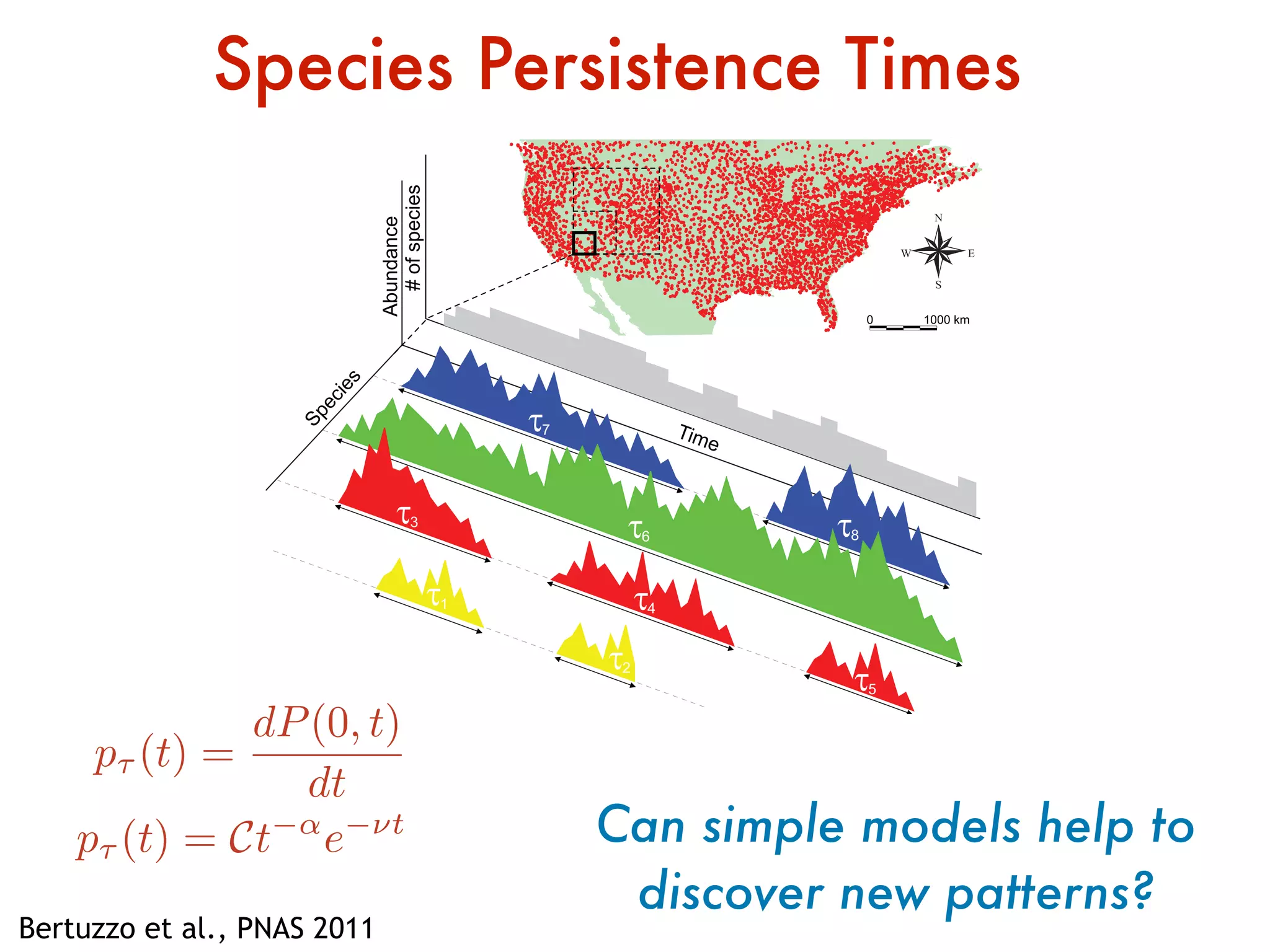
Species Persistence Times
p⌧ (t) =
dP(0, t)
dt
p⌧ (t) = Ct ↵
e ⌫t Can simple models help to
discover new patterns?
Bertuzzo et al., PNAS 2011
2 5 10 20 40 1052 203 301.5 157
10
0
10
1
10
10
−4
10
−3
10
−2
10
−1
10
0
10
−5
pτΙ
(t) s
pτ‘(t) s
data
fit
fit
p(t)
10
0
10
1
10
2
10
−4
10
−3
10
−2
10
−1
10
10
−5
p(t)
Time (yr)Time (yr)
2
10
−4
10
−3
10
−2
10
−1
10
0
10
−5
p(t)
0
10
−4
10
−3
10
−2
10
−1
10
p(t)
0
Time (yr)Time (yr)
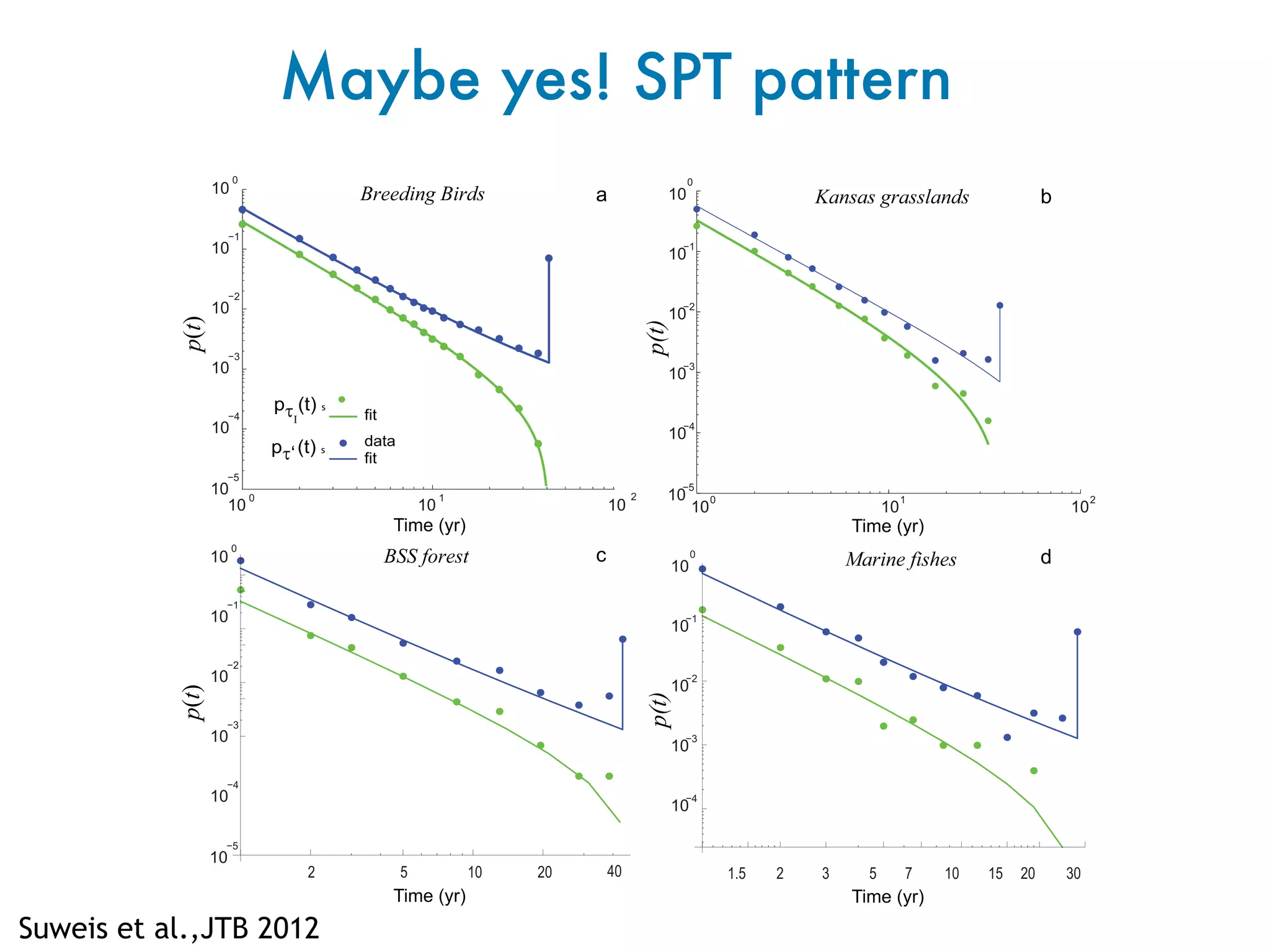
a b
c d
Breeding Birds Kansas grasslands
BSS forest Marine fishes
Suweis et al.,JTB 2012
Maybe yes! SPT pattern
Pollinator
Pollinator
Pollinator
Pollinator
Plant
Plant
Plant
Plant
Pollinator
Plants
Complex ecological networks
Freshwater	food	web
C.	Elegans	Gene-Protein	Network	
Biological Networks
1011 neurons!
<103> dendrites!
Very Complex Brain network
What is a Network?
Network (graph) is a mathematical structure
composed of points connected by lines
Network Theory <-> Graph Theory
Network ↔ Graph
Nodes ↔ Vertices (points)
Links ↔ Edges (Lines)
System vs. Parts = Networks vs. Nodes
Real networks can be divided in four different classes:
Graph Theory
aij=1 aik=0
Adjacency matrix: A -> Describe the network.
If weighted links, weighted adjacency matrix W
i
jk
aji=1 aki=0
From
To
Wij=0.4 Wik=0
Wji=1.2 Wki=0
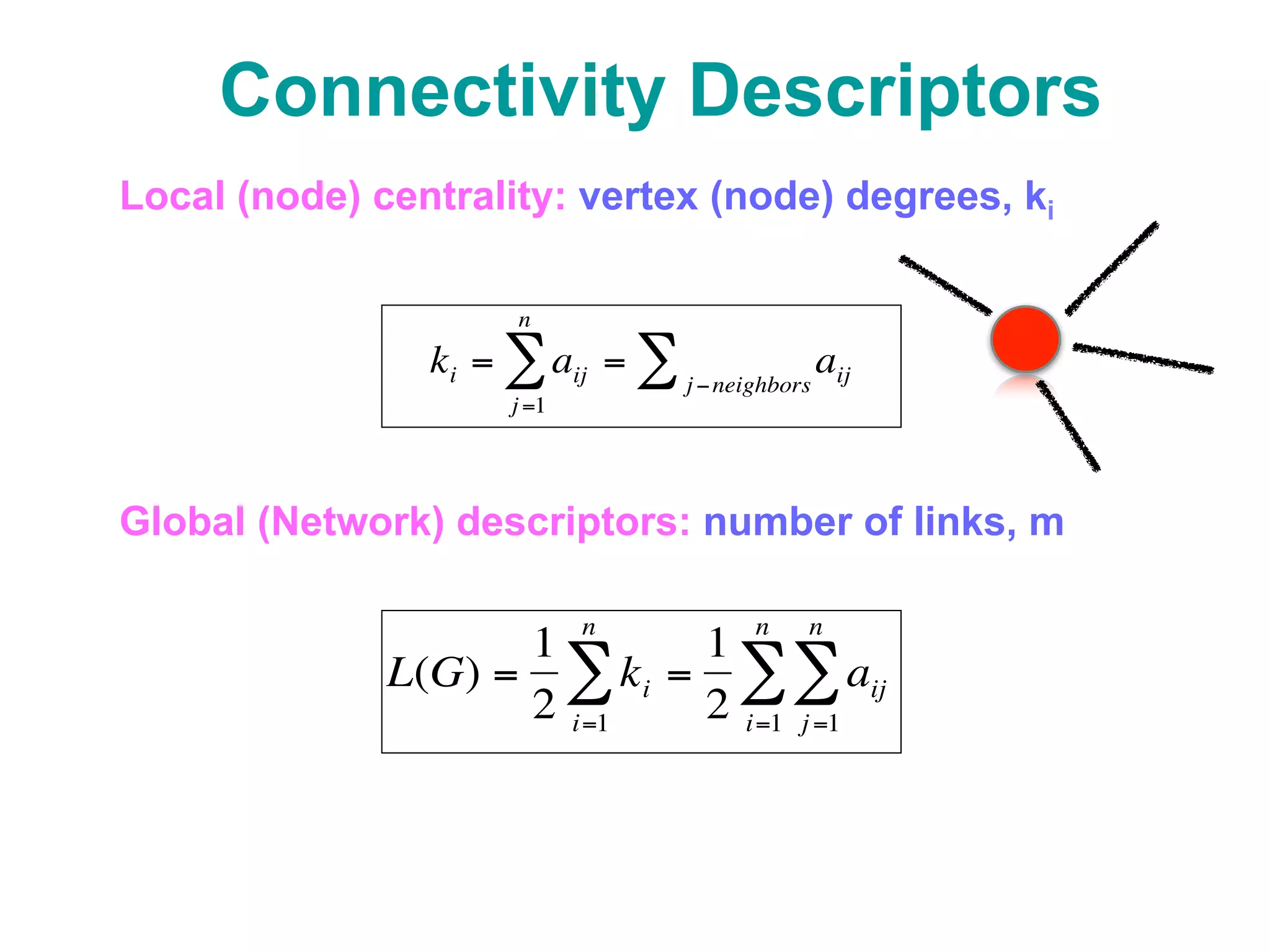
Connectivity Descriptors
Local (node) centrality: vertex (node) degrees, ki
Global (Network) descriptors: number of links, m
€
ki = aij
j =1
n
∑ = aijj −neighbors
∑
€
L(G) =
1
2
ki
i=1
n
∑ =
1
2
aij
j =1
n
∑
i=1
n
∑
Clustering Coefficients
Local
Global (WS)
Global (I)
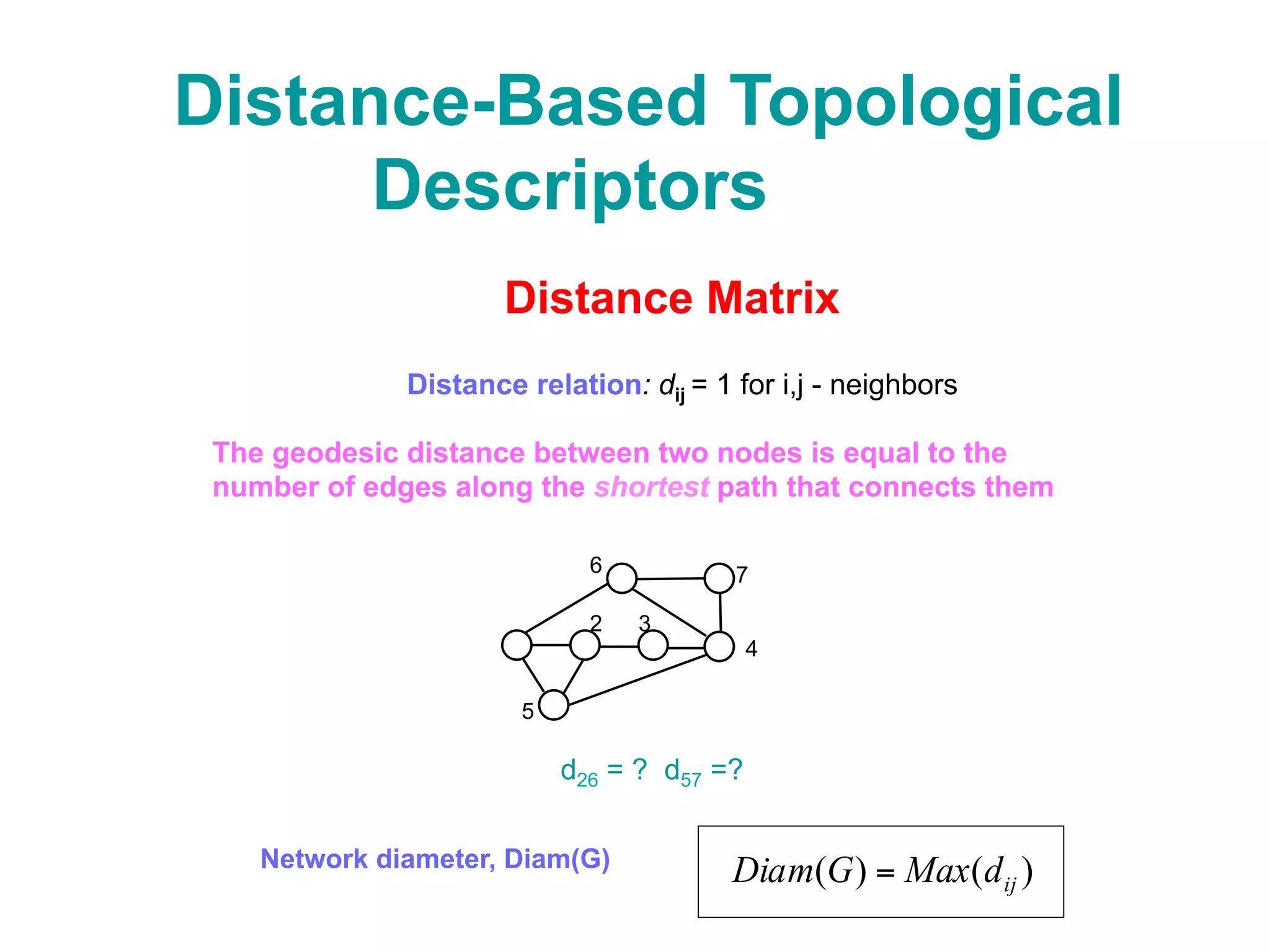
Distance-Based Topological
Descriptors
Distance Matrix
Distance relation: dij = 1 for i,j - neighbors
The geodesic distance between two nodes is equal to the
number of edges along the shortest path that connects them
32
6
4
5
7
d26 = ? d57 =?
Distance Descriptors
Node descriptors:
Network descriptors:
∑∑∑ = ==
==
V
i
V
j
ij
V
i
i ddGD
1 11
)(Network distance, D(G)
Network diameter, Diam(G)
)()( ijdMaxGDiam =
Node eccentricity, eie ei = Max(dij)
∑=
=
V
j
iji dd
1
node distance, di
Connected components in a network
Laplacian matrix!
The Laplacian matrix is a similarly useful matrix defined by:!
L = K - A!
dΨ[t]/dt=-DLΨ[t]
Eigenvalues of L
Connected Compone
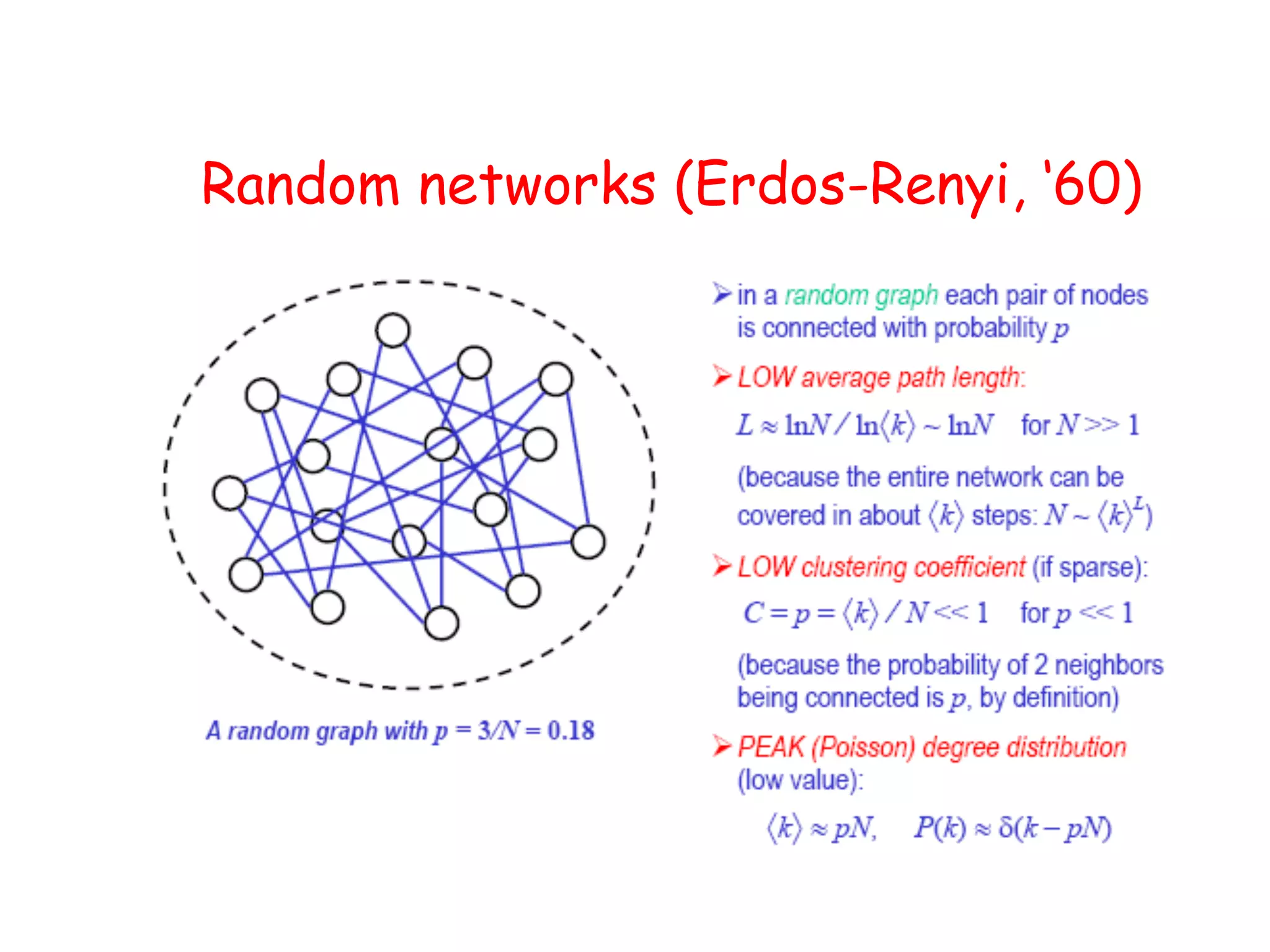
Random networks (Erdos-Renyi, ‘60)
Random Networks - Percolation
y health
of com-
m patho-
nt (3–6).
s ecolog-
different
tends to
periods
for host
res that
unctions
espond-
ity com-
h (4, 13).
en char-
al work.
erstand-
rticular,
y. There
heory to
erns for
n made
dels (14)
ities (15).
y diverse
), which
llenging
ecology
dels that
rge and
develop
he gen-
where the types of interactions between species
are randomly distributed, meaning that +/+ (coop-
eration) and –/– (competition) interactions occur
with half the probability of +/– (exploitation) inter-
actions. Also, whereas ecological competition is
thought to be prevalent in natural microbial com-
munities (20), it is commonly assumed that the
functioning of microbiome communities restsupon
species that engage in cooperative metabolism (+/+)
potentialcommunitytypes,coveringthefullrangeof
possible interactions and species diversities [Fig. 1
and supplementary method 1 (31)]. We develop
our theory for unstructured ecological networks
because, unlike in plant-pollinator communities
or food webs (32, 33), there is no evidence of strong
structuring within microbial communities (16).
However, although no single structure type dom-
inates in these communities, our mathematics
Fig. 1. Ecological theory and microbiota stability. (A) Ecological network theory captures networks of
microbial species that interact with themselves (–s) and other genotypes (aij). (B) Coupled ordinary differential
onNovemwww.sciencemag.orgDownloadedfromonNovemwww.sciencemag.orgDownloadedfromonNovemwww.sciencemag.orgDownloadedfromonNovemwww.sciencemag.orgDownloadedfrom
tion of cooperative interactions within communi-
ties nearly always decreases the overall return
rate and the likelihood of stability [Fig. 2 and
lysis, we find the same
is destabilizing. Howe
plementary materials
Fig. 2. Cooperation reduces community stability. (A) Illustration of changin
the proportion of cooperative links in networks. Pm, proportion of cooperative in
MICROBIOME
The ecology of the microbiome:
Networks, competition, and stability
Katharine Z. Coyte,1,2
* Jonas Schluter,1,2,3
*† Kevin R. Foster1,2
†
The human gut harbors a large and complex community of beneficial microbes that remain stable
over long periods.This stability is considered critical for good health but is poorly understood.
Here we develop a body of ecological theory to help us understand microbiome stability.
Although cooperating networks of microbes can be efficient, we find that they are often unstable.
Counterintuitively, this finding indicates that hosts can benefit from microbial competition when
this competition dampens cooperative networks and increases stability. More generally, stability is
promoted by limiting positive feedbacks and weakening ecological interactions.We have analyzed
host mechanisms for maintaining stability—including immune suppression, spatial structuring, and
feeding of community members—and support our key predictions with recent data.
T
he human microbiome contains hundreds
of species and trillions of cells that reside
predominantly in the gastrointestinal tract
(1, 2). These microbes provide many health
benefits, including the breakdown of com-
plex molecules in food, protection from patho-
gens, and healthy immune development (3–6).
The gut microbiome is often noted for its ecolog-
ical stability. Different people may carry different
microbial species, but any one individual tends to
carry the same key set of species for long periods
(6–8). This stability is considered critical for host
Seminal work by May suggests that species di-
versity can be problematic for community stability
(17, 19). However, May’s work focused on networks
where the types of interactions between species
are randomly distributed, meaning that +/+ (coop-
eration) and –/– (competition) interactions occur
with half the probability of +/– (exploitation) inter-
actions. Also, whereas ecological competition is
thought to be prevalent in natural microbial com-
munities (20), it is commonly assumed that the
functioning of microbiome communities restsupon
species that engage in cooperative metabolism (+/+)
and
The
Com
num
tera
anti
coop
prod
ly re
olism
alth
tent
ecol
T
biom
fects
with
crob
ics. T
of th
subs
gene
pote
poss
and
our
beca
or fo
stru
How
inat
Generalized Lotka-Volterra
intrinsic
growth rates
interaction
matrix
fixed point
how many combinations of growth rates
are compatible with coexistence?
What is the effect of the interaction matrix?
Stable &
Feasible
(n>0)
-
˙n = J n
Jij = Aijn⇤
i random matrix
1.  M.E.J. Newman, Networks: An Introduction. Oxford University Press, 2010
3. S. Havlin and R. Cohen, Complex Networks. Cambridge, 2010
4. Social and Economic Networks: Models and Analysis by Matthew O. Jackson
(Stanford University). Coursera: https://class.coursera.org/networksonline-001/class
5. S.Maslov, “Statistical physics of complex networks”
http://www.cmth.bnl.gov/~maslov/3ieme_cycle_Maslov_lectures_1_and_2.ppt
6. D. Bonchev, “Networks Basics”
http://www.ims.nus.edu.sg/Programs/biomolecular07/files/Danail_tut1.ppt
Recommended Literature & References
A Case Study: Emergent Patterns in
Mutualistic Ecological Networks
@SamirSuweis
CISM-UniUD joint course 2018
CISM-UniUD Joint course
coordinated by
PhD School in
Agricultural Science and Biotechnology
of the University of Udine
Udine September 3 - 7 2018
UniversityofUdine
InternationalCentreforMechanicalSciences
SYSTEMS BIOLOGY
ACADEMICYEAR
2018
Eco-networks
Challenges
•Interaction strengths very difficult to
measure, vary in time, env. condition
•Biological systems are typically large
But
•Statistical ensemble of networks
sharing similar characteristics.
•Emergent patterns and regularities
Species Interaction Networks
10/14/2014 Web of Life: ecological networks database
Networks All Data All Species >0 & <10000 Interactions >0 & <10000 Reset Results Download(89) Help
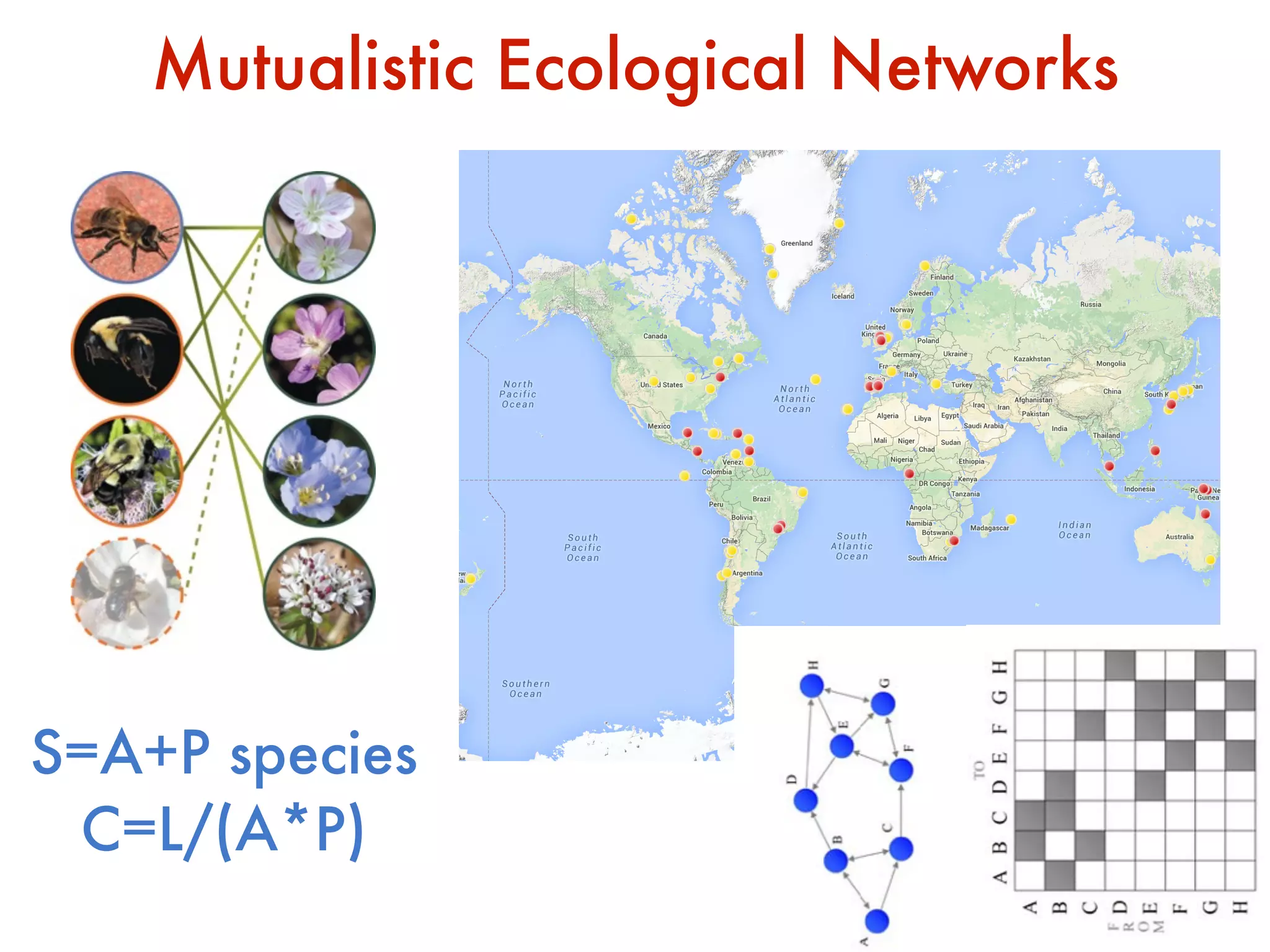
Mutualistic Ecological Networks
S=A+P species
C=L/(A*P)
Why do physicists care ?
aP A
ij
Why do physicists care ?
PPLEMENTARY INFORMATION
50 100 200 500
0.02
0.05
0.10
0.20
0.50
Number of Species [S]
Connectance[CΓ
]
C~1/S
Why do we care?
Stability ?
Extinctions ?
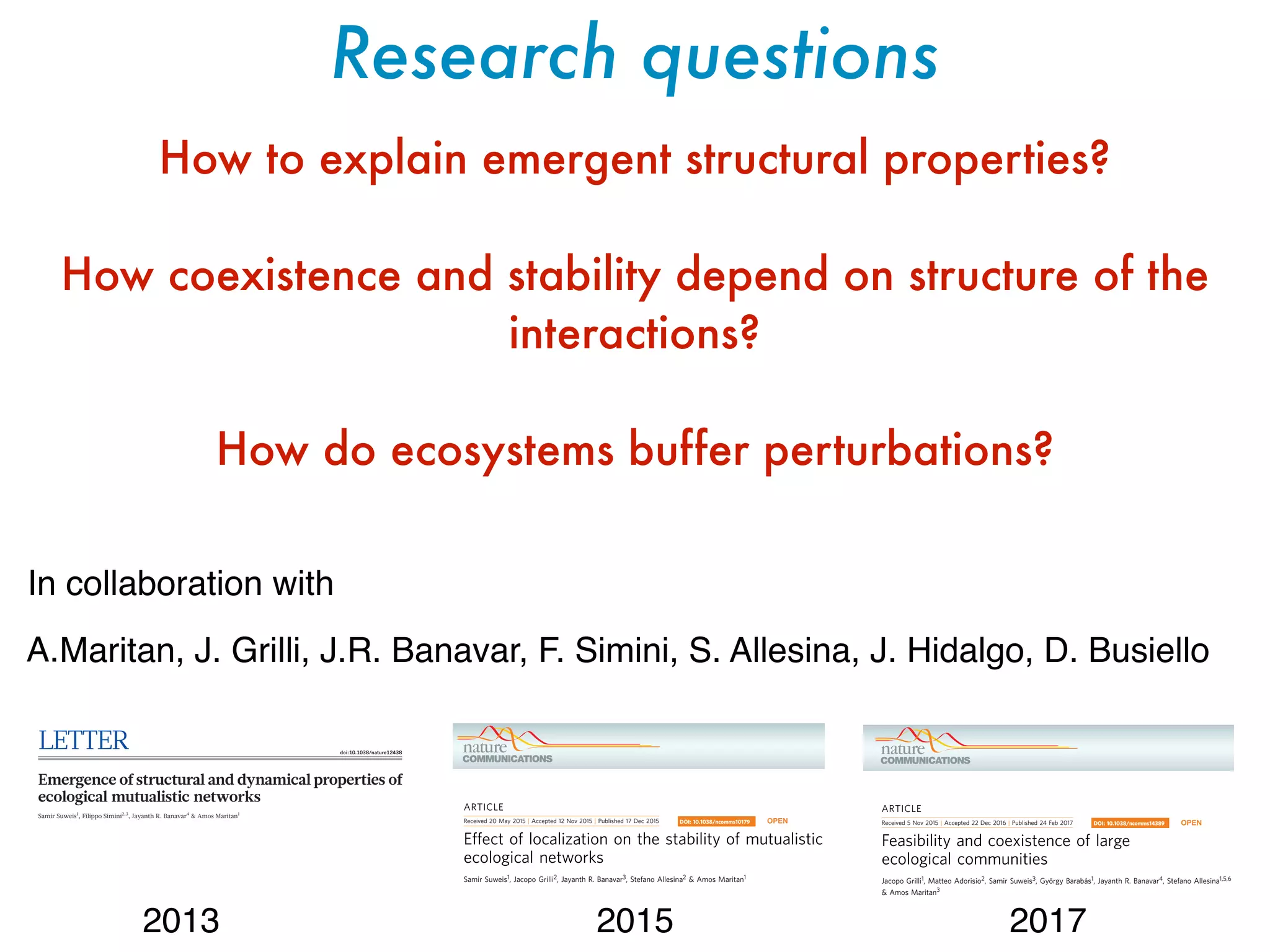
Research questions
How to explain emergent structural properties?
How coexistence and stability depend on structure of the
interactions?
How do ecosystems buffer perturbations?
A.Maritan, J. Grilli, J.R. Banavar, F. Simini, S. Allesina, J. Hidalgo, D. Busiello
ARTICLE
Received 5 Nov 2015 | Accepted 22 Dec 2016 | Published 24 Feb 2017
Feasibility and coexistence of large
ecological communities
Jacopo Grilli1, Matteo Adorisio2, Samir Suweis3, Gyo¨rgy Baraba´s1, Jayanth R. Banavar4, Stefano Allesina1,5,6
& Amos Maritan3
The role of species interactions in controlling the interplay between the stability of ecosys-
tems and their biodiversity is still not well understood. The ability of ecological communities
to recover after small perturbations of the species abundances (local asymptotic stability) has
DOI: 10.1038/ncomms14389 OPEN
LETTER doi:10.1038/nature12438
Emergence of structural and dynamical properties of
ecological mutualistic networks
Samir Suweis1
, Filippo Simini2,3
, Jayanth R. Banavar4
& Amos Maritan1
Mutualistic networks are formed when the interactions between
two classes of species are mutually beneficial. They are important
examples of cooperation shaped by evolution. Mutualism between
animals and plants has a key role in the organization of ecological
communities1–3
. Such networks in ecology have generally evolved
a nested architecture4,5
independent of species composition and
latitude6,7
; specialist species, with only few mutualistic links, tend
to interact with a proper subset of the many mutualistic partners of
anyofthegeneralistspecies1
.Despitesustainedefforts5,8–10
toexplain
observed network structure on the basis of community-level stabi-
lity or persistence, such correlative studies have reached minimal
consensus11–13
. Here we show that nested interaction networks could
emergeasaconsequenceofanoptimizationprincipleaimedatmaxi-
mizing the species abundance in mutualistic communities. Using
analytical and numerical approaches, we show that because of the
total number of individuals (henceforth referred to as the total popu-
lation) within the mutualistic community. We then show that, under
stationary conditions, the total population is directly correlated with
nestedness and vice versa. Finally, we demonstrate that nested mutua-
listic communities are less resilient than communities in which species
interact randomly. These results suggest a simple and general optim-
ization principle: key aspects of mutualistic network structure and its
dynamical properties could emerge as a consequence of the maximiza-
tionofthespeciesabundanceinthemutualisticcommunity(seeFig. 1).
We consider a community comprising a total of S interacting species
(see Methods), in which population dynamics is driven by interspecific
interactions.Wemodelmutualisticandcompetitivespeciesinteractions
using both the classical Holling type I and II functional responses16–18
(SupplementaryInformation).Weperformacontrollednumericalexperi-
ment at the stable stationary state by holding fixed the number of spe-
ARTICLE
Received 20 May 2015 | Accepted 12 Nov 2015 | Published 17 Dec 2015
Effect of localization on the stability of mutualistic
ecological networks
Samir Suweis1, Jacopo Grilli2, Jayanth R. Banavar3, Stefano Allesina2 & Amos Maritan1
The relationships between the core–periphery architecture of the species interaction network
and the mechanisms ensuring the stability in mutualistic ecological communities are still
unclear. In particular, most studies have focused their attention on asymptotic resilience or
persistence, neglecting how perturbations propagate through the system. Here we develop a
DOI: 10.1038/ncomms10179 OPEN
In collaboration with
2013 2015 2017
The architecture of species
interactions network
From patterns to principles
Why this recurrent topological properties?
Optimization Principles to explain
emergent patterns
UPPLEMENTARY INFORMATION
50 100 200 500
0.02
0.05
0.10
0.20
0.50
Number of Species [S]
Connectance[CΓ
]
e S1: Best fit (red solid line) of the connectivity as a function of the number of
es for 56 mutualistic communities. Dashed gray lines represent the region within
±1 standard deviation confidence interval for the exponent estimate. The plot is in
g scale.
C~1/S
Busiello et al., Scientific Report
The Origin of Sparsity in the Interaction Networks of Living Systems
This talk
A closer look to the nested structure
Plant Pollinator
web in Chile
Arroyo, et al.
Random
same S,C
Random
same S,C
Avian fruit web
in Puerto Rico
Carlo, et al.
1
5
10
15
20
1 10 20 32
1
5
10
15
20
25
1 10 20 30 36
NODF=0.424 NODF=0.192
1
5
10
15
20
25
1 10 20 30 36
NODF=0.072
1 10 20 32
1
5
10
15
20 NODF=0.133
Bascompte et al., PNAS 2003
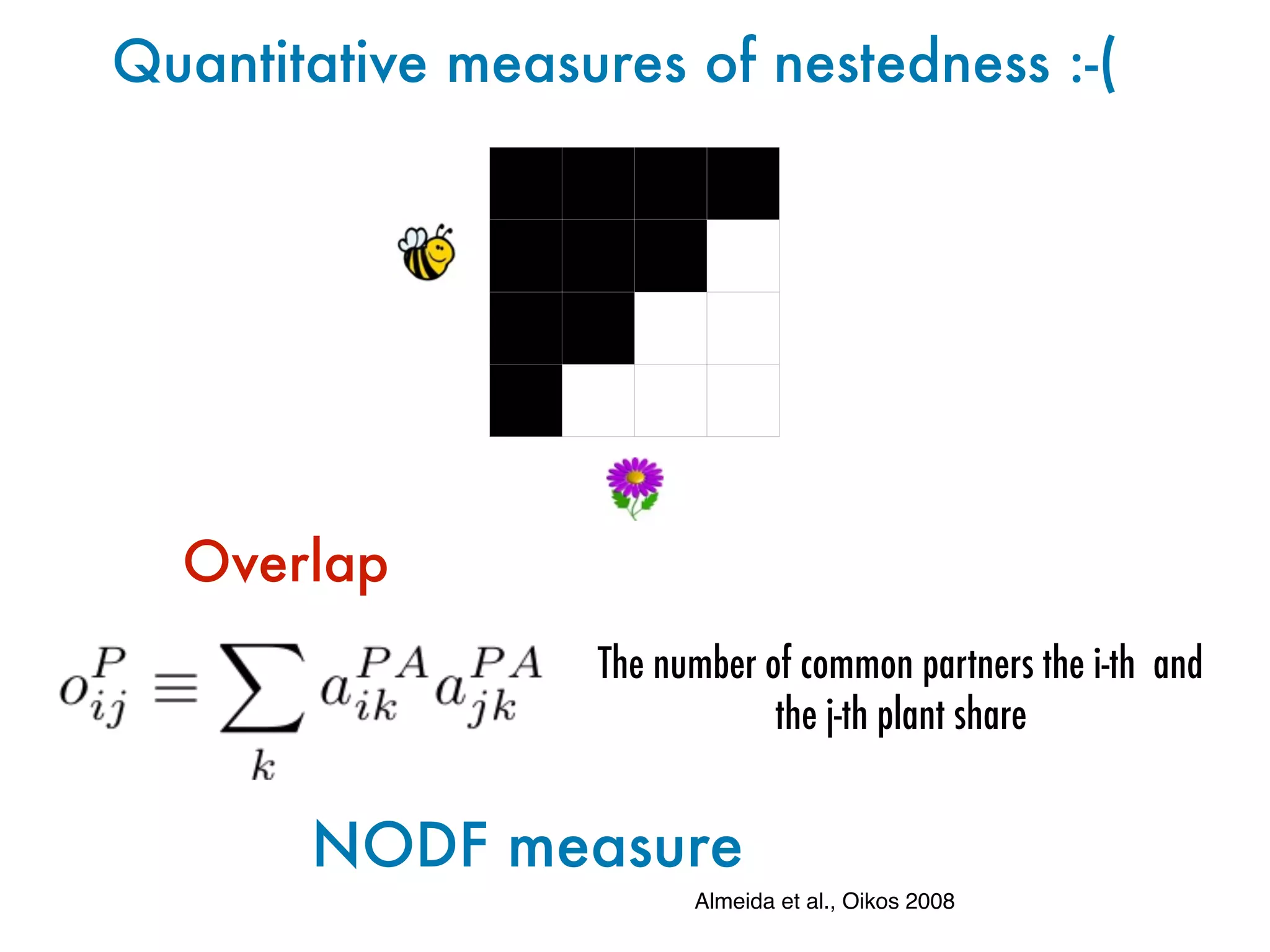
The number of common partners the i-th and
the j-th plant share
NODF measure
Almeida et al., Oikos 2008
Quantitative measures of nestedness :-(
Overlap
Network data vs Randomization 1
Null model 1: we keep fixed S and C,
and place at random the edges
# Species [S]
Nestedness[NODF]
20 40 60 80 100 120 140 160 180 200
0
0.1
0.2
0.3
0.4
0.5
0.6
0.7
0.8
Random
Data
0.1 0.2 0.3 0.4 0.5 0.6 0.7
0.1
0.2
0.3
0.4
0.5
0.6
0.7
NODF DATA
NODFNullModel
Network data vs Randomization 2
Null model 2: we keep p(k) fixed
while randomizing the edges
Effect of Interactions on Stability is very Controversial
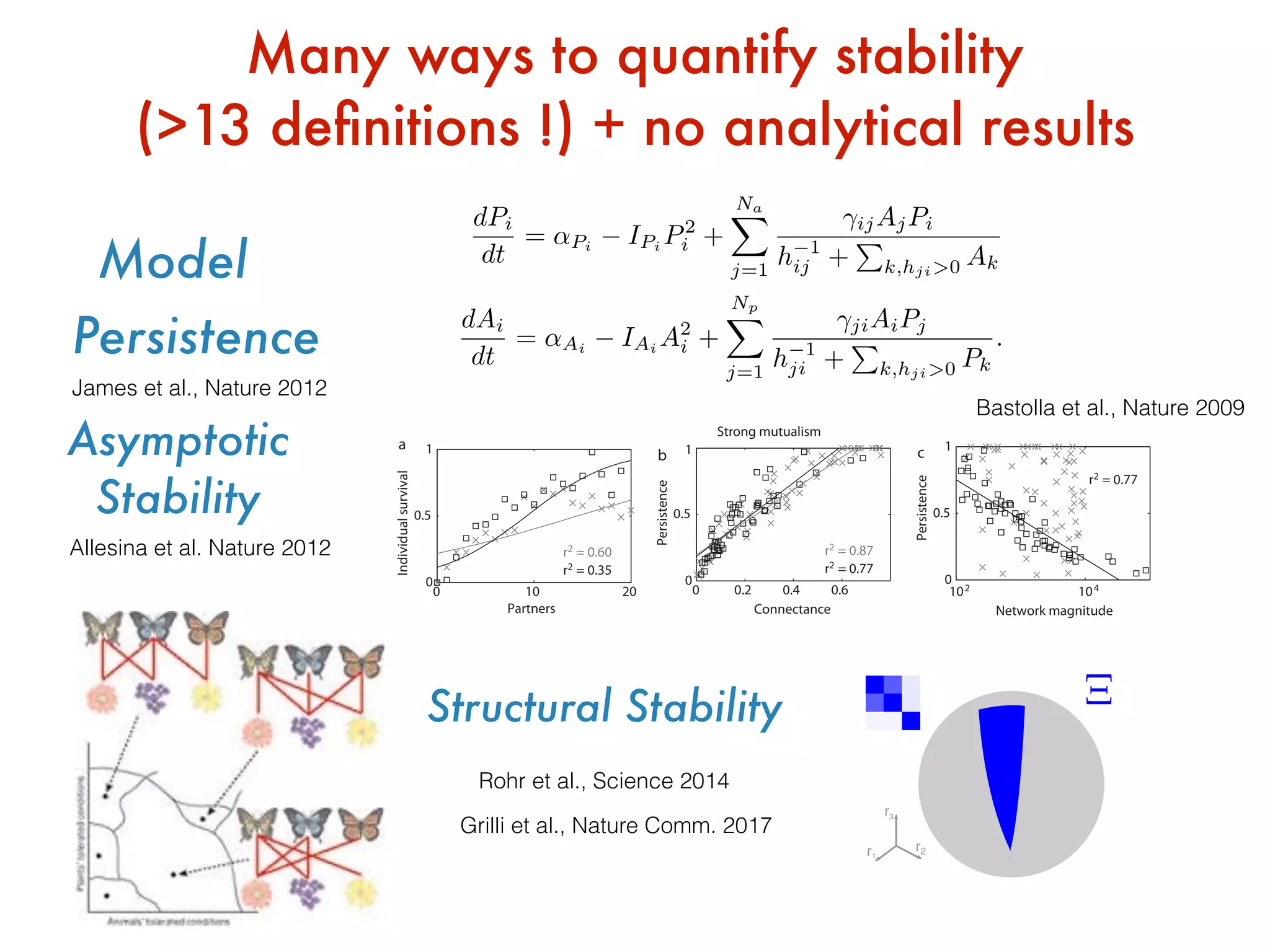
Many ways to quantify stability
(>13 definitions !) + no analytical results
Persistence
dPi
dt
= ↵Pi
IPi
P2
i +
NaX
j=1
ijAjPi
h 1
ij +
P
k,hji>0 Ak
dAi
dt
= ↵Ai IAi A2
i +
Np
X
j=1
jiAiPj
h 1
ji +
P
k,hji>0 Pk
.
Model
Individualsurvival
Persistence
Persistence
0 10 20
0
0.5
1
r2 = 0.60
r2 = 0.35
Partners
Strong mutualism
0 0.2 0.4 0.6
0
0.5
1
r2 = 0.87
r2 = 0.77
Connectance
0
0.5
1
r2 = 0.77
Network magnitude
102 104
a
b c
James et al., Nature 2012
Rohr et al., Science 2014
Bastolla et al., Nature 2009
Asymptotic
Stability
Structural Stability
Allesina et al. Nature 2012
Grilli et al., Nature Comm. 2017
r2
r3
r1
=
FIG. 1: Geometrical properties of feasibility. The panels show the
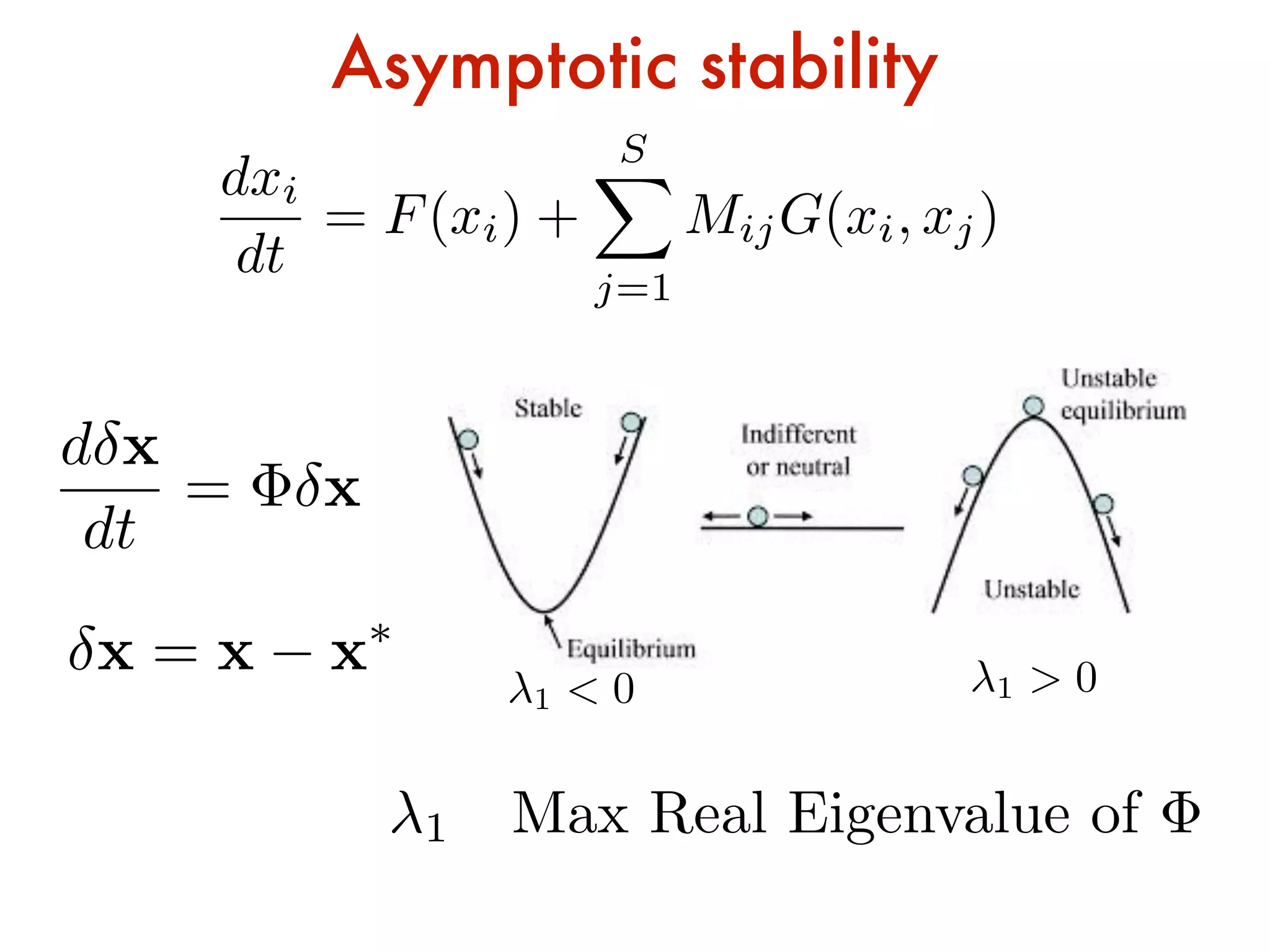
Asymptotic stability
dxi
dt
= F(xi) +
SX
j=1
MijG(xi, xj)
d x
dt
= x
x = x x⇤
1 Max Real Eigenvalue of
1 > 01 < 0
Random Matrix and Ecological Networks
ij ⇠ N(0, )
-20 -10 0 10 20
-20
-10
0
10
20
0.6 0.8 1.0 1.2 1.4
0
0.2
0.4
0.6
0.8
1.0
σ SC
P(stability)
Random
Re λ
Imλ
R. May
Random Structure
dx
dt
= x
−20 −10 0 10 20
−20
−10
0
10
20
−20
−10
0
10
20
Real
−20
Imaginary
−1
Randoma
b
0.6 0.8 1.0 1.2 1.4
0
0.2
0.4
0.6
0.8
1.0
0
0.2
0.4
0.6
0.8
1.0
σ SC
P(stability)
Random
1.5
Complexity-Stability Paradox
R =
p
SC
ii = 1
Different sign pairs correspond to
different interaction types
5 10 15 20
Real
++-- +-
competition mutualism predation
parasitism
All the interaction types are present in a random matrix
One can build random matrices
with fixed proportions of interactions
Thanks to JG
Signs matters in terms of correlations
Allesina & Tang, Nature 2012
Suweis, Grilli and Maritan, Oikos 2013
Interaction signs change the expected correlation ρ
between the element Mij and Mji
a
b
a
b
a
b
ρ<0
ρ=0
ρ>0
a ~ (1+ρ)
b ~ (1-ρ)
Thanks to JG
Universal results
1 ⇠ g"(C ⇤ S)
Real
Imaginary
−7 −6 −5 −4 −3 −2 −1 0 1 2 3 4 5
A
B
−0.5
1.0
0.5
−0.5
1.0
0.5
Allesina & Tang, Nature 2012Suweis et al.,Oikos 2013
Adding structure to Random Matrix
Mutualistic & Nested
Structure reduces system
stability!
1 ⇠ SC
Trade-off stability-
adaptability?
Alternative Path
Simple mechanism driving mutualistic
community to nested network architectures?
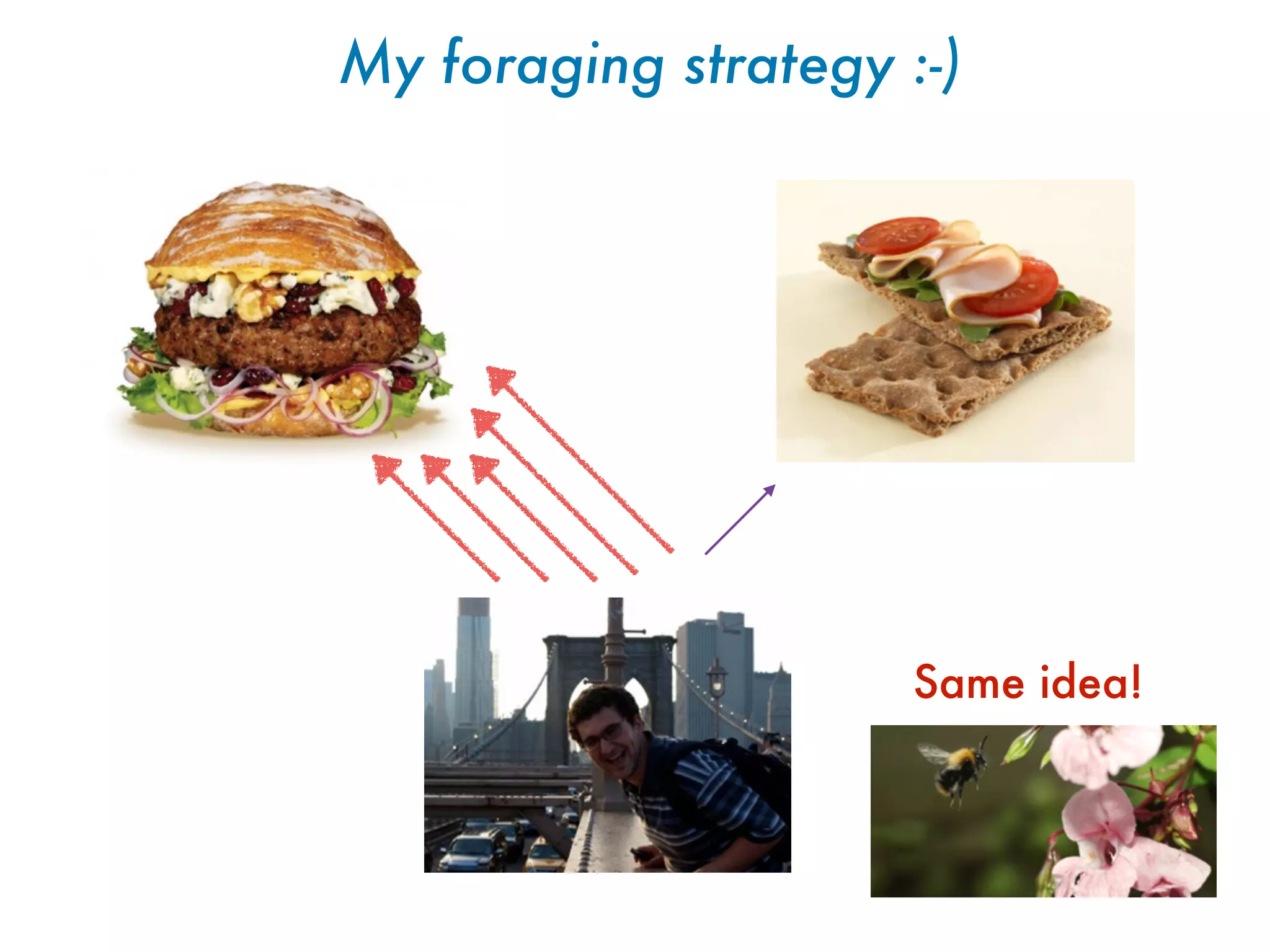
Adaptive/foraging strategy?
My foraging strategy :-)
Same idea!
Theoretical Framework
• Abundances = {x1,x2,...,xS}
• σΩ , σΓ so that x* is stable
• Community population dynamics
Connectance C
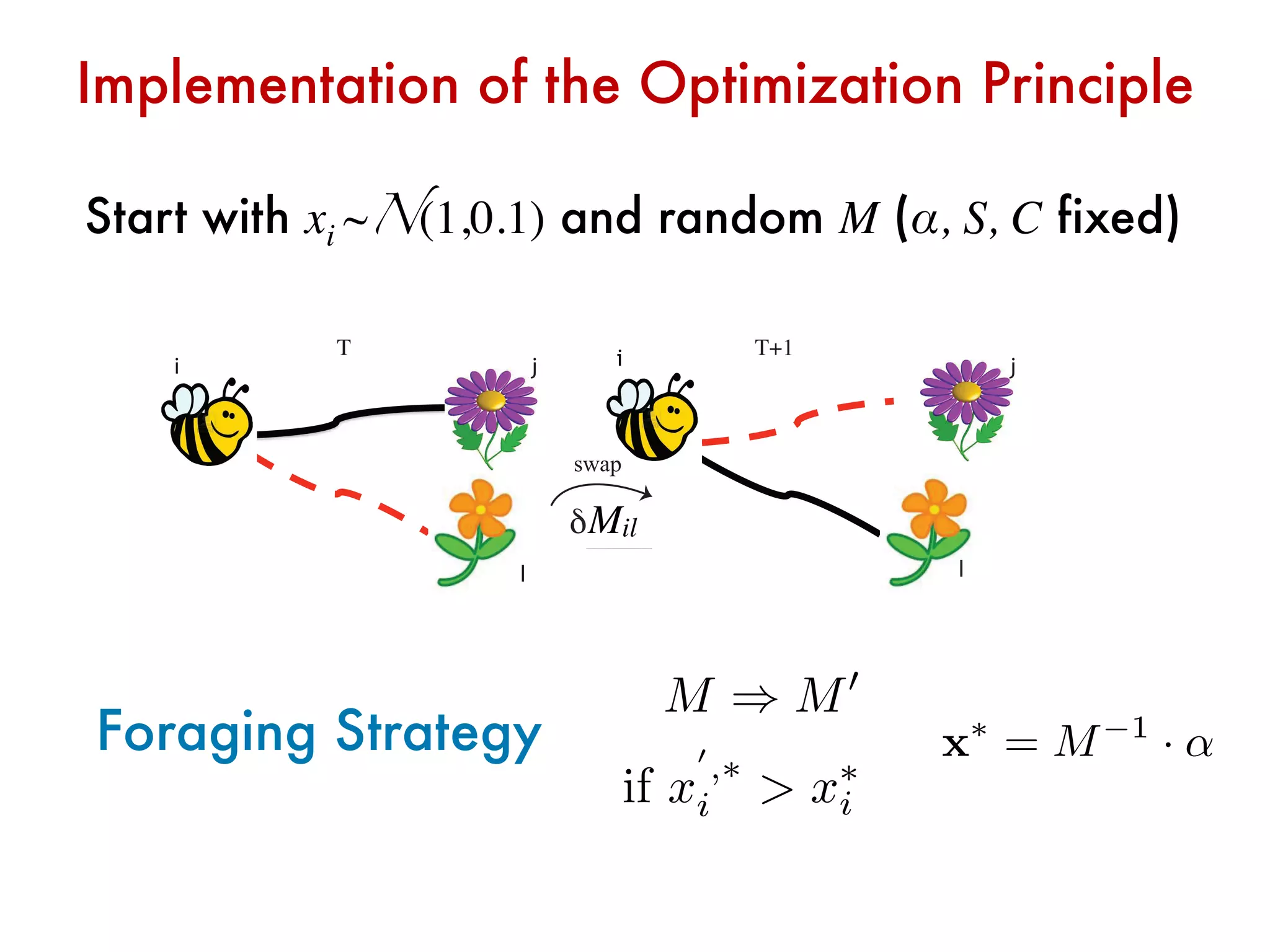
Implementation of the Optimization Principle

T T+1
i j
l
k j
l
swap
δWil
Start with xi ~N(1,0.1) and random M (α, S, C fixed)
Foraging Strategy
i
Mil
M ) M0
if x
0
,⇤
i > x⇤
i
x⇤
= M 1
· ↵
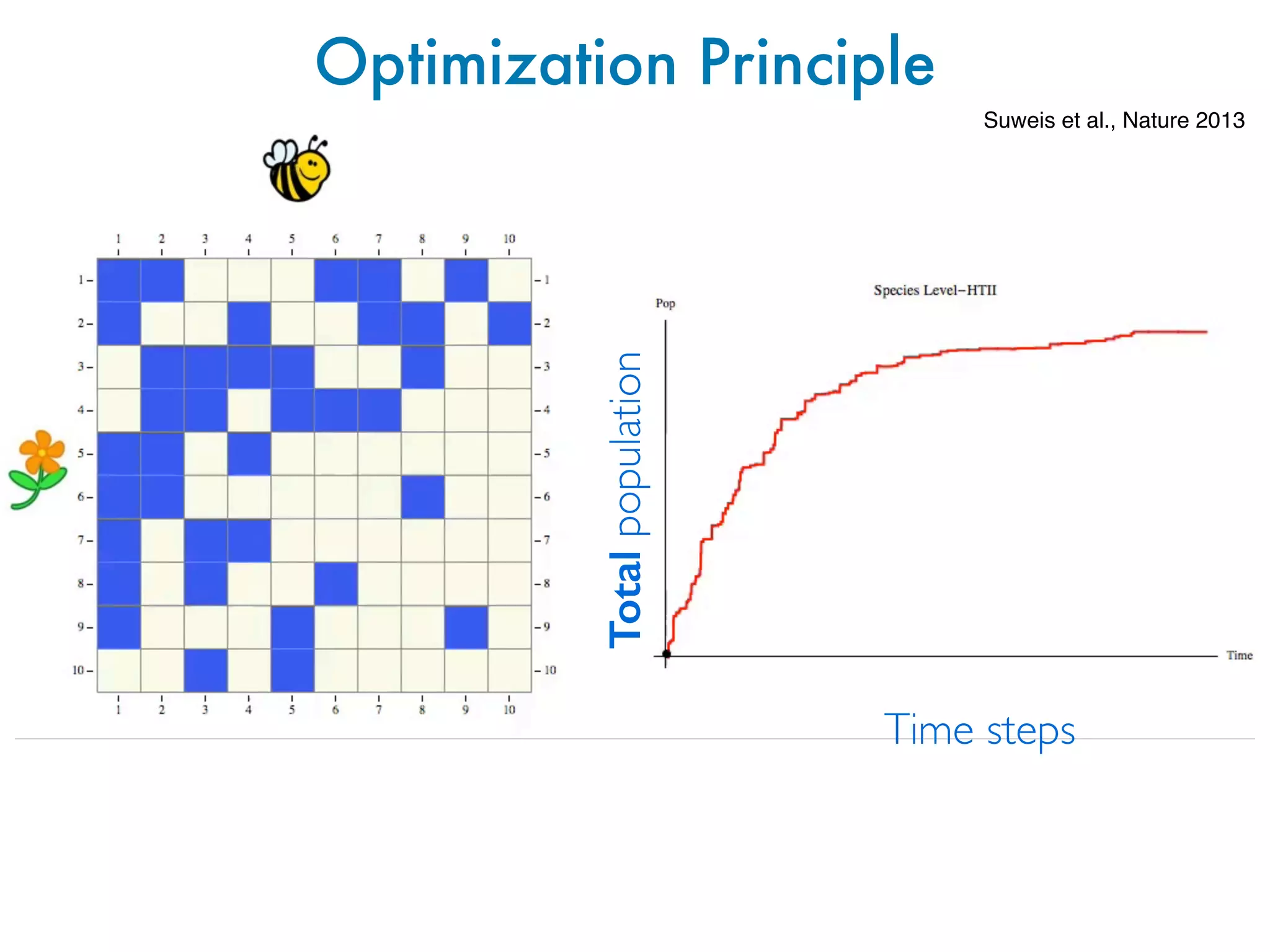
Optimization Principle
Time steps
Totalpopulation
Suweis et al., Nature 2013
Why does it work ??
1) Relation between optimization of
single species and community abundance
2) Relation between species abundance
and nestedness
Relation between sigle species and total abundance
i
li
j
|γij
|=0.0017
|γij
|=0
T=n
i
li
j
|γij
|=0.0017
|γij
|=0
T=n+1
swap
0.803522
1.08178
1.05803
1.05014
0.977939
1.01422
0.958128
1.13397
1.04078
1.0356
0.9664
1.02013
1.00682
0.67361
1.10131
1.07571
1.10289
0.959658
0.996913
0.918892
1.15298
1.03813
1.0223
1.01314
0.958794
1.00217
::
x* = x* =
T T+1
i j
l
k j
l
swap
δWilMil
x⇤
= M 1
· ↵
���� �����
����������[��]
Suweis et al., Nature 2013
Overlap and community abundance are correlated!
M = M0 + V =

I + ⌦ O
O I + ⌦
+

O
T
O
xtot
= K + Co ) o / C 1
xtot
+ constant
0.2 0.3 0.4 0.5 0.6 0.7 0.8
50
54
58
62
66
Nestedness [NODF]
Abundance[x]
C
ij =
⇢
with probability C ( > 0)
0 with probability 1 C
⌦ij = C!(1 ij) ! > 0
x⇤
= M 1
· ↵
Suweis et al., Nature 2013
x⇤
= M 1
· ↵ x⇤
+ x⇤
= (M + M) 1
· ↵
0 200 400 600 800 100012001400160018002000
9.8
10
10.2
10.4
10.6
10.8
11
11.2
11.4
11.6
11.8
STEPS [T]
Population
0 200 400 600 800 100012001400160018002000
9.8
10
10.2
10.4
10.6
10.8
11
11.2
11.4
11.6
11.8
STEPS [T]
Population
Averaged over 100 realizations
0 200 400 600 800 100012001400160018002000
19.5
20
20.5
21
21.5
22
22.5
STEPS [T]
TotoalPopulation
mean
1 realiz
if x⇤
k > 0 ) x⇤
tot > 0
Cooperation in nested mutualistic community!
# Species [S]
Nestedness[NODF]
σΓ
=0.0025
σΓ
=0.05
20 40 60 80 100 120 140 160 180 200
0
0.1
0.2
0.3
0.4
0.5
0.6
0.7
0.8
Random σΓ
=0.025
DataA
Suweis et al., Nature 2013
What about stability?
Are optimal mutualistic networks more
stable?
No! Optimal networks are less resilient
c
−0.05 −0.04 −0.03 −0.02 −0.01 0
0
0.01
0.02
0.03
0.04
0.05
Max[Re(λ)]RarestSpecies[x]
b
R2
=0.999
0 5 10 15 20 25
0
1
2
3
4
5
number of connections [k]
speciesabundance‹x›
si
=|∑j
γij
|
a
‹x›
pdf
Max[Re(λ)]
0 1 2
5
0
4
3
2
1
-0.8 -0.7 -0.6 -0.5 -0.4 -0.3
5
10
15
20
25
Suweis et al., Nature 2013
A CB
time
perturbationstrength
λH reactivity
λ1 resilience
amplitude1
d x
dt
= J x
Jv1 = 1v1
u1J = 1u1
Suweis et al., in Nature Communications 2015
Beyond Resilience: Localization
Localized Not Localized
0 50 100 150 200
0.0
0.2
0.4
0.6
0.8
Component @SpeciesD
»vi
Beyond Asymp Stability: Localization
rIPR =
* PS
i=1 v1(i)|4
PS
i=1 |vran
1 (i)|4
+
xxx(t) =
SX
↵=1
⇠⇠⇠ · uuu↵
uuu↵ · vvv↵
e ↵t
vvv↵
Localization in Optimal Mutualistic Networks
right
left
rIPR =
* PS
i=1 v1(i)|4
PS
i=1 |vran
1 (i)|4
+
1
0
0.5
max
ASSIGN INTERACTION

STRENGTHS
Null Model ) aran
Suweis et al., in Nature Communications 2015
Mij = aij
0
ki
0 200 400 600 800
1
2
5
10
20
50
Size S
rIPRleft
0 200 400 600 800
1.0
10.0
5.0
2.0
3.0
1.5
15.0
7.0
Size S
rIPRright
A B
Ecological networks are localized!
A1 = |⇠0|(
X
j
v1,j|)2
Localization attenuates perturbations
Max|{v1}
A1 = 1/
p
S
Min|{v1}
A1 = i,j⇤
●
●●
●
●
●
●
●
●●
●
●
●
●
●
●
●
●
●●
●
●
●
●
●
●
●
●
●
●
●
●
●
●●
●
●
●
●
●●
●
●
●
●
●
●
●
●
●
●
●
●●
●
●
●
●
●
■
■■
■
■
■
■
■
■■
■
■
■
■
■
■
■
■
■■
■
■
■■
■
■
■
■
■
■
■
■
■ ■■
■
■
■
■
■■
■
■
■
■
■
■
■
■
■
■
■
■
■
■
■
■
■
■
◆
◆
◆
◆◆
◆
◆
◆
◆
◆
◆
◆
◆
◆
◆
◆◆◆
◆◆
◆
◆
◆◆
◆
◆
◆
◆ ◆
◆
◆
◆
◆
◆
◆
◆
◆
◆
◆
◆◆
◆
◆
◆
◆
◆
◆
◆◆
◆
◆
◆
◆
◆◆
◆
◆
◆
◆
� ��� ��� ��� ���
���
���
���
���
���
���
���
���
���� [�]
/���
Trade Off with May!
Suweis et al., in Nature Communications 2015
Localization occurs on the hubs
Suweis et al., in Nature Communications 2015
1.0
0.8
0.6
0.4
0.2
0 20 40 60
max=–0.27v1
u1
WH
s
smax
H=0.47
Species
TURE COMMUNICATIONS | DOI: 10.1038/ncomms10179
[| |]
#
#
Figure S33: Comparison between the histogram of all species degree and degree of lo-
calized species (✓ = 1.5/S) merging all the species in the 59 mutualistic networks (with
asymmetric interactions = 0.5).
Conditions are changing
estimated percentage of plant community changes
due to climate change in the next three centuries
How do environmental changes affect an ecosystem?
Thanks to JG
Generalized Lotka-Volterra
intrinsic
growth rates
interaction
matrix
fixed point
how many combinations of growth rates
are compatible with coexistence?
What is the effect of the interaction matrix?
[Grilli, Adorisio, Suweis, Barabas, Banavar, Allesina and Maritan, 1507.05337]
Stable &
Feasible
(n>0)
Thanks to JG
-
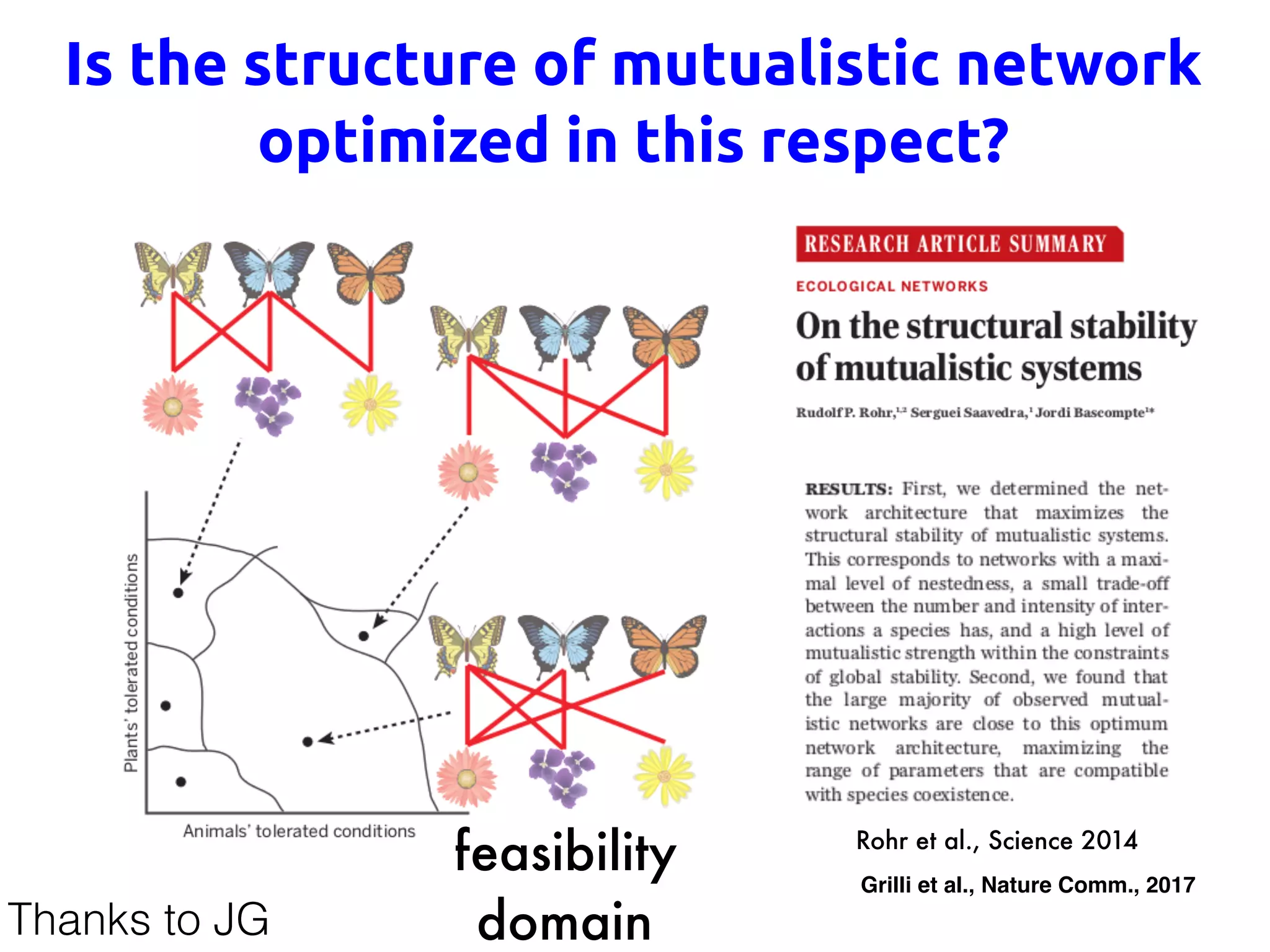
Is the structure of mutualistic network
optimized in this respect?
Rohr et al., Science 2014
Grilli et al., Nature Comm., 2017
Thanks to JG
feasibility
domain
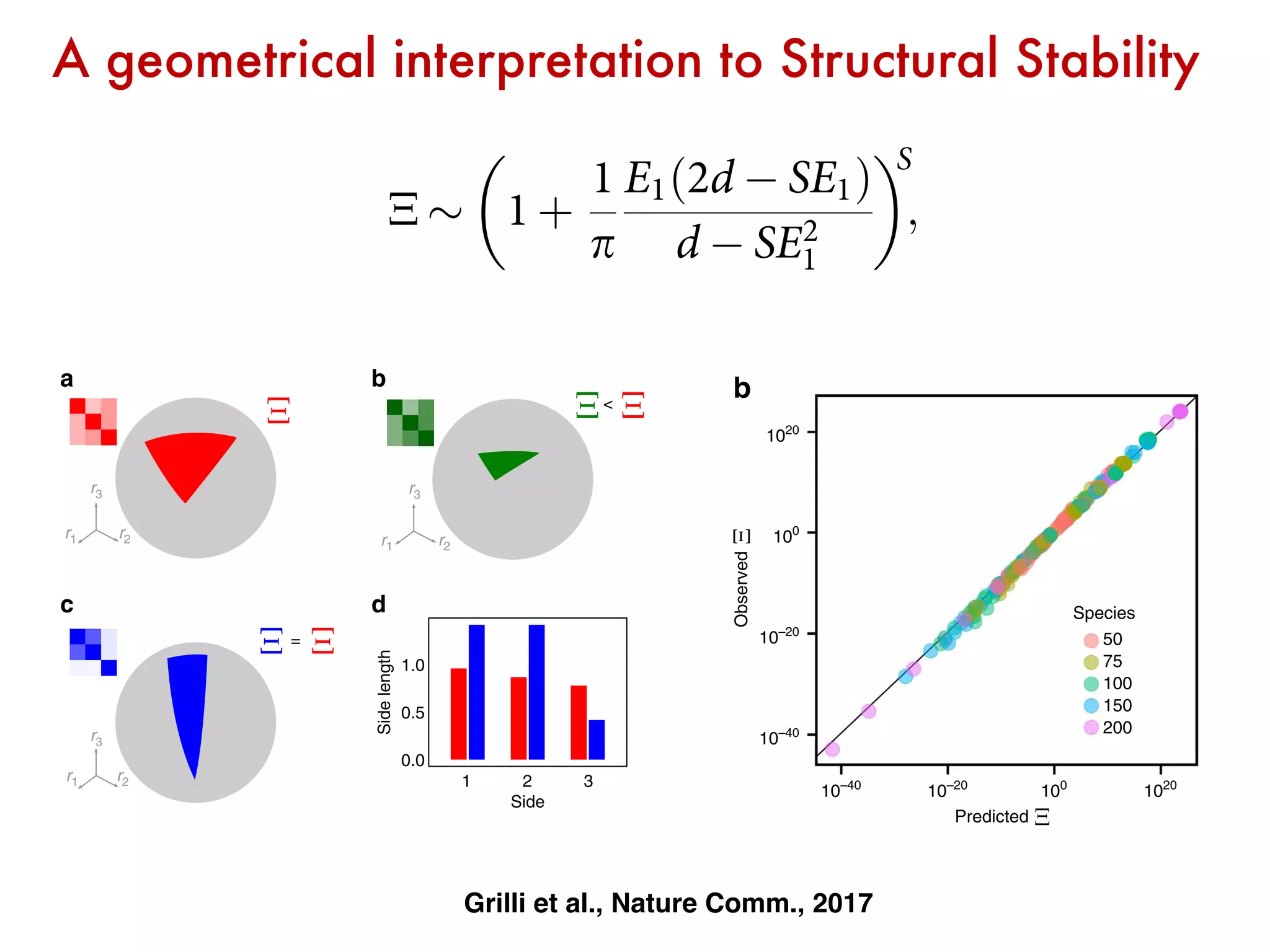
we are able to derive the following approximation for X for
large random interaction matrices A:
Ä $ 1 þ
1
p
E1 2d À SE1ð Þ
d À SE2
1
 S
; ð2Þ
where S is is the number of species, d is the mean of A’s diagonal
entries and E1 ¼ Cm, the product of the connectance C and
the average interaction strength m (see Methods). A more
accurate formula is presented in Supplementary Note 6.
In analogy with the celebrated result of May11 connecting
stability and complexity, equation (2) can be considered
as a complexity–feasibility relationship. While in May’s scenario
and in its generalizations12 the effect of complexity and diversity
on stability is always detrimental, it does depend on
the interaction type in the case of feasibility. Given that
d is negative by construction, having more species or
connections can either increase (E140) or shrink (E1o0) the
A geometrical interpretation to Structural Stability
Grilli et al., Nature Comm., 2017
treatment. As explained in Supplementary Note 6 and show
in Fig. 2, when the mean and variance of interaction strength
are not too large and in the limit of large number of specie
we are able to derive the following approximation for X fo
large random interaction matrices A:
Ä $ 1 þ
1
p
E1 2d À SE1ð Þ
d À SE2
1
 S
; ð2
where S is is the number of species, d is the mean of A’s diagon
entries and E1 ¼ Cm, the product of the connectance C an
the average interaction strength m (see Methods). A mo
accurate formula is presented in Supplementary Note 6.
In analogy with the celebrated result of May11 connectin
stability and complexity, equation (2) can be considere
as a complexity–feasibility relationship. While in May’s scenar
and in its generalizations12 the effect of complexity and diversi
on stability is always detrimental, it does depend o
the interaction type in the case of feasibility. Given th
d is negative by construction, having more species o
connections can either increase (E140) or shrink (E1o0) th
size of the feasibility domain, as a function of the sign
interaction strenghts (see Fig. 2). It is important to stress th
0.0
0.5
1.0
1
r2
r3
r1
=
r3
r1 r2
r2
r3
r1
32
a b
c d
Side
Sidelength

Figure 1 | Geometrical properties of feasibility. The panels show the size
and shape of the feasibility domain for three interaction matrices, each
defining the interactions between three populations. If r corresponds
to a feasible equilibrium, so does cr for any positive c; one can therefore
study the feasibility domain on the surface of a sphere25 (Supplementary
NATURE COMMUNICATIONS | DOI: 10.1038/ncomms14389 ARTICL
1010
−0.01 0.00 0.01
Mean interaction strength E1
Food webs Mutualistic
50
75
100
150
200
Species
105
100
10–5
10–10
10–15
1020
100
10–20
10–40
10–40
10–20
100
1020
10 10
a b
c d
Observed
Observed
Predicted
RTICLE NATURE COMMUNICATIONS | DOI: 10.10
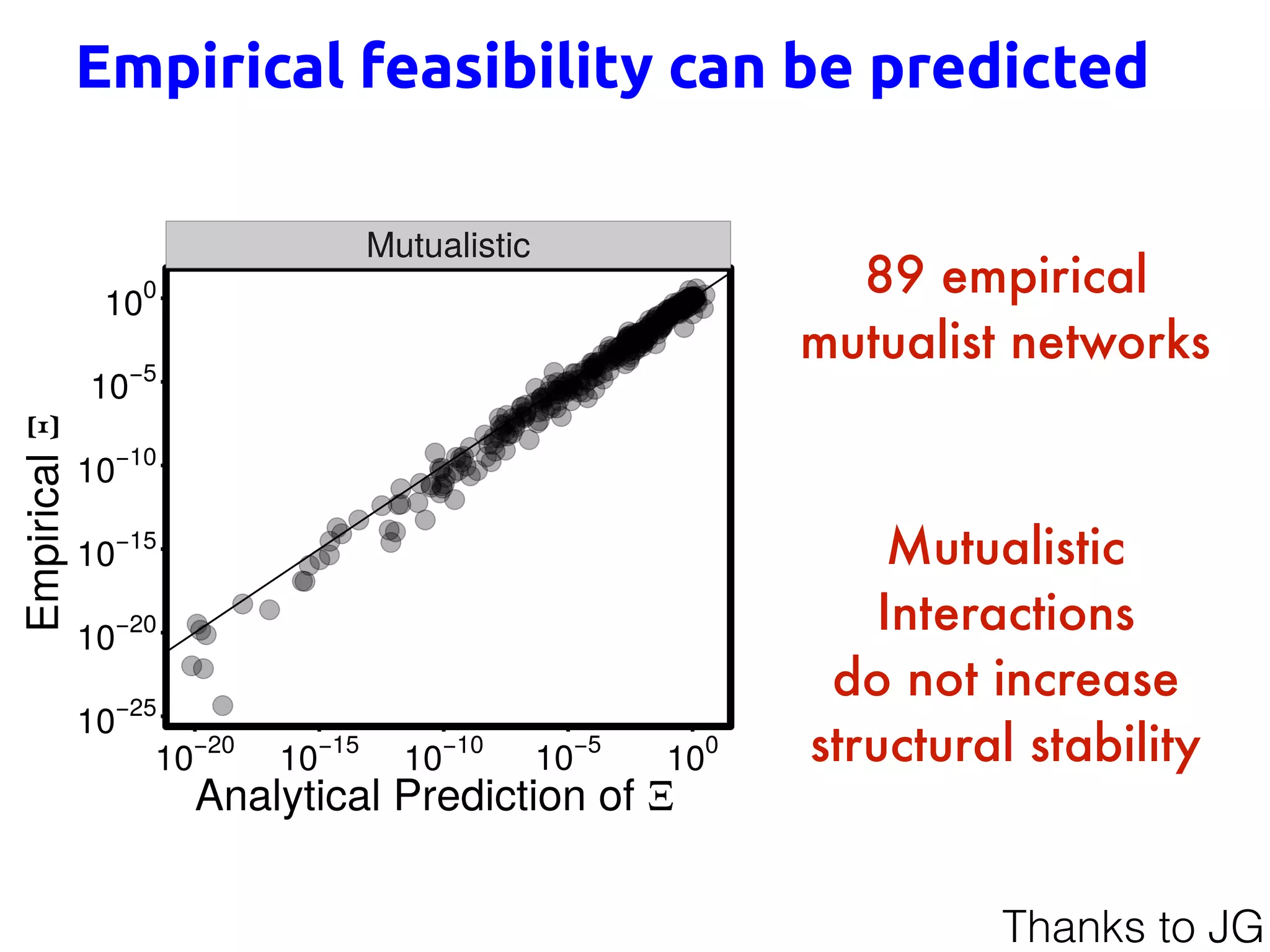
Empirical feasibility can be predicted
89 mutualistic networks
59 plant-pollinators
30 seed disperser
Mutualistic
10 25
10 20
10 15
10 10
10 5
100
10 20
10 15
10 10
10 5
100
Analytical Prediction of
Empirical
Mutualistic
Interactions
do not increase
structural stability
89 empirical
mutualist networks
Thanks to JG
Why this recurrent topological properties?
Optimization Principles to explain
emergent patterns
UPPLEMENTARY INFORMATION
50 100 200 500
0.02
0.05
0.10
0.20
0.50
Number of Species [S]
Connectance[CΓ
]
e S1: Best fit (red solid line) of the connectivity as a function of the number of
es for 56 mutualistic communities. Dashed gray lines represent the region within
±1 standard deviation confidence interval for the exponent estimate. The plot is in
g scale.
C~1/S
Network Connectivity [C]
Explorability[E]
Ability of living system to adapt and
explore new states
Trade-off stability-adaptability?
Explorability:
fixed C
Varying strengths W
volume of feasible
and stable x* the
dynamics can visit
M = TC ⇤ W(t)
C~1/S
1 ⇠ SC
Explorability[E]
Asymptotic stability [Λ]
Morestable,lessexplorable
Less stable, less explorable
Less stable, more explorable
Optimizing
Explorability
Optimizing Stability
Starting Random Networks
Increasing C
Optimal tree-like
Convergent Optimality
C~1/S
Busiello et al. Sci. Report 2017
257
biomass[OD620]
time [hours]
0 10 20 30 40
0
0.05
0.1
0.15
0.2
on
ucts
Enterobacter
Raoultella
Citrobacter
Pseudomonas
Stenotrophomonas
44%
20%
26%
7%
3%
OD620nm
time [hours]
0 10 20 30
0.4
0.2
0.0
0.2% glucose
Enterobacter byproducts
Logistic fit
Citrobacter growth
r = 0.34
K = 0.35
M9 + Glucose
?
M9 + metabolic
byproducts
a b
c d
e
% change biomass after 24h
-40 0 40numberofcommunities
0
10
20
30
40
50
f
K
Pseudomonas Raoultella
EnterobacterCitrobacter
0.2% Glucose
Coexistence of bacteria species with 1 resource!
characterization of all dominant genera within a representative community (fig. S5).
1
2
3
4
5
6
inoculum
7
8
9
10
11
12
0
0
0.25
0.25
0.5
0.5
0.75
0.75
1
10
0.25
0.5
0.75
1
0
0
0.25
0.25
0.5
0.5
0.75
0.75
1
10
0.25
0.5
0.75
1
Enterobacteriaceae
Pseudomonadaceae Pseudomonadaceae
Otherfamilies
Otherfamilies
Enterobacteriaceae
Initial (t = 0) Final (t = 84)
a
Inoculate
growth
dilution
Cross feeding is
fundamental
for coexistence!
Goldford et al. BioArxiv 2017 - Emergent Simplicity
+
ameters8,25,26. To garner a better
ct of perturbations on ecological
P), that is, Bkl ¼ 1 if insect k and plant l interact. S ¼ A þ P is
total number of species in the community. We analyse
cb
Time
0.5
0.4
0.3
0.2
0.1
0
ivity
1 resilience
1 amplitude
erturbation through the network. (a) Trajectory of a perturbation through time. Reactivity (lH) measures whether
ing; asymptotic resilience l1 indicates whether perturbations eventually decay; and the asymptotic perturbation amplit
perturbation for large time. The principal right eigenvector determines which species will be affected most by the
n, while the left principal eigenvector controls which species are the most sensitive to the initial perturbation. The weigh
localization pattern in the network: (b) is a regular graph where each node is connected to six other nodes, while (c)
he same size and with similar connectance. In both cases, edge weights are randomly extracted from a Gamma distribut
odes indicate the absolute values of the corresponding component of the leading right eigenvector. In b, all species
c, only few species are affected.
NATURE COMMUNICATIONS | 6:10179 | DOI: 10.1038/ncomms10179 | www.nature.com/naturecommunicat
2D connectivty structure
networked connectivity structure
ix entries from a given probability distribution.
e consider a well mixed system where spatial effects can be neglected. The
ibed by a continuum time stochastic Markov process: a randomly chosen in
d and substituted by an individual of the j-th species at a rate
!(j, ⌘, M, L) = ¯⌘j
+ ✏1
X
k
¯⌘k
Mkj✓(¯⌘j
) + ✏2
X
k
¯⌘k
Lkj ¯⌘j
1  0 and ✏2  0 give the cooperation and exploitation intensity, and ✓(·) is the
ction, i.e., ✓(x)  0 when x  0 and 0 otherwise. The presence of the ✓-fun
stic contribution, guarantees that the transition rate is zero if the j-th species is
= 0 we recover the standard VM. When ✏1  0 the species j is favored by th0.0 0.2 0.4 0.6 0.8 1.0
0.00.20.40.60.81.0
0 100 200 300 400 500 600
N
10
1
10
2
10
3
10
4
10
5
TN

0.0
0.1
0.15
0.05
0.01
The cooperative Voter Model
✏2 = 0
M = ++
L = +
Thanks for your attention!
Questions?
Thanks to all
collaborators!
A. Maritan
J. Grilli
J.R. Banavar
F. Simini
S. Allesina
S. Azaele
J. Hidalgo
D. Busiello
Main References
Suweis, S. et al., Nature 2013
Suweis, S., Grilli J,  A. Maritan, Oikos 2014
Suweis, S. et al., Nature Communication 2015
Grilli J. et al., Nature Communication 2017
Busiello, D., Suweis, S., Hidalgo, J.  A. Maritan, Scientific Report 2017

A statistical physics approach to system biology

  • 1.
    A statistical physicsapproach to system biology @SamirSuweis CISM-UniUD joint course 2018 CISM-UniUD Joint course coordinated by PhD School in Agricultural Science and Biotechnology of the University of Udine Udine September 3 - 7 2018 UniversityofUdine InternationalCentreforMechanicalSciences SYSTEMS BIOLOGY ACADEMICYEAR 2018
  • 2.
  • 3.
    System Biology Systems biologyis the computational and mathematical modeling of complex biological systems. It is a biology-based interdisciplinary field of study that focuses on complex interactions within biological systems, using a holistic approach (instead of the traditional reductionism) to biological research. CLASSIC REDUCTIONISM (transistor in a computer) – All we need to know is the behavior of the system elements –  Particles in physics, molecules or proteins in biology. – More complex systems are nothing but the result of the sum of many systems elements (think to a pc) – No new phenomena will emerge when we consider the entire system
  • 4.
    The Human GenomeProject Cell Nucleus Genes DNA helix Nucleotide pair SNP Individual 1 Individual 2 Individual 3 Individual 4 The human genome (or complete set of DNA) is contained within 22 nonsex chromosomes plus the X and Y. We inherit one set of 23 chromosomes from each parent. Chromosome 1 2 3 4 5 6 7 8 9 10 11 12 13 14 15 16 17 18 19 20 21 22 X Y G G A G G A T C T G A G T C T G G T The Logic behind Genome Studies Much research into the genetic contributions to common diseases has started with the seemingly logical assumption that DNA variants occur- ring frequently in the human population would be at fault. Some argue, though, that this reasoning is faulty. The Starting Point The Human Genome Project identified the sequence of nucleotide pairs, or DNA building blocks, in the human genome, based on DNA from several volunteers.A single pair consists of a nucleotide (A, C,T or G) on one strand of the DNA double helix and its complement on the opposite strand (C always pairs with G; A with T). Related work revealed many single-nucleotide polymorphisms, or SNPs—chromosomal locations where a nucleotide pair in one person can differ from that in another person (below)—and it identified“common”SNPs, ones that vary in many people. Single DNA strand Nucleotide G G A G G A T C T G A G T A T G G T G G A G G A T C T G A G T A T G G T G G A G G A T C T G A G T C T G G T Common variant strategy
  • 5.
    October 2010, ScientificAmerican.com63Illustration by Bryan Christie Individual 4 Diseased Diseased Healthy The Studies and Results Investigators hoped that they could identify gene variants responsible for major diseases by comparing nucleotides at common SNPs throughout the genomes of people with and without a disease. SNP variants, or“alleles,”and nearby protein-coding genes tend to be inherited together, and so researchers expected that SNP alleles occurring much more frequently in people with a disease would point to common gene variants important to the illness.These genome-wide association (GWA) studies uncovered many SNP alleles related to specific diseases. So far, though, the variations found have typically accounted for only a small fraction of disease risk. Healthy SNP allele associated with disease Single DNA strand Diseased Nearby gene variant G G A G G A T C T G A G T C T G G T 0Hall5p.indd 63 8/2 Revolution Postponed: Why the Human Genome Project Has Been Disappoinyng (Scientfic American, 18.10.2010). Evolvability and Robustness A. Wagner
  • 6.
    •  System properties emerge from interactions of components: the whole is more than the sum of the parts. –  B. Mandelbrot and others: Chaos and non-linear dynamical systems –  P. Bak: Self-Organized Criticality – The edge of chaos –  S. Wolfram: Cellular Automata –  S. Kauffman: Random Boolean Networks –  J. Holland: Emergence –  Systems Biology
  • 7.
    How to studycomplex system? Ferromagnetism Emergent Properties Transitions Stochastic Interacting Particle Models Emerging Pattern in Ecosystems The importance of Space: SAR 0.01 0.1 1 10 100 1000 10000 0 0.01 0.02 0.03 0.04 0.05 Panama r (km) F 0 (r) within 50 ha plot mean from pairs of single ha theory 0.01 0.02 0.03 0.04 Yasuni F0 (r) within 25 ha plot mean from pairs of single ha theory
  • 8.
    How to linkmicro and micro states Statistical Physics The link is probabilistic Configuration space Thermodynamic Limit N -> ∞ 11 12 21 22 13 31 …. 16 61 34 43 25 52 … 66 macroscopic state microscopic state
  • 9.
    (FERRO)MAGNETS ISING (1925) FERROMAGNETISM MAGNETIZATION UNDER ACERTAIN TEMPERATURE! magnetization temperature Magnetic dipoles of its atomic spins The Ising Model
  • 10.
    (FERRO)MAGNETS I wanna belike you guys! LOW TEMPERATURE Spins can “feel” each other Yeah! DYNAMICS = ALIGMENT VS RANDOMNES HIGH TEMPERATURE To much noise!!! ?? ?? ?? ?? ?? ??
  • 11.
    Introduce the Isingmodel The energy of two neighboring spins is −J if the spins are parallel, and +J if they are antiparallel is the energy per spin is the magnetization per spin is the specific heat is the magnetic susceptibility i jJs s− 2 i j ij J s s E N = ∑ i i H s M N = ∑ ( )22E C E E T T β∂ = = − ∂ ( )22M M M H χ β ∂ = = − ∂ The Ising model has a lattice of N sites i with a single, two-state degree of freedom on each site that may take values ±1. The Hamiltonian for the Ising model is The notation <ij> indicates that sites i and j are nearest neighbors. J is the coupling between these neighboring sites. H is the external field. is i j i ij i J s s H s= − −∑ ∑ It is traditional to denote the values as up and down, or as two different colors. 1is = ± H = J X hiji sisj H X i si The Ising Model
  • 12.
    e random thermalfluctuation from state to em. In theory, sum over all possible states he statistical mean values of a physical ghing each state based on its Boltzmann Heat Bath Algorithm Local Update Algorithms Metropolis Algorithm thod Glauber Algorithm model Swendsen Wang Cluster Cluster Algorithms Wolff Cluster − − Algorithms to simulate the Ising Model and not only
  • 13.
    Ordered (T<Tc) Critical (T=Tc) Disordered(T>Tc) Special features AT criticality ● Power law behavior and scale invariance ● Diverging correlation length ● Highly sensitive to external perturbations States in the Ising Model
  • 14.
    What we learnfrom these models? Simple Rules may lead to Complex Collective Phenomena Criticality is a nice phenomena: long correlation, high susceptibility… Similar results for deterministic systems: “to be at the edge of chaos” d x dt = J x edge of chaos J < 0 J > 0 J / 0
  • 15.
    - Collective motionsin ecosystem dynamics - Foraging strategies, Chemotaxis, movements and communications among microorganisms - Scaling in ecological communities - Ecological networks - Emergent Macro Ecological patterns Why should a physicist may be interested in ecology/biology? should a physicist may be interested in ecology? nderstanding an ecosystem is a rmidable many-body problem. One as an interacting system, made up of dividuals of various species with mperfectly known interactions and haracterized by a wide range of spatial nd temporal scales. evertheless, some "general" emergent atures characterize very complex and fferent ecological systems. Figure: It is interesting to contemplate an entangled bank, clothed with many plants of many kinds, with birds singing on the bushes, with various insects fitting about, and with worms crawling through the damp earth, and to reflect that these elaborately constructed forms, so different from each other in so complex a manner, have been all produced by laws acting around us. (Darwin, Origin of Species)
  • 16.
    Criticality has beenfound in many biological systems! Biological systems may bene>t from criticality??
  • 17.
    FLOCKING BEHAVIOR Moving entities exhibitpatterns of COORDINATED behavior... … in the absence of any LEADER!!
  • 18.
    The physicist approach A.Einstein “Make everything as simple as possible, but not simpler.” “You don’t really understand something unless you can explain it to your grandmother.”
  • 19.
  • 20.
    ● “Birds” are representedby vectors in the space (with constant velocity in modulus) ● Each “bird” has an “interaction radius”, r. ● At each time, each “bird” aligns its velocity with the average direction of their neighbors ● There is some “error” in the dynamics which introduces noise and stochasticity) → NOISE PARAMETER (~TEMPERATURE) Vicsek model
  • 21.
    Increasing noise Globalaligment noise PHASE TRANSITION Vicsekmodel results Simulations based on flock dynamics are used in films to make them more realistic
  • 22.
    Flocks of birdsexhibit PROPERTIES akin to CRITICAL POINTS! WHY??? Correlations among individuals had not a characteristic length (the larger the @ock, the larger the correlation length) From records of real @ocks they were able to monitor each Individual's movement (similar experiments with @ying insects years later)
  • 23.
    Critical Systems areHIGHLY SENSITIVE to EXTERNAL PERTURBATIONS! (SUCH A PREDATOR!)
  • 24.
  • 25.
    0 2 46 8 10 0 2 4 6 8 10 2 4 6 8 10 0 5 10 15 0 5 10 15 20 25 0 5 10 15 20 0 5 10 15 20 25 30 2 4 6 8 10 0 12 Numberofspecies Coral Reefs Tropical Forests 1 2 3 4 5 6 7 0 2 4 6 0 2 4 6 8 10 0 2 4 6 8 10 0 10 20 30 40 0 10 20 30 0 10 20 30 0 10 20 30 40 40 d2c2 40 b2a2 Numberofspecies 0 8 d1c1 b1a1 Abundance category 180 plots 45 plots 15 plots 5 plots Emergent Pattern in Ecology: RSA
  • 26.
    2D connectivty structure networkedconnectivity structure The Voter Model in Ecology • Community of N individuals and S species (colours) • Pick at random an individual. It dies. • 1-m: replaced it by another random individual in the system • m: it is replaced by an individual of a new species (migration) dPn(t) dt = bn 1Pn 1(t) + dn+1Pn+1(t) (bn + dn)Pn(t) Parameters: bn/dn and m = b0 Functional form of bn Density dependent effectsIf m=0 -> absorbing state 1-m m
  • 27.
    ie e vienedescritta dalla birth-deah master equation [8], che descrive la probabilità P(n, t) data specie al tempo t di avere una popolazione di n individui dP dt (n, t) = b(n 1) · P(n 1, t) [b(n) + d(n)] · P(n, t) + d(n + 1) · P(n + 1, t) e b(n) e d(n) sono rispettivamente i parametri di nascita e morte, dati dalle seguenti b(n) = (1 n) · n J J n J 1 d(n) = (1 n) · n J J n J 1 + n · n J Notiamo che queste definizioni sono consistenti con le due regole della dinamica del V del: con probabilità 1 n si ha la morte di un individuo della comunità non appartenente specie data (con probabilità J n J ) accompagnata dalla nascita di un individuo della sp scelta ( n J 1 ); con probabiltà n J si ha la morte di un individuo appartenente alla specie data accompag ta o dalla migrazione di un individuo proveniente da una delle altre specie presenti probabilità (1 n) ⇣ J n J 1 ⌘ ) o dalla comparsa di una nuova specie (con probabilità n). oluzione stazionaria o di equilibrio P⇤(n) per la (3.1) è la seguente [8] escritta dalla birth-deah master equation [8], che descrive la probabilità P(n, t) per al tempo t di avere una popolazione di n individui ) = b(n 1) · P(n 1, t) [b(n) + d(n)] · P(n, t) + d(n + 1) · P(n + 1, t) (3.1) ) sono rispettivamente i parametri di nascita e morte, dati dalle seguenti b(n) = (1 n) · n J J n J 1 (3.2) d(n) = (1 n) · n J J n J 1 + n · n J (3.3) e queste definizioni sono consistenti con le due regole della dinamica del Voter bilità 1 n si ha la morte di un individuo della comunità non appartenente alla a (con probabilità J n J ) accompagnata dalla nascita di un individuo della specie ); biltà n J si ha la morte di un individuo appartenente alla specie data accompagna- migrazione di un individuo proveniente da una delle altre specie presenti (con à (1 n) ⇣ J n J 1 ⌘ ) o dalla comparsa di una nuova specie (con probabilità n). zionaria o di equilibrio P⇤(n) per la (3.1) è la seguente [8] Ciascun nodo è un individuo rappresentato da un label che ne identifi za. Denotiamo con C la collezione di tutti gli individui appartenenti a ~n = {n1, n2, . . . , nS} il vettore delle abbondanze per C, dove nj indica della j-esima specie. Ci poniamo nell’ensemble microcanonico, imponendo che ogni in sostituito immediatamente da un altro della stessa o di un’altra specie J = S  i=1 ni La dinamica del mean field Voter Model a ogni istante di tempo è selezionato casualmente muore e viene sostituito con un individuo di probabilità n, mentre con probabilità 1 n il sito viene colonizzato d presente su un nodo selezionato casualmente nella griglia. A differe del Voter Model, dove l’interazione avveniva tra primi vicini, nel mode con qualsiasi nodo della griglia, senza che però ci sia dispersione sulla Il parametro n, detto diversification rate, gioca un ruolo fondamental da che esso sia o meno nullo, la dinamica è completamente differente parla di mean field Voter Model senza speciazione e in questo caso s specie: in un tempo finito tutti i nodi saranno occupati da individui popolazione dei votanti ha raggiunto un consenso). Se, invece, n > 0 Model con speciazione: in questo caso, in un tempo finito si raggiun della distribuzione delle specie presenti. P⇤ (n) = P(0) n ’ z=1 b(z 1) d(z) (3.4) e dedotta dalla condizione di normalizzazione  n P⇤ (n) = 1 esto risultato, imponiamo la condizione di equilibrio dP dt (n, t) = 0 e notiamo ere l’equazione come I(n + 1) I(n) = 0 (3.5) to I(n) = d(n)P⇤ (n) b(n 1)P⇤ (n 1) zione fisica che non si possa avere un numero di individui negativo, si ha che quindi, I(0) = 0. Inoltre, supporre che quando una specie si estingue con- na nuova la rimpiazza è equivalente a imporre condizioni al contorno riflet- a ipotesi è ragionevole sulle scale temporali di nostro interesse. Sommando otteniamo 1 [I(z + 1) I(z)] = I(n) I(0) = 0 =) I(n) = 0 La soluzione stazionaria o di equilibrio P⇤(n) per la (3.1) è la segue P⇤ (n) = P(0) n ’ z=1 b(z 1) d(z) dove P(0) può essere dedotta dalla condizione di normalizzazione  n P⇤ (n) = 1 Per arrivare a questo risultato, imponiamo la condizione di equ che possiamo riscrivere l’equazione come I(n + 1) I(n) = 0 dove abbiamo definito I(n) = d(n)P⇤ (n) b(n 1)P⇤ (n 1 Imponendo la condizione fisica che non si possa avere un numero d b( 1) = d(0) = 0 e, quindi, I(0) = 0. Inoltre, supporre che quan temporaneamente una nuova la rimpiazza è equivalente a imporr tenti alla (3.1): questa ipotesi è ragionevole sulle scale temporali d Per arrivare a questo ri che possiamo riscrivere l’e dove abbiamo definito Imponendo la condizione b( 1) = d(0) = 0 e, quin temporaneamente una nu tenti alla (3.1): questa ipot su tutti gli n la (3.5) ottenia n 1  z=0 [I(z + da cui segue che P⇤(n) è ri z=1 dove P(0) può essere dedotta dalla condizione di normali  n P⇤ (n) = 1 Per arrivare a questo risultato, imponiamo la condizio che possiamo riscrivere l’equazione come I(n + 1) I(n) = 0 dove abbiamo definito I(n) = d(n)P⇤ (n) b(n 1) Imponendo la condizione fisica che non si possa avere un b( 1) = d(0) = 0 e, quindi, I(0) = 0. Inoltre, supporre c temporaneamente una nuova la rimpiazza è equivalente tenti alla (3.1): questa ipotesi è ragionevole sulle scale tem su tutti gli n la (3.5) otteniamo n 1  z=0 [I(z + 1) I(z)] = I(n) I(0) = 0 e P(0) può essere dedotta dalla condizione di normalizzazione  n P⇤ (n) = 1 Per arrivare a questo risultato, imponiamo la condizione di equilibrio dP dt (n, t) = 0 e notiamo possiamo riscrivere l’equazione come I(n + 1) I(n) = 0 (3.5 e abbiamo definito I(n) = d(n)P⇤ (n) b(n 1)P⇤ (n 1) onendo la condizione fisica che non si possa avere un numero di individui negativo, si ha che 1) = d(0) = 0 e, quindi, I(0) = 0. Inoltre, supporre che quando una specie si estingue con poraneamente una nuova la rimpiazza è equivalente a imporre condizioni al contorno riflet i alla (3.1): questa ipotesi è ragionevole sulle scale temporali di nostro interesse. Sommando utti gli n la (3.5) otteniamo n 1  z=0 [I(z + 1) I(z)] = I(n) I(0) = 0 =) I(n) = 0 ui segue che P⇤(n) è ricorsiva, come si voleva: d(n)P⇤(n) = b(n 1)P⇤(n 1).  n P⇤ (n) = 1 niamo la condizione di equilibrio dP dt (n, t) = 0 e notiamo e n + 1) I(n) = 0 (3.5) )P⇤ (n) b(n 1)P⇤ (n 1) si possa avere un numero di individui negativo, si ha che noltre, supporre che quando una specie si estingue con- za è equivalente a imporre condizioni al contorno riflet- ole sulle scale temporali di nostro interesse. Sommando I(n) I(0) = 0 =) I(n) = 0 si voleva: d(n)P⇤(n) = b(n 1)P⇤(n 1). dP dt (n, t) = b(n 1) · P(n 1, t) [b(n) + d(n)] · P(n, t) + d(n + 1) · dove b(n) e d(n) sono rispettivamente i parametri di nascita e morte, dati dal b(n) = (1 n) · n J J n J 1 d(n) = (1 n) · n J J n J 1 + n · n J Notiamo che queste definizioni sono consistenti con le due regole della Model: • con probabilità 1 n si ha la morte di un individuo della comunità no specie data (con probabilità J n J ) accompagnata dalla nascita di un ind scelta ( n J 1 ); • con probabiltà n J si ha la morte di un individuo appartenente alla specie ta o dalla migrazione di un individuo proveniente da una delle altre s probabilità (1 n) ⇣ J n J 1 ⌘ ) o dalla comparsa di una nuova specie (con p La soluzione stazionaria o di equilibrio P⇤(n) per la (3.1) è la seguente [8] P⇤ (n) = P(0) n ’ z=1 b(z 1) d(z) dove P(0) può essere dedotta dalla condizione di normalizzazione Mapping birth-death ME with Voter Model: Analytical Solution Birth rate Death rate BCCurrent of probability Solution
  • 28.
    0 2 46 8 10 0 2 4 6 8 10 2 4 6 8 10 0 5 10 15 0 5 10 15 20 25 0 5 10 15 20 0 5 10 15 20 25 30 2 4 6 8 10 0 12 Numberofspecies Coral Reefs Tropical Forests 1 2 3 4 5 6 7 0 2 4 6 0 2 4 6 8 10 0 2 4 6 8 10 0 10 20 30 40 0 10 20 30 0 10 20 30 0 10 20 30 40 40 d2c2 40 b2a2 Numberofspecies 0 8 d1c1 b1a1 Abundance category 180 plots 45 plots 15 plots 5 plots Azaele et al., Review of Modern Physics 2016 0 2 4 6 8 10 0 2 4 6 8 10 2 4 6 8 10 0 5 10 15 0 5 10 15 20 25 0 5 10 15 20 0 5 10 15 20 25 30 2 4 6 8 10 0 12 Numberofspecies Coral Reefs Tropical Forests 1 2 3 4 5 6 7 0 2 4 6 0 2 4 6 8 10 0 2 4 6 8 10 0 10 20 30 40 0 10 20 30 0 10 20 30 0 10 20 30 40 40 d2c2 40 b2a2 Numberofspecies 0 8 d1c1 b1a1 Abundance category 180 plots 45 plots 15 plots 5 plots Results P(n) = (1 n)n n log n (4 guenti grafici sono è riportato il confronto tra la soluzione analitica della (4.3) e la R del Voter Model simulato con i parametri sopraccitati. 11 *
  • 29.
    Species Time Abundance τ3 τ8 τ7 τ6 τ5 τ4 0 1000 km #ofspecies τ1 τ2 SpeciesPersistence Times p⌧ (t) = dP(0, t) dt p⌧ (t) = Ct ↵ e ⌫t Can simple models help to discover new patterns? Bertuzzo et al., PNAS 2011
  • 30.
    2 5 1020 40 1052 203 301.5 157 10 0 10 1 10 10 −4 10 −3 10 −2 10 −1 10 0 10 −5 pτΙ (t) s pτ‘(t) s data fit fit p(t) 10 0 10 1 10 2 10 −4 10 −3 10 −2 10 −1 10 10 −5 p(t) Time (yr)Time (yr) 2 10 −4 10 −3 10 −2 10 −1 10 0 10 −5 p(t) 0 10 −4 10 −3 10 −2 10 −1 10 p(t) 0 Time (yr)Time (yr) a b c d Breeding Birds Kansas grasslands BSS forest Marine fishes Suweis et al.,JTB 2012 Maybe yes! SPT pattern
  • 31.
  • 32.
  • 33.
  • 34.
    What is aNetwork? Network (graph) is a mathematical structure composed of points connected by lines Network Theory <-> Graph Theory Network ↔ Graph Nodes ↔ Vertices (points) Links ↔ Edges (Lines) System vs. Parts = Networks vs. Nodes Real networks can be divided in four different classes:
  • 35.
    Graph Theory aij=1 aik=0 Adjacencymatrix: A -> Describe the network. If weighted links, weighted adjacency matrix W i jk aji=1 aki=0 From To Wij=0.4 Wik=0 Wji=1.2 Wki=0
  • 36.
    Connectivity Descriptors Local (node)centrality: vertex (node) degrees, ki Global (Network) descriptors: number of links, m € ki = aij j =1 n ∑ = aijj −neighbors ∑ € L(G) = 1 2 ki i=1 n ∑ = 1 2 aij j =1 n ∑ i=1 n ∑
  • 37.
  • 38.
    Distance-Based Topological Descriptors Distance Matrix Distancerelation: dij = 1 for i,j - neighbors The geodesic distance between two nodes is equal to the number of edges along the shortest path that connects them 32 6 4 5 7 d26 = ? d57 =? Distance Descriptors Node descriptors: Network descriptors: ∑∑∑ = == == V i V j ij V i i ddGD 1 11 )(Network distance, D(G) Network diameter, Diam(G) )()( ijdMaxGDiam = Node eccentricity, eie ei = Max(dij) ∑= = V j iji dd 1 node distance, di
  • 39.
    Connected components ina network Laplacian matrix! The Laplacian matrix is a similarly useful matrix defined by:! L = K - A! dΨ[t]/dt=-DLΨ[t] Eigenvalues of L Connected Compone
  • 40.
  • 41.
    Random Networks -Percolation
  • 42.
    y health of com- mpatho- nt (3–6). s ecolog- different tends to periods for host res that unctions espond- ity com- h (4, 13). en char- al work. erstand- rticular, y. There heory to erns for n made dels (14) ities (15). y diverse ), which llenging ecology dels that rge and develop he gen- where the types of interactions between species are randomly distributed, meaning that +/+ (coop- eration) and –/– (competition) interactions occur with half the probability of +/– (exploitation) inter- actions. Also, whereas ecological competition is thought to be prevalent in natural microbial com- munities (20), it is commonly assumed that the functioning of microbiome communities restsupon species that engage in cooperative metabolism (+/+) potentialcommunitytypes,coveringthefullrangeof possible interactions and species diversities [Fig. 1 and supplementary method 1 (31)]. We develop our theory for unstructured ecological networks because, unlike in plant-pollinator communities or food webs (32, 33), there is no evidence of strong structuring within microbial communities (16). However, although no single structure type dom- inates in these communities, our mathematics Fig. 1. Ecological theory and microbiota stability. (A) Ecological network theory captures networks of microbial species that interact with themselves (–s) and other genotypes (aij). (B) Coupled ordinary differential onNovemwww.sciencemag.orgDownloadedfromonNovemwww.sciencemag.orgDownloadedfromonNovemwww.sciencemag.orgDownloadedfromonNovemwww.sciencemag.orgDownloadedfrom tion of cooperative interactions within communi- ties nearly always decreases the overall return rate and the likelihood of stability [Fig. 2 and lysis, we find the same is destabilizing. Howe plementary materials Fig. 2. Cooperation reduces community stability. (A) Illustration of changin the proportion of cooperative links in networks. Pm, proportion of cooperative in MICROBIOME The ecology of the microbiome: Networks, competition, and stability Katharine Z. Coyte,1,2 * Jonas Schluter,1,2,3 *† Kevin R. Foster1,2 † The human gut harbors a large and complex community of beneficial microbes that remain stable over long periods.This stability is considered critical for good health but is poorly understood. Here we develop a body of ecological theory to help us understand microbiome stability. Although cooperating networks of microbes can be efficient, we find that they are often unstable. Counterintuitively, this finding indicates that hosts can benefit from microbial competition when this competition dampens cooperative networks and increases stability. More generally, stability is promoted by limiting positive feedbacks and weakening ecological interactions.We have analyzed host mechanisms for maintaining stability—including immune suppression, spatial structuring, and feeding of community members—and support our key predictions with recent data. T he human microbiome contains hundreds of species and trillions of cells that reside predominantly in the gastrointestinal tract (1, 2). These microbes provide many health benefits, including the breakdown of com- plex molecules in food, protection from patho- gens, and healthy immune development (3–6). The gut microbiome is often noted for its ecolog- ical stability. Different people may carry different microbial species, but any one individual tends to carry the same key set of species for long periods (6–8). This stability is considered critical for host Seminal work by May suggests that species di- versity can be problematic for community stability (17, 19). However, May’s work focused on networks where the types of interactions between species are randomly distributed, meaning that +/+ (coop- eration) and –/– (competition) interactions occur with half the probability of +/– (exploitation) inter- actions. Also, whereas ecological competition is thought to be prevalent in natural microbial com- munities (20), it is commonly assumed that the functioning of microbiome communities restsupon species that engage in cooperative metabolism (+/+) and The Com num tera anti coop prod ly re olism alth tent ecol T biom fects with crob ics. T of th subs gene pote poss and our beca or fo stru How inat
  • 43.
    Generalized Lotka-Volterra intrinsic growth rates interaction matrix fixedpoint how many combinations of growth rates are compatible with coexistence? What is the effect of the interaction matrix? Stable & Feasible (n>0) - ˙n = J n Jij = Aijn⇤ i random matrix
  • 44.
    1.  M.E.J. Newman,Networks: An Introduction. Oxford University Press, 2010 3. S. Havlin and R. Cohen, Complex Networks. Cambridge, 2010 4. Social and Economic Networks: Models and Analysis by Matthew O. Jackson (Stanford University). Coursera: https://class.coursera.org/networksonline-001/class 5. S.Maslov, “Statistical physics of complex networks” http://www.cmth.bnl.gov/~maslov/3ieme_cycle_Maslov_lectures_1_and_2.ppt 6. D. Bonchev, “Networks Basics” http://www.ims.nus.edu.sg/Programs/biomolecular07/files/Danail_tut1.ppt Recommended Literature & References
  • 45.
    A Case Study:Emergent Patterns in Mutualistic Ecological Networks @SamirSuweis CISM-UniUD joint course 2018 CISM-UniUD Joint course coordinated by PhD School in Agricultural Science and Biotechnology of the University of Udine Udine September 3 - 7 2018 UniversityofUdine InternationalCentreforMechanicalSciences SYSTEMS BIOLOGY ACADEMICYEAR 2018
  • 46.
  • 47.
    Challenges •Interaction strengths verydifficult to measure, vary in time, env. condition •Biological systems are typically large But •Statistical ensemble of networks sharing similar characteristics. •Emergent patterns and regularities Species Interaction Networks
  • 48.
    10/14/2014 Web ofLife: ecological networks database Networks All Data All Species >0 & <10000 Interactions >0 & <10000 Reset Results Download(89) Help Mutualistic Ecological Networks S=A+P species C=L/(A*P)
  • 49.
    Why do physicistscare ? aP A ij
  • 50.
    Why do physicistscare ? PPLEMENTARY INFORMATION 50 100 200 500 0.02 0.05 0.10 0.20 0.50 Number of Species [S] Connectance[CΓ ] C~1/S
  • 51.
    Why do wecare? Stability ? Extinctions ?
  • 52.
    Research questions How toexplain emergent structural properties? How coexistence and stability depend on structure of the interactions? How do ecosystems buffer perturbations? A.Maritan, J. Grilli, J.R. Banavar, F. Simini, S. Allesina, J. Hidalgo, D. Busiello ARTICLE Received 5 Nov 2015 | Accepted 22 Dec 2016 | Published 24 Feb 2017 Feasibility and coexistence of large ecological communities Jacopo Grilli1, Matteo Adorisio2, Samir Suweis3, Gyo¨rgy Baraba´s1, Jayanth R. Banavar4, Stefano Allesina1,5,6 & Amos Maritan3 The role of species interactions in controlling the interplay between the stability of ecosys- tems and their biodiversity is still not well understood. The ability of ecological communities to recover after small perturbations of the species abundances (local asymptotic stability) has DOI: 10.1038/ncomms14389 OPEN LETTER doi:10.1038/nature12438 Emergence of structural and dynamical properties of ecological mutualistic networks Samir Suweis1 , Filippo Simini2,3 , Jayanth R. Banavar4 & Amos Maritan1 Mutualistic networks are formed when the interactions between two classes of species are mutually beneficial. They are important examples of cooperation shaped by evolution. Mutualism between animals and plants has a key role in the organization of ecological communities1–3 . Such networks in ecology have generally evolved a nested architecture4,5 independent of species composition and latitude6,7 ; specialist species, with only few mutualistic links, tend to interact with a proper subset of the many mutualistic partners of anyofthegeneralistspecies1 .Despitesustainedefforts5,8–10 toexplain observed network structure on the basis of community-level stabi- lity or persistence, such correlative studies have reached minimal consensus11–13 . Here we show that nested interaction networks could emergeasaconsequenceofanoptimizationprincipleaimedatmaxi- mizing the species abundance in mutualistic communities. Using analytical and numerical approaches, we show that because of the total number of individuals (henceforth referred to as the total popu- lation) within the mutualistic community. We then show that, under stationary conditions, the total population is directly correlated with nestedness and vice versa. Finally, we demonstrate that nested mutua- listic communities are less resilient than communities in which species interact randomly. These results suggest a simple and general optim- ization principle: key aspects of mutualistic network structure and its dynamical properties could emerge as a consequence of the maximiza- tionofthespeciesabundanceinthemutualisticcommunity(seeFig. 1). We consider a community comprising a total of S interacting species (see Methods), in which population dynamics is driven by interspecific interactions.Wemodelmutualisticandcompetitivespeciesinteractions using both the classical Holling type I and II functional responses16–18 (SupplementaryInformation).Weperformacontrollednumericalexperi- ment at the stable stationary state by holding fixed the number of spe- ARTICLE Received 20 May 2015 | Accepted 12 Nov 2015 | Published 17 Dec 2015 Effect of localization on the stability of mutualistic ecological networks Samir Suweis1, Jacopo Grilli2, Jayanth R. Banavar3, Stefano Allesina2 & Amos Maritan1 The relationships between the core–periphery architecture of the species interaction network and the mechanisms ensuring the stability in mutualistic ecological communities are still unclear. In particular, most studies have focused their attention on asymptotic resilience or persistence, neglecting how perturbations propagate through the system. Here we develop a DOI: 10.1038/ncomms10179 OPEN In collaboration with 2013 2015 2017
  • 53.
    The architecture ofspecies interactions network From patterns to principles
  • 54.
    Why this recurrenttopological properties? Optimization Principles to explain emergent patterns UPPLEMENTARY INFORMATION 50 100 200 500 0.02 0.05 0.10 0.20 0.50 Number of Species [S] Connectance[CΓ ] e S1: Best fit (red solid line) of the connectivity as a function of the number of es for 56 mutualistic communities. Dashed gray lines represent the region within ±1 standard deviation confidence interval for the exponent estimate. The plot is in g scale. C~1/S Busiello et al., Scientific Report The Origin of Sparsity in the Interaction Networks of Living Systems This talk
  • 55.
    A closer lookto the nested structure Plant Pollinator web in Chile Arroyo, et al. Random same S,C Random same S,C Avian fruit web in Puerto Rico Carlo, et al. 1 5 10 15 20 1 10 20 32 1 5 10 15 20 25 1 10 20 30 36 NODF=0.424 NODF=0.192 1 5 10 15 20 25 1 10 20 30 36 NODF=0.072 1 10 20 32 1 5 10 15 20 NODF=0.133 Bascompte et al., PNAS 2003
  • 56.
    The number ofcommon partners the i-th and the j-th plant share NODF measure Almeida et al., Oikos 2008 Quantitative measures of nestedness :-( Overlap
  • 57.
    Network data vsRandomization 1 Null model 1: we keep fixed S and C, and place at random the edges # Species [S] Nestedness[NODF] 20 40 60 80 100 120 140 160 180 200 0 0.1 0.2 0.3 0.4 0.5 0.6 0.7 0.8 Random Data
  • 58.
    0.1 0.2 0.30.4 0.5 0.6 0.7 0.1 0.2 0.3 0.4 0.5 0.6 0.7 NODF DATA NODFNullModel Network data vs Randomization 2 Null model 2: we keep p(k) fixed while randomizing the edges
  • 59.
    Effect of Interactionson Stability is very Controversial
  • 60.
    Many ways toquantify stability (>13 definitions !) + no analytical results Persistence dPi dt = ↵Pi IPi P2 i + NaX j=1 ijAjPi h 1 ij + P k,hji>0 Ak dAi dt = ↵Ai IAi A2 i + Np X j=1 jiAiPj h 1 ji + P k,hji>0 Pk . Model Individualsurvival Persistence Persistence 0 10 20 0 0.5 1 r2 = 0.60 r2 = 0.35 Partners Strong mutualism 0 0.2 0.4 0.6 0 0.5 1 r2 = 0.87 r2 = 0.77 Connectance 0 0.5 1 r2 = 0.77 Network magnitude 102 104 a b c James et al., Nature 2012 Rohr et al., Science 2014 Bastolla et al., Nature 2009 Asymptotic Stability Structural Stability Allesina et al. Nature 2012 Grilli et al., Nature Comm. 2017 r2 r3 r1 = FIG. 1: Geometrical properties of feasibility. The panels show the
  • 61.
    Asymptotic stability dxi dt = F(xi)+ SX j=1 MijG(xi, xj) d x dt = x x = x x⇤ 1 Max Real Eigenvalue of 1 > 01 < 0
  • 62.
    Random Matrix andEcological Networks ij ⇠ N(0, ) -20 -10 0 10 20 -20 -10 0 10 20 0.6 0.8 1.0 1.2 1.4 0 0.2 0.4 0.6 0.8 1.0 σ SC P(stability) Random Re λ Imλ R. May Random Structure dx dt = x −20 −10 0 10 20 −20 −10 0 10 20 −20 −10 0 10 20 Real −20 Imaginary −1 Randoma b 0.6 0.8 1.0 1.2 1.4 0 0.2 0.4 0.6 0.8 1.0 0 0.2 0.4 0.6 0.8 1.0 σ SC P(stability) Random 1.5 Complexity-Stability Paradox R = p SC ii = 1
  • 63.
    Different sign pairscorrespond to different interaction types 5 10 15 20 Real ++-- +- competition mutualism predation parasitism All the interaction types are present in a random matrix One can build random matrices with fixed proportions of interactions Thanks to JG
  • 64.
    Signs matters interms of correlations Allesina & Tang, Nature 2012 Suweis, Grilli and Maritan, Oikos 2013 Interaction signs change the expected correlation ρ between the element Mij and Mji a b a b a b ρ<0 ρ=0 ρ>0 a ~ (1+ρ) b ~ (1-ρ) Thanks to JG Universal results 1 ⇠ g"(C ⇤ S)
  • 65.
    Real Imaginary −7 −6 −5−4 −3 −2 −1 0 1 2 3 4 5 A B −0.5 1.0 0.5 −0.5 1.0 0.5 Allesina & Tang, Nature 2012Suweis et al.,Oikos 2013 Adding structure to Random Matrix Mutualistic & Nested Structure reduces system stability! 1 ⇠ SC Trade-off stability- adaptability?
  • 66.
    Alternative Path Simple mechanismdriving mutualistic community to nested network architectures? Adaptive/foraging strategy?
  • 67.
    My foraging strategy:-) Same idea!
  • 68.
    Theoretical Framework • Abundances= {x1,x2,...,xS} • σΩ , σΓ so that x* is stable • Community population dynamics Connectance C
  • 69.
    Implementation of theOptimization Principle
 T T+1 i j l k j l swap δWil Start with xi ~N(1,0.1) and random M (α, S, C fixed) Foraging Strategy i Mil M ) M0 if x 0 ,⇤ i > x⇤ i x⇤ = M 1 · ↵
  • 70.
  • 71.
    Why does itwork ?? 1) Relation between optimization of single species and community abundance 2) Relation between species abundance and nestedness
  • 72.
    Relation between siglespecies and total abundance i li j |γij |=0.0017 |γij |=0 T=n i li j |γij |=0.0017 |γij |=0 T=n+1 swap 0.803522 1.08178 1.05803 1.05014 0.977939 1.01422 0.958128 1.13397 1.04078 1.0356 0.9664 1.02013 1.00682 0.67361 1.10131 1.07571 1.10289 0.959658 0.996913 0.918892 1.15298 1.03813 1.0223 1.01314 0.958794 1.00217 :: x* = x* = T T+1 i j l k j l swap δWilMil x⇤ = M 1 · ↵ ���� ����� ����������[��] Suweis et al., Nature 2013
  • 73.
    Overlap and communityabundance are correlated! M = M0 + V =  I + ⌦ O O I + ⌦ +  O T O xtot = K + Co ) o / C 1 xtot + constant 0.2 0.3 0.4 0.5 0.6 0.7 0.8 50 54 58 62 66 Nestedness [NODF] Abundance[x] C ij = ⇢ with probability C ( > 0) 0 with probability 1 C ⌦ij = C!(1 ij) ! > 0 x⇤ = M 1 · ↵ Suweis et al., Nature 2013 x⇤ = M 1 · ↵ x⇤ + x⇤ = (M + M) 1 · ↵ 0 200 400 600 800 100012001400160018002000 9.8 10 10.2 10.4 10.6 10.8 11 11.2 11.4 11.6 11.8 STEPS [T] Population 0 200 400 600 800 100012001400160018002000 9.8 10 10.2 10.4 10.6 10.8 11 11.2 11.4 11.6 11.8 STEPS [T] Population Averaged over 100 realizations 0 200 400 600 800 100012001400160018002000 19.5 20 20.5 21 21.5 22 22.5 STEPS [T] TotoalPopulation mean 1 realiz if x⇤ k > 0 ) x⇤ tot > 0 Cooperation in nested mutualistic community!
  • 74.
    # Species [S] Nestedness[NODF] σΓ =0.0025 σΓ =0.05 2040 60 80 100 120 140 160 180 200 0 0.1 0.2 0.3 0.4 0.5 0.6 0.7 0.8 Random σΓ =0.025 DataA Suweis et al., Nature 2013
  • 75.
    What about stability? Areoptimal mutualistic networks more stable?
  • 76.
    No! Optimal networksare less resilient c −0.05 −0.04 −0.03 −0.02 −0.01 0 0 0.01 0.02 0.03 0.04 0.05 Max[Re(λ)]RarestSpecies[x] b R2 =0.999 0 5 10 15 20 25 0 1 2 3 4 5 number of connections [k] speciesabundance‹x› si =|∑j γij | a ‹x› pdf Max[Re(λ)] 0 1 2 5 0 4 3 2 1 -0.8 -0.7 -0.6 -0.5 -0.4 -0.3 5 10 15 20 25 Suweis et al., Nature 2013 A CB time perturbationstrength λH reactivity λ1 resilience amplitude1 d x dt = J x Jv1 = 1v1 u1J = 1u1 Suweis et al., in Nature Communications 2015 Beyond Resilience: Localization
  • 77.
    Localized Not Localized 050 100 150 200 0.0 0.2 0.4 0.6 0.8 Component @SpeciesD »vi Beyond Asymp Stability: Localization rIPR = * PS i=1 v1(i)|4 PS i=1 |vran 1 (i)|4 + xxx(t) = SX ↵=1 ⇠⇠⇠ · uuu↵ uuu↵ · vvv↵ e ↵t vvv↵
  • 78.
    Localization in OptimalMutualistic Networks right left rIPR = * PS i=1 v1(i)|4 PS i=1 |vran 1 (i)|4 +
  • 79.
    1 0 0.5 max ASSIGN INTERACTION
 STRENGTHS Null Model) aran Suweis et al., in Nature Communications 2015 Mij = aij 0 ki
  • 80.
    0 200 400600 800 1 2 5 10 20 50 Size S rIPRleft 0 200 400 600 800 1.0 10.0 5.0 2.0 3.0 1.5 15.0 7.0 Size S rIPRright A B Ecological networks are localized! A1 = |⇠0|( X j v1,j|)2 Localization attenuates perturbations Max|{v1} A1 = 1/ p S Min|{v1} A1 = i,j⇤ ● ●● ● ● ● ● ● ●● ● ● ● ● ● ● ● ● ●● ● ● ● ● ● ● ● ● ● ● ● ● ● ●● ● ● ● ● ●● ● ● ● ● ● ● ● ● ● ● ● ●● ● ● ● ● ● ■ ■■ ■ ■ ■ ■ ■ ■■ ■ ■ ■ ■ ■ ■ ■ ■ ■■ ■ ■ ■■ ■ ■ ■ ■ ■ ■ ■ ■ ■ ■■ ■ ■ ■ ■ ■■ ■ ■ ■ ■ ■ ■ ■ ■ ■ ■ ■ ■ ■ ■ ■ ■ ■ ■ ◆ ◆ ◆ ◆◆ ◆ ◆ ◆ ◆ ◆ ◆ ◆ ◆ ◆ ◆ ◆◆◆ ◆◆ ◆ ◆ ◆◆ ◆ ◆ ◆ ◆ ◆ ◆ ◆ ◆ ◆ ◆ ◆ ◆ ◆ ◆ ◆ ◆◆ ◆ ◆ ◆ ◆ ◆ ◆ ◆◆ ◆ ◆ ◆ ◆ ◆◆ ◆ ◆ ◆ ◆ � ��� ��� ��� ��� ��� ��� ��� ��� ��� ��� ��� ��� ���� [�] /��� Trade Off with May! Suweis et al., in Nature Communications 2015
  • 81.
    Localization occurs onthe hubs Suweis et al., in Nature Communications 2015 1.0 0.8 0.6 0.4 0.2 0 20 40 60 max=–0.27v1 u1 WH s smax H=0.47 Species TURE COMMUNICATIONS | DOI: 10.1038/ncomms10179 [| |] # # Figure S33: Comparison between the histogram of all species degree and degree of lo- calized species (✓ = 1.5/S) merging all the species in the 59 mutualistic networks (with asymmetric interactions = 0.5).
  • 82.
    Conditions are changing estimatedpercentage of plant community changes due to climate change in the next three centuries How do environmental changes affect an ecosystem? Thanks to JG
  • 83.
    Generalized Lotka-Volterra intrinsic growth rates interaction matrix fixedpoint how many combinations of growth rates are compatible with coexistence? What is the effect of the interaction matrix? [Grilli, Adorisio, Suweis, Barabas, Banavar, Allesina and Maritan, 1507.05337] Stable & Feasible (n>0) Thanks to JG -
  • 84.
    Is the structureof mutualistic network optimized in this respect? Rohr et al., Science 2014 Grilli et al., Nature Comm., 2017 Thanks to JG feasibility domain
  • 85.
    we are ableto derive the following approximation for X for large random interaction matrices A: Ä $ 1 þ 1 p E1 2d À SE1ð Þ d À SE2 1 S ; ð2Þ where S is is the number of species, d is the mean of A’s diagonal entries and E1 ¼ Cm, the product of the connectance C and the average interaction strength m (see Methods). A more accurate formula is presented in Supplementary Note 6. In analogy with the celebrated result of May11 connecting stability and complexity, equation (2) can be considered as a complexity–feasibility relationship. While in May’s scenario and in its generalizations12 the effect of complexity and diversity on stability is always detrimental, it does depend on the interaction type in the case of feasibility. Given that d is negative by construction, having more species or connections can either increase (E140) or shrink (E1o0) the A geometrical interpretation to Structural Stability Grilli et al., Nature Comm., 2017 treatment. As explained in Supplementary Note 6 and show in Fig. 2, when the mean and variance of interaction strength are not too large and in the limit of large number of specie we are able to derive the following approximation for X fo large random interaction matrices A: Ä $ 1 þ 1 p E1 2d À SE1ð Þ d À SE2 1 S ; ð2 where S is is the number of species, d is the mean of A’s diagon entries and E1 ¼ Cm, the product of the connectance C an the average interaction strength m (see Methods). A mo accurate formula is presented in Supplementary Note 6. In analogy with the celebrated result of May11 connectin stability and complexity, equation (2) can be considere as a complexity–feasibility relationship. While in May’s scenar and in its generalizations12 the effect of complexity and diversi on stability is always detrimental, it does depend o the interaction type in the case of feasibility. Given th d is negative by construction, having more species o connections can either increase (E140) or shrink (E1o0) th size of the feasibility domain, as a function of the sign interaction strenghts (see Fig. 2). It is important to stress th 0.0 0.5 1.0 1 r2 r3 r1 = r3 r1 r2 r2 r3 r1 32 a b c d Side Sidelength Figure 1 | Geometrical properties of feasibility. The panels show the size and shape of the feasibility domain for three interaction matrices, each defining the interactions between three populations. If r corresponds to a feasible equilibrium, so does cr for any positive c; one can therefore study the feasibility domain on the surface of a sphere25 (Supplementary NATURE COMMUNICATIONS | DOI: 10.1038/ncomms14389 ARTICL 1010 −0.01 0.00 0.01 Mean interaction strength E1 Food webs Mutualistic 50 75 100 150 200 Species 105 100 10–5 10–10 10–15 1020 100 10–20 10–40 10–40 10–20 100 1020 10 10 a b c d Observed Observed Predicted RTICLE NATURE COMMUNICATIONS | DOI: 10.10
  • 86.
    Empirical feasibility canbe predicted 89 mutualistic networks 59 plant-pollinators 30 seed disperser Mutualistic 10 25 10 20 10 15 10 10 10 5 100 10 20 10 15 10 10 10 5 100 Analytical Prediction of Empirical Mutualistic Interactions do not increase structural stability 89 empirical mutualist networks Thanks to JG
  • 87.
    Why this recurrenttopological properties? Optimization Principles to explain emergent patterns UPPLEMENTARY INFORMATION 50 100 200 500 0.02 0.05 0.10 0.20 0.50 Number of Species [S] Connectance[CΓ ] e S1: Best fit (red solid line) of the connectivity as a function of the number of es for 56 mutualistic communities. Dashed gray lines represent the region within ±1 standard deviation confidence interval for the exponent estimate. The plot is in g scale. C~1/S
  • 88.
    Network Connectivity [C] Explorability[E] Abilityof living system to adapt and explore new states Trade-off stability-adaptability? Explorability: fixed C Varying strengths W volume of feasible and stable x* the dynamics can visit M = TC ⇤ W(t) C~1/S
  • 89.
    1 ⇠ SC Explorability[E] Asymptoticstability [Λ] Morestable,lessexplorable Less stable, less explorable Less stable, more explorable Optimizing Explorability Optimizing Stability Starting Random Networks Increasing C Optimal tree-like Convergent Optimality C~1/S Busiello et al. Sci. Report 2017
  • 90.
    257 biomass[OD620] time [hours] 0 1020 30 40 0 0.05 0.1 0.15 0.2 on ucts Enterobacter Raoultella Citrobacter Pseudomonas Stenotrophomonas 44% 20% 26% 7% 3% OD620nm time [hours] 0 10 20 30 0.4 0.2 0.0 0.2% glucose Enterobacter byproducts Logistic fit Citrobacter growth r = 0.34 K = 0.35 M9 + Glucose ? M9 + metabolic byproducts a b c d e % change biomass after 24h -40 0 40numberofcommunities 0 10 20 30 40 50 f K Pseudomonas Raoultella EnterobacterCitrobacter 0.2% Glucose Coexistence of bacteria species with 1 resource! characterization of all dominant genera within a representative community (fig. S5). 1 2 3 4 5 6 inoculum 7 8 9 10 11 12 0 0 0.25 0.25 0.5 0.5 0.75 0.75 1 10 0.25 0.5 0.75 1 0 0 0.25 0.25 0.5 0.5 0.75 0.75 1 10 0.25 0.5 0.75 1 Enterobacteriaceae Pseudomonadaceae Pseudomonadaceae Otherfamilies Otherfamilies Enterobacteriaceae Initial (t = 0) Final (t = 84) a Inoculate growth dilution Cross feeding is fundamental for coexistence! Goldford et al. BioArxiv 2017 - Emergent Simplicity
  • 91.
    + ameters8,25,26. To garnera better ct of perturbations on ecological P), that is, Bkl ¼ 1 if insect k and plant l interact. S ¼ A þ P is total number of species in the community. We analyse cb Time 0.5 0.4 0.3 0.2 0.1 0 ivity 1 resilience 1 amplitude erturbation through the network. (a) Trajectory of a perturbation through time. Reactivity (lH) measures whether ing; asymptotic resilience l1 indicates whether perturbations eventually decay; and the asymptotic perturbation amplit perturbation for large time. The principal right eigenvector determines which species will be affected most by the n, while the left principal eigenvector controls which species are the most sensitive to the initial perturbation. The weigh localization pattern in the network: (b) is a regular graph where each node is connected to six other nodes, while (c) he same size and with similar connectance. In both cases, edge weights are randomly extracted from a Gamma distribut odes indicate the absolute values of the corresponding component of the leading right eigenvector. In b, all species c, only few species are affected. NATURE COMMUNICATIONS | 6:10179 | DOI: 10.1038/ncomms10179 | www.nature.com/naturecommunicat 2D connectivty structure networked connectivity structure ix entries from a given probability distribution. e consider a well mixed system where spatial effects can be neglected. The ibed by a continuum time stochastic Markov process: a randomly chosen in d and substituted by an individual of the j-th species at a rate !(j, ⌘, M, L) = ¯⌘j + ✏1 X k ¯⌘k Mkj✓(¯⌘j ) + ✏2 X k ¯⌘k Lkj ¯⌘j 1 0 and ✏2 0 give the cooperation and exploitation intensity, and ✓(·) is the ction, i.e., ✓(x) 0 when x 0 and 0 otherwise. The presence of the ✓-fun stic contribution, guarantees that the transition rate is zero if the j-th species is = 0 we recover the standard VM. When ✏1 0 the species j is favored by th0.0 0.2 0.4 0.6 0.8 1.0 0.00.20.40.60.81.0 0 100 200 300 400 500 600 N 10 1 10 2 10 3 10 4 10 5 TN 0.0 0.1 0.15 0.05 0.01 The cooperative Voter Model ✏2 = 0 M = ++ L = +
  • 92.
    Thanks for yourattention! Questions? Thanks to all collaborators! A. Maritan J. Grilli J.R. Banavar F. Simini S. Allesina S. Azaele J. Hidalgo D. Busiello Main References Suweis, S. et al., Nature 2013 Suweis, S., Grilli J, A. Maritan, Oikos 2014 Suweis, S. et al., Nature Communication 2015 Grilli J. et al., Nature Communication 2017 Busiello, D., Suweis, S., Hidalgo, J. A. Maritan, Scientific Report 2017