1
Life is Different: it is inherited
Oberwolfach Workshop, February 2018
Bob Eisenberg
Department of Applied Mathematics
Illinois Institute of Technology
Department of Physiology and Biophysics
Rush University
Chicago USA
u


Page 2
Oberwolfach Workshop 1809
The Mathematics of Mechanobiology and Cell Signaling
25 February – 3 March 2018
Organizers:
Davide Ambrosi, Milano Italy
Chun Liu, State College PA USA
Matthias Röger, Dortmund Germany
Angela Stevens, Münster Germany
at the Mathematisches Forschungsinstitut Oberwolfach.
3
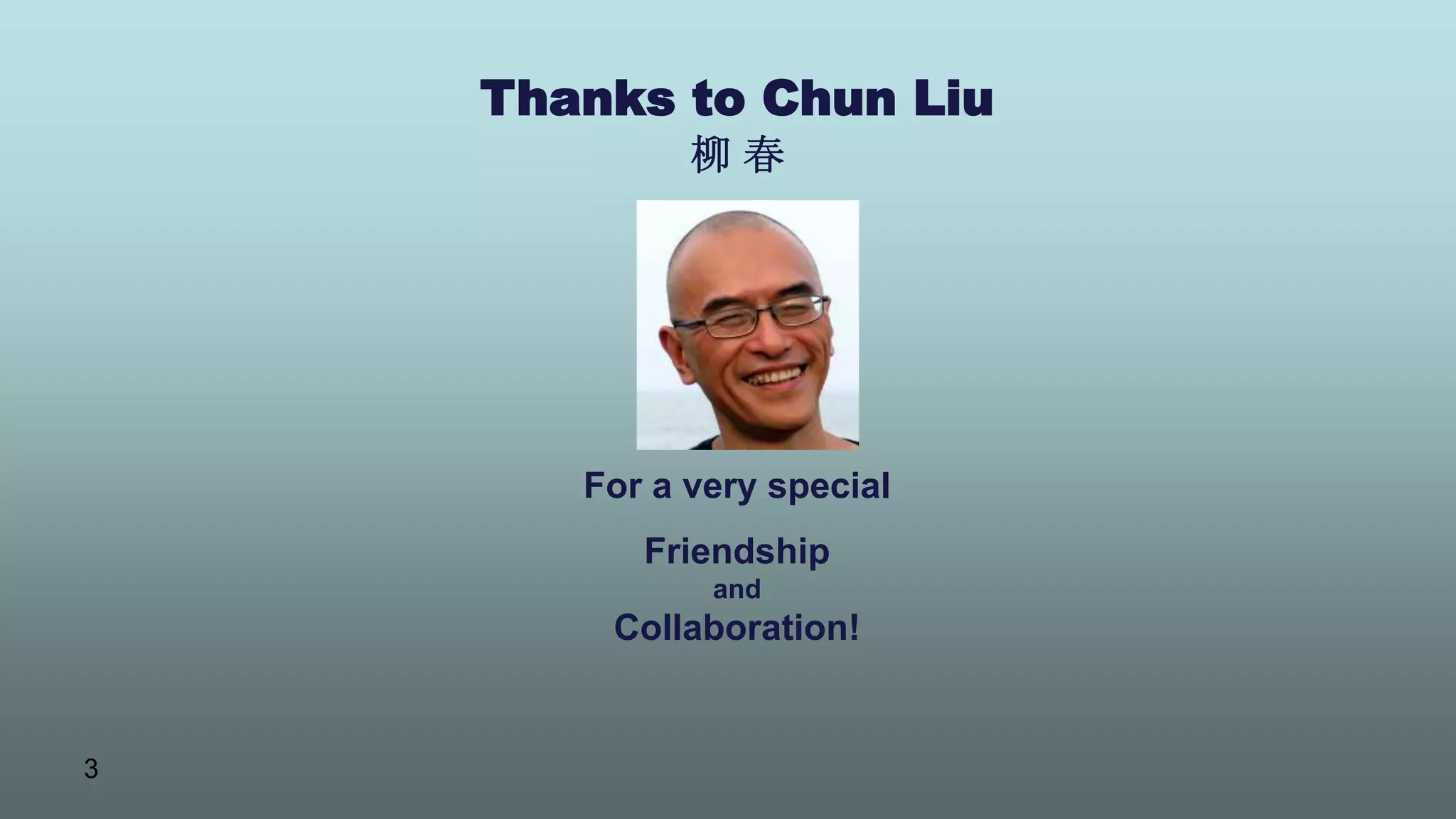
Thanks to Chun Liu
柳 春
For a very special
Friendship
and
Collaboration!
Page 4
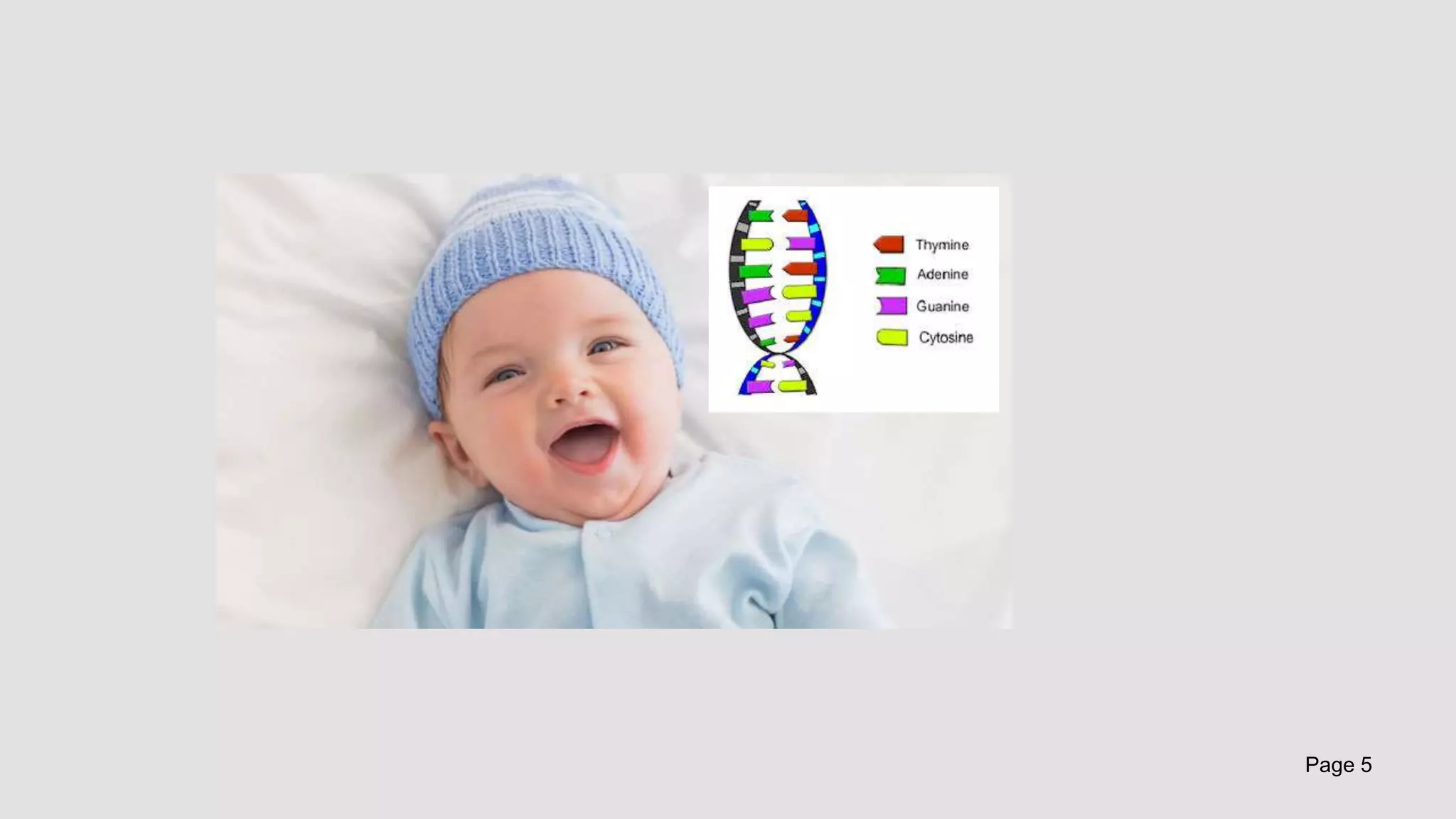
Life is special because it is
inherited from a tiny number
of atoms
And the central question of biology is
How is this possible?
Page 5
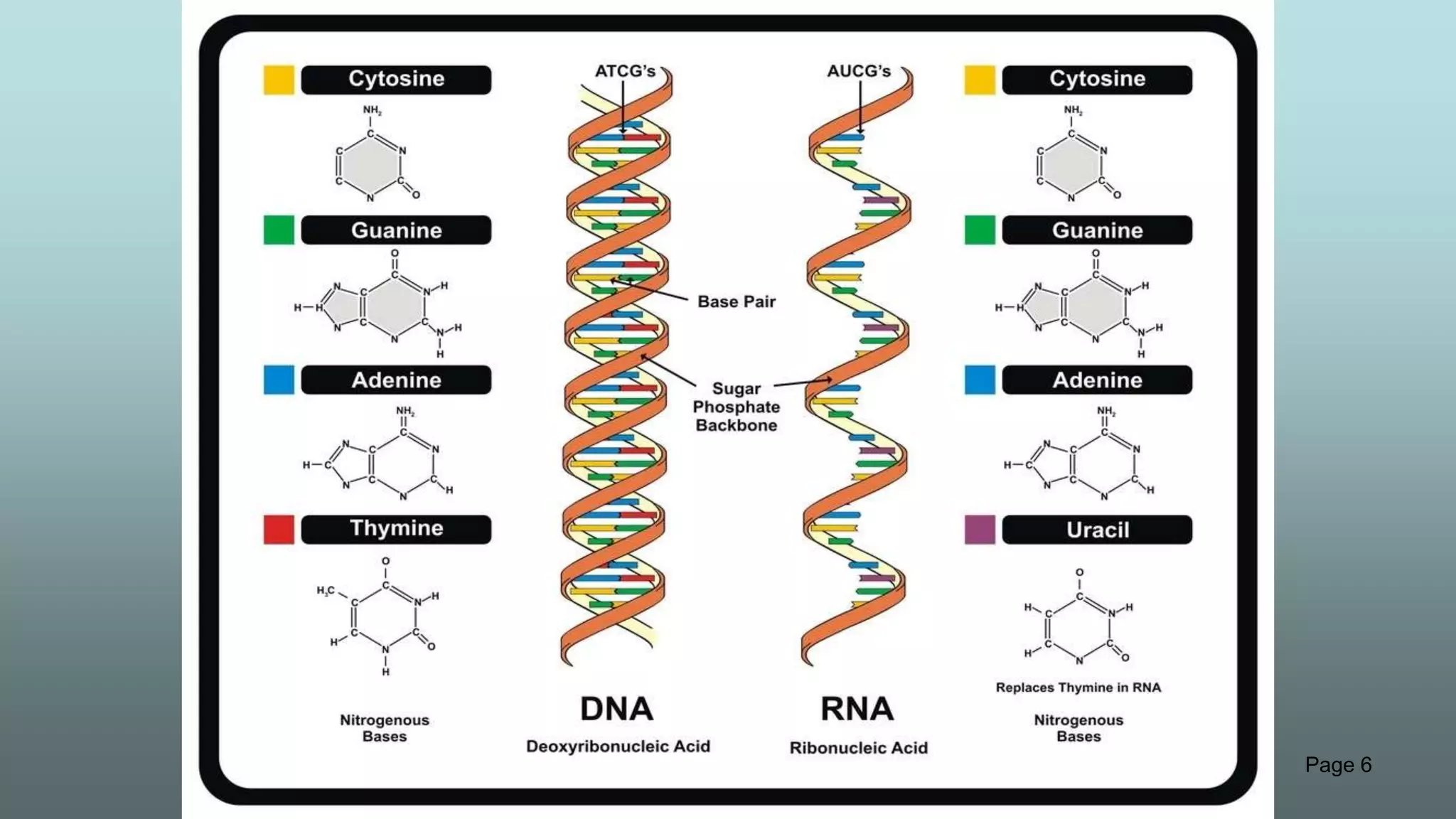
Page 6
Page 7
How can a few thousand atoms
conceivably control 1025 atoms?
8
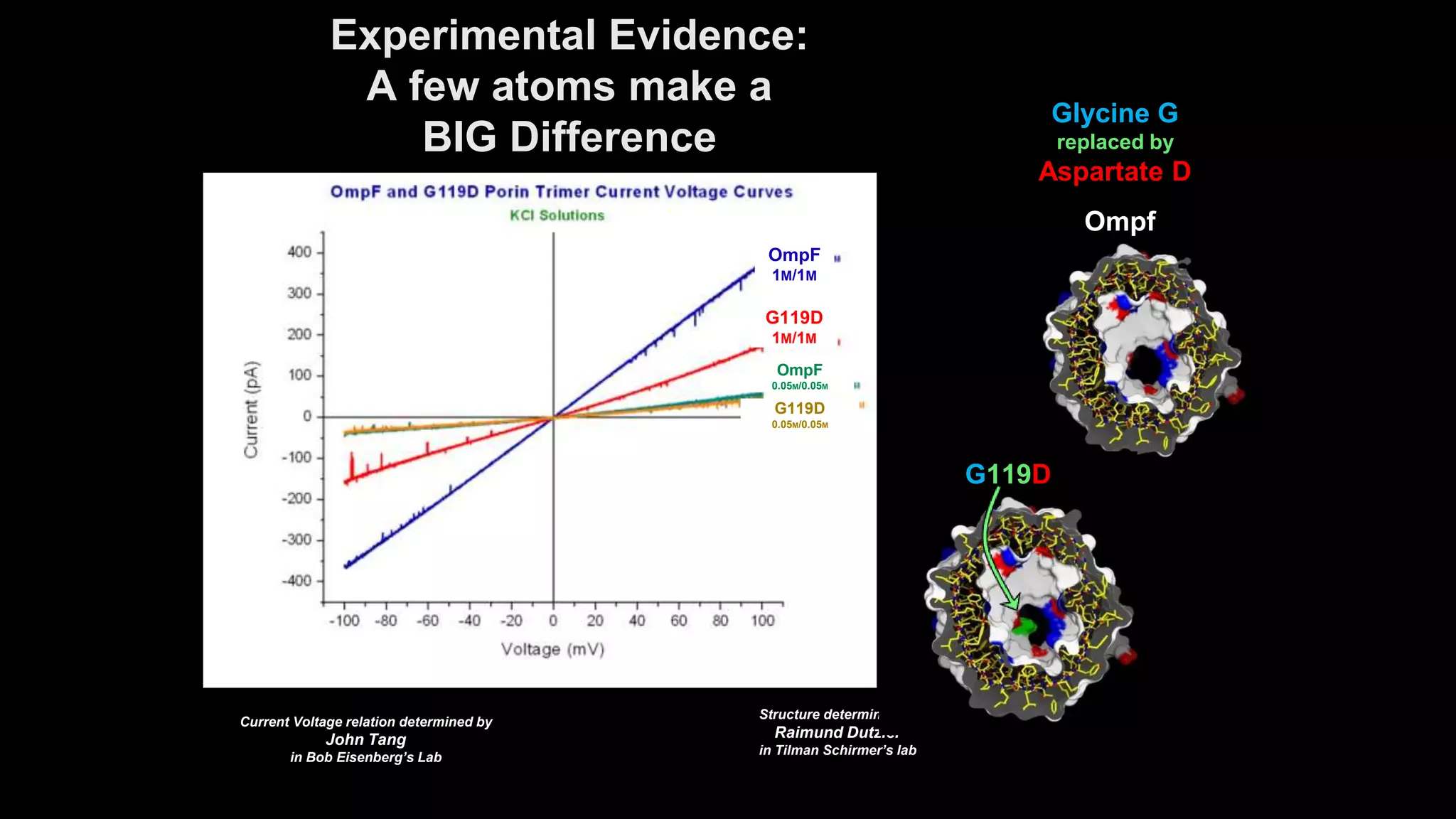
Experimental Evidence:
A few atoms make a
BIG Difference
OmpF
1M/1M
G119D
1M/1M
G119D
0.05M/0.05M
OmpF
0.05M/0.05M
Structure determined by
Raimund Dutzler
in Tilman Schirmer’s lab
Current Voltage relation determined by
John Tang
in Bob Eisenberg’s Lab
Ompf
G119D
Glycine G
replaced by
Aspartate D
Page 9
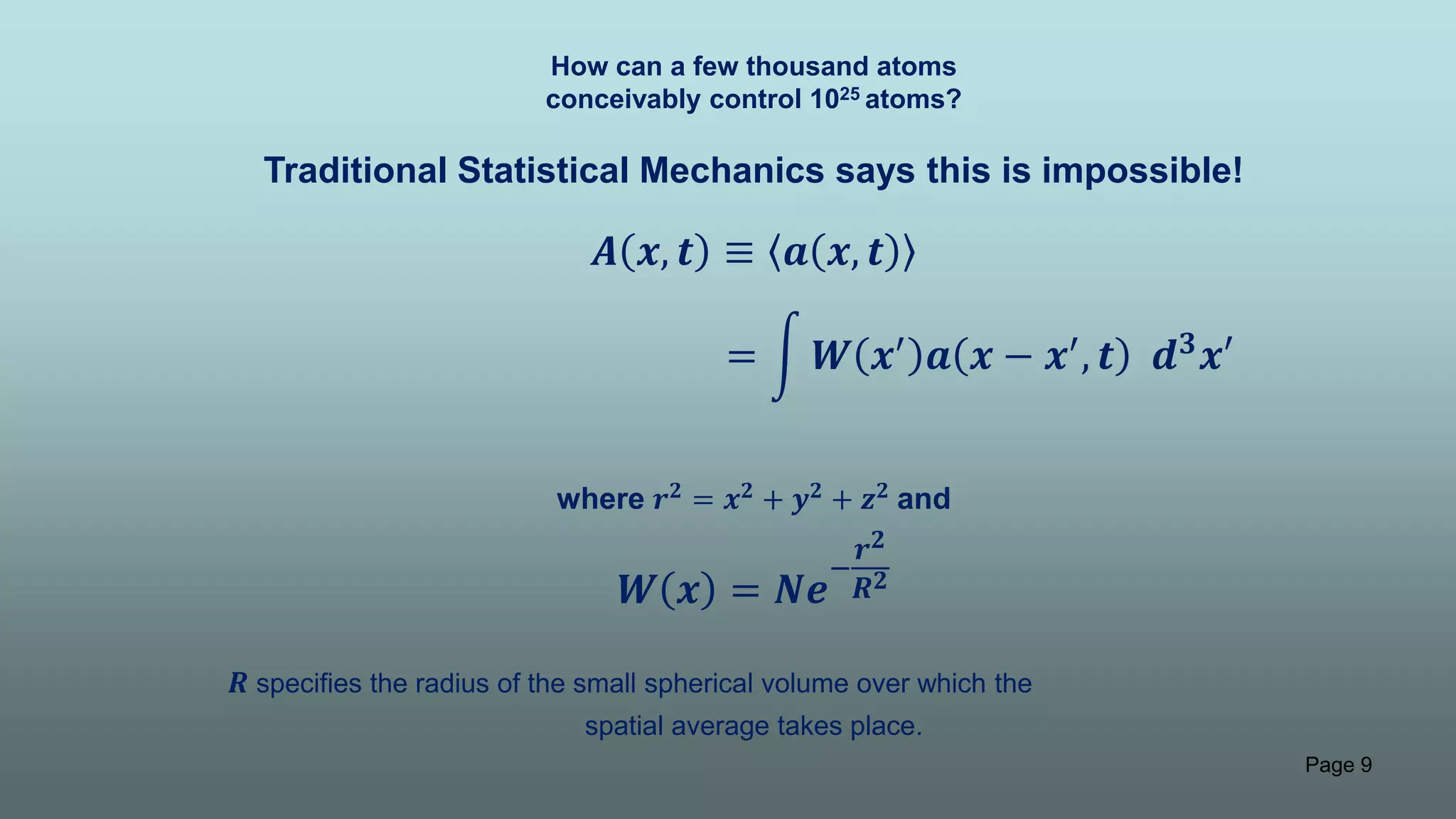
How can a few thousand atoms
conceivably control 1025 atoms?
Traditional Statistical Mechanics says this is impossible!
𝑨 𝒙, 𝒕 ≡ 𝒂 𝒙, 𝒕
where 𝒓 𝟐 = 𝒙 𝟐 + 𝒚 𝟐 + 𝒛 𝟐 and
𝑾 𝒙 = 𝑵𝒆
−
𝒓 𝟐
𝑹 𝟐
𝑹 specifies the radius of the small spherical volume over which the
spatial average takes place.
= 𝑾 𝒙′ 𝒂 𝒙 − 𝒙′, 𝒕 𝒅 𝟑 𝒙′
Page 10
How can a few thousand atoms
conceivably control 1025 atoms?
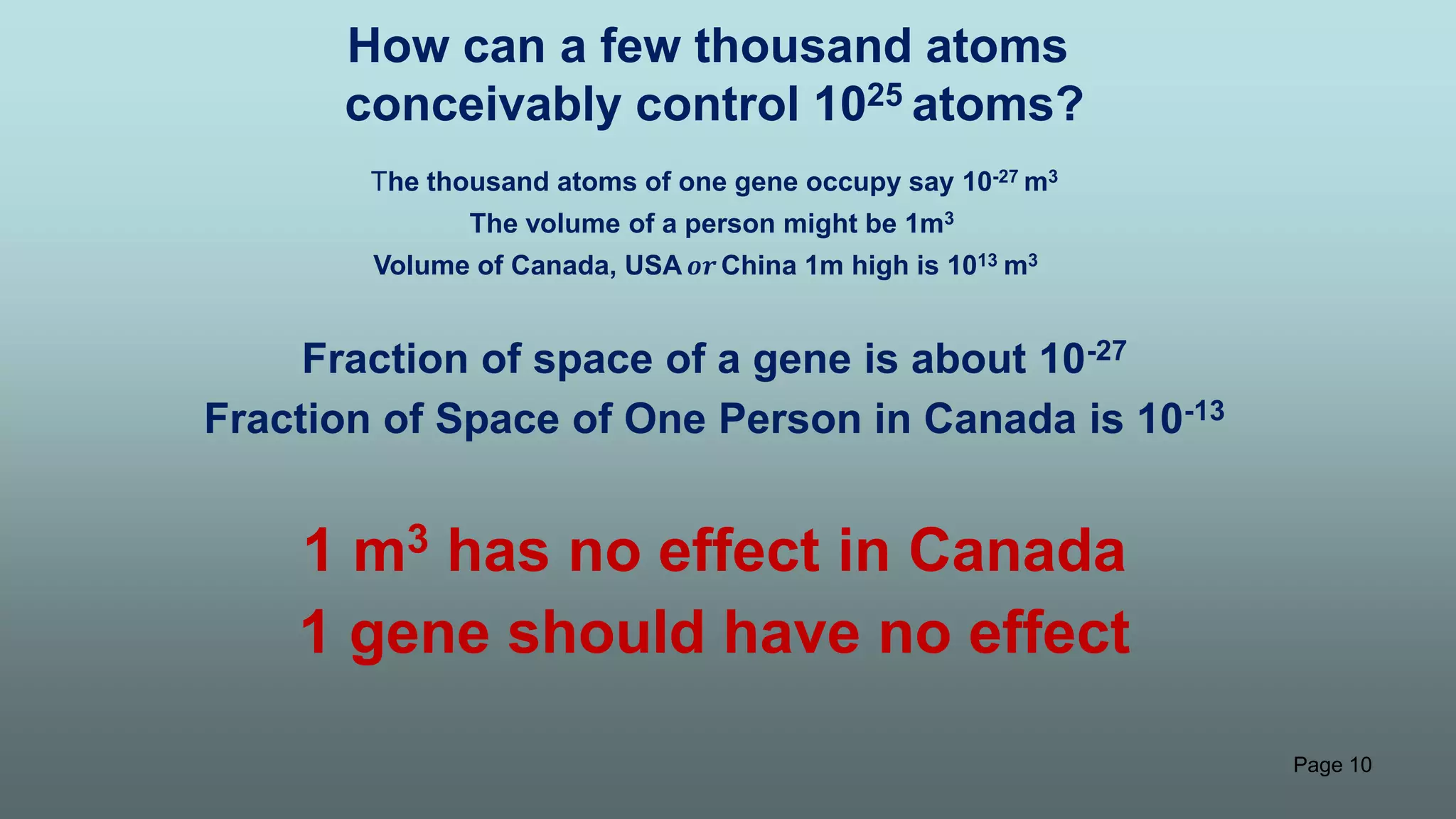
The thousand atoms of one gene occupy say 10-27 m3
The volume of a person might be 1m3
Volume of Canada, USA 𝒐𝒓China 1m high is 1013 m3
Fraction of space of a gene is about 10-27
Fraction of Space of One Person in Canada is 10-13
1 m3 has no effect in Canada
1 gene should have no effect
Page 11
How can a few thousand atoms
conceivably control 1025 atoms?
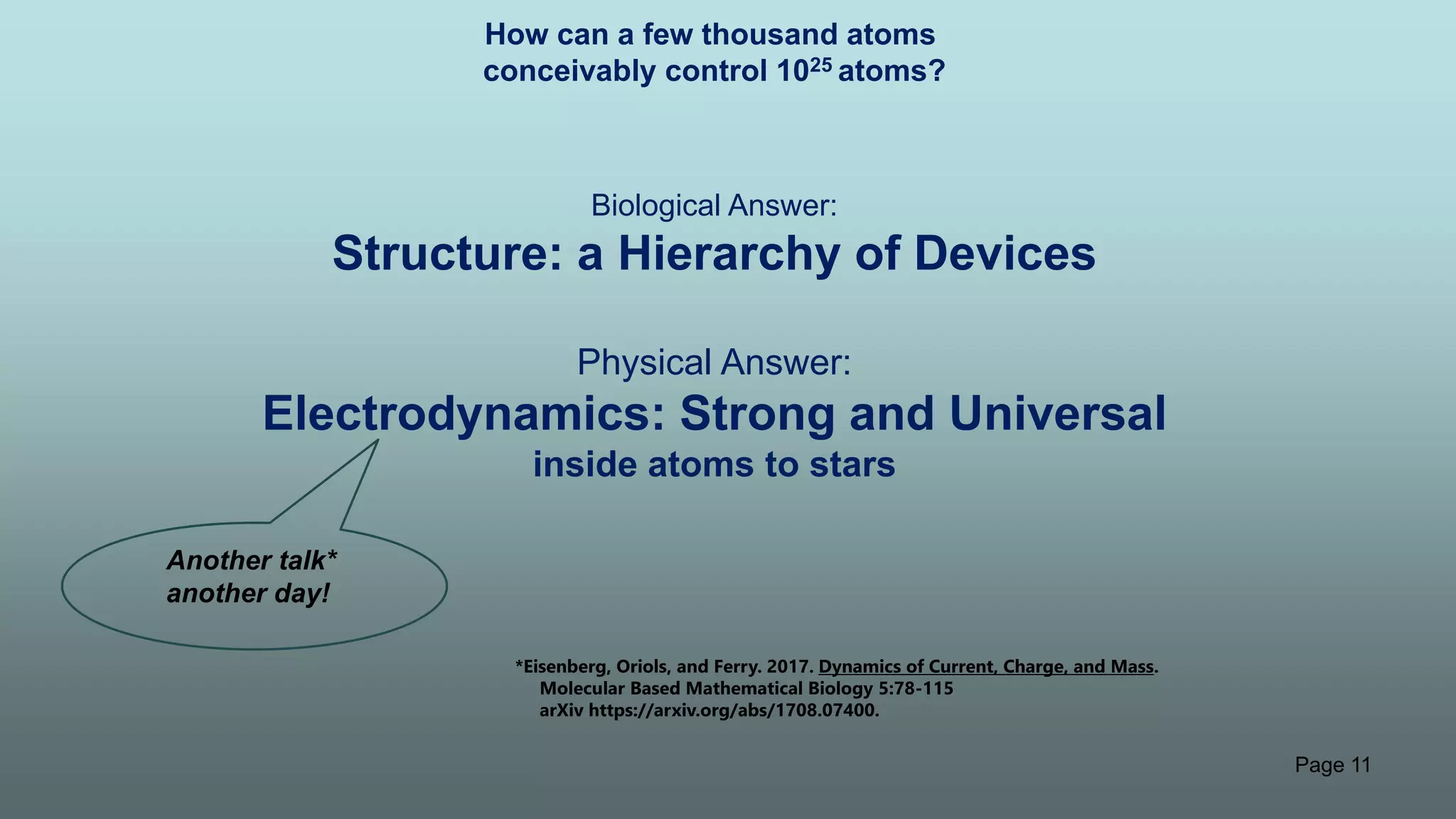
Biological Answer:
Structure: a Hierarchy of Devices
Physical Answer:
Electrodynamics: Strong and Universal
inside atoms to stars
Another talk*
another day!
*Eisenberg, Oriols, and Ferry. 2017. Dynamics of Current, Charge, and Mass.
Molecular Based Mathematical Biology 5:78-115
arXiv https://arxiv.org/abs/1708.07400.
12
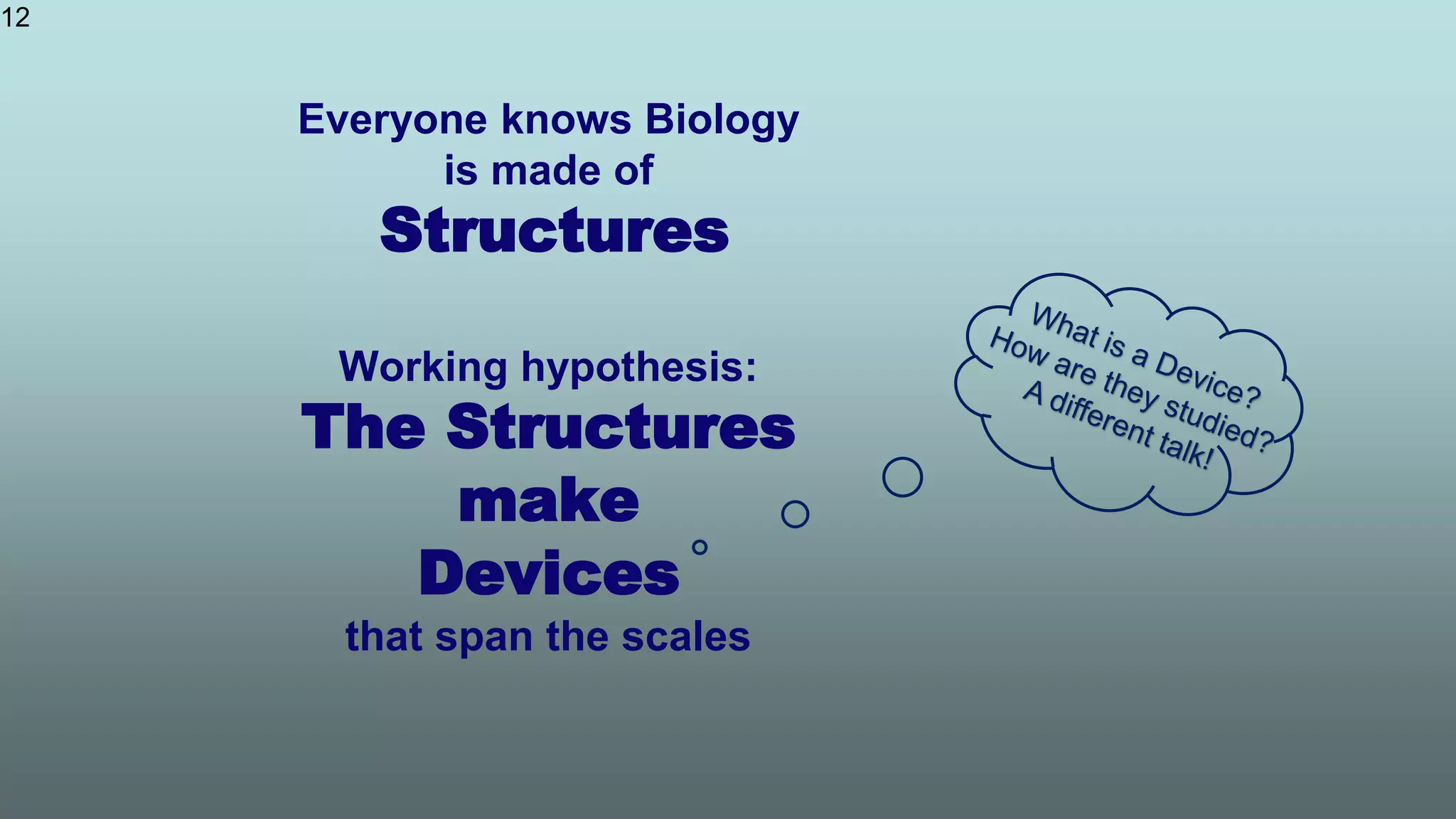
Everyone knows Biology
is made of
Structures
Working hypothesis:
The Structures
make
Devices
that span the scales
13
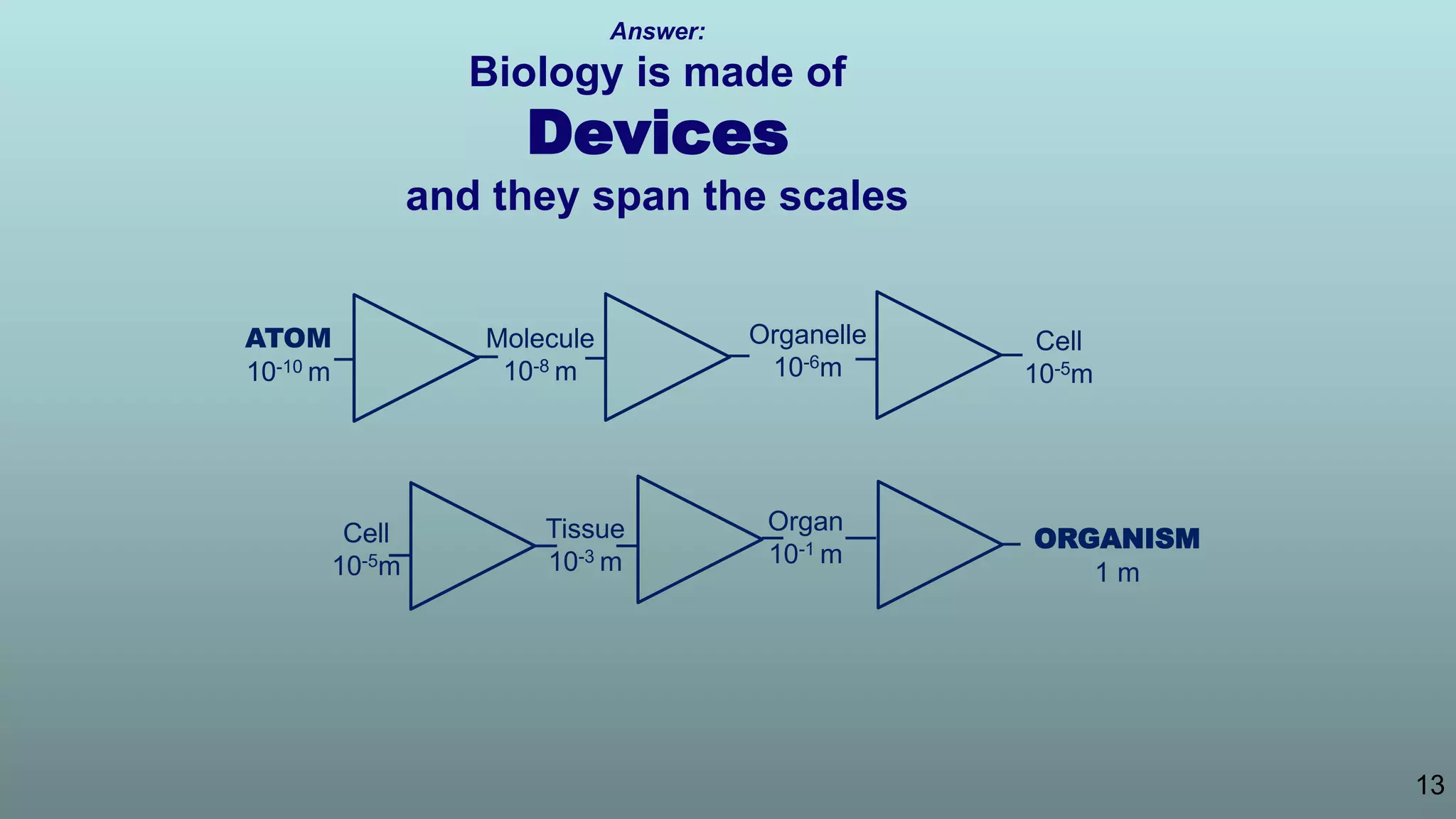
ATOM
10-10 m
Molecule
10-8 m
Organelle
10-6m
Cell
10-5m
Cell
10-5m
Tissue
10-3 m
Organ
10-1 m
ORGANISM
1 m
Answer:
Biology is made of
Devices
and they span the scales
Page 14
How can a few thousand atoms
conceivably control 1025 atoms?
ANSWER:
by forming a
HIERARCHY of DEVICES
Page 15
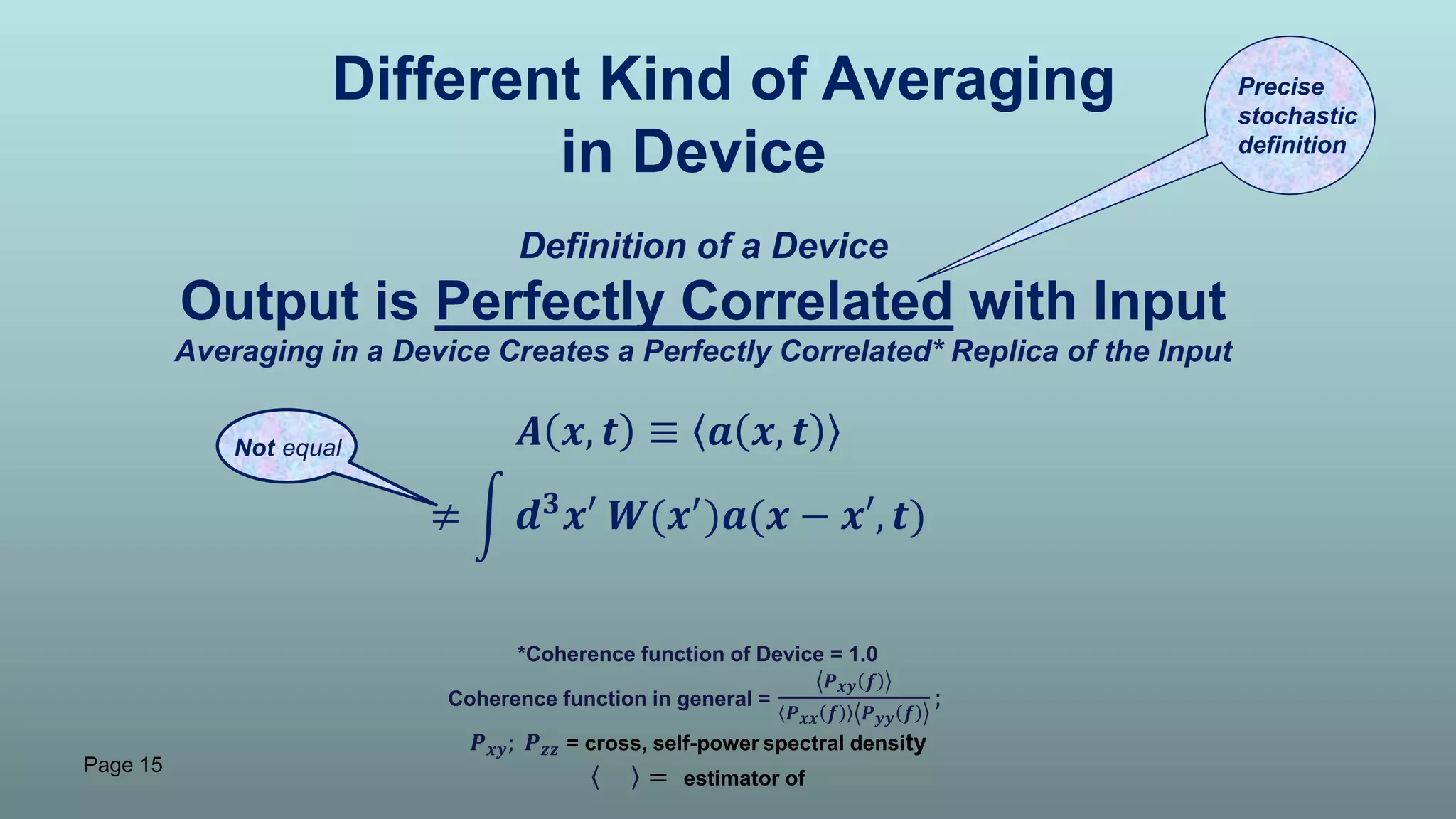
Different Kind of Averaging
in Device
Definition of a Device
Output is Perfectly Correlated with Input
Averaging in a Device Creates a Perfectly Correlated* Replica of the Input
𝑨 𝒙, 𝒕 ≡ 𝒂 𝒙, 𝒕
≠ 𝒅 𝟑
𝒙′ 𝑾(𝒙′
)𝒂(𝒙 − 𝒙′, 𝒕)
Not equal
Precise
stochastic
definition
*Coherence function of Device = 1.0
Coherence function in general =
𝑷 𝒙𝒚 𝒇
𝑷 𝒙𝒙 𝒇 𝑷 𝒚𝒚 𝒇
;
𝑷 𝒙𝒚; 𝑷 𝒛𝒛 = cross, self-power spectral density
= estimator of
Page 16
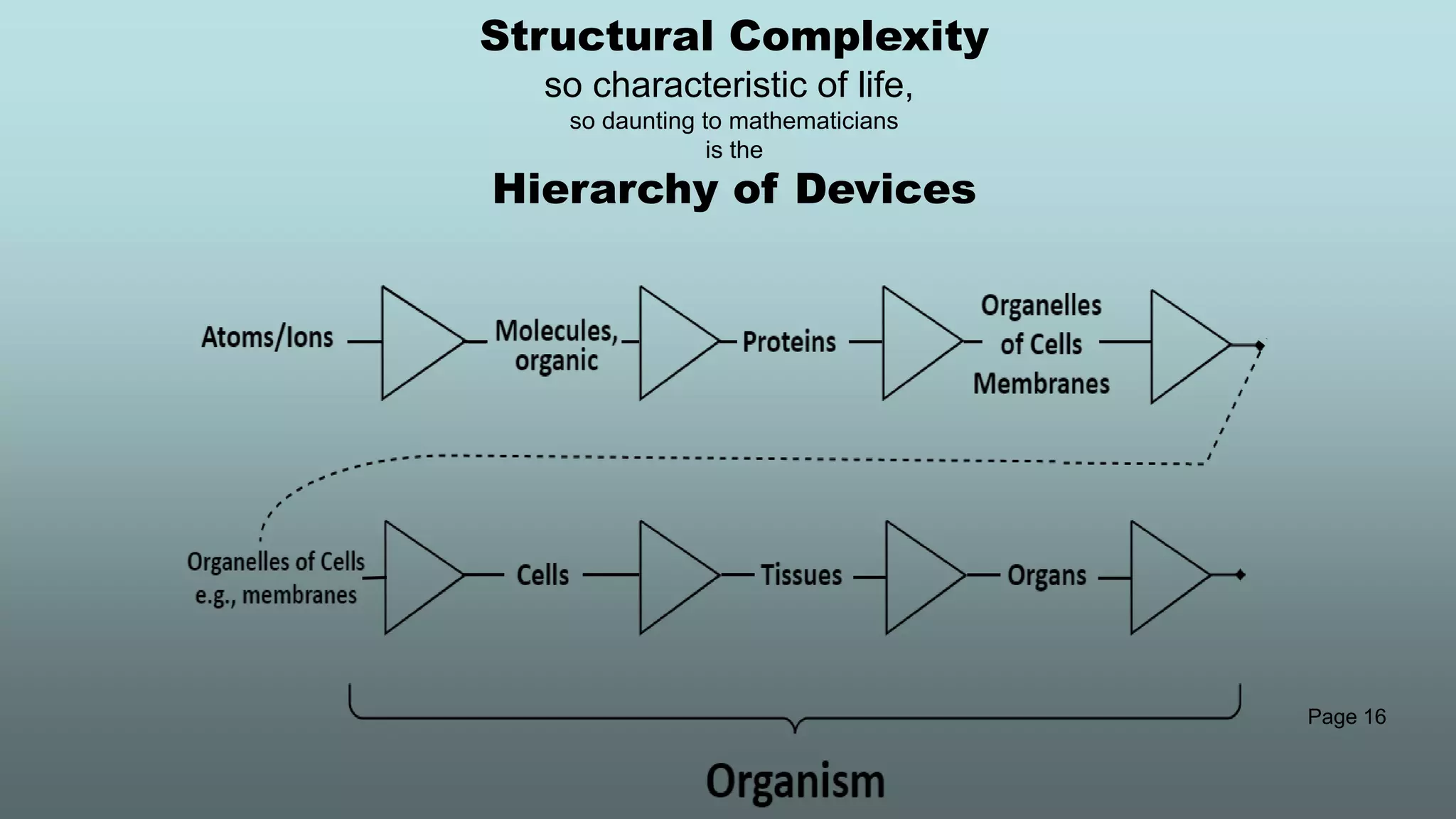
Structural Complexity
so characteristic of life,
so daunting to mathematicians
is the
Hierarchy of Devices
Page 17
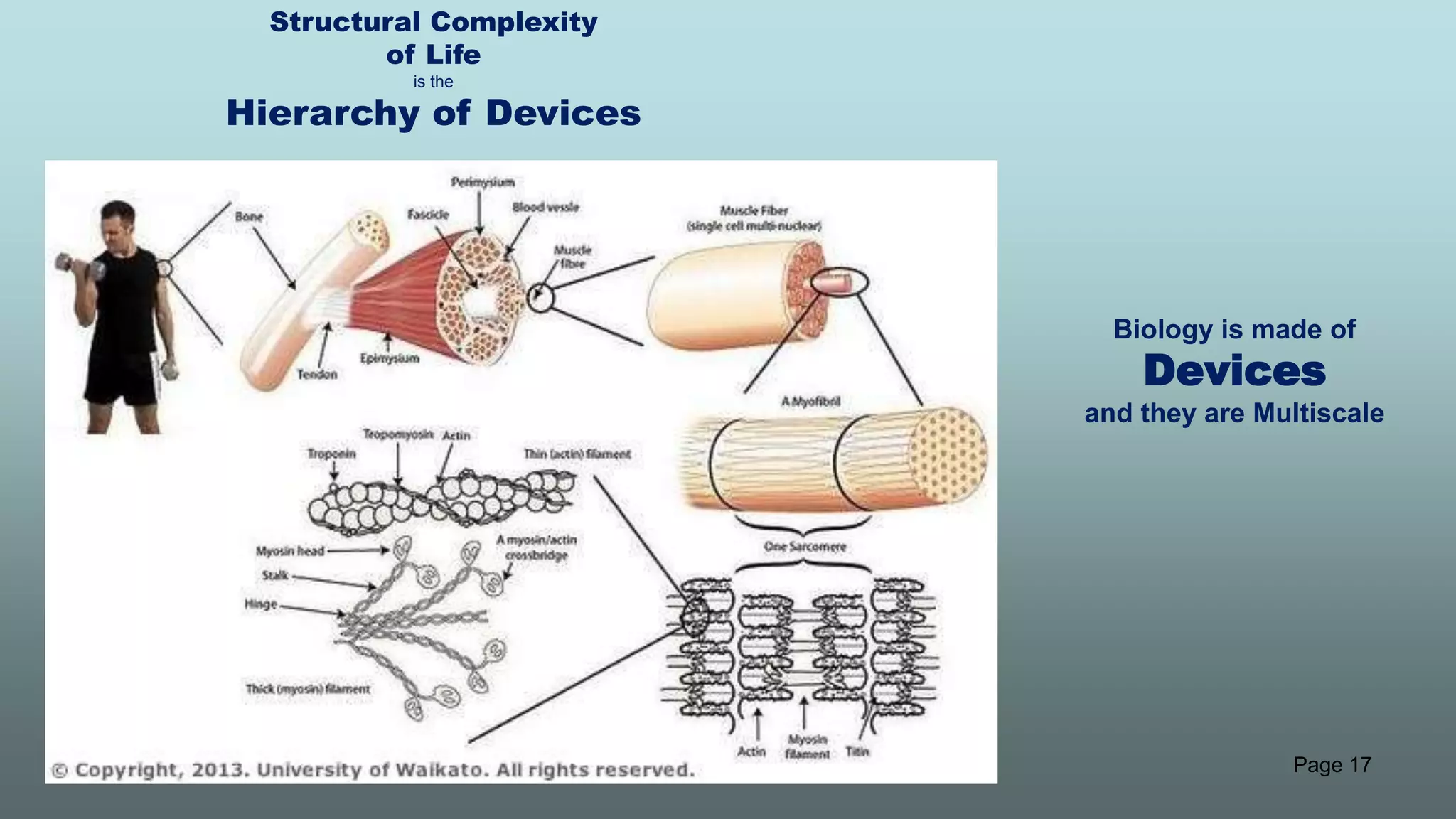
Biology is made of
Devices
and they are Multiscale
Structural Complexity
of Life
is the
Hierarchy of Devices
18
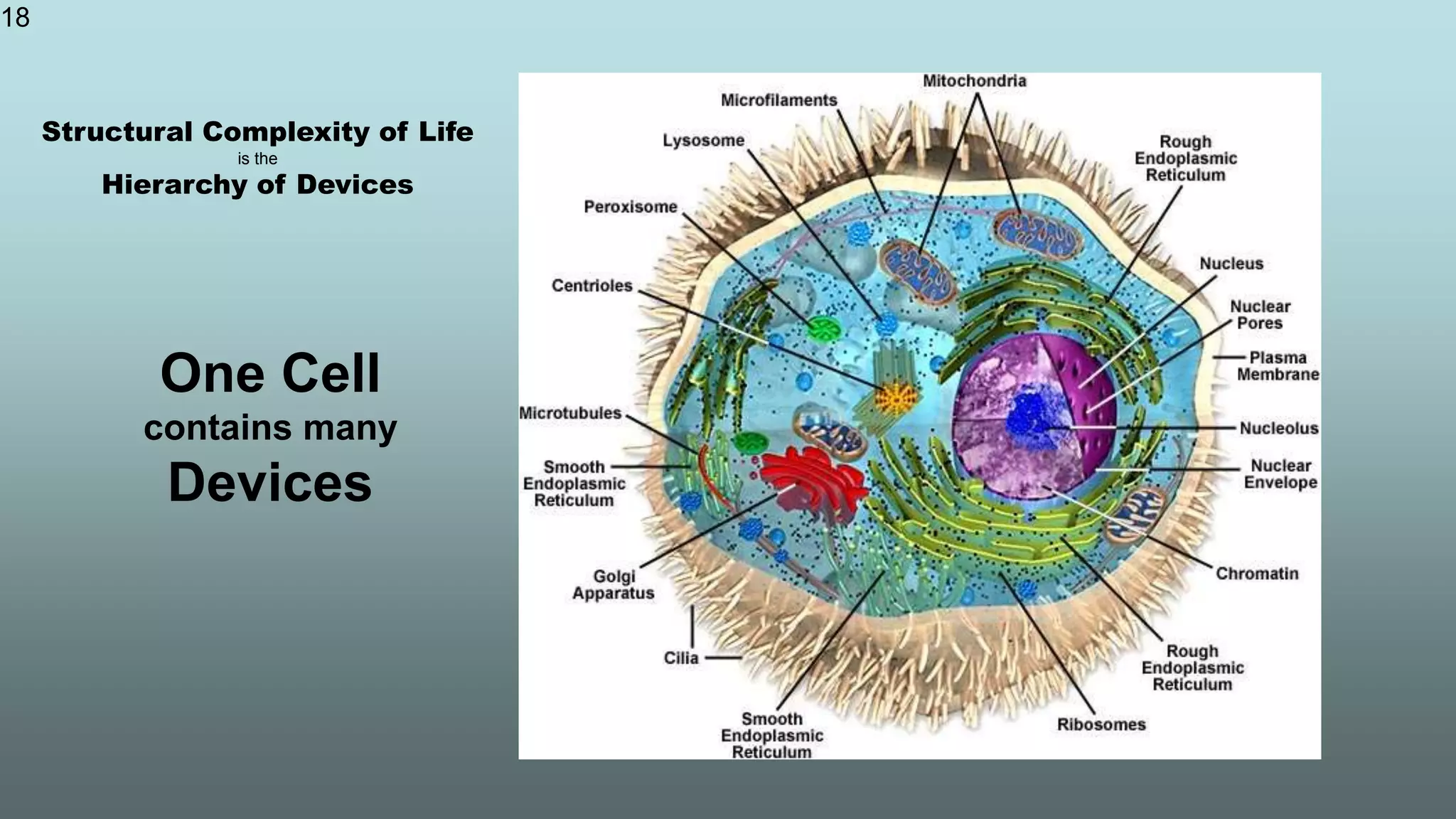
One Cell
contains many
Devices
Structural Complexity of Life
is the
Hierarchy of Devices
19
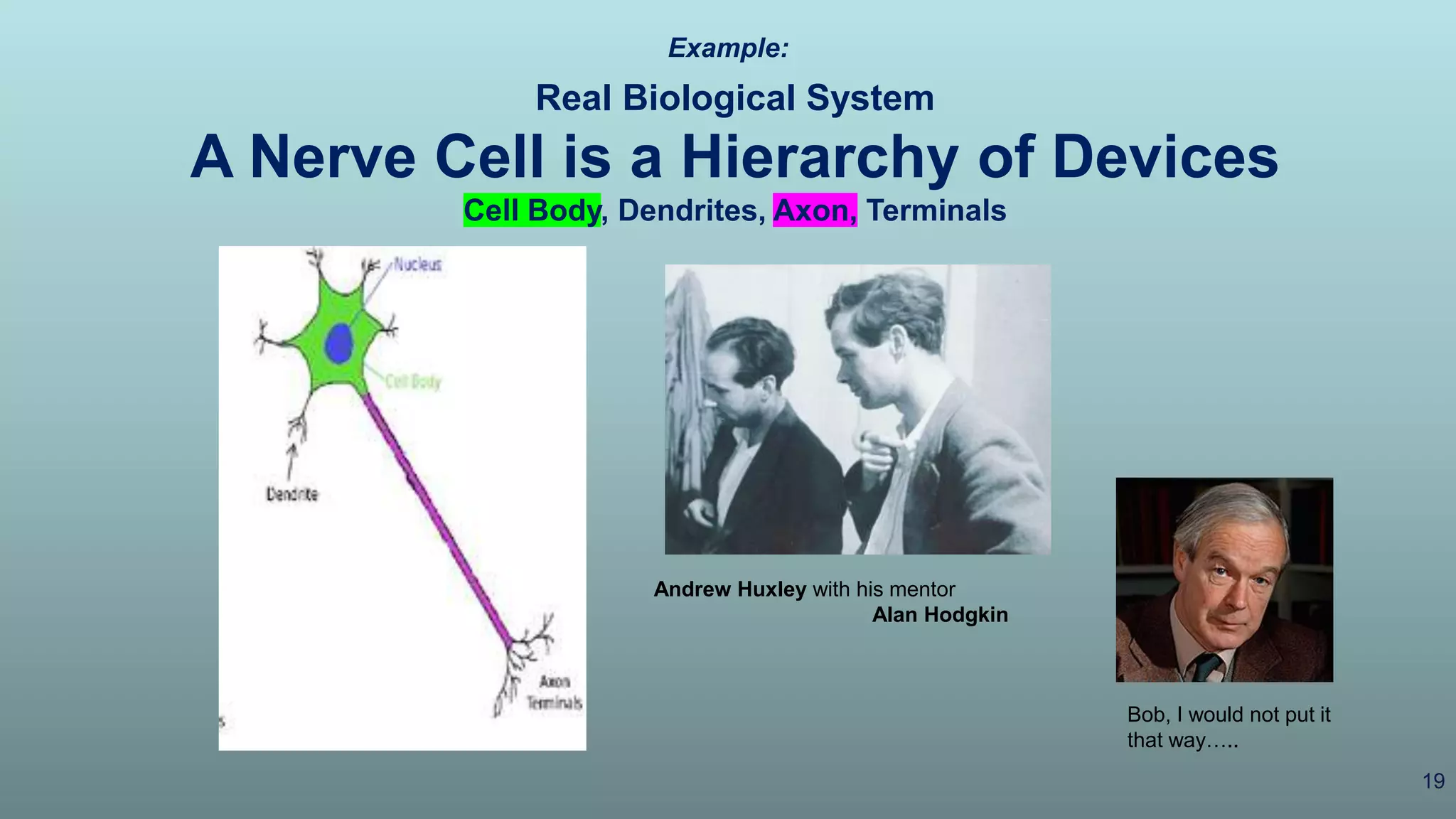
Real Biological System
A Nerve Cell is a Hierarchy of Devices
Cell Body, Dendrites, Axon, Terminals
Example:
Bob, I would not put it
that way…..
Andrew Huxley with his mentor
Alan Hodgkin
20
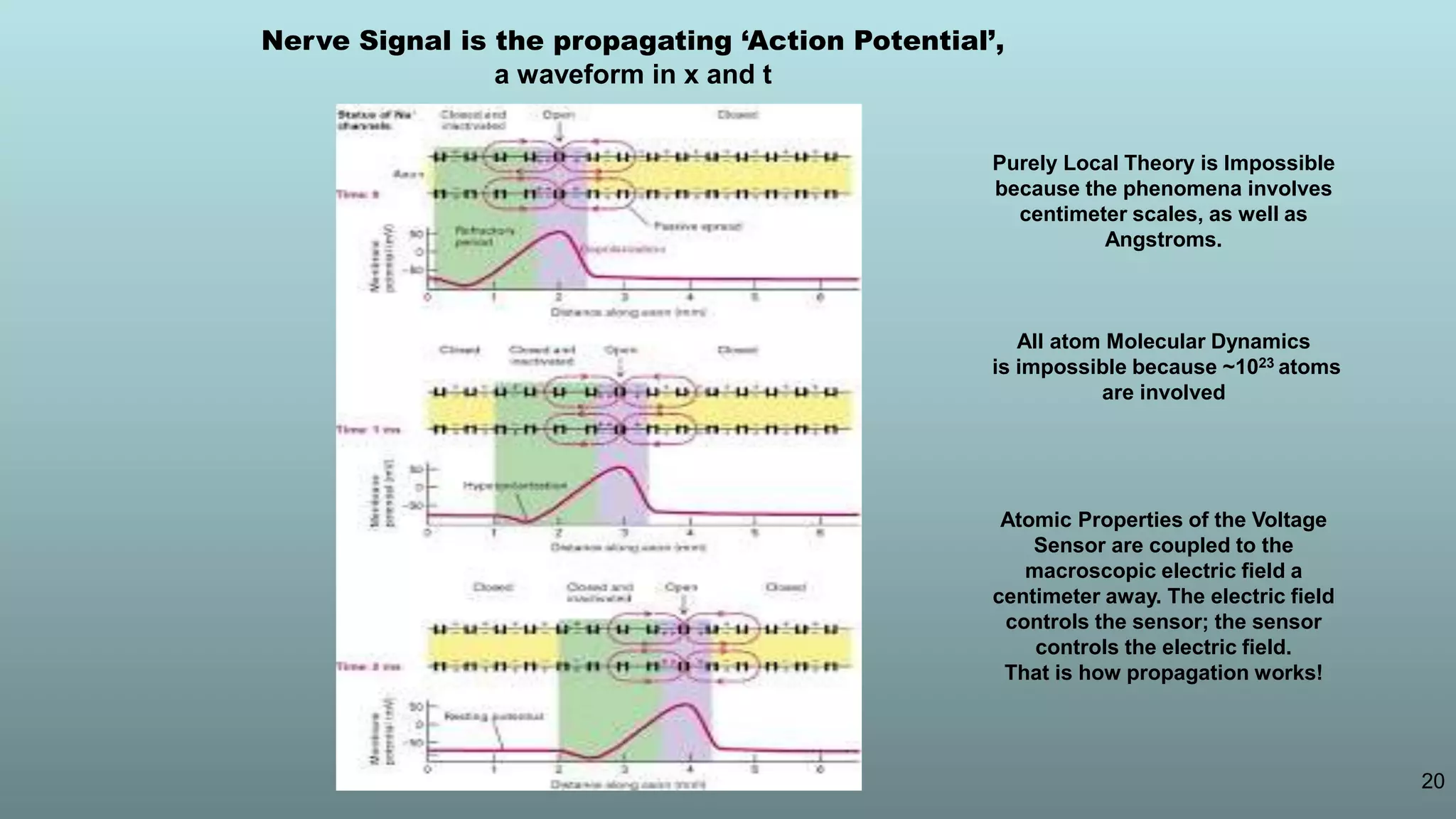
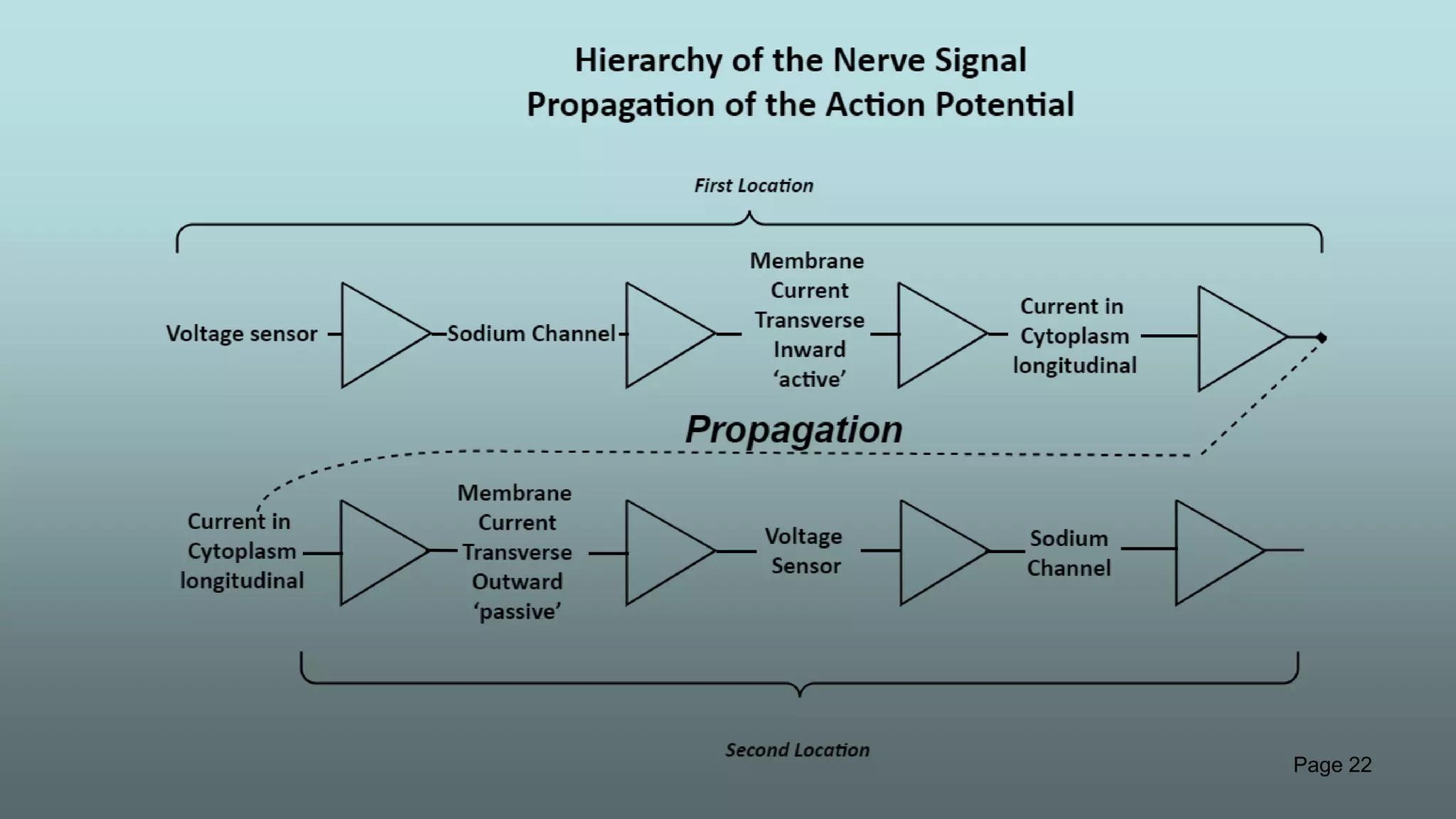
Nerve Signal is the propagating ‘Action Potential’,
a waveform in x and t
Purely Local Theory is Impossible
because the phenomena involves
centimeter scales, as well as
Angstroms.
All atom Molecular Dynamics
is impossible because ~1023 atoms
are involved
Atomic Properties of the Voltage
Sensor are coupled to the
macroscopic electric field a
centimeter away. The electric field
controls the sensor; the sensor
controls the electric field.
That is how propagation works!
Page 21
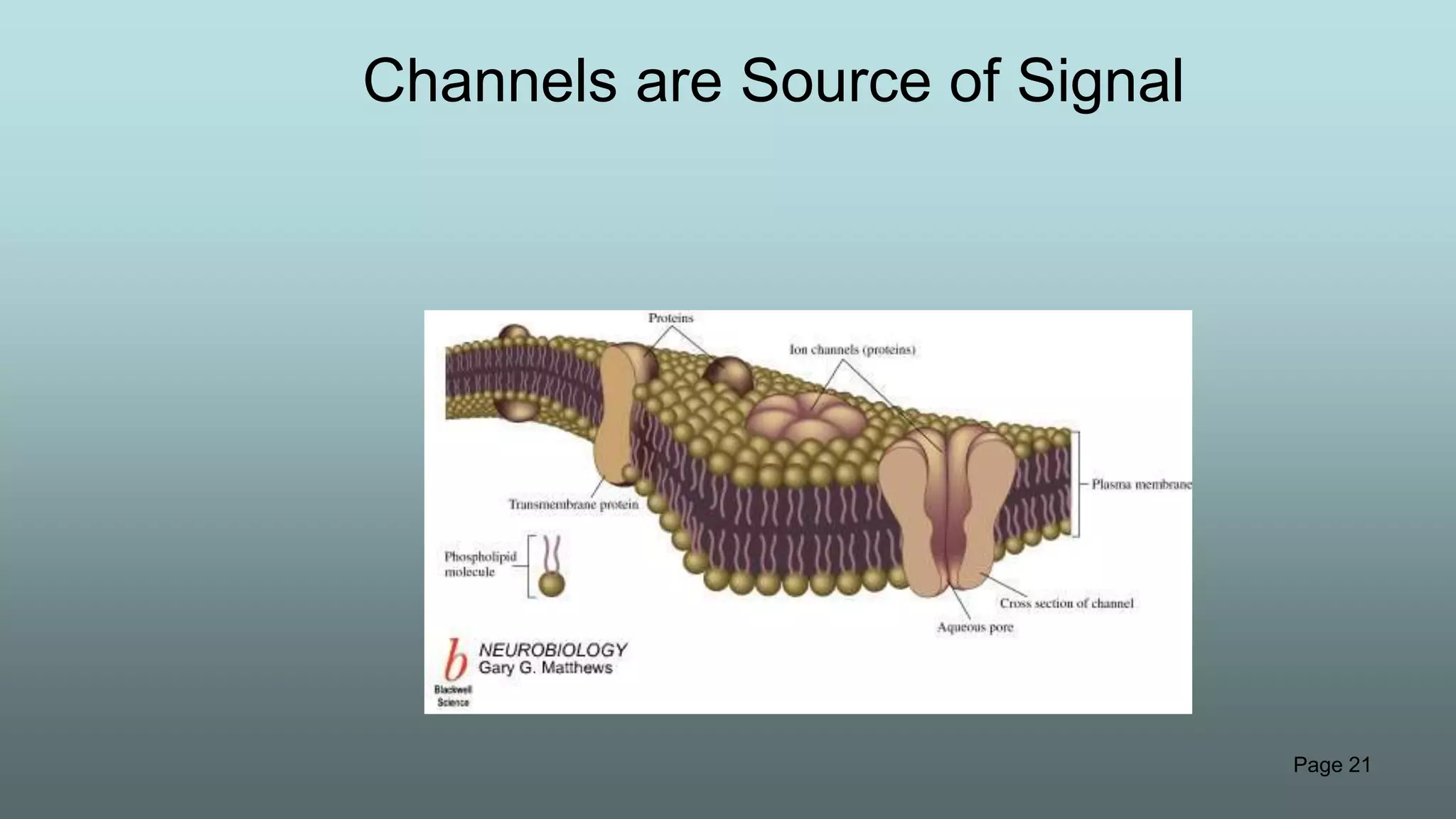
Channels are Source of Signal
Page 22
Page 23
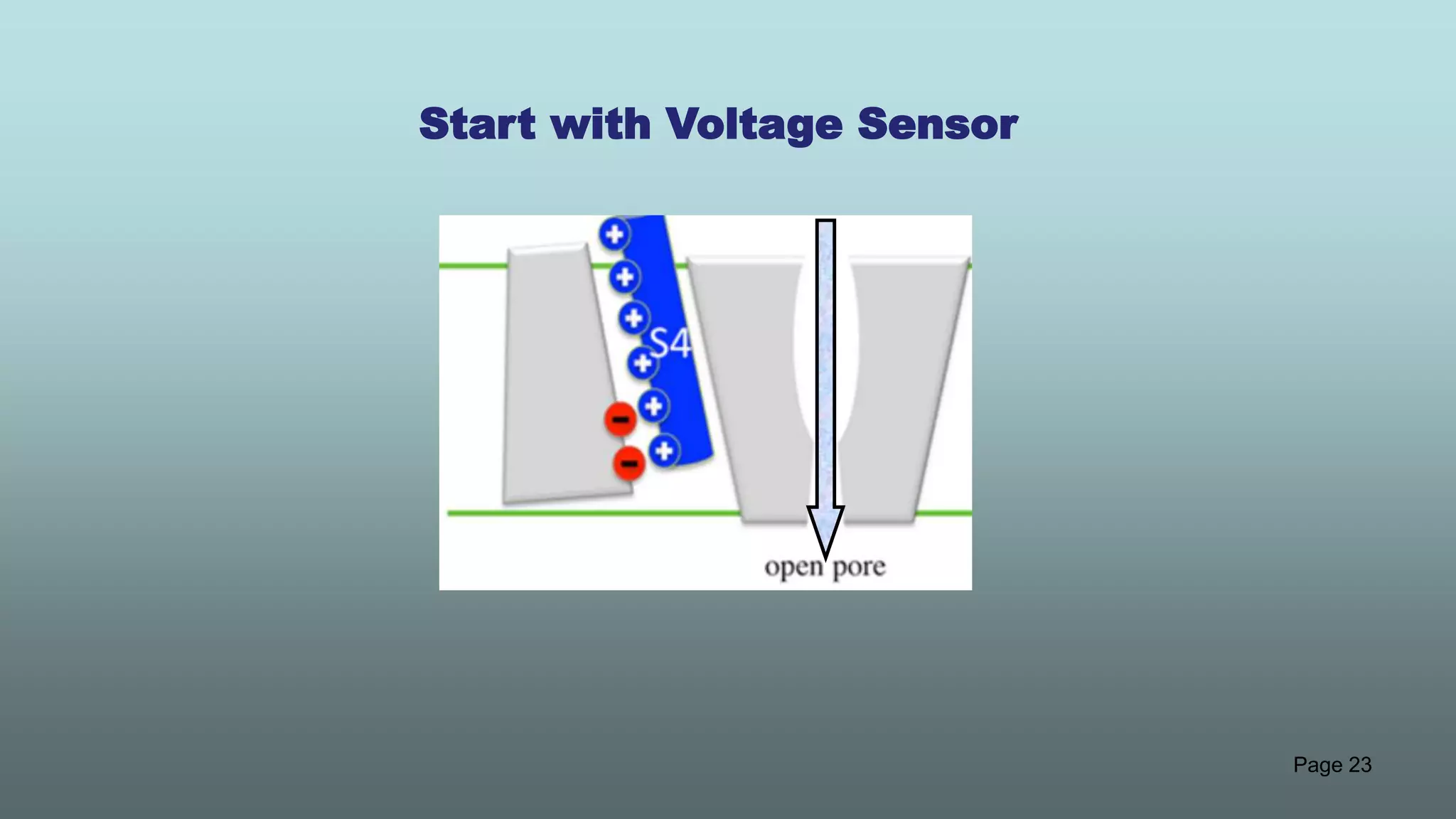
Start with Voltage Sensor
24
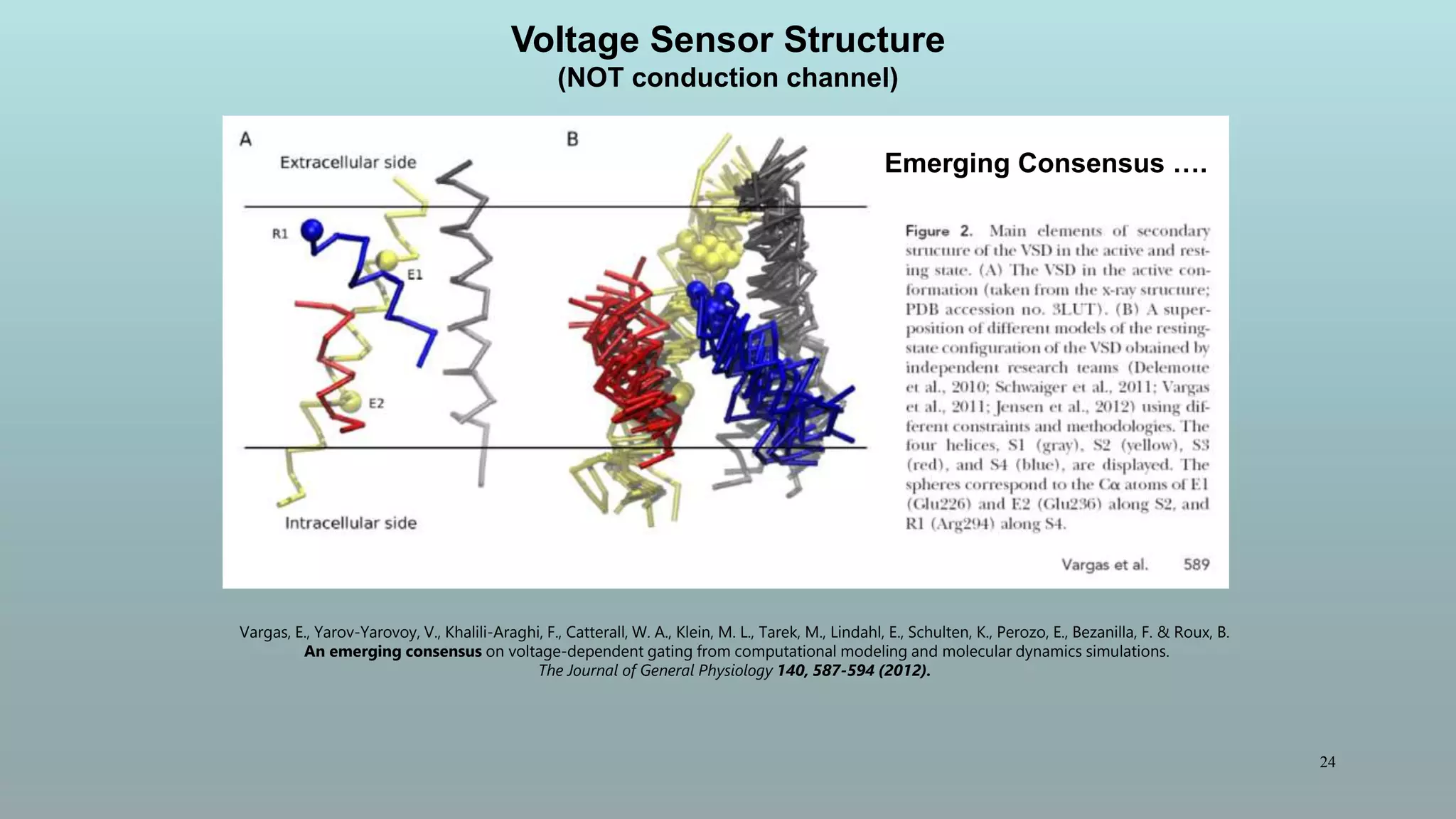
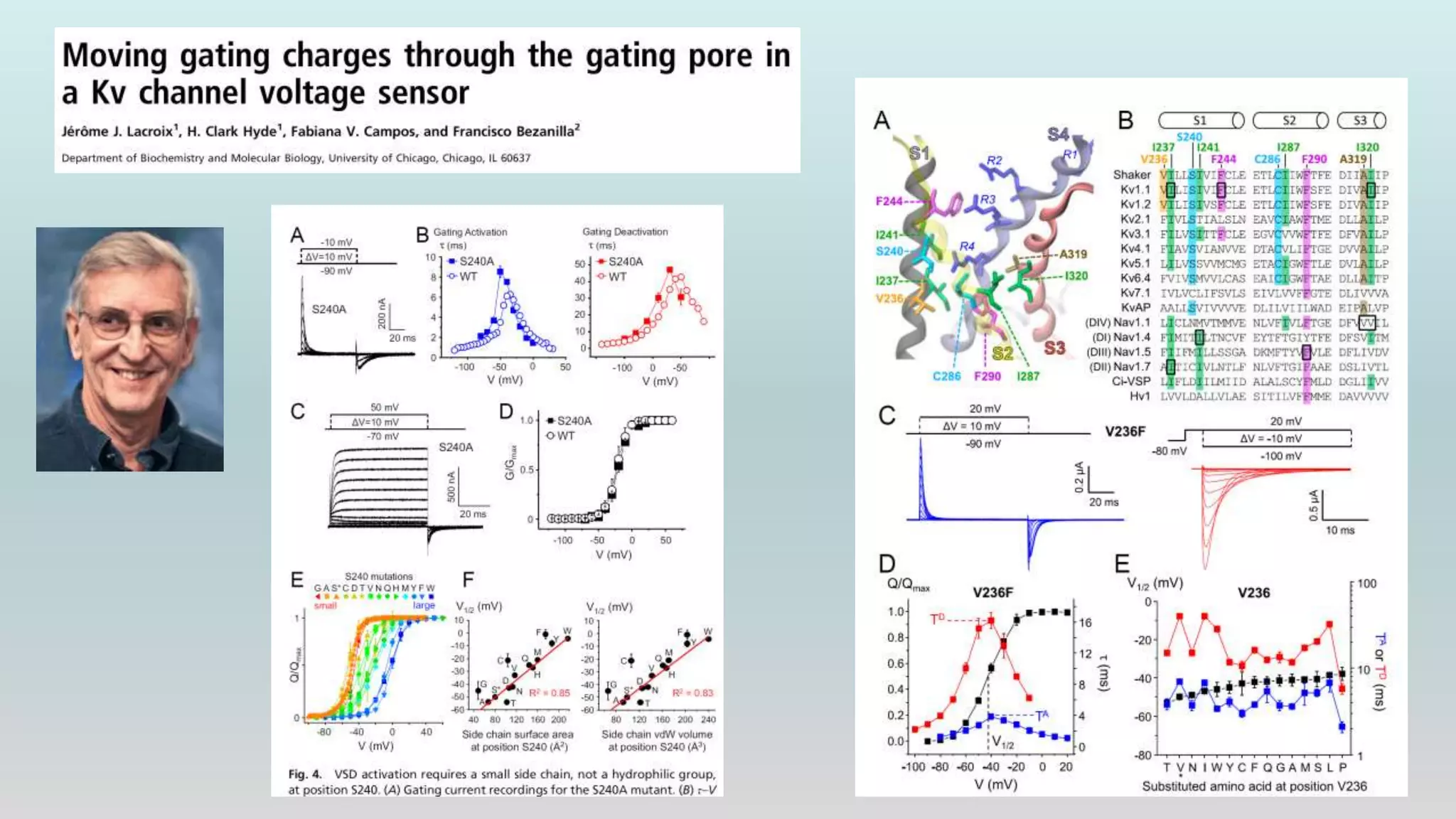
Vargas, E., Yarov-Yarovoy, V., Khalili-Araghi, F., Catterall, W. A., Klein, M. L., Tarek, M., Lindahl, E., Schulten, K., Perozo, E., Bezanilla, F. & Roux, B.
An emerging consensus on voltage-dependent gating from computational modeling and molecular dynamics simulations.
The Journal of General Physiology 140, 587-594 (2012).
Emerging Consensus ….
Voltage Sensor Structure
(NOT conduction channel)
25
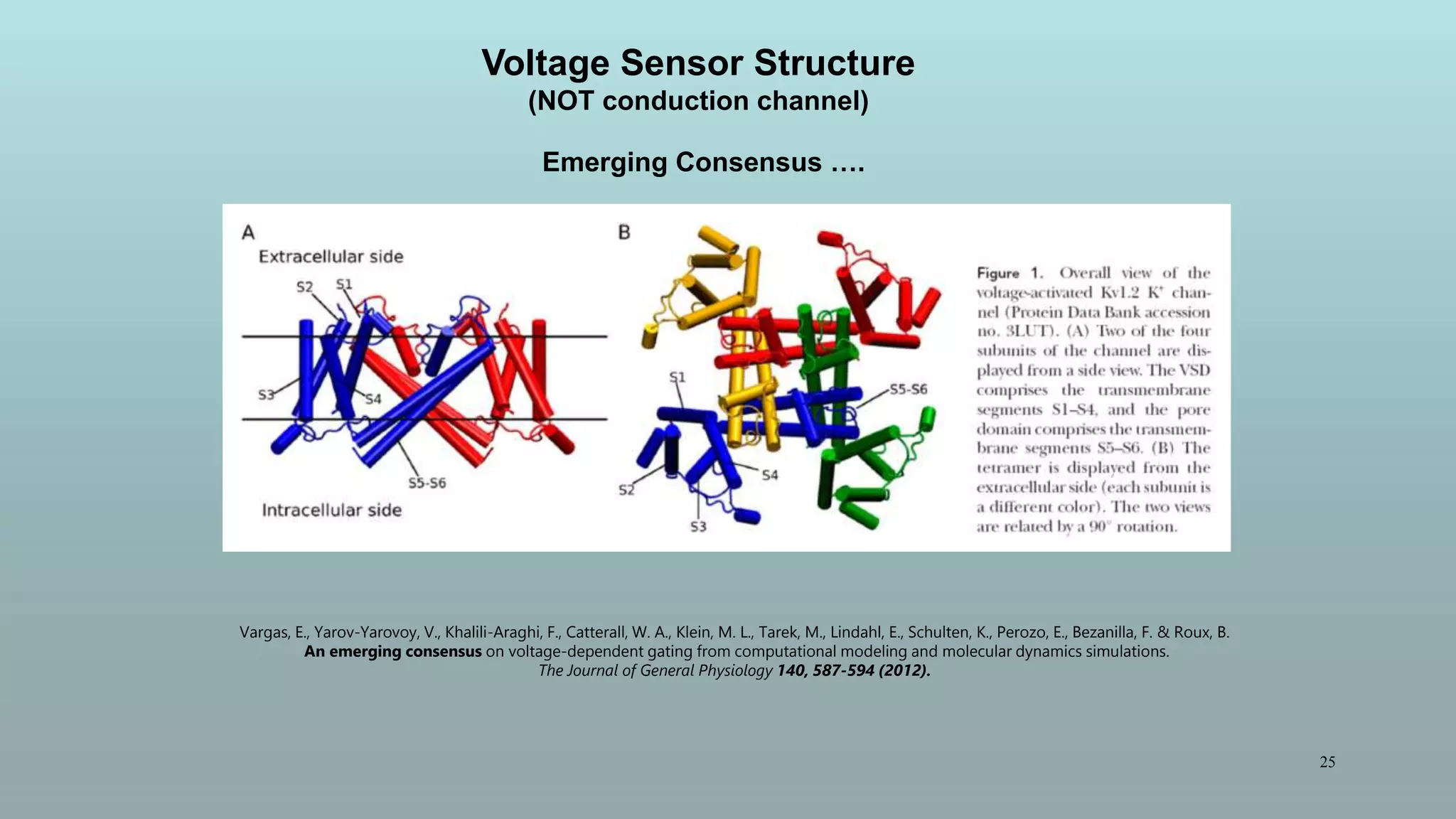
Vargas, E., Yarov-Yarovoy, V., Khalili-Araghi, F., Catterall, W. A., Klein, M. L., Tarek, M., Lindahl, E., Schulten, K., Perozo, E., Bezanilla, F. & Roux, B.
An emerging consensus on voltage-dependent gating from computational modeling and molecular dynamics simulations.
The Journal of General Physiology 140, 587-594 (2012).
Emerging Consensus ….
Voltage Sensor Structure
(NOT conduction channel)
26
27
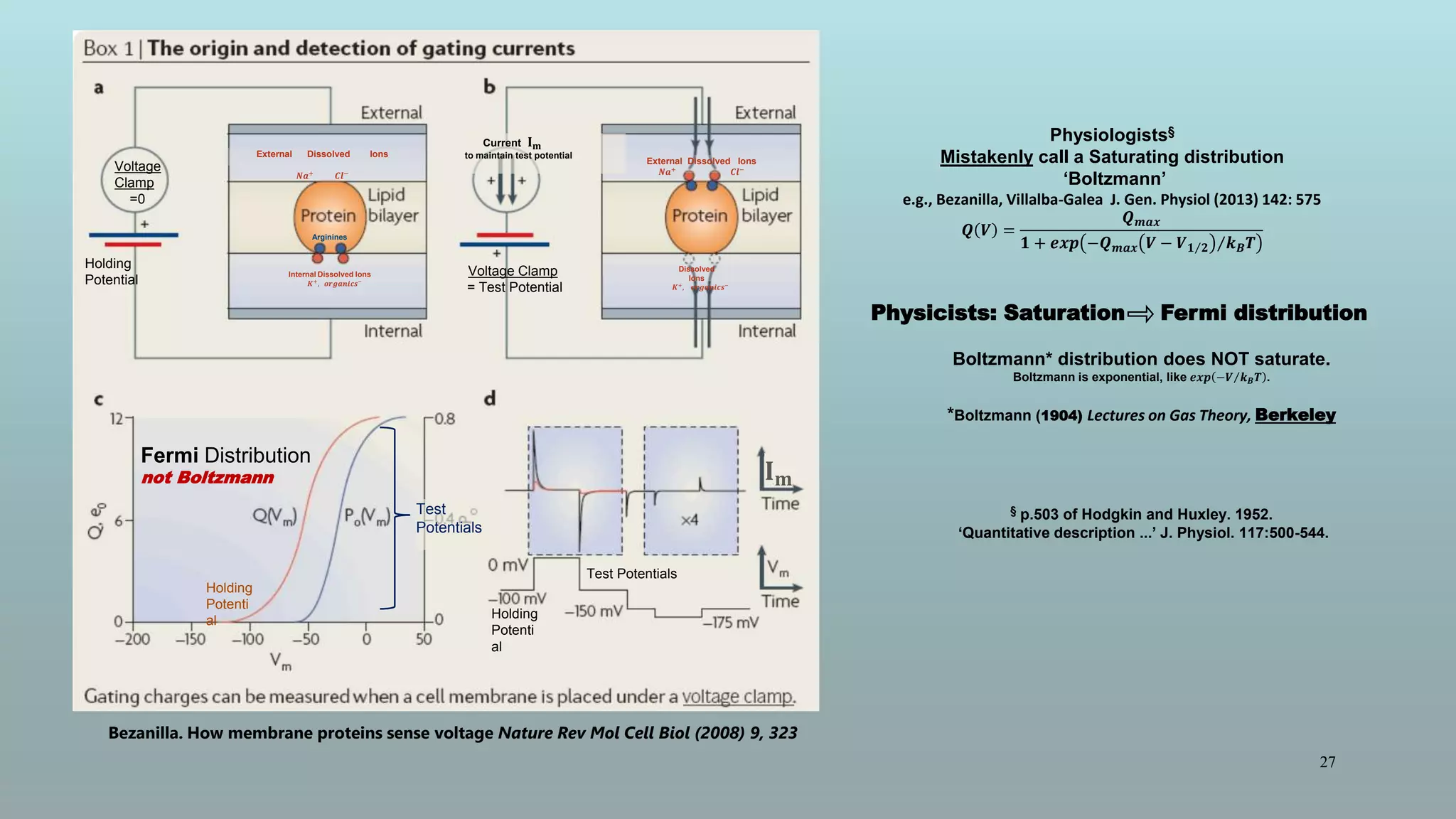
Physiologists§
Mistakenly call a Saturating distribution
‘Boltzmann’
e.g., Bezanilla, Villalba-Galea J. Gen. Physiol (2013) 142: 575
𝑸 𝑽 =
𝑸 𝒎𝒂𝒙
𝟏 + 𝒆𝒙𝒑 −𝑸 𝒎𝒂𝒙 𝑽 − 𝑽 𝟏 𝟐 𝒌 𝑩 𝑻
Physicists: Saturation Fermi distribution
Boltzmann* distribution does NOT saturate.
Boltzmann is exponential, like 𝒆𝒙𝒑 −𝑽 𝒌 𝑩 𝑻 .
*Boltzmann (1904) Lectures on Gas Theory, Berkeley
§ p.503 of Hodgkin and Huxley. 1952.
‘Quantitative description ...’ J. Physiol. 117:500-544.
Bezanilla. How membrane proteins sense voltage Nature Rev Mol Cell Biol (2008) 9, 323
Fermi Distribution
not Boltzmann
Arginines
Internal Dissolved Ions
𝑲+, 𝒐𝒓𝒈𝒂𝒏𝒊𝒄𝒔−
External Dissolved Ions
𝑵𝒂+ 𝑪𝒍−
Dissolved
Ions
𝑲+, 𝒐𝒓𝒈𝒂𝒏𝒊𝒄𝒔−
External Dissolved Ions
𝑵𝒂+ 𝑪𝒍−
Voltage Clamp
= Test Potential
Voltage
Clamp
=0
Holding
Potential
Current 𝐈 𝐦
to maintain test potential
Holding
Potenti
al
Test Potentials
Holding
Potenti
al
Test
Potentials
𝐈 𝐦
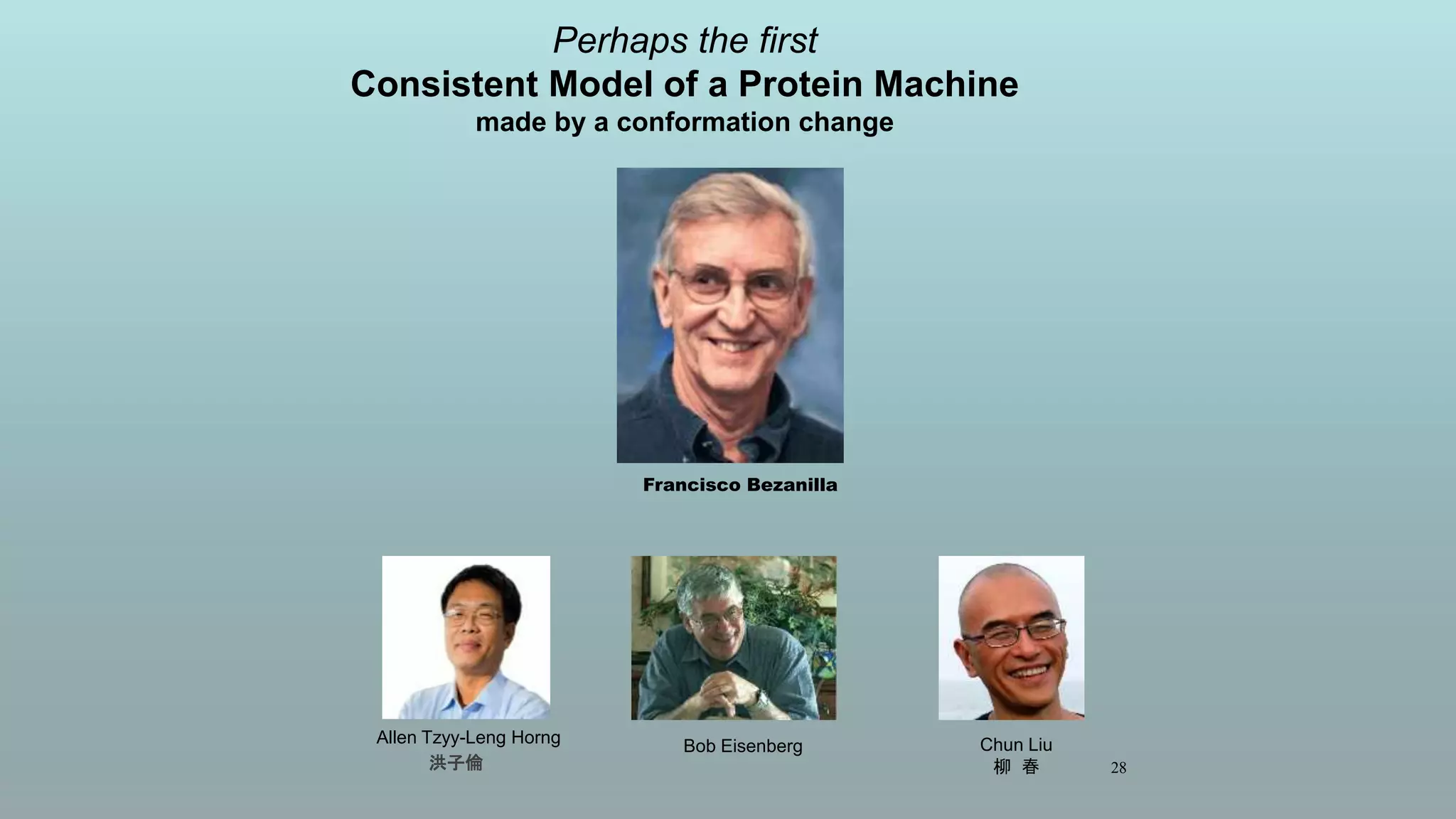
Perhaps the first
Consistent Model of a Protein Machine
made by a conformation change
28
Francisco Bezanilla
Chun Liu
柳 春
Allen Tzyy-Leng Horng
洪子倫
Bob Eisenberg
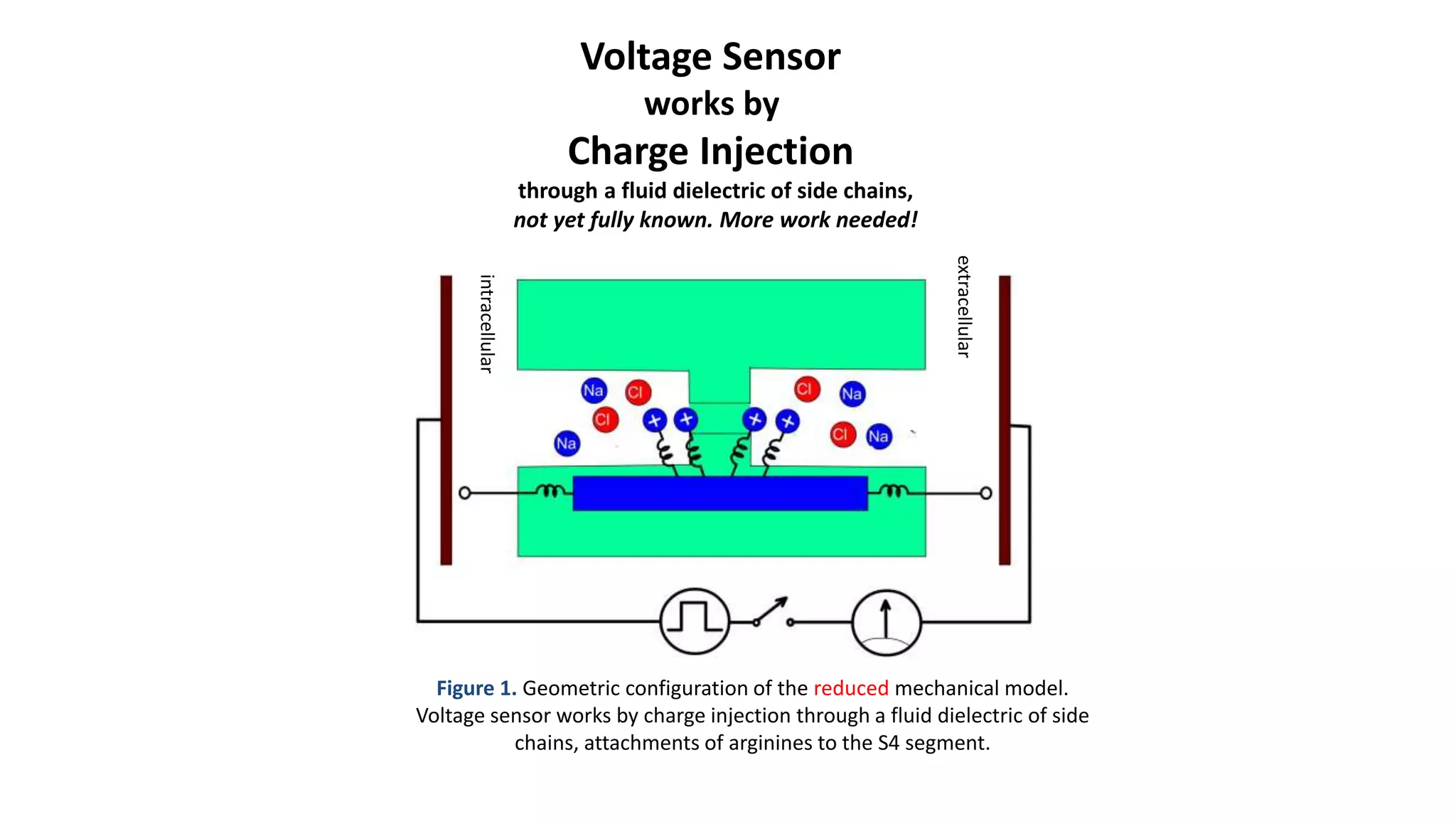
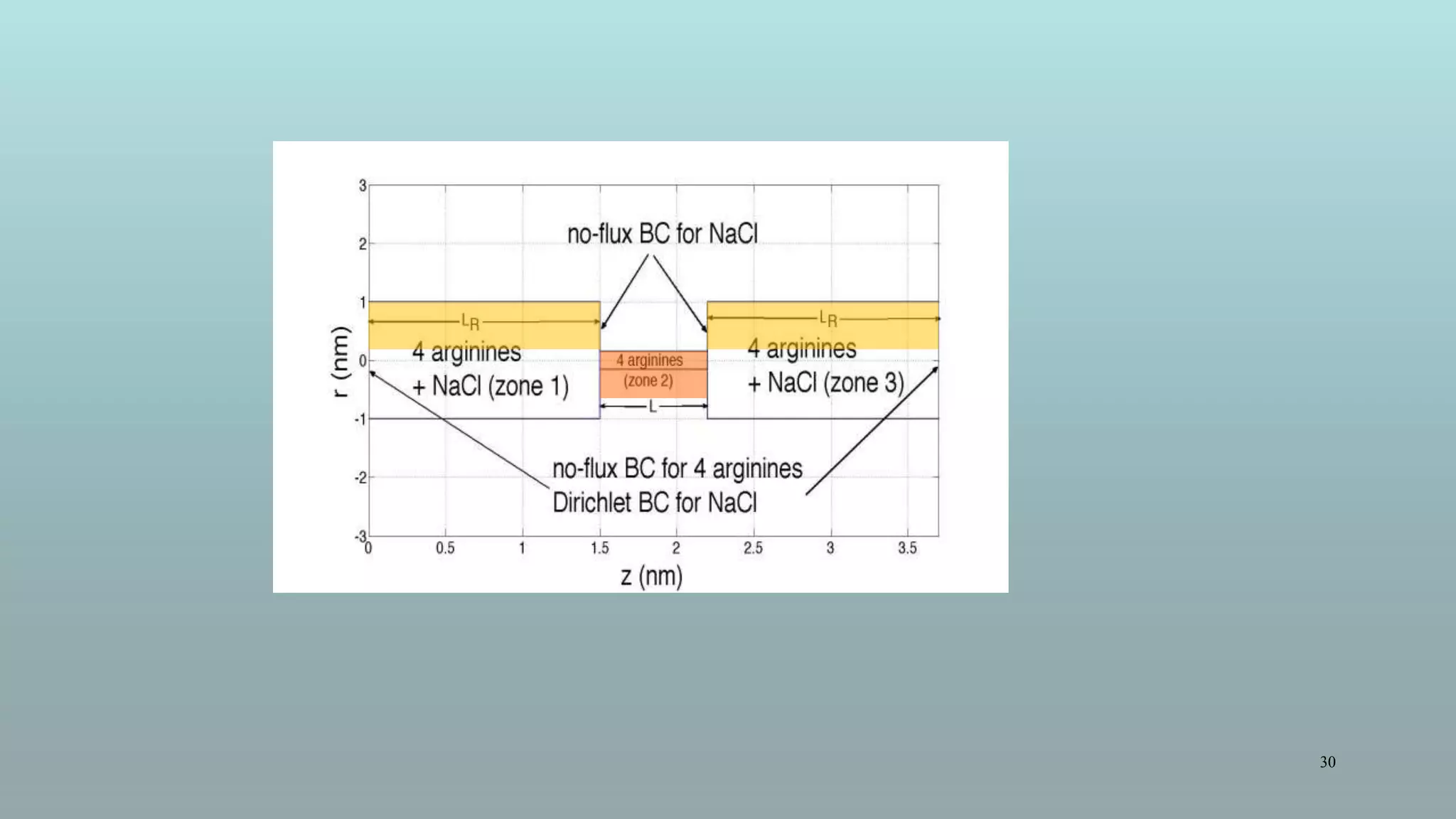
Figure 1. Geometric configuration of the reduced mechanical model.
Voltage sensor works by charge injection through a fluid dielectric of side
chains, attachments of arginines to the S4 segment.
intracellular
extracellular
Voltage Sensor
works by
Charge Injection
through a fluid dielectric of side chains,
not yet fully known. More work needed!
30
31
𝐸 = 𝑘 𝐵 𝑇 𝑐𝑖 𝑙𝑜𝑔𝑐𝑖 −
𝜀0 𝜀𝑟
2𝑎𝑙𝑙 𝑖
∇𝜙 2
+ 𝑧𝑖 𝑒
𝑎𝑙𝑙 𝑖
𝑐𝑖 𝜙 + ( 𝑉𝑖 + 𝑉𝑏 )
𝑎𝑟𝑔𝑖𝑛𝑖𝑛𝑒𝑠
𝑐𝑖
𝑉
+
𝑔𝑖𝑗
2
𝑐𝑖 𝑐𝑗
𝑎𝑟𝑔𝑖𝑛𝑖𝑛𝑒𝑠 𝑖,𝑗
𝑑𝑉,
Variational Formulation
EnVarA
because
‘Everything’ interacts with ‘Everything Else’
through the electric field and often through steric interactions of Pauli exclusion principle
Poisson Equation and Transport equation are DERIVED, not assumed from variations like
𝛿𝐸
𝛿𝜙
= 0,
so cross terms are always consistent, i.e., satisfy all equations with one set of parameters.
30
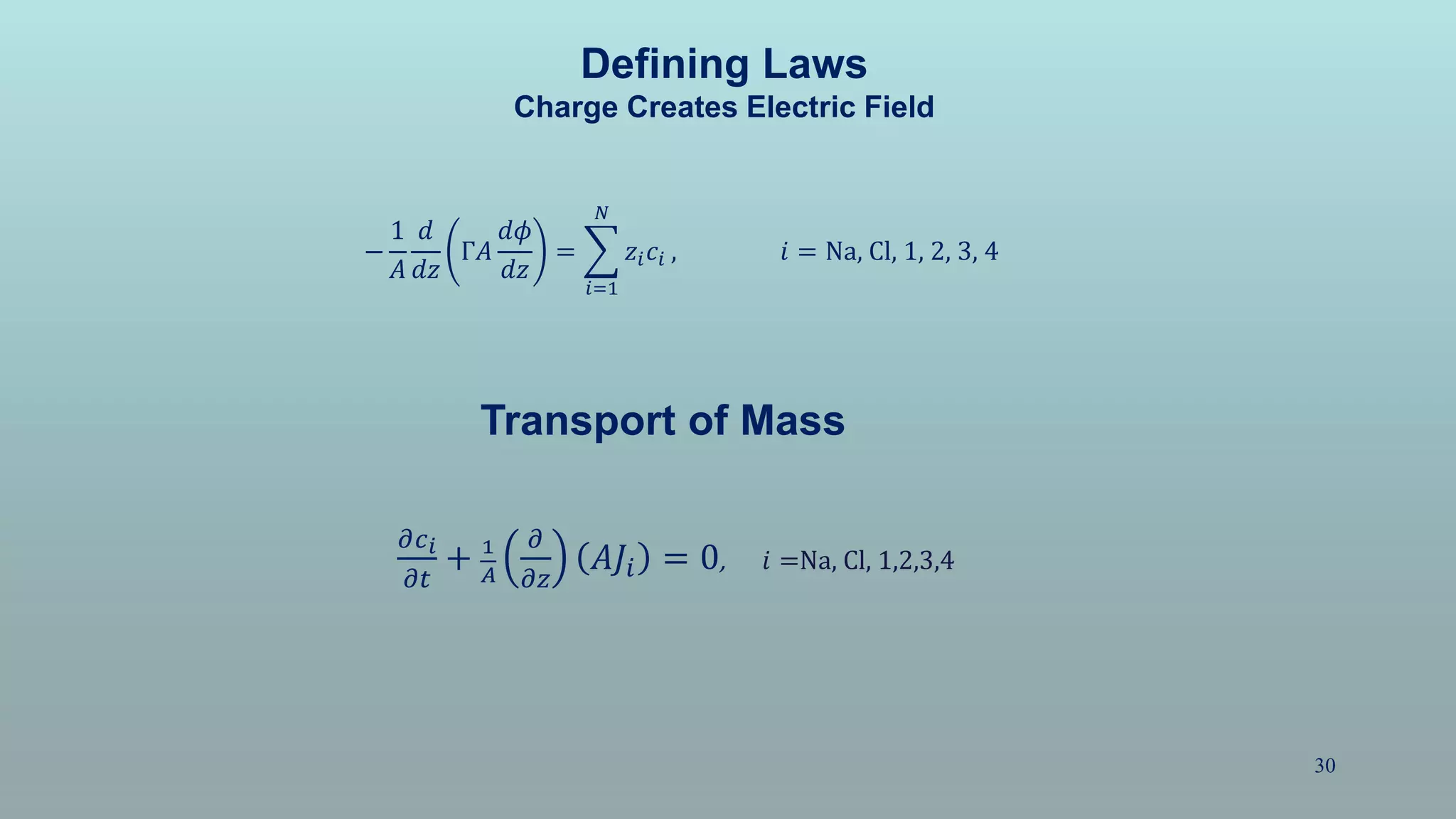
Defining Laws
Charge Creates Electric Field
−
1
𝐴
𝑑
𝑑𝑧
Γ𝐴
𝑑𝜙
𝑑𝑧
=
𝑖=1
𝑁
𝑧𝑖 𝑐𝑖 , 𝑖 = Na, Cl, 1, 2, 3, 4
Transport of Mass
𝜕𝑐 𝑖
𝜕𝑡
+ 1
𝐴
𝜕
𝜕𝑧
𝐴𝐽𝑖 = 0, 𝑖 =Na, Cl, 1,2,3,4
33
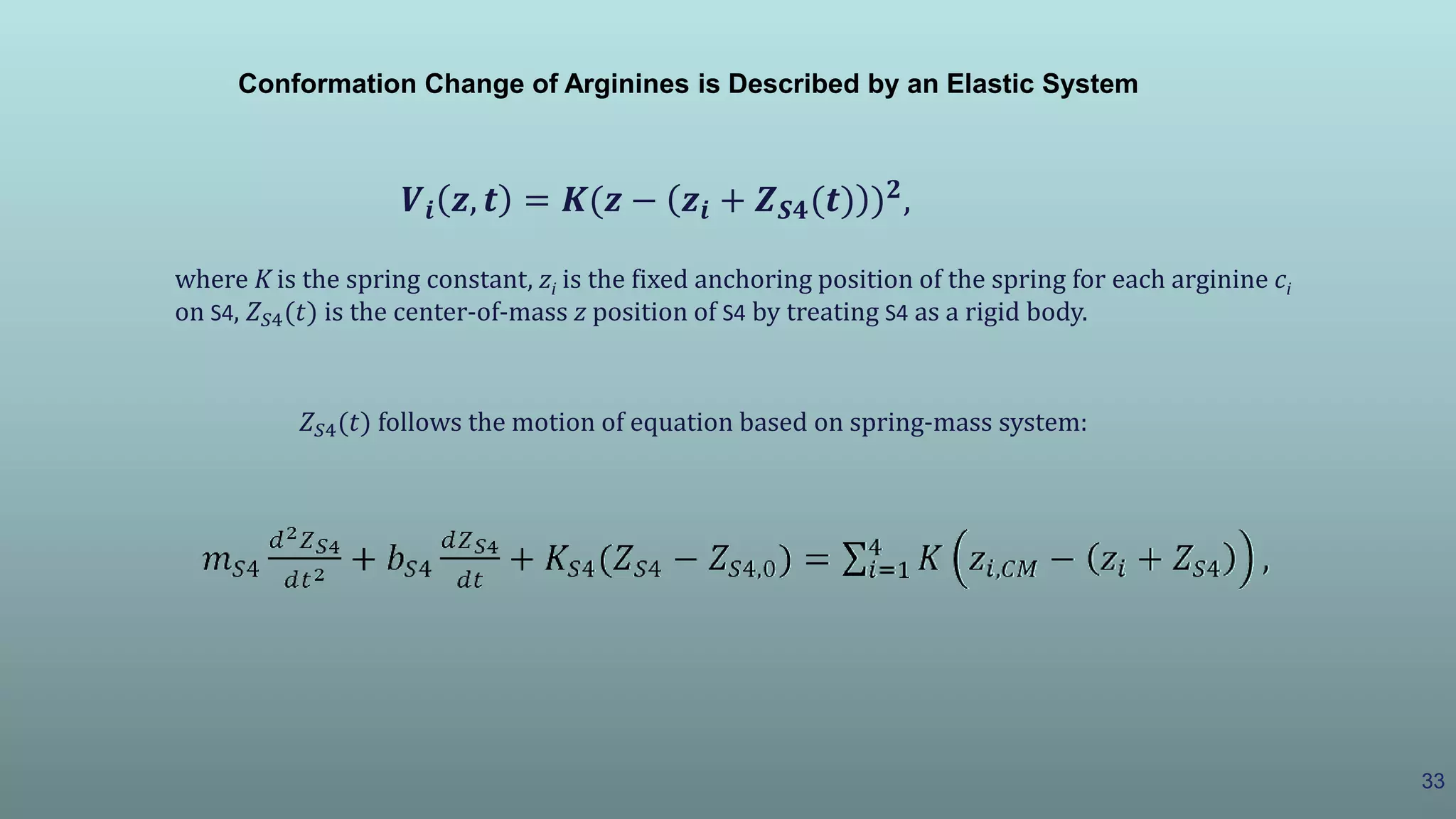
𝑽𝒊 𝒛, 𝒕 = 𝑲(𝒛 − 𝒛𝒊 + 𝒁 𝑺𝟒(𝒕) ) 𝟐
,
where K is the spring constant, zi is the fixed anchoring position of the spring for each arginine ci
on S4, 𝑍 𝑆4(𝑡) is the center-of-mass z position of S4 by treating S4 as a rigid body.
𝑍 𝑆4(𝑡) follows the motion of equation based on spring-mass system:
Conformation Change of Arginines is Described by an Elastic System
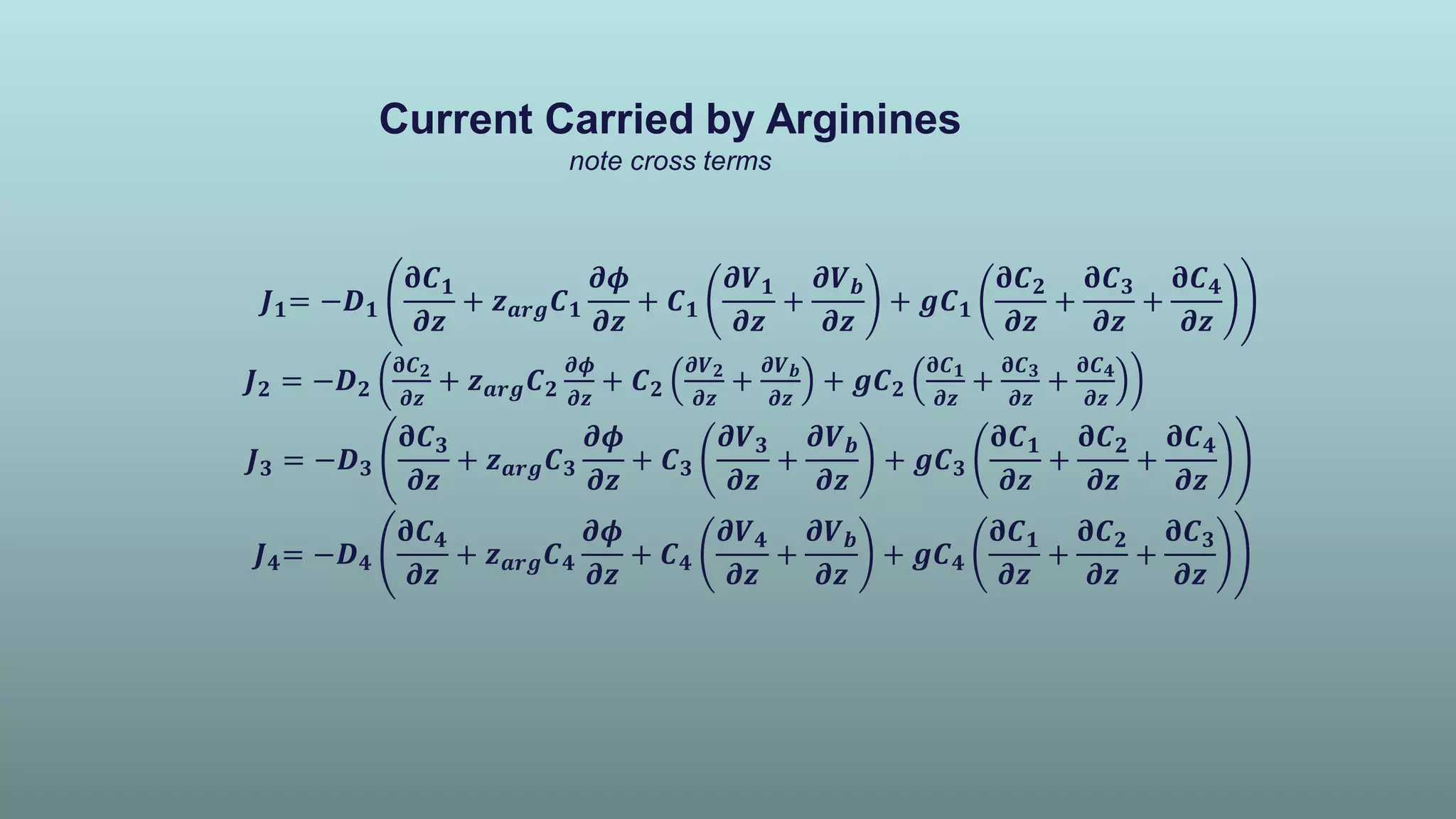
Current Carried by Arginines
note cross terms
𝟏= − 𝟏
𝑪 𝟏
𝒛
+ 𝒛 𝒂𝒓𝒈 𝑪 𝟏
𝒛
+ 𝑪 𝟏
𝑽 𝟏
𝒛
+
𝑽
𝒛
+ 𝒈𝑪 𝟏
𝑪 𝟐
𝒛
+
𝑪 𝟑
𝒛
+
𝑪 𝟒
𝒛
𝟐 = − 𝟐
𝑪 𝟐
𝒛
+ 𝒛 𝒂𝒓𝒈 𝑪 𝟐 𝒛
+ 𝑪 𝟐
𝑽 𝟐
𝒛
+
𝑽
𝒛
+ 𝒈𝑪 𝟐
𝑪 𝟏
𝒛
+
𝑪 𝟑
𝒛
+
𝑪 𝟒
𝒛
𝟑 = − 𝟑
𝑪 𝟑
𝒛
+ 𝒛 𝒂𝒓𝒈 𝑪 𝟑
𝒛
+ 𝑪 𝟑
𝑽 𝟑
𝒛
+
𝑽
𝒛
+ 𝒈𝑪 𝟑
𝑪 𝟏
𝒛
+
𝑪 𝟐
𝒛
+
𝑪 𝟒
𝒛
𝟒= − 𝟒
𝑪 𝟒
𝒛
+ 𝒛 𝒂𝒓𝒈 𝑪 𝟒
𝒛
+ 𝑪 𝟒
𝑽 𝟒
𝒛
+
𝑽
𝒛
+ 𝒈𝑪 𝟒
𝑪 𝟏
𝒛
+
𝑪 𝟐
𝒛
+
𝑪 𝟑
𝒛
Page 35
Figure 9. (a) Time courses of subtracted gating current [A1] with voltage rising
from -90mV to V mV at t=10, holds on till t=150, and drops back to -90mV,
where V=-62, -50, … -8 mV. (b) τ2 versus V compared with experiment [7].
Fitting Data
Page 36
Figure 3. (a) QV curve and comparison with [7]. Steady-state distributions for Na, Cl
and arginines at (b) V=-90mV, (c) V=-48mV, (d) V=-8mV.
Fitting Data
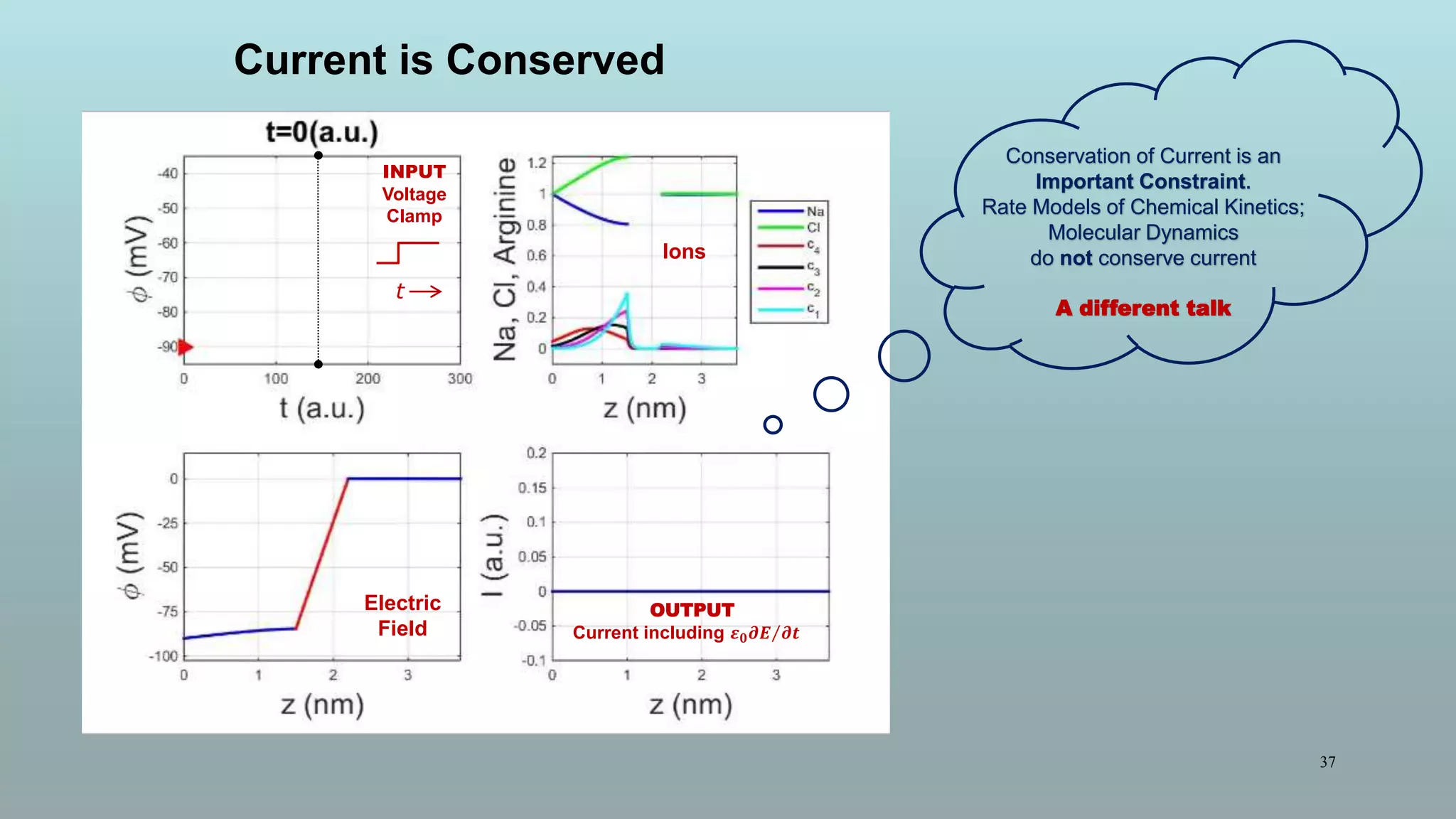
37
Ions
Electric
Field
Current is Conserved
OUTPUT
Current including 𝜺 𝟎 𝑬 𝒕
INPUT
Voltage
Clamp
t
Conservation of Current is an
Important Constraint.
Rate Models of Chemical Kinetics;
Molecular Dynamics
do not conserve current
A different talk
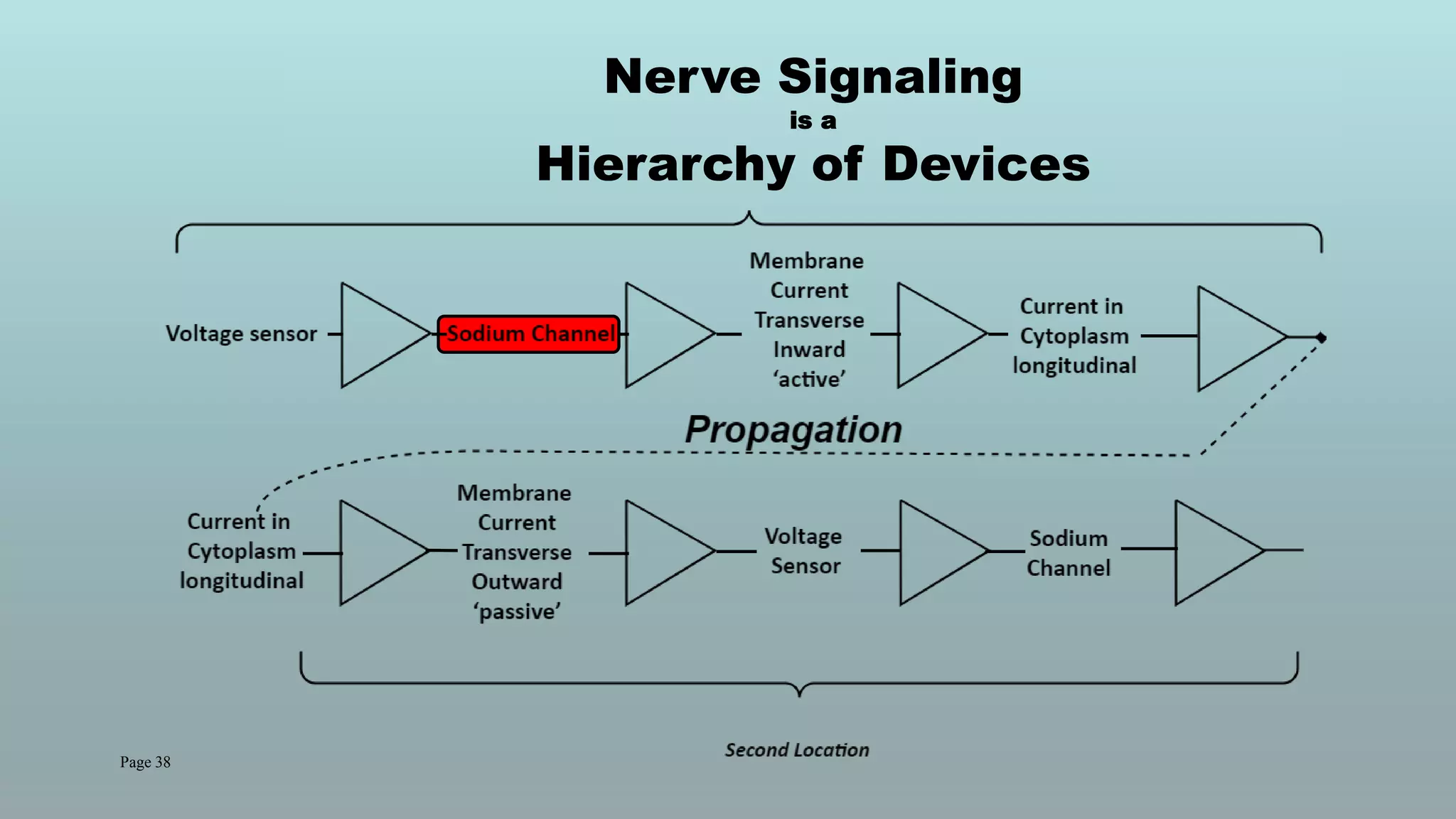
Page 38
Nerve Signaling
is a
Hierarchy of Devices
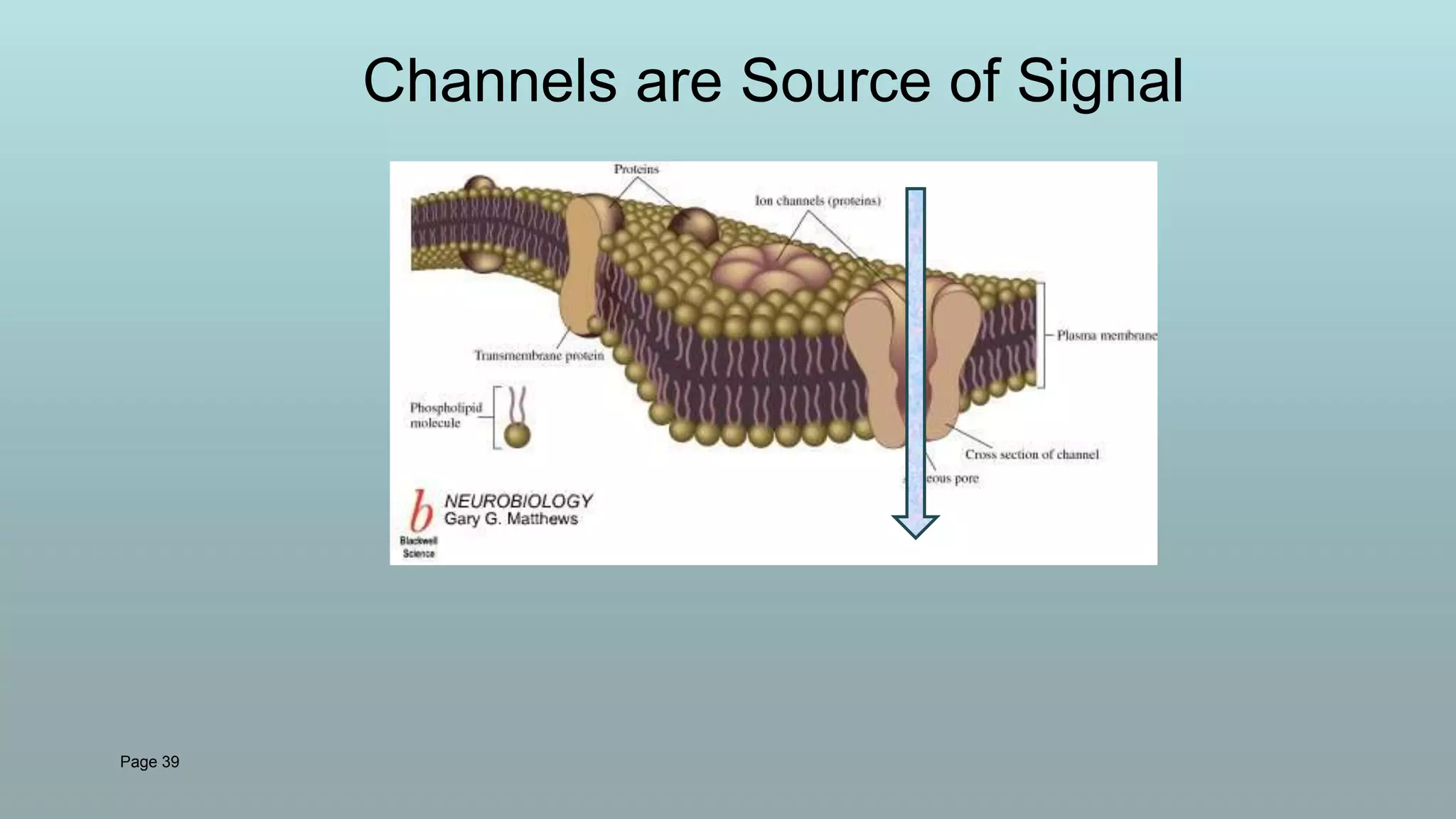
Page 39
Channels are Source of Signal
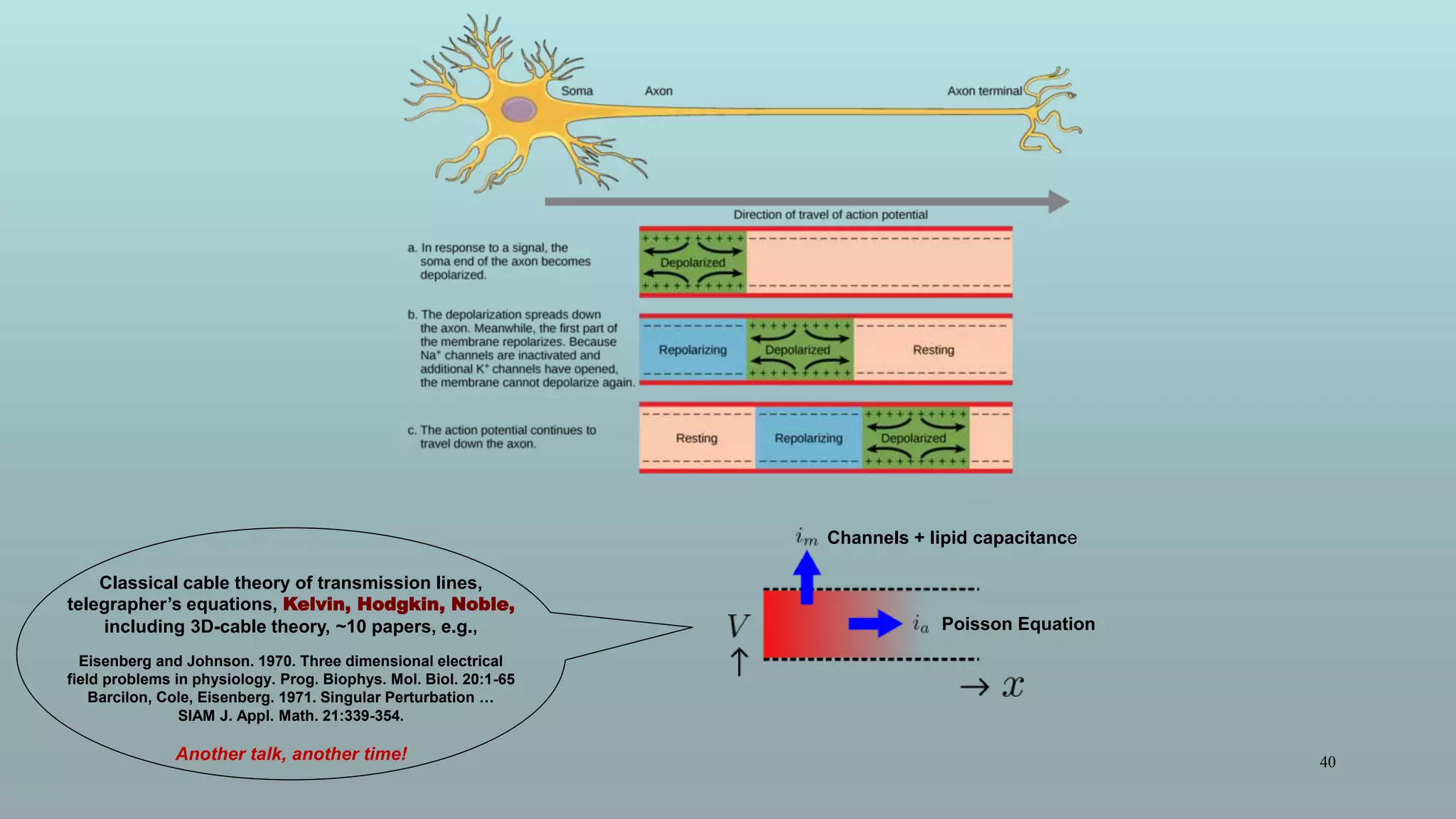
40
Classical cable theory of transmission lines,
telegrapher’s equations, Kelvin, Hodgkin, Noble,
including 3D-cable theory, ~10 papers, e.g.,
Eisenberg and Johnson. 1970. Three dimensional electrical
field problems in physiology. Prog. Biophys. Mol. Biol. 20:1-65
Barcilon, Cole, Eisenberg. 1971. Singular Perturbation …
SIAM J. Appl. Math. 21:339-354.
Another talk, another time!
Channels + lipid capacitance
Poisson Equation
How do ions move through channels?
>75 papers since 1986
41
42
Working Hypothesis
bio-speak:
Crucial Biological Adaptation is
Crowded Ions and Side Chains
Biology occurs in concentrated >0.3 M
mixtures of spherical charges
NOT IDEAL AT ALL
Poisson Boltzmann does NOT fit data!!
Solutions are extraordinarily concentrated >10M where
they are most important, near DNA, enzyme active sites, and channels
and
electrodes of batteries and electrochemical cells.
Solid NaCl is 37M
43
Solutions are Extraordinarily Concentrated
>10M Solid NaCl is 37M
where they are most important,
DNA,
enzyme active sites,
channels and
electrodes
of batteries and electrochemical cells
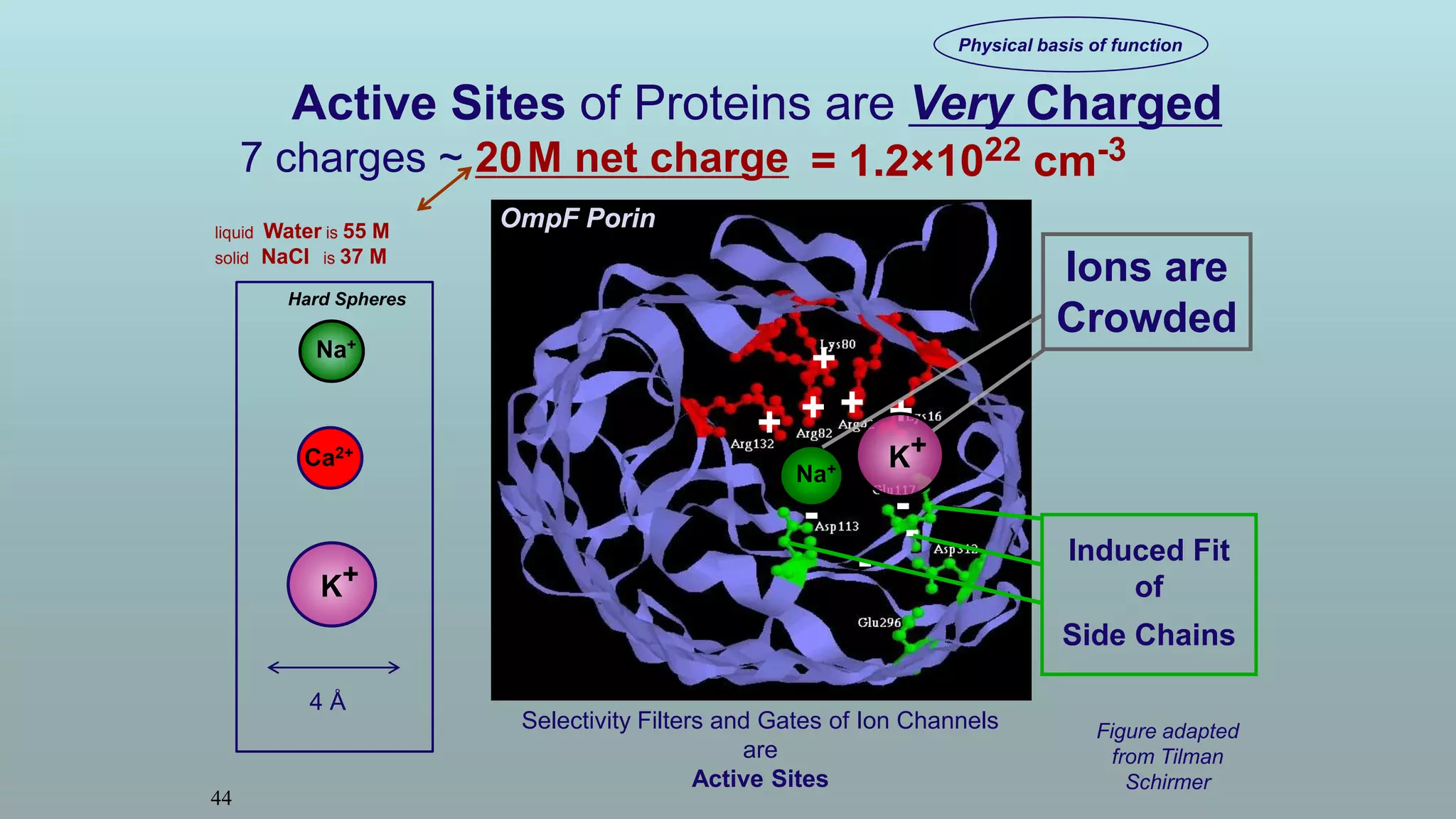
Active Sites of Proteins are Very Charged
7 charges ~ 20M net charge
Selectivity Filters and Gates of Ion Channels
are
Active Sites
= 1.2×1022 cm-3
-
+ + + +
+
-
-
-
4 Å
K+
Na+
Ca2+
Hard Spheres
44
Figure adapted
from Tilman
Schirmer
liquid Water is 55 M
solid NaCl is 37 M
OmpF Porin
Physical basis of function
K+
Na+
Induced Fit
of
Side Chains
Ions are
Crowded
Crowded Active Sites
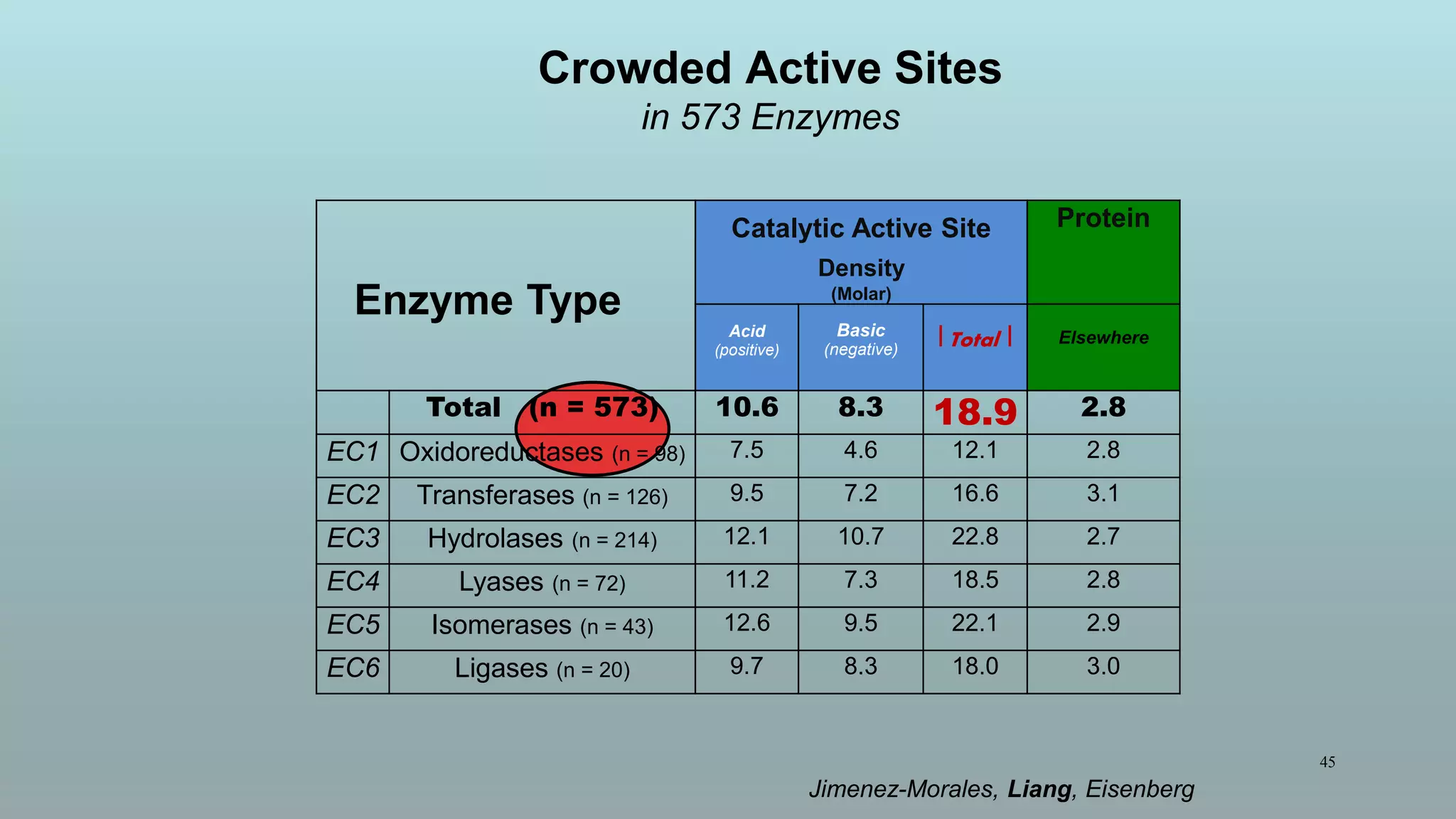
in 573 Enzymes
45
Enzyme Type
Catalytic Active Site
Density
(Molar)
Protein
Acid
(positive)
Basic
(negative)
| Total | Elsewhere
Total (n = 573) 10.6 8.3 18.9 2.8
EC1 Oxidoreductases (n = 98) 7.5 4.6 12.1 2.8
EC2 Transferases (n = 126) 9.5 7.2 16.6 3.1
EC3 Hydrolases (n = 214) 12.1 10.7 22.8 2.7
EC4 Lyases (n = 72) 11.2 7.3 18.5 2.8
EC5 Isomerases (n = 43) 12.6 9.5 22.1 2.9
EC6 Ligases (n = 20) 9.7 8.3 18.0 3.0
Jimenez-Morales, Liang, Eisenberg
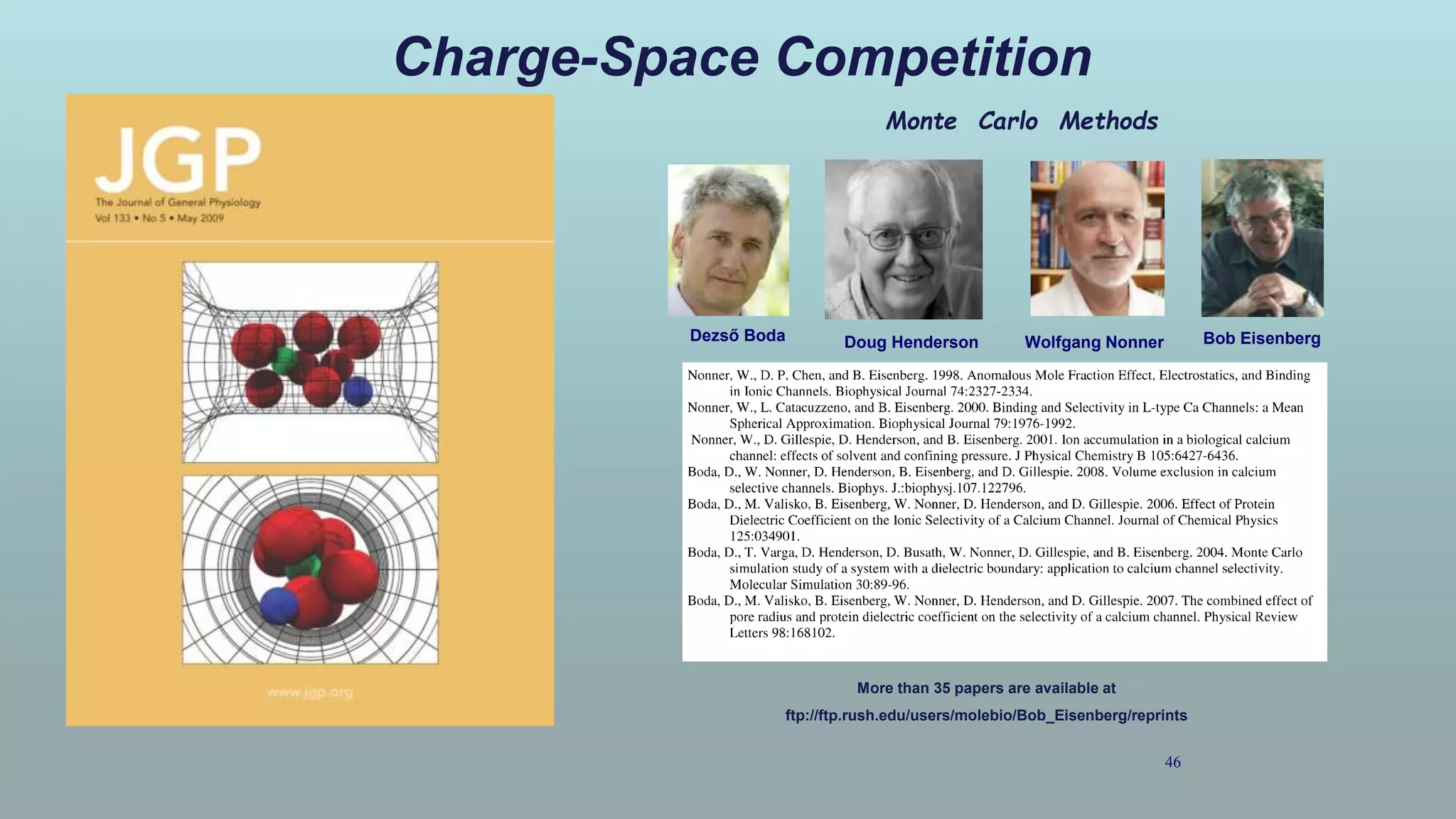
Charge-Space Competition
46
More than 35 papers are available at
ftp://ftp.rush.edu/users/molebio/Bob_Eisenberg/reprints
Monte Carlo Methods
Dezső Boda Wolfgang NonnerDoug Henderson Bob Eisenberg
47
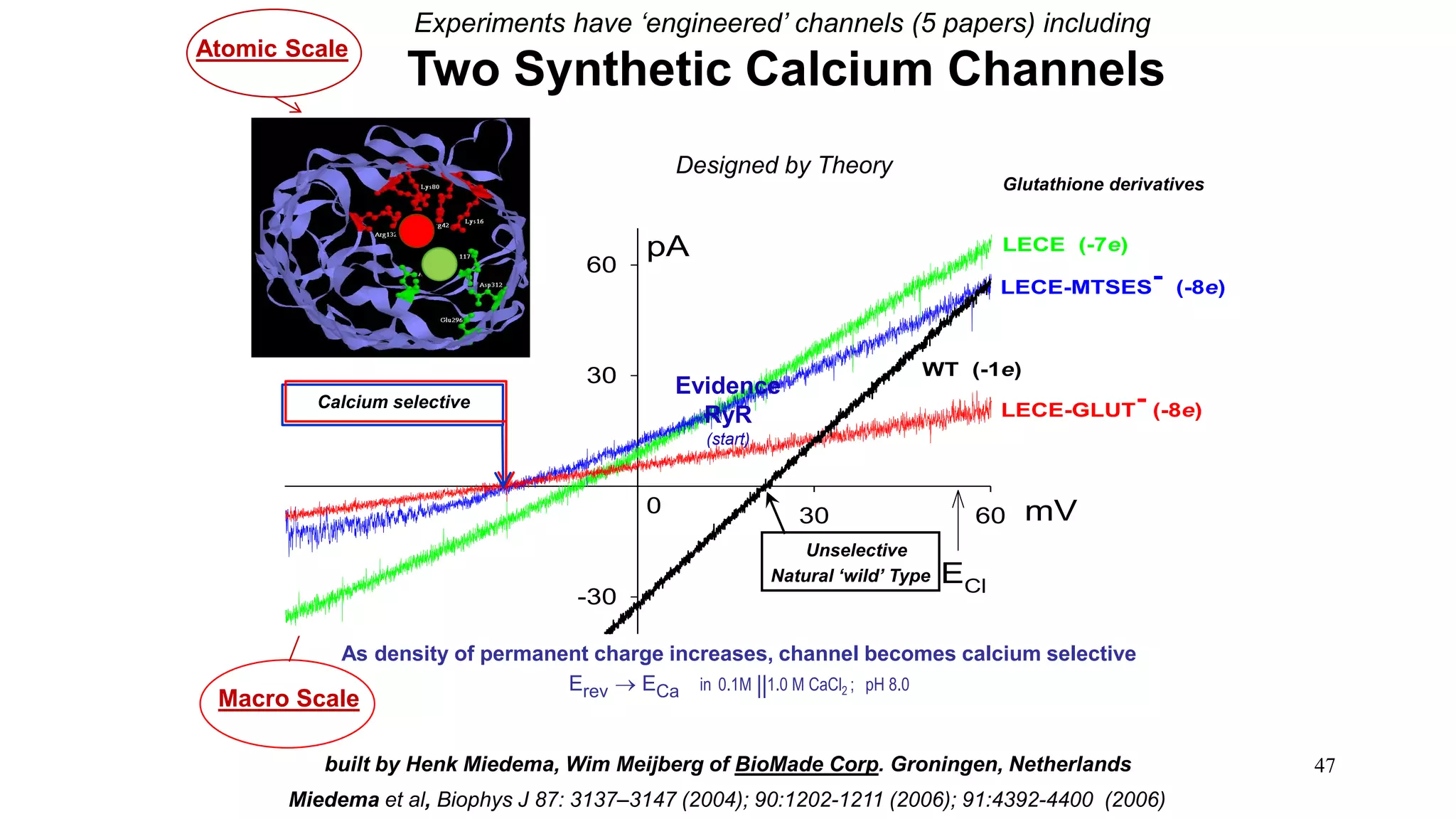
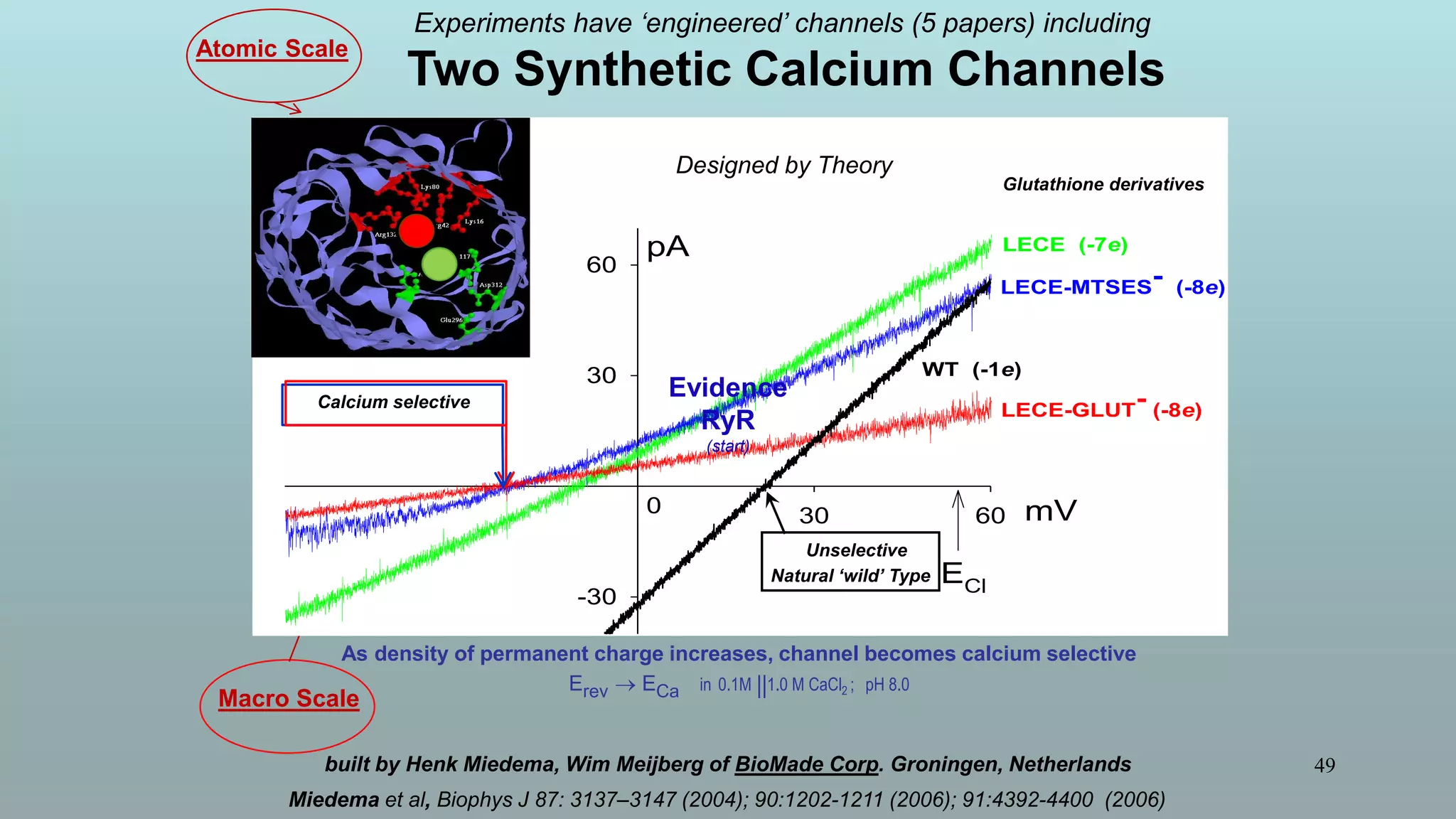
Mutants of ompF Porin
Atomic Scale
Macro Scale
30 60
-30
30
60
0
pA
mV
LECE (-7e)
LECE-MTSES- (-8e)
LECE-GLUT- (-8e)ECa
ECl
WT (-1e)
Calcium selective
Experiments have ‘engineered’ channels (5 papers) including
Two Synthetic Calcium Channels
As density of permanent charge increases, channel becomes calcium selective
Erev  ECa in 0.1M 1.0 M CaCl2 ; pH 8.0
Unselective
Natural ‘wild’ Type
built by Henk Miedema, Wim Meijberg of BioMade Corp. Groningen, Netherlands
Miedema et al, Biophys J 87: 3137–3147 (2004); 90:1202-1211 (2006); 91:4392-4400 (2006)
MUTANT ─ Compound
Glutathione derivatives
Designed by Theory
||
Evidence
RyR
(start)
48
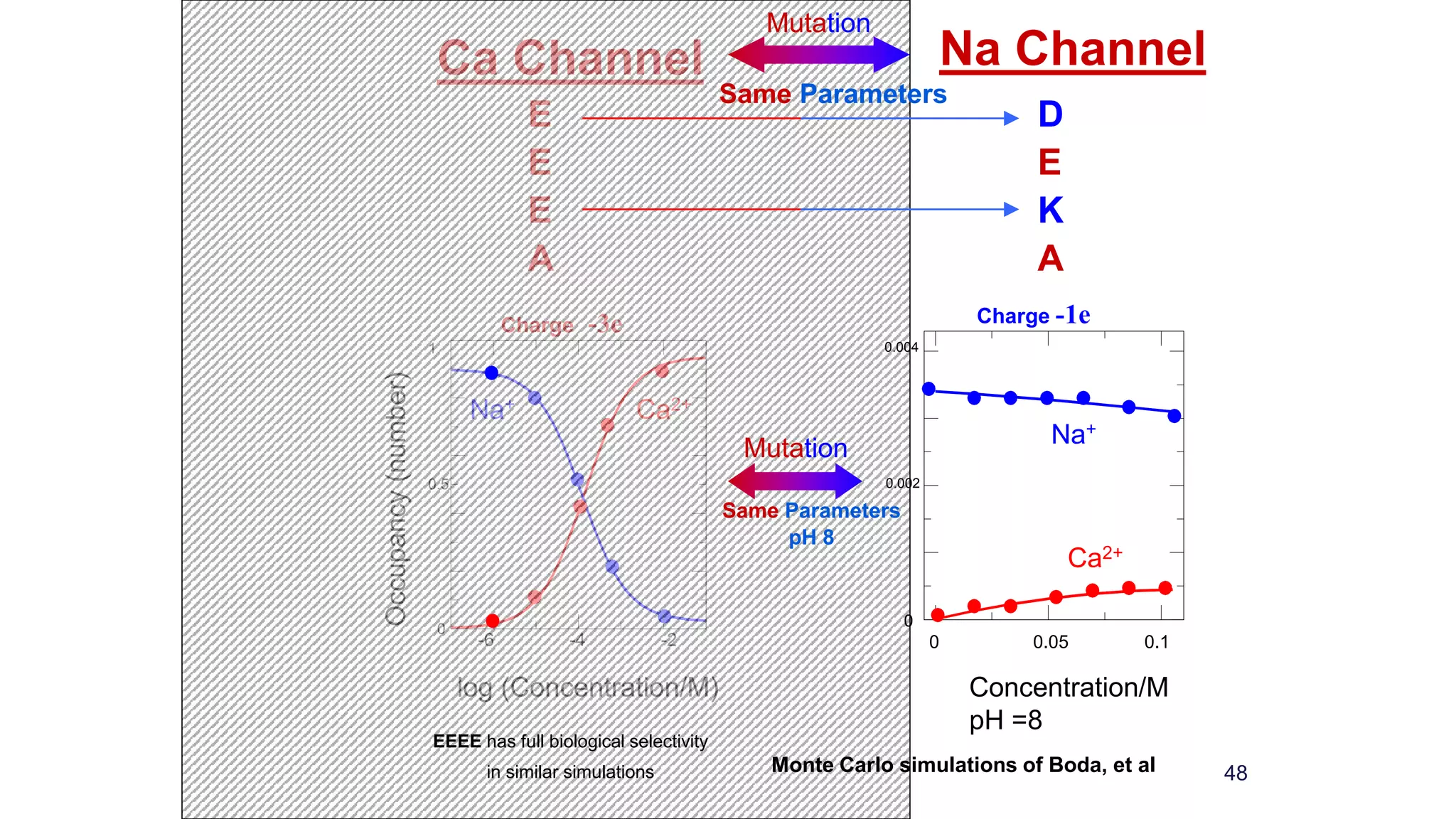
Ca Channel
log (Concentration/M)
0.5
-6 -4 -2
Na+
0
1
Ca2+
Charge -3e
Occupancy(number)
E
E
E
A
Monte Carlo simulations of Boda, et al
Same Parameters
pH 8
Mutation
Same Parameters
Mutation
EEEE has full biological selectivity
in similar simulations
Na Channel
Concentration/M
pH =8
Na+
Ca2+
0.004
0
0.002
0.05 0.10
Charge -1e
D
E
K
A
49
Mutants of ompF Porin
Atomic Scale
Macro Scale
30 60
-30
30
60
0
pA
mV
LECE (-7e)
LECE-MTSES- (-8e)
LECE-GLUT- (-8e)ECa
ECl
WT (-1e)
Calcium selective
Experiments have ‘engineered’ channels (5 papers) including
Two Synthetic Calcium Channels
As density of permanent charge increases, channel becomes calcium selective
Erev  ECa in 0.1M 1.0 M CaCl2 ; pH 8.0
Unselective
Natural ‘wild’ Type
built by Henk Miedema, Wim Meijberg of BioMade Corp. Groningen, Netherlands
Miedema et al, Biophys J 87: 3137–3147 (2004); 90:1202-1211 (2006); 91:4392-4400 (2006)
MUTANT ─ Compound
Glutathione derivatives
Designed by Theory
||
Evidence
RyR
(start)
Poisson Fermi Approach to Ion
Channels
50
.
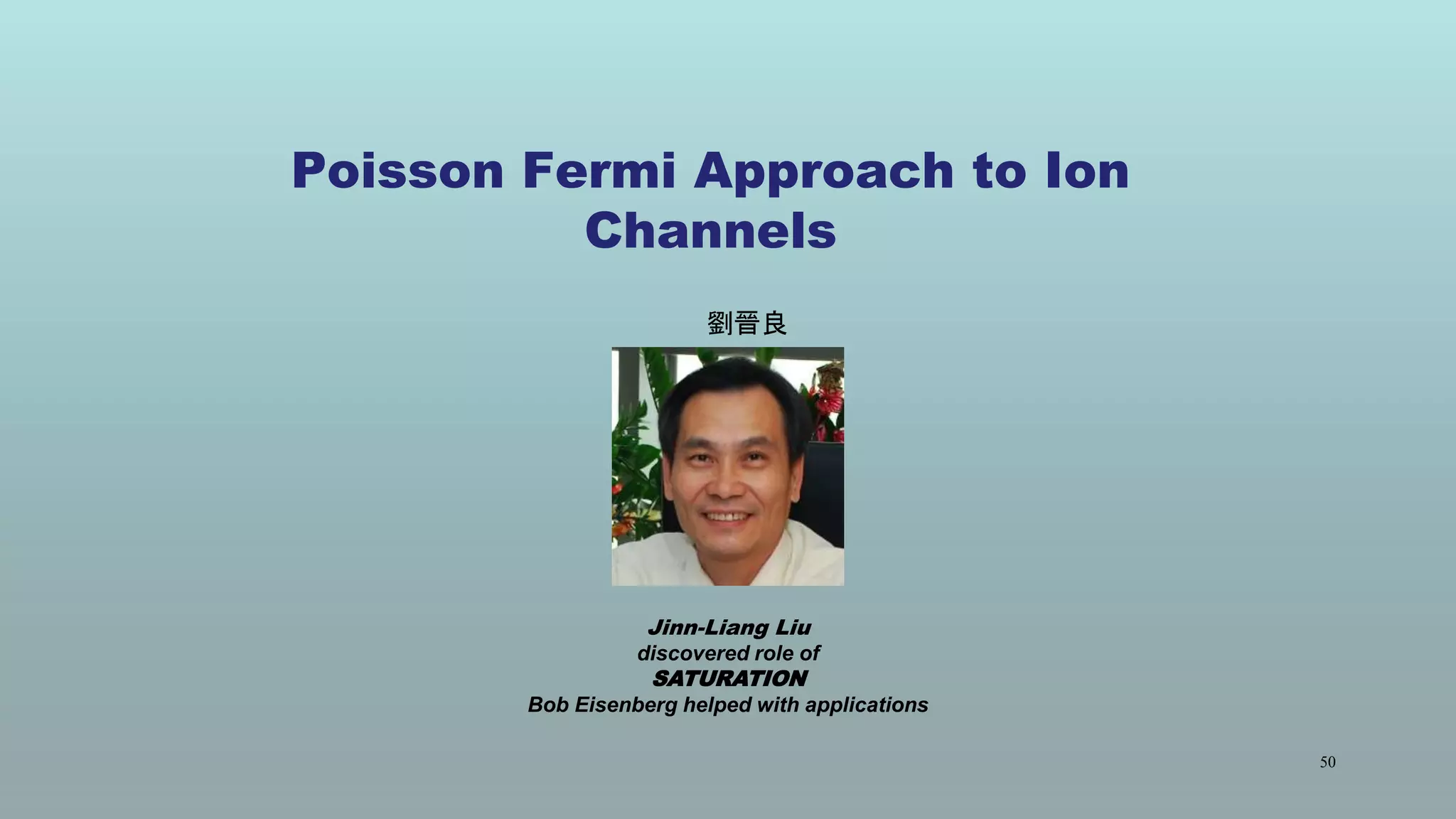
劉晉良
Jinn-Liang Liu
discovered role of
SATURATION
Bob Eisenberg helped with applications
Motivation
Natural Description of Crowded Charge
is a
Fermi Distribution
designed to describe saturation
Simulating saturation by interatomic repulsion (Lennard Jones)
is a significant mathematical challenge
to be side-stepped if possible
51
Motivation
Largest Effect
of
Crowded Charge
is
Saturation
important
in channels, DNA, enzymes, and
electrochemical devices in general
Saturation cannot be described at all by classical Poisson Boltzmann
approach and is described in a (wildly) uncalibrated way
by present day Molecular Dynamics
52
53
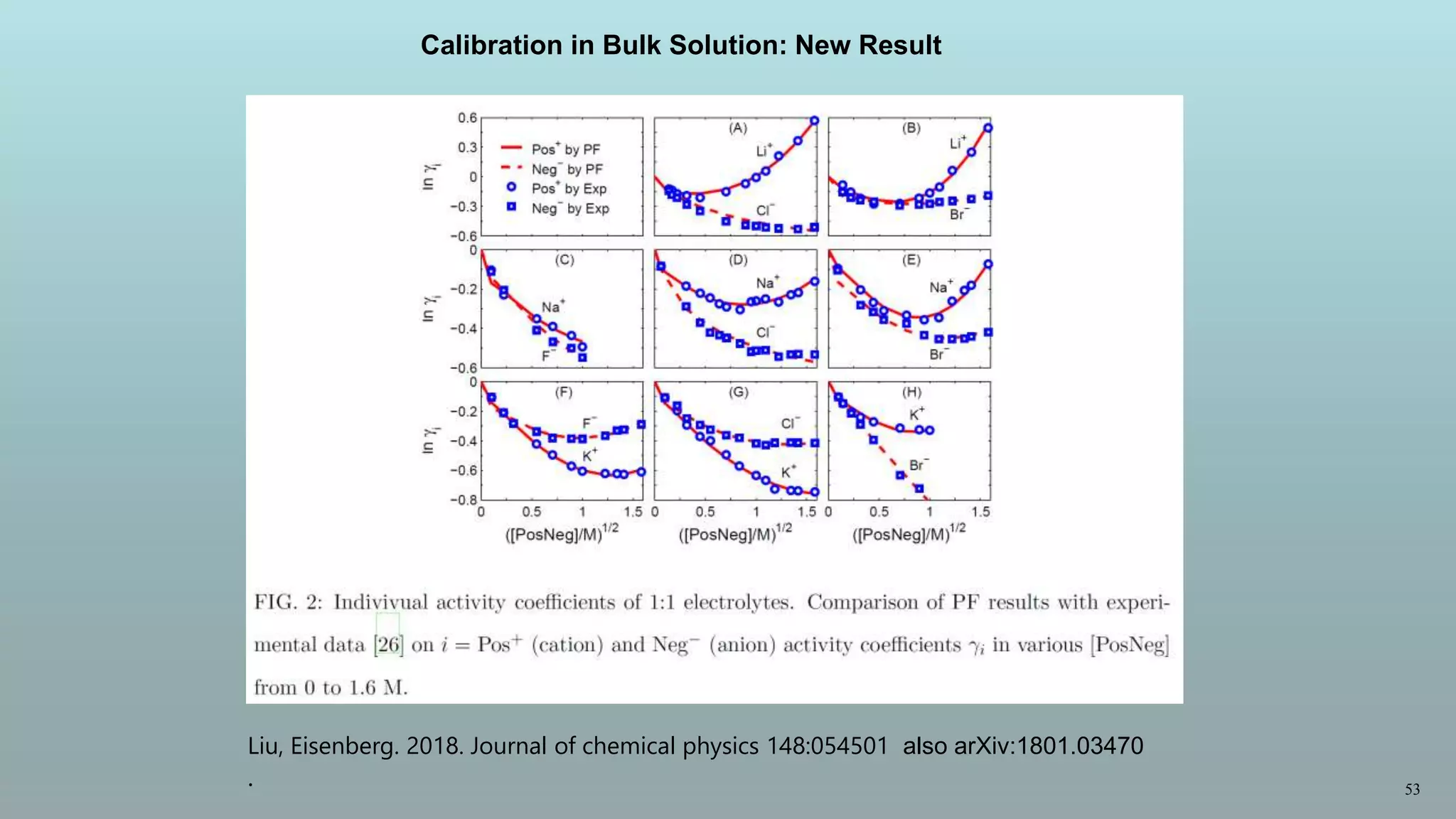
Liu, Eisenberg. 2018. Journal of chemical physics 148:054501 also arXiv:1801.03470
.
Calibration in Bulk Solution: New Result
54
Individual activity coefficients of 2:1 electrolytes.
Comparison of PF results with experimental
data [26] on i = Pos2+ (cation) and Neg− (anion) activity coefficients γi in various [PosNeg2]
from 0 to 1.5 M.
Calibration in Bulk Solution:
New Result
Na Channel
55
Signature of Cardiac Calcium Channel CaV1.n
Anomalous* Mole Fraction (non-equilibrium)
Liu & Eisenberg (2015) Physical Review E 92: 012711
*Anomalous because CALCIUM CHANNEL IS A SODIUM CHANNEL at [CaCl2]  10-3.4
Ca2+ is conducted for [Ca2+] > 10-3.4, but Na+ is conducted for [Ca2+] <10-3.
Ca Channel
56
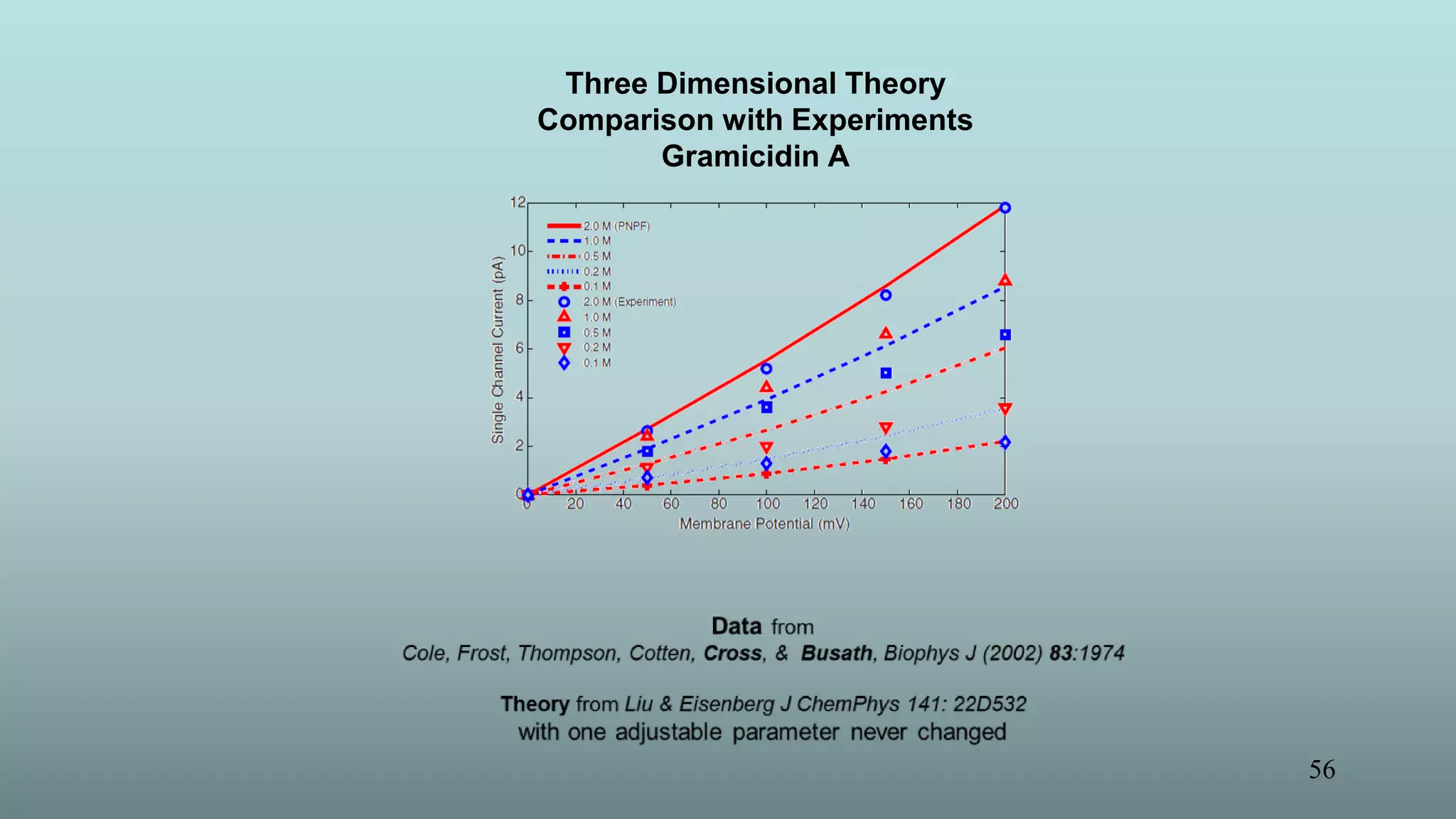
Three Dimensional Theory
Comparison with Experiments
Gramicidin A
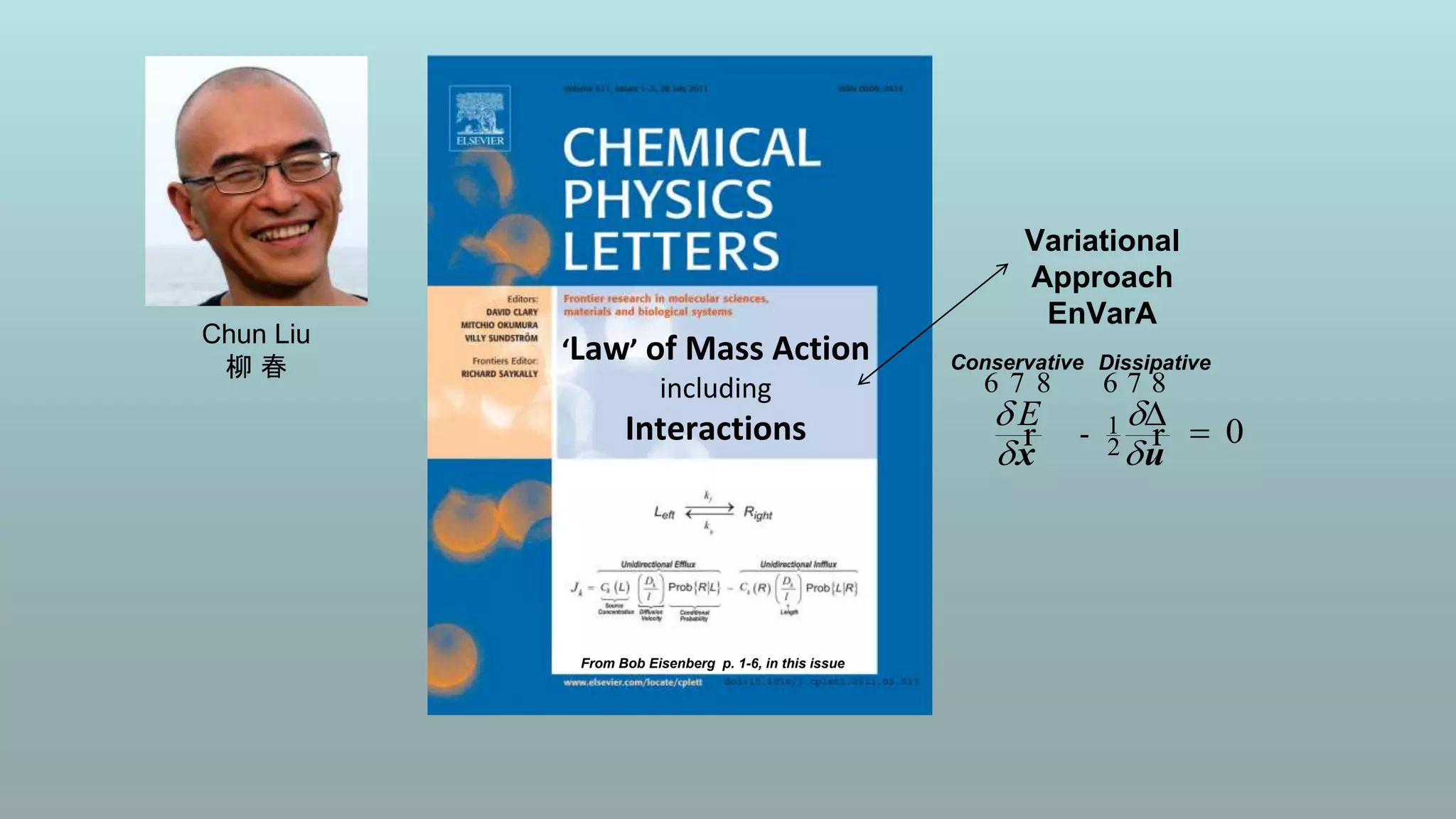
‘Law’ of Mass Action
including
Interactions
From Bob Eisenberg p. 1-6, in this issue
Variational
Approach
EnVarA
1
2- 0E 
 
 
6 7 8 6 7 8
r r
x u
Conservative Dissipative
Chun Liu
柳 春
58
Energetic Variational Approach
allows
accurate computation of
Flow and Interactions
in Complex Fluids like Liquid Crystals
Engineering needs Calibrated Theories and
Simulations
Engineering Devices almost always use flow
Classical theories and Molecular Dynamics
have difficulties with flow, interactions,
and complex fluids
59
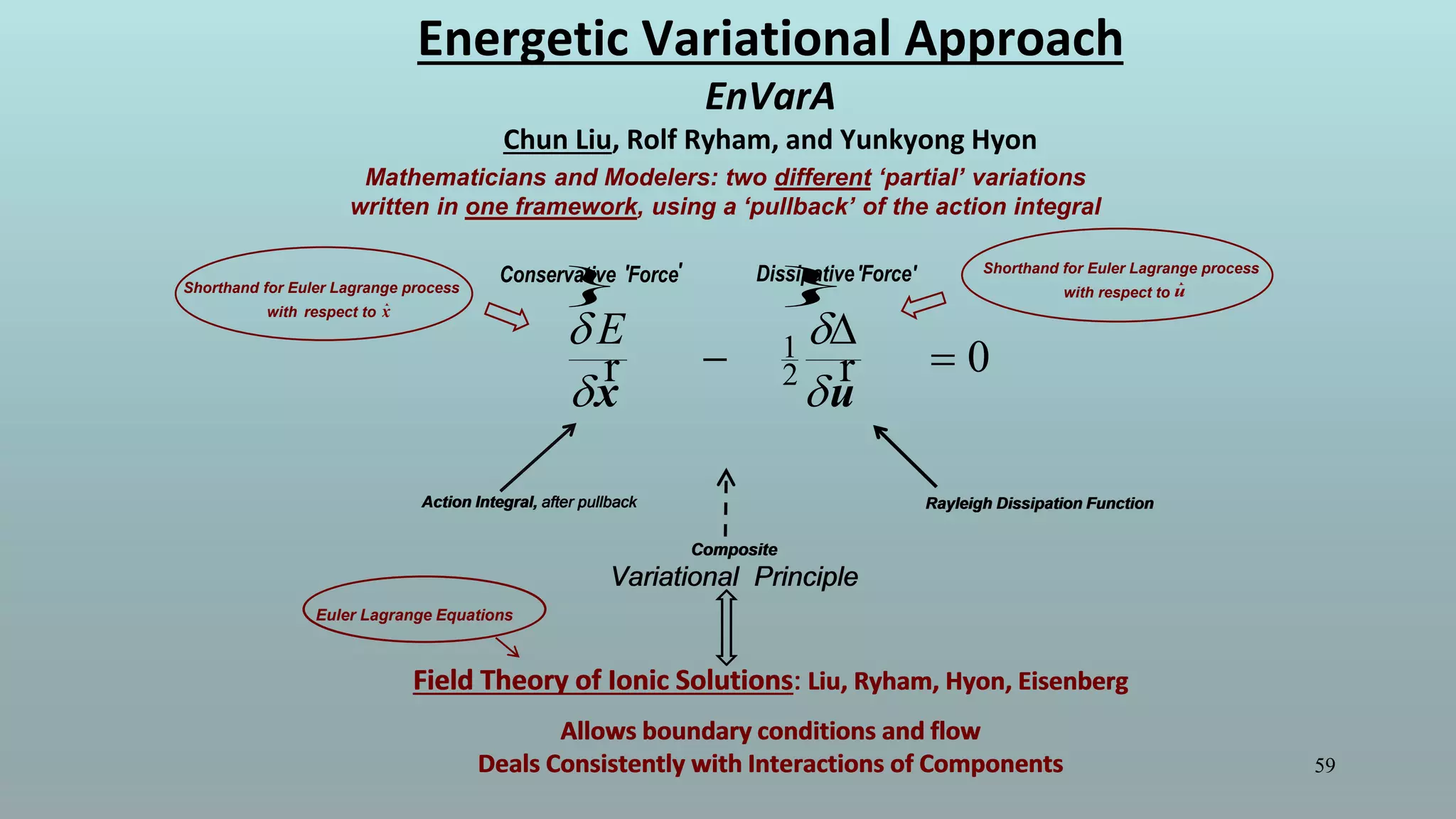
Energetic Variational Approach
EnVarA
Chun Liu, Rolf Ryham, and Yunkyong Hyon
Mathematicians and Modelers: two different ‘partial’ variations
written in one framework, using a ‘pullback’ of the action integral
} }
1
2 0
E 
 

 
'' Dissipative'Force'Conservative Force
r r
x u
Action Integral, after pullback Rayleigh Dissipation FunctionAction Integral, after pullback Rayleigh Dissipation Function
Field Theory of Ionic Solutions: Liu, Ryham, Hyon, Eisenberg
Allows boundary conditions and flow
Deals Consistently with Interactions of Components
Composite
Variational Principle
Euler Lagrange Equations
Field Theory of Ionic Solutions: Liu, Ryham, Hyon, Eisenberg
Allows boundary conditions and flow
Deals Consistently with Interactions of Components
Composite
Variational Principle
Shorthand for Euler Lagrange process
with respect to
r
x
Shorthand for Euler Lagrange process
with respect to
r
u
2
,
= , = ,
i i i
B i i j j
B i
i n p j n p
D c c
k T z e c d y dx
k T c


    
 
   
 
 
  =
Dissipative
r r%
1 4 4 4 4 4 4 4 4 4 2 4 4 4 4 4 4 4 4 4 3
,
= = , ,
0
, , =
1
log
2 2
i
B i i i i i j j
i n p i n p i j n p
c
k T c c z ec c d y dx
d
dt
    
  
   
    

    
Conservative
r r%
6 4 4 4 4 4 4 4 4 4 4 44 7 4 4 4 4 4 4 4 4 4 4 4 48
Hard Sphere
Terms
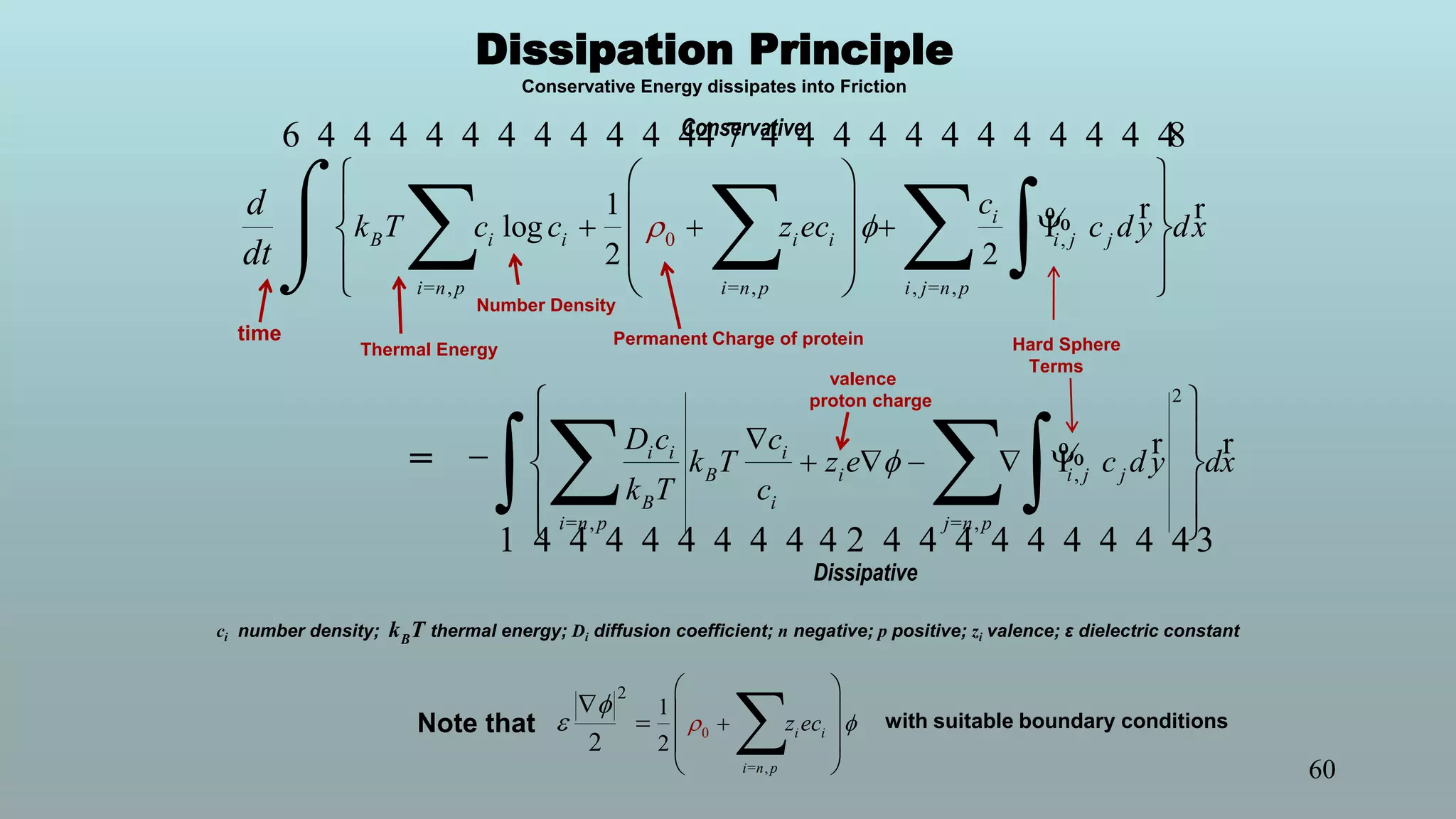
Permanent Charge of proteintime
ci number density; thermal energy; Di diffusion coefficient; n negative; p positive; zi valence; ε dielectric constantBk T
Number Density
Thermal Energy
valence
proton charge
Dissipation Principle
Conservative Energy dissipates into Friction
= ,
0
2
1
22
i i
i n p
z ec 

 
 
  
 
 
Note that with suitable boundary conditions
60
61
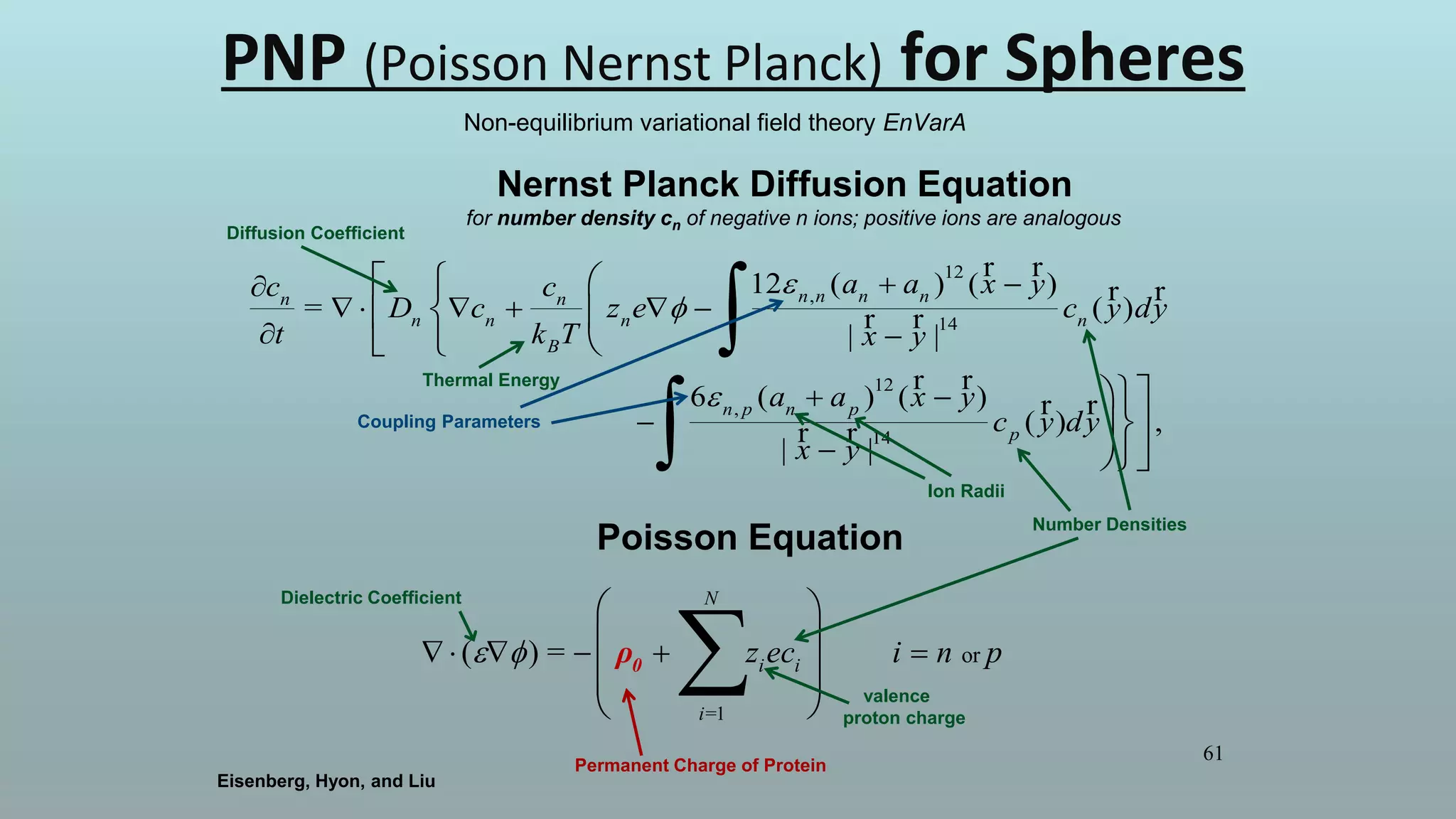
PNP (Poisson Nernst Planck) for Spheres
Eisenberg, Hyon, and Liu
12
,
14
12
,
14
12 ( ) ( )
= ( )
| |
6 ( ) ( )
( ) ,
| |
n n n nn n
n n n n
B
n p n p
p
a a x yc c
D c z e c y dy
t k T x y
a a x y
c y dy
x y



 
     
 
 


  
 
  

 



r r
r r
r r
r r
r r
r r
Nernst Planck Diffusion Equation
for number density cn of negative n ions; positive ions are analogous
Non-equilibrium variational field theory EnVarA
Coupling Parameters
Ion Radii
=1
or( ) =
N
i i
i
z ec i n p      
 
 
 
 
0ρ
Poisson Equation
Permanent Charge of Protein
Number Densities
Diffusion Coefficient
Dielectric Coefficient
valence
proton charge
Thermal Energy
62
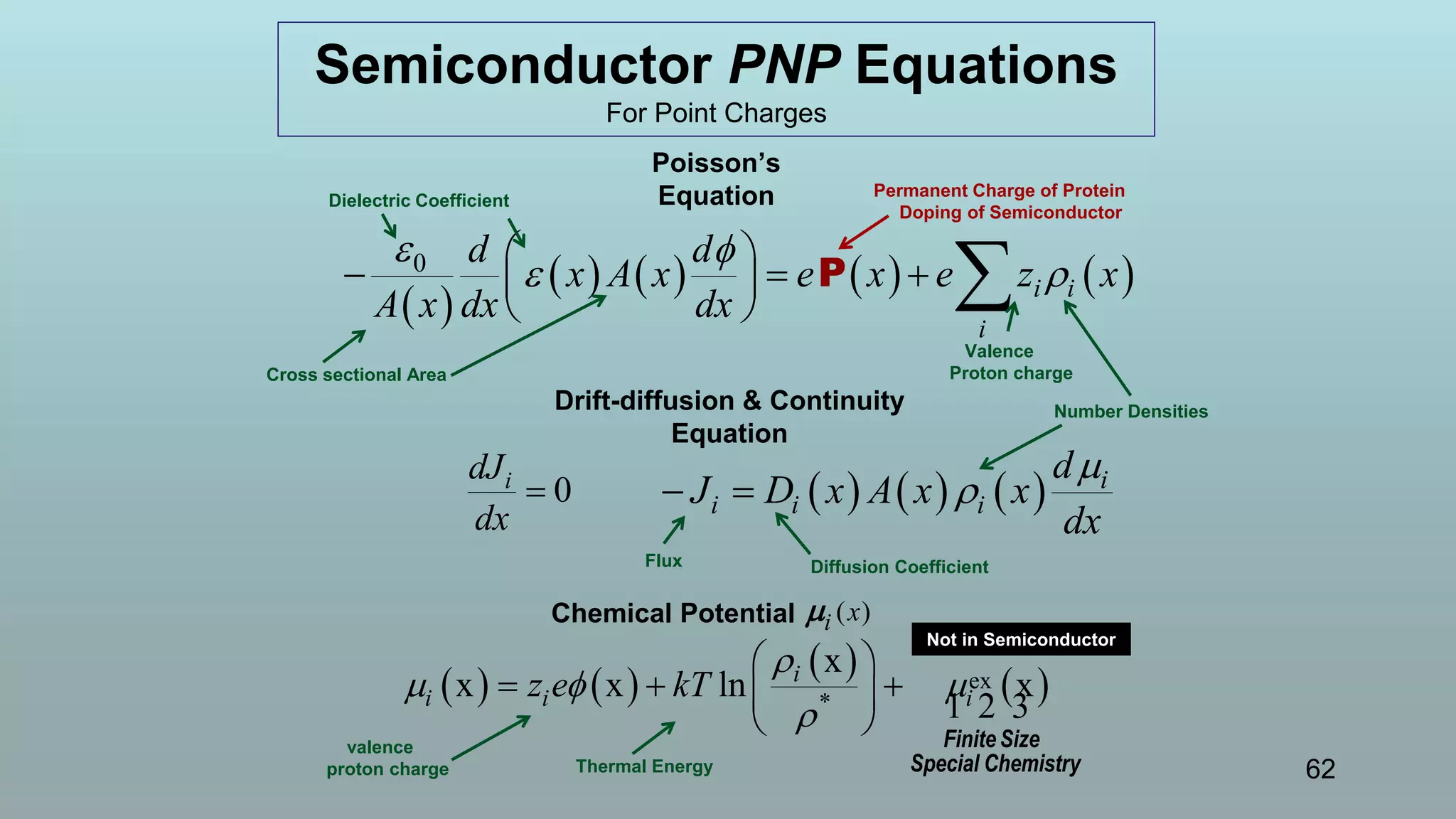
Semiconductor PNP Equations
For Point Charges
      i
i i i
d
J D x A x x
dx

 
Poisson’s
Equation
Drift-diffusion & Continuity
Equation
 
       0
i i
i
d d
x A x e x e z x
A x dx dx
 
  
   
  Ρ
0idJ
dx

   
 
 ex
*
x
x x ln xi
i i iz e kT

  

 
   
  1 2 3
Finite Size
Special Chemistry
Chemical Potential
Thermal Energy
Valence
Proton charge
Permanent Charge of Protein
Doping of Semiconductor
Cross sectional Area
Flux Diffusion Coefficient
Number Densities
Dielectric Coefficient
valence
proton charge
Not in Semiconductor
( )i x
All we have to do is
Solve them!
with Boundary Conditions
defining
Charge Carriers
ions, holes, quasi-electrons
Geometry
63
64
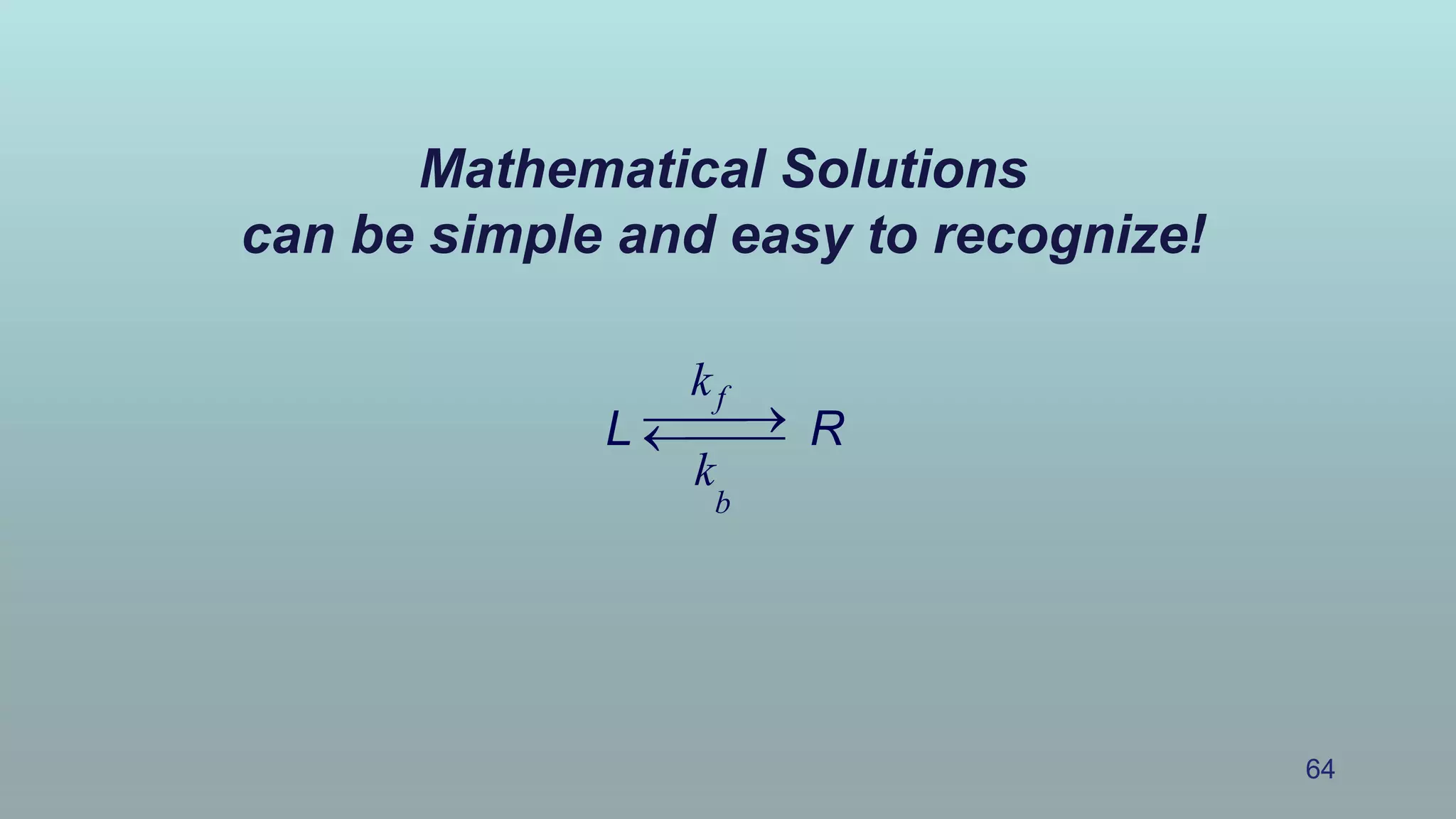
Mathematical Solutions
can be simple and easy to recognize!
f
b
k
k
L R
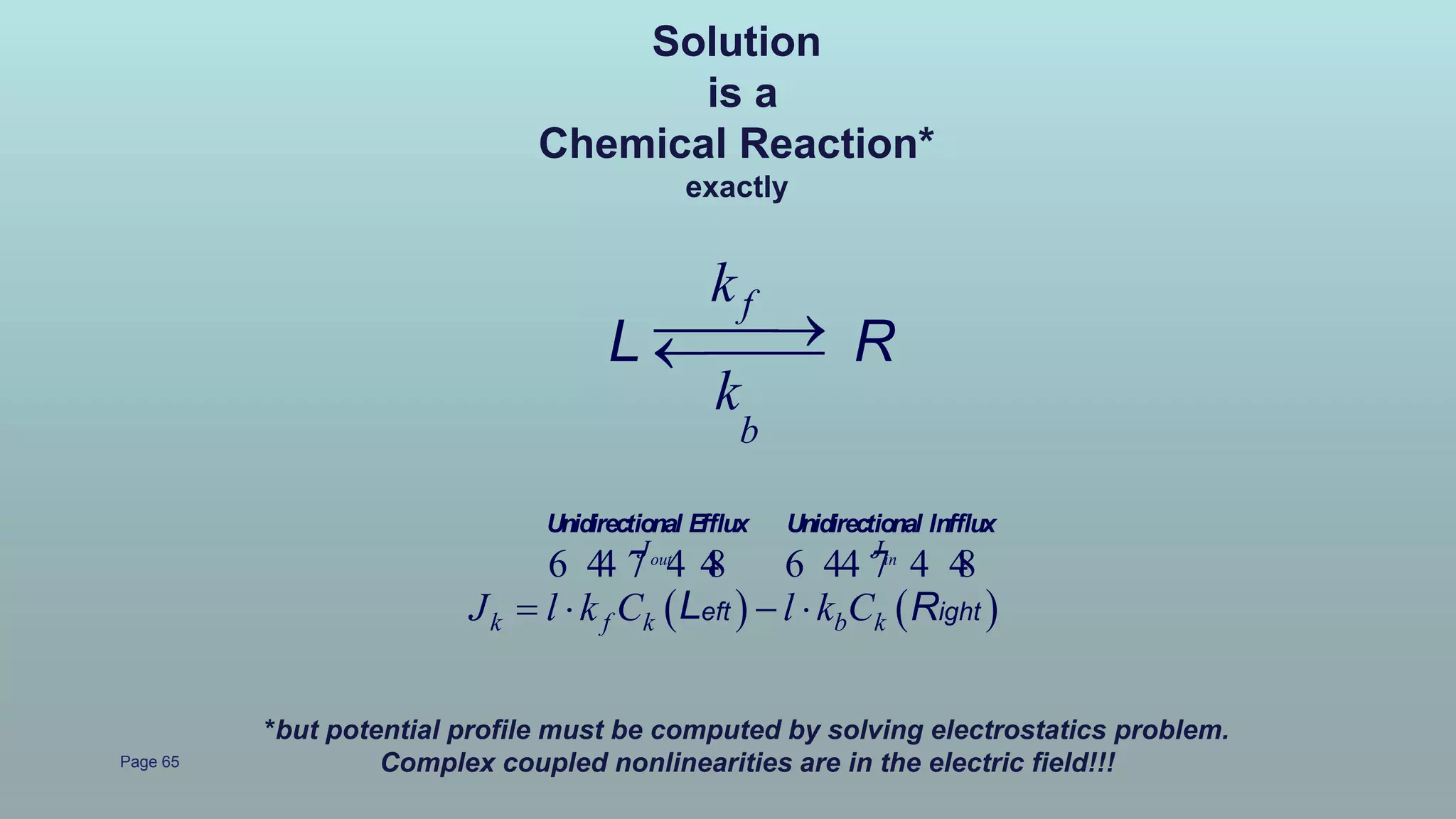
Page 65
   
out inJ J
k f k b kJ l k C l k C   
6 44 7 4 48 6 44 7 4 48
Unidirectional Efflux Unidirectional Infflux
eft ightL R
f
b
k
k
L R
*but potential profile must be computed by solving electrostatics problem.
Complex coupled nonlinearities are in the electric field!!!
Solution
is a
Chemical Reaction*
exactly
66
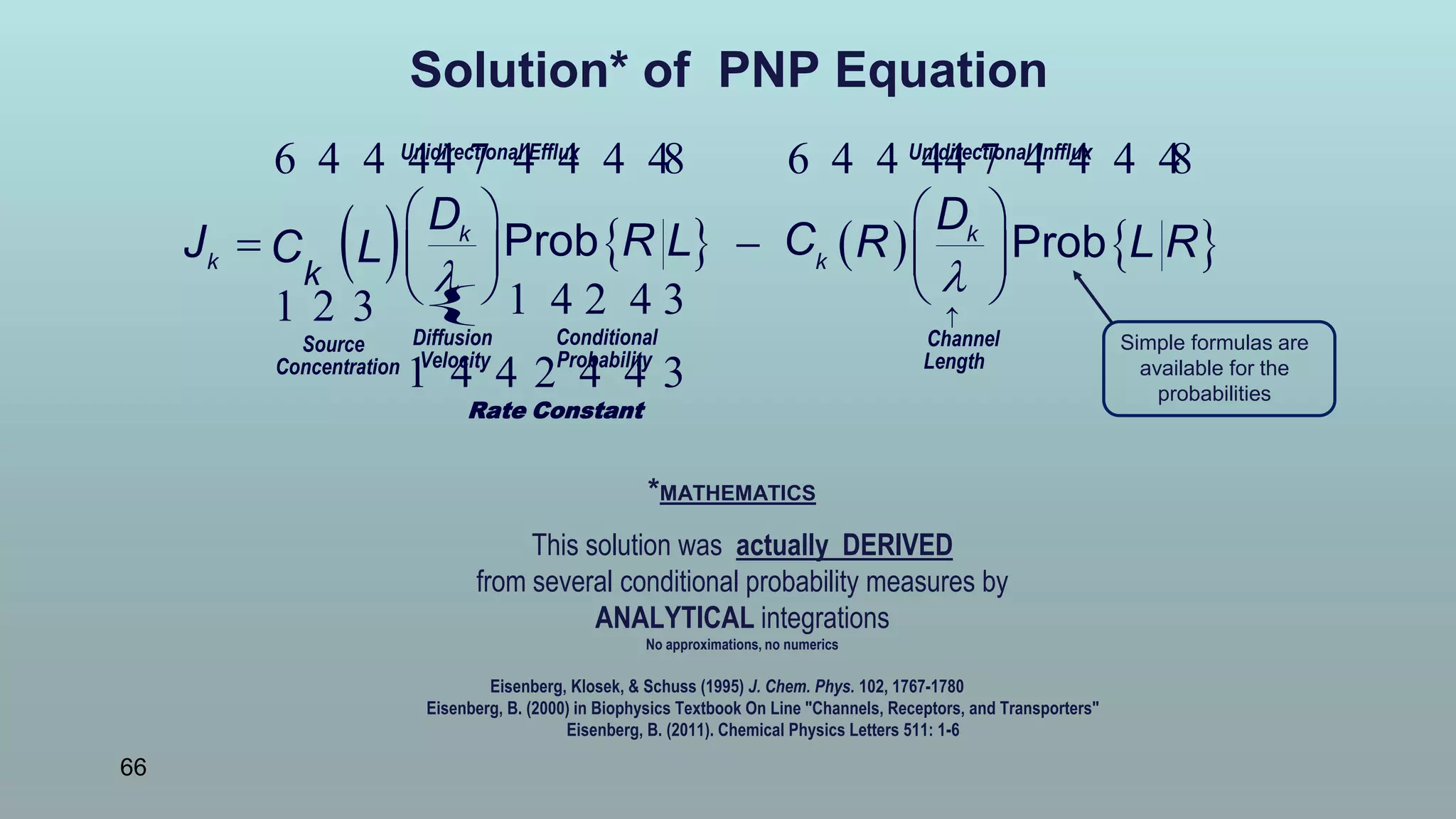
Solution* of PNP Equation
*MATHEMATICS
This solution was actually DERIVED
from several conditional probability measures by
ANALYTICAL integrations
No approximations, no numerics
Eisenberg, Klosek, & Schuss (1995) J. Chem. Phys. 102, 1767-1780
Eisenberg, B. (2000) in Biophysics Textbook On Line "Channels, Receptors, and Transporters"
Eisenberg, B. (2011). Chemical Physics Letters 511: 1-6
Simple formulas are
available for the
probabilities
 
{
     
 

   
    
   
Unidirectional Efflux Unidirectional I
ConditionalDiffusion ChannelSource
ProbabilityVelocity LengthConcentration
6 4 4 44 7 4 4 4 48
1 4 2 4 31 2 3
1 4 4 2 4 4 3
k k
k k
k
D D
CR LJ R L RC L Prob Prob
Rate Constant
nfflux
6 4 4 44 7 4 4 4 48
Page 67
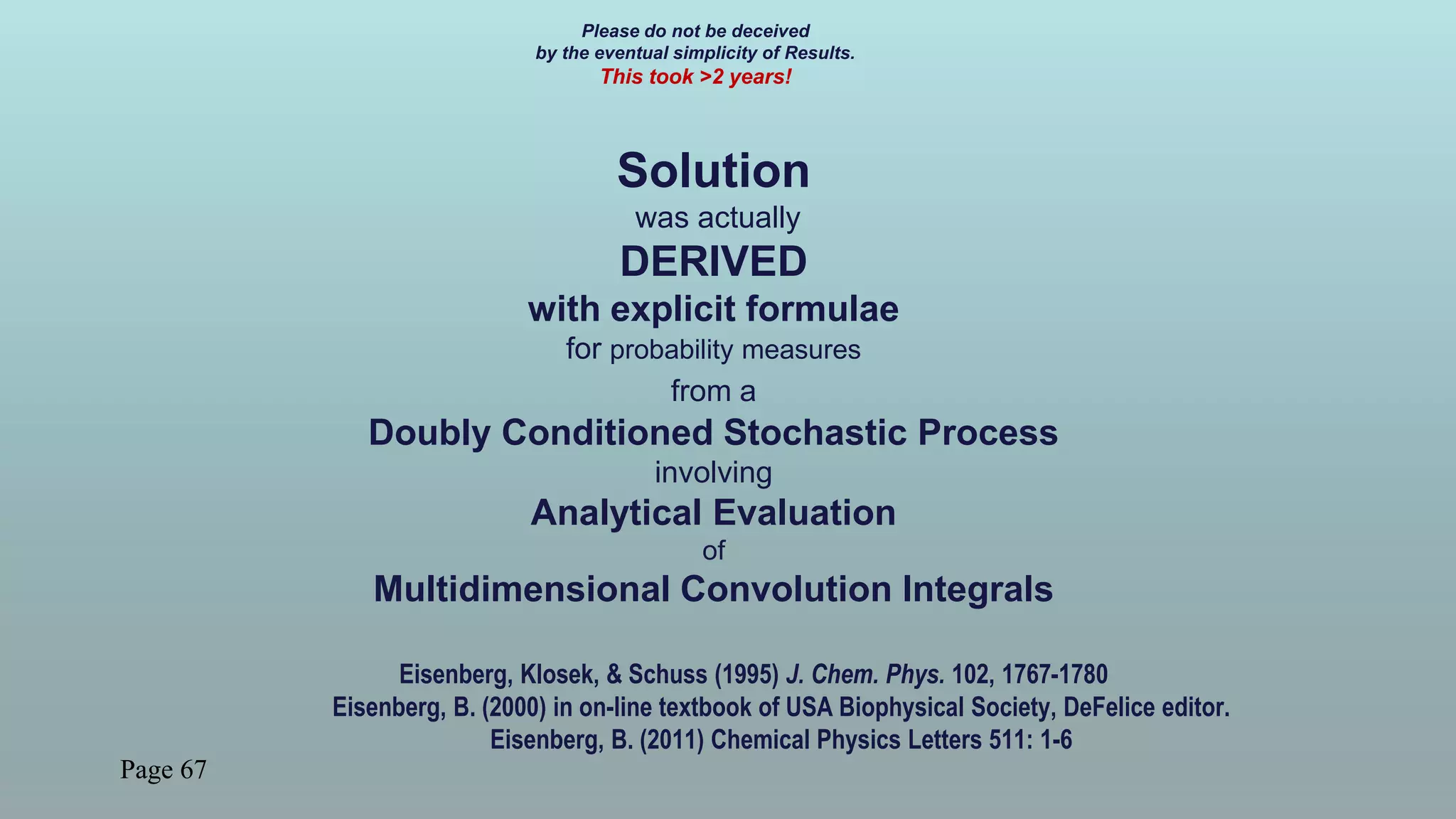
Please do not be deceived
by the eventual simplicity of Results.
This took >2 years!
Solution
was actually
DERIVED
with explicit formulae
for probability measures
from a
Doubly Conditioned Stochastic Process
involving
Analytical Evaluation
of
Multidimensional Convolution Integrals
Eisenberg, Klosek, & Schuss (1995) J. Chem. Phys. 102, 1767-1780
Eisenberg, B. (2000) in on-line textbook of USA Biophysical Society, DeFelice editor.
Eisenberg, B. (2011) Chemical Physics Letters 511: 1-6
All we have to do is
Solve them!
Don’t Despair
Semiconductor
Technology has
Already Done That!
68
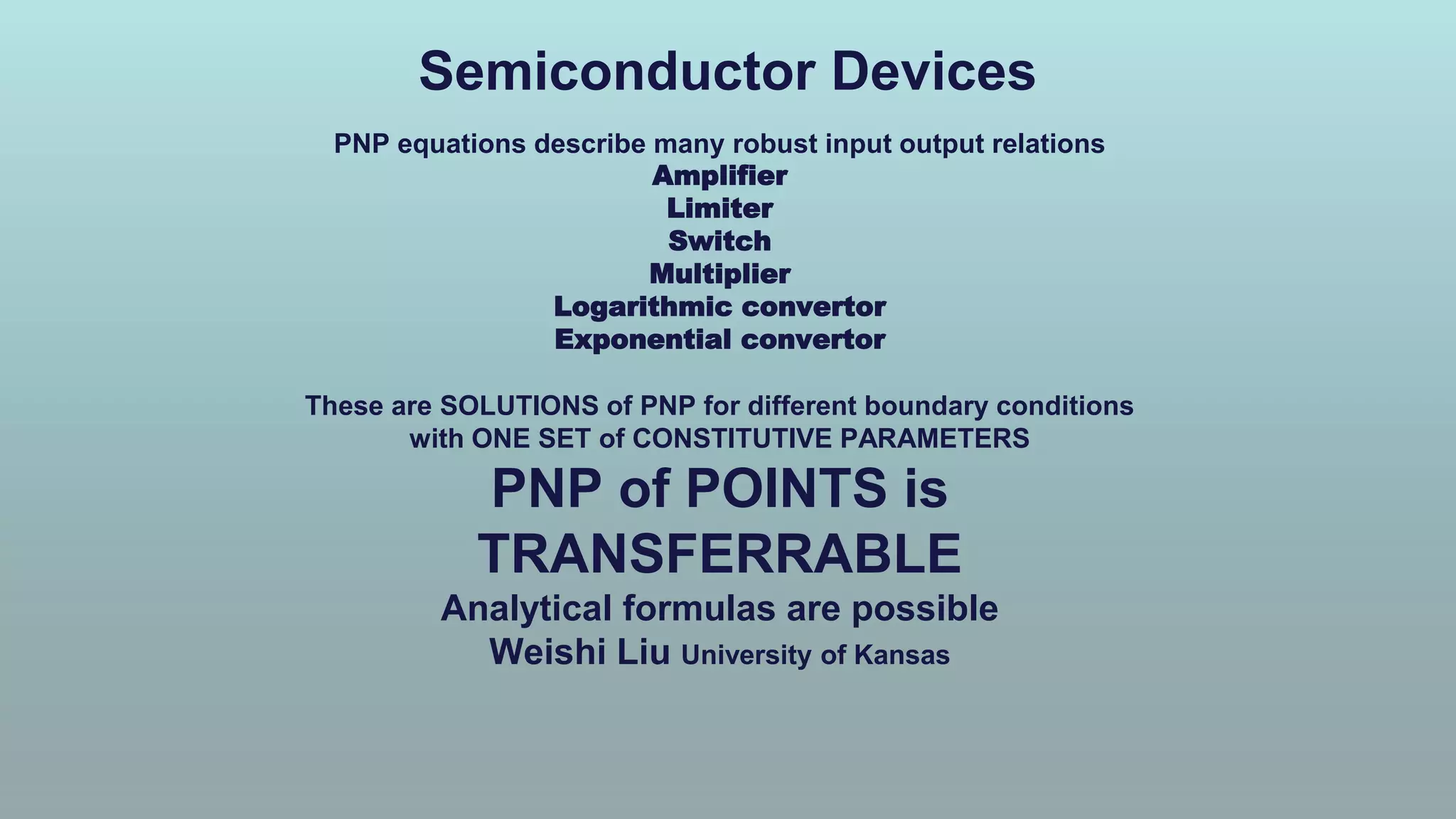
Semiconductor Devices
PNP equations describe many robust input output relations
Amplifier
Limiter
Switch
Multiplier
Logarithmic convertor
Exponential convertor
These are SOLUTIONS of PNP for different boundary conditions
with ONE SET of CONSTITUTIVE PARAMETERS
PNP of POINTS is
TRANSFERRABLE
Analytical formulas are possible
Weishi Liu University of Kansas
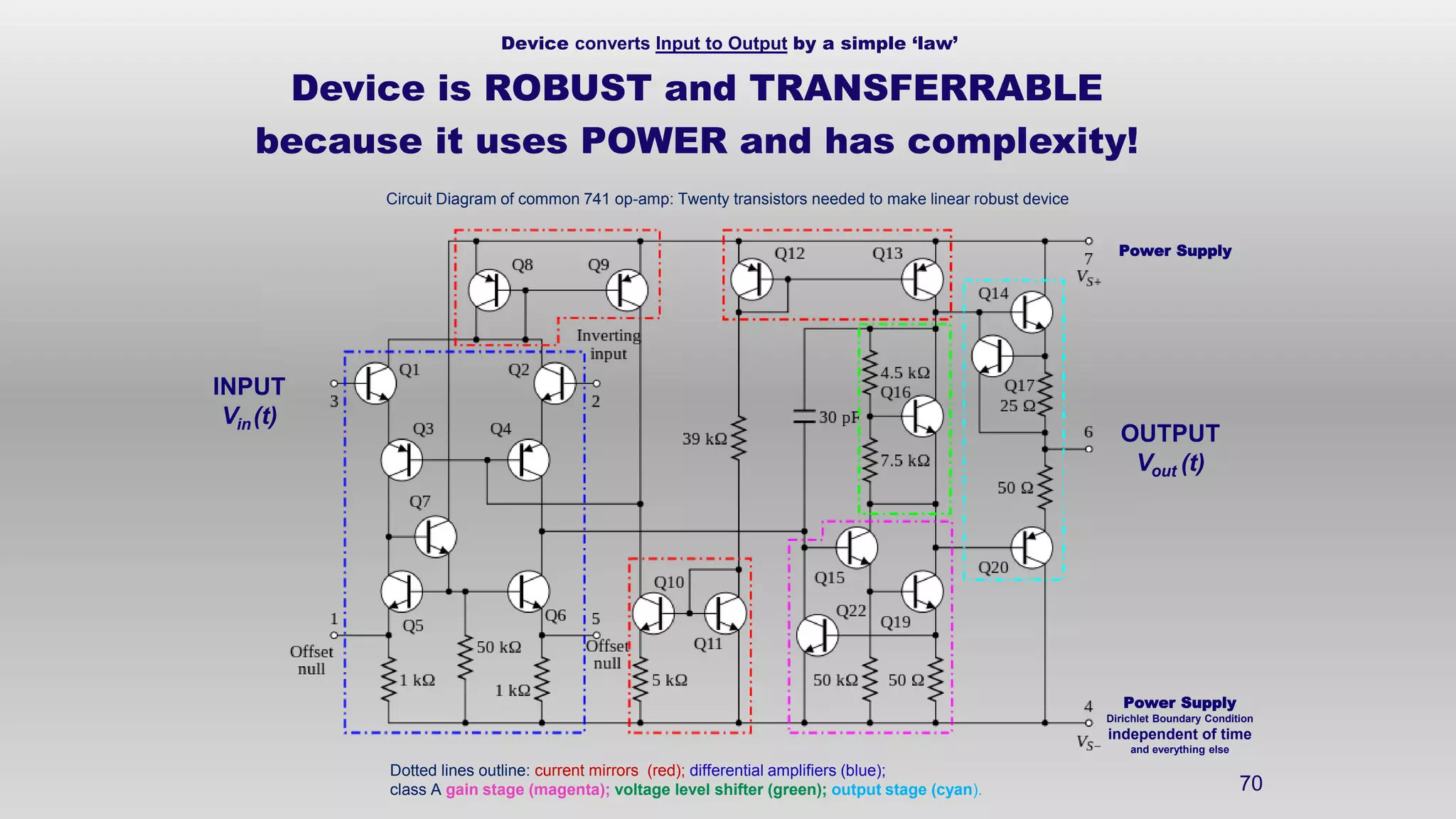
Device converts Input to Output by a simple ‘law’
70
Device is ROBUST and TRANSFERRABLE
because it uses POWER and has complexity!
Dotted lines outline: current mirrors (red); differential amplifiers (blue);
class A gain stage (magenta); voltage level shifter (green); output stage (cyan).
Circuit Diagram of common 741 op-amp: Twenty transistors needed to make linear robust device
INPUT
Vin(t)
OUTPUT
Vout (t)
Power Supply
Dirichlet Boundary Condition
independent of time
and everything else
Power Supply
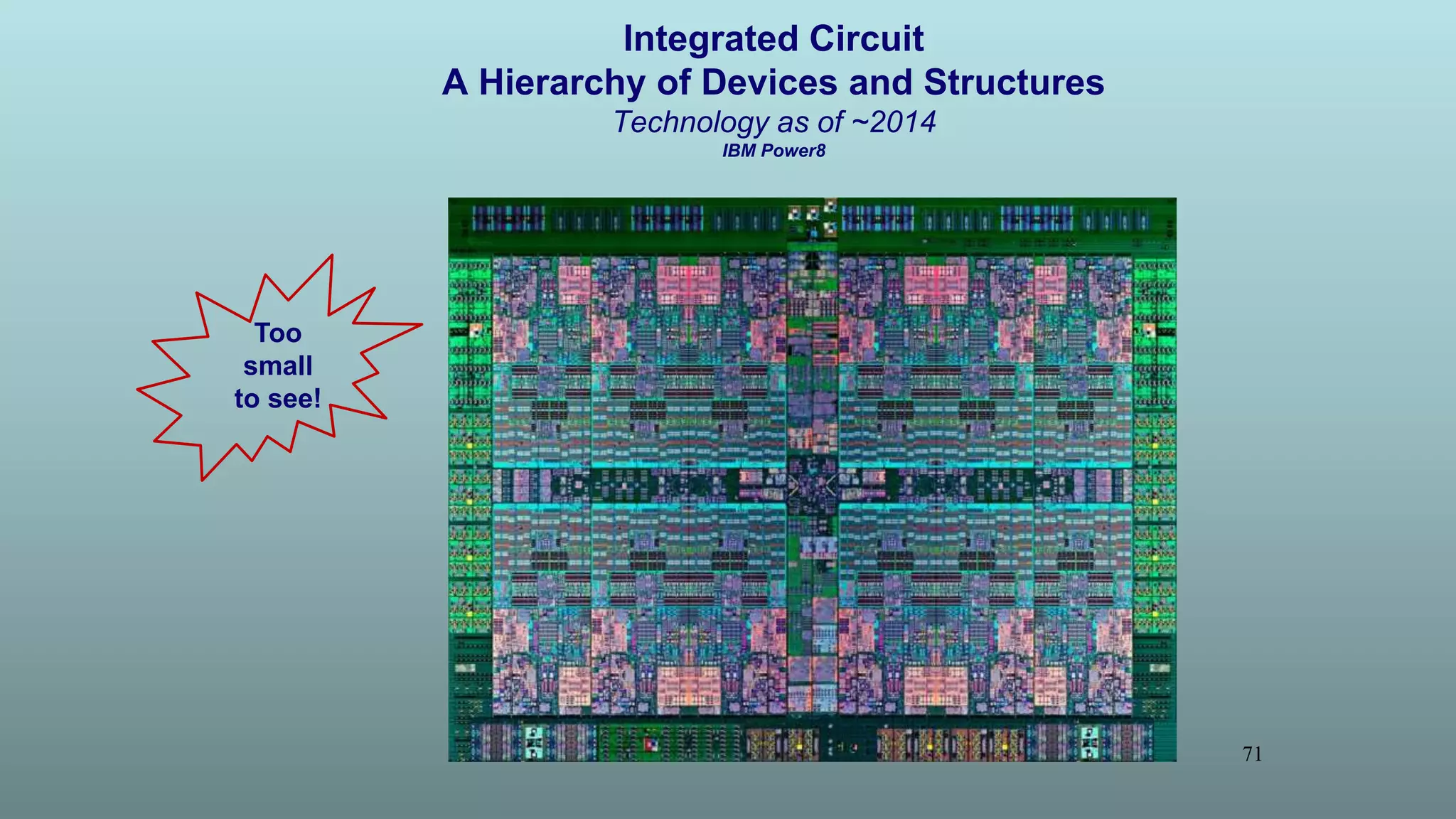
Integrated Circuit
A Hierarchy of Devices and Structures
Technology as of ~2014
IBM Power8
71
Too
small
to see!
72
Any Questions ?

What is different about life? it is inherited oberwolfach march 7 1 2018

  • 1.
    1 Life is Different:it is inherited Oberwolfach Workshop, February 2018 Bob Eisenberg Department of Applied Mathematics Illinois Institute of Technology Department of Physiology and Biophysics Rush University Chicago USA u  
  • 2.
    Page 2 Oberwolfach Workshop1809 The Mathematics of Mechanobiology and Cell Signaling 25 February – 3 March 2018 Organizers: Davide Ambrosi, Milano Italy Chun Liu, State College PA USA Matthias Röger, Dortmund Germany Angela Stevens, Münster Germany at the Mathematisches Forschungsinstitut Oberwolfach.
  • 3.
    3 Thanks to ChunLiu 柳 春 For a very special Friendship and Collaboration!
  • 4.
    Page 4 Life isspecial because it is inherited from a tiny number of atoms And the central question of biology is How is this possible?
  • 5.
  • 6.
  • 7.
    Page 7 How cana few thousand atoms conceivably control 1025 atoms?
  • 8.
    8 Experimental Evidence: A fewatoms make a BIG Difference OmpF 1M/1M G119D 1M/1M G119D 0.05M/0.05M OmpF 0.05M/0.05M Structure determined by Raimund Dutzler in Tilman Schirmer’s lab Current Voltage relation determined by John Tang in Bob Eisenberg’s Lab Ompf G119D Glycine G replaced by Aspartate D
  • 9.
    Page 9 How cana few thousand atoms conceivably control 1025 atoms? Traditional Statistical Mechanics says this is impossible! 𝑨 𝒙, 𝒕 ≡ 𝒂 𝒙, 𝒕 where 𝒓 𝟐 = 𝒙 𝟐 + 𝒚 𝟐 + 𝒛 𝟐 and 𝑾 𝒙 = 𝑵𝒆 − 𝒓 𝟐 𝑹 𝟐 𝑹 specifies the radius of the small spherical volume over which the spatial average takes place. = 𝑾 𝒙′ 𝒂 𝒙 − 𝒙′, 𝒕 𝒅 𝟑 𝒙′
  • 10.
    Page 10 How cana few thousand atoms conceivably control 1025 atoms? The thousand atoms of one gene occupy say 10-27 m3 The volume of a person might be 1m3 Volume of Canada, USA 𝒐𝒓China 1m high is 1013 m3 Fraction of space of a gene is about 10-27 Fraction of Space of One Person in Canada is 10-13 1 m3 has no effect in Canada 1 gene should have no effect
  • 11.
    Page 11 How cana few thousand atoms conceivably control 1025 atoms? Biological Answer: Structure: a Hierarchy of Devices Physical Answer: Electrodynamics: Strong and Universal inside atoms to stars Another talk* another day! *Eisenberg, Oriols, and Ferry. 2017. Dynamics of Current, Charge, and Mass. Molecular Based Mathematical Biology 5:78-115 arXiv https://arxiv.org/abs/1708.07400.
  • 12.
    12 Everyone knows Biology ismade of Structures Working hypothesis: The Structures make Devices that span the scales
  • 13.
    13 ATOM 10-10 m Molecule 10-8 m Organelle 10-6m Cell 10-5m Cell 10-5m Tissue 10-3m Organ 10-1 m ORGANISM 1 m Answer: Biology is made of Devices and they span the scales
  • 14.
    Page 14 How cana few thousand atoms conceivably control 1025 atoms? ANSWER: by forming a HIERARCHY of DEVICES
  • 15.
    Page 15 Different Kindof Averaging in Device Definition of a Device Output is Perfectly Correlated with Input Averaging in a Device Creates a Perfectly Correlated* Replica of the Input 𝑨 𝒙, 𝒕 ≡ 𝒂 𝒙, 𝒕 ≠ 𝒅 𝟑 𝒙′ 𝑾(𝒙′ )𝒂(𝒙 − 𝒙′, 𝒕) Not equal Precise stochastic definition *Coherence function of Device = 1.0 Coherence function in general = 𝑷 𝒙𝒚 𝒇 𝑷 𝒙𝒙 𝒇 𝑷 𝒚𝒚 𝒇 ; 𝑷 𝒙𝒚; 𝑷 𝒛𝒛 = cross, self-power spectral density = estimator of
  • 16.
    Page 16 Structural Complexity socharacteristic of life, so daunting to mathematicians is the Hierarchy of Devices
  • 17.
    Page 17 Biology ismade of Devices and they are Multiscale Structural Complexity of Life is the Hierarchy of Devices
  • 18.
    18 One Cell contains many Devices StructuralComplexity of Life is the Hierarchy of Devices
  • 19.
    19 Real Biological System ANerve Cell is a Hierarchy of Devices Cell Body, Dendrites, Axon, Terminals Example: Bob, I would not put it that way….. Andrew Huxley with his mentor Alan Hodgkin
  • 20.
    20 Nerve Signal isthe propagating ‘Action Potential’, a waveform in x and t Purely Local Theory is Impossible because the phenomena involves centimeter scales, as well as Angstroms. All atom Molecular Dynamics is impossible because ~1023 atoms are involved Atomic Properties of the Voltage Sensor are coupled to the macroscopic electric field a centimeter away. The electric field controls the sensor; the sensor controls the electric field. That is how propagation works!
  • 21.
    Page 21 Channels areSource of Signal
  • 22.
  • 23.
    Page 23 Start withVoltage Sensor
  • 24.
    24 Vargas, E., Yarov-Yarovoy,V., Khalili-Araghi, F., Catterall, W. A., Klein, M. L., Tarek, M., Lindahl, E., Schulten, K., Perozo, E., Bezanilla, F. & Roux, B. An emerging consensus on voltage-dependent gating from computational modeling and molecular dynamics simulations. The Journal of General Physiology 140, 587-594 (2012). Emerging Consensus …. Voltage Sensor Structure (NOT conduction channel)
  • 25.
    25 Vargas, E., Yarov-Yarovoy,V., Khalili-Araghi, F., Catterall, W. A., Klein, M. L., Tarek, M., Lindahl, E., Schulten, K., Perozo, E., Bezanilla, F. & Roux, B. An emerging consensus on voltage-dependent gating from computational modeling and molecular dynamics simulations. The Journal of General Physiology 140, 587-594 (2012). Emerging Consensus …. Voltage Sensor Structure (NOT conduction channel)
  • 26.
  • 27.
    27 Physiologists§ Mistakenly call aSaturating distribution ‘Boltzmann’ e.g., Bezanilla, Villalba-Galea J. Gen. Physiol (2013) 142: 575 𝑸 𝑽 = 𝑸 𝒎𝒂𝒙 𝟏 + 𝒆𝒙𝒑 −𝑸 𝒎𝒂𝒙 𝑽 − 𝑽 𝟏 𝟐 𝒌 𝑩 𝑻 Physicists: Saturation Fermi distribution Boltzmann* distribution does NOT saturate. Boltzmann is exponential, like 𝒆𝒙𝒑 −𝑽 𝒌 𝑩 𝑻 . *Boltzmann (1904) Lectures on Gas Theory, Berkeley § p.503 of Hodgkin and Huxley. 1952. ‘Quantitative description ...’ J. Physiol. 117:500-544. Bezanilla. How membrane proteins sense voltage Nature Rev Mol Cell Biol (2008) 9, 323 Fermi Distribution not Boltzmann Arginines Internal Dissolved Ions 𝑲+, 𝒐𝒓𝒈𝒂𝒏𝒊𝒄𝒔− External Dissolved Ions 𝑵𝒂+ 𝑪𝒍− Dissolved Ions 𝑲+, 𝒐𝒓𝒈𝒂𝒏𝒊𝒄𝒔− External Dissolved Ions 𝑵𝒂+ 𝑪𝒍− Voltage Clamp = Test Potential Voltage Clamp =0 Holding Potential Current 𝐈 𝐦 to maintain test potential Holding Potenti al Test Potentials Holding Potenti al Test Potentials 𝐈 𝐦
  • 28.
    Perhaps the first ConsistentModel of a Protein Machine made by a conformation change 28 Francisco Bezanilla Chun Liu 柳 春 Allen Tzyy-Leng Horng 洪子倫 Bob Eisenberg
  • 29.
    Figure 1. Geometricconfiguration of the reduced mechanical model. Voltage sensor works by charge injection through a fluid dielectric of side chains, attachments of arginines to the S4 segment. intracellular extracellular Voltage Sensor works by Charge Injection through a fluid dielectric of side chains, not yet fully known. More work needed!
  • 30.
  • 31.
    31 𝐸 = 𝑘𝐵 𝑇 𝑐𝑖 𝑙𝑜𝑔𝑐𝑖 − 𝜀0 𝜀𝑟 2𝑎𝑙𝑙 𝑖 ∇𝜙 2 + 𝑧𝑖 𝑒 𝑎𝑙𝑙 𝑖 𝑐𝑖 𝜙 + ( 𝑉𝑖 + 𝑉𝑏 ) 𝑎𝑟𝑔𝑖𝑛𝑖𝑛𝑒𝑠 𝑐𝑖 𝑉 + 𝑔𝑖𝑗 2 𝑐𝑖 𝑐𝑗 𝑎𝑟𝑔𝑖𝑛𝑖𝑛𝑒𝑠 𝑖,𝑗 𝑑𝑉, Variational Formulation EnVarA because ‘Everything’ interacts with ‘Everything Else’ through the electric field and often through steric interactions of Pauli exclusion principle Poisson Equation and Transport equation are DERIVED, not assumed from variations like 𝛿𝐸 𝛿𝜙 = 0, so cross terms are always consistent, i.e., satisfy all equations with one set of parameters.
  • 32.
    30 Defining Laws Charge CreatesElectric Field − 1 𝐴 𝑑 𝑑𝑧 Γ𝐴 𝑑𝜙 𝑑𝑧 = 𝑖=1 𝑁 𝑧𝑖 𝑐𝑖 , 𝑖 = Na, Cl, 1, 2, 3, 4 Transport of Mass 𝜕𝑐 𝑖 𝜕𝑡 + 1 𝐴 𝜕 𝜕𝑧 𝐴𝐽𝑖 = 0, 𝑖 =Na, Cl, 1,2,3,4
  • 33.
    33 𝑽𝒊 𝒛, 𝒕= 𝑲(𝒛 − 𝒛𝒊 + 𝒁 𝑺𝟒(𝒕) ) 𝟐 , where K is the spring constant, zi is the fixed anchoring position of the spring for each arginine ci on S4, 𝑍 𝑆4(𝑡) is the center-of-mass z position of S4 by treating S4 as a rigid body. 𝑍 𝑆4(𝑡) follows the motion of equation based on spring-mass system: Conformation Change of Arginines is Described by an Elastic System
  • 34.
    Current Carried byArginines note cross terms 𝟏= − 𝟏 𝑪 𝟏 𝒛 + 𝒛 𝒂𝒓𝒈 𝑪 𝟏 𝒛 + 𝑪 𝟏 𝑽 𝟏 𝒛 + 𝑽 𝒛 + 𝒈𝑪 𝟏 𝑪 𝟐 𝒛 + 𝑪 𝟑 𝒛 + 𝑪 𝟒 𝒛 𝟐 = − 𝟐 𝑪 𝟐 𝒛 + 𝒛 𝒂𝒓𝒈 𝑪 𝟐 𝒛 + 𝑪 𝟐 𝑽 𝟐 𝒛 + 𝑽 𝒛 + 𝒈𝑪 𝟐 𝑪 𝟏 𝒛 + 𝑪 𝟑 𝒛 + 𝑪 𝟒 𝒛 𝟑 = − 𝟑 𝑪 𝟑 𝒛 + 𝒛 𝒂𝒓𝒈 𝑪 𝟑 𝒛 + 𝑪 𝟑 𝑽 𝟑 𝒛 + 𝑽 𝒛 + 𝒈𝑪 𝟑 𝑪 𝟏 𝒛 + 𝑪 𝟐 𝒛 + 𝑪 𝟒 𝒛 𝟒= − 𝟒 𝑪 𝟒 𝒛 + 𝒛 𝒂𝒓𝒈 𝑪 𝟒 𝒛 + 𝑪 𝟒 𝑽 𝟒 𝒛 + 𝑽 𝒛 + 𝒈𝑪 𝟒 𝑪 𝟏 𝒛 + 𝑪 𝟐 𝒛 + 𝑪 𝟑 𝒛
  • 35.
    Page 35 Figure 9.(a) Time courses of subtracted gating current [A1] with voltage rising from -90mV to V mV at t=10, holds on till t=150, and drops back to -90mV, where V=-62, -50, … -8 mV. (b) τ2 versus V compared with experiment [7]. Fitting Data
  • 36.
    Page 36 Figure 3.(a) QV curve and comparison with [7]. Steady-state distributions for Na, Cl and arginines at (b) V=-90mV, (c) V=-48mV, (d) V=-8mV. Fitting Data
  • 37.
    37 Ions Electric Field Current is Conserved OUTPUT Currentincluding 𝜺 𝟎 𝑬 𝒕 INPUT Voltage Clamp t Conservation of Current is an Important Constraint. Rate Models of Chemical Kinetics; Molecular Dynamics do not conserve current A different talk
  • 38.
    Page 38 Nerve Signaling isa Hierarchy of Devices
  • 39.
    Page 39 Channels areSource of Signal
  • 40.
    40 Classical cable theoryof transmission lines, telegrapher’s equations, Kelvin, Hodgkin, Noble, including 3D-cable theory, ~10 papers, e.g., Eisenberg and Johnson. 1970. Three dimensional electrical field problems in physiology. Prog. Biophys. Mol. Biol. 20:1-65 Barcilon, Cole, Eisenberg. 1971. Singular Perturbation … SIAM J. Appl. Math. 21:339-354. Another talk, another time! Channels + lipid capacitance Poisson Equation
  • 41.
    How do ionsmove through channels? >75 papers since 1986 41
  • 42.
    42 Working Hypothesis bio-speak: Crucial BiologicalAdaptation is Crowded Ions and Side Chains Biology occurs in concentrated >0.3 M mixtures of spherical charges NOT IDEAL AT ALL Poisson Boltzmann does NOT fit data!! Solutions are extraordinarily concentrated >10M where they are most important, near DNA, enzyme active sites, and channels and electrodes of batteries and electrochemical cells. Solid NaCl is 37M
  • 43.
    43 Solutions are ExtraordinarilyConcentrated >10M Solid NaCl is 37M where they are most important, DNA, enzyme active sites, channels and electrodes of batteries and electrochemical cells
  • 44.
    Active Sites ofProteins are Very Charged 7 charges ~ 20M net charge Selectivity Filters and Gates of Ion Channels are Active Sites = 1.2×1022 cm-3 - + + + + + - - - 4 Å K+ Na+ Ca2+ Hard Spheres 44 Figure adapted from Tilman Schirmer liquid Water is 55 M solid NaCl is 37 M OmpF Porin Physical basis of function K+ Na+ Induced Fit of Side Chains Ions are Crowded
  • 45.
    Crowded Active Sites in573 Enzymes 45 Enzyme Type Catalytic Active Site Density (Molar) Protein Acid (positive) Basic (negative) | Total | Elsewhere Total (n = 573) 10.6 8.3 18.9 2.8 EC1 Oxidoreductases (n = 98) 7.5 4.6 12.1 2.8 EC2 Transferases (n = 126) 9.5 7.2 16.6 3.1 EC3 Hydrolases (n = 214) 12.1 10.7 22.8 2.7 EC4 Lyases (n = 72) 11.2 7.3 18.5 2.8 EC5 Isomerases (n = 43) 12.6 9.5 22.1 2.9 EC6 Ligases (n = 20) 9.7 8.3 18.0 3.0 Jimenez-Morales, Liang, Eisenberg
  • 46.
    Charge-Space Competition 46 More than35 papers are available at ftp://ftp.rush.edu/users/molebio/Bob_Eisenberg/reprints Monte Carlo Methods Dezső Boda Wolfgang NonnerDoug Henderson Bob Eisenberg
  • 47.
    47 Mutants of ompFPorin Atomic Scale Macro Scale 30 60 -30 30 60 0 pA mV LECE (-7e) LECE-MTSES- (-8e) LECE-GLUT- (-8e)ECa ECl WT (-1e) Calcium selective Experiments have ‘engineered’ channels (5 papers) including Two Synthetic Calcium Channels As density of permanent charge increases, channel becomes calcium selective Erev  ECa in 0.1M 1.0 M CaCl2 ; pH 8.0 Unselective Natural ‘wild’ Type built by Henk Miedema, Wim Meijberg of BioMade Corp. Groningen, Netherlands Miedema et al, Biophys J 87: 3137–3147 (2004); 90:1202-1211 (2006); 91:4392-4400 (2006) MUTANT ─ Compound Glutathione derivatives Designed by Theory || Evidence RyR (start)
  • 48.
    48 Ca Channel log (Concentration/M) 0.5 -6-4 -2 Na+ 0 1 Ca2+ Charge -3e Occupancy(number) E E E A Monte Carlo simulations of Boda, et al Same Parameters pH 8 Mutation Same Parameters Mutation EEEE has full biological selectivity in similar simulations Na Channel Concentration/M pH =8 Na+ Ca2+ 0.004 0 0.002 0.05 0.10 Charge -1e D E K A
  • 49.
    49 Mutants of ompFPorin Atomic Scale Macro Scale 30 60 -30 30 60 0 pA mV LECE (-7e) LECE-MTSES- (-8e) LECE-GLUT- (-8e)ECa ECl WT (-1e) Calcium selective Experiments have ‘engineered’ channels (5 papers) including Two Synthetic Calcium Channels As density of permanent charge increases, channel becomes calcium selective Erev  ECa in 0.1M 1.0 M CaCl2 ; pH 8.0 Unselective Natural ‘wild’ Type built by Henk Miedema, Wim Meijberg of BioMade Corp. Groningen, Netherlands Miedema et al, Biophys J 87: 3137–3147 (2004); 90:1202-1211 (2006); 91:4392-4400 (2006) MUTANT ─ Compound Glutathione derivatives Designed by Theory || Evidence RyR (start)
  • 50.
    Poisson Fermi Approachto Ion Channels 50 . 劉晉良 Jinn-Liang Liu discovered role of SATURATION Bob Eisenberg helped with applications
  • 51.
    Motivation Natural Description ofCrowded Charge is a Fermi Distribution designed to describe saturation Simulating saturation by interatomic repulsion (Lennard Jones) is a significant mathematical challenge to be side-stepped if possible 51
  • 52.
    Motivation Largest Effect of Crowded Charge is Saturation important inchannels, DNA, enzymes, and electrochemical devices in general Saturation cannot be described at all by classical Poisson Boltzmann approach and is described in a (wildly) uncalibrated way by present day Molecular Dynamics 52
  • 53.
    53 Liu, Eisenberg. 2018.Journal of chemical physics 148:054501 also arXiv:1801.03470 . Calibration in Bulk Solution: New Result
  • 54.
    54 Individual activity coefficientsof 2:1 electrolytes. Comparison of PF results with experimental data [26] on i = Pos2+ (cation) and Neg− (anion) activity coefficients γi in various [PosNeg2] from 0 to 1.5 M. Calibration in Bulk Solution: New Result
  • 55.
    Na Channel 55 Signature ofCardiac Calcium Channel CaV1.n Anomalous* Mole Fraction (non-equilibrium) Liu & Eisenberg (2015) Physical Review E 92: 012711 *Anomalous because CALCIUM CHANNEL IS A SODIUM CHANNEL at [CaCl2]  10-3.4 Ca2+ is conducted for [Ca2+] > 10-3.4, but Na+ is conducted for [Ca2+] <10-3. Ca Channel
  • 56.
    56 Three Dimensional Theory Comparisonwith Experiments Gramicidin A
  • 57.
    ‘Law’ of MassAction including Interactions From Bob Eisenberg p. 1-6, in this issue Variational Approach EnVarA 1 2- 0E      6 7 8 6 7 8 r r x u Conservative Dissipative Chun Liu 柳 春
  • 58.
    58 Energetic Variational Approach allows accuratecomputation of Flow and Interactions in Complex Fluids like Liquid Crystals Engineering needs Calibrated Theories and Simulations Engineering Devices almost always use flow Classical theories and Molecular Dynamics have difficulties with flow, interactions, and complex fluids
  • 59.
    59 Energetic Variational Approach EnVarA ChunLiu, Rolf Ryham, and Yunkyong Hyon Mathematicians and Modelers: two different ‘partial’ variations written in one framework, using a ‘pullback’ of the action integral } } 1 2 0 E       '' Dissipative'Force'Conservative Force r r x u Action Integral, after pullback Rayleigh Dissipation FunctionAction Integral, after pullback Rayleigh Dissipation Function Field Theory of Ionic Solutions: Liu, Ryham, Hyon, Eisenberg Allows boundary conditions and flow Deals Consistently with Interactions of Components Composite Variational Principle Euler Lagrange Equations Field Theory of Ionic Solutions: Liu, Ryham, Hyon, Eisenberg Allows boundary conditions and flow Deals Consistently with Interactions of Components Composite Variational Principle Shorthand for Euler Lagrange process with respect to r x Shorthand for Euler Lagrange process with respect to r u
  • 60.
    2 , = , =, i i i B i i j j B i i n p j n p D c c k T z e c d y dx k T c                    = Dissipative r r% 1 4 4 4 4 4 4 4 4 4 2 4 4 4 4 4 4 4 4 4 3 , = = , , 0 , , = 1 log 2 2 i B i i i i i j j i n p i n p i j n p c k T c c z ec c d y dx d dt                        Conservative r r% 6 4 4 4 4 4 4 4 4 4 4 44 7 4 4 4 4 4 4 4 4 4 4 4 48 Hard Sphere Terms Permanent Charge of proteintime ci number density; thermal energy; Di diffusion coefficient; n negative; p positive; zi valence; ε dielectric constantBk T Number Density Thermal Energy valence proton charge Dissipation Principle Conservative Energy dissipates into Friction = , 0 2 1 22 i i i n p z ec              Note that with suitable boundary conditions 60
  • 61.
    61 PNP (Poisson NernstPlanck) for Spheres Eisenberg, Hyon, and Liu 12 , 14 12 , 14 12 ( ) ( ) = ( ) | | 6 ( ) ( ) ( ) , | | n n n nn n n n n n B n p n p p a a x yc c D c z e c y dy t k T x y a a x y c y dy x y                                r r r r r r r r r r r r Nernst Planck Diffusion Equation for number density cn of negative n ions; positive ions are analogous Non-equilibrium variational field theory EnVarA Coupling Parameters Ion Radii =1 or( ) = N i i i z ec i n p               0ρ Poisson Equation Permanent Charge of Protein Number Densities Diffusion Coefficient Dielectric Coefficient valence proton charge Thermal Energy
  • 62.
    62 Semiconductor PNP Equations ForPoint Charges       i i i i d J D x A x x dx    Poisson’s Equation Drift-diffusion & Continuity Equation          0 i i i d d x A x e x e z x A x dx dx            Ρ 0idJ dx         ex * x x x ln xi i i iz e kT              1 2 3 Finite Size Special Chemistry Chemical Potential Thermal Energy Valence Proton charge Permanent Charge of Protein Doping of Semiconductor Cross sectional Area Flux Diffusion Coefficient Number Densities Dielectric Coefficient valence proton charge Not in Semiconductor ( )i x
  • 63.
    All we haveto do is Solve them! with Boundary Conditions defining Charge Carriers ions, holes, quasi-electrons Geometry 63
  • 64.
    64 Mathematical Solutions can besimple and easy to recognize! f b k k L R
  • 65.
    Page 65    out inJ J k f k b kJ l k C l k C    6 44 7 4 48 6 44 7 4 48 Unidirectional Efflux Unidirectional Infflux eft ightL R f b k k L R *but potential profile must be computed by solving electrostatics problem. Complex coupled nonlinearities are in the electric field!!! Solution is a Chemical Reaction* exactly
  • 66.
    66 Solution* of PNPEquation *MATHEMATICS This solution was actually DERIVED from several conditional probability measures by ANALYTICAL integrations No approximations, no numerics Eisenberg, Klosek, & Schuss (1995) J. Chem. Phys. 102, 1767-1780 Eisenberg, B. (2000) in Biophysics Textbook On Line "Channels, Receptors, and Transporters" Eisenberg, B. (2011). Chemical Physics Letters 511: 1-6 Simple formulas are available for the probabilities   {                       Unidirectional Efflux Unidirectional I ConditionalDiffusion ChannelSource ProbabilityVelocity LengthConcentration 6 4 4 44 7 4 4 4 48 1 4 2 4 31 2 3 1 4 4 2 4 4 3 k k k k k D D CR LJ R L RC L Prob Prob Rate Constant nfflux 6 4 4 44 7 4 4 4 48
  • 67.
    Page 67 Please donot be deceived by the eventual simplicity of Results. This took >2 years! Solution was actually DERIVED with explicit formulae for probability measures from a Doubly Conditioned Stochastic Process involving Analytical Evaluation of Multidimensional Convolution Integrals Eisenberg, Klosek, & Schuss (1995) J. Chem. Phys. 102, 1767-1780 Eisenberg, B. (2000) in on-line textbook of USA Biophysical Society, DeFelice editor. Eisenberg, B. (2011) Chemical Physics Letters 511: 1-6
  • 68.
    All we haveto do is Solve them! Don’t Despair Semiconductor Technology has Already Done That! 68
  • 69.
    Semiconductor Devices PNP equationsdescribe many robust input output relations Amplifier Limiter Switch Multiplier Logarithmic convertor Exponential convertor These are SOLUTIONS of PNP for different boundary conditions with ONE SET of CONSTITUTIVE PARAMETERS PNP of POINTS is TRANSFERRABLE Analytical formulas are possible Weishi Liu University of Kansas
  • 70.
    Device converts Inputto Output by a simple ‘law’ 70 Device is ROBUST and TRANSFERRABLE because it uses POWER and has complexity! Dotted lines outline: current mirrors (red); differential amplifiers (blue); class A gain stage (magenta); voltage level shifter (green); output stage (cyan). Circuit Diagram of common 741 op-amp: Twenty transistors needed to make linear robust device INPUT Vin(t) OUTPUT Vout (t) Power Supply Dirichlet Boundary Condition independent of time and everything else Power Supply
  • 71.
    Integrated Circuit A Hierarchyof Devices and Structures Technology as of ~2014 IBM Power8 71 Too small to see!
  • 72.