Group Name
Spondon
Welcome to all
AIS Department
University of Rajshahi
Course No.110
Course Name. Micro Economics
Course Teacher
MD. Sumon Hossain
Assistant professor,
Department of Accounting and
Information Systems,
University of Rajshahi.
Content
Dynamics staticsi
Comparative statics
Micro-statics
AIS
1
ii
On the basis of time, the equilibrium
between two variables in microeconomics is divided
into two parts as dynamic and comparative which
are also called types of microeconomics. The types of
Microeconomics is explained separately as stated
below;
1.Micro Dynamics
2.Micro comparative statics
Micro-statics
Micro statics
Micro statics refers to the
stationary situation of the equilibrium
between different variables at certain point
of time. In other words, when the value of
economic variables are related to the same
point of time, the functional relationship
between variables is said to be statics.
Y
X
S
S
D
D
0 Q
P
Price
Quantity
E
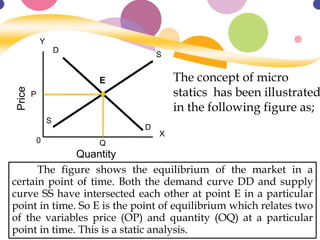
timotThe figure shows the equilibrium of the market in a
certain point of time. Both the demand curve DD and supply
curve SS have intersected each other at point E in a particular
point in time. So E is the point of equilibrium which relates two
of the variables price (OP) and quantity (OQ) at a particular
point in time. This is a static analysis.
The concept of micro
statics has been illustrated
in the following figure as;
Limitation of micro Statics
1.Statics analysis assumes many times. We can
not pump in much meaning into our statements
regarding economics changes since they take
place over time.
2.Static analysis only a limited scope to deal
with the real economics problem.
3.It assumes variable data, but the actual world
is a dynamic one where the data are
continuously changing.
1. Micro dynamics
There is always change in time. This change brings
change in price and the demand & supply of quantity
of commodities. Consequently there is a change in
equilibrium. Therefore micro dynamics refers to that
situation of equilibrium in which an equilibrium of
different variables goes through disequilibrium and
new equilibrium establishes. Hence micro dynamics is
the study of the process which shows how the initial
equilibrium breaks and new equilibrium attains.
Micro dynamics can also be explain by the following
figure.
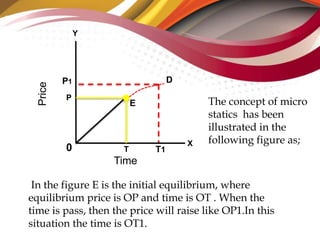
In the figure E is the initial equilibrium, where
equilibrium price is OP and time is OT . When the
time is pass, then the price will raise like OP1.In this
situation the time is OT1.
D
Y
X
0 T
P
Price
Time
E
P1
T1
The concept of micro
statics has been
illustrated in the
following figure as;
1.The method of dynamic
statics essentially very complex.
2.Only a few economists
equipped with the techniques
of advance mathematics can
make use of it. That why it
has reduced its popularity.
Limitation of Dynamic Statics
Comparative Micro statics
As time passes, there is change in the condition of
demand and supply. This change in demand and
supply brings a change even in the equilibrium
condition. This type of change in equilibrium at
different points of time is the study of comparative
micro statics. Therefore comparative micro statics
is the study of different equilibriums at different
points of time.
Comparative micro statics compares one
equilibrium with other equilibrium but it does not
study about the process how one equilibrium
breaks and another equilibrium establishes.
Limitation of Comparative Micro statics
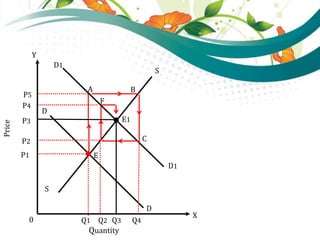
(i) It fails to predict the path
which the market fallows when
moving from one equilibrium
position to another, and
(ii) It can not predict whether
or not a given equilibrium position
will ever be achieved.(For this we
need dynamic analysis.)
Comparative statics suffer from
certain limitation. There are two
types of problem
P
S
S
Q
0
EP1
Q1
D
D
D1
D1
E1P2
Q2
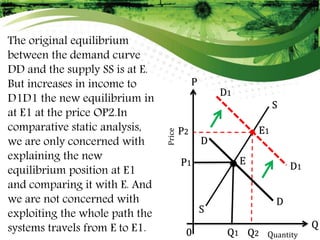
The original equilibrium
between the demand curve
DD and the supply SS is at E.
But increases in income to
D1D1 the new equilibrium in
at E1 at the price OP2.In
comparative static analysis,
we are only concerned with
explaining the new
equilibrium position at E1
and comparing it with E. And
we are not concerned with
exploiting the whole path the
systems travels from E to E1. Quantity
Price
F
D
S
S
X
Y
E1
E
BA
D1
D1
D
C
0 Q1 Q2 Q3 Q4
Quantity
Price
P5
P4
P3
P2
P1
Have you any question

Economics

  • 1.
  • 2.
  • 3.
  • 4.
  • 5.
    Course Teacher MD. SumonHossain Assistant professor, Department of Accounting and Information Systems, University of Rajshahi.
  • 6.
  • 7.
    On the basisof time, the equilibrium between two variables in microeconomics is divided into two parts as dynamic and comparative which are also called types of microeconomics. The types of Microeconomics is explained separately as stated below; 1.Micro Dynamics 2.Micro comparative statics Micro-statics
  • 8.
    Micro statics Micro staticsrefers to the stationary situation of the equilibrium between different variables at certain point of time. In other words, when the value of economic variables are related to the same point of time, the functional relationship between variables is said to be statics.
  • 9.
    Y X S S D D 0 Q P Price Quantity E timotThe figureshows the equilibrium of the market in a certain point of time. Both the demand curve DD and supply curve SS have intersected each other at point E in a particular point in time. So E is the point of equilibrium which relates two of the variables price (OP) and quantity (OQ) at a particular point in time. This is a static analysis. The concept of micro statics has been illustrated in the following figure as;
  • 10.
    Limitation of microStatics 1.Statics analysis assumes many times. We can not pump in much meaning into our statements regarding economics changes since they take place over time. 2.Static analysis only a limited scope to deal with the real economics problem. 3.It assumes variable data, but the actual world is a dynamic one where the data are continuously changing.
  • 11.
    1. Micro dynamics Thereis always change in time. This change brings change in price and the demand & supply of quantity of commodities. Consequently there is a change in equilibrium. Therefore micro dynamics refers to that situation of equilibrium in which an equilibrium of different variables goes through disequilibrium and new equilibrium establishes. Hence micro dynamics is the study of the process which shows how the initial equilibrium breaks and new equilibrium attains. Micro dynamics can also be explain by the following figure.
  • 12.
    In the figureE is the initial equilibrium, where equilibrium price is OP and time is OT . When the time is pass, then the price will raise like OP1.In this situation the time is OT1. D Y X 0 T P Price Time E P1 T1 The concept of micro statics has been illustrated in the following figure as;
  • 13.
    1.The method ofdynamic statics essentially very complex. 2.Only a few economists equipped with the techniques of advance mathematics can make use of it. That why it has reduced its popularity. Limitation of Dynamic Statics
  • 14.
    Comparative Micro statics Astime passes, there is change in the condition of demand and supply. This change in demand and supply brings a change even in the equilibrium condition. This type of change in equilibrium at different points of time is the study of comparative micro statics. Therefore comparative micro statics is the study of different equilibriums at different points of time. Comparative micro statics compares one equilibrium with other equilibrium but it does not study about the process how one equilibrium breaks and another equilibrium establishes.
  • 15.
    Limitation of ComparativeMicro statics (i) It fails to predict the path which the market fallows when moving from one equilibrium position to another, and (ii) It can not predict whether or not a given equilibrium position will ever be achieved.(For this we need dynamic analysis.) Comparative statics suffer from certain limitation. There are two types of problem
  • 16.
    P S S Q 0 EP1 Q1 D D D1 D1 E1P2 Q2 The original equilibrium betweenthe demand curve DD and the supply SS is at E. But increases in income to D1D1 the new equilibrium in at E1 at the price OP2.In comparative static analysis, we are only concerned with explaining the new equilibrium position at E1 and comparing it with E. And we are not concerned with exploiting the whole path the systems travels from E to E1. Quantity Price
  • 17.
    F D S S X Y E1 E BA D1 D1 D C 0 Q1 Q2Q3 Q4 Quantity Price P5 P4 P3 P2 P1
  • 18.
    Have you anyquestion