Microeconomics: Lecture 1
Introduction and Preliminaries
10/6/2023 Introduction 2
About the course
 This is a sophisticated introduction to
economics for students like you!
 there will be some challenges, but you will be
surprised by how much you will achieve!
 You will learn
 the most fundamental tools that economists use
 how modern economic theory allows us to
understand economic phenomena
10/6/2023 Introduction 3
Two ‘teaching blocks’
 Lecture: formal tools, language and analysis are
introduced.
 Recitation by TA: go over problem sets and
discuss other material
Course Website:
http://newclasses.nyu.edu/
1. lecture notes (slides)
2. problem sets and answer
keys
3. sample exams
10/6/2023 Introduction 5
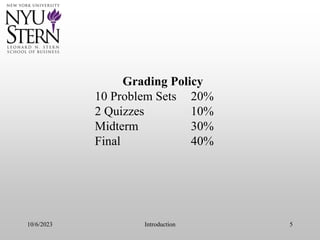
Grading Policy
10 Problem Sets 20%
2 Quizzes 10%
Midterm 30%
Final 40%
10/6/2023 Introduction 6
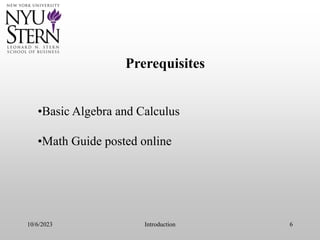
Prerequisites
•Basic Algebra and Calculus
•Math Guide posted online
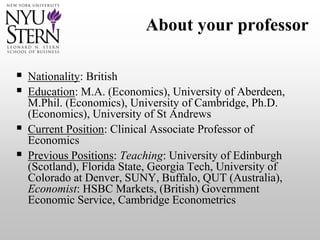
About your professor
 Nationality: British
 Education: M.A. (Economics), University of Aberdeen,
M.Phil. (Economics), University of Cambridge, Ph.D.
(Economics), University of St Andrews
 Current Position: Clinical Associate Professor of
Economics
 Previous Positions: Teaching: University of Edinburgh
(Scotland), Florida State, Georgia Tech, University of
Colorado at Denver, SUNY, Buffalo, QUT (Australia),
Economist: HSBC Markets, (British) Government
Economic Service, Cambridge Econometrics
10/6/2023 Introduction 8
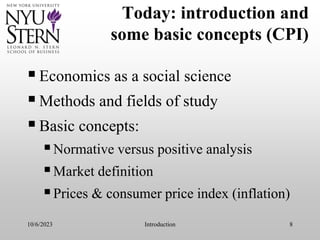
Today: introduction and
some basic concepts (CPI)
Economics as a social science
Methods and fields of study
Basic concepts:
Normative versus positive analysis
Market definition
Prices & consumer price index (inflation)
Economics: Definition
 Economics is the study of how a society uses
its limited resources to produce, trade and
consume goods and services
Limited budgets and time for consumers
Limited ability to produce for producers
Micro versus Macro
 Macroeconomics: branch of economics that
deals with aggregate economic variables,
such as
 Growth rate of GDP
 Interest Rates
 Unemployment
 Inflation
Micro versus Macro
 Microeconomics: branch of economics that
deals with behavior of individual economic
units – consumers, firms, workers, investors
– and markets that these units comprise
Themes of Microeconomics
 Workers, firms and consumers must make trade-offs
Do I work or go on vacation?
Do I purchase a new car or save my money?
Do we hire more workers or buy new machinery?
 How are these trade-offs best made?
 Theories and models give insight by providing basic structure
Theories and Models
 Theories are expressed in the form of economic
models
 An economic model is a description of an economic
situation via words and mathematical expressions
 Often mathematical expressions are depicted with
diagrams
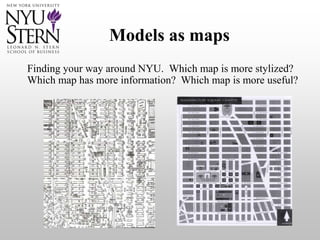
Models as maps
Finding your way around NYU. Which map is more stylized?
Which map has more information? Which map is more useful?
Economic Models:
Description
A model usually consists of:
agents: their resources, objectives,
preferences, how they behave, …
economic environment (markets, contractual
arrangements, other relevant institutions)
Economic Model:
US Open
Some concepts:
1)Positive & Normative Analysis
 Positive Analysis – statements that describe the
relationship of cause and effect
 Questions that deal with explanation and
prediction
 Normative Analysis - analysis examining
questions of what ought to be
 Often supplemented by value judgments
Positive & Normative Analysis (ctd)
10/6/2023 Introduction 19
2) Market
 Collection of buyers and sellers, through their
actual or potential interaction, determine the prices
of products
 Buyers: consumers purchase goods, companies
purchase labor and inputs
 Sellers: consumers sell labor, resource owners
sell inputs, firms sell goods
10/6/2023 Introduction 20
What is a Market?
 Many of the most interesting questions in economics
concern the functioning of markets
 Why are there a lot of firms in some markets and
not in others?
 Are consumers better off with many firms?
 Should the government intervene in markets?
The Extent of the Market
 Are fast-food restaurants in Williamsburg
and the Village part of the same market?
 Are laptops and Ipads part of the same
market or not?
3) Price
Price = signal to agents when making
decisions
Not always in a market environment:
Centrally planned economies (Cuba,
North Korea, former Soviet Union)
by government or regulatory body
Real Versus Nominal Prices
Comparing prices over time requires
measuring prices relative to some
overall price level
Nominal price is the absolute or current
dollar price of a good or service when it
is sold
Real price is the price relative to an
aggregate measure of prices or constant
dollar price
Real Versus Nominal Prices
Consumer Price Index (CPI) is often
used as a measure of aggregate prices
Records the prices of a large market
basket of goods purchased by a “typical”
consumer over time
Weighted by expenditure shares
Percent changes in CPI measure the rate
of inflation
Real Versus Nominal Prices
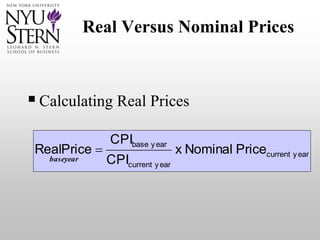
Calculating Real Prices
year
current
year
current
year
base
Price
Nominal
x
CPI
CPI
RealPrice 
baseyear
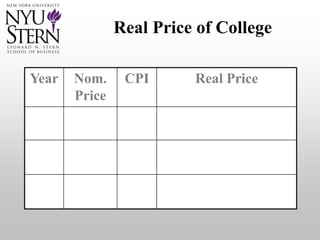
Real Price of College
Year Nom.
Price
CPI Real Price
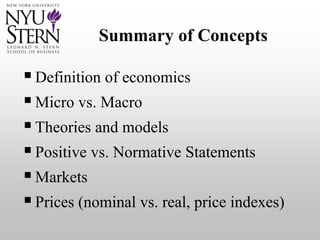
Summary of Concepts
Definition of economics
Micro vs. Macro
Theories and models
Positive vs. Normative Statements
Markets
Prices (nominal vs. real, price indexes)
Required Reading
Pindyck and Rubinfeld,
Microeconomics, 8th edition, Chapter
1, pp. 3-20.

vdocuments.mx_lecture1-micro-2013.ppt

  • 1.
  • 2.
    10/6/2023 Introduction 2 Aboutthe course  This is a sophisticated introduction to economics for students like you!  there will be some challenges, but you will be surprised by how much you will achieve!  You will learn  the most fundamental tools that economists use  how modern economic theory allows us to understand economic phenomena
  • 3.
    10/6/2023 Introduction 3 Two‘teaching blocks’  Lecture: formal tools, language and analysis are introduced.  Recitation by TA: go over problem sets and discuss other material
  • 4.
    Course Website: http://newclasses.nyu.edu/ 1. lecturenotes (slides) 2. problem sets and answer keys 3. sample exams
  • 5.
    10/6/2023 Introduction 5 GradingPolicy 10 Problem Sets 20% 2 Quizzes 10% Midterm 30% Final 40%
  • 6.
    10/6/2023 Introduction 6 Prerequisites •BasicAlgebra and Calculus •Math Guide posted online
  • 7.
    About your professor Nationality: British  Education: M.A. (Economics), University of Aberdeen, M.Phil. (Economics), University of Cambridge, Ph.D. (Economics), University of St Andrews  Current Position: Clinical Associate Professor of Economics  Previous Positions: Teaching: University of Edinburgh (Scotland), Florida State, Georgia Tech, University of Colorado at Denver, SUNY, Buffalo, QUT (Australia), Economist: HSBC Markets, (British) Government Economic Service, Cambridge Econometrics
  • 8.
    10/6/2023 Introduction 8 Today:introduction and some basic concepts (CPI) Economics as a social science Methods and fields of study Basic concepts: Normative versus positive analysis Market definition Prices & consumer price index (inflation)
  • 9.
    Economics: Definition  Economicsis the study of how a society uses its limited resources to produce, trade and consume goods and services Limited budgets and time for consumers Limited ability to produce for producers
  • 10.
    Micro versus Macro Macroeconomics: branch of economics that deals with aggregate economic variables, such as  Growth rate of GDP  Interest Rates  Unemployment  Inflation
  • 11.
    Micro versus Macro Microeconomics: branch of economics that deals with behavior of individual economic units – consumers, firms, workers, investors – and markets that these units comprise
  • 12.
    Themes of Microeconomics Workers, firms and consumers must make trade-offs Do I work or go on vacation? Do I purchase a new car or save my money? Do we hire more workers or buy new machinery?  How are these trade-offs best made?  Theories and models give insight by providing basic structure
  • 13.
    Theories and Models Theories are expressed in the form of economic models  An economic model is a description of an economic situation via words and mathematical expressions  Often mathematical expressions are depicted with diagrams
  • 14.
    Models as maps Findingyour way around NYU. Which map is more stylized? Which map has more information? Which map is more useful?
  • 15.
    Economic Models: Description A modelusually consists of: agents: their resources, objectives, preferences, how they behave, … economic environment (markets, contractual arrangements, other relevant institutions)
  • 16.
  • 17.
    Some concepts: 1)Positive &Normative Analysis  Positive Analysis – statements that describe the relationship of cause and effect  Questions that deal with explanation and prediction
  • 18.
     Normative Analysis- analysis examining questions of what ought to be  Often supplemented by value judgments Positive & Normative Analysis (ctd)
  • 19.
    10/6/2023 Introduction 19 2)Market  Collection of buyers and sellers, through their actual or potential interaction, determine the prices of products  Buyers: consumers purchase goods, companies purchase labor and inputs  Sellers: consumers sell labor, resource owners sell inputs, firms sell goods
  • 20.
    10/6/2023 Introduction 20 Whatis a Market?  Many of the most interesting questions in economics concern the functioning of markets  Why are there a lot of firms in some markets and not in others?  Are consumers better off with many firms?  Should the government intervene in markets?
  • 21.
    The Extent ofthe Market  Are fast-food restaurants in Williamsburg and the Village part of the same market?  Are laptops and Ipads part of the same market or not?
  • 22.
    3) Price Price =signal to agents when making decisions Not always in a market environment: Centrally planned economies (Cuba, North Korea, former Soviet Union) by government or regulatory body
  • 23.
    Real Versus NominalPrices Comparing prices over time requires measuring prices relative to some overall price level Nominal price is the absolute or current dollar price of a good or service when it is sold Real price is the price relative to an aggregate measure of prices or constant dollar price
  • 24.
    Real Versus NominalPrices Consumer Price Index (CPI) is often used as a measure of aggregate prices Records the prices of a large market basket of goods purchased by a “typical” consumer over time Weighted by expenditure shares Percent changes in CPI measure the rate of inflation
  • 25.
    Real Versus NominalPrices Calculating Real Prices year current year current year base Price Nominal x CPI CPI RealPrice  baseyear
  • 26.
    Real Price ofCollege Year Nom. Price CPI Real Price
  • 27.
    Summary of Concepts Definitionof economics Micro vs. Macro Theories and models Positive vs. Normative Statements Markets Prices (nominal vs. real, price indexes)
  • 28.
    Required Reading Pindyck andRubinfeld, Microeconomics, 8th edition, Chapter 1, pp. 3-20.