WE ARE TALKING ABOUT ECONOMICS!!!
 ECONOMIC MODEL: CIRCULAR FLOW OF INCOME
 GDP
 ECONOMIC CYCLE
 RECESSION (CRISIS)
 ECONOMICS INDICATORS
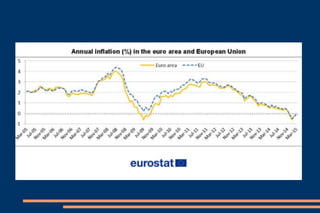
 INFLATION: CPI
 INTEREST RATES
 EURIBOR
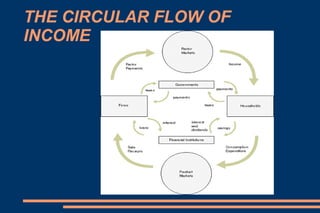
THE CIRCULAR FLOW OF INCOME
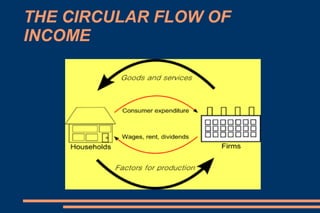
 Definition:The circular flow of income is a simple model of the
economy showing flows of goods and services and factors of
production between firms and households. It shows that
households provide the factors of production for firms who
produce goods and services. In return the factors of production
receive factor payments, such as wages, which in turn are spent
on the output of firms.
THE CIRCULAR FLOW OF
INCOME
THE CIRCULAR FLOW OF INCOME
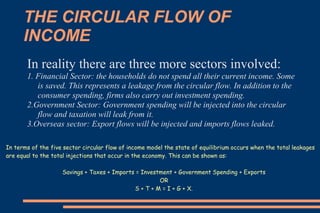
 In reality there are three more sectors involved:
 1.Financial Sector:the households do not spend all their current income.Some is saved.This
represents a leakage from the circular flow.In addition to the consumer spending,firms also
carry out investment spending.
 2.Government Sector:Government spending will be injected into the circular flow and taxation
will leak from it.
 3.Overseas sector:Export flows will be injected and imports flows leaked.
In terms of the five sector circular flow of income model the state of equilibrium occurs when the total leakages
are equal to the total injections that occur in the economy. This can be shown as:
Savings + Taxes + Imports = Investment + Government Spending + Exports
OR
S + T + M = I + G + X.
THE CIRCULAR FLOW OF
INCOME
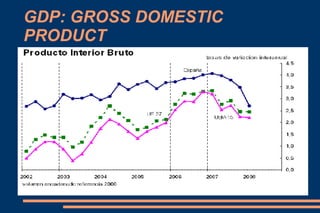
GDP: GROSS DOMESTIC PRODUCT
 Definition:The total market value of all goods and services
produced within the political boundaries of an economy during a
given period of time, usually one year.This is the government's
official measure of how much output our economy produces.
GDP: GROSS DOMESTIC PRODUCT
ECONOMIC CYCLE
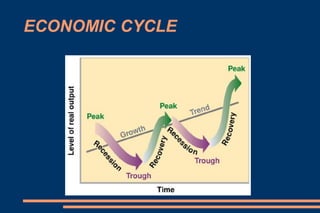
 The business cycle or economic cycle refers to the fluctuations of
economic activity about its long term growth trend.The cycle
involves shifts over time between periods of relatively rapid
growth of output (recovery and prosperity), and periods of
relative stagnation or decline (contraction or recession).These
fluctuations are often measured using the real gross domestic
product.
ECONOMIC CYCLE
RECESSION
 Definition:A not very well defined term that indicates a
slowdown in economic activity.A particularly long-lasting and
painful recession is known as a depression.
 Recession? Depression?What's the difference?
There is an old joke among economists that states:
A recession is when your neighbor loses his job.
A depression is when you lose your job.
ECONOMIC INDICATORS
 Definition:An economic indicator is simply any economic
statistic, such as the unemployment rate, GDP, or the inflation
rate, which indicate how well the economy is doing and how well
the economy is going to do in the future, investors use all the
information to make decisions.And also they show how effective
are economic policies.
ECONOMIC INDICATORS: TIMING
 Definition: Economic Indicators can be leading, lagging, or
coincident which indicates the timing of their changes
relative to how the economy as a whole changes.
 1. Leading: Leading economic indicators are indicators which change before the economy changes.Stock market returns
are a leading indicator,as the stock market usually begins to decline before the economy declines and they improve before the economy
begins to pull out of a recession.Leading economic indicators are the most important type for investors as they help predict what the
economy will be like in the future.
 2. Lagged: A lagged economic indicator is one that does not change direction until a few quarters after the economy does.The
unemployment rate is a lagged economic indicator as unemployment tends to increase for 2 or 3 quarters after the economy starts
to improve.
 3. Coincident: A coincident economic indicator is one that simply moves at the same time the economy does.The Gross
Domestic Product is a coincident indicator.
INFLATION: CPI (CONSUMERS PRICE
INDEX)
 Definition: Inflation is a rise in the general level of prices of goods and
services over time.
 Negative effects: Decreases the purchasing power and also reduce
incentives to save.
 Calculating inflation: There are many measures of inflation, because
there are many different price indices relating to different sectors of
the economy.The two most common price indices used in calculating
inflation are CPI and the GDP deflator.
INTEREST RATES
 Definition:The interest rate is the price charged by a lender to a
borrower in order for the borrower to obtain a loan.This is
usually expressed as a percentage of the total amount loaned.
Interest rates, both nominal and real, have impacts on the
economy as they impact the saving, spending and investment
decisions made by households and firms.
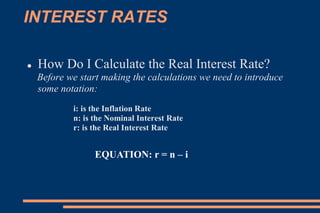
INTEREST RATES
 How Do I Calculate the Real Interest Rate?
Before we start making the calculations we need to introduce some notation:
i: is the Inflation Rate
n: is the Nominal Interest Rate
r: is the Real Interest Rate
EQUATION: r = n – i
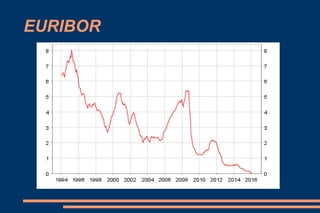
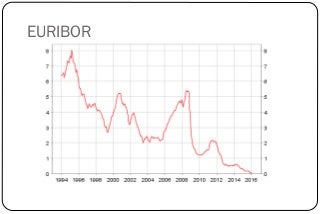
EURIBOR
 Definition:The Euro Interbank Offered Rate (or Euribor) is a
daily reference rate based on the averaged interest rates at which
banks offer to lend unsecured funds to other banks in the euro
wholesale money market (or interbank market).
EURIBOR

Economics indicators

  • 1.
    WE ARE TALKINGABOUT ECONOMICS!!!
  • 2.
    WE ARE TALKINGABOUT ECONOMICS!!!  ECONOMIC MODEL: CIRCULAR FLOW OF INCOME  GDP  ECONOMIC CYCLE  RECESSION (CRISIS)  ECONOMICS INDICATORS  INFLATION: CPI  INTEREST RATES  EURIBOR
  • 3.
    THE CIRCULAR FLOWOF INCOME  Definition:The circular flow of income is a simple model of the economy showing flows of goods and services and factors of production between firms and households. It shows that households provide the factors of production for firms who produce goods and services. In return the factors of production receive factor payments, such as wages, which in turn are spent on the output of firms.
  • 4.
  • 5.
    THE CIRCULAR FLOWOF INCOME  In reality there are three more sectors involved:  1.Financial Sector:the households do not spend all their current income.Some is saved.This represents a leakage from the circular flow.In addition to the consumer spending,firms also carry out investment spending.  2.Government Sector:Government spending will be injected into the circular flow and taxation will leak from it.  3.Overseas sector:Export flows will be injected and imports flows leaked. In terms of the five sector circular flow of income model the state of equilibrium occurs when the total leakages are equal to the total injections that occur in the economy. This can be shown as: Savings + Taxes + Imports = Investment + Government Spending + Exports OR S + T + M = I + G + X.
  • 6.
  • 7.
    GDP: GROSS DOMESTICPRODUCT  Definition:The total market value of all goods and services produced within the political boundaries of an economy during a given period of time, usually one year.This is the government's official measure of how much output our economy produces.
  • 8.
  • 9.
    ECONOMIC CYCLE  Thebusiness cycle or economic cycle refers to the fluctuations of economic activity about its long term growth trend.The cycle involves shifts over time between periods of relatively rapid growth of output (recovery and prosperity), and periods of relative stagnation or decline (contraction or recession).These fluctuations are often measured using the real gross domestic product.
  • 10.
  • 11.
    RECESSION  Definition:A notvery well defined term that indicates a slowdown in economic activity.A particularly long-lasting and painful recession is known as a depression.  Recession? Depression?What's the difference? There is an old joke among economists that states: A recession is when your neighbor loses his job. A depression is when you lose your job.
  • 12.
    ECONOMIC INDICATORS  Definition:Aneconomic indicator is simply any economic statistic, such as the unemployment rate, GDP, or the inflation rate, which indicate how well the economy is doing and how well the economy is going to do in the future, investors use all the information to make decisions.And also they show how effective are economic policies.
  • 13.
    ECONOMIC INDICATORS: TIMING Definition: Economic Indicators can be leading, lagging, or coincident which indicates the timing of their changes relative to how the economy as a whole changes.  1. Leading: Leading economic indicators are indicators which change before the economy changes.Stock market returns are a leading indicator,as the stock market usually begins to decline before the economy declines and they improve before the economy begins to pull out of a recession.Leading economic indicators are the most important type for investors as they help predict what the economy will be like in the future.  2. Lagged: A lagged economic indicator is one that does not change direction until a few quarters after the economy does.The unemployment rate is a lagged economic indicator as unemployment tends to increase for 2 or 3 quarters after the economy starts to improve.  3. Coincident: A coincident economic indicator is one that simply moves at the same time the economy does.The Gross Domestic Product is a coincident indicator.
  • 14.
    INFLATION: CPI (CONSUMERSPRICE INDEX)  Definition: Inflation is a rise in the general level of prices of goods and services over time.  Negative effects: Decreases the purchasing power and also reduce incentives to save.  Calculating inflation: There are many measures of inflation, because there are many different price indices relating to different sectors of the economy.The two most common price indices used in calculating inflation are CPI and the GDP deflator.
  • 16.
    INTEREST RATES  Definition:Theinterest rate is the price charged by a lender to a borrower in order for the borrower to obtain a loan.This is usually expressed as a percentage of the total amount loaned. Interest rates, both nominal and real, have impacts on the economy as they impact the saving, spending and investment decisions made by households and firms.
  • 17.
    INTEREST RATES  HowDo I Calculate the Real Interest Rate? Before we start making the calculations we need to introduce some notation: i: is the Inflation Rate n: is the Nominal Interest Rate r: is the Real Interest Rate EQUATION: r = n – i
  • 18.
    EURIBOR  Definition:The EuroInterbank Offered Rate (or Euribor) is a daily reference rate based on the averaged interest rates at which banks offer to lend unsecured funds to other banks in the euro wholesale money market (or interbank market).
  • 19.