INFLATION
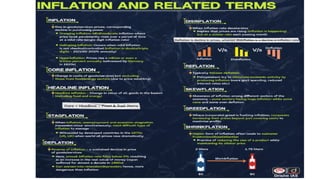
It is the gradual rise in prices of goods and
services within a particular economy wherein,
the purchasing power of consumers decreases, and
the value of the cash holdings erode.
The opposite and rare fall in the price index of this basket of items is
called deflation.
In India, the Ministry of Statistics and Programme Implementation
(MoSPI) measures inflation.
Cause of Inflation
Demand-pull inflation: When aggregate demand surpasses the available
goods and services, it leads to demand-pull inflation.
Cost-Push Inflation: Rising production costs, such as higher wages or
increased raw material prices, can result in cost-push inflation.
Bottleneck Inflation:- Due to old /primitive technology and structure
Few Terms
Creeping Inflation (Mild/Moderate Inflation)
1️
1️
⃣
Rate: Below 3% per year
Features: Gradual rise in prices
Impact: Considered normal and healthy for economic growth
Example: 2% annual inflation in developed economies
Few Terms
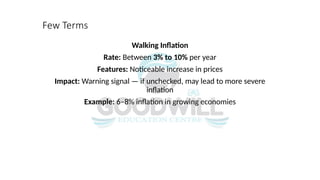
Walking Inflation
Rate: Between 3% to 10% per year
Features: Noticeable increase in prices
Impact: Warning signal — if unchecked, may lead to more severe
inflation
Example: 6–8% inflation in growing economies
Few Terms
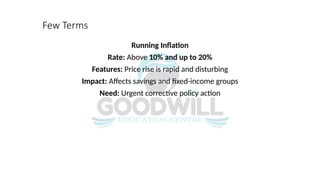
Running Inflation
Rate: Above 10% and up to 20%
Features: Price rise is rapid and disturbing
Impact: Affects savings and fixed-income groups
Need: Urgent corrective policy action
Few Terms
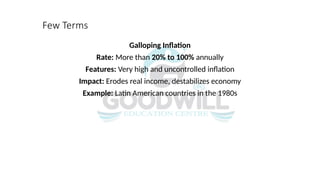
Galloping Inflation
Rate: More than 20% to 100% annually
Features: Very high and uncontrolled inflation
Impact: Erodes real income, destabilizes economy
Example: Latin American countries in the 1980s
Few Terms
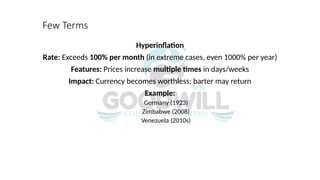
Hyperinflation
Rate: Exceeds 100% per month (in extreme cases, even 1000% per year)
Features: Prices increase multiple times in days/weeks
Impact: Currency becomes worthless; barter may return
Example:
Germany (1923)
Zimbabwe (2008)
Venezuela (2010s)
Few Terms
Hyperinflation
Rate: Exceeds 100% per month (in extreme cases, even 1000% per year)
Features: Prices increase multiple times in days/weeks
Impact: Currency becomes worthless; barter may return
Example:
Germany (1923)
Zimbabwe (2008)
Venezuela (2010s)
Few Terms
Deflation
A sustained decrease in the general price level.
Indicates falling demand, can lead to unemployment and economic
slowdown.
Few Terms
Disinflation
A decrease in the rate of inflation (prices still rise, but at a slower rate).
Often achieved through monetary tightening by the central bank.
Reflation
A deliberate policy to raise prices to the desired level after a period of
deflation or stagnation.
Achieved through government spending, tax cuts, or lower interest rate
Few Terms
Skewflation
Inflation in certain sectors only, while others remain stable or fall.
Example: High price rise in food or fuel, but not in clothing or rent.
Stagflation
A rare situation where inflation and unemployment both rise.
Economy faces stagnation + inflation simultaneously.
Very difficult to control through standard economic policies.
Few Terms
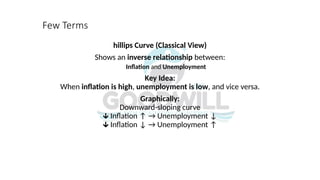
hillips Curve (Classical View)
Shows an inverse relationship between:
Inflation and Unemployment
Key Idea:
When inflation is high, unemployment is low, and vice versa.
Graphically:
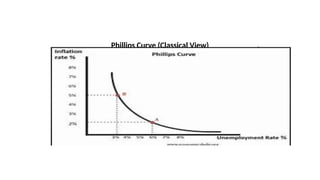
Downward-sloping curve
Inflation ↑ → Unemployment ↓
🡳
Inflation ↓ → Unemployment ↑
🡳
Philip’s
Curve
Phillips Curve (Classical View)
Few Terms
hillips Curve (Classical View)
Shows an inverse relationship between:
Inflation and Unemployment
Key Idea:
When inflation is high, unemployment is low, and vice versa.
Graphically:
Downward-sloping curve
Inflation ↑ → Unemployment ↓
🡳
Inflation ↓ → Unemployment ↑
🡳
Few Terms
hillips Curve (Classical View)
Shows an inverse relationship between:
Inflation and Unemployment
Key Idea:
When inflation is high, unemployment is low, and vice versa.
Graphically:
Downward-sloping curve
Inflation ↑ → Unemployment ↓
🡳
Inflation ↓ → Unemployment ↑
🡳
Control Inflation
. Monetary Policy (RBI)
Adjusts Repo Rate to control money supply and credit.
Uses Open Market Operations (OMO) to buy/sell govt. securities.
✅ 2. Fiscal Policy
Uses taxation and public spending to manage demand.
Higher taxes reduce disposable income → controls inflation.
Control Inflation
✅ 3. Food Price Management
Tools: Minimum Support Price (MSP) & Public Distribution System (PDS).
Ensures stable food supply to prevent food-led inflation.
✅ 4. Buffer Stock Operations
Maintains essential commodities to stabilize prices.
Strengthening Price Support Scheme (PSS) is essential.
Control Inflation
✅ 5. Trade Policy Measures
Import/export regulations to manage domestic supply.
Align trade policy with inflation targets.
✅ 6. Anti-Hoarding Steps
Action against hoarding & black marketing.
Improve enforcement of Essential Commodities Act, 1955.
✅ 7. Exchange Rate Management
Stable exchange rate helps control import-led inflation.
Suggestion: Create Public Debt & Exchange Rate Management Agency.
✅ 8. Financial Inclusion
Promote savings via PM Jan Dhan Yojana (PMJDY).
Formal banking reduces informal cash circulation & inflation risk.
Inflation for civil services preparation

Inflation for civil services preparation

  • 1.
  • 2.
    It is thegradual rise in prices of goods and services within a particular economy wherein, the purchasing power of consumers decreases, and the value of the cash holdings erode. The opposite and rare fall in the price index of this basket of items is called deflation. In India, the Ministry of Statistics and Programme Implementation (MoSPI) measures inflation.
  • 3.
    Cause of Inflation Demand-pullinflation: When aggregate demand surpasses the available goods and services, it leads to demand-pull inflation. Cost-Push Inflation: Rising production costs, such as higher wages or increased raw material prices, can result in cost-push inflation. Bottleneck Inflation:- Due to old /primitive technology and structure
  • 4.
    Few Terms Creeping Inflation(Mild/Moderate Inflation) 1️ 1️ ⃣ Rate: Below 3% per year Features: Gradual rise in prices Impact: Considered normal and healthy for economic growth Example: 2% annual inflation in developed economies
  • 5.
    Few Terms Walking Inflation Rate:Between 3% to 10% per year Features: Noticeable increase in prices Impact: Warning signal — if unchecked, may lead to more severe inflation Example: 6–8% inflation in growing economies
  • 6.
    Few Terms Running Inflation Rate:Above 10% and up to 20% Features: Price rise is rapid and disturbing Impact: Affects savings and fixed-income groups Need: Urgent corrective policy action
  • 7.
    Few Terms Galloping Inflation Rate:More than 20% to 100% annually Features: Very high and uncontrolled inflation Impact: Erodes real income, destabilizes economy Example: Latin American countries in the 1980s
  • 8.
    Few Terms Hyperinflation Rate: Exceeds100% per month (in extreme cases, even 1000% per year) Features: Prices increase multiple times in days/weeks Impact: Currency becomes worthless; barter may return Example: Germany (1923) Zimbabwe (2008) Venezuela (2010s)
  • 9.
    Few Terms Hyperinflation Rate: Exceeds100% per month (in extreme cases, even 1000% per year) Features: Prices increase multiple times in days/weeks Impact: Currency becomes worthless; barter may return Example: Germany (1923) Zimbabwe (2008) Venezuela (2010s)
  • 10.
    Few Terms Deflation A sustaineddecrease in the general price level. Indicates falling demand, can lead to unemployment and economic slowdown.
  • 11.
    Few Terms Disinflation A decreasein the rate of inflation (prices still rise, but at a slower rate). Often achieved through monetary tightening by the central bank. Reflation A deliberate policy to raise prices to the desired level after a period of deflation or stagnation. Achieved through government spending, tax cuts, or lower interest rate
  • 12.
    Few Terms Skewflation Inflation incertain sectors only, while others remain stable or fall. Example: High price rise in food or fuel, but not in clothing or rent. Stagflation A rare situation where inflation and unemployment both rise. Economy faces stagnation + inflation simultaneously. Very difficult to control through standard economic policies.
  • 13.
    Few Terms hillips Curve(Classical View) Shows an inverse relationship between: Inflation and Unemployment Key Idea: When inflation is high, unemployment is low, and vice versa. Graphically: Downward-sloping curve Inflation ↑ → Unemployment ↓ 🡳 Inflation ↓ → Unemployment ↑ 🡳
  • 14.
  • 15.
    Few Terms hillips Curve(Classical View) Shows an inverse relationship between: Inflation and Unemployment Key Idea: When inflation is high, unemployment is low, and vice versa. Graphically: Downward-sloping curve Inflation ↑ → Unemployment ↓ 🡳 Inflation ↓ → Unemployment ↑ 🡳
  • 16.
    Few Terms hillips Curve(Classical View) Shows an inverse relationship between: Inflation and Unemployment Key Idea: When inflation is high, unemployment is low, and vice versa. Graphically: Downward-sloping curve Inflation ↑ → Unemployment ↓ 🡳 Inflation ↓ → Unemployment ↑ 🡳
  • 18.
    Control Inflation . MonetaryPolicy (RBI) Adjusts Repo Rate to control money supply and credit. Uses Open Market Operations (OMO) to buy/sell govt. securities. ✅ 2. Fiscal Policy Uses taxation and public spending to manage demand. Higher taxes reduce disposable income → controls inflation.
  • 19.
    Control Inflation ✅ 3.Food Price Management Tools: Minimum Support Price (MSP) & Public Distribution System (PDS). Ensures stable food supply to prevent food-led inflation. ✅ 4. Buffer Stock Operations Maintains essential commodities to stabilize prices. Strengthening Price Support Scheme (PSS) is essential.
  • 20.
    Control Inflation ✅ 5.Trade Policy Measures Import/export regulations to manage domestic supply. Align trade policy with inflation targets. ✅ 6. Anti-Hoarding Steps Action against hoarding & black marketing. Improve enforcement of Essential Commodities Act, 1955. ✅ 7. Exchange Rate Management Stable exchange rate helps control import-led inflation. Suggestion: Create Public Debt & Exchange Rate Management Agency. ✅ 8. Financial Inclusion Promote savings via PM Jan Dhan Yojana (PMJDY). Formal banking reduces informal cash circulation & inflation risk.