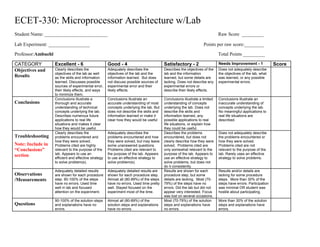
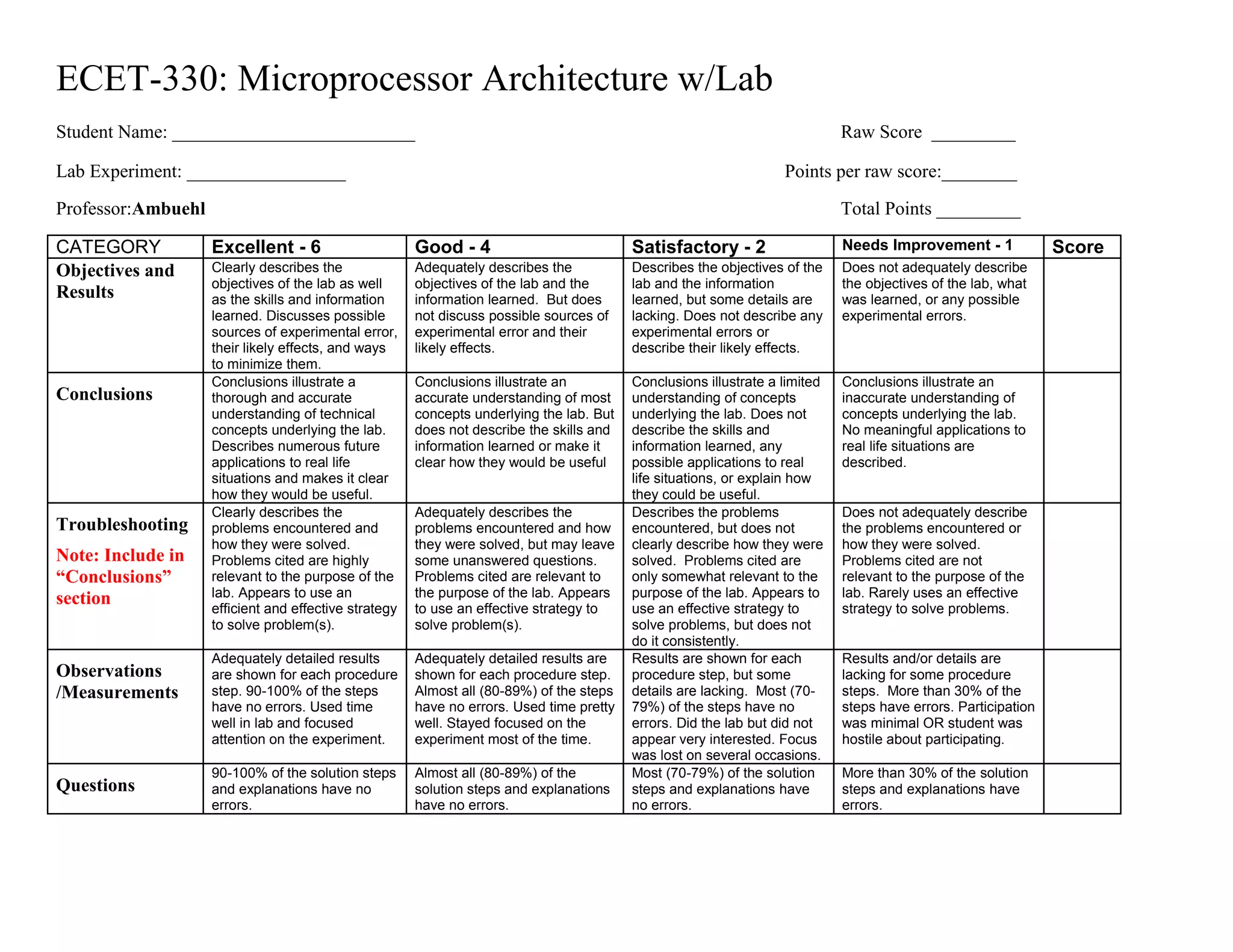
ECET-330: Microprocessor Architecture w/Lab
Student Name: __________________________ Raw Score _________
Lab Experiment: _________________ Points per raw score:________
Professor:Ambuehl Total Points _________
CATEGORY Excellent - 6 Good - 4 Satisfactory - 2 Needs Improvement - 1 Score
Objectives and
Results
Clearly describes the
objectives of the lab as well
as the skills and information
learned. Discusses possible
sources of experimental error,
their likely effects, and ways
to minimize them.
Adequately describes the
objectives of the lab and the
information learned. But does
not discuss possible sources of
experimental error and their
likely effects.
Describes the objectives of the
lab and the information
learned, but some details are
lacking. Does not describe any
experimental errors or
describe their likely effects.
Does not adequately describe
the objectives of the lab, what
was learned, or any possible
experimental errors.
Conclusions
Conclusions illustrate a
thorough and accurate
understanding of technical
concepts underlying the lab.
Describes numerous future
applications to real life
situations and makes it clear
how they would be useful.
Conclusions illustrate an
accurate understanding of most
concepts underlying the lab. But
does not describe the skills and
information learned or make it
clear how they would be useful
Conclusions illustrate a limited
understanding of concepts
underlying the lab. Does not
describe the skills and
information learned, any
possible applications to real
life situations, or explain how
they could be useful.
Conclusions illustrate an
inaccurate understanding of
concepts underlying the lab.
No meaningful applications to
real life situations are
described.
Troubleshooting
Note: Include in
“Conclusions”
section
Clearly describes the
problems encountered and
how they were solved.
Problems cited are highly
relevant to the purpose of the
lab. Appears to use an
efficient and effective strategy
to solve problem(s).
Adequately describes the
problems encountered and how
they were solved, but may leave
some unanswered questions.
Problems cited are relevant to
the purpose of the lab. Appears
to use an effective strategy to
solve problem(s).
Describes the problems
encountered, but does not
clearly describe how they were
solved. Problems cited are
only somewhat relevant to the
purpose of the lab. Appears to
use an effective strategy to
solve problems, but does not
do it consistently.
Does not adequately describe
the problems encountered or
how they were solved.
Problems cited are not
relevant to the purpose of the
lab. Rarely uses an effective
strategy to solve problems.
Observations
/Measurements
Adequately detailed results
are shown for each procedure
step. 90-100% of the steps
have no errors. Used time
well in lab and focused
attention on the experiment.
Adequately detailed results are
shown for each procedure step.
Almost all (80-89%) of the steps
have no errors. Used time pretty
well. Stayed focused on the
experiment most of the time.
Results are shown for each
procedure step, but some
details are lacking. Most (70-
79%) of the steps have no
errors. Did the lab but did not
appear very interested. Focus
was lost on several occasions.
Results and/or details are
lacking for some procedure
steps. More than 30% of the
steps have errors. Participation
was minimal OR student was
hostile about participating.
Questions
90-100% of the solution steps
and explanations have no
errors.
Almost all (80-89%) of the
solution steps and explanations
have no errors.
Most (70-79%) of the solution
steps and explanations have
no errors.
More than 30% of the solution
steps and explanations have
errors.

Ecet330 lab rubric

  • 1.
    ECET-330: Microprocessor Architecturew/Lab Student Name: __________________________ Raw Score _________ Lab Experiment: _________________ Points per raw score:________ Professor:Ambuehl Total Points _________ CATEGORY Excellent - 6 Good - 4 Satisfactory - 2 Needs Improvement - 1 Score Objectives and Results Clearly describes the objectives of the lab as well as the skills and information learned. Discusses possible sources of experimental error, their likely effects, and ways to minimize them. Adequately describes the objectives of the lab and the information learned. But does not discuss possible sources of experimental error and their likely effects. Describes the objectives of the lab and the information learned, but some details are lacking. Does not describe any experimental errors or describe their likely effects. Does not adequately describe the objectives of the lab, what was learned, or any possible experimental errors. Conclusions Conclusions illustrate a thorough and accurate understanding of technical concepts underlying the lab. Describes numerous future applications to real life situations and makes it clear how they would be useful. Conclusions illustrate an accurate understanding of most concepts underlying the lab. But does not describe the skills and information learned or make it clear how they would be useful Conclusions illustrate a limited understanding of concepts underlying the lab. Does not describe the skills and information learned, any possible applications to real life situations, or explain how they could be useful. Conclusions illustrate an inaccurate understanding of concepts underlying the lab. No meaningful applications to real life situations are described. Troubleshooting Note: Include in “Conclusions” section Clearly describes the problems encountered and how they were solved. Problems cited are highly relevant to the purpose of the lab. Appears to use an efficient and effective strategy to solve problem(s). Adequately describes the problems encountered and how they were solved, but may leave some unanswered questions. Problems cited are relevant to the purpose of the lab. Appears to use an effective strategy to solve problem(s). Describes the problems encountered, but does not clearly describe how they were solved. Problems cited are only somewhat relevant to the purpose of the lab. Appears to use an effective strategy to solve problems, but does not do it consistently. Does not adequately describe the problems encountered or how they were solved. Problems cited are not relevant to the purpose of the lab. Rarely uses an effective strategy to solve problems. Observations /Measurements Adequately detailed results are shown for each procedure step. 90-100% of the steps have no errors. Used time well in lab and focused attention on the experiment. Adequately detailed results are shown for each procedure step. Almost all (80-89%) of the steps have no errors. Used time pretty well. Stayed focused on the experiment most of the time. Results are shown for each procedure step, but some details are lacking. Most (70- 79%) of the steps have no errors. Did the lab but did not appear very interested. Focus was lost on several occasions. Results and/or details are lacking for some procedure steps. More than 30% of the steps have errors. Participation was minimal OR student was hostile about participating. Questions 90-100% of the solution steps and explanations have no errors. Almost all (80-89%) of the solution steps and explanations have no errors. Most (70-79%) of the solution steps and explanations have no errors. More than 30% of the solution steps and explanations have errors.