Outline of Presentation
Part1 Departmental Profile
Part 2 Presentation As Per NBA Guidelines
Part 3 Conclusion and Overall Improvement
2
3.
Mission Vision Statement:Institute and Department
Institute Vision:
Thakur College of Engineering and
Technology will excel in Technical
Education to become an
internationally renowned premier
Institute of Engineering and
Technology.
Institute Mission:
To provide state of the art infrastructure and right academic
ambience for developing professional skills as well as an
environment for growth of leadership and managerial skills to
students which will make them competent engineers to deliver
quality results in industry.
Department Vision:
The department of Electronics and
Telecommunication Engineering
envisions developing internationally
competent professionals with a
sense of responsibility and social
sensitivity.
Department Mission:
To impart professional education endowed with human values
using active learning techniques to transform the students to
be competent and committed engineers meeting the current
and future demands and capable of providing engineering
solutions with social sensitivity.
3
4.
Department Profile
Irrespective of
Markettrends &
Condition, the
department is able
to attract students
and fill up all the
seats.
Consistent
Improvement in
success rate.
Consistent
placement
record , and is
above 80% out
of Eligible
students.
Two Rank
Holders since
2010
66% faculty
have
experience
higher than 5
years in TCET
70% faculty
have more than
5 years as a
whole.
Ranked Amber
in 3i survey
conducted by
AICTE-CII in AY
14-15.
4
5.
Classrooms in theDepartment
6 classrooms
Exclusive with capacity of 74
Black Board, LCD
Projector, LAN/Internet
Connection, Laptop
Well illuminated, good air
circulation with large windows
on one wall.
5
6.
Laboratories in theDepartment to meet the
Curriculum Requirements and the POs
Facilities:
Air Conditioned
Well Illuminated
111 PCs with internet
connection
Whiteboard / Blackboard
Soft boards
Laboratories
Number :-15
Area :-
10 X 37.11 sq. mtr.
4 X 74.25 sq. mtr.
1 X 87.36 sq. mtr. 6
28%
3%
3%
66%
Year 2015-16
less than1 year
1 to 2 years of
experience
4 to 5 years of
experience
More than 5 years of
experience
Faculty Experience in TCET
8
9.
During admission in2011-12
Min CET Marks: 49/200(24.5%)
Max CET Marks: 142/200(71%)
Exit:
At the time of Pass out 2014-15
Min Marks score in 4th Year: 890/1550(57.41%)
Max marks score in 4th Year: 1239/1550(79.93%)
Entry Year-2011-12 Exit Year-2014-15
24.5%
71%
79.93%
57.41%
Student Entry and Exit profile
10
10.
Part 2 PresentationAs Per NBA Guidelines
• Programme Educational Objectives, participation of
Constituents, Level of implementation
• Overview of Course Content delivery, course outcome
assessment and evaluation methods
• Overview of Assessment and evaluation of Program
Outcomes
• Curriculum Design and Revision, and Program Specific
Criteria
• Academic Performance of students, participation in
professional activities and their achievements
• Faculty development and research activity
11
11.
1. Process ofEstablishment.
2. PEO of the Program.
3. Participation of constituents.
4. Level of PEO Implementation.
Programme Educational Objectives
Vision Mission PEO
13
12.
Process for establishingthe PEOs
Management
Industry,
Students,
Parents,
Faculty,
Alumni,
Society
Regulating Affiliating
and Accrediting bodies
14
13.
Programme Educational Objectives(PEO)
PE0-1: To provide students with a strong foundation in the
mathematical, scientific and engineering fundamentals
PEO-2: To prepare students to demonstrate ability to identify,
formulate and solve electronics and telecommunication
engineering problems.
PEO-3: To prepare students to demonstrate ability to design
electrical and electronics systems and conduct experiments,
analyse and interpret data.
PEO-4: To develop the ability amongst students to synthesize data
and technical concepts from applications to product design. 15
14.
Programme Educational Objectives(PEO)
PEO-5: To prepare students for a successful career in the industry, by
identifying the gaps between the curriculum and the industry
requirement.
PEO-6: To provide opportunity to the students to work as part of teams
on multidisciplinary projects, including presentation skills, technical
writing and communication skills.
PEO-7: To motivate and prepare the students for higher studies and
specialization.
PEO-8: To promote awareness amongst students for life-long learning
and to inculcate in them professional and ethical attitude, good leadership
qualities and commitment to social responsibilities. 16
15.
Programme Educational Objectives
VisionMission
PEO1 Foundation for
Basic
University
curriculum of first
Year
PEO2
PEO3
PEO4
* Ability to
identify, formulate and
solve engineering
problems,
* Design electrical and
electronics systems
* Develop the ability
amongst to students
synthesize data and
technical concepts
University
curriculum of
Second to Final
Year
Implemented
through
Achieved
by
Deals
with
Attained
by
Achieved
by
17
16.
Programme Educational Objectives
VisionMission
PEO5
Prepare students for successful
career in the industry
PEO6
Provide opportunity for students to
work as part of teams
PEO7
Motivate and prepare the students
for higher studies and specialization.
PEO8
Inculcate in students professional
and ethical attitude, good leadership
qualities
Campus
connect,
Bridge
courses
, Co-
curricular
activities
& Extra
curricular
activities
Implemented
through
Achieved by
Attained
through
Deals with
Deals with
Deals with
Deals with
18
17.
PEO1
Alumni Survey
Education inEXTC prepared
me in Theoretical knowledge
of math, science and
engineering
At least 50 % of the
respondents should
agree and strongly
agree
85%
University
Results
How many students
Passed
FE-70% FE-63.18%
How many students passed
with Distinction /First class
50% of those passed 71.02%
PEO-Level of Implementation
Tools Criteria Goals Achievements
19
18.
PEO2
Alumni
Survey
Education in EXTCprepared me in
Identifying, formulating, and
solving problems
At least 50 % of the
respondents should agree
and strongly agree
75%
Corporate
Feedback
Practical use of Knowledge and skills
Above 70%
82.5%
University
Results
How many students Passed
SE-75%
TE- 85%
BE- 90%
SE-55.56%
TE- 85.4%
BE- 89.4%
How many students passed with
Distinction/First class
50% of those passed
SE-79.8%
TE- 78.3%
BE- 80.5%
Tools Criteria Goals Achievements
PEO-Level of Implementation
20
19.
PEO3
Alumni Survey
Education atEXTC prepared me in
analyzing and interpreting data
At least 50 % of the
respondents should agree and
strongly agree
62%
Education at EXTC prepared me in
designing a product to meet
requirements
At least 50 % of the
respondents should agree and
strongly agree
45%
Education in EXTC prepared me in the use
of Modern engineering
equipment, software and tools
At least 50 % of the
respondents should agree and
strongly agree
62%
Corporate
Feedback
Practical use of Knowledge and skills
Above 70% 82.5%
Tools Criteria Goals Achievements
PEO-Level of Implementation
21
20.
PEO4
Alumni Survey
Education atEXTC prepared me in Designing a
product to meet requirements
At least 50 % of the
respondents should agree and
strongly agree
45%
Education at EXTC prepared me in engineering
techniques and skills (practical ability in applying
skills)
At least 50 % of the
respondents should agree and
strongly agree
72%
Education in EXTC prepared me in the use of
Modern engineering equipment, software and
tools
At least 50 % of the
respondents should agree and
strongly agree
62%
Education at EXTC prepared me in the ability to
analyze and design complex systems using
hardware and software components
At least 50 % of the
respondents should agree and
strongly agree
48%
Corporate
Feedback
Practical use of Knowledge and skills
Above 70% 82.5%
Tools Criteria Goals Achievements
PEO-Level of Implementation
22
21.
PEO5
Alumni
Survey
Education in EXTCprepared
me for employment.
At least 50 % of the
respondents should
agree and strongly
agree
60 %
Placement
Number of students
placed in campus interview
during Graduation
95% of B.E.
students who have
secured first class
2011 - 86.09%
2012 - 78.63%
2013 - 76.42%
Tools Criteria Goals Achievements
PEO-Level of implementation
23
22.
PEO6
Alumni Survey
Education atEXTC prepared me in oral
communication
At least 50 % of the
respondents should agree
and strongly agree
69%
Education at EXTC prepared me in
written Communication
At least 50 % of the
respondents should agree
and strongly agree
66%
Education at EXTC prepared me for
multi-disciplinary Team Work
At least 50 % of the
respondents should agree
and strongly agree
76%
Corporate
Feedback
Team spirit Above 70% 87.5%
Communication skills Above 70% 87.5%
Tools Criteria Goals Achievements
PEO-Level of implementation
24
23.
PEO7 Alumni Survey
Educationat EXTC
prepared me for Higher
Education
At least 50 % of the
respondents should
agree and strongly
agree
57%
Did TCET prepare you for
higher studies
At least 20% from
usual respondent
60 %
Tools Criteria Goals Achievements
PEO-Level of Implementation
25
24.
PEO8
Alumni
Survey
Did you pursueadvanced
education after graduating
from TCET?
At least 20% from
usual respondent
60%
Education at EXTC prepared me for
Lifelong Learning
At least 50 % of the
respondents should agree
and strongly agree
72%
Education at EXTC
prepared me for Ethical and
Professional Behaviour
At least 50 % of the
respondents should agree
and strongly agree
68%
Education at EXTC prepared me in
Understanding societal impact of
engineering solutions
At least 30 % of the
respondents should agree
and strongly agree
47%
Corporate
Feedback
Initiative, Eagerness to
learn new things Above 70%
77.5% & 90%
respectively
Communication skills Above 70%
88%
Tools Criteria Goals Achievements
PEO-Level of Implementation
26
25.
Level of Implementation
Summary and steps to Improve
PEO
Gaps in
Implementation
Level of
Implementation
(Before)
Steps towards
Improvement
Level of
Implementation
(After)
PEO 3
Product development
training is rated low
45%
Bridge course on
Electronic product
development is
initiated.
82%
PEO 4
Ability to analyze and
design complex systems
using hardware and
software components
which is rated low
48%
Bridge course on
Computer Networks
is started.
59%
27
Course Objectives andOutcomes
University of Mumbai provided course objectives and
course outcomes for all courses from curriculum.
In our courses we have rewritten course outcomes in
measurable forms.
We aligned content delivery and assessment with course
outcomes.
29
28.
Example of courseobjectives and Course Outcomes
Image and Video Processing (Sem VII) (ETC701)
Course Objectives:-
To cover the fundamentals and mathematical models in digital image and video processing.
To develop time and frequency domain techniques for image enhancement.
To expose the students to current technologies and issues in image and video processing.
To develop image and video processing applications in practice.
Course outcomes:-
Students will be able to
Understand theory and models in Image and Video Processing.
Interpret and analyze 2D signals in frequency domain through image transforms.
Apply quantitative models of image and video processing for various engineering applications.
Develop innovative design for practical applications in various fields.
30
29.
University Defined courseoutcomes Modified course outcomes
Students will be able to:
Understand theory and models in
Image and Video Processing.
Interpret and analyze 2D signals in
frequency domain through image
transforms.
Apply quantitative models of image
and video processing for various
engineering applications.
Develop innovative design for practical
applications in various fields.
Students will be able to:
List the elements of a Digital Image processing system and
also describe the formation of digital images in a computer.
Calculate the transform of a given image and also the inverse
transform
Describe and perform image enhancement in spatial and
frequency domain.
Describe image segmentation techniques and also describe
Morphological tools
Describe Image Restoration Techniques
Describe Video formation, Perception and Representation
and also describe 2D Motion Estimation
Example of course objectives and Course Outcomes
Image and Video Processing (Sem VII) (ETC701)
31
30.
Content Delivery Mode
Lectures
Interspersed
withdiscussion
Use of Visuals
such as
PPTS, Diagrams
etc.
Demonstration Group
activity
e-resources
and Online
learning
Projects
/Presentations
Classroom
explanations
Lab courses
32
31.
Example
OPTSIM issoftware for simulation of optical network.
Course Outcome:- Students should be able to simulate an
optical network and analyse the network performance.
e-resource :- OPTSIM introduction tutorial is designed.
33
32.
Course Outcomes Assessmentand
Evaluation Method
Direct:- Internal Assessment
Two term tests with questions mapped to course
outcomes
Indirect:- Course Survey
Survey questions based on attainment of CO.
34
33.
Example of CourseOutcome Attainment
Image Processing (Sem VIII)(ETC804)
Course Outcomes
1. Students should be able to list the elements of a Digital Image processing system and also
describe the formation of digital images in a computer.
2. Students should be able to calculate the transform of a given image and also the inverse
transform
3. Students should be able to describe and perform image enhancement in spatial and
frequency domain.
4. Students should be able to describe lossless and lossy image compression principles and
techniques.
5. Students should be able to describe image segmentation techniques based on
Discontinuities and Similarities and also describe image restoration models and techniques.
35
34.
Blueprint for TermTest I
Sr.
No.
Question
Marks
CO1 CO2 CO3 Total marks
1 Q1 (a) 05
10
2 Q1 (b) 05
3 Q2 10 10
4 Q3 10 10
5 Q4 10 10
6 Q5 10 10
Total Marks 15 10 25 50
36
35.
Course Attainment ofIP
CO CO1 CO2 CO3 CO4 CO5
Percentage
Attainment
64.89 70.11 52.22 35.89 60.26
37
CO attainment –Indirectassessment
• The students’ response to each question is one of the five:
Strongly Disagree, Disagree, Neutral, Agree, and Strongly Agree.
• The responses in which the students either agree or strongly
agree to a certain outcome are only considered towards
attainment.
• The student perception of the outcomes attained is then
considered as an indirect way of measurement of attainment of
Programme Outcomes.
40
38.
CO Attainment throughcourse survey
Survey Questions based on CO
Course
Outcomes (CO)
mapped
Course
attainment
(sample size = 50)
1. I am able to list the elements of a Digital Image processing system and also
describe the formation of digital images in a computer.
CO-1 88 %
2. I am able to calculate the transform of a given image and also the inverse
transform
CO-2 94 %
3. I am able to describe and perform image enhancement in spatial and
frequency domain.
CO-3 90 %
4. I am able to describe lossless and lossy image compression principles and
techniques.
CO-4 88 %
5. I am able to describe image segmentation techniques based on
Discontinuities and Similarities and also describe image restoration models
and techniques.
CO-5 88 %
41
CO Attainment :Summary
Course Outcomes
CO attainment
through Direct
Assessment
CO attainment
through Indirect
Assessment
Students should be able to list the elements of a Digital Image
processing system and also describe the formation of digital images
in a computer.
64.89 % 88 %
Students should be able to calculate the transform of a given image
and also the inverse transform
70.11 % 94 %
Students should be able to describe and perform image
enhancement in spatial and frequency domain.
52.22 % 90 %
Students should be able to describe lossless and lossy image
compression principles and techniques.
35.89 % 88 %
Students should be able to describe image segmentation
techniques based on Discontinuities and Similarities and also
describe image restoration models and techniques.
60.26 % 88 %
44
PO-Overview on Assessmentand Evaluation
Programme Outcomes(PO)
1. Ability to apply knowledge of mathematics (differential equations, vector
calculus, complex variables, matrix theory, probability theory), science
(physics, chemistry, EVS etc.), and engineering (electrical, electronics,
mechanical etc.).
2. Ability to design and perform experiments as well as analyse and interpret
data.
3. Ability to design, simulate and test a system to meet desired specification.
4. Ability to apply the knowledge of electrical and electronic circuits, computer
programming, analogue and digital electronics, principles of communication
engineering, data communications, and telecommunications systems in the
solution of engineering problems. 46
43.
Programme Outcomes(PO)-CONTD
5. Abilityto function on multidisciplinary teams for projects.
6. Ability to communicate effectively in both verbal and written form.
7. Ability to understand the impact of engineering solutions in a
global/societal context.
8. Ability to recognize of the need for and ability to engage in lifelong
learning and understanding of professional and ethical responsibility.
9. Ability to use the techniques, skills, and modern engineering tools
necessary for engineering practice.
10. Ability to participate and succeed in competitive examinations like GATE,
GRE etc. and also professional practice examinations at various levels.
47
Attainment of ProgramOutcomes
Attainment of
Programme
Outcomes
Direct
Assessment
Indirect
Assessment
49
46.
Attainment of ProgramOutcomes
Direct
Assessment
Course Direct
Assessment
(Term test)
PO
1-4, 6-7, 9-10
Student
Validation
PO
1-4,6-10
University
result
PO
1-4
Projects
PO
1-9
Assessment and evaluation of PO for all tools is shown for 2011-2015 batch 50
47.
Details of
tools
Description ofprocess
(ISO Process Reference)
Frequency
of
occurrence
of process
PO
attained
Data
collection
Course Direct
Assessment
(Term Test)
Average assessment of CO
attainment for Term Test 1
and Term Test 2
After the
end of the
every
semester
PO 1-4, 6-
7, 9-10
Term Test I
& II
PO Attainment through Direct Assessment
(Term Test)
51
PO Attainment throughstudent validation
Details of
tools
Description of process
(ISO Process Reference)
Frequency of
occurrence
of process
PO
attained
Data collection
Student
Validation
Learning of the student
can be monitored by the
faculty members on the
basis of profiling of the
students
After the
end of the
every
semester
1,2,3,4,
6,7,9,10
Term Test I
& II,
University
Marks
(previous),
Term Work
Marks &
Attendance
53
50.
PO Attainment throughstudents validation
81.36
85.38 87.30 84.53 85.43 87.11 89.12 83.83
0
10
20
30
40
50
60
70
80
90
100
PO-1 PO-2 PO-3 PO-4 PO-5 PO-6 PO-7 PO-8 PO-9 PO-10
Students
validation
score
Programme Outcomes
Attainment through students validation
Students
validation format
54
51.
Details of
tools
Description ofprocess
(ISO Process
Reference)
Frequency
of
occurrence
of process
PO
attained
Data
collection
University
results
Number of students
passed ,no.of students
passed with first class,
success rate
Annually 1,2,3,4
University
result
gazette
PO Attainment through University Results
56
52.
University Results (mappingof PO1,2,3,4)
Includes
First Class
and
Distinction
both
62.99
71.81
87.21 90.18
63.5
70.59
77.02
84.36
0
10
20
30
40
50
60
70
80
90
100
FE SE TE BE
May-12 May-13 May-14 May-15
%
of
students
Year of passing
University Results
Overall result
First class and Distinction
Success
Rate=0.85
57
53.
PO Attainment throughProjects
Details of
Tools
Description of Process
(ISO Process Reference)
Frequency
of
occurrence
of process
PO
Attained
Data
Collection
Project
Project categorized into
best and average projects
based on Rubrics and
project evaluation done
above 85%
Annually
1,2,3,4,5,6,
7,8,9
Project
evaluation
58
54.
Project Evaluation (Batch2011-2015)
Quality Method
29%
62%
9%
Quality of projects -Best,average and poor
Best
Average
Poor
59
Attainment of ProgramOutcomes
Indirect
Assessment
Course
Survey
PO
1-10
Exit
Survey
PO
1-10
61
57.
Example question fromcourse survey and PO
attainments through course survey
Survey Questions
based on CO/PO
Course
Outcomes
(CO) mapped
Programme Outcomes
1 2 3 4 5 6 7 8 9 10
I am able to describe
and compute different
source coding
techniques for
text compression and
also evaluate the
efficiency and
performance of the
coding techniques.
CO-1 91 91 91 91 91
Course name:- Data Compression and Encryption (SEM-VII)(ETC 705)
62
58.
Attainment of ProgramOutcomes
Indirect
Assessment
Course
Survey
PO
1-10
Exit
Survey
PO
1-10
64
Program Specific criteria
Needof
probability and
statistics and its
application
Curriculum
courses like
RSA,DCOM, I
mage
processing
etc.
Mathematics
through
differential and
integral calculus
Applied
maths
Basic
sciences
Basic
sciences
Engineering topics
required to design
systems
AE-I,AE-II, Logic
design, circuit theory
and transmission
lines
Specific criteria for
programme
UOM syllabus fulfils programme
specific criteria requirements 72
66.
Curriculum Design &Revision
Steps to identify gaps of
curriculum to meet PO
Identified Gaps Steps taken to bridge the gap
PO mapping with theory and lab courses.
University curriculum suffice
PO1,2,3,4,6,9,10, but it does not contribute
to PO 5,7,8.
• Bridge courses and Infosys Campus
Connect Programmes started to
fulfil this gap.
• Domain specific bridge courses
initiated.
• Workshop and seminars related to
domain are conducted.
• Student development Programme
started which includes soft skills
training.
• Project competition IC THE FUTURE
started for second year students.
Comparison of AICTE prescribed
components and its credits with existing
university curriculum components and its
credits.
Less number of credits available for
Humanities & Social Science and Electives
Alumni feedback through Alumni survey
1. Gap between industry requirements
and Curriculum
2. Need of project at second year level.
3. Need of soft skill development training
facility of internship.
4. Need of Entrepreneurship cell
73
Academic Performance ofstudents,
participation in Professional Activities
and their Achievements
75
69.
Admission intake inthe program
Students
Sanctioned Intake (120) + Lateral Entry (24)
Placement
and Higher
Studies
Academic performance(API )
Success rate
Professional
Development
&
Achievements
76
70.
Success Index
Item
Approximating theAPI by the
following mid-point
Analysis (Final year:% to CGPA
conversion: Given on back of mark
sheet)
LYG
2011-
12
LYG
2010-
11
LYG
2009-
10
LYG-1
2008-
09
Number of students admitted in
the corresponding First Year +
admitted via lateral entry in 2nd
year
159 144 143 143
Number of students who have
graduated in the stipulated period
136 116 109 117
Success index (SI) 0.85 0.81 0.76 0.80
0.76
0.81 0.85
0
0.2
0.4
0.6
0.8
1
2009-2010 2010-2011 2011-2012
Success Index
Success Index
78
BE RESULTS
90 90
90
9090
93.8 94.12
80.26
91.03 90.74
0
10
20
30
40
50
60
70
80
90
100
May 2011 May 2012 May 2013 May 2014 May 2015
Passing
Percentage
BE Result
TCET Result ISO Requirment % Passing
50 50 50
50 50
74.38
77.78
89.26
84.09 84.36
0
10
20
30
40
50
60
70
80
90
100
May 2011 May 2012 May 2013 May 2014 May 2015
Students
Passing
with
First
Class
BE Result with First Class
TCET Result ISO Requirment % Passed
80
73.
TE RESULTS
85 85
85
8585
85.03
86.76
91.89
89.7 85.61
0
10
20
30
40
50
60
70
80
90
100
May 2011 May 2012 May 2013 May 2014 May 2015
Passing
Percentage
TE Result
TCET Result ISO Requirment % Passed
50 50 50
50 50
67.48
84.75 82.35
77.02
80.67
0
10
20
30
40
50
60
70
80
90
100
May 2011 May 2012 May 2013 May 2014 May 2015
Students
Passing
with
First
Class
TE Result with First Class
TCET Result ISO Requirment % Passed
Examination Distinction First Class
May 2015 38 (31.93%)
(above GPA 7.75)
58(48.73%)
(above GPA 6.75 & < GPA 7.75)
May 2014 70(47.30%)
(above GPA 7.75)
44(29.73%)
(above GPA 6.75 & < GPA 7.75)
May 2013 57(41.91%) 55(40.44%)
May 2012 57(48.31%) 43(36.44%)
May 2011 34(27.64%) 49(39.84%)
81
74.
SE RESULTS
75 7575
75 75
63.86
53.1
77.27
55.56
63.46
0
10
20
30
40
50
60
70
80
90
100
May 2011 May 2012 May 2013 May 2014 May 2015
Passing
Percentage
SE Result
TCET Result ISO Requirment % Passed
50 50 50 50 50
86.87
81.82
70.59
83
68.69
0
10
20
30
40
50
60
70
80
90
100
May 2011 May 2012 May 2013 May 2014 May 2015
Students
Passing
with
First
Class
SE Result with First Class
TCET Result ISO Requirment % Passed
Examination Distinction First Class
May 2015 30(33.33% )
(above GPA 7.75)
39 (39.39%)
(above GPA 6.75 & < GPA 7.75)
May 2014 51 (60 % )
(above GPA 7.75)
34(40% )
(above GPA 6.75 & < GPA 7.75)
May 2013 29(24.37%) 55(46.22%)
May 2012 27(35.06%) 36(46.75%)
May 2011 36(36.36%) 50(50.51%)
82
75.
FE RESULTS
70 7070
70 70
48.02
62.99 61.14
63.48 57.47
0
10
20
30
40
50
60
70
80
90
100
May 2011 May 2012 May 2013 May 2014 May 2015
Passing
Percentage
FE Result
TCET Result ISO Requirment % Passing
50 50 50
50 50
50.69
63.5
98.87
96.65
81.57
0
10
20
30
40
50
60
70
80
90
100
May 2011 May 2012 May 2013 May 2014 May 2015
Students
Passing
with
First
Class
FE Result with First Class
TCET Result ISO Requirment % Passed
83
76.
Comparison of BEresults with
University results
0
10
20
30
40
50
60
70
80
90
100
Jan-12 Jan-13 Jan-14 Jan-15
Passing
Percentage
May-12 May-13 May-14 May-15
College Result 94.03 80.67 91.03 90.74
University Result 87 86.49 86.43 87.78
BE Result Comparison with University
84
Higher Studies
2012-13 2013-142014-15 2015-16
Higher Studies 18 30 33 35
0
5
10
15
20
25
30
35
40
No
of
Students
Higher Studies
87
80.
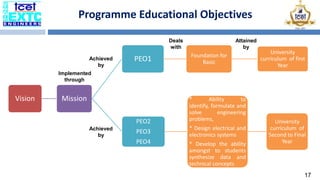
Professional Activities &Achievements
Academic Orientation
Programme (AOP)
[July]
TCET-MUN Inter
Collegiate/ School
[September]
Zephyr-Inter Collegiate
Technical Festival
[September]
NSS Residential Camp
[December]
Academic
Orientation
Programme
(AOP) [January ]
Tspark
Event of EDC
cell [February]
Multicon-W,
ICWET, IOW
[February]
Enertia
Annual
Sports Event
[March]
Soujorn
Annual Cultural
Event [March]
E-WEEK
[February]
Odd Semester
Even Semester
88
81.
Students Professional Activities
STUDENTSACTIVITIES
EDC
CELL
Seminars
and
Workshop
R & D
Activities
IOW, IEE
E, SDP
NEN CII
IC THE
FUTURE
MINDS EYE
Project
competition
MULTICON
AND
ICWET
• IC THE FUTURE is a
miniproject
competition for 2nd
year students.
• B.E PROJECT exhibition
showcases the projects made
by Final Year students while
encouraging them to develop
innovative ideas.
• Each team is required to
design, construct and operate
a prototype.
• The objective of the conference is
to bring together the
specialists, experts from different
fields and eminent personalities
from industries, research
institutes, government
organizations and academicians.
• It will provide a
platform for the
students, researchers
and faculty
acquainted with the
current trends and
practices in industrial
‘Industry Oriented
Workshop’ is
proposed in
MULTICON.
• National Entrepreneurship
Network (NEN) Membership
in TCET was taken with a
mission to inspire, educate and
support high potential
entrepreneurs to create of
high-value jobs.
• The Confederation of Indian Industry
(CII) organized events:
Starting your own start up
EDC was developed in
A. Y. 2014-2015 for
creating awareness
among the students
regarding
entrepreneurship as a
career option.
89
82.
Students Professional Activities
OUTCOMESOF STUDENTS ACTIVITIES
R&D
Activities
Technical
Paper
Presentation
Students Publications in
the year
2013-14: 6
2012-13: 4
2011-12: 2
Prizes Shared in the Year
2014-15: 4
2013-14: 3
2012-13: 5
2011-12: 8
Prizes won in the Year
2014-15: 3
2013-14: 3
2012-13: 3
2011-12: 4
Events Organized by
Professional Society in
the year
2014-15: 7
2013-14: 6
2012-13: 9
2011-12: 6
2010-11: 6
IC THE
FUTURE
MINDS EYE
Project
competition
MULTICON
AND ICWET
HIGHER
STUDIES
90
83.
Students Activities AndOutcomes
OUTCOMES OF STUDENTS ACTIVITIES
Seminars and
Workshop
PLACEMENTS
TO THE
INDUSTRY
IOW, IEEE
, SDP
IEEE Seminars /
Workshops conducted
2014-15: 7
2013-14: 3
2012-13: 6
Number of students participated in
IOW
2014: 342
2013: 318
SDP Seminars/Workshops
conducted
2014-15 : 3
2013-14 : 2
2012-13 : 1
91
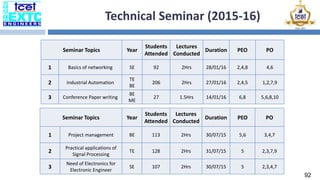
84.
Technical Seminar (2015-16)
SeminarTopics Year
Students
Attended
Lectures
Conducted
Duration PEO PO
1 Basics of networking SE 92 2Hrs 28/01/16 2,4,8 4,6
2 Industrial Automation
TE
BE
206 2Hrs 27/01/16 2,4,5 1,2,7,9
3 Conference Paper writing
BE
ME
27 1.5Hrs 14/01/16 6,8 5,6,8,10
Seminar Topics Year
Students
Attended
Lectures
Conducted
Duration PEO PO
1 Project management BE 113 2Hrs 30/07/15 5,6 3,4,7
2
Practical applications of
Signal Processing
TE 128 2Hrs 31/07/15 5 2,3,7,9
3
Need of Electronics for
Electronic Engineer
SE 107 2Hrs 30/07/15 5 2,3,4,7
92
85.
Technical Seminar (2014-15)
SeminarTopics Year
Students
Attended
Lectures
Conducted
Duration PEO PO
1
Project Selection for Final Year
Engineering Students
BE 80 2Hrs 29-01-15 5,6 4, 5, 6, 8, 9
2 Harmful effects of Mobile and WiFi BE 80 2Hrs 29-01-15 2,8 8,9
3 Raspberry pi TE 108 2Hrs 06-02-15 2,3,4 1,2,7,9
4 Computer Networking TE 48 2Hrs 05-02-15 2,4,5 2,3,4,7
5
Bridging the gap in Telecom & IT
sector
SE 81 2Hrs 05-02-15 5 2,3,4,7
6 Higher studies after Engineering TE 124 1Hr. 24-02-2015 7 8,9,10
Seminar Topics Year
Students
Attended
Lectures
Conducted
Duration PEO PO
1 Project Research & Innovation BE 84 2Hrs 01-08-14 5,6 4, 5, 6, 8, 9
2 Project management
BE
TE
101 2Hrs 01-08-14 5,6 4, 5, 6, 8, 9
3
Need of Electronics for Electronic
Engineer
SE 102 2Hrs 01-08-14 5 2,3,4,7
93
86.
Technical Seminar (2013-14)
SeminarTopics Year
Students
Attended
Lectures
Conducted
Duration PEO PO
1
Ethical Hacking and
Network Security
BE 96 2Hrs 18-03-14 5,7 7, 8, 9
2 Future Engineering Trends TE 114 2Hrs 23-01-14 5,7 7,8
3
Application of Aakash to
explore real-time audio
signal
SE 57 1Hrs 24-01-14 3 4,7,8
94
87.
Bridge Course Details(2015-16)
Bridge Course Topics Year
Students
Attended
Lectures
Conducted
Duration PEO PO
1
Project design and
implementation
SE 57 40 Hrs.
6 Feb – 2
Jun,2016
1,2,3,4,5,6 1,2,3,4,5,7
2
Computer
Networks
TE 16+2 (ext.) 48 Hrs
23 Jan-19 Mar
2016
1,2,5,7 1,2,3,4,8,9,10
3
Ethics in
Engineering
SE EXTC 150 06Hrs. 22 Sep,2015 5,6,7 8, 9, 10
95
88.
Bridge Course Details(2014-15)
Bridge Course Topics Year
Students
Attended
Lectures
Conducted
Duration PEO PO
1
Eessentials of
electronic project
design and
implementation
SE & TE
(EXTC &
ETRX)
57 40 Hrs.
13 Mar –
18
Apr,2015
2,3,4,5,6 2,3,4,5,7
2
Computer
Networks
TE 14+1 (ext.) 40 Hrs
23 Jun- 25
Jul,2015
1,2,5,7
1,2,3,4,8,
9,10
3
Ethics in
Engineering
SE EXTC 150 06Hrs.
28 July –
22
Sep,2015
5,6,8 8
96
89.
Students achievements
Project grants
Student
achievements
Project
competitions
Start-ups
Paper
publications
2014-15
•Mr. Ketul Shah: Technophilia Systems
Pvt, Ltd. Sponsored him for making his
B. E. Project on Swarm Robotics.
• Mr. Bilal Khan, got grant of Rs.16,000/-
for his project on Solar Tree.
• Mr. Traush Shenoy is working on the
project for developing a Textbook
Companion in Scilab under the
mentorship of Dr. Lochan Jolly.
2013-14
1. Electronic Oxygen Tree “Technical paper
presentation by Khan Mohd Bilal and Sangeeta
Pal was awarded 1st Prize at Vasantdada Patil
College of Engineering at National Level.
2. “RFID Traffic Control” at National Level
technical paper presented by Khan Mohd Bilal
and Sangeeta Pal at Atharva College of
Engineering.
3. Rahul Tiwari and Amit Keshri Presented paper
on “Sixth Sense Technology” at LTCOE national
level
97
90.
Students achievements
Project
grants
Student
achievement
s
Project
competitions
Start-ups
Paper
publicatio
ns
Mr. AbhishekShah alumni from 2014 batch
has initiated to start up with his company
STRATAGILE in Nov 2015.
2015-16
• Six students won Texas Instruments “Analog Makers Competition”
• 1st prize: Mr. Ashish Rawat and Ms. Arshdeep Sood. Mr. Pratik Jain and Ms.
Shivani Seksaria
• 1st Runner up: Mr. Amitraj Varma and Mr. Anish Shukla
2014-15
• “EDC best Debutant” Students: Manav Nayak
• Sanmith Shetty & Smit Mistry
2012-13
• Omkar Joglekar won 1st prize in 'Electoworks-National level Electronics
competition' held at SPIT
• Omkar Joglekar won 1st prize in project competition held at DJ Sanghavi
college of Engg.
• Mahipal Singh Rajpurohit won 1st Prize in project competition held at TSEC
• Sarvesh Giri won 1st Prize in project competition held at TSEC
• Sayali Naringrekar, Akansha Patel & Siddhesh Parab won 3rd prize in
'Electoworks-National level Electronics competition' held at SPIT
• Ketul Shah won 4th prize 'Electoworks-National level Electronics competition'
held at SPIT 98
Faculty Competencies (DomainSpecialization)
EXTC
(Domain)
Communication
Engg.
Embedded
System
Signal
Processing
Antenna
and Micro
Wave Engg.
Electronic
Devices and
Modeling
Dr. B.K. Mishra, Mrs. Sujata Kulkarni, Mrs. Kalawati Patil, Ms. Sangeeta
Mishra, Ms. Sukruti Kaulgud, Ms. Megha Gupta, Ms. Ankita Chakor
Dr. Vinitkumar Dongre, Mr.
Shailendra Shastri, Ms. Archana
Deshpande, Mr. Nikhil Tiwari
Dr. B.K. Mishra, Dr. Lochan Jolly, Mrs.
Madhuri Mavinkurve, Ms. Sonia
Behra, Ms. Anvita Birje, , Ms. Amruta
Naik, Ms. Sonali Singh, Mr. Niket Amoda
Mr. Sanjeev Ghosh, Ms. Aradhana
Manekar, Mr. Manoj Chavan, Mr. Deepak
Shete, Mrs. Rashmita Kumari
Mohapatra, Mr. Biju Balakrishnan
Mrs. Payel Saha, Mrs. Rupali
Mane, Ms. Rutvi Panchal, Ms.
Poonam Chaudhary, Mr. Deepak
Sinha
101
94.
Faculty Development
Domain
supportive
training
Teaching Skills
Enhancement
Facultyas
Resource
Person
Professional
and Work
force related
Training
Interaction
with Industry
Dimensions
of Faculty
Development
Awareness of PO,CO,LO
and its alignment in
teaching learning process
Pedagogy workshop for
effective teaching,
IET Membership
• IITB remote
center
courses on
specific
courses such
as Analog
electronics
signals and
systems etc.
• Latest
technology
awareness
• NS2 training
• LAB migration
in SCI-LAB
• Embedded
system
R&D
integration into
academics
• Industry institute
symposium,
• Industrial visits
(Reliance –Sep
2015, ABB-July 2015)
• Conferences
Guest lecturers
for various
sessions to share
their expertise
outside institute
Enhancing
educational
productivity
Positive
attitude
and
leadership
quality.
102
95.
Faculty Training
Academic
Year Nameof FDP & STTP
Number of
Person
attended
No. of People
used knowledge
% Outcome
attainment
2012-13
1. ISTE approved workshop on
“Introduction to research
methodologies” at TCET
remote center, IITBombay
under NMEICT MHRD India.
7 5 71%
2. Workshop on Analog
Electronics by IIT Kharagpur
3 1 33%
2013-14
1. FDP on Android application 9 2 22%
2. IMC RBNQA Proposal writing 3 3 100%
3. Effective counselling for
engg. Students
19 19 100%
103
96.
Faculty Training
Academic YearName of FDP & STTP
Number of Person
attended
No. of People used
knowledge
% Outcome attainment
2013-14
4. Positive attitude for self
development
10 10 100%
5. Bridging the industry
GAP
16 16 100%
6. ISTE workshop on Signal
and system
4 4 100%
7. Opportunities of
Research and antennas
18 18 100%
8. Learning objective 16 16 100%
9. Effective use of
Visualisation in the class
room
16 10 63%
10. Leadership Quality
Enhancement
15 15 100%
11. CISCO Training 6 6 100%
12. Workshop on CCNA By
IIT Bombay
6 6 100%
104
97.
Faculty Training
Academic
Year
Name ofFDP & SDP
Number of
Person attended
No. of People used
knowledge
% Outcome
attainment
2014-15
1. ISTE workshop on cyber
security
3 3 100%
2. Institute level FDP on
"Emotional intelligence , Rubrics" 17 17 100%
3. Institute level FDP on
"concept map and thesis writing" 16 16 100%
4. Institute level FDP on
"Effective integration of
visualization for effective
learning"
16 16 100%
5. Art of living mind and
matters
11 11 100%
6. FDP on" Lab Migration in Sci-
lab"
6 3 50%
7. Two Week ISTE Workshop on
Pedagogy for Effective Use of ICT
in Engineering
8 8 100%
105
98.
Faculty Training
Academic YearName of FDP & SDP
Number of Person
attended
No. of People used
knowledge
% Outcome
attainment
2014-15
8. FDP on Financial Planning &
Tax Planning
20 20 100%
9. ISTE STTP on "Integration of
R &D consultancy with
academics"
6 6 100%
10. Workshop Control systems
by IIT KGP
2 2 100%
2015-2016
1. ISTE STTP on "Embedded
Systems and Advanced Micro
controller"
19 5 26%
2. Self Defence Seminar for
Women
10 10 100%
3. Texas Instruments training 2 2 100%
4. ISO auditors training 3 3 100%
106
99.
Faculty Research Efforts
FacultyResearch
Efforts
Research
Publication
Details
Published In:
No. of research
papers published
Funded R&D
Projects
University of
Mumbai Research
Grant
Trust Grants
IEEE Explorer
Springer
IJCA
IJCER
IJRRAS
IJCSIT
IJARECE
ICCICT
Academic Years:
2012-13: 27
2013-14: 20
2014-15:19
Dr. Vinitkumar
Dongre
Project: Gain and
bandwidth
enhancement of
helical loaded cavity
backed antenna
Amount(Rs.):25,000
Year:2012
Megha Gupta
Project: Home
Automation
Amount(Rs.):15,000
Year:2014
Dr. Lochan Jolly
Project: Next
generation Farming
Amount(Rs.):15,000
Year:2014
Development of
Wireless Networking
Lab:
Training for
faculty(50Hrs) &
student(40Hrs)
Total cost:
Rs. 4.45 Lacs
108
100.
Faculty Achievements
• Threepatents are filed by Dr. B.K.Mishra and Dr. Vinitkumar Dongre in Nov 2015
and Feb 2016.
• Dr. B.K.Mishra received copyrights for three books in May 2014.
IPR
• Remote center of IIT-Bombay funding for 21 STTPs of Rs. 19.53 Lacs.
• Two projects of faculty members Dr. Lochan Jolly and Dr. Sangeeta Mishra
received funding under IEDC scheme by DST, New Delhi.
• Three projects of Dr. Lochan Jolly, Dr. Vinitkumar Dongre and Ms. Megha Gupta
received minor grant of University of Mumbai totaling Rs. 55 thousand.
• Five projects of Mr. Sanjeev Ghosh, Mr. Manoj Chavan, Dr. Sangeeta Mishra
, Mr. Deepak Shete, and Ms. Anvita Birje have received minor grants from the
University of Mumbai totaling Rs. 1.55 Lacs recently.
Funding
109
101.
Faculty Achievements
• Mrs.Kalawati Patil developed Scilab Manuals for Digital
Communication which was funded by a grant from National Mission
Education through ICT in 2014.
• Dr. Lochan Jolly developed Scilab Manuals for Satellite Communication
Lab, Optical Communication and CSEM which was funded by a grant
from the National Mission Education through ICT in 2014.
Lab Migration
to Open Source
Software
• The students of Thakur College of Engineering and
Technology, under the guidance of Dr. Kamal Shah and Dr. Madhuri
Mavinkurve have developed an application for Android based
tablets which helps students of Hindi medium schools to learn
Mathematics in a better manner.
Applications
Developed
110
102.
Faculty Achievements
• Ms.Sujata Kulkarni won best paper award in ICAET-2014,Nagpur
for her paper titled “Finger Vein Recognition”.
• Dr. Madhuri Mavinkurve won APSCE Merit scholarship at ICCE13
Bali, Indonesia for contribution to educational technology field.
Winners of Awards
& Scholarships
• Dr. Lochan Jolly received a certificate of 6 weeks internship from
IIT, Bombay for developing a Text Book Companion In Scilab.
• Dr. Lochan Jolly, Mr. Sanjeev Ghosh, Ms. Sukruti Kaulgud received
consultancy offer from Pulsar Electronics Private Limited for project Next
Generation Farming.
• Dr. Lochan Jolly, Ms. Sukruti Kaulgud and Ms. Kalawati Patil received
consultancy offer from Pulsar Electronics Private Limited for project
Security Systems
Internships &
Consultancy
111
Overall Improvement
2001
Program started
withIntake 60
2003
Intake increased to
120
Started Students
IEEE Chapter
2005
RvA Accreditation
under ISO
9000:2000
Certification
2008
PG Programs
Started with 18
intake
2010
ICWET 1st
International
Conference with
ACM
Upgraded ISO to
9001:2008
Standard
113
105.
Overall Improvement
2011
NBA first
Accreditationfor
3 Years
Started R&D Cell
2012
Research grant
received from
University of
Mumbai by one
faculty member
for project in
Antenna domain
2013
TCET Accenture
Innovation Center
Started
Graded Medium
by AICTE-CII 3i
Survey
2014
Research grant
received from
University of
Mumbai by two
faculty members
for project in
communication
domain
Started EDC Cell
Graded High by
AICTE-CII 3i
Survey
2015
University of
Mumbai Ph. D.
Research Center
Started HOC Cell
Started
incubation Center
NEN Best Debut
Award at National
Level
Texas Instruments
center of
Excellence
Patent filed by
one faculty
member
2016
IEDC Grant of 48
Lacs for 5 years
Academic
Affiliation with IET
7th International
Conference ICWET
in Association with
IET.
IMC RBNQA
AWARD in
Education Sector
Embedded system
center of
Excellence with
ARM university
and Cypress
Semiconductors.
2 patents are filed.
ISO-9000: 2015
awareness
114




![Professional Activities & Achievements
Academic Orientation
Programme (AOP)
[July]
TCET-MUN Inter
Collegiate/ School
[September]
Zephyr-Inter Collegiate
Technical Festival
[September]
NSS Residential Camp
[December]
Academic
Orientation
Programme
(AOP) [January ]
Tspark
Event of EDC
cell [February]
Multicon-W,
ICWET, IOW
[February]
Enertia
Annual
Sports Event
[March]
Soujorn
Annual Cultural
Event [March]
E-WEEK
[February]
Odd Semester
Even Semester
88](https://image.slidesharecdn.com/extcppt-250320033741-f25429a9/85/electronics-and-telecommunication-PPT-pdf-80-320.jpg)