Hearty Welcome to NAAC Visit Expert Members
E.G.S. PILLAY ENGINEERING COLLEGE

(An Autonomous Institution, Affiliated to Anna University, Chennai)
Nagore Post, Nagapattinam – 611 002, Tamilnadu.
Department of Electronics and Communication Engineering
19.07.2023
Presented by
Dr. D.Devarajan
Head & Assoc.Prof/ECE
8/20/2022 1
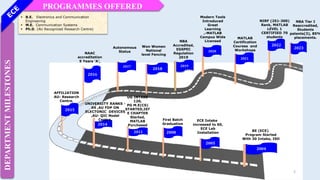
 B.E. Electronics and Communication
Engineering
 M.E. Communication Systems
 Ph.D. (AU Recognized Research Centre)
PROGRAMMES OFFERED
DEPARTMENT
MILESTONES
2004
BE (ECE)
Program Started
With 30 Intake, ISO
2005
ECE Intake
increased to 60,
ECE Lab
Installation
2008
First Batch
Graduation
2015
AFFILIATION
AU- Research
Centre,
2014
UNIVERSITY RANKS -
04 ,AU FDP ON
ELECTONIC DEVICES
,AU- QIC Nodal
Centre,
2016
NAAC
accreditation
5 Years ‘A’,
2017
Autonomous
Status
2013
2018
Won Women
National
level Fencing
2019
NBA
Accredited,
EGSPEC
Regulation
2019
2020
Modern Tools
Introduced
Great
Learning
,-MATLAB
Campus Wide
Licensed
2021
MATLAB
Certification
Courses and
Workshops
2
2022
NIRF (251-300)
Rank, MATLAB
LEVEL 1
CERTIFIED 70
students
2023
NBA Tier I
Reaccredited,
Students
patents(3), 85%
placements.
UG INTAKE
120,
PG M.E(CS)
STARTED,IST
E CHAPTER
Started,
MATLAB
Purchased
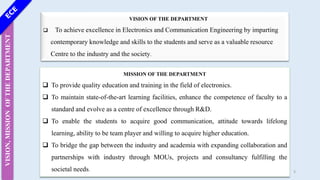
MISSION OF THE DEPARTMENT
 To provide quality education and training in the field of electronics.
 To maintain state-of-the-art learning facilities, enhance the competence of faculty to a
standard and evolve as a centre of excellence through R&D.
 To enable the students to acquire good communication, attitude towards lifelong
learning, ability to be team player and willing to acquire higher education.
 To bridge the gap between the industry and academia with expanding collaboration and
partnerships with industry through MOUs, projects and consultancy fulfilling the
societal needs.
VISION OF THE DEPARTMENT
 To achieve excellence in Electronics and Communication Engineering by imparting
contemporary knowledge and skills to the students and serve as a valuable resource
Centre to the industry and the society.
VISION,
MISSION
OF
THE
DEPARTMENT
3
8/20/2022 4
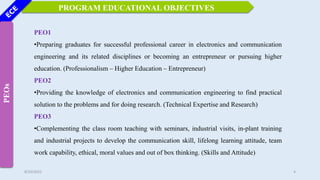
PEO1
•Preparing graduates for successful professional career in electronics and communication
engineering and its related disciplines or becoming an entrepreneur or pursuing higher
education. (Professionalism – Higher Education – Entrepreneur)
PEO2
•Providing the knowledge of electronics and communication engineering to find practical
solution to the problems and for doing research. (Technical Expertise and Research)
PEO3
•Complementing the class room teaching with seminars, industrial visits, in-plant training
and industrial projects to develop the communication skill, lifelong learning attitude, team
work capability, ethical, moral values and out of box thinking. (Skills and Attitude)
PROGRAM EDUCATIONAL OBJECTIVES
PEOs
8/20/2022 5
PROGRAM SPECIFIC OUTCOMES
PSOs
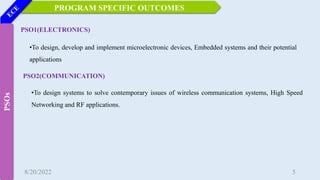
PSO1(ELECTRONICS)
•To design, develop and implement microelectronic devices, Embedded systems and their potential
applications
•To design systems to solve contemporary issues of wireless communication systems, High Speed
Networking and RF applications.
PSO2(COMMUNICATION)
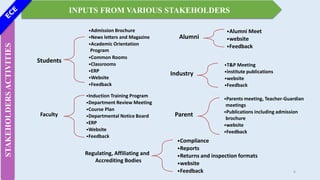
INPUTS FROM VARIOUS STAKEHOLDERS
STAKEHOLDERS
ACTIVITIES
Students
•Admission Brochure
•News letters and Magazine
•Academic Orientation
Program
•Common Rooms
•Classrooms
•ERP
•Website
•Feedback
Faculty
•Parents meeting, Teacher-Guardian
meetings
•Publications including admission
brochure
•website
•Feedback
Regulating, Affiliating and
Accrediting Bodies
Alumni
Industry
Parent
6
•Induction Training Program
•Department Review Meeting
•Course Plan
•Departmental Notice Board
•ERP
•Website
•Feedback
•Compliance
•Reports
•Returns and inspection formats
•website
•Feedback
•Alumni Meet
•website
•Feedback
•T&P Meeting
•institute publications
•website
•Feedback
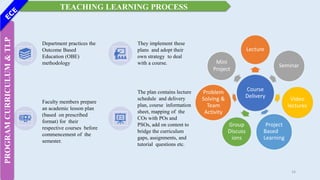
Course
Delivery
Lecture
Seminar
Video
lectures
Project
Based
Learning
Group
Discuss
ions
Problem
Solving &
Team
Activity
Mini
Project
Department practices the
Outcome Based
Education (OBE)
methodology
They implement these
plans and adopt their
own strategy to deal
with a course.
Faculty members prepare
an academic lesson plan
(based on prescribed
format) for their
respective courses before
commencement of the
semester.
The plan contains lecture
schedule and delivery
plan, course information
sheet, mapping of the
COs with POs and
PSOs, add on content to
bridge the curriculum
gaps, assignments, and
tutorial questions etc.
TEACHING LEARNING PROCESS
PROGRAM
CURRICULUM
&
TLP
16
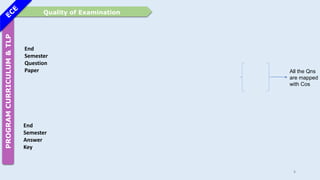
Quality of Examination
PROGRAM
CURRICULUM
&
TLP
End
Semester
Question
Paper
End
Semester
Answer
Key
8
All the Qns
are mapped
with Cos
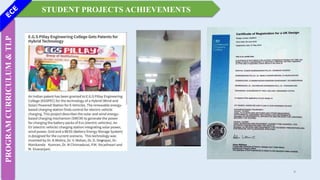
STUDENT PROJECTS ACHIEVEMENTS
PROGRAM
CURRICULUM
&
TLP
9
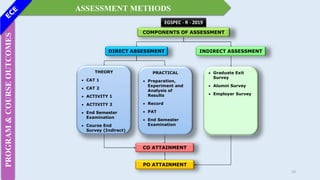
ASSESSMENT METHODS
PROGRAM
&
COURSE
OUTCOMES
COMPONENTS OF ASSESSMENT
DIRECT ASSESSMENT INDIRECT ASSESSMENT
 Graduate Exit
Survey
 Alumni Survey
 Employer Survey
CO ATTAINMENT
PO ATTAINMENT
THEORY
 CAT 1
 CAT 2
 ACTIVITY 1
 ACTIVITY 2
 End Semester
Examination
 Course End
Survey (Indirect)
PRACTICAL
 Preparation,
Experiment and
Analysis of
Results
 Record
 PAT
 End Semester
Examination
EGSPEC - R - 2019
10
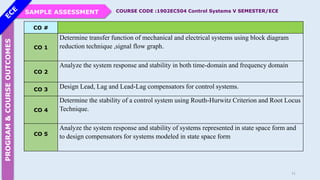
CO #
CO 1
Determine transfer function of mechanical and electrical systems using block diagram
reduction technique ,signal flow graph.
CO 2
Analyze the system response and stability in both time-domain and frequency domain
CO 3
Design Lead, Lag and Lead-Lag compensators for control systems.
CO 4
Determine the stability of a control system using Routh-Hurwitz Criterion and Root Locus
Technique.
CO 5
Analyze the system response and stability of systems represented in state space form and
to design compensators for systems modeled in state space form
SAMPLE ASSESSMENT
PROGRAM
&
COURSE
OUTCOMES COURSE CODE :1902EC504 Control Systems V SEMESTER/ECE
11
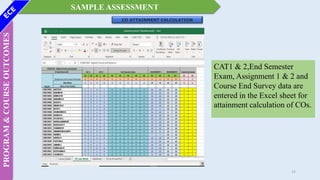
SAMPLE ASSESSMENT
PROGRAM
&
COURSE
OUTCOMES
CO ATTAINMENT CALCULATION
CAT1 & 2,End Semester
Exam, Assignment 1 & 2 and
Course End Survey data are
entered in the Excel sheet for
attainment calculation of COs.
12
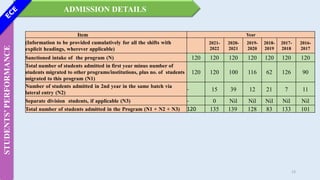
ADMISSION DETAILS
STUDENTS’
PERFORMANCE
Item Year
(Information to be provided cumulatively for all the shifts with
explicit headings, wherever applicable)
2021-
2022
2020-
2021
2019-
2020
2018-
2019
2017-
2018
2016-
2017
Sanctioned intake of the program (N) 120 120 120 120 120 120 120
Total number of students admitted in first year minus number of
students migrated to other programs/institutions, plus no. of students
migrated to this program (N1)
120 120 100 116 62 126 90
Number of students admitted in 2nd year in the same batch via
lateral entry (N2)
- 15 39 12 21 7 11
Separate division students, if applicable (N3) - 0 Nil Nil Nil Nil Nil
Total number of students admitted in the Program (N1 + N2 + N3) 120 135 139 128 83 133 101
13
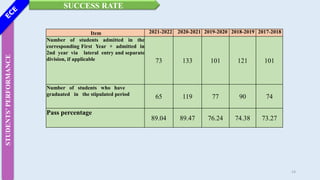
STUDENTS’
PERFORMANCE SUCCESS RATE
Item 2021-2022 2020-2021 2019-2020 2018-2019 2017-2018
Number of students admitted in the
corresponding First Year + admitted in
2nd year via lateral entry and separate
division, if applicable 73 133 101 121 101
Number of students who have
graduated in the stipulated period
65 119 77 90 74
Pass percentage
89.04 89.47 76.24 74.38 73.27
14
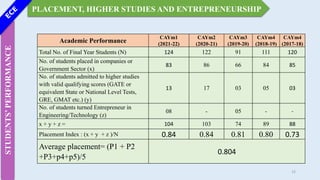
PLACEMENT, HIGHER STUDIES AND ENTREPRENEURSHIP
STUDENTS’
PERFORMANCE
Academic Performance
CAYm1
(2021-22)
CAYm2
(2020-21)
CAYm3
(2019-20)
CAYm4
(2018-19)
CAYm4
(2017-18)
Total No. of Final Year Students (N) 124 122 91 111 120
No. of students placed in companies or
Government Sector (x)
83 86 66 84 85
No. of students admitted to higher studies
with valid qualifying scores (GATE or
equivalent State or National Level Tests,
GRE, GMAT etc.) (y)
13 17 03 05 03
No. of students turned Entrepreneur in
Engineering/Technology (z)
08 - 05 - -
x + y + z = 104 103 74 89 88
Placement Index : (x + y + z )/N 0.84 0.84 0.81 0.80 0.73
Average placement= (P1 + P2
+P3+p4+p5)/5
0.804
15
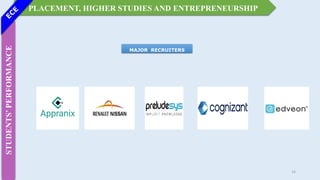
PLACEMENT, HIGHER STUDIES AND ENTREPRENEURSHIP
STUDENTS’
PERFORMANCE
MAJOR RECRUITERS
16
8/20/2022 17
PLACEMENT, HIGHER STUDIES AND ENTREPRENEURSHIP
INDUSTRY
INTERACTIONSTUDENTS
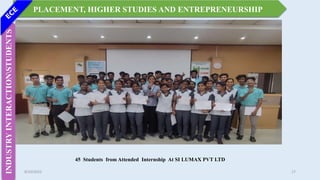
45 Students from Attended Internship At SI LUMAX PVT LTD
8/20/2022 18
PLACEMENT, HIGHER STUDIES AND ENTREPRENEURSHIP
INDUSTRY
INTERACTIONSTUDENTS
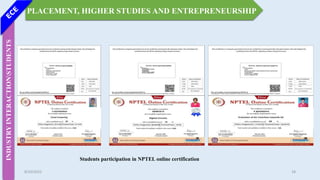
Students participation in NPTEL online certification
PLACEMENT, HIGHER STUDIES AND ENTREPRENEURSHIP
STUDENTS’
PERFORMANCE
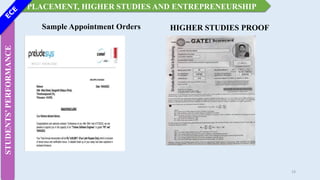
Sample Appointment Orders
19
HIGHER STUDIES PROOF
PROFESSIONALACTIVITIES
STUDENTS’
PERFORMANCE
0
0.2
0.4
0.6
0.8
1
1.2
1.4
1.6
1.8
2
2019-20 2020-21 2021-22
2
1 1
2
1 1
Number
of
events
IETE
ISTE
20
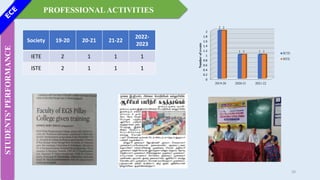
Society 19-20 20-21 21-22
2022-
2023
IETE 2 1 1 1
ISTE 2 1 1 1
Activity Count
Technical Event
Winners/Attended
122
Student Publication 11
Paper Presentation
Winners/Attended
48
Sports/dance Achievements 27
NPTEL/SWAYAM Online
Course
16
STUDENTACHIEVEMENTS
STUDENT
ACHIEVEMENTS
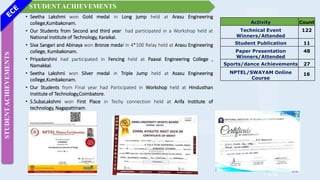
• Seetha Lakshmi won Gold medal in Long jump held at Arasu Engineering
college,Kumbakonam.
• Our Students from Second and third year had participated in a Workshop held at
National Institute of Technology, Karaikal.
• Siva Sangari and Abinaya won Bronze medal in 4*100 Relay held at Arasu Engineering
college, Kumbakonam.
• Priyadarshini had participated in Fencing held at Paavai Engineering College ,
Namakkal.
• Seetha Lakshmi won Silver medal in Triple Jump held at Asasu Engineering
college,Kumbakonam.
• Our Students from Final year had Participated in Workshop held at Hindusthan
Institute of Technology,Coimbatore.
• S.SubaLakshmi won First Place in Techy connection held at Arifa Institute of
technology, Nagapattinam.
4/44
21/45
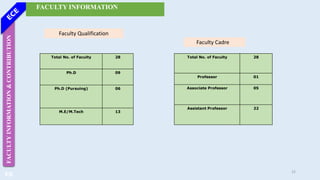
Total No. of Faculty 28
Ph.D 09
Ph.D (Pursuing) 06
M.E/M.Tech 13
Faculty Qualification
Total No. of Faculty 28
Professor 01
Associate Professor 05
Assistant Professor 22
C5
FACULTY
INFORMATION
&
CONTRIBUTION FACULTY INFORMATION
Faculty Qualification
Faculty Cadre
22
FACULTY
INFORMATION
&
CONTRIBUTION
C
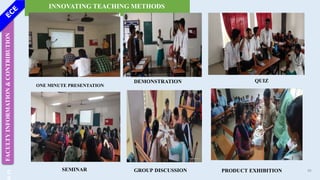
INNOVATING TEACHING METHODS
49
GROUP DISCUSSION PRODUCT EXHIBITION
ONE MINUTE PRESENTATION
SEMINAR
QUIZ
DEMONSTRATION
8/20/2022 24/45
FACULTY
INFORMATION
&
CONTRIBUTION
C
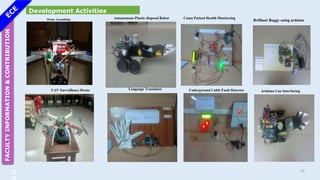
Autonomous Plastic disposal Robot Coma Patient Health Monitoring
UAV Surveillance Drone Language Translator Underground Cable Fault Detector
FACULTY
INFORMATION
&
CONTRIBUTION
C
Development Activities
Drone Assembling Brilliant Buggy using arduino
Arduino Uno Interfacing
52
8/20/2022 26/45
FACULTY
INFORMATION
&
CONTRIBUTION
C
FACULTY
INFORMATION
&
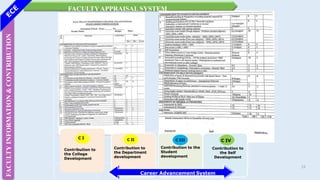
CONTRIBUTION FACULTYAPPRAISAL SYSTEM
C I
Contribution to
the College
Development
Career Advancement System
C II C III C IV
Contribution to
the Department
development
Contribution to
the Self
Development
Contribution to the
Student
development
53
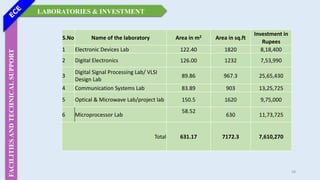
LABORATORIES & INVESTMENT
FACILITIES
AND
TECHNICAL
SUPPORT
S.No Name of the laboratory Area in m2 Area in sq.ft
Investment in
Rupees
1 Electronic Devices Lab 122.40 1820 8,18,400
2 Digital Electronics 126.00 1232 7,53,990
3
Digital Signal Processing Lab/ VLSI
Design Lab
89.86 967.3 25,65,430
4 Communication Systems Lab 83.89 903 13,25,725
5 Optical & Microwave Lab/project lab 150.5 1620 9,75,000
6 Microprocessor Lab
58.52
630 11,73,725
Total 631.17 7172.3 7,610,270
28
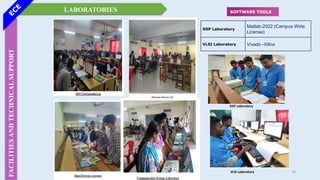
LABORATORIES
FACILITIES
AND
TECHNICAL
SUPPORT
29
SOFTWARE TOOLS
DSP Laboratory
Matlab-2022 (Campus Wide
License)
VLSI Laboratory Vivado -Xilinx
DSP Laboratory
VLSI Laboratory
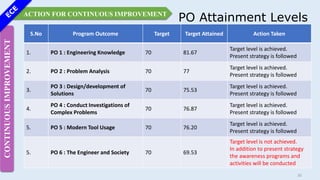
PO Attainment Levels
S.No Program Outcome Target Target Attained Action Taken
1. PO 1 : Engineering Knowledge 70 81.67
Target level is achieved.
Present strategy is followed
2. PO 2 : Problem Analysis 70 77
Target level is achieved.
Present strategy is followed
3.
PO 3 : Design/development of
Solutions
70 75.53
Target level is achieved.
Present strategy is followed
4.
PO 4 : Conduct Investigations of
Complex Problems
70 76.87
Target level is achieved.
Present strategy is followed
5. PO 5 : Modern Tool Usage 70 76.20
Target level is achieved.
Present strategy is followed
5. PO 6 : The Engineer and Society 70 69.53
Target level is not achieved.
In addition to present strategy
the awareness programs and
activities will be conducted
ACTION FOR CONTINUOUS IMPROVEMENT
CONTINUOUS
IMPROVEMENT
30
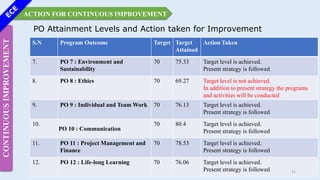
PO Attainment Levels and Action taken for Improvement
S.N Program Outcome Target Target
Attained
Action Taken
7. PO 7 : Environment and
Sustainability
70 75.33 Target level is achieved.
Present strategy is followed
8. PO 8 : Ethics 70 69.27 Target level is not achieved.
In addition to present strategy the programs
and activities will be conducted
9. PO 9 : Individual and Team Work 70 76.13 Target level is achieved.
Present strategy is followed
10.
PO 10 : Communication
70 80.4 Target level is achieved.
Present strategy is followed
11. PO 11 : Project Management and
Finance
70 78.53 Target level is achieved.
Present strategy is followed
12. PO 12 : Life-long Learning 70 76.06 Target level is achieved.
Present strategy is followed
ACTION FOR CONTINUOUS IMPROVEMENT
CONTINUOUS
IMPROVEMENT
31
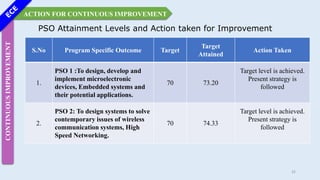
PSO Attainment Levels and Action taken for Improvement
S.No Program Specific Outcome Target
Target
Attained
Action Taken
1.
PSO 1 :To design, develop and
implement microelectronic
devices, Embedded systems and
their potential applications.
70 73.20
Target level is achieved.
Present strategy is
followed
2.
PSO 2: To design systems to solve
contemporary issues of wireless
communication systems, High
Speed Networking.
70 74.33
Target level is achieved.
Present strategy is
followed
ACTION FOR CONTINUOUS IMPROVEMENT
CONTINUOUS
IMPROVEMENT
32
ACTION FOR CONTINUOUS IMPROVEMENT
CONTINUOUS
IMPROVEMENT
33
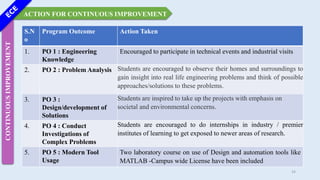
S.N
o
Program Outcome Action Taken
1. PO 1 : Engineering
Knowledge
Encouraged to participate in technical events and industrial visits
2. PO 2 : Problem Analysis Students are encouraged to observe their homes and surroundings to
gain insight into real life engineering problems and think of possible
approaches/solutions to these problems.
3. PO 3 :
Design/development of
Solutions
Students are inspired to take up the projects with emphasis on
societal and environmental concerns.
4. PO 4 : Conduct
Investigations of
Complex Problems
Students are encouraged to do internships in industry / premier
institutes of learning to get exposed to newer areas of research.
5. PO 5 : Modern Tool
Usage
Two laboratory course on use of Design and automation tools like
MATLAB -Campus wide License have been included
ACTION FOR CONTINUOUS IMPROVEMENT
CONTINUOUS
IMPROVEMENT
34
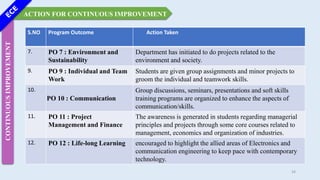
S.NO Program Outcome Action Taken
7. PO 7 : Environment and
Sustainability
Department has initiated to do projects related to the
environment and society.
9. PO 9 : Individual and Team
Work
Students are given group assignments and minor projects to
groom the individual and teamwork skills.
10.
PO 10 : Communication
Group discussions, seminars, presentations and soft skills
training programs are organized to enhance the aspects of
communication/skills.
11. PO 11 : Project
Management and Finance
The awareness is generated in students regarding managerial
principles and projects through some core courses related to
management, economics and organization of industries.
12. PO 12 : Life-long Learning encouraged to highlight the allied areas of Electronics and
communication engineering to keep pace with contemporary
technology.
ACTION FOR CONTINUOUS IMPROVEMENT
CONTINUOUS
IMPROVEMENT
35
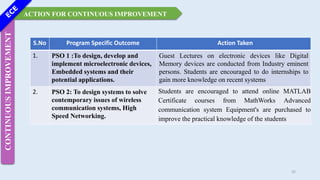
S.No Program Specific Outcome Action Taken
1. PSO 1 :To design, develop and
implement microelectronic devices,
Embedded systems and their
potential applications.
Guest Lectures on electronic devices like Digital
Memory devices are conducted from Industry eminent
persons. Students are encouraged to do internships to
gain more knowledge on recent systems
2. PSO 2: To design systems to solve
contemporary issues of wireless
communication systems, High
Speed Networking.
Students are encouraged to attend online MATLAB
Certificate courses from MathWorks Advanced
communication system Equipment's are purchased to
improve the practical knowledge of the students
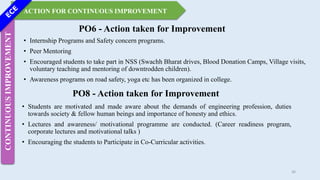
PO6 - Action taken for Improvement
• Internship Programs and Safety concern programs.
• Peer Mentoring
• Encouraged students to take part in NSS (Swachh Bharat drives, Blood Donation Camps, Village visits,
voluntary teaching and mentoring of downtrodden children).
• Awareness programs on road safety, yoga etc has been organized in college.
ACTION FOR CONTINUOUS IMPROVEMENT
CONTINUOUS
IMPROVEMENT
36
PO8 - Action taken for Improvement
• Students are motivated and made aware about the demands of engineering profession, duties
towards society & fellow human beings and importance of honesty and ethics.
• Lectures and awareness/ motivational programme are conducted. (Career readiness program,
corporate lectures and motivational talks )
• Encouraging the students to Participate in Co-Curricular activities.
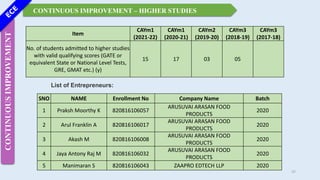
CONTINUOUS IMPROVEMENT – HIGHER STUDIES
CONTINUOUS
IMPROVEMENT
Item
CAYm1
(2021-22)
CAYm1
(2020-21)
CAYm2
(2019-20)
CAYm3
(2018-19)
CAYm3
(2017-18)
No. of students admitted to higher studies
with valid qualifying scores (GATE or
equivalent State or National Level Tests,
GRE, GMAT etc.) (y)
15 17 03 05
SNO NAME Enrollment No Company Name Batch
1 Praksh Moorthy K 820816106057
ARUSUVAI ARASAN FOOD
PRODUCTS
2020
2 Arul Franklin A 820816106017
ARUSUVAI ARASAN FOOD
PRODUCTS
2020
3 Akash M 820816106008
ARUSUVAI ARASAN FOOD
PRODUCTS
2020
4 Jaya Antony Raj M 820816106032
ARUSUVAI ARASAN FOOD
PRODUCTS
2020
5 Manimaran S 820816106043 ZAAPRO EDTECH LLP 2020
List of Entrepreneurs:
37
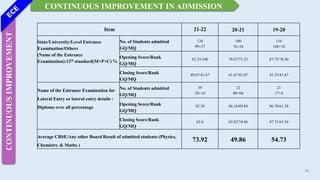
CONTINUOUS IMPROVEMENT IN ADMISSION
CONTINUOUS
IMPROVEMENT
Item 21-22 20-21 19-20
State/University/Level Entrance
Examination/Others
(Name of the Entrance
Examination):12th standard(M+P+C) %
No. of Students admitted
GQ/MQ
126
99+27
100
76+24
116
106+10
Opening Score/Rank
GQ/MQ
92.33/100 79.67/73.33 87.75/78.50
Closing Score/Rank
GQ/MQ
49.67/41.67 41.67/41.67 41.33/41.67
Name of the Entrance Examination for
Lateral Entry or lateral entry details :
Diploma over all percentage
No. of Students admitted
GQ/MQ
39
29+10
12
08+04
21
17+4
Opening Score/Rank
GQ/MQ
92.39 86.18/89.84 96.78/61.38
Closing Score/Rank
GQ/MQ
62.8 65.82/74.86 97.71/63.56
Average CBSE/Any other Board Result of admitted students (Physics,
Chemistry & Maths )
73.92 49.86 54.73
38
Thank You
39

ECE HOD PPT NEW_04.07.23_SSK.ppt

  • 1.
    Hearty Welcome toNAAC Visit Expert Members E.G.S. PILLAY ENGINEERING COLLEGE (An Autonomous Institution, Affiliated to Anna University, Chennai) Nagore Post, Nagapattinam – 611 002, Tamilnadu. Department of Electronics and Communication Engineering 19.07.2023 Presented by Dr. D.Devarajan Head & Assoc.Prof/ECE 8/20/2022 1
  • 2.
     B.E. Electronicsand Communication Engineering  M.E. Communication Systems  Ph.D. (AU Recognized Research Centre) PROGRAMMES OFFERED DEPARTMENT MILESTONES 2004 BE (ECE) Program Started With 30 Intake, ISO 2005 ECE Intake increased to 60, ECE Lab Installation 2008 First Batch Graduation 2015 AFFILIATION AU- Research Centre, 2014 UNIVERSITY RANKS - 04 ,AU FDP ON ELECTONIC DEVICES ,AU- QIC Nodal Centre, 2016 NAAC accreditation 5 Years ‘A’, 2017 Autonomous Status 2013 2018 Won Women National level Fencing 2019 NBA Accredited, EGSPEC Regulation 2019 2020 Modern Tools Introduced Great Learning ,-MATLAB Campus Wide Licensed 2021 MATLAB Certification Courses and Workshops 2 2022 NIRF (251-300) Rank, MATLAB LEVEL 1 CERTIFIED 70 students 2023 NBA Tier I Reaccredited, Students patents(3), 85% placements. UG INTAKE 120, PG M.E(CS) STARTED,IST E CHAPTER Started, MATLAB Purchased
  • 3.
    MISSION OF THEDEPARTMENT  To provide quality education and training in the field of electronics.  To maintain state-of-the-art learning facilities, enhance the competence of faculty to a standard and evolve as a centre of excellence through R&D.  To enable the students to acquire good communication, attitude towards lifelong learning, ability to be team player and willing to acquire higher education.  To bridge the gap between the industry and academia with expanding collaboration and partnerships with industry through MOUs, projects and consultancy fulfilling the societal needs. VISION OF THE DEPARTMENT  To achieve excellence in Electronics and Communication Engineering by imparting contemporary knowledge and skills to the students and serve as a valuable resource Centre to the industry and the society. VISION, MISSION OF THE DEPARTMENT 3
  • 4.
    8/20/2022 4 PEO1 •Preparing graduatesfor successful professional career in electronics and communication engineering and its related disciplines or becoming an entrepreneur or pursuing higher education. (Professionalism – Higher Education – Entrepreneur) PEO2 •Providing the knowledge of electronics and communication engineering to find practical solution to the problems and for doing research. (Technical Expertise and Research) PEO3 •Complementing the class room teaching with seminars, industrial visits, in-plant training and industrial projects to develop the communication skill, lifelong learning attitude, team work capability, ethical, moral values and out of box thinking. (Skills and Attitude) PROGRAM EDUCATIONAL OBJECTIVES PEOs
  • 5.
    8/20/2022 5 PROGRAM SPECIFICOUTCOMES PSOs PSO1(ELECTRONICS) •To design, develop and implement microelectronic devices, Embedded systems and their potential applications •To design systems to solve contemporary issues of wireless communication systems, High Speed Networking and RF applications. PSO2(COMMUNICATION)
  • 6.
    INPUTS FROM VARIOUSSTAKEHOLDERS STAKEHOLDERS ACTIVITIES Students •Admission Brochure •News letters and Magazine •Academic Orientation Program •Common Rooms •Classrooms •ERP •Website •Feedback Faculty •Parents meeting, Teacher-Guardian meetings •Publications including admission brochure •website •Feedback Regulating, Affiliating and Accrediting Bodies Alumni Industry Parent 6 •Induction Training Program •Department Review Meeting •Course Plan •Departmental Notice Board •ERP •Website •Feedback •Compliance •Reports •Returns and inspection formats •website •Feedback •Alumni Meet •website •Feedback •T&P Meeting •institute publications •website •Feedback
  • 7.
    Course Delivery Lecture Seminar Video lectures Project Based Learning Group Discuss ions Problem Solving & Team Activity Mini Project Department practicesthe Outcome Based Education (OBE) methodology They implement these plans and adopt their own strategy to deal with a course. Faculty members prepare an academic lesson plan (based on prescribed format) for their respective courses before commencement of the semester. The plan contains lecture schedule and delivery plan, course information sheet, mapping of the COs with POs and PSOs, add on content to bridge the curriculum gaps, assignments, and tutorial questions etc. TEACHING LEARNING PROCESS PROGRAM CURRICULUM & TLP 16
  • 8.
  • 9.
  • 10.
    ASSESSMENT METHODS PROGRAM & COURSE OUTCOMES COMPONENTS OFASSESSMENT DIRECT ASSESSMENT INDIRECT ASSESSMENT  Graduate Exit Survey  Alumni Survey  Employer Survey CO ATTAINMENT PO ATTAINMENT THEORY  CAT 1  CAT 2  ACTIVITY 1  ACTIVITY 2  End Semester Examination  Course End Survey (Indirect) PRACTICAL  Preparation, Experiment and Analysis of Results  Record  PAT  End Semester Examination EGSPEC - R - 2019 10
  • 11.
    CO # CO 1 Determinetransfer function of mechanical and electrical systems using block diagram reduction technique ,signal flow graph. CO 2 Analyze the system response and stability in both time-domain and frequency domain CO 3 Design Lead, Lag and Lead-Lag compensators for control systems. CO 4 Determine the stability of a control system using Routh-Hurwitz Criterion and Root Locus Technique. CO 5 Analyze the system response and stability of systems represented in state space form and to design compensators for systems modeled in state space form SAMPLE ASSESSMENT PROGRAM & COURSE OUTCOMES COURSE CODE :1902EC504 Control Systems V SEMESTER/ECE 11
  • 12.
    SAMPLE ASSESSMENT PROGRAM & COURSE OUTCOMES CO ATTAINMENTCALCULATION CAT1 & 2,End Semester Exam, Assignment 1 & 2 and Course End Survey data are entered in the Excel sheet for attainment calculation of COs. 12
  • 13.
    ADMISSION DETAILS STUDENTS’ PERFORMANCE Item Year (Informationto be provided cumulatively for all the shifts with explicit headings, wherever applicable) 2021- 2022 2020- 2021 2019- 2020 2018- 2019 2017- 2018 2016- 2017 Sanctioned intake of the program (N) 120 120 120 120 120 120 120 Total number of students admitted in first year minus number of students migrated to other programs/institutions, plus no. of students migrated to this program (N1) 120 120 100 116 62 126 90 Number of students admitted in 2nd year in the same batch via lateral entry (N2) - 15 39 12 21 7 11 Separate division students, if applicable (N3) - 0 Nil Nil Nil Nil Nil Total number of students admitted in the Program (N1 + N2 + N3) 120 135 139 128 83 133 101 13
  • 14.
    STUDENTS’ PERFORMANCE SUCCESS RATE Item2021-2022 2020-2021 2019-2020 2018-2019 2017-2018 Number of students admitted in the corresponding First Year + admitted in 2nd year via lateral entry and separate division, if applicable 73 133 101 121 101 Number of students who have graduated in the stipulated period 65 119 77 90 74 Pass percentage 89.04 89.47 76.24 74.38 73.27 14
  • 15.
    PLACEMENT, HIGHER STUDIESAND ENTREPRENEURSHIP STUDENTS’ PERFORMANCE Academic Performance CAYm1 (2021-22) CAYm2 (2020-21) CAYm3 (2019-20) CAYm4 (2018-19) CAYm4 (2017-18) Total No. of Final Year Students (N) 124 122 91 111 120 No. of students placed in companies or Government Sector (x) 83 86 66 84 85 No. of students admitted to higher studies with valid qualifying scores (GATE or equivalent State or National Level Tests, GRE, GMAT etc.) (y) 13 17 03 05 03 No. of students turned Entrepreneur in Engineering/Technology (z) 08 - 05 - - x + y + z = 104 103 74 89 88 Placement Index : (x + y + z )/N 0.84 0.84 0.81 0.80 0.73 Average placement= (P1 + P2 +P3+p4+p5)/5 0.804 15
  • 16.
    PLACEMENT, HIGHER STUDIESAND ENTREPRENEURSHIP STUDENTS’ PERFORMANCE MAJOR RECRUITERS 16
  • 17.
    8/20/2022 17 PLACEMENT, HIGHERSTUDIES AND ENTREPRENEURSHIP INDUSTRY INTERACTIONSTUDENTS 45 Students from Attended Internship At SI LUMAX PVT LTD
  • 18.
    8/20/2022 18 PLACEMENT, HIGHERSTUDIES AND ENTREPRENEURSHIP INDUSTRY INTERACTIONSTUDENTS Students participation in NPTEL online certification
  • 19.
    PLACEMENT, HIGHER STUDIESAND ENTREPRENEURSHIP STUDENTS’ PERFORMANCE Sample Appointment Orders 19 HIGHER STUDIES PROOF
  • 20.
    PROFESSIONALACTIVITIES STUDENTS’ PERFORMANCE 0 0.2 0.4 0.6 0.8 1 1.2 1.4 1.6 1.8 2 2019-20 2020-21 2021-22 2 11 2 1 1 Number of events IETE ISTE 20 Society 19-20 20-21 21-22 2022- 2023 IETE 2 1 1 1 ISTE 2 1 1 1
  • 21.
    Activity Count Technical Event Winners/Attended 122 StudentPublication 11 Paper Presentation Winners/Attended 48 Sports/dance Achievements 27 NPTEL/SWAYAM Online Course 16 STUDENTACHIEVEMENTS STUDENT ACHIEVEMENTS • Seetha Lakshmi won Gold medal in Long jump held at Arasu Engineering college,Kumbakonam. • Our Students from Second and third year had participated in a Workshop held at National Institute of Technology, Karaikal. • Siva Sangari and Abinaya won Bronze medal in 4*100 Relay held at Arasu Engineering college, Kumbakonam. • Priyadarshini had participated in Fencing held at Paavai Engineering College , Namakkal. • Seetha Lakshmi won Silver medal in Triple Jump held at Asasu Engineering college,Kumbakonam. • Our Students from Final year had Participated in Workshop held at Hindusthan Institute of Technology,Coimbatore. • S.SubaLakshmi won First Place in Techy connection held at Arifa Institute of technology, Nagapattinam. 4/44 21/45
  • 22.
    Total No. ofFaculty 28 Ph.D 09 Ph.D (Pursuing) 06 M.E/M.Tech 13 Faculty Qualification Total No. of Faculty 28 Professor 01 Associate Professor 05 Assistant Professor 22 C5 FACULTY INFORMATION & CONTRIBUTION FACULTY INFORMATION Faculty Qualification Faculty Cadre 22
  • 23.
    FACULTY INFORMATION & CONTRIBUTION C INNOVATING TEACHING METHODS 49 GROUPDISCUSSION PRODUCT EXHIBITION ONE MINUTE PRESENTATION SEMINAR QUIZ DEMONSTRATION
  • 24.
  • 25.
    Autonomous Plastic disposalRobot Coma Patient Health Monitoring UAV Surveillance Drone Language Translator Underground Cable Fault Detector FACULTY INFORMATION & CONTRIBUTION C Development Activities Drone Assembling Brilliant Buggy using arduino Arduino Uno Interfacing 52
  • 26.
  • 27.
    FACULTY INFORMATION & CONTRIBUTION FACULTYAPPRAISAL SYSTEM CI Contribution to the College Development Career Advancement System C II C III C IV Contribution to the Department development Contribution to the Self Development Contribution to the Student development 53
  • 28.
    LABORATORIES & INVESTMENT FACILITIES AND TECHNICAL SUPPORT S.NoName of the laboratory Area in m2 Area in sq.ft Investment in Rupees 1 Electronic Devices Lab 122.40 1820 8,18,400 2 Digital Electronics 126.00 1232 7,53,990 3 Digital Signal Processing Lab/ VLSI Design Lab 89.86 967.3 25,65,430 4 Communication Systems Lab 83.89 903 13,25,725 5 Optical & Microwave Lab/project lab 150.5 1620 9,75,000 6 Microprocessor Lab 58.52 630 11,73,725 Total 631.17 7172.3 7,610,270 28
  • 29.
    LABORATORIES FACILITIES AND TECHNICAL SUPPORT 29 SOFTWARE TOOLS DSP Laboratory Matlab-2022(Campus Wide License) VLSI Laboratory Vivado -Xilinx DSP Laboratory VLSI Laboratory
  • 30.
    PO Attainment Levels S.NoProgram Outcome Target Target Attained Action Taken 1. PO 1 : Engineering Knowledge 70 81.67 Target level is achieved. Present strategy is followed 2. PO 2 : Problem Analysis 70 77 Target level is achieved. Present strategy is followed 3. PO 3 : Design/development of Solutions 70 75.53 Target level is achieved. Present strategy is followed 4. PO 4 : Conduct Investigations of Complex Problems 70 76.87 Target level is achieved. Present strategy is followed 5. PO 5 : Modern Tool Usage 70 76.20 Target level is achieved. Present strategy is followed 5. PO 6 : The Engineer and Society 70 69.53 Target level is not achieved. In addition to present strategy the awareness programs and activities will be conducted ACTION FOR CONTINUOUS IMPROVEMENT CONTINUOUS IMPROVEMENT 30
  • 31.
    PO Attainment Levelsand Action taken for Improvement S.N Program Outcome Target Target Attained Action Taken 7. PO 7 : Environment and Sustainability 70 75.33 Target level is achieved. Present strategy is followed 8. PO 8 : Ethics 70 69.27 Target level is not achieved. In addition to present strategy the programs and activities will be conducted 9. PO 9 : Individual and Team Work 70 76.13 Target level is achieved. Present strategy is followed 10. PO 10 : Communication 70 80.4 Target level is achieved. Present strategy is followed 11. PO 11 : Project Management and Finance 70 78.53 Target level is achieved. Present strategy is followed 12. PO 12 : Life-long Learning 70 76.06 Target level is achieved. Present strategy is followed ACTION FOR CONTINUOUS IMPROVEMENT CONTINUOUS IMPROVEMENT 31
  • 32.
    PSO Attainment Levelsand Action taken for Improvement S.No Program Specific Outcome Target Target Attained Action Taken 1. PSO 1 :To design, develop and implement microelectronic devices, Embedded systems and their potential applications. 70 73.20 Target level is achieved. Present strategy is followed 2. PSO 2: To design systems to solve contemporary issues of wireless communication systems, High Speed Networking. 70 74.33 Target level is achieved. Present strategy is followed ACTION FOR CONTINUOUS IMPROVEMENT CONTINUOUS IMPROVEMENT 32
  • 33.
    ACTION FOR CONTINUOUSIMPROVEMENT CONTINUOUS IMPROVEMENT 33 S.N o Program Outcome Action Taken 1. PO 1 : Engineering Knowledge Encouraged to participate in technical events and industrial visits 2. PO 2 : Problem Analysis Students are encouraged to observe their homes and surroundings to gain insight into real life engineering problems and think of possible approaches/solutions to these problems. 3. PO 3 : Design/development of Solutions Students are inspired to take up the projects with emphasis on societal and environmental concerns. 4. PO 4 : Conduct Investigations of Complex Problems Students are encouraged to do internships in industry / premier institutes of learning to get exposed to newer areas of research. 5. PO 5 : Modern Tool Usage Two laboratory course on use of Design and automation tools like MATLAB -Campus wide License have been included
  • 34.
    ACTION FOR CONTINUOUSIMPROVEMENT CONTINUOUS IMPROVEMENT 34 S.NO Program Outcome Action Taken 7. PO 7 : Environment and Sustainability Department has initiated to do projects related to the environment and society. 9. PO 9 : Individual and Team Work Students are given group assignments and minor projects to groom the individual and teamwork skills. 10. PO 10 : Communication Group discussions, seminars, presentations and soft skills training programs are organized to enhance the aspects of communication/skills. 11. PO 11 : Project Management and Finance The awareness is generated in students regarding managerial principles and projects through some core courses related to management, economics and organization of industries. 12. PO 12 : Life-long Learning encouraged to highlight the allied areas of Electronics and communication engineering to keep pace with contemporary technology.
  • 35.
    ACTION FOR CONTINUOUSIMPROVEMENT CONTINUOUS IMPROVEMENT 35 S.No Program Specific Outcome Action Taken 1. PSO 1 :To design, develop and implement microelectronic devices, Embedded systems and their potential applications. Guest Lectures on electronic devices like Digital Memory devices are conducted from Industry eminent persons. Students are encouraged to do internships to gain more knowledge on recent systems 2. PSO 2: To design systems to solve contemporary issues of wireless communication systems, High Speed Networking. Students are encouraged to attend online MATLAB Certificate courses from MathWorks Advanced communication system Equipment's are purchased to improve the practical knowledge of the students
  • 36.
    PO6 - Actiontaken for Improvement • Internship Programs and Safety concern programs. • Peer Mentoring • Encouraged students to take part in NSS (Swachh Bharat drives, Blood Donation Camps, Village visits, voluntary teaching and mentoring of downtrodden children). • Awareness programs on road safety, yoga etc has been organized in college. ACTION FOR CONTINUOUS IMPROVEMENT CONTINUOUS IMPROVEMENT 36 PO8 - Action taken for Improvement • Students are motivated and made aware about the demands of engineering profession, duties towards society & fellow human beings and importance of honesty and ethics. • Lectures and awareness/ motivational programme are conducted. (Career readiness program, corporate lectures and motivational talks ) • Encouraging the students to Participate in Co-Curricular activities.
  • 37.
    CONTINUOUS IMPROVEMENT –HIGHER STUDIES CONTINUOUS IMPROVEMENT Item CAYm1 (2021-22) CAYm1 (2020-21) CAYm2 (2019-20) CAYm3 (2018-19) CAYm3 (2017-18) No. of students admitted to higher studies with valid qualifying scores (GATE or equivalent State or National Level Tests, GRE, GMAT etc.) (y) 15 17 03 05 SNO NAME Enrollment No Company Name Batch 1 Praksh Moorthy K 820816106057 ARUSUVAI ARASAN FOOD PRODUCTS 2020 2 Arul Franklin A 820816106017 ARUSUVAI ARASAN FOOD PRODUCTS 2020 3 Akash M 820816106008 ARUSUVAI ARASAN FOOD PRODUCTS 2020 4 Jaya Antony Raj M 820816106032 ARUSUVAI ARASAN FOOD PRODUCTS 2020 5 Manimaran S 820816106043 ZAAPRO EDTECH LLP 2020 List of Entrepreneurs: 37
  • 38.
    CONTINUOUS IMPROVEMENT INADMISSION CONTINUOUS IMPROVEMENT Item 21-22 20-21 19-20 State/University/Level Entrance Examination/Others (Name of the Entrance Examination):12th standard(M+P+C) % No. of Students admitted GQ/MQ 126 99+27 100 76+24 116 106+10 Opening Score/Rank GQ/MQ 92.33/100 79.67/73.33 87.75/78.50 Closing Score/Rank GQ/MQ 49.67/41.67 41.67/41.67 41.33/41.67 Name of the Entrance Examination for Lateral Entry or lateral entry details : Diploma over all percentage No. of Students admitted GQ/MQ 39 29+10 12 08+04 21 17+4 Opening Score/Rank GQ/MQ 92.39 86.18/89.84 96.78/61.38 Closing Score/Rank GQ/MQ 62.8 65.82/74.86 97.71/63.56 Average CBSE/Any other Board Result of admitted students (Physics, Chemistry & Maths ) 73.92 49.86 54.73 38
  • 39.