Dr John Moffat
Richard Price Building, Room F49
Email: J.D.Moffat@swansea.ac.uk
Office Hours: Tuesday & Friday, 1:30-2:30pm
Section Outline
 The following topics will be covered in the next five
weeks:
1. The Case for Regional Policy
2. UK Regional Policy
3. EU Regional Policy
4. Devolution
5. Regional Funding
 The exam will be a two hour written examination
(worth 45% of the final course grade) on all the
material covered in semester 2
Topic 1: The Case for Regional Policy 2
Readings
 The main textbook for this section of the
course is:
 Armstrong, H. & Taylor, J.
(2000), Regional Economics and
Policy, 3rd ed. Oxford: Blackwell
 This week’s reading is:
 Armstrong & Taylor, chapter 8
3Topic 1: The Case for Regional Policy
Learning Outcomes
 Students should be able to answer the following
questions:
 What are the main justifications for the existence of a
regional policy?
 Should regional economic disparities be alleviated by a
market-based or an interventionist approach?
4Topic 1: The Case for Regional Policy
The Case for Regional Policy
 Regional policy aims to reduce disparities in living
standards across regions
 Arguments for a regional policy can be based on
considerations of:
 Equity
 Policy motivated by equity concerns aims to make the
distribution of income/wealth more equitable
 Efficiency
 Policy motivated by efficiency concerns attempts to make
some people better off without making anybody worse off
5Topic 1: The Case for Regional Policy
The Equity Case
 Substantial differences in living standards lead to
dissatisfaction and resentment
 This is most strongly felt by those whose living
standards are poor through no fault of their own
 A regional policy motivated purely by equity
considerations could make certain people worse off
6Topic 1: The Case for Regional Policy
The Efficiency Case
 To understand the efficiency case for regional policy, ask
the following question:
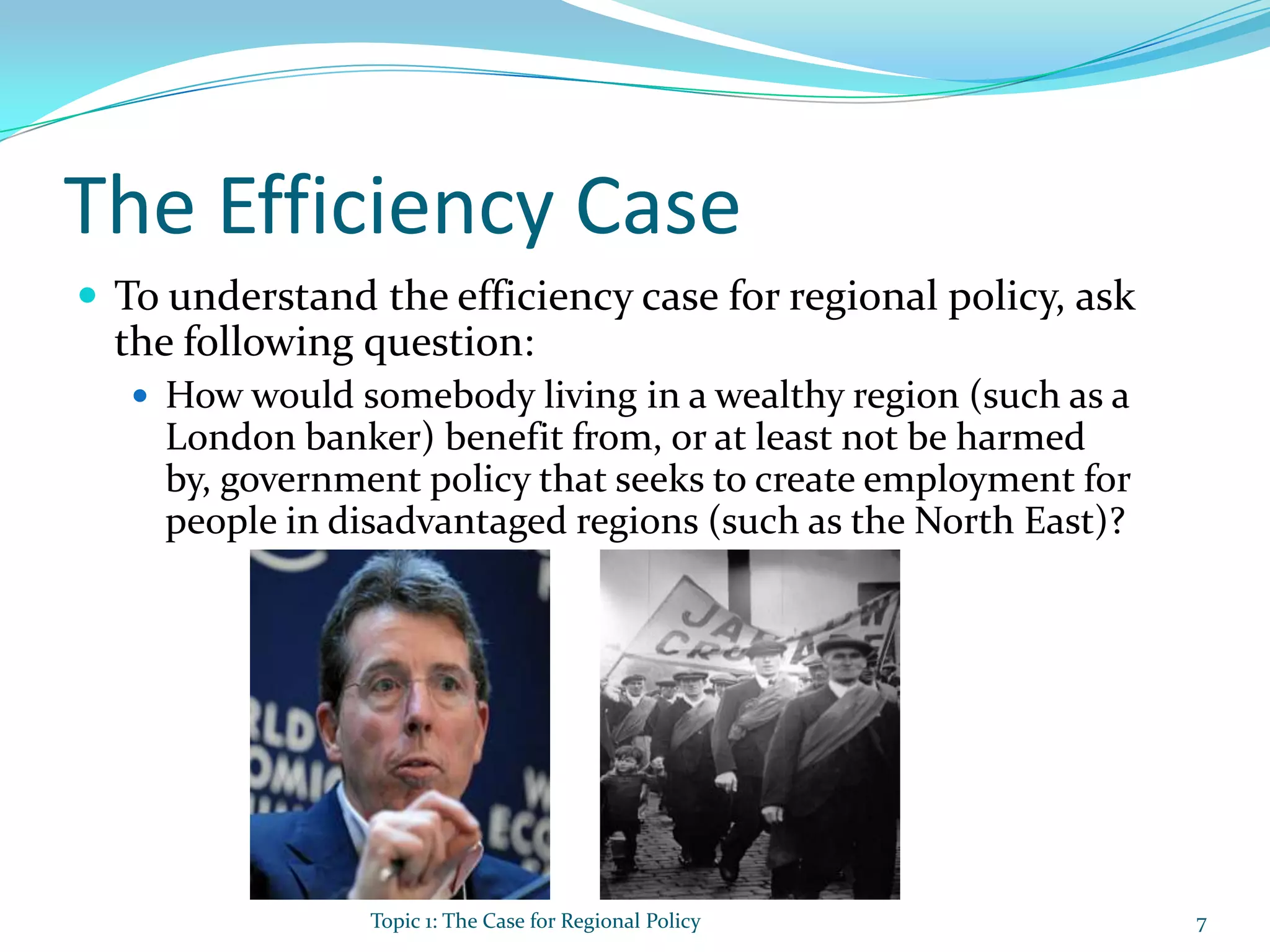
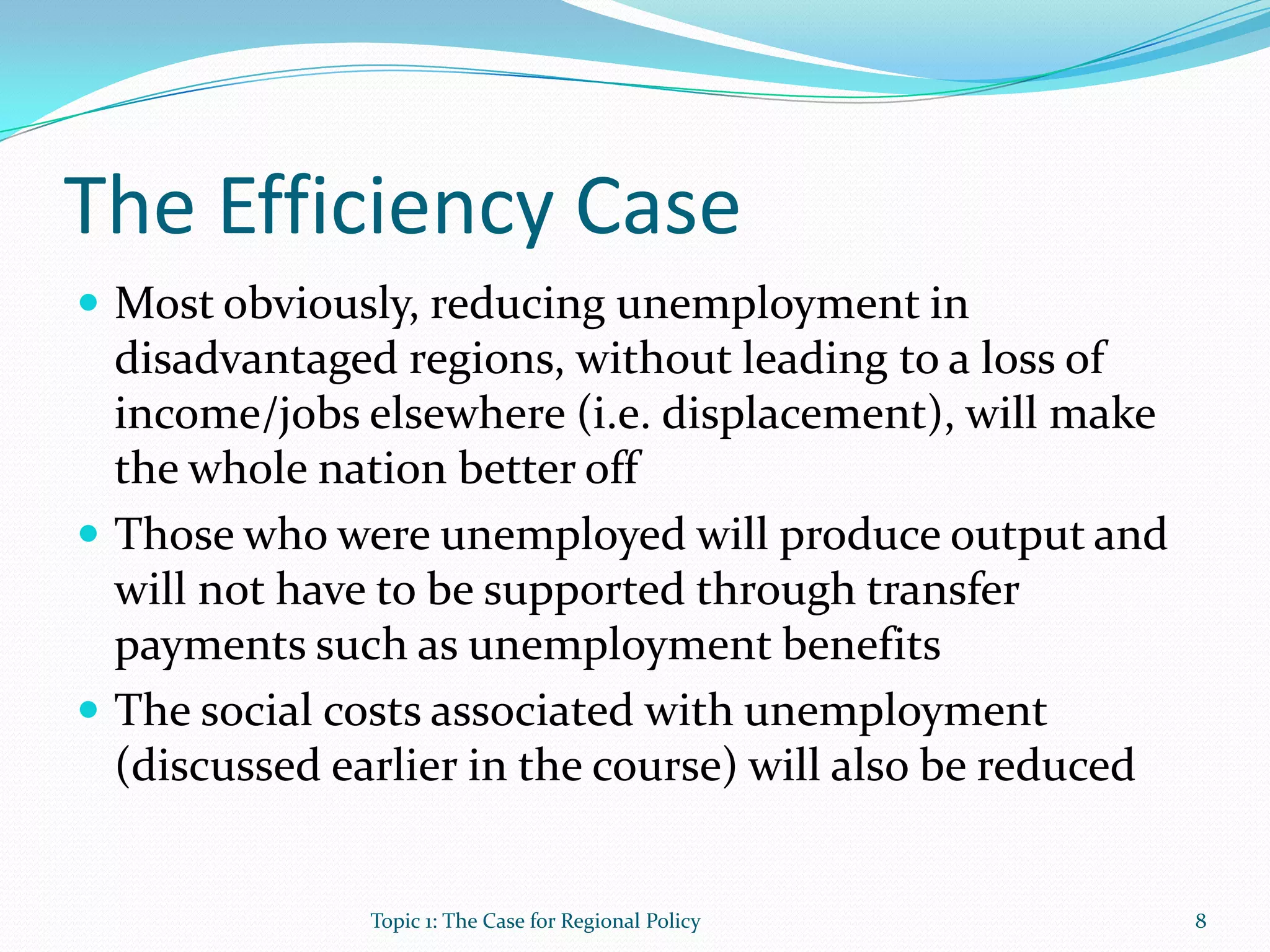
 How would somebody living in a wealthy region (such as a
London banker) benefit from, or at least not be harmed
by, government policy that seeks to create employment for
people in disadvantaged regions (such as the North East)?
Topic 1: The Case for Regional Policy 7
The Efficiency Case
 Most obviously, reducing unemployment in
disadvantaged regions, without leading to a loss of
income/jobs elsewhere (i.e. displacement), will make
the whole nation better off
 Those who were unemployed will produce output and
will not have to be supported through transfer
payments such as unemployment benefits
 The social costs associated with unemployment
(discussed earlier in the course) will also be reduced
8Topic 1: The Case for Regional Policy
The Efficiency Case
 Congestion costs arise in regions that experience rapid
economic growth because of excess demand for
infrastructure and public services
 According to the Eddington Transport Study
(2006), reducing the travel time for all business travel
on the roads by 5% could generate around £2.5 billion
of cost savings
 Congestion can be relieved by shifting the demand for
infrastructure and public services away from congested
areas and towards under-performing regions where
infrastructure is used less intensively
9Topic 1: The Case for Regional Policy
The Efficiency Case
 Low unemployment regions experiencing fast growth
will tend to experience labour shortages
 The resultant wage inflation will be transmitted to
poorly performing parts of the country through
national wage-setting and inter-plant bargaining
within firms
 National inflation rates can therefore be reduced by
equalising unemployment rates across regions so that
labour shortages do not arise in fast growing areas
10Topic 1: The Case for Regional Policy
Policy Alternatives
 There are two main approaches to removing disparities
in economic performance:
 Market-based (neoclassical) approach
 generally favoured by those on the right
 Interventionist (spatial Keynesian) approach
 generally favoured by those on the left
 As will be seen in the next lecture, the interventionist
approach has been the dominant approach in recent
British history
11Topic 1: The Case for Regional Policy
Market-Based Approach
 Proponents of this approach argue that if markets
are allowed to operate efficiently, disparities in
wages and unemployment rates will be
automatically eliminated though:
 Wages falling in areas of high unemployment
and rising in areas of low unemployment
 Workers migrating from low wage to high wage
areas
12Topic 1: The Case for Regional Policy
Market-Based Approach
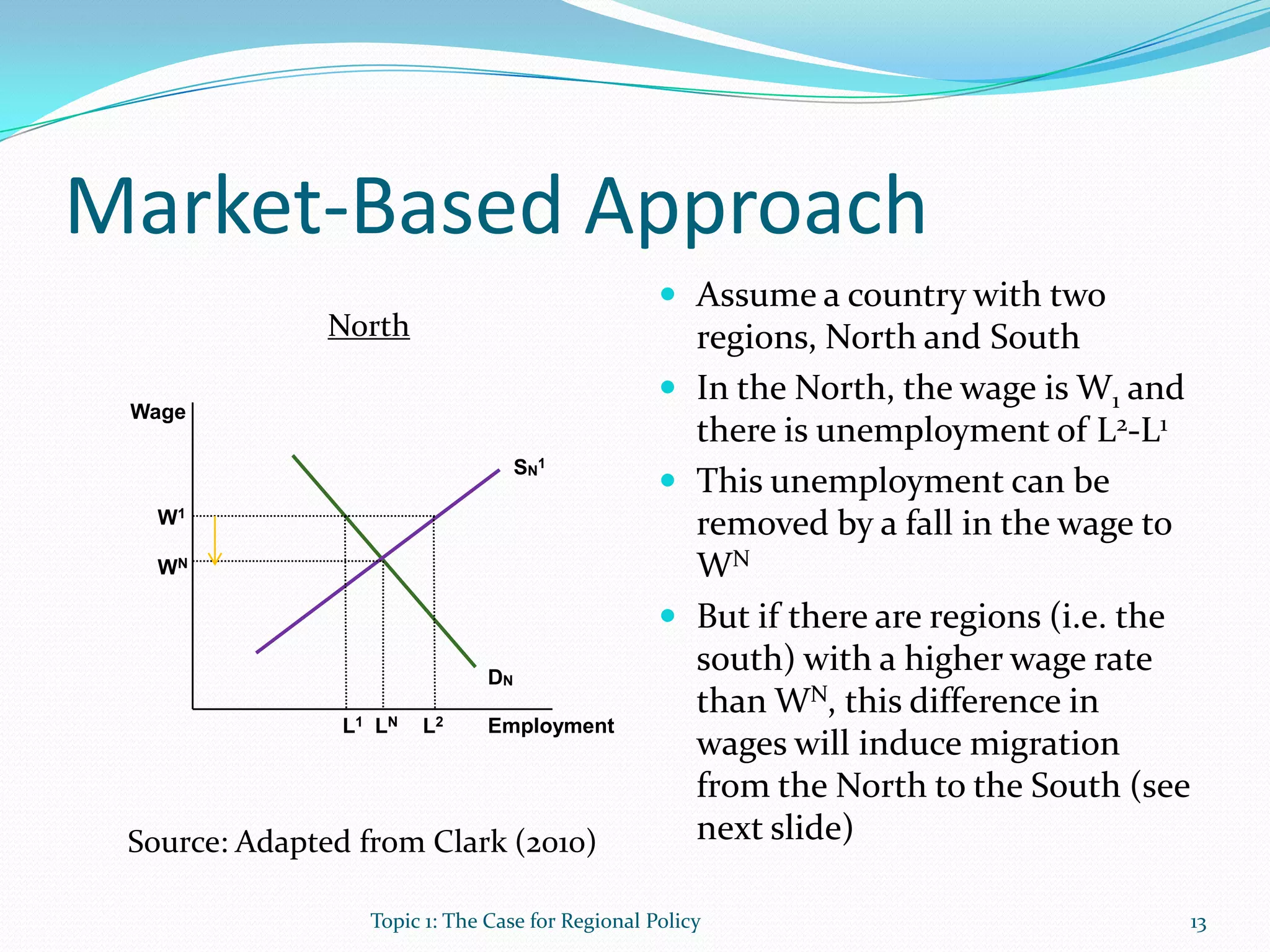
 Assume a country with two
regions, North and South
 In the North, the wage is W1 and
there is unemployment of L2-L1
 This unemployment can be
removed by a fall in the wage to
WN
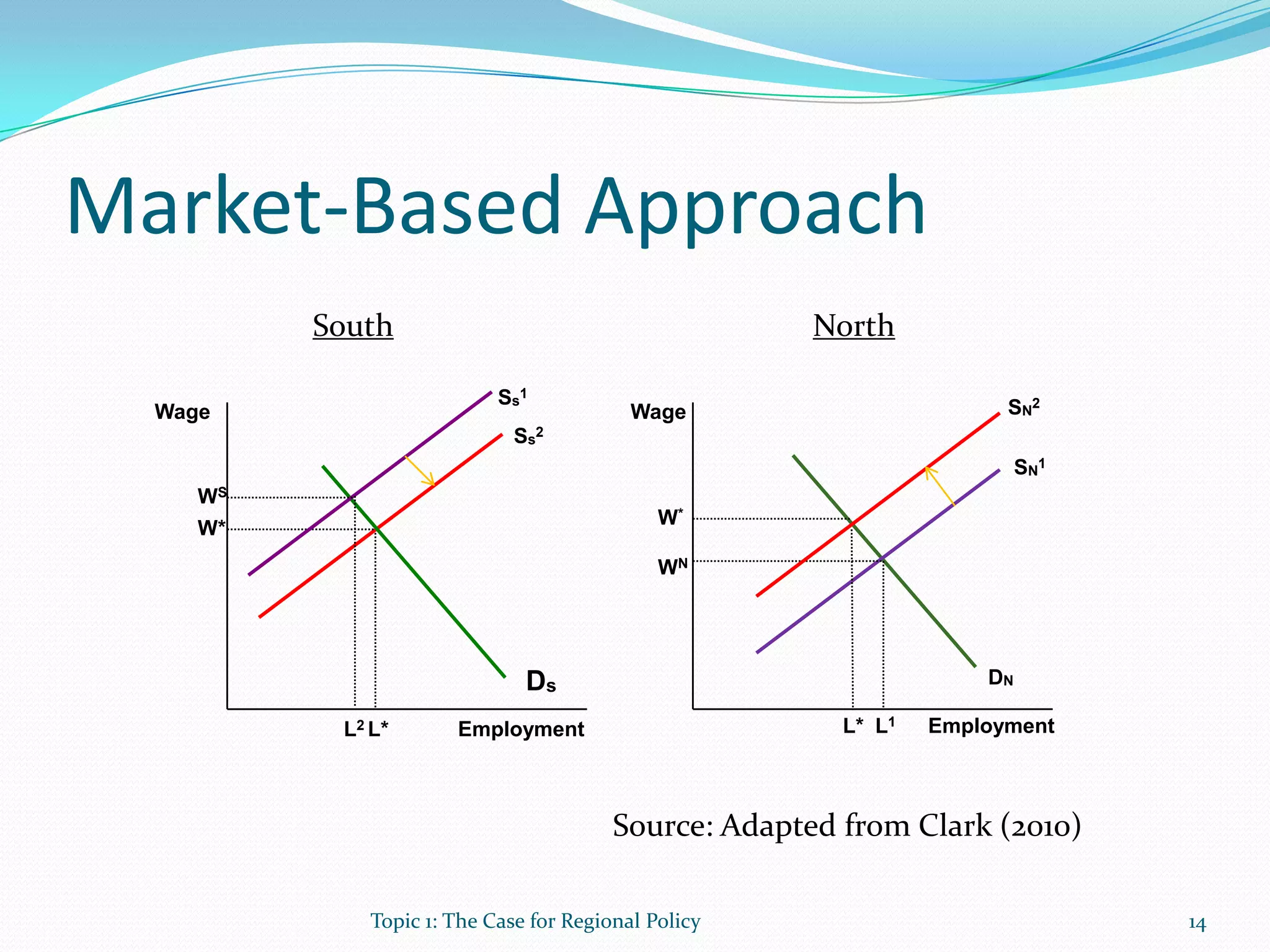
 But if there are regions (i.e. the
south) with a higher wage rate
than WN, this difference in
wages will induce migration
from the North to the South (see
next slide)
Topic 1: The Case for Regional Policy 13
Source: Adapted from Clark (2010)
Wage
Employment
SN
1
DN
WN
LN
W1
L1
North
L2
Market-Based Approach
Topic 1: The Case for Regional Policy 14
Ss
2
W*
L*
Wage
Employment
Ss
1
Ds
WS
L2
South
Wage
Employment
SN
1
DN
WN
L1
SN
2
W*
L*
North
Source: Adapted from Clark (2010)
Market-Based Approach
 But wage differentials may not arise in the first place if
wages do not respond to local labour market
conditions because of:
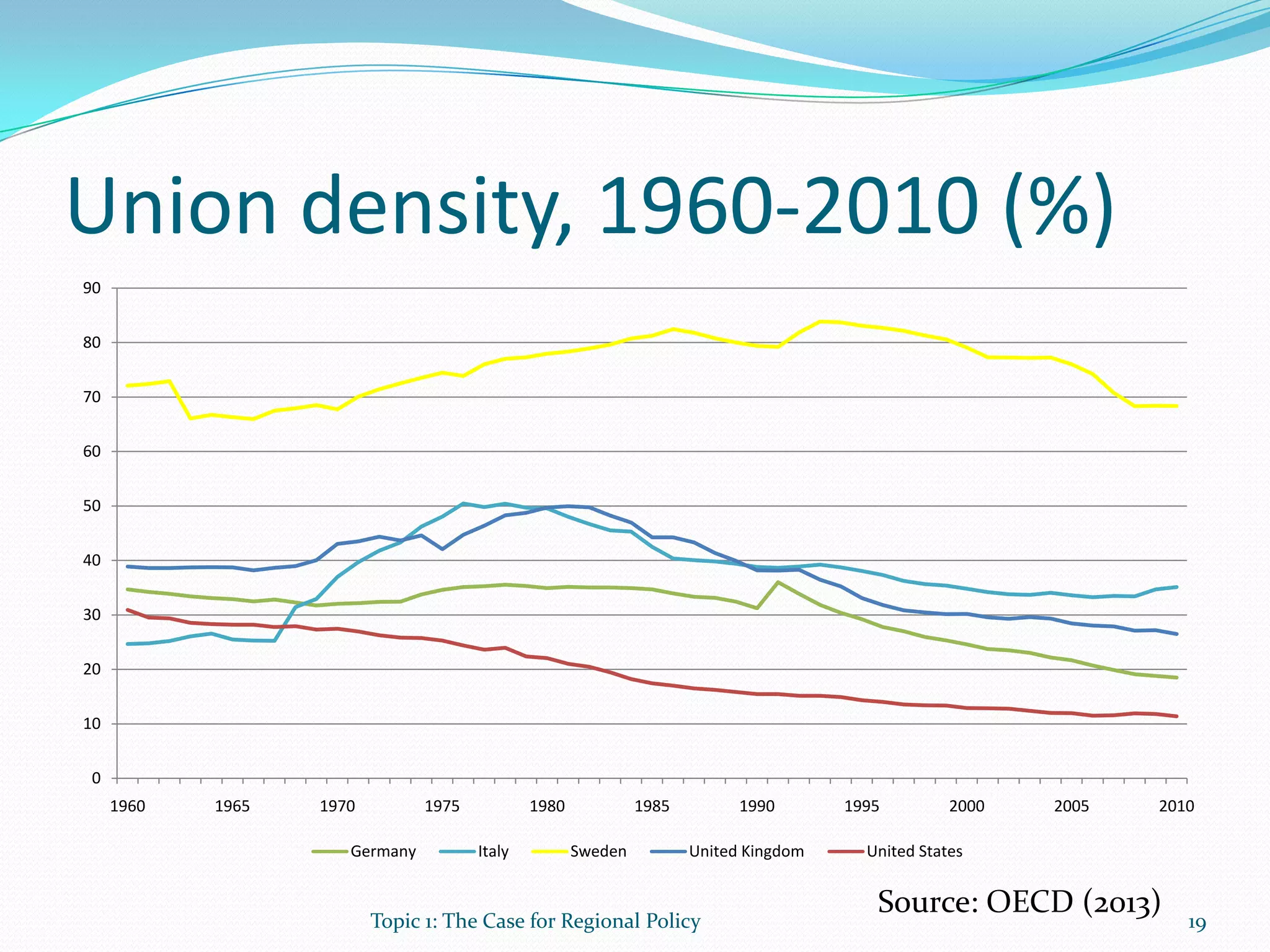
 Industry-wide collective wage agreements rather than
local wage bargaining
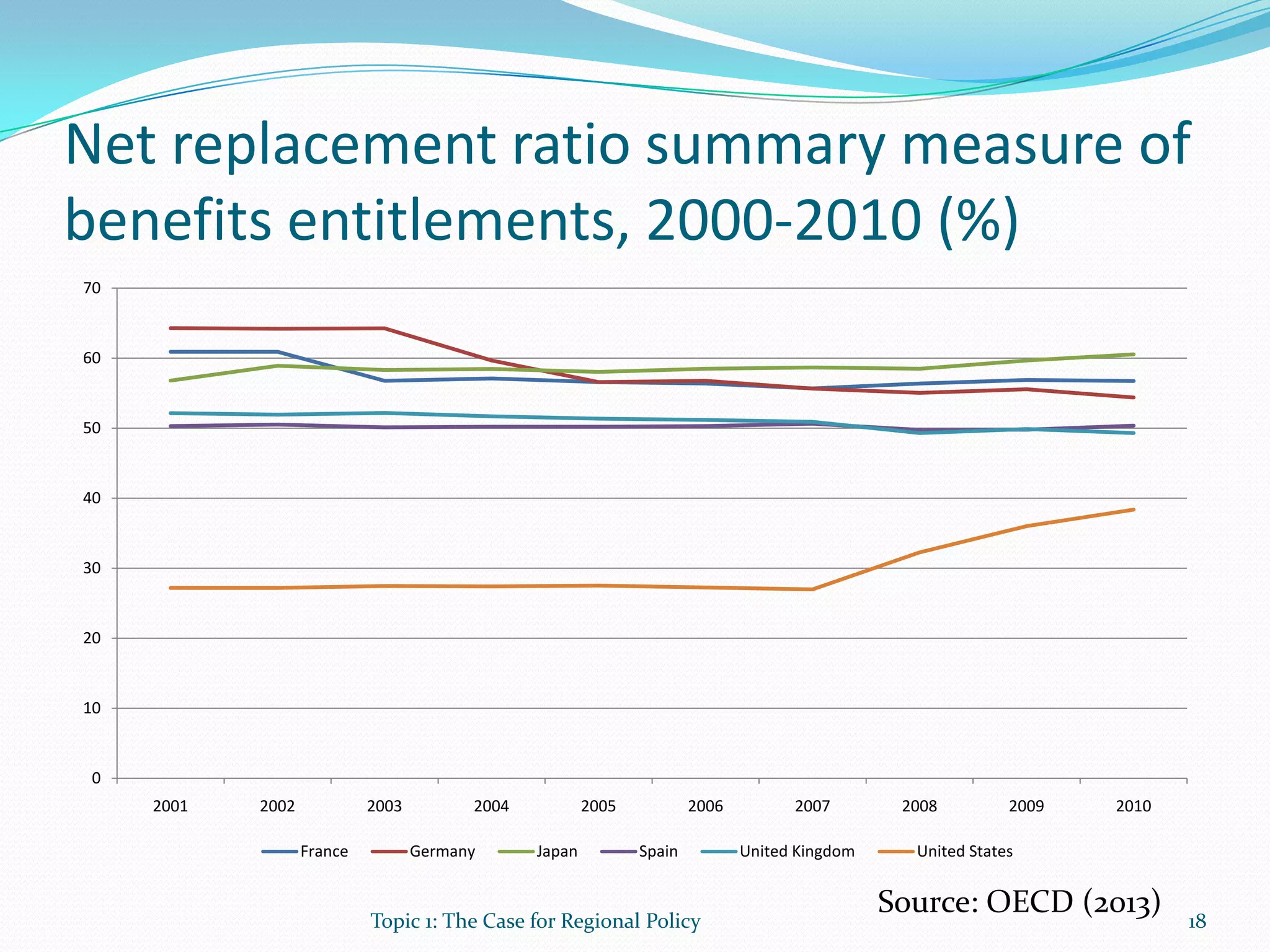
 Unemployment benefit and income support that is ‘too
high’ and too easy to access
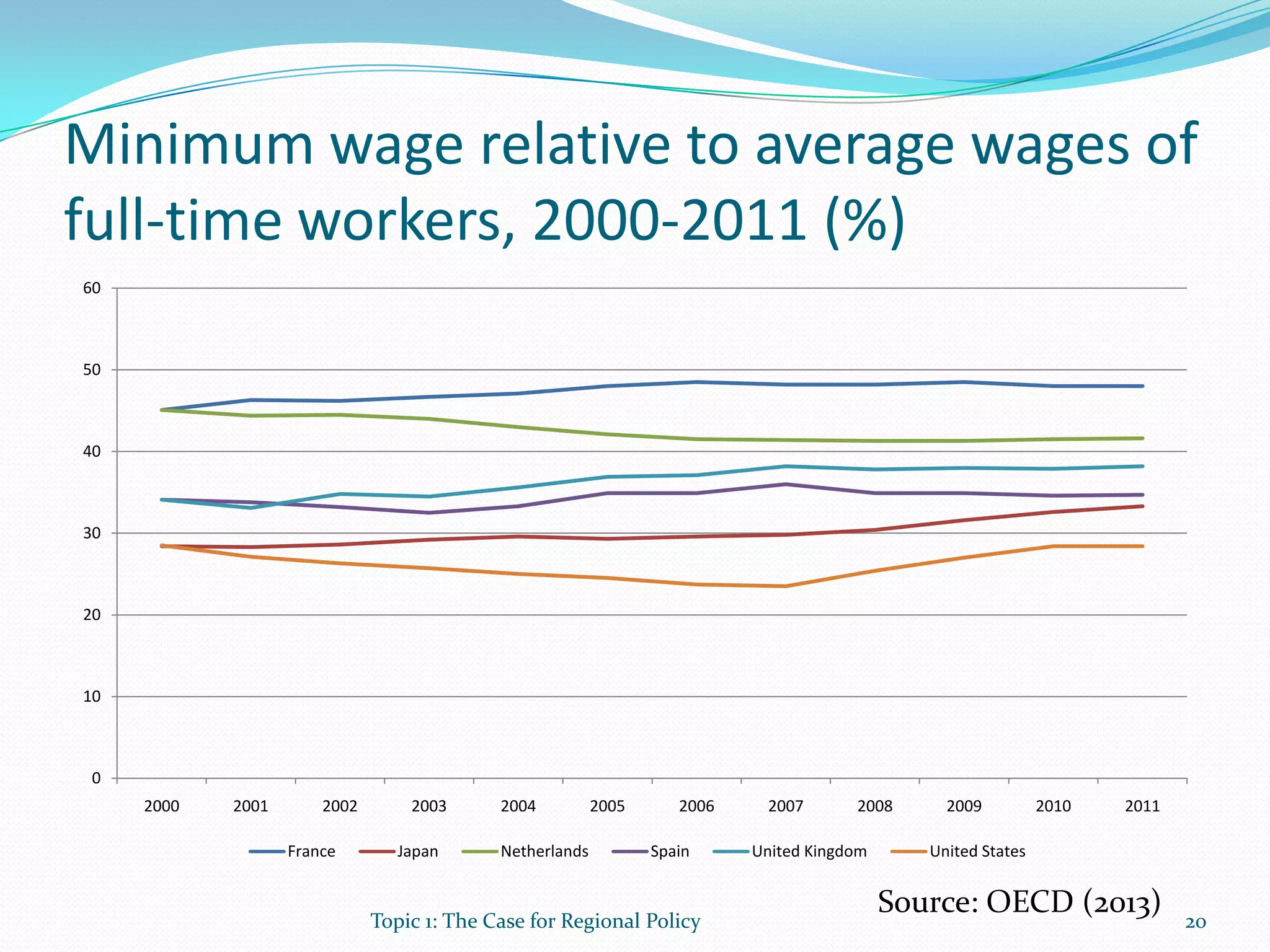
 A minimum wage that is too high
15Topic 1: The Case for Regional Policy
Market-Based Approach
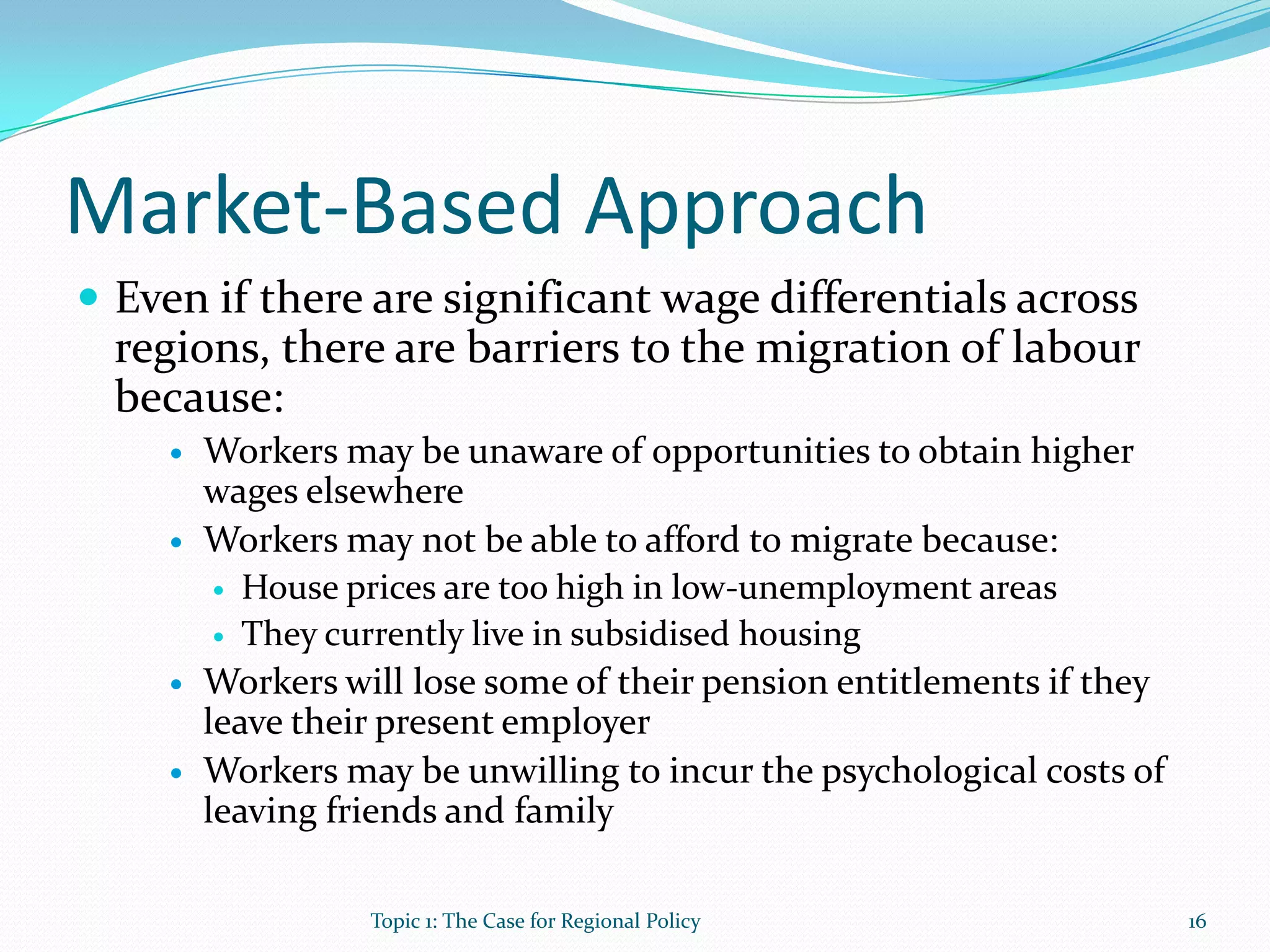
 Even if there are significant wage differentials across
regions, there are barriers to the migration of labour
because:
 Workers may be unaware of opportunities to obtain higher
wages elsewhere
 Workers may not be able to afford to migrate because:
 House prices are too high in low-unemployment areas
 They currently live in subsidised housing
 Workers will lose some of their pension entitlements if they
leave their present employer
 Workers may be unwilling to incur the psychological costs of
leaving friends and family
16Topic 1: The Case for Regional Policy
Market-Based Approach
 The solution is therefore to remove these
constraints on the free operation of the market:
 Increase wage flexibility by:
 Reducing benefits and making them harder to access
 Reducing union power and encouraging more local
wage bargaining
 Reducing the minimum wage
 To what extent can these policies be pursued in the
UK?
17Topic 1: The Case for Regional Policy
Net replacement ratio summary measure of
benefits entitlements, 2000-2010 (%)
Topic 1: The Case for Regional Policy 18
Source: OECD (2013)
0
10
20
30
40
50
60
70
2001 2002 2003 2004 2005 2006 2007 2008 2009 2010
France Germany Japan Spain United Kingdom United States
Union density, 1960-2010 (%)
Topic 1: The Case for Regional Policy 19
Source: OECD (2013)
0
10
20
30
40
50
60
70
80
90
1960 1965 1970 1975 1980 1985 1990 1995 2000 2005 2010
Germany Italy Sweden United Kingdom United States
Minimum wage relative to average wages of
full-time workers, 2000-2011 (%)
Topic 1: The Case for Regional Policy 20
Source: OECD (2013)
0
10
20
30
40
50
60
2000 2001 2002 2003 2004 2005 2006 2007 2008 2009 2010 2011
France Japan Netherlands Spain United Kingdom United States
Market-Based Approach
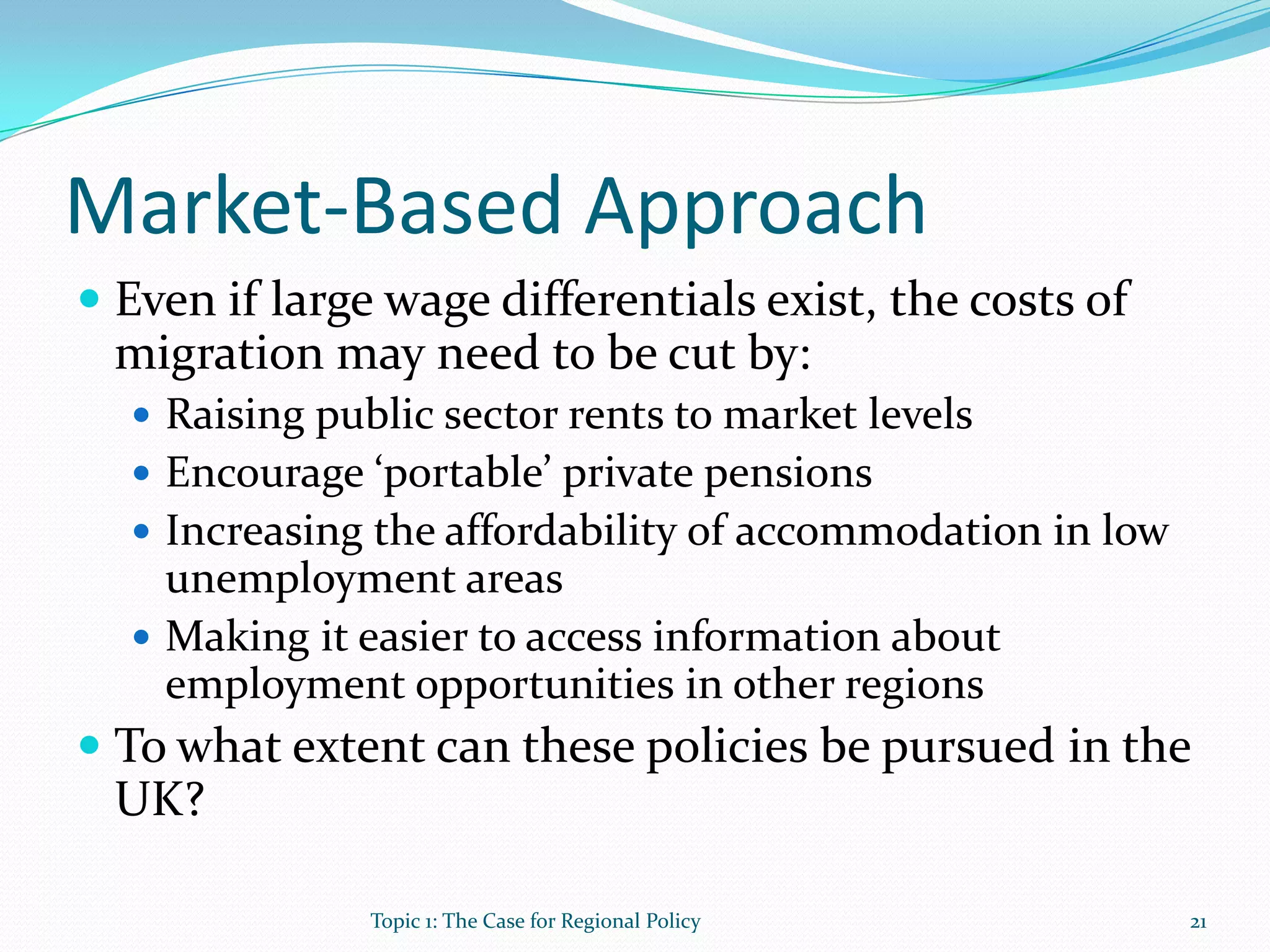
 Even if large wage differentials exist, the costs of
migration may need to be cut by:
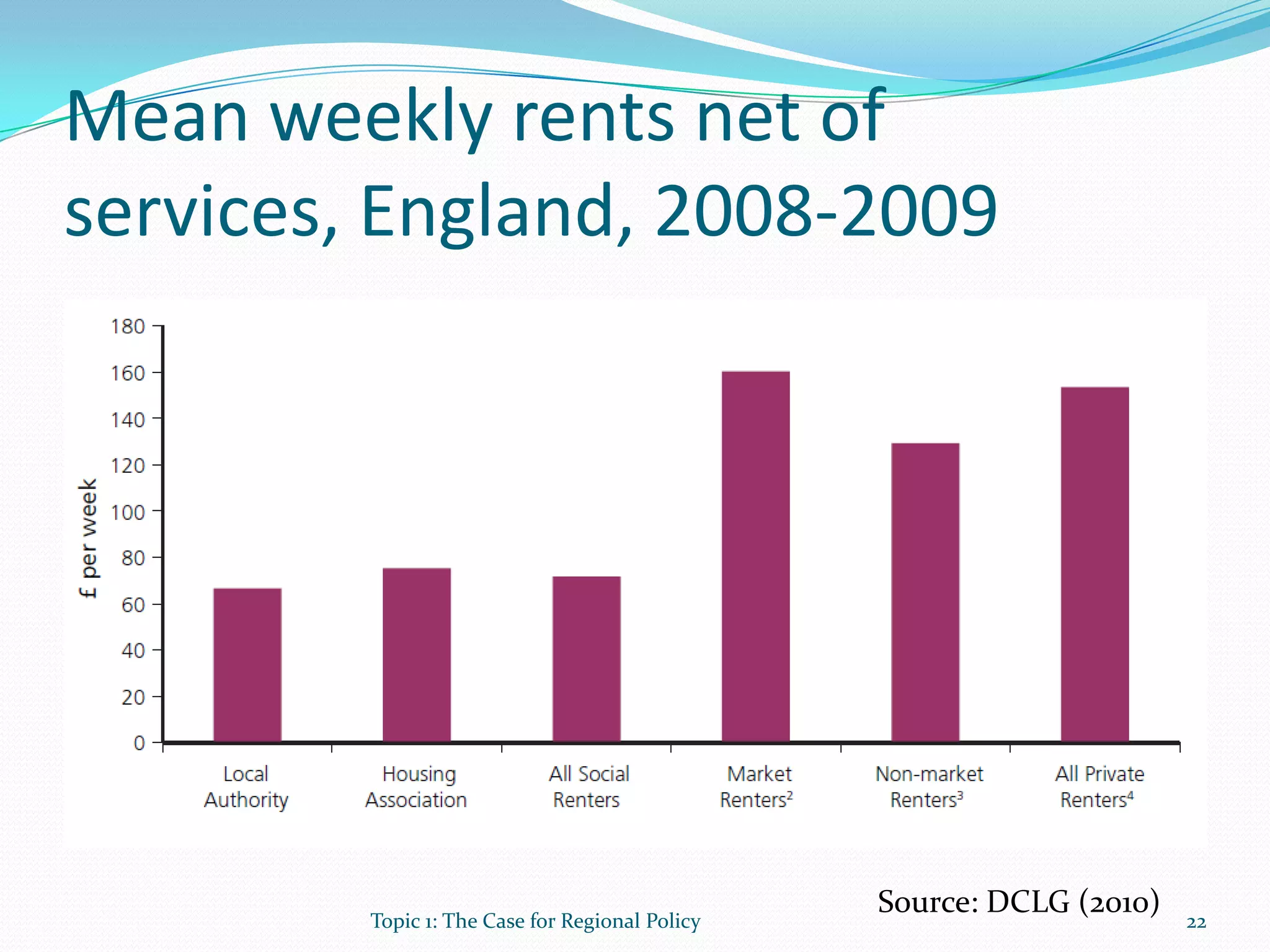
 Raising public sector rents to market levels
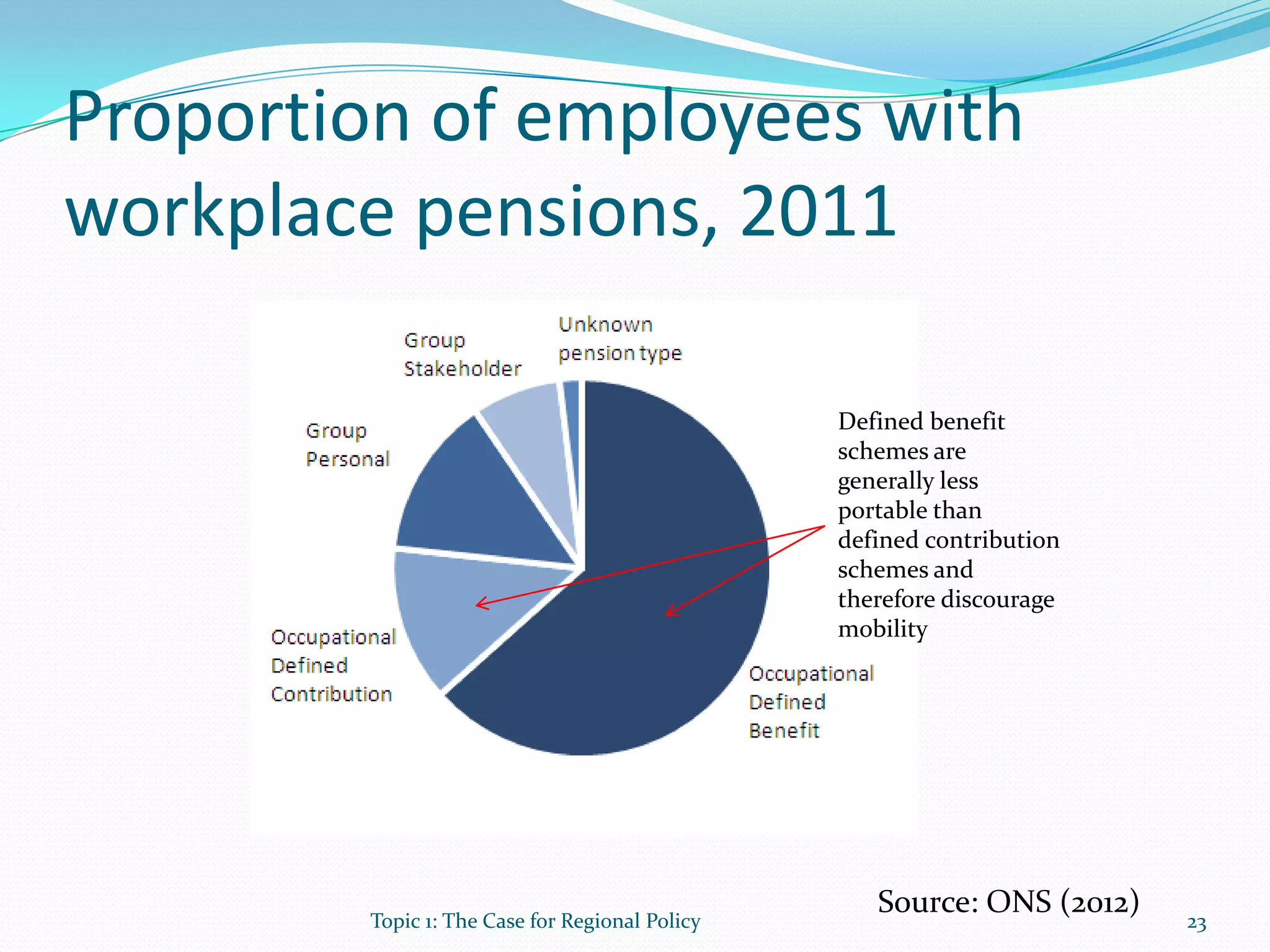
 Encourage ‘portable’ private pensions
 Increasing the affordability of accommodation in low
unemployment areas
 Making it easier to access information about
employment opportunities in other regions
 To what extent can these policies be pursued in the
UK?
21Topic 1: The Case for Regional Policy
Mean weekly rents net of
services, England, 2008-2009
Topic 1: The Case for Regional Policy 22
Source: DCLG (2010)
Proportion of employees with
workplace pensions, 2011
Topic 1: The Case for Regional Policy 23
Source: ONS (2012)
Defined benefit
schemes are
generally less
portable than
defined contribution
schemes and
therefore discourage
mobility
Average house prices, July-
September 2012
Topic 1: The Case for Regional Policy 24
Source: BBC (2013)
£0
£50,000
£100,000
£150,000
£200,000
£250,000
£300,000
£350,000
£400,000
£450,000
£500,000
Greater
London
South East South West East Anglia West
Midlands
East
Midlands
Yorks &
Humber
North West Scotland Wales North Northern
Ireland
Market-Based Approach
 Even if the government were able to encourage
migration from low to high wage regions, this may not
help in removing disparities in economic performance
 This is because those leaving low wage areas will tend
to be younger, higher skilled workers who will
contribute most to economic growth
 Furthermore, migration to high wage areas will create
extra demand for over-utilised social infrastructure
25Topic 1: The Case for Regional Policy
Interventionist Approach
 This approach, also known as the spatial Keynesian
approach, argues that direct state intervention is
required to remove disparities in regional economic
performance
 Such disparities are viewed as the consequence of:
 Structural weaknesses in the regional economy
 A lack of investment as capital drains from poor to rich
regions
26Topic 1: The Case for Regional Policy
Interventionist Approach
 The solution is supply-side policies to:
 Encourage the migration of capital into high-
unemployment areas
 Encourage indigenous growth in high unemployment
areas
 Enhance competitiveness by regenerating high
unemployment areas through public investment in the
socio-economic infrastructure
27Topic 1: The Case for Regional Policy
Interventionist Approach
 A serious criticism of the interventionist approach to
regional policy is that it creates ‘deadweight’ spending
where public money is spent on private sector projects
that would have gone ahead anyway
 One way around this is through providing
discretionary rather than automatic assistance (see
next lecture)
 But even when discretionary assistance is
provided, funding may still go towards projects that
are not successful (see next slide)
28Topic 1: The Case for Regional Policy
Interventionist Approach
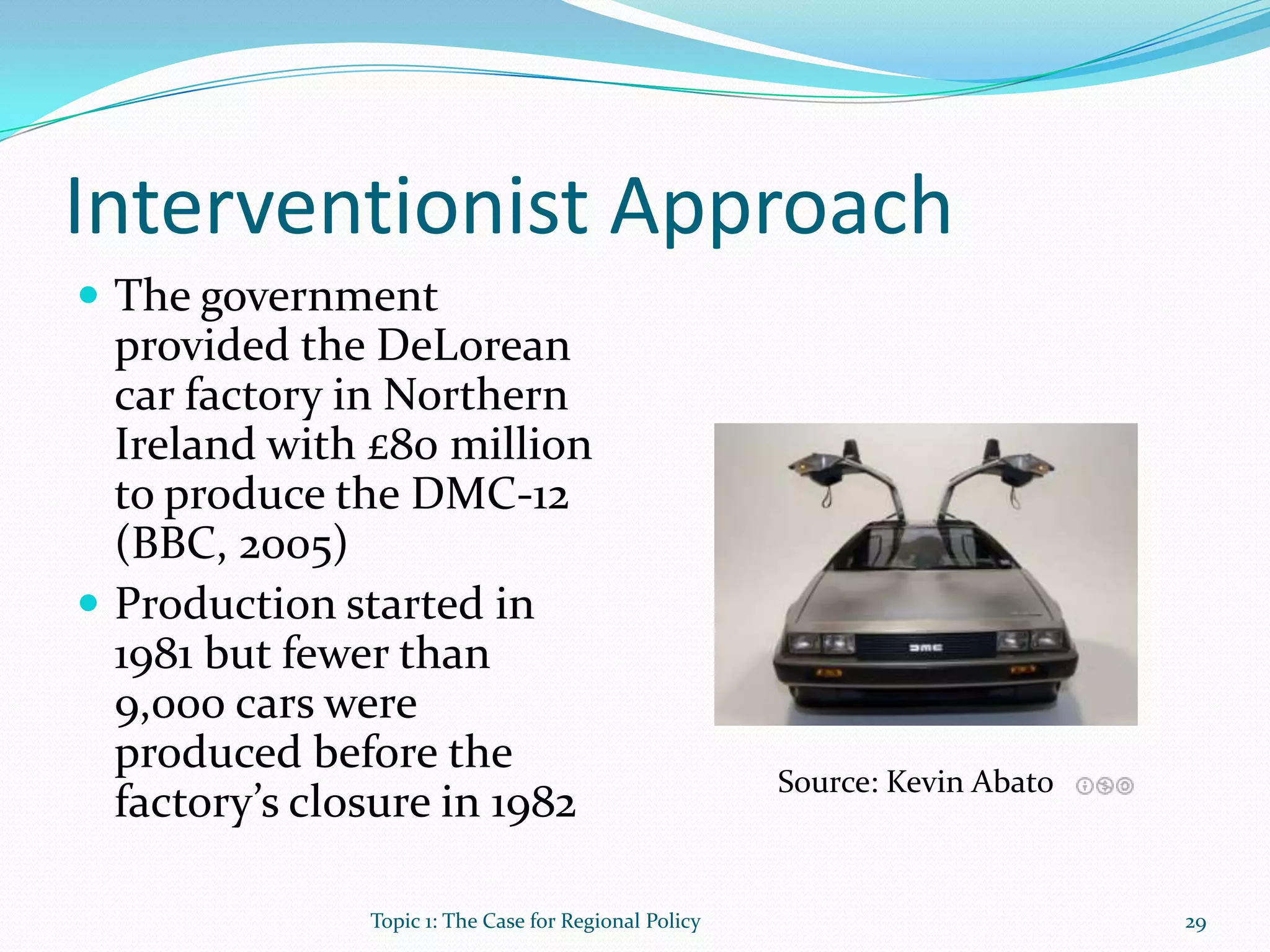
 The government
provided the DeLorean
car factory in Northern
Ireland with £80 million
to produce the DMC-12
(BBC, 2005)
 Production started in
1981 but fewer than
9,000 cars were
produced before the
factory’s closure in 1982
Source: Kevin Abato
29Topic 1: The Case for Regional Policy
Summary
 Regional policy can be justified on efficiency and
equity grounds
 The market-based approach to regional policy
attempts to remove distortions which prevent the
market from equalising unemployment and wage rates
across regions
 The interventionist approach is based on the
assumption that direct state intervention is required to
remove regional disparities in economic performance
30Topic 1: The Case for Regional Policy
Next topic:
UK REGIONAL
POLICY
31Topic 1: The Case for Regional Policy

1 the case for regional policy(4)-1

  • 1.
    Dr John Moffat RichardPrice Building, Room F49 Email: J.D.Moffat@swansea.ac.uk Office Hours: Tuesday & Friday, 1:30-2:30pm
  • 2.
    Section Outline  Thefollowing topics will be covered in the next five weeks: 1. The Case for Regional Policy 2. UK Regional Policy 3. EU Regional Policy 4. Devolution 5. Regional Funding  The exam will be a two hour written examination (worth 45% of the final course grade) on all the material covered in semester 2 Topic 1: The Case for Regional Policy 2
  • 3.
    Readings  The maintextbook for this section of the course is:  Armstrong, H. & Taylor, J. (2000), Regional Economics and Policy, 3rd ed. Oxford: Blackwell  This week’s reading is:  Armstrong & Taylor, chapter 8 3Topic 1: The Case for Regional Policy
  • 4.
    Learning Outcomes  Studentsshould be able to answer the following questions:  What are the main justifications for the existence of a regional policy?  Should regional economic disparities be alleviated by a market-based or an interventionist approach? 4Topic 1: The Case for Regional Policy
  • 5.
    The Case forRegional Policy  Regional policy aims to reduce disparities in living standards across regions  Arguments for a regional policy can be based on considerations of:  Equity  Policy motivated by equity concerns aims to make the distribution of income/wealth more equitable  Efficiency  Policy motivated by efficiency concerns attempts to make some people better off without making anybody worse off 5Topic 1: The Case for Regional Policy
  • 6.
    The Equity Case Substantial differences in living standards lead to dissatisfaction and resentment  This is most strongly felt by those whose living standards are poor through no fault of their own  A regional policy motivated purely by equity considerations could make certain people worse off 6Topic 1: The Case for Regional Policy
  • 7.
    The Efficiency Case To understand the efficiency case for regional policy, ask the following question:  How would somebody living in a wealthy region (such as a London banker) benefit from, or at least not be harmed by, government policy that seeks to create employment for people in disadvantaged regions (such as the North East)? Topic 1: The Case for Regional Policy 7
  • 8.
    The Efficiency Case Most obviously, reducing unemployment in disadvantaged regions, without leading to a loss of income/jobs elsewhere (i.e. displacement), will make the whole nation better off  Those who were unemployed will produce output and will not have to be supported through transfer payments such as unemployment benefits  The social costs associated with unemployment (discussed earlier in the course) will also be reduced 8Topic 1: The Case for Regional Policy
  • 9.
    The Efficiency Case Congestion costs arise in regions that experience rapid economic growth because of excess demand for infrastructure and public services  According to the Eddington Transport Study (2006), reducing the travel time for all business travel on the roads by 5% could generate around £2.5 billion of cost savings  Congestion can be relieved by shifting the demand for infrastructure and public services away from congested areas and towards under-performing regions where infrastructure is used less intensively 9Topic 1: The Case for Regional Policy
  • 10.
    The Efficiency Case Low unemployment regions experiencing fast growth will tend to experience labour shortages  The resultant wage inflation will be transmitted to poorly performing parts of the country through national wage-setting and inter-plant bargaining within firms  National inflation rates can therefore be reduced by equalising unemployment rates across regions so that labour shortages do not arise in fast growing areas 10Topic 1: The Case for Regional Policy
  • 11.
    Policy Alternatives  Thereare two main approaches to removing disparities in economic performance:  Market-based (neoclassical) approach  generally favoured by those on the right  Interventionist (spatial Keynesian) approach  generally favoured by those on the left  As will be seen in the next lecture, the interventionist approach has been the dominant approach in recent British history 11Topic 1: The Case for Regional Policy
  • 12.
    Market-Based Approach  Proponentsof this approach argue that if markets are allowed to operate efficiently, disparities in wages and unemployment rates will be automatically eliminated though:  Wages falling in areas of high unemployment and rising in areas of low unemployment  Workers migrating from low wage to high wage areas 12Topic 1: The Case for Regional Policy
  • 13.
    Market-Based Approach  Assumea country with two regions, North and South  In the North, the wage is W1 and there is unemployment of L2-L1  This unemployment can be removed by a fall in the wage to WN  But if there are regions (i.e. the south) with a higher wage rate than WN, this difference in wages will induce migration from the North to the South (see next slide) Topic 1: The Case for Regional Policy 13 Source: Adapted from Clark (2010) Wage Employment SN 1 DN WN LN W1 L1 North L2
  • 14.
    Market-Based Approach Topic 1:The Case for Regional Policy 14 Ss 2 W* L* Wage Employment Ss 1 Ds WS L2 South Wage Employment SN 1 DN WN L1 SN 2 W* L* North Source: Adapted from Clark (2010)
  • 15.
    Market-Based Approach  Butwage differentials may not arise in the first place if wages do not respond to local labour market conditions because of:  Industry-wide collective wage agreements rather than local wage bargaining  Unemployment benefit and income support that is ‘too high’ and too easy to access  A minimum wage that is too high 15Topic 1: The Case for Regional Policy
  • 16.
    Market-Based Approach  Evenif there are significant wage differentials across regions, there are barriers to the migration of labour because:  Workers may be unaware of opportunities to obtain higher wages elsewhere  Workers may not be able to afford to migrate because:  House prices are too high in low-unemployment areas  They currently live in subsidised housing  Workers will lose some of their pension entitlements if they leave their present employer  Workers may be unwilling to incur the psychological costs of leaving friends and family 16Topic 1: The Case for Regional Policy
  • 17.
    Market-Based Approach  Thesolution is therefore to remove these constraints on the free operation of the market:  Increase wage flexibility by:  Reducing benefits and making them harder to access  Reducing union power and encouraging more local wage bargaining  Reducing the minimum wage  To what extent can these policies be pursued in the UK? 17Topic 1: The Case for Regional Policy
  • 18.
    Net replacement ratiosummary measure of benefits entitlements, 2000-2010 (%) Topic 1: The Case for Regional Policy 18 Source: OECD (2013) 0 10 20 30 40 50 60 70 2001 2002 2003 2004 2005 2006 2007 2008 2009 2010 France Germany Japan Spain United Kingdom United States
  • 19.
    Union density, 1960-2010(%) Topic 1: The Case for Regional Policy 19 Source: OECD (2013) 0 10 20 30 40 50 60 70 80 90 1960 1965 1970 1975 1980 1985 1990 1995 2000 2005 2010 Germany Italy Sweden United Kingdom United States
  • 20.
    Minimum wage relativeto average wages of full-time workers, 2000-2011 (%) Topic 1: The Case for Regional Policy 20 Source: OECD (2013) 0 10 20 30 40 50 60 2000 2001 2002 2003 2004 2005 2006 2007 2008 2009 2010 2011 France Japan Netherlands Spain United Kingdom United States
  • 21.
    Market-Based Approach  Evenif large wage differentials exist, the costs of migration may need to be cut by:  Raising public sector rents to market levels  Encourage ‘portable’ private pensions  Increasing the affordability of accommodation in low unemployment areas  Making it easier to access information about employment opportunities in other regions  To what extent can these policies be pursued in the UK? 21Topic 1: The Case for Regional Policy
  • 22.
    Mean weekly rentsnet of services, England, 2008-2009 Topic 1: The Case for Regional Policy 22 Source: DCLG (2010)
  • 23.
    Proportion of employeeswith workplace pensions, 2011 Topic 1: The Case for Regional Policy 23 Source: ONS (2012) Defined benefit schemes are generally less portable than defined contribution schemes and therefore discourage mobility
  • 24.
    Average house prices,July- September 2012 Topic 1: The Case for Regional Policy 24 Source: BBC (2013) £0 £50,000 £100,000 £150,000 £200,000 £250,000 £300,000 £350,000 £400,000 £450,000 £500,000 Greater London South East South West East Anglia West Midlands East Midlands Yorks & Humber North West Scotland Wales North Northern Ireland
  • 25.
    Market-Based Approach  Evenif the government were able to encourage migration from low to high wage regions, this may not help in removing disparities in economic performance  This is because those leaving low wage areas will tend to be younger, higher skilled workers who will contribute most to economic growth  Furthermore, migration to high wage areas will create extra demand for over-utilised social infrastructure 25Topic 1: The Case for Regional Policy
  • 26.
    Interventionist Approach  Thisapproach, also known as the spatial Keynesian approach, argues that direct state intervention is required to remove disparities in regional economic performance  Such disparities are viewed as the consequence of:  Structural weaknesses in the regional economy  A lack of investment as capital drains from poor to rich regions 26Topic 1: The Case for Regional Policy
  • 27.
    Interventionist Approach  Thesolution is supply-side policies to:  Encourage the migration of capital into high- unemployment areas  Encourage indigenous growth in high unemployment areas  Enhance competitiveness by regenerating high unemployment areas through public investment in the socio-economic infrastructure 27Topic 1: The Case for Regional Policy
  • 28.
    Interventionist Approach  Aserious criticism of the interventionist approach to regional policy is that it creates ‘deadweight’ spending where public money is spent on private sector projects that would have gone ahead anyway  One way around this is through providing discretionary rather than automatic assistance (see next lecture)  But even when discretionary assistance is provided, funding may still go towards projects that are not successful (see next slide) 28Topic 1: The Case for Regional Policy
  • 29.
    Interventionist Approach  Thegovernment provided the DeLorean car factory in Northern Ireland with £80 million to produce the DMC-12 (BBC, 2005)  Production started in 1981 but fewer than 9,000 cars were produced before the factory’s closure in 1982 Source: Kevin Abato 29Topic 1: The Case for Regional Policy
  • 30.
    Summary  Regional policycan be justified on efficiency and equity grounds  The market-based approach to regional policy attempts to remove distortions which prevent the market from equalising unemployment and wage rates across regions  The interventionist approach is based on the assumption that direct state intervention is required to remove regional disparities in economic performance 30Topic 1: The Case for Regional Policy
  • 31.
    Next topic: UK REGIONAL POLICY 31Topic1: The Case for Regional Policy