

Easy Jet
THE WEB’S FAVOURITE AIRLINE
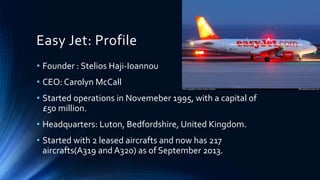
Easy Jet: Profile
• Founder : Stelios Haji-Ioannou
• CEO: Carolyn McCall
• Started operations in Novemeber 1995, with a capital of
£50 million.
• Headquarters: Luton, Bedfordshire, United Kingdom.
• Started with 2 leased aircrafts and now has 217
aircrafts(A319 and A320) as of September 2013.
European Market
• Deregulation in 1992, more new airlines were created.
• 1999, only 3% - 5% flew on low-cost carrier in Europe
whereas it was 24% in U.S.
• Competition from High speed rail service
• Cost of running an airline was 40% higher than in U.S.
• 60 out of 80 had gone bankruptcy by 1996.
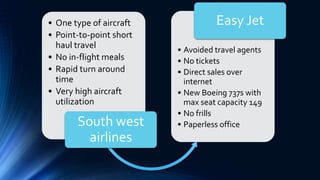
• One type of aircraft
• Point-to-point short
haul travel
• No in-flight meals
• Rapid turn around
time
• Very high aircraft
utilization
South west
airlines
• Avoided travel agents
• No tickets
• Direct sales over
internet
• New Boeing 737s with
max seat capacity 149
• No frills
• Paperless office
Easy Jet
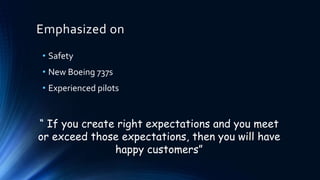
Emphasized on
• Safety
• New Boeing 737s
• Experienced pilots
“ If you create right expectations and you meet
or exceed those expectations, then you will have
happy customers”
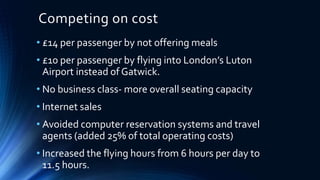
Competing on cost
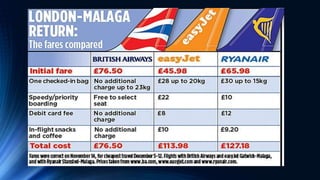
• £14 per passenger by not offering meals
• £10 per passenger by flying into London’s Luton
Airport instead of Gatwick.
• No business class- more overall seating capacity
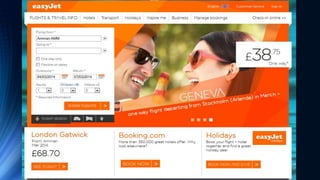
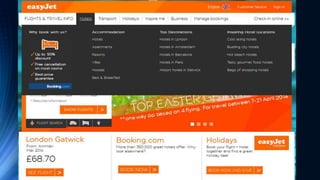
• Internet sales
• Avoided computer reservation systems and travel
agents (added 25% of total operating costs)
• Increased the flying hours from 6 hours per day to
11.5 hours.
SERVICE COMPETENCIES
• Approach to customer satisfaction
• Internet and on telephone sales and no reimbursement for
missed flights.
• Credit card payments and acknowledgement through six
character booking reference number.
• No pre-assigned seating, first come first serve basis.
• Target group: travelers, entrepreneurs and managers of
small firms.
• Ignored business travelers on some routes who accounted
for 50% of passengers.
• Yield management – fill as many seats as possible
• Lottery system
% of seats sold   Price of the seat 
• Drew potential customers who were in search of
cheap fares.
• Punctuality
Outsourcing
• Lowered costs and increased efficiency
• Airline provided only Planes, Pilots, Cabin crew, marketing
and sales people.
• All other responsibilities from check-in to the on-site
customer information desk were handled by
Subcontractors.
• Early 1998, owned operating certificate.
• Workshops, role-reversal exercises and simulations
• Not only quantitative criteria(on-time flights) but also
qualitative criteria (understanding of easy-jet concept).
Brand Awareness
• 10% of revenue were spent on newspaper, magazine and
radio advertising.
• By 1998, recognition rate was 88% in London and 82% in
Geneva.
• “Say no to Swissair monopoly”
Corporate Culture
• Strong, inclusive employee-culture – EasyJet Culture
Committee
• Company-sponsored barbecue
• Complete transparency in the data (excluding payroll
information)
• “The fight with Go”
• Acquiring ofTEA, a Swiss charter airline.
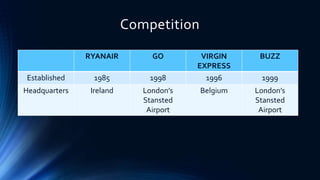
Competition
RYANAIR GO VIRGIN
EXPRESS
BUZZ
Established 1985 1998 1996 1999
Headquarters Ireland London’s
Stansted
Airport
Belgium London’s
Stansted
Airport
Challenges
• Privately held company to public
• Subcontractors- outsourcing of vital functions
• Becoming more corporate
• Relative youth and inexperience of employees
• Stabilizing internally
Other ventures
• Creation of a cyber café business called easyEverything
Café in 1999.
“ to offer the Internet to the masses” and
“to be the cheapest way to access web”
• First debuted in London on June 21, 1999 nearVictoria
station.
• First café – 400 terminals and fibre optic communication
lines that offered faster connections.
• Rental car business and Internet based bank.
THANK YOU

Easy Jet_ Low cost carrier

  • 1.
    Easy Jet THE WEB’SFAVOURITE AIRLINE
  • 2.
    Easy Jet: Profile •Founder : Stelios Haji-Ioannou • CEO: Carolyn McCall • Started operations in Novemeber 1995, with a capital of £50 million. • Headquarters: Luton, Bedfordshire, United Kingdom. • Started with 2 leased aircrafts and now has 217 aircrafts(A319 and A320) as of September 2013.
  • 5.
    European Market • Deregulationin 1992, more new airlines were created. • 1999, only 3% - 5% flew on low-cost carrier in Europe whereas it was 24% in U.S. • Competition from High speed rail service • Cost of running an airline was 40% higher than in U.S. • 60 out of 80 had gone bankruptcy by 1996.
  • 6.
    • One typeof aircraft • Point-to-point short haul travel • No in-flight meals • Rapid turn around time • Very high aircraft utilization South west airlines • Avoided travel agents • No tickets • Direct sales over internet • New Boeing 737s with max seat capacity 149 • No frills • Paperless office Easy Jet
  • 7.
    Emphasized on • Safety •New Boeing 737s • Experienced pilots “ If you create right expectations and you meet or exceed those expectations, then you will have happy customers”
  • 8.
    Competing on cost •£14 per passenger by not offering meals • £10 per passenger by flying into London’s Luton Airport instead of Gatwick. • No business class- more overall seating capacity • Internet sales • Avoided computer reservation systems and travel agents (added 25% of total operating costs) • Increased the flying hours from 6 hours per day to 11.5 hours.
  • 10.
    SERVICE COMPETENCIES • Approachto customer satisfaction • Internet and on telephone sales and no reimbursement for missed flights. • Credit card payments and acknowledgement through six character booking reference number. • No pre-assigned seating, first come first serve basis. • Target group: travelers, entrepreneurs and managers of small firms. • Ignored business travelers on some routes who accounted for 50% of passengers.
  • 11.
    • Yield management– fill as many seats as possible • Lottery system % of seats sold   Price of the seat  • Drew potential customers who were in search of cheap fares. • Punctuality
  • 12.
    Outsourcing • Lowered costsand increased efficiency • Airline provided only Planes, Pilots, Cabin crew, marketing and sales people. • All other responsibilities from check-in to the on-site customer information desk were handled by Subcontractors. • Early 1998, owned operating certificate. • Workshops, role-reversal exercises and simulations • Not only quantitative criteria(on-time flights) but also qualitative criteria (understanding of easy-jet concept).
  • 13.
    Brand Awareness • 10%of revenue were spent on newspaper, magazine and radio advertising. • By 1998, recognition rate was 88% in London and 82% in Geneva. • “Say no to Swissair monopoly”
  • 14.
    Corporate Culture • Strong,inclusive employee-culture – EasyJet Culture Committee • Company-sponsored barbecue • Complete transparency in the data (excluding payroll information) • “The fight with Go” • Acquiring ofTEA, a Swiss charter airline.
  • 15.
    Competition RYANAIR GO VIRGIN EXPRESS BUZZ Established1985 1998 1996 1999 Headquarters Ireland London’s Stansted Airport Belgium London’s Stansted Airport
  • 16.
    Challenges • Privately heldcompany to public • Subcontractors- outsourcing of vital functions • Becoming more corporate • Relative youth and inexperience of employees • Stabilizing internally
  • 17.
    Other ventures • Creationof a cyber café business called easyEverything Café in 1999. “ to offer the Internet to the masses” and “to be the cheapest way to access web” • First debuted in London on June 21, 1999 nearVictoria station. • First café – 400 terminals and fibre optic communication lines that offered faster connections. • Rental car business and Internet based bank.
  • 18.