Strategy module | Kevin Constant | Lesley Wieme
Ryanair – Business Model
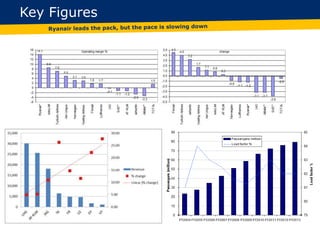
Key Figures
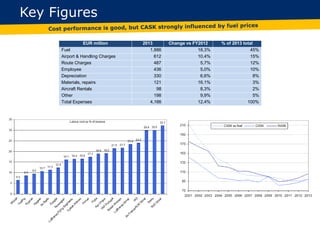
Key Figures
EUR million 2013 Change vs FY2012 % of 2013 total
Fuel 1,886 18,3% 45%
Airport & Handling Charges 612 10,4% 15%
Route Charges 487 5,7% 12%
Employee 436 5,0% 10%
Depreciation 330 6,6% 8%
Materials, repairs 121 16,1% 3%
Aircraft Rentals 98 8,3% 2%
Other 198 9,9% 5%
Total Expenses 4,166 12,4% 100%
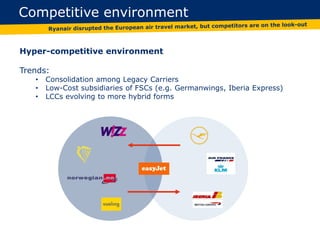
Hyper-competitive environment
Trends:
• Consolidation among Legacy Carriers
• Low-Cost subsidiaries of FSCs (e.g. Germanwings, Iberia Express)
• LCCs evolving to more hybrid forms
Competitive environment
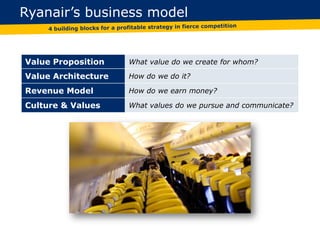
Ryanair‟s business model
Value Proposition What value do we create for whom?
Value Architecture How do we do it?
Revenue Model How do we earn money?
Culture & Values What values do we pursue and communicate?
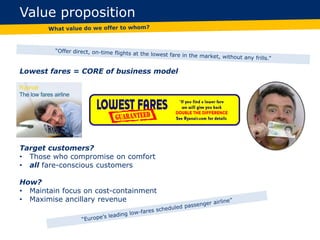
Value proposition
Lowest fares = CORE of business model
Target customers?
• Those who compromise on comfort
• all fare-conscious customers
How?
• Maintain focus on cost-containment
• Maximise ancillary revenue
Value architecture
Airport-related
• Short-haul
• Point-to-point
• Monopoly on most of its routes
• Secondary airports:
 Less congestion
 Lower charges
 Bargaining power
Value architecture
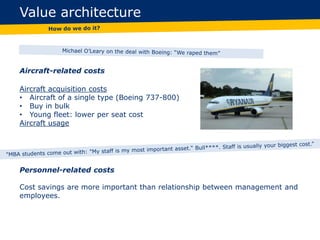
Aircraft-related costs
Aircraft acquisition costs
• Aircraft of a single type (Boeing 737-800)
• Buy in bulk
• Young fleet: lower per seat cost
Aircraft usage
Personnel-related costs
Cost savings are more important than relationship between management and
employees.
Value architecture
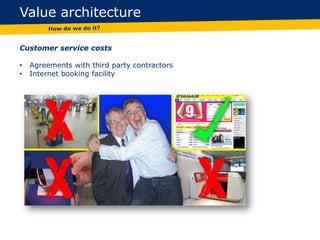
Customer service costs
• Agreements with third party contractors
• Internet booking facility
Value architecture
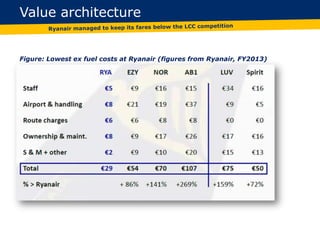
Figure: Lowest ex fuel costs at Ryanair (figures from Ryanair, FY2013)
Value architecture
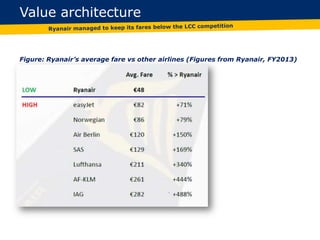
Figure: Ryanair’s average fare vs other airlines (Figures from Ryanair, FY2013)
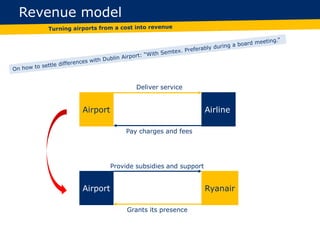
Revenue model
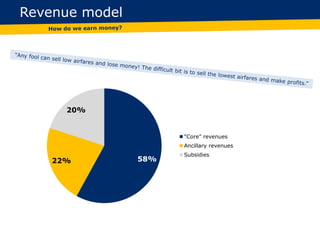
58%22%
20%
"Core" revenues
Ancillary revenues
Subsidies
Revenue model
Compulsory fees and charges
Variable amount fare based on barebone ticket structure
Ticket-related fees and additional charges
Ancillary revenues
“We think [passengers who forget their boarding pass] should pay 60 euros for being so stupid.”
Airport Airline
Deliver service
Pay charges and fees
Airport Ryanair
Provide subsidies and support
Grants its presence
Revenue model
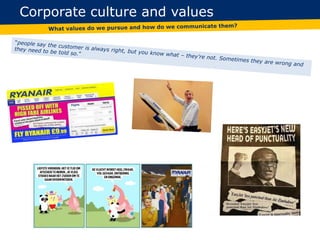
Corporate culture and values
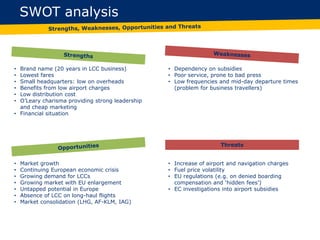
SWOT analysis
• Brand name (20 years in LCC business)
• Lowest fares
• Small headquarters: low on overheads
• Benefits from low airport charges
• Low distribution cost
• O‟Leary charisma providing strong leadership
and cheap marketing
• Financial situation
• Dependency on subsidies
• Poor service, prone to bad press
• Low frequencies and mid-day departure times
(problem for business travellers)
• Market growth
• Continuing European economic crisis
• Growing demand for LCCs
• Growing market with EU enlargement
• Untapped potential in Europe
• Absence of LCC on long-haul flights
• Market consolidation (LHG, AF-KLM, IAG)
• Increase of airport and navigation charges
• Fuel price volatility
• EU regulations (e.g. on denied boarding
compensation and „hidden fees‟)
• EC investigations into airport subsidies
Threats
Strategy module | Kevin Constant | Lesley Wieme
?