Ryanair's  Competitive Advantages Last Update:15.Sep.2009
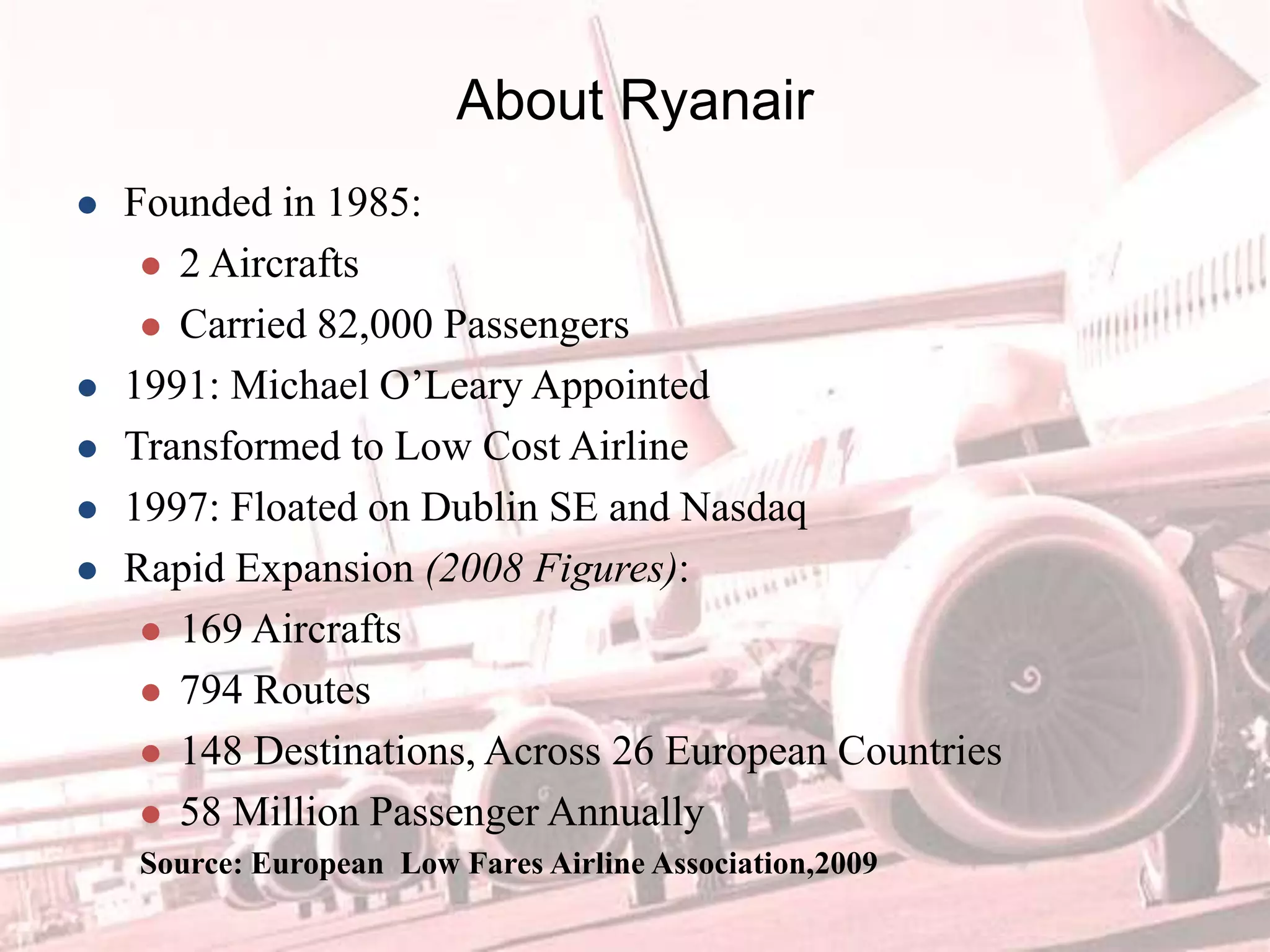
About Ryanair Founded in 1985: 2 Aircrafts Carried 82,000 Passengers 1991: Michael O’Leary Appointed Transformed to Low Cost Airline 1997: Floated on Dublin SE and Nasdaq Rapid Expansion  (2008 Figures) : 169 Aircrafts 794 Routes 148 Destinations, Across 26 European Countries 58 Million Passenger Annually Source: European  Low Fares Airline Association,2009
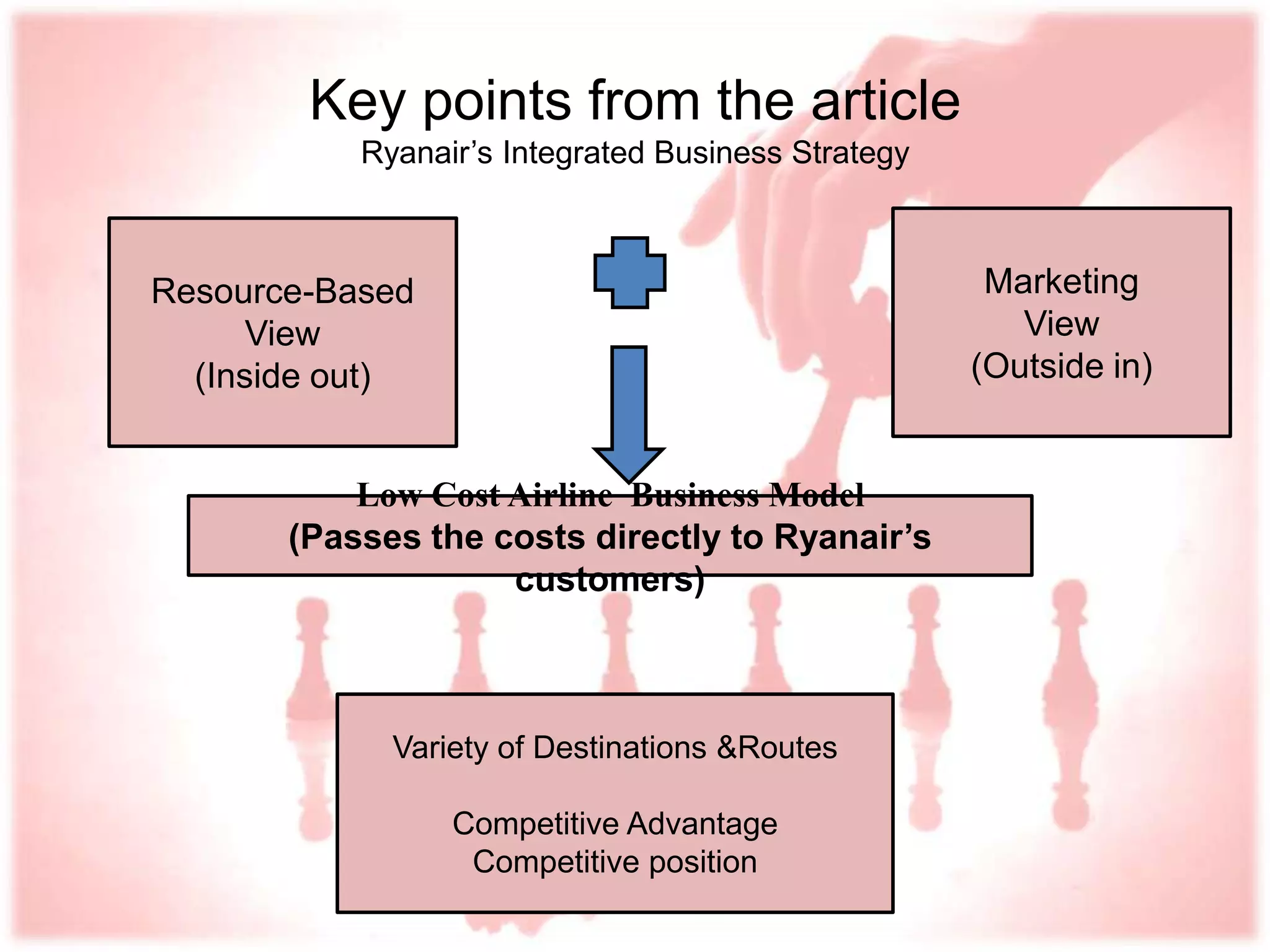
Ryanair’s Integrated Business Strategy Resource-Based View (Inside out) Marketing  View  (Outside in) Variety of Destinations &Routes Competitive Advantage Competitive position  Low Cost Airline  Business Model (Passes the costs directly to Ryanair’s customers)
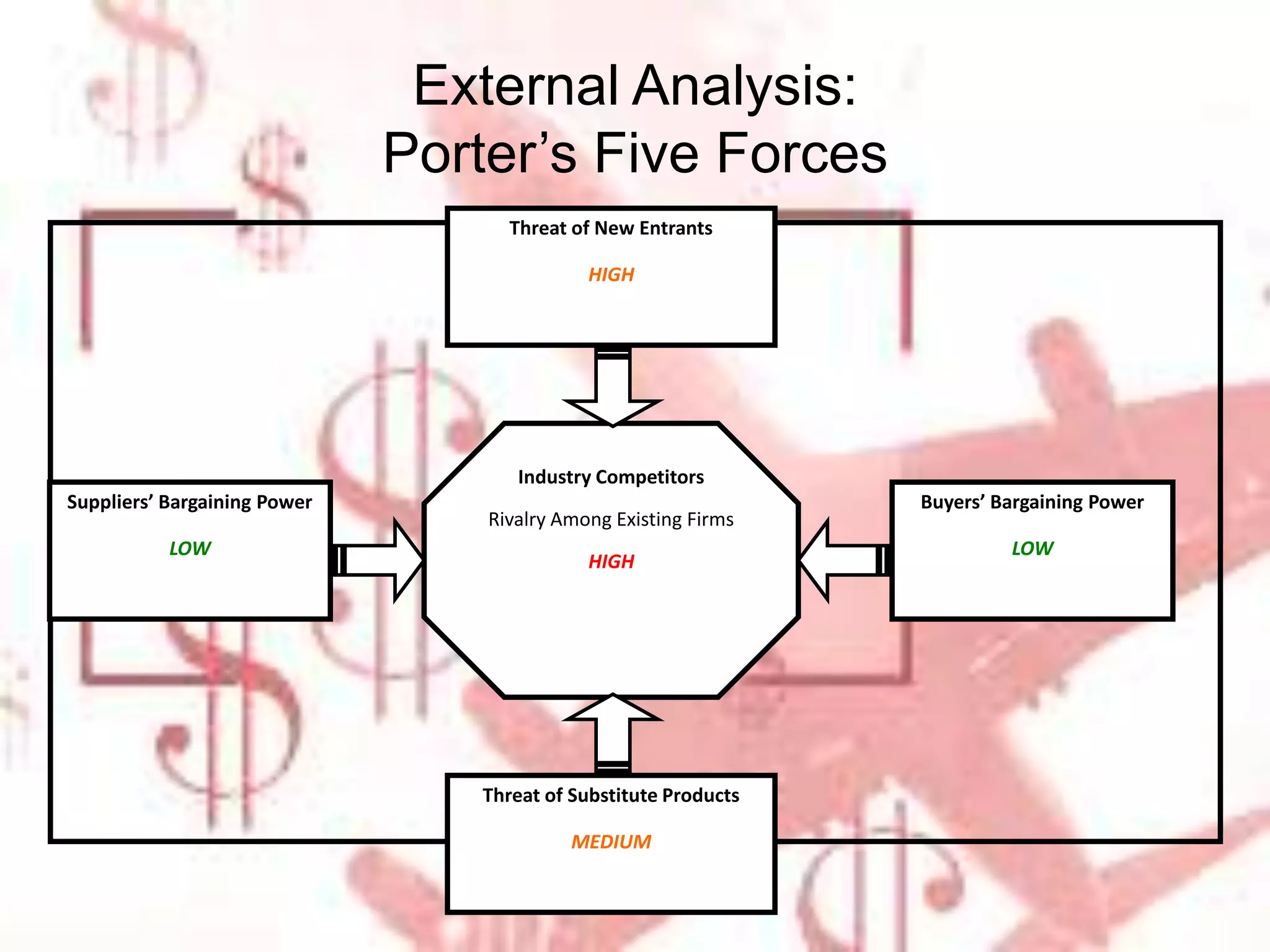
External Analysis: Porter’s Five Forces Threat of New Entrants HIGH Threat of Substitute Products MEDIUM Buyers’ Bargaining Power LOW Suppliers’ Bargaining Power LOW Industry Competitors Rivalry Among Existing Firms HIGH
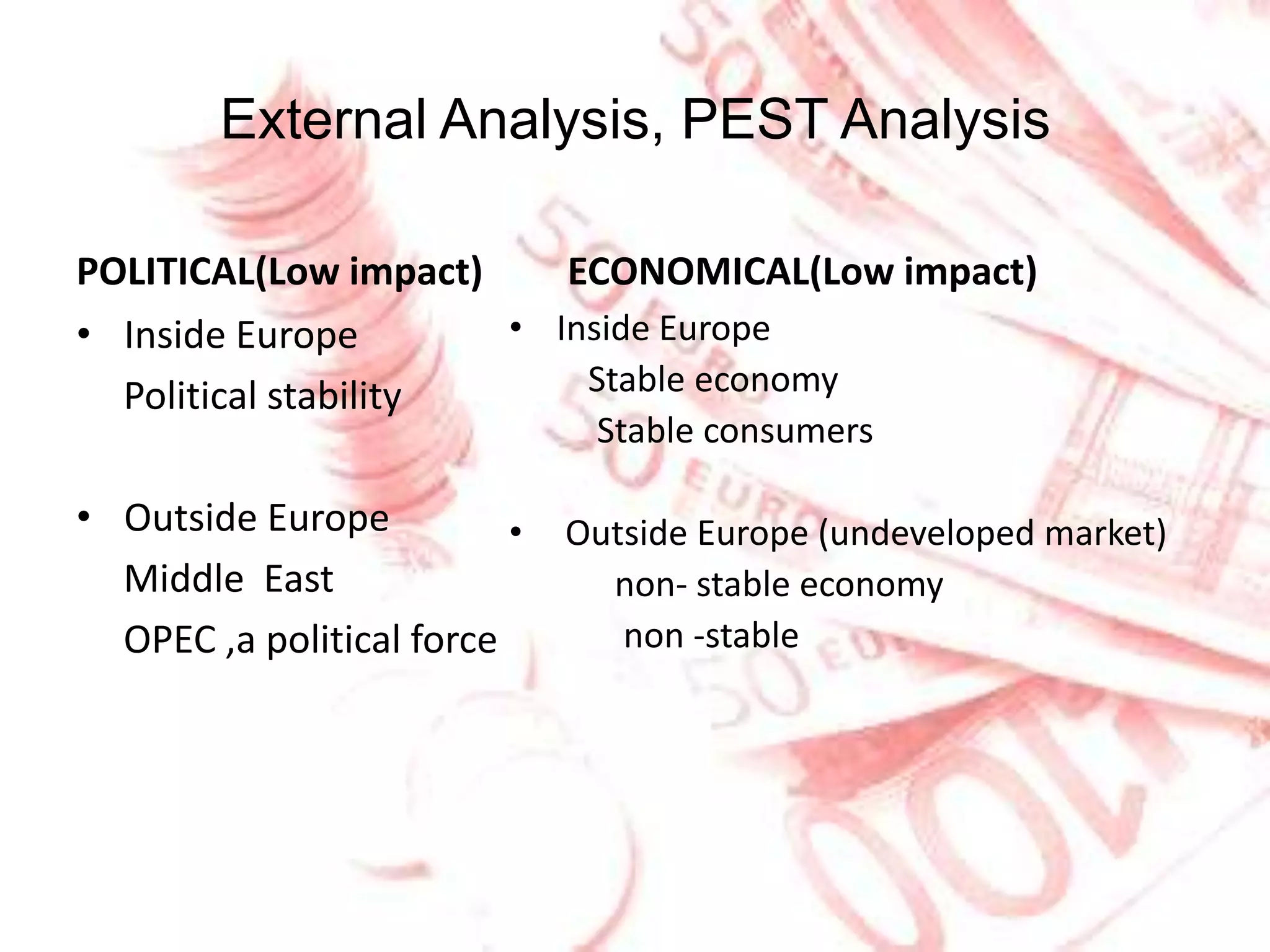
External Analysis, PEST Analysis POLITICAL(Low impact) Inside Europe Political stability Outside Europe Middle  East OPEC ,a political force ECONOMICAL(Low impact) Inside Europe Stable economy Stable consumers Outside Europe (undeveloped market) non- stable economy non -stable
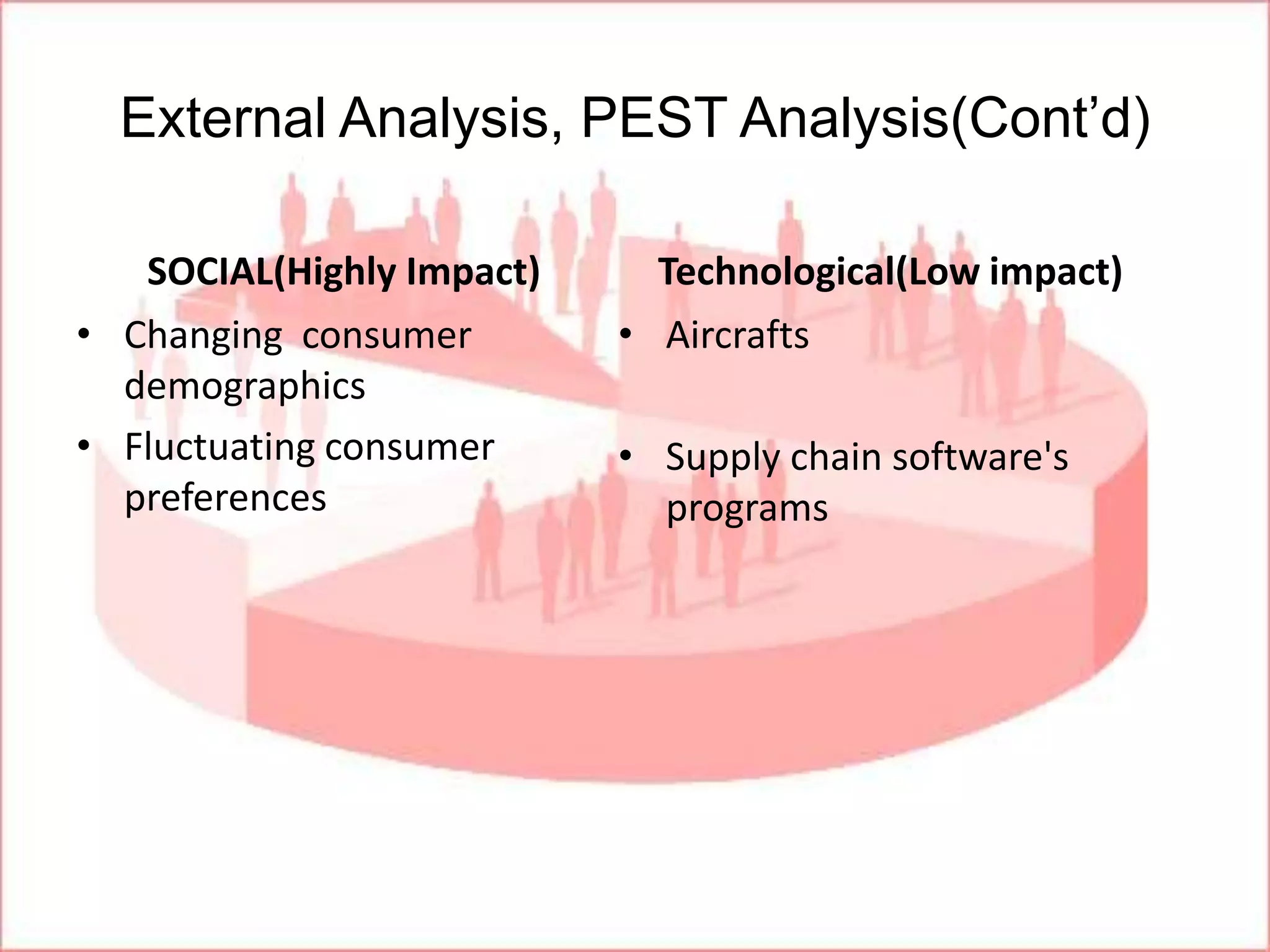
External Analysis, PEST Analysis(Cont’d) SOCIAL(Highly Impact) Changing  consumer demographics  Fluctuating consumer preferences  Technological(Low impact) Aircrafts Supply chain software's programs
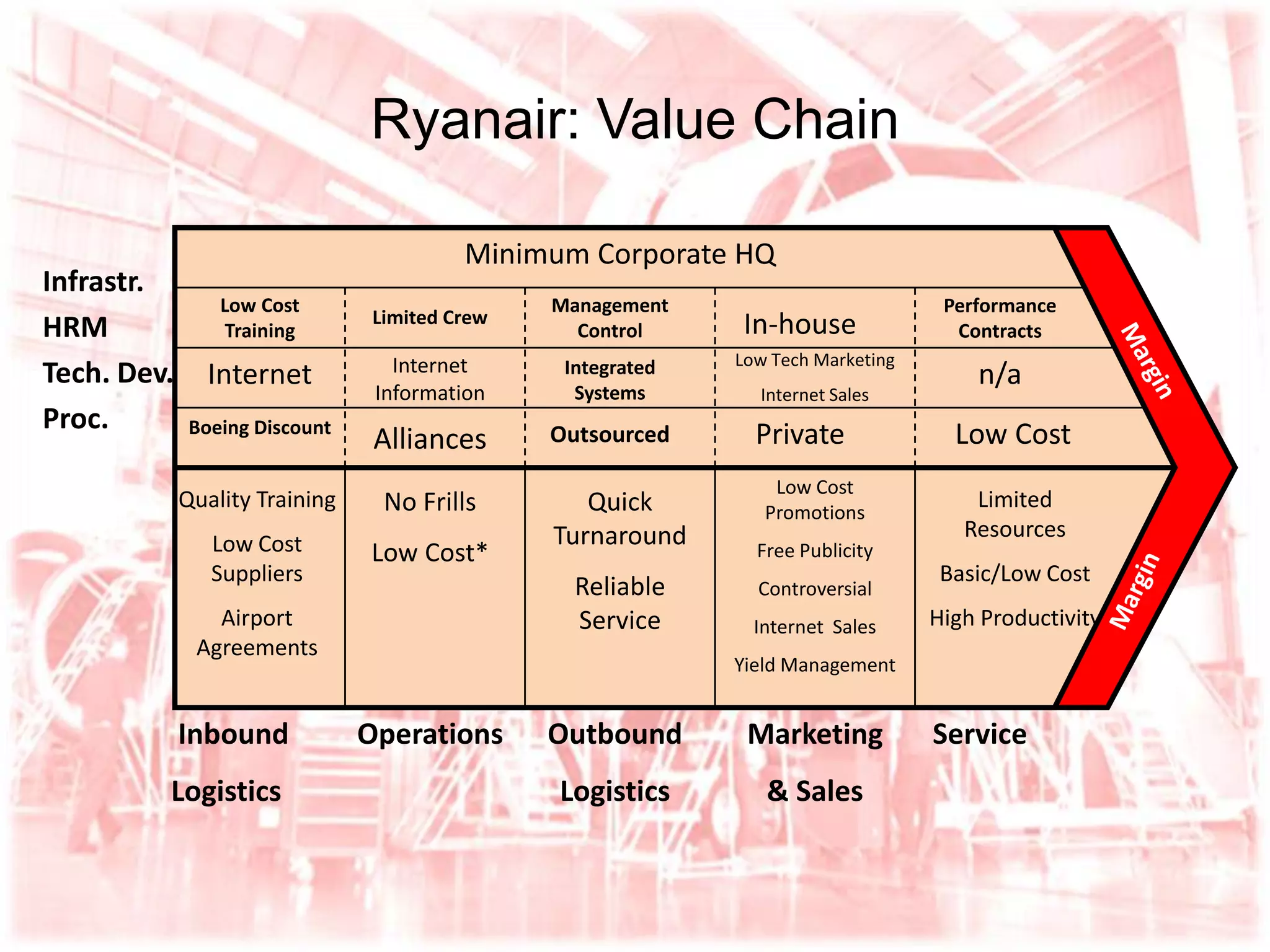
Ryanair: Value Chain Infrastr. HRM Tech. Dev. Proc. Margin Margin Minimum Corporate HQ Low Cost Training Internet Boeing Discount Quality Training Low Cost Suppliers Airport Agreements No Frills Low Cost* Quick Turnaround Reliable Service Low Cost Promotions Free Publicity Controversial Internet  Sales Yield Management Limited Resources Basic/Low Cost High Productivity Inbound  Logistics Operations Outbound Logistics Marketing & Sales Service Limited Crew Internet Information Alliances Management Control Integrated Systems Outsourced In-house Low Tech Marketing Internet Sales Private Performance Contracts n/a Low Cost
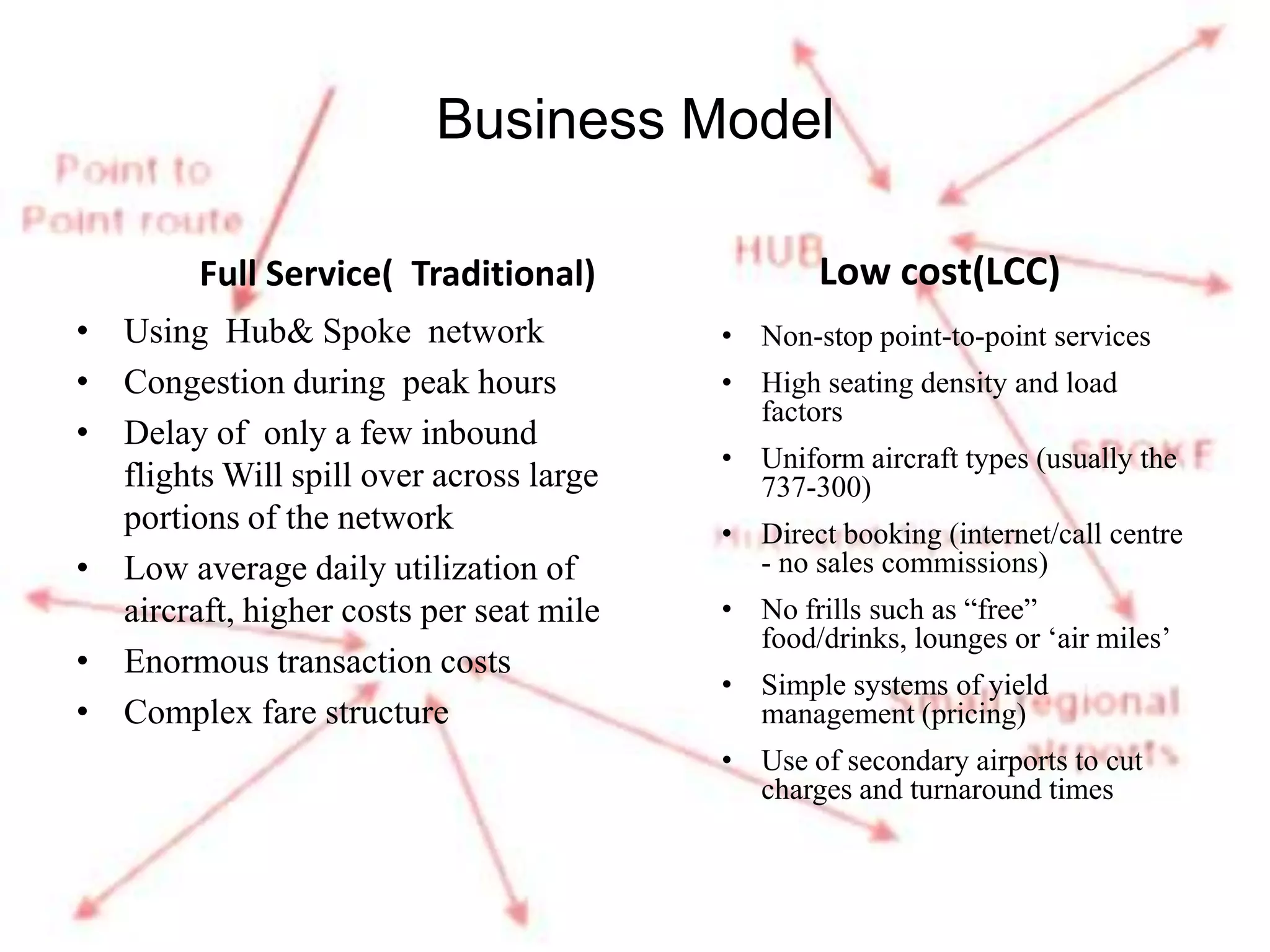
Business Model Full Service(  Traditional) Using  Hub& Spoke  network Congestion during  peak hours Delay of  only a few inbound flights Will spill over across large portions of the network Low average daily utilization of aircraft, higher costs per seat mile Enormous transaction costs Complex fare structure Low cost(LCC) Non-stop point-to-point services High seating density and load factors Uniform aircraft types (usually the 737-300) Direct booking (internet/call centre - no sales commissions) No frills such as “free” food/drinks, lounges or ‘air miles’ Simple systems of yield management (pricing) Use of secondary airports to cut charges and turnaround times
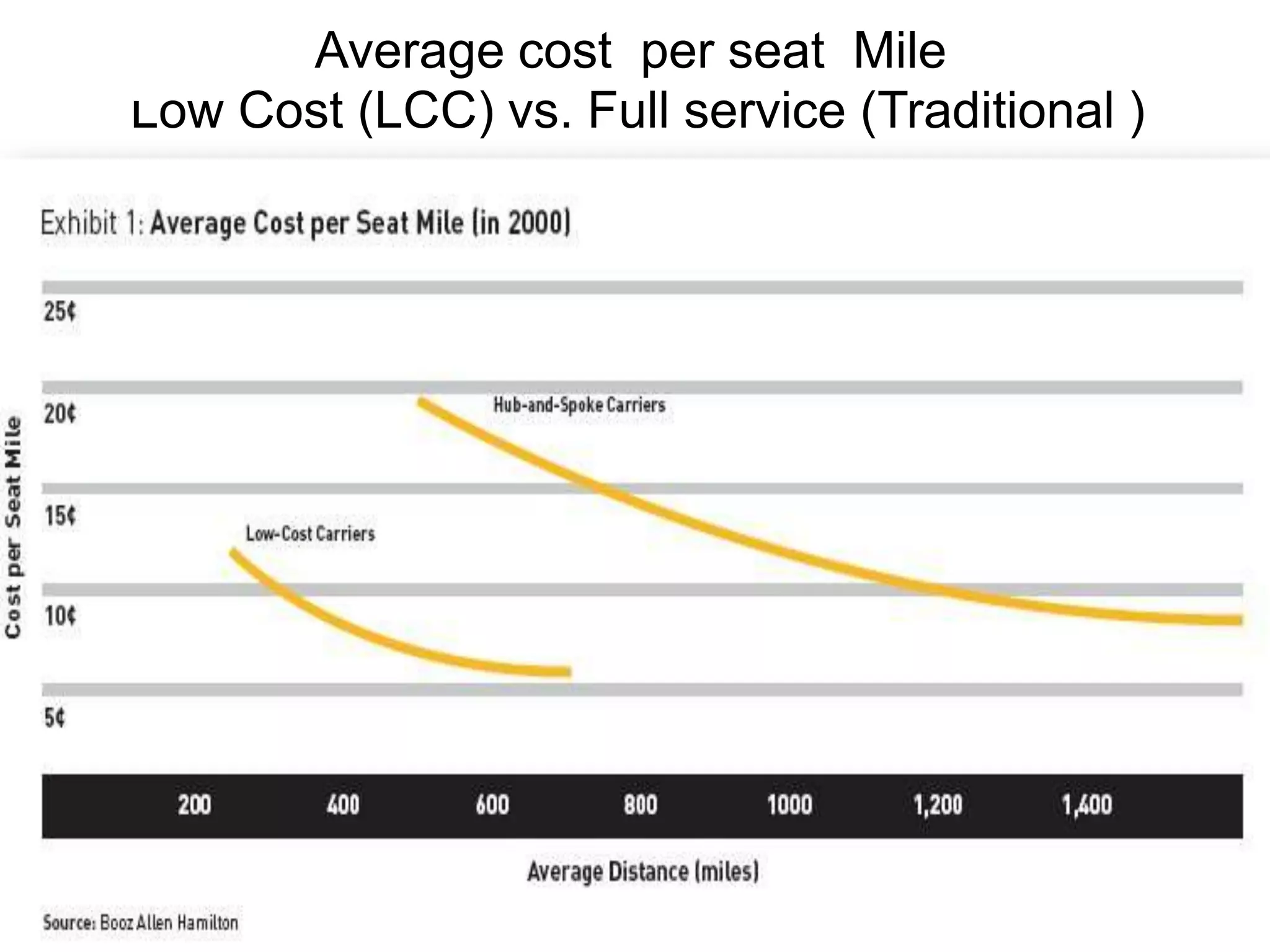
Average cost  per seat  Mile  Low Cost (LCC) vs. Full service (Traditional )
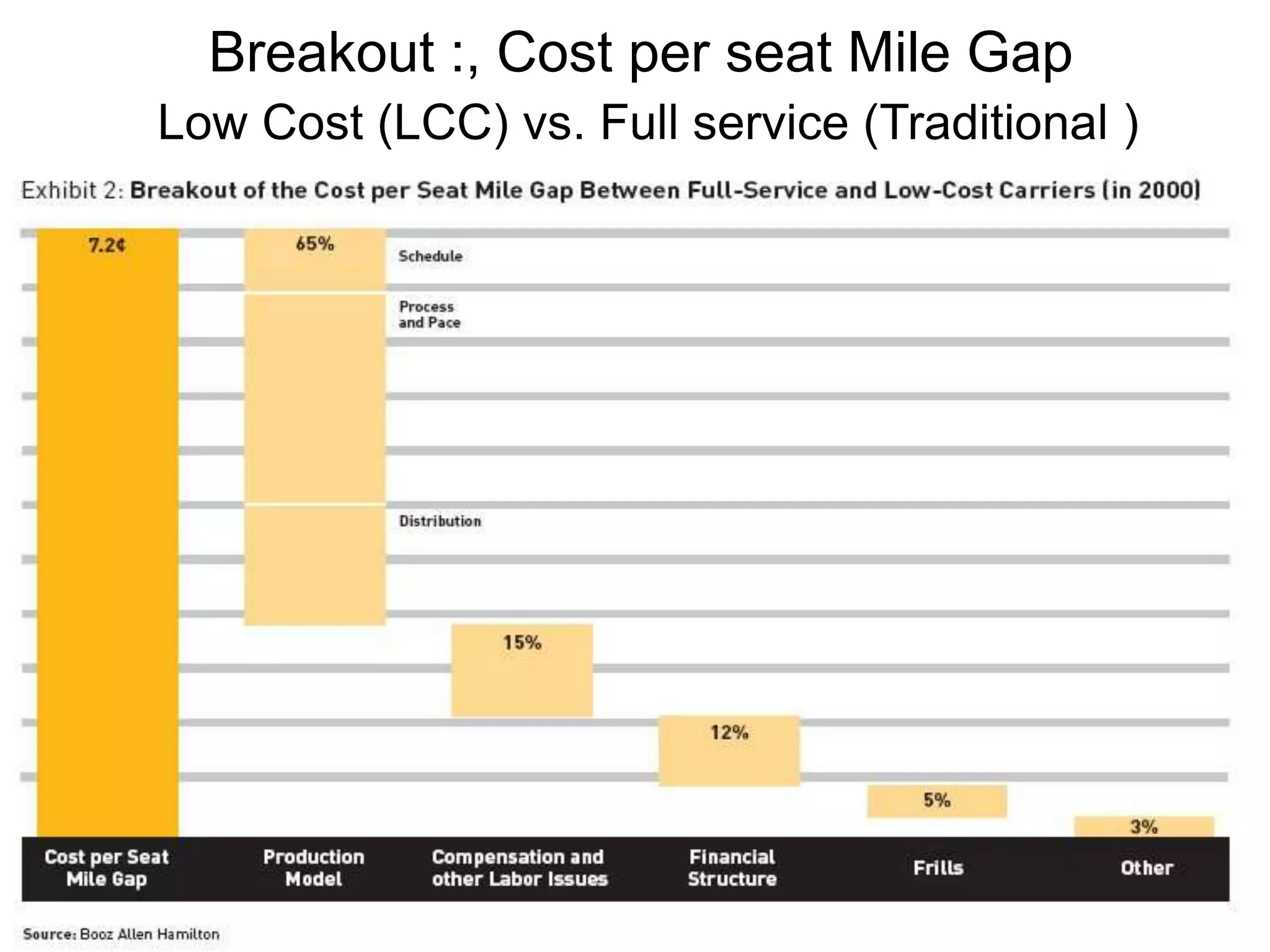
Breakout :, Cost per seat Mile Gap   Low Cost (LCC) vs. Full service (Traditional )
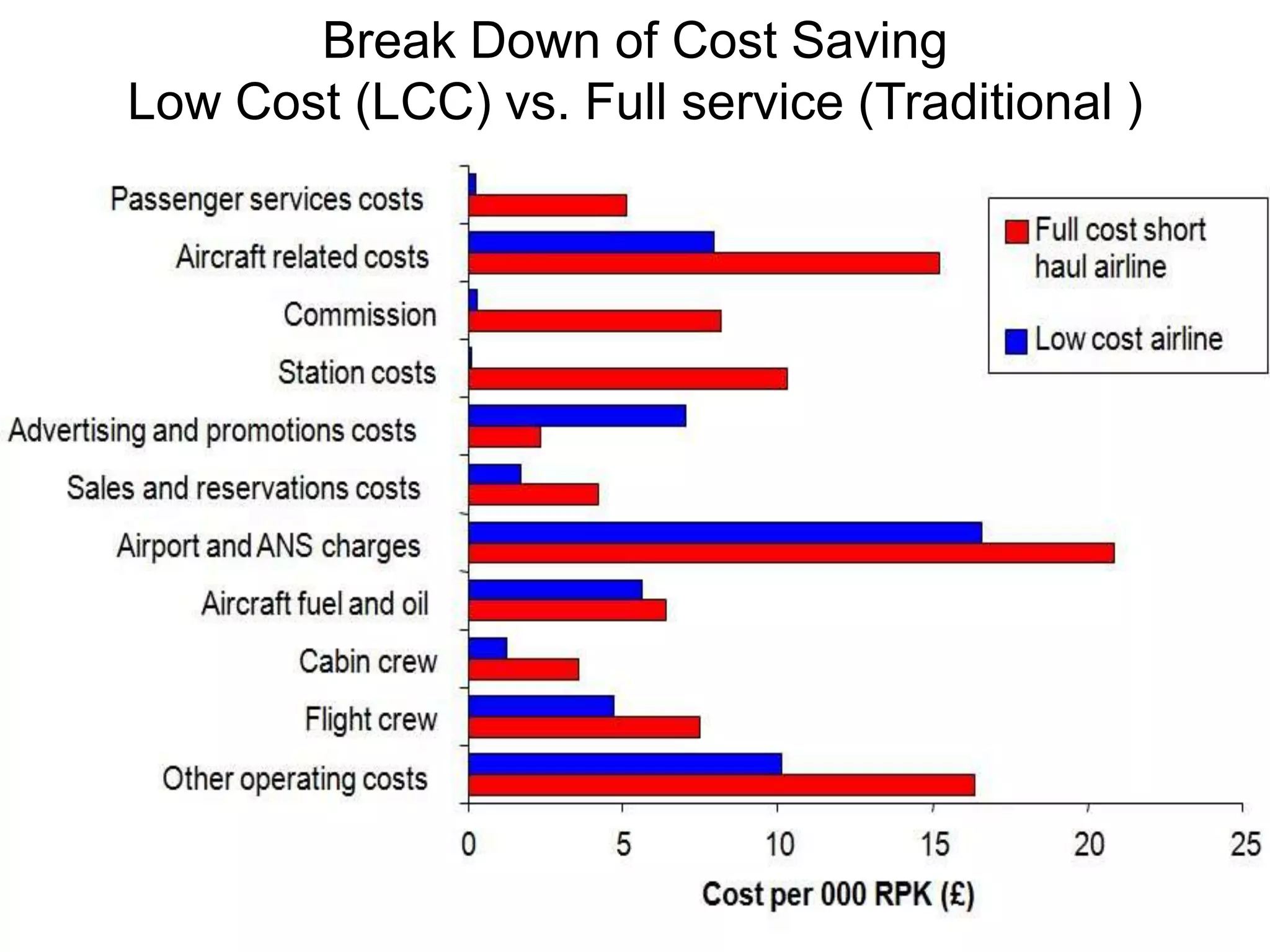
Break Down of Cost Saving Low Cost (LCC) vs. Full service (Traditional )
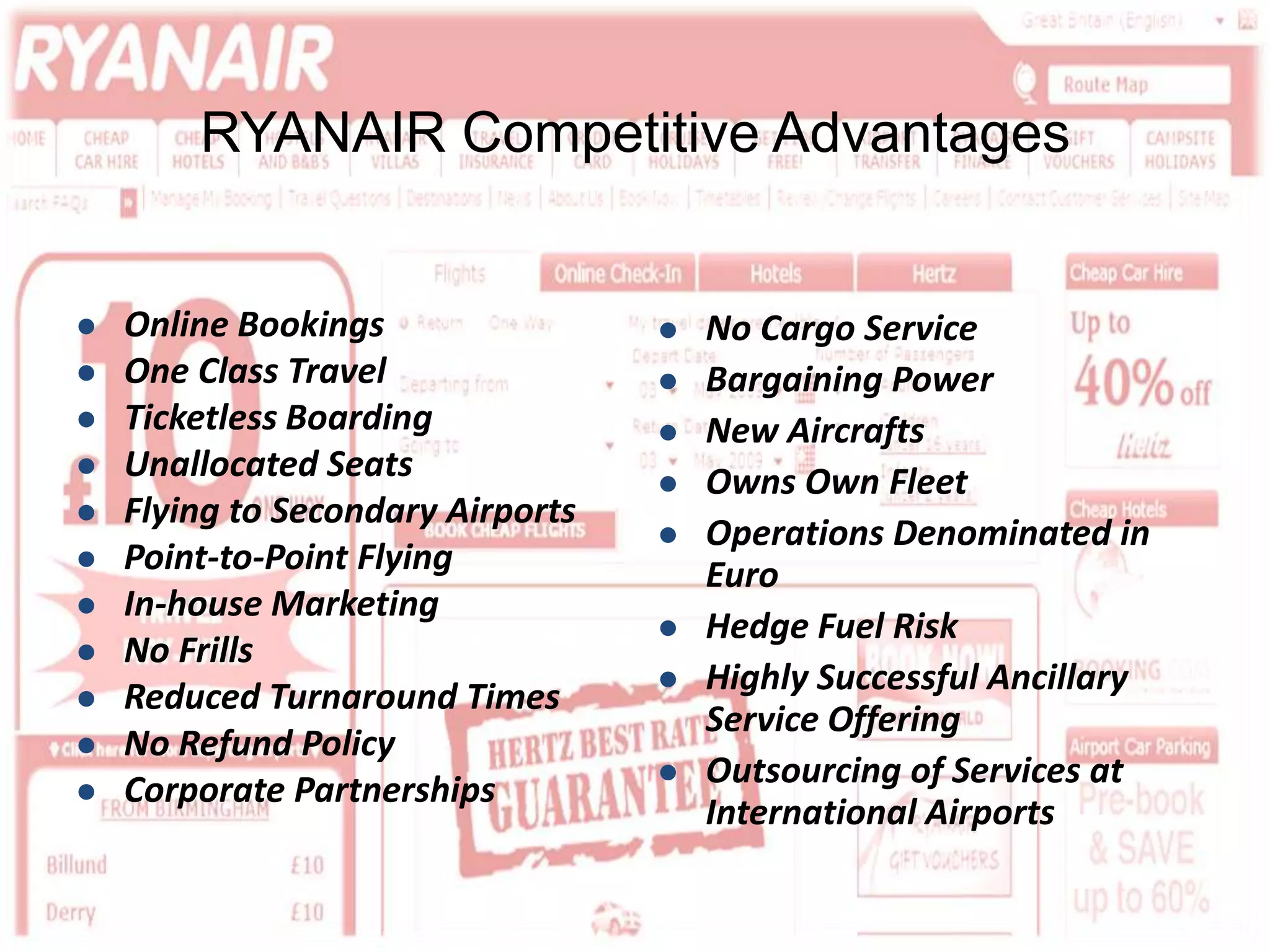
RYANAIR Competitive Advantages Online Bookings   One Class Travel   Ticketless Boarding   Unallocated Seats   Flying to Secondary Airports   Point-to-Point Flying   In-house Marketing   No Frills   Reduced Turnaround Times   No Refund Policy   Corporate Partnerships   No Cargo Service Bargaining Power New Aircrafts Owns Own Fleet Operations Denominated in Euro Hedge Fuel Risk Highly Successful Ancillary Service Offering Outsourcing of Services at International Airports
Limited Airport Transportation   Advertising on Airplanes   Yield Management   Uniform Fleet   High Productivity   High Service Levels   General Cost Reductions Eliminating seatback pockets  No blankets or pillows Airsickness bags distributed on request  Charges larger penalties for overweight luggage    RYANAIR  Competitive  Advantages(cont’d.)
Cutting costs:“Race to bottom” Ryanair, the World’s favourite airline, today (9 th  July) launched an online poll to ask if  passengers would ‘stand’ on short flights if it meant they could travel for FREE, or pay 50% less than seated passengers. Ryanair is gauging passenger demand for its ‘vertical seating’ which will allow passengers to travel – for free – in a secure upright position on short flights of approximately one hour. Source: http://www.ryanair.com/site/EN/news.php?yr=09&month=jul&story=gen-en-090709
Europe short haul market(TOP.6) Lufthansea   Passengers – 5.53m  Market share – 7.8%  Ryanair   Passengers – 5.12m  Market share – 7.2%  Air France   Passengers – 4.64m  Market share – 6.6%  easyJet   Passengers – 3.53m  Market share – 5%  Iberia   Passengers – 3.3m  Market share – 4.7%  SAS   Passengers – 3.23m  Market share – 4.6%
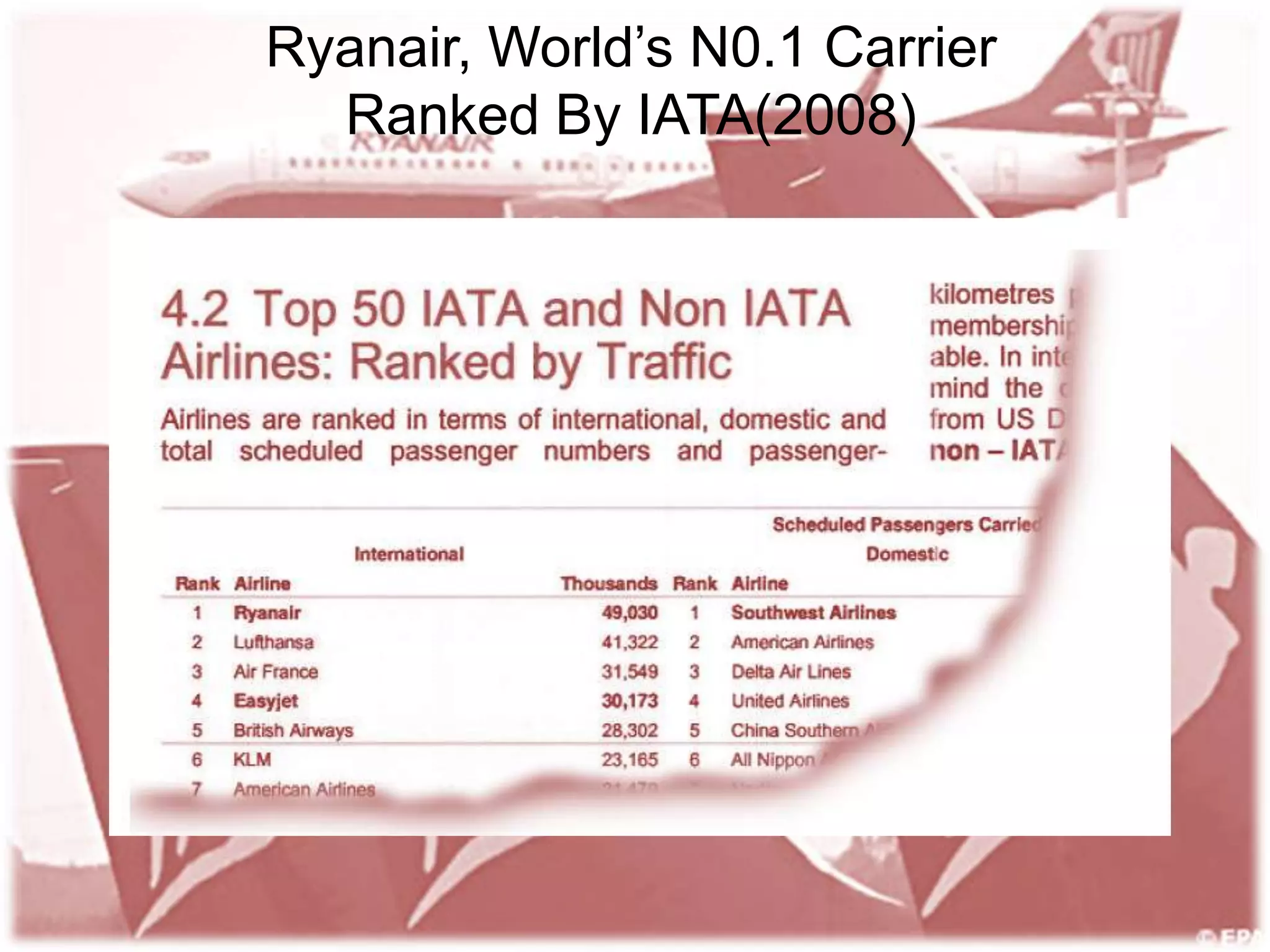
Ryanair, World’s N0.1 Carrier Ranked By IATA(2008)
Ryanair’s Future Plans  Cutting Costs No Window Blinds   No Reclining Seats ,  Leather Seats   Velcro Headrests   Carry-on Luggage Revenue Enhancement Satellite Television   Internet On-board   Rented In-flight entertainment
Ryanair’s Future Plans(cont.)  “ Free tickets. In a  decade or so, airlines will  pay travellers to distribute people around Europe. The airline industry is Tesco, is Ikea, is network  TV in the way viewers watch for free and advertisers Pay  for  access to them, is the internet in the same way that websites earn money for delivering click-through traffic or other sites.” Michael O'Leary ,Chief Executive Officer of the Irish airline  Ryanair  
Conclusion Ryanair  rapid growth is due to: Low cost Airline Business Model that  restructured European Aviation Industry Pioneer innovative cost reduction methods Creative  alternative revenue generation &free flights goal in next phase evolution
Q&A Questions ?
Thank you!
References www.ryanair.com Analysis of Ryanair’s competitive advantage ,November ,2008 by Jess Mun www.associatedcontent.com/1159874

Analysis of Ryanair's Competitive Advantages

  • 1.
    Ryanair's CompetitiveAdvantages Last Update:15.Sep.2009
  • 2.
    About Ryanair Foundedin 1985: 2 Aircrafts Carried 82,000 Passengers 1991: Michael O’Leary Appointed Transformed to Low Cost Airline 1997: Floated on Dublin SE and Nasdaq Rapid Expansion (2008 Figures) : 169 Aircrafts 794 Routes 148 Destinations, Across 26 European Countries 58 Million Passenger Annually Source: European Low Fares Airline Association,2009
  • 3.
    Ryanair’s Integrated BusinessStrategy Resource-Based View (Inside out) Marketing View (Outside in) Variety of Destinations &Routes Competitive Advantage Competitive position Low Cost Airline Business Model (Passes the costs directly to Ryanair’s customers)
  • 4.
    External Analysis: Porter’sFive Forces Threat of New Entrants HIGH Threat of Substitute Products MEDIUM Buyers’ Bargaining Power LOW Suppliers’ Bargaining Power LOW Industry Competitors Rivalry Among Existing Firms HIGH
  • 5.
    External Analysis, PESTAnalysis POLITICAL(Low impact) Inside Europe Political stability Outside Europe Middle East OPEC ,a political force ECONOMICAL(Low impact) Inside Europe Stable economy Stable consumers Outside Europe (undeveloped market) non- stable economy non -stable
  • 6.
    External Analysis, PESTAnalysis(Cont’d) SOCIAL(Highly Impact) Changing consumer demographics Fluctuating consumer preferences Technological(Low impact) Aircrafts Supply chain software's programs
  • 7.
    Ryanair: Value ChainInfrastr. HRM Tech. Dev. Proc. Margin Margin Minimum Corporate HQ Low Cost Training Internet Boeing Discount Quality Training Low Cost Suppliers Airport Agreements No Frills Low Cost* Quick Turnaround Reliable Service Low Cost Promotions Free Publicity Controversial Internet Sales Yield Management Limited Resources Basic/Low Cost High Productivity Inbound Logistics Operations Outbound Logistics Marketing & Sales Service Limited Crew Internet Information Alliances Management Control Integrated Systems Outsourced In-house Low Tech Marketing Internet Sales Private Performance Contracts n/a Low Cost
  • 8.
    Business Model FullService( Traditional) Using Hub& Spoke network Congestion during peak hours Delay of only a few inbound flights Will spill over across large portions of the network Low average daily utilization of aircraft, higher costs per seat mile Enormous transaction costs Complex fare structure Low cost(LCC) Non-stop point-to-point services High seating density and load factors Uniform aircraft types (usually the 737-300) Direct booking (internet/call centre - no sales commissions) No frills such as “free” food/drinks, lounges or ‘air miles’ Simple systems of yield management (pricing) Use of secondary airports to cut charges and turnaround times
  • 9.
    Average cost per seat Mile Low Cost (LCC) vs. Full service (Traditional )
  • 10.
    Breakout :, Costper seat Mile Gap Low Cost (LCC) vs. Full service (Traditional )
  • 11.
    Break Down ofCost Saving Low Cost (LCC) vs. Full service (Traditional )
  • 12.
    RYANAIR Competitive AdvantagesOnline Bookings One Class Travel Ticketless Boarding Unallocated Seats Flying to Secondary Airports Point-to-Point Flying In-house Marketing No Frills Reduced Turnaround Times No Refund Policy Corporate Partnerships No Cargo Service Bargaining Power New Aircrafts Owns Own Fleet Operations Denominated in Euro Hedge Fuel Risk Highly Successful Ancillary Service Offering Outsourcing of Services at International Airports
  • 13.
    Limited Airport Transportation Advertising on Airplanes Yield Management Uniform Fleet High Productivity High Service Levels General Cost Reductions Eliminating seatback pockets No blankets or pillows Airsickness bags distributed on request Charges larger penalties for overweight luggage RYANAIR Competitive Advantages(cont’d.)
  • 14.
    Cutting costs:“Race tobottom” Ryanair, the World’s favourite airline, today (9 th  July) launched an online poll to ask if  passengers would ‘stand’ on short flights if it meant they could travel for FREE, or pay 50% less than seated passengers. Ryanair is gauging passenger demand for its ‘vertical seating’ which will allow passengers to travel – for free – in a secure upright position on short flights of approximately one hour. Source: http://www.ryanair.com/site/EN/news.php?yr=09&month=jul&story=gen-en-090709
  • 15.
    Europe short haulmarket(TOP.6) Lufthansea Passengers – 5.53m Market share – 7.8% Ryanair Passengers – 5.12m Market share – 7.2% Air France Passengers – 4.64m Market share – 6.6% easyJet Passengers – 3.53m Market share – 5% Iberia Passengers – 3.3m Market share – 4.7% SAS Passengers – 3.23m Market share – 4.6%
  • 16.
    Ryanair, World’s N0.1Carrier Ranked By IATA(2008)
  • 17.
    Ryanair’s Future Plans Cutting Costs No Window Blinds No Reclining Seats , Leather Seats Velcro Headrests Carry-on Luggage Revenue Enhancement Satellite Television Internet On-board Rented In-flight entertainment
  • 18.
    Ryanair’s Future Plans(cont.) “ Free tickets. In a decade or so, airlines will pay travellers to distribute people around Europe. The airline industry is Tesco, is Ikea, is network TV in the way viewers watch for free and advertisers Pay for access to them, is the internet in the same way that websites earn money for delivering click-through traffic or other sites.” Michael O'Leary ,Chief Executive Officer of the Irish airline Ryanair  
  • 19.
    Conclusion Ryanair rapid growth is due to: Low cost Airline Business Model that restructured European Aviation Industry Pioneer innovative cost reduction methods Creative alternative revenue generation &free flights goal in next phase evolution
  • 20.
  • 21.
  • 22.
    References www.ryanair.com Analysisof Ryanair’s competitive advantage ,November ,2008 by Jess Mun www.associatedcontent.com/1159874