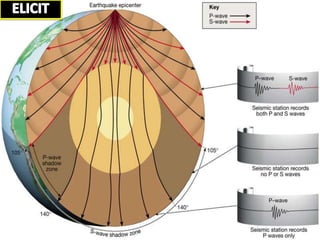



What are P-waves and S-Waves?
Explain the difference between
P-waves and S-waves?
Why is it important to study
P-waves and S-waves?
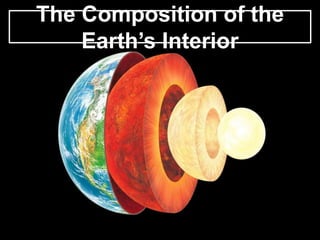
The Composition of the
Earth’s Interior
The structure of Earth can be defined in two
ways: by mechanical properties such as
rheology, or chemically.
Mechanically, it can be divided into
• lithosphere,
• asthenosphere,
• mesospheric mantle,
• outer core, and
• inner core.
Chemically, it can be divided into
• crust,
• upper mantle,
• lower mantle,
• outer core, and
• inner core.
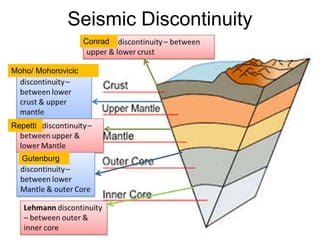
Discontinuities in earth structure:
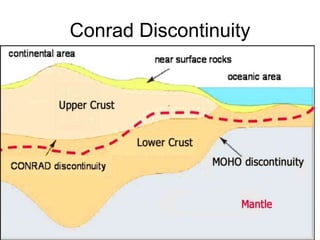
• Connard discontinuity Zone that separates the Earth’s upper
crust from the lower crust.
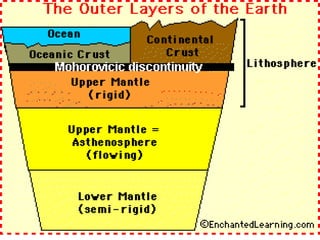
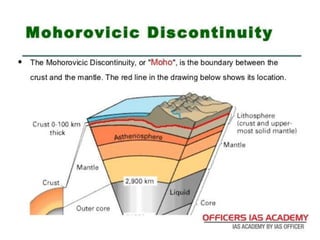
• Mohorovicic discontinuity. Zone that separates the Earth’s crust
from the asthenosphere.
• Repetti discontinuity
Zone that separates the upper mantle from the lower mantle.
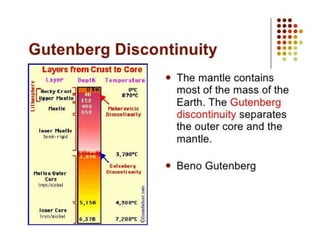
• Gutenberg discontinuity Zone separating the lower mantle from
the core; it is located at a depth of about 1,800 mi.
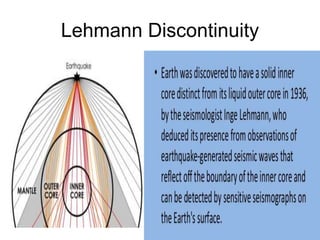
• Lehman Discontinuity Zone that separates the Earth's outer core
from the Inner core
The Composition of the
Earth’s Interior
Objectives:
1. Examine data of the Earth’s interior.
2. Illustrate and explain Earth’s
internal composition.
Watch the movie
trailer for Journey to
the Center of the
Earth. Identify
characteristics that
you think are true
and those you think
are not true about
earth. Be prepared
to share.
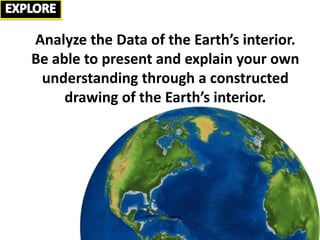
Analyze the Data of the Earth’s interior.
Be able to present and explain your own
understanding through a constructed
drawing of the Earth’s interior.
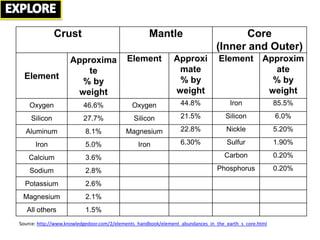
Crust Mantle Core
(Inner and Outer)
Element
Approxima
te
% by
weight
Element Approxi
mate
% by
weight
Element Approxim
ate
% by
weight
Oxygen 46.6% Oxygen 44.8% Iron 85.5%
Silicon 27.7% Silicon 21.5% Silicon 6.0%
Aluminum 8.1% Magnesium 22.8% Nickle 5.20%
Iron 5.0% Iron 6.30% Sulfur 1.90%
Calcium 3.6% Carbon 0.20%
Sodium 2.8% Phosphorus 0.20%
Potassium 2.6%
Magnesium 2.1%
All others 1.5%
Source: http://www.knowledgedoor.com/2/elements_handbook/element_abundances_in_the_earth_s_core.html
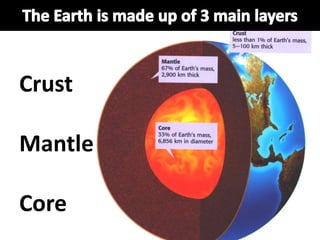
Crust
Mantle
Core
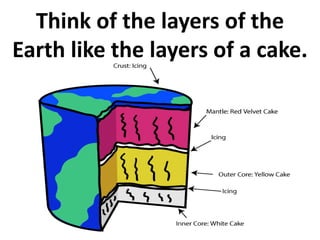
Think of the layers of the
Earth like the layers of a cake.
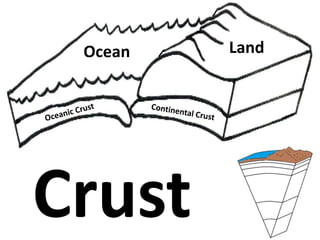
Crust
Ocean Land
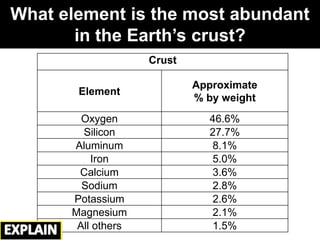
What element is the most abundant
in the Earth’s crust?
Crust
Element
Approximate
% by weight
Oxygen 46.6%
Silicon 27.7%
Aluminum 8.1%
Iron 5.0%
Calcium 3.6%
Sodium 2.8%
Potassium 2.6%
Magnesium 2.1%
All others 1.5%
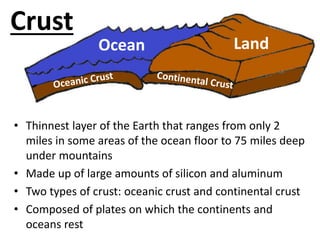
• Thinnest layer of the Earth that ranges from only 2
miles in some areas of the ocean floor to 75 miles deep
under mountains
• Made up of large amounts of silicon and aluminum
• Two types of crust: oceanic crust and continental crust
• Composed of plates on which the continents and
oceans rest
Ocean Land
Crust
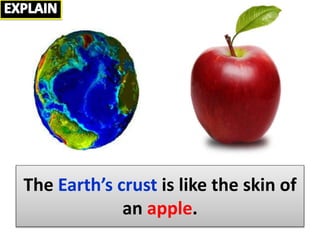
The Earth’s crust is like the skin of
an apple.
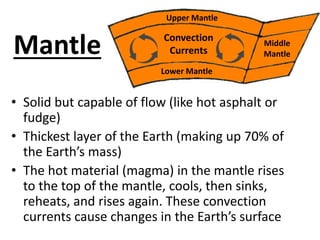
Mantle
Upper Mantle
Lower Mantle
Middle
Mantle
Convection
Currents
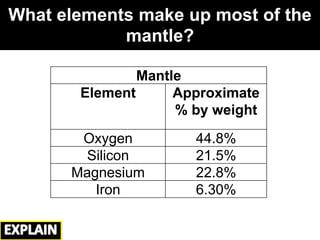
What elements make up most of the
mantle?
Mantle
Element Approximate
% by weight
Oxygen 44.8%
Silicon 21.5%
Magnesium 22.8%
Iron 6.30%
• Solid but capable of flow (like hot asphalt or
fudge)
• Thickest layer of the Earth (making up 70% of
the Earth’s mass)
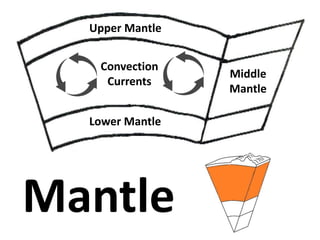
• The hot material (magma) in the mantle rises
to the top of the mantle, cools, then sinks,
reheats, and rises again. These convection
currents cause changes in the Earth’s surface
Upper Mantle
Convection
Currents
Middle
Mantle
Lower Mantle
Mantle
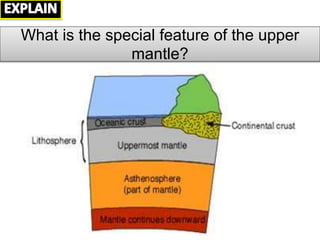
What is the special feature of the upper
mantle?
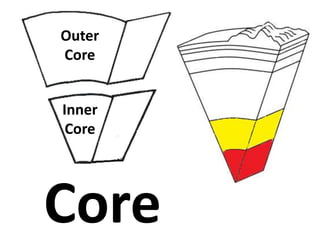
Core
Inner
Core
Outer
Core
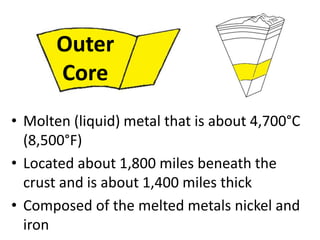
Outer
Core
• Molten (liquid) metal that is about 4,700°C
(8,500°F)
• Located about 1,800 miles beneath the
crust and is about 1,400 miles thick
• Composed of the melted metals nickel and
iron
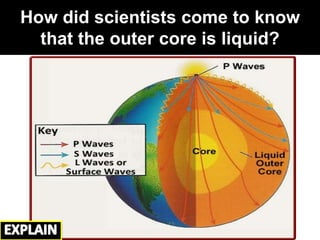
How did scientists come to know
that the outer core is liquid?
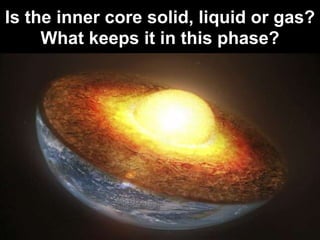
Is the inner core solid, liquid or gas?
What keeps it in this phase?
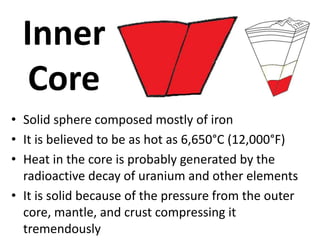
Inner
Core
• Solid sphere composed mostly of iron
• It is believed to be as hot as 6,650°C (12,000°F)
• Heat in the core is probably generated by the
radioactive decay of uranium and other elements
• It is solid because of the pressure from the outer
core, mantle, and crust compressing it
tremendously
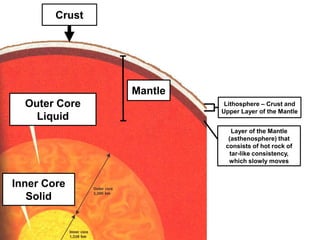
Inner Core
Solid
Outer Core
Liquid
Mantle
Crust
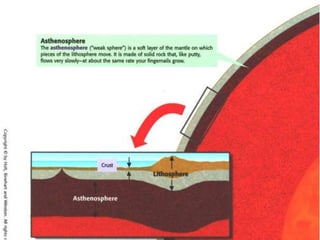
Lithosphere – Crust and
Upper Layer of the Mantle
Layer of the Mantle
(asthenosphere) that
consists of hot rock of
tar-like consistency,
which slowly moves
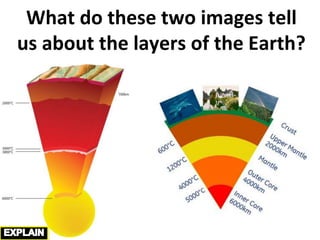
What do these two images tell
us about the layers of the Earth?
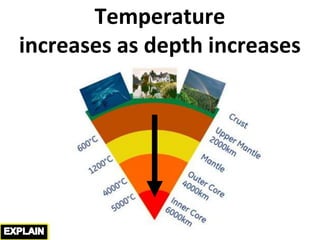
Temperature
increases as depth increases
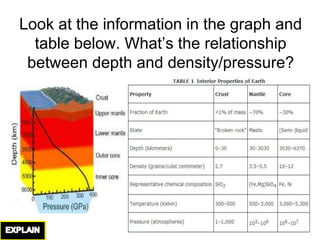
Look at the information in the graph and
table below. What’s the relationship
between depth and density/pressure?
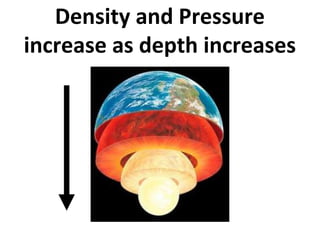
Density and Pressure
increase as depth increases
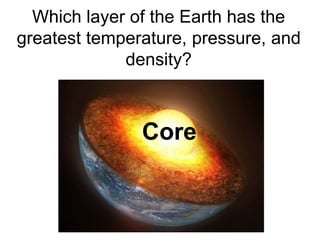
Which layer of the Earth has the
greatest temperature, pressure, and
density?
Core
Seismic Discontinuity
Conrad
Gutenburg
Moho/ Mohorovicic
Repetti
Conrad Discontinuity
Lehmann Discontinuity
Imagine you are going to take a
journey to the center of the earth
(like the movie but more accurate).
Write a short story describing your
journey. Include the layers of the
earth and descriptions of each
layer.
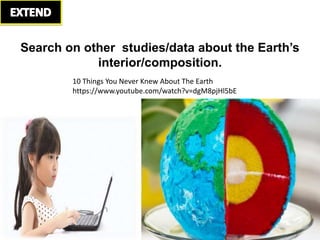
Search on other studies/data about the Earth’s
interior/composition.
10 Things You Never Knew About The Earth
https://www.youtube.com/watch?v=dgM8pjHl5bE

Earth's interior

  • 1.
    What are P-wavesand S-Waves?
  • 2.
    What are P-wavesand S-Waves? Explain the difference between P-waves and S-waves? Why is it important to study P-waves and S-waves?
  • 4.
    The Composition ofthe Earth’s Interior
  • 5.
    The structure ofEarth can be defined in two ways: by mechanical properties such as rheology, or chemically. Mechanically, it can be divided into • lithosphere, • asthenosphere, • mesospheric mantle, • outer core, and • inner core.
  • 6.
    Chemically, it canbe divided into • crust, • upper mantle, • lower mantle, • outer core, and • inner core.
  • 7.
    Discontinuities in earthstructure: • Connard discontinuity Zone that separates the Earth’s upper crust from the lower crust. • Mohorovicic discontinuity. Zone that separates the Earth’s crust from the asthenosphere. • Repetti discontinuity Zone that separates the upper mantle from the lower mantle. • Gutenberg discontinuity Zone separating the lower mantle from the core; it is located at a depth of about 1,800 mi. • Lehman Discontinuity Zone that separates the Earth's outer core from the Inner core
  • 8.
    The Composition ofthe Earth’s Interior Objectives: 1. Examine data of the Earth’s interior. 2. Illustrate and explain Earth’s internal composition.
  • 9.
    Watch the movie trailerfor Journey to the Center of the Earth. Identify characteristics that you think are true and those you think are not true about earth. Be prepared to share.
  • 10.
    Analyze the Dataof the Earth’s interior. Be able to present and explain your own understanding through a constructed drawing of the Earth’s interior.
  • 12.
    Crust Mantle Core (Innerand Outer) Element Approxima te % by weight Element Approxi mate % by weight Element Approxim ate % by weight Oxygen 46.6% Oxygen 44.8% Iron 85.5% Silicon 27.7% Silicon 21.5% Silicon 6.0% Aluminum 8.1% Magnesium 22.8% Nickle 5.20% Iron 5.0% Iron 6.30% Sulfur 1.90% Calcium 3.6% Carbon 0.20% Sodium 2.8% Phosphorus 0.20% Potassium 2.6% Magnesium 2.1% All others 1.5% Source: http://www.knowledgedoor.com/2/elements_handbook/element_abundances_in_the_earth_s_core.html
  • 13.
  • 14.
    Think of thelayers of the Earth like the layers of a cake.
  • 15.
  • 16.
    What element isthe most abundant in the Earth’s crust? Crust Element Approximate % by weight Oxygen 46.6% Silicon 27.7% Aluminum 8.1% Iron 5.0% Calcium 3.6% Sodium 2.8% Potassium 2.6% Magnesium 2.1% All others 1.5%
  • 17.
    • Thinnest layerof the Earth that ranges from only 2 miles in some areas of the ocean floor to 75 miles deep under mountains • Made up of large amounts of silicon and aluminum • Two types of crust: oceanic crust and continental crust • Composed of plates on which the continents and oceans rest Ocean Land Crust
  • 18.
    The Earth’s crustis like the skin of an apple.
  • 20.
  • 21.
    What elements makeup most of the mantle? Mantle Element Approximate % by weight Oxygen 44.8% Silicon 21.5% Magnesium 22.8% Iron 6.30%
  • 22.
    • Solid butcapable of flow (like hot asphalt or fudge) • Thickest layer of the Earth (making up 70% of the Earth’s mass) • The hot material (magma) in the mantle rises to the top of the mantle, cools, then sinks, reheats, and rises again. These convection currents cause changes in the Earth’s surface Upper Mantle Convection Currents Middle Mantle Lower Mantle Mantle
  • 23.
    What is thespecial feature of the upper mantle?
  • 24.
  • 25.
    Outer Core • Molten (liquid)metal that is about 4,700°C (8,500°F) • Located about 1,800 miles beneath the crust and is about 1,400 miles thick • Composed of the melted metals nickel and iron
  • 26.
    How did scientistscome to know that the outer core is liquid?
  • 27.
    Is the innercore solid, liquid or gas? What keeps it in this phase?
  • 28.
    Inner Core • Solid spherecomposed mostly of iron • It is believed to be as hot as 6,650°C (12,000°F) • Heat in the core is probably generated by the radioactive decay of uranium and other elements • It is solid because of the pressure from the outer core, mantle, and crust compressing it tremendously
  • 29.
    Inner Core Solid Outer Core Liquid Mantle Crust Lithosphere– Crust and Upper Layer of the Mantle Layer of the Mantle (asthenosphere) that consists of hot rock of tar-like consistency, which slowly moves
  • 31.
    What do thesetwo images tell us about the layers of the Earth?
  • 32.
  • 33.
    Look at theinformation in the graph and table below. What’s the relationship between depth and density/pressure?
  • 34.
  • 35.
    Which layer ofthe Earth has the greatest temperature, pressure, and density? Core
  • 36.
  • 37.
  • 41.
  • 42.
    Imagine you aregoing to take a journey to the center of the earth (like the movie but more accurate). Write a short story describing your journey. Include the layers of the earth and descriptions of each layer.
  • 43.
    Search on otherstudies/data about the Earth’s interior/composition. 10 Things You Never Knew About The Earth https://www.youtube.com/watch?v=dgM8pjHl5bE