 An opening in the earth's crust through which
molten lava, ash, and gases are ejected.
 formed by the materials ejected from a
volcano.
 Volcanology – the study of volcanoes
 Volcanism – the process and phenomena
associated with the surficial discharge of
molten rock and other materials into the
surface of Earth
 Came from the word VULCANO, a volcanic
island in Italy whose named has been derived
from VULCAN, the Roman God of Fire
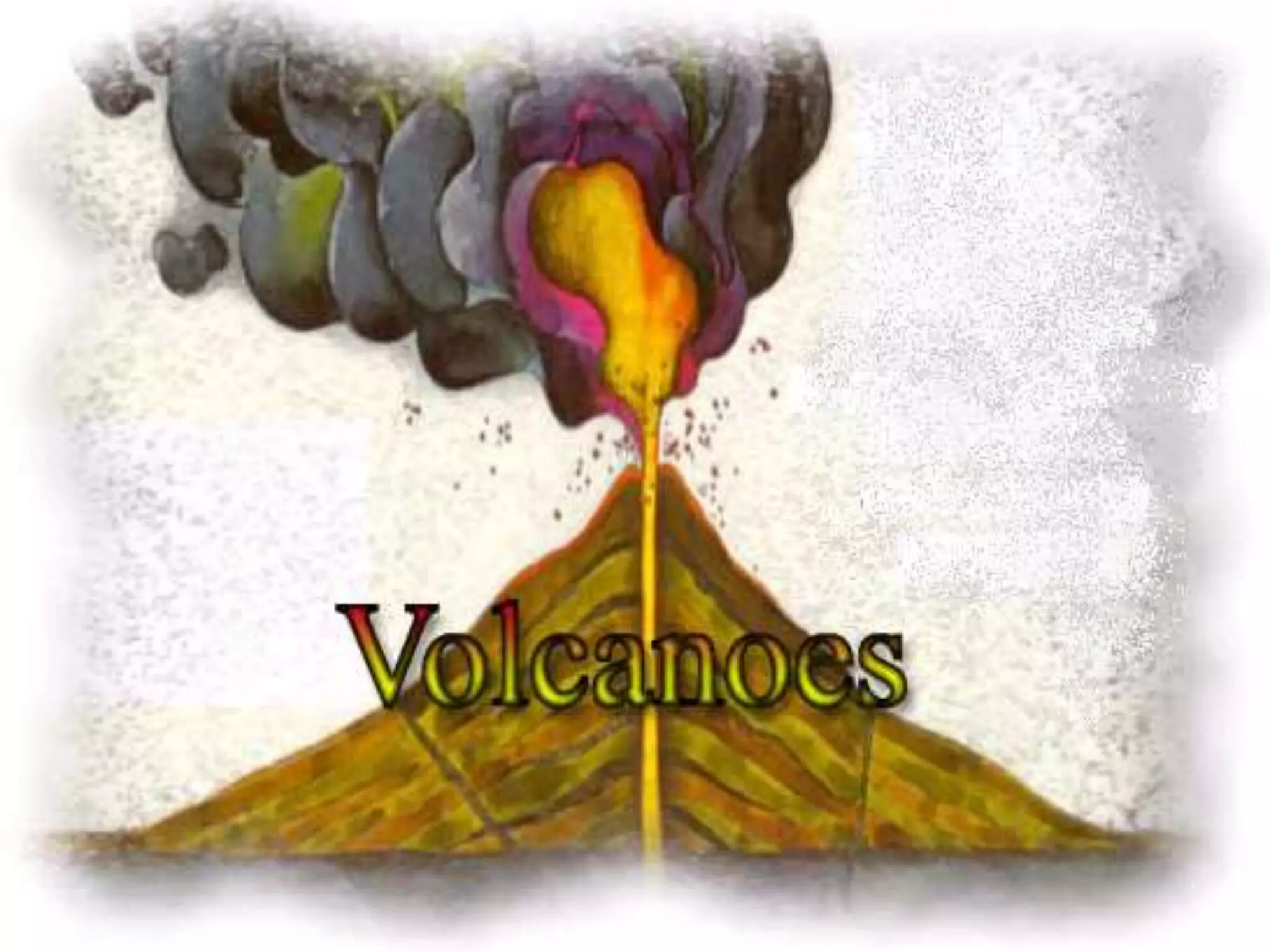
What is A Volcano?
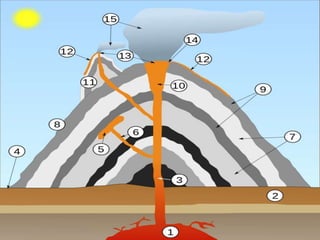
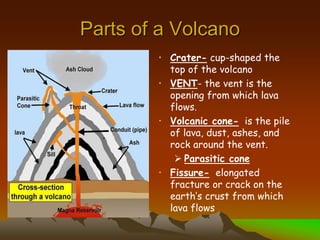
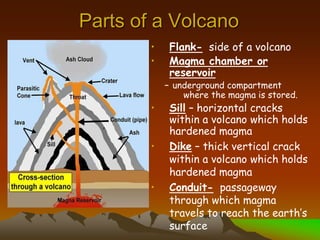
Parts of a Volcano
• Crater- cup-shaped the
top of the volcano
• VENT- the vent is the
opening from which lava
flows.
• Volcanic cone- is the pile
of lava, dust, ashes, and
rock around the vent.
 Parasitic cone
• Fissure- elongated
fracture or crack on the
earth’s crust from which
lava flows
Parts of a Volcano
• Flank- side of a volcano
• Magma chamber or
reservoir
– underground compartment
where the magma is stored.
• Sill – horizontal cracks
within a volcano which holds
hardened magma
• Dike – thick vertical crack
within a volcano which holds
hardened magma
• Conduit- passageway
through which magma
travels to reach the earth’s
surface
TYPES OF
VOLCANOES
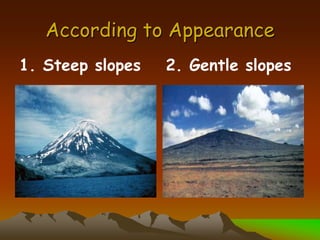
According to Appearance
1. Steep slopes 2. Gentle slopes
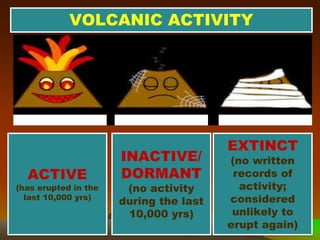
VOLCANIC ACTIVITY
ACTIVE
(has erupted in the
last 10,000 yrs)
INACTIVE/
DORMANT
(no activity
during the last
10,000 yrs)
EXTINCT
(no written
records of
activity;
considered
unlikely to
erupt again)
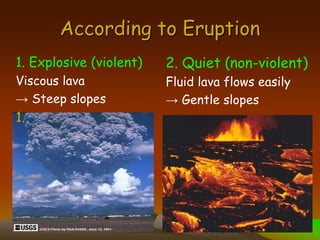
According to Eruption
2. Quiet (non-violent)
Fluid lava flows easily
→ Gentle slopes
1. Explosive (violent)
Viscous lava
→ Steep slopes
1.
According to Shape
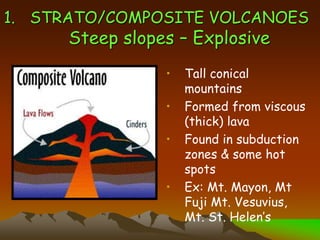
1. STRATO/COMPOSITE VOLCANOES
Steep slopes – Explosive
• Tall conical
mountains
• Formed from viscous
(thick) lava
• Found in subduction
zones & some hot
spots
• Ex: Mt. Mayon, Mt
Fuji Mt. Vesuvius,
Mt. St. Helen’s
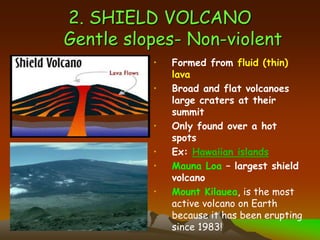
2. SHIELD VOLCANO
Gentle slopes- Non-violent
• Formed from fluid (thin)
lava
• Broad and flat volcanoes
large craters at their
summit
• Only found over a hot
spots
• Ex: Hawaiian islands
• Mauna Loa – largest shield
volcano
• Mount Kilauea, is the most
active volcano on Earth
because it has been erupting
since 1983!
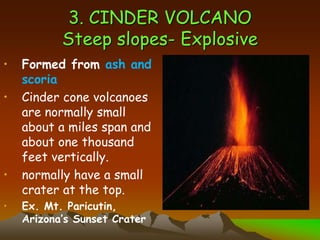
3. CINDER VOLCANO
Steep slopes- Explosive
• Formed from ash and
scoria
• Cinder cone volcanoes
are normally small
about a miles span and
about one thousand
feet vertically.
• normally have a small
crater at the top.
• Ex. Mt. Paricutin,
Arizona’s Sunset Crater
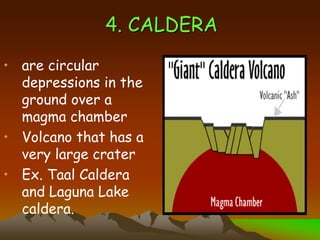
4. CALDERA
• are circular
depressions in the
ground over a
magma chamber
• Volcano that has a
very large crater
• Ex. Taal Caldera
and Laguna Lake
caldera.
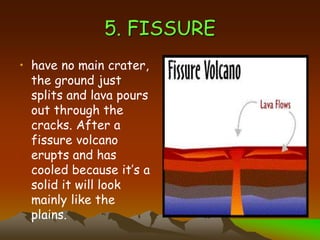
5. FISSURE
• have no main crater,
the ground just
splits and lava pours
out through the
cracks. After a
fissure volcano
erupts and has
cooled because it’s a
solid it will look
mainly like the
plains.
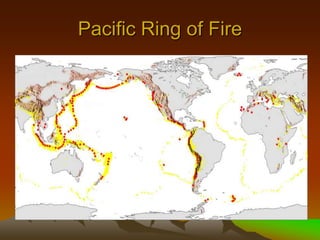
Pacific Ring of Fire
Active volcanism occurs in
four principal settings
• Divergent Boundaries
• Continental Extension
• Convergent Boundaries
• Hot Spots
Diastrophism
• It is a process by which the earth’s
surface is changed through rock
movements and displacements
• 2 Effects of diastrophism
a. Fold
b. Fault
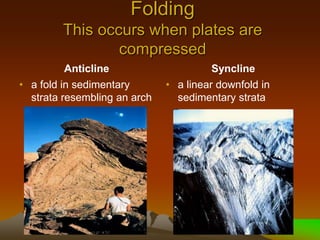
Anticline
• a fold in sedimentary
strata resembling an arch
Syncline
• a linear downfold in
sedimentary strata
Folding
This occurs when plates are
compressed
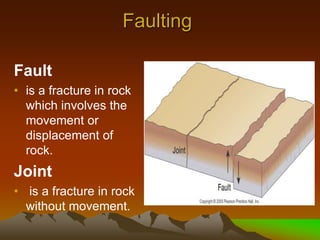
Faulting
Fault
• is a fracture in rock
which involves the
movement or
displacement of
rock.
Joint
• is a fracture in rock
without movement.
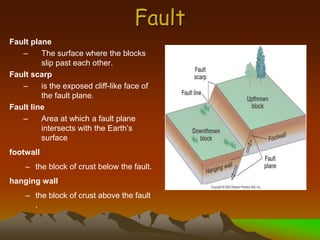
Fault
Fault plane
– The surface where the blocks
slip past each other.
Fault scarp
– is the exposed cliff-like face of
the fault plane.
Fault line
– Area at which a fault plane
intersects with the Earth’s
surface
footwall
– the block of crust below the fault.
hanging wall
– the block of crust above the fault
.
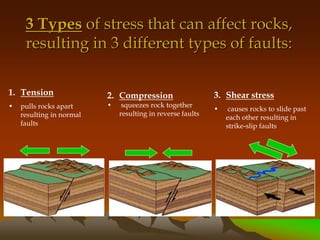
3. Shear stress
• causes rocks to slide past
each other resulting in
strike-slip faults
2. Compression
• squeezes rock together
resulting in reverse faults
1. Tension
• pulls rocks apart
resulting in normal
faults
3 Types of stress that can affect rocks,
resulting in 3 different types of faults:
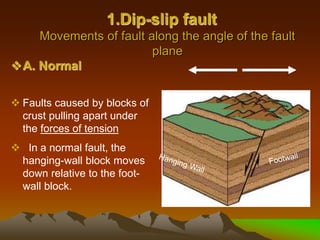
1.Dip-slip fault
Movements of fault along the angle of the fault
plane
A. Normal
 Faults caused by blocks of
crust pulling apart under
the forces of tension
 In a normal fault, the
hanging-wall block moves
down relative to the foot-
wall block.
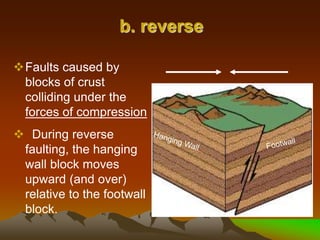
Faults caused by
blocks of crust
colliding under the
forces of compression
 During reverse
faulting, the hanging
wall block moves
upward (and over)
relative to the footwall
block.
b. reverse
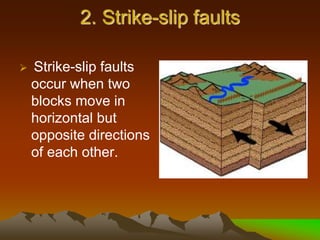
2. Strike-slip faults
 Strike-slip faults
occur when two
blocks move in
horizontal but
opposite directions
of each other.
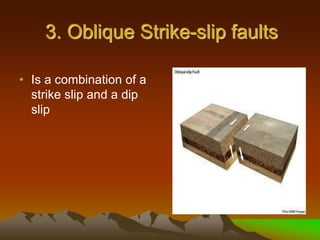
3. Oblique Strike-slip faults
• Is a combination of a
strike slip and a dip
slip
…what’s the connection?
Earthquakes and Plate
Tectonics…
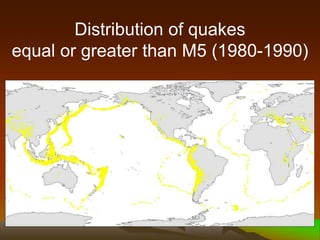
Distribution of quakes
equal or greater than M5 (1980-1990)
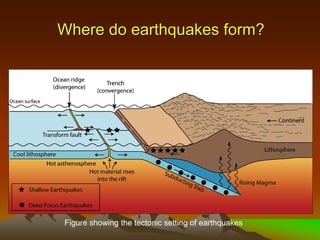
Where do earthquakes form?
Figure showing the tectonic setting of earthquakes
What is an earthquake?
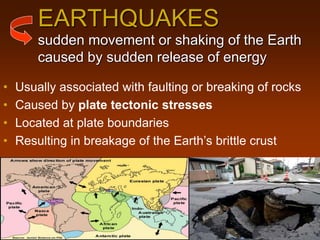
EARTHQUAKES
sudden movement or shaking of the Earth
caused by sudden release of energy
• Usually associated with faulting or breaking of rocks
• Caused by plate tectonic stresses
• Located at plate boundaries
• Resulting in breakage of the Earth’s brittle crust
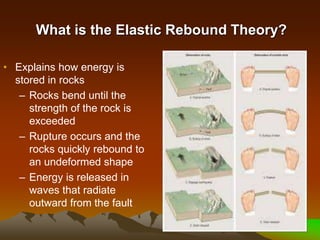
What is the Elastic Rebound Theory?
• Explains how energy is
stored in rocks
– Rocks bend until the
strength of the rock is
exceeded
– Rupture occurs and the
rocks quickly rebound to
an undeformed shape
– Energy is released in
waves that radiate
outward from the fault
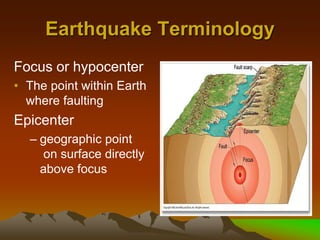
Focus or hypocenter
• The point within Earth
where faulting
Epicenter
– geographic point
on surface directly
above focus
Earthquake Terminology
What are Seismic Waves?
• Response of material to the arrival of
energy fronts released by rupture
• Two types:
–Body waves
• P and S
–Surface waves
• R and L
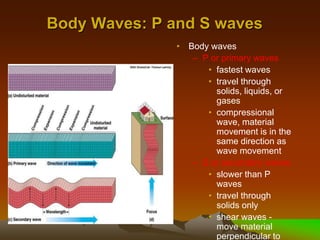
Body Waves: P and S waves
• Body waves
– P or primary waves
• fastest waves
• travel through
solids, liquids, or
gases
• compressional
wave, material
movement is in the
same direction as
wave movement
– S or secondary waves
• slower than P
waves
• travel through
solids only
• shear waves -
move material
perpendicular to
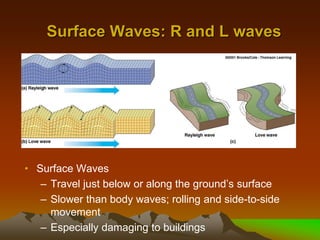
Surface Waves: R and L waves
• Surface Waves
– Travel just below or along the ground’s surface
– Slower than body waves; rolling and side-to-side
movement
– Especially damaging to buildings
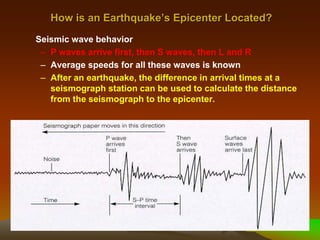
How is an Earthquake’s Epicenter Located?
Seismic wave behavior
– P waves arrive first, then S waves, then L and R
– Average speeds for all these waves is known
– After an earthquake, the difference in arrival times at a
seismograph station can be used to calculate the distance
from the seismograph to the epicenter.
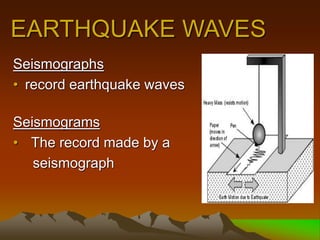
EARTHQUAKE WAVES
Seismographs
• record earthquake waves
Seismograms
• The record made by a
seismograph
Types of earthquake
1. Foreshock
– Smaller earthquakes that happen in the
same place before a larger earthquake
takes place
2. Main shock
– Largest main earthquake
3. aftershock
– Smaller earthquakes that follow the main
earthquake
Measurement of
Earthquakes
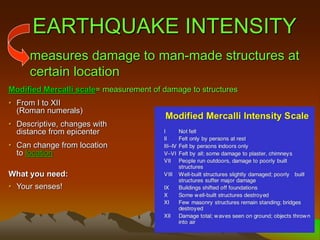
EARTHQUAKE INTENSITY
Modified Mercalli scale= measurement of damage to structures
• From I to XII
(Roman numerals)
• Descriptive, changes with
distance from epicenter
• Can change from location
to location
What you need:
• Your senses!
measures damage to man-made structures at
certain location
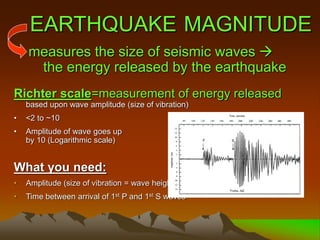
EARTHQUAKE MAGNITUDE
measures the size of seismic waves 
the energy released by the earthquake
Richter scale=measurement of energy released
based upon wave amplitude (size of vibration)
• <2 to ~10
• Amplitude of wave goes up
by 10 (Logarithmic scale)
What you need:
• Amplitude (size of vibration = wave height)
• Time between arrival of 1st P and 1st S waves
Types of earthquake based on the
depth of their foci:
1. Shallow focus
– Foci are less than 70 km depth. Most
destructive earthquakes.
2. Intermediate focus
– Foci are between 70 and 300 km depth.
3. Deep focus
– Foci are greater than 300 km.
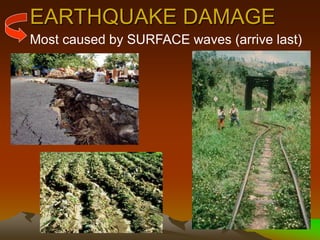
EARTHQUAKE DAMAGE
Most caused by SURFACE waves (arrive last)
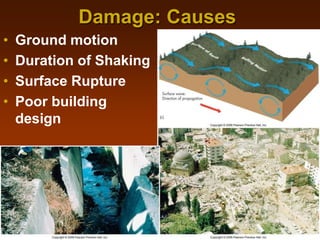
Damage: Causes
• Ground motion
• Duration of Shaking
• Surface Rupture
• Poor building
design
Effects of Earthquakes
• Ground shaking,
• uplift,
• dam breaks,
• landslides,
• aftershocks,
• Fire
• liquefaction,
• tsunami,
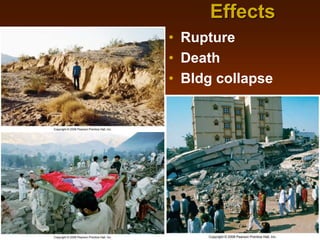
Effects
• Rupture
• Death
• Bldg collapse
Effects
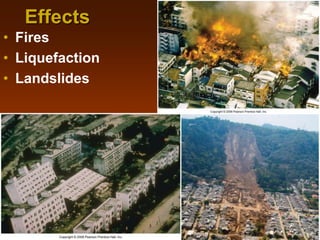
• Fires
• Liquefaction
• Landslides
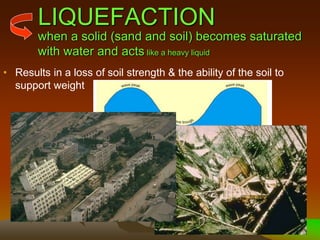
LIQUEFACTION
• Results in a loss of soil strength & the ability of the soil to
support weight
when a solid (sand and soil) becomes saturated
with water and acts like a heavy liquid
What is a tsunami?
• A tsunami is a series of waves usually
caused by an undersea earthquake that
displaces the ocean floor.
• The Japanese word tsunami means
“harbor wave.”
• •A tsunami travels across the open
ocean at over 500mph, the speed of a
jet airplane
• As it reaches shallower water and
approaches shore, it slows down but
grows in height.
• •A tsunami can happen at any time of
day or year.
geomorpHology
The science that is specifically
concerned with the study of
mountains
orogenesis
The process of forming mountains
and mountain ranges.
MOUNTAINS
• area of land that rises steeply from the
land around it.
• Mountains are the result of tectonic forces
to rock.
• Mountain-building on continents is
associated with intense deformation,
folding, and faulting, usually along
convergent plate boundaries.
•
Ranges versus Belts
• Most mountains belong to ranges—long lines of
mountains that were formed at about the same
time and by the same processes. Ranges that are
close together make up mountain belts.
– Ranges are groups of mountain peaks or ridges
that form areas bordered by valleys or rivers.
– Mountain belts are long chains of mountain
ranges that can extend across continents or
along their edges.
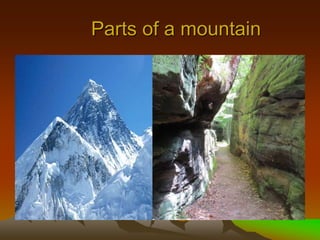
Parts of a mountain
1. Summit
– The top of a mountain
2. Slope
– Side of the mountain
3. Gorge
– Very deep valley between young mountains
Parts of a mountain
Types of Mountains
TYPES OF MOUNTAINS
• Folded: reverse faults and compression
• Fault-block: normal faulting and tension
• Volcanic: Shield and Composite; magma
rises from asthenosphere and breaks
through the surface of Earth
• Dome: Magma rises through the mantle
but does not break through the surface.
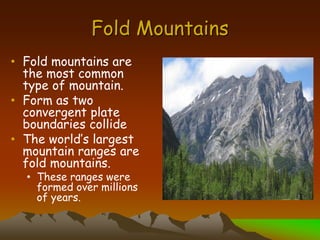
Fold Mountains
• Fold mountains are
the most common
type of mountain.
• Form as two
convergent plate
boundaries collide
• The world’s largest
mountain ranges are
fold mountains.
• These ranges were
formed over millions
of years.
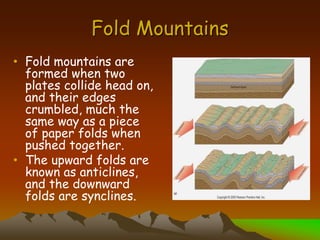
Fold Mountains
• Fold mountains are
formed when two
plates collide head on,
and their edges
crumbled, much the
same way as a piece
of paper folds when
pushed together.
• The upward folds are
known as anticlines,
and the downward
folds are synclines.
Fold Mountains
• Examples of fold mountains include:
• Himalayas
• Alps in Europe
• Andes
• Appalachians
• Rocky Mountains
• Great Dividing Range
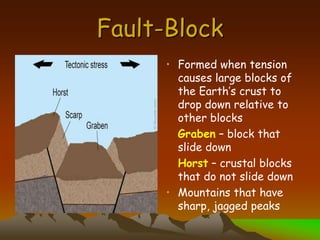
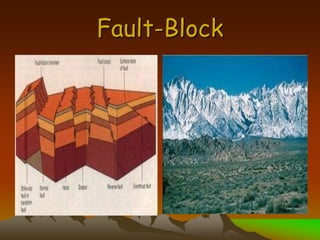
Fault-Block
• Formed when tension
causes large blocks of
the Earth’s crust to
drop down relative to
other blocks
Graben – block that
slide down
Horst – crustal blocks
that do not slide down
• Mountains that have
sharp, jagged peaks
Fault-Block
Fault-Block
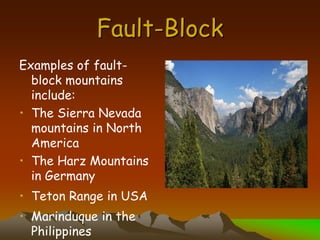
Examples of fault-
block mountains
include:
• The Sierra Nevada
mountains in North
America
• The Harz Mountains
in Germany
• Teton Range in USA
• Marinduque in the
Philippines
Volcanic Mountains
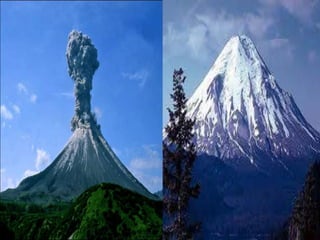
• Volcanic Mountains are formed when
molten rock (magma) deep within the
earth, erupts, and piles upon the surface.
– When the ash and lava cools, it builds a cone
of rock.
– Rock and lava pile up, layer on top of layer.
Volcanic Mountains
• Examples of volcanic mountains
include:
– Mount St. Helens in North America
– Mount Pinatubo in the Philippines
– Mount Mayon in the Philippines
– Mount Fuji in the Japan
– Mount Kea and Mount Loa in Hawaii
Dome Mountains
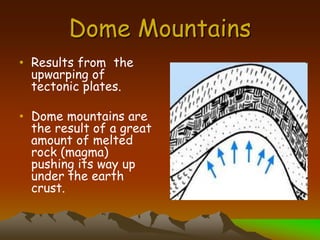
• Results from the
upwarping of
tectonic plates.
• Dome mountains are
the result of a great
amount of melted
rock (magma)
pushing its way up
under the earth
crust.
Dome Mountains
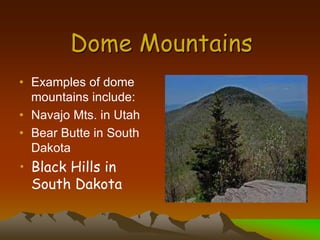
• Examples of dome
mountains include:
• Navajo Mts. in Utah
• Bear Butte in South
Dakota
• Black Hills in
South Dakota
EROSION -FORMED
• FORMED FROM EROSION AND
WEATHERING
• EX. APPALACHIAN PLATEAU
NAMIBIA IN AFRICA
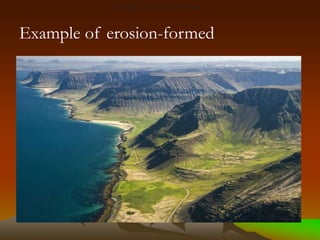
Examples of erosion-formed
Example of erosion-formed

Earthquake-Volcanoes-and-Mountains.ppt

  • 2.
     An openingin the earth's crust through which molten lava, ash, and gases are ejected.  formed by the materials ejected from a volcano.  Volcanology – the study of volcanoes  Volcanism – the process and phenomena associated with the surficial discharge of molten rock and other materials into the surface of Earth  Came from the word VULCANO, a volcanic island in Italy whose named has been derived from VULCAN, the Roman God of Fire What is A Volcano?
  • 4.
    Parts of aVolcano • Crater- cup-shaped the top of the volcano • VENT- the vent is the opening from which lava flows. • Volcanic cone- is the pile of lava, dust, ashes, and rock around the vent.  Parasitic cone • Fissure- elongated fracture or crack on the earth’s crust from which lava flows
  • 5.
    Parts of aVolcano • Flank- side of a volcano • Magma chamber or reservoir – underground compartment where the magma is stored. • Sill – horizontal cracks within a volcano which holds hardened magma • Dike – thick vertical crack within a volcano which holds hardened magma • Conduit- passageway through which magma travels to reach the earth’s surface
  • 6.
  • 7.
    According to Appearance 1.Steep slopes 2. Gentle slopes
  • 8.
    VOLCANIC ACTIVITY ACTIVE (has eruptedin the last 10,000 yrs) INACTIVE/ DORMANT (no activity during the last 10,000 yrs) EXTINCT (no written records of activity; considered unlikely to erupt again)
  • 9.
    According to Eruption 2.Quiet (non-violent) Fluid lava flows easily → Gentle slopes 1. Explosive (violent) Viscous lava → Steep slopes 1.
  • 10.
  • 11.
    1. STRATO/COMPOSITE VOLCANOES Steepslopes – Explosive • Tall conical mountains • Formed from viscous (thick) lava • Found in subduction zones & some hot spots • Ex: Mt. Mayon, Mt Fuji Mt. Vesuvius, Mt. St. Helen’s
  • 12.
    2. SHIELD VOLCANO Gentleslopes- Non-violent • Formed from fluid (thin) lava • Broad and flat volcanoes large craters at their summit • Only found over a hot spots • Ex: Hawaiian islands • Mauna Loa – largest shield volcano • Mount Kilauea, is the most active volcano on Earth because it has been erupting since 1983!
  • 13.
    3. CINDER VOLCANO Steepslopes- Explosive • Formed from ash and scoria • Cinder cone volcanoes are normally small about a miles span and about one thousand feet vertically. • normally have a small crater at the top. • Ex. Mt. Paricutin, Arizona’s Sunset Crater
  • 14.
    4. CALDERA • arecircular depressions in the ground over a magma chamber • Volcano that has a very large crater • Ex. Taal Caldera and Laguna Lake caldera.
  • 15.
    5. FISSURE • haveno main crater, the ground just splits and lava pours out through the cracks. After a fissure volcano erupts and has cooled because it’s a solid it will look mainly like the plains.
  • 16.
  • 17.
    Active volcanism occursin four principal settings • Divergent Boundaries • Continental Extension • Convergent Boundaries • Hot Spots
  • 18.
    Diastrophism • It isa process by which the earth’s surface is changed through rock movements and displacements • 2 Effects of diastrophism a. Fold b. Fault
  • 19.
    Anticline • a foldin sedimentary strata resembling an arch Syncline • a linear downfold in sedimentary strata Folding This occurs when plates are compressed
  • 20.
    Faulting Fault • is afracture in rock which involves the movement or displacement of rock. Joint • is a fracture in rock without movement.
  • 21.
    Fault Fault plane – Thesurface where the blocks slip past each other. Fault scarp – is the exposed cliff-like face of the fault plane. Fault line – Area at which a fault plane intersects with the Earth’s surface footwall – the block of crust below the fault. hanging wall – the block of crust above the fault .
  • 22.
    3. Shear stress •causes rocks to slide past each other resulting in strike-slip faults 2. Compression • squeezes rock together resulting in reverse faults 1. Tension • pulls rocks apart resulting in normal faults 3 Types of stress that can affect rocks, resulting in 3 different types of faults:
  • 23.
    1.Dip-slip fault Movements offault along the angle of the fault plane A. Normal  Faults caused by blocks of crust pulling apart under the forces of tension  In a normal fault, the hanging-wall block moves down relative to the foot- wall block.
  • 24.
    Faults caused by blocksof crust colliding under the forces of compression  During reverse faulting, the hanging wall block moves upward (and over) relative to the footwall block. b. reverse
  • 25.
    2. Strike-slip faults Strike-slip faults occur when two blocks move in horizontal but opposite directions of each other.
  • 26.
    3. Oblique Strike-slipfaults • Is a combination of a strike slip and a dip slip
  • 27.
  • 28.
    Distribution of quakes equalor greater than M5 (1980-1990)
  • 29.
    Where do earthquakesform? Figure showing the tectonic setting of earthquakes
  • 30.
    What is anearthquake?
  • 31.
    EARTHQUAKES sudden movement orshaking of the Earth caused by sudden release of energy • Usually associated with faulting or breaking of rocks • Caused by plate tectonic stresses • Located at plate boundaries • Resulting in breakage of the Earth’s brittle crust
  • 32.
    What is theElastic Rebound Theory? • Explains how energy is stored in rocks – Rocks bend until the strength of the rock is exceeded – Rupture occurs and the rocks quickly rebound to an undeformed shape – Energy is released in waves that radiate outward from the fault
  • 33.
    Focus or hypocenter •The point within Earth where faulting Epicenter – geographic point on surface directly above focus Earthquake Terminology
  • 34.
    What are SeismicWaves? • Response of material to the arrival of energy fronts released by rupture • Two types: –Body waves • P and S –Surface waves • R and L
  • 35.
    Body Waves: Pand S waves • Body waves – P or primary waves • fastest waves • travel through solids, liquids, or gases • compressional wave, material movement is in the same direction as wave movement – S or secondary waves • slower than P waves • travel through solids only • shear waves - move material perpendicular to
  • 36.
    Surface Waves: Rand L waves • Surface Waves – Travel just below or along the ground’s surface – Slower than body waves; rolling and side-to-side movement – Especially damaging to buildings
  • 37.
    How is anEarthquake’s Epicenter Located? Seismic wave behavior – P waves arrive first, then S waves, then L and R – Average speeds for all these waves is known – After an earthquake, the difference in arrival times at a seismograph station can be used to calculate the distance from the seismograph to the epicenter.
  • 38.
    EARTHQUAKE WAVES Seismographs • recordearthquake waves Seismograms • The record made by a seismograph
  • 39.
    Types of earthquake 1.Foreshock – Smaller earthquakes that happen in the same place before a larger earthquake takes place 2. Main shock – Largest main earthquake 3. aftershock – Smaller earthquakes that follow the main earthquake
  • 40.
  • 41.
    EARTHQUAKE INTENSITY Modified Mercalliscale= measurement of damage to structures • From I to XII (Roman numerals) • Descriptive, changes with distance from epicenter • Can change from location to location What you need: • Your senses! measures damage to man-made structures at certain location
  • 42.
    EARTHQUAKE MAGNITUDE measures thesize of seismic waves  the energy released by the earthquake Richter scale=measurement of energy released based upon wave amplitude (size of vibration) • <2 to ~10 • Amplitude of wave goes up by 10 (Logarithmic scale) What you need: • Amplitude (size of vibration = wave height) • Time between arrival of 1st P and 1st S waves
  • 43.
    Types of earthquakebased on the depth of their foci: 1. Shallow focus – Foci are less than 70 km depth. Most destructive earthquakes. 2. Intermediate focus – Foci are between 70 and 300 km depth. 3. Deep focus – Foci are greater than 300 km.
  • 44.
    EARTHQUAKE DAMAGE Most causedby SURFACE waves (arrive last)
  • 45.
    Damage: Causes • Groundmotion • Duration of Shaking • Surface Rupture • Poor building design
  • 46.
    Effects of Earthquakes •Ground shaking, • uplift, • dam breaks, • landslides, • aftershocks, • Fire • liquefaction, • tsunami,
  • 47.
  • 48.
  • 49.
    LIQUEFACTION • Results ina loss of soil strength & the ability of the soil to support weight when a solid (sand and soil) becomes saturated with water and acts like a heavy liquid
  • 50.
    What is atsunami? • A tsunami is a series of waves usually caused by an undersea earthquake that displaces the ocean floor. • The Japanese word tsunami means “harbor wave.”
  • 52.
    • •A tsunamitravels across the open ocean at over 500mph, the speed of a jet airplane • As it reaches shallower water and approaches shore, it slows down but grows in height. • •A tsunami can happen at any time of day or year.
  • 53.
    geomorpHology The science thatis specifically concerned with the study of mountains
  • 54.
    orogenesis The process offorming mountains and mountain ranges.
  • 55.
    MOUNTAINS • area ofland that rises steeply from the land around it. • Mountains are the result of tectonic forces to rock. • Mountain-building on continents is associated with intense deformation, folding, and faulting, usually along convergent plate boundaries. •
  • 56.
    Ranges versus Belts •Most mountains belong to ranges—long lines of mountains that were formed at about the same time and by the same processes. Ranges that are close together make up mountain belts. – Ranges are groups of mountain peaks or ridges that form areas bordered by valleys or rivers. – Mountain belts are long chains of mountain ranges that can extend across continents or along their edges.
  • 57.
    Parts of amountain 1. Summit – The top of a mountain 2. Slope – Side of the mountain 3. Gorge – Very deep valley between young mountains
  • 58.
    Parts of amountain
  • 59.
  • 60.
    TYPES OF MOUNTAINS •Folded: reverse faults and compression • Fault-block: normal faulting and tension • Volcanic: Shield and Composite; magma rises from asthenosphere and breaks through the surface of Earth • Dome: Magma rises through the mantle but does not break through the surface.
  • 61.
    Fold Mountains • Foldmountains are the most common type of mountain. • Form as two convergent plate boundaries collide • The world’s largest mountain ranges are fold mountains. • These ranges were formed over millions of years.
  • 62.
    Fold Mountains • Foldmountains are formed when two plates collide head on, and their edges crumbled, much the same way as a piece of paper folds when pushed together. • The upward folds are known as anticlines, and the downward folds are synclines.
  • 63.
    Fold Mountains • Examplesof fold mountains include: • Himalayas • Alps in Europe • Andes • Appalachians • Rocky Mountains • Great Dividing Range
  • 64.
    Fault-Block • Formed whentension causes large blocks of the Earth’s crust to drop down relative to other blocks Graben – block that slide down Horst – crustal blocks that do not slide down • Mountains that have sharp, jagged peaks
  • 65.
  • 66.
    Fault-Block Examples of fault- blockmountains include: • The Sierra Nevada mountains in North America • The Harz Mountains in Germany • Teton Range in USA • Marinduque in the Philippines
  • 67.
    Volcanic Mountains • VolcanicMountains are formed when molten rock (magma) deep within the earth, erupts, and piles upon the surface. – When the ash and lava cools, it builds a cone of rock. – Rock and lava pile up, layer on top of layer.
  • 68.
    Volcanic Mountains • Examplesof volcanic mountains include: – Mount St. Helens in North America – Mount Pinatubo in the Philippines – Mount Mayon in the Philippines – Mount Fuji in the Japan – Mount Kea and Mount Loa in Hawaii
  • 70.
    Dome Mountains • Resultsfrom the upwarping of tectonic plates. • Dome mountains are the result of a great amount of melted rock (magma) pushing its way up under the earth crust.
  • 71.
    Dome Mountains • Examplesof dome mountains include: • Navajo Mts. in Utah • Bear Butte in South Dakota • Black Hills in South Dakota
  • 72.
    EROSION -FORMED • FORMEDFROM EROSION AND WEATHERING • EX. APPALACHIAN PLATEAU NAMIBIA IN AFRICA
  • 73.