Biography
Unit 11: Writing a Biography
Learning Objectives
At the end of this lesson, the learner should be
able to:
 identify the features of a biography;
 discovers the conflicts presented in literary selections
and the need to resolve those conflicts in non-violent
ways; and
 write a biographical essay.
Definition of Terms
1. insulator (noun) - a material that does not allow heat, electricity, or
sound to go into or out of something.
2. rudiment (noun) - a fundamental skill
3. stoic (adjective) - showing no emotion when a bad thing happens
4. patent (noun) - an official document that gives a person or a
company a right to own and sell a product at a certain period of
time.
5. dissipation (noun) - the process of gradually disappearing or
becoming less.
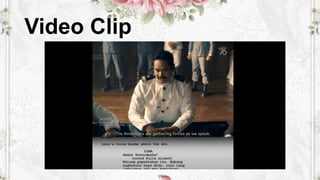
Video Clip
Questions:
1. What do you know about the
subject/main character in the movie?
2. How was the life of the subject
presented in the video?
Why is it important to document people’s
important life events?
What is Biography?
● about the life of a famous or
infamous celebrity or historical
figure, or just an ordinary being.
● can be about a subject who is
either still living or already dead.
Important Details Included in a Biography
● the basic facts about the person’s family, education, work, and other
common information
● the person’s striking or unique characteristics
● the person’s achievement(s) and impact on other people’s lives or the
society
● the conflicts or obstacles the person faced and how he/she overcame
it/them
● the person’s legacy after his/her death (if the subject is dead already)
● other people’s perception about his/her character or achievements.
Steps in Writing a Biography
1. Select an interesting character as a subject.
2. Research about this person in references (If the person is
someone you can easily contact, you can interview this person
as well and get facts straight from him/her).
3. Choose details to include in your biography.
4. Organize the details in chronological order.
5. Give specific details and descriptions.
Let’s Read
The Young Telegraph Operator
By Frank Lewis Dyer and Thomas
Commerford Martin
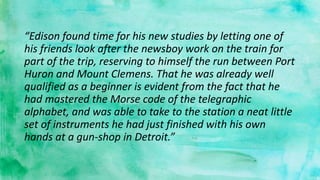
“Edison found time for his new studies by letting one of
his friends look after the newsboy work on the train for
part of the trip, reserving to himself the run between Port
Huron and Mount Clemens. That he was already well
qualified as a beginner is evident from the fact that he
had mastered the Morse code of the telegraphic
alphabet, and was able to take to the station a neat little
set of instruments he had just finished with his own
hands at a gun-shop in Detroit.”
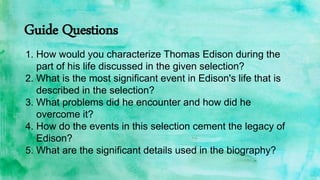
Guide Questions
1. How would you characterize Thomas Edison during the
part of his life discussed in the given selection?
2. What is the most significant event in Edison's life that is
described in the selection?
3. What problems did he encounter and how did he
overcome it?
4. How do the events in this selection cement the legacy of
Edison?
5. What are the significant details used in the biography?
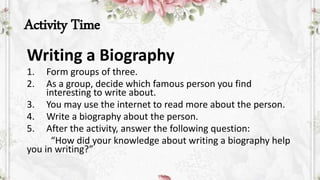
Activity Time
Writing a Biography
1. Form groups of three.
2. As a group, decide which famous person you find
interesting to write about.
3. You may use the internet to read more about the person.
4. Write a biography about the person.
5. After the activity, answer the following question:
“How did your knowledge about writing a biography help
you in writing?”
Assignment
1. Think of one person from your family or community who
you think has interesting life events.
2. Write a 400-word biographical essay about that person.
Make sure to observe the features of a biography.
3. Put it on a short bond paper.
4. Submit your work through Google Classroom (English 7).
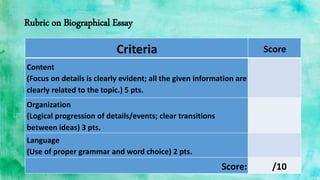
Rubric on Biographical Essay
Criteria Score
Content
(Focus on details is clearly evident; all the given information are
clearly related to the topic.) 5 pts.
Organization
(Logical progression of details/events; clear transitions
between ideas) 3 pts.
Language
(Use of proper grammar and word choice) 2 pts.
Score: /10

Biography

  • 1.
  • 2.
    Learning Objectives At theend of this lesson, the learner should be able to:  identify the features of a biography;  discovers the conflicts presented in literary selections and the need to resolve those conflicts in non-violent ways; and  write a biographical essay.
  • 3.
    Definition of Terms 1.insulator (noun) - a material that does not allow heat, electricity, or sound to go into or out of something. 2. rudiment (noun) - a fundamental skill 3. stoic (adjective) - showing no emotion when a bad thing happens 4. patent (noun) - an official document that gives a person or a company a right to own and sell a product at a certain period of time. 5. dissipation (noun) - the process of gradually disappearing or becoming less.
  • 4.
  • 5.
    Questions: 1. What doyou know about the subject/main character in the movie? 2. How was the life of the subject presented in the video?
  • 6.
    Why is itimportant to document people’s important life events?
  • 7.
    What is Biography? ●about the life of a famous or infamous celebrity or historical figure, or just an ordinary being. ● can be about a subject who is either still living or already dead.
  • 8.
    Important Details Includedin a Biography ● the basic facts about the person’s family, education, work, and other common information ● the person’s striking or unique characteristics ● the person’s achievement(s) and impact on other people’s lives or the society ● the conflicts or obstacles the person faced and how he/she overcame it/them ● the person’s legacy after his/her death (if the subject is dead already) ● other people’s perception about his/her character or achievements.
  • 9.
    Steps in Writinga Biography 1. Select an interesting character as a subject. 2. Research about this person in references (If the person is someone you can easily contact, you can interview this person as well and get facts straight from him/her). 3. Choose details to include in your biography. 4. Organize the details in chronological order. 5. Give specific details and descriptions.
  • 10.
    Let’s Read The YoungTelegraph Operator By Frank Lewis Dyer and Thomas Commerford Martin
  • 11.
    “Edison found timefor his new studies by letting one of his friends look after the newsboy work on the train for part of the trip, reserving to himself the run between Port Huron and Mount Clemens. That he was already well qualified as a beginner is evident from the fact that he had mastered the Morse code of the telegraphic alphabet, and was able to take to the station a neat little set of instruments he had just finished with his own hands at a gun-shop in Detroit.”
  • 12.
    Guide Questions 1. Howwould you characterize Thomas Edison during the part of his life discussed in the given selection? 2. What is the most significant event in Edison's life that is described in the selection? 3. What problems did he encounter and how did he overcome it? 4. How do the events in this selection cement the legacy of Edison? 5. What are the significant details used in the biography?
  • 13.
    Activity Time Writing aBiography 1. Form groups of three. 2. As a group, decide which famous person you find interesting to write about. 3. You may use the internet to read more about the person. 4. Write a biography about the person. 5. After the activity, answer the following question: “How did your knowledge about writing a biography help you in writing?”
  • 14.
    Assignment 1. Think ofone person from your family or community who you think has interesting life events. 2. Write a 400-word biographical essay about that person. Make sure to observe the features of a biography. 3. Put it on a short bond paper. 4. Submit your work through Google Classroom (English 7).
  • 15.
    Rubric on BiographicalEssay Criteria Score Content (Focus on details is clearly evident; all the given information are clearly related to the topic.) 5 pts. Organization (Logical progression of details/events; clear transitions between ideas) 3 pts. Language (Use of proper grammar and word choice) 2 pts. Score: /10