Regular Expressions in
R
Houston R Users Group
10.05.2011
Ed Goodwin
twitter: @egoodwintx
What is a Regular
Expression?
Regexes are an extremely flexible tool for
finding and replacing text. They can easily
be applied globally across a document,
dataset, or specifically to individual strings.
Example
LastName, FirstName, Address, Phone
Baker, Tom, 123 Unit St., 555-452-1324
Smith, Matt, 456 Tardis St., 555-326-4567
Tennant, David, 567 Torchwood Ave., 555-563-8974
Data
gsub(“St.”, “Street”, data[i])
*Note the double-slash “” to escape the ‘.’
Regular Expression to Convert “St.” to “Street”
Benefits of Regex
• Flexible (can be applied globally or
specifically across data)
• Terse (very powerful scripting template)
• Portable (sort of) across languages
• Rich history
Disadvantages of regex
• Non-intuitive
• Easy to make errors (unintended
consequences)
• Difficult to robustly debug
• Various flavors may cause portability issues.
Why do this in R?
• Easier to locate all code in one place
• (Relatively) Robust regex tools
• May be the only tool available
• Familiarity
Other alternatives?
• Perl
• Python
• Java
• Ruby
• Others (grep, sed, awk, bash, csh, ksh, etc.)
Components of a
Regular Expression
• Characters
• Metacharacters
• Character classes
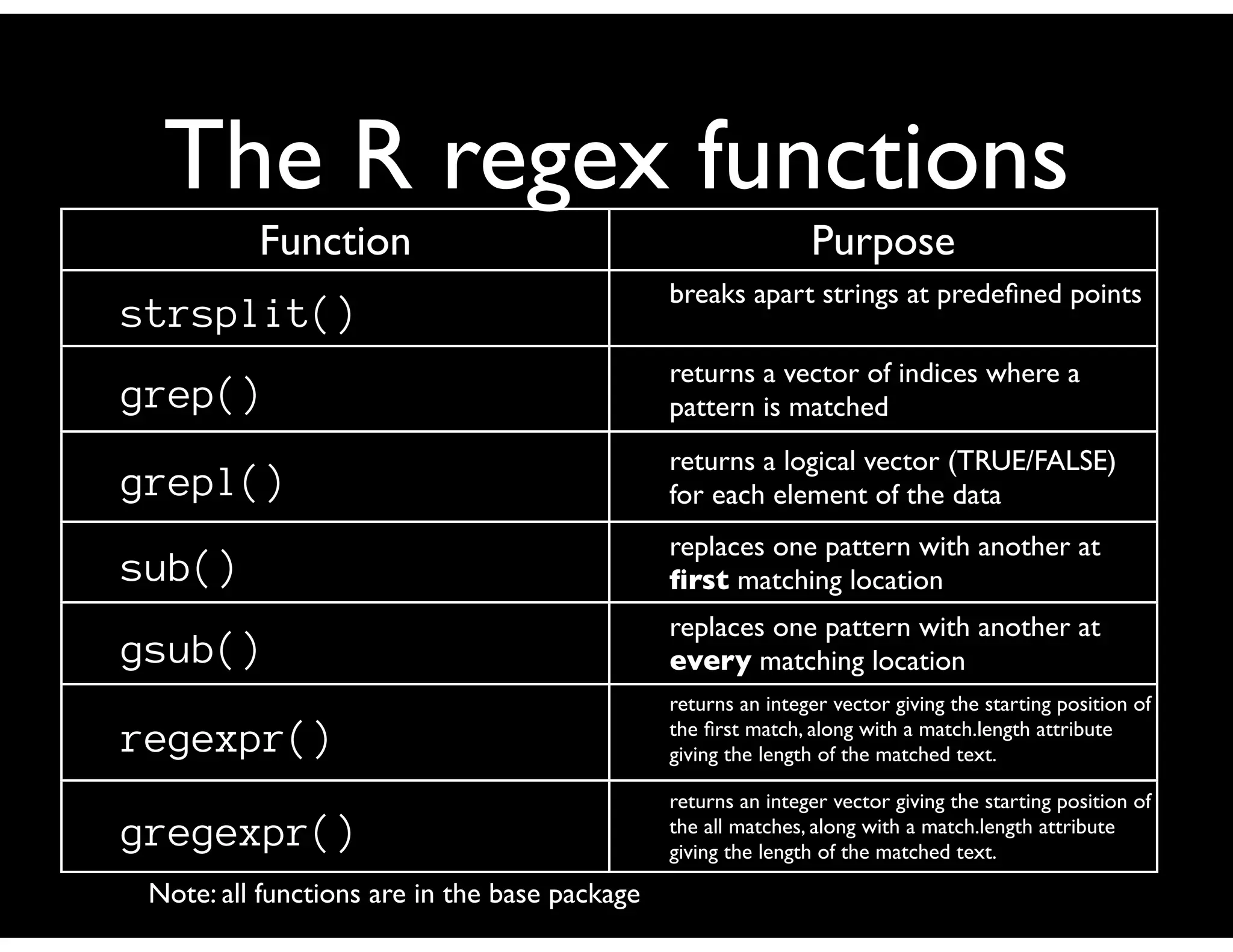
The R regex functions
Note: all functions are in the base package
Function Purpose
strsplit()
breaks apart strings at predefined points
grep()
returns a vector of indices where a
pattern is matched
grepl()
returns a logical vector (TRUE/FALSE)
for each element of the data
sub()
replaces one pattern with another at
first matching location
gsub()
replaces one pattern with another at
every matching location
regexpr()
returns an integer vector giving the starting position of
the first match, along with a match.length attribute
giving the length of the matched text.
gregexpr()
returns an integer vector giving the starting position of
the all matches, along with a match.length attribute
giving the length of the matched text.
Metacharacter Symbols
Modifier Meaning
^ anchors expression to beginning of target
$ anchors expression to end of target
. matches any single character except newline
| separates alternative patterns
[] accepts any of the enclosed characters
[^] accepts any characters but the ones enclosed in brackets
() groups patterns together for assignment or constraint
* matches zero or more occurrences of preceding entity
? matches zero or one occurrences of preceding entity
+ matches one or more occurrences of preceding entity
{n} matches exactly n occurrences of preceding entity
{n,} matches at least n occurrences of preceding entity
{n,m} matches n to m occurrences of preceding entity
 interpret succeeding character as literal
Source:“Data Manipulation with R”. Spector, Phil. Springer, 2008. page 92.
Examples
[A-Za-z]+ matches one or more alphabetic characters
.* matches zero or more of any character up to the newline
.*.* matches zero or more characters followed by a literal .*
(July? ) Accept ‘Jul’ or ‘July’ but not ‘Julyy’. Note the space.
(abc|123) Match “abc” or “123”
[abc|123] Match a, b, c, 1, 2 or 3.The ‘|’ is extraneous.
^(From|Subject|Date):
Matches lines starting with “From:” or “Subject:” or
“Date:”
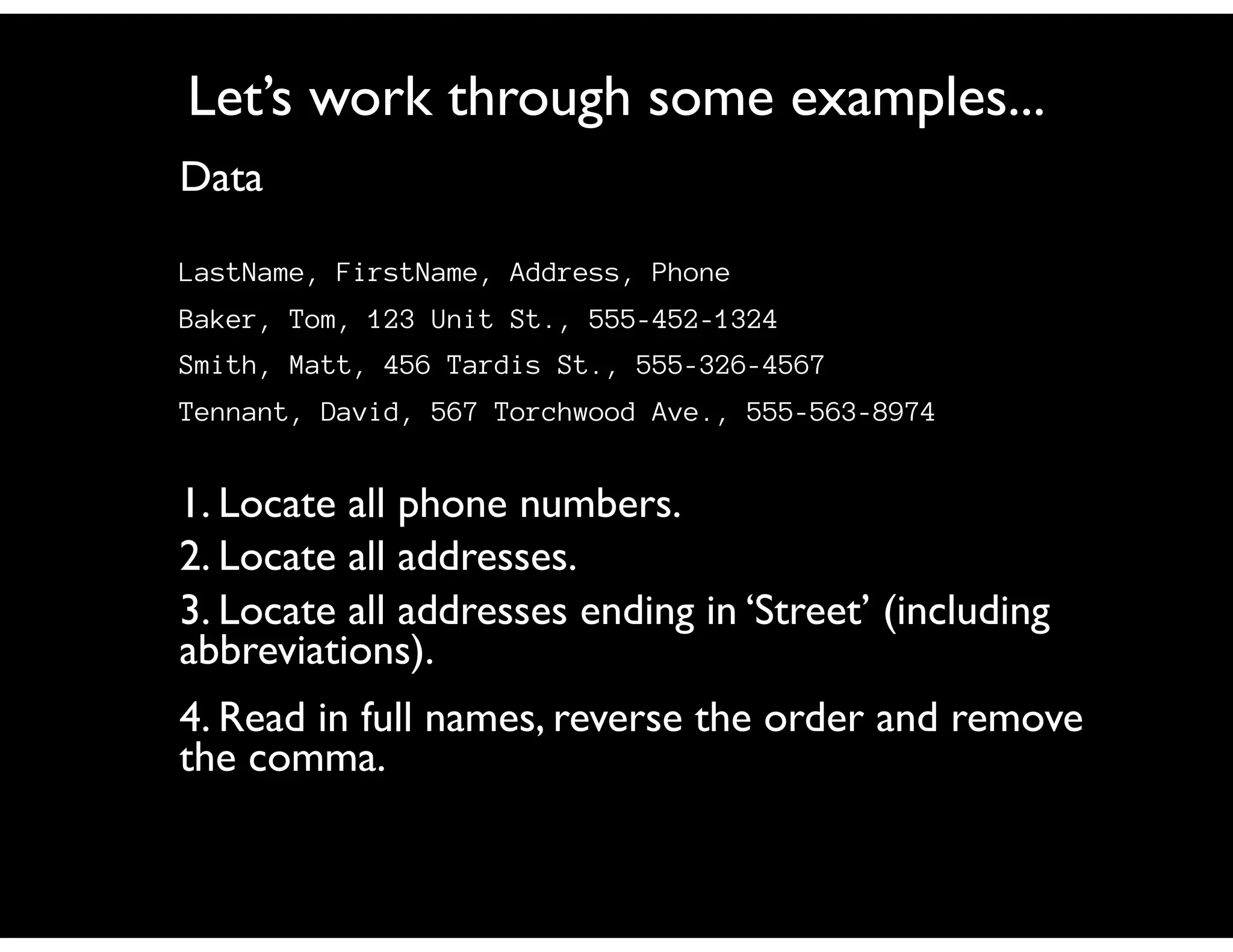
Let’s work through some examples...
Data
LastName, FirstName, Address, Phone
Baker, Tom, 123 Unit St., 555-452-1324
Smith, Matt, 456 Tardis St., 555-326-4567
Tennant, David, 567 Torchwood Ave., 555-563-8974
1. Locate all phone numbers.
2. Locate all addresses.
3. Locate all addresses ending in ‘Street’ (including
abbreviations).
4. Read in full names, reverse the order and remove
the comma.
So how would you write the regular
expression to match a calendar date in
format “mm/dd/yyyy” or “mm.dd.yyyy”?
Regex to identify date
format?
What’s wrong with
“[0-9]{2}(.|/)[0-9]{2}(.|/)[0-9]{4}” ?
Or with
“[1-12](.|/)[1-31](.|/)[0001-9999]” ?
Dates are not an easy problem
because they are not a simple text
pattern
Best bet is to validate the textual pattern
(mm.dd.yyyy) and then pass to a separate
function to validate the date (leap years, odd
days in month, etc.)
“^(1[0-2]|0[1-9])(.|/)(3[0-1]|[1-2][0-9]|0[1-9])(.|/)
([0-9]{4})$”
Supported flavors of
regex in R
• POSIX 1003.2
• Perl
Perl is the more robust of the two. POSIX
has a few idiosyncracies handling ‘’ that may
trip you up.
Usage Patterns
• Data validation
• String replace on dataset
• String identify in dataset (subset of data)
• Pattern arithmetic (how prevalent is string
in data?)
• Error prevention/detection
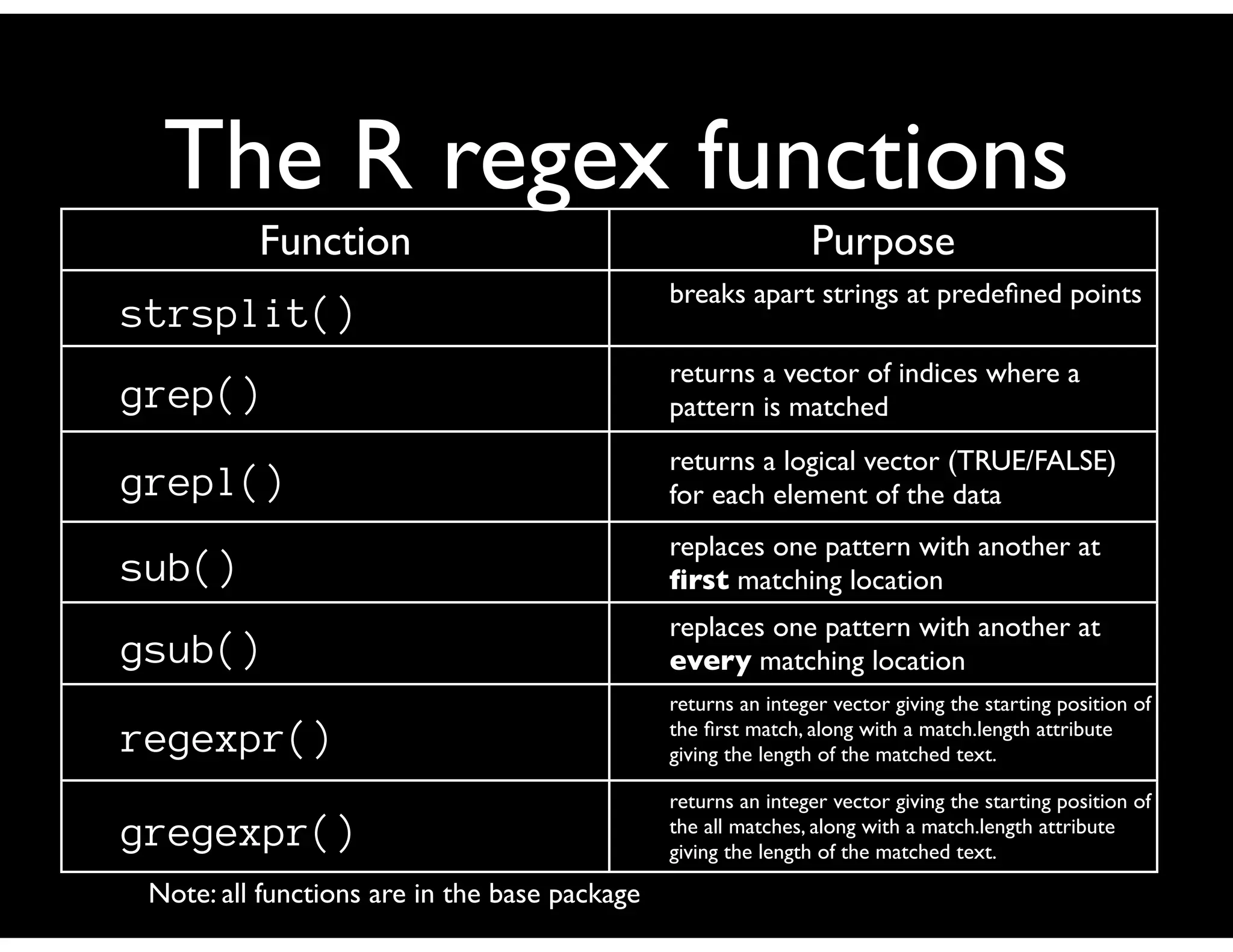
The R regex functions
Note: all functions are in the base package
Function Purpose
strsplit()
breaks apart strings at predefined points
grep()
returns a vector of indices where a
pattern is matched
grepl()
returns a logical vector (TRUE/FALSE)
for each element of the data
sub()
replaces one pattern with another at
first matching location
gsub()
replaces one pattern with another at
every matching location
regexpr()
returns an integer vector giving the starting position of
the first match, along with a match.length attribute
giving the length of the matched text.
gregexpr()
returns an integer vector giving the starting position of
the all matches, along with a match.length attribute
giving the length of the matched text.
strsplit( )
Definition:
strsplit(x, split, fixed=FALSE, perl=FALSE, useBytes=FALSE)
Example:
str <- “This is some dummy data to parse x785y8099”
strsplit(str, “[ xy]”, perl=TRUE)
Result:
[[1]]
[1] "This" "is" "some" "dumm" "" "data" "to"
"parse" ""
[10] "785" "8099"
grep( )
Definition:
grep(pattern, x, ignore.case=FALSE, perl=FALSE, value=FALSE,
fixed = FALSE, useBytes = FALSE, invert = FALSE)
Example:
str <- “This is some dummy data to parse x785y8099”
grep(“[a-z][0-9]{3}[a-z][0-9]{4}”, str, perl=TRUE,
value=TRUE)
Result:
[1] "This is some dummy data to parse x785y8099"
grepl( )
Definition:
grepl(pattern, x, ignore.case=FALSE, perl=FALSE,
value=FALSE,fixed = FALSE, useBytes = FALSE, invert = FALSE)
Example:
str <- “This is some dummy data to parse x785y8099”
grepl(“[a-z][0-9]{3}[a-z][0-9]{4}”, str, perl=TRUE)
Result:
[1] TRUE
sub( )
Definition:
sub(pattern, replacement, x, ignore.case=FALSE, perl=FALSE,
fixed=FALSE, useBytes=FALSE)
Example:
str <- “This is some dummy data to parse x785y8099”
sub("dummy(.* )([a-z][0-9]{3}).([0-9]{4})",
"awesome12H3", str, perl=TRUE)
Result:
[1] "This is some awesome data to parse x785H8099"
gsub( )
Definition:
gsub(pattern, replacement, x, ignore.case=FALSE,
perl=FALSE,fixed=FALSE, useBytes=FALSE)
Example:
str <- “This is some dummy data to parse x785y8099 you
dummy”
gsub(“dummy”, “awesome”, perl=TRUE)
Result:
[1] "This is some awesome data to parse x785y8099 you
awesome"
regexpr( )
Definition:
regexpr(pattern, text, ignore.case=FALSE, perl=FALSE,
fixed = FALSE, useBytes = FALSE)
Example:
duckgoose <- "Duck, duck, duck, goose, duck, duck, goose,
duck, duck"
regexpr("duck", duckgoose, ignore.case=TRUE, perl=TRUE)
Result:
[1] 1
attr(,"match.length")
[1] 4
gregexpr( )
Definition:
gregexpr(pattern, text, ignore.case=FALSE, perl=FALSE,
fixed=FALSE, useBytes=FALSE)
Example:
duckgoose <- "Duck, duck, duck, goose, duck, duck, goose,
duck, duck"
regexpr("duck", duckgoose, ignore.case=TRUE, perl=TRUE)
Result:
[[1]]
[1] 1 7 13 26 32 45 51
attr(,"match.length")
[1] 4 4 4 4 4 4 4
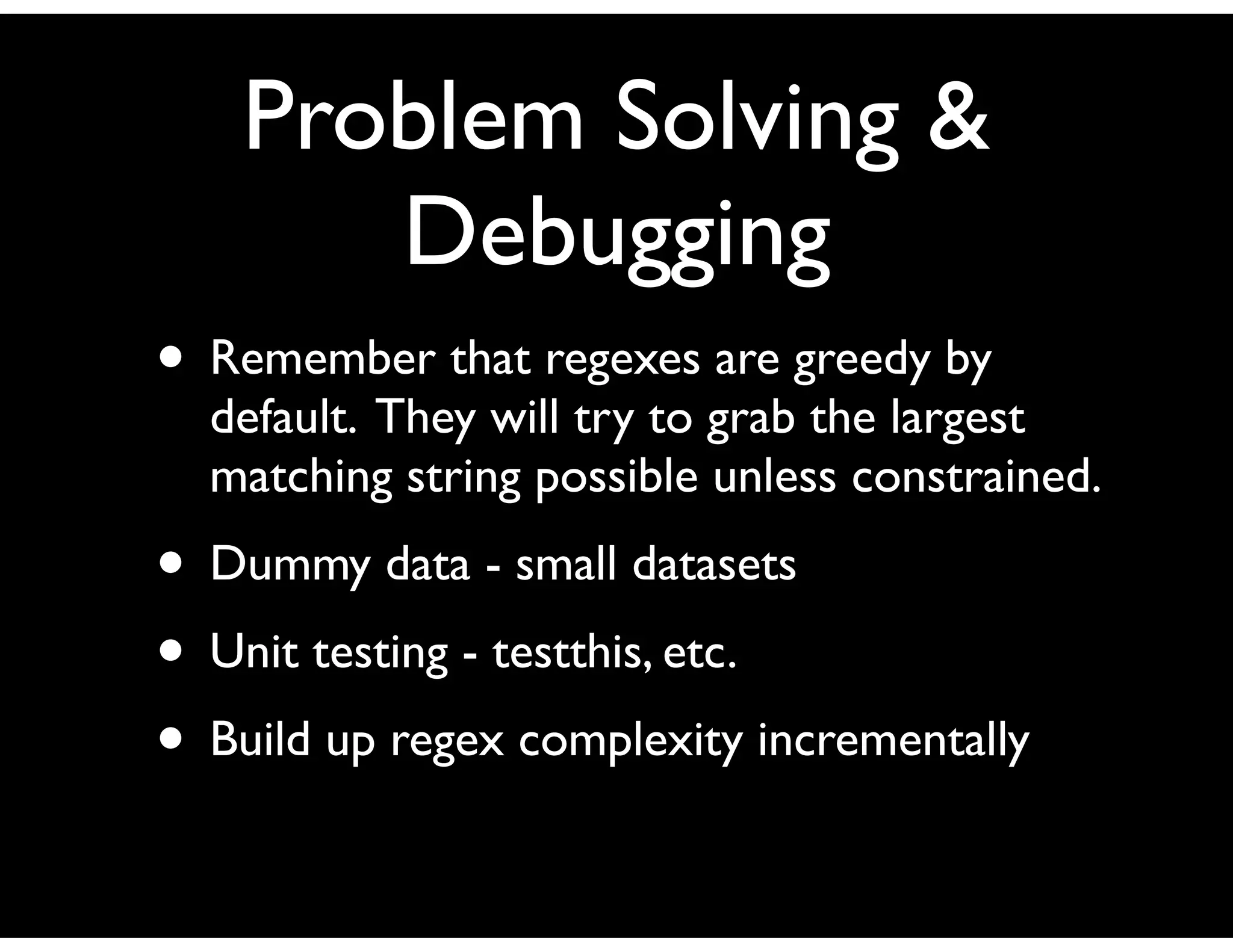
Problem Solving &
Debugging
• Remember that regexes are greedy by
default. They will try to grab the largest
matching string possible unless constrained.
• Dummy data - small datasets
• Unit testing - testthis, etc.
• Build up regex complexity incrementally
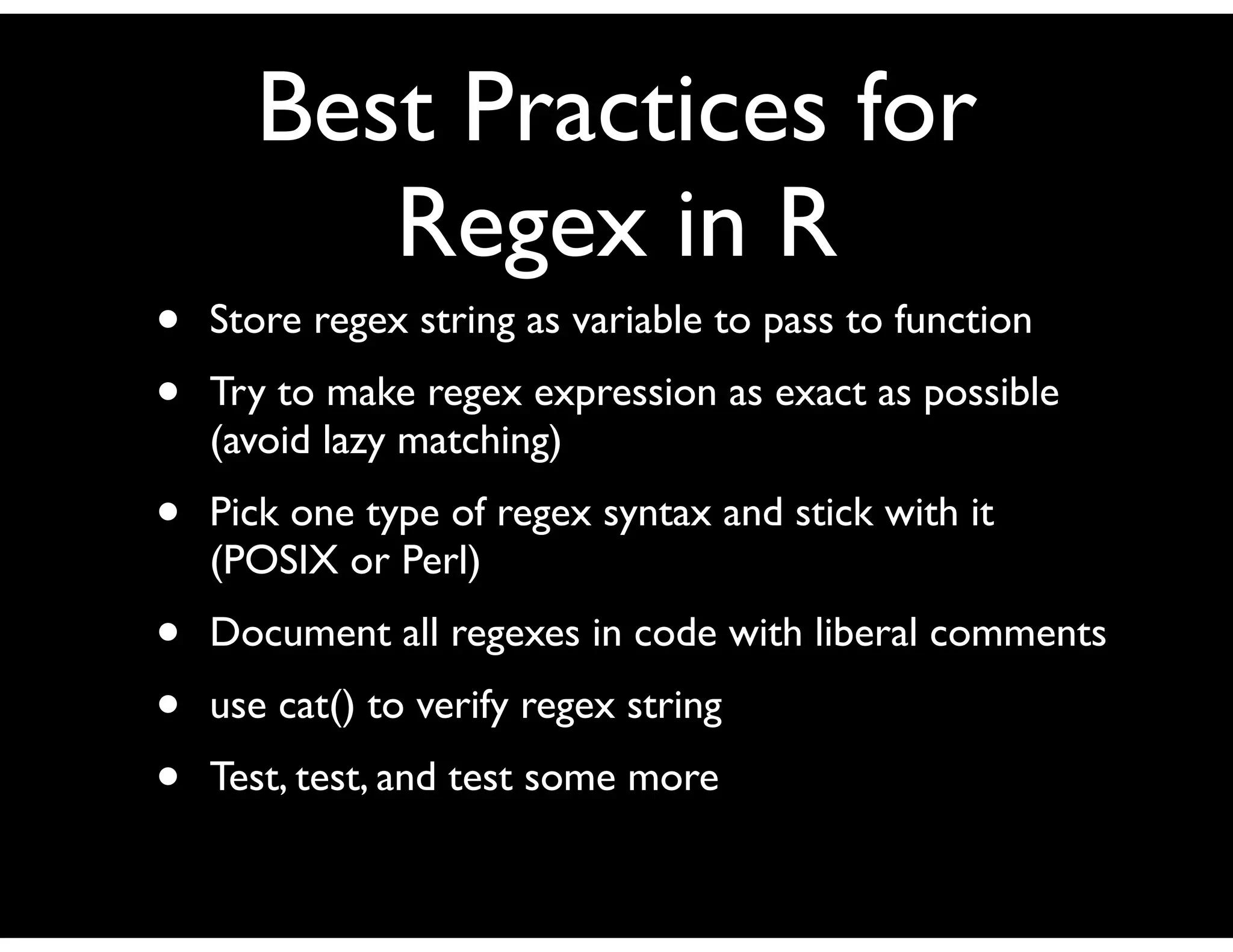
Best Practices for
Regex in R
• Store regex string as variable to pass to function
• Try to make regex expression as exact as possible
(avoid lazy matching)
• Pick one type of regex syntax and stick with it
(POSIX or Perl)
• Document all regexes in code with liberal comments
• use cat() to verify regex string
• Test, test, and test some more
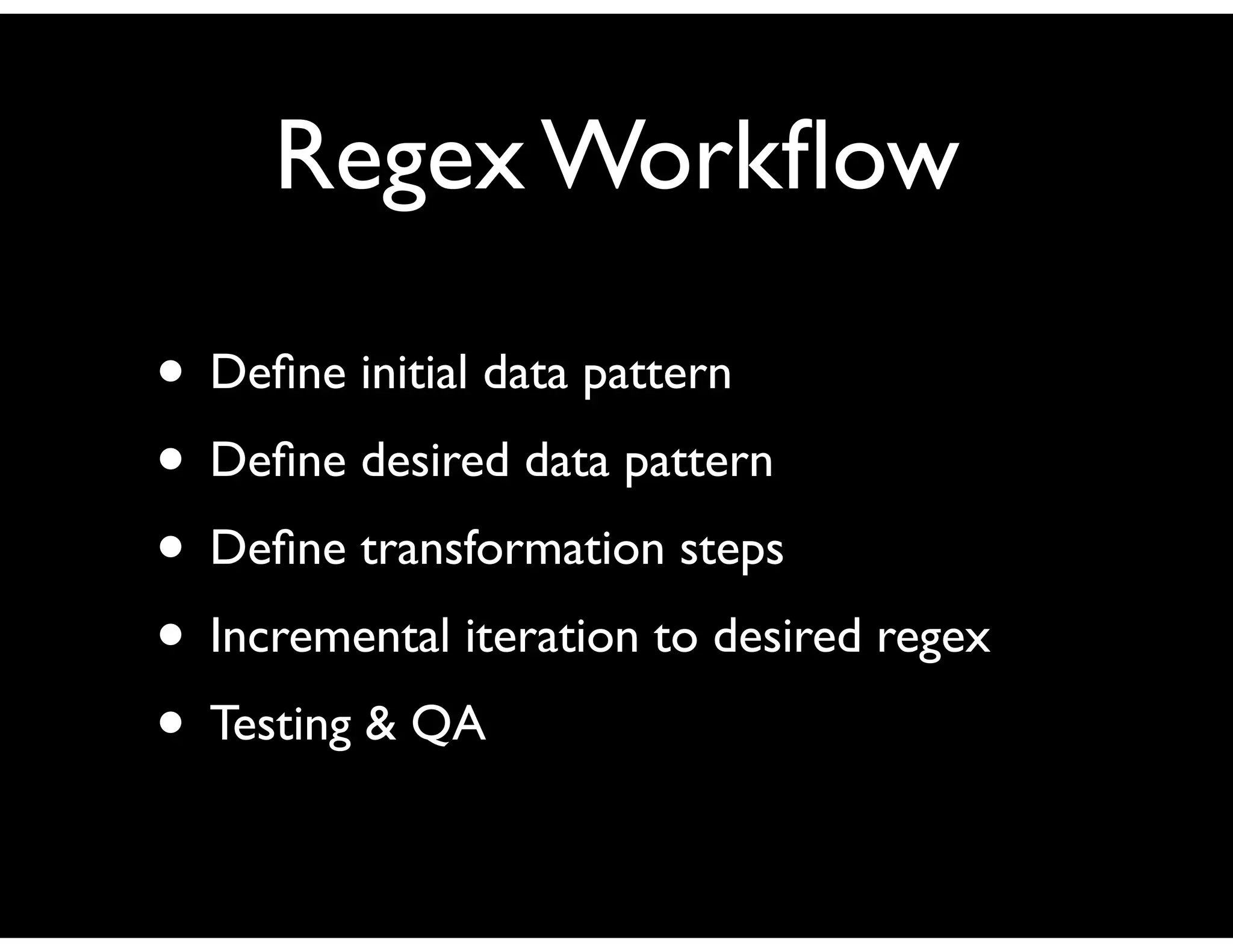
Regex Workflow
• Define initial data pattern
• Define desired data pattern
• Define transformation steps
• Incremental iteration to desired regex
• Testing & QA
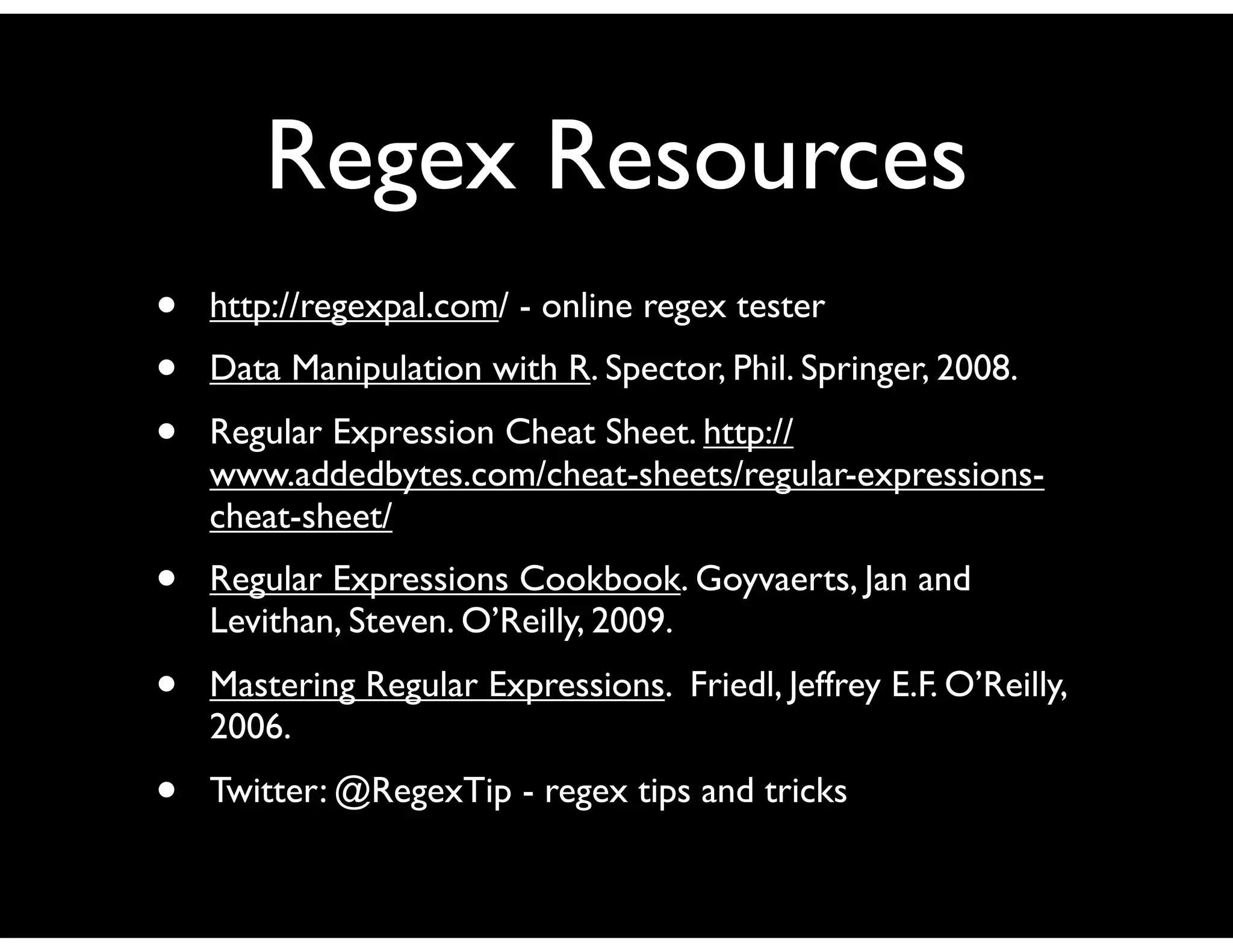
Regex Resources
• http://regexpal.com/ - online regex tester
• Data Manipulation with R. Spector, Phil. Springer, 2008.
• Regular Expression Cheat Sheet. http://
www.addedbytes.com/cheat-sheets/regular-expressions-
cheat-sheet/
• Regular Expressions Cookbook. Goyvaerts, Jan and
Levithan, Steven. O’Reilly, 2009.
• Mastering Regular Expressions. Friedl, Jeffrey E.F. O’Reilly,
2006.
• Twitter: @RegexTip - regex tips and tricks

Eag 201110-hrugregexpresentation-111006104128-phpapp02

  • 1.
    Regular Expressions in R HoustonR Users Group 10.05.2011 Ed Goodwin twitter: @egoodwintx
  • 2.
    What is aRegular Expression? Regexes are an extremely flexible tool for finding and replacing text. They can easily be applied globally across a document, dataset, or specifically to individual strings.
  • 3.
    Example LastName, FirstName, Address,Phone Baker, Tom, 123 Unit St., 555-452-1324 Smith, Matt, 456 Tardis St., 555-326-4567 Tennant, David, 567 Torchwood Ave., 555-563-8974 Data gsub(“St.”, “Street”, data[i]) *Note the double-slash “” to escape the ‘.’ Regular Expression to Convert “St.” to “Street”
  • 4.
    Benefits of Regex •Flexible (can be applied globally or specifically across data) • Terse (very powerful scripting template) • Portable (sort of) across languages • Rich history
  • 5.
    Disadvantages of regex •Non-intuitive • Easy to make errors (unintended consequences) • Difficult to robustly debug • Various flavors may cause portability issues.
  • 6.
    Why do thisin R? • Easier to locate all code in one place • (Relatively) Robust regex tools • May be the only tool available • Familiarity
  • 7.
    Other alternatives? • Perl •Python • Java • Ruby • Others (grep, sed, awk, bash, csh, ksh, etc.)
  • 8.
    Components of a RegularExpression • Characters • Metacharacters • Character classes
  • 9.
    The R regexfunctions Note: all functions are in the base package Function Purpose strsplit() breaks apart strings at predefined points grep() returns a vector of indices where a pattern is matched grepl() returns a logical vector (TRUE/FALSE) for each element of the data sub() replaces one pattern with another at first matching location gsub() replaces one pattern with another at every matching location regexpr() returns an integer vector giving the starting position of the first match, along with a match.length attribute giving the length of the matched text. gregexpr() returns an integer vector giving the starting position of the all matches, along with a match.length attribute giving the length of the matched text.
  • 10.
    Metacharacter Symbols Modifier Meaning ^anchors expression to beginning of target $ anchors expression to end of target . matches any single character except newline | separates alternative patterns [] accepts any of the enclosed characters [^] accepts any characters but the ones enclosed in brackets () groups patterns together for assignment or constraint * matches zero or more occurrences of preceding entity ? matches zero or one occurrences of preceding entity + matches one or more occurrences of preceding entity {n} matches exactly n occurrences of preceding entity {n,} matches at least n occurrences of preceding entity {n,m} matches n to m occurrences of preceding entity interpret succeeding character as literal Source:“Data Manipulation with R”. Spector, Phil. Springer, 2008. page 92.
  • 11.
    Examples [A-Za-z]+ matches oneor more alphabetic characters .* matches zero or more of any character up to the newline .*.* matches zero or more characters followed by a literal .* (July? ) Accept ‘Jul’ or ‘July’ but not ‘Julyy’. Note the space. (abc|123) Match “abc” or “123” [abc|123] Match a, b, c, 1, 2 or 3.The ‘|’ is extraneous. ^(From|Subject|Date): Matches lines starting with “From:” or “Subject:” or “Date:”
  • 12.
    Let’s work throughsome examples... Data LastName, FirstName, Address, Phone Baker, Tom, 123 Unit St., 555-452-1324 Smith, Matt, 456 Tardis St., 555-326-4567 Tennant, David, 567 Torchwood Ave., 555-563-8974 1. Locate all phone numbers. 2. Locate all addresses. 3. Locate all addresses ending in ‘Street’ (including abbreviations). 4. Read in full names, reverse the order and remove the comma.
  • 13.
    So how wouldyou write the regular expression to match a calendar date in format “mm/dd/yyyy” or “mm.dd.yyyy”?
  • 14.
    Regex to identifydate format? What’s wrong with “[0-9]{2}(.|/)[0-9]{2}(.|/)[0-9]{4}” ? Or with “[1-12](.|/)[1-31](.|/)[0001-9999]” ?
  • 15.
    Dates are notan easy problem because they are not a simple text pattern Best bet is to validate the textual pattern (mm.dd.yyyy) and then pass to a separate function to validate the date (leap years, odd days in month, etc.) “^(1[0-2]|0[1-9])(.|/)(3[0-1]|[1-2][0-9]|0[1-9])(.|/) ([0-9]{4})$”
  • 16.
    Supported flavors of regexin R • POSIX 1003.2 • Perl Perl is the more robust of the two. POSIX has a few idiosyncracies handling ‘’ that may trip you up.
  • 17.
    Usage Patterns • Datavalidation • String replace on dataset • String identify in dataset (subset of data) • Pattern arithmetic (how prevalent is string in data?) • Error prevention/detection
  • 18.
    The R regexfunctions Note: all functions are in the base package Function Purpose strsplit() breaks apart strings at predefined points grep() returns a vector of indices where a pattern is matched grepl() returns a logical vector (TRUE/FALSE) for each element of the data sub() replaces one pattern with another at first matching location gsub() replaces one pattern with another at every matching location regexpr() returns an integer vector giving the starting position of the first match, along with a match.length attribute giving the length of the matched text. gregexpr() returns an integer vector giving the starting position of the all matches, along with a match.length attribute giving the length of the matched text.
  • 19.
    strsplit( ) Definition: strsplit(x, split,fixed=FALSE, perl=FALSE, useBytes=FALSE) Example: str <- “This is some dummy data to parse x785y8099” strsplit(str, “[ xy]”, perl=TRUE) Result: [[1]] [1] "This" "is" "some" "dumm" "" "data" "to" "parse" "" [10] "785" "8099"
  • 20.
    grep( ) Definition: grep(pattern, x,ignore.case=FALSE, perl=FALSE, value=FALSE, fixed = FALSE, useBytes = FALSE, invert = FALSE) Example: str <- “This is some dummy data to parse x785y8099” grep(“[a-z][0-9]{3}[a-z][0-9]{4}”, str, perl=TRUE, value=TRUE) Result: [1] "This is some dummy data to parse x785y8099"
  • 21.
    grepl( ) Definition: grepl(pattern, x,ignore.case=FALSE, perl=FALSE, value=FALSE,fixed = FALSE, useBytes = FALSE, invert = FALSE) Example: str <- “This is some dummy data to parse x785y8099” grepl(“[a-z][0-9]{3}[a-z][0-9]{4}”, str, perl=TRUE) Result: [1] TRUE
  • 22.
    sub( ) Definition: sub(pattern, replacement,x, ignore.case=FALSE, perl=FALSE, fixed=FALSE, useBytes=FALSE) Example: str <- “This is some dummy data to parse x785y8099” sub("dummy(.* )([a-z][0-9]{3}).([0-9]{4})", "awesome12H3", str, perl=TRUE) Result: [1] "This is some awesome data to parse x785H8099"
  • 23.
    gsub( ) Definition: gsub(pattern, replacement,x, ignore.case=FALSE, perl=FALSE,fixed=FALSE, useBytes=FALSE) Example: str <- “This is some dummy data to parse x785y8099 you dummy” gsub(“dummy”, “awesome”, perl=TRUE) Result: [1] "This is some awesome data to parse x785y8099 you awesome"
  • 24.
    regexpr( ) Definition: regexpr(pattern, text,ignore.case=FALSE, perl=FALSE, fixed = FALSE, useBytes = FALSE) Example: duckgoose <- "Duck, duck, duck, goose, duck, duck, goose, duck, duck" regexpr("duck", duckgoose, ignore.case=TRUE, perl=TRUE) Result: [1] 1 attr(,"match.length") [1] 4
  • 25.
    gregexpr( ) Definition: gregexpr(pattern, text,ignore.case=FALSE, perl=FALSE, fixed=FALSE, useBytes=FALSE) Example: duckgoose <- "Duck, duck, duck, goose, duck, duck, goose, duck, duck" regexpr("duck", duckgoose, ignore.case=TRUE, perl=TRUE) Result: [[1]] [1] 1 7 13 26 32 45 51 attr(,"match.length") [1] 4 4 4 4 4 4 4
  • 26.
    Problem Solving & Debugging •Remember that regexes are greedy by default. They will try to grab the largest matching string possible unless constrained. • Dummy data - small datasets • Unit testing - testthis, etc. • Build up regex complexity incrementally
  • 27.
    Best Practices for Regexin R • Store regex string as variable to pass to function • Try to make regex expression as exact as possible (avoid lazy matching) • Pick one type of regex syntax and stick with it (POSIX or Perl) • Document all regexes in code with liberal comments • use cat() to verify regex string • Test, test, and test some more
  • 28.
    Regex Workflow • Defineinitial data pattern • Define desired data pattern • Define transformation steps • Incremental iteration to desired regex • Testing & QA
  • 29.
    Regex Resources • http://regexpal.com/- online regex tester • Data Manipulation with R. Spector, Phil. Springer, 2008. • Regular Expression Cheat Sheet. http:// www.addedbytes.com/cheat-sheets/regular-expressions- cheat-sheet/ • Regular Expressions Cookbook. Goyvaerts, Jan and Levithan, Steven. O’Reilly, 2009. • Mastering Regular Expressions. Friedl, Jeffrey E.F. O’Reilly, 2006. • Twitter: @RegexTip - regex tips and tricks