Title heading
© Capita Business Services Limited 2011
“A new learning system for NHS South West
Julia Eadie
Design and Development Director
10th
June 2011
© Capita Business Services Limited 2011
 How, where and why learning is evolving
 Working and learning in complex environments
 Working in new ways
 Aligning working and learning through technology
 SouthWest Learning4Health
Overview
© Capita Business Services Limited 2011
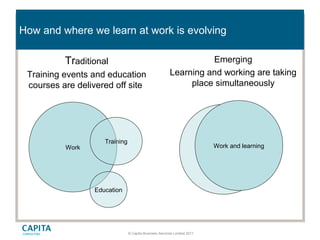
How and where we learn at work is evolving
Traditional
Training events and education
courses are delivered off site
Emerging
Learning and working are taking
place simultaneously
Work
Training
Education
Work
Work and learning
© Capita Business Services Limited 2011
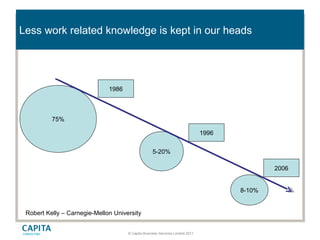
Less work related knowledge is kept in our heads
75%
5-20%
8-10%
1986
1996
2006
Robert Kelly – Carnegie-Mellon University
© Capita Business Services Limited 2011
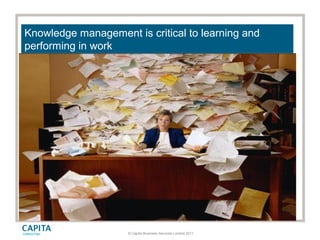
Knowledge management is critical to learning and
performing in work
© Capita Business Services Limited 2011
Continuous learning is essential
 People are working in highly complex environments which are
constantly changing
 Work practices are changing more rapidly than ever before
 More decisions are taking place on the front line and across
organisation boundaries
 Collaboration is required to deliver seamless care services
© Capita Business Services Limited 2011
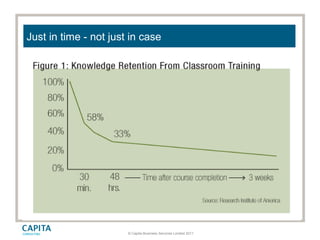
Just in time - not just in case
© Capita Business Services Limited 2011
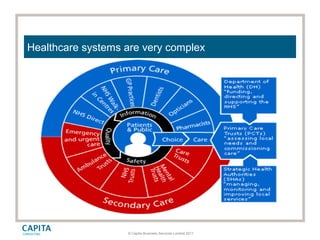
Healthcare systems are very complex
© Capita Business Services Limited 2011
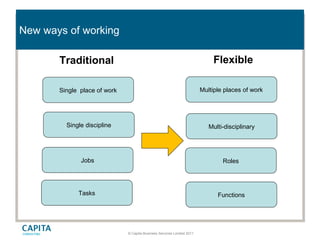
New ways of working
Traditional Flexible
Jobs
Tasks Functions
Single discipline
Single place of work
Multi-disciplinary
Roles
Multiple places of work
© Capita Business Services Limited 2011
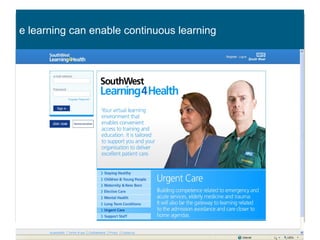
e learning can enable continuous learning
© Capita Business Services Limited 2011
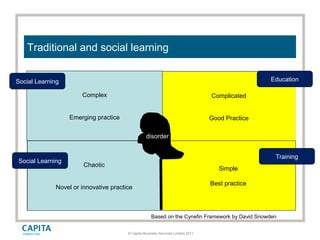
Traditional and social learning
Complicated
Good Practice
Complex
Emerging practice
Simple
Best practice
Chaotic
Novel or innovative practice
disorder
Based on the Cynefin Framework by David Snowden
Training
Social Learning
Social Learning Education
© Capita Business Services Limited 2011
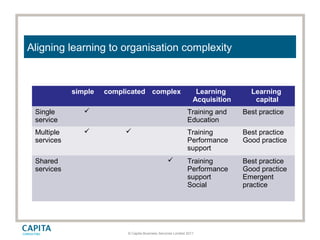
Aligning learning to organisation complexity
simple complicated complex Learning
Acquisition
Learning
capital
Single
service
 Training and
Education
Best practice
Multiple
services
  Training
Performance
support
Best practice
Good practice
Shared
services
 Training
Performance
support
Social
Best practice
Good practice
Emergent
practice
© Capita Business Services Limited 2011
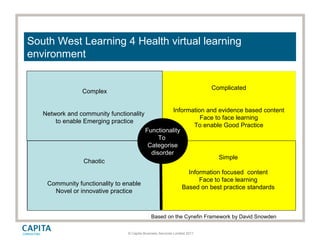
South West Learning 4 Health virtual learning
environment
Complicated
Information and evidence based content
Face to face learning
To enable Good Practice
Complex
Network and community functionality
to enable Emerging practice
Simple
Information focused content
Face to face learning
Based on best practice standards
Chaotic
Community functionality to enable
Novel or innovative practice
Based on the Cynefin Framework by David Snowden
Functionality
To
Categorise
disorder
© Capita Business Services Limited 2011
Access to knowledge and learning has never been greater
© Capita Business Services Limited 2011
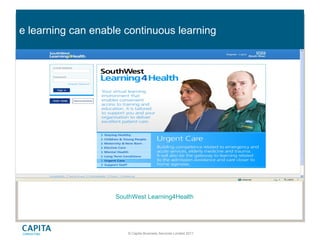
e learning can enable continuous learning
SouthWest Learning4Health
Title heading
© Capita Business Services Limited 2011
Capita Consulting

Eadie2011

  • 1.
    Title heading © CapitaBusiness Services Limited 2011 “A new learning system for NHS South West Julia Eadie Design and Development Director 10th June 2011
  • 2.
    © Capita BusinessServices Limited 2011  How, where and why learning is evolving  Working and learning in complex environments  Working in new ways  Aligning working and learning through technology  SouthWest Learning4Health Overview
  • 3.
    © Capita BusinessServices Limited 2011 How and where we learn at work is evolving Traditional Training events and education courses are delivered off site Emerging Learning and working are taking place simultaneously Work Training Education Work Work and learning
  • 4.
    © Capita BusinessServices Limited 2011 Less work related knowledge is kept in our heads 75% 5-20% 8-10% 1986 1996 2006 Robert Kelly – Carnegie-Mellon University
  • 5.
    © Capita BusinessServices Limited 2011 Knowledge management is critical to learning and performing in work
  • 6.
    © Capita BusinessServices Limited 2011 Continuous learning is essential  People are working in highly complex environments which are constantly changing  Work practices are changing more rapidly than ever before  More decisions are taking place on the front line and across organisation boundaries  Collaboration is required to deliver seamless care services
  • 7.
    © Capita BusinessServices Limited 2011 Just in time - not just in case
  • 8.
    © Capita BusinessServices Limited 2011 Healthcare systems are very complex
  • 9.
    © Capita BusinessServices Limited 2011 New ways of working Traditional Flexible Jobs Tasks Functions Single discipline Single place of work Multi-disciplinary Roles Multiple places of work
  • 10.
    © Capita BusinessServices Limited 2011 e learning can enable continuous learning
  • 11.
    © Capita BusinessServices Limited 2011 Traditional and social learning Complicated Good Practice Complex Emerging practice Simple Best practice Chaotic Novel or innovative practice disorder Based on the Cynefin Framework by David Snowden Training Social Learning Social Learning Education
  • 12.
    © Capita BusinessServices Limited 2011 Aligning learning to organisation complexity simple complicated complex Learning Acquisition Learning capital Single service  Training and Education Best practice Multiple services   Training Performance support Best practice Good practice Shared services  Training Performance support Social Best practice Good practice Emergent practice
  • 13.
    © Capita BusinessServices Limited 2011 South West Learning 4 Health virtual learning environment Complicated Information and evidence based content Face to face learning To enable Good Practice Complex Network and community functionality to enable Emerging practice Simple Information focused content Face to face learning Based on best practice standards Chaotic Community functionality to enable Novel or innovative practice Based on the Cynefin Framework by David Snowden Functionality To Categorise disorder
  • 14.
    © Capita BusinessServices Limited 2011 Access to knowledge and learning has never been greater
  • 15.
    © Capita BusinessServices Limited 2011 e learning can enable continuous learning SouthWest Learning4Health
  • 16.
    Title heading © CapitaBusiness Services Limited 2011 Capita Consulting

Editor's Notes

  • #2 Good afternoon ladies and gentlemen. Thank you for inviting me to speak with you this afternoon.
  • #3 I am going to talk about the changes that are taking place in the worlds of learning and work ,and how we are meeting these in developing and implementing the e learning platform to support the organisations in the South West health system and their employees in making the transitions required of them to meet changing demands
  • #4 Traditionally, training and education have taken place mostly outside the work place being delivered at set times and to set curriculums and take place as a series of events However, over the past two years or so we have seen a different set of behaviours emerging where working and learning are taking place simultaneously. The key reason for this is that learning is a continuous process that can be enabled by technology, allowing wider and more democratic access to learning materials via the web and powerful search engines. These allow individuals to find and undertake learning that interests them or enables them to perform their job better. – a self motivated behaviour. Often this learning can be accessed in real time and does not require permission from line managers or the organisations
  • #5 It is interesting to note that over the past two decades, the amount of work related knowledge we keep in our heads has vastly decreased. This has been driven by: a massive increase in the amount of knowledge that is available to us The speed at which is becomes obsolete The vastness information or evidence base that supports our knowledge and legitimises it Generally we are less inclined to promote or accept knowledge without this
  • #6 However, there is also a downside to accessing and optimising knowledge when it comes to learning and performing at work It comes from many sources It doesn’t arrive in an ordered fashion It needs to be synthesised to be understood and make decisions It requires more effort and time to manage Its quality can be inconsistent and variable
  • #8 Traditional learning that takes place in a sequence of events to a set timetable cannot meet all the learning needs that people need perform their work. There is also emerging evidence to confirm that unless learning events are quickly applied in the work place the learning retained will decrease until at just three weeks, there is only around 15% remaining. In today’s complex and rapidly changing work environments learning needs to be delivered just in time and not just in case.
  • #9 The transitions facing all healthcare organisations are very demanding To ensure that the cost savings can be delivered through the QIPP programme staff will need to think and act differently. This includes working across organisation boundaries and cultures, thinking outside normal routines and practices to develop and apply new ones, a better understanding of the knowledge and capabilities required to deliver effective care and optimise health across all the system
  • #10 These transitions are driving significant changes in working practices which are driving the demand for: Learning to be accessible any time, any place and any where Learning needs to encompass more collective knowledge – the single subject matter expert is being replaced by specialist communities Roles are being shared rather than jobs being carried out Tasks are giving way to functions Multi-disciplinary teams share the workload through collective roles to increase productivity
  • #11 Virtual learning environments are enablers of continuous learning and can be set up to enable collaboration and shared learning to underpin functions and roles rather than tasks and jobs
  • #12 There is a place for both traditional and social learning at work. What is critically important is to recognise where each adds value to the organisation to optimise performance and to provide the learner with a good learning experience Simple learning takes place where there is a clear understanding of cause, effect and outcome. This type of learning lends itself well to training against best practice standards – but in the world of work much of this is being automated Complicated learning takes place where cause, effect and outcomes are understood but can be influenced by other things including environment or competing causes. In these instances , as well as understanding the good practices , the learner must be able to recognise through reflection which of the good practice standards to select and deliver to ensure the best outcome and optimal performance Complex situations occur where there are no well defined causal relationships to outcomes, in these situations, practices are often emerging with the evidence base being developed through problem solving activities and research Chaos refers to the unknown; and requires the learner to draw largely on problem solving skills from a wide number of perspectives to develop innovative or novel solutions to problems that present themselves social learning can enable communities to come together regardless of place
  • #13 You can see that with increasing service complexities that a greater blend of learning is required
  • #14 In developing our learning platform, we have : Built in functionality that enable the learner to deal with disorder – learners can select their learning through various categorisations including clinical pathway, pay band and function Content is specifically designed to provide instruction, at its simplest level underpinned by best practice standards Critical thinking to reflect on and select good practices Functionality to support networking and action learning sets to enable complex issues to be explored and solutions developed Functionality to support communities of interest and action learning where collective expertise is required to deliver solutions to presenting complex problems