Open access and the Wellcome Trust
UHMLG Spring Forum
Monday, 10th
February 2008
Robert Kiley, Head e-strategy, Wellcome Library, Wellcome Trust
r.kiley@wellcome.ac.uk
Overview
• Provide summary of the Trust’s OA policy and discuss
why the Wellcome Trust supports OA
• Highlight how grantees can comply with this policy
• Consider how publishers have responded to the Trust’s
OA policy
• Provide initial data on compliance with the Trust’s OA
policy
• Discuss the funding of OA articles
• Highlight next steps for UKPMC
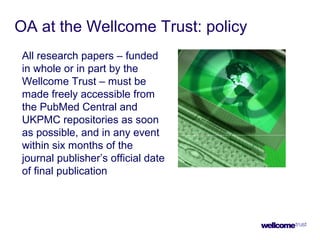
OA at the Wellcome Trust: policy
All research papers – funded
in whole or in part by the
Wellcome Trust – must be
made freely accessible from
the PubMed Central and
UKPMC repositories as soon
as possible, and in any event
within six months of the
journal publisher’s official date
of final publication
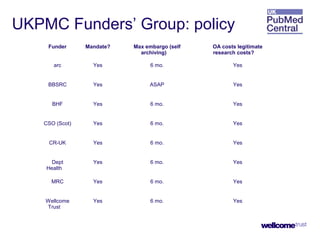
UKPMC Funders’ Group: policy
Funder Mandate? Max embargo (self
archiving)
OA costs legitimate
research costs?
arc Yes 6 mo. Yes
BBSRC Yes ASAP Yes
BHF Yes 6 mo. Yes
CSO (Scot) Yes 6 mo. Yes
CR-UK Yes 6 mo. Yes
Dept
Health
Yes 6 mo. Yes
MRC Yes 6 mo. Yes
Wellcome
Trust
Yes 6 mo. Yes
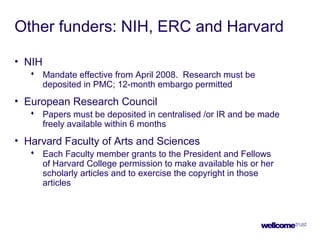
Other funders: NIH, ERC and Harvard
• NIH
 Mandate effective from April 2008. Research must be
deposited in PMC; 12-month embargo permitted
• European Research Council
 Papers must be deposited in centralised /or IR and be made
freely available within 6 months
• Harvard Faculty of Arts and Sciences
 Each Faculty member grants to the President and Fellows
of Harvard College permission to make available his or her
scholarly articles and to exercise the copyright in those
articles
Why the Trust is supporting open
access to the research literature [1]
1.To improve the quality of research by maximising
access to the research outputs
 Access is still an issue. Analysis undertaken by the Trust showed that
even researchers who have access to well-funded libraries still could
not access between 10%-20% of Trust-funded research papers.
 Research by BMC shows that 90% of NHS-funded research available
online full text ; 30% immediately available to public; only 40%
immediately available to NHS staff.
Why the Trust is supporting open
access to the research literature? [2]
1.To improve the quality of research by maximising access
to the research outputs
2.To improve the research process by ensuring greater
integration between the research literature and its
underlying data
 e.g. articles linked to gene and chemical compound datasets
 e.g. data mining and the semantic web - enables the extraction of new
facts from the literature
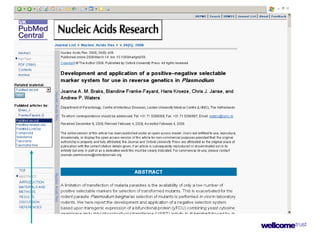
Programmatic linking of text to data
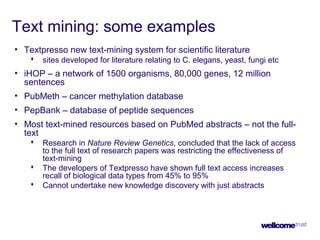
Text mining: some examples
• Textpresso new text-mining system for scientific literature
 sites developed for literature relating to C. elegans, yeast, fungi etc
• iHOP – a network of 1500 organisms, 80,000 genes, 12 million
sentences
• PubMeth – cancer methylation database
• PepBank – database of peptide sequences
• Most text-mined resources based on PubMed abstracts – not the full-
text
 Research in Nature Review Genetics, concluded that the lack of access
to the full text of research papers was restricting the effectiveness of
text-mining
 The developers of Textpresso have shown full text access increases
recall of biological data types from 45% to 95%
 Cannot undertake new knowledge discovery with just abstracts
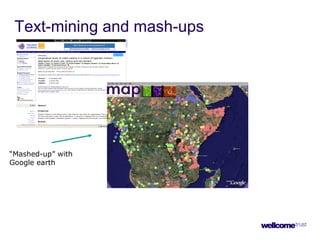
Text-mining and mash-ups
Data mined from the research literature
“Mashed-up” with
Google earth
Why the Trust is supporting open
access to the research literature? [3]
1. To improve the quality of research by maximising access to the
research outputs
2. To improve the research process by ensuring greater integration
between the research literature and its underlying data
3. Develop repository-based services to meet needs of UK research
community
 e.g. link articles in UKPMC to relevant UK resources (e.g. NICE
guidelines, HTA assessments' etc
4. Long-term preservation
 Articles deposited in PMC are marked-up in XML - future-proofing the
record of medicine
5. Evaluation purposes - is our funding making a difference?
How can Wellcome grantees comply?
• Compliance can be achieved by following one of two
routes:
• Route 1
 Publish in OA/hybrid journal – preferred route
• Route 2
 Publish anywhere - but self-archive a version of the author manuscript and
make that available from PMC/UKPMC within 6 months
• If a publisher offers neither route then:
 Author can suggest revision to the journal’s copyright agreement –
boilerplate language provided on Wellcome website – and see if the
publisher will accept this
 Look for an alternative publisher
Route 1 – OA/hybrid journal
• If publisher offers an OA option, Wellcome will encourage
its authors to use it (and provide additional funding to meet
OA costs)
• In return for meeting these costs, publisher must provide
the following services:
 Deposit, on behalf of the author, the final version of the article - in PMC,
where it must be made freely available at the time of publication
 Licence these articles such that they can be freely accessed and re-
used, subject to agreed limits
 Allow these articles to be mirrored to PMC International repositories, such
as UKPMC
 Deposit article in SGML/XML, along with high-resolution images
 Sign PMC Selective Deposit Agreement
Route 1 – OA/hybrid journal: licence
• Articles published under an OA option must have a licence
that allows the world at large the right to access and re-use
published content subject to agreed limits
 e.g. correct attribution is essential
 e.g. commercial rights reside with publisher
• Wellcome does not prescribe any particular licence
 Examples of acceptable licences include:
 The CC-BY-NC (used by Oxford Open, Springer’s Open Choice,
Biophysical Society etc.)
 Elsevier’s Sponsored Documents licence: see
http://www.elsevier.com/wps/find/authorsview.authors/supplementalterms
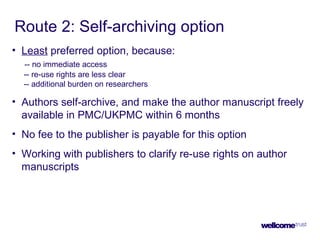
Route 2: Self-archiving option
• Least preferred option, because:
-- no immediate access
-- re-use rights are less clear
-- additional burden on researchers
• Authors self-archive, and make the author manuscript freely
available in PMC/UKPMC within 6 months
• No fee to the publisher is payable for this option
• Working with publishers to clarify re-use rights on author
manuscripts
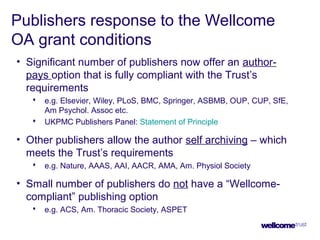
Publishers response to the Wellcome
OA grant conditions
• Significant number of publishers now offer an author-
pays option that is fully compliant with the Trust’s
requirements
 e.g. Elsevier, Wiley, PLoS, BMC, Springer, ASBMB, OUP, CUP, SfE,
Am Psychol. Assoc etc.
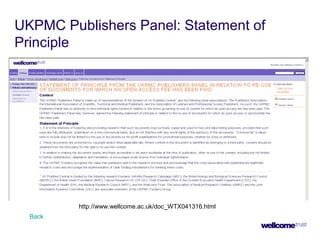
 UKPMC Publishers Panel: Statement of Principle
• Other publishers allow the author self archiving – which
meets the Trust’s requirements
 e.g. Nature, AAAS, AAI, AACR, AMA, Am. Physiol Society
• Small number of publishers do not have a “Wellcome-
compliant” publishing option
 e.g. ACS, Am. Thoracic Society, ASPET
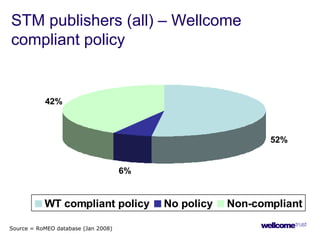
52%
6%
42%
WT compliant policy No policy Non-compliant
Source = RoMEO database (Jan 2008)
STM publishers (all) – Wellcome
compliant policy
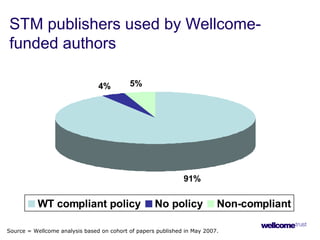
91%
4% 5%
WT compliant policy No policy Non-compliant
Source = Wellcome analysis based on cohort of papers published in May 2007.
STM publishers used by Wellcome-
funded authors
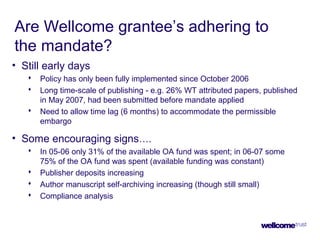
Are Wellcome grantee’s adhering to
the mandate?
• Still early days
 Policy has only been fully implemented since October 2006
 Long time-scale of publishing - e.g. 26% WT attributed papers, published
in May 2007, had been submitted before mandate applied
 Need to allow time lag (6 months) to accommodate the permissible
embargo
• Some encouraging signs….
 In 05-06 only 31% of the available OA fund was spent; in 06-07 some
75% of the OA fund was spent (available funding was constant)
 Publisher deposits increasing
 Author manuscript self-archiving increasing (though still small)
 Compliance analysis
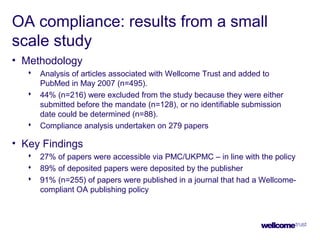
OA compliance: results from a small
scale study
• Methodology
 Analysis of articles associated with Wellcome Trust and added to
PubMed in May 2007 (n=495).
 44% (n=216) were excluded from the study because they were either
submitted before the mandate (n=128), or no identifiable submission
date could be determined (n=88).
 Compliance analysis undertaken on 279 papers
• Key Findings
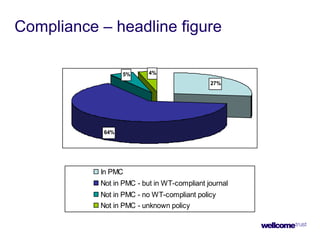
 27% of papers were accessible via PMC/UKPMC – in line with the policy
 89% of deposited papers were deposited by the publisher
 91% (n=255) of papers were published in a journal that had a Wellcome-
compliant OA publishing policy
Compliance – headline figure
64%
5% 4%
27%
In PMC
Not in PMC - but in WT-compliant journal
Not in PMC - no WT-compliant policy
Not in PMC - unknown policy
OA compliance: results from a small
scale study
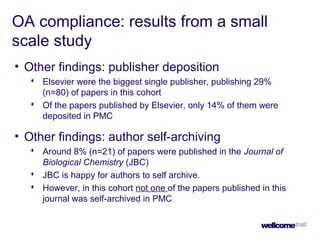
• Other findings: publisher deposition
 Elsevier were the biggest single publisher, publishing 29%
(n=80) of papers in this cohort
 Of the papers published by Elsevier, only 14% of them were
deposited in PMC
• Other findings: author self-archiving
 Around 8% (n=21) of papers were published in the Journal of
Biological Chemistry (JBC)
 JBC is happy for authors to self archive.
 However, in this cohort not one of the papers published in this
journal was self-archived in PMC
Improving compliance
• Work more closely with publishers who provide a “author-
pays” option to ensure that papers are deposited
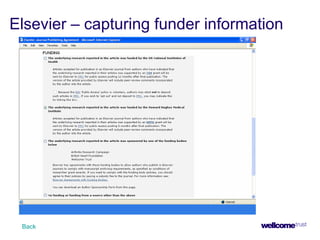
 Elsevier and Wiley, for example, have modified workflow to capture
funding information at the point of article accepted for publication
• Further encourage grant holders to self-archive their
papers
 Reinforce message that deposition should occur when manuscript has
been accepted (and can then be embargoed for up to 6 months)
• Currently perusing a persuasive rather than a punitive
approach
 Will undertake a much bigger study – looking at articles over a 6 month
period – and decide whether the persuasive approach is still appropriate
Meeting the costs of OA?
• Publication costs are legitimate research costs
• Trust estimates that providing OA to all the research
papers it helps fund will cost between 1%-2% of its
annual research budget
 Approx 4000 original research papers published every year. If
every single one of those papers was published as an open access
article, with an average cost of £1650 per article, the total cost to
the Trust would be £6.64 million; just over 1% of our annual
research budget.
 Trust is rarely the sole funder of a research team, and more than
80% of papers that acknowledge our support also acknowledge the
support of one or more other funders.
• Working with UUK/RIN to explore potential of
establishing “central funds” (at an institutional level) to
meet OA costs
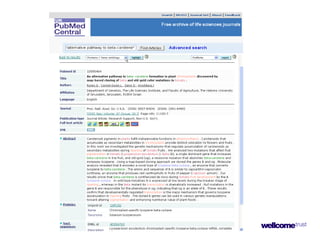
UK PubMed Central
• Service has been up-and running for 14 months
• Planning a programme of work to develop the service
to make it unique, attractive, and useful for the UK
research community
 Enriching the literature (data/text mining)
 Increasing the amount of content in UKPMC
 Providing additional search services and access points
Next steps
• Continue to work with publishers
 Encourage development of Wellcome-compliant policies
 Explore OA/re-use status of author manuscripts
• Continue to monitor compliance
• Continue to make additional funding available to cover
OA costs
 Encourage the establishment of central funds (at institutional level)
to meet OA costs
• Develop UKPMC
 Need to demonstrate the benefits of OA – rich linking, semantic
web etc.
Elsevier – capturing funder information
Back
UKPMC Publishers Panel: Statement of
Principle
http://www.wellcome.ac.uk/doc_WTX041316.html
Back

Kiley2008

  • 1.
    Open access andthe Wellcome Trust UHMLG Spring Forum Monday, 10th February 2008 Robert Kiley, Head e-strategy, Wellcome Library, Wellcome Trust r.kiley@wellcome.ac.uk
  • 2.
    Overview • Provide summaryof the Trust’s OA policy and discuss why the Wellcome Trust supports OA • Highlight how grantees can comply with this policy • Consider how publishers have responded to the Trust’s OA policy • Provide initial data on compliance with the Trust’s OA policy • Discuss the funding of OA articles • Highlight next steps for UKPMC
  • 3.
    OA at theWellcome Trust: policy All research papers – funded in whole or in part by the Wellcome Trust – must be made freely accessible from the PubMed Central and UKPMC repositories as soon as possible, and in any event within six months of the journal publisher’s official date of final publication
  • 4.
    UKPMC Funders’ Group:policy Funder Mandate? Max embargo (self archiving) OA costs legitimate research costs? arc Yes 6 mo. Yes BBSRC Yes ASAP Yes BHF Yes 6 mo. Yes CSO (Scot) Yes 6 mo. Yes CR-UK Yes 6 mo. Yes Dept Health Yes 6 mo. Yes MRC Yes 6 mo. Yes Wellcome Trust Yes 6 mo. Yes
  • 5.
    Other funders: NIH,ERC and Harvard • NIH  Mandate effective from April 2008. Research must be deposited in PMC; 12-month embargo permitted • European Research Council  Papers must be deposited in centralised /or IR and be made freely available within 6 months • Harvard Faculty of Arts and Sciences  Each Faculty member grants to the President and Fellows of Harvard College permission to make available his or her scholarly articles and to exercise the copyright in those articles
  • 6.
    Why the Trustis supporting open access to the research literature [1] 1.To improve the quality of research by maximising access to the research outputs  Access is still an issue. Analysis undertaken by the Trust showed that even researchers who have access to well-funded libraries still could not access between 10%-20% of Trust-funded research papers.  Research by BMC shows that 90% of NHS-funded research available online full text ; 30% immediately available to public; only 40% immediately available to NHS staff.
  • 7.
    Why the Trustis supporting open access to the research literature? [2] 1.To improve the quality of research by maximising access to the research outputs 2.To improve the research process by ensuring greater integration between the research literature and its underlying data  e.g. articles linked to gene and chemical compound datasets  e.g. data mining and the semantic web - enables the extraction of new facts from the literature
  • 8.
  • 9.
    Text mining: someexamples • Textpresso new text-mining system for scientific literature  sites developed for literature relating to C. elegans, yeast, fungi etc • iHOP – a network of 1500 organisms, 80,000 genes, 12 million sentences • PubMeth – cancer methylation database • PepBank – database of peptide sequences • Most text-mined resources based on PubMed abstracts – not the full- text  Research in Nature Review Genetics, concluded that the lack of access to the full text of research papers was restricting the effectiveness of text-mining  The developers of Textpresso have shown full text access increases recall of biological data types from 45% to 95%  Cannot undertake new knowledge discovery with just abstracts
  • 10.
    Text-mining and mash-ups Datamined from the research literature “Mashed-up” with Google earth
  • 11.
    Why the Trustis supporting open access to the research literature? [3] 1. To improve the quality of research by maximising access to the research outputs 2. To improve the research process by ensuring greater integration between the research literature and its underlying data 3. Develop repository-based services to meet needs of UK research community  e.g. link articles in UKPMC to relevant UK resources (e.g. NICE guidelines, HTA assessments' etc 4. Long-term preservation  Articles deposited in PMC are marked-up in XML - future-proofing the record of medicine 5. Evaluation purposes - is our funding making a difference?
  • 12.
    How can Wellcomegrantees comply? • Compliance can be achieved by following one of two routes: • Route 1  Publish in OA/hybrid journal – preferred route • Route 2  Publish anywhere - but self-archive a version of the author manuscript and make that available from PMC/UKPMC within 6 months • If a publisher offers neither route then:  Author can suggest revision to the journal’s copyright agreement – boilerplate language provided on Wellcome website – and see if the publisher will accept this  Look for an alternative publisher
  • 13.
    Route 1 –OA/hybrid journal • If publisher offers an OA option, Wellcome will encourage its authors to use it (and provide additional funding to meet OA costs) • In return for meeting these costs, publisher must provide the following services:  Deposit, on behalf of the author, the final version of the article - in PMC, where it must be made freely available at the time of publication  Licence these articles such that they can be freely accessed and re- used, subject to agreed limits  Allow these articles to be mirrored to PMC International repositories, such as UKPMC  Deposit article in SGML/XML, along with high-resolution images  Sign PMC Selective Deposit Agreement
  • 14.
    Route 1 –OA/hybrid journal: licence • Articles published under an OA option must have a licence that allows the world at large the right to access and re-use published content subject to agreed limits  e.g. correct attribution is essential  e.g. commercial rights reside with publisher • Wellcome does not prescribe any particular licence  Examples of acceptable licences include:  The CC-BY-NC (used by Oxford Open, Springer’s Open Choice, Biophysical Society etc.)  Elsevier’s Sponsored Documents licence: see http://www.elsevier.com/wps/find/authorsview.authors/supplementalterms
  • 15.
    Route 2: Self-archivingoption • Least preferred option, because: -- no immediate access -- re-use rights are less clear -- additional burden on researchers • Authors self-archive, and make the author manuscript freely available in PMC/UKPMC within 6 months • No fee to the publisher is payable for this option • Working with publishers to clarify re-use rights on author manuscripts
  • 16.
    Publishers response tothe Wellcome OA grant conditions • Significant number of publishers now offer an author- pays option that is fully compliant with the Trust’s requirements  e.g. Elsevier, Wiley, PLoS, BMC, Springer, ASBMB, OUP, CUP, SfE, Am Psychol. Assoc etc.  UKPMC Publishers Panel: Statement of Principle • Other publishers allow the author self archiving – which meets the Trust’s requirements  e.g. Nature, AAAS, AAI, AACR, AMA, Am. Physiol Society • Small number of publishers do not have a “Wellcome- compliant” publishing option  e.g. ACS, Am. Thoracic Society, ASPET
  • 17.
    52% 6% 42% WT compliant policyNo policy Non-compliant Source = RoMEO database (Jan 2008) STM publishers (all) – Wellcome compliant policy
  • 18.
    91% 4% 5% WT compliantpolicy No policy Non-compliant Source = Wellcome analysis based on cohort of papers published in May 2007. STM publishers used by Wellcome- funded authors
  • 19.
    Are Wellcome grantee’sadhering to the mandate? • Still early days  Policy has only been fully implemented since October 2006  Long time-scale of publishing - e.g. 26% WT attributed papers, published in May 2007, had been submitted before mandate applied  Need to allow time lag (6 months) to accommodate the permissible embargo • Some encouraging signs….  In 05-06 only 31% of the available OA fund was spent; in 06-07 some 75% of the OA fund was spent (available funding was constant)  Publisher deposits increasing  Author manuscript self-archiving increasing (though still small)  Compliance analysis
  • 20.
    OA compliance: resultsfrom a small scale study • Methodology  Analysis of articles associated with Wellcome Trust and added to PubMed in May 2007 (n=495).  44% (n=216) were excluded from the study because they were either submitted before the mandate (n=128), or no identifiable submission date could be determined (n=88).  Compliance analysis undertaken on 279 papers • Key Findings  27% of papers were accessible via PMC/UKPMC – in line with the policy  89% of deposited papers were deposited by the publisher  91% (n=255) of papers were published in a journal that had a Wellcome- compliant OA publishing policy
  • 21.
    Compliance – headlinefigure 64% 5% 4% 27% In PMC Not in PMC - but in WT-compliant journal Not in PMC - no WT-compliant policy Not in PMC - unknown policy
  • 22.
    OA compliance: resultsfrom a small scale study • Other findings: publisher deposition  Elsevier were the biggest single publisher, publishing 29% (n=80) of papers in this cohort  Of the papers published by Elsevier, only 14% of them were deposited in PMC • Other findings: author self-archiving  Around 8% (n=21) of papers were published in the Journal of Biological Chemistry (JBC)  JBC is happy for authors to self archive.  However, in this cohort not one of the papers published in this journal was self-archived in PMC
  • 23.
    Improving compliance • Workmore closely with publishers who provide a “author- pays” option to ensure that papers are deposited  Elsevier and Wiley, for example, have modified workflow to capture funding information at the point of article accepted for publication • Further encourage grant holders to self-archive their papers  Reinforce message that deposition should occur when manuscript has been accepted (and can then be embargoed for up to 6 months) • Currently perusing a persuasive rather than a punitive approach  Will undertake a much bigger study – looking at articles over a 6 month period – and decide whether the persuasive approach is still appropriate
  • 24.
    Meeting the costsof OA? • Publication costs are legitimate research costs • Trust estimates that providing OA to all the research papers it helps fund will cost between 1%-2% of its annual research budget  Approx 4000 original research papers published every year. If every single one of those papers was published as an open access article, with an average cost of £1650 per article, the total cost to the Trust would be £6.64 million; just over 1% of our annual research budget.  Trust is rarely the sole funder of a research team, and more than 80% of papers that acknowledge our support also acknowledge the support of one or more other funders. • Working with UUK/RIN to explore potential of establishing “central funds” (at an institutional level) to meet OA costs
  • 25.
    UK PubMed Central •Service has been up-and running for 14 months • Planning a programme of work to develop the service to make it unique, attractive, and useful for the UK research community  Enriching the literature (data/text mining)  Increasing the amount of content in UKPMC  Providing additional search services and access points
  • 27.
    Next steps • Continueto work with publishers  Encourage development of Wellcome-compliant policies  Explore OA/re-use status of author manuscripts • Continue to monitor compliance • Continue to make additional funding available to cover OA costs  Encourage the establishment of central funds (at institutional level) to meet OA costs • Develop UKPMC  Need to demonstrate the benefits of OA – rich linking, semantic web etc.
  • 28.
    Elsevier – capturingfunder information Back
  • 29.
    UKPMC Publishers Panel:Statement of Principle http://www.wellcome.ac.uk/doc_WTX041316.html Back