Prepared by
M.Sreekanth Reddy
Act as Drainage Layer
Act as Load Distribution Layer
Load Distribution & Drainage Layer
 Weakening of Pavement Layers
 Loss of bond between layers
 Loss of Strength and durability of asphalt mixtures.
 Cause for pavement distresses such as ravelling, rutting
and stripping.
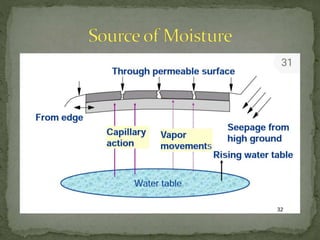
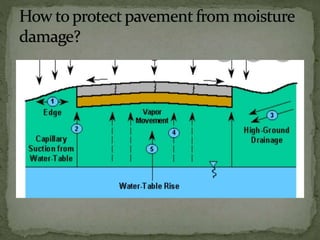
It can preventing capillary water to rise to top road
layers (Particle size of drainage layer is planned in such
way that the capillary action stops and can not go
beyond drainage layer)
It has to act as a medium where water can pass through
without damaging other road layers.
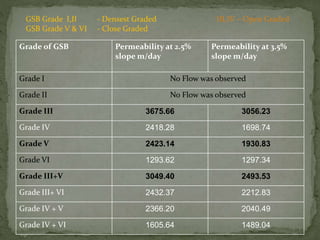
Grade of GSB Permeability at 2.5%
slope m/day
Permeability at 3.5%
slope m/day
Grade I No Flow was observed
Grade II No Flow was observed
Grade III 3675.66 3056.23
Grade IV 2418.28 1698.74
Grade V 2423.14 1930.83
Grade VI 1293.62 1297.34
Grade III+V 3049.40 2493.53
Grade III+ VI 2432.37 2212.83
Grade IV + V 2366.20 2040.49
Grade IV + VI 1605.64 1489.04
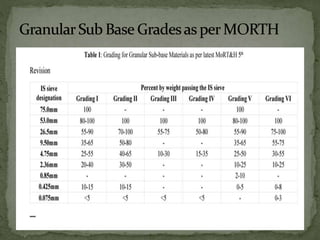
GSB Grade I,II - Densest Graded III,IV – Open Graded
GSB Grade V & VI - Close Graded
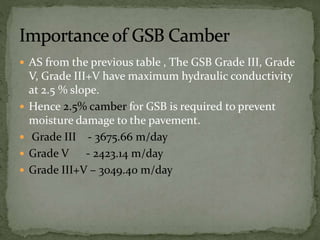
 AS from the previous table , The GSB Grade III, Grade
V, Grade III+V have maximum hydraulic conductivity
at 2.5 % slope.
 Hence 2.5% camber for GSB is required to prevent
moisture damage to the pavement.
 Grade III - 3675.66 m/day
 Grade V - 2423.14 m/day
 Grade III+V – 3049.40 m/day
Densest grades among all grades specified in MoRTH.
Having 65 % of 4.75 mm passing material.
These grades showed good structural stability than
drainage property.
It is used in areas where there is need of structural
support to pavement rather than drainage
requirement.
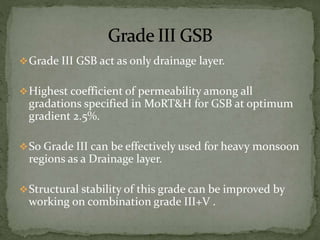
Grade III GSB act as only drainage layer.
Highest coefficient of permeability among all
gradations specified in MoRT&H for GSB at optimum
gradient 2.5%.
So Grade III can be effectively used for heavy monsoon
regions as a Drainage layer.
Structural stability of this grade can be improved by
working on combination grade III+V .
It can be used as drainage cum structural layer
Fulfil the drainage requirement with providing full
thickness of 300mm
But while providing these grades camber provision
must be verified.
Grade V is having approximately 50% finer
material i.e 4.75 mm sieve passing , so this grade is
considered as Close graded.
Presentation on gsb
Presentation on gsb

Presentation on gsb

  • 1.
  • 2.
    Act as DrainageLayer Act as Load Distribution Layer Load Distribution & Drainage Layer
  • 4.
     Weakening ofPavement Layers  Loss of bond between layers  Loss of Strength and durability of asphalt mixtures.  Cause for pavement distresses such as ravelling, rutting and stripping.
  • 6.
    It can preventingcapillary water to rise to top road layers (Particle size of drainage layer is planned in such way that the capillary action stops and can not go beyond drainage layer) It has to act as a medium where water can pass through without damaging other road layers.
  • 8.
    Grade of GSBPermeability at 2.5% slope m/day Permeability at 3.5% slope m/day Grade I No Flow was observed Grade II No Flow was observed Grade III 3675.66 3056.23 Grade IV 2418.28 1698.74 Grade V 2423.14 1930.83 Grade VI 1293.62 1297.34 Grade III+V 3049.40 2493.53 Grade III+ VI 2432.37 2212.83 Grade IV + V 2366.20 2040.49 Grade IV + VI 1605.64 1489.04 GSB Grade I,II - Densest Graded III,IV – Open Graded GSB Grade V & VI - Close Graded
  • 9.
     AS fromthe previous table , The GSB Grade III, Grade V, Grade III+V have maximum hydraulic conductivity at 2.5 % slope.  Hence 2.5% camber for GSB is required to prevent moisture damage to the pavement.  Grade III - 3675.66 m/day  Grade V - 2423.14 m/day  Grade III+V – 3049.40 m/day
  • 10.
    Densest grades amongall grades specified in MoRTH. Having 65 % of 4.75 mm passing material. These grades showed good structural stability than drainage property. It is used in areas where there is need of structural support to pavement rather than drainage requirement.
  • 11.
    Grade III GSBact as only drainage layer. Highest coefficient of permeability among all gradations specified in MoRT&H for GSB at optimum gradient 2.5%. So Grade III can be effectively used for heavy monsoon regions as a Drainage layer. Structural stability of this grade can be improved by working on combination grade III+V .
  • 12.
    It can beused as drainage cum structural layer Fulfil the drainage requirement with providing full thickness of 300mm But while providing these grades camber provision must be verified. Grade V is having approximately 50% finer material i.e 4.75 mm sieve passing , so this grade is considered as Close graded.