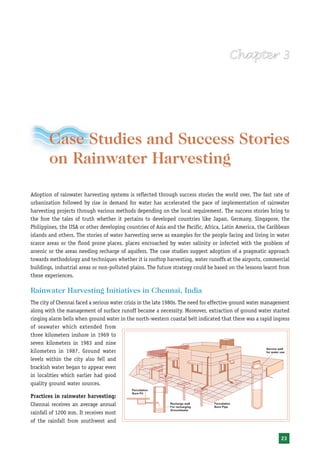
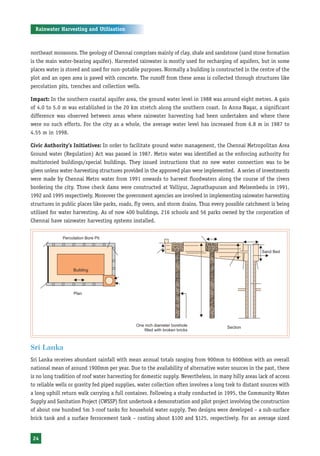
Contents

1   Introduction                                                                 1
Global Demographic Trends                                                         1
The World Water Crisis                                                            2
Scenario in Selected Cities                                                       3
Benefits of Rainwater Harvesting                                                  3
The Growing Global Interest in Rainwater Harvesting                               4
Objectives of the UN-HABITAT Guide on Rainwater Harvesting                        6
Rainwater Harvesting: An Overview                                                 7
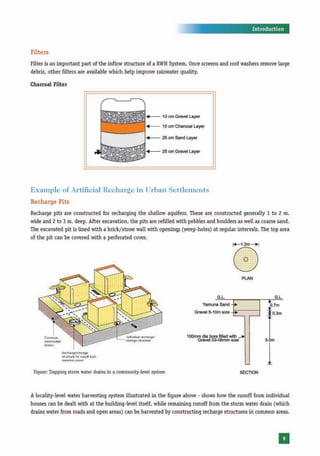
Example of Artificial Recharge in Urban Settlements                               9
Water for Cities Programme                                                       10
Programme Objectives                                                             10
Key Programme Activities                                                         11
Partnership and Capacity Building for Pro-poor Investments                       11
Users of the “Blue Drop Series”                                                  11


2   Legal and Administrative Framework for Rainwater Harvesting                  12
Policy Framework for Rainwater Harvesting                                        12
Ground Water Rights: Legal Considerations                                        14
Legal and Fiscal Measures to Protect Ground Water                                14
Legal and Other Measures Initiated in India to Promote Rainwater Harvesting      15
Promoting Urban Water Harvesting: Some Guiding Principles                        17
Financial Assistance                                                             18
Fiscal Incentives and Regulatory Mechanisms                                      19
Administrative and Planning Measures                                             21
Steps Necessary for Promotion and Further Development of Rainwater Utilisation   21


3   Case Studies and Success Stories on Rainwater Harvesting                     23
Rainwater Harvesting Initiatives in Chennai, India                               23
Sri Lanka                                                                        24
Indonesia                                                                        26
Sumida City, Tokyo                                                               26
Profile of People for Promoting Rainwater Utilisation (PPRU)                            27
   Capiz Province, The Philippines                                                         28
   Singapore                                                                               28
   Thailand                                                                                29
   China                                                                                   30
   Germany                                                                                 32
   Bermuda                                                                                 33
   Brazil                                                                                  33
   Island of Hawaii, USA                                                                   34
   St. Thomas, US Virgin Islands                                                           34
   Dar es Salaam, Tanzania                                                                 35


References                                                                                 36

Glossary                                                                                   42

Rainwater Harvesting FAQs                                                                  45


List of Boxes
Box 1.1 Rainwater Harvesting - Multiple Benefits                                            3
Box 2.1 Initiatives in Promoting Rainwater Harvesting in Indore, India                     13
Box 2.2 Regulating Ground Water Use                                                        16
Box 2.3 Financial Incentive for Housing Societies in India Adopting Rainwater Harvesting   18
Box 2.4 Regulating Ground Water Use through Legal Instruments and Financial Measures:
        Experiences of the Federal State of Hessen (Germany)                               19
Box 2.5 Legal, Administrative and Fiscal Measures Taken in Selected Cities of India for
        Promoting Rainwater Harvesting                                                     22
Box 3.1 Designing Rainwater Harvesting Systems in Urban Environment for Direct Use         25
Introduction
Water forms the lifeline of any society. Water is essential for the environment, food security and sustainable
development. All the known civilizations have flourished with water source as the base and it is true in the
present context too. Availability of drinking water and provision of sanitation facilities are the basic minimum
requirements for healthy living. Water supply and sanitation, being the two most important urban services,
have wide ranging impact on human health, quality of life, environment and productivity. Despite the
technological advancements, the global scenario still remains grim, as all the inhabitants of the world do not
have access to safe water and adequate sanitation.

In most urban areas, the population is increasing rapidly and the issue of supplying adequate water to meet
societal needs and to ensure equity in access to water is one of the most urgent and significant challenges faced
by the policy-makers.

With respect to the physical alternatives to fulfil sustainable management of freshwater, there are two solutions:
finding alternate or additional water resources using conventional centralised approaches; or utilising the
limited amount of water resources available in a more efficient way. To date, much attention has been given to
the first option and only limited attention has been given to optimising water management systems. Among
the various technologies to augment freshwater resources, rainwater harvesting and utilisation is a decentralised,
environmentally sound solution, which can avoid many environmental problems often caused by conventional
large-scale projects using centralised approaches.

Rainwater harvesting, in its broadest sense, is a technology used for collecting and storing rainwater for human
use from rooftops, land surfaces or rock catchments using simple techniques such as jars and pots as well as
engineered techniques. Rainwater harvesting has been practiced for more than 4,000 years, owing to the
temporal and spatial variability of rainfall. It is an important water source in many areas with significant
rainfall but lacking any kind of conventional, centralised supply system. It is also a good option in areas where
good quality fresh surface water or ground water is lacking. The application of appropriate rainwater harvesting
technology is important for the utilisation of rainwater as a water resource.

Global Demographic Trends
The World population has more than doubled since 1950 and reached 6.15 billion in 2001. The most recent
population forecasts from the United Nations indicate that, under a medium-fertility scenario, global population
is likely to peak at about 8.9 billion in 2050.


                                                                                                              1
Rainwater Harvesting and Utilisation


In parallel with these demographic changes, there have been profound demographic shifts as people continue to
migrate from rural to urban areas in search of work and new opportunities. The number of people living in
urban areas has jumped from 750 million in 1950 to nearly 2.93 billion in 2001. Currently, some 61 million
people are added to cities each year through rural to urban migration, natural increase within cities, and the
transformation of villages into urban areas. By 2025, the total urban population is projected to increase to more
than five billion, and 90 per cent of this increase is expected to occur in developing countries. Sixty per cent of
the global population is living in Asia. Urban population growth in Asia at 2.7 per cent per annum is 27 per cent
higher than the global average. Asia’s population living in urban areas is projected at 43.0 per cent for 2010 and
will represent 50.8 per cent of world’s total urban population. Asia is expected to double its urban population
by the year 2020. By 2025, the majority of this region’s population will live in cities. By 2015, there will be 153
cities of one million inhabitants, 22 cities with 8 or more million people and 15 with 10 to 20 million people.

The population of urban Africa is estimated to increase from 37.2 per cent in 2000 to 42.7 percent in 2010 and
will represent 12.1 per cent of the world’s urban population. The share of Latin America & the Caribbean is
projected to increase from 75.4 per cent in 2000 to 79.0 percent in 2010, representing 13.4 per cent of the
world’s urban population.

The urban population of Africa, Asia and Latin America and the Caribbean is now nearly three times the size of

urban population of the rest of the world. This population is growing so much faster than the rural population
that 85 per cent of the growth in the world’s population between 2000 and 2010 will be in urban areas and
virtually all this growth will be in Africa, Asia and Latin America. Given that many natural resources (such as
water, soil, forests and fish stocks) are already being exploited beyond their limits in some regions, significant
effort will be required to meet the needs of additional people in the next 50 years.

The World Water Crisis
Rapid population growth, combined with industrialisation, urbanisation, agricultural intensification and water-
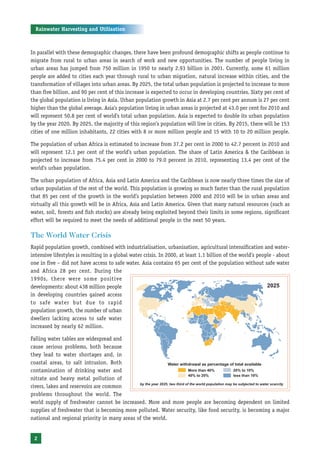
intensive lifestyles is resulting in a global water crisis. In 2000, at least 1.1 billion of the world’s people - about
one in five – did not have access to safe water. Asia contains 65 per cent of the population without safe water
and Africa 28 per cent. During the
1990s, there were some positive
developments: about 438 million people
in developing countries gained access
to safe water but due to rapid
population growth, the number of urban
dwellers lacking access to safe water
increased by nearly 62 million.

Falling water tables are widespread and
cause serious problems, both because
they lead to water shortages and, in
coastal areas, to salt intrusion. Both
contamination of drinking water and
nitrate and heavy metal pollution of
rivers, lakes and reservoirs are common
problems throughout the world. The
world supply of freshwater cannot be increased. More and more people are becoming dependent on limited
supplies of freshwater that is becoming more polluted. Water security, like food security, is becoming a major
national and regional priority in many areas of the world.


 2
Introduction


Scenario in Selected Cities
In Kolkata, India, about half the population that lives in the slum or squatter settlements collect water from
stand posts. The rest of the slum population do not have access to the municipal water supply and have to make
their own arrangements – for instance relying on handpumps/drawing from tube wells. In Bangalore, India a
city of some 6 million inhabitants, it is estimated that more than half depends on public fountains. Almost a
third of the population has partial or no access to piped water. In Dhaka, Bangladesh it is estimated that in
2002 there were 2.5 million people in its ‘slum’ areas with most having very inadequate provision for water and
sanitation. Tens of thousands of children die each year in Dhaka because of waterborne diseases and polluted
water. In Pakistan more than half of Karachi’s 12 million inhabitants live in katchi abadis. Only half the katchi
abadis have piped water. In Faisalabad, Pakistan some two thirds of the city’s two million inhabitants live in
largely unserviced areas. Over half have no piped water supply.

In Kampala (Uganda) only inhabitants of affluent and middle-income districts in central and residential areas
have private connections serviced by National Water & Sewerage Corporation. More than half the population in
Nairobi (Kenya) depend on standpipe vendors for access to water; 30% of the population have a connection to
the official network. In Lima (Peru) almost 2 million inhabitants have no water supply and 30% of those who
do receive water (1996) is of dubious quality. The water shortage in Tugucigalpa (Honduras) is particularly
acute as there is not even enough water to supply to consumers already having municipal water connections.

To further illustrate, India’s population as per 2001 census is 1027.02 million. Over 60 per cent of households
in India meet their drinking water requirements from underground water sources such as hand pumps, tube
wells and wells. In urban areas while 68.7 per cent households use tap water, 29 per cent of the households
directly use those underground water resources. Intense use of underground water has resulted in depletion of
sub-terrene water resources in many parts of India.

Benefits of Rainwater Harvesting
Rainwater harvesting provides the long-term answers to the problem of water scarcity. Rainwater harvesting
offers an ideal solution in areas where there is sufficient rain but inadequate ground water supply and surface
water resources are either lacking or are insufficient. In hilly areas, rainwater can be used by humans, vegetation
and animals. Rainwater harvesting system is particularly useful in remote and difficult terrain as it has the
ability to operate independently. The whole process is environment friendly. There are a number of ways in
which water harvesting can benefit a community – water harvesting enables efficient collection and storage of
rainwater, makes it accessible and substitutes for
poor quality water (Box 1.1). Water harvesting           Box 1.1    Rainwater Harvesting - Multiple Benefits
helps smooth out variation in water availability        ™ Improvement in the quality of ground water

by collecting the rain and storing it more              ™ Rise in the water levels in wells and bore wells that are
efficiently in closed stores or in sandy riverbeds.        drying up
In doing so, water harvesting assures a                 ™ Mitigation of the effects of drought and attainment of
continuous and reliable access to water.                   drought proofing

A water harvesting system collects and stores water     ™   An ideal solution to water problems in areas having
                                                            inadequate water resources
within accessible distance of its place of use. While
traditional sources are located away from the           ™   Reduction in the soil erosion as the surface runoff is reduced
community particularly in peri-urban areas,             ™   Decrease in the choking of storm water drains and flooding
collecting and storing water close to households,           of roads
villages or pastures greatly enhances the               ™   Saving of energy, to lift ground water. (One-meter rise in
accessibility and convenience of water supplies.            water level saves 0.40-kilowatt hour of electricity)


                                                                                                                       3
Rainwater Harvesting and Utilisation


The rainwater collected can be stored for direct use or can be recharged into the ground water to improve the
quality of ground water and rise in the water levels in wells and bore wells that are drying up as well as reduce
the soil erosion as the surface runoff is reduced. Rainwater harvesting is an ideal solution to water problems in
areas having inadequate water resources and helpful in mitigation of the effects of drought and attainment of
drought proofing.

Water harvesting provides an alternative source for good quality water (rainwater is the cheapest form of raw
water) seasonally or even the year round. This is relevant for areas where ground water or surface water is
contaminated by harmful chemicals or pathogenic bacteria or pesticides and/or in areas with saline surface
water. The rainwater harvesting systems can be both individual and community/utility operated and managed.
Rainwater collected using various methods has less negative environmental impacts compared to other technologies
for water resources development. The physical and chemical properties of rainwater are usually superior to
sources of ground water that may have been subjected to contamination. Rainwater is relatively clean and the
quality is usually acceptable for many purposes with little or even no treatment.

Rainwater harvesting technologies are flexible and can be built to meet almost any requirements. Construction,
operation, and maintenance are not labour intensive. Predictions regarding global warming could have a major
effect in significantly increasing water demand in many cities. At the same time increased evaporation from
reservoirs and reduced river flows in some areas may decrease the available surface water supplies. A greater
uncertainty regarding yields from major reservoirs and well fields is likely to make investments in the
diversification of water sources, better water management and water conservation even more prudent in future.
The role of rainwater harvesting systems as sources of supplementary, back-up, or emergency water supply will
become more important especially in view of increased climate variability and the possibility of greater frequencies
of droughts and floods in many areas. This will particularly be the case in areas where increasing pressure is put
on existing water resources.

In urban areas, scarcity and accelerating demand of water is a major problem and it can be reduced by rainwater
harvesting, using various existing structures like rooftops, parking lots, playgrounds, parks, ponds, flood plains,
etc. to increase the ground water table, which saves the electric energy to lift the ground water because one-
metre rise in water level saves 0.40 kilowatt hour of electricity. Subsequently it can also reduce storm drainage
load and flooding in city streets.

As cities continue to grow in the future such problems are likely to become increasingly common. Since cities
comprise numerous impervious surfaces designed to encourage rainwater runoff the scope for rainwater collection
is substantial. Atmospheric pollution remains a major constraint as it contaminates both the rainwater and
catchment surfaces making rainwater unsuitable for drinking in many cities around the world. Nevertheless,
rainwater can still be used for non-potable uses such as toilet flushing, clothes washing and gardening.
Furthermore, greater use of rainwater in urban areas could in future significantly strengthen the lobby to clean
up the urban atmosphere entirely.

The Growing Global Interest in Rainwater Harvesting
With development of modern ‘conventional’ water supply systems in the first half of this century, many traditional
water sources went out of favour. This was the case with rainwater harvesting technologies which came to be
considered only as an option of last resort. While the exploitation of rainwater was considered appropriate in
certain extreme situations such as on coral islands or at remote farms for which reticulated supplies were
uneconomic, little serious consideration was given to the more general use of the technology.


 4
Introduction


Since around 1980, however, things have changed and there have been numerous grassroots initiatives supported
by enlightened government and donor agencies promoting and implementing rainwater harvesting technologies.
This has partly been a response to the growing technical feasibility of using roof catchment systems in the South
due to the spread of impervious roofing materials in urban as well as rural areas. It has also been motivated by a
paradigm shift regarding global attitudes to the environment and the growing realisation that water resource
utilisation has to become more sustainable. In 1979 UNEP commissioned a series of regional case studies into
Rain and Storm water Harvesting in Rural Areas. This included work from China, India, Mexico, the U.S., Africa,
Australia, and the South Pacific. This was the first time a global overview of experiences with the technology was
brought together in a single publication. Another even more influential overview by Pacey, A. & Cullis, A. 1986
followed soon after. At around the same time, UNICEF, several bi-lateral donor agencies (including DANIDA and
SIDA), and many NGOs were promoting the use of household roof catchment tanks in East Africa and working on
developing various low cost designs in Kenya. This work, much of which was done directly with community
groups, led to rapid rates of adoption of roof tanks among rural communities. In a parallel development, the first
conference on the use of rainwater cisterns for domestic water supply was held in Honolulu, Hawaii in 1982
attracting around 50 mainly academic participants. It was not envisaged at the time that the meeting would
herald the beginning of a series of international conferences on the topic over the next 20 years which would
include thousands of participants from a very broad cross-section of countries and professions.
The next three conferences took place in the U.S. Virgin Islands (1984), Thailand (1987), and the Philippines
(1989) at which point the scope of the
conference series was broadened to include
                                                   International Conferences on Rainwater Harvesting
other forms of rainwater catchment systems
                                                   z Hawaii (1982)                  z Kenya (1993)
such as rainwater harvesting for agriculture.
At the 1989 conference in Manila, it was also      z U.S. Virgin Islands (1984)     z China (1995)

agreed to set up an Association to oversee the     z Thailand (1987)                z Iran (1997)
conference series and endeavour to promote
                                                   z The Philippines (1989)         z Brazil (1999)
the technology worldwide. Subsequent
                                                   z Taiwan (1991)                  z Germany (2001)
conferences took place in Taiwan (1991), Kenya
(1993), China (1995), Iran (1997), Brazil (1999)
and Germany (2001).
In addition to international conferences, many regional, national, and local meetings and initiatives took place
during this period reinforcing the suggestion that the technology is now being given more attention globally
than at any time prior to 1980. These have included the efforts by the New Delhi based Centre for Science and
Environment to revive traditional rainwater harvesting practices in India (Agarwal & Narain 1997); the
establishment of a rainwater harvesting forum in Sri Lanka (LRWHF 1999); setting up of People for Promoting

  The Millennium Development Goal (7) of ensuring environmental sustainability has set out the target of
  reducing the proportion of people without sustainable access to safe drinking water to half by 2015.
  It is generally believed that water and sanitation provision has been a serious constraint in urban areas in
  nations that have experienced the most rapid increase in their urban population as a proportion of their total
  population (i.e. urbanization levels) but this is not uniformly true. In fact some of the regions with the largest
  increase in urbanization levels have achieved much better levels of water and sanitation provision than some
  regions with smaller increases. Many of the world’s most rapidly growing cities over the last 50 years have very
  good water and sanitation provision and many slower growing cities or smaller urban centres have very poor
  provision. It is surprising that such large cities do not face serious water shortages. In the case of Asia, however,
  the picture, by and large, is quite disappointing.


                                                                                                                      5
Rainwater Harvesting and Utilisation


Rainwater Utilisation (PPRU) in April 1995 in Tokyo, Japan and new initiatives such as the promotion on
rainwater utilisation in modern mega cities such as Tokyo (Murase 1994). The Vision 21 initiative also placed
the use of appropriate technologies such as rainwater harvesting at the centre of its proposed strategies for
providing clean water, adequate sanitation, and hygiene education for 95% of the population by 2025.

Rainwater harvesting/collection is considered among the most appropriate technologies for efficient use. In
pursuance of the Millennium Development Goals, UN-HABITAT, therefore, has decided to bring out a guidebook
on rainwater harvesting under Water for Asian Cities Programme in “Blue Drop Series” to encourage rainwater
harvesting as part of the strategy for integrated water resource management in the Asian Region, Africa and
Latin America & the Caribbean.

Objectives of the UN-HABITAT Guide on Rainwater Harvesting
In the hydrological cycle, rain is the first form of water that we know and hence is a primary source of water for
us. Rivers, lakes and ground water are all secondary sources of water. In the present times, we depend entirely
on such secondary sources of water and the primary source has been neglected to a great extent.

The purpose of the “Blue Drop Series” is to introduce the planners, decision makers, project managers, beneficiaries
and others to the concept and technology of rainwater harvesting in urban areas and to show them where it fits
into the overall picture of appropriate and sustainable community water supply development in urban areas. Just
                                                            like other water resources, rainwater harvesting is an
                                                            option to be considered when planning an improved
                                                            water supply system with a community. Depending on
                                                            local environmental conditions, water harvesting may
                                                            provide a supplementary supply, an alternative supply
                                                            or the only feasible improved supply, especially in urban
                                                            areas which are heavily dependent on underground
                                                            water. The information provided on technical issues is
                                                            quite specific, as considerable experience is available,
                                                            in particular in the area of construction technologies
                                                            involved in rainwater harvesting.

The information on socio-economic aspects though less specific has also been provided as no tailor-made
approaches can be recommended and much will have to be developed to cope with the differences in size, social
organization, leadership and complicity of the urban community concerned. This “Blue Drop Series” has been
prepared with the objective of presenting the basics required for undertaking rainwater harvesting. The three
books under the series have been written in a simple form so that these can be used even by ordinary householders.

Apart from various methods and techniques for water harvesting, selected case studies of harvesting systems
designed by various organizations working in the field of rainwater harvesting have been cited so that
establishments with similar conditions can take up water harvesting on the same lines. This volume specifically
presents methods suitable for singular building/establishment level – residences, institutions and industries.
The scope of water harvesting can be extended to a locality/community level by incorporating various such
singular units into a group. As one may learn through the “Blue Drop Series”, broadly there are two approaches
to harvesting water – storing of water for direct use or recharging of ground water.

The “Blue Drop Series” on water harvesting is comprehensive enough and incorporates useful information on
various innovations in techniques that can be applied. This guide on water harvesting has been conceived as
part of the broader objectives of the Water for Asian Cities Programme.


 6
Introduction


Rainwater Harvesting: An Overview
Water Harvesting
Scientifically, water harvesting refers to
collection and storage of rainwater and other
activities aimed at harvesting surface and ground
water. It also includes prevention of losses
through evaporation and seepage and all other
hydrological and engineering interventions,
aimed at conservation and efficient utilisation
of the limited water endowment of physiographic
unit such as a watershed. In general, water
harvesting is the activity of direct collection of
rainwater. The rainwater collected can be stored
for direct use or can be recharged into the ground
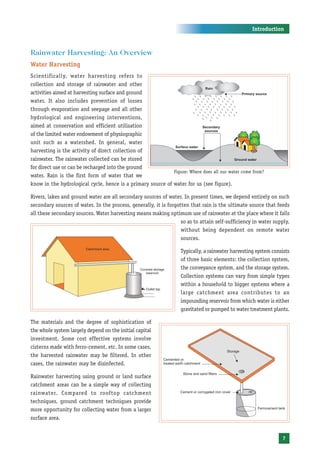
                                                             Figure: Where does all our water come from?
water. Rain is the first form of water that we
know in the hydrological cycle, hence is a primary source of water for us (see figure).

Rivers, lakes and ground water are all secondary sources of water. In present times, we depend entirely on such
secondary sources of water. In the process, generally, it is forgotten that rain is the ultimate source that feeds
all these secondary sources. Water harvesting means making optimum use of rainwater at the place where it falls
                                                                   so as to attain self-sufficiency in water supply,
                                                                   without being dependent on remote water
                                                                   sources.

                                                                   Typically, a rainwater harvesting system consists
                                                                   of three basic elements: the collection system,
                                                                   the conveyance system, and the storage system.
                                                                   Collection systems can vary from simple types
                                                                   within a household to bigger systems where a
                                                                   large catchment area contributes to an
                                                                   impounding reservoir from which water is either
                                                                   gravitated or pumped to water treatment plants.

The materials and the degree of sophistication of
the whole system largely depend on the initial capital
investment. Some cost effective systems involve
cisterns made with ferro-cement, etc. In some cases,
the harvested rainwater may be filtered. In other
cases, the rainwater may be disinfected.

Rainwater harvesting using ground or land surface
catchment areas can be a simple way of collecting
rainwater. Compared to rooftop catchment
techniques, ground catchment techniques provide
more opportunity for collecting water from a larger
surface area.


                                                                                                                7
Rainwater Harvesting and Utilisation


Harvesting System
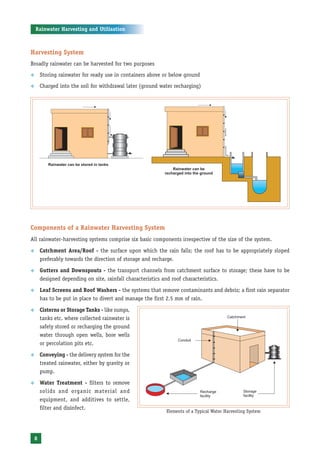
Broadly rainwater can be harvested for two purposes
™    Storing rainwater for ready use in containers above or below ground
™    Charged into the soil for withdrawal later (ground water recharging)


Components of a Rainwater Harvesting System
All rainwater-harvesting systems comprise six basic components irrespective of the size of the system.

™    Catchment Area/Roof - the surface upon which the rain falls; the roof has to be appropriately sloped
     preferably towards the direction of storage and recharge.

™    Gutters and Downspouts - the transport channels from catchment surface to storage; these have to be
     designed depending on site, rainfall characteristics and roof characteristics.

™    Leaf Screens and Roof Washers - the systems that remove contaminants and debris; a first rain separator
     has to be put in place to divert and manage the first 2.5 mm of rain.

™    Cisterns or Storage Tanks - like sumps,
     tanks etc. where collected rainwater is
     safely stored or recharging the ground
     water through open wells, bore wells
     or percolation pits etc.

™    Conveying - the delivery system for the
     treated rainwater, either by gravity or
     pump.

™    Water Treatment - filters to remove
     solids and organic material and
     equipment, and additives to settle,
     filter and disinfect.
                                                          Elements of a Typical Water Harvesting System


 8
Rainwater Harvesting and Utilisation


Water for Cities Programme
The objectives of the Water for African Cities programme and the Water for Asian Cities programme are to reduce
the urban water crisis in cities through efficient and effective water demand management, to build capacity to
reduce the environmental impact of urbanisation on fresh water resources and to boost awareness and information
exchange on water management and conservation.

Water for African Cities Programme
A programme on Water for African cities was launched by UN-HABITAT in 1999 as a direct response to the Cape
Town Resolution (1997) adopted by African Ministers addressing the urban water challenge facing the continent.
This was the first comprehensive initiative to support African Countries to effectively manage the growing
urban water crisis and protect the continent’s threatened water resources from the increasing volume of land
based pollution from the cities. The main objectives under the programme
include:

™     Development of water-related environmental education strategy for
      African cities.
™     Establishment of water classrooms

™     Schools water audit

™     Water quality education

™     Curriculum development and introducing water education in pilot schools

™     Non-formal education with community initiatives

™     Water health care education

™     Information exchange and North-South twinning arrangements.

Water for Asian Cities Programme
To meet the Millennium Declaration Goal of halving the proportion of people without access to improved
services by 2015, an additional 1.5 billion people in Asia will need access to adequate sanitation facilities, while
an additional 980 million will need access to safe water. In urban areas, the corresponding figures are 675
million and 619 million respectively. Emphasis on urban water and sanitation has also been placed in the
Millennium Declaration by setting a target of improving the living conditions of at least 100 million slum
dwellers by 2020.

Following the New Delhi Consultation in April 2002, UN-HABITAT together with ADB launched this regional
programme on Water for Asian Cities to promote pro-poor investments in water and sanitation in the region.
The New Delhi Consultation made specific recommendations with regard to the implementation strategy and
partnership arrangements for the proposed programme.

Programme Objectives
The Programme focuses on three inter-linked priorities.

(i) Introducing demand-responsive and demand management strategies to improve efficiency of water-use and
    give more influence to those currently deprived of water and sanitation

(ii) Scaling-up sanitation provision city-wide through innovative public-private-NGO partnerships, finance


 10
Introduction


    mechanisms and appropriate technical choices
(iii) New pro-poor investments in urban water supply and sanitation with emphasis on serving the urban poor
      with piped water and formal sanitation facilities

Key Programme Activities
™   Monitoring of progress towards achieving Millennium Goal targets in the water and sanitation sector in
    Asian cities.
™   Mobilization of political will through advocacy and exchange of information.
™   Strengthening regional, country and city level capacities for integrated water and sanitation management.
    This requires human resource development in a focused manner, strengthening the capacity of existing
    institutions. Gender mainstreaming is an important crosscutting theme of capacity building at all levels.
™   Creating a new ethic among children and community through Water, Sanitation and Hygiene Education.
    Interventions include: introducing value-based water education in schools; establishing water education
    classrooms in pilot cities; community education, training of trainers etc. Twinning of cities and schools is
    part of this initiative.
™   Promoting pro-poor investments in the water and sanitation sector. This calls for the establishment of a
    pro-poor governance framework at the city level through stakeholder consultations, to facilitate the necessary
    policy and institutional reforms required for improving water and sanitation services for the urban poor.
    Investments in water supply and sanitation in Asian cities will provide the source developments, pipelines,
    treatment plants, reservoirs and distribution systems to bring water to those without direct access to piped
    water. It will also provide sanitation facilities in those cities, based on appropriate technology.

Partnership and Capacity Building for Pro-poor Investments
The programme commenced with a partnership development phase. The focus in this phase was on developing
a framework for collaboration among city level actors as also with external support agencies and other ongoing
programmes.
The central emphasis of the Water for Asian Cities Programme is on capacity building in the countries and cities
in the region with a view to prepare the environment for pro-poor investments in the water and sanitation
sector. While the Capacity Building Phase of the Programme is being directed to enhancing the willingness and
commitment of the policy makers and creating the necessary institutional and human resource capacity to
implement pro-poor policies and programmes, the investment promotion phase of the Programme shall be
directed to creating the enabling environment for pro-poor investments.

Users of the “Blue Drop Series”
The “Blue Drop Series” on Rainwater Harvesting and Utilisation consists of three books and has been designed for
policy makers, planners and all those involved in the implementation of urban water supply programmes. It has
been prepared with a view to integrate the “state of the art” on Rainwater Harvesting to provide a handy, self-
contained reference volume for use by all levels of functionaries in this sector in different regions of the world.
This volume, Blue Drop Series, Book 1, has been designed for Policy Makers. The book consists of three chapters
including introduction about the Rainwater harvesting requirements, benefits and the role of UN-HABITAT in
Rainwater Harvesting. The information contained in the Book provides useful information/data needed by
policy makers/decision makers which include legal and administrative requirements for framing policies and
programmes and giving proper directions. Also success stories/case studies around the world, as incorporated in
the book, would provide valuable guidance for a pragmatic approach.
                                                                                                               11
Rainwater Harvesting and Utilisation


    Legal and Administrative Framework
    for Rainwater Harvesting

The fast rate of urbanization, resulting in rapid increase in demand for water, makes it scarce day by day. A
growing number of cities and towns are, therefore, facing serious problems due to water scarcity. Whereas the
water demand on one hand is increasing manifold, on the other hand state assured water supply is quite
inelastic. These need to be addressed through mobilizing the people as well as enacting legislations that
promote water harvesting on one hand, and regulate water extraction on the other. In urban areas water
harvesting can be undertaken for a variety of purposes.
™    To increase water supply for potable water needs;
™    To increase water supply for low-quality household uses like gardening, washing clothes and for sanitary
     purposes;
™    To provide water for institutional needs;
™    To increase ground water recharge to improve the quantity and quality of ground water; and,
™    To reduce storm water runoff and thus avoid flooding of urban areas and overloading of urban drainage and
     sewage treatment plants.

Policy Framework for Rainwater Harvesting
Many countries have national water laws. Most European countries have national water byelaws which put
strict controls on Rainwater Harvesting (RWH) systems to prevent contamination of mains supplies by rainwater
or inadvertent drinking of rainwater (of unknown quality) by individuals. As per law the mains and Rainwater
(RW) plumbing systems are kept separate and RW taps are clearly marked. In India, however, there is no
national law as such. There is, however, a national water policy. The National Water Policy (NWP) 2002 is a
cogent and comprehensive document and can form a basis to be converted into a law. Water harvesting systems
are diverse in their nature, size, number of users and ownership. People in South Asia, it is believed, evolved a
water harvesting system based on availability of a resource, its geophysical conditions and local needs. The
system is ancient. The need for a policy framework for water harvesting systems arises mainly because the
prevailing policy statements do not touch upon the issue. The national water policy, national law policy,
agriculture policy, national conservation strategies and policy statement on environment and development do
not specifically touch upon the issues.


12
Legal and Administrative Framework for Rainwater Harvesting


 Box 2.1      Initiatives for Promoting Rainwater Harvesting in Indore, India

 The local administration and various groups in Indore city are raising awareness and implementing rainwater
 harvesting to deal with the rapidly depleting ground water resources. The water supply to the town of Indore is
 168 million litres per day as against the daily requirement of 320 million litres. Declining rainfall and the growing
 population has resulted in the gap increasing between demand and supply. This gap between demand and supply
 is met through tapping ground water. As a result, the ground water table is rapidly declining. “Energised pumps
 are working overtime to meet water needs”.
 When it comes to overexploitation of ground water, the story of Indore is no different from other big and small
 towns across India. What is different is the effort of the people to harvest rains. The Indore Municipal Corporation
 (IMC) and the city Mayor with the help of some media groups are involved in raising awareness and implementing
 rainwater harvesting. But rather than just complain, residents of the town are taking the matter into their own
 hands and are trying to alleviate the problem. Efforts to raise the ground water level in the area have started
 through rainwater harvesting programmes.
 On the occasion of the 50th anniversary of the Nai Duniya newspaper group, a Nai Duniya Seva Trust was set up.
 The proprietors agreed to deposit a sum of five paise for each of the 1,30,000 newspaper copies sold every day. The
 scheme was launched on 23rd June 2000. So far, about Rs. 75 lakh have been collected and will be used for various
 development projects. Informs Ravindra Shukla, Senior Assistant Editor of the newspaper, “This fund is currently
 being used to finance organizations working to promote rainwater harvesting in rural and urban areas. So far, we
 have involved 12 organisations, six each in rural and urban areas. We have also sponsored satellite imagery of
 ground water resources in Indore so that rainwater harvesting efforts can be more effective”.
 A lot of effort is going into raising awareness. The group is spreading the message through advertisements and
 articles in their newspaper. The mayor is appealing to the citizens to adopt rainwater harvesting methods to raise
 the ground water level in the city. He informs, “I am planning a water march for water harvesting before the next
 monsoon. This water march will include a door-to-door campaign, public meetings, on the spot construction and
 exhibition of models.
 The IMC launched its activities on 6th May 2000 with the theme, “If you protect water, water protects you”. An
 exhibition was arranged at Rajwada, the palace of the Holkar kings, where models of different water harvesting
 methods, posters and filters samples were displayed and leaflets distributed. Rainwater harvesting is being
 implemented in residential colonies, institutes, clubs and gardens. Records of the IMC indicate that more than
 2,000 houses in Indore have water harvesting structures The Nai Duniya office complex has a water harvesting
 structure that harvests rooftop rainwater from the roof area and recharges an old dugwell.
 A rebate of six per cent on property tax has been announced for those who install rainwater harvesting in their
 house, bungalow or building. Three committees – technical, education and execution – were set up by the IMC for
 this purpose, the first of its kind in the country. For construction of new buildings on areas more than 250 square
 metres in size, rainwater harvesting is now compulsory. The Corporation has proposed to make rainwater harvesting
 mandatory for the existing buildings also.


The policy framework should respect people’s right to free and easy access to water. The policy should also
respect the right of people to clean and unpolluted water and a healthy environment. Further, the policy should
also incorporate the principle of equity and distributive justice in the utilisation of water and to do so drinking
water should get top priority followed by other domestic uses. The policy needs a law and for a possible law, a
policy framework is a guideline.

In India, under the constitutional set up, water is a state subject. Institutions of local self-govt. have been
established and steps are being taken to improve the existing law and to empower local institutions. In this
regard, necessary efforts are also on to ensure that these institutions and local communities work together for
the maintenance, use and survival of traditional water harvesting systems. The laws, however, should adopt a
flexible framework for the management structure of water harvesting systems. There is, therefore, a clear need


                                                                                                                   13
Rainwater Harvesting and Utilisation


to evolve a decentralized legal regime which empowers people and makes them real managers of resources. For
promoting urban water harvesting, a policy should include a mix of incentives and penalties. Measures that
need to be undertaken include:-
™     Provision of rainwater harvesting/recharge of ground water systems should become an essential town-
      planning requirement and be a pre-requisite for sanction of new colonies.
™     Provision of rainwater harvesting structures in all building plans should be made before applications are
      accepted.
™     Technical regulations should be in place to ensure that a certain distance of the pipes is maintained so that
      rainwater harvested is not contaminated by septic tanks.
™     All the water carriers and bodies should be used as water storage through rainwater harvesting system.
™     Creation of a national rainwater-harvesting fund.
™     Creation/constitution of a single water authority or local body to control and regulate all water bodies.
™     Granting rebate on property tax assessment and other fiscal incentives for effective use of rainwater harvesting
      system.
™     Rainwater harvesting systems and conservation of water should be proclaimed as matters of national
      importance by the national Governments.

For implementing such policy measures the policy initiatives should be further strengthened through legislation.
This apart, there is also a need to legally regulate ground water use.

Ground Water Rights: Legal Considerations
Ground water poses an extremely difficult legal problem. Unlike the case of surface water, it is often difficult to
determine the source and rates of recharge, the extent and variation of quality in storage, and the direction of
water movement. In United States three basic rules cover the use of ground water. The first, or English, rule
is one of absolute ownership. It allows the overlying landowner to take ground water from the land at any time
and in any quantity, regardless of the effect on the water table of a neighbor’s land. Under this rule it would be
possible for a landowner to exhaust the total ground water supply of an area by heavy pumping. This rule has
been qualified in some areas to limit the malicious and wasteful use of the water. The American rule, or rule
of reasonable use, recognizes that the landowner has rights to the water under the land but that these rights
may be limited. The rights to water are limited to its reasonable use in relationship to the overlying land. The
third rule covering ground water is the appropriation principle, whereby the water is allocated for specific uses.
The growing intensity of water scarcity, however, calls for certain legislative, administrative and fiscal measures.
Legislation is a source as well as an instrument of public policy.

Legal and Fiscal Measures to Protect Ground Water
A variety of measures have been undertaken by governments to promote water harvesting by urban households.
In the city of Chennai (India), urban authorities have made it mandatory under the city’s building regulations
for all new buildings to have water-harvesting mechanisms primarily to recharge the ground water aquifers. In
Bonn, a fiscal incentive is provided to households through a municipal tax that forces households to pay for
runoff producing areas like paved areas and the roof area, unless they unpave the paved areas or collect the
rainwater from rooftops and paved areas for domestic use. The primary objective in Bonn is to reduce urban
flooding and overloading of sewage treatment plants and to increase ground water recharge locally. Sumida
city, a ward of Tokyo, provides a subsidy to all households interested in developing water-harvesting systems.


 14
Legal and Administrative Framework for Rainwater Harvesting


The main objective here is to promote the use of rainwater for low quality household uses, for drinking in
emergency situations and to reduce urban flooding. If any subsidies are provided to promote urban water
harvesting, it must be ensured that only the poor and lower middle classes benefit from them.

Legal and Other Measures Initiated in India to Promote Rainwater Harvesting
In order to ensure that the buildings that are erected in Delhi provide for water harvesting through storing of
rainwater runoff to recharge underground aquifers, the Central Government in India has notified modifications/
additions to the Building Bye Laws of 1983. The modified Buildings Bye Laws have made water harvesting
through storing of water runoff including rainwater in all new buildings on plots of 100 sq. mtrs and above
mandatory. The plans submitted to the local bodies have to indicate the system of storm water drainage along
with points of collection of rainwater in surface reservoirs or in recharge wells.

Secondly, buildings having a minimum discharge of 10,000 litres and above per day have to incorporate a
wastewater recycling system. The recycled water would be used for horticultural purposes. Every time a building
plan is submitted for approval, a certificate has to be submitted along with the building drawings stating that
the building plans submitted for approval satisfy the water harvesting requirements as well as minimum anticipated
discharge of waste water as stipulated in the revised Building Bye Laws.

Similarly, the Central Government has amended the Environment (Protection) Act 1986 to incorporate the
following provisions relating to Rainwater Harvesting with a view to protect and improve the quality of environment
in all the hill towns located in the Himalayan region.

™   All buildings to be constructed in future in hilly urban areas to have provision for rooftop rainwater harvesting
    commensurate with its plinth area with minimum capacity of 5 Kl for plinth area above 200 sq.m, 2Kl for
    plinth area of 200 sq.m or below in case of residential buildings and minimum capacity of 0.01 cu.m per sq.m
    of plinth area in case of commercial and institutional buildings such as tourist complexes, hotels, shopping
    complexes and Government buildings.
™   Where minimum standards have already been laid down by the State Governments, such standards shall
    take precedence.
™   The institutional and commercial buildings not to draw water from existing water supply schemes which
    adversely affect water supply to local villages or settlements.
™   In rural and peri-urban areas rainwater harvesting to be undertaken through such structures as percolation
    tanks and storage tanks and any other means.
™   Spring sanctuary development to be undertaken in the spring recharge zones to augment spring water
    discharge.
™   Rainwater collected through storm water drains to be used to clean the waste disposal drains and sewers.
™   Ground water aquifer recharge structures to be constructed wherever such structures do not lead to slope
    instabilities.

The Govt. of India has also constituted the Central Ground Water Authority (CGWA) under section 3(3) of the
Environment (Protection) Act 1986 for the purpose of regulation and control of ground water management and
development. The CGWA has been vested with the powers under section 5 of the said Act for issuing direction
and taking up such measures as may be deemed necessary to any authority and such person, officer or authority
shall be bound to comply with such directions. The Authority has issued several Public Notices declaring areas/
complexes as “Notified Areas” for the regulation of ground water extraction. It regulates undertaking of any


                                                                                                                 15
Rainwater Harvesting and Utilisation


 Box 2.2        Regulating Ground Water Use

           The city of Chennai (India) has resorted to legislative control to regulate ground water use
 The Chennai Metropolitan Area Ground water (Regulation) Act 27 of 1987 envisages control, regulation, extraction
 and transportation of ground water in the notified area through (i) registration of existing wells; (ii) regulation
 of sinking of new wells; (iii) issue of licenses to extract water for non-domestic use; and (iv) issue of licenses for
 transportation by goods vehicles.
 The term ‘Ground water’ mentioned in the Act means the water which exists below the surface of the ground and
 the term ‘scheduled area’ means the whole of the city of Chennai and the villages specified in the schedule. The
 Act, which came into force in February 1988, exempted from its purview wells used for purely domestic purposes,
 requiring a grant of permission regulated construction of wells for other uses. Extraction of water was, however,
 regulated on an annual basis.
 The competent authority for the purpose of the Act:
 ™   In the city of Chennai, the Metro Water Board;
 ™   In relation to the villages specified in the schedule, the respective sub-collectors or revenue divisional officers
     of the taluks in which the villages fall.
 In granting or refusing a license, the competent authority takes into account:
 ™   Purpose or purposes for which ground water is to be used;
 ™   Existence of competitive users;
 ™   Availability of ground water;
 ™   Effects on sources of water supply;
 ™   Compatibility with existing water supply system; and,
 ™   Availability of factors controlling or preventing pollution.
 The competent authority has full powers to withdraw or cancel the license, if any of the provisions of the Act, or
 the rules made under the Act, or if any terms and conditions and restrictions, subject to which the permits or
 licenses have been granted, are contravened, or otherwise not complied with.
 Punishment for first offence is a fine which may extend to Rs. 500, and for the second and subsequent offences
 with imprisonment for a term which may extend to six months or with a fine which may extend to Rs. 1,000 or
 both. Any offence punishable under the Act is a cognizable offence within the meaning of the code of criminal
 procedure.


operation connected with drilling, cleaning, construction or rehabilitation of ground water abstraction structures
and related works including installation of pumps in the notified areas. The CGWA also promotes adoption of
rooftop rainwater harvesting system by Group Housing Societies, Institutions, Schools, Hotels, Industrial
Establishments and Farm Houses etc. This apart, the Authority also declares aquifers as “Protected aquifers”.

A number of State Governments have made rainwater harvesting mandatory. Depending on the intensity of the
problem, rooftop harvesting has been made compulsory on new buildings, old buildings and buildings according
to their size in various Indian cities. Fiscal incentives like rebate in property tax and financial assistance for
making provision of rainwater harvesting in the existing buildings are also available in a number of cities. Some
of the important measures adopted in different states/cities are highlighted in Box 2.5.

Besides the steps being taken by the Central Ground Water Authority for adopting water harvesting compulsorily,
several State and City Governments have resorted to legal and administrative measures for making rainwater
harvesting mandatory. Andhra Pradesh has passed an Act titled “Water, Land and Trees Act”, 2002, which came
into force on July 1, 2002. The Act aims at regulating the exploitation and use of ground and surface water for
protection and conservation of water resources. Under this Act, a Water, Land and Tree Authority has been


16
Legal and Administrative Framework for Rainwater Harvesting


established. This Authority regulates all ground water resources including prohibiting water pumping and
sinking of new wells. Similarly Govt. of Tamil Nadu has issued an ordinance titled “Tamil Nadu Municipal Laws
2003” making rainwater harvesting mandatory for all the buildings, both public and private in the State. The
state Govt. of Rajasthan, Gujarat and Haryana have also taken administrative/legal measures for making rainwater-
harvesting mandatory for all public/government buildings. Several city governments, which include Indore,
Kanpur, Hyderabad, New Delhi, Mumbai and Chennai, have also adopted similar measures.

Promoting Urban Water Harvesting: Some Guiding Principles
In urban areas, rooftop water harvesting has an enormous potential to reduce the demand on river and ground
water systems, many of which are getting increasingly overexploited and polluted. In order to promote water
harvesting in urban buildings, development byelaws need to be suitably formulated or modified. The following
steps need to be taken:
™   Every urban area should have a master plan; wherein water catchment areas are clearly demarcated and
    should be left undisturbed. Municipal corporations should demarcate such lands and utilize them as water
    catchment areas. These catchment areas can be used for afforestation by the forest department or can be
    transferred to the forest department as an urban sanctuary, so that its land use cannot be changed without
    government approval.
™   Prior clearance before land acquisition to ensure that water catchment areas are not disturbed.
™   A single water authority or local body, as the case may be, should be vested with the control and regulation
    of all water bodies including rivers / canals / waterways / ground water aquifers in urban areas.
™   Town planners / local authorities should provide for surface water percolation along roads, pavements and
    other open spaces.
™   All building plans must provide for water harvesting structures before applications are accepted, though
    provisions for exemptions should exist for those who cannot build water harvesting structures for genuine
    reasons like lack of space. Statutory provisions should be made for public buildings and large structures,
    making water audits essential.
™   Provision of Water Harvesting (WH) systems in plans should be followed up by enforcement at the time of
    grant of water and / or sewer connections / assessment of property tax, etc.
™   Builders and planners should be given clear technical guidelines on precautions to be observed in providing
    WH systems so that there is no contamination by septic tanks. The local authority in charge of water supply
    should be responsible for the maintenance of rivers and other water bodies with the specific aim of using
    them for water storage through WH systems. More efforts are needed to simplify approval procedures to
    reduce the overload on the existing administration.
™   Master plans for rainwater collection and use for all urban centres should be made a pre-requisite for
    meeting eligibility requirements of national / international funding agencies like the ADB, the World Bank
    and others.
™   The misuse of water bodies and waterways through sewage discharges should be restricted with provisions
    made for interceptory sewers and canals along waterways. This is an expensive proposition but can be taken
    up in a phased manner. At the same time, all new housing / commercial / industrial / construction activity
    by private or government agencies, should be allowed after a proper sewer system is laid and commissioned.
™   WH systems should be promoted as a means of both providing water and preventing floods so that the
    message and the need are permanent.


                                                                                                             17
Rainwater Harvesting and Utilisation


™     A central nodal agency in each country should provide technical and engineering advice on structures and
      systems to be used particularly in urban areas where the availability of non-paved areas is increasingly
      getting limited.
™     Industrial houses should be encouraged, through incentives as well as town planning requirements, to
      provide for water harvesting on their premises and to maintain at least one WH community structure in an
      urban area.
™     In the case of the Singapore Changi Airport, harnessing of runoff has been in operation for more than a
      decade. Since it has been successful even when the airport is very close to the sea, such projects should, as
      far as possible, be adopted in all airports. It should be made mandatory for all airports to utilize the runoff
      water on their land to recharge ground water and meet their requirements. Similarly, all highways and roads
      should construct structures to collect rainwater in order to sustain green strips on both sides.

Financial Assistance
Rainwater harvesting, like infrastructure, is an area in which government policy and finance have an important
role to play because of its pervasive impact on economic development sustainability and human welfare. In
recent decades, developing countries have made substantial investments in infrastructure, achieving dramatic
gains for households and producers by expanding their access to services such as safe water, sanitation, electric
power, telecommunications and transport. Water harvesting is, therefore, an area which needs to be governed
by certain effective measures which could be mandatory, promotional, incentive related or others.

The governments should come forward to provide financial assistance to communities and households in addition
to their contribution. Every household has something to contribute. The rich households have money to pay
and the poor households have labour to contribute. People should also be urged to save and contribute money
and labour for maintenance. As much as possible, people must be allowed to undertake construction themselves;
at the least they must be involved in the supervision of the construction. They must be involved in the decision
on what to construct. It is equally vital that people should know what money has been given to their community
and for what purpose. All these are ingredients of a system of incentives meant to encourage community
institutions to function effectively and take decisions.
™     Generally a large number of urban local authorities are both water and cash starved. The government to
      extend financial assistance in the form of loans or grants should promote a Water Harvesting fund.
™     Offering subsidies, rebates or a progressive water tariff should encourage individual and community
      participation.

                 Financial Incentive for Housing Societies           A growing number of local governments in
 Box 2.3
                 in India Adopting Rainwater Harvesting              Germany today are supporting Rainwater
    The State Government of Delhi has introduced a financial         Harvesting to save drinking water and for
    incentive for adopting Rainwater Harvesting by the Resident      promoting decentralized seepage. Municipalities
    Welfare Associations and Neighborhood Societies in the worst     have developed different strategies to extend
    affected areas of South and South West district. Financial       direct or indirect support to rainwater
    assistance is given up to 50 per cent of the total cost of the   harvesting. The city of Hamburg, for example,
    project or a maximum of Rs. 50,000/- on satisfactory             initially gave money directly to house owners
    completion of the project. The Housing Society takes the
                                                                     for constructing Rainwater Harvesting systems.
    responsibility for proper maintenance of the structure at all
                                                                     Gradually, it stopped this direct support and
    times. The state water utility also disseminates information
    on Rainwater Harvesting (RWH) and provides technical             gave indirect help by way of providing
    assistance for its adoption.                                     consultation, planning and change in the water
                                                                     fees system.


18
Legal and Administrative Framework for Rainwater Harvesting


The city of Bonn has also changed its system of water fees in order to support decentralized rainwater retention
and seepage. It has split the sewage charges into fees for wastewater and fees for rainwater. The latter is
calculated in accordance with the area of sealed surface per household. If a household has taken measures for
decentralized rainwater retention or seepage by building grass-covered roof, seepage facilities or rainwater
harvesting system, the rainwater fee is reduced.

Another very important instrument to support rainwater harvesting is through proper planning. To empower
municipalities to take appropriate steps, national statutes concerning the construction of buildings have been
changed and now municipalities can lay down their own decentralized rainwater management plans.


Fiscal Incentives and Regulatory Mechanisms
Subsidies
In order to encourage people to install rainwater utilisation systems in some of the cities in Japan, residents
and companies are given subsidies to install systems. Sumida City now offers subsidies up to Y1 million
(US $7,500) per rainwater utilisation project. Increasingly, local governments, including Okinawa Prefecture,
Takamatsu City, Toyota City, Kamakura City and Kawaguchi City have begun subsidizing or loaning funds for
installing rainwater systems. The Indore Municipal Corporation in India has proposed a rebate of 6% on
property tax for those who install rainwater harvesting in their house, bungalow or a building.

There is clearly a need to study the                     Regulating Ground Water Use through Legal
                                             Box 2.4
possibility and feasibility of various                   Instruments and Financial Measures: Experiences
fiscal incentives and regulatory                         of the Federal State of Hessen (Germany)
mechanisms for promotion of water           In Hessen, 95% of drinking water is supply from ground water sources.
harvesting. In Arthshastra, Kautilya        The summers of 1992 and 1993 were very dry and the state experienced
                                            water scarcity and depletion in ground water levels. To overcome these
recommended tax exemption for those
                                            problems, the government introduced a five-point programme including
who constructed water-harvesting            appropriate legal steps. These were
structures in their homes. Without
                                            ™   Introduction of high charges for drawing ground water
appropriate pricing of water and
                                            ™   A ground water management plan for critical regions where the
electricity, households and institutions        ground water levels were sinking
will have little economic interest to
                                            ™   Changes in the permission system of ground water based on the
meet a significant part of their water           calculation of certain ground water measure-points
needs through local water harvesting,
                                            ™   Use of legal instruments to reduce water consumption coercively
and, thus, reduce the pressure on
                                            ™   Construction of filter systems for rainwater.
municipal water supply systems. The
                                            As a result of these measures the withdrawal declined from 483 mcum
efforts made by Frankfurt Airport
                                            to 432 mcum between 1992 to 1996. The money raised by the ground
managers to meet a large part of their      water extraction fees was used for supporting number of rainwater
water needs illustrate the need for         harvesting projects as well as a number of water protection projects in
working in this direction. The system       the industrial sector.
set in place was able to save them
unnecessary expenses.

For effective utilisation of water resources, research is needed on pricing and legal rights of water while respecting
social equity. There may be differential pricing of water for industry and domestic use. However, water should
be priced keeping in view the overall social, economic and financial objectives in view for integrated water
resource development.


                                                                                                                  19
Rainwater Harvesting and Utilisation


One option is for government agencies to concentrate on the provision of clean water supply for drinking and
cooking, leaving households and communities to develop their own water harvesting structures to meet other
lower quality water uses. The project can be supported with appropriate fiscal incentives. Currently in urban
areas, generally all household activities utilize potable water, regardless of its use. In Rajasthan (India), while
the traditional kundis met potable water supply, tanks and other structures met other household needs.

Another option is to provide a certain minimum level of potable water at low prices which can be used for
drinking and cooking while the price of the remaining water use by households can be sufficiently increased to
discourage indiscriminate use and wastage.

Legal Empowerment
If existing government laws have legal provisions that prevent communities from undertaking water harvesting
activities, these legal provisions need to be modified and replaced with provisions that support community and
household efforts for water harvesting. There is an equally pressing need to develop and / or strengthen legal
provisions that help to prevent destruction of existing water harvesting structures.

Institutional Mechanisms
There is also the need to develop and strengthen institutional mechanisms that are needed to promote water
harvesting at various levels.
™     User level;
™     Village level;
™     Urban neighbourhood level;
™     City level;
™     Province level; and,
™     National level;

Each level should have a clear and defined role which helps to strengthen the role of other levels.

For integrated development, it is necessary that the national and the provincial governments should recognize
and accept the need to rationalize planning and administration under a unified authority which should have
representatives from the civil society, members of rural and urban institutions, and officials from relevant
ministries, such as those dealing with planning, urban development, rural development, health and environment.
This authority should function under the head of the government at various levels of Govt. The purpose of these
authorities should not only be to promote water harvesting in different ecological regions of the country but
also to promote efforts to protect existing water harvesting structures.

In India there is no institution today which deals with the protection of these water bodies. The National River
Conservation Authority, for example, deals only with river pollution. These authorities could be empowered
under the Environment Protection Act of the Central government to issue appropriate directives to relevant
authorities for the protection of lakes and other urban water bodies. Otherwise a separate National Urban Lake
and Water Body Authority may be created to protect urban tanks and various other water bodies. The Environment
Protection Act provisions to protect water bodies and the catchment areas from encroachment or any activity
which would pollute, impair, disturb or destroy them.

Legal support should be provided to the public to help fight cases where these bodies are being destroyed.
Institutional mechanisms should be developed for the rapid settlement of disputes relating to water bodies.


 20
Legal and Administrative Framework for Rainwater Harvesting


Administrative and Planning Measures
One of the important aspects of the utilisation of urban catchment is the need to take an integrated approach
towards planning. This involves a number of government, quasi-government and even private organizations for
ensuring that water pollution should be avoided and minimized. Normally such coordinating efforts should be
spearheaded by the water utility of the city. For the utilisation of urban catchments, there is a need for
excellent control and coordination between many departments. The success of the utilisation of urban runoff
largely hinges on the ability of the water authority to closely monitor the quantitative and qualitative
characteristics of the raw water.

Steps Necessary for Promotion and Further Development of Rainwater
Utilisation
A Systematic Approach
Rainwater utilisation, together with water conservation and wastewater reclamation, should be incorporated
into municipal ordinances and regulations. Some standardisation of materials, at least at national/regional
level, may be desirable from a maintenance and replacement point of view. It may be also appropriate to
standardise the design of the rainwater utilisation system, at least at the national/regional level.

Implementation Policy
Various implementation policies should be established to make rainwater utilisation and other measures a part
of the social system. Leadership is very important and local governments must take the initiative to promote
the concept of water resource independence and restoration of the natural hydrological cycle. Consideration
should be given to subsidising facilities for rainwater utilisation.
Technology Development and Training
Encouraging technology and human resources development to support rainwater utilisation is very important.
It is also important to promote the development of efficient and affordable devices to conserve water, facilities
to use rainwater and devices to enhance the underground seepage of rainwater. Together with this, there is a
need to train specialists with a thorough grasp of these
technologies and devices.

Networking
To promote rainwater harvesting and utilisation as an
environmentally sound approach for sustainable urban water
management, a network should be established involving
government administrators, citizens, architects, plumbers and
representatives of equipment manufacturers. It is essential to
encourage regional exchanges amongst public servants, citizens
                                                                      Public awareness and education are essential to
and industry representatives involved in rainwater storage, seepage   improve acceptance and implementation of rainwater
and use, as well as the conservation and reclamation of water.        harvesting and utilization


                                                                                                                   21
Rainwater Harvesting and Utilisation


Box 2.5      Legal, Administrative and Fiscal Measures Taken in Selected Cities of India for
             Promoting Rainwater Harvesting
          Cities/Authority                                          Measures Adopted
New Delhi                                 Rainwater harvesting made mandatory since June 2001 in (i) all new
Ministry of Urban Affairs & Poverty       buildings with a roof area of more than 100 sq.m. and (ii) all plots with
Alleviation, Govt. of India               an area of more than 1000 sq.m. that are being developed.
Kanpur                                    Rainwater harvesting made mandatory in all new buildings with an
State Govt. of U.P.                       area of 1000 sq.m. or more
Indore                                    Rainwater harvesting made mandatory in all new buildings with an
City Municipal Corp. (M.P.)               area of 250 sq.m. or more
                                          Rebate of 6 per cent offered on property tax as an incentive for
                                          implementing rainwater systems.
Hyderabad and other City Municipalities   Rainwater harvesting made mandatory in all new buildings with an
in the State of Andhra Pradesh            area of 300 sq.m. or more (enforcing deadline was June 2001)
Chennai                                   Rainwater harvesting made mandatory in three storied buildings
State Govt. of Tamil Nadu                 (irrespective of the size of rooftop area)
State Govt. of Haryana                    Rainwater harvesting made mandatory in all new buildings irrespective
                                          of roof area.
State Govt. of Rajasthan                  Rainwater harvesting made mandatory for all public establishments
                                          and all properties in plots covering more than 500 sq.m. in urban areas
Mumbai                                    Rainwater harvesting made mandatory for all buildings being constructed
State Govt. of Maharashtra                on plots more than 1000 sq.m. in size (deadline for this was Oct. 2002)
Delhi (South and South West Delhi and     Rainwater harvesting made mandatory in all institutions and residential
adjoining areas like Faridabad, Gurgaon   colonies in notified areas (applicable for all buildings in notified areas
& Ghaziabad) Central Ground Water         that have tube wells). Deadline for this was March 31, 2002.
Authority (CGWA)
Central Ground Water Authority            Drilling of tube wells in notified areas of Haryana banned.
Chennai                                   New water and sewer connections provided only after implementation
                                          of rainwater harvesting systems.


22
Case Studies and Success Stories
        on Rainwater Harvesting

Adoption of rainwater harvesting systems is reflected through success stories the world over. The fast rate of
urbanization followed by rise in demand for water has accelerated the pace of implementation of rainwater
harvesting projects through various methods depending on the local requirement. The success stories bring to
the fore the tales of truth whether it pertains to developed countries like Japan, Germany, Singapore, the
Philippines, the USA or other developing countries of Asia and the Pacific, Africa, Latin America, the Caribbean
islands and others. The stories of water harvesting serve as examples for the people facing and living in water
scarce areas or the flood prone places, places encroached by water salinity or infected with the problem of
arsenic or the areas needing recharge of aquifers. The case studies suggest adoption of a pragmatic approach
towards methodology and techniques whether it is rooftop harvesting, water runoffs at the airports, commercial
buildings, industrial areas or non-polluted plains. The future strategy could be based on the lessons learnt from
these experiences.

Rainwater Harvesting Initiatives in Chennai, India
The city of Chennai faced a serious water crisis in the late 1980s. The need for effective ground water management
along with the management of surface runoff became a necessity. Moreover, extraction of ground water started
ringing alarm bells when ground water in the north-western coastal belt indicated that there was a rapid ingress
of seawater which extended from
three kilometers inshore in 1969 to
seven kilometers in 1983 and nine
kilometers in 1987. Ground water
levels within the city also fell and
brackish water began to appear even
in localities which earlier had good
quality ground water sources.

Practices in rainwater harvesting:
Chennai receives an average annual
rainfall of 1200 mm. It receives most
of the rainfall from southwest and


                                                                                                              23
Rainwater Harvesting and Utilisation


northeast monsoons. The geology of Chennai comprises mainly of clay, shale and sandstone (sand stone formation
is the main water-bearing aquifer). Harvested rainwater is mostly used for recharging of aquifers, but in some
places water is stored and used for non-potable purposes. Normally a building is constructed in the centre of the
plot and an open area is paved with concrete. The runoff from these areas is collected through structures like
percolation pits, trenches and collection wells.

Impact: In the southern coastal aquifer area, the ground water level in 1988 was around eight metres. A gain
of 4.0 to 5.0 m was established in the 20 km stretch along the southern coast. In Anna Nagar, a significant
difference was observed between areas where rainwater harvesting had been undertaken and where there
were no such efforts. For the city as a whole, the average water level has increased from 6.8 m in 1987 to
4.55 m in 1998.

Civic Authority’s Initiatives: In order to facilitate ground water management, the Chennai Metropolitan Area
Ground water (Regulation) Act was passed in 1987. Metro water was identified as the enforcing authority for
multistoried buildings/special buildings. They issued instructions that no new water connection was to be
given unless water-harvesting structures provided in the approved plan were implemented. A series of investments
were made by Chennai Metro water from 1991 onwards to harvest floodwaters along the course of the rivers
bordering the city. Three check dams were constructed at Valliyur, Jagnathapuram and Melsembedu in 1991,
1992 and 1995 respectively. Moreover the government agencies are involved in implementing rainwater harvesting
structures in public places like parks, roads, fly overs, and storm drains. Thus every possible catchment is being
utilised for water harvesting. As of now 400 buildings, 216 schools and 56 parks owned by the corporation of
Chennai have rainwater harvesting systems installed.


Sri Lanka
Sri Lanka receives abundant rainfall with mean annual totals ranging from 900mm to 6000mm with an overall
national mean of around 1900mm per year. Due to the availability of alternative water sources in the past, there
is no long tradition of roof water harvesting for domestic supply. Nevertheless, in many hilly areas lack of access
to reliable wells or gravity fed piped supplies, water collection often involves a long trek to distant sources with
a long uphill return walk carrying a full container. Following a study conducted in 1995, the Community Water
Supply and Sanitation Project (CWSSP) first undertook a demonstration and pilot project involving the construction
of about one hundred 5m 3-roof tanks for household water supply. Two designs were developed – a sub-surface
brick tank and a surface ferrocement tank – costing about $100 and $125, respectively. For an average sized


 24
Case Studies and Success Stories on Rainwater Harvesting


 Box 3.1       Designing Rainwater Harvesting Systems in Urban Environment for Direct Use

 Using Bore wells
 In the North East part of the city of Bangalore (India) is the residence of Mr. Namboodiri. Water lines have just
 reached the colony. The owner has dug a bore well to a depth of about 90 metres. The plot area for the site is 288
 square metres and the roof area of the house is 121 square metres.
 Approximately sloping roofs, locating down-pipes and providing filters at each down-pipe, guide clear water to a
 sump of capacity 8000 litres. Overflow from the sump is led to the bore well to recharge the underground aquifer.
 For the remaining plot area, ground slopes are worked and water is collected in a small water body. Overflow from
 the water body also recharges the ground water through percolation pits.
 Every year it is estimated that on average 93,700 litres of rainwater is harvested and 32,400 litres of water is
 recharged.
 Using Open Wells
 Located in Sahakara Nagar about 13 km north of the city. City water lines are connected to the house. The twins,
 Prithvi and Purushottam, have an open well in their plot, which are about 6 metres deep. Water level in the dry
 season is at about 5 metres below ground level and in the monsoon it comes up to about 1 metre below the
 ground. The flat roof of about 60 square metres was gently sloped to a single point for the down water pipe, which
 would come down close to the Sump location. A first rain separator was provided to segregate the first 2.5 mm of
 rainwater. A drum filter designed by the owner was installed on the down pipe. After filtration the water is led
 into a sump of 6000 litres capacity. Overflow from the sump is led to the open well to recharge the unconfined
 aquifer. If the well water reaches ground level, provision is made for leading it out to a storm water drain outside.
 Every year close to 54,000 litres are harvested and about 40,000 litres recharged.
 Using Ponds
 The Industrial unit of ESCORTS-MAHLE-GOETZE is located in Yelahanka a northern satellite town of Bangalore. The
 industrial unit has a site area of 20 Hectares.
 Breakup of the area:
 ™   Rooftop area: 29,961 sq.m,
 ™   Paved area: 43,095.66 sq.m,
 ™   Unpaved area: 129,286.98 sq.m
 The total rainwater harvesting potential of the site is 185 million litres.
 A pilot project was set up in May 2000 covering about 1280 sq.m of roof area for the administrative block and the
 canteen building. With storage capacity of 4200 litres, the unit collects about 1.05 million litres per year. The
 system is expected to pay back for itself in five years. The pilot system has received widespread publicity and is
 seen as a pioneering model for water harvesting by an industrial unit in Bangalore. The rooftop water harvesting
 is now being scaled up to cover 3000 sq.m of roof area.
 Rainwater incident (harvesting potential) on the site was calculated to be 185 million litres of which it was
 estimated that 62 million litres could be harvested in a series of sumps and finally 3 ponds at the lowest contour
 of the site. A rooftop harvesting system for 2500 square metres of roof area has been put in place, which collects
 2.40 million litres every year. Finally designing has been done to harvest the entire 62 million litres in the lined
 ponds. A payback period of about 3 years is expected for the Rainwater Harvesting System proving financial
 viability of the project.


roof of 60m, a household in the project area could expect a rainwater supply equivalent to between 150-200
litres/day or even higher during the wettest part of the year.

The end of 1997 had over 5000 grant applications for tank construction approved by the CWSSP in Badulla and
Matara Districts and around 2800 tanks had already been constructed. The Lanka Rainwater Harvesting Forum


                                                                                                                    25
Rainwater Harvesting and Utilisation


was established in 1996 to promote the application of rainwater for domestic purposes throughout the country
and to develop technology and establish guidelines for good rainwater harvesting practices.

Indonesia
In Indonesia, ground water is becoming scarcer in large urban areas due to reduced water infiltration. The
decrease of ground water recharge in the cities is directly proportional to the increase in the pavement and roof
area. In addition, high population density has brought about high ground water consumption. Recognising the
need to alter the drainage system, the Indonesian government introduced a regulation requiring that all buildings
have an infiltration well. The regulation applies to two-thirds of the territory, including the Special Province of
Yogyakarta, the Capital Special Province of Jakarta, West Java and Central Java Province. It is estimated that if
each house in Java and Madura had its own infiltration well, the water deficit of 53% at the end of the year 2000
would be reduced to 37%, which translates into a net savings of 16% through conservation.

Sumida City, Tokyo
Tokyo had been facing the problem of water shortages and floods
alternately. The average yearly precipitation in Tokyo is about
1400 millimetres. Over two decades back, Sumida Ward (also
called Sumida City), one of the most densely populated wards in
Tokyo was inflicted with a serious flood causing heavy financial
and health losses. Floodwaters inundated many buildings with
sewage-contaminated water and for weeks people had no drinking
water as the city’s water tanks are installed underground.

Sumida City encompasses an area of 13.75 km2, located in the eastern part of Tokyo and surrounded by the Sumida
and Arakawa Rivers. The population of Sumida City is 225,935 (as of December 2001). Sumida City became
involved in rainwater utilisation projects in 1982. Since then, Sumida City Government has been promoting
rainwater utilisation in cooperation with its citizens. The Tokyo International Rainwater Utilisation Conference
(TIRUC), organized by citizens and the Sumida City Government, entitled “Rainwater Utilisation Saves the Earth -
Form a Friendship with Raindrops in Urban Areas”, was held in Sumida City in August 1994.

Sumida City has since been actively promoting rainwater utilisation policies with the aim of developing water
resources in communities, restoring natural water cycle and securing water supply for emergencies. Sumida City
introduced the concept of rainwater utilisation in wrestling area in 1982. Since then the concept has been
adopted in different facilities of the area. A simple rainwater utilisation system “Rojison” was constructed in
many communities of the city hand-in-hand with the residents. The city’s ward office boasts of the system that
covers half of the building’s water needs, apart from huge savings. Following the example of the area hundreds
of buildings in Tokyo have introduced rainwater utilisation system. Thus Sumida City of Tokyo set the example
for cities the world over.

Sumida City provided subsidy to residents and companies planning to install the rainwater utilisation system.
The movement then started spreading nationwide. The government is planning water conservation policies for
promoting the system and restricting ground water use.

A local Govt. Council was set up as proposed by Sumida City with the aim of utilizing rainwater to deal with the
water shortage and flooding problems and has to improve the regional and global environment through measures


 26
Case Studies and Success Stories on Rainwater Harvesting


such as the restoration of regional natural water cycle. The latter is exchanging information on policies, networking
with local Govt. nationwide and spreading the network worldwide.

To date, 300 rainwater tanks have been installed in Sumida City, achieving a total rainwater reservoir capacity
of 9000 m3. In 1996, the Sumida City Government organized the Rainwater Utilisation Liaison Council for Local
Governments. 104 local governments in Japan have joined this council in order to exchange policy ideas and
experiences related to rainwater utilisation. Sumida City’s rainwater utilisation projects were selected as an
example of “best practice” by the G8 Environmental Futures Forum 2000, and also received an excellence award
from ICLEI for “Local Initiatives” in 2000.

Profile of People for Promoting Rainwater Utilisation (PPRU)
PPRU was established on April 17, 1995 when the TIRUC Organizing Committee was re-organized as an NPO. The
objectives of the PPRU are as follows:
™   To promote autonomy of water resources by use of on-site rainwater.
™   To promote regeneration of local water circulation by infiltration of rainwater.
™   To promote policies which reduce air pollution so pure rainwater can be collected.
™   To promote harmony with rainwater which has nurtured creatures and culture for millions of years.
™   To create a global network for rainwater utilisation.

PPRU plans to create an International Rain Center to help
solve the problems associated with the water crisis in the
21st Century and to promote a rain culture around the world.
It will serve as the basis for an international network where
information, ideas and experiences related to rainwater
utilisation can be shared. Included in this international
network will be citizens, businesses and public officials.

The promotion of rainwater utilisation and a rain culture requires acting locally, and thinking globally. In May
2001, the world’s first Rainwater Museum was opened in Sumida City, Tokyo, Japan. City officials of Sumida City
commissioned PPRU to create the museum in a vacant primary school in cooperation with the Japan Businesses
Association for Rainwater Utilisation. The museum presents a wealth of information on rainwater and rain
culture from around the world. In December 2001, PPRU published a Rain Encyclopaedia. PPRU has plans to
translate this Encyclopaedia from Japanese into English and publish the English version. After its publication,
PPRU is planning to initiate an International Rain Encyclopaedia project in cooperation with other countries.

Rainwater Museum in Sumida City
The Rainwater Museum is the first facility of its kind in the world. PPRU incorporated five key exhibit designs
in the museum. The first is a pumpkin-shaped rainwater tank, which serves as the symbol of the Rainwater
Museum. A symbolic message is written on this tank courtesy of the Lanka Rainwater Harvesting Forum (Sri
Lanka): “Problem: Water, Solution: Rainwater”. Another key exhibit is “Rainwater Crisis”, which focuses on
water shortages and flooding in urban areas in the 21st Century. The third exhibit provides an introduction to
the study of rainwater utilisation not only in Japan, but also around the World. The fourth exhibit, “Rainwater
Utilisation Systems”, shows collection systems, various types of rainwater tanks, etc. Finally, the fifth main
exhibit area is “Thinking Spots”. This creative corner provides a space for thinking about the importance of
rainwater.


                                                                                                                 27
Rainwater Harvesting and Utilisation


Capiz Province, The Philippines
In the Philippines, a rainwater-harvesting programme was initiated in 1989 in Capiz Province with the assistance
of the Canadian International Development Research Centre (IDRC). About 500 rainwater storage tanks were
constructed made of wire-framed ferro-cement, with capacities varying from 2 to 10 m3. The construction of the
tanks involved building a frame of steel reinforcing bars (rebar) and wire mesh on a sturdy reinforced concrete
foundation. The tanks were then plastered both inside and outside, thereby reducing their susceptibility to
corrosion relative to metal storage tanks.

The rainwater harvesting programme in Capiz Province was implemented as part of an income generation initiative.
Under this arrangement, loans were provided to fund the capital cost of the tanks and related agricultural
operations. Loans of US$200, repayable over a three-year period, covered not only the cost of the tank but also
one or more income generating activities such as the purchase and rearing of pigs, costing around US$25 each.
Mature pigs can sell for up to US$90 each, providing an income opportunity for generating that could provide
sufficient income to repay the loan. This type of innovative mechanism for financing rural water supplies can
help avoid the requirement for water resources development subsidies.

Singapore
The Republic of Singapore has a land area of 61,000 hectares. Water availability is poor. In spite of 50 per cent
of land area being used as a water catchment area, almost 40-50 per cent of water requirements are imported.
After considerable research and development, schemes for abstraction of ground water in Singapore include
utilisation of roofs of high rise buildings, use of run-off from airports for non-potable uses, integrated systems
using combined run-off from industrial complexes, aquaculture farms and educational institutions.

A recent study of an urban residential area of about 742 ha used a model to determine the optimal storage
volume of the rooftop cisterns, taking into consideration non-potable water demand and actual rainfall at 15-
minute intervals. This study demonstrated an effective saving of 4% of the water used, the volume of which did
not have to be pumped from the ground floor. As a result of savings in terms of water, energy costs, and deferred
capital, the cost of collected roof water was calculated to be S$0.96 against the previous cost of S$1.17 per
cubic meter. The catchment areas under utilisation are relatively clean and as a result the raw waters are of good
quality. Singapore has earmarked specific locations where pollution-contributing activities are prohibited. The
growing need for water led to establishment of Lower Seletar-Bedak Water Scheme in 1986. Control of Water
Pollution and relevant technologies were the main priorities in the said scheme. Control of water pollution
required great inter-departmental coordination which included government and quasi-government groups.

Besides inter-departmental planning for controlling water pollution, there are other important factors to be
considered in the overall planning of such systems which include: hydrological simulation, water quality,
trapping urban run-off, sediment removal etc. It has been established in Singapore that the utilisation of urban
catchments is a reality that can be highly efficient if the system is well planned and is maintained and monitored.
Additional research and development will help to optimize the reliable yield from such catchments and make
the multiple uses of such catchments a truly working proposition.

A marginally larger rainwater harvesting and utilisation system exists in the Changi Airport. Rainfall from the
runways and the surrounding green areas is diverted to two impounding reservoirs. One of the reservoirs is
designed to balance the flows during the coincident high runoffs and incoming tides, and the other reservoir is
used to collect the runoff. The water is used primarily for non-potable functions such fire-fighting drills and
toilet flushing. Such collected and treated water accounts for 28 to 33% of the total water used, resulting in
savings of approximately S$ 390,000 per annum.


 28
Case Studies and Success Stories on Rainwater Harvesting


The experience of Singapore shows that the concept of utilizing small catchments has to be accepted. The
system of rainwater harvesting can be adopted in all the airports. The airports can provide both larger surface
run-off and roof water. For utilizing urban catchments there is a need for proper coordination among various
departments. This is very important to monitor qualitative and quantitative characteristics of the raw water.

Thailand
Thai Rainwater Jar Construction Programme
The construction of over 10 million 1-2 cubic metre ferrocement jars for rainwater storage in Thailand between
1985-1991 has demonstrated the potential and appropriateness of rainwater catchment systems as a primary
rural water supply technology. The unprecedented success of the programme was a result of several favourable
factors all-encouraging the rapid spread of the technology. These included the following:

™   The existing tradition of household rainwater storage in small jars;

™   The relatively high rainfall and existence of large impervious roofs at most households

™   The low price of cement;

™   The availability of low cost skilled rural labour;

™   The ongoing rapid rural economic development;

™   The development of a durable and affordable tank design;

™   The combination of a top down and bottom up approach;

™   The combined public and private sector involvement;

™   A willingness to adapt, modify and improve both the design and implementation strategies.

Although national, regional and local governments sponsored
the programme through rural job creation initiatives to the
tune of $64 million and both foreign and local donors provided
some financial support, the recipients themselves contributed
to most of the cost, estimated at between $250-350 million.
The price of 1.8 cubic metre jars sold by entrepreneurs fell to
just $20 making outright purchase affordable to most people
and making the use of revolving funds unnecessary. By the
early 1990’s, most households in Northeast Thailand, a region
previously dogged by inadequate rural water supplies, had year
round access to clean water.

Two approaches are used for the acquisition of water jars. The
first approach involves technical assistance and training villagers    Example of the rainwater jar used in Thailand

on water jar fabrication. This approach is suitable for many villages, and encourages the villagers to work
cooperatively. Added benefits are that this environmentally appropriate technology is easy to learn, and villagers
can fabricate water jars for sale at local markets. The second approach is applicable to those villages that do not
have sufficient labour for making water jars. It involves access to a revolving loan fund to assist these villages
in purchasing the jars. For both approaches, ownership and self-maintenance of the water jars are important.
Villagers are also trained on how to ensure a safe supply of water and how to extend the life of the jars.


                                                                                                                29
Rainwater Harvesting and Utilisation


Initially implemented by the Population and Community Development Association (PDA) in Thailand, the
demonstrated success of the rainwater jar project has encouraged the Thai government to embark on an extensive
national program for rainwater harvesting.

China
China’s Gansu Province
Gansu province in China is one of the driest – and poorest – states in China. The loess (wind-blown soil) plateau
in its central and eastern parts is the worst hit. Most of the river runoff is much too salty for drinking or
irrigation purposes, and agriculture is rainfall-dependent. Ground water too is rare, and most of it is bad quality.

The Gansu Research Institute for Water Conservancy’s (GRIWAC) four-year research findings suggested rainwater
harvesting system (RWH) – tapping the only potential water source, the seasonal rains – as the answer. Its pilot
program in the early 1990s helped 2,000-plus households set up RWH systems. They acted as true-life
demonstrations of what could be achieved by harnessing water for supplemental irrigation and domestic use.

The provincial government in the wake of a drought of 1995 launched GRIWAC’s successful project rather
quickly. It provides each rural household with a $50 subsidy to build one rainwater collection field on their
roofs or on a paved courtyard, two underground tanks, and a piece of land for courtyard economy. Design
modifications in the structures were made to suit local conditions. Cement tanks were built instead of clay ones,
as the latter are labour-intensive and prone to quality control problems. Rainwater collection efficiency was
enhanced by adopting special measures of seepage control on the rainwater collection surface, or by using
existing structure surfaces with less infiltration rates.

The impact of the project has been phenomenal. On an average, it has saved 70 water-fetching labour days per
year per family. Supplemental irrigation yields have gone up by 20-40 percent for normal years, and is much
higher for dry years. The cropping structure has undergone modification with farmers growing cash crops.
Rainwater harvesting has, thus, become an indispensable option for Gansu Province to supply drinking water,
develop rain-fed agriculture and improve the ecosystem in dry areas.

By 2002, the farmers in the area built 23,500 greenhouses and planted 40,440 hectare of fruit trees and 22,500
hectare of cash crops. The average per capita income has increased from $100 in 1995 to $182 in 2002. Food and
livelihood security is finally a reality.

The Gansu success has caught the country’s imagination as well as that of the international RWH community.
By 2001, 12 million water cellars, tanks and small ponds were built throughout China with a cumulative storage
capacity of 16 billion cubic meters, supplying water for domestic use to 36 million people, and providing
supplemental irrigation for 2.6 million hectare of dry lands, helping 30 million people secure a relatively stable
water source, a prerequisite for poverty alleviation.

The large-scale and quick replication of the Gansu experiment throughout the country is due to GRIWAC’s step-
by-logical-step research/experiment-demonstration-training-replication strategy.

The key success factors included motivation of and active participation in planning, construction and operations
on the part of the farmers. Their labour and the donation of local construction materials provided two-thirds of
the total cost. The springboard was the local government that recognized water as key to fundamental social
and economic change and took it up in that spirit. They donated the subsidy money and spearheaded a hugely
successful fund raising media campaign under this slogan: “Let us give our love to those suffering from thirst


 30
Case Studies and Success Stories on Rainwater Harvesting


and poverty.” Almost all government officials and employees of many enterprises, as well as donors from outside
the provinces, contributed. Moreover, the participation of all sectors – universities, citizen groups, health
departments, water and agriculture institutions – was sought.

Beyond this, setting up demonstration projects to showcase the benefits of this system, coupled with every
household’s ownership of it, are major reasons for success in engaging and motivating an increasing number of
farmers.

Being is one of the driest provinces in China, Gansu’s annual precipitation is about 300 mm, while potential
evaporation amounts to 1500-2000 mm. Surface water and ground water is limited. Thus agriculture in the
province relies on rainfall and people generally suffer from inadequate supplies of drinking water.

Since the 1980s, research, demonstration and extension projects on rainwater harvesting have been carried out
with very positive results. In 1995/96, the “121” Rainwater Catchment Project implemented by the Gansu
Provincial Government supported farmers by building one rainwater collection field, two water storage tanks
and providing one piece of land to grow cash crops. This project has proven successful in supplying drinking
water for 1.3 million people and developing irrigated land for a courtyard economy. As of 2000, a total of
2,183,000 rainwater tanks had been built with a total capacity of 73.1 million m3 in Gansu Province, supplying
drinking water for 1.97 million people and supplementary irrigation for 236,400 ha of land.

Rainwater harvesting has become an important option for Gansu Province to supply drinking water, develop
rain-fed agriculture and improve the ecosystem in dry areas. Seventeen provinces in China have since adopted
the rainwater utilisation technique, building 5.6 million tanks with a total capacity of 1.8 billion m3, supplying
drinking water for approximately 15 million people and supplemental irrigation for 1.2 million ha of land.

Contributed by: -Li Yuanhong, Project Director (gsws@public.lz.gs.cn), Gansu Research Institute for Water Conservancy, China


   Gansu Province lies on the loess plateau in central China and is one of the driest and poorest areas of the
   country with annual per capita incomes of around US$70-80 in rural areas. Traditionally, people have depended
   on rainwater as their main source of water supply, excavating 20m3 clay lined underground cisterns in the loess
   soil for storing surface runoff. In dry years, however, these could not always provide sufficient water and
   people were forced to trek long distances to rivers or to depend on government water trucks. In 1995 the
   region suffered its worst drought in 60 years. In response the Gansu Research Institute for Water Conservancy
   with the support of the Provincial Government launched the 1-2-1 projects which was based on test trials,
   demonstrations and pilot projects carried out since 1988.
   The 1-2-1 projects were so named because each family was provided with 1 clay tiled roof catchment area, 2
   upgraded cement water cellars and plastic sheeting for concentrating rainwater runoff on 1 field. Traditional
   clay lined water cellars (Shuijiao) were upgraded by lining them with cement or concrete and small metal
   pumps attached. Proper tiled roof catchments and cemented courtyards replaced the bare earth catchments
   and strong plastic sheeting was placed over the rills on fields to concentrate runoff onto crops. Some households
   also used spare plastic sheeting to construct temporary greenhouses using wooden frames. A trench dug
   around these was used to collect rainwater for watering the vegetables being produced.
   Using these simple, effective yet inexpensive approaches, the project assisted over 200,000 families in 1995-
   1996 and ensured that around 1 million people were provided not only with sufficient water but also with food
   and through the production of cash crops, some limited income. For a total cost of around $12 million, half
   provided by the local government and half by community donations, the recipient families acquired upgraded
   water supplies and supplementary irrigation. The provision of labour and locally available materials by the
   community ensured that the total implementation cost for the project amounted to just $12 per capita.


                                                                                                                       31
Rainwater Harvesting and Utilisation


Germany
Subsidies for Household Rainwater Systems in Germany
In Germany there is currently a growing interest in the promotion of household rainwater collection particularly
at local government level. Due to serious industrial air pollution and strict regulations regarding drinking water
standards, household rainwater supplies are limited to non-potable uses such as toilet flushing, clothes washing,
and garden watering. In addition to reducing overall domestic water demand, benefits from rainwater utilisation
include flood control and reduced storm water drainage capacity requirements. When used in conjunction with
a seepage well to return any overflow to the ground, the systems also enhance ground water recharge. Most
household tanks are constructed underground and one recent design incorporates a porous ring at the top of the
tank so when it is more than half full, water seeps back into the ground.

The main advantage of designing rainwater collection systems in this way or in conjunction with seepage wells
is that many German cities charge householders an annual rainwater drainage fee, which is waived if rainwater
runoff is retained or returned to the ground, allowing significant savings. In Bonn, for example, current annual
fees are $1.80 per m2 of roof area and sealed surround, respectively (König, 1998).

In many German towns and cities, grants and subsidies are available to encourage householders to construct
rainwater tanks and seepage wells. In Osnabruck, Wessels, R. 1994 reported that a grant of $600-$1200 per
household was available along with a further subsidy of $3 per m2 of roof area draining to any tank linked to a
seepage well. On the basis of this subsidy, savings in water charges ($0.56/m3) and an annual rainwater drainage
fees waiver of $1.30 per m2, the pay back period for investment in a tank seepage well system constructed at a
new house was estimated to be 12 years. Even without the subsidy and constructing a system at an existing
house, the investment would be recouped in 19 years. Costs and the return period on investments would be
greatly reduced if householders were prepared to undertake some of the work themselves.

Berlin
In October 1998, rainwater utilisation systems were introduced in Berlin as part of a large scale urban re-
development, the DaimlerChrysler Potsdamer Platz, to control urban flooding, save city water and create a
better micro climate. Rainwater falling on the rooftops (32,000 m2) of 19 buildings is collected and stored in a
3500 m3 rainwater basement tank. It is then used for toilet flushing, watering of green areas (including roofs
with vegetative cover) and the replenishment of an artificial pond.

In another project at Belss-Luedecke-Strasse building estate in Berlin, rainwater from all roof areas (with an
approximate area of 7,000 m2) is discharged into a separate public rainwater sewer and transferred into a cistern
with a capacity of 160 m3, together with the runoff from streets, parking spaces and pathways (representing an
area of 4,200 m2). The water is treated in several stages and used for toilet flushing as well as for garden
watering.

The system design ensures that the majority of the pollutants in the initial flow are flushed out of the rainwater
sewer into the sanitary sewer for proper treatment in a sewage plant. It is estimated that 58% of the rainwater
can be retained locally through the use of this system. Based on a 10-year simulation, the savings of potable
water through the utilisation of rainwater are estimated to be about 2,430 m3 per year, thus preserving the
ground water reservoirs of Berlin by a similar estimated amount. Both of these systems not only conserve city
water, but also reduce the potential for pollutant discharges from sewerage systems into surface waters that
might result from storm water overflows. This approach to the control of non point sources of pollution is an
important part of a broader strategy for the protection of surface water quality in urban areas.


32
Case Studies and Success Stories on Rainwater Harvesting


Frankfurt Airport & TU Darmstadt
Rainwater is being harvested at two huge complexes in Germany: Frankfurt Airport and the Technical University
of Darmstadt. The combinations of huge catchment areas and simple technology have worked wonders. Frankfurt
Airport is the biggest airport in the European continent. The city of Frankfurt is situated in the middle of
Germany, where adequate quantities of water have been a problem. Most buildings in the airport have water
saving installations.

In 1993, when a new terminal building was being constructed, a system for rainwater harvesting was installed.
With an expectation of handling 13 million people every year, detailed studies were made on the future demands
of water. For instance, toilet flushing was estimated at 20,000 litres per day. The rainwater system collects water
from the roof of the new terminal which has an area of 26,800 square metres. The water is collected in the
basement of the airport where six tanks have been put up, each with a storage capacity of 100 cubic metres
(cu.m). This water is used mainly for flushing the toilets, watering the plants, and cleaning the air conditioning
system with refined river water. In case of scarcity, this refined river water is also fed into the rainwater system.
The rainwater harvesting system is one of the biggest in Germany and helps save approximately 100,000 cu.m
of water per year. The costs of the system were 1.5 million DM (US $63,000). Some 50 per cent of the project was
financed by the federal state of Hessen. The remaining investments will pay for themselves in approximately
four years by reduction in the costs of water supply.

The Technical University of Darmstadt has another colossal rainwater harvesting system. Since 1993, a combination
of rainwater harvesting and used-water is being supplied to the university. The water is used for flushing the
toilets and is also supplied to the laboratories of the university for cooling and cleaning purposes, for which the
water is cleaned prior to use. Ever since this system has been installed, only 20 per cent of the water demand is
covered by drinking water, amounting to a saving of 80,000 cu.m of drinking water per year.

Bermuda
The island of Bermuda is located 917 km east of the North American coast. The island is 30 km long, with a
width ranging from 1.5 to 3 km. The total area is 53.1 km2. The elevation of most of the land mass is less than
30 m above sea level, rising to a maximum of less than 100 m. The average annual rainfall is 1,470 mm. A unique
feature of Bermuda roofs is the wedge-shaped limestone “glides” which have been laid to form sloping gutters,
diverting rainwater into vertical leaders and then into storage tanks. Most systems use rainwater storage tanks
under buildings with electric pumps to supply piped indoor water. Storage tanks have reinforced concrete floors
and roofs, and the walls are constructed of mortar-filled concrete blocks with an interior mortar application
approximately 1.5 cm thick. A Public Health Act which requires that catchments be whitewashed by white latex
paint regulates rainwater utilisation systems in Bermuda; the paint must be free from metals that might leach
into water supplies. Owners must also keep catchments, tanks, gutters, pipes, vents, and screens in good repair.
Roofs are commonly repainted every two to three years and storage tanks must be cleaned at least once every
six years.

Brazil
Over the past decade, many NGOs and grassroots organisations have focused their work on the supply of drinking
water using rainwater harvesting, and the irrigation of small-scale agriculture using sub-surface impoundments.
In the semi-arid tropics of the north-eastern part of Brazil, annual rainfall varies widely from 200 to 1,000 mm,
with an uneven regional and seasonal rainfall pattern. People have traditionally utilised rainwater collected in
hand-dug rock catchments and river bedrock catchments. To address the problem of unreliable rural drinking


                                                                                                                 33
Rainwater Harvesting and Utilisation


water supply in north-eastern Brazil, a group of NGOs combined their efforts with government to initiate a
project involving the construction of one million rainwater tanks over a five year period, with benefits to
5 million people. Most of these tanks are made of pre-cast concrete plates or wire mesh concrete.


                           Tanks made of pre-cast concrete plates & wire mesh concrete


Rainwater harvesting and utilisation is now an integrated part of educational programs for sustainable living in
the semi-arid regions of Brazil. The rainwater utilisation concept is also spreading to other parts of Brazil,
especially urban areas. A further example of the growing interest in rainwater harvesting and utilisation is the
establishment of the Brazilian Rainwater Catchment Systems Association, which was founded in 1999 and held
its 3rd Brazilian Rainwater Utilisation Symposium in the fall of 2001.

Island of Hawaii, USA
At the U.S. National Volcano Park, on the Island of Hawaii, rainwater
utilisation systems have been built to supply water for 1,000 workers and
residents of the park and 10,000 visitors per day. The Park’s rainwater
utilisation system includes the rooftop of a building with an area of
0.4 hectares, a ground catchment area of more than two hectares, storage
tanks with two reinforced concrete water tanks with 3,800m3 capacities
each, and 18 redwood water tanks with 95m3 capacities each. Several
smaller buildings have their own rainwater utilisation systems as well. A
water treatment and pumping plant was built to provide users with good
quality water.                                                                     A wooden water tank in Hawaii, USA

St. Thomas, US Virgin Islands
St. Thomas, US Virgin Islands, is an island city which is 4.8 km wide and 19 km long. It is situated adjacent to
a ridge of mountains which rise to 457 m above sea level. Annual rainfall is in the range of 1,020 to 1,520 mm.
A rainwater utilisation system is a mandatory requirement for a residential building permit in St. Thomas. A
single-family house must have a catchment area of 112 m2 and a storage tank with 45 m3 capacity. There are no
restrictions on the types of rooftop and water collection system construction materials. Many of the homes on
St. Thomas are constructed so that at least part of the roof collects rainwater and transports it to storage tanks


34
Case Studies and Success Stories on Rainwater Harvesting


located within or below the house. Water quality test of samples collected from the rainwater utilisation
systems in St. Thomas found that contamination from faecal coliform and Hg concentration was higher than
EPA water quality standards, which limits the use of this water to non-potable applications unless adequate
treatment is provided.

Dar es Salaam, Tanzania
Due to inadequate piped water supplies, the University of Dar es Salaam has applied rainwater harvesting and
utilisation technology to supplement the piped water supply in some of the newly built staff housing. Rainwater
is collected from the hipped roof made with corrugated iron sheets and led into two “foul” tanks, each with a
70 litre capacity. After the first rain is flushed out, the foul tanks are filled up with rainwater. As the foul tanks
fill up, settled water in the foul tanks flows to two underground storage tanks with a total capacity of
80,000 litres. Then, the water is pumped to a distribution tank with 400 litres capacity that is connected to the
plumbing system of the house.

The principles for the operation of this system are: (i) only one underground tank should be filled at a time;
(ii) while one tank is being filled, water can be consumed from the other tank, (iii) rainwater should not be
mixed with tap water; (iv) underground storage tanks must be cleaned thoroughly when they are empty; (v) in
order to conserve water, water should only be used from one distribution tank per day.


                                                                                                                  35
Rainwater Harvesting and Utilisation


          References
1. Handbook on Rainwater Harvesting – Rajiv Gandhi National Drinking Water Mission.
2. Shelter Vol. 5 No. 1 January, 2002 Special Issue on Water and Sanitation – A HUDCO-HSMI Publication.
3. K.R.G. Rainwater Harvesting Foundation Chennai PROFILE – K. R. Gopinath.
4. Making Water Everybody’s Business – Anil Agarwal, Sunita Narain and Indira Khurana.
5. Water Supply and Pollution Control Fourth Edition – Warren Viessman, JR.
6. RWH and Artificial Recharge to Ground Water November 2000 – UNESCO.
7. Water Links (Water Harvesters Directory) – CSE.
8. Human Development Report 2003 – UNDP.
9. Water and Sanitation in the World’s Cities – UN-HABITAT.
10. RWH A Guide For All – Delhi Jal Board.
11. Census of India 2001 – Data Dissemination Wing, Delhi.
12. Census of India 2001 Provisional Population Totals – Bimla Jindgar, Director of Census Operations, Delhi.
13. New Delhi Master Plan: Vision of a Globalised Metropolis – Times of India Dated – August 11, 2003.
14. Reaping the Rain – Hindustan Times Dated – July 16, 2003.
15. Calder R Ian, (1999). The Blue Revolution-Land And Integrated Water Resources Management-Earthscan Publications
    Ltd, London.
16. STEM – Centre for Symbiosis of Technology, Environment and Management (2000).
17. A Conceptual Frame for Rainwater Harvesting In Bangalore.
18. Gardner T., Coombes P., Marks R., (2001) – Use Of Rainwater in Australian Urban Environments-Paper for 11th
    IRCSA.
19. Online material from www.rainwaterharvesting.org
20. Contribution Relating to Rainwater Harvesting – John Gould Independent Expert, New Zealand Prepared for
    Thematic Review IV.3: Assessment of Water Supply Options.
21. Texas Guide to Rainwater Harvesting – Austin Texas 1997, Second Edition.
22. Closing The Demand-Supply Gap Through Rainwater Harvesting: A Case Study of Sargasan, Gujarat, India –
    Srinivas Mudrakartha and Shashikant Chopde: Paper presented at UNESCO IHP-IAH Workshop on Evaluation of
    Recharge Enhancement Projects in Arid & Semi-arid Areas.
23. Asian Development Bank (1998): The Bank’s Policy on Water: Working Paper – August 1998.


36
References


24. Centre for Science and Environment, New Delhi:
    ™ Dying Wisdom: Rise, Fall and Potential of India’s Traditional Water Harvesting Systems (1997)
    ™ Making Water Everybody’s business: Practice and policy of water harvesting edited by Anil Agarwal, Sumita
      Narayan and Indira Khurana (March 2001)
    ™ Down to Earth, Journal of the Centre for Science and Environment, different issues
25. Government of India: National Water Policy, Ministry of Water Resources, New Delhi.
26. Indian Water Resources Society: 1998: Five Decades of Water Resources Development in India, New Delhi.
27. International Conference on Water and Environment, Dublic Statement, Dublic 1992.
28. Planning Commission, New Delhi: Tenth Five Year Plan Document (2002-2007).
29. Vohra B B (1990): Managing India’s Water Resources INTACH, New Delhi.
30. World Water Forum (The Hague) Papers.
31. World Water Vision Commission Report: A Water Secure World – Vision to Water, Life and Environment, World
    Water Council 2000.
32. 1992. IRC Technical Papers Series No 30 titled “Water Harvesting”. A Guide for Planners and Project Managers”.
    DANIDA.
33. 2002. SEARNET Briefs No 1, 2, 3. RELMA, Nairobi.
34. 2003. RELMA – SEARNET. Rainwater Exposition. Nairobi.
35. 2002. Proceedings from the 10th International Rainwater Catchments Systems Conference, Manheim.
36. 2003. “Water Harvesting Management - Improving Land Management in Rajasthan, India”. Inter-Cooperation/
    Swiss Agency for Development & Cooperation.
37. 2004. Alberto Jimenez Merino. Agua para el Desarrollo. Mexico.
38. Vishwanath S., Bangalore, India, Designing Rainwater Harvesting Systems in Urban Environment.
39. 1999. Dr. Makoto Murase, Sumida City Government, Japan, “Creating a Rainwater Utilization Based Society for
    Sustainable Development”
40. 1995. Group Raindrops, “Rainwater & You – 100 Ways to Use Rainwater”,
41. 1999. M. Murase etc. edited by K. Matsushita, in English, “Sustainable Water Strategies for New Development
    Patterns - Environment in 21st Century and New Development Patterns”
42. 2002, March. People for Rainwater, Sumida City Hall and UNEP/IETC, “Rainwater Harvesting and Utilization - An
    Environmentally Sound Approach for Sustainable Urban Water Management”
43. 2003, March. People for Rainwater, Skywater - Rain in Japan and Around the World

Useful websites
™ www.cseindia.org,
™ www.irha-h2o.org,
™ www.searnet.org,
™ www.wotr.org,
™ www.malanad.com,
™ www.malanad.org and www.watersustainable.com,
™ www.abcmac.org.br

1. Rainwater harvesting and purification system.
    http://www.%20rdrop.%20com%20/users%20/krishna/%20rainwater.htm
2. Rainwater harvesting in pdf format- vedeo, courtesy of the city of Austin
    http://www.twdh.state.tx.us/assistance/%20conversation/conversation/rain.htm


                                                                                                              37
Rainwater Harvesting and Utilisation


3. Rainwater harvesting in texas-a new water source…. unreliable aquifer.
      www.twri.tamu.rdu/twripubs/wtrsavrs/v3n2/article-1.html
4. Rainwater harvesting in honduras - technical description the harvesting of water from the surface of roofs for
   domestic or agricultural uses is a technology.
      http://www.oas.org/sp/prog/chap5-1.htm
5. Wedc-garnet,tnc/ roofwater-roof water harvesting.
      http://www.%20iboro.ac.ac.uk/departments/cv/wedc/garnet%20/tncrain.html
6. Central ground water authority - the official web site of the central ground water authority of india provides a
   primer on rainwater.
      http://www.cgwaindia.com/
7. Rainwater harvesting -elements of casa’s rooftop catchment.
   http://www.ag.arizona.edu/oals/oals%20/dru/waterharvesting.html
8. Rainwater harvesting systems for mountains by gretchen rupp,pe, extension engineer specialist
   http://www.mantana.edu/wwwph/pules/mt9707.html
9. Rainwater harvesting from jade mountain (jm). floating suction filter
   http://www.%20jademountain.com/waterproducts/rainwatercistamswp.html
10. Rainwater harvesting: the complete guide to harvesting rainwater for household and landscape needs
    http://www.oasisdesign.net/books/rainwater%20harvestingarvesting.htm
11. Software tools for harvesting, storage and utilization of capturing water. cida. combating desertification.
    www.idre.ca/books/reports/1997/21-oie.html
12. Rainwater harvesting-patil 364 22nd wepc conference: discussion paper new delhi, india,1996 rainwater harvesting
    dr.medha j.dixit and prof. subhash m. patil india
    http://www.iboro.ac.uk/departments/cv/wede/papers/22/grouph/dixit.plf
13. Sourcebook harvested rainwater- rainwater harvesting section of sustainable building sourcebook describes the
    potential for collecting.
    http://www.greenbuelder.com/source%20book/rain%20water.html
14. Water wiser -the water efficiency clearing house reuse/recycling & rainwater harvesting-cisterns/rainwater
    harvesting systems- advanced technologies for commercial buldings.
    http://www.%20waterwiser.org/template2.page1=reuselinks%20&page2=links-memu
15. Water wiser - the water efficiency cleaning house rainwater harvesting-texas guide to rainwater harvesting
    available in pdf...
    http://www.waterwiser.org/template1cfm?page1=rain%20books%20&page2=books-menu%20
16. Rainwater harvesting -for more information on rainwater harvesting and water efficient landscaping
    http://www.southface.org/home/sfpubs/articles/rainwater.html
17. Rainwater harvesting …energy, conserve water, reduce erosion and storm water runoff and keep your landscape
    healthy and green consider an ancient technology.
    http://www.southface.org/hame/sfpubs/sfjvloo/rainwater.html
18. Rainwater harvesting system - usda forest service, pacific southwest research station. Centre for urban forest
    research home.
    http://www.wcufre.ucdams.edu/1slide%2011.html.
19. Rainwater harvesting system, need of the hour, environment.
    http://www.%20chennaionline.com/science/environment/%20rainwater%20.asp
20. Rainwater harvesting oasis design water system consultancy
    www.oasisdesign.net/rainwaterharvesting/rainwater.html
21. The desert house: rainwater harvesting or collecting rainwater for future water needs, has been used for many
    centuries as a way to take advantage of seasonal participation.
    www.dbg.org/center-de/rainwater-harwesting.html


 38
References


22. Sustainable earth technologies - rainwater harvesting.. what is rainwater harvesting and why is it important?
    what are the benefits in rainwater harvesting?
    www.acay.com.am/~south/rainwater.html
23. Rainwater harvesting is also a part of our food production and shelter programmers in africa…..
    http://www.itdg.org/htm/water_and_sanitation/xpertise3.htm
24. Barish rainwater
    http://www.azadbarish.com/
25. (pdf) water harvesting rainwater harvesting system is an alternative method that we can utilised to reduce our
    dependency on potable water. Rainwater harvesting system is not…
    http://www.swfwmd.state.fl.us/watercon/files/water%20%%2020
26. Rainwater harvesting system for increasing livestock for age on arid… range lands of pakistan.
    www.uvalde.tamu.edu/jrm/nov95/suleman.htm
27. Rainwater club, bangalore
    http://www.rainwaterclub.org/
28. Rainwater harvesting-healthful investment for an ecological future
    www.wildflower.org/grow_native/faq/rainwater_harvesting
29. Rooftop rainwater harvesting-irc home dgis policy supporting paper
    www.irc.nl/themes/iwrm/pprainwater.html
30. The web of rain
    www.gdrc.org/uesn/water/rainwater/rain_web.html
31. Special focus: info rain sources
    www.gdrc.org/uesn/water/rainwater
32. Rainwater harvesting, landscape and hard surface
    www.ag.arizona.edu/cochise/waterwise/rainwaterharvesting.html
33. Rainwater harvesting agriculture- an integrated system for water management in rainfed and in china’s semi arid areas
    http://www.ambio.kva.se/2000/nr8_00_3.html
34. Rainwater harvesting climatic solutions
    http://www.climatesolutions.org/
35. The hindu rainwater harvesting-online edition of india’s national newspaper
    http://www.hinduonnet.com/the%20hindu/2001/07/23/stories
36. City to unveil rainwater harvesting rebate programmes march 1998. us water news online.
    http://www.uswatermews.com/archives/arcconserve/8citunv3.htm
37. Lanka rainwater harvesting forum
    http://www.rainwaterharvesting.com/
38. Rainwater harvesting: ways of raising public awareness for rainwater harvesting for artificial recharge
    http://www.water-2001-de/datenbank/756523053.36977.9/ways%20%200f
39. Somali land: cement lined tanks for rainwater harvesting. 21st wedc conference
    http://www.anaserve.com/
40. Contributions relating to rainwater harvesting- a new framework for decision making
    http://www.damsreport.org/docs/kbasw/contrib/opt163.pdf
41. Information on rainwater harvesting with an emphasis on roofwater harvesting
    www.jiscmoril.ac.uk/files/rainwaterharvesting/rainwaterharvesting_resources.doc
42. Rainwater harvesting demonstration incentive programme
    www.ci.austin.tx.us/watercon/rainbrochure.pdf
43. Rainwater harvesting with multiple barrels
    http://www.kidsfromkanata.org/


                                                                                                                     39
Rainwater Harvesting and Utilisation


44. Rainwater harvesting water system design service, system examples
      http://www.rainwaterharvesting.net/
45. Rainwater harvesting be a solution to drinking water problem in Bangladesh
    www.eb2000.org/short_note_4.htm
46. Rainwater harvesting the collection of rainfall and runoff in rural areas: arnold pacey, adrian cullis
    http://www.styluspub.com/books/book3229.html
47. Rainwater harvesting in situ: site preparation methods for rainwater harvesting in northeastern brazil
    http://www.oas.org/usde/publications/unit/oea59e/ch11.htm
48. Rainwater harvesting or collections: for centuries the world has relied upon rainwater harvesting to supply
    water for household, landscape and agricultural uses….
    http://www.tnrce.state.tx.us/exec/sbea/rainwater/rainwater.htm
49. Water magazine index- rainwater harvesting and collection-article links: examples of simple, low cost rainwater
    harvesting systems were seen over Yorkshire
    http://www.watermagazine.com/
50. Rainwater harvesting: A rainwater collection and storage system is investigated, focusing on water quality at
    various parts
    http://www.uoregon.edu/~jcohen2/
51. Rainwater harvesting over the last few years, Britain...
    www.2.rgn.ac.uk/sub/searchin/research/materialconservation/wastewater/waha.htm
52. Rainwater harvesting in Bangladesh
    http://www.bien.com/acic/resources/infobank/deh98-12conf/paper3-1.htm
53. Hindustan times
    www.thehindustantimes.com/nonfram/070901/detc1t16.asp
54. Construction of underground rainwater harvesting tanks
    http://www.enrap.org/partness/srilanka2/rainwater%20harvestingmanual.htm
55. Kaaraka, v. 1996, Management of bushland vegetation using rainwater harvesting in eastern Kenya.
    http://www.metla.f:/julkaisut/acta/abs/aa253.htm
56. Water conservation-prevents soil erosion and flooding especially in urban areas
    http://www.edugreen.teri.res.in/explore/water/conser.htm
57. Rainwater harvesting water softness and reverse osmosis-complete rainwater harvesting systems
    http://www.texasmetalasterms.com/services.htm
58. Rainwater harvesting guide...
    www.csf.colorado.edu/archive/2000/permaculture/msg02188.html
59. Potential for rainwater harvesting in bangladesh
    www.phys4.harvard.edu/~wilson/arsenic-project-paper3-1.htm
60. Alternative concept
    www.pastornet.net.au/worldnews/ac.htm
61. Rainwater harvesting type book description: This book shows ancient and modern designs for drinking water
    systems, tanks and cisterns....
    http://www.gaia.org.services/article/water/detail-140.asp
62. Untitled- can rainwater harvesting be a solution...
    http://www.dainichi.consul.co.jp/english/arsenic/article/rain-water.htm
63. Rainwater harvesting in the developing world....
    www.esr.org.nz/events/even2000/rainwater.html
64. FAKT field of work introduction: Water supply
      www.fakt-consult.de/sector/2was.htm


 40
References


65. Texas water- water facts-....
    www.tpood.state.tx.us/texaswater/sb1/primer/primer1/oof-rain-waterharvesting.htm
66. Source book of alternative technologies for freshwater..
    www.unep.or.jp/ietc/publications/techpublications/techpub-se
67. Rainwater harvesting in tamil nadu....
    http://www.sciseek.com/dir/environment/water-resources/rainwater-hav/index.shtml
68. Preliminary study of rainwater harvesting in mid west uganda...
    www.eng.warcrick.ac.uk.dtu/pubs/up/up45/001cov.html
69. Duryog nivaran : publications...
    www.adpc.ait.ac.th/duryog/publications
70. Rainwater harvesting - media. to tackle the problem of drought...
    www.teriin.org/energy/waterhar.htm
71. Rainwater harvesting is decentralised...
    www.verhnizen-ww.com/html/wh.html
72. International center for integrated mountain development, Rainwater harvesting system - key solution to a
    looming crisis
    http://www.%20icimod.org.sg/publications/newsletter/news%2036/rain.htm
73. Information on the history of water harvesting methodologies in tamilnadu and the modern methods adopted
    for rainwater harvesting structures and advised by TWAD Board for both the individuals & professionals.
    http://www.aboutrainwaterharvesting.com/
74. Drip irrigation system. Rainwater harvesting: a new water source by Jan ... popularity in a new way. Rainwater
    harvesting is enjoying a renaissance ... biblical times. Extensive rainwater harvesting apparatus existed 4000 years ...
    http://twri.tamu.edu/twripubs/WtrSavrs/v3n2/article-1.html
75. Has the mandate for the “Regulation and Control of Ground Water Development and Management” in the country...
    http://www.cgwaindia.com/
76. A beautiful example on rainwater harvesting done by Mr. Krishna, an Oregon resident. Portland receives 4 feet of
    rainfall anually. His 1200 squarefeet house captures on average 3600 cubit...
    http://www.rdrop.com/users/krishna/rainwatr.htm
77. Rainwater harvesting the rainwater harvesting system at casa del agua channels rainfall for ... evaporative
    cooler. Elements of Casa’s Rooftop Rainwater Harvesting Rooftop Catchment Size
    http://ag.arizona.edu/OALS/oals/dru/waterharvesting.html
78. Rainwater harvesting in honduras technical description the harvesting of water ... bibliography schiller, ej, and
    bg latham. 1995. Rainwater harvesting systems. Santiago, chile, paho/cepis. This page last updated
    http://www.oas.org/SP/PROG/chap5_1.htm
79. Rainwater harvesting, or collecting rainwater for ... use on their farms and ranches. Rainwater harvesting is a
    major source of drinking ... The second component of rainwater harvesting at desert house uses the roof
    http://www.dbg.org/center_dl/rainwater_harvesting.html
80. Texas guide to rainwater harvesting texas guide to ... second edition texas guide to rainwater harvesting second
    edition acknowledgments ... acknowledgments the texas guide to rainwater harvesting was developed by the
    center [link will download it in pdf format.]
    http://www.twdb.state.tx.us/publications/.../RainHarv.pdf
81. You are here: Home > rainwater harvesting rainwater harvesting ... ferrocement rainwater harvesting cistern
    http://www.rainwaterharvesting.net/
82. Systems ltd is the uk leader in rainwater harvesting systems ... market leading supplier for rainwater harvesting
    filters. We have designed rainwater harvesting systems for all types of...
    http://www.rainharvesting.co.uk/


                                                                                                                        41
Rainwater Harvesting and Utilisation


            Glossary
Air gap: A vertical space between a water or drain line and the flood level of a receptacle used to prevent backflow or
siphonage from the receptacle in the event of negative pressure or vacuum.
Aquifer: A porous geological formation which can store an appreciable amount of ground water and from which water can
be extracted in useful quantities.
Artificial recharge: Any man made scheme or facility that adds water to an aquifer is artificial recharge system.
Backflow preventer: A device or system installed in a water line to stop backflow from a nonpotable source.
Backflow: Flow of water in a pipe or water line in a direction opposite to normal flow.
Backwater: The wastewater from toilets and kitchen sinks.
Bore well: Small diameter wells, which are generally deeper than open wells.
Buffer: To shift pH to a specific value.
Building footprint: The area of a building on the ground.
Catchment Area: The area from which runoff flows into a river, reservoir, etc.
Check Dam: Small dam constructed in a gully or other small watercourse to decrease the stream flow velocity, minimize
channel scour and promote deposition of sediment.
Chlorination: The use of chlorine for the treatment of water, sewage or industrial wastes for disinfection or oxidation.
Cistern: An above or below ground tank used to store water, generally made of galvanized metal, fiberglass, ferrocement or
concrete.
Contamination: To introduce a substance that would cause the concentration of that substance to exceed the maximum
contaminant level and make the water unsuitable for its intended use.
Disinfection: A process in which pathogenic (disease producing) bacteria are killed by use of chlorine or physical processes.
Diverter: A mechanism designed to divert the first flush rainwater from entering the cistern.
Dug wells: Traditionally used large diameter wells. Defined precisely as pits excavated in the ground until the water table
is reached, supported on the sides by RCC/Bricks/Stones/Walls, Diameters could vary from 0.6 metres onwards.
Erosion: The loss of topsoil that occurs as a result of run-off.
Filtration: The process of separating particles of 2 microns or larger in diameter from water by means of a porous substance
such as a permeable fabric or layers of inert material housed in a media filter or removable cartridge filter.
First flush: Generally the first 50 litres of rainwater per 1,000 square feet of roof surface thatis diverted due to potential
for contamination.


 42
Glossary


Flow rate: The quantity of water which passes a given point in a specified unit of time, expressed in litres per minute.

Force breaker: An extension of the fill pipe to a point 1" above the bottom of the cistern, which dissipates the pressure of
incoming rainwater and thus minimizes the stirring of settled solids.

Greywater: The wastewater from residential appliances or fixtures except toilets and kitchen sinks.

Ground Water Draft: It is the quantity of Ground Water withdrawn from Ground Water Reservoirs.

Ground Water: The water retained in the intergranular pores of soil or fissures of rock below the water table is called
ground water.

Hardness: A characteristic of ground water due to the presence of dissolved calcium and magnesium, which is responsible
for most scale formation in pipes and water heaters.

Hydrologic cycle: The continual exchange of water from the atmosphere to the land and oceans and back again.

Katchi Abadis: Settlements/living colonies where people live in not so durable houses/shelters which may be made of
mud, thatch, wood etc. or other non durable materials.

Leaf screen: A mesh installed over gutters and entry points to downspouts to prevent leaves and other debris from clogging
the flow of rainwater.

Masonry: A wall or other structures made using building blocks like bricks or stone with binding materials like cement or
lime.

Micron: A linear measure equal to one millionth of a meter, or .00003937 inch.

Nonpotable water: Water intended for non-human consumption purposes, such as irrigation, toilet flushing, and dishwashing.

Open Wells: Same as dug well. These wells were kept open in earlier days for manual withdrawal of water. Today, with
electrical or diesel/patrol pumps, these can be fully covered.

Pathogen: An organism which may cause disease.

pH: A logarithmic scale of values of 0 to 14 that measure of hydrogen ion concentration in water which determines whether
the water is neutral (pH 7), acidic (pH 0-7) or basic (pH 7-14).

Potable water: Water which is suitable and safe for human consumption.

Pressure tank: A component of a plumbing system that provides the constant level of water pressure necessary for the
proper operation of plumbing fixtures and appliances.

Rainwater harvesting: The principle of collecting and using precipitation from a catchment surface.

Recharge: The process of surface water (from rain or reservoirs) joining the ground water aquifer.

Replenishable Ground Water: It is the portion of precipitation which after infiltration percolates down and joins the
ground water reservoir.

Reservoir: A pond or lake built for the storage of water, usually by the construction of dam across a river.

Roof washer: A device used to divert the first flush rainwater from entering a cistern.

Runoff: Runoff is the term applied to the water that flows away from a surface after falling on the surface in the form of
rain.

Sedimentation: The process in which solid suspended particles settle out (sink to the bottom) of water, frequently after
the particles have coagulated.

Total dissolved solids: A measure of the mineral content of water supplies.

Water Pollution: The addition of harmful or objectionable material causing an alteration of water quality.

Water Quality: A graded value of the components which comprise the nature of water. Established criteria determine the
upper and/or lower limits of those values which are suitable for particular uses (organic, inorganic, chemical, physical).


                                                                                                                       43
Rainwater Harvesting and Utilisation


Water Table: The level of water within it granular pores of soil or fissures of rock, below which the pores of the host are
saturated.
Wetlands: Areas of marsh, fen, peatlands or water, natural or artificial, permanent or temporary, with water that is static
or flowing, fresh, brackish or salt including areas of marine water less than six metres deep at low tide.


 44
Rainwater Harvesting FAQS
                               FAQs
1. What is Roof Top Harvesting?
   To collect and store the rainwater which falls on the terrace of the buildings/houses. The water collected from the
   terrace is of good quality and it can be stored in tanks/sumps either for direct use or can be diverted to the existing
   bore well/open well for ground water recharge and storage.

2. What are the precautions to be taken for roof top harvesting?
   The terrace of the building should be maintained clean. A grill/mesh has to be fixed at the entrance of the rainwater
   pipe in the terrace to arrest large particles such as papers, leaves, etc. A filter chamber has to be provided to filter
   small/minute dust particles before diverting the rainwater into the storage tank or open well/bore well.

3. How to harvest rainwater in the open spaces?
   Rainwater collected in the open spaces, being relatively dirty in nature, cannot be used for direct recharge of the well
   and therefore used for ground water recharge, using appropriate recharge methods/structures. In the absence of open
   well, the roof-top water may also be harvested along with open space water.

4. What are the precautions to be taken while harvesting rainwater from open space around the building?
   A dwarf wall of (7.5 cm height) has to be constructed at the entrance/gate to avoid run off into the street/road. If man
   holes are present (sewerage/waste water line) the height has to be raised a little to avoid draining of rainwater through
   the manholes.

5. What are the RWH methods used for ground water recharge?
   There are various methods available for rainwater recharge into the ground which depend on the nature of sub-surface
   formation, extent of the area from where rainwater is collected. Some of the simple and cost effective RWH structure
   methods are:
   ™   Percolation Pit
   ™   Percolation Pit with Bore
   ™   Recharge Trench
   ™   Recharge Trench with Bore
   ™   Recharge well (shallow/small)
   ™   Recharge well (deep/large)

6. What are the methods suitable for sandy sub-soil area?
   As the sandy soil facilitates easy percolation of rainwater, shallow recharge structures such as percolation pits, recharge
   trenches and shallow/small recharge wells are enough for sandy sub-soil areas.


                                                                                                                         45
Rainwater Harvesting and Utilisation


7. What are the methods suitable for areas with clay sub-soil and hard rock areas?
      Since clay sub-soil formation is impervious in nature and is having poor permeability, deep recharge structures such as
      percolation pit with bore, recharge trench with bore and deep/large recharge wells are needed for deep percolation into
      the underlying sandy layer.
      For hard rock areas it is advisable to construct recharge wells the size of which depend on the extent of the area/
      building.
8. Can existing structures be used for RWH?
      Yes. Existing structures such as defunct bore wells, unused/dried up open wells, unused sump, etc. can be very well
      used for RWH instead of constructing recharge structures to reduce the total cost.
9. Does RWH help to get immediate benefits?
      Yes. In case of roof top rainwater harvesting where the water is collected in storage tanks/sumps after filtering, the
      water is available for use the moment it rains.
      In case of ground water recharge where the quality of ground water is poor or moderate considerable improvement in
      quality would be observed from three to five years, if continuous recharge of rainwater is effected into an open well.
      However, slight improvement can be seen within weeks of rain if RWH structures have been installed. As far as improvement
      in ground water table is concerned, the improvement can be seen even during one rain fall season if large number of
      people have done RWH in a locality. In short, rainwater is relatively pure form of water and when it is added to the
      relatively poor quality of ground water, the quality of that water will improve due to dilution. More the water harvested
      better will be the result.
10. Is it necessary to construct all types of recharge structures in buildings?
      Not necessary. In areas with alluvial sand, recharge structures would not be required unless the open spaces are covered
      with cement pavements. In other areas depending upon the area one or two recharge structures are enough to meet the
      requirement of an average sized house. Preference must be given to roof-top harvesting using existing open well. When
      roof-top harvesting using sumps and existing sumps and open well is practiced, it would take care of 60 to 75 percent
      of the rainwater recharge in an ordinary/normal house. In such cases, one or two simple structures would suffice to
      harvest the rainwater from the remaining open spaces around the building.
11. Is roof top water suitable for drinking and cooking?
      Though the rainwater which falls on roof is pure but, still when it falls on roof and on the way to sump, some dirt, dust
      particles etc. are carried away with it. Therefore, it is advisable to filter this water and boil it before using for cooking
      and drinking.
12. What kind of catchment surfaces are most efficient?
      The effective catchment area and the material used in constructing the catchment surface influence the collection
      efficiency and water quality. Materials commonly used for roof catchment are corrugated aluminium and galvanized
      iron, concrete, fibreglass shingles, tiles, slates, etc. Mud is used primarily in rural areas. Bamboo roofs are least suitable
      because of possible health hazards. The materials of catchment surfaces must be non-toxic and should not contain
      substances which impair water quality. For example, asbestos roofs should be avoided; also, painting or coating of
      catchment surfaces should be avoided if possible. If the use of paint or coating is unavoidable, only non-toxic paint or
      coating should be used; lead, chromium, and zinc-based paints/coatings should be avoided. Similarly, roofs with
      metallic paint or other coatings are not recommended as they may impart tastes or colour to the collected water.
      Catchment surfaces and collection devices should be cleaned regularly to remove dust, leaves and bird droppings so as
      to minimize bacterial contamination and maintain the quality of collected water. Roofs should also be free from over-
      hanging trees since birds and animals in the trees may defecate on the roof.
13. How can the runoff capacity be increased?
      When land surfaces are used as catchment areas, various techniques are available to increase runoff capacity, including: i)
      clearing or altering vegetation cover, ii) increasing the land slope with artificial ground cover, and iii) reducing soil
      permeability by soil compaction. Specially constructed ground surfaces (concrete, paving stones, or some kind of liner) or
      paved runways can also be used to collect and convey rainwater to storage tanks or reservoirs. In the case of land surface
      catchments, care is required to avoid damage and contamination by people and animals. If required, these surfaces should
      be fenced to prevent the entry of people and animals. Large cracks in the paved catchment due to soil movement, earthquakes
      or exposure to the elements should be repaired immediately. Maintenance typically consists of the removal of dirt, leaves
      and other accumulated materials. Such cleaning should take place annually before the start of the major rainfall season.


 46
Rainwater Harvesting and Utilisation Policy Maker

Rainwater Harvesting and Utilisation Policy Maker

  • 7.
    Contents 1 Introduction 1 Global Demographic Trends 1 The World Water Crisis 2 Scenario in Selected Cities 3 Benefits of Rainwater Harvesting 3 The Growing Global Interest in Rainwater Harvesting 4 Objectives of the UN-HABITAT Guide on Rainwater Harvesting 6 Rainwater Harvesting: An Overview 7 Example of Artificial Recharge in Urban Settlements 9 Water for Cities Programme 10 Programme Objectives 10 Key Programme Activities 11 Partnership and Capacity Building for Pro-poor Investments 11 Users of the “Blue Drop Series” 11 2 Legal and Administrative Framework for Rainwater Harvesting 12 Policy Framework for Rainwater Harvesting 12 Ground Water Rights: Legal Considerations 14 Legal and Fiscal Measures to Protect Ground Water 14 Legal and Other Measures Initiated in India to Promote Rainwater Harvesting 15 Promoting Urban Water Harvesting: Some Guiding Principles 17 Financial Assistance 18 Fiscal Incentives and Regulatory Mechanisms 19 Administrative and Planning Measures 21 Steps Necessary for Promotion and Further Development of Rainwater Utilisation 21 3 Case Studies and Success Stories on Rainwater Harvesting 23 Rainwater Harvesting Initiatives in Chennai, India 23 Sri Lanka 24 Indonesia 26 Sumida City, Tokyo 26
  • 8.
    Profile of Peoplefor Promoting Rainwater Utilisation (PPRU) 27 Capiz Province, The Philippines 28 Singapore 28 Thailand 29 China 30 Germany 32 Bermuda 33 Brazil 33 Island of Hawaii, USA 34 St. Thomas, US Virgin Islands 34 Dar es Salaam, Tanzania 35 References 36 Glossary 42 Rainwater Harvesting FAQs 45 List of Boxes Box 1.1 Rainwater Harvesting - Multiple Benefits 3 Box 2.1 Initiatives in Promoting Rainwater Harvesting in Indore, India 13 Box 2.2 Regulating Ground Water Use 16 Box 2.3 Financial Incentive for Housing Societies in India Adopting Rainwater Harvesting 18 Box 2.4 Regulating Ground Water Use through Legal Instruments and Financial Measures: Experiences of the Federal State of Hessen (Germany) 19 Box 2.5 Legal, Administrative and Fiscal Measures Taken in Selected Cities of India for Promoting Rainwater Harvesting 22 Box 3.1 Designing Rainwater Harvesting Systems in Urban Environment for Direct Use 25
  • 9.
    Introduction Water forms thelifeline of any society. Water is essential for the environment, food security and sustainable development. All the known civilizations have flourished with water source as the base and it is true in the present context too. Availability of drinking water and provision of sanitation facilities are the basic minimum requirements for healthy living. Water supply and sanitation, being the two most important urban services, have wide ranging impact on human health, quality of life, environment and productivity. Despite the technological advancements, the global scenario still remains grim, as all the inhabitants of the world do not have access to safe water and adequate sanitation. In most urban areas, the population is increasing rapidly and the issue of supplying adequate water to meet societal needs and to ensure equity in access to water is one of the most urgent and significant challenges faced by the policy-makers. With respect to the physical alternatives to fulfil sustainable management of freshwater, there are two solutions: finding alternate or additional water resources using conventional centralised approaches; or utilising the limited amount of water resources available in a more efficient way. To date, much attention has been given to the first option and only limited attention has been given to optimising water management systems. Among the various technologies to augment freshwater resources, rainwater harvesting and utilisation is a decentralised, environmentally sound solution, which can avoid many environmental problems often caused by conventional large-scale projects using centralised approaches. Rainwater harvesting, in its broadest sense, is a technology used for collecting and storing rainwater for human use from rooftops, land surfaces or rock catchments using simple techniques such as jars and pots as well as engineered techniques. Rainwater harvesting has been practiced for more than 4,000 years, owing to the temporal and spatial variability of rainfall. It is an important water source in many areas with significant rainfall but lacking any kind of conventional, centralised supply system. It is also a good option in areas where good quality fresh surface water or ground water is lacking. The application of appropriate rainwater harvesting technology is important for the utilisation of rainwater as a water resource. Global Demographic Trends The World population has more than doubled since 1950 and reached 6.15 billion in 2001. The most recent population forecasts from the United Nations indicate that, under a medium-fertility scenario, global population is likely to peak at about 8.9 billion in 2050. 1
  • 10.
    Rainwater Harvesting andUtilisation In parallel with these demographic changes, there have been profound demographic shifts as people continue to migrate from rural to urban areas in search of work and new opportunities. The number of people living in urban areas has jumped from 750 million in 1950 to nearly 2.93 billion in 2001. Currently, some 61 million people are added to cities each year through rural to urban migration, natural increase within cities, and the transformation of villages into urban areas. By 2025, the total urban population is projected to increase to more than five billion, and 90 per cent of this increase is expected to occur in developing countries. Sixty per cent of the global population is living in Asia. Urban population growth in Asia at 2.7 per cent per annum is 27 per cent higher than the global average. Asia’s population living in urban areas is projected at 43.0 per cent for 2010 and will represent 50.8 per cent of world’s total urban population. Asia is expected to double its urban population by the year 2020. By 2025, the majority of this region’s population will live in cities. By 2015, there will be 153 cities of one million inhabitants, 22 cities with 8 or more million people and 15 with 10 to 20 million people. The population of urban Africa is estimated to increase from 37.2 per cent in 2000 to 42.7 percent in 2010 and will represent 12.1 per cent of the world’s urban population. The share of Latin America & the Caribbean is projected to increase from 75.4 per cent in 2000 to 79.0 percent in 2010, representing 13.4 per cent of the world’s urban population. The urban population of Africa, Asia and Latin America and the Caribbean is now nearly three times the size of urban population of the rest of the world. This population is growing so much faster than the rural population that 85 per cent of the growth in the world’s population between 2000 and 2010 will be in urban areas and virtually all this growth will be in Africa, Asia and Latin America. Given that many natural resources (such as water, soil, forests and fish stocks) are already being exploited beyond their limits in some regions, significant effort will be required to meet the needs of additional people in the next 50 years. The World Water Crisis Rapid population growth, combined with industrialisation, urbanisation, agricultural intensification and water- intensive lifestyles is resulting in a global water crisis. In 2000, at least 1.1 billion of the world’s people - about one in five – did not have access to safe water. Asia contains 65 per cent of the population without safe water and Africa 28 per cent. During the 1990s, there were some positive developments: about 438 million people in developing countries gained access to safe water but due to rapid population growth, the number of urban dwellers lacking access to safe water increased by nearly 62 million. Falling water tables are widespread and cause serious problems, both because they lead to water shortages and, in coastal areas, to salt intrusion. Both contamination of drinking water and nitrate and heavy metal pollution of rivers, lakes and reservoirs are common problems throughout the world. The world supply of freshwater cannot be increased. More and more people are becoming dependent on limited supplies of freshwater that is becoming more polluted. Water security, like food security, is becoming a major national and regional priority in many areas of the world. 2
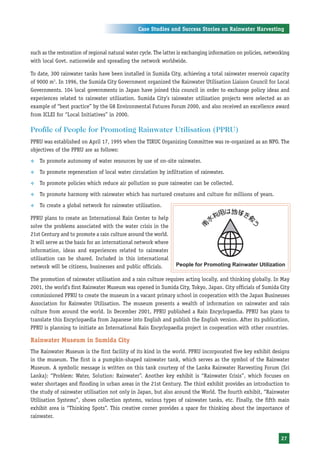
  • 11.
    Introduction Scenario in SelectedCities In Kolkata, India, about half the population that lives in the slum or squatter settlements collect water from stand posts. The rest of the slum population do not have access to the municipal water supply and have to make their own arrangements – for instance relying on handpumps/drawing from tube wells. In Bangalore, India a city of some 6 million inhabitants, it is estimated that more than half depends on public fountains. Almost a third of the population has partial or no access to piped water. In Dhaka, Bangladesh it is estimated that in 2002 there were 2.5 million people in its ‘slum’ areas with most having very inadequate provision for water and sanitation. Tens of thousands of children die each year in Dhaka because of waterborne diseases and polluted water. In Pakistan more than half of Karachi’s 12 million inhabitants live in katchi abadis. Only half the katchi abadis have piped water. In Faisalabad, Pakistan some two thirds of the city’s two million inhabitants live in largely unserviced areas. Over half have no piped water supply. In Kampala (Uganda) only inhabitants of affluent and middle-income districts in central and residential areas have private connections serviced by National Water & Sewerage Corporation. More than half the population in Nairobi (Kenya) depend on standpipe vendors for access to water; 30% of the population have a connection to the official network. In Lima (Peru) almost 2 million inhabitants have no water supply and 30% of those who do receive water (1996) is of dubious quality. The water shortage in Tugucigalpa (Honduras) is particularly acute as there is not even enough water to supply to consumers already having municipal water connections. To further illustrate, India’s population as per 2001 census is 1027.02 million. Over 60 per cent of households in India meet their drinking water requirements from underground water sources such as hand pumps, tube wells and wells. In urban areas while 68.7 per cent households use tap water, 29 per cent of the households directly use those underground water resources. Intense use of underground water has resulted in depletion of sub-terrene water resources in many parts of India. Benefits of Rainwater Harvesting Rainwater harvesting provides the long-term answers to the problem of water scarcity. Rainwater harvesting offers an ideal solution in areas where there is sufficient rain but inadequate ground water supply and surface water resources are either lacking or are insufficient. In hilly areas, rainwater can be used by humans, vegetation and animals. Rainwater harvesting system is particularly useful in remote and difficult terrain as it has the ability to operate independently. The whole process is environment friendly. There are a number of ways in which water harvesting can benefit a community – water harvesting enables efficient collection and storage of rainwater, makes it accessible and substitutes for poor quality water (Box 1.1). Water harvesting Box 1.1 Rainwater Harvesting - Multiple Benefits helps smooth out variation in water availability ™ Improvement in the quality of ground water by collecting the rain and storing it more ™ Rise in the water levels in wells and bore wells that are efficiently in closed stores or in sandy riverbeds. drying up In doing so, water harvesting assures a ™ Mitigation of the effects of drought and attainment of continuous and reliable access to water. drought proofing A water harvesting system collects and stores water ™ An ideal solution to water problems in areas having inadequate water resources within accessible distance of its place of use. While traditional sources are located away from the ™ Reduction in the soil erosion as the surface runoff is reduced community particularly in peri-urban areas, ™ Decrease in the choking of storm water drains and flooding collecting and storing water close to households, of roads villages or pastures greatly enhances the ™ Saving of energy, to lift ground water. (One-meter rise in accessibility and convenience of water supplies. water level saves 0.40-kilowatt hour of electricity) 3
  • 12.
    Rainwater Harvesting andUtilisation The rainwater collected can be stored for direct use or can be recharged into the ground water to improve the quality of ground water and rise in the water levels in wells and bore wells that are drying up as well as reduce the soil erosion as the surface runoff is reduced. Rainwater harvesting is an ideal solution to water problems in areas having inadequate water resources and helpful in mitigation of the effects of drought and attainment of drought proofing. Water harvesting provides an alternative source for good quality water (rainwater is the cheapest form of raw water) seasonally or even the year round. This is relevant for areas where ground water or surface water is contaminated by harmful chemicals or pathogenic bacteria or pesticides and/or in areas with saline surface water. The rainwater harvesting systems can be both individual and community/utility operated and managed. Rainwater collected using various methods has less negative environmental impacts compared to other technologies for water resources development. The physical and chemical properties of rainwater are usually superior to sources of ground water that may have been subjected to contamination. Rainwater is relatively clean and the quality is usually acceptable for many purposes with little or even no treatment. Rainwater harvesting technologies are flexible and can be built to meet almost any requirements. Construction, operation, and maintenance are not labour intensive. Predictions regarding global warming could have a major effect in significantly increasing water demand in many cities. At the same time increased evaporation from reservoirs and reduced river flows in some areas may decrease the available surface water supplies. A greater uncertainty regarding yields from major reservoirs and well fields is likely to make investments in the diversification of water sources, better water management and water conservation even more prudent in future. The role of rainwater harvesting systems as sources of supplementary, back-up, or emergency water supply will become more important especially in view of increased climate variability and the possibility of greater frequencies of droughts and floods in many areas. This will particularly be the case in areas where increasing pressure is put on existing water resources. In urban areas, scarcity and accelerating demand of water is a major problem and it can be reduced by rainwater harvesting, using various existing structures like rooftops, parking lots, playgrounds, parks, ponds, flood plains, etc. to increase the ground water table, which saves the electric energy to lift the ground water because one- metre rise in water level saves 0.40 kilowatt hour of electricity. Subsequently it can also reduce storm drainage load and flooding in city streets. As cities continue to grow in the future such problems are likely to become increasingly common. Since cities comprise numerous impervious surfaces designed to encourage rainwater runoff the scope for rainwater collection is substantial. Atmospheric pollution remains a major constraint as it contaminates both the rainwater and catchment surfaces making rainwater unsuitable for drinking in many cities around the world. Nevertheless, rainwater can still be used for non-potable uses such as toilet flushing, clothes washing and gardening. Furthermore, greater use of rainwater in urban areas could in future significantly strengthen the lobby to clean up the urban atmosphere entirely. The Growing Global Interest in Rainwater Harvesting With development of modern ‘conventional’ water supply systems in the first half of this century, many traditional water sources went out of favour. This was the case with rainwater harvesting technologies which came to be considered only as an option of last resort. While the exploitation of rainwater was considered appropriate in certain extreme situations such as on coral islands or at remote farms for which reticulated supplies were uneconomic, little serious consideration was given to the more general use of the technology. 4
  • 13.
    Introduction Since around 1980,however, things have changed and there have been numerous grassroots initiatives supported by enlightened government and donor agencies promoting and implementing rainwater harvesting technologies. This has partly been a response to the growing technical feasibility of using roof catchment systems in the South due to the spread of impervious roofing materials in urban as well as rural areas. It has also been motivated by a paradigm shift regarding global attitudes to the environment and the growing realisation that water resource utilisation has to become more sustainable. In 1979 UNEP commissioned a series of regional case studies into Rain and Storm water Harvesting in Rural Areas. This included work from China, India, Mexico, the U.S., Africa, Australia, and the South Pacific. This was the first time a global overview of experiences with the technology was brought together in a single publication. Another even more influential overview by Pacey, A. & Cullis, A. 1986 followed soon after. At around the same time, UNICEF, several bi-lateral donor agencies (including DANIDA and SIDA), and many NGOs were promoting the use of household roof catchment tanks in East Africa and working on developing various low cost designs in Kenya. This work, much of which was done directly with community groups, led to rapid rates of adoption of roof tanks among rural communities. In a parallel development, the first conference on the use of rainwater cisterns for domestic water supply was held in Honolulu, Hawaii in 1982 attracting around 50 mainly academic participants. It was not envisaged at the time that the meeting would herald the beginning of a series of international conferences on the topic over the next 20 years which would include thousands of participants from a very broad cross-section of countries and professions. The next three conferences took place in the U.S. Virgin Islands (1984), Thailand (1987), and the Philippines (1989) at which point the scope of the conference series was broadened to include International Conferences on Rainwater Harvesting other forms of rainwater catchment systems z Hawaii (1982) z Kenya (1993) such as rainwater harvesting for agriculture. At the 1989 conference in Manila, it was also z U.S. Virgin Islands (1984) z China (1995) agreed to set up an Association to oversee the z Thailand (1987) z Iran (1997) conference series and endeavour to promote z The Philippines (1989) z Brazil (1999) the technology worldwide. Subsequent z Taiwan (1991) z Germany (2001) conferences took place in Taiwan (1991), Kenya (1993), China (1995), Iran (1997), Brazil (1999) and Germany (2001). In addition to international conferences, many regional, national, and local meetings and initiatives took place during this period reinforcing the suggestion that the technology is now being given more attention globally than at any time prior to 1980. These have included the efforts by the New Delhi based Centre for Science and Environment to revive traditional rainwater harvesting practices in India (Agarwal & Narain 1997); the establishment of a rainwater harvesting forum in Sri Lanka (LRWHF 1999); setting up of People for Promoting The Millennium Development Goal (7) of ensuring environmental sustainability has set out the target of reducing the proportion of people without sustainable access to safe drinking water to half by 2015. It is generally believed that water and sanitation provision has been a serious constraint in urban areas in nations that have experienced the most rapid increase in their urban population as a proportion of their total population (i.e. urbanization levels) but this is not uniformly true. In fact some of the regions with the largest increase in urbanization levels have achieved much better levels of water and sanitation provision than some regions with smaller increases. Many of the world’s most rapidly growing cities over the last 50 years have very good water and sanitation provision and many slower growing cities or smaller urban centres have very poor provision. It is surprising that such large cities do not face serious water shortages. In the case of Asia, however, the picture, by and large, is quite disappointing. 5
  • 14.
    Rainwater Harvesting andUtilisation Rainwater Utilisation (PPRU) in April 1995 in Tokyo, Japan and new initiatives such as the promotion on rainwater utilisation in modern mega cities such as Tokyo (Murase 1994). The Vision 21 initiative also placed the use of appropriate technologies such as rainwater harvesting at the centre of its proposed strategies for providing clean water, adequate sanitation, and hygiene education for 95% of the population by 2025. Rainwater harvesting/collection is considered among the most appropriate technologies for efficient use. In pursuance of the Millennium Development Goals, UN-HABITAT, therefore, has decided to bring out a guidebook on rainwater harvesting under Water for Asian Cities Programme in “Blue Drop Series” to encourage rainwater harvesting as part of the strategy for integrated water resource management in the Asian Region, Africa and Latin America & the Caribbean. Objectives of the UN-HABITAT Guide on Rainwater Harvesting In the hydrological cycle, rain is the first form of water that we know and hence is a primary source of water for us. Rivers, lakes and ground water are all secondary sources of water. In the present times, we depend entirely on such secondary sources of water and the primary source has been neglected to a great extent. The purpose of the “Blue Drop Series” is to introduce the planners, decision makers, project managers, beneficiaries and others to the concept and technology of rainwater harvesting in urban areas and to show them where it fits into the overall picture of appropriate and sustainable community water supply development in urban areas. Just like other water resources, rainwater harvesting is an option to be considered when planning an improved water supply system with a community. Depending on local environmental conditions, water harvesting may provide a supplementary supply, an alternative supply or the only feasible improved supply, especially in urban areas which are heavily dependent on underground water. The information provided on technical issues is quite specific, as considerable experience is available, in particular in the area of construction technologies involved in rainwater harvesting. The information on socio-economic aspects though less specific has also been provided as no tailor-made approaches can be recommended and much will have to be developed to cope with the differences in size, social organization, leadership and complicity of the urban community concerned. This “Blue Drop Series” has been prepared with the objective of presenting the basics required for undertaking rainwater harvesting. The three books under the series have been written in a simple form so that these can be used even by ordinary householders. Apart from various methods and techniques for water harvesting, selected case studies of harvesting systems designed by various organizations working in the field of rainwater harvesting have been cited so that establishments with similar conditions can take up water harvesting on the same lines. This volume specifically presents methods suitable for singular building/establishment level – residences, institutions and industries. The scope of water harvesting can be extended to a locality/community level by incorporating various such singular units into a group. As one may learn through the “Blue Drop Series”, broadly there are two approaches to harvesting water – storing of water for direct use or recharging of ground water. The “Blue Drop Series” on water harvesting is comprehensive enough and incorporates useful information on various innovations in techniques that can be applied. This guide on water harvesting has been conceived as part of the broader objectives of the Water for Asian Cities Programme. 6
  • 15.
    Introduction Rainwater Harvesting: AnOverview Water Harvesting Scientifically, water harvesting refers to collection and storage of rainwater and other activities aimed at harvesting surface and ground water. It also includes prevention of losses through evaporation and seepage and all other hydrological and engineering interventions, aimed at conservation and efficient utilisation of the limited water endowment of physiographic unit such as a watershed. In general, water harvesting is the activity of direct collection of rainwater. The rainwater collected can be stored for direct use or can be recharged into the ground Figure: Where does all our water come from? water. Rain is the first form of water that we know in the hydrological cycle, hence is a primary source of water for us (see figure). Rivers, lakes and ground water are all secondary sources of water. In present times, we depend entirely on such secondary sources of water. In the process, generally, it is forgotten that rain is the ultimate source that feeds all these secondary sources. Water harvesting means making optimum use of rainwater at the place where it falls so as to attain self-sufficiency in water supply, without being dependent on remote water sources. Typically, a rainwater harvesting system consists of three basic elements: the collection system, the conveyance system, and the storage system. Collection systems can vary from simple types within a household to bigger systems where a large catchment area contributes to an impounding reservoir from which water is either gravitated or pumped to water treatment plants. The materials and the degree of sophistication of the whole system largely depend on the initial capital investment. Some cost effective systems involve cisterns made with ferro-cement, etc. In some cases, the harvested rainwater may be filtered. In other cases, the rainwater may be disinfected. Rainwater harvesting using ground or land surface catchment areas can be a simple way of collecting rainwater. Compared to rooftop catchment techniques, ground catchment techniques provide more opportunity for collecting water from a larger surface area. 7
  • 16.
    Rainwater Harvesting andUtilisation Harvesting System Broadly rainwater can be harvested for two purposes ™ Storing rainwater for ready use in containers above or below ground ™ Charged into the soil for withdrawal later (ground water recharging) Components of a Rainwater Harvesting System All rainwater-harvesting systems comprise six basic components irrespective of the size of the system. ™ Catchment Area/Roof - the surface upon which the rain falls; the roof has to be appropriately sloped preferably towards the direction of storage and recharge. ™ Gutters and Downspouts - the transport channels from catchment surface to storage; these have to be designed depending on site, rainfall characteristics and roof characteristics. ™ Leaf Screens and Roof Washers - the systems that remove contaminants and debris; a first rain separator has to be put in place to divert and manage the first 2.5 mm of rain. ™ Cisterns or Storage Tanks - like sumps, tanks etc. where collected rainwater is safely stored or recharging the ground water through open wells, bore wells or percolation pits etc. ™ Conveying - the delivery system for the treated rainwater, either by gravity or pump. ™ Water Treatment - filters to remove solids and organic material and equipment, and additives to settle, filter and disinfect. Elements of a Typical Water Harvesting System 8
  • 18.
    Rainwater Harvesting andUtilisation Water for Cities Programme The objectives of the Water for African Cities programme and the Water for Asian Cities programme are to reduce the urban water crisis in cities through efficient and effective water demand management, to build capacity to reduce the environmental impact of urbanisation on fresh water resources and to boost awareness and information exchange on water management and conservation. Water for African Cities Programme A programme on Water for African cities was launched by UN-HABITAT in 1999 as a direct response to the Cape Town Resolution (1997) adopted by African Ministers addressing the urban water challenge facing the continent. This was the first comprehensive initiative to support African Countries to effectively manage the growing urban water crisis and protect the continent’s threatened water resources from the increasing volume of land based pollution from the cities. The main objectives under the programme include: ™ Development of water-related environmental education strategy for African cities. ™ Establishment of water classrooms ™ Schools water audit ™ Water quality education ™ Curriculum development and introducing water education in pilot schools ™ Non-formal education with community initiatives ™ Water health care education ™ Information exchange and North-South twinning arrangements. Water for Asian Cities Programme To meet the Millennium Declaration Goal of halving the proportion of people without access to improved services by 2015, an additional 1.5 billion people in Asia will need access to adequate sanitation facilities, while an additional 980 million will need access to safe water. In urban areas, the corresponding figures are 675 million and 619 million respectively. Emphasis on urban water and sanitation has also been placed in the Millennium Declaration by setting a target of improving the living conditions of at least 100 million slum dwellers by 2020. Following the New Delhi Consultation in April 2002, UN-HABITAT together with ADB launched this regional programme on Water for Asian Cities to promote pro-poor investments in water and sanitation in the region. The New Delhi Consultation made specific recommendations with regard to the implementation strategy and partnership arrangements for the proposed programme. Programme Objectives The Programme focuses on three inter-linked priorities. (i) Introducing demand-responsive and demand management strategies to improve efficiency of water-use and give more influence to those currently deprived of water and sanitation (ii) Scaling-up sanitation provision city-wide through innovative public-private-NGO partnerships, finance 10
  • 19.
    Introduction mechanisms and appropriate technical choices (iii) New pro-poor investments in urban water supply and sanitation with emphasis on serving the urban poor with piped water and formal sanitation facilities Key Programme Activities ™ Monitoring of progress towards achieving Millennium Goal targets in the water and sanitation sector in Asian cities. ™ Mobilization of political will through advocacy and exchange of information. ™ Strengthening regional, country and city level capacities for integrated water and sanitation management. This requires human resource development in a focused manner, strengthening the capacity of existing institutions. Gender mainstreaming is an important crosscutting theme of capacity building at all levels. ™ Creating a new ethic among children and community through Water, Sanitation and Hygiene Education. Interventions include: introducing value-based water education in schools; establishing water education classrooms in pilot cities; community education, training of trainers etc. Twinning of cities and schools is part of this initiative. ™ Promoting pro-poor investments in the water and sanitation sector. This calls for the establishment of a pro-poor governance framework at the city level through stakeholder consultations, to facilitate the necessary policy and institutional reforms required for improving water and sanitation services for the urban poor. Investments in water supply and sanitation in Asian cities will provide the source developments, pipelines, treatment plants, reservoirs and distribution systems to bring water to those without direct access to piped water. It will also provide sanitation facilities in those cities, based on appropriate technology. Partnership and Capacity Building for Pro-poor Investments The programme commenced with a partnership development phase. The focus in this phase was on developing a framework for collaboration among city level actors as also with external support agencies and other ongoing programmes. The central emphasis of the Water for Asian Cities Programme is on capacity building in the countries and cities in the region with a view to prepare the environment for pro-poor investments in the water and sanitation sector. While the Capacity Building Phase of the Programme is being directed to enhancing the willingness and commitment of the policy makers and creating the necessary institutional and human resource capacity to implement pro-poor policies and programmes, the investment promotion phase of the Programme shall be directed to creating the enabling environment for pro-poor investments. Users of the “Blue Drop Series” The “Blue Drop Series” on Rainwater Harvesting and Utilisation consists of three books and has been designed for policy makers, planners and all those involved in the implementation of urban water supply programmes. It has been prepared with a view to integrate the “state of the art” on Rainwater Harvesting to provide a handy, self- contained reference volume for use by all levels of functionaries in this sector in different regions of the world. This volume, Blue Drop Series, Book 1, has been designed for Policy Makers. The book consists of three chapters including introduction about the Rainwater harvesting requirements, benefits and the role of UN-HABITAT in Rainwater Harvesting. The information contained in the Book provides useful information/data needed by policy makers/decision makers which include legal and administrative requirements for framing policies and programmes and giving proper directions. Also success stories/case studies around the world, as incorporated in the book, would provide valuable guidance for a pragmatic approach. 11
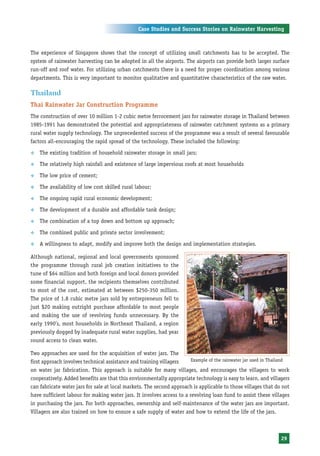
  • 20.
    Rainwater Harvesting andUtilisation Legal and Administrative Framework for Rainwater Harvesting The fast rate of urbanization, resulting in rapid increase in demand for water, makes it scarce day by day. A growing number of cities and towns are, therefore, facing serious problems due to water scarcity. Whereas the water demand on one hand is increasing manifold, on the other hand state assured water supply is quite inelastic. These need to be addressed through mobilizing the people as well as enacting legislations that promote water harvesting on one hand, and regulate water extraction on the other. In urban areas water harvesting can be undertaken for a variety of purposes. ™ To increase water supply for potable water needs; ™ To increase water supply for low-quality household uses like gardening, washing clothes and for sanitary purposes; ™ To provide water for institutional needs; ™ To increase ground water recharge to improve the quantity and quality of ground water; and, ™ To reduce storm water runoff and thus avoid flooding of urban areas and overloading of urban drainage and sewage treatment plants. Policy Framework for Rainwater Harvesting Many countries have national water laws. Most European countries have national water byelaws which put strict controls on Rainwater Harvesting (RWH) systems to prevent contamination of mains supplies by rainwater or inadvertent drinking of rainwater (of unknown quality) by individuals. As per law the mains and Rainwater (RW) plumbing systems are kept separate and RW taps are clearly marked. In India, however, there is no national law as such. There is, however, a national water policy. The National Water Policy (NWP) 2002 is a cogent and comprehensive document and can form a basis to be converted into a law. Water harvesting systems are diverse in their nature, size, number of users and ownership. People in South Asia, it is believed, evolved a water harvesting system based on availability of a resource, its geophysical conditions and local needs. The system is ancient. The need for a policy framework for water harvesting systems arises mainly because the prevailing policy statements do not touch upon the issue. The national water policy, national law policy, agriculture policy, national conservation strategies and policy statement on environment and development do not specifically touch upon the issues. 12
  • 21.
    Legal and AdministrativeFramework for Rainwater Harvesting Box 2.1 Initiatives for Promoting Rainwater Harvesting in Indore, India The local administration and various groups in Indore city are raising awareness and implementing rainwater harvesting to deal with the rapidly depleting ground water resources. The water supply to the town of Indore is 168 million litres per day as against the daily requirement of 320 million litres. Declining rainfall and the growing population has resulted in the gap increasing between demand and supply. This gap between demand and supply is met through tapping ground water. As a result, the ground water table is rapidly declining. “Energised pumps are working overtime to meet water needs”. When it comes to overexploitation of ground water, the story of Indore is no different from other big and small towns across India. What is different is the effort of the people to harvest rains. The Indore Municipal Corporation (IMC) and the city Mayor with the help of some media groups are involved in raising awareness and implementing rainwater harvesting. But rather than just complain, residents of the town are taking the matter into their own hands and are trying to alleviate the problem. Efforts to raise the ground water level in the area have started through rainwater harvesting programmes. On the occasion of the 50th anniversary of the Nai Duniya newspaper group, a Nai Duniya Seva Trust was set up. The proprietors agreed to deposit a sum of five paise for each of the 1,30,000 newspaper copies sold every day. The scheme was launched on 23rd June 2000. So far, about Rs. 75 lakh have been collected and will be used for various development projects. Informs Ravindra Shukla, Senior Assistant Editor of the newspaper, “This fund is currently being used to finance organizations working to promote rainwater harvesting in rural and urban areas. So far, we have involved 12 organisations, six each in rural and urban areas. We have also sponsored satellite imagery of ground water resources in Indore so that rainwater harvesting efforts can be more effective”. A lot of effort is going into raising awareness. The group is spreading the message through advertisements and articles in their newspaper. The mayor is appealing to the citizens to adopt rainwater harvesting methods to raise the ground water level in the city. He informs, “I am planning a water march for water harvesting before the next monsoon. This water march will include a door-to-door campaign, public meetings, on the spot construction and exhibition of models. The IMC launched its activities on 6th May 2000 with the theme, “If you protect water, water protects you”. An exhibition was arranged at Rajwada, the palace of the Holkar kings, where models of different water harvesting methods, posters and filters samples were displayed and leaflets distributed. Rainwater harvesting is being implemented in residential colonies, institutes, clubs and gardens. Records of the IMC indicate that more than 2,000 houses in Indore have water harvesting structures The Nai Duniya office complex has a water harvesting structure that harvests rooftop rainwater from the roof area and recharges an old dugwell. A rebate of six per cent on property tax has been announced for those who install rainwater harvesting in their house, bungalow or building. Three committees – technical, education and execution – were set up by the IMC for this purpose, the first of its kind in the country. For construction of new buildings on areas more than 250 square metres in size, rainwater harvesting is now compulsory. The Corporation has proposed to make rainwater harvesting mandatory for the existing buildings also. The policy framework should respect people’s right to free and easy access to water. The policy should also respect the right of people to clean and unpolluted water and a healthy environment. Further, the policy should also incorporate the principle of equity and distributive justice in the utilisation of water and to do so drinking water should get top priority followed by other domestic uses. The policy needs a law and for a possible law, a policy framework is a guideline. In India, under the constitutional set up, water is a state subject. Institutions of local self-govt. have been established and steps are being taken to improve the existing law and to empower local institutions. In this regard, necessary efforts are also on to ensure that these institutions and local communities work together for the maintenance, use and survival of traditional water harvesting systems. The laws, however, should adopt a flexible framework for the management structure of water harvesting systems. There is, therefore, a clear need 13
  • 22.
    Rainwater Harvesting andUtilisation to evolve a decentralized legal regime which empowers people and makes them real managers of resources. For promoting urban water harvesting, a policy should include a mix of incentives and penalties. Measures that need to be undertaken include:- ™ Provision of rainwater harvesting/recharge of ground water systems should become an essential town- planning requirement and be a pre-requisite for sanction of new colonies. ™ Provision of rainwater harvesting structures in all building plans should be made before applications are accepted. ™ Technical regulations should be in place to ensure that a certain distance of the pipes is maintained so that rainwater harvested is not contaminated by septic tanks. ™ All the water carriers and bodies should be used as water storage through rainwater harvesting system. ™ Creation of a national rainwater-harvesting fund. ™ Creation/constitution of a single water authority or local body to control and regulate all water bodies. ™ Granting rebate on property tax assessment and other fiscal incentives for effective use of rainwater harvesting system. ™ Rainwater harvesting systems and conservation of water should be proclaimed as matters of national importance by the national Governments. For implementing such policy measures the policy initiatives should be further strengthened through legislation. This apart, there is also a need to legally regulate ground water use. Ground Water Rights: Legal Considerations Ground water poses an extremely difficult legal problem. Unlike the case of surface water, it is often difficult to determine the source and rates of recharge, the extent and variation of quality in storage, and the direction of water movement. In United States three basic rules cover the use of ground water. The first, or English, rule is one of absolute ownership. It allows the overlying landowner to take ground water from the land at any time and in any quantity, regardless of the effect on the water table of a neighbor’s land. Under this rule it would be possible for a landowner to exhaust the total ground water supply of an area by heavy pumping. This rule has been qualified in some areas to limit the malicious and wasteful use of the water. The American rule, or rule of reasonable use, recognizes that the landowner has rights to the water under the land but that these rights may be limited. The rights to water are limited to its reasonable use in relationship to the overlying land. The third rule covering ground water is the appropriation principle, whereby the water is allocated for specific uses. The growing intensity of water scarcity, however, calls for certain legislative, administrative and fiscal measures. Legislation is a source as well as an instrument of public policy. Legal and Fiscal Measures to Protect Ground Water A variety of measures have been undertaken by governments to promote water harvesting by urban households. In the city of Chennai (India), urban authorities have made it mandatory under the city’s building regulations for all new buildings to have water-harvesting mechanisms primarily to recharge the ground water aquifers. In Bonn, a fiscal incentive is provided to households through a municipal tax that forces households to pay for runoff producing areas like paved areas and the roof area, unless they unpave the paved areas or collect the rainwater from rooftops and paved areas for domestic use. The primary objective in Bonn is to reduce urban flooding and overloading of sewage treatment plants and to increase ground water recharge locally. Sumida city, a ward of Tokyo, provides a subsidy to all households interested in developing water-harvesting systems. 14
  • 23.
    Legal and AdministrativeFramework for Rainwater Harvesting The main objective here is to promote the use of rainwater for low quality household uses, for drinking in emergency situations and to reduce urban flooding. If any subsidies are provided to promote urban water harvesting, it must be ensured that only the poor and lower middle classes benefit from them. Legal and Other Measures Initiated in India to Promote Rainwater Harvesting In order to ensure that the buildings that are erected in Delhi provide for water harvesting through storing of rainwater runoff to recharge underground aquifers, the Central Government in India has notified modifications/ additions to the Building Bye Laws of 1983. The modified Buildings Bye Laws have made water harvesting through storing of water runoff including rainwater in all new buildings on plots of 100 sq. mtrs and above mandatory. The plans submitted to the local bodies have to indicate the system of storm water drainage along with points of collection of rainwater in surface reservoirs or in recharge wells. Secondly, buildings having a minimum discharge of 10,000 litres and above per day have to incorporate a wastewater recycling system. The recycled water would be used for horticultural purposes. Every time a building plan is submitted for approval, a certificate has to be submitted along with the building drawings stating that the building plans submitted for approval satisfy the water harvesting requirements as well as minimum anticipated discharge of waste water as stipulated in the revised Building Bye Laws. Similarly, the Central Government has amended the Environment (Protection) Act 1986 to incorporate the following provisions relating to Rainwater Harvesting with a view to protect and improve the quality of environment in all the hill towns located in the Himalayan region. ™ All buildings to be constructed in future in hilly urban areas to have provision for rooftop rainwater harvesting commensurate with its plinth area with minimum capacity of 5 Kl for plinth area above 200 sq.m, 2Kl for plinth area of 200 sq.m or below in case of residential buildings and minimum capacity of 0.01 cu.m per sq.m of plinth area in case of commercial and institutional buildings such as tourist complexes, hotels, shopping complexes and Government buildings. ™ Where minimum standards have already been laid down by the State Governments, such standards shall take precedence. ™ The institutional and commercial buildings not to draw water from existing water supply schemes which adversely affect water supply to local villages or settlements. ™ In rural and peri-urban areas rainwater harvesting to be undertaken through such structures as percolation tanks and storage tanks and any other means. ™ Spring sanctuary development to be undertaken in the spring recharge zones to augment spring water discharge. ™ Rainwater collected through storm water drains to be used to clean the waste disposal drains and sewers. ™ Ground water aquifer recharge structures to be constructed wherever such structures do not lead to slope instabilities. The Govt. of India has also constituted the Central Ground Water Authority (CGWA) under section 3(3) of the Environment (Protection) Act 1986 for the purpose of regulation and control of ground water management and development. The CGWA has been vested with the powers under section 5 of the said Act for issuing direction and taking up such measures as may be deemed necessary to any authority and such person, officer or authority shall be bound to comply with such directions. The Authority has issued several Public Notices declaring areas/ complexes as “Notified Areas” for the regulation of ground water extraction. It regulates undertaking of any 15
  • 24.
    Rainwater Harvesting andUtilisation Box 2.2 Regulating Ground Water Use The city of Chennai (India) has resorted to legislative control to regulate ground water use The Chennai Metropolitan Area Ground water (Regulation) Act 27 of 1987 envisages control, regulation, extraction and transportation of ground water in the notified area through (i) registration of existing wells; (ii) regulation of sinking of new wells; (iii) issue of licenses to extract water for non-domestic use; and (iv) issue of licenses for transportation by goods vehicles. The term ‘Ground water’ mentioned in the Act means the water which exists below the surface of the ground and the term ‘scheduled area’ means the whole of the city of Chennai and the villages specified in the schedule. The Act, which came into force in February 1988, exempted from its purview wells used for purely domestic purposes, requiring a grant of permission regulated construction of wells for other uses. Extraction of water was, however, regulated on an annual basis. The competent authority for the purpose of the Act: ™ In the city of Chennai, the Metro Water Board; ™ In relation to the villages specified in the schedule, the respective sub-collectors or revenue divisional officers of the taluks in which the villages fall. In granting or refusing a license, the competent authority takes into account: ™ Purpose or purposes for which ground water is to be used; ™ Existence of competitive users; ™ Availability of ground water; ™ Effects on sources of water supply; ™ Compatibility with existing water supply system; and, ™ Availability of factors controlling or preventing pollution. The competent authority has full powers to withdraw or cancel the license, if any of the provisions of the Act, or the rules made under the Act, or if any terms and conditions and restrictions, subject to which the permits or licenses have been granted, are contravened, or otherwise not complied with. Punishment for first offence is a fine which may extend to Rs. 500, and for the second and subsequent offences with imprisonment for a term which may extend to six months or with a fine which may extend to Rs. 1,000 or both. Any offence punishable under the Act is a cognizable offence within the meaning of the code of criminal procedure. operation connected with drilling, cleaning, construction or rehabilitation of ground water abstraction structures and related works including installation of pumps in the notified areas. The CGWA also promotes adoption of rooftop rainwater harvesting system by Group Housing Societies, Institutions, Schools, Hotels, Industrial Establishments and Farm Houses etc. This apart, the Authority also declares aquifers as “Protected aquifers”. A number of State Governments have made rainwater harvesting mandatory. Depending on the intensity of the problem, rooftop harvesting has been made compulsory on new buildings, old buildings and buildings according to their size in various Indian cities. Fiscal incentives like rebate in property tax and financial assistance for making provision of rainwater harvesting in the existing buildings are also available in a number of cities. Some of the important measures adopted in different states/cities are highlighted in Box 2.5. Besides the steps being taken by the Central Ground Water Authority for adopting water harvesting compulsorily, several State and City Governments have resorted to legal and administrative measures for making rainwater harvesting mandatory. Andhra Pradesh has passed an Act titled “Water, Land and Trees Act”, 2002, which came into force on July 1, 2002. The Act aims at regulating the exploitation and use of ground and surface water for protection and conservation of water resources. Under this Act, a Water, Land and Tree Authority has been 16
  • 25.
    Legal and AdministrativeFramework for Rainwater Harvesting established. This Authority regulates all ground water resources including prohibiting water pumping and sinking of new wells. Similarly Govt. of Tamil Nadu has issued an ordinance titled “Tamil Nadu Municipal Laws 2003” making rainwater harvesting mandatory for all the buildings, both public and private in the State. The state Govt. of Rajasthan, Gujarat and Haryana have also taken administrative/legal measures for making rainwater- harvesting mandatory for all public/government buildings. Several city governments, which include Indore, Kanpur, Hyderabad, New Delhi, Mumbai and Chennai, have also adopted similar measures. Promoting Urban Water Harvesting: Some Guiding Principles In urban areas, rooftop water harvesting has an enormous potential to reduce the demand on river and ground water systems, many of which are getting increasingly overexploited and polluted. In order to promote water harvesting in urban buildings, development byelaws need to be suitably formulated or modified. The following steps need to be taken: ™ Every urban area should have a master plan; wherein water catchment areas are clearly demarcated and should be left undisturbed. Municipal corporations should demarcate such lands and utilize them as water catchment areas. These catchment areas can be used for afforestation by the forest department or can be transferred to the forest department as an urban sanctuary, so that its land use cannot be changed without government approval. ™ Prior clearance before land acquisition to ensure that water catchment areas are not disturbed. ™ A single water authority or local body, as the case may be, should be vested with the control and regulation of all water bodies including rivers / canals / waterways / ground water aquifers in urban areas. ™ Town planners / local authorities should provide for surface water percolation along roads, pavements and other open spaces. ™ All building plans must provide for water harvesting structures before applications are accepted, though provisions for exemptions should exist for those who cannot build water harvesting structures for genuine reasons like lack of space. Statutory provisions should be made for public buildings and large structures, making water audits essential. ™ Provision of Water Harvesting (WH) systems in plans should be followed up by enforcement at the time of grant of water and / or sewer connections / assessment of property tax, etc. ™ Builders and planners should be given clear technical guidelines on precautions to be observed in providing WH systems so that there is no contamination by septic tanks. The local authority in charge of water supply should be responsible for the maintenance of rivers and other water bodies with the specific aim of using them for water storage through WH systems. More efforts are needed to simplify approval procedures to reduce the overload on the existing administration. ™ Master plans for rainwater collection and use for all urban centres should be made a pre-requisite for meeting eligibility requirements of national / international funding agencies like the ADB, the World Bank and others. ™ The misuse of water bodies and waterways through sewage discharges should be restricted with provisions made for interceptory sewers and canals along waterways. This is an expensive proposition but can be taken up in a phased manner. At the same time, all new housing / commercial / industrial / construction activity by private or government agencies, should be allowed after a proper sewer system is laid and commissioned. ™ WH systems should be promoted as a means of both providing water and preventing floods so that the message and the need are permanent. 17
  • 26.
    Rainwater Harvesting andUtilisation ™ A central nodal agency in each country should provide technical and engineering advice on structures and systems to be used particularly in urban areas where the availability of non-paved areas is increasingly getting limited. ™ Industrial houses should be encouraged, through incentives as well as town planning requirements, to provide for water harvesting on their premises and to maintain at least one WH community structure in an urban area. ™ In the case of the Singapore Changi Airport, harnessing of runoff has been in operation for more than a decade. Since it has been successful even when the airport is very close to the sea, such projects should, as far as possible, be adopted in all airports. It should be made mandatory for all airports to utilize the runoff water on their land to recharge ground water and meet their requirements. Similarly, all highways and roads should construct structures to collect rainwater in order to sustain green strips on both sides. Financial Assistance Rainwater harvesting, like infrastructure, is an area in which government policy and finance have an important role to play because of its pervasive impact on economic development sustainability and human welfare. In recent decades, developing countries have made substantial investments in infrastructure, achieving dramatic gains for households and producers by expanding their access to services such as safe water, sanitation, electric power, telecommunications and transport. Water harvesting is, therefore, an area which needs to be governed by certain effective measures which could be mandatory, promotional, incentive related or others. The governments should come forward to provide financial assistance to communities and households in addition to their contribution. Every household has something to contribute. The rich households have money to pay and the poor households have labour to contribute. People should also be urged to save and contribute money and labour for maintenance. As much as possible, people must be allowed to undertake construction themselves; at the least they must be involved in the supervision of the construction. They must be involved in the decision on what to construct. It is equally vital that people should know what money has been given to their community and for what purpose. All these are ingredients of a system of incentives meant to encourage community institutions to function effectively and take decisions. ™ Generally a large number of urban local authorities are both water and cash starved. The government to extend financial assistance in the form of loans or grants should promote a Water Harvesting fund. ™ Offering subsidies, rebates or a progressive water tariff should encourage individual and community participation. Financial Incentive for Housing Societies A growing number of local governments in Box 2.3 in India Adopting Rainwater Harvesting Germany today are supporting Rainwater The State Government of Delhi has introduced a financial Harvesting to save drinking water and for incentive for adopting Rainwater Harvesting by the Resident promoting decentralized seepage. Municipalities Welfare Associations and Neighborhood Societies in the worst have developed different strategies to extend affected areas of South and South West district. Financial direct or indirect support to rainwater assistance is given up to 50 per cent of the total cost of the harvesting. The city of Hamburg, for example, project or a maximum of Rs. 50,000/- on satisfactory initially gave money directly to house owners completion of the project. The Housing Society takes the for constructing Rainwater Harvesting systems. responsibility for proper maintenance of the structure at all Gradually, it stopped this direct support and times. The state water utility also disseminates information on Rainwater Harvesting (RWH) and provides technical gave indirect help by way of providing assistance for its adoption. consultation, planning and change in the water fees system. 18
  • 27.
    Legal and AdministrativeFramework for Rainwater Harvesting The city of Bonn has also changed its system of water fees in order to support decentralized rainwater retention and seepage. It has split the sewage charges into fees for wastewater and fees for rainwater. The latter is calculated in accordance with the area of sealed surface per household. If a household has taken measures for decentralized rainwater retention or seepage by building grass-covered roof, seepage facilities or rainwater harvesting system, the rainwater fee is reduced. Another very important instrument to support rainwater harvesting is through proper planning. To empower municipalities to take appropriate steps, national statutes concerning the construction of buildings have been changed and now municipalities can lay down their own decentralized rainwater management plans. Fiscal Incentives and Regulatory Mechanisms Subsidies In order to encourage people to install rainwater utilisation systems in some of the cities in Japan, residents and companies are given subsidies to install systems. Sumida City now offers subsidies up to Y1 million (US $7,500) per rainwater utilisation project. Increasingly, local governments, including Okinawa Prefecture, Takamatsu City, Toyota City, Kamakura City and Kawaguchi City have begun subsidizing or loaning funds for installing rainwater systems. The Indore Municipal Corporation in India has proposed a rebate of 6% on property tax for those who install rainwater harvesting in their house, bungalow or a building. There is clearly a need to study the Regulating Ground Water Use through Legal Box 2.4 possibility and feasibility of various Instruments and Financial Measures: Experiences fiscal incentives and regulatory of the Federal State of Hessen (Germany) mechanisms for promotion of water In Hessen, 95% of drinking water is supply from ground water sources. harvesting. In Arthshastra, Kautilya The summers of 1992 and 1993 were very dry and the state experienced water scarcity and depletion in ground water levels. To overcome these recommended tax exemption for those problems, the government introduced a five-point programme including who constructed water-harvesting appropriate legal steps. These were structures in their homes. Without ™ Introduction of high charges for drawing ground water appropriate pricing of water and ™ A ground water management plan for critical regions where the electricity, households and institutions ground water levels were sinking will have little economic interest to ™ Changes in the permission system of ground water based on the meet a significant part of their water calculation of certain ground water measure-points needs through local water harvesting, ™ Use of legal instruments to reduce water consumption coercively and, thus, reduce the pressure on ™ Construction of filter systems for rainwater. municipal water supply systems. The As a result of these measures the withdrawal declined from 483 mcum efforts made by Frankfurt Airport to 432 mcum between 1992 to 1996. The money raised by the ground managers to meet a large part of their water extraction fees was used for supporting number of rainwater water needs illustrate the need for harvesting projects as well as a number of water protection projects in working in this direction. The system the industrial sector. set in place was able to save them unnecessary expenses. For effective utilisation of water resources, research is needed on pricing and legal rights of water while respecting social equity. There may be differential pricing of water for industry and domestic use. However, water should be priced keeping in view the overall social, economic and financial objectives in view for integrated water resource development. 19
  • 28.
    Rainwater Harvesting andUtilisation One option is for government agencies to concentrate on the provision of clean water supply for drinking and cooking, leaving households and communities to develop their own water harvesting structures to meet other lower quality water uses. The project can be supported with appropriate fiscal incentives. Currently in urban areas, generally all household activities utilize potable water, regardless of its use. In Rajasthan (India), while the traditional kundis met potable water supply, tanks and other structures met other household needs. Another option is to provide a certain minimum level of potable water at low prices which can be used for drinking and cooking while the price of the remaining water use by households can be sufficiently increased to discourage indiscriminate use and wastage. Legal Empowerment If existing government laws have legal provisions that prevent communities from undertaking water harvesting activities, these legal provisions need to be modified and replaced with provisions that support community and household efforts for water harvesting. There is an equally pressing need to develop and / or strengthen legal provisions that help to prevent destruction of existing water harvesting structures. Institutional Mechanisms There is also the need to develop and strengthen institutional mechanisms that are needed to promote water harvesting at various levels. ™ User level; ™ Village level; ™ Urban neighbourhood level; ™ City level; ™ Province level; and, ™ National level; Each level should have a clear and defined role which helps to strengthen the role of other levels. For integrated development, it is necessary that the national and the provincial governments should recognize and accept the need to rationalize planning and administration under a unified authority which should have representatives from the civil society, members of rural and urban institutions, and officials from relevant ministries, such as those dealing with planning, urban development, rural development, health and environment. This authority should function under the head of the government at various levels of Govt. The purpose of these authorities should not only be to promote water harvesting in different ecological regions of the country but also to promote efforts to protect existing water harvesting structures. In India there is no institution today which deals with the protection of these water bodies. The National River Conservation Authority, for example, deals only with river pollution. These authorities could be empowered under the Environment Protection Act of the Central government to issue appropriate directives to relevant authorities for the protection of lakes and other urban water bodies. Otherwise a separate National Urban Lake and Water Body Authority may be created to protect urban tanks and various other water bodies. The Environment Protection Act provisions to protect water bodies and the catchment areas from encroachment or any activity which would pollute, impair, disturb or destroy them. Legal support should be provided to the public to help fight cases where these bodies are being destroyed. Institutional mechanisms should be developed for the rapid settlement of disputes relating to water bodies. 20
  • 29.
    Legal and AdministrativeFramework for Rainwater Harvesting Administrative and Planning Measures One of the important aspects of the utilisation of urban catchment is the need to take an integrated approach towards planning. This involves a number of government, quasi-government and even private organizations for ensuring that water pollution should be avoided and minimized. Normally such coordinating efforts should be spearheaded by the water utility of the city. For the utilisation of urban catchments, there is a need for excellent control and coordination between many departments. The success of the utilisation of urban runoff largely hinges on the ability of the water authority to closely monitor the quantitative and qualitative characteristics of the raw water. Steps Necessary for Promotion and Further Development of Rainwater Utilisation A Systematic Approach Rainwater utilisation, together with water conservation and wastewater reclamation, should be incorporated into municipal ordinances and regulations. Some standardisation of materials, at least at national/regional level, may be desirable from a maintenance and replacement point of view. It may be also appropriate to standardise the design of the rainwater utilisation system, at least at the national/regional level. Implementation Policy Various implementation policies should be established to make rainwater utilisation and other measures a part of the social system. Leadership is very important and local governments must take the initiative to promote the concept of water resource independence and restoration of the natural hydrological cycle. Consideration should be given to subsidising facilities for rainwater utilisation. Technology Development and Training Encouraging technology and human resources development to support rainwater utilisation is very important. It is also important to promote the development of efficient and affordable devices to conserve water, facilities to use rainwater and devices to enhance the underground seepage of rainwater. Together with this, there is a need to train specialists with a thorough grasp of these technologies and devices. Networking To promote rainwater harvesting and utilisation as an environmentally sound approach for sustainable urban water management, a network should be established involving government administrators, citizens, architects, plumbers and representatives of equipment manufacturers. It is essential to encourage regional exchanges amongst public servants, citizens Public awareness and education are essential to and industry representatives involved in rainwater storage, seepage improve acceptance and implementation of rainwater and use, as well as the conservation and reclamation of water. harvesting and utilization 21
  • 30.
    Rainwater Harvesting andUtilisation Box 2.5 Legal, Administrative and Fiscal Measures Taken in Selected Cities of India for Promoting Rainwater Harvesting Cities/Authority Measures Adopted New Delhi Rainwater harvesting made mandatory since June 2001 in (i) all new Ministry of Urban Affairs & Poverty buildings with a roof area of more than 100 sq.m. and (ii) all plots with Alleviation, Govt. of India an area of more than 1000 sq.m. that are being developed. Kanpur Rainwater harvesting made mandatory in all new buildings with an State Govt. of U.P. area of 1000 sq.m. or more Indore Rainwater harvesting made mandatory in all new buildings with an City Municipal Corp. (M.P.) area of 250 sq.m. or more Rebate of 6 per cent offered on property tax as an incentive for implementing rainwater systems. Hyderabad and other City Municipalities Rainwater harvesting made mandatory in all new buildings with an in the State of Andhra Pradesh area of 300 sq.m. or more (enforcing deadline was June 2001) Chennai Rainwater harvesting made mandatory in three storied buildings State Govt. of Tamil Nadu (irrespective of the size of rooftop area) State Govt. of Haryana Rainwater harvesting made mandatory in all new buildings irrespective of roof area. State Govt. of Rajasthan Rainwater harvesting made mandatory for all public establishments and all properties in plots covering more than 500 sq.m. in urban areas Mumbai Rainwater harvesting made mandatory for all buildings being constructed State Govt. of Maharashtra on plots more than 1000 sq.m. in size (deadline for this was Oct. 2002) Delhi (South and South West Delhi and Rainwater harvesting made mandatory in all institutions and residential adjoining areas like Faridabad, Gurgaon colonies in notified areas (applicable for all buildings in notified areas & Ghaziabad) Central Ground Water that have tube wells). Deadline for this was March 31, 2002. Authority (CGWA) Central Ground Water Authority Drilling of tube wells in notified areas of Haryana banned. Chennai New water and sewer connections provided only after implementation of rainwater harvesting systems. 22
  • 31.
    Case Studies andSuccess Stories on Rainwater Harvesting Adoption of rainwater harvesting systems is reflected through success stories the world over. The fast rate of urbanization followed by rise in demand for water has accelerated the pace of implementation of rainwater harvesting projects through various methods depending on the local requirement. The success stories bring to the fore the tales of truth whether it pertains to developed countries like Japan, Germany, Singapore, the Philippines, the USA or other developing countries of Asia and the Pacific, Africa, Latin America, the Caribbean islands and others. The stories of water harvesting serve as examples for the people facing and living in water scarce areas or the flood prone places, places encroached by water salinity or infected with the problem of arsenic or the areas needing recharge of aquifers. The case studies suggest adoption of a pragmatic approach towards methodology and techniques whether it is rooftop harvesting, water runoffs at the airports, commercial buildings, industrial areas or non-polluted plains. The future strategy could be based on the lessons learnt from these experiences. Rainwater Harvesting Initiatives in Chennai, India The city of Chennai faced a serious water crisis in the late 1980s. The need for effective ground water management along with the management of surface runoff became a necessity. Moreover, extraction of ground water started ringing alarm bells when ground water in the north-western coastal belt indicated that there was a rapid ingress of seawater which extended from three kilometers inshore in 1969 to seven kilometers in 1983 and nine kilometers in 1987. Ground water levels within the city also fell and brackish water began to appear even in localities which earlier had good quality ground water sources. Practices in rainwater harvesting: Chennai receives an average annual rainfall of 1200 mm. It receives most of the rainfall from southwest and 23
  • 32.
    Rainwater Harvesting andUtilisation northeast monsoons. The geology of Chennai comprises mainly of clay, shale and sandstone (sand stone formation is the main water-bearing aquifer). Harvested rainwater is mostly used for recharging of aquifers, but in some places water is stored and used for non-potable purposes. Normally a building is constructed in the centre of the plot and an open area is paved with concrete. The runoff from these areas is collected through structures like percolation pits, trenches and collection wells. Impact: In the southern coastal aquifer area, the ground water level in 1988 was around eight metres. A gain of 4.0 to 5.0 m was established in the 20 km stretch along the southern coast. In Anna Nagar, a significant difference was observed between areas where rainwater harvesting had been undertaken and where there were no such efforts. For the city as a whole, the average water level has increased from 6.8 m in 1987 to 4.55 m in 1998. Civic Authority’s Initiatives: In order to facilitate ground water management, the Chennai Metropolitan Area Ground water (Regulation) Act was passed in 1987. Metro water was identified as the enforcing authority for multistoried buildings/special buildings. They issued instructions that no new water connection was to be given unless water-harvesting structures provided in the approved plan were implemented. A series of investments were made by Chennai Metro water from 1991 onwards to harvest floodwaters along the course of the rivers bordering the city. Three check dams were constructed at Valliyur, Jagnathapuram and Melsembedu in 1991, 1992 and 1995 respectively. Moreover the government agencies are involved in implementing rainwater harvesting structures in public places like parks, roads, fly overs, and storm drains. Thus every possible catchment is being utilised for water harvesting. As of now 400 buildings, 216 schools and 56 parks owned by the corporation of Chennai have rainwater harvesting systems installed. Sri Lanka Sri Lanka receives abundant rainfall with mean annual totals ranging from 900mm to 6000mm with an overall national mean of around 1900mm per year. Due to the availability of alternative water sources in the past, there is no long tradition of roof water harvesting for domestic supply. Nevertheless, in many hilly areas lack of access to reliable wells or gravity fed piped supplies, water collection often involves a long trek to distant sources with a long uphill return walk carrying a full container. Following a study conducted in 1995, the Community Water Supply and Sanitation Project (CWSSP) first undertook a demonstration and pilot project involving the construction of about one hundred 5m 3-roof tanks for household water supply. Two designs were developed – a sub-surface brick tank and a surface ferrocement tank – costing about $100 and $125, respectively. For an average sized 24
  • 33.
    Case Studies andSuccess Stories on Rainwater Harvesting Box 3.1 Designing Rainwater Harvesting Systems in Urban Environment for Direct Use Using Bore wells In the North East part of the city of Bangalore (India) is the residence of Mr. Namboodiri. Water lines have just reached the colony. The owner has dug a bore well to a depth of about 90 metres. The plot area for the site is 288 square metres and the roof area of the house is 121 square metres. Approximately sloping roofs, locating down-pipes and providing filters at each down-pipe, guide clear water to a sump of capacity 8000 litres. Overflow from the sump is led to the bore well to recharge the underground aquifer. For the remaining plot area, ground slopes are worked and water is collected in a small water body. Overflow from the water body also recharges the ground water through percolation pits. Every year it is estimated that on average 93,700 litres of rainwater is harvested and 32,400 litres of water is recharged. Using Open Wells Located in Sahakara Nagar about 13 km north of the city. City water lines are connected to the house. The twins, Prithvi and Purushottam, have an open well in their plot, which are about 6 metres deep. Water level in the dry season is at about 5 metres below ground level and in the monsoon it comes up to about 1 metre below the ground. The flat roof of about 60 square metres was gently sloped to a single point for the down water pipe, which would come down close to the Sump location. A first rain separator was provided to segregate the first 2.5 mm of rainwater. A drum filter designed by the owner was installed on the down pipe. After filtration the water is led into a sump of 6000 litres capacity. Overflow from the sump is led to the open well to recharge the unconfined aquifer. If the well water reaches ground level, provision is made for leading it out to a storm water drain outside. Every year close to 54,000 litres are harvested and about 40,000 litres recharged. Using Ponds The Industrial unit of ESCORTS-MAHLE-GOETZE is located in Yelahanka a northern satellite town of Bangalore. The industrial unit has a site area of 20 Hectares. Breakup of the area: ™ Rooftop area: 29,961 sq.m, ™ Paved area: 43,095.66 sq.m, ™ Unpaved area: 129,286.98 sq.m The total rainwater harvesting potential of the site is 185 million litres. A pilot project was set up in May 2000 covering about 1280 sq.m of roof area for the administrative block and the canteen building. With storage capacity of 4200 litres, the unit collects about 1.05 million litres per year. The system is expected to pay back for itself in five years. The pilot system has received widespread publicity and is seen as a pioneering model for water harvesting by an industrial unit in Bangalore. The rooftop water harvesting is now being scaled up to cover 3000 sq.m of roof area. Rainwater incident (harvesting potential) on the site was calculated to be 185 million litres of which it was estimated that 62 million litres could be harvested in a series of sumps and finally 3 ponds at the lowest contour of the site. A rooftop harvesting system for 2500 square metres of roof area has been put in place, which collects 2.40 million litres every year. Finally designing has been done to harvest the entire 62 million litres in the lined ponds. A payback period of about 3 years is expected for the Rainwater Harvesting System proving financial viability of the project. roof of 60m, a household in the project area could expect a rainwater supply equivalent to between 150-200 litres/day or even higher during the wettest part of the year. The end of 1997 had over 5000 grant applications for tank construction approved by the CWSSP in Badulla and Matara Districts and around 2800 tanks had already been constructed. The Lanka Rainwater Harvesting Forum 25
  • 34.
    Rainwater Harvesting andUtilisation was established in 1996 to promote the application of rainwater for domestic purposes throughout the country and to develop technology and establish guidelines for good rainwater harvesting practices. Indonesia In Indonesia, ground water is becoming scarcer in large urban areas due to reduced water infiltration. The decrease of ground water recharge in the cities is directly proportional to the increase in the pavement and roof area. In addition, high population density has brought about high ground water consumption. Recognising the need to alter the drainage system, the Indonesian government introduced a regulation requiring that all buildings have an infiltration well. The regulation applies to two-thirds of the territory, including the Special Province of Yogyakarta, the Capital Special Province of Jakarta, West Java and Central Java Province. It is estimated that if each house in Java and Madura had its own infiltration well, the water deficit of 53% at the end of the year 2000 would be reduced to 37%, which translates into a net savings of 16% through conservation. Sumida City, Tokyo Tokyo had been facing the problem of water shortages and floods alternately. The average yearly precipitation in Tokyo is about 1400 millimetres. Over two decades back, Sumida Ward (also called Sumida City), one of the most densely populated wards in Tokyo was inflicted with a serious flood causing heavy financial and health losses. Floodwaters inundated many buildings with sewage-contaminated water and for weeks people had no drinking water as the city’s water tanks are installed underground. Sumida City encompasses an area of 13.75 km2, located in the eastern part of Tokyo and surrounded by the Sumida and Arakawa Rivers. The population of Sumida City is 225,935 (as of December 2001). Sumida City became involved in rainwater utilisation projects in 1982. Since then, Sumida City Government has been promoting rainwater utilisation in cooperation with its citizens. The Tokyo International Rainwater Utilisation Conference (TIRUC), organized by citizens and the Sumida City Government, entitled “Rainwater Utilisation Saves the Earth - Form a Friendship with Raindrops in Urban Areas”, was held in Sumida City in August 1994. Sumida City has since been actively promoting rainwater utilisation policies with the aim of developing water resources in communities, restoring natural water cycle and securing water supply for emergencies. Sumida City introduced the concept of rainwater utilisation in wrestling area in 1982. Since then the concept has been adopted in different facilities of the area. A simple rainwater utilisation system “Rojison” was constructed in many communities of the city hand-in-hand with the residents. The city’s ward office boasts of the system that covers half of the building’s water needs, apart from huge savings. Following the example of the area hundreds of buildings in Tokyo have introduced rainwater utilisation system. Thus Sumida City of Tokyo set the example for cities the world over. Sumida City provided subsidy to residents and companies planning to install the rainwater utilisation system. The movement then started spreading nationwide. The government is planning water conservation policies for promoting the system and restricting ground water use. A local Govt. Council was set up as proposed by Sumida City with the aim of utilizing rainwater to deal with the water shortage and flooding problems and has to improve the regional and global environment through measures 26
  • 35.
    Case Studies andSuccess Stories on Rainwater Harvesting such as the restoration of regional natural water cycle. The latter is exchanging information on policies, networking with local Govt. nationwide and spreading the network worldwide. To date, 300 rainwater tanks have been installed in Sumida City, achieving a total rainwater reservoir capacity of 9000 m3. In 1996, the Sumida City Government organized the Rainwater Utilisation Liaison Council for Local Governments. 104 local governments in Japan have joined this council in order to exchange policy ideas and experiences related to rainwater utilisation. Sumida City’s rainwater utilisation projects were selected as an example of “best practice” by the G8 Environmental Futures Forum 2000, and also received an excellence award from ICLEI for “Local Initiatives” in 2000. Profile of People for Promoting Rainwater Utilisation (PPRU) PPRU was established on April 17, 1995 when the TIRUC Organizing Committee was re-organized as an NPO. The objectives of the PPRU are as follows: ™ To promote autonomy of water resources by use of on-site rainwater. ™ To promote regeneration of local water circulation by infiltration of rainwater. ™ To promote policies which reduce air pollution so pure rainwater can be collected. ™ To promote harmony with rainwater which has nurtured creatures and culture for millions of years. ™ To create a global network for rainwater utilisation. PPRU plans to create an International Rain Center to help solve the problems associated with the water crisis in the 21st Century and to promote a rain culture around the world. It will serve as the basis for an international network where information, ideas and experiences related to rainwater utilisation can be shared. Included in this international network will be citizens, businesses and public officials. The promotion of rainwater utilisation and a rain culture requires acting locally, and thinking globally. In May 2001, the world’s first Rainwater Museum was opened in Sumida City, Tokyo, Japan. City officials of Sumida City commissioned PPRU to create the museum in a vacant primary school in cooperation with the Japan Businesses Association for Rainwater Utilisation. The museum presents a wealth of information on rainwater and rain culture from around the world. In December 2001, PPRU published a Rain Encyclopaedia. PPRU has plans to translate this Encyclopaedia from Japanese into English and publish the English version. After its publication, PPRU is planning to initiate an International Rain Encyclopaedia project in cooperation with other countries. Rainwater Museum in Sumida City The Rainwater Museum is the first facility of its kind in the world. PPRU incorporated five key exhibit designs in the museum. The first is a pumpkin-shaped rainwater tank, which serves as the symbol of the Rainwater Museum. A symbolic message is written on this tank courtesy of the Lanka Rainwater Harvesting Forum (Sri Lanka): “Problem: Water, Solution: Rainwater”. Another key exhibit is “Rainwater Crisis”, which focuses on water shortages and flooding in urban areas in the 21st Century. The third exhibit provides an introduction to the study of rainwater utilisation not only in Japan, but also around the World. The fourth exhibit, “Rainwater Utilisation Systems”, shows collection systems, various types of rainwater tanks, etc. Finally, the fifth main exhibit area is “Thinking Spots”. This creative corner provides a space for thinking about the importance of rainwater. 27
  • 36.
    Rainwater Harvesting andUtilisation Capiz Province, The Philippines In the Philippines, a rainwater-harvesting programme was initiated in 1989 in Capiz Province with the assistance of the Canadian International Development Research Centre (IDRC). About 500 rainwater storage tanks were constructed made of wire-framed ferro-cement, with capacities varying from 2 to 10 m3. The construction of the tanks involved building a frame of steel reinforcing bars (rebar) and wire mesh on a sturdy reinforced concrete foundation. The tanks were then plastered both inside and outside, thereby reducing their susceptibility to corrosion relative to metal storage tanks. The rainwater harvesting programme in Capiz Province was implemented as part of an income generation initiative. Under this arrangement, loans were provided to fund the capital cost of the tanks and related agricultural operations. Loans of US$200, repayable over a three-year period, covered not only the cost of the tank but also one or more income generating activities such as the purchase and rearing of pigs, costing around US$25 each. Mature pigs can sell for up to US$90 each, providing an income opportunity for generating that could provide sufficient income to repay the loan. This type of innovative mechanism for financing rural water supplies can help avoid the requirement for water resources development subsidies. Singapore The Republic of Singapore has a land area of 61,000 hectares. Water availability is poor. In spite of 50 per cent of land area being used as a water catchment area, almost 40-50 per cent of water requirements are imported. After considerable research and development, schemes for abstraction of ground water in Singapore include utilisation of roofs of high rise buildings, use of run-off from airports for non-potable uses, integrated systems using combined run-off from industrial complexes, aquaculture farms and educational institutions. A recent study of an urban residential area of about 742 ha used a model to determine the optimal storage volume of the rooftop cisterns, taking into consideration non-potable water demand and actual rainfall at 15- minute intervals. This study demonstrated an effective saving of 4% of the water used, the volume of which did not have to be pumped from the ground floor. As a result of savings in terms of water, energy costs, and deferred capital, the cost of collected roof water was calculated to be S$0.96 against the previous cost of S$1.17 per cubic meter. The catchment areas under utilisation are relatively clean and as a result the raw waters are of good quality. Singapore has earmarked specific locations where pollution-contributing activities are prohibited. The growing need for water led to establishment of Lower Seletar-Bedak Water Scheme in 1986. Control of Water Pollution and relevant technologies were the main priorities in the said scheme. Control of water pollution required great inter-departmental coordination which included government and quasi-government groups. Besides inter-departmental planning for controlling water pollution, there are other important factors to be considered in the overall planning of such systems which include: hydrological simulation, water quality, trapping urban run-off, sediment removal etc. It has been established in Singapore that the utilisation of urban catchments is a reality that can be highly efficient if the system is well planned and is maintained and monitored. Additional research and development will help to optimize the reliable yield from such catchments and make the multiple uses of such catchments a truly working proposition. A marginally larger rainwater harvesting and utilisation system exists in the Changi Airport. Rainfall from the runways and the surrounding green areas is diverted to two impounding reservoirs. One of the reservoirs is designed to balance the flows during the coincident high runoffs and incoming tides, and the other reservoir is used to collect the runoff. The water is used primarily for non-potable functions such fire-fighting drills and toilet flushing. Such collected and treated water accounts for 28 to 33% of the total water used, resulting in savings of approximately S$ 390,000 per annum. 28
  • 37.
    Case Studies andSuccess Stories on Rainwater Harvesting The experience of Singapore shows that the concept of utilizing small catchments has to be accepted. The system of rainwater harvesting can be adopted in all the airports. The airports can provide both larger surface run-off and roof water. For utilizing urban catchments there is a need for proper coordination among various departments. This is very important to monitor qualitative and quantitative characteristics of the raw water. Thailand Thai Rainwater Jar Construction Programme The construction of over 10 million 1-2 cubic metre ferrocement jars for rainwater storage in Thailand between 1985-1991 has demonstrated the potential and appropriateness of rainwater catchment systems as a primary rural water supply technology. The unprecedented success of the programme was a result of several favourable factors all-encouraging the rapid spread of the technology. These included the following: ™ The existing tradition of household rainwater storage in small jars; ™ The relatively high rainfall and existence of large impervious roofs at most households ™ The low price of cement; ™ The availability of low cost skilled rural labour; ™ The ongoing rapid rural economic development; ™ The development of a durable and affordable tank design; ™ The combination of a top down and bottom up approach; ™ The combined public and private sector involvement; ™ A willingness to adapt, modify and improve both the design and implementation strategies. Although national, regional and local governments sponsored the programme through rural job creation initiatives to the tune of $64 million and both foreign and local donors provided some financial support, the recipients themselves contributed to most of the cost, estimated at between $250-350 million. The price of 1.8 cubic metre jars sold by entrepreneurs fell to just $20 making outright purchase affordable to most people and making the use of revolving funds unnecessary. By the early 1990’s, most households in Northeast Thailand, a region previously dogged by inadequate rural water supplies, had year round access to clean water. Two approaches are used for the acquisition of water jars. The first approach involves technical assistance and training villagers Example of the rainwater jar used in Thailand on water jar fabrication. This approach is suitable for many villages, and encourages the villagers to work cooperatively. Added benefits are that this environmentally appropriate technology is easy to learn, and villagers can fabricate water jars for sale at local markets. The second approach is applicable to those villages that do not have sufficient labour for making water jars. It involves access to a revolving loan fund to assist these villages in purchasing the jars. For both approaches, ownership and self-maintenance of the water jars are important. Villagers are also trained on how to ensure a safe supply of water and how to extend the life of the jars. 29
  • 38.
    Rainwater Harvesting andUtilisation Initially implemented by the Population and Community Development Association (PDA) in Thailand, the demonstrated success of the rainwater jar project has encouraged the Thai government to embark on an extensive national program for rainwater harvesting. China China’s Gansu Province Gansu province in China is one of the driest – and poorest – states in China. The loess (wind-blown soil) plateau in its central and eastern parts is the worst hit. Most of the river runoff is much too salty for drinking or irrigation purposes, and agriculture is rainfall-dependent. Ground water too is rare, and most of it is bad quality. The Gansu Research Institute for Water Conservancy’s (GRIWAC) four-year research findings suggested rainwater harvesting system (RWH) – tapping the only potential water source, the seasonal rains – as the answer. Its pilot program in the early 1990s helped 2,000-plus households set up RWH systems. They acted as true-life demonstrations of what could be achieved by harnessing water for supplemental irrigation and domestic use. The provincial government in the wake of a drought of 1995 launched GRIWAC’s successful project rather quickly. It provides each rural household with a $50 subsidy to build one rainwater collection field on their roofs or on a paved courtyard, two underground tanks, and a piece of land for courtyard economy. Design modifications in the structures were made to suit local conditions. Cement tanks were built instead of clay ones, as the latter are labour-intensive and prone to quality control problems. Rainwater collection efficiency was enhanced by adopting special measures of seepage control on the rainwater collection surface, or by using existing structure surfaces with less infiltration rates. The impact of the project has been phenomenal. On an average, it has saved 70 water-fetching labour days per year per family. Supplemental irrigation yields have gone up by 20-40 percent for normal years, and is much higher for dry years. The cropping structure has undergone modification with farmers growing cash crops. Rainwater harvesting has, thus, become an indispensable option for Gansu Province to supply drinking water, develop rain-fed agriculture and improve the ecosystem in dry areas. By 2002, the farmers in the area built 23,500 greenhouses and planted 40,440 hectare of fruit trees and 22,500 hectare of cash crops. The average per capita income has increased from $100 in 1995 to $182 in 2002. Food and livelihood security is finally a reality. The Gansu success has caught the country’s imagination as well as that of the international RWH community. By 2001, 12 million water cellars, tanks and small ponds were built throughout China with a cumulative storage capacity of 16 billion cubic meters, supplying water for domestic use to 36 million people, and providing supplemental irrigation for 2.6 million hectare of dry lands, helping 30 million people secure a relatively stable water source, a prerequisite for poverty alleviation. The large-scale and quick replication of the Gansu experiment throughout the country is due to GRIWAC’s step- by-logical-step research/experiment-demonstration-training-replication strategy. The key success factors included motivation of and active participation in planning, construction and operations on the part of the farmers. Their labour and the donation of local construction materials provided two-thirds of the total cost. The springboard was the local government that recognized water as key to fundamental social and economic change and took it up in that spirit. They donated the subsidy money and spearheaded a hugely successful fund raising media campaign under this slogan: “Let us give our love to those suffering from thirst 30
  • 39.
    Case Studies andSuccess Stories on Rainwater Harvesting and poverty.” Almost all government officials and employees of many enterprises, as well as donors from outside the provinces, contributed. Moreover, the participation of all sectors – universities, citizen groups, health departments, water and agriculture institutions – was sought. Beyond this, setting up demonstration projects to showcase the benefits of this system, coupled with every household’s ownership of it, are major reasons for success in engaging and motivating an increasing number of farmers. Being is one of the driest provinces in China, Gansu’s annual precipitation is about 300 mm, while potential evaporation amounts to 1500-2000 mm. Surface water and ground water is limited. Thus agriculture in the province relies on rainfall and people generally suffer from inadequate supplies of drinking water. Since the 1980s, research, demonstration and extension projects on rainwater harvesting have been carried out with very positive results. In 1995/96, the “121” Rainwater Catchment Project implemented by the Gansu Provincial Government supported farmers by building one rainwater collection field, two water storage tanks and providing one piece of land to grow cash crops. This project has proven successful in supplying drinking water for 1.3 million people and developing irrigated land for a courtyard economy. As of 2000, a total of 2,183,000 rainwater tanks had been built with a total capacity of 73.1 million m3 in Gansu Province, supplying drinking water for 1.97 million people and supplementary irrigation for 236,400 ha of land. Rainwater harvesting has become an important option for Gansu Province to supply drinking water, develop rain-fed agriculture and improve the ecosystem in dry areas. Seventeen provinces in China have since adopted the rainwater utilisation technique, building 5.6 million tanks with a total capacity of 1.8 billion m3, supplying drinking water for approximately 15 million people and supplemental irrigation for 1.2 million ha of land. Contributed by: -Li Yuanhong, Project Director (gsws@public.lz.gs.cn), Gansu Research Institute for Water Conservancy, China Gansu Province lies on the loess plateau in central China and is one of the driest and poorest areas of the country with annual per capita incomes of around US$70-80 in rural areas. Traditionally, people have depended on rainwater as their main source of water supply, excavating 20m3 clay lined underground cisterns in the loess soil for storing surface runoff. In dry years, however, these could not always provide sufficient water and people were forced to trek long distances to rivers or to depend on government water trucks. In 1995 the region suffered its worst drought in 60 years. In response the Gansu Research Institute for Water Conservancy with the support of the Provincial Government launched the 1-2-1 projects which was based on test trials, demonstrations and pilot projects carried out since 1988. The 1-2-1 projects were so named because each family was provided with 1 clay tiled roof catchment area, 2 upgraded cement water cellars and plastic sheeting for concentrating rainwater runoff on 1 field. Traditional clay lined water cellars (Shuijiao) were upgraded by lining them with cement or concrete and small metal pumps attached. Proper tiled roof catchments and cemented courtyards replaced the bare earth catchments and strong plastic sheeting was placed over the rills on fields to concentrate runoff onto crops. Some households also used spare plastic sheeting to construct temporary greenhouses using wooden frames. A trench dug around these was used to collect rainwater for watering the vegetables being produced. Using these simple, effective yet inexpensive approaches, the project assisted over 200,000 families in 1995- 1996 and ensured that around 1 million people were provided not only with sufficient water but also with food and through the production of cash crops, some limited income. For a total cost of around $12 million, half provided by the local government and half by community donations, the recipient families acquired upgraded water supplies and supplementary irrigation. The provision of labour and locally available materials by the community ensured that the total implementation cost for the project amounted to just $12 per capita. 31
  • 40.
    Rainwater Harvesting andUtilisation Germany Subsidies for Household Rainwater Systems in Germany In Germany there is currently a growing interest in the promotion of household rainwater collection particularly at local government level. Due to serious industrial air pollution and strict regulations regarding drinking water standards, household rainwater supplies are limited to non-potable uses such as toilet flushing, clothes washing, and garden watering. In addition to reducing overall domestic water demand, benefits from rainwater utilisation include flood control and reduced storm water drainage capacity requirements. When used in conjunction with a seepage well to return any overflow to the ground, the systems also enhance ground water recharge. Most household tanks are constructed underground and one recent design incorporates a porous ring at the top of the tank so when it is more than half full, water seeps back into the ground. The main advantage of designing rainwater collection systems in this way or in conjunction with seepage wells is that many German cities charge householders an annual rainwater drainage fee, which is waived if rainwater runoff is retained or returned to the ground, allowing significant savings. In Bonn, for example, current annual fees are $1.80 per m2 of roof area and sealed surround, respectively (König, 1998). In many German towns and cities, grants and subsidies are available to encourage householders to construct rainwater tanks and seepage wells. In Osnabruck, Wessels, R. 1994 reported that a grant of $600-$1200 per household was available along with a further subsidy of $3 per m2 of roof area draining to any tank linked to a seepage well. On the basis of this subsidy, savings in water charges ($0.56/m3) and an annual rainwater drainage fees waiver of $1.30 per m2, the pay back period for investment in a tank seepage well system constructed at a new house was estimated to be 12 years. Even without the subsidy and constructing a system at an existing house, the investment would be recouped in 19 years. Costs and the return period on investments would be greatly reduced if householders were prepared to undertake some of the work themselves. Berlin In October 1998, rainwater utilisation systems were introduced in Berlin as part of a large scale urban re- development, the DaimlerChrysler Potsdamer Platz, to control urban flooding, save city water and create a better micro climate. Rainwater falling on the rooftops (32,000 m2) of 19 buildings is collected and stored in a 3500 m3 rainwater basement tank. It is then used for toilet flushing, watering of green areas (including roofs with vegetative cover) and the replenishment of an artificial pond. In another project at Belss-Luedecke-Strasse building estate in Berlin, rainwater from all roof areas (with an approximate area of 7,000 m2) is discharged into a separate public rainwater sewer and transferred into a cistern with a capacity of 160 m3, together with the runoff from streets, parking spaces and pathways (representing an area of 4,200 m2). The water is treated in several stages and used for toilet flushing as well as for garden watering. The system design ensures that the majority of the pollutants in the initial flow are flushed out of the rainwater sewer into the sanitary sewer for proper treatment in a sewage plant. It is estimated that 58% of the rainwater can be retained locally through the use of this system. Based on a 10-year simulation, the savings of potable water through the utilisation of rainwater are estimated to be about 2,430 m3 per year, thus preserving the ground water reservoirs of Berlin by a similar estimated amount. Both of these systems not only conserve city water, but also reduce the potential for pollutant discharges from sewerage systems into surface waters that might result from storm water overflows. This approach to the control of non point sources of pollution is an important part of a broader strategy for the protection of surface water quality in urban areas. 32
  • 41.
    Case Studies andSuccess Stories on Rainwater Harvesting Frankfurt Airport & TU Darmstadt Rainwater is being harvested at two huge complexes in Germany: Frankfurt Airport and the Technical University of Darmstadt. The combinations of huge catchment areas and simple technology have worked wonders. Frankfurt Airport is the biggest airport in the European continent. The city of Frankfurt is situated in the middle of Germany, where adequate quantities of water have been a problem. Most buildings in the airport have water saving installations. In 1993, when a new terminal building was being constructed, a system for rainwater harvesting was installed. With an expectation of handling 13 million people every year, detailed studies were made on the future demands of water. For instance, toilet flushing was estimated at 20,000 litres per day. The rainwater system collects water from the roof of the new terminal which has an area of 26,800 square metres. The water is collected in the basement of the airport where six tanks have been put up, each with a storage capacity of 100 cubic metres (cu.m). This water is used mainly for flushing the toilets, watering the plants, and cleaning the air conditioning system with refined river water. In case of scarcity, this refined river water is also fed into the rainwater system. The rainwater harvesting system is one of the biggest in Germany and helps save approximately 100,000 cu.m of water per year. The costs of the system were 1.5 million DM (US $63,000). Some 50 per cent of the project was financed by the federal state of Hessen. The remaining investments will pay for themselves in approximately four years by reduction in the costs of water supply. The Technical University of Darmstadt has another colossal rainwater harvesting system. Since 1993, a combination of rainwater harvesting and used-water is being supplied to the university. The water is used for flushing the toilets and is also supplied to the laboratories of the university for cooling and cleaning purposes, for which the water is cleaned prior to use. Ever since this system has been installed, only 20 per cent of the water demand is covered by drinking water, amounting to a saving of 80,000 cu.m of drinking water per year. Bermuda The island of Bermuda is located 917 km east of the North American coast. The island is 30 km long, with a width ranging from 1.5 to 3 km. The total area is 53.1 km2. The elevation of most of the land mass is less than 30 m above sea level, rising to a maximum of less than 100 m. The average annual rainfall is 1,470 mm. A unique feature of Bermuda roofs is the wedge-shaped limestone “glides” which have been laid to form sloping gutters, diverting rainwater into vertical leaders and then into storage tanks. Most systems use rainwater storage tanks under buildings with electric pumps to supply piped indoor water. Storage tanks have reinforced concrete floors and roofs, and the walls are constructed of mortar-filled concrete blocks with an interior mortar application approximately 1.5 cm thick. A Public Health Act which requires that catchments be whitewashed by white latex paint regulates rainwater utilisation systems in Bermuda; the paint must be free from metals that might leach into water supplies. Owners must also keep catchments, tanks, gutters, pipes, vents, and screens in good repair. Roofs are commonly repainted every two to three years and storage tanks must be cleaned at least once every six years. Brazil Over the past decade, many NGOs and grassroots organisations have focused their work on the supply of drinking water using rainwater harvesting, and the irrigation of small-scale agriculture using sub-surface impoundments. In the semi-arid tropics of the north-eastern part of Brazil, annual rainfall varies widely from 200 to 1,000 mm, with an uneven regional and seasonal rainfall pattern. People have traditionally utilised rainwater collected in hand-dug rock catchments and river bedrock catchments. To address the problem of unreliable rural drinking 33
  • 42.
    Rainwater Harvesting andUtilisation water supply in north-eastern Brazil, a group of NGOs combined their efforts with government to initiate a project involving the construction of one million rainwater tanks over a five year period, with benefits to 5 million people. Most of these tanks are made of pre-cast concrete plates or wire mesh concrete. Tanks made of pre-cast concrete plates & wire mesh concrete Rainwater harvesting and utilisation is now an integrated part of educational programs for sustainable living in the semi-arid regions of Brazil. The rainwater utilisation concept is also spreading to other parts of Brazil, especially urban areas. A further example of the growing interest in rainwater harvesting and utilisation is the establishment of the Brazilian Rainwater Catchment Systems Association, which was founded in 1999 and held its 3rd Brazilian Rainwater Utilisation Symposium in the fall of 2001. Island of Hawaii, USA At the U.S. National Volcano Park, on the Island of Hawaii, rainwater utilisation systems have been built to supply water for 1,000 workers and residents of the park and 10,000 visitors per day. The Park’s rainwater utilisation system includes the rooftop of a building with an area of 0.4 hectares, a ground catchment area of more than two hectares, storage tanks with two reinforced concrete water tanks with 3,800m3 capacities each, and 18 redwood water tanks with 95m3 capacities each. Several smaller buildings have their own rainwater utilisation systems as well. A water treatment and pumping plant was built to provide users with good quality water. A wooden water tank in Hawaii, USA St. Thomas, US Virgin Islands St. Thomas, US Virgin Islands, is an island city which is 4.8 km wide and 19 km long. It is situated adjacent to a ridge of mountains which rise to 457 m above sea level. Annual rainfall is in the range of 1,020 to 1,520 mm. A rainwater utilisation system is a mandatory requirement for a residential building permit in St. Thomas. A single-family house must have a catchment area of 112 m2 and a storage tank with 45 m3 capacity. There are no restrictions on the types of rooftop and water collection system construction materials. Many of the homes on St. Thomas are constructed so that at least part of the roof collects rainwater and transports it to storage tanks 34
  • 43.
    Case Studies andSuccess Stories on Rainwater Harvesting located within or below the house. Water quality test of samples collected from the rainwater utilisation systems in St. Thomas found that contamination from faecal coliform and Hg concentration was higher than EPA water quality standards, which limits the use of this water to non-potable applications unless adequate treatment is provided. Dar es Salaam, Tanzania Due to inadequate piped water supplies, the University of Dar es Salaam has applied rainwater harvesting and utilisation technology to supplement the piped water supply in some of the newly built staff housing. Rainwater is collected from the hipped roof made with corrugated iron sheets and led into two “foul” tanks, each with a 70 litre capacity. After the first rain is flushed out, the foul tanks are filled up with rainwater. As the foul tanks fill up, settled water in the foul tanks flows to two underground storage tanks with a total capacity of 80,000 litres. Then, the water is pumped to a distribution tank with 400 litres capacity that is connected to the plumbing system of the house. The principles for the operation of this system are: (i) only one underground tank should be filled at a time; (ii) while one tank is being filled, water can be consumed from the other tank, (iii) rainwater should not be mixed with tap water; (iv) underground storage tanks must be cleaned thoroughly when they are empty; (v) in order to conserve water, water should only be used from one distribution tank per day. 35
  • 44.
    Rainwater Harvesting andUtilisation References 1. Handbook on Rainwater Harvesting – Rajiv Gandhi National Drinking Water Mission. 2. Shelter Vol. 5 No. 1 January, 2002 Special Issue on Water and Sanitation – A HUDCO-HSMI Publication. 3. K.R.G. Rainwater Harvesting Foundation Chennai PROFILE – K. R. Gopinath. 4. Making Water Everybody’s Business – Anil Agarwal, Sunita Narain and Indira Khurana. 5. Water Supply and Pollution Control Fourth Edition – Warren Viessman, JR. 6. RWH and Artificial Recharge to Ground Water November 2000 – UNESCO. 7. Water Links (Water Harvesters Directory) – CSE. 8. Human Development Report 2003 – UNDP. 9. Water and Sanitation in the World’s Cities – UN-HABITAT. 10. RWH A Guide For All – Delhi Jal Board. 11. Census of India 2001 – Data Dissemination Wing, Delhi. 12. Census of India 2001 Provisional Population Totals – Bimla Jindgar, Director of Census Operations, Delhi. 13. New Delhi Master Plan: Vision of a Globalised Metropolis – Times of India Dated – August 11, 2003. 14. Reaping the Rain – Hindustan Times Dated – July 16, 2003. 15. Calder R Ian, (1999). The Blue Revolution-Land And Integrated Water Resources Management-Earthscan Publications Ltd, London. 16. STEM – Centre for Symbiosis of Technology, Environment and Management (2000). 17. A Conceptual Frame for Rainwater Harvesting In Bangalore. 18. Gardner T., Coombes P., Marks R., (2001) – Use Of Rainwater in Australian Urban Environments-Paper for 11th IRCSA. 19. Online material from www.rainwaterharvesting.org 20. Contribution Relating to Rainwater Harvesting – John Gould Independent Expert, New Zealand Prepared for Thematic Review IV.3: Assessment of Water Supply Options. 21. Texas Guide to Rainwater Harvesting – Austin Texas 1997, Second Edition. 22. Closing The Demand-Supply Gap Through Rainwater Harvesting: A Case Study of Sargasan, Gujarat, India – Srinivas Mudrakartha and Shashikant Chopde: Paper presented at UNESCO IHP-IAH Workshop on Evaluation of Recharge Enhancement Projects in Arid & Semi-arid Areas. 23. Asian Development Bank (1998): The Bank’s Policy on Water: Working Paper – August 1998. 36
  • 45.
    References 24. Centre forScience and Environment, New Delhi: ™ Dying Wisdom: Rise, Fall and Potential of India’s Traditional Water Harvesting Systems (1997) ™ Making Water Everybody’s business: Practice and policy of water harvesting edited by Anil Agarwal, Sumita Narayan and Indira Khurana (March 2001) ™ Down to Earth, Journal of the Centre for Science and Environment, different issues 25. Government of India: National Water Policy, Ministry of Water Resources, New Delhi. 26. Indian Water Resources Society: 1998: Five Decades of Water Resources Development in India, New Delhi. 27. International Conference on Water and Environment, Dublic Statement, Dublic 1992. 28. Planning Commission, New Delhi: Tenth Five Year Plan Document (2002-2007). 29. Vohra B B (1990): Managing India’s Water Resources INTACH, New Delhi. 30. World Water Forum (The Hague) Papers. 31. World Water Vision Commission Report: A Water Secure World – Vision to Water, Life and Environment, World Water Council 2000. 32. 1992. IRC Technical Papers Series No 30 titled “Water Harvesting”. A Guide for Planners and Project Managers”. DANIDA. 33. 2002. SEARNET Briefs No 1, 2, 3. RELMA, Nairobi. 34. 2003. RELMA – SEARNET. Rainwater Exposition. Nairobi. 35. 2002. Proceedings from the 10th International Rainwater Catchments Systems Conference, Manheim. 36. 2003. “Water Harvesting Management - Improving Land Management in Rajasthan, India”. Inter-Cooperation/ Swiss Agency for Development & Cooperation. 37. 2004. Alberto Jimenez Merino. Agua para el Desarrollo. Mexico. 38. Vishwanath S., Bangalore, India, Designing Rainwater Harvesting Systems in Urban Environment. 39. 1999. Dr. Makoto Murase, Sumida City Government, Japan, “Creating a Rainwater Utilization Based Society for Sustainable Development” 40. 1995. Group Raindrops, “Rainwater & You – 100 Ways to Use Rainwater”, 41. 1999. M. Murase etc. edited by K. Matsushita, in English, “Sustainable Water Strategies for New Development Patterns - Environment in 21st Century and New Development Patterns” 42. 2002, March. People for Rainwater, Sumida City Hall and UNEP/IETC, “Rainwater Harvesting and Utilization - An Environmentally Sound Approach for Sustainable Urban Water Management” 43. 2003, March. People for Rainwater, Skywater - Rain in Japan and Around the World Useful websites ™ www.cseindia.org, ™ www.irha-h2o.org, ™ www.searnet.org, ™ www.wotr.org, ™ www.malanad.com, ™ www.malanad.org and www.watersustainable.com, ™ www.abcmac.org.br 1. Rainwater harvesting and purification system. http://www.%20rdrop.%20com%20/users%20/krishna/%20rainwater.htm 2. Rainwater harvesting in pdf format- vedeo, courtesy of the city of Austin http://www.twdh.state.tx.us/assistance/%20conversation/conversation/rain.htm 37
  • 46.
    Rainwater Harvesting andUtilisation 3. Rainwater harvesting in texas-a new water source…. unreliable aquifer. www.twri.tamu.rdu/twripubs/wtrsavrs/v3n2/article-1.html 4. Rainwater harvesting in honduras - technical description the harvesting of water from the surface of roofs for domestic or agricultural uses is a technology. http://www.oas.org/sp/prog/chap5-1.htm 5. Wedc-garnet,tnc/ roofwater-roof water harvesting. http://www.%20iboro.ac.ac.uk/departments/cv/wedc/garnet%20/tncrain.html 6. Central ground water authority - the official web site of the central ground water authority of india provides a primer on rainwater. http://www.cgwaindia.com/ 7. Rainwater harvesting -elements of casa’s rooftop catchment. http://www.ag.arizona.edu/oals/oals%20/dru/waterharvesting.html 8. Rainwater harvesting systems for mountains by gretchen rupp,pe, extension engineer specialist http://www.mantana.edu/wwwph/pules/mt9707.html 9. Rainwater harvesting from jade mountain (jm). floating suction filter http://www.%20jademountain.com/waterproducts/rainwatercistamswp.html 10. Rainwater harvesting: the complete guide to harvesting rainwater for household and landscape needs http://www.oasisdesign.net/books/rainwater%20harvestingarvesting.htm 11. Software tools for harvesting, storage and utilization of capturing water. cida. combating desertification. www.idre.ca/books/reports/1997/21-oie.html 12. Rainwater harvesting-patil 364 22nd wepc conference: discussion paper new delhi, india,1996 rainwater harvesting dr.medha j.dixit and prof. subhash m. patil india http://www.iboro.ac.uk/departments/cv/wede/papers/22/grouph/dixit.plf 13. Sourcebook harvested rainwater- rainwater harvesting section of sustainable building sourcebook describes the potential for collecting. http://www.greenbuelder.com/source%20book/rain%20water.html 14. Water wiser -the water efficiency clearing house reuse/recycling & rainwater harvesting-cisterns/rainwater harvesting systems- advanced technologies for commercial buldings. http://www.%20waterwiser.org/template2.page1=reuselinks%20&page2=links-memu 15. Water wiser - the water efficiency cleaning house rainwater harvesting-texas guide to rainwater harvesting available in pdf... http://www.waterwiser.org/template1cfm?page1=rain%20books%20&page2=books-menu%20 16. Rainwater harvesting -for more information on rainwater harvesting and water efficient landscaping http://www.southface.org/home/sfpubs/articles/rainwater.html 17. Rainwater harvesting …energy, conserve water, reduce erosion and storm water runoff and keep your landscape healthy and green consider an ancient technology. http://www.southface.org/hame/sfpubs/sfjvloo/rainwater.html 18. Rainwater harvesting system - usda forest service, pacific southwest research station. Centre for urban forest research home. http://www.wcufre.ucdams.edu/1slide%2011.html. 19. Rainwater harvesting system, need of the hour, environment. http://www.%20chennaionline.com/science/environment/%20rainwater%20.asp 20. Rainwater harvesting oasis design water system consultancy www.oasisdesign.net/rainwaterharvesting/rainwater.html 21. The desert house: rainwater harvesting or collecting rainwater for future water needs, has been used for many centuries as a way to take advantage of seasonal participation. www.dbg.org/center-de/rainwater-harwesting.html 38
  • 47.
    References 22. Sustainable earthtechnologies - rainwater harvesting.. what is rainwater harvesting and why is it important? what are the benefits in rainwater harvesting? www.acay.com.am/~south/rainwater.html 23. Rainwater harvesting is also a part of our food production and shelter programmers in africa….. http://www.itdg.org/htm/water_and_sanitation/xpertise3.htm 24. Barish rainwater http://www.azadbarish.com/ 25. (pdf) water harvesting rainwater harvesting system is an alternative method that we can utilised to reduce our dependency on potable water. Rainwater harvesting system is not… http://www.swfwmd.state.fl.us/watercon/files/water%20%%2020 26. Rainwater harvesting system for increasing livestock for age on arid… range lands of pakistan. www.uvalde.tamu.edu/jrm/nov95/suleman.htm 27. Rainwater club, bangalore http://www.rainwaterclub.org/ 28. Rainwater harvesting-healthful investment for an ecological future www.wildflower.org/grow_native/faq/rainwater_harvesting 29. Rooftop rainwater harvesting-irc home dgis policy supporting paper www.irc.nl/themes/iwrm/pprainwater.html 30. The web of rain www.gdrc.org/uesn/water/rainwater/rain_web.html 31. Special focus: info rain sources www.gdrc.org/uesn/water/rainwater 32. Rainwater harvesting, landscape and hard surface www.ag.arizona.edu/cochise/waterwise/rainwaterharvesting.html 33. Rainwater harvesting agriculture- an integrated system for water management in rainfed and in china’s semi arid areas http://www.ambio.kva.se/2000/nr8_00_3.html 34. Rainwater harvesting climatic solutions http://www.climatesolutions.org/ 35. The hindu rainwater harvesting-online edition of india’s national newspaper http://www.hinduonnet.com/the%20hindu/2001/07/23/stories 36. City to unveil rainwater harvesting rebate programmes march 1998. us water news online. http://www.uswatermews.com/archives/arcconserve/8citunv3.htm 37. Lanka rainwater harvesting forum http://www.rainwaterharvesting.com/ 38. Rainwater harvesting: ways of raising public awareness for rainwater harvesting for artificial recharge http://www.water-2001-de/datenbank/756523053.36977.9/ways%20%200f 39. Somali land: cement lined tanks for rainwater harvesting. 21st wedc conference http://www.anaserve.com/ 40. Contributions relating to rainwater harvesting- a new framework for decision making http://www.damsreport.org/docs/kbasw/contrib/opt163.pdf 41. Information on rainwater harvesting with an emphasis on roofwater harvesting www.jiscmoril.ac.uk/files/rainwaterharvesting/rainwaterharvesting_resources.doc 42. Rainwater harvesting demonstration incentive programme www.ci.austin.tx.us/watercon/rainbrochure.pdf 43. Rainwater harvesting with multiple barrels http://www.kidsfromkanata.org/ 39
  • 48.
    Rainwater Harvesting andUtilisation 44. Rainwater harvesting water system design service, system examples http://www.rainwaterharvesting.net/ 45. Rainwater harvesting be a solution to drinking water problem in Bangladesh www.eb2000.org/short_note_4.htm 46. Rainwater harvesting the collection of rainfall and runoff in rural areas: arnold pacey, adrian cullis http://www.styluspub.com/books/book3229.html 47. Rainwater harvesting in situ: site preparation methods for rainwater harvesting in northeastern brazil http://www.oas.org/usde/publications/unit/oea59e/ch11.htm 48. Rainwater harvesting or collections: for centuries the world has relied upon rainwater harvesting to supply water for household, landscape and agricultural uses…. http://www.tnrce.state.tx.us/exec/sbea/rainwater/rainwater.htm 49. Water magazine index- rainwater harvesting and collection-article links: examples of simple, low cost rainwater harvesting systems were seen over Yorkshire http://www.watermagazine.com/ 50. Rainwater harvesting: A rainwater collection and storage system is investigated, focusing on water quality at various parts http://www.uoregon.edu/~jcohen2/ 51. Rainwater harvesting over the last few years, Britain... www.2.rgn.ac.uk/sub/searchin/research/materialconservation/wastewater/waha.htm 52. Rainwater harvesting in Bangladesh http://www.bien.com/acic/resources/infobank/deh98-12conf/paper3-1.htm 53. Hindustan times www.thehindustantimes.com/nonfram/070901/detc1t16.asp 54. Construction of underground rainwater harvesting tanks http://www.enrap.org/partness/srilanka2/rainwater%20harvestingmanual.htm 55. Kaaraka, v. 1996, Management of bushland vegetation using rainwater harvesting in eastern Kenya. http://www.metla.f:/julkaisut/acta/abs/aa253.htm 56. Water conservation-prevents soil erosion and flooding especially in urban areas http://www.edugreen.teri.res.in/explore/water/conser.htm 57. Rainwater harvesting water softness and reverse osmosis-complete rainwater harvesting systems http://www.texasmetalasterms.com/services.htm 58. Rainwater harvesting guide... www.csf.colorado.edu/archive/2000/permaculture/msg02188.html 59. Potential for rainwater harvesting in bangladesh www.phys4.harvard.edu/~wilson/arsenic-project-paper3-1.htm 60. Alternative concept www.pastornet.net.au/worldnews/ac.htm 61. Rainwater harvesting type book description: This book shows ancient and modern designs for drinking water systems, tanks and cisterns.... http://www.gaia.org.services/article/water/detail-140.asp 62. Untitled- can rainwater harvesting be a solution... http://www.dainichi.consul.co.jp/english/arsenic/article/rain-water.htm 63. Rainwater harvesting in the developing world.... www.esr.org.nz/events/even2000/rainwater.html 64. FAKT field of work introduction: Water supply www.fakt-consult.de/sector/2was.htm 40
  • 49.
    References 65. Texas water-water facts-.... www.tpood.state.tx.us/texaswater/sb1/primer/primer1/oof-rain-waterharvesting.htm 66. Source book of alternative technologies for freshwater.. www.unep.or.jp/ietc/publications/techpublications/techpub-se 67. Rainwater harvesting in tamil nadu.... http://www.sciseek.com/dir/environment/water-resources/rainwater-hav/index.shtml 68. Preliminary study of rainwater harvesting in mid west uganda... www.eng.warcrick.ac.uk.dtu/pubs/up/up45/001cov.html 69. Duryog nivaran : publications... www.adpc.ait.ac.th/duryog/publications 70. Rainwater harvesting - media. to tackle the problem of drought... www.teriin.org/energy/waterhar.htm 71. Rainwater harvesting is decentralised... www.verhnizen-ww.com/html/wh.html 72. International center for integrated mountain development, Rainwater harvesting system - key solution to a looming crisis http://www.%20icimod.org.sg/publications/newsletter/news%2036/rain.htm 73. Information on the history of water harvesting methodologies in tamilnadu and the modern methods adopted for rainwater harvesting structures and advised by TWAD Board for both the individuals & professionals. http://www.aboutrainwaterharvesting.com/ 74. Drip irrigation system. Rainwater harvesting: a new water source by Jan ... popularity in a new way. Rainwater harvesting is enjoying a renaissance ... biblical times. Extensive rainwater harvesting apparatus existed 4000 years ... http://twri.tamu.edu/twripubs/WtrSavrs/v3n2/article-1.html 75. Has the mandate for the “Regulation and Control of Ground Water Development and Management” in the country... http://www.cgwaindia.com/ 76. A beautiful example on rainwater harvesting done by Mr. Krishna, an Oregon resident. Portland receives 4 feet of rainfall anually. His 1200 squarefeet house captures on average 3600 cubit... http://www.rdrop.com/users/krishna/rainwatr.htm 77. Rainwater harvesting the rainwater harvesting system at casa del agua channels rainfall for ... evaporative cooler. Elements of Casa’s Rooftop Rainwater Harvesting Rooftop Catchment Size http://ag.arizona.edu/OALS/oals/dru/waterharvesting.html 78. Rainwater harvesting in honduras technical description the harvesting of water ... bibliography schiller, ej, and bg latham. 1995. Rainwater harvesting systems. Santiago, chile, paho/cepis. This page last updated http://www.oas.org/SP/PROG/chap5_1.htm 79. Rainwater harvesting, or collecting rainwater for ... use on their farms and ranches. Rainwater harvesting is a major source of drinking ... The second component of rainwater harvesting at desert house uses the roof http://www.dbg.org/center_dl/rainwater_harvesting.html 80. Texas guide to rainwater harvesting texas guide to ... second edition texas guide to rainwater harvesting second edition acknowledgments ... acknowledgments the texas guide to rainwater harvesting was developed by the center [link will download it in pdf format.] http://www.twdb.state.tx.us/publications/.../RainHarv.pdf 81. You are here: Home > rainwater harvesting rainwater harvesting ... ferrocement rainwater harvesting cistern http://www.rainwaterharvesting.net/ 82. Systems ltd is the uk leader in rainwater harvesting systems ... market leading supplier for rainwater harvesting filters. We have designed rainwater harvesting systems for all types of... http://www.rainharvesting.co.uk/ 41
  • 50.
    Rainwater Harvesting andUtilisation Glossary Air gap: A vertical space between a water or drain line and the flood level of a receptacle used to prevent backflow or siphonage from the receptacle in the event of negative pressure or vacuum. Aquifer: A porous geological formation which can store an appreciable amount of ground water and from which water can be extracted in useful quantities. Artificial recharge: Any man made scheme or facility that adds water to an aquifer is artificial recharge system. Backflow preventer: A device or system installed in a water line to stop backflow from a nonpotable source. Backflow: Flow of water in a pipe or water line in a direction opposite to normal flow. Backwater: The wastewater from toilets and kitchen sinks. Bore well: Small diameter wells, which are generally deeper than open wells. Buffer: To shift pH to a specific value. Building footprint: The area of a building on the ground. Catchment Area: The area from which runoff flows into a river, reservoir, etc. Check Dam: Small dam constructed in a gully or other small watercourse to decrease the stream flow velocity, minimize channel scour and promote deposition of sediment. Chlorination: The use of chlorine for the treatment of water, sewage or industrial wastes for disinfection or oxidation. Cistern: An above or below ground tank used to store water, generally made of galvanized metal, fiberglass, ferrocement or concrete. Contamination: To introduce a substance that would cause the concentration of that substance to exceed the maximum contaminant level and make the water unsuitable for its intended use. Disinfection: A process in which pathogenic (disease producing) bacteria are killed by use of chlorine or physical processes. Diverter: A mechanism designed to divert the first flush rainwater from entering the cistern. Dug wells: Traditionally used large diameter wells. Defined precisely as pits excavated in the ground until the water table is reached, supported on the sides by RCC/Bricks/Stones/Walls, Diameters could vary from 0.6 metres onwards. Erosion: The loss of topsoil that occurs as a result of run-off. Filtration: The process of separating particles of 2 microns or larger in diameter from water by means of a porous substance such as a permeable fabric or layers of inert material housed in a media filter or removable cartridge filter. First flush: Generally the first 50 litres of rainwater per 1,000 square feet of roof surface thatis diverted due to potential for contamination. 42
  • 51.
    Glossary Flow rate: Thequantity of water which passes a given point in a specified unit of time, expressed in litres per minute. Force breaker: An extension of the fill pipe to a point 1" above the bottom of the cistern, which dissipates the pressure of incoming rainwater and thus minimizes the stirring of settled solids. Greywater: The wastewater from residential appliances or fixtures except toilets and kitchen sinks. Ground Water Draft: It is the quantity of Ground Water withdrawn from Ground Water Reservoirs. Ground Water: The water retained in the intergranular pores of soil or fissures of rock below the water table is called ground water. Hardness: A characteristic of ground water due to the presence of dissolved calcium and magnesium, which is responsible for most scale formation in pipes and water heaters. Hydrologic cycle: The continual exchange of water from the atmosphere to the land and oceans and back again. Katchi Abadis: Settlements/living colonies where people live in not so durable houses/shelters which may be made of mud, thatch, wood etc. or other non durable materials. Leaf screen: A mesh installed over gutters and entry points to downspouts to prevent leaves and other debris from clogging the flow of rainwater. Masonry: A wall or other structures made using building blocks like bricks or stone with binding materials like cement or lime. Micron: A linear measure equal to one millionth of a meter, or .00003937 inch. Nonpotable water: Water intended for non-human consumption purposes, such as irrigation, toilet flushing, and dishwashing. Open Wells: Same as dug well. These wells were kept open in earlier days for manual withdrawal of water. Today, with electrical or diesel/patrol pumps, these can be fully covered. Pathogen: An organism which may cause disease. pH: A logarithmic scale of values of 0 to 14 that measure of hydrogen ion concentration in water which determines whether the water is neutral (pH 7), acidic (pH 0-7) or basic (pH 7-14). Potable water: Water which is suitable and safe for human consumption. Pressure tank: A component of a plumbing system that provides the constant level of water pressure necessary for the proper operation of plumbing fixtures and appliances. Rainwater harvesting: The principle of collecting and using precipitation from a catchment surface. Recharge: The process of surface water (from rain or reservoirs) joining the ground water aquifer. Replenishable Ground Water: It is the portion of precipitation which after infiltration percolates down and joins the ground water reservoir. Reservoir: A pond or lake built for the storage of water, usually by the construction of dam across a river. Roof washer: A device used to divert the first flush rainwater from entering a cistern. Runoff: Runoff is the term applied to the water that flows away from a surface after falling on the surface in the form of rain. Sedimentation: The process in which solid suspended particles settle out (sink to the bottom) of water, frequently after the particles have coagulated. Total dissolved solids: A measure of the mineral content of water supplies. Water Pollution: The addition of harmful or objectionable material causing an alteration of water quality. Water Quality: A graded value of the components which comprise the nature of water. Established criteria determine the upper and/or lower limits of those values which are suitable for particular uses (organic, inorganic, chemical, physical). 43
  • 52.
    Rainwater Harvesting andUtilisation Water Table: The level of water within it granular pores of soil or fissures of rock, below which the pores of the host are saturated. Wetlands: Areas of marsh, fen, peatlands or water, natural or artificial, permanent or temporary, with water that is static or flowing, fresh, brackish or salt including areas of marine water less than six metres deep at low tide. 44
  • 53.
    Rainwater Harvesting FAQS FAQs 1. What is Roof Top Harvesting? To collect and store the rainwater which falls on the terrace of the buildings/houses. The water collected from the terrace is of good quality and it can be stored in tanks/sumps either for direct use or can be diverted to the existing bore well/open well for ground water recharge and storage. 2. What are the precautions to be taken for roof top harvesting? The terrace of the building should be maintained clean. A grill/mesh has to be fixed at the entrance of the rainwater pipe in the terrace to arrest large particles such as papers, leaves, etc. A filter chamber has to be provided to filter small/minute dust particles before diverting the rainwater into the storage tank or open well/bore well. 3. How to harvest rainwater in the open spaces? Rainwater collected in the open spaces, being relatively dirty in nature, cannot be used for direct recharge of the well and therefore used for ground water recharge, using appropriate recharge methods/structures. In the absence of open well, the roof-top water may also be harvested along with open space water. 4. What are the precautions to be taken while harvesting rainwater from open space around the building? A dwarf wall of (7.5 cm height) has to be constructed at the entrance/gate to avoid run off into the street/road. If man holes are present (sewerage/waste water line) the height has to be raised a little to avoid draining of rainwater through the manholes. 5. What are the RWH methods used for ground water recharge? There are various methods available for rainwater recharge into the ground which depend on the nature of sub-surface formation, extent of the area from where rainwater is collected. Some of the simple and cost effective RWH structure methods are: ™ Percolation Pit ™ Percolation Pit with Bore ™ Recharge Trench ™ Recharge Trench with Bore ™ Recharge well (shallow/small) ™ Recharge well (deep/large) 6. What are the methods suitable for sandy sub-soil area? As the sandy soil facilitates easy percolation of rainwater, shallow recharge structures such as percolation pits, recharge trenches and shallow/small recharge wells are enough for sandy sub-soil areas. 45
  • 54.
    Rainwater Harvesting andUtilisation 7. What are the methods suitable for areas with clay sub-soil and hard rock areas? Since clay sub-soil formation is impervious in nature and is having poor permeability, deep recharge structures such as percolation pit with bore, recharge trench with bore and deep/large recharge wells are needed for deep percolation into the underlying sandy layer. For hard rock areas it is advisable to construct recharge wells the size of which depend on the extent of the area/ building. 8. Can existing structures be used for RWH? Yes. Existing structures such as defunct bore wells, unused/dried up open wells, unused sump, etc. can be very well used for RWH instead of constructing recharge structures to reduce the total cost. 9. Does RWH help to get immediate benefits? Yes. In case of roof top rainwater harvesting where the water is collected in storage tanks/sumps after filtering, the water is available for use the moment it rains. In case of ground water recharge where the quality of ground water is poor or moderate considerable improvement in quality would be observed from three to five years, if continuous recharge of rainwater is effected into an open well. However, slight improvement can be seen within weeks of rain if RWH structures have been installed. As far as improvement in ground water table is concerned, the improvement can be seen even during one rain fall season if large number of people have done RWH in a locality. In short, rainwater is relatively pure form of water and when it is added to the relatively poor quality of ground water, the quality of that water will improve due to dilution. More the water harvested better will be the result. 10. Is it necessary to construct all types of recharge structures in buildings? Not necessary. In areas with alluvial sand, recharge structures would not be required unless the open spaces are covered with cement pavements. In other areas depending upon the area one or two recharge structures are enough to meet the requirement of an average sized house. Preference must be given to roof-top harvesting using existing open well. When roof-top harvesting using sumps and existing sumps and open well is practiced, it would take care of 60 to 75 percent of the rainwater recharge in an ordinary/normal house. In such cases, one or two simple structures would suffice to harvest the rainwater from the remaining open spaces around the building. 11. Is roof top water suitable for drinking and cooking? Though the rainwater which falls on roof is pure but, still when it falls on roof and on the way to sump, some dirt, dust particles etc. are carried away with it. Therefore, it is advisable to filter this water and boil it before using for cooking and drinking. 12. What kind of catchment surfaces are most efficient? The effective catchment area and the material used in constructing the catchment surface influence the collection efficiency and water quality. Materials commonly used for roof catchment are corrugated aluminium and galvanized iron, concrete, fibreglass shingles, tiles, slates, etc. Mud is used primarily in rural areas. Bamboo roofs are least suitable because of possible health hazards. The materials of catchment surfaces must be non-toxic and should not contain substances which impair water quality. For example, asbestos roofs should be avoided; also, painting or coating of catchment surfaces should be avoided if possible. If the use of paint or coating is unavoidable, only non-toxic paint or coating should be used; lead, chromium, and zinc-based paints/coatings should be avoided. Similarly, roofs with metallic paint or other coatings are not recommended as they may impart tastes or colour to the collected water. Catchment surfaces and collection devices should be cleaned regularly to remove dust, leaves and bird droppings so as to minimize bacterial contamination and maintain the quality of collected water. Roofs should also be free from over- hanging trees since birds and animals in the trees may defecate on the roof. 13. How can the runoff capacity be increased? When land surfaces are used as catchment areas, various techniques are available to increase runoff capacity, including: i) clearing or altering vegetation cover, ii) increasing the land slope with artificial ground cover, and iii) reducing soil permeability by soil compaction. Specially constructed ground surfaces (concrete, paving stones, or some kind of liner) or paved runways can also be used to collect and convey rainwater to storage tanks or reservoirs. In the case of land surface catchments, care is required to avoid damage and contamination by people and animals. If required, these surfaces should be fenced to prevent the entry of people and animals. Large cracks in the paved catchment due to soil movement, earthquakes or exposure to the elements should be repaired immediately. Maintenance typically consists of the removal of dirt, leaves and other accumulated materials. Such cleaning should take place annually before the start of the major rainfall season. 46