SlACROFiCHE
AT                 REFERENCE
                   LIBRARY
A project of Volunteers in Asia


        By: Arnold Pacey with Adrian Cullis


 Published by: intermediateTechnology Publications
               103/105 Southampton Wow
               London WClB 4HH


 Available from: IntermediateTechnology Publications
                 103/l 05 Southampton Row
                 London WClB 4HH


 Reproduced with permission.

 Reproduction of this microfichedocument in any form is subject to the same
 restrictions as those of th8 original document.
RAINWATER            HARVESTING
The collection of rainfall and run-off in rural areas


Arnold Pacey with Adrian Cullis
WITH ILLUSTRATIONS   BY PHIL CLARK


INTERMEDIATE    TECHNOLOGY     PUBLICATIONS   1986
Intermediate Technology Publications,
103-105 Southampton Row, London WClB 4HH, UK


0 IT Publications, 1986

Reprinted 1989

ISBN 0 946688 22 2


Typeset in Great Britain by Photobooks (Bristol) Ltd
and printed by WBC Print Ltd, Bristol
-.-
CONTENTS

ACKNOWLEDGEMENTS                                   vi
PREFACE                                           vii
CHAPTER 1 Technical perspectives on
            rainwater collection                    1
CHAPTER 2   Water, livelihood and organization    22.
CHAPTER 3   Data collection and design criteria   43
CHAPTER 4   Rainwater tanks and
            technical assistance                   72
CHAPTER 5   Design for drinking water systems      99
CHAPTER 6   Traditions in runoff farming          127
CHAPTER 7   Replication of runoff farming         158
CHAPTER 8   Rainwater economics and
            future prospects                      181

REFERENCES AND BIBLIOGRAPHY                       196
INDEX                                             209
ACKNOWLEDGEMENTS

The publishers would like to thank the organizations and individuals
named below for giving permission to use or to draw upon published
material; illustrations have been redrawn, basedupon originals in works by
the authors cited in captions (for full details of works in question see
Bibliography, starting page 196).

A passagefrom ‘Who puts the water into taps?’ by Sumi Krishna Chauhan:
Earthscan, London (p. 67); quotations from ‘Why the poor suffer most:
Drought and the Sahef by Nigel Twose: Oxfam, Oxford (Chapter 8);
Heinemann Educational Books, London (Figure 1.I); GRET, Paris
(Figure 4.4); Water Resources Research Centre, Honolulu (Figure 1.2);
IRC, The Hague (Figure 3.1); Institute for Rural Water, c/o USAID,
Washington (Figures 3.4, 3.5, 5.3 and Boxes 5.1 and 5.2); VITA,
Washington (part of Box 5.1); YDD, Yogyakarta, Indonesia(Figures 4.3,
5.2, 5.8); CIEPAC, Paris (Figure 7.5); D. M. Farrar, U.K. (Figure 1.6);
Geographische Gesellschaft Trier, W. Germany (Figures 1.3, 1.4,6.6 and
6.8); Chicago University Press, Illinois (Table 7.1); The City Engineer,
Public Works Dept., Gibraltar (Figure 1.7); African Environment, c/o
ENDA, Senegal (Figure 6.2a); IWACO, Rotterdam (Box 4.2); Friends’
Rural Training Centre, Hlekweni, Zimbabwe (?ox 4.1); UNICEF in
Thailand (Figures 4.1 and 5.9 and illustrations in Fricke’s work 1982);
UNICEF, Nairobi (Box 3.1); Food and Agriculture Organization of the
United Nations, Rome (Figure 7.3); W. R. S. Critchley, Baring0 Pilot Project,
Kenya (Box 6.2 and Figure 6.10); Experimental Farm for Dchert
Agriculture, Wadi Mashash, 6114 Gro&Umstadt, Bodenacker 10, West
Germany (Figure 2.2); Geographical Journal, Royal Geographical Society,
London (Figure 6.9); Jownal of Arid Environments, Academic Press,
London (Figure 6.3); Professor Rama Prasad, Indian Inst. of Science,
Bangalore (Box 6.1); Tycooly International, Dublin, Eire (Figures 3.5 and
5. IO).

The publishers also wish to thank the foliowing for the plates which appear
between pages 120 and 121.
PREFACE

Rainwater collection and storage has been a long-standing interest of
ITDG, stemming from the work in the 1960sof one of its earliest advisers,
Michael Ionides, on low-cost water storage reservoirs in the Sudan. ITDG
subsequently initiated a rainwater harvesting and micro-irrigation demon-
stration project with the Department of Community Development in
Botswana in 1967. Further project work followed in Swaziland, Jamaica
and Brazil (with the financial support of the Ministry of Overseas
Development and Oxfam) and at the end of the 1970sPeter Stem, founder
chairman of ITDG’s Water Panel, proposed a research project for a
rainwater harvesting publication to continue investigating the subject.
Funding for the proposal was secured from the Shell Grants Committee in
1982 (as a contribution towards the U.N. International Drinking Water
Supply and Sanitation Decade, 1981-90) and Adrian Cullis undertook a
major literature search as well as carrying out practical work in Kenya.
Arnold Pacey then used the results ofthis research in writing this book. The
opinions, estimates and definitions expressed in the book are the
responsibility of the authors and should not necessarily be taken to
represent the views of. ITDG.
   Rainwater harvesting has attracted considerable attention in recent
years in work covering a wide range of techniques - from the collection of
rainwater from roofs to the retention of surface and sub-surface flow in
rivers. The main interest of the authors has been methods ofcollectingand
conserving rainwater at as early a stage as possible in the hydrological cycle
to ensure the best use of rainfall, before it has run away into rivers and
g.oundwater, or has disappeared as evaporation. Additional benefits from
such measures of water control will often include a reduction in both soil
erosion and in the damage caused by flooding. The authors believe that the
systems they describe could hold out the greatest immediate hope for
thousands of’ scattered, small communities that cannot be served by more
centralized water supply schemesin the foreseeablefuture. For the purpose
of this book, therefore, rainwater harvesting, or ‘collection’, has been
defined as ‘the gathering and storage of water running off surfaces on
which rain has directly fallen’ and not the ‘harvesting’ of valley floodwater
or stream flow.
   At the outset of our researchITDG was planning to produce a handbook
which would describe in mainly technical terms the different methods
of harvesting rainwater for domestic, livestock and crop production
. ..
Vlll                                              RAINWATER     HARVESTING

purposes. During the literature search it became clear that there were
already plenty of documents in existence which adequately described the
technical details, especially for domestic systems. What was missing,
however, was material on designing and implementing schemeswhich were
socially, technically, econor.lically and environmenta!ly appropriate for
use in different patterns of livelihood and organization. This book aims to
present the subject from these various perspectives in order to emphasize
the importance of such interdependent dimensions of rural development.
    Equally neglected, we concluded, was the subject of how systems, once
established, could be sustained or copied by other groups so that larger
r,umbers of people could benefit from the same ideas. These observations,
together with the known limitations of a purely technical text, led us to shift
our emphasis towards a more people-oriented treatment of the subject.
This does not mean, however, that this book will not interest the technician
- on the contrary, the mixture of technical and non-technical matters
should help to stimulate the awareness of factors often overlooked by the
single-subject specialist. The book is intended for rural development
workers, especially those involved with water resources for domestic and
agricultural purposes. The authors have tried to avoid a dull ‘official’
account of the subject and believe that the ideas presented will be
stimulating to practical field-workers, project planners or managers, policy
makers and academics - indeed to anyone with a commitment to rural
development with the poor.
    During the research and production of this work ITDG has been helped
 by numerous individuals and we are particularly grateful to the following:
Jack Lawrence for his guidance during the initial stages; John Gould,
 Brian Latham, Steve Layton, Derek Ray, Angela Sinclair, Jeremy Swift (in
 connection with Chapter 2) and Peter Wright (Chapter 7) for contributing
 case study material; and Peter Stern for his invaluable advice throughout.
 My special thanks are due to Arnold Pacey, who not only edited the
 material which appears in the book but also provided invaluable assistance
 at all stagesof the project. ITDG is, of course, greatly indebted to the Shell
 Grants Committee for their financial support.
    Readers may be interested to know of other outcomes of this project,
 which are the assembly of a unique collection of documents on rainwater
harvesting (kept at 1TDG’s Head Office in Rugby and accessible by
 arrangement) and the fact that ITDG has again become involved in a
 rainwater harvesting project overseas, in Turkana. north-west Kenya -
 with the possibility of involvement with other projects in Kenyaand India.
 It is my hope that at least some of the lessons learned through the research
 and publishing of this book can be applied in practice in order to support
 the poor in their struggle for survival.
                                                           John Cotlett
                        Programme Officer. The intermediate Technology
                                           Development Group (ITDG)
                                                             Rugby, UK
                                                            August 1985
1.    TECHNICAL               PERSPECTIVES                ON
      RAINWATER                COLLECTION

RAINFALL        AND WATER          RESOURCES

Modern technologies for obtaining and using water are concerned
chiefly with the exploitation of river systems and the development of
ground water by means of wells and borehotes. On average, however, river
flows together with the annual turnover of groundwater account for less
than 40 per cent of the rain and snow which falls on the world’s land
surfaces. The remainder is lost to the land by evaporation from the soil, or
from pools, marshesand lakes, and by evapotranspiration from the leavesof
growing plants. In some of the world’s driest areas, rivers account for as
little as 4 per cent of precipitation.
     Yet civil engineers have concentrated their efforts on the major rivers,
seeing them, perhaps, as ‘a sort of challenge’, and considering how many
dams they could build on them, how great a command area could be
created, and so on. ‘But for the vastly greater areas of the world’s surface
that are outside big river systems, they had virtually nothing to offer’
(lonides !9’16).
     Clearly, if rivers only represent a small proportion of annual precipitation,
 one method to try outside the big river systems is to collect rainwater
 immediately it falls, and before large evaporation losses occur. In earlier
 phases of human civilisation, major rivers were certainly exploited, but
 there was also a complementary and more extensive pattern of settlement
 in areas where rivers were few, and where the direct collection of rainfall
 was one of the few methods available for securing a water supply. Rainfall
 was collected from house roofs (Fig. 1.1) and was also sometimes directed
  into cisterns from paved courtyards, from hill and rock surfaces, and even
 from specialty surfaced areas sloping towards cistern inlets (Fig. 1.2).
     More surprisingly, among earlier civilizations, productive agriculture
 extended much further into the semi-desert areas of Arabia, Sinai, North
  Africa and Mexico than has seemed possible in more recent times.
  Moreover, this is explicable not by a markedly better climate in the past,
  but by the use of rainwater collection and conservation techniques. Figure
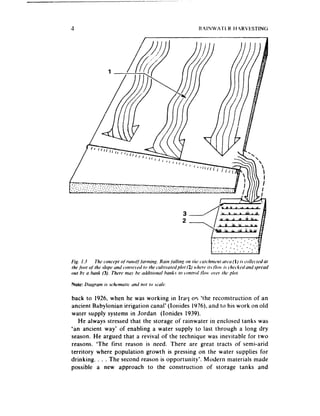
  1.3 illustrates one approach, where a channel dug across a hillside
  intercepts water running downslope during storms, and directs that water
RAINWATER       HARVESTING

                                            PLAN


                                    CROSS-SECTION


                                     0                  10m
                                     A
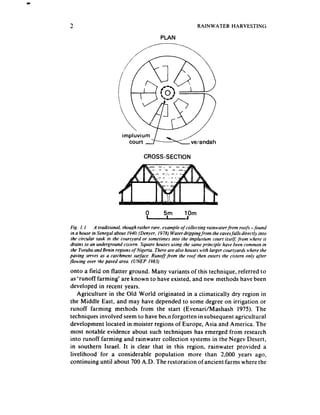
Fig. I. I    A traditional. though rather rare, example of collecting rainwater-from roofs -found
in a house in Senegal about 1940.(Denyer, 1978) Water drippingfrom the eavesfailsdirectly into
 the circular tank in the courtyard or sometimes into the impluvium court itselj: from where it
drains to an underground cistern. Square houses using the same principle have been common in
 the Yoruba and Benin regions of Nigeria. There are also houses with larger courtyards where the
paving serves as a catchment surface. Runoff from the roof then enters the ci.rtern only after
Jowing over the paved area. (UNEP 1983)
onto a fieid on flatter ground. Many variants of this technique, referred to
as ‘runoff farming’ are known to have existed, and new methods have been
developed in recent years.
   Agriculture in the Old World originated in a ckimatically dry region in
the Middle East, and may have depended to some degree on irrigation or
runoff farming merhods from the start (Evenari/Mashash 1975). The
techniques involved seemto have been forgotten insubsequent agricultural
development located in moister regions of Europe, Asia and America. The
most notable evidence about such techniques has emerged from research
into runoff farming and rainwater collection systems in the Negev Desert,
in southern Israel. It is clear that in this region, rainwater provided a
livelihood for a considerable population more than 2,000 years ago,
continuing until about 700 A.D. The restoration of ancient farms where the
TECNNKAL        PERSPECTIVES                                                                   3
techniques were used and the application of lessonslearned has made new
settlements possible in the desert, and has stimulated research elsewhere.
However, conditions in the Negev Desert are atypical, and techniques
developed there are not easily applicable in other regions, as will be
explained in Chapter 6. Runoff farming should not, therefore, be thought
of as genera!/” applicable in deserts and ‘arid’ regions. Other areas where it
has been successfulhave moister climates than these terms imply, though
not moist enough for reliable crop production without use of runoff.
   In North America, some notable rssearch on runoff farming has been
stimulated by realization that people living in what is now Mexico and the
south-western United States prior to European settlement had methods of
directing runoff water onto plots where crops were raised, thereby making
a productive agriculture possible in an otherwise unpromising, semi-arid
environment. In a few instances, similar systems are still used, and much
research has been devoted to elucidating their operation (see Chapter 6)
and in devising new but analogous methods of rainwater cohection, for
example, utilizing chemical soil treatments. There have also been
important innovations in Australia, where something like a million people,
mostly in remote areas, are today dependent on rainwater as their most
important (but rarely their only) source of supply (Perrens 1982). Other
work on rainwater collection techniques has been supported by the
Intermediate Technology movement in Britain, and it is from this that
the present book has stemmed. Again, ancient precedents were important.
The initiator of this work, Michael ionides, traced the origin of his ideas
              CROSS-SECTION                                           PLAN


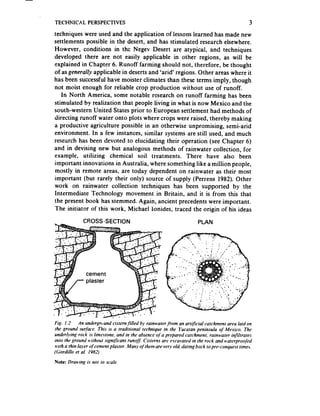
FiR. I.2     An undergn.und cistern/ilied by rainwater from an artificial catchment area laid on
the ground surface. This is a traditional technique in the Yucatan peninsula of Mexico, The
underi.ving rock is limestone, and in the absence of a prepared ratchment. rainwater infi,trates
mto the ground without .significant runofj Cisterns are e.wavated in the rock and waterproofed
wrth a thin layer q/cement plaster. Many of them are very old, dating back to pre-conquest times.
(Gordillo et al. 1982)
Note: Drawing is not to scale.
Note: Drugrant is schtvnuric und not to .wtk.

back to 1926. when he was working in Iraq or, ‘the reconstruction of an
ancient Babylonian irrigation canal’ (Iouides 1976).and to his work on old
water supply systems in Jordan (Ionides 1939).
   He always stressed that the storage of rainwater in enclosed tanks was
*an ancient way’ of enabling a water supply to last through a long dry
season. He argued that a revival of the technique was inevitable for two
reasons. ‘The first reason is need. There are great tracts of semi-arid
territory where population growth is pressing on the water supplies for
drinking. . . . The second reason is opportunity’. Modern materials made
possible a new approach to the construction of storage tanks and
TECHNICAL    PERSPECTIVES                                                   5

catchment surfaces, and could ‘open the way for a massive attack on a
problem which is becoming more and more acute as the years go by’.
   The collection of rainwater from roofs has been a common practice in
many moist climatic zones, not just in semi-arid areas. In Kenya, Indonesia
and elsewhere, use of water from roofs has sometimes been a particular
advantage at busy times in the farming year. There is most rainwater to
collect at the very seasonwhen people are working hardest on the land, and
have least time for carrying water from distant sources; thus even a small
rainwater tank may ease a seasonal labour bottleneck. There are also
islands a;ld other places with no rivers and no good groundwater sources,
and where rainfall is the only feasible means of providing a water supply.
   The technique of rainwater collection for domestic supply or runoff
farming, is essentially small in scale. It utilizes the roofs of individual
houses, or ground catchments, which, becausethey are small, maximize the
efficiency of runoff collection. Thus a scatter of small rainwater
catchments, each serving an individual farm, homestead or hamlet, is the
characteristic pattern. This implies an extensive form of development, in
contrast to the intemivr irrigation and hydropower potential of big dams
built on major rivers.
   Where large concentrations of population have to be supported,
intensive forms of development are inescapable, and must sometimes
include large dams and river basin projects. In such areas, rainwater
collection will have only a small role to play, perhaps complementirgother
water sources or giving individual families a private source of supply. By
contrast, on small islands and in a few other exceptional places where there
are no significant rivers, ingenuity has sometimes been used in devising
rainwater catchment schemes to supply substantial towns. Gibraltar has
one of the largest rainwater systemsin existence,and on both Gibraltar and
Bermuda, regulations compel householders to collect water from their own
roofs. In the iimestone districts of Jamaica, there are many small rainwater
supplies, some private and some communal.
   Despite these exceptions, when studying the socio-economic conditions
under which rainwater can be most effectively used, we are quickly brought
back to the semi-arid areas where rivers may be few or only seasonally
flowing, and where climatic conditions and environmental resources tend
to restrict settlement to a scattered, extensive pattern. In such areas,
rainwater collection offers its greatest technical advantage in terms of the
conservation of the scarce water resource. The fact that ‘it also fits the
settlement pattern so well tends to confirm its appropriateness.

DEFINING       RAINWATER          COLLECTION

The principle of collecting and using precipitation from a small catchment
area is often referred to as ‘rainwater harvesting’. This tertn derives from a
6                                                  RAINWATER     HARVESTING

more general name, ‘water harvesting’, first used in Australia by H. J.
Geddes to denote, ‘the collection and storage of any farm waters, either
runoff or creek flow, for irrigation use’. This nomenclature has since been
used very loosely, as if the collection of rainfall and all other water
harvesting amounted to the same thing. Yet in the above definition, water
harvesting includes stream flow in creeks and gullies, not just rainwater at
the point where it falls. Other definitions include water arising from all
kinds of precipitation, not just rainfall. This book deals only with water
running off surfaces on which rain has directly fallen, not with stream flow,
and utilization of this runoff will be referred to as‘rainwater collection’ (or
concentration). Something needsto bc said, however, about other forms of
precipitation. For example, in Afghanistan, the winter snow is sometimes
‘harvested’ by manually coiLsting and packing it into a deep watertight pit.
With the top sealed, the snow melts very slowly during the following
summer, and water is withdrawn from the bottom of the pit. However, this
book is concerned with countries where snow is a rare occurrence, so this
technique is not further considered.
    It is also sometimes said that dew and mist can usefully contribute to
water supplies. Having himself shaken enough dew off long grass for a
scanty morning wash, at least one of the present authors is not inclined to
dismiss the idea. In the Negev Desert, where mean rainfall is less than
 150mm, dew is equivalent to a further 20-30mm of grecrpitation. From this
general region comes the Biblical story about harvesting dew by spreading
a fleece on the ground in the evening. Next morning, enough dew could be
wrung from it ‘to fill a drinking cup’ (Judges 6:38). In a place in Africa
where the eavesof buildings are observed to drip in the early mornings after
a dew, it was estimated that a roof area of 29m2could yield 320 litres of dew
water in a year. An Indian publication suggestslining a small depression
with a plastic sheet and piling stones on this, so that dew forming on the
stones drips onto the plastic (CCSK 1983).
    However, the amounts of water which can be collected in these ways will
always be very small. Dew may sometimes contribute a little extra water to
a system designed for coilecting rainfall, but the number of situations
 where it is worth devising structures specifically to collect dew and mist will
 be rare indeed. The so-called ‘dew ponds’ of southern England were filled
 mainly by rainwater, and ground surface catchments were constructed to
drain into them. However, their linings, which were made by compacting
 clay over a layer of straw, favoured rapid cooling of the sides and bottom of
an empty pond at night, and hence some increased condensation of dew
 may have contributed very slightly to their contents.
    Because of the marginal relevance of snow and dew collection, this
 book deals only with precipitation in the form of rain, and particularly with
 rain close to the point where it is intercepted by the ground or by a roof. The
concern is with collecting rainwater before it has flowed very far over the
TECHNICAL    PERSPECTIVES                                                      7
ground, in order to avoid as far as possible the losses to which runoff is
subject. Stern ( 1978. 1979)points out that in the semi-arid regions within or
clost: to the tropics, runoff water from a small catchment may amount to
half the rainfall, even though only around 5 per cent of the rain may
ultimately enter a river system. This is because the smaller the catchment
area from which runoff water is collected, the less water is lost by
evaporation or interception in depressions. Shanan and Tadmor (1979)
observe that in the Negev Desert, watersheds of 300 to 500 hectares in
extent produce lessthan 3mm of runoff on average each year. By contrast, a
‘micro watershed’ of 0.02ha may produce to-30mm of runoff per year
depending on slope, shape of catchment, soil conditions and the intensity
of the storms.
   Analysing this in more detail Shanan and Tadmor consider three main
ways by which rain failing on a watershed is detained and ‘lost’. Firstly, it
may be intercepted by the leaves of plants growing on the watershed,
evaporating without reaching the ground. In a dry area, vegetation is
usually sparse,and interception lossesare likely to be lessthan 2 per cent of
rainfall. In a moist area with more vegetation, they may be more than
5 per cent.
   Secondly, as already noted, runoff accumulates in any depression on the
watershed to form puddles. On steep slopes, this may happen to only a
small extent. On flatter land, there will usually be many large puddles after
a storm, and where these are observed it may well mean that around 2-4mm
of rainfall from that storm is accounted for by ‘depression storage’.
    The third way in which runoff is diminished is by infiltration into the soil.
At the beginning of a storm, the dry soil may absorb all the rain that
 reachesit. However, somesoils crust over under the impact of raindrops, in
 which case, infiltration diminishes almost to nothing, and runoff begins
quite quickly. Even with soils which do not form a crust, the infiltration
 rate diminishes considerably once the surface has been thoroughly wetted.
    Much therefore depends on local conditions. Moreover, infiltration
 occurs at a faster rate in hot weather than in cold; it is affected in complex
 ways by stones on the watershed, and usually reduced quite considerably if
 vegetation is removed.
    Referring to the comparison made earlier between small (0.02ha) and
 large watersheds, one may comment that the proportion of rainfall lost due
 to interception by vegetation is likely to be independent of catchment size,
 whereas the proportion accounted for by depression storage and infiltration
 will tend to become greater the further the runoff flows across the ground
 surface. It may perhaps be added that while a small watershed is a more
 efficient collector of rainfall, in areas where showers are very localized and
 precipitation is patchy, a large catchment area may sometimes produce
 runoff on occasions when individual small watersheds do not receive
 rain at a!!.
8                                                 RAINWATER     HARVESTING

    It needsto be made clear that the rainwater collection methods discussed
in this book are mainly (but not exclusively) concerned with smalt
catchment areas or watersheds. To establish the distinction between
techniques relevant with these applications and other forms of water
harvesting, it is useful to consider the following example. In Yemen, when
rains fall in the mountains, which rise to 2,50Om, torrents of water rush
down steep valleys, or wadis, towards the Red Sea. Much of the water soaks
into the sandy soil of the coastal plain and evaporates, but a proportion is
diverted onto fields, where enough infiltrates the soil in most years to
support a crop. Some of the diversion structures used are again very
ancient, and this type of irrigation may have been practised in the area for
3,000 years. However, the water is only utilized in this way after it has
flowed some distance as a well-defined stream, and after some has already
been lost. It is a method which fits the general definition of water
 harvesting, and may be appropriately described as ‘floodwater harvesting’,
 or ‘spate irrigation’. But if the same water were to be collected asrainwater,
 this would be a matter for people living in the mountain areas where the rain
 falls. They could collect water from house roofs, or from small areas of
 ground whose slope and surface are suited to a high rate of runoff into an
 excavated tank, or onto cultivated terraces, and all these techniques are in
 fact used to an extent. But clearly, the latter are very different techniques
 from those involved in using floodwater far down the wadis.
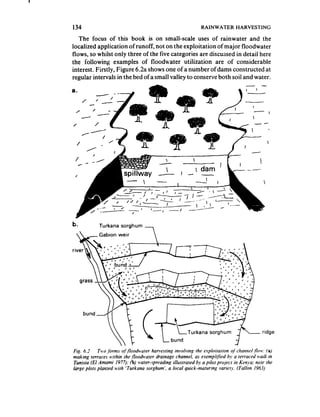
     Typically, floodwater flows are collected behind dams or by means of
 diversion weirs. In many semi-arid areas, sand accumulates in the beds of
 the larger ephemeral streams, and a flow of water persists in the sand long
 after the Roodwaters have subsided. These ‘sand rivers’ are regularly
 exploited by the inhabitants of semi-arid areas, often simply by digging a
 hole in the dry river bed to reach the water. Such supplies may be improved
 by constructing subsurface dams in stream beds to hold back the flow in
 the sand, or by constructing silt-trapping dams across gullies. Ail these
 techniques, together with more conventional means of using dams and
 bunds to hold back floodwater, come into the general category of water
 harvestirtg. None of them, however, may be described as rainwater
 collection.
     Shanan and Tadmor imply a very specific way of defining the distinction
  between rainwater collection and the harvesting of floodwater flows. They
  point out that when rain is falling on a small catchment, water will move
 downslope in a sheet of roughly even depth, often described as ‘overland
  flow’. Some distance from the top of the slope, however, as the sheet flow
  becomes deeper and swifter, turbulence and erosion of the soil surface
  begins, and the water tends increasingly to flow in rills. In one case
  anatysed, the transition from sheet Row to turbulent flow occurred 90m
  from the top of the slope and more generally we can expect it within 50-
   15Omof the top of a gentle (1 per cent) slope.
TECHNICAL    PERSPECTIVES                                                     9
    In runoff farming, a careful balance has to be struck between the
efficiency of a catchment in producing runoff and its susceptibility to
erosion. While it is always possible to increase runoff by clearing slopes of
vegetation and compacting the surface, the dangers of this leading to erosion
are greater with longer slope lengths and steeper gradients. The precise
distance downslope at which erosive flow begins not only depends on the
gradient, though, but also on the soil, the intensity of the rain and many other
environmental conditions. In designing catchment systems, a considerable
margin of safety is needed to allow for unusually intense storms, and with
‘microcatchments’ in their local desert environment, Shanan and Tadmor
specified a maximum siope length of 25m on a 1 per cent slope, and 14m
with a 3 per cent incline. For the purpose of definition rather than design,
however, the SCm-150mslope length can be taken to differentiate rainwater
collection from other ways of manipulating runoff or harvesting floodwater.
    In the work described by Shanan and Tadmor (though not in the
programmes discussed in Chapters 6 and 7 below), the microcatchment is
the most characteristic method of using rainwater directly to support
growing crops. It must be explained, then, that this term refers to a bare
 catchment area on a gentte.slope demarcated by a low bank or bund. The
 catchment has a small cultivated plot at its lowest point, watered by runoff
 from the whole area. The collection of sheet flow or overland flow,
 *differentiates the design of microcatchments’ from the design of runoff
 systems in which water is utilized, ‘after it has collected in channels’.
    To summarize these points, rainwater collection is defined here so that it
 comprises the harvesting of runoff only on the basis of what might be
 called ‘microcatchment principles’, that is runoff from:
   0 roofs;
   l artificial surfaces at ground level:
   0 tand surfaces with slopes less than 50-150m in length.
   In practice, however, there is no easydistinction between runoff farming
on short and long slopes. A more practical distinction is between runoff
from within-Jie/rl catrhmenrs and external catcitmenr.s. The first category
refers to systems where patches (or strips) of catchment area alternate with
cultivated plots inside the field boundary. The most common version is
where strips of bare ground are aligned with the contour, and runoff from
these areas is used by growing crops on parallel, cultivated strips. On
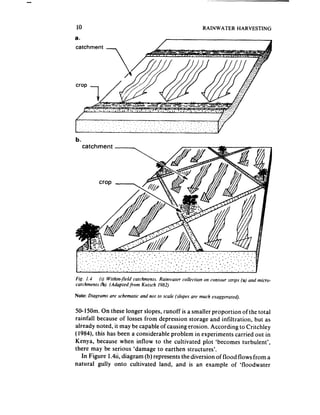
steeper slopes, the cultivated strips become terraces. Figure 1.4 compares
this arrangement - in diagram i(a) - with other runoff farming methods.
Microcatchments - in diagram i(b) - are also within-field catchments, in
contrast to the external catchments shown in both parts of Figure 1.4ii.
Within-field catchments invariably have short slope lengths and conform
with the definition of rainwater collection given above. External catch-
ments. by contrast, often (but not always) have slope lengths greater than
-


    IO                                                         RAINWATER      HARVESTING

    a.
    catchment -


    b.


    Fig. 1.4 (I) Within-fieM ca!chmennrs.Rainwater collection on conwar strips (a) aud micra-
    cafchmenrs b). (Adapredfrom Kursch 1982)

    Note: Diagrams are schematic and not IO scale (slopes are much exaggerated).


    50-150m. On these longer slopes, runoff is a smaller proportion of the total
    rainfall because of losses from depression storage and infiltration, but as
    already noted, it may be capable of causing erosion. According to Critchley
    (1984), this has been a considerable problem in experiments carried out in
    Kenya, because when inflow to the cultivated plot ‘becomes turbulent’,
    there may be serious ‘damage to earthen structures’.
       In Figure 1.4ii, diagram (b) represents the diversion of flood flows from a
    natural gully onto cultivated land, and is an example of ‘floodwater
12                                               RAINWATER    HARVESTING

CLASSIFYING        TECHNIQh:ES         AND USES

With these definitions in mind, +‘t’ cat examine the uses of rainwater in
more detail. It is tempting to think ofjust two contrasting applications. In
one, water from a house roof is collected in a tank owned by the household
and is used for drinking and cooking. The other is exemplified by the
various runoff farming and microcatchment techniques. In these latter
systems, the soil of the cultivated areas itself provides the storage medium,
and water is abstracted directly by the plants’ roots.
   We can get a better perspective. however, by thinking briefly about the
whole range of water sourceswhich might conceivably be used for domestic
or agricultural purposes. If the water sourcesavailable are rivers on the one
hand or wells on the other, relevant techniques are clearly outside the
scope of this book, as Figure 1.5 indicates. When it comes to surface runoff,
the preceding paragraphs make a distinction between turbulent, erosive
runoff from long catchments (which raise problems of soil conservation)
and sheet runoff from short catchments. Figure 1.5 shows this further
subdivision and indicates how the scope of this book is chiefly limited to
application of sheet runoff, whilst recognizing that with most types of
runoff farming (except microcatchments), there is some overlap between
short and long catchments.
    However, it would be wrong to make too sharp a division between
domestic and agricultural applications, or between rc*cf and ground
surface catchments. Sometimes water from roofs is used to irrigate crops, if
only on a garden scale. An example is a house in Botswana which has two
 rainwater tanks. One stands on the ground and collects water directly from
the roof to provide water for drinking and cooking. The other is an
excavated tank filled by overtlows from the first tank as well as by runoff
 water from hard ground near the house. This tank is used to provide small
amounts of water for the garden, as well as some water for washing and
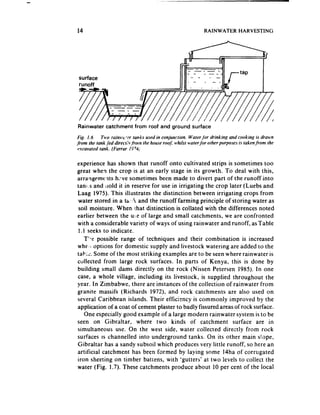
laundry. The principle is illustrated by Figure 1.6, which shows a slightly
improved version of its application.
    In other situations, especially where a larger supply is required than a
single roof can provide, a ground surface catchment may be fenced to
prevent contamination by livestock and may then produce water for
domestic purposes. Thus one cannot say that roof catchments are
associated solely with the domestic use of rainwater and ground surface
catchments with its agricultural use. Nor can one totally separate systems
which store water in the soil for use by growing crops from systems
employing tanks or cisterns for storage. At one particular farm in the Negev
 Desert investigators found a conduit carrying water from a hiilside
clstchment which had two branches, one supplying a cistern within the
farmhouse, and the other discharging onto the fields.
    Another example is reported from the southern United States where
TECHNICAL       PERSPECTIVES                                                  13

                               SOURCE OF WATER
                                --


                                                               SHEET RUNOFF


   FLOODWATER          HARVESTING:


  byamy       season                    I spate irr


       external catchments
       RUNOFF
       FARMING
                             lwv---l                      n
       (see Chapter 6)


   1 conyentlonal       1 lnundat Ion                 I
   I met hods           1 methods
                                  -1         d


   1 mainly
14                                                           RAINWATER        HARVESTING


 surface


Rainwater     catchment     from roof and ground surface
 Fig. I.6   Two rains ‘t-t- rut&s used in conjuncrion. Wuler for drinking and cooking is drawn
from the tank fed direct,‘v.from the house rooJ nlilsr wterfor other purposes is taken from the
 excavated tank. (Farrar 1974;

experience has shown that runoff onto cultivated strips is sometimes too
great when the crop is at an early stage in its growth. To deal with this,
arrangements h;*ve sometimes been made to divert part of the runoff into
tani..s and ilold it in reserve for use in irrigating the crop later (Luebs and
Laag 1975). This illustrates the distinction between irrigating crops from
water stored in a ta’,% and the runoff farming principle of storing water as
 soil moisture. When ,ihat distinction is collated with the differences noted
earlier between the u:,e of large and small catchments, we are confronted
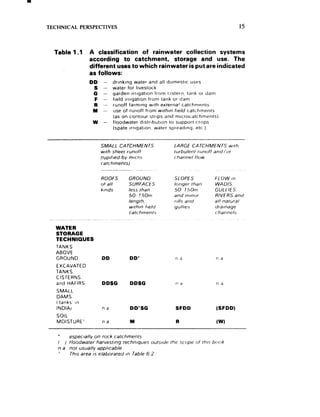
with a considerable variety of ways of using rainwater and runoff, asTable
 1.1 seeks to indicate.
   T’Y possible range of techniques and their combination is increased
whe:i options for domestic supply and livestock watering are added to the
tabi:. Some of the most striking examples are to be seenwhere rainwater is
collected from large rock surfaces. In parts of Kenya, this is done by
building small dams directly on the rock (Nissen Petersen 1985). In one
case, a whole village, including its livestock, is supplied throughout the
year. In Zimbabwe, there are instances of the collection of rainwater from
granite massifs (Richards 1972), and rock catchments are also used on
several Caribbean islands. Their efficiency is commonly improved by the
application of a coat of cement plaster to badly fissured areasof rock surface.
   One especially good example of a large modern rainwater system is to be
seen on Gibraltar, where two kinds of catchment surface are in
simultaneous use. On the west side, water collected directly from rock
surfaces IS channelled into underground tanks. On its other main slope,
Gibraltar has a sandy subsoil which produces very little runoff, so here an
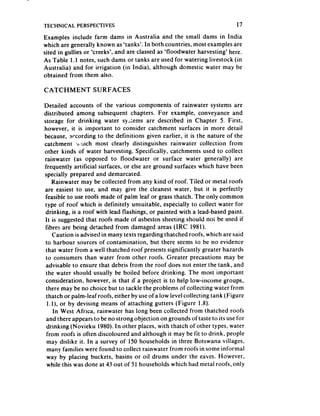
artificial catchment has been formed by laying some 14ha of corrugated
iron sheeting on timber battens, with ‘gutters’ at two levels to collect the
water (Fig. 1.7). These catchments produce about 10 per cent of the local
TECHNICAL          PERSPECTIVES                                                                              15


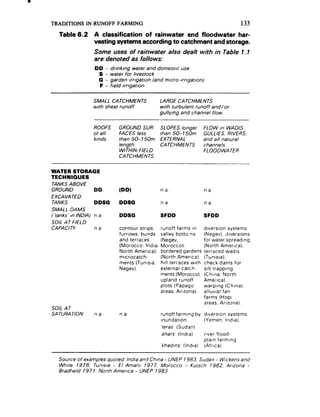
  Table 1 .l          A classification    of rainwater     collection  systems
                      according     to catchment,     storage     and use. The
                      different uses to which rainwater is put are indicated
                      as follows:
                      DD      -    drlnktng        wafer      and all dornesttc        uses
                        S     -    water    for llvestock
                        G     -    garden       lrrlgatlon         from c:Istern.    tank or dam
                        F     -    field lrrlgatlon          from tank or dam
                        R     .-   runoff     farmlng         wrth exrema!        catchments
                       M      --   use of runofl           from w/!hrn       field catchments
                                   (as on contour              strips   and mlcrocatchments)
                       W      -    floodwater          dlstrlbutlon       to support      crops
                                   (spate     trngation.          water   spreading.      etc )


                            SMALL CATCHMENTS                            LARGE CA TCHMEN JS w/rh
                            wrfh sheet runoff                           turbulent runoff andior
                            (rypifled by micro                          channel flow
                            carchmenls)


                            ROOFS           GROUND                      SLOPES                     FLOW jr:
                              all
                            <If             SURFACES                    longer rhan                WA DtS.
                            kmds            less than                    50 1 SOm                  GULLIES.
                                            50- ? 50rn                  and manor                  RIVERS and
                                            length.                     rills and                  all narural
                                            wlthrn fletd                gullies                    drainage
                                            carchmenr.r                                            channels


   WATER
   STORAGE
   TECHNIQUES
   TANKS
   ABOVE
   GROUND                   DD               DD’                         ri 3                      I1 a

   EXCAVATED
   TANKS,
   CISTERNS
   and HAFIRS               DDSG             DDSG                        rI a                      fl   a

   SMALL
   DAMS
   (‘tanks’   In
   INDIA)                    na              DD’SG                       SFDD                      (SFDD)
   SOIL
   MOISTURE’                 na              I                           R                         w

    .   espec@ttv on rock catchments
    ( ) floodwater   harvesting  techntques   outside                 the scope      of IDIOTbook
    n a nor usually applicable
    1    Thts area IS elaborared   In Table 6 2
RAINWATER     HARVESTING

                                                                   Rock Gun


    rainwater catchment areas
    East side (14ha)


community’s potable water requirement, the rest being obtained from
groundwater. desalination and importation (Doody 1980).
   Elaborate rainwater catchments such as this are only justified when the
need is for a domestic water supply and other sourcesare very limited. On a
smaller scale, the cisterns or tanks which collect water from house roofs are
also relatively costly and arejustified chiefly when the water is used for high
priority domestic purposes. Excavated cisterns, suitably lined with cement
plaster or other impermeable material, can be cheaper and may collect
large volumes of water from ground surfaces. As with the example in
Figure 1.6. such tanks are well suited to purposes with lower priority than
drinking water - such as laundry, watering gardens, or providing for
livestock.
   Small dams are often built for collecting water from the larger types of
catchment, where the volume of water is too large for storage in a tank.
TECHNICAL    PERSPECTIVES                                                   17
Examples include farm dams in Australia and the small dams in India
which are generally known as ‘tanks’. In both countries, most examples are
sited in gullies or ‘creeks’, and are classed as ‘floodwater harvesting’ here.
As Table 1.1 notes, such dams or tanks are used for watering livestock (in
Australia) and for irrigation (in India), although domestic water may be
obtained from them also.

CATCHMENT          SURFACES

Detailed accounts of the various components of rainwater systems are
distributed among subsequent chapters. For example, conveyance and
storage for drinking water syLems are described in Chapter 5. First,
however, it is important to consider catchment surfaces in more detail
because, according to the definitions given earlier, it is the nature of the
catchment b l.lich most clearly distinguishes rainwater collection from
other kinds of water harvesting. Specifically, catchments used to collect
rainwater (as opposed to floodwater or surface water generally) are
frequently artificial surfaces, or else are ground surfaces which have been
specially prepared and demarcated.
     Rainwater may be collected from any kind of roof. Tiled or metal roofs
are easiest to use, and may give the cleanest water, but it is perfectly
feasible to use roofs made of palm leaf or grass thatch. The only common
type of roof which is definitely unsuitable, especially to collect water for
drinking, is a roof with lead flashings, or painted with a lead-based paint.
It is suggested that roofs made of asbestos sheeting should not be used if
Iibres are being detached from damaged areas (IRC 1981).
     Caution is advised in many texts regarding thatched roofs, which are said
to harbour sources of contamination, but there seems to be no evidence
 that water from a well thatched roof presents significantly greater hazards
 to consumers than water from other roofs. Greater precautions may be
 advisable to ensure that debris from the roof does not enter the tank, and
 the water should usually be boiled before drinking. The most important
consideration, however, is that if a project is to help low-income groups,
 there may be no choice but to tackle the problems of collecting water from
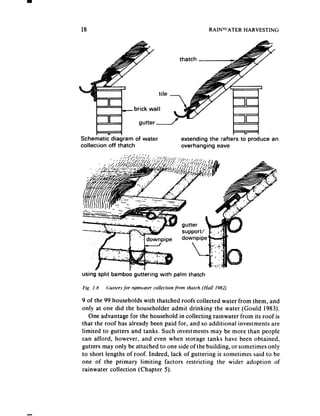
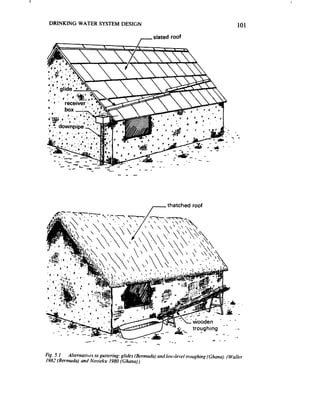
 thatch or palm-leaf roofs, either by useof a low level collecting tank (Figure
  I.I), or by devising means of attaching gutters (Figure 1.8).
      In West Africa, rainwater has long been collected from thatched roofs
 and there appears to be no strong objection on grounds of taste to its usefor
 drinking (Novieku 1980). In other places, with thatch of other types, water
 from roofs is often discoloured and although it may be fit to drink, people
 may dislike it. In a survey of 150 households in three Botswana villages,
  many families were found to collect rainwater from roofs in some informal
 way by placing buckets, basins or oil drums under the eaves. However,
 while this was done at 43 out of 51 households which had metal roofs, only
18                                                             RAIN’“ATER   HARVESTING


                            gutter -

Schematic diagram of water                       extending the rafters to produce    an
collection off thatch                            overhanging  eave


using split bambob guttering           with palm thatch

Fig. I. x   Purrers ji7r ruinwurer collecrion jimr   rhurch. (Hull 1982)

9 of the 99 households with thatched roofs collected water from them, and
only at one did the householder admit drinking the water (Gould 1983).
   One advantage for the household in collecting ramwater from its roof is
that the roof has already been paid for, and so additional investments are
limited to gutters and tanks. Such investments may be more than people
can afford, however, and even when storage tanks have been obtained,
gutters may only be attached to one side of the building, or sometimes only
to short lengths of roof. Indeed, lack of guttering is sometimes said to be
one of the primary limiting factors restricting the wider adoption of
rainwater collection (Chapter 5).
TECHNICAL    PERSPECTIVES                                                  19
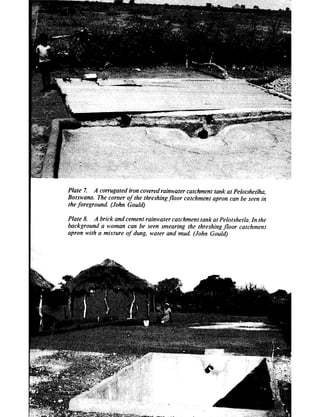
  The collecting of rainwater from ground-level catchments is sometimes
possible using a hard surface created for some other purpose. School
playgrounds and threshing floors have both been used in Botswana. More
usually, though, a catchment area or watershed is developed for rainwater
coiisction by applying some more specific form of treatment to the ground
surface. UNEP has proposed a classification of surface treatments which,
with one addition, is as follows:

  l clearing sloping surfaces of vegetation and loose material;
  l improving vegetation management by planting with different species
    or by cropping;
  a mechanical treatment of the soil, including smoothing and
    compacting the surface, as on contour strips and microcatchments;
  l making a hard surface using traditional soil stabilization techniques
    (as used on Botswana threshing floor catchments);
  l reducing soil permeability by application of chemicals (e.g. sodium
    salts);
  l applying chemical binders such as asphalt to seal the surface;
  o covering the catchment with conventional paving materials;
  l covering the catchment with other rigid materials;
  l covering the catchment with flexible/plastic material.


Most of these techniques fall into one or other of two main groups -
firstly, those which involve treutment of the soil itself, either mechanically
or with chemicals, to reduce infiltration by rainwater and achieve greater
runoff, and secondly, those which entail covering the soil witir another
material, as with the last three items in the list (compare Table 3.1 in
Chapter 3).
   As regards treatment of the soi!, much research has been carried out in
the United States on substances which can be mixed with, spread or
sprayed over the soil (Frasier 1975). Experiments have been made with
sodium salts (which encourage surface crusting on soils containing clay);
with silicones (which are water repellent); and with oil, paraffin wax,
bitumin or asphalt (which bind soil particles together), The sodium
treatment is cheap but may not last for more than a year and can lead to
increased soil erosion. The other methods tend to be expensive, though
most are less costly than such alternatives as covering ground surface
catchments with plastic sheeting, butyl rubber, or even aluminium foil, all
of which have occasionally been tried (Maddocks 1975).Not only is the use
of these last materials expensive, but unlesssupervision and maintenance is
meticulous, their durability is not good -weed growth from below or stray
animals can easily puncture surfaces.
   More significant than research findings with the materials is to notice
what is done in practice. Where public water supply is an urgent need and
20                                               RAINWATER    HARVESTING

ample funds are available, ground catchments have been successfully
surfaced with smooth concrete, butyl rubber or plastic sheet. These
materials are now used in preference to corrugated iron catchments of the
Gibraltar type for economic reasons. Butyl rubber, which also makes a
good lining for excavated storage tanks, may be the most widely usedof the
modern materials. On Hawaii, over 300 butyl catchments and reservoirs
have been constructed. Plastic sheeting - usually black polythene - has
been less successful becauseof its vulnerability vhen exposed to wind and
sun. One method of countering this has beento cover the plastic catchment
surface with a 3cm layer of pea-sized gravel. Less runoff is obtained, but
there is a marked gain in durability and encouraging results have been
reported, for example, from trials in Jamaica.
   Where a ground catchment must fill a farm pond from which livestock
drinking water is supplied, or where it supports the cultivation of crops by
runoff farming methods, plastic surfaces are rarely used except on a very
small scale. In Australia, for example, rainwater harvesting is widely
practised on farms, but one commentator emphasizes that the technique is
used by ‘commercial farmers’ and must therefore be ‘economically
attractive’ (Laing 1981). This excludes most exotic materials, and means
that improvement of catchment surfaces to obtain greater runoff must
depend very largely on earth forming, smoothing and compaction.
   One particularly notable Australian technique was developed by
analogy with road-building and is referred to as the ‘roaded catchment’.
The point is that a well-constructed highway must have a camber and
surface capable of disposing of rainwater quickly into the roadside drains.
If a small catchment is covered with a seriesof parallel, cambered roadways
surfaced with smooth, compacted soil, ditches laid out between them can
collect rainwater and discharge it into a suitable storage reservoir. Early
results were highly satisfactory, especially on clay or clay-loam soils, and
since the 1950s.roaded catchments have been wideiy adopted in Western
Australia. Individual catchments of 2-4ha have been constructed for
livestock water supply, and larger ones are also to be seen,some over 40ha.
   With mechanical earth-moving equipment needed for construction,
roaded catchments may not be immediately applicable for low-income
developing communities, where it might make more sense to look at
traditional technologies, at least for small catchments. For example, in
 Botswana, the ground within household compounds is surfaced with a
clay/cow-dung mixture which can be smoothed to form a hard, polished,
impermeable surface from which some provision for rainwater drainage
has to be provided. As already noted, threshing floors made this way have
recently been utilized as catchments. In other countries, various mixtures
of soil with clay, lime, dung or even cassavaflour are used as ‘cements’ for
sealing flat roofs as well as making floors, and these traditional soil
stabilization techniques deserveto be better appreciated. Where c<)w-dung
TECHNICAL    PERSPECTIVES                                                  21
is used, it is probably inert by the time floor surfaces have dried thoroughly,
and is not a source of contamination.
   In many places, ground catchments must be made at low cost and with
very basic techniques. Sometimes all that can be attempted on a large
catchment is the filling of obvious depressions, and construction of banks
or bunds to divert runoff into storage, or to retain it on cultivated land.
Even so, 20 to 30 per cent of rainfall may often be collected as runoff. In
low-rainfall areas where the priority is to maximize runoff, vegetatier?may
be completely removed. Where rainfall is higher, control of erosion is often
 more important and trees or grassare planted on catchments (as sometimes
in India). Where it is possible to obtain sufficient runoff from grassed
catchment areas, they may be used by grazing animals, though of course:
this would not be considered where the water is for domestic use because
animals are invariably a source of contamination, and so are fertilizers if
they are used.
    Here an important distinction can be made between multi-purpose and
single-purpose catchment surfaces. The roof of a house is designed
 primarily to provide shelter and privacy. Sometimes it is also a status
symbol. Flat roofs in some countries are used for sleeping, storage and
 drying clothes. Thus when a roof is used to collect water, it is very much a
 multi-purpose structure, and may serve some purposes which conflict with
 requirements for rainwater collection, especially regarding contamination.
 Other examples of multi-purpose catchments, apart from those used for
 grazing, include school playgrounds and public roads. Most catchments of
 these kinds are appropriate only for agricultural (or industrial) application,
 not for domestic supply.
    These points about how catchments are used. and more generally, about
 how rainwater is applied, make it clear that rainwater collection is not
 something that can be analysed in a purely technical manner. Its relevance
 in any situation depends critically on whether it is compatible with other
 economic and domestic activities, on whether people have the organization
 necessary to build and maintain the system, whether they have adequate
 housing, and above all. whether they regard a water supply of’this kind as a
 high priority. Many of these factors arise from the way in which the people
 obtain their livelihood, and that must be a central concept in any
 examination of where and how rainwater collection techniques have most
 to offer.
2. WATER, LIVELIHOOD                          AND
   ORGANIZATION

THE GEOGRAPHICAL               RELEVANCE         OF RAINWATER

All water resources are limited, but the nature of the limiting factors
varies greatly from one part of the world to another. The relatively low
proportion of rainfall reaching river systems in climatically dry regions is
one factor already mentioned. Groundwater is much favoured for drinking
water supplies becauseof its freedom from contamination, but in the more
arid parts of the world, potable groundwater is not always available.
Sometimes it can be found, but is too salty for human consumption. There
are also ‘extensive areas in Africa, the drier parts of South America, the
Indian sub-continents and many islands in the sub-tropics where ground-
water can be found but the recharge rate of wells is inadequate to meet
demands’ (Stern 1982). It may also be very deep, and hence costly to
exploit, and to pump. Not surprisingly, places where rainwater collection
has been most fully applied are frequently in regions where these other
water resources are inadequate. However, sceptics are quick to point out
that rainwater collection has limitations also, noting the questionable
 reliability of a system dependent on erratic rainfall, and the diseconomies of
 scale associated with rainfall storage when each household acquires its own
 small storage tank. As regards reliability, in almost no circumstances can
stored rainwater be regarded as the sole source of supply. At some times,
 and for some purposes (such as laundry or garden irrigation), other water
 sources will have to be used. But for the individual household which wants
 the convenienceof its own supply under its own control, and often for whole
 communities where the area lacks rivers or groundwater, the possibility of
 developing rainwater collection systems can be very attractive.
    Islands may have water supply problems simply becausethere are no large
 catchments from which rivers can flow or aquifers can be recharged, Coral
 islands have highly permeable ground from which there is no runoff.
 Bermuda is notable as an island on which rainwater collection has been
 particularly well developed, and so is the quasi-island of Gibraltar. In both
 places, water is collected from the roofs of all households as well as from
 large corporately managed catchments (Figure 1.7) But even so, rainwater
 is not the sole source of supply. Seawater or brackish groundwater is used
LIVELIHOOD    AND ORGANIZATION                                               23
for secondary purposes, and desalination plant has been introduced.
Furthermore, during periods of drought, water has been imported by ship.
There are other islands, including several in the Pacific and Caribbean
regions, where rainwater is an important source for drinking water supplies
but where technologies for its collection are lessadvanced (Fujimura 1982,
Layton 1984).
    Places where geological conditions have so limited other sources of
supply that rainwater collection is strongly emphasized include parts of
Nova Scotia (Canada), Jamaica, Java (Indonesia) and the Yucatan
Peninsula of Southern Mexico. In the three latter areas, the underlying
 rocks are permeable limestones, whilst in Nova Scotia, and also in West
Java, the high mineral content of the groundwater makes it unfit to drink.
    Climatically dry areaswhere rainwater is collected, not only for domestic
supplies but for watering livestock, for runoff farming and evensometimes
for irrigation, include much of Australia, parts of India, the Middle East,
North Africa, parts of East Africa, Mexico and the south-western United
States. These areas constitute a large proportion of the earth’s surface with
 a fairly large (if thinly dispersed) population, often dependent on raising
 livestock, and they will be a considerable preoccupation in this book.
    In all such areas, rainwater collection is frequently the&leastcost’ form of
 water supply, largely becauseof the high cost of alternatives. Even where
 this cannot bc claimed, it may bc easier to mobilize household capital for a
 family rainwater tank than to secure large-scale investments in public
 supplies. Moreover, in some regions generally well-endowed with low-cost
 supplies, rainwater collection may fill a gap in existing provision. It may be
 that the quality of the water is advantageous for washing (where public
 supplies provide hard water), or for drinking (where borehole water is
 slightly brackish). Or in moist tropical climates, there is sometimes a
 particular season when work pressuresand water needs are both critical,
 and the convenience of having a household tank of rainwater is very great.
 Rainwater collection may also have some insurance value against failure of
 other sources. Even in England there are some regions where water
 authorities encourage householders to store rainwater from roofs for USC     in
 times of drought, when watering gardens from the public supply may be
 prohibited (SW W 1984).

DISSEMINATION            OF TECHNIQUES

With so many examples of the advantageous use of rainwater, it is puzzling
to some commentators that there are still numerous villages in Asia, Africa
and Latin America which experience desperate water shortages but where
no effort appears to be made to exploit the rainwater resource. Equally,
there are many areas where it might seem that agriculture could benefit
greatly from runoff’ farming techniques. One reaction has been to carry out
24                                                RAINWATER     HARVESTING

more research to improve the performance of available techniques or
reduce their cost. Efforts have a’so been devoted to making more technical
information available, and yet the spread of techniques still seemspainfully
slow. Three possible reasons for this situation need to be explored.
     Firstly, although progress in organized projects for disseminating
rainwater collection has been disappointing, it sometimes turns out that
more people are collecting water from roofs or using runoff farming
methods than is generally realized. Often they employ techniques which are
informal or inconspicuous, or the spread of a new technique has been
promoted by local craftsmen and traders whose activities have not been
recorded. The latter is true in parts of Kenya, for example, where quite
significant numbers of households have acquired tanks to collect roof
 runoff on their own initiative. Thus it may simply be the official version of
 rainwater collection which spreads slowly. Local people may have their
own approaches - as later chapters will explain.
     Secondly. it needs to be noticed that much of the research done on
 rainwater collection has been of a purely technical kind. There has been
 relatively little investigation of the processes by which a successful water
 tank construction project might be ‘replicated’ or ‘extended’, spreading
 from one village to another over wide areas. Such processes not only
 involve the spread of information, but also depend on village organization,
 on the organization of support services and technical assistance, and on
 manpower, skills, money and material resources. These various aspectsof
 the extension or replication process are well illustrated by programmes in
 Thailand and Indonesia and in publications influenced by them (Fricke
  1982, Keller 1982), and are discussed in Chapter 4 of this book.
     Thirdly, however, it is necessary to consider a facet of the culture of
 western technology which is sometimes hard to recognize and face up to -
 that our enthusiasm for the ingenuity of a technical device, or its
 performance under test, can often mislead us into believing that it is more
  relevant than is really the case. There is a distinct danger that we begin to
  interpret people’s needs or to study environmental circumstances very
 selectively, examining only those facets of a problem which the favoured
  technique might remedy, and neglecting other aspects which ought to rule
  it out.
     With regard to runoff farming in the Negev Desert, for example, nobody
  can fail to be impressed by techniques which allow crops to be grown
  wihout conventional irrigation, solely by using the low desert rainfall of
  lessthan 1SOmmper year. The old vision of the desert blooming as the rose
  seemswithin reach, and in our enthusiasm, we naturally think of the many
  other desert areas of the world which could be reclaimed for agriculture.
  Yet the Negev version of runoff farming is unusual both in the
  environment;il niche it exploits (rainfall in a cool, winter growing season)
  and in its socral and cultural origins. Thus, most fieldworkers attempting to
LIYELIHOOD    AND ORGANIZATION                                              25
apply the Negev techniques in other areas have had to modify them
considerably or even abandon the attempt altogether (see Chapter 6).
    Often our commitments to research and to particular innovations leave
us open to the criticism that we find solutions first and then search for
problems they may fit. Thus the nature of ‘world hunger’ and malnutrition
has sometimes been misrepresented to suit the particular forms of
agricultural innovation or ‘food aid’ that the West had to offer. And
there is a similar danger of misrepresenting the special problems of semi-
arid regions in Africa and elsewhere, in order to suit the particular
techniques and patterns of organization favoured by western agencies.
Rainwater technologies have long been used by the inhabitants of these
regions and so are undeniably relevant - but there is still need to be wary
of imposing alien and inappropriate versions.
    For example, in semi-arid areas of Africa where pastoralism is the chief
means of livelihood, traditional ways of using rainwater are by means of
excavated cisterns, ‘hafirs’ (from the Arabic hufra), small dams and
natural water holes. For African pastoralists south of the Sahara, natural
water holes are probably most important, although small artificial
excavations are also common. But in western Sudan and parts of Ethiopia
and Kenya, the much larger hafir is used for collecting rainwater for all
purposes.
    Typically. hafirs are located on land with very gentle slopes where there
 are no well-defined drainage channels or sites for small dams. Thus a hafir
 has to be created by excavation, the spoil being used to build a bund around
 its perimeter (Figure 2. I). Long bunds extending upslope are also usually
 necessaryto direct sheet runoff into the hafir. In small hafirs, livestock may
 gain accessto the water by wading in at the inflow side, but this leads to
 erosion and rapid silting, and it is preferable for animals to be watered via a
 well and suitable drinking troughs, as indicated in the diagram. A further
 refinement is for inflow of water to be via a silting basin from which a pipe
 leads into the hafir; in this case,the bund may extend round all four sidesof
 the excavation. The capacity of’a hatir may be as little as 1,500m1,e.g. in the
 Ogaden region of Ethiopia, or as much as 200,000m3 in Sudan. In
  Botswana, where hafirs were introduced around 1970,a typical capacity is
 9,OOOm(Classen 1980).
    Sandford (1983) notes that in the areas where traditional hafirs and
 cisterns were most highly developed, drinking troughs and other arrange-
 ments for distributing water to livestock were carefully planned and rules
 for maintenance and use of rhese water sources were meticulously
 enforced. Guards might be posted at hafirs, for example, which would be
 carefully fenced. He notes that such provision is neglected in many modern
 installations. In north-east Kenya, one result has been that of 100 hafirs or
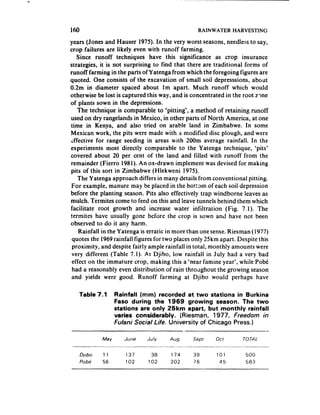
 ‘hafir-dams’ built after 1969, most had silted up ten years later. At some of
 them, maintenance was adequately managed by local herdsmen for so long
26                                                             RAINWATER       HARVESTING


     a.


                                                                                  scale
                                                  V’
                                                          fl
                                                           1
                                                                        ‘?m,       , , 5CXIm
                                                                                        , ,


                                                          -outlet              well

                                              ‘spillway

                                          PLAN


b.


                                PERSPECTIVE        DRAWING

F1.q.2. I  Plan (a) and perspective view (5) of a Somali ‘hafir’ (or ‘balli’) with access to the
srored water via a well. Hofirs qf rhis serf are stron&?~fcnced IO prevent animals gelting to the
waler and treading down the banks. (Based on a druwirlg provided by G(@rd and Parlners.
Southampton)
LIVELIHOOD   AND ORGANIZATION                                                  27

as use of the hafirs was limited to their own social groups. However, once
the government opened them to all comers, including some ethni-
cally different pastoral groups, nobody would take responsibility for
maintenance.
     In North Africa and adjacent regions of the Middle East, rock
formations with soft strata underlying harder rock lend themselves to the
construction of large excavated cisterns, with the harder layers as natural
roofing. Such cisterns are filled by runoff from hillsides (Fig. 2.2) and may
provide water for large herds of animals. A major rainwater collection


                                                            //        bu nds

 catchment boundary
 as defined by natural                                   instrument
 topography


                                                    (capacity 440m3)
28                                                  RAINWATER     HARVESTING

project completed before recent controversies about semi-arid areas came
to a head was carried out in Libya between 1955 and 1962 (Stewart 1960;
Ray 1983). One of its aims was to repair existing cisterns, and over 7,000
were either renovated or newly built. It was estimated that 0.75m3 of water
in a cistern could support one sheep through about half the grazing season,
and the cistern could be expected to fill three years in five. In other years,
drought would limit the amount of water available and hence the number of
animals which could be kept, and this was a very valuable and effective
check on overgrazing at times when the growth of grassand forage was also
 limited by deficient rainfall. With a sharply changed political climate in
 Libya, no long-term assessmentof the results of this scheme is available.
 Misrepresentation of the problems of pastoral peoples living in areas such
 as this is evident in many accounts of the ‘environmental crisis’ which
 confronts them, which is often labelled ‘desertification’. In the countries
 immediately south of the Sahara Desert, for example, there has been a
 serious loss of tree cover, much soil erosion, and a general spread of desert-
 like conditions. Large numbers of people - many of them former
  pastoralists - became destitute in the iong drought of the early 197Os,    and
  with the underlying problems unresolved. widespread and tragic suffering
 has again resulted from the drought of 1983-5.
     Yet simply to describe this as an environtnenro/ problem rather than a
  social or institutional one is part of the misrepresentation. Environmental
  problems are usually regarded as calling for technological solutions, which
  is principally what the developed countries feel they have to offer. But a
  more fundamental issue is the way in which the policies of government
 agencies in almost aII thesecountries have for several decadesweakened the
  traditional institutions through which pastoralists once regulated the
  grazing of their herds. and by which a balance was struck between the use of
  different areas by cultivators and pastoralists. In India as well as Africa,
  there has been a tendency for cultivated areas in semi-arid regions to
  expand at the expense of grazing lands.
     In these circumstances purely technical responsesto drought in the form
  of boreholes and rainwater conservation can achieve nothing. Proclaiming
  a ‘crisis of desertification’ as a problem requiring various forms ot
  ‘technical tix’ is equally misleading. .4s Sandford ( 1983)says.there is no real
  agreement among experts as to how desertification should be defined, let
  alone how it should be measured. nor is there agreement as to its causes.
  Those who blame overgrazing by the herds of nomadic pastoralists cannot
  agree on how large those herds should be. and those who blame the
  extension of cultivated areas have few convincing remedies. Indeed, most
  statements about this widespread ‘crisis’ are one-sided interpretations
  angled towards favoured technical solutions.
     But even with these warnings in mind, it is still possible to seea consensus
  among several commentators (Sandford 198.3,       Swift 1977. Ray 1984)about
LIVELIHOOD    AND ORGANIZATION                                             29
the relevance of rainwater collection, especially if it is complemented by
appropriate institutional innovation. For example, Swift (1984) points to
associations of herders formed in Niger during the early 1980s.Comprising
about 20 paszoralist households each, these are managing grazing lands on
a co-operative basis and appear to be the right units to manage small-scale
rainwater collection systems on those lands.
    In this part of Africa, natural rain-filled pools are the first source of
water used by pastoralists after rain has fallen. There is scopefor deepening
some of these, for constructing artificial pools to complement them and for
 better management of their use by pastoral communities. Such rain-filled
drinking points for livestock could help sustain pastoral lifestyles, and their
advantage over borehole supplies is that the stored rainwater at any one
 point would be limited in quantity. Its exhaustion would force herds to
 move to another water point before vegetation in the vicinity is over-grazed
 - a matter of very considerable importance. Indeed one might say
 that rainwater collection is the most ‘environmentally appropriate’
 technology for this application, and that boreholes are frequently quite
 inappropriate.
     In India, as Ray points out. environmental problems are very different.
 There is drought and erosion on farms in central India, waterlogging and
 salinity in north India. and deforestation everywhere. Rainwater conserva-
 tion could make a modest contribution to the solution of many of these
 problems. but faces major political and bureaucratic obstacles.
     It is not. of course, the job of water engineers to initiate nation21
 programmrs for institutional change. nor to campaign for political reform.
 But they do have a responsibility to ensure that the technological
 deAopments they favour are truly appropriate to the problems of local
 peuple, particularly disadvantaged groups, and are not being used by
 politicians and other interest-groups as a means of evading or disguising
 the need for more fundamental kinds of change.
     At the local IoYI. too. engineers or planners have a responsibility to
  consider whether their gcUIs in promoting a specitic technique are
  compatible vith the needsand values of the people they seekto help. There
 13an increasing awareness ot’ the way in which the objecti,rs ot‘ planners,
  hovr,er well-meaning. may be in conflict uith the aims of‘ the people for
  whose velt’art they plan. Such contlicts have been examined in the context
 of small ivater supplies (Thomas and Lockett 197X).rural sanitation (Pace!:
  1980) and the ivider needs of pastoral communities (Sandtbrd 1983).
     Chauhan and Gopalakrishnan ( 19X3)very effectively exposethe illusions
  kvhich arise when the lofty goals of the United Nations Water Decade are
  translated to village level: ‘poor villagers , . . have their own clear
  perception of basic human needs. . . Earning enough from emplo>nient or
  land to buy more and better food for the family and to build a more durable
  house. is considered fundamental. Sanitation and even health are not.’
30                                                 RAINWATER     HARVESTING

   If people are simply asked whether they would like a better water supply
and whether they would like a school for their children, they will, of course,
say ‘Yes’. Such things are certainly desirable. But, as Sandford notes, to ask
whether the people want a school does not establish whether the school
conflicts with other aims. New schools and water supplies almost
invariably demand that people divert time and resources from some other
activity, which may be of higher priority for them. Then the school may be
badly attended and the water supply unmaintained. To avoid such
situations, it is essential to discuss projects fully so that the people can see
what obligations would be placed on them by the introduction of a new
water supply, and so that planners and water engineers can appreciate the
wider needs and goals of local people and identify potential points of
conflict.
   At this point, it is possible to identify two ways ofsafeguarding planning
for rainwater collection (or any other specialized technique) against the
danger of becoming merely a reflection of technological enthusiasms. The
first involves the vexed question of participation by ordinary people in
planning and implementing projects. Chapters 3 and 4 will argue that even
if this does tend to slow down a project, the comments of local people
should always be sought, both as a check on the social appropriateness of
the project and as a meansof obtaining practical information about the local
environment, including water sources, building materials and so on.
    The other safeguard is to check the economic appropriateness of projects
 in a more comprehensive way than has hitherto been usual, emphasizing
 especially their impact on people’s livelihoods. This is the subject for the
 remainder of chapter 2.

PERCEIVING         NEEDS AND UNDERSTANDING
LIVELiHOODS

Economists make the point that when a new technology is introduced, its
successdepends on it being both technically effective and economically
efficient. It must fit its environment and do what it sets out to do reliably
and well. But it must also make sense in terms of the productivity with
which resources are used. Over-enthusiasm for favoured techniques can
lead to them being promoted solely for their environmental and technical
effectiveness,with factors relating to efficient resource-usebeing forgotten.
   However, Ray (1984) makes the further point that efficient resource-use
in the context of rainwater collection will be seen differently according to
whether the water is essential for survival or whether it is a means of profit.
For some pastoralists and many islanders, rainwater collection is a pre-
condition of life in their particular environments, and the same may be true
of many scattered groups of farmers in dry regions. Such people may spend
a much larger fraction of their limited resources on water supply than
LIVELIHOOD   AND ORGANIZATION                                              31

would be usual elsewhere,sometimes building cisterns and catchments that
would seemextravagant by other standards. As Ray points out, survival is
not conducive to economic analysis, ‘particularly where the survivors are
mainly subsistence-basedpoor farmers and labourers’, or else pastoralists.
   By contrast, in most of India, the relevance of rainwater technologies is
mostly as a form of resource development for agriculture, with implications
for erosion control and forestry. Survival is less often in question, and a
hard-headed view of economic benefits is much more in order. But however
hard-headed one’s approach, there is still a choice to be made between
economic analysis which considers mainly profit and cash income, and
alternative economic views which focus more closely on the all-pervading
problem of poverty. Cullis (1984) argues that existing rainwater projects
have had least impact, ‘where it really matters, amongst the lives of the
rural poor’. There are few examples, he suggests, of modern rainwater
technologies being ‘actively maintained and widely used’ by such people.
   Economic analysis relevant to this priority arguably needsto be centred
on the concept of livelihood, and some general points can be made by
classifying different types of livelihood which rainwater collection may
 help to sustain. In the various environmental conditions already mentioned,
these may fairly simply be identified as the following:
   0 In arid and semi-arid regions, livelihoods are commonly based on
     pastoralism, with small areas of irrigated crop production and
     some dryland farming based on drought-resistant crops. There
     may also be a rather small number of artisans and traders,
   l In moister areas where rainwater collection is used mainly to
     provide a supplementary water source, its relevance seems often
     to be related to the seasonal pattern of crop production.
   l On islands and in other places mentioned where rainwater collection
     is almost the only possible source of supply, livelihoods are often
     based on tourism and trade, and the main usesof water will thus be in
     domestic supply and cooking. There will often be some small-
     scale, but intensive, agriculture for which water is needed.
   This approach gives us a list of economic activities which can be
examined in order lo check the relevance of rainwater collection to raising
production, increasing incomes, or enlarging employment opportunities -
and it is vital that all such prospective improvements in production or
income should be thoroughly evaluated. As the economists quoted earlier
have pointed out, many good ideas in technology are never taken up
becausethe contribution they make to production, or to the more efficient
use of resourcesis too small to justify their ccjst. Where rainwater collection
is used to provide water for crops, it is possible to work out the value of the
extra crop production and check this against the costs of the rainwater
scheme.
32                                                RAINWATER    HARVESTING

   Where water is used mainly in the household, however, it is not so easy to
compare benefits and costs. People may benefit through better domestic
hygiene, better health, and a reduction in the time they spend carrying
water from distant sources. Some of these gains may be reflected in raised
levels of production, especially if the time saved is diverted to work in the
fields or to some form of small-scale manufacture. But it is a mistake to
think that improved domestic supplies must always be justified by their
contribution to increasing production.
    Where concern is with the improvement of livelihoods, it has to be
recognized that a family’s livelihood is only purr/y dependent on
production and income as theseare conventionally understood. Hypotheti-
cally, one might imagine a group of herdsmen, farmers or even artisans
living in the open, eating raw food, and having no children to care for. Such
a group could, theoretically, provide the whole of its livelihood from its
own production and trade without devoting any of its iabour to domestic
tasks. However, in normal communities, livelihoods depend heavily on
domestic work which is not always regarded as ‘productive’. Such work
includes food preparation and cooking, maintenance of the home,
domestic hygiene, and child care. Household water supplies contribute
significantly to almost all these basic livelihood support activities. Thus if
we are going to talk about the economic benefits of water supply, it is
essential that we come to economic terms with the real significance ofthese
various domestic tasks.
    The activities which more conventionally count as ‘production’ all have
a market value. Crops grown and goods manufactured can be sold (though
 in practice they may be partly retained for family consumption). Many
 kinds of service are paid for, and wages represent the market value of
 labour. By contrast, many activities which relate to the home, to cooking
and to children are carried out by housewives working without wages,
 whose ‘output’ has no market value.
    One way of thinking about this is to use concepts formulated in what is
 sometimes called the ‘new home economics’. These are founded on the idea
 that two kinds of production are necessaryto support people’s livelihoods,
 ‘market’ production and ‘home’ production (Evenson 1981). The unpaid
 work which women do in the home may have no market value, but such
 ‘home production processes’ are economic activities in that they ‘utilize
 resources which have real costs, i.e. they could be devoted to alternative
 income-generating pursuits’. One of the resources is water. Another is the
 women’s own labour power, which is often subjected to contlicting
 demands from ‘market’ activities, (tending a crop or earning wages) and
 from home production duties. A third type of resource used in home
 production is the household’s capital equipment - its cooking pots,
 stoves, brushes, water-carrying containers, and if it possesses  them, pipes,
 taps, cisterns and so on. Finally, there are resourcessuch as food which are
LIVELIHOOD    AND ORGANIZATION                                             33
regularly bought in and subjected to some form of processing in the course
of the home production activity.
    Arguments of this sort proceed by saying that although home production
has no market value, a cash value can be ascribed to it by noting what kind of
market opportunities are given up in order to undertake home production.
If a woman has the chance to take paid work and might then earn up to six
rupees per day, but instead she chooses to stay at home and care for her
children, then she is said to be ‘producing* a child-care ‘service’ which she
values at more than six rupees.
     Evenson (198 1) argues that ideas about income and livelihood ‘take on a
quite different meaning in this approach. The conventional definition of
income is oriented to market goods.’ However, in the new home
economics, the value of goods consumed in a household is not just what is
 paid for them. it also takes account of the resources applied to them within
 the household. The value of a meal is not just the market cost of the basic
 ingredients plus the cost of the fuel and water used in cooking. There is also
 some ‘value added’ as a result of the time and effort and capital used in
 preparing and cooking it. Thus the value of goods and servicesconsumed in
 a household exceed3 the value of the market goods involved in their
 production.
     Theoretically. one might attempt to estimate the value of water used in
 the home by an extension of this approach. When water has to be carried
 some distance from its source to the household where it is used, water
 carrying must be regarded as an aspect of ‘home production’. The low
 productivity of this activity will enforce firm and resolrrce constraints on
 other activities. There are many documented instances of malnutrition in
 young children occurring at busy times in the farming year becausewomen
  have so much work to do in the fields that they spend less time preparing
  food. Mothers are torn between ‘market’ and ‘home’ production activities,
  and if water-carrying time can be reduced, this might allow production to
  rise in either or both sectors.
     At the same time, when domestic water has to be carried some distance it
  is observed that families rarely use cwough water for hygiene practice to be
  adequate. The high incidence of diarrhoeal and skin diseases in many
  countries may be directly attributed to this resource constraint. If the only
  water obtainable is contaminated, its poor quality may also be regarded as
  a resource constraint.
     If a greater volume of water is made available to a famliy, domestic and
  personal hygiene can improve, there may be new possibilities with regard to
  cooking, home maintenance might bc better, and garden vegetables might
  be watered. All these benefits could be valued either as home production,
  or, in the case of the vegetables, as market production and a benefit/cost
  ratio for the improved water supply could then bc calculated.
      More simply, we may look back at the different circumstances in which
34                                                 RAINWATER    HARVESTING

rainwater collection is commonly applied and ask: ‘what is the significance
of the techniques for people’s livelihoods in relieving either time
constraints or resource constraints?’ For example, in semi-arid areas and
on islands where rainwater harvesting is used, water shortages are likely to
be a constraint on all forms of production, and the prime requirement is to
make more of the resource available. By contrast, in moist climates, it may
less often be necessary to think of rainwater collection as a means of
relieving a resource constraint, e.g. supplying more water to crops, but it
may be relevant to consider reducing time constraints, especialiy on ‘home’
production activities such as child care. Table 2.1 summarizes other
livelihood support activities for which rainwater harvesting might have
relevance, and for the sake of completeness, points out that many
livelihoods depend not only on production but on receiptsof welfare, interest
or other ‘transfers of resources’. Conversely, livelihoods are diminished to
the extent that interest or taxes have to be paid out.
   These arguments may again seem academic, but in Chapter 3, we will
find that they are relevant to establishing design criteria for rainwater
harvesting systems. For example, it may prove that a larger volume of
water storage is required for each household when resource constraints are
critical than when the problem is one of time constraints on production
during a fairly short season.
   There is not always a sharp distinction between the different categories in
Table 2.1. In most respects,growing vegetablesand other crops is certainly
a ‘market production’ activity, because even when the food is grown for
subsistence rather than for market, and the work is done without pay by
women of the household, the crops have a market value and may be
occasionally sold if a surplus is produced, or the family has an urgent need
for cash. However, Ninez (1984) points out that many household gardens
are used as what she calls ‘budget gardens’, meaning that they form part of
a family’s strategy for adapting to changing economic circumstances.
 When families are poor, or if a wage-earner loses his job, the household
garden is likely to be intensively used for growing vegetables and even
staples. If the family becomes more prosperous, vegetablesand herbs may
be increasingly oriented towards making meals taste better rather than as
 substitutes for food purchases, and flowers may also be grown. When such
changes occur, there is a shift from use of the garden for ‘market
 production’ towards its use as a means of improving the quality of life
 within the home, which counts as a ‘home production’ activity.
   Many of the other benefits of using rainwater come into the ‘home
production’ category, especially where the water is cleaner or has a better
 taste than water from elsewhere. If better health results from using cleaner
 water, this too may have more significance as ‘quality of life’ than as higher
 production potential.
   The point about household gardens is particularly relevant in that they
LIVELIHOOD              AND ORGANlZATlON                                                          35


    Table 2.1                Some basic livelihood support activities, with rough
                             indications    of the possible relevance of rainwater
                             collection   in relieving either ‘time’ (T) or ‘resource’
                             (R) constraints.

                                              arrd .?nd    feglvns with         islands.
                                              semi-artd    motst                6olated
                                              regtons      cl/mates              ii verless
                                                                                commumttes
___------.-             ------    ------.--                                                 ---
    SOURCES             OFLIVELlHOOD
    Market        production
          Animal     husbandry                 R
          Crop productton                      R            T’                   R
          Services.     trade.  tourism                                          R
          Manufactures.        artisan
            trades                             R                                 R
          Water     vending                   IRi’          (RI                 ,Ri’

    Home productIon
          Carrytng    the famtly’s
             water                             T             T
          Food preparatlen        dnd
          cooklny                              R. T          T’ Rt               R
          Chtld care                           R. T          T’                  R
          DomestIc      hygiene.
             per sonal hygiene                 R             Rt                  R
          Home     maintenance                 R                                 R

     Transfers        of resources
              Total receipts       less
              payments       from
              - Inherrtance
                 lriterest
              - rents
              - tares
                welfare     hdridouts
              FIxed water       rates          R             R                   R


     .   lrl motst climates.        t/me constramts     which can be rellsved        by rainwater
        r:ollectlon     are usually lm,lted to short seasOns when labour requtrements            for
         other work are at a peak
    ** Manufacture           ot many types of ratnwater         tank requires      water. e g for
         terroce;r,enr     or lor puddlmg     clay Many tanks tatI because cement or concrete
        /s not ‘c:ured’ by bemg kept wet for a t/me after settjng
    t resource         constramts     poss,b!y L’ 3 to contammatmn      oi available   water
    ! / Rainwater       collectton    may have a negative effect on llvellhoods       unless water
         vendors controi tanks
36                                              RAINWATER     HARVESTlNG

will often be watered more frequently if the family acquires a tank for
collecting rainwater from its own roof. Even if the water in the tank is
reserved for drinking, water from other sources may more often be used to
sustain a vegetable crop through a rainless period or for transplanting
seedlings. Even with crop production on a fiekl scale a rainwater tank
which is too small for any sort of regular irrigation may allow a crop to
be planted with water earlier than otherwise, leading to gains either
in yield or in opportunities for a second crop. Ray (1984) considers that
in the right circumstances, this use of rainwater for early planting
may have a very high economic efticiency as measured in terms of
benefits and costs.
   Another instance :vhere the sharp distinctions of Table 2.1 need to
be qualified concerns payment for water. Where charges for a water
supply or for irrigation water are levied at a fixed rate almost as a tax,
they can be classed in the table as ‘transfer’ payments. However,
when water is sold by vendors. it becomes a market commodity like
food which some households depend on for a livelihood and others
purchase. In these circumstances, water carrying should be classed
as market production rather than home production.
   This example serves as a reminder that in examining connections
between rainwater collection and livelihoods, we need to be aware
that an ill-designed project might lead to increased inequalities, or
 may actually worsen livelihoods for the poorest groups in society.
There are several ways in which this may occur. Firstly, it is important
to recognize that one person’s time constraint is sometimes another’s
employment opportunity. Some people gain their livelihoods as water
vendors or as well-diggers and may be thrown out of work when
better-off people acquire rainwater tanks, unless the tanks lead to the
creation of relevant, new kinds of employment.
    Secondly, where tanks collecting rainwater from roofs are proposed,
families with thatched roofs may not be catered for, and families without
permanent homes, and hence lacking permanent roofs, cannot be served-
yet they may be the poorest families who have most need of the water.
   Thirdly. even when equipment is subsidized, it may still be too expensive
for the very poor, and only better-off families will then benefit from the
subsidy. There is thus a need to devisesystems which have very low costs, or
whose costs take the form of resources which the poor already possess,
chiefly their own labour during seasons when employment opportunities
are least.

THE SOCIAL       RELEVANCE         OF RAINWATER

Whilst preceding paragraphs may classify the benefits of rainwater
technologies, it is important to enquire whether local people see things in
LIVELIHOOD    AND ORGANIZ4TION                                               37
the same way. Time constraints, for example, may easily be misunderstood.
Where women normally carry their household water, the time saved when
supplies improve is not necessarily used for increased production. In one
Indian village, better water supplies led to more water being consumed, so
the women spent just as much time carrying it, even though the distance
was shorter (Chauhan and Gopalakrishnan 1983).The question might then
be whether the increased consumption led to an improvement in
livelihoods.
    On the other hand, there are undoubtedly situations, especially in sub-
Saharan Africa. where iabour shortages during peak times in the
cultivation cycle are a constraint on agricultural yields and output. The
 problem is particularly great in those countries such as Botswana, Lesotho
and Kenya, where migration of men to cities or industrial areas means that
 food production is largely left to women and children. There are also some
placeswhere it is usual for men to carry water - for example, Java (Latham
 1984b);or where water is carted rather than being manually carried, in which
 case, water carrying will be more likely to compete for time with ‘market’
 rather than ‘home’ production.
     For such reasons, men and women will often seethe benefits of rainwater
 collection differently, and neither may value the particular advantages
 which planners imagine to be important. There are other viewpoints to
 consider also. Rainwater projects must produce benefits that are valued by
 those whose support is needed if they are to be financed from public funds.
 Therefore, as well as benefits for individual householders or farmers, it may
 well be necessaryto show that a rainwater project has something to offer
 the wider community. One limitation here is that although rainwater
 collection may lead to some increase in market production in the semi-arid
  hinterland area, the overall production increase for the nation is likely to be
 quite small. The question then is: ‘how can policy-makers be persuaded to
 allocate scarce resources and improve water supplies with such little
  result’?’On the premise that rainwater harvesting schemesin poor dry areas
 should also provide some tangible benefits to people in the better-off
  heartlands, Ray (1983) suggests that there can be wider gains in the
  following respects:

Resource conservariou. Many semi-arid zones provide the upper
catchments for rivers which flow through the towns and cities of
the heartlands. Flood control, erosion control, groundwater
recharge, and reduced silting at major dams are possible benefits
from rainwater harvesting. Measures to reafforest watersheds and
control grazing can be readily related to the direct interests of
city-dwellers. Rainwater harvesting schemes which require public
expenditure for conservation measures can be justified on these
grounds.
38                                                RAINWATER     HARVESTING

Cost-effectiveness. For scattered settlements, rainwater
harvesting can often be presented as a cheaper alternative to a
much more costly piped water scheme which would be impossible
to justify on economic grounds.
Employment and skills. Populations in semi-arid areas may be
too dispersed to construct major schemes and works, but
perfectly adequate for small-scale rainwater harvesting
construction. The making of jars and cisterns helps build up local
skills as well.
Self-reliance. A further benefit which may be appreciated by the
planners responsible for committing public money to finance
rainwater collection in marginal areas is that with improved water
supplies, such areas become less likely to require famine relief and
health expenditures; they may become more politically stable and
more closely identified with the nation as a whole. At the same
time, if livelihoods in these areas improve, there may be less
migration to shanty towns on the fringes of cities. Even better,
past rural migrants to the towns may return home.

   Ray (1983) concludes that these potential benefits, ‘are not the
ones usually cited by donor agencies*,but are present as implicit goals in
most rainwater collection schemesconsidered a ‘success* those involved.
                                                             by
The goals we mentioned earlier, concerned with alleviating poverty and
improving livelihoods, are often more explicitly recognized as the
objectives of rainwater and similar projects. However, in practice it is
important to demonstrate that rainwater harvesting ‘is also a worthwhile
investment from the national point of view’.
   The idea that rural development might provide counterattractions
capable of bringing people back from the towns, or at least, stemming the
flow of migrants to the urban areas, has often proved a vain hope.
However, one project in the hinterland of Bombay provides a small but
successful example. Known as the Gram Gourav Pratisthan, meaning
Village Pride Trust, its location is indicated on Fig. 2.3. The basic principle
is that households owning very small areas of land -some as little as 0.2ha
- can come together to manage a water source and use it for irrigation.
This makes it possible to grow two crops each year instead of one, and the
results have been sufficiently impressive for recent migrants to Bombay
with iand rights in the area to join the water management groups and
subscribe their share of the cost. In one village, some 25 families out of 100
were living in Bombay or other towns, and the project leader estimated that
 15 wouid shortly return ‘for a better life than in the slums’. In another
village, 7 out of 35 families in a water management group had returned to
the countryside from an urban existence in Sholapur (Chambers 1981;
Parulkar 1982).
I   .


        LIVELIHOOD      AND ORGANIZATION                                                            39
                                              1
                                              _.          I     .


                  location of
                  Gram Gourav
                  Pratisthan project


                          areas associated       with runoff farming        by
                          inundation    of land behind large bunds (see
                          ‘khadins’ and ‘ahars’, discussed in Chapter
                          6).
                          States of India in which floodwater harvesting
                          by means of ‘tanks’ (including       ‘percolation
                          tanks’) has traditionally     supplied    a large
                          proportion of irrigation   water:
                          single hatching denotes 15-30 per cent of
                          irrigation, and
                          double Latching      denotes over 30 per cent
                          (1963 data).

        Fig. 2.3 I.ocJlron ofrhe Cirum (;ouruv Prurisrhan ((i(iP) projerrs in India and rht, hnck,ground
        of conrrpsring water harvesring vudirions. The (;(;Pprojt~ct.s make u.veo/‘waler,from ytwolarum
        ‘ranks’. (Prusad 1979; UNEP 1983)

           This programme is based on floodwater harvesting by check dams and
        percolation tanks built across small streams. A percolation tank is, in
        effect, a dam built on permeable ground so that floodwater is held back
        long enough to percolate into the ground and raise water levels in wells
        further down the valley (Fig. 2.4). Thus the water is stored underground as
        much as behind the dam (where evaporation lossesare high), but a pump is
        then required to draw water from the well and irrigate cultivated land. The
        problem for the owners of the very small plots is that although the
        percolation tanks and wells exist, the cost of the pump (usually electrically
40                                                              RAINWATER        HARVESTING


                                                                 -@itkhment .
                                                                    . . ..


Fig. 2.4 Schematic view of the operation sfa percolation tank which retains floodwater and
recharges an aquifer so that land may be irrigated by pumping from wells. Percolation tanks are
usualIF @med by building dams or bunds across natural drainage channek I’hq, fail irrto the
general category*ef ‘‘ater harvesting’. or ‘floodwater harvesting’, but depend on channelflow and
are usual!,* on a larger scale than ‘rainwater collection in its most specific sense.

powered) and the necessarypipes is more than they can afford and greater
than can be justified by their own fraction of a hectare. It is only if 30 or 40
families with adjacent plots share a pump that a scheme becomes viable.
    In fact, the programme now consists of 52 water management groups in
which there are a total of 1,725 families with 1,333ha of land to irrigate
(Ray 1984). The successof the scheme depends on its parent organization
(known as the Pani Panchayat) which sponsors the water management
groups, offering soft loans, negotiating grants and establishing legal title to
water rights at wells. Each group has its own leader and a paid field
assistant whose job is to keep a log book of irrigations requested and
carried out, and of loan repayments. Fortnightly meetings are held for
group leadersand assistants where problems are discussedand information
from the official agricultural extension service is circulated.
    As with the pastoral groups in Africa mentioned earlier, there is the
prospect here that water technologies can raise the level of livelihood for
the rural poor provided that the scale is right for a group of families to work
together. The organisational factor is crucial. There is a need to avoid the
inefficiencies of large co-operatives, but yet t3 overcome the disadvantages
of extreme small scale which the individual low income family will
otherwise face.
   It is tempting to assume Thatvillages, where they exist, provide the right
size of unit. But villages may be divided, sometimes bitterly, by conflicts
of interest, and in India by caste. In African countries as well as in India,
bland assumptions about community participation in water developments
can be entirely invalidated by such problems. In several instances in South
LIVELIHOOD    AND ORGANIZATION                                             41
India, for ‘historical and economic reasons, the senseof being one village
community does not exist’ (Chauhan and Gopalakrishnan 1983).However,
some sections of a village may be united by common interests, by common
problems of poverty or poor housing, as well as by networks of extended
family relationships. It is groups based on such bonds that may have the
best chance of successin the ‘participatory’ schemes for management of
agricultural or water resources (UNRISD 1974).
     In the Gram Gourav Pratisthan most water management groups appear
to have been formed on the initiative of their own members, many of whom
do have family links or share common problems. One group includes a
 number of widows farming their own land. Once groups are formed,
 representative members attend regular meetings of the Pani Panchayat to
 request recognition of their project. Small groups such as this obviously
 need some such parent organization to provide technical advice, to co-
 ordinate purchases of equipment, and so on.
     The importance of effective organization is also emphasized by the fate
 of many traditional rainwater or floodwater harvesting systems under
 modern conditions. Often the labour to build and maintain dams, tanks
 and runoff collecting channels was organized under a degree of pressure
 from authoritarian social structures. Sometimes these were relatively
  paternalistic and fostered a sense of village solidarity and co-operation;
 sometimes, as in parts of West Africa(as well as Asia), water resources were
 developed under systems of caste-work and even slavery. With the decline
 of such institutions, maintenance of old earthworks has often been
  neglected and the construction of new ones has ceased.
      For example, the decline in the efficiency and use of floodwater
  harvesting in India by means of tanks and contour bunds (czhar-s) been
                                                                      has
  attributed to the disappearance of ramindar landlords who owned large
  tracts of land and could require tenants to remove silt from tanks or build
  new bunds. Ray (1984) confirms that the ‘broader context’ of rainwater
  harvesting in India is dominated by ‘the decline of traditional authority’
  and the parallel loss of ‘village concensus’ and communal effort, The new
  atmosphere is one in which opportunity for individual gain has been greatly
  enhanced.
      Experience in other countries underlines this point. In North Yemen,
  the ancient feudal system in :vhich less than 10 per cent of the population
  controlled 90 per cent of the land was also highly successful in sustaining
  agricultural production through water conservation. But recently, with
  tenants gaining more independence by taking up temporary industrial
  employment outside the country, run n’f. farms and terraced cultivation
                                             ..
  have been neglected.
      In the very different conditions of Mao’s China, major water conservation
   works - including much floodwater harvesting - were constructed by
   large labour forces organized by the communes. But with the more
.


    42                                             RAINWATER   HARVESTING

    individualistic type of farming recently introduced - the so-called
    ‘responsibility system’ - it is suggested that the maintenance and
    extension of these works will become much more difficult (Hinton 1984).
       One cannot envisage the return of autocratic landlords, or even a new
    development of large communes, and questions may therefore be raised
    about the continuing relevance or applicability of some forms of water
    harvesting. The value of the Pani Panchayat programme in India is that it
    demonstrates a form of organization for water management which does
    not depend on authoritarian structures but on voluntary co-operation.
    However, it may also he that the smaller scaie of rainwater collection as
    compared with floodwater harvesting will eventually provide a better fit
    with the new kinds of organization which are emerging.
3. DATA COLLECTION                        AND DESIGN
   CRITERIA

TECHNICAL        AND SOCIAL         ASSESSMENTS

The essenceof appropriate technology is that equipment and techniques
should be relevant to local resources and needs, to feasible patterns of
organization, and to the local environment. It is easy to talk generally
about these things, as in the previous chapter, but the design of rainwater
tanks or runoff farming systems for a specific area requires a much more
detailed analysis. information will be needed about rainfall, existing water
sources, availability of materials, housing and roof types, and the people’s
means of livelihood. However, there are likely to be different points of
view about local needsand how the project may affect them - as was also
seen in the previous chapter. Experts on water supply, local residents and
government officials may all have different views about what should be the
goals of the project. One essential task, therefore, is to collect information
which clarifies these different views and seeks common ground between
them.
    It may appear that the more technical aspects oi a cistern or ground
surface catchment will have to be designed by trained personnel without
reference to local views. However, design decisions made this way are often
compromised by site conditions, or negated by the purposes for which
 people actually use rainwater. One might make a precise technical
calculation about the optimum size of tank only to find that a different size
 is built in order to make construction easier, or to cut costs. Even if the
 tank is built to specification. its size may prove to be wrong because its
 users draw water from it in different quantities or at different intervals
 from those assumed, or use it in unexpected ways, such as to store water
 brought from other sources(as in Botswana and Indonesia: Latham 1984b;
 Gould 1983). In other words, innovations concerning the use of tanks are
 likely to be made after the design process, as conventionally understood,
 has been completed.
    Thus the development of an appropriate technology for rainwater
 collection (or for anything else)cannot be achieved by rhe simple processof
 collecting information and using it to formulate an optimum design. It is
 necessary instead to think in terms of an ‘innovative dialogue’ in which
.


    44                                                 RAINWATER    HARVESTING

    information, opinion and innovation come from users of the system as
    well as designers. A more conventional term for this process is ‘adaptive
    research’, which usefully denotes the need to modify techniques to suit
    local conditions but which does not sufficiently acknowledge the input
    which must come from local informants. If an introduced technology is to
    take root in a particular locality what is needed, in addition to research as a
    specialist activity carried out by experts, is a dialogue - such as that
    described by Payne (1985) as ‘interactive research’. He argues that the
    impact of technical expertise on human welfare is limited by ‘how well we
    make the connection between professionalism and the problems experienced
     and perceived by the majority of the population’. In the context of rural
     society, an approach is required in which professionals interact with local
     people, ‘not merely to study them but to listen and learn from them’.
       One example concerns experts on crop storage who recommended a range
    of metal grain bins for use in Andhra Pradesh (in India) on the basis of
    conventional engineering criteria. They ignored existing grain storage
    methods in the area, assuming them to be inefficient and wasteful without
    making any measurements that could provide a check. But their
    recommended grain bins were found to be costly and inappropriate, and no
    progress was made until another research team began again, this time with
    a study of the traditional storage techniques already in use, and devised
    improvements of them based on discussion with local craftsmen (Greeley
     1978). The same contrast is to be seen in technical reports on rainwater
    collection. All too often such reports discuss hydrology in terms of
    computer runs on rainfall records, but offer only the barest comment on
    whethe? local people already collect rainwater from roofs (perhaps in
    portable containers) or whether they already cultivate small plots by runoff
    farming methods. Indeed one has to turn to the work of social
    anthropologists (e.g. Bradfield 197I, Morgan 1974)to find out about such
    things.
       Yet if water specialists were better prepared to observe traditional water
    catchment arrangements, they could gather many general clues about the
    hydrology of the area and the kinds of technique likely to work well, as will
     be shown in Chapter 6. If they were prepared to ‘interact’ more directly and
    talk to local farmers, they could learn about dates when the soil is moist
    enough for planting, frequency of crop failures, and many other matters.
    Moreover, awarenessof traditional techniques might suggest how modern
    equipment could be used to build on existing practices rather than
    displacing them.
       One manual on the training of fieldworkers for rain-water tank
    construction projects which recognizes these points is the Training Guide of
    the American WASH programme. This suggeststhat the initial compilation
    of informatioi! for planning a rainwater project in a particular village
    should be subdivided between a ‘social assessment’ and a ‘technical
DATA FOR DESIGN                                                           45
assessment’.Both are conceived in terms of dialogue -that is, interactive
research.
   The technical assessmentbegins by seeking out formal rainfall records
from weather stations near the project are.a. Frequently, the figures
obtained will be unreliable, or will come from places that seem
unrepresentative of the project site. Fieldworkers must then necessarily
turn to the ‘oral, qualitative data base’, asking people about wet and dry
seasons, observing visual impressions of rainfall intensity, and noting
folklore about droughts (Kay 1983). Thus the WASH Training Guide
advises that if amounts of rainfall have to be guessedusing records from
some rather distant weather station and a map showing isohyets, villagers
can provide a check on the adequacy of the estimates so obtained. By
contrast, the social assessment suggested is concerned with collecting
information on:

   l   existing rainwater catchment practices;
   l   opinions of local people about the usefulness and quality of
       water collected from roofs - what type of water use would have
       highest priority: drinking, cooking, washing, livestock or garden?
   l   opinions as to whether shared or individually owned rainwater
       tanks would be best;
   l   views of people interested in acquiring rainwater cisterns as to
       how much time and money they would wish to expend.

   Information should also be collected on the chief means of livelihood in
the village and on time and resource constraints affecting these. Some
preliminary views can be formed as to whether, and how, rainwater
collection could make a contribution to local livelihoods. It is important
that this be done searchingly and frankly becausethere is always a danger
that a project team aiming to build rainwater cisterns will press ahead
towards construction without being sure that the cisterns can really meet a
need, or that people want them and can afford them.
   If technical and social assessments lead to the conclusion that it would be
desirable to construct cisterns in a particular locality there would then be
need for further data collection, this time to compile what the Training
Guide calls an ‘inventory of local skills, m; .rials and experience.’ The
importance of this is that if one can devise rainwater collection equipment
based on materials which people know how to use, it will be easier and
cheaper to build and maintain. Data included in the inventory Lvould cover
costs and wages, as well as dealing with available materials and identifying
local craftsmen (especially masons, basket-makers, or people capable ot
making large pots).
  In countries such as Thailand and Indonesia, to which the Training
Guide is closely related, it may seem obvious that local skills of this sort
46                                              RAINWATER     HARVESTING

should be fully used. But in Africa, where local skills may be less
clearly compatible with western techniques, project planners have often
ignored them completely. Many deveiopment programmes fail, and much
environmental degradation and soil erosion occur becauselocal construction
techniques are ignored or undervalued.

THE SIGNIFICANCE           OF HOUSING

In nearly all technical and social assessments,and in most inventories of
materials and skills, considerable attention must necessarily be devoted to
housing conditions. If collecting of rainwater from roofs is envisaged there
is an obvious requirement for information about the materials of which
roofs are made. Enquiries should also be made about whether any gutters
have been fttted, and whether households already collect rainwater-even
if from only small lengths of roof (Fig. 3.1).
    If surveys extend to other aspects of housing, and also to ancillary
buildings, they can yield useful information about local building materials
and methods. It may be especially instructive to examine grain storage bins,
since these are often roughly the same size and shape as rainwater cisterns.
Thus, in the past, disused rainwater tanks have been re-used as granaries
(in Botswana for example) and conversely several innovations in cistern
design have originated from traditional types of food store. For example,
the Ghaiu tank which is built in Kenya is made by modifying a traditional
granary basket or Ghala and plastering it inside and out with a 2: 1
sand/cement mixture (see Box 3. I) This technique also owes a good deal to
reports of traditional water jars in Thailand. Another example is the large
adobe (mud-walled) grain bins used by the Dogon people of Mali, West
Africa, which were adapted as water tanks by the addition of wire
 reinforcement and a plastered cement lining (Watt 1978).
    Examination of local buildings and their surroundings may reveal other
techniques which are relevant. The Botswana house compounds and
threshing floors which are surfaced with a clay/cow dung plaster and can
 be used very effectively as rainwater catchments were mentioned in
Chapter 1, whilst in Asia, the use of bamboo in construction is another
local technique from which much has been learned (Kaufman 1983)
    However, a housing survey may be valuable as much for its social as for
its technological implications. Orje point to notice is whether houses are
being extended or rebuilt, or whether many are in disrepair. Experience in
several countries is that where houses are being actively improved, it is
relatively easy to arouse people’s interest in such things as latrines,
rainwater tanks or new types of cooking stove - items which can all be
 perceived as desirable additions to the home. On the other hand, if housing
 is seriously overcrowded or poorly constructed and people cannot afford
 any improvement, they will not be able to afford rainwater tanks either.
DATA FOR DESIGN


              O .          .-.-v                  0
               0           ..
  _ 1           v
                                                * - -:
 -G- =--ik -- -
   2-- --                                     &B-  -- -.45 - -- -
                                                      -


                            .   I                                        


Fig 3. I    improvised rainwtter collection with 30 litre oil drums used for storage (gfter
Hoflex. 19X1 and White et al.. 1972). A .swve,v in Ktsii, Kenyn, revealed that 33 per cent of
household1 coliertt.d H’uter in oil drumr contpared with 17 per cent which had permanent tanks.
,~ost of the remurnrn,~ fanrikY coitected .Fonteruno/f~from ro@.r in pm. pans or buckets placed
under cave durrny storm. (Omwnq~ 1984)
Box 3.1   Construction  of a plastered                                         basket      or ‘Ghata’         tank of
2.3m” capacity. (UNICEF, 1982)

Materials    See Table 5.3                                             arr Inlet _           ,suout    for collectmg
Construction      of basket A ‘Ghala’ or
granary basket is made without a base
as in Diagram 1. In Kenya, the basket
frame is made from sticks from a woody
shrub which grows country-wide.         In
Rwanda and Burundi. the frame is made                                                    twu lavers of mortar      1 5cm
from bamboo. Provided that the material                                                                             each
is strong, the basket could conceivably
be made from any number of shrubs or
sticks which can be woven into basket                                                                              ‘P
form.
   The actual shape does not seem very
important,    but it is recommended  that
the bottom be omitted so that the sides
can bond with the base.
                         +- ?0cm,
                                                                        Diagram      2

                                                                        2a.    After the base has set, a mason
                                                                               should begin plastering         :he insrde
                                                                               from      the bottom         up. Careful
                                                                               attention      must be given to bond
                                                        T50cm                  the sides with the base, adding a
                                                        i
                                                         ,                      little cement to give a smooth curve.
                                                                          b. Plaster the inside of the basket
                                                        !                      wrth two layers of plaster. The first
                                                             1OOC!T?
                                                                               layer should be a 1.5cm thick 1:3
                                                        1                      cement and sand mixture and the
                                                                               second 1.5 cm thick 1:2 cement
                                                        i                      and sand mixture.
      --        .c   .               -.   ..--+    -4                    C.    Apply the plaster with a trowel,
           40                120cm                40                           first by throwing      the cement on to
   Dragram               1                                                     the weave and then smearing rt on
                                                                               and smoothrng it in. The outside of
Method    ol construction                                                      the tank is plastered          m a similar
la.  Construct       a foundation  of rocks                                    fashron.
     200cm dtameter,         20cm deep.
                                                                          d Cure the plaster            by draping     the
  b. Spread murram on the rocks and                                            tank wrth wet sacking as soon as
     stamp down to a 1-5cm thickness.                                          the cement         has set. After        12
     (Murram       IS a naturally occurring                                     hours, fill the tank to a quarter
     mix of sands, clays and pebbles                                           capacity-this        greatly    helps the
     commonly        used m road surfaces.)                                    curing process. Keep the sacking
  c. Lay a 2.5cm layer of concrete 1:2:4                                       wet for a minimum          of seven days.
     on the foundation.                                                 Note: poor curing has been the major
  d. Place the water pipe wrth socket                                   cause of tanks cracking and the correct
     and tap fnted in posmon as shown                                   use of the procedure        should be strongly
     in Diagram 2.                                                      emphasized.        It should also be pointed
  e. Place a 5cm layer of concrete 1:2:4                                out that curing cement can contaminate
     on the foundation.                                                 drinking water up to 48 days.
   f  lmmedrately        place the basket                                 e. Construct a lid on the ground using
     centrally     on the foundation      and                                   reinforced cement (see Diagram 2).
     work it mto the concrete.                                                 A suitable form can easily be cut
  g. Add concrete as necessary around                                          out in the earth. Lids are usually
     the base of the basket to ensure                                           between      3-5 cm thick, depending
     that it IS firm within the foundation                                      on the tank opening.
     (see Diagram 2).
DATA FOR DESIGN                                                              49
     One way of checking on how realistic a proposed cistern design might be
is to enquire about the cost of building a house in the locality concerned. If
materials needed for the cistern cost more than 10 or 15 per cent of what is
needed to buy materials for a house, the cistern is probab!y too
costly. The Ghala tank in Kenya, and cisterns built in Indonesia and
Thailand using bamboo reinforcement instead of metal, have been highly
significant in enabling low-cost tanks to be made, though there is still some
way to go in ensuring their durability. Another way of keeping costs down
 - which is used in many projects - is to construct smaller tanks than
 would otherwise be desirable.
     However, the point of a survey of housing conditions goes deeper than
 seeking clues to what people can afford. It can also be a useful starting
 point for discussion with local people about their most urgent needs.What
 people say they want will often be quite different from what the
 professional thinks they need. And while the professional may validly
 provide information to encourage people to see their needs in a different
 light, this should be in the context of a dialogue, not pressurized forms of
 health education designed to change views at all costs. What professionals
 ought to recognize is that however great their senseof mission and however
 justifiable their views about water, local householders will see their
  inadequate supply as just one of a whole range of problems, others being
  connected with housing, food, low income, family relationships and so on
  - all the problems of poverty and of the human condition. A particular
  improvement in water supply, attractive in isolation, may not fit well with a
 strategy for coping with other problems, and in any case, the poorest
  people may see their most urgent needs in terms of food and housing, not
  water and health (Chauhan and Gopalakrishnan 1983).
      What water-supply professionals need to do in such circumstances is to
  look for common ground where their own goals and those of the people
  overlap. If they aim only to build a certain type of rainwater cistern, and it
  is clear that the people have other priorities, there may be no basis for a
  project. However, it is unlikely that the issuewill be posed asstarkly as this.
  More probably. the survey of housing will identify some groups of homes
  with tiled or metal roofs in good repair and evidence of recent
  improvements and extensions, and it will be tempting to feel that these
  would provide the best starting point for a rainwater programme. In other
  areas, by contrast. houses may be in poor repair, with no recent building
  work done, and roofs so roughly thatched that collection of rainwater from
  them is hardly feasible.
      It has often been commented that quick visual surveys of housing
   provide one of the easiest methods of identifying places where the low-
  income groups are to be found, and for advocates of rainwater harvesting
   this is likely to expose a particularly critical dilemma. Having found the
  groups of people likely to be most in need of a better wa.er supply, one may
50                                                RAINWATER     HARVESTING

then find that a rainwater system is almost impossible for them becauseof
its cost and/or their inadequate roofs. One may then learn from the people
that they want better housing far more urgently than they want water
tanks.
    At this point, the rainwater advocates will need seriously to consider
where their priorities lie. Is their commitment and that of the funding
agency to a specific technology, or to seeking to improve the livelihoods of
the poor? To use the jargon of more sophisticated policy debates, is the
priority ‘technology push’ or ‘response to need’?
    If the primary commitment is to demonstrate rainwater technology, the
best chance of a successfulproject will be in the areas where housesalready
have good roofs and active home improvements are evident. On the other
hand, if there is a commitment to working in the poor areas, various other
possibilities ought to be considered. Firstly, there is the option of
postponing rainwater collection as an immediate aim and initiating a
housing improvement programme instead. This is more likely to accord
with the people’s own sense of priorities than is a specialist form of
development which would leave the worst of their living conditions
untouched. Sometimes, work with the very poor will mean accepting the
continued use of traditional roofing materials and tackling the problems of
collecting rainwater from thatch (Fig. 1.8). More often, perhaps, a housing
improvement programme will lead to the installation of new types of
 iOOfitlg.  Then, very simple forms of rainwater collection could be
 introduced almost immediately, perhaps using containers people already
 possess(Fig. 3. I), with short lengths of modern guttering, or if they can
 afford it, Ghala tanks (Box 3.1) or a local equivalent.
     Better housing materials may be a particularly urgent need in the shanty
 towns which fringe many urban areas, where materials for thatched roofs
 may be almost unobtainable and corrugated iron expensive. Locally made
 tiles may be available or possibly wooden shingles - which can be made
 from coconut tree trunks that have been split. There are also new materials
 such as fibre reinforced cement, made into tiles. These have sisal or coconut-
 coir reinforcement and are potentially very cheap in regions where sisal or
 coconuts are grown (and where cement is available) (Parry 1981).In India,
 corrugated fibre sheeting made from waste paper has been successfully
  used, with impregnated asphalt for waterproofing and durability (Rao
  1975).
     A second option for advocates of rainwater collection who also feel a
 commitment to working with the poorest social groups is to try and
  understand why people in the project arta are so poor. This would mean
 extending the data gathering exercise to seek extra information on local
  means of livelihood, and to gain insights into whether water resource
 development might contribute in any way. If he people have accessto land,
  would extra water allow more crops to be grown? Or could it extend the
DATA FOR DESIGN                                                           51
growing season?If rainwater collection from roofs is not feasible, are there
ground catchments that could be used - or even opportunities to collect
runoff from road surfaces?
    A third strategy, and the one most usually suggested for areas of poor
housing, is to promote a communal rainwater system using the roof of
some large public building as a catchment, such as a school or a church.
Alternatively, where people cannot afford their own cisterns, but their
house roofs are suitable for rainwater collection, shared tanks are a
possibility. In Indonesia, for example, large tanks (9m3 capacity) are
sometimes shared by four families, and smaller tanks (4.5m3) by two. Such
arrangements may often be necessan, but there are difficulties in allocating
responsibilities for maintenance of shared facilities and in ensuring that
individual users do not take disproportionate amounts of water. Although
there are generally doubts about the merits of communal as opposed to
individual catchment tanks, where discussions have been held with local
people, it is usually possible to state quite clearly which approach is
preferred. Molvaer (1982) and Sinclair (1983) report ‘a preference for
individual household tanks in the Kitui District of Kenya’, whereas Swift
(1984) indicated’thesuitability ofcommunal ground catchment,systems’ in
 some pastoral areas of West Africa where ‘communal decision-making is a
 traditional practice’.
    Clearly, then, information collection about housing is not simply a
 matter of observing and mapping roof types and building materials, but
 has implications which must lead on to discussion with local people about
 their preferences regarding house improvement, shared facilities, and
 several other matters.

THE HYDROLOGY             OF RAINWATER           SYSTEMS

With the data requirements of rainwater projects set in their wider context,
it is now important to consider the more technical kinds of information
that are essential for planning, especially those concerning rainfall. A first
and vital point to notice is that the hydrology of rainwater collection needs
to be approached differently according to whether one is dealing with
runoff farming or the collection of water from roofs. With the latter,
projects can be successfully initiated using very uncertain knowledge of
rainfall amounts, but in runoff farming, a detailed appreciation of rainfall
intensity and runoff is essential from the start. Many hours of labour may
be required to construct bunds, channels and terraces to control the flow of
runoff on cultivated land. It‘ these are inadequate for the volume of runoff
which actually occurs, and are destroyed or seriously damaged in the first
major storm, the demonstration effect of the project will be extremely
negative. The cultivators affected by such an experience may never try again.
   Therefore, in areas where there is no prior experience of runoff farming,
52                                                     RALNWATER      HARVESTING

Shanan and Tadmor, speaking about winter rainfall conditions (1979),
advise that ar leasr two years should be spent collecting rainfall and runoff
data on site before any large-scale construction begins. There may be some
traditional runoff farming in the area, study of whose performance can
allow cultivation on new sites to begin earlier, and Chapter 7 indicates
approaches based on rhis which differ markedly from what Shanan and
Tadmor advise, particularly with reference to summer rainfall. However, it
will always be desirable to identify a weather station in the region where
records can be used 3s3 guide to long-term minimum and average rainfalls.
To check whether its dnta correlate with weather at the project site, daily
records from the weather station should be compared with both quantities
and timing of rainfall observed on site during the two year preliminary
period.
   Information to bc &jught from a weather station might also include data
on temperatures anct . Laporation rates, especially for the season when the
rain is recorded. Til>. h because runoff farming must be carried out in a
different way if the go$+wingcrop has to cope with the heavy evaporation
losses of a hot sumrn~*r,or alternatively, if it can benefit from the cooler
grooving conditions cbt;t winter rainfall regime (see Chapter 6).
   information on ralnt.all intensities is especially important in the context
of soil erosion. Storm in which intensities exceed 25mm/hour are ver)
likely to cause erosion on exposed ground surfaces. In most temperate
regions. clnly 5 per cent 01‘rain comes into this Cilt~g:or~.but in the tropics. it
can be up to 40 per LUII.
   f:or the design of nilcrocatchmcnts or runoff ftirming systems, then. 44’~
need a considerable amount ot’ hydrological information, as summari/cd in
Box 3.2. For example. during the nine growing se;~~ns which occurred at
 Lokitaung in north-c‘:rst Kenya between the years lc)7S-X3. the a‘erage
rainfall 4ViiSZlXmni. I‘he iolloving simple calculation M’;1smade to
estimate the catchmen!: c’ultivation ratio for il sorghum crop:
Turkana sorghum t-equll-cs4OOmm01’rain within the prcjwinp scast)n, but
the average rainfall !  2 IXJIIJH. Rain falling OJI the culti~~;ttcd plot is
therefclre cidiciml     h : average ot‘ I Qmrn, and ;n ecluivalent ;tmount 01‘
water is the trtirtinttrnt ILL must be supplied in the fi>rm of’rtinot’t’froni the
catchment area. f!~jt       I’. it Lvill be dcsir3blr 113
                                                         supply much more runot‘t
than this since rhc act! r~ainfiill kvill frequentI> be lessthan a~eragc.In this
instance, experience ~~..-~~steJ      that if’ runoff equiL,:ilerit to 4OOrnni 01’ rain
on the cuitivated arc;1 I 6 )c~ldbe achieL.edin ;IJI ‘a~‘er;l~e’ season, pro~~iding
the crop with hlXmm III total. then the minimum requirement M.IXI~C~                 be
achiet,ed in many drier vears.
If the area of‘ the ~ulr~‘.,tted plot in 111’is represented b> H. ~IICJI runoff
equivalent to an extra :(lmm of rain amounts to ;t ~~c~lumc   01’400x B litres
of water.
Box 3.2     Summary    of measurements     needed                               for       design      of
    microcatchments    and runoff farming systems.

  DATA REOUIRED
  1. Daily rainfall      measurements           owx       To measure RAINFALL            INTENSITY.         it
  2-3 years from rain gauges about 2km                    is best to use a continuously        recording
  apart on the project area.                              rain gauge with a pen trace. It is also
  2. Estimates     of average and minimum                 possible to time the lengths of individual
  monthly     and annual rainfall.                        storms,    note rainfall,       and calculate
  3. Measurements         of rainfall intensity           average    intensity     in mm/hour.        (Peak
  and runoff in individual        storms so that          intensity   may be estimated          from the
  earthworks     can be designed            to cope       average values by methods given in the
  with maximum        water flows. Textbooks              aforementioned       textbooks.)
  on runoff farming (Shanan and Tadmor                     To measure        RUNOFF,        small   runoff
  1979) and soil conservation              (Hudson        plots can be laid out on proposed catch-
  1971) give details.                                      ment area, (see diagram). Sites should
  4. Estimates      of totalrunoff      in months         be chosen with surface conditions             and
  prior to and during the growing season                  slopes that are typical. Allowance           must
  in order to calculate the catchment           area      be made for the fact that runoff is a
  needed to provrde sufficient           water for         much greater proportion         of rainfall on
i the crop. Ratros of cultivated          to catch-       small catchments           as compared        with
  ment areas vary from 1:2 or 1:5 in Texas                large ones (Chapter 1).
  and Arizona (Fangmeter.           1975; Jones
  and Hauser, 1975) to 1:20 or 1130 in the
  Negev Desert (Evenari et al.. 1982).
  5. Measurements          of open pan evap-
  oration    and of soil moisture            may be
   useful    tn refining      calculations         of
  necessary     catchment      areas, optrmum
  planting dates, etc
                                                     PLAN
I                                                 t-------m-


                 p                                11           run off plot
                 u
                         rain   gauge      -0                     0
                                                  [I           border bank
                           conduit                             20cm high
                                                                                          1
                                                               border bank

                                             CROSS-SECTION
      conduit
     2% slope
54                                                RAINWATER     HARVESTING

The amount of runoff actually obtained from the catchment was estimated
by the method described in Box 3.2, and was found to be 30 per cent of the
rainfall, that is:
      30   X   218mm in an average year.
     100
If the area of the catchment is A, the actual volume of water running offit is
then:
     30
    100 X 218 X A litres,
which must provide the requirement of 400 X B litres previously specified.
Equating these two quantities, we can then calculate the necessaryratio of
catchment area to cultivated area, A:B.

             400   100
  Thus A:B = 218 x 3. = 6.1:1

Despite the allowances made in this calculation for drier seasons than
average, a greater margin of safety is actually sought in this part of Kenya,
and the ratio of catchment to cultivated area normally used is about 10:1,

  By contrast, when rainwater is to be collected from house roofs, much
more approximate data is usually sufficient. The main question hydrologists
need to ask is ‘how big should the storage tank or cistern be?’ This breaks
down into three subsidiary problems:

     1. matching the capacity of the tank to the area of the roof;
     2. matching the capacity of the tank to the quantities of water
        required by its users;
     3. choosing a tank size that is appropriate in terms of costs,
        resources and construction methods.

Some researchers have de loted considerable attention to calculating
answers for the first two questions, using computers to process long runs
of rainfall records where these are available (seeFujimura 1982) or even to
simulate data where records are missing. This may be appropriate in some
richer countries where the usual approach is to start with the second
question above, specifying a desirable level of consumption and then
designing catchment areas and storage tanks so that this can be provided.
By contrast, in poorer countries much greater weight has to be placed on
cost, and hence on the third question. It also makes senseto take account
of what resources are available - roofs as they already exist, local
materials, and labour. One can then work out a plan for expending these
resources in a way that comes as close as possible to a target for water
DATA FOR DESIGN                                                                      55

consumption (Keller 1982). In practice, costs and construction methods
tend to limit tanks to smaller capacities than would otherwise be justified
by roof areas or likely needs of consumers.
   For this reason, elaborate calculations aimed at matching tank capacity
to roof area and consumption are usually unnecessary. However, a
simplified calculatL;n of this form can give a rough idea of the potential for
rainwater collection in a particular region. The starting point is data for
average monthly rainfall, expressed in millimetres, and measurements of
the roof from which rain is to be collected - its length and horizontal
width. The volume of water (in litres) likely to be collected each month is
then found by multiplying the average monthly rainfall by the horizontal
 area covered by the roof (in square metres), and then multiplying by 0.8.
   The latter figure is the runoff coefficient, and allows for the fact that
 some rainfall will be lost from the roof by evaporation and in other ways.
 While 0.8 is typical for a hard roof, the number to adopt here would be
 better chosen in the light of the rooting material actually used, for which
 some rough figures are given in Table 3.1.

   Table 3.1          Runoff        coefficients. (Hofkes, 1981;     UNEP,        1983;
                      Frasier,      1975 and Gould, 1983)

   Type     of catchment                                           Coefficients


   Roof catchments
   - tiles                                                         0 8 - 0.9
   -     corrugated         metal    sheet                         0.7 - 0.9
   Ground        surface     coverlngs
   -     concrete                                                  0.6 - 0.8
   --    plastic sheeting           (gravel   covered)             0.7-  08
   -     butyl rubber                                              0 8 - 0.9
   ---   brtck pavement                                            0.5 - 0 6
   Treated ground catchments
   - compacted    and smoothed                   so11              0 3 - 0.5
   -     clay/cow-dung         threshing        floors
         (Botswana.       Gould 1983)                              0.5-  06
   -.    sllrcone-treated      so11                                0.5 - 0.8
   -     so11 treated with sodium              salts               04-07
   -     sot1 treated with paraffin            wax                 0.6 - 0 9
   Untreated ground catchments
   - soli on slopes less than 10 per cent                          00-03’
   -     rocky    natural     catchments                           0.2 - 0.5
56                                                RAINWATER     HARVESTING

  When expected monthly volumes of water have been estimated in this
way, the figures are plotted on a diagram such as Figure 3.2. In this diagram,
each calculated monthly total is added to the total for previous months so
as to represent, by an approximate, stepped form of graph, the way in
which water levels in a cistern would rise through the year if none were
drawn off and used. In Figure 3.2, the dry season is from May to
September. Very little water enters the tank then, so the line on the diagram
remains almost horizontal.

     40,000
       litres


     30.000
       litres
z
z
3 20,000
% litres
iz
g 10,000
       lives


   When plotting graphs of this kind, it is important to start at the left hand
side with the beginning of the rainy season, when the tank is assumed to be
empty. so that the way in which the water level rises during the rains is
clearly illustrated. In Figure 3.2, the graph begins in November, which is
the fir$t month of really heavy rainfall.
   Usually it is assumed that people will take the same amount of water
from the tank each day throughout the year. ‘This is unrealistic because
consumption varies greatly with the seasons, and according to whether
water from other sources is being used. However, by assuming a constant
ra:e 01’consumption, we get a rough indication of the system’s capabilities.
DATA FOR DESIGN                                                               57
    Again referring to Figure 3.2, the total amount of water running off the
roof in a year of average rainfall is recorded as about 40,000 litres. So
theoretically, if their cistern is of adequate size, the owners of the roof could
ration themselves so as to use all this water in 365 daily withdrawals of 112
litres each. This steady rate of use is represented by the straight upward
sloping line AB. At point B, where this line meets the stepped line
representing rain water entering the system, the tank has been emptied,
though it should be filled again almost immediately with the onset of the
new rainy season. However, at point X, where the two lines are farthest
apart, the tank is fuller than at any other time. The distance separating the
two lines, XY, then represents a volume of 20,000 litres, which is thus an
estimate of the capacity the tank should have - 20 m3 - if it is to provide
the 112 fitre daily ration.
    Although it is unlikely that any household would draw exactly the same
ration from the tank on every day of the year, it is possible to think of this as
one method of using a rainwater tank. It might be called the ‘rationing
method’. By contrast, Parker (1973) working in Ghana, regarded it as
more realistic to think of people using their tanks according to a ‘rapid
depletion method’. This envisaged that members of the household take all
the water they require from the rainwater tank for as long as it contains
water, and then turn to an alternative source. They will especially tend to
do this if the alternative source is a long way from the house, or if they are
working hard in the fields during the season when the tank is full, because
the tank is so much more convenient.
    In Figure 3.2, the steep line AC represents use of the tank by the ‘rapid
depletion’ method, with point C indicating the date when the tank is empty.
This is in May, and the maximum amount of water stored, represented by
hne PQ, is about 15,000litres. So a tank ofthis latter size - 1Sm3- would
meet the rate of consumption shown as AC for about six months in the
year: November to May.
    This illustrates the paradoxical choice which often has to be made
between a kurgr tank capable of meeting a rationed rate of consumption
over a whole year, or a smnll tank capable of providing for greater
consumption on a rapid depletion basis. For most households, the latter
will be the more realistic option.
    Hafirs and excavated cisterns on arid grazing lands will have to meet a
very different pattern of demand. During the brief rainy season, when
animals can drink at natural water holes, there may be no withdrawals of
water from a cistern or small haflr, only losses due to evaporation and
perhaps leakage (Fig. 3.3, line AB). Then, when the water holes have dried
up, herds will be moved so that they can graze within each reach of the
hafir, and will be watered there regularly --perhaps daily, or perhaps on
alternate days. Withdrawals ~111 very heavy - cattle drink between 20
                                       be
and 100 litres per day depending on their breed and size, and varying with
58                                                                RAINWATER         HARVESTING

ambient temperatures, but camels, goats and sheep require much less
(usually lessthan 5 litres). As water levels in the cistern or hafir get low, the
herdsmen will find out which other water points in the region can still
provide for their livestock, and will then move on. Figure 3.3 illustrates a
location with a short July-August rainy season,and indicates schematically
the likely consumption of 200 cattle for a 6 week period in the dry season.
Once again, the stepped line shows inflows to the cistern, and the straight
lines ABC show consumption. The cistern is empty ai point C, and the
maximum storage required is indicated by PX.
     200m3
                r


       50m3


          OA


                                                      Months
Fig.3.3      Volunrcs ql’M~nli,r,flo,c,irl~into. und being consumedfrom u cistern (or vq* small h0fir)
in nn arid pasrorul region. The ruins twme mainly in .lu!v and Augusr. The cistern is used IOprovide
drinking water jtir livesrock which .groze in the area during November rmd early December. The
cisrern is t*mptv during mid-December unril early May.
AB represents loss of wtuer I)!* evuporurion while the cistern is nol being used;
BC’ is rhe consumprion tf ,100curtle during 6 weeks, UI Ihe rate of 20 litres/head/doy (npprmi-
malely);
PX is lhr sroragy ctrpaciry required lo meet this demund, which in rhis case is ver.)’slightly more
rhnn Ihe volume ?I!/’water consumed b.v lhe animuis.

  In designing a cistern or hafir for use in these circumstances, the starting
point should probably be an examination of how much grazing local
grasslands and forage shrubs can withstand. Cattle will graze within a day’s
walk of the water point. If it is thought that the area defined by this can only
safely feed 200 cattle for six Meeks,care should be taken to limit the
capacity PX to their likely requirements, so that lack of water forces the
herd to move on in due time, and allows the vegetation to recover,
DATA   FOR DESIGN                                                          59
TANK     CAPACITIES        IN PRACTICE

Reverting to the question of how large household water tanks should be, we
have seen that it is unrealistic to assumethat people will ration themselves
precisely when using rainwater. However, lessons can still be learned by
gathering together some of the varied recommendations for tank sizeswhich
have been based on the idea of rationing. Thus in Table 3.2, the data given
by a number of authors have been recalculated to provide information in a
standard format relevant to roofs of revatively small houses, 30m2 in
extent. Where the original authors emphasize figures for much larger roofs,
these are also included.
   Not all the figures in this table are comparable. Differing methods of
calculation (or estimation) have been used, and differing assumptions
about runoff coefficients. More fundamentally, divergent views about how
reliable rainwater systems should be are incorporated in the figures.
Several authors specify conditions under which the system will operate
with 95 per cent reliability - that is, with the tank containing water and
maintaining the daily ration for 95 per cent of the time, but with supply
failures during drought leaving the tank empty for 5 per cent of the time. As
the figures for Botswana and Java show, recommendations may be greatly
modified if altered requirements regarding reliability are fed into the
calculation.
   A surprising feature ofI able 3.2 is that despite the large variations which
might be expected to arise from different assumptions of this sort,
recommendations for tank capacities mostly lie in a rather small range
between 3m’ and 8m’. This is particularly remarkable in view of the wide
range of climatic conditions represented. However, information from Java
indicates that, in high-rainfall regions, authors may be suggesting smaller
tanks than are feasible because they assume that households will restrict
themselves to a rather limited daily ration. So even if local rainfall could
provide a larger ration - say 60 litres per day in Java -tank capacities are
specified for half this, presumably because that is consistent with a tank
capacity which people can afford. Only for the two most prosperous
countries represented, Australia and Bermuda, are significantly larger
tanks recommended wirh a view to maximizing the daily ration.
    This may seem to confirm the unreality of sophisticated hydrological
calculations. Not only is the idea of a strict daily ration at variance with
normal human behaviaur, but many calculations are not entirely objective
- they incorporate assumptions about how big the daily ration should be
based on economic criteria. Observations of how much water people use
 for drinking and cooking can, of course. provide a rough guide, and a
 ration of 5 litres per person daily seems to accord with conditions in
 Indonesia (Kerkvoordcn 1982) With typical families of between four and
 six individuals, it is thus tempting to design for 30 litres per household
60                                                                       RAINWATER     HARVESTING


     Table 3.2                      Some recommended       rainwater  tank capacities
                                    based on the assumption    that water consumption  is
                                    rationed to ensure an all-year supply (Water Panel,
                                    1974 and data from the authors cited)
                                    (rel. = reliability)

     REGION AND                              MEAN               SAMPLE   RECOMMEN-      THEORE TICAL
     DATA SOURCE                             ANNUAL             ROOF     DE0 TANK       DAIL Y RA TION
                                             RAINFALL’         AREA’     CAPACITY       FOR RELIABLE
                                             (mm)              !m21      lrn3/          ALL- YEAR
                                                                                        SUPPL Y (lures)

     AFRICA
     Ghana. N E region
                      --

                                              800 In two          30            75       66 (a)
                                                                                                --___


       (Parker 1973)                          wet seasons,
     Swaztland.  Lowveld
       (Farrar 19’4)
                                              635 wtth 6
                                              dry months,
                                                                  30            50        37     (al
     Botswana. Franclstown                    470                               45        3 1 (80% rel )
       (Gould 19831                           with 7-9            30            45        22 (95% rel )


     INDONESIA
                                              dry months.                       80        31 (95% rel )


     Java. Jakarta area                       1800                                        30 (80% rel 1
        (Irish er al 1982)                    00 really                         ;:        60 [80X rel )
                                              dry months.         30            3s        30 (99% rel J
                                                                              I 18        60      (99%   rrzi )

     Madura                                   1500 with 5         30            51        30      fYY%   rel )
           ftrlsh     er   a/ t 982)          dry months.
     Java. Yogyakdrta area                    1800 with 6


     WAILA
        (Latham 19841                         tlrv   months.

                      ND
     Khan Kaen area                           1300 with 4         6(J         11 5        90      (95%   rel )
                                                                  30            58        45 ILfLJ’!%rei j
     AUSFRALIA
       (Nopmonqcol  el al 1981 1              drv months


     SVt-lnry (Perrens              1982)                                   126         HGG id!
                                                                              11 H        74      (rfi

                                                                            3 3 f-1     t(O(J     fdi
                                                                              10 !YJ      25      ld)


     BERMUDA
           IWailfzr        i 9821             1500   no                       11 7
                                              dry r%n(hs

       l      Most auftlors do not state recommendations         for 30mz roofs bul give graphs or
              rabies from which ibest? can be .-ead off. the term ‘dry month’ IS relarl/e and
              does nor Imply rotal lack of ram
     (ai      no sratemenr of rellablllty   lrel) In rhese lnsrances
     16)      larham quotes acrual roof areas from wh/ch rainwaler IS collected ranging from
               12 ro 3 1m2 w,lh 62mJ avatlable      In rhe lalrer case
     IC)      recommenclatlons    based on experrence.       not exact calculazton
     (d)      average probablltry  of fatlure once In 5 years
     iei      fjgures Dased on local regulartons.      NOi exact calcularion
daily. If the recommendations ofTable 3.2 are followed, this would suggest
tanks of 3.6m’ capacity for households in the Jakarta area.
    In practice, however. tanks are constructed according to a smaller
number of standard sizes:2.5m’ and 10m’ in West Java, and 4.5m’ and 9m’
in the Yogyakarta area. So even if the recommendations concerning the
most appropriate capacity could be regarded as precise and realistic, a tank
could not be provided to match it. Many programmes standardize tank
sizesand cannot tailor capacities to suit the rainfall ofa particular area nor
the number of consumers in a particular household, so on these grounds
also, sophisticated calculation is unnecessary.
    Commenting on tank capacities in the Yogyakarta region, Latham
( 1984b)concludes that they are ‘determined by cost and easeofconstruction’
more than by hydrological theory. On the basis of experience he suggests
that the minimum storage volume per family which can supply only
clrinkinsg ,r’ar~r (5 litres/person/day) is about Sm’ for Yogyakarta. ‘If any
other use is to be satisfied by rainwa!er, each family should have IOm3 ot
storage.’ As it is, 4.5m’ tanks are usually shared between pairs of families.
They are used on a rapid depletion basis, and often go dry ‘in as little as one
month’.
    Having commented that most of the recommended tank sizes in Table
3.2 are in the range 3-8m’ for a 30m? roof area, we may add that the
standard sizes adopted in programmes operating in Africa and Asia
 represent a somewhat larger range: 2- I2m’. One reason, of course, is
variation in roofarca. Although 3Orn~ a fairly typical catchment size(e.g.
                                          is
 in Kenya and Indonesia), Latham (1984b) points out that many tanks collect
 water from only half a roof. In Indonesia and Thailand, horn2 or even
 IOOm could be used, justifying much larger tanks. By contrast, in Africa,
 many houses will have roofs of less than 3Om?.
    However, tank capacities are in practice usually determined by what
 people can afford. The choice of a tank may also depend on what
contribution it makes to people’s livelihoods. If a tank is used by rapid
depletion and only provides water for a few mcjnths each year, it is worth
asking in what season will that water benefit livelihoods most’?
    Ray (1983) comments on the use of rainwater in gardens to extend the
cropping season by a tiw weeks and allow a supplementary crop to be
grown. If this relatively modest, seasonal use of water provides a ma.jor
 increment to livelihoods, either through salesor nutritional value, it may be
optimal for iI project to install tanks of only 3m’ capacity (which local
people might say are too small), even though the unit costs of such tanks
are greater than for tanks of 1Om’capacity. The economies of scale arising
from the larger tank will he wasted if the extra water is unproductively
 used.
     IMore typically, if the supply of drinking water from a tank is most
 significant in saving time spent carrying water during a busy season. the
62                                                 RAINWATER     HARVESTING

best size of tank will be the one which provides all the water needed during
that season, but no more. However, where the problem a community faces
is one of resource constraints - an absolute shortage of water at some time
in the year, or a serious problem of water quality - it is lesseasy to suggest
solutions for which small tanks will be adequate. The time when water is
most needed may be the end of the dry season,yet this is when a small tank
is almost certain to be empty. Noting this problem in Indonesia, Ray
suggeststhat households might ultimately be advised to acquire two small
tanks, one for use on a rapid depletion basis, the other to be held in reserve
and not used at a11   until other sources have dried up. By contrast, in Kenya,
Ray notes that when Ghala tanks were first introduced, the size was usually
 I. lm’, but these were felt to be rather small, and 2.2m) tanks are now most
popular. In this context, village-level research by UNICEF concluded that
rainwater collection can form a valuable NY: seusm supply for the
household, and that small containers suited to this limited function do
make an impact on the household (Molvaer 1982).
    Thus development workers are slowly accepting the seasonal val,ue of
tanks used on a rapid depletion basis, and have moved away from emphasis
on rainwater for all-year supply, necessitating large and costly storage
systems. Moreover, experience in Kenya is that once tanks of about 2 or
3m’ are made available, they are in high demand. Agencies concerned to
help the rural poor might perhaps do best by concentraiing on this
 relatively small size of tank, in Kenya at any rate, since those who can
afford larger tanks buy them on their own initiative. Many houses
 belonging to better-off farmers may be observed to possess5-10m’ tanks,
 made locally from corrugated galvanized iron, or from fired bricks {with
cement lining and wire reinforcement).
     In Indonesia, the preferred type of tank is one built of ferrocement with 9
or IOm’ capacity. However, in order to provide a low-cost alternative for
poor families, much work has been done on a tank in which bamboo is used
in place of metal to reinforce the plastered cement walls. With this method
 of construction, the maximum size for a satisfactory tank is felt to be 4.5m”
and several hundred tanks of this size have been built (O’Reilley 1984). As
 with Ghala tanks, there are still doubts about how long-lasting they will be.
 If the bamboo reinforcement is left exposed at any point, it deteriorates
 rapidly. In Thailand, bamboo is used to reinforce relatively thick-walled
tanks built of concrete (rather than cement). There seem to be fewer
 problems with this method of construction, and tanks of just under 12m’
capacity are regularly made (Fricke 1982).
     It is construction methods such as these, and what can be afforded,
 which determine most choices of tank capacity, not hydrology. Data such
 as those of Table 3.2 are marginally useful mainly as a check on the tanks’
 theoretical capability.
DATA FOR DESIGN                                                            63
WATER      QUALITY       AND HEALTH

A major advantage of rainwater collected from house roofs is that it is
usually much cleaner than water from other sources (apart from boreholes
and springs), and thus may offer a considerable advantage if reserved for
drinking and cooking. However, it should not be assumed that water from
roofs is totally free from contamination. Birds, small animals and wind-
blown dirt may all contribute some pollution. Moreover, the water is
usually lacking in mineral salts (including fluorides and calcium salts)
whose presence in other water supplies is regarded as beneficial in
appropriate proportions.
   Wherever water quality tests have been carried out, some bacteriological
contamination of water from roofs has been found. Often it is very slight,
but one outbreak of diarrhoea on a Caribbean island was traced to bird
excreta on a roof. On Belau, a Pacific island, water from 60 per cent of roofs
was free of contamination, but samples from 25 per cent showed high total
counts of coliform bacteria, and included some faecal coliforms (Romeo
 1982). Experience in Bermuda seems to reflect a more consistently high
rainwater quality, with no faecal coliforms detected and a maximum of 2 or
3 total coliforms per IOOml (Waller 1982).
   Such findings may not always be very significant becauseconditions in
the storage tank or cistern are more critical than conditions on the roof. A
cistern formed by excavation below ground level, and any tank without a
 cover . is very much at risk. On the other hand, if a tank is completely
 covered, and if organic debris is prevented from entering with the water by
 means of a suitable strainer or filter, any bacteria or parasites carried by
 water flowing into the tank will tend to die off. Thus water drawn from
 tanks several days after the last rainfall will usually be of better
 bacteriological quality than the fresh rainwater.
    When rain falls after a long dry period, water collected from a roof may
 carry noticeable amounts of debris arising from dust and leaveswhich have
 accumulated on the roofs and in gutters. Many authorities therefore
 recommended that water running off the roof during the first IO-20 minutes
 of a storm should be discarded, and many devices have been suggested for
 diverting this initial ‘foul flush’ away from storage tanks. The simplest
 method is to have flexible joints in the pipes conveying water from gutters
 to tanks 1Fig. 3.4). or gadgets which automatically hold back or discard a
 certain volume of water before allowing any to enter the tank have also
 been designed. The simplest is a IO-litre receptacle through which
 rainwater passeson its way to the tank (Fig. 3.5).
    Few devices for foul flush rejection seem likely to be used or maintained
 consistently in village conditions, so it is worth noticing that although they
 are valuable in preventing visible debris from entering a tank, such devices
 have less effect on bacteriological pollution. Contrary to former belief,
64                                                       RAINWATER      HARVESTING


        brick or tale dram
Fig. 3.4 Jointed downpipes mabk the-firs1 $ksh qf rainwater ajier a long drJ pwiod to be
diverted away from storage jars. (Institute for Rural Water 1982)
recent tests suggest that bacteria are likely to be present in runoff from a
roof throughout a storm, increasing as rainfall intensity increases
(Wheeler and Lloyd 1983). Thus the omission of a foul flush deflector may
not be crucial. However, the material which would then be washed into the
tank may affect the appearance and taste of the water; it will mean that the
tank needs to be cleaned out more often; and more importantly, there is
every chance that organic debris in the tank will enable bacteria and other
organisms to survive longer, with the result that the usual improvement in
 water quality during a period of storage does not occur. Thus it is still
strongly advised that for any catchment surface, the first 15-20 minutes of
 rain should be diverted away from drinking water tanks if at all possible,
perhaps using jointed downpipes as in Figure 3.4.
    However, in view of the difficulties which may make the rejection of first
flush water impracticable. it is important to note the more basic
precautions for ensuring that rainwater is of good quality. The roof and
gutters should be accessible for cleaning, which should be done at the
beginning of every rainy season, and their regular maintenance is also very
important. On Bermuda, roofs are whitewashed for greater cleanliness.
There should also be some form of coarse screening between guttering and
the delivery pipe, and a finer screen or filter at the point where water enters
the tank. Even with the simplest screens, though, maintenance in village
conditions is poor (Latham 1984b).Another maintenance task which should
be carried out annually or when the tank becomes empty is to clean it out,
removing sediments and if possible disinfecting it. If water quality is still
regarded as suspect it may be necessaryto advise filtering water through a
ceramic filter or boiling it before drinking. The worst fouling of roofs by
birds and insects as we!! as by debris occurs under trees, and roofs in such
DATA FOR DL4GN                                                                               65
situations ought not to be used for rainwater collection if alternatives exist.
   Ground surface catchments and excavated tanks are particularly
vulnerable to contamination. In Botswana, excavated tanks covered with
corrugated metal roofs become a habitat for frogs and other small animals,
and the water shows a high level of bacteriological pollution. In Swaziland,
excavated tanks were built in the early 1970s whose storage space was
totally enclosed, and into which water flowed via a layer of sand. Water
from these was of consistently high quality, though a frog gained accessto
the pump shaft of one (FArrar 1974).
   Controversy sometimes arises as to whether rainwater tanks should be
advocated for drinking water supply if freedom from contamination
cannot be guaranteed. It is suggestedthat engineersshould not advocate use
of a water source from which they themselves are not prepared to drink.
However, the question that might be better asked is whether the rainwater
system leads to an improvement in people’s livelihoods, not whether it
meets some idealized standard. If the water provided is of a better standard
than would otherwise be used, or if it is of the same standard but more
 readily available, livelihoods may benetit. What one needsto beware of are
systems which look good to the engineer but which would actually tend to
erode livelihoods, either because the costs involved are too great, or even
 because health hazards are worsened. The greatest danger of the latter
 arises where tanks and gutters become mosquito breeding sites. Thus in
 areas where malaria is endemic, the most important health precautions are
 not those aimed at preventing contamination, but precautions against
 mosquitoes. These include ensuring that gutters do not contain depressions
 in which water is left standing, and fitting a fine gauze on al! openings to the
 tank, such as overflow pipes. Maintenance is again crucial. A report from
 Indonesia notes that gauze on overflow pipes had been damaged, perhaps
 by children, and suggested that it should be fitted on the inside of the
 opening where it would be less vulnerable (Latham 1984b).


      flow baffle
           sieve
   accumulated
   sediment
    inlet to tank
Fig. 3.5   &II/~ tank designt-d to hold back sedimtwts. Iraves and athe; debris byfore raimvater
Ii-om a rw; enters swage. (UIVEP IY83)
66                                                RAINWATER     HARVESTING

    It is of course true that ordinary people who are not biochemists judge
the purity of water by taste, colour and smell - and women in South India
judge it by how long pulsestake to cook (Chauhan 1983).One should there-
fore not be surprised if in some countries, such as Bangladesh (Ahmed
 1972) people prefer dirty pond water to tubewell water becauseof the taste.
Similarly, a report from Indonesia mentions that mud is sometimes mixed
 with rainwater to give it the required local flavour (Soedjarwo 1981).
    Following the injunction that engineers drink the water they expect
 others to imbibe, one of the present authors spent a week in Swaziland
 drinking water (after boiling) obtained at dams where cattle had stirred up
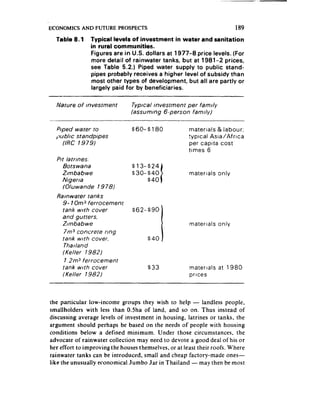
 a heavy suspension of colloidal clay. This gave the water a sickly-sweet
 taste, acceptable to the author in soup and coffee but not in tea, and it was
 easy to appreciate that people accustomed to this would find pure water
 excessively bland. TecIInica! and social assessmentsin a village should
 therefore include assessmentof water quality from existing sources and
 enquire which sources people prefer. Effective health education may, of
 course, persuade people to accept a blander taste, but it may also be worth
 experimenting with recipes in which rainwater confers better flavours.
 During surveys, enquiry might also be made about traditiona! methods for
 improving water quality. In parts of South America, crushed bark from
 certain trees is added to water. Elsewhere, various seedsare used, or curd
 from sour milk, and in parts of India, leaves from the neem tree. The useof
 such substances with rainwater could be helpful in providing a familiar
 taste.

STRATEGIES         FOR DATA       COLLECTION

This discussion of two specialist areas, hydrology and health, has shown
that the information required for planning a rainwater project does not
only consist of data which need specialist expertise for their collection and
analysis, but also involves much more general information, for example
about existing water sources and how they are used, or local experience of
the effects of drought. Such information, often looked down on as
‘anecdotal’, may be useful for filling gaps in the technical data, and in
showing whether rainwater collection can make a contribution to
improved livelihoods, and if so, for whom and in what form.
    In order to collect this information, people who speak the local language
need to visit villages where projects are envisaged and carry out surveys like
the social and technical assessmentsdiscussed earlier. The individuals
who do this may be community workers or health workers already
employed in the area; they may be agricultural extension worhers, and they
may include residents elected by the villages concerned. In a large
pfcigi%lfihc,   community workers may need to carry out surveys in a
considerable number of villages, and any local residents who take part will
DATA FOR DESIGN                                                             67
clearly need careful briefing. Thus it is desirable to provide some formal
training for the survey teams, and the WASH Training Guide quoted earlier
envisages an intensive course lasting a week (5’/, working days).
    During such a course the community workers (as we shall now describe
them), need to be told not only why the information is needed, but also how
to collect it systematically. To this end, it may be useful to provide them
with checklists of points which can be learned by observation (for example,
concerning building materials, roof types, and roofs overhung by trees) at
the same time, giving them questionnaires covering points about which
local people should be asked. Such checklists and questionnaires might be
compiled in a preliminary way by picking out the main points made in each
of the previous sections of this chapter, though they will also need to be
refined in the light of local experience. The important point to remember is
that the technical assessmentshould principally be seeking answers to the
question ‘is a rainwater project technically feasible in this village?*
 Meanwhile, the social assessmentseeks to know whether there would be
 active support for such a project from the people. The relationship of these
 questions to the later survey of skills, materials and resources,is illustrated
 by a ‘decision tree’ in Figure 3.6.
     One important point about decision trees is that they pose questions
 which must be answered ‘yes’ or ‘no’, and so therefore the decision about
 whether a rainwater project should go ahead can be answered in the
 negative. It is important that surveys are carried out in a way which leaves
 this option open. Where advocates of rainwater collection are over-keen on
 their favoured technology, there is a danger that they will compile
 questionnaires on the assumption that the project will go ahead and only its
 details can be modified. As Chauhan (1983) puts it, surveys of this kind
 tend to be ‘treated like market research for a new consumer product. If the
 community is indifferent to the product, it is assumed that the answer is to
 advertise the benefits more widely and educate the ‘target population’ that
 this is what theyshoukl want. The designersof programmes and technology
 will rarely admit that the “products” themselves may be inappropriate.’
     To guard against this danger, it first needsto be recognized that although
 the use of checklists and questionnaires is almost inevitable if information
 is to be systematically obtained, over-use of them can have the effect of
 excluding real dialogue with the local people and preventing them from
 *participating’ in anything but a formal sense. A questionnaire may allow
 us to find out N hat we want to know, but nothing more - it will tend to
 exclude ideas and information volunteered by local people.
     It is therefore strongly advised that questionnaires used when interviewing
  householders should be brief and confined to essentials. The interview
 should be open-ended, and the community workers should be prepared to
  listen for perspectives on local problems which the project organizers may
  not have consrdered. Often such insights are best generated if people are
RAINWATER              HARVESTING


                                                        rainwater      meet
                                                       a perceivea      neea


                                                          communrty?                                               AA


                                                                                            i
                                                   .                                        :          Ill”-
             /          rainwater
                  harvestmg         confhct
                 wtth   other       needs     of                                  0D)A          ICPT
                   the community?


                                                                                         water         the     1

      I PROJECT
         --                                                                                   top
                                                                                          priority?
      >,--                                                                    


        PLANNING TECHNICAL
        ASSISTANCE                                                                  OF TECHNOLOGY
        to fill gaps in                                                             to fit the local
        availability  of                                                            resource base and
        materials,   skills, etc.                                                   to match a feasible
        and to remove                                                               technical   assistance
        constraints    on                                                           programme;      design
        application   of chosen                                                     of tanks
        technology    (see Cbapfer’ 4)                                              (see Chapter 5)

Fig. 3.6    ‘Decision tree’ representing successiw phawr in the planning q/a wliage ruinwater
coliection project.
DATA FOR DESIGN                                                            69
interviewed in groups rather than individually. For example, a group of
older and younger women with a female interviewer may express views
which a mixed group would not, and the age difference could stimulate
comparisons which would show which recent changes in housing or water
supplies are valued as ‘improvements’. It is particularly important to
obtain women’s views, as it is, of course, women who usually have the
greater responsibility for domestic water use - and often for home
improvements and gardens also. Apart from informal interviews with
groups of neighbours, or members of extended families, discussion with
people attending village gatherings may be useful, as may formal meetings
and committees convened specifically to discuss water supplies.
    One of the two Indonesian rainwater programmes mentioned earlier in
this chapter (e.g. in Table 3.2) illustrates many of these points very
effectively. It is run by a local agency, Yayasan Dian Desa (Y DD) in the
 Yogyakarta area of Java. Villages which seemlikely candidates for projects
are chosen by Y DD from among the poorer communities in a district where
conventional water sources are unreliable and inadequate due to the nature
 of the underlying rocks. Many of the villages are critically short of water at
 times.
    The first step taken in any individual community is to visit it on an
 evening when people are meeting in the headman’s house (maybe to watch
 a favourite television programme). Several YDD people will go to these
 sessions,justto meet people, talk about family affairs, and to introduce
 themselves. Eventually, conversation turns to water, and when tea is made,
 !he YDD people produce their own containers of fresh water. Its taste is
 quite different from that of water from local ponds, and villagers are
 invited to try it. Further meetings are arranged where the benefits of good
 water and the disadvantagesof local water are discllssedmore fully and more
 information is obtained from the villagers about local veeds. Finally the
 YDD staff mention the possibility of building rainwater tanks. The basic
 technology is carefully explained and the demands which would be made of
 villagers during construction are discussed. If people accept the idea, the
 next step is the choice by the village committee of a local person (known as
 a ‘cadre’) to be trained in the construction technique.
     Building the tanks presents few problems once the procedure has been
 discussedin this way. The villagers do the work themselveswith the help of
 the cadre, and are asked to provide the bamboo required. Indeed, one
 advantage of using bamboo reinforcement in the tanks is that it increases
 the villagers* input and makes the tanks less of a gift. Where people can
 afford it, they are asked to pay for the other materials also - many are
 too poor. All groups, however, make a sufficiently large contribution to
 feel that the tanks belong to them and, as a result, maintenance is
 generally good.
70                                                RAINWATER     HARVESTING

TAKING      TIME

If building tanks in Indonesia presents few difficulties, effective use of the
water they contain seems more problematic. It has been found that for as
much as a year after they acquire a tank, some householders are doubtful
about the water it provides. They are unaccustomed to its taste, and are
unfamiliar with water that looks so clear. Some fear that chemicals in the
tank (perhaps detergents) are the cause of its strange appearance. A good
deal of reassurance is required about this, and YDD staff make frequent
informal visits on their way to other projects in the area. In addition, they
organize educational activities aimed at ensuring prudent use of the water,
care of the tanks, and confidence that the water is safe. The taste problem
takes a long time to overcome, but easy availability of the water helps
persuade owners to use it for drinking and cooking.
    Latham (1984b) comments that: ‘A!1 this is time-consuming but YDD see
it as a necessary part of introducing the tanks’, and as a major factor
making for the sucessof their programme. Provision of water is regarded as
a starting point for village development, and YDD link it to additional
programmes of animal and crop improvement. Many hundreds of tanks
have been built, but more important than numbers is the willingness of
YDD personnel to spend time in the villages alongside the people
concerned listening to local views and working out solutions to water
supply problems.
    In other countries, also, and in other aspects of rural development, it is
noticeable that the most effective fieldworkers and agencies are usually
those which are prepared to spend time with the people they attempt to
 help. In Kenya, one project which was building excavated rainwater-tanks
 and latrines grew up through a long period during which a lone fieldworker
got to know local families, built up ‘an accurate picture of people’s
 problems’, and gave encouragement to ‘decision-making mechanisms’
 based on village meetings. Indeed, so much time was spent on these
activities that funds from America were in danger of being cut off due to
‘lack of results’. Commenting on this, Batchelor (1985) notes that although
 most agencies reahse that a period of assessmentand ‘familiarization’ is
 required in any project, ‘pressure from performance-orientated donors
 often cuts this short or . . . at least combines it with a prototype project’.
    Occasionally, programmes seem to run smoothly without the prelimi-
 naries advocated here, but, when that occurs it is usually becausepeople
 have been prepared for the new technology by other experiences.
 Subsequent chapters discuss a rainwater tank programme in part of
Thailand where some people were already using large jars to collect water
 from their roofs. Thus the taste of the water and the method ofcollecting it
did not seem so alien as it did in the YDD region. However, one result of
there being shorter periods of assessmentand discussion is that the Thai
DATA FOR DESIGN                                                            71
programme is now criticized for being too construction-orientated and for
paying too little attention to maintenance and local-level organization
(Fricke 1982).
    All these issuesdo not just apply to tanks collecting runoff from roofs,
but also to other forms of rainwater collection. Obviously, though, social and
technical assessments subsequent discussion are very different in detail
                         and
if a runoff farming project or a communal effect to exploit a rock
 catchment is planned - or if nomadic herdsmen are being approached
 about renovating cisterns or building new livestock watering points.
 However, it has not been possible to describe a rock catchment project
 here, nor any programme concerned with pastoralists, largely because of
 the lack of documentation. In the latter case this IS because the
 orientation of the book is towards the work of non-government
 organizations, most of which have left the problems of pastoralists to
 government.
    Therefore, although provision of water for livestock in arid and semi-
 arid areas is potentially one of the most appropriate of all applications of
 rainwater collection, little more will be said about it here. Instead, the
 remainder of the book will discuss firstly, rainwater tanks used to provide
 domestic water, and then later, attempts to apply the same concepts about
 the organization of programmes to some recent work on runoff farming.
4. RAINWATER TANKS AND TECHNICAL
   ASSISTANCE

TECHNICAL        ASSISTANCE        PACKAGES

Development workers have frequently been perplexed at the slow rate with
which applications of rainwater technologies have spread. In one village in
Lesotho, 63 per cent of houses have iron roofs, but lessthan 2 per cent have
gutters (Feacham et al. 1978). In Ghana, a similar reluctance of house-
owners with metal roofs to install gutters has also been noticed (Parker
1973). In both countries, women face long walks to fetch water, and people
appreciate the value of rainwater and place containers under their eaves
when it rains. So their lack of interest in gutters and permanent storage
containers is not due to any ignorance of the value of rainwater.
   Even where organized programmes have built significant numbers of
roofcatchment tanks within limited districts, one can rare!y report that the
techniques they introduce are being actively replicated in surrounding
areas. Nor can one often say that local builders, craftsmen or businessmen
have copied the programme’s construction methods and are promoting the
techniques on their own account.
   Some general reasons for this disappointing situation have already been
discussed, and others, some of them specific to particular areas, may be
identified during social assessments.In both Lesotho and Ghana, one
constraint could be that the installation of gutters would be a job for the
man of the household, and it is usually the women who carry water and
who put out small containers to collect rainwater during storms. If
rainwater tanks were promoted as improvements to the appearance and
structure of a house rather than simply as a means of saving time spent
carrying water, they might appeal more strongly to the men. Thus
rainwater technologies may fail to spread becausethey are not perceived in
the same way by all villagers, and water supply experts rarely take enough
trouble to find out how different groups do perceive them.
   Another constraint, however, is that in the past there has been no real
concept of technical assistance at village level. If Lesotho villagers can
obtain gutters, downpipes and brackets as cheaply as Feacham ef al claim,
and money is not an obstacle, do the villagers actually have the tools
necessaryto fix them? If it is the wumen who would have to do the fixing
TANKS AND TECHNICAL       ASSISTANCE                                       73
while men are absent in urban employment, do they have the skill, and if
not, is anyone trying to assist them?
   One mistake made in the early days of the Appropriate Technology
movement was to think that small-scale technologies could be disseminated
around the world merely by publishing relevant information and making it
widely available. Clearly, the availability of information is essential, and
we should take a comprehensive view of how it may be spread - through
advertising, the printed word, the broadcast media, talks and demonstra-
tions, advisory servicesand extension work. But it is wrong to assume that
if a book or even a demonstration project can show that a new technique is
of potential benefit to people, that technique will be quickly taken up by
them without further promotion. As Whitcombe (1983) puts it, the
replication of any ‘appropriate’ technology is a highly complex process,and
few agencies have been able to develop a ‘methodology to go beyond
prototype development’. If a ‘truly appropriate technology’ is developed its
originators often assume that ‘it will sell itself.
   Tanks and large jars for collecting rainwater from roofs do sell
themselves in a few places, and there are also one or two agencies which
have reasonably effective methodologies for replication. Table 4.1 lists
examples of such agencies, and by implication, suggeststhat their success
 may be attributable to the comprehensivenessof their technical assistance
 activities within village communitites. None of them limits itself to
 demonstration projects, or to providing information via educational or
 extension work.
    Compared with the examples in Table 4.1, the technical assistance
 methodologies of many agencies tend to be deficient in some of the
 following ways:
   l   fully comprehensive packages of help with information, skills,
       materials and money are rarely developed;
   l   there is a lack of commercial involvement, e.g. with builders
       interested in constructing rainwater tanks as a business venture
       (in contrast, see Layton 1984);
   l   there is inflexibility and lack of dialogue with potential users of
       rainwater because of over-commitment to one specific technique;
   l   there may not be sufficient attention to local organization, especially
       in relation to maintenance;
   l   follow-up and monitoring of completed tanks or other works may
       be neglected.
   It was suggested in the previous chapter that village surveys could
 culminate in the compilation of an inventory of local materials, tools, skills
 and resources (Fig. 3.6). This inventory can be helpful in identifying
 technology which matches the resourcesof the village; it is also a starting
 point for developing the necessarytechnical assistance package. I-Iowever
Table 4.1          Technical assistance           in four roof catchment
                      programmes

COUNTRY                     ZtMElAB WE        KENYA                  INDONESIA                THAILAND
and area                    Bulawayo          Karat loc-             Gunung Kidul             Khon Kaen
                            area              atlon,                  near Yogya-             Province
                                              Klambu                 karta

AGENCY                      Friends’          UNICEF                 YDD’                    CBATDSt
and source                  Training          (Molvaer               (Wtnarto                (Frlcke 1982;
                            Centre            1982)                  198 1; Latham           Power 1983)
                            (Hlekwenr                                1984)
                            1975)
             _-.--                                               -                                          -
OPTIONS OFFERED
TO VILLAGERS
ramwater                    ferro-            Ghala                  ferro-                   bamboo
tanks                       cement      9m3   tanks 1 I.             cement 9m3;              concrete.
                            (later            2 2 and                barn boo                 6-l lm3
                            brick)            4.5m3                  cement 4 5m3
roofmg                      experi-           NO                     NO                       NO
matertals                   mental
gutterlng                   metal type        ndS                    metal or                nd
                            supplled                                 bamboo
complementary               agrtcul-          cooking                agrlcul-                varied, fam-
programmes                  tural             stoves                 tural                   11y planning
I_                                                       1---_                   -I-__--~-
COMPONENTS OF TECHNICAL
ASSISTANCE PACKAGES
rrarnmg specialist
craftsmen                   YES               YES                NO                          NO
or community-worker
technlclans                 NO                NO                     cadres’                 ‘vrl!age
                                                                                             technlclans’
bulk purchase   &           YES               YES                    YES                     YES
transport of materials
loan of formwork            YES               formwork               formwork                YES
                                              not                    of local
                                              needed                 maternal
fmanctal help
payment b Instal-
ments                      NO                 nd                 YES                         YES
substdles                  YES                YES                YES                         slight
prtnfed leaflets.           YES               n.d                    YES                     YES
tnstructions   on
construction
follow up work              slight            YES                    strongly                YES
on maintenance.                                                      developed
health education

        ’ YDD IS the local lndoneslan       agency Yayasan            D/an Desa.
        t CEATDS IS the Communrty        Based Appropriate            Technology      and Development
          Service of the Thai agency PDA
        $ I! d den,. .-4 I,” “YdU avurwllJe
TANKS AND TECHNICAL      ASSISTANCE                                       75
good the match between the chosen technology and local resources, there
will always be some constraints on the use of that technology, such
as a lack of certain skills, or the high costs of cement and transport of
materials, or the need for a particular tool. The aim of technical assistance
is of course to reduce the effect of these constraints by the various means
listed in Table 4.1. Training is probably most universally important, but
bulk purchases and transport of materials aimed at reducing costs are often
necessary, as is the loan of tools, or some sort of financial help for
householders acquiring rainwater tanks. Helping people to organize
themselves for carrying out the work and perhaps for following it with
other changes in village conditions is also important, though it is too big an
issueto analyse within the confines of Table 4.1 (however, for a comparison
see Table 7.2).
    The cost of rainwater systems may seemto demand particular attention
from those who plan technical assistanceacrivities. Very small rainwater
tanks or jars will often be used becausethat is all that people can afford,
and sometimes shared tanks are proposed in order to reduce the cost falling
on each household. However, a good deal can be learned from regions
 where significant numbers of households are prosperous enough to afford
 the full cost of individually owned roof catchment-tanks. In the
 Khon Kaen province of Thailand, for example, many people have well-
 constructed timber houses built on platforms (Fig. 4.1) with corrugated
 iron roofs. They already collect rainwater, and even in the poor villages, 30
 per cent of households have some guttering. Elsewhere, as many as 60 per
 cent do. Roof areas are large, often exceeding 100m2,though guttering may
 only be installed on half t he area (Nopmongcol LV 1981). Hemispherical
                                                     ni.
 ferrocement jars up to 2m’ in capacity are available commercially and are
 purchased by some households.
    Such an area is clearly ripe for a programme aiming to build larger tanks,
 and one need not be too surprised at the success the agency representedin
                                                  of
 Table 4. I which has completed 6,500 tanks in four years (Nation 1984).The
 tanks range in size up to 11.3m’ but are typical!y 9.4m’; they are made 01
 bamboo-reinforced concrete.
    With housing standards in this area so high, it may be appropriate to
 draw comparisons with technical assistance offered in a much more
 prosperous country. The Sout!r Australian government initiated a
 ‘rainwater tank promotion campaign’ in the Adelaide area during 1981,
 based mainly on advertising and the provision of information. According
 to Hoey and West (1982). this led to many new tanks being purchased by
 householders. The main features of the scheme were:

   l   a booklet written for householders giving advice about the
       installation and maintenance of gutters and tanks;
   l   an advisory service (by telephone);
76                                                RAINWATER     HARVESTING


     l   a major newspaper publicity campaign which stimulated advertising
         by local manufacturers of tanks; but
     l   no financial incentives or subsidies.
   In poorer communities, financial help is often essential and advisory
services need to be more personal and practical. But in countries where
better-off families purchase rainwater tanks on their own initiative, such as
Thailand and parts of Kenya, and where tanks are available on the market,
local versionsof this sort of campaign could be very effective. They could lead
to existing tanks being better used as well as new ones being installed, and
could encourage better maintenance. One should not be squeamish about
‘social marketing’ of this kind. It can contribute to development by
TANKS AND TECHNICAL      ASSISTANCE                                        77
encouraging the constructive use of private resources and by reducing
demand on stretched public water supplies. It can also confer ‘status’ and
improve the ‘image’ of the technology concerned, which is a more
important factor in arousing enthusiasm than most health educators and
extension workers care to admit. Moreover, such campaigns aimed at
better-off groups may indirectly widen political support for subsidized
projects in poorer areas.
   In Thailand, although the prior existence of gutters and some small
rainwater jars made it easy to arouse interest in the larger tanks, a
considerable amount of technical assistance has still been necessary.
Householders work together in loosely organized mutual-help groups with
10 or 15 people in each, but they still need help from a ‘village technician’.
This is a local person recruited to attend special training sessions.Technical
assistance also includes the loan of metal formwork and tools, bulk
purchases of cement, and a scheme whereby householders can pay foe ihe
materials by instalments. The initial payment is equivalent to US$22, and
subsequent monthly payments are in the range $6 to $10. The option of
payment by instalments has been crucial. The total cost to a householder of
a large (1 l.3m3) tank was $175 in 1982 when the l.4m3 ferrocement jar -
which is all most people could o!:!*:rwise afford - would have a market
price of only $25 (Fricke 1982).
   Taking a general view of costs and n.etllods of payment, strategies likely
to be helpful include use of low-cost, local materials wherever possible;
bulk purchasing (e.g. of cement) as a means of negotiating lower prices;
credit or saving schemesto make payment easier; and of course, outright
subsidies.
   Small mutual-help groups may have a part to play in enabling people to
cope with costs as well as in practical construction. For example, savings
clubs oriented towards bulk purchasing have been successful in parts of
Africa. They usu:rlly consist of neighbours, or groups of families with
similar interests and existing ties of friendship, and they agree a common
goal for which all members wish to saveover a specified period of time (up
to a year). Savings clubs of this type hold weekly meetings for members at
which they pay a fixed contribution and have a stamp stuck on their cards.
When sufficient money has been accumulated, the materials which club
members have agreed to buy are purchased in bulk and shared among
them. This system has been successfully used in Zambia for the purchase of
corrugated iron roofing sheets for home improvements.
   Such schemes work well if there is an agreed objective in which people
can sustain a shared interest. The best examples have been in Zimbabwe
where farming families have saved to make bulk purchases of fertilizer.
With such things as rainwater tanks it is usually better it’ the desired
improvement comes much sooner, and if the saving is done retrospectitvely
when the benefits of the project are apparent. This is what happens in
78                                                RAINWATER     HARVESTING

Thailand when people pay for tanks in instalments. The scheme is made
possible by the opera.tion of a ‘revolving loan fund’. Under this system, the
agency responsible for the rainwater programme sets aside a fixed sum of
money from which the cost of each family’s tank is paid. This constitutes a
loan to the family, and as they pay back the money mom3 by month, the
fund is replenished and new tanks can be financed for oiiler households.
People should be encouraged to regard loan funds as money belonging to
the community as a whole and not to an impersonal body such as a bank.
They will then be aware that delaying repayment of their loan will postpone
the day when a neighbour can borrow money for his own rainwater system.

‘I-RAINING     VILLAGERS        AND CRAFTSMEN

When householders acquire rainwater tanks on their own initiative, this is
most often by purchasing them ready-made from a factory (as is possible
with small cement mortar jars in Thailand). Galvanized corrugated iron
tanks are available for purchase ready-made in many countries in a range of
sizes up to about 10m3.
    Few organized programmes which promote rainwater collection usr:
factory-made tanks, often because of a self-help emphasis within the
village, but also becauseof transport difficulties and the high cost of these
sorts of tanks -especially the metal ones. However, since tank construction
is a skilled task, any self-help effort must involve specially trained
individuals, even if most of the more basic tasks dre lcfi it; the householders
themselves, Indeed, the provision of skilled help needsto be linked in a co-
ordinated way to the help given with supplies of materials (such as cement),
and the help, just discussed, with payment. As we have seen, village-level
technical assistance must go far beyond providing information and
education if it is to cater for the needs of low-income communities.
Assistance with skills, supplies andpaymenr are three of its most important
practical ingredients, and there is also the question of organization.
    Several approaches to the dev4opment of necessary skills have been
used in rainwater projects. Training may be offered to village craftsmen (as
in Kenya), or to community workers or individuals chosen at village
meetings who are given special training as ‘village technicians* (in
Thailand) or construction ‘cadres’ (Indonesia).
    There is a sharp distinction to be noticed here between the ‘community-
worker technicians and the specialist craftsman (Table 4.1). If a village
tccllnician is thought of as a community worker, his role will be seen as
 assisting and supervising householders who build their own tanks. In
Thailand, where groups of householders help each other, a group usually
finds that after relying heavily on the village technician in building their
firsi one or two tanks, they are able to construct others withou! furthx
help. Thus skills become widely diffused in the village. By cc;trast, the
TANKS AND TECHNICAL     ASSISTANCE                                     79
village craftsmen trained in Kenya carry out the whole construction task
for householders. They do not assist others to acquire building skills but
function as specialists, potentially able to work as commercial tank-
building contractors.
   The WASH Training Guide (see Chapter 3) envisages that the skills of
tank-building should be taught to ‘masons’ at the same time as community
social workers are trained to carry out surveys, social assessmentsand
related educational work. This implies a non-commercial view of the
mason’s role, and aims to provide a basis for co-operation between masons
and community workers. If community workers are to explain the
raicwdter tanks adequately to people, they must know how they are built.
At the same time, masons may co-operate in much of the survey work,
particularly in technical assessments and in compiling inventories of
materials and resources. The WASH Guide assumes that masons can be
trained in the same one-week course as the community workers, if it is
organized with separate sessionsfor practical *vork. However, time-tabling
tank construction exercisesin such a course may be difficult becauseof the
time required for cement or concrete to set. Layton ( 1984)is probably more
realistic when he describes three-week courses for training young men to
build ferrocement tanks on a commercial basis in the North Solomons
(Papua New Guinea). Business development officers take part in the
training in an effort to teach entrepreneurial as well as technical
skills.
    Much pioneer work on rainwater tanks has taken place in Zimbabwe
under the aegis both of Young Farmers’ Clubs and ofchurch organizations.
One starting point was the high costs and corrosion problems associated
with the galvanized iron rainwater tanks which were already widely used in
Zimbabwe. Efforts to produce cheaper and more durable tanks mostly
 involved ferrocement construction.
    The Young Farmers’ groups put their main efforts into large circular
tanks with domed tops. Some were built to collect water from roofs and
 rock catchments. Others, constructed in exactly the same way, were built in
excavations in order to colr,‘ct water from ground catchments with smooth,
cemented suri‘aces(Fig. 4 2) and with chicken wire reinforcement (e.g. at
 Kowa).
    By contrast, a church group based at Hlekweni, near Bulawayo in the
 south-west of Zimbabwe, concentrated on a smaller ferrocement tank
 for collecting water from roofs. Its size was standardized (at 9m’) so that
 many tanks could be built by repeatedly using the formwork. The
 method of construction is explained by Watt ( 1978)and more briefly in Box
4.1. Of particular interest here is the technical assistance which enabled
 householders to acquire the tanks, and the distinctive approach to the
 transfer of skills which was developed. Whilst individuals were trained HIS
specialist craftsmen, they were encouraged to work ~t*ithhouseholders. and
80                                                          RAINWATER       HARVESTING

                                               silt trap
                                          /-


Fig. 4.2 A ftrrocement ruinwtter tunk in Zimbabwe built in on escavution so as to colkt
water front a smooth, cemented cutchment. Withdrawul of water from the tank is 4,’ means of a
hand-pump (not shown). A tunk of‘this six (4Om’) tsouidnormal~v require a catchment measuring
about Aim X Illm. i.e. larger than the example shown. (Nat1 1975; see also Watt 1978)

the latter for their part were asked to provide sand for mixing the cement
plaster, and to contribute their labour where unskilled work was required.
This helped to hold down costs, but also meant that householders learned
more about tank construction on the job, and thus might be better able to
maintain their tanks subsequently.
   The technical assistancepackage also involved a subsidy on costs and the
supply of metal guttering (which was specially made at Hlekweni) as well as
the loan of formwork and tools. At tirst, some tanks were built without
payment from the householder, the cost being born by drought relief
funds. However, villagers were sceptical, expecting that money would be
demanded at some later stage. From 1970, it was decided to charge a
nominal amount (equivalent to US$12) and the tanks were then in such
demand that four builders trained at the centre were kept constantly busy.
But it was noticed that only the better-off families with good hauses were
acquiring the tanks, which could not easily be fitted to traditional thatched
houses with curving eaves,so it was decided to phaseout the subsidy. There
were hopes that it would be possible for the builders to continue work on a
comtnercial basis. However, although the tanks were cheaper than the
competing galvanized iron ones, they were still too costly for most
villagers. Thus the effect of rising cement prices and the withdrawal of
 subsidy was that fewer tanks were built.*
    Reports from the area ten years later suggestthat many ofthese tanks are
still in use. However, since 1977, Hlekweni has been building rainwater
30x 4.1    Procedure for building a 9m3 tank of the type developed
It the Friends’ Training Centre, Hlekweni, Zimbabwe.     (Hlekweni,
1975; Watt, 1978)


f. The formwark       needed rn brri!d this
:ank can be usad repeateary          ior con-
;truction of many tanks. It is made from
;heets of corrugated      iron curved to a
radius of 1.25m and is in four sections,
aach quarter     of a circle in plan, and
xtual to the full height of the tank. Each
section has angle iron riveted to the
rertical edges. When the formwork              is
assembled, the angle iron flanges face
up to one another and have holes which
allow them to be bolted together through
a wooden wedge (Diagram I).
2. A circular found8tion        2.8m in dia-
meter is dug out on site and a concrete             Diagram    2
floor 80mm thick is laid. A 20mm bare
pipe bent to a U-curve is concreted into
the floor in such a position,that     one end
will project upwards in thefinished         tank
BOmm above the floor and theother end               4. Plastering         of the outside          then
will be outside       and can be fitted             begins, first with a thin layer of 1:3
with a tap.                                         cement/sand,        then two hours later with
3. Erection    of the formwork         follows      a second layer to a depth &f 15mm. This
when the floor slab has hardened. After             should be finished smooth with a float,
oiling the formwork,        wire netting       of   entirely hiding the corrugations.
50mm mesh is wrapped            round it and        5. The formwork         is unbolted     some 48
tucked under it at the bottom (Diagram              hours     after    the second        plastering.
2). Then a length of 2.5mm plain wire is            Ladders used for climbing into the tank
pulled round each corrugation         and the       are leaned        against     the house,         not
ends are twisted together until the wire            against the incomplete          tank. An over-
IS taut. (Two wires are used in the four            flow pipe with mosquito screen on its
bottom corrugations     and in the topmost          Inner end is built into the top of the tank
one.)                                               wall. Then a 50mm layer of concrete is
                                                    laid on the floor.
                                                    6. The inside walls are plastered once
                                                    the floor has set. Two layers of 1:3
                                                    cement/sand         are applied to fill up the
                                                    corrugations.     The inside walls and floor
                                                    are finished      off with a thick cement
                                                    slurry to render the tank water-tight.
                                                     7. Curing. Water to a depth of 50mm is
                                                    poured in and the walls are periodically
                                                    moistened       or otherwise      kept wet for
                                                    seven days.


Diagram    1
82                                                RAINWATER     HARVESTING

tanks of brick with wire reinforcement and cement linings, becauss the
availability of broken bricks (or bricks made on site} makes these cheaper
(Gould 1983).
   Experiences of this sort show that the design of a rainwater tank is not
merely an abstract problem in engineering, but is crucially related to the
type of technical assistancethat can be organized, and the sort of materials
and other resourceswhich are available in the locality. !This is why technical
assistance has been discussed in this book beforr the chapter on tank
design.) Both the planning of technical assistance and the design of
hardware depend on establishing what materi,alh- Iabour, and financial
contribution it is reasonable to ask householder!: 6,~ provide. Careful
thought will also be necessary about the provision of guttering and
downpipes, a!t!z:ugh this is a striking omissLn i:i FM~;T reports on
 rainwater collection programmes. It may be that glittering is WJI -idered to
 be simpler than tank construction and is taken for granted - which
presumably means that householders must supply their own. But for some
people installation of a gutter may seem a formidable task, and it has
sometimes been said that inadequate guttering is a major constraint,
discouraging some householders from acquiring tanks at all.
   In places where satisfactory rainwater jars or tanks are available on the
market, technical assistance should perhaps aim mainly to provide
guttering and offer advice 2s to which type of tank to buy, with possibly
some help from a revolving loan fund to pay for it. Some programmes may
make their task over-complicated by concentrating too much effort on
building tanks independently of the market. Their task might be simpler if
they exploited the existence of the commercially available tanks and
concentrated OII the constraints which prevent low-,income groups from
acquiring the&n

SELF-SUSTAINING           PROGRAMMES

It should be the ultimate aim cjfevery programme that its work will become
self-sustaining, and independent of external subsidy. This means that tank
construction must be incorporated into the normal production system of
the country, whatever that might be - individual craftsmen with their own
businesses,larger commercial organizations, local collectives or publicly-
owned factories. In many countries, the long-term future of household
rainwater collection will depend on what the individual family can obtain
on the market, and on what craftsmen and commercial outlets have to
offer The public service traditions of man! aid agencies make them
reluctant either to form a relationship with local commerce or to teach
entrepreneurial skills to the craftsmen they train. Yet these things may be
necessaryif rainwater techniques are to take root and continue to develop
in a region. Indeed, it may be desirable to offer training to people who
TANKS AND TECHNICAL       ASSISTANCE                                       83
explicitly wish to exploit the techniques for commercial profit, charging
them an appropriate fee for the training. This happens in principle with the
three-week courses on ferrocement tank construction in the North
Solomons. However, instead of paying cash, ‘would-be entrepreneurs* are
merely asked to provide food and accommodation for the Training Unit
staff (Layton 1984).
    The Zimbabwe project referred to earlier was probably right to envisage
that the builders it trained should ultimately operate independently with
their own tank construction businesses,though the tanks being built proved
too large and expensivefor this goal to be achieved. A programme in Karai
Location, Kenya, organized by UNICEF (Table 4.1) seems to have come
nearer to successin this respect. One reason is probably that it started with
much smaller tanks of the Ghala type (described in Box 3.1), with
correspondingly lower costs.
    At first, the people trained in the Ghala technique were young men who
had not yet settled down. When some left the area, training was offered to
established local craftsmen who already had skills as basket makers or
 masons. At first they were sceptical and did not think the tanks would
 become popular, but after a year or so, demand increased rapidly.
 However, UNICEF had asked that a committee of local people beset up to
organize the project. Orders for tanks were channelled through the
 committee, so the craftsmen could not promote their businessindependently.
 Molvaer (1982) implies that this has inhibited technical initiative. Some
 craftsmen have thought it best to merely do ‘what they were told’ since that
 is what they were paid for. However, some owners of tanks have had ideas
 for improvements, and a couple of ideas did also come from craftsmen. The
 main change which resulted was that concerning the basket-work frame of
 the tanks which was not initially plastered on the outside. Tanks made this
 way were found not to be durable, and so now plaster is always applied
 both inside and outside.
    This programme has developed considerable momentum and one sign
 that it might become self-sustaining is that craftsmen now recruit and train
 apprentices on their own initiative. UNICEF therefore no longer has to
 train each new craftsman, as they did with the first two groups of tank
 builders. However, ‘without orders - and orders are due to acceptance by
 the committee - the craftsmen would go idle’ (Molvaer 1982),and the idea
 of a craftsman himself seeking orders seems to have been very slow to
 develop. Householders are showing initiative in acquiring rainwater tanks,
 including some from outside the area officially covered by the programme,
 but the committee is still in charge.
    MAvaer comments that a change in approach would help craftsmen to
 acquire ‘a bit of the entrepreneurial spirit’, but adds that individuals whose
 enterprise is encouraged ought to be those with roots in the local
 community. A man who has close ties with the people for whom he works is
84                                              RAINWATER     HARVESTING

more likely to conduct his business in a manner combining a sense of
service with the necessary entrepreneurial skills. Besides these attributes,
craftsmen also need to be more open to innovation. Molvaer suggests
creating a ‘climate of change’ by disseminating information about
rainwater techniques in other areas. In Karai, basket-framed Ghala tanks
were adopted after some failures of unreinforced cement jars. But in other
parts of Kenya, there have been unhappy experiences with Ghala tanks
(Sinclair 1983). and despite the 300 or more built at Karai, they are still
regarded as unproven. Thus a programme supported by the Diocese of
Machakos encouraged a more robust technology, in concrete ring tanks,
whilst brick is used by some private contractors and metal tanks are
available commercially. In one area, some 150ferrocement jars of 5m-’
capacity have been built to a UNICEF design (Byrne 1983). It is suggested,
then, that a more innovative spirit would develop if there were active
exchanges of experience between the craftsmen who build these varied
types of tank.
   A different model of what constitutes a self-sustaining programme is
needed when rainwater techniques are implemented by mutual-helpgroups
of neighbours without the involvement of specialist craftsmen. This applies
both to rainwater tank construction, and to the co-operative groups of up
to forty families practising small-scale irrigation of the kind discussed in
Chapter 2. Neither mutual-help groups nor community workers can usually
be ‘self-sustaining’ in isolation. They need encouragement, advice and
technical support on a continuing basis, as well as help in negotiating with
commercial suppliers and government departments. Some kind of ‘parent’
organization for the small groups is therefore necessary, and we may
consider three ways in which it may operate.
   Firstly, there may be a regional or national federation of local mutual-
help groups with administrative officers elected by its members, Secondly.
the parent body may be officially organized. Many governments operate
servicesto support farmers’ co-operatives. and t hc same framework - or a
more flexible version capable of dealing with smaller groups - could be
adapted for this purpose.
   Thirdly, however, the ‘parent’ role may be undertaken by a voluntary
agency or non-government organization. All the examples cited so far are
of this type. They include the Pani Panchayat organization linking groups
of small-scale irrigators in India (Chapter 2) and the roof catchment
programmes in Thailand and Indonesia (Table 4.1). For the activities of
such bodies to have a permanent effect and to be self-sustaining, it is
impnrtant that agencies undertaking this role have deep roots within the
countries concerned. Few foreign or international agencies have a
sufficiently strong commitment to very long-term support of specific
projects. However, any agency of this kind could make its proprammes
increasingiy self-sustaining by encouraging an evolution toward a federal
TANKS AND TECHNICAL       ASSISTANCE                                        85
organization in which the mutual-help groups it supports eventually
assume control and manage the parent body themselves.
   One function of the parent organization will be to sustain technical assis-
tance activities so that the replication of rainwater tanks continues. However,
it must also support villages which have already built rainwater tanks but are
encountering problems in their operation. An indication of what may be
needed in this respect can be seen from the activities of the Indonesian
agency Yayasan Dian Desa (YDD). Its routine technical assistance
activities are summarized in Table 4.1. They centre on the training of
village construction supervisors or ‘cadres’ to assist in building tanks and
to act as contact persons. Some cadresare paid for special tasks but most of
their work is voluntary. Materials and transport for tank building are
supplied and subsidized by YDD, who also send a staff member to villages
where construction is beginning. Even when tanks are completed, staff
members visit villages regularly, keeping in contact with cadres, monitoring
operation of the tanks, and checking whether rainwater is providing the
expected benefits.
    An exampie of the problems discussedby Y DD staff during their village
visits, is the COSL the ferrocement tanks - which has been a major
                      of
constraint, as in Zimbabwe. Kaufman (1983) records a discussion about
this which took place in a village during 1979. A village headman made the
comment that when the reinforcing bars and wires for a ferrocement tank
were assembled, they ‘resembled his cassavastorage bin, except of course
this his storage bin was made of woven bamboo’. He wondered whether it
would be possible to replace some of the metal reinforcment in the tanks
with bamboo. The local cadre then remarked that ‘in constructing pit
latrines, he often used a cylindrical woven bamboo liner, which he
plastered with cement. Such a cylinder could conceivably be built above
ground and function as a water tank’.
   Kaufman notes that this conversation saw the birth of ‘a new hybrid
technology: bambc>o-cement’.YDD staff who were present were quick to
experiment with bamboo in the manner suggested, and made rapid
progress with the design of a small (4.5m’) ‘single-family’ tank which has
since been built in large numbers (Fig. 4.3) It costs considerably less than a
ferrocement tank of the same size, but its durability has beendisappointing
because the smallest accident or defect in the cement plaster can lead to
rapid decay of the bamboo which is exposed. Initially. however, bamboo-
cement seemed a real break-through. Trained cadres were often the chief
means by which villagers learned the merhod of construction and
sometimes one cadre would train another (Kaufman 1983). Although this
points to a self-sustaining pattern of development, it seemsunlikely that
volunteer cadres could, or would, function successfully for long without
support from YDD.
   The continued contact of YDD with villages also led to recognition that
86   RAINWATER   HARVESTING
TANKS AND TECHNICAL      ASSISTANCE                                      87
many tanks were not achieving ‘their intended effect on the local water
situation’. Instead of being used to provide emergency water in the dry
season, it was found that tanks were being most fully used in the rainy
season and were often empty long before the ‘critical period’ of water
scarcity toward the end of the dry season. Noting this, YDD staff also
observed rainwater being drawn from tanks for ‘non-essential’ purposes as
well as contaminated water from ponds being poured into the tanks on
occasion. In other words, the long-term commitment of YDD led them to
monitor the operation of the completed tanks and so to discover these
apparent eccentricities in usage. That in turn led them to suggest an
improved and expanded educational effort to help people become ‘better
managers* of water resources.

MAINTENANCE,          MONITORING          AND INNOVATIVE
DIALOGUE

 For a programme to be self-sustaining, it is not enough for rainwater
systemsto be replicated effectively - they should also be well maintained so
that their benefits are permanent. Their operation should be carefu‘ully
 monitored by the parent organization with particular attention to de-
 ficiencies in maintenance, and to any defects in tanks which develop over
 time, so that the long-term technical assistance provided can adapt to
 problems as they arise.
    Where rainwater tanks have been acquired through commercial trans-
actions between householders and craftsmen, if the craftsman is a local
person who has close links with his customers, he will quickly be alerted if
tanks crack or start to leak, even if this is after a long period of use. His
training should cover the repair and maintenance of tanks as well as their
construction. Indeed, he might be encouragedto visit customers periodically
during the rainy seasonto inspect tanks when they are full and look for wet
spots and cracks. Those whose tanks show evidence of faults could then be
revisited in a season when tanks are empty, so that necessaryrepairs can be
carried out.
    Many maintenance tasks are simply a matter of keeping gutters, screens
and filters clear of debris, as discussed in Chapter 3. These are matters for
which householders must be responsible. In some areas, it will be especially
important that mosquito net or gauze on overflow pipes and other
apertures is always in good condition. Householders should be encouraged
to check on this regularly, but it should also be seen as a responsibility of
craftsmen doing other repairs that they also check mosquito protection.
Project organizers may also find it useful to draw up a schedule,such as that
given in Box 4.2 to ensure that all the maintenance tasks listed are covered
in the training of craftsmen and in the educational work they undertake
within the villages. Good maintenance is often difficult to achieve, and the
88                                                                          RAiNWATER             HARVESTiNG


BOX  4.2    A schedule of operation    and maintenance      tasks for
concrete and ferrocement   rainwater    tanks .and associated    roofs
and gutters. (IWACO, 1982-considerably       modified)

TASKS            NEEDING    FREQUENT                             a cement/water         mixture    is applied on
4JTENTION         FROM HOUSEHOLDERS                              the inside and finished off with a layer of
                                                                 plaster. If there has been evidence              of
1. Roof surfaces and gutters to be kept                          leakage     but no wet spots have been
free of bird droppings.      Gutters        and                  discovered      on the walls, the floor should
nflow filters must be regularly       cleared                    be treated with a cement/water           mixture
of leaves and other rubbish.                                     and then finished         off with a layer of
2. The mosquito      net on the overflow                         plaster.
pope should be checked regularly,           and                  2. The roof surface, gutters, supporting
renewed if necessary.                                            brackets     and inflow pipes need to be
3. Unless there is some automatic                                checked and repaired if necessary.
means of diverting      the first flush of                       3. If a sand filter is incorporated,           the
water in a storm away from the tank, the                         filter sand should be washed with clean
inflow pipe should be disconnected        from                   water      or renewed.        Other    types     of
the tank during dry periods. Then 15-20                           strainer, filter or screen must be checked
minutes after rain begins, it can be                              and repaired as necessary
moved back into postion     so that water                         4. The mosquito net on the overflow
flows into the tank.                                              pipe should be checked and if necessary
4. The water level in the tank may be                             renewed.
measured once a week using a graduated                            5. Removal of deposrts from the bottom
stick (whtch should be kept in a clean                            of the tank is periodically         necessary.
place and not used for any other                                  Depending on local conditions,         this may
purpose). During dry periods, the drop in                         be destrable annually (IWACO 1982) or
water level should correspond        approxi-                     only once in 3-5 years.
mately wuh consumption.        If thts is not                     6. After repairs have been carried out
the case. the tank IS leaking. and wet                            inside a tank, after deposits have been
spots on its walls should be carefully                            cleaned out, and after a new tank has
looked for.                                                       been completed,       the interior should be
                                                                  scrubbed down with a solution of one of
ANNUAL      OR INFREQUENT         TASKS                           the following:     3 parfs vinegar to one of
FOR    WHICH     TECHNfCAL       ASSIS-                            water, OR 1 kg ts.:.G~y^ ,x:wder to 9 litres
 TANCE MAY BE REOUIRED                                            of water,       OR ‘/! cup !.‘5mlJ of 5%
 1. At the end of the dry season, when                            chlorine    bleach to 45 litres of water.
the tank IS empty, any leaks that have                             After scrubbing,       the tank should be
been noticed should be repaired. Where                            left for 36 hours and finally washed
there have been wet spots on the walls,                           down with clean water.


 subject       should       appear      prominently         on    the   agenda       of all monitoring and
 evaluation          activities.
    In the Indonesian    work. maintenance problems reported include failure
 to clean and repair iqlet filters c>ntanks and damage to mosquito screens
 (Lathrim 19X4b).However, maintenance has largely been left in the hands of‘
 householders    and village ‘cadres’ and is general!y thought to be good. The
 main    problem    to emcrgc  has been the deterioration   of sOme bamboo-
 cement        tanks,       which     illustrates     the   importance           of’ monitoring       for   design
 policy       anti    t’ututc      choice ot‘ technology, as well as f’c>rplanning technical
 support.
TANKS AND TECHNICAL       ASSISTANCE                                        89

     In discussing these issues, general comment on the desirability of
‘participation’ has been avoided becauseof the often misplaced ideological
connotations of this over-used word. The casestudies have indicated ways
in which villagers have participated more or less actively in rainwater
projects, although the technical assistance provided from outside their
communities has usually been more crucial.
     ‘Dialogue’ or ‘partnership’ (Drucker 1985) are other equally over-used
words, but ones which may have a rather more important meaning to
convey. In Indonesia, we have seen that an exchange of ideas between
vili;gers and professional staff led to the invention of bamboo-cement
construction, and in Kenva, exchanges between craftsmen were seen as
offering potential for inno; .:t:;on. When YDD staff in Indonesia observed
 how villagers were using ra!:,; =iLz: and planned an educational programme
to improve water managemen!., !7;’ was dialogue of another kind. It was a
 responseto what people were doing rather than what they were saying, and
 it led to innovation in the ‘software* element of the programme. To install
 hardware and then not to monitor its utilization and performance is to
 ignore a dialogue which could lead either to improvements in hardware, or
to recognition of unforeseen maintenance or training needs.
     innovative diaiogue and partnership is necessary at every stage in the
 development of a rainwater programme (or indeed any other kind of water
 supply). It should begin whenever an outside agency arrives in an area with
 new ideas, and should continue through construction and monitoring
 until, perhaps many years later, some of the original ideas in modified form
 have become part of the local culture and are being implemented in a self-
 sustaining manner. The beginning of the dialogue might be a social
 assessmentin which it emerges that local people have a view of their most
 urgent needs and goals which differs significantly from outsiders’
 expectations. In a survey in Guinea-Bissau, villagers were found to identify
 their most urgent needs with food supplies. Asked about improved water
 provision, they spoke of water for rice-growing and for irrigating
 vegetables (Chauhan 1983).
      A project which sets out to build rainwater tanks cannot usually be so
  responsive to local needs that it can divert its energies to irrigating
  ricefields. It should not, however, insist that rainwater be used only for
 drinking if the people feel their greatest need is water for a small vegetable
  plot. Where people use rainwater tanks in unexpected ways, it is nearly
 always a mistake to see this as simply ‘misuse’. The villagers may well be
  bad at managing water resources, but an agency which is open to dialogue
 will also wish to consider that apparent misuse is really a reflection of
 some unmet, unarticulated need. Rather than misusing tanks, the people
 may be innovating intelligently to cope with the unrecognized need. The
 biggest exceptions to this may concern health aspects of water quality
 and contamination which are not obvious to the layman, and where
90                                               RAINWATER    HARVESTING

‘misuse’ may we! reflect a requirement for information and ‘education’.
   Very occasionally a new technique will be so well suited to what people
want, and so well marketed, that it seems to catch on overnight without
adaptation. More usually, however, innovative dialogue is a slow process
in which hardwtire and patterns of maintenance and use are gradually
modified. Even in Thailand, where small pottery rainwater jars were
already in widespread use and people were receptive to suggestions about
larger containers, quite a number of tanks had to be built before the new
technique crossed the ‘threshold of popularization’ (Fricke 1982). In the
Kenya programme aheady quoted, only a few people, mostly from better-
off households, took advantage of the water jars being offered when they
first appeared, and it was twelve months before the threshold of
popularization was crossed. Yet these are programmes in which progress
has been unusually good.
    Innovative dialogue rec.uirespatience and a long-term commitment. It is
 not something to which experts flown in from overseas can contribute
greatly during brief consultancies. Significantly, two of the agencies
 represented in Table 4.1 are local ones with roots in the areas where they
 work; in addition the Zimbabwe programme has been experimenting with
 rainwater collection for around fifteen years. It is not unusual for
 innovative dialogue to extend over long periods such as this. Another
 example is in Botswana, where experiments with excavated rainwater
 catchment tanks have been undertaken at intervals since 1966, but
 without widespread construction of such tanks until the early 1980s.
 Slow progress has been attributed to an initial lack of government support
 (Gibberd 1981), but radical modifications of the technique and the
 purposes for which it was used also seem significant in securing its recent
 more widespread adoption.
    The chief technical problem in the Botswana work was to line
 excavations so that the stored rainwater would not seep away. Linings
 made of butyl rubber and PVC sheeting were tried (Gibberd 1969). but the
 technique selected for development in the early projects was one previously
 tested in Sudan (Ionides 1966). The basic components were polythene
 sheeting, mud, and a specially-made building block referred to as a
 ‘sausage*.The latter was a short length of ‘lay-flat’ polythene tube tied at
 the ends and filled with a sand and cement mix. The sausageswere laid
 without mortar before the mix set, with 20cm lengths of gauge 8 wire
 pushed through to hold them together (Fig. 4.4). Being enclosed by
 polythene, the mix did not dry out quickly, (a perennial problem with the
 use of mortar in hot climates) and the cement was able to cure
 fully, achieving high strength with a very lean mixture of 13 parts of
 sand to 1 part cement. The sausages  were laid after the excavation intended
 for water storage had been lined with two or more alternate layers of
 polythene sheeting and mud. The function of the sausageswas to support
TANKS AND TECHNICAL       ASSISTANCE                                        91


                                         ‘sausaaes’


             / ‘1 ’ ’ ‘vfirst      polythene sheet- ’      ’ ’ ’ ’ /


                                                   first polythene sheet


the sides and protect the sheeting from exposure and damage, whilst the
reason for the alternating mud and poiythene layers was to create a
self-sealing effect should a puncture occur.
    Initial trials with this technique in Botswana were carried out by Vernon
Gibbcrd, who subsequently took several initiatives aimed at replicating it.
For example, in 1968he ran a course which attracted a mixed attendance of
men and women, village leaders and local staff of’ the government
Community Development Department. This led to the construction of at
least two catchment tanks, one at the home of a course participant. The
latter (which was privately paid for) had a fault and leaked at first, but after
repairs with cement, it has seen fourteen years of continuous use. It is filled
by runoff from hard ground immediately surrounding the owner’s house,
and is complemented by more conventional tanks which collect rainwater
from the house roof.
    Another initiative in which Gibberd was involved was a programme for
building excavated rainwater tanks at primary schools to enable ‘micro-
irrigation’ to be practised in school gardens. Twelve schools took part in
the programme, teachers were trained and tanks were built, but as
92                                               RAINWATER    HARVESTING

compared with the other projects discussed in this chapter, the technical
assistance provided was of a very short-term and limited kind. The
Intermediate Technology Development Group (ITDG), based in Britain,
recruited an assistant to work with Gibberd, and a grant was obtained to
cover the cost of materials. However, there was no parent organization in
the region to monitor progress after the tanks were completed, or to
provide continuing technical support, and the future of the work was
left entirely in the hands of teachers at the schools where tanks were
built.
   Unfortunately, many of the teachers were transferred to other schools
quite soon after the catchment systems were completed. Had there been
adequate monitoring and follow-up the new teachers replacing them could
have been encouraged to nlaintain and use the catchments. As it was,
however, Gibberd had other responsibilities and his ITDG assistant had
left the country. Neither was immediately aware of the altered staffing at
the school!;. Thus the new teachers were given no help in continuing with
rainwate: collection and in most cases it was entirely abandoned.
   There is much parallel experience in other countries where attempts to
develop rainwater systems or gardens at schools have been disappointing.
Ghala tanks at schools in Kenya have been far lesssuccessful than those at
private homes (Sinclair 1983), and the same may prove true :lf excavated
catchment tanks at schools in a neighbouring area (Childers 1984).
Similarly, ITDG’s second project in southern Africa, at schools in
Swaziland, did not achieve all that was expected of it. This again entailed
the construction of excavated tanks utilizing playgrounds for rainwater
catchment, but this time - with the aim of providing water for drinking -
domed ‘beehive’ structures were built inside the tanks to enclose the stored
water (as advocated by Ionides 1966).Sand spread on top of the ‘beehives’
then ensured that water was filtered as it entered the tank, and a small
hand-pump was installed for withdrawing water.
   A mismatch between these tanks and the schools is suggested by a
generally gloomy picture of slow construction. incomplete tanks and
broker. pumps (Moody 1972). but the occasional successful example
emphasizes the role an enthusiastic teacher can play. One such in
Swaziland was the headmistress of Secusha School who ensured that her
schooi’s tank was properly completed, took trouble over maintenance of
the pump, and made good use of water from the tank in cooking school
meals.
   Teachers in Botswana also included occasional enthusiasts. Tamasane
School had a well-run garden even before its catchment system was built
(Moody 1969). With the aid of water from the tank, it was providing
vegetables for 200 meals per week by July 1968. When visited by one of the
present authors in 1972, the garden and tank were in full use. and the whole
school seemedimpressively well run, with models and pottery made by the
TAN& S AND TECHNICAL ASSISTANCE                                          93
children on display. Ten years later, Gould (1983) reported that the tank
was still being used (though it had needed repair by cementing over most of
the lining), water being drawn for washing clothes as well as for growing
tomatoes. It seems that many of the schools projects that fail do so because
they are based on the assumption that all the teachers involved will be as
committed ,IS were those in the successful project. The reality is that most
teachers, like mos; community workers, most village technicians, and most
mutt;al-hell) groups, need continuing support from a locally-based
technical as,:istance organisation.

VILLAGE      i-tOLES   IN REPLICATION          AND    INNOVATION

The conventional view of ‘participation’     in water programmes tends to
envisage considerable responsibility and voluntary effort being undertaken
by community workers, teachers, and village people in general. The
concept of a practical or innovative dialogue between a technical assistance
organization and villagers may be more realistic because it does not
presuppose anything final about allocation of responsibilities. Rather, it
stresses the monitoring of practical experience and the exchange of views
with the aim of detecting problems as they arise, and modifying
organization (and hence responsibilities) or hardware accordingly.
    Many people are inclined to see the Botswana schopis project as a ‘total
failure’ but Gould (1983) takes a more positive view, arguing that there was
some replication of the catchment systems elsewhere, and that the
Botswana work may have had ‘influence . . . on later developments of the
technology’. If it had influence, then on some level there must have been
dialogue, even if the absence of effective monitoring and the lack of help
with immediate problems at the scl~ools indicates that the dialogue was
incomplete.
    in order to work out what sort of dialogue took place and whether it
intluenced innovation or replication, some of the oranizations and
individuals connected with rainwater development in Botswana have been
identified and are indicated by the marked(“) names in Figure 4.5. This
diagram sutnmarizes a great deal of research into the contributions of the
various groups, and seeks to show not only the slow and sometimes
unexpected ways in which innovations <irise, but also the occasionally
crucial role played by highly motivated individuals. Reviewing water
supplies in several African and Asian countries, Chauhan ( 1983) concludes
that the ‘key agents of development’ are often exceptionally dedicated
professionals. sometimes unidentified staff members in a voluntary agency
or government ministry, but sometimes playing a more conspicuous part,
as Vernon Gibberd did in this instance. Other individuals with more
modest but still significant roles were the Morwa school teacher and
members of the Zimbabwe programme quoted earlier. The latter kept in
94                                                               RAINWATER HARVESTING

                                                                          an experience
      Villagers’”
      experience of
      excavated water
      storage, local
     needs, threshing
     ~
     floors           I


                                                IMennonite
                                                 church
                                                          I-


     leaf let
     on unlined
     tanks
     1973               I
                                                                ades, tanks,
                                                                1969.1977.
                                                                also hafirs;
                                                                Mlochudi
                                                                Brigades,
                                                                Kanye Brigade             II
                                                                ALDEP tanks


                                                                              ALDEP-type
                                                                              tank at
                                         continuing     programme             school 1981

Fig. 4.5 A represenrarion of rhe development qf rainwater collection techniques in Botswana he-
rween 1966 and 1981. showing rhe mainjlows of ideas and ittformarion (arrows), atfd idenrljj fng some
key participants in the innovative dialogue (“). (Sourcesfor developmenrs prior to 1972:personal
inrervrews (*) b,t one oj‘the authors; for later developments. Gould I983 end Cullis I98$). ALDEP
is rhe Arable Lands Development Programme.
TANKS ANO T’ECHNlCAL Assistant       :’                                     95
regular contact with the Botswart;i ?CI, and built their own trial tanks with
                                       1
polythene sausages.
    Figure 4.5 also mentions village people, some of whose children attended
the schools where tanks were built. Their voluntary labour was called on
during construction, but not enough attention was paid to their experience,
opinions and priorities. For example, water for school gardens was not a
priority for them, but water at ar.%ble lands distant from the villages was of
greater concern. Moreover, rainwater collection in excavated ‘tanks’ was
not something entirely new in which people needed instruction from an
outside agency. Many farmers already made excavations for rainwater
collection near to their arable land (Gibberd 1969). These excavations
were unlined, and so were only feasible on clay soils, but they retained
rainwater during the short period in each year w”, n people were living on
their lands. For this particular application, thp.‘, rhe seasonal availability.
of rainwater was wzl! matched to a specific n=ed.
    Government initiatives in rainwater col!~. I~I were slow to develop
(despite Gibberd’s urgent advocacy of them ‘: 1981)), but appear to have
taken more account of villagers’ experience i!jan did the ITDG work. For
example, in 1973, the Ministry of Agriculture issued a well-illustrated
leaflet advising farmers on the construction of unlined ‘water catchment
tanks’ on their arable land. Though reflecting influence from the earlier
programme, the leaflet also gave formal recognition to the traditional
practice of excavating small rainwater ponds, recommending dimensions
and promising help from extension officers in assessing soil conditions. At
 the same time, the Ministry was using earth-moving machinery to construct
‘hafirs’ (Classen 1980). which were much larger, unlined excavations
designed to provide water for livestock.
    Another direction in which the Botswana tradition of excavated
drainage storage could develop was indicated by a footnote in the
 Ministry’s 1973 leaflet. This said that if a farmer’s unlined excavation did
 not hold water, it ‘could be lined with plastic sheeting or cement - seek
advice from your District Agricultural Officer’. The idea of a cement lining
 was taken further in 1979 when chicken wire was pegged to the sides ot’
experimental excavated tanks and cement was plastered onto it; the
 resulting ferrocement lining was highly effective, and produced what
amounted to a new type of tank in this region. Strikingly similar rainwater
tanks have since been built in Kenya (Batchelor 1985; Childers 19X4),
 probably with knowledge of the Botswana experiments derived from
 Maikano and Nyberg (1980). In a leaflet describing the Kenyan design,
 UNkCEF advocates a hemispherical excavation rather than the shape
 indicated in Figure 4.6, and refinements in the method of covering the tank
and the inlet filter.
    The Botswana tanks were deveioped as part of the Ministry of
 Agriculture’s Arable Lands Development Programme (ALDFP), and are
 also notable for the way in which threshing tloors of‘ trzditional
96                                                            RAINWATER HARVESTlNCi

                              corrugated   iron cover
                     timber poles supporting        cover I
                                                        7
               ,- threshing     floor                     I     3m dial


                          bottom: cokeie’aid


Fig. 4.4     Excavated rainwater tank in Botswana withferrocement  lining. The catchmenr area is
a rhreshingfloor surfaced wilh a clay/cow dung mixture which is worked IO a smooth. hardfinish.
( Whireside 1982: Gould I983}
Note: Vertical dimensions have been exaggerated.

construction were adapted as catchment surfaces (Maikano and Nyberg
1980). Here again it seems that government water experts were learning
from villagers, and especially from the occasional farmer who diverted
drainage water from a threshing floor to fill his excavated storage.
Another source of ideas, possibly indirect, was experience in Zimbabwe
with cement-surfaced catchments of about the same size and shape as
threshing floors (Fig. 4.2). The Zimbabwe installations also included
ferrocement tanks, though information about simpler methods of lining
excavations with ferrocement seems also to have reached the ALDEP
workers from ITDG.
   Thus, a very diverse range of exchanges of information             involving
government staff, farmers, and outside agencies all played a part in the
innovative dialogue which led to the development of the ALDEP rainwater
collection tank (Fig. 4.5). Following the success of the initial experiments, a
nationwide pilot project was launched in which 200 demonstration tanks
were built for farmers in a wide scatter of locations. This can be seen as a way
of extending the dialogue by seeking to encourage additional farmers to
acquire tanks, thereby spreading knowledge of the tanks and at the same
time gaining experience of their use under a greater variety of conditions.
This extended dialogue has included other people also: a Mennonite
church community has begun building tanks for farmers in its area, usually
of IO-15m’ capacity, and young men in the artisan training ‘brigades’ have
been involved in tank construction. The teacher at Morwa whose private
tank was mentioned earlier arranged for a large (40m’) tank on the ALDEP
model to be made at the school of which she is headmistress; it was intended
TANKS AND TECHNICAL ASSISTANCE                                             97
for watering a vegetable garden ((%u13 1983). In addition, one local
community development trust ha!. produced its own instruction booklet
describing how excavated tanks of this sort are made (Whiteside 1982).
     Alongside these voluntary contributions to ‘dialogue’ and replication,
 the official ALDEP technical assistance programme offers loans and
subsidies for farmers wishing to acquire tanks, and has trained local
builders to make the ferrocement linings, with the intention that they
should undertake the work on a commercial basis. The builders, however,
complain that the officially fixed price is too low for them to make a profit.
     A conventional perspective on the development of rainwater catchment
in Botswana would tend to stress only formal arrangements for technical
assistance, noting the short-term nature of ITDG’s initial commitment and
the much more substantial ALDEP programme. The exchange of
information which contributed to innovation would also be seen in formal
 terms, and would include evaluations commissioned by ITDG and
 consultants’ reports to government departments (e.g. Classen 1980). The
 conventional perspective would thus ignore or under-state informal
 learning processes - the information picked up from villagers, and the role
 of individuals whose private use of rainwater tanks and personal initiatives
 have spread ideas even when official bodies seemed to lack interest.
     It is probably true that informal processes of dialogue always play some
 part in filling gaps in organized technical assistance programmes and help
 to keep them in touch with local realities. They are an essential
 accompaniment to more formal research effort and to technical assistance
 if the replication and improvement of a technology is to proceed at al!
 vigorously. Examples have been cited from Indonesia as well as Botswana
 in which knowledge of existing village techniques contributed to significant
  innovations, and parallel experiences have been noted in other technologies
 (Pacey 1983).
     Agencies must operate in an organized way, however, and cannot simply
  leave informal exchanges of information to proceed at their own pace,
  Thus organized asse.wmen~.        monitoring and evahrariort  are important
  elements in the planned component of innovative dialogue. Evaluation
  usually refers to a longer-term perspective than is dealt with by the
  monitoring activities described so far. Rather than looking for immediate
  problems of operation or maintenance, evaluation tends to ask broader
  questions of a water supply: ‘is it being fully used‘?’ ‘Is it achieving its
  intended benefits for health or livelihoods?‘The World Health Organization
  (1983) has developed a ‘minimum evaluation procedure’ (MEP) which
  allows such questions to be investigated without excessively time-
  consuming research. Survey procedures are similar to those used in the
  social and technical assessments described in Chapter 3, but now they
  apply to completed rainwater systems or other supplies and adopt specific
  criteria of function and use. These latter include the quantity of water
98                                               RAlNWATE2 HARVESTING

supplied, its quality, the re!iabiiity of supply, and the alternative sources
which are used when the supply fails.
    But however thoroughly an agency learns from such evaluations,
replication of the technology it promotes will not come about solely as a
result of formal knowledge and official schemes of technical assistance.
The crossing of ‘thresholds of popularization’     depends also on the inter-
actions between individuals and local organizations           which generate
enthusiasm and stimulate ideas - inter-actions between householders and
builders who construct tanks; between farmers and extension offtcers;
between commercial and public sectors in the economy. The role of
villagers in this process should not be misrepresented by exaggerated
claims about participation, but neither should it be under-estimated.
5.    DESIGN FOR DRINKING                        WATER
      SYSTEMS

CONSTRAINTS         ON ROOF       CATCHMENTS

 The design and construction of storage tanks is technically the most
 interesting and difficult aspect of rainwater collection, and it is perhaps
 inevitable that a discussion of design should focus on that. However, in
 Chapter 1 it was suggested that rainwater collection should be thought of as
 involving a s~‘srenr whose components were identified as including
 catchment surfaces, gutters, and some aspects of the end-use of the water,
 as well as storage tanks. Moreover, it was observed that most components
 in these systems have associated means of protection against such ha7;trds
 as contamination of water, mosquito breeding, and animals falling into
 tanks.
    In subsequent chapters, an even broader view of rainwater systems has
 been suggested, embracing the livelihoods of people who use rainwater, the
 organization of groups of users, and constraints limiting the replication of
 techniques. These are all things which may influence the detailed design of
 tanks and gutters. In Chapter 3, for example, we observed that the capacity
 of the storage tank a family requires might vary according to whether the
 family needs an all-year supply, or whether its livelihood depends on work
 done during an especially critical season when a convenient source of water
 has particularly high value in time-saving or for growing a vital crop.
    Constraints affecting the replication of rainwater techniques - high
 costs. inadequate guttering, unsuitability of local roofing materials -
 clearly require close attention during the design stage of any project. In
 practice, most rainwater programmes do not tackle major problems of
 repair and reconstruction of roofs, but install tanks only where roofs are
judged adequate as catchment surfaces. However, the point has been made
 that if a programme gives priority to low-income groups, the bad state of
their housing, including roofs, should receive attention. Technical support
 for roof repair or replacement might then become part of the programme.
This might involve introducing and testing new low-cost materials such as
sisal-cement roofing tiles; it might include training builders in a new
technique or paying them to assist householders who cannot carry out thei
own repairs; or it might entail setting up a revolving loan fund or savings
100                                                 RAINWATER HARVESTING

scheme so that a householder can pay for corrugated iron sheeting in easy
stages (Chapter 4).
    Guttering seems to be a difficulty for many householders, yet it is rarely
mentioned in reports from technical assistance programmes. Where there
are practical obstacles to installing conventional gutters, one option may
be to devise ways of collecting waker from roofs without them. In Bermuda,
this is achieved by means of slanting ridges on the roof surface known as
‘glides’ (Fig. 5.1). They are formed of lengths of stone cut to a triangular
shape, or else are precast in concrete, and are bedded on the limestone roof
slates with cement mortar. This method is only practicable where roof
surfaces are smooth, and it would not be satisfactory with corrugated iron.
Elsewhere, troughing below the eaves but near to ground level has been
used to collect rainwater in small containers. Such troughing may be
particularly appropriate for thatched roofs (Fig. 5.1) and could be used to
fill a larger permanent tank or jar at a low level, perhaps constructed in a
shallow excavation.
    The cost of conventional guttering is often said to be small compared
with the cost of a tank. In the Zimbabwe work discussed in the previous
chapter, metal guttering was made by the technical assistance organization
in its own workshop. When the total cost of a ferrocement tank installation
was quoted as roughly equivalent to US$75, this included $6 for gutters and
a further $6 for fixing them. The latter was a labour cost which could be
saved by householders able to fix the gutters themselves. But since lack of
 the necessary skills appears to be a constraint in itself, the cost ofguttering
in this instance should be reckoned as $12 or 16 per cent of the total.
    The conveyance of water from eaves gutters to the inlet of a storage tank
 can be via an extra length of guttering (Fig. 5.2), or it can involve a complex
 array of downpipes (Fig. 5.3). In view of the need to keep costs low and
 avoid maintenance problems, the simpler approach is clearly preferable.
 However, when a large tank is filled from gutters on both sides of a house, it
 may not be easy to have extension gutters bridging across from the eaves to
 the tank. In that case, to avoid the complications illustrated by Fig, 5.3, two
 small tanks may be better, each filled by one side of the roof. Despite the
 diseconomies of scale which make two small tanks considerably more
 expensive than a single large one, the saving on downpipes can lead to a
 cheaper installation, or at least to no greater expense (see Table 5.1). In many
 countries, including Thailand, Indonesia and Kenya, many low-income
 households can only afford small tanks collecting water from one side of
 the roof, in any case. A second tank on the other side is therefore an option
 for future improvements rather than an immediate possibility.
    In tropical areas, the high intensity of rainfall in some of the heavy
 downpours that occur means that gutters must be larger than in temperate
 regions if they are not to overflow. In general, gutters with a cross-sectional
 area of 200cm2 will be able to cope with all but the heaviest rain when
DRINKING WATER SYSTEM DESIGN                                                                101
                                                   slated roof


                                             SC __ --- .._ _ --.
                                                 -- -a, -
                                  ---


                                                 ,-thatched           roof


Fig- 5. I Alrernarivrs to gumring: glides (Bermuda) and lou4evel   rroughing (Ghana). (Wok
198, (Bermuda) and Novieku 1980 (Ghana))
.


                                                                    RAINWATER HARVESTING


                              intake filter:
                              fibre and gravel
                              on base plate                    --
                          I
    Over         ,iDe


     ,.‘////,h           ////’       I           ’                            PLAN VIEW OF
             CROSS-SECTION                                               FILTER BASE PLATE
    Fig. 3.2    A bamboo-cement ruinwrer rank in hdonesiu with II short length ofgurtering making
    the connection between the eaves gurrer and the inlet filler on rhe mnk. The gutwing     can be
    temporarily moved to divert ‘first flush’ water awa.v from the tank. The section and plan shobc,
    details of rhe inlet filter. (Kuufnxm 1983)


    attached to a small roof, which implies approximately 200mm width for
    gutters of semicircular section (Figure 5.4). However, where local materials
    such as bamboo are used, sizes will have to depend mainly on what is
    available.
       Another problem is simply the weight of the gutter when loaded with
    water. Gutters will need to be well supported so that they cannot sag or be
    pulled away from their supports. They must be carefully positioned to
DRINKING WATER SYSTEM DESIGN                                                                      103
     plastic, tile or
     metal roofing


overflow -      -


                                                                    outlet (may be       -
                                                                    piped into dwelling)
                                                                    gravel soakaway


                     trench
Fig. 5.3  Downpipes &or cnlleclitq   warcr/rom   bath sides r$‘a pirchrd roof: (lnstrtutP.fkjr   Rural
Wurer 1982)

catch both gushing flow from the roof and also drips. In addition, they need
an adequate slope for their entire flow length so that stagnanr pools which
could provide breeding places for mosquitoes are avoided. For all these
reasons, fixing gutters is not a simpie task to be left m the hands of
inexperienced people, but should be taken seriously in rechnical assistance
programmes.
   The way in which gutters are actually supported must depend very much
on the construction of the house. Sometimes it is possible to fix iron or
timber brackets to walls, but for houses that have wide eaves, some method
of attachment to the rafters will be necessary. It may often be easiest to bind
gutters to their supports with thick wire, though rope may be used provided
that it is replaced regularly, before rotting weakens it. Several techniques
fcr fixing gutters to thatched roofs were illustrated earlier (Fig. 1.8), some
of which are applicable for tiled roofs with very little modification, and
Figure 5.4 shows other possibilities. It is, of course, impossible to illustrate
every feasible method.
   As to construction of the gutter itself, one of the simplest methods is to
 nail cedar or other planks together in a V-shape (Fig. 5.4). The joint is
sealed with tar or any suitabie, locally available, resinous material
(McDowell 1976). Metal gutters can sometimes be made locally, and btrlh
metal and plastic (PVC) guttering may be available for purchase. Haived
tin cans riveted together have been demonstrated by several appropriate
104                                                        RAINWATER HARVESTING

  Table 6.1        Comparative   costs of one large tank collecting water
                   from both sides of a roof as compared with two small
                   tanks+.
                                                                           --~-
                                             Large tank               Two small
                                             collecting              tanks, each
                                             from both               collecting
                                             sides of a              from one side
                                             roof                    of the roof

  Cost of tanks:
                       1 Om3 size                  100                       -
                         5m3 size                   -                         56
                                                                              56
      Cost of guttering                              17                       17
      Cost of downpipes                              15                        3
                                                                     ----_ll-
                                                   132                       132

  l    Figures are based on experience    In Zimbabwe   and data on economies     of scale
       lndlcared by Edwards and Keller.   1984. The notional cost of a large tank IS set at
        s 100.00.

technology centres (e.g. in Nairobi), but no widespread practical applications
have been reported. Much the most widely used and important form of
guttering produced from local materials is that made from bamboo, for
which detail is given in Box 5.1.
    Large rainwater tanks may be nearly as high as the eaves of the houses
they serve so only short lengths of downpipe are required. Current practice
is to connect the downpipe directly to the gutter without a receiver box, and
to use a large diameter pipe - 1OOmm or more - or a length of open
gutter. The downpipe should be big enough to carry flows from intensive
rainfall and for clogging by leaves to be unlikely. The most important point
to consider at this stage is the method that should be adopted to prevent
debris from being washed into the tank and to arrange for the dirty ‘first
flush rainwater after a dry spell to be discarded. Due to the extra cost of
installing any elaborate device and the near impossiblity of maintaining it
in rural situations, most programmes do no more than provide a screen or
filter at the entry to the tank to prevent the grosser forms of debris from
passing. In the Indonesian work quoted earlier, an inlet filter moulded into
the tank roof is a prominent feature of the design (Fig. 5.2). No special
provision is made for first flush diversion, but the length of guttering which
takes the place of the downpipe can be moved during any dry periods and
replaced after the first few minutes of rain in a new wet season, Other
simple methods of moving downpipe outlets away from tanks du.ring dry
DRINKING WATER SYSTEM DESIGN                                                                    105


                                                                                gutter made
 wooden rafter                                                                  from boards
                                                                                120mm wide
                                                                                x 20mm thick


    wooden wall post


                      extra tile lath


      bamboo rafter


                         wooden plug
 fig. 3.4    Methods ofJ.ring ntetalgutter.:F to r~jiers, and ,c,ooden qtters to wall posts. (See Fig,
 1.8 for other techniques.) Where rafttrrs are nde qfhanthoo the hollowly tvds qftlre rafters tteeti to
 he plugged with wood bejfore laths are attached to carry the gutter. (For clarit): rajiers art’ showy
 without the tilts or cortqqated iron sheeting they support.)
Box 5.1       Bamboo       guttering.    (Institute      for Rural Water 1992; VITA
1973)

Bamboo gutters are made by splitting
bamboo culms (i.e. stems) lengthways
down the middle, and removing           the
partitions  inside.
   The cuims may be split using a sharp
knife (Diagram      1) which should have a
short handle and a broad blade. Heavy
culms can be more easily tackled by
mounting      an iron wedge      on a post
(Diagram     2). An axe is then used to
make a small breach at the top end of
                                               Diagram      3: Joining    two pieces         of bamboo
the culm; the wedge is inserted into the
breach, and the culm is pushed or pulled             Downpipes      can also be made from
toward the wedge until it splits. The            bamboo (Diagram 4). The joints shown
edges of the split bamboo are razor-             have little inherent strength and depend
sharp and should be handled with care.           on the gutters       and downpipes     being
                                                 securely    fixed in position   against the
                                                 walls and roof before the joint is made.
                                                 Sealing of joints is again done with tar
                                                 or caulking compound.
                                                     Place a small mesh wire screen over
                                                 the opening       of the downpipe    so that
                                                 leaves    or other debris     which    could
                                                 contaminate      the water do not enter the
                                                 cistern.   The mesh should         be large
                                                 enough to catch leaves and debris but
                                                 allow water to flow through.

                                                      hole in gutter.        gutter
                                                      screened                   


                                                                         C
                                                                         a
                                                                         8


                                                                          rubber tube
                                                 screenmg                 inserted into

                 Diagram   2    --
   Bamboo Buttering     may be tied to the
roof structure with wire at 0.5m intervals.
One way of joining lengths of gutter is to
use a piece of rubber cut from an old
inner tube. The rubber firs under the
gutters and is secured to then, by wire
(Diagram 3). Tar or caulking is then used
to make a seal. Ensure that thtt two                                                  wrapped on outside
pieces of bamboo fit together       closely                                               of downplpe
before sealing the joint.                     Disgram     4: Joining     gutters        and downpipes
DRINKING WATER SYSTEM DESIGN                                                   107
spells were illustrated in Fig. 3.4. Of all the programmes quoted so far, only
 the one in Thailand incorporates any device for holding back first flush
 water. It consists of a length of large diameter pipe suspended alongside the
 rainwater tank (Fig. 5.5). This is sealed at the bottom with a plug. When
 rain begins to fall, this length of pipe must fill before any water can enter the
rank. It will thus retain any sediments carried by the first flush water. After
 each storm, the plug is removed and the pipe is drained.


                                                    gutter


                                                -     downpipe


                                           -2   .Om
                                                -

                                                inlet
                                                    I@
                                                                          I
                                                                        tank
                                                                        3.6m
                                                                        high

  pipe to retain


 /plug removed after’
 ,/ rain to drain
 /first flush water
 / and
108                                              RAINWATER HARVESTINCI

RAINWATER         TANK     DESIGN

The key decisions that have to be made about tank design relate firstly to
materials and methods of construction, and secondly to tank r,apacity.
Both decisions depend critically on costs. Whilst large ta!iks show
economies of scale, so that the cost per cubic metre of water stored may be
reduced, with smaller tanks, there is more scope for using local materials
and cutting costs that way. Indeed, available choices of materials and
 methods of construction vary greatly with tank size.
    Very small rainwater tanks are often containers made for other purposes
 which have been pressed into service when the rainy season begins. They
 include buckets, barrels, bowls, large clay pots, and even tin baths. The
 ubiquitous oil drum of 0.2m3 capacity may be adapted for use as a
 permanent rainwater tank (Fig. 3.1) and in some countries, large pottery
water jars with capacities up to 0.3m3 are made for the purpose. How-
ever, the development of techniques for manufacturing similar jars from
cement mortar is now providing a cheaper alternative to the pottery
jar.
    Unreinforced cement mortar jars can be made in a range of capacities
 from 0.3m3 upwards. For the smaller sizes, the easiest method of
 construction is to use sacking stuffed with sand or sawdust as the basic
 framework onto which cement mortar is plastered (Box 5.2). Like many
 other techniques for using cement mortar (e.g. for granary bins, NAS
  1973), the technique originated in Thailand. However, it has also been used
 in Kenya notably in the Karai project described in Chapter 4 - but there
 the sacking/sawdust formwork was found rather cumbersome for iarge
jars- and Ghala tanks were ultimately regarded as more satisfactory. It is of
 interest, then, that Thai innovators have recently been building cement
 mortar jars of 1.8m3 capacity (‘Jumbo jars’) using specially made curved
 bricks or blocks to construct the formwork. These blocks are themselves
 cast in cement, and are used repeatedly, so that many jars can be made with
 one set of about 90 of them. Mud is used as a ‘temporary mortar’ when the
 formwork is erected. It crumbles away easily when the tank is complete and
 the blocks are removed (Latham 1984a). This method is used for factory
 production of Jumbo jars in Thailand. Wire reinforcement is incorporated
 during construction, so that the jar have sufficient strength to be loaded
 into lorries for delivery. This makes them comparable to the ferrocement
 tanks built in many rural programmes.
    Many other types of material can be used to make the medium-sized
 water storage containers suitable for collecting rainwater from the roofs of
 small houses. However, there has been a striking tendency in the last
 decade for rural development programmes to opt for cement-based
 materials. Unreinforced jars (including Ghala tanks) and bamboo-cement
 tanks have been used for sizes up to about 4.5m3, whilst for capacities
Box 5.2         Construction of a cement            mortar          jar of 1 .Om3 capacity.
[Institute     for Rural Water, 1982)


 1. The mouidor formworkfor            a 1 .0m3
jar is made from two pieces of gunny
cloth or hessian sacking cut and stitched
together      with twine as in Diagram        1.
After sewing, the resulting       bottomless
bag is turned inside out.
2. To make the bonom of the tank,
 mark out a circle on the ground 1 .Om in
diameter and place half bricks or other
 suitable     material    around its circum-
ference      to act as formwork.        Spread
 paper or plastic sheeting on the ground
 within    the circle to stop the mortar           line         ’
 sticking. Mix a 1:2 cement/sand        mortar
 and spread within the circle toa depth of            Diagram        1
 15mm.
 3. When the bottom plate has set,                    sand,   sawdust
 place the sacking bag narrow end down
 on the plate and begin filling it with
 sand, sawdust or rice husks. fvtake sure
 the mortar base sticks out from under
 the sack, as in Diagram 2, and tuck the
 edges of the sacking under the sand or
 sawdust filling so that the weight of the
 material holds the sack onto the plate.
 4. Fill the sack, fold the top and tie it
 closed. Then smooth and press the sack
 into 8 regular shape. Make a circular
 ring from wood or cement mortar and
 place this on top as formwork          for the
 opening in the jar. (Diagram 3).
 6. Spray the sacking with water until
 it is thoroughly      wet. Then plaster on a         Diagram        2
 first layer of cement mortar to a thick-
  ness of 5-7mm.                                   wet material                    concrete or
6.   Plaster on the second 5mm layer               thoroughly                        wooden form
in the same manner as the first, checking                                p:!?.q/        for
                                                        I
the thickness by pushing a nail in. Build                                               opening
up any thin spots.
7. Remove the sack and its contents
24 hours after plastering     is finished.
Repair any defects in the jar with mortar,
paint the inside with cement         slurry.
Then cure the jar for two weeks pro-
tecting it from sun and wind under damp
sacking.


                                                   sacking shaped          and
                                                   smoothed   with         stick

                                                      Diagram        3
Box 6.2         Construction of a cement             mortar     jar of 1 .0m3 capacity.
(Institute     for Rural Water, 1982)


 1. The mouidor formworkfor             a 1 .0m3
jar is made from two pieces of gunny
cloth or hessian sacking cut and stitched
together       with twine as in Diagram        1.
After sewing, the resulting        bottomless
bag is turned inside out.
2. To make the bottom of the tank,
 mark out a circle on the ground 1 .Om in
diameter and place half bricks or other
 suitable      material    around its circum-
 ference      to act as formwork.        Spread
 paper or plastic sheeting on the ground
 within     the circle to stop the mortar
 sticking. Mix a 1:2 cement/sand         mortar
 and spread within the circle to a depth of           Diagram      1
 15mm.
 3. When the bottom plate has set,                    sand,   sawdust
 place the sacking bag narrow end down
 on the plate and begin filling it with
 sand, sawdust or rice husks. hnake sure
 the mortar base sticks out from under
 the sack, as in Diagram 2, and tuck the
 edges of the sacking under the sand or
  sawdust filling so that the weight of the
  material holds the sack onto the plate.
  4. Fill the sac&. fold the top and tie it
 closed. Then smooth and press the sack
 into a regular shape. Make a circular
 ring from wood or cement mortar and
 place this on top as formwork           for the
 opening in the jar. (Diagram 3).
  5. Spray the sacking with water until
  it is thoroughly      wet. Then plaster on a        Diagram      2
  first kyer of cement mortar to a thick-
  ness of 5-7mm.                                    wet material                concrete   or
6.   P/aster on the second 5mm layer
in the same manner as the first, checking
the thickness by pushing a nail in. Build
up any thin spots.
 7. Remove the sack and its contents
24 hours after plastering     is finished.
Repair any defects in the jar with mortar,
paint the inside with cement         slurry.
Then cure the jar for two weeks pro-
tecting it from sun and wind under damp
sacking.


                                                    sacking shaped      and
                                                    smoothed   with     stick

                                                      Diagram      3
110                                                RAINWATER HARVESTING

between 5 and 12m3, cylindrical tanks are the norm, and are made of
ferrocement or concrete.
    Outside rural development work, however, it needs to be remembered
that galvanized corrugated iron tanks are often available in this range of
sizes and are probably more widely used than any other type. Tanks built of
brick ure widespread in some countries, and there are also more exotic
materials (including tibreglass). In addition, there are butyl rubber liners
supported by metal frames or other containers. In Jamaica, for example,
metal silos for storage of animal feed are available much more cheaply than
nletal water tanks, and to provide water storage they can be fitted with a
butyl or other plastic lining (Maddocks 1973). In Senegal, similar linings
have been used to turn large mud-walled grain bins into water tanks
(UNESCO 1981).
    Reasons why ferrocement or other cement-based materials are so often
preferred include favourable experience of their use in village conditions
and with self-help construction. However, costs are also lower and the
tanks may last longer than other types. The short life of many corrugated
metal tanks is frequently commented on (e.g. by Layton 1984), but the
problem is usually one of faulty installation - physical damage to the
galvanised surface, lack of a firm and well-drained foundation, and the use
of electrolytically incompatible metals for pipes or other fittings. In Kenya,
 metal tank:- last for ten years when properly installed on a raised platform.
    Galvanized corrugated iron tanks also have merits when looked at in
terms of social benefits and livelihoods. In many areas they are the most
 readily available tanks for those householders able to purchase at full
 market prices, and in some places - including parts of Kenya and Papua
 New Guinea - their construction provides jobs for significant numbers of
‘tin-smiths’.
    It is impossible to quote cost figures that are applicable to all countries.
 Cement prices, transport costs and inflation rates vary, and policies for
 employing craftsmen and/or self-help labour on site also differ from
 one programme to another. Table 5.2 quotes some figures for West Java
(Indonesia) together with some interpolated           data from Africa and
 Thailand which seem very roughly comparable. Cement-based tanks are
 the cheapest option almost everywhere. The figures for unit storage also
 indicate economies of scale which will show up in any programme. Where
 people can only afford relatively small tanks, it makes sense to investigato
 the costs of bamboo-cement and Ghala tanks. Despite evident low costs in
 comparison with other 2.5m3 tanks, their unit costs are not especially
 attractive - big ferrocement tanks may sometimes be cheaper per cubic
 metre of storage capacity.
    The chief exception, where a small tank appears to defeat the scale
 factor, is the Thai Jumbo jar of 1.8m3 capacity. it is economical in its use of
 materials, and costs are also kept down by factory methods of construction.
DRINKING WATER SYSTEM DESIGN                                                            111
  Table 5.2           Comparative      costs for different    kinds of rainwater
                      tank (1981-2      prices).
                      The majority of figures are Doelhomid’s           estimates
                      for West Java, Indonesia          (1982). quoted in U.S.
                      dollars and including labour costs. Figures given by
                      Keller (1982) are set in brackets to emphasize that they
                      are not precisely comparable with the West Java data,
                      and brackets are also used for figures from Thailand
                      (Fricke, 1982; Power, 1983)

   Ti “E OF TANK                  Tank capacity   2..‘?-3m3     Tank capacity   9- 1 Om3

                                   total          unu cast       total          unu cost
                                   cost            per m3        cost            per m3


  Flbreglass                       400               160         1800             180
  Shee: metal                                                     900              90
  Galvanlred  corrugated
     iron                          (150)"             (‘301”      (350)"             (35)
  Ferrocement
    - West Java type                 94                38          200               20
  Ferrocement
    - Zimbabwe          type
    materials      only                                           (1 50)h         (15T
    matertals      & labour                                       (220)"          (22)”
  Bamboo-reintorced
    concrete       (Thatiandl
    materials       only                                          (135!'             (14)
    materials       & labour                                      i306)'             (32)’
     (contractors’       pncel
  Bamboo-cement
     (West Java type)                 70               28
  Ghala tank (Kenya)
     materials      only             (421h            (18?

  ’ authors   estrrnates
  ’ Keller (1982) basing h/s esrlmares for the ferrocement     tank on Watt (1978)     and
    tor Ghala tanks on 2 3mJ capacity
  ’ Frlcke ( 1982) and Power ( 1983) for a 9.4m3 tank


At 1984 price levels, one of these jars would cost the equivalent of US$23,
which implies a unit cost of less than $13 per m3 (Latham 1984a). That is
lower than any unit cost in Table 5.2, despite the rise in prices since the data
for the table were collected. The large bamboo-reinforced        concrete tanks
which are also built in Thailand have unit costs around twice those of the
Jumbo jar yet show some of the lowest costs in Table 5.2. Probably the
figures from other countries are not comparable, but details of the Thai
bamboo-reinforced tanks to be given later indicate that their low cost is due
partly to a relatively small requirement for cement as well as to the absence
112                                               RAINWATER HARVESTING

    of metal reinforcement. Rather elaborate formwork is used, however, and
    so average costs are only low when the formwork is re-used and its cost
    spread over many tanks.
       For tanks with capacities larger than 15m3, such as might be needed to
    collect rainwater from the roof of a large public building, ferrocement
    remains a possibility (Watt 1978), but brick, stone or cement block construc-
    tion are also widely used. Such tanks or reservoirs are often built in shallow
    excavations so that the mass of soil against the tank walls helps withstand
    the water pressure inside. Where excavation is decided on, however, the
    cheapest option for a large volume of storage may well be simply to line the
    sides of a hole with ferrocement, as described previously (see Fig. 4.6).
    Other forms of excavated storage which might be considered are discussed
    at the end of this chapter.
       Brickwork deserves more detailed consideration not only because of its
    regular use for building tanks in some countries, but because under certain
    conditions, it lends itself to very low-cost forms of construction both for
    smail and large tanks. Indeed, costs for brickwork have been omitted from
    Table 5.2 because of their great variability from place to place. In West
    Java, a 10m3 brick tank costs nearly twice as much as a ferrocement one
    (Doelhomid 1982), but in Zimbabwe, ferrocement tanks are no longer built
    by the Hlekweni Training Centre (Table 4. I) because brickwork is cheaper.
    This is due to the availability of locally fired bricks and cheap broken
    bricks.
       However, trial designs for brickwork tanks have been developed in West
    Java, and Figure 5.6 shows some structural detail. A quite different type of
    brick construction which has been used in Zimbabwe is also presented
    in the same diagram. This latter illustrates the use of steel reinforcing
    wires to strengthen the tank against the internal water pressure. There is a
    double skin of brickwork which is built in stages, beginning with three or
    four courses of the inner skin of bricks. When these are in place, reinforcing
    wires are drawn tightly round the tank at the points shown, and fixed in
    place. Then the outer skin is raised by three courses and the space in between
    is grouted with mortar before the inner brickwork is built up any further.
    This form of reinforcement is suited to a large tank, in this case of 25m”
    capacity containing a 2m depth of vater. The low-cost brick tanks now
    being built in Zimbabwe are not identical but they also incorporate wire
    reinforcement. By contrast, the West Java design in Figure 5.6 is for a much
    smaller tank (2.2m’j with water depths no greater than 1.2m (though
    Kerkvoorden quotes 1.5m). There is no wire reinforcement but a fairly
    substantial foundation helps take up the water pressure. Both tanks are
    made watertight by applying a cement plaster to the inside of the walls, and
    when this has set, by brushing it over with a thick cement slurry. However,
    the floor is dealt with differently in the two instances. The Zimbabwe tank
    (Fig. 5.6b) has a heavy concrete floor slab which is plastered like the walls


I
DRlNKlNG WATER SYSTEM DESIGN                                                              113

  a.


                                                     1:2 cement/sand


   1.2m                                                  plastic membrane
              soil
                                                                brick f locr
              backfill
                         1


  b.
                                                                   cement plaster
                                                                   with sealing
          grouting                                                 compound
                                                               r

                                                                               concrp+*


Fig. 5.6 Conrrasring merhods of cons~nrction fiw brickwork rtdnwrrr rclnks. Diqytwr (n)
shows a smcdl runk built irt Wesr Juvn. Indonesia a&hour reinforcemtw. (Kcrkvoordcn 1982) The
other diagram fb) is II detail of LI larger runk designed in Zimbabwe wirh wire rcir@wrenwnr
between MO skirts 01’ brickwork. (Hall 1975)
Note: Bricks are noI of smndard size.


and then painted with a proprietary sealing compound. The West Java
tank has a brick floor with a plastic membrane below it.
   Cylindrical tanks constructed in brick are widely used in East Africa
(UNEP ‘.983), and Nissen-Petersen (1982) describes the use of concrete
blocks to build similar tanks in Kenya. Again there are reinforcing wires
encirchng the tank, this time set in the mortar between the courses of
blockwork. More typical of Kenya are matofali      tanks, that is, made of
locally burned brick. They are typically of about 10m3 capacity and are to
114                                              RAINWATER HARVESTING
be seen at the homes of wealthy farmers and in larger sizes are used for
collecting water from the roofs of public buildings.
   Rainwater tanks built with blocks of coral and lined with locally made
cement are to be seen on Wasini Island, off the coast of Kenya (Gould
 1983), and tanks with limestone walls are widely used in Jamaica. Despite
annual rainfall of 1500mm, parts of Jamaica have a highly permeable
limestone such that conventional surface and groundwater sources cannot
be developed. Many individual houses have tanks collecting water from
roofs, and there are also large public tanks or reservoirs filled from ground
surface catchments, some with capacities up to 500m3.
   The household tanks are built partly or wholly below ground level and
water is drawn from them using buckets or pumps. Because of the
permeability of the stone, a waterproof lining of cement or marl is needed.
Tanks tend to be large, and Maddocks (1973) quotes costs of construction
for one of 27m’ capacity which include a high charge for the labour
involved in excavation (US$311 at 1973 prices). After that, construction of
the tank itself costs US$989 - which is a large sum even by the standards of
 the 1981-2 prices in Table 5.2.

DESIGN     CRITERIA       AND    CEMENT-BASED            MATERIALS

It is clear from previous paragraphs that a decision about construction
methods and materials for any tank-building programme is closely linked
to the decision about the capacities required, and that both are closely
constrained by cost. It might appear that a choice concerning capacity
should be determined by the available catchment area and the rainfall
pattern in the area. However, the limitations of hydrological analysis were
made clear in Chapter 3. Tanks in low-income communities are nearly
always smaller than the hydrological optimum. Therefore, all that is
needed from hydrology in most cases is a rough guideline that will prevent
money being wasted on an occasional over-large tank that never fills. In
Botswana, for example, although Gould (1983) quotes sophisticated
hydrological calculations, for many purposes he is content to use a
simplified rule to the effect that tank capacity (in m-‘) should not be more
than about 0.2 times the catchment area (in m2). Local experience in other
regions will suggest similar rules of thumb, perhaps with larger multipliers
where rainfall is higher.
   Thus, hydrology merely provides an upper limit on the choice of tank
capacities and other criteria are basically more important. They include
questions about what people can afford, what employment opportunities
are created, and what technical assistance can be provided. Where
employment is a consideration and it is intended that tank constructors
should run their own business, we have noted that 6m3 ferrocement tanks
have been successful in the Yorth Solomons and 2.3m3 Ghala tanks have
DRINKING WATER SYSTEM DESIGN                                                115
potential in Kenya; we have also seen that in many countries, there is a
place for galvanized iron tanks as well. However, where technical
assistance is directed toward training villagers or community workers to
help house-holders build their own tanks, it is more important to consider
which types of construction are easiest to teach to inexperienced people. In
this context, Keller (1982) picks out three types which he regards as
especially ‘teachable’, as follows:

  o unreinforced cement mortar jar, l.0m3 capacity (see Box 5.2);
  l plastered Ghala basket, 2.3m3 (Box 3.1);
  0 ferrocement tank, 9m’ (Box 4.1).

    Choice of tanks for their ‘teachability’ does not, of course, automatically
lead to the lowest possible costs. As already noted, brickwork may be a
cheaper form of construction than ferrocement where bricks are locally
made, or alternatively, bamboo-cement tanks may seem the best low-cost
option.
    At this point, however, there are other criteria which ought to influence
the choice of tank. Bamboo-cement tanks in Indonesia have not proved
very durable, and many have lasted for less than five years. Doubts have
also been expressed about Ghala tanks. It is probable that much depends
on good workmanship with both these types, and on whether adequate
curing of the cement mortar is possible. Curing depends on preventing
tanks from drying out during a 7-14 day period after construction by
pouring some water into the taidk, shading it from the sun, and draping
damp sacking or cloth over exposed areas. In districts where water is short
and people cannot give frequent attention to keeping sacking damp,
 curing is often poor and tank failures are frequent. In such circumstances,
 bamboo-cement or Ghala tanks are perhaps inadvisable. Instead, forms of
 construction should be chosen in which tanks are over-designed and so
 would be much stronger than necessary if good workmanship                   and
qdequate curing could be guaranteed. Tanks which most conspicuously
demonstrate tolerance of bad curing are those built of concrete, including
 bamboo-reinforced     types in Thailand and concrete ring tanks in Kenya.
 However, concrete construction may no! be a low-cost option in places
 where a suitable aggregate cannot be easily obtained.
    A final point concerns the type of technical assistance in which some
components are supplied to villages from a central depot. Where specially-
 made formwork is required, as with most concrete tanks, and also with the
 ferrocement tank described in Box 4.1. this must nearly always be supplied
on loan as part of the technical assistance programme. It may also speed up
construction     if some materials are prepared centrally. For example,
chicken wire for ferrocement tanks might be cut to length, or bamboo
 reinforcement could be prepared this way with benefits for quality control.
116                                                RAINWATER HARVESTING

In Indonesia, where hundreds of rainwater tanks are now made each year,
methods of this sort are being introduced to speed up production. Where
tanks are made from pre-cast concrete rings, it will usually be an advantage
to establish a central site in a village where rings can be made for
households in the immediate vicinity.
   To sum up then, criteria influencing the design of tanks for collecting
rainwater from house roofs should include the following:

   .   cost;
   l   availability of materials (e.g. aggregate, bamboo, local brick);
   l   employment opportunities;
   l   ‘teachability’ and the organization of technical assistance;
   l   adequate curing of cement mortar;
   l   design tolerance for bad workmanship;
   l   possible supply of components from a central depot;
   l   hydrology as a check on maximum capacities.

   Whilst construction procedures for the three most ‘teachable’ methods
of building rainwater tanks have already been described in the information
boxes, it remains to list the materials required, which is done in Table 5.3.
When tanks are built by their prospective owners, and where suitable sand
and aggregate can be obtained locally, the biggest factor in the total cost of
a tank is the amount of cement needed, and the metal components such as
pipes, taps and wire reinforcement. Table 5.3 quotes the number of 50kg
bags of cement required per cubic metre of water storage in the completed
tank. The authors of this book have collected data on cement requirements
for a much larger range of tank sizes and types, and it is clear that there are
some definiteeconomies of scale involved. Whether made of ferrocement
or concrete, tanks larger than 7m’ in capacity never require more than 1.4
bags of cement per cubic metre of storage, whereas cement mortar jars and
Ghala tanks with less than 3rnj capacity all require more than 1.7 bags and
often as much as 2.0 bags of cement per cubic metre. Among the smaller
tanks, the Thai Jumbo jar is exceptionally          economical in cement.
However, according to Kaufman (1983), the bamboo-cement tanks built in
Indonesia require 1.8 bags/m’, so whilst they economize by using bamboo
instead of metal reinforcement, they do not show savings in cement.
Concrete often appears to be a costly form of construction (Kerkvoorden
 1982), but bamboo-reinforced     concrete tanks in Thailand and Kenya
require somewhat less cement than ferrocement tanks of similar capacity.
The v;alls of the Thai tanks are three times thicker than the walls of
equivalent ferrocement but the extra bulk is accounted for by the gravel
aggregate used in the concrete.
   It should also be noted that lists of materials required to build a tank
include some allowance for wastage. In Thailand, metal boxes were made
DRINKING WATER SYSTEM DESIGN                                                              117


    Table 5.3          Materials   needed for the construction     of some
                       widely used types of rainwater     tank. (Watt, 1979,
                       Fricke, 1982, Keller, 1982, and sources quoted in the
                       information  boxes referr,ed to)

                         Unreinforced    Ghala          Ferrocement     Bamboo
                         cement          tank.          rank.           reinforced
                         mortar jar,     as In          ds tn           concrete    rank
                         as tn           Box 3 1        Box 4. I        as built In
                         Box 5.2                                        Thafland
-                                                           .-. .__.                   -.__
Capacity                 I .Om3          2.3m3          g.Oill’             1 1.3m3

Local     materials      rice husks,     woven stick                    bamboo
                         sawdust or      granary
                         sand to         basket
                         stuff sacklng
                         formwork        murram    or
                                         clay
Special                  hessran                        corrugated          mt+lal formwork
requirements             sacking                        Iron                as in
                         4m x 1.7m                      formwork            Figure 5.9

Cement                   2 bags          5 bags         12 bags             13 ‘sdgs
:5Okg bags)
Sand                     200kg           500kg           1300kg             1300kg

Gravel.     25mrn                        200kg               500k- 9        2000kg

Quarry     chlpplngs                     3OOkg                               800kg
Chicken wtre                                             16m’
50mm mesh

Straight wire.                                          200m
2.5mm gauge

Water pipe.                              lm             2m                  lm
15mm

Overflow      pipe                                      0 2m                02m
50mm

Taps                                     1 no            1 no               1 no

Roof or Iid              made of         cement         6W sheet            concrete
                         wood or         mortar         metal
                         cement
                         mortar


Bags of cement
per rn3 storage          20              22              13                 115
                                                                       --
118                                                             RAINWATER HARVESTING
for measuring out materiais for bamboo/concrete tanks, to ensure that the
required 1:2:3 proportions by volume of cement, sand and gravel were
adhered to when the concrete was mixed. Experience shows that this has
cut waste so effectively that the cement requirements for an 1 1.3m3 tank
has been reduced from 14 to 13 bags (Fricke 1982). In other projects also it
may help to use gauging boxes because specific volumes of sand and gravel
are difficult to judge by shovelling. For example, if a box is made to the
size 0.5 X 0.5 X 0.27m one box full of sand mixed with a 50kg bag of cement
will give a 1:2 cement/sand mortar mix.
    Instructions given earlier for building Ghala tanks (Box 3.1) describe
how a cover for the tank is made, but similar information is not given for
the ferrocement tank described in Box 4.1. In Zimbabwe, where the tanks
originated, they were fitted with sheet metal covers. Corrugated iron can
also be used if it is firmly fixed in place, and access by mosquitoes is
prevented by cementing the spaces under the corrugations.           Another
technique is to make the framework for a tank roof using chicken wire
supported by wooden joists. This is then covered with hessian and painted
with a cement slurry. However, the most elegant way of covering a
ferrocement tank is to construct the roof in ferrocement also. This may be
done by leaving some of the chicken wire reinforcement protruding at the
top when the walls of the tank are plastered. Then, after the walls are
finished and the formwork is removed, two layers of wire mesh are placed
over the tank. They are knitted into the chicken wire at the sides and tied
with wire, and a square hole is cut for an access hatch. Then they are firmly
supported by props and boards from below to form a shallow, dome-
shaped roof, and cement plaster is applied from above. When this has set,
the props are removed and the underside of the roof is plastered (Fig. 5.7).

trowel on mortar


FIR. 5. 7     .Merhod qf consmrucrin,~ a ferrocenlenr roqf’ for N rank of [he .sante ntaterral. T~IF
diagram shows p~~wooci forrwc~ork supporred b.,, pr0p.x lmcier the mesh of chicken wire
reinforcment.     (Wa’arr 1978)
DRINKING WATER SYSTEM DESIGN                                                 119
    it is nearly always an advantage to paint exposed water tanks white to
reflect the sun’s heat, keep the water coo!, and reduce evaporation. With
ferrocement, and probably other cement mortar tanks, especially those
with cemented roofs of the type just described, thermal expansion and
contraction entails some risk of cracks developing. If the tank is painted
white and as a resuit does nor get so hot in sunlight, this risk wilt be reduced.
    One other way of using ferrocement is tostrengthen an existing structure
and render it watertight. In Papua New Guinea, galvanized iron tanks are
widely used but suffer such serious corrosion that they must often be
replaced within two years. However, an alternative to replacement is to use
the corroded tank as a permanent formwork                within which a new
ferrocement lining can be made. Using rather similar techniques, mud-
walled grain bins in Mali and Senegal have been lined with ferrocement to
convert them into rainwater tanks (Watt 1978; UNESCO 1981). The mud
walling not only serves as formwork during construction but is retained as
a permanent part of the tank, contributing to its strength and making it
possible to use 50 per cent less cement than would otherwise be required in
a tank of similar size.
    Adobe or mud walling has also been used as purely temporary
formwork. In this instance, wire reinforcement is wrapped around a
cylinder of mud walling and cement plaster is applied. When the plaster has
set, the mud walling is demolished and the structure is ptastercd from the
other side.
    This use of mud walling highlights an important issue surrounding the
design of at! the cement-based types of tank: to what extent can costs be
 reduced by using local materials for formwork or to replace metal
 reinforcement? Apart from mud, local wood or fibre may be used. Ghala
 tanks in Kenya and bamboo-cement tanks in Indonesia are the outstanding
 examples, though Kerkvoorden (1982) also mentions sisal cement and
experiments with palm fibre reinforcement (Ijuk cement).
     As already noted, however, there is doubt about the durability of both
 bamboo-cement and Ghata tanks. This raises a problem of design
 concerning the relationship between permanent structural reinforcement
 and the temporary formwork used during construction. The rote of any
 reinforcement in a completed tank is to take up tensile stresses, but not by
 itself to provide stiffness. During construction, however, when the mortar
 is wet, the stiffness of the structure and its ability to retain its shape can
depend either on the formwork           or on the inherent stiffness of the
 reinforcement, or on both. Ferrocement tanks are sometimes built with
 very flimsy formwork such as bamboo matting, which has been used in
 Nepal and Indonesia (Winarto 1981). It is even possible to build them with
 no formwork at at! (Watt 1978). In at! these instances, heavy welded mesh is
 needed for reinforcement, or vertical rebars or angle irons are set in the
 floor stab so that the reinforcing system will stand up on its own like a cage
120                                              RAINWATER HARVESTING

without formwork. By contrast, the method of ferrocement construction
recommended earlier (Box 4.1) depends on rigid formwork, whilst the
reinforcement system itself is light and could certainly not stand up
on its own.
   At first sight, the basket frame of a Ghala tank would appear to be
reinforcement of the stiffer kind; cement plaster is applied to it without
need for any formwork. However, in some instances, the Ghala basket has
 been plastered entirely from the inside, leaving the basketwork exposed
externally. In the course of time, the basketwork has rotted, and white this
appears to have ted to some tank failures, in other cases the basketwork has
been stripped away leaving an unreinforced cement mortar jar stilt cap;bte
of serving its purpose. It seems, then, that the primary role of the basket
frame is to function as formwork by supporting the cement mortar during
construction. No doubt it also contributes to the strength of the finished
tank, but perhaps only marginally.

                                               bamboo-cement


cement mortar


   In Indonesia, the mesh ofbamboostrips    used in bamboo-cement tanks is
designed as a true reinforcing system. The tank walls are plastered from
both sides so that the bamboo is in the centre of the cement mortar mass.
However, it is also clear that the bamboo reinforcement functions as a rigid
frame during construction (Fig. 4.3), and the formwork used is a relatively
flexible bamboo matting (Fig. 5.8). An inherent disadvantage is that if the
bamboo decays, the remaining cement mortar is r,ot a solid mass with
considerable strength of its own but has voids at critical points. Because of
the need for the reinforcement to stand as a rigid frame during construction
the tanks may contain much more reinforcement than necessary. Initially,
thodical collection o~rainwater. in the domestic q*stern oj*a
    fair@ q[fluent .fbmily in Thailand. showing jirnne/~f~iter. and a flexible pipe
I    A...     .
                       ‘zed tank. (Alongside can be seen the traditional decorated
     clay jars, calkd ‘dra,qms’ -fitted with /ids.) (.lohrl Collet t)


    Plate .?. .4 ver:~~
                      basic dorm~stic system in Thailand-a split (hahvd) bamboo
                       wloff from the roof (wooden tiles) into an old oil drum.
Plate 3. A cement jar for rainwater    collection at a house near Musani,
Kenya, 1983. (John Gould)

Plate 4. A ‘Ghala’ basket performing the samefirnction   at Mwingi, Kenya
1983. (John Gould)
P/ate 5. An esca~~atedrainwater tank at Tatnasane. Botswana. built in 19~58,
replastered in ear!1 I97Os anti still operatirtg in 1983. It is wed to irrigate a
sc*hol garden (see pages 92-3). The absence qf‘ a .f?nce or cover can he
darip-mrs - even tragic.
Plate 7. A corrugated iron covered rainwater catchment tank at Pelotshetlha.
Botswana. The corner of the threshing floor catchment apron can be seen in
the foreground. (John Gould)

Plate 8. A brick and cement rainwater catchment tank at Peiotshetia. In the
background a woman can be seen smearing the threshing floor catchment
apron with a mixture of dung, water and mud. (John Gould)
_--,   ---


Pfate Il.   Small stone barriers in Burkina Faso roughly comparable to the
‘hoops’ in Kenya illustrated in Figure 7.3.


Pfate 12. Stone barriers for slowing sheet runoff on very gently sloping land
in Burkina Faso.
Plate 13. One of a series of water-harvesting     bunds built with gabion-
reinforced spillways, near Lokitaung, Kenya.

Plate 14. Detail of gabion spillway construction in a bund system -part   of
the River Naupwala water harvesting scheme, near Lokitaug,      Kenya.
DRINKING WATER SYSTEM DESIGN                                               121
then, they are stronger than need be, but if the bamboo decays they are
more seriously weakened than might otherwise happen.
     Many instances of failure in these tanks are attributed to decay resulting
from exposure of the bamboo by accident or poor workmanship, Thus
 improved durability might result from rethinking the role of the bamboo
reinforcement. Use of more rigid formwork during construction might
open new possibilities for design. Alternatively, small tanks could perhaps
be made which, like the Ghala tank, would survive the decay of the
bamboo. The latter approach would mean conceiving the bamboo frame
primarily as providing support during construction and applying the
 plaster so that the frame is no longer central to the tank walls. It might also
 mean modifying the shape of the tank since jar shapes are inherently
 stronger than cylinders. In cylindrical tanks, the junction between the
 vertical walls and horizontal floor is a weak pi,$nt with special need for
 reinforcement. The benefits to be obtained by any such changes could, of
 course, only be assessed after observation of kinds of failure in both
 bamboo-cement and Ghala tanks. Ghala tanks can be and have been made
  with bamboo basket frames, and it might be particularly instructive to
  compare their durability with that of bamboo-cement tanks.
     Further light on the use of bamboo is shed by experience of bamboo-
 reinforced concrete in Thailand. The concrete consists of a 1:2:3 ‘mix of
  cement, sand and gravel, and tanks built of this material are set on a IOOmm
  thick concrete foundation slab. Concrete construction is of course based on
  pouring the mix rather than plastering, and so to make a cylindrical tank,
  formwork is needed both inside and outside the tank to contain the wet
  concrete. The metal formwork used in Thailand is illustrated in Figure 5.9,
  which also shows vertical bamboo culms serving as reinforcement.
  Horizontal bamboo reinforcement, cu**r;   , vIng with the tank walis, is also
  incorporated. The formwork is 0.6m in height, so the walls of the tank are
  built in stages up to 2.4, 3.0 or 3.6m above the ground. These dimensions
  correspond to tank capacities of 7.5,9.4 and 11.3m3 and suit the high eaves
  level of Thai platform houses (Figs. 4.1 and 5.5).
     The walls of these tanks are 1OOmm thick as compared with 30mm for
  most small ferrocement tanks. The extra thickness allows for greater
  tolerance of poor workmanship such as badly mixed concrete. Fricke
  (1982) comments that improper curing is also quite often observed but does
  not usually affect performance. The thick walls and bamboo reinforcement
  reduce potential for structural defects or load failure. This high degree of
  tolerance reduces requirements for constant supervislon by skilled
  personnel. Tanks are nearly always watertight so long as the internal
  plastering is properly done.
     Features of design which make construction easy for inexperienced
  people are obviously important in self-help programmes. Where gravel for
  making concrete is unavailable on site and a ferrocement tank is chosen as
122                                                            RAINWATER HARVESTING


Fig. 5.9     Two stages in the construction of a bamboo-reinforced    rainwater tank in Thailand
showing how the concrete is poured between two cylinders offormwork. and how the,formwork is
raised after each 0.6m high section of the tank is completed. This illustration is from a booklet
distributed by UNICEF. (UNICEF and Fricke 1982)

an alternative to concrete, the design illustrated in Box 4.1 is recommended
above the many other types of ferrocement tank. This is because the
corrugated iron formwork makes it easy for unskilled workers to achieve
the correct wall thickness. If two layers of plaster are applied on each side to
the point where the corrugations are filled up and a smooth finish is
obtained, the tank walls will have a sufficient thickness (at least 30mm) at
every point. However, where elaborate types of formwork are required,
they must be used repeatedly to justify their cost, and so rapid construction
is desirable with the formwork passed on quickly to other households
where tanks are to be built.
DRINKING WATER SYSTEM DESIGN                                                 123
    Tests carried out in Thailand on the bamboo reinforcement confirm
some aspects of Indonesian experience. For example, it is found that
different species of bamboo vary greatly in strength and durability. Also,
when bamboo-reinforced       concrete beams were tested under load, failure
was found to occur when the bond between the bamboo and the cement
gave way. Bond strength could be increased significantly if the bamboo was
coated with dammar which helps to keep the moisture content of the
bamboo low (Nopmongcol et al. 1981).
    Use of local materials to keep costs down also had implications for the
types of cement and sand used. Recommendations given here presuppose
that Portland cement is available, but it may often be cheaper to use local
types of cement. This may entail problems which first need to be
investigated. In Thailand, for example, concrete tanks are made with a
local silica cement. This is recognized as a disadvantage but the over-design
of the tanks means that local cement has proved satisfactory, On Wasini
Island (Kenya) cement made locally from coral lime has for long been used
in lining excavated cisterns and tanks built of coral blocks, though
commercial cement is now more common (Gould 1983).
    As regards sand, the main requirement is that it should be free from
organic or chemical impurities. These would tend to weaken the lrnortar,
and indeed, a major reason why mortar should always be mixed on a board
or slab, not on the ground, is to keep it free ofsuch impurities. If there is any
doubt about local sand, it may be advisable to wash it with a large volume
of water (if this can be obtained). Watt (1978) suggests that a moderately
coarse sand which makes the mortar more difficult to work has the
 advantage of better resistance to shrinkage cracks than mortar made with a
 fine sand.

EXCAVATED           RAINWATER          TANKS

Excavations used ior rainwater storage are of three main types: ‘hafirs’,
catchment tanks and underground cisterns. Hafirs are chiefly used to
provide water for 1ivesto.k (Fig. 2. I), and hence are outside the scope of
this chapter on domestic rainwater collection.
   Excavated cisterns, often cut in soft rock below harder layers capable of
forming a roof, are to be found in large numbers in the Middle East and
North Africa, and also in parts of central America (Fig. 1.2). However,
most are very old and there are few instances of new construction. In the
Negev. excavated cisterns were made under the floors of individual
dwellings, both in towns and at isolated farmsteads. These household
cisterns were usually of 5-IOm’ capacity, that is, of much the same size as
many of the domestic rainwater tanks currently built. Much larger cisterns
were also excavated for community water supply and for livestock.
   Almost the only examples of underground cisterns recently constructed in
124                                                            RAINWATER HARVESTING

                           0.6-0.8


                                                           A     Y /U        inflow oipe’ /


                              .----+i--
 / / / /platform       /       , ,


Fig. S. 10  Cross sections o/unriwground rainwater cisterns in the Gansu arttl.Shan.vr provinces
of China. (Rimtvsions are in metrrs.) (UNEP 1983)


large numbers are those reported from China (UN EP 1983) and referred to
as ‘water storage wells’ (Fig. 5.10). These are chiefly confined to loess
plateau regions but are very numerous there. In one part of Shanxi
Province, 45,000 such cisterns were constructed between 1970 and 1974. In
many villages, each household has its own cistern which consists of ajar-
shaped or kiln-shaped cavity excavated in the cohesive loess subsoil to a
depth of as much as 10m and with a storage capacity around 15m’. The soil
has a low permeability, but even so, cisterns are usually plastered inside
with a lime-clay mixture to make them watertight. Sites are chosen SJ that
the cistern can be filled by runoff from yards, roads, barren ground surfaces
and house roofs. Water flows into the tanks via small silt-trapping basins.
   Although well-digging techniques have occasionally been used to
construct rainwater cisterns elsewhere, for example in Zimbabwe (See
DRINKING WATER SYSTEM DESIGN                                               125
figures in Pacey et al. 1977), excavated water storage in the rural
development context has near!y always been conceived in terms of
relatively shallow catchment tanks, or small dams on rock surfaces or steep
slopes. Other types include nadir, or artificial ponds in the Rajasthan arid
zone in India (Sharma and Joshi 1981) and telegas in Indonesia. The latter
are constructed in karstic limestone by lining natural sink holes with mud
or clay, supported by bamboo framing over large cavities. Water is
collected from small areas of unimproved hillside catchment - typically
 1000mZ in extent - and is used for domestic and livestock purposes.
Traditionally    there was also some fish farming in these ‘tanks’. More
recently, telegas have sometimes been deepened, holes in the bottom have
been concreted over, and the whole interior lined with clay.
   Modern catchment tanks are typically about 2m deep and are used for
domestic water supply chiefly where house roofs are either unsuitable for
rainwater collection or provide insufficient storage area. An instance which
has been given much publicity (UNEP 1983) conc;:rns a purely hypothetical
scheme for Manda Island, off the Kenya coast, but more realistic examples
are to be found on Wasini island, further south on the same coastline
(Grover 1971). This coral island has already been mentioned because of the
large number of household rainwater tanks in use there. In addition,
however, there are two large excavated cntchmert tanks which provide
public supplies. One has been in continuou,s use since the early 1950s: it has
a ground surface catchment about l,000m2 in extent with a smooth
concrete finish. The other excavated tank was completed in 1969 and has a
capacity of 300m3 with a lining of butyl robber sheeting. The catchment
was levelled using spoil from the excava!ion. Its area of 1,50Om? was not
determined by hydrological calculation but rather by the amount of spoil.
The levelled surface was stabilized by mixing cement with topsoil and
rolling, and was sealed by spraying asphalt in kelosene (Grover 1971).
   The chief technical problems associated with this type of drinking water
supply are lining and roofing the tank and protecting the water from
contamination. Whilst butyl rubber is frequently used for lining excavated
tanks and in some regions may be the cheapest method, the ferrocement
lining described in Chapter 4 (Fig. 4.6) is likely to be more durable. The
roofing of tanks to reduce evaporation and prevent contamination           is a
much more intractable problem. On Wasini Island, the ta,:k built in 1969
was provided with a cover of butyl rubber sheet supported by ropes, Holes
were made in the cover at intervals so that rainwater would not accumulate
on it and weigh it down. However, this did not prove satisfactory. The
cover sagged and tore and soon failed completely. Like the older tank on
the island, it now has a pitched corrugated iron roof of 18m span (Gould
 1983).
   The two Wasini tanks differ markedly in the precautions taken to
prevent contamination.      The catchment area of the older tank is
126                                               RAINWATER HARVESTING
surrounded by a high wall topped by broken glass, and the catchment
surface is regularly swept clean. Water from the tank is sampled every two
weeks to check on its quality. By contrast, the newer tank, situated in a
large village some distance from the main settlement, has no fencing
around its catchment and goats wander about at will. The surface is visibly
contaminated by goat droppings and other debris. The water from this
tank is sampled regularly also, but the results have not yet led to a demand
for fencing of the catchment.
    In Botswana, ferrocement-lined rainwater tanks have been given flat
roofs of corrugated iron suppflrted by poles (Fig. 4.6). This is a durable and
effective means of reducing evaporation losses, but the tanks are still open
to contamination.      More satisfactory, though limited to small tanks of
circular shape, is a ferrocement cover reported from the New Hebrides
islands in the Pacific. This cover is of a domed shape and is constructed
before excavation of the tank is begun. First, a circular earth mound is
 made for use as formwork in constructing the dome. Chicken wire is spread
over it and pegged down, then plastered with cement to a thickness of
 SOmm. Two man-holes of 0.6m diameter are left in the plaster, When the
cement has set and cured, excavation begins with men removing spoil
through the holes. The excavation is finally lined with ferrocement in the
 same way as the Botswana tanks (Calvert aill Binney 1977). Similar
 ferrocement linings for excavated tanks have also been used in Kenya
 (UNICEF 1984).
     Whilst there is still much to do in refining designs for rainwater tanks,
 particularly in reducing costs and devising satisfactory ways of covering
 them, it is clear from this chapter that a good range of well-tried technical
 options now exists. The constraints which limit their use in many countries
 are therefore not strongly related to limitations in the technology - the
 problem, as we saw in the previous chapter, is more commonly due to
 inadequate organization and technical assistance.
I


    6.    TRADITIONS              IN RUNOFF             FARMING

    CROPPING        WITH    SUMMER        RAINFALL

    The World Bank ( 1984) has commented that none of its economic statistics
    ‘can convey the human misery spreading in sub-Saharan Africa’. Since
     1970, food production has stagnated in many areas or has increased only
    slowly, and grain output per capita has shown a steady downward trend
    (FAO 1983, World Bank 1984). In 1984, ‘abnormal* shortages were
    reported in 24 countries, with famine conditions attributed to drought in
    several of them, It is with a considerable sense of urgency, then, that one
    notes the relevance of rainwater collection techniques in certain limited but
    significant areas of Africa, both for food production              and for the
     conservation of eroding soils. Kutsch ( 1982) has reviewed climatic and soil
    conditions with a view to identifying areas in which the prospects for
    rainwater concentration and runoff faiming seem good, and when his
    recommendations for Africa are plotted on a map (Fig. 6. I), it is striking
     that they coincide quite closely with the areas which have experienced food
    shortages in 1983-4.
        However, there has been no serious investigation of the potential of
     runoff farming in many of these areas. This reflecr;s another of the World
     Bank’s comments, about ‘weaknesses of agricultural research’. Information
     about existing traditions of runoff farmin.g is inadequate nearly everywhere.
     Sometimes the only well-documented information has been provided by
     anthropologists and geographers (e.g. Morgan 1974) and agriculturalists
     have made no contribution at all. By contrast, much more research has been
    done in India, where some very large runoff farming systems exist (Kolarkar
     et al. 1983), but this is insufficiently appreciated elsewhere. Similar com-
     ments can be made about ‘micro-irrigation’,      the range of techniques which
    allows restricted volumes of water (such as rainwater tanks can provide) to
    be used for vegetable production (NAS 1974; Gibberd 1969), or for early
    planting of rain-fed crops (Ray 1983), though it will not be possible to detail
    these techniques even here.
        The use of rainwater in runoff farming is only one of a number of
     approaches to land and water management which together might
     contribute to a slow recovery of pastoralism, crop production and forestry
     in drought-prone areas. Its potential varies according to local climate and
RAINWATER HARVESTING


Equator


                       subtropical winter
                       rainfall areas

                       tropical summer
                       rainfall areas
                                            
               -a::*A.7 tropical winter
            ~~~j~..I


     f;T4
               ::i’:.y-*- ramfall areas
                     .*
 Fig. 6. I   Areas in Africa which A’utsch (I 982) identifies as IikelJ IO be suitabl,: jar runrflf
j?wmirtg, together with some arfiacent parts of the Middle L’ost. The technique is alread)! used in
 man,v of the ureas marked which lie north of the equator,

soils (see Table 6. I), and also depends on patterns ofsocial organi.zation. Yet
the areas where it might make some contribution contain clonsiderable
populations, including many of the 30 million people in the African Sahel.
   Potentially, then, rainwater collection in agriculture has a far greater
importance - and for more people’s livelihoods - than rainwater for
domestic supply. But the latter subject has been dealt with first in this book
because of better information         and clearer evidence of constructive
progress. Much of that progress in countries such as Thailand, Indonesia
and Kenya is due to local adaptive research or ‘innovative dialogue’ which
has allowed techniques to develop in response to local conditions. Progress
is also attributable to the thoroughness with which technical assistance has
been planned and provided. Part of the purpose of this section of the book
will be to enquire whether any of these lessons about innovation and
TRADITIONS IN RUNOFF FARMING                                                129
technical assistance are applicable to agricultural      uses of rainwater.
Techniques of runoff farming will first be reviewed with the aim of
identifying opportunities for innovation, application and development,
especially in sub-Saharan Africa and India. Then in Chapter 7, the
replication of successful techniques and the planning of technical
assistance for runoff farming will be discussed.
   Because of the inadequacy of research into runoff farming in many parts
of the world, most discussions of the techniques focus on the few areas from
   Table 6.1    Environmental    conditions    and crop characteristics
                suitable  for runoff     farming   (i.e. farming   which
                makes use of microcatchments.          01 contour strips/
                terraces, or external catchments).        (NAS 1974, and
                data quoted in this chapter)

   1. Climatic    conditions
      (a) Winter rainfall areas
          - minimum average annual rainfall of approximately
           100mm can be used (e.g. in the Negev), but 200mm
          would be more viable.
      (b) Tropical summer rainfall areas
          - for small external catchments  and within-field catch-
          ments, 500-600mm         average annual rainfall should
          generally be regarded as necessary.
          - mrnimum average rainfall of 150mm can be used
          when measures are taken to maximize moisture storage
          (e.g. khadins. Rajasthan).
   2. Soil conditions
      (a) within-field  catchment systems
          - deep soils, clay content, crust-forming        capability.
      (b) external catchments
          - crust-forming     soils or relatively impermeable      ground
             (including   rock surfaces).
      (c) cultivated areas
          - deep SOIIS (1.5-2.5m).      high water-storing    capacity;
          - low salinity.
      (d) - earthworks     - stable soil types not subject to piping.
   3. Crop characteristics
      (a) perenmals, trees (e.g. on microcatchments)
          - must be able to withstand      long periods of drought,
      (b) annual crops
          - short growing season (e.g. quack-maturing       millets)
          - deep-rooting    habit (e.g. sorghum)
          - tolerance    of occasional    waterlogging   as well as
             drought.
130                                                     RAINWATER HARVESTING

which detailed studies have been reported - the Negev Desert in Israel
(Evenari et al. 1968, 1982; Shanan and Tadmor 1979) and the south-
western part of North America (Frasier 1975; Dutt et nl. 1981). It has been
tempting to assume that the techniques described in these reports offer the
best available demonstration of this type of farming. The Negev example
has gained a particular authority not only because of the impressive
achievements of desert farming there, and because of the thoroughness of
the research work done, but also because of its historical origins. It is a
system which has a demonstrable long-term viability. What is too easily
forgotten is that other countries, notably India, have equally venerable
traditions of runoff farming, some of which may be more relevant to
hydrological conditions in the tropical areas.
    Kutsch (1982) points out that requirements for runoff farming are very
different in regions where rainfall comes in winter, as it does in the Negev
and North Africa, as compared with tropical regions where rainfall occurs
in summer, at times when evaporation rates are very high. Kutsch identifies
many areas in Africa where ciimates, soils and slopes may in principle be
suitable for runoff farming, but is also careful to distinguish areas with
summer and winter rainfall, and these are plotted separately on the map in
 Figure 6.1. Having personally studied traditional runoff farming mainly in
 Morocco, where the rains come in winter, Kutsch is justifiably cautious
 about making definite recommendations about arid tropical areas with
 summer rainfall.
    Significantly, the regions which Kutsch tentatively picks out as ‘suitable’
 for runoff farming in the tropics are mostly those with annual average
 rainfall of at least 3OOmm, and we would add that the most suitable are areas
 with 500400mm.* They are almost never regions where rainfall is as low as
 in the Negev (1OOmm). However, he also points out that annual rainfall
 is not the most important criterion. What matters more is the balance of
 rainfall and evaporation during the growing season, which is rather
 favourable in the Negev. By contrast, in summer rainfall areas evaporation
 rates during the rainy season are very high, and crop water needs are
 correspondingly greater. A runoff farming system designed for a crop
 with a IOO-day growing season will usually need several storms pro-
 ducing significant amounts of runoff spaced at regular intervals within
 the lOO-day period if the crop is to do well. In the Negev, a couple of
 storms within the cool winter growing season can produce sufficient soil
 moisture on a runoff farm to support a crop. In tropical areas with summer
 rainfall and high evaporative demand, there is no question of such sparse
 rains being sufficient.
    One limitation of most of the techniques on which detailed research has

*The latter is a conservative
                            recommendation   becauseof evidencethat awqy rainfall levels
in much of Africa are declining (though interpretation of this evidence is controversial).
TRADITIONS IN RUNOFF FARMING                                              131
been done is that because crops are grown during the season when rainfall
is expected, it is necessary to avoid collecting too much rainwater on
cultivated plots because inundation and waterlogging can kill growing
plants, especially seedlings. Thus in American experiments, arrangements
have sometimes been made for excess runoff to be diverted away from
cultivated plots (Luebs and Laag 1975), and in the Negev, most plots are
equipped with spillways of such a height that excessive depths of water on
the cropped area are avoided.
    In regions with more exacting climatic conditions of limited rainfall in a
hot summer season, different strategies are needed, based on storing more
water in the soil profile, and sometimes also postponing the planting of the
crop until after the season of highest evaporative demand is past. One such
strategy involves building high bunds or banks along contours so that
extended strips of land may be inundated to a depth of as much as a metre.
This water slowly infiltrates the soil or evaporates, and a crop is planted as
the water subsides. By this time, the season of highest temperatures may be
over, so the crop is able to grow under conditions where evaporative
demand is relatively modest.
    This technique is used in Sudan, on plains to the east of the Nile where
 there are large areas of clay soil and gentle slopes. Here embankments are
 made ‘to intercept sheet-wash runoff following heavy storms’. Quick-
 maturing millet is planted immediately the water left by a storm has
 subsided. ‘The crop grows and matures in 80 days, using the moisture that
 has been induced to infiltrate the soil behind the bunds’ (Wickens and
 White 1978). According to Kutsch (1982). plots cultivated like this are
 known as ferus. He describes them as artifiCia1 basins used for cropping on
 slightly sloping land. The technique conforms with the definition of
 rainwater collection proposed in Chapter 1 in that the water is sheet flow
 (not channel flow) on the short and gentle slopes of the Sudan plains.
     In North and South Yemen, a similar approach to water storage in the
 soil is used but in connection with floodwater harvesting rather than
 rainwater. Indeed, the rainfall from which the floods originate occurs
 mainly in a nearby mountain area, not in the immediate environs of the
 cultivated land. It flows in torrents down steep wadis, and where these
 discharge onto flatter land, the water is diverted from its natural channel
 by dams or barrages, and is led via canals to innundate large arcas of land.
 There the water is ponded to a considerable depth behind large bunds,
 sometimes 2-3m in height. Within ten or fifteen days the flooding has
 subsided and crops can be planted(Clouet 1979; Thomas 1982; Podchivalov
  1983).
     Similar techniques are used in other tropical arid or semi-arid areas
 where the rains come in summer, including parts of southern Pakistan
 (where systems of this kind are known as sniiabos or kuskabas), and
 northern India (which has kimdins and nhars). In some of these places the
132                                                    RAINWATER HARVESTING

source of water is rainfall on a nearby catchment, as in Sudan, but in others,
floodwater is used, as in Yemen.

CLASSIFYING            RUNOFF        FARMING         METHODS

 The existence of these techniques for using summer rainfall calls for some
 modification of the classification of rainwater storage methods suggested
  in Chapter 1. In that discussion, four methods of rainwater storage were
 compared - tanks above ground, excavated cisterns, small dams and ‘soil
  moisture*. The latter term adequately summarizes how water is stored
  where runoff farming is practised under winter rainfall conditions, with
  runoff flowing onto cultivated plots while crops are growing. Although
  such plots may be temporarily inundated to a depth of 10 or 15cm, this
  flooding must be very short-lived if the crop is to flourish. Thus the
  technique presupposes that water will infiltrate quickly and will be stored
  as soil moisture, leaving ample empty pore space in the soil for aeration of
  the crop’s root zone. The maximum amount of moisture which can be held
  in soil under these conditions is referred to as the.field capacify of the soil
  profile.
     The deep inundations practised in summer rainfall areas store more
  water than this in the soil profile bysatltruring it - that is, by filling up all the
  pore space so that the soil becomes waterlogged. Because most crops (apart
  from rice) cannot tolerate this, they are planted after the inundation has
  subsided but when the water table is still within a few centimetres of the soil
  surface. Only as the season progresses does the water table fall leaving a
 steadily larger aerated root zone for the growing crop.
     Thus two methods of storing water in the soil need to be distinguished
  according to whether storage takes place at field capacity (i.e. air in the
  pore space) or at saturation (i.e. pore space filled with water). In view of
  this, the comments made in Chapter 1 about moisture storage in soil need
  the clarification which is provided by Table 6.2. This table, like Table 1.1
  in the first chapter, not only classifies techniques according to how water is
  stored, but also according to the type of catchment from which the runoff
  comes. Firstly, patches or strips of bare ground within rhe j&49s being
  cropped may serve as catchments. Secondly, the water may be sheet flow
  from external carchments, or thirdly, it may be floodwater in a stream or
  channel.
     Where moisture storage takes place at field capacity, any of these three
 catchment types may be used. However, the small-scale option of within-
 field catchments is not compatible with large bunds and deep inundations,
 so storage of runoff water in the soil at saturation is usually found only in
 connection with external catchments or with floodwater utilization. Thus
five categories of runoff and flood farming are distinguished in Table 6.2,
 and examples are cited of regions in which they have been used.
TRADITIONS IN RUNOFF FARMING                                                                133
   Table 6.2         A classification of rainwater   and floodwater  har-
                     vesting systems according to catchment and storage.
                     Some uses of rainwater                 also dealt with in Table 1. I
                     are denoted as follows:
                     DD - drrnkmg      water and domestlc     use
                       S - water for Ilvestock
                       0 - garden lrrlgatlon    (and micro-lrngatton)
                       F - field Irrtgatron


                     SMAL I! CA TCHMENTS            LARGE CATCHMLNTS
                     with sheet runoff              with turbulent  runoff      and/or
                                                    gullymg   and channel       flow


                     ROOFS      GROUND SUR-         SLOPES longer        FLOW In WADIS.
                     of all     FACES less          than 50- 15Om        GULLIES. RIVERS.
                     kinds      than 50- 150m       EXTERNAL             and all natural
                                length.             CATCHMENTS           channels
                                WITHIN-FIELD                             FLOODWATER
                                CATCHMENTS


WATER STORAGE
TECHNIQUES
TANKS ABOVE
GROUND               DD         (DD)                 n.a.                na
EXCAVA TED
TANKS                DDSG       DDSG                 n.a.                n.a.
SMALL DAMS
(“Ianks” tn INDIA)   n a        DDSG                 SFDD                SFDD
SOIL AT FIELD
CAPACI N             n.a.       contour strips.     runoff farms in      dIversIon     systems
                                furrows. bunds      valley botto.ns      (Negev). dIversIons
                                and terraces        (Negev.              for water spreading
                                (Morocco.    India. Morocco):            (North America).
                                North America);     bordered gardens     terraced wadis
                                mlcrocatch-         (North America).     (Tunisia);
                                ments (Tunlsta.     hill terraces with   check dams for
                                Negev).             external catch-      slit trapping
                                                    ments (Morocco):     (ChIlla. North
                                                    upland runoff        America!.
                                                    plots (Papago        warping     (China).
                                                    areas, Arizona).     alluvial fan
                                                                         farms (Hop1
                                                                         areas. Arizona).
SOIL AT
SATURATION           n a         na                  runoff farmlng by dlverston    systems
                                                     Inundation.       (Yemen. India).
                                                     ‘teras’ (Sudan)
                                                     ‘ahars’ (India)   river flood-
                                                                       plain farmlng
                                                     ‘khadms’ (India)  (Africa):


   Source of examples quoted. Ind/a and ChIna - UNEP 1983; Sudan - Wtckens and
   White 1978: Tunula     - El Amanl   197 7. Morocco - Kutsch  1982: Arizona -
   Bradfield 197 1. North America  - UNEP 1983.
134                                                                            RAINWATER HARVESTING

   The focus of this book is on small-scale uses of rainwater and the
localized application of runoff, not on the exploitation of major floodwater
flows, so whilst only three of the five categories are discussed in detail here
the following examples of floodwater utilization are of considerable
interest. Firstly, Figure 6.2a shows one of a number of dams constructed at
regular intervals in the bed of a small valley to conserve both soil and water.

a.
           -         ---


                                                                            dam ’                 --.--
                                                   -            l-


                                                                           I               __._I
         r_/-   /                    .,       ,        ’-      ,     ---
         I __cc-              -.-              ----I

b.             Turkana     sorghum        -


                                                                     Turkana     sorghum                   ridge


Fig. 6.2    Two .foms of jloohvurer   harvesting              involving the esploirarion of channeI,/lnw: (a)
making terraces within rhe.floodwarer drainage                 channel, as e.remplQIed by a terraced wadi in
Tunisia (El Amami 1977): (b) water-spreading                illustrated by a piior projecr in Kenya; note the
large plots planted with ’ Turkana sorghum’. a              local quick-muturing     variety. (Fallon 1963)
TRADITIONS IN RUNOFF FARMING                                                  135
These dams function as silt traps, and as soil builds up behind them, fertile
plots are formed. Many versions of this technique are to be found -
in China, in Mexico (where maize is grown on the accumuiated sediments),
and in Tunisia. In parts of the latter country, stone dams holding back
sediments have the effect of terracing long lengths of wadi, enabling olive,
fig and date palm trees to be grown on the terraces, and sometimes cereals
also. The natural wadi flow during rains is controlled by spillways and
provides water for all these crops in a region where rainfall is only ISO-
 200mm. Terraced wadis in Tunisia have been developed quite considerably
in recent years, and state encouragement has led to the systematic design of
spillways to standard dimensions (for example, with crests 50cm above the
terrace soil level.)
    Secondly, a very common way of using flood flows in 3 wadi or river
channel is to construct a dam or barrage to divert water onto cultivated
land. Such arrangements have been found on ancient sites in the Negev and
are still actively used in South Yemen (Thomas 1982) and many other
countries. The diverted water may be used in several ways. The land may be
inundated (as in Yemen), or water spreading techniques may be employed.
The latter term indicates a flow of diverted floodwater across a prepared
‘spreading area’ at very low velocities. Thus the water is not ponded on the
land, but flows over it. On soils with high infiltration capacities, sufficient is
 stored as soil moisture to support a crop. Water spreading is particularly
appropriate on grassed areas used for forage production, and is practised
on the plains of North America and in Australia. However, it has also been
used experimentally       in West Africa and Kenya. It typically entails
constructing a small diversion structure across a seasonal water-course and
the use of short lengths of bund to spread the flow without erosion (Fig.
6.2b).
    A final way of using river floods where these spread out over a wide river
 bed or flood plain is simply to wait until floodwaters are subsiding and then
 plant crops on the areas which have been inundated. This approach is
 widely used in Africa where major rivers such as the Niger and Senegal pass
 through semi-arid areas. It is also practised on the margins of Lake Chad
 and rivers which flow into it.

RUNOFF       FARMING         BY INUNDATION

With regard to runoff farming as opposed to the exploitation of floodwater,
the inundation method used in Sudan, Pakistan and India has been
developed to its highest level of sophistication in the latter country.
Techniques differ in detail, but the principle is to allow runoff to collect
behind a bund and leave the water standing until the plantina date for the
crop approaches. Then the land is drained and the crop is sown. The area
behind the bund is known as a submergence tank, or an ahar (in Bihar), or
136                                              RAINWATER HARVESTING

a khadin (in Rajasthan), and may cover many hectares (for locations,
see Fig. 2.3).
     During the period when runoff is ponded behind the bunds, ahars are
treated as reservoirs from which water is taken for a number of different
purposes. Firstly, overflow via spillways is allowed for; water discharged in
this way is often trapped by a second ahar further downslope, There it may
be supplemented by water released from sluices in the first ahar when that is
drained prior to sowing. Secondly, supplies may be pu,nped from an ahar
to irrigate other land, or may be released for irrigation by gravity flow via
pipes passing through the bund. Box 6.1 gives some technical detail and
indicates the location of pipes through which irrigation water is released,
     A third way of exploiting the water in an ahar, or more particularly, in
the very similar khadins of Rajasthan, is to take advantage of infiltration
from the inundated land to the water table beyond the bund. Wells are
commonly dug downslope from 3 khadin, and in the Thar Desert (in
 Rajasthan) such wells are important sources of water for livestock. The
 wells also help to avoid the build-up of salinity in the khadin soils by
 increasing the rate of drainage through them. In this area, catchments
include large areas of weathered rock which can produce unusually saline
runoff.
     Cultivation on ahars and khadins is more systematic than in the similar,
 but much simpler, basins used for runoff farming by inundation in Sudan
 and elsewhere because the provision of sluices in the bunds allows ponded
 water to be released in time for the preferred planting date. Thus in
  Rajasthan, wheat and pulses are sown in November and the main harvest is
 in April. This very effectively avoids the season when evaporative
  demands on crops are highest, for during the rainy monsoon season from
  July to October, potential evapotranspiration is 697mm, whilst during the
  first half of the growing season, November to February, it is only 106mm
  (Kolarkar et al. 1983). Evaporation rates are highest of all in the hot
  months of May and June. Some light rain may fall in December, but the
  majority of the crop’s soil moisture requirements are provided by the
  runoff ponded on the land before planting.
      The sharp contrast between this approach to runoff farming and the
  methods more usual in the Negev, North Africa and America is emphasized
  in Table 6.3. Here, the American examples show crops benefiting from soii
  moisture which is present before they are planted, but depending primarily
  on the rainfall and runoff which occur while the crops are growing. In the
  contrasting inundation system, almost the whole of the crop’s water
  requirements are met by water present in the soil prior to planting. The
  table also shows that in areas of reasonably good rainfall, where
  catchments are relatively small, runoff may contribute much less water
  than rain falling directly on the cultivated plot. In these circumstances,
  runoff farming may show little advantage over conventional agriculture in
Box 6.1           Technical         details       of ahar construction.               (Prasad,        1979)

 7. An aher, made on land with very
gentle gradients (so that large areas can
be flooded), presupposes            clay soils.
2. The bund, unlike a dam, does not                                   PLAN (Not to scale)
contain a clay core or hearting,              nor a
cut-off     trench.      The soil is uniform              
                                                              
throughout        the section. Upstream           and
downstream          faces usually have slopes
of 1:2, although        the downstream        slope
must be adjusted to keep the phreatic
line (i.e. the boundary of the saturated
zone) within the bund. The height of the
bund does not exceed 3m (including                   a
lm freeboard),          and the top width is
normally 1 m. The upstream face may be
pitched with stone.
3. The length of the bund may vary
from 150m to 1Okm or more. The bund
follows the contours as far as possible.
However,        on very gently sloping land
(e.g. a fall of O.lm in lkm) exact align-
ment is not important.               Where       it is
desired      to terminate        the bund it is                              (0 -                    
turned transverse!0
higher ground.
                             the contour to meet                             13 
4. A long spillway is always incor-                                     d’G ‘I !
                                                                           i                          I
porated, the crown of which is 1 m lower
than the top of the bund. It is topped with                             1
                                                                                p    pipe for release
stone and has a gently graded down-
stream slope which is paved with stone.
                                                                         1,  RF .I.of irrigation   water
                                                                                                     
5. Sluice-gates            are set in masonry
structures       so that the ahar may be
emptied quickly in time for sowing. The
sluice gates are made of steel plate and
are about 1 m square; they are operated
with a screw. Water discharged                  from
                                                                        SECTION        OF DUND
them is led to a local stream,                 or to
another ahar downslope.                                                                 lm
6. Pipes made of stoneware,               concrete
or cast iron, 150-300mm               in diameter,
are embedded in the bund at intervals of
50-l OOm to enable water to be released
for irrigation.      To prevent erosion around                    &.-                         ----I
the pipe, small blocks of masonry are                             I             16,    max            I
built up around it at both ends. When
the release of water is to be prevented,
ths upper ends of the pipes are simply
plugged with straw and earth.
138                                                             RAINWATER HARVESTING

  Table 6.3           Sources     of soil moisture   used by crops under
                      contrasting   runoff farming systems.
                      Data given by the authors cited have been recalculated
                      as percentages of total consumptive     use to facilitate
                      comparison.    (From Journal    of Arid Environments,
                      ‘Khadin - a method of harvesting water for agricul-
                      ture in the Thar desert’ by A.S. Kolarkar et a/.)

                                           INDIA                    NOR l-l-i AMERICA
                                           Runoff fafmrng          Convent/c     r7al’
                                           by inundation           runoff fafn ing
                                           (so11 inmally           (sod at field
                                           saturated)              capacity    of less1


      CROP                                 WHEAT                   BARLEY              SORGHUM
      and distrrct                         Rajasthan               California          Texas
      SOURCE                               Kolarkar et             Luebs &             Jones &
                                           al. 1980                Laag 1975           Hauser
                                                                                        1975
      MEAN ANNUAL RAINFALL                 200mm                   3CUmm               470mm
      RATIO. catchment to
      cultrvated areas                      11.1                   2:l                 2:l     ”
                      --                                 -
  SOURCES OF MOISTURE
  Water and motsture in the soil
  profile prmf to plantmg.
  a) due to runoff from the
      catchment                            02%                     1 O’K               14%
  6) due to ramfall on cultivated
      plots                                 15%                    1 2%                1 8?h
  Ramfall and runoff during the
  growmg season.
  a) due to runoff from the
      catchment                              0’                    39%                 12%
  b) due to rainfall on cultivated
     plots                                   3 Q/o’                39%                 56%

  l     Only occasional   lfght showers   durtng   the growmg    season:   no runoff    except     at
        margms of cultivated    area.


seasons of average rain. The benefits consist chiefly of an improved reliability
of yield in poor years because then runoff helps the crop to survive periods of
drought (Jones and Hauser 1975).
   Whilst the contrast between the inundation system and the North
American and Negev methods is clear, different versions of the inundation
system ought also to be noticed. In Bihar and adjacent areas of India, as in
Sudan, ahars are built on very gently sloping land. During the monsoon
rainwater running off the ground above the bund submerges very large
areas behind the bund because the ground is so nearly flat. The soil in these
regions has a high clay content, which again makes them comparable with
TRADITlONS            IN RUNOFF FARMING                                                        139
Sudan, so its moisture-retaining      capacity is good. Sometimes in India a
special variety of rice is sown in the bed of the ahar before it actually fills up.
This ‘floating rice’ can grow in deep water, and although the yield is low,
the effort is worthwhile when a second crop, winter wheat, is to be planted
once the ahar is drained (Prasad 1979).
   Though some ahars may otiy be lha in extent with a bund 1OOmlong,
others may be as large as 500ha and the largest of all submerge 4,OOOhawith
bunds wandering along the contours for 1Okm or more. Large numbers of
these systems exist in Bihar state providing about 800,OOOha of runoff
cultivation, and there are others in Uttar Pradesh (See Fig. 2.3 also).
    In Rajasthan, khadins are necessarily rather different because rainfall is
less than in Bihar and soils are sandy, so there is almost no runoff from
gentle slopes. Instead, khadins are generally located near to low eroded
hills and ridges of sandstone and limestone which serve as catchments,
generating runoff which flows down to relatively flat valley land. Bunds are
constructed in the valleys where they can collect and hold back the runoff
water and the sediments it carries (Fig. 6.3).
    In this desert area, rainfall is higher than in the Negev, but comes in
summer rather than winter. In the Jai:almer District, where the annual
 average rainfall is 164mm, many of the older khadins are so constructed
                        wells
 -              f-


          -   -_
     --       -
          inundated    la       __


                                                             catchment     -              .-


Fig. 6.3    A ‘khadin’ viewed from the hillside which serves as its catchment. showitlg an ideal
setting /OK this type of runoff farming - valrqv land wirh very gentle slopes adjacent to rocky
uplands. (Kolarkar et al. 1983)
140                                                RAINWATER    HARVESTING

that they will fill with a total precipitation of less than 100mm. Water
stands in the khadin areas during the whole monsoon period reaching a
depth of 0.5 to 1.25m. In November, after the land has been drained via
sluices and. the crop has been planted, the water table slowly subsides but
continues to supply moisture to the growing crop. Typically the depth of
the water table at harvest will be about 2m (Kolarkar et al. 1983).
    Like ahars, individual khadins may be very large. In Jaisalmer District,
Kolarkar states that there are over 500 with a total cultivated area of
 12,140ha. The first to be made in this area was constructed five centuries
ago. Over the years, accumulation of sediments inside a khadin cause a
gradual increase in soil level, with fine loam or clay loam soils developing,
 in contrast to the sandy soils of surrounding areas. The long period for
which khadin soils are moist promotes microbial activity and as a result,
they contain more humus, are more fertile, and have better moisture-
holding characteristics than local desert soils.
    It should be noted that while most khadins are true run’off farming
systems, filled directly by sheet runoff and from small gullies on
immediately adjacent hillsides, there are also some which depend on
diverted floodwater. Prasad describes one near Bharatpur which was built
in 1895 with a bund 19km long and which is fed by water from a nearby
river. It inundates 4,lOOha which is later used for winter crops, and water is
 released from it to allow irrigation of 4,800ha more.
    Some western engineers have argued that if techniques of this sort are to
 be employed in future agricultural development programmes, the land to
 be inundated ought to be levelled when the bund is constructed. This, they
 say, would ensure a more even availability of water to crops. But it would
add considerably to costs, and the suggestion represents a misunderstanding
 of the way these systems operate. The build-up of sediments over the years
 ensures that the land is levelled naturally. Farming methods are slowly
 modified as soils deepen and the system matures. Artificial land levelling
 would only offer a temporary advantage in the early stages. Whatever
 measures are taken, soil and moisture conditions are bound to vary across
 the width of an ahar due to a varying depth and quality of sediment, and
 this can be exploited by growing different crops on different parts of the
 land. Millet may be grown on tb.e margins where there is less moisture while
 wheat is often the main crop on the deepest soils. Fuelwood trees may also
 be planted, and date palms can be grown below the bund to make use of
seepage water (Ray 1984).
   A bigger difficulty confronting any proposals for the extension of this type
of runoff farming is the organization involved. With individual ahars or
 khadins covering several hundred hectares, they are normally divided
between many small farmers. Ray quotes a khadin of 150ha cultivated by
25-30 individuals, with some holdings as small as lha and the largest
around 7ha. In such circumstances, co-ordination. of efforts to ensure that
TRADITIONS    IN RUNOFF FARMING                                           141
bunds are maintained and sluices are opened at mutually beneficial times
requires considerable organization. This significantly affects prospects for
the perpetuation and replication of these systems as will bs discussed in the
next chapter.
   Runoff farming by inundation can be used on a smaller scale with less
massive earthworks in areas where rainfall is higher, and this may offer
better prospects for replication. In Rajasthan, Kolarkar et al. (1980) point
out that while khadins are used particularly in areas with less than 200mm
rainfall per year, a different form of inundation is practised in the Siwana
area where rainfall is above 250mm. Here, contour bunds only 0.3m high
divide low-lying land into strips. Water is led onto the uppermost strip; it
gradually flows to lower strips, and is allowed to stand to 0.2m depth, The
inundation subsides by November when the crop is sown.

RUNOFF       USE ON GROWING            CROPS

 Runoff farming by inundation works well on clay soils, but on sandy soils,
the water table may recede too quickly after the rains cease to support a
crop through the whole of its growing season. On the sandy desert soils of
 Rajasthan, khadins only acquire adequate moisture storage capability after
several years of sedimentation. Ray reports on two new khadins wh!ch had
not yet received their ‘optimum load of silt’ and so did not retain water into
the post-monsoon dry season. Farmers using them planted their land
during the summer monsoon rains so that runoff would flow directly onto
the cropped plots. Thus structures ultimately intended to make possible
the cultivation of winter crops after an earlier deep inundation were
initially used for cropping in the more difficult summer conditions, with
runoff applied directly to the cropped land.
    When used in this way, a khadin works on the same principle as the
runoff farms of the Negev and North Africa which have external
catchments with bunds and channels to direct water onto growing crops.
There are, however, important differences in construction.           The re-
lationship of external catchments to cultivated areas is similar, but the
size of the bunds required and the methods of water control are very
different. A khadin depends on use of a large bund capable of impounding
water at a depth of a metre or more. But where water is applied to a growing
crop, runoff is not usually impounded at more than O.l-0.2m. The actual
depth of ponded water which can be tolerated by a crop depends on the
infiltration capacity of the soil and on how quickly the water will subside.
Control of depth depends on dividing up the cultivated area by small bunds
built along contours, each of which has a spillway at intervals along its
length - every 20m or so. The latter are commonly built of stone with good
foundations and an apron on the downstream side to prevent erosion (see
Fig. 6.4). Typical dimensions are suggested in Box 6.2, but if experience
RAINWATER                 HARVESTING
            water                                                                   catchment         area
                 flow 
                                                                     f-


                    .--          -
    w   -
                            --


farmed


                                           ---
                                                                                        I       spillway
                                                          --1
                                                     --
                                                                --              /           -         --
            1-
/
                                                                            /---=----


Fig. 6.4    Components of a typical sysrem for rwoffjtirming        with an ‘exrernal catchmetrr’,
including a low bund or wall for co/leering runoff on rhe catchment, and rhe bunds and spilhqvs
necessary for water control on the farmed plot. (Cullis I984)

Note: Diagram       is schematic and not IO scale.

shows that the water depths impounded are too great or too little, spillway
heights can be modifed by some simple rebuilding.
    Water discharged from the spillways on one plot is usually impounded
on other plots lower down the field. In a wet year, the uppermost plots may
get rather too much water, whereas in drought years the lowest plots may
not get enough. At a site in Kenya where this system is the subject of
experiment, it is recommended that sorghum should be grown on the upper
plots as often as is consistent with crop rotation, since sorghum is tolerant
of waterlogging (Critchley 1984). By contrast, it may be advisable to grow
drought-resistant millets in the lowest plot.
   Yet another way of adjusting to variations in water availability on
different plots is to vary the planting density. In a district near Agadir in
Box 6.2    Bunds and spillways for cropped areas receiving runoff
from external catchments   in the tropics. (Barrow, 1983; Critchley,
1984)

1.   On     land      receiving     runoff    from     flows from the spillways,       he may wish to
extemaicatchments,            bunds aligned with       add further bunds subsequently.
contours,     having spillways        at 20m in-       5. Spillways should preferably be built
tervals    along their lengths           serve to      of stone (see diagram) or if this is not
controi applications       of water tocultivated       available,    of termite-proof        timber   or
plots.                                                 concrete. The downstream          slope should
2. Dimensions            must depend on the            be as gentle as possible with a level area
maximum        amount of water to be im-               at its foot covered with stones or gravel.
pounded       after any one storm. Much                Special care is needed at the ends of the
depends on rainfall intensities,            runoff     spillway    to build up a stone shoulder
coefficients,      soils, and the catchment            around the ends of the bund and make
area. The following          are typical dimen-        sure these cannot be eroded.               Grass
sion which should be checked against                   growth on spillways        and bunds should
local conditions.                                      be encouraged       to stabilize the soil.
3. For a plot of 0.1 ha on a 1% slope,                 6.   Typical dimensions        of spillways:
the bund might            be 0.4;n high and
0.5-l.Om       wide at the base. One man               height. 0.1-O. 15m;
should     be able to construct            a 1Om       width at base. 0.8m:
length of bund in a day, building it up in             length, 1 .O-2.5m:
 50mm layers of soil, and compacting
each layer by trampling          before starting       7. One rule of thumb is that the total
the next.                                              length of spillway     needed (in metres)
4. Bunds are made at 15-20m                      in-   should be 0.5 times the catchment       area
tervals down the slope. A farmer may be                (in ha). So a 50m length of bund receiving
well advised to build only a couple of                 water from aha of catchment      requires a
bunds in the first year. If these are                  total spillway length of 4m. either as two
successful      and there are regular over-            2m spillways,   or three 1.35m spillways.


  bund _                                                            bund 1:          -..
144                                                RAINWATER     HARVESTING

Morocco which receives winter rainfall, Kutsch (1982) has observed that
when wheat or barley is grown on plots watered by runoff it is sown to a
density of 100 plants per m 2. By contrast, on plots depending solely on
direct rainfall without supplementation by runoff, the planting density is 70
plants per m*. Smallholders adapt the weight of seed they use to the average
soil moisture situation they expect. The deliberate reduction of plant
density results in some sacrifice of yield in seasons of ample rainfall, but it
makes for greater certainty that there will be useful grain production in a
droaght year.
   Water availability del;ends partly on the ratio between areas of
catchments and cultivated plots. In desert regions, this ratio may be in the
range 10: 1 up to 30: 1. However, it needs to be stressed repeatedly that
runoff farming in areas with average annual rainfall less than 200 to 300mm
is only likely to be viable in special circumstances - either when crops can
be grown during the coolest time of the year, or when khadins (or
something comparable) can be built. For small-scale runoff farming in the
tropics, average precipitations in the range 500-600 are suitable (Table 6.1).
Then ratios of catchment to cultivated areas may typically be between 20
and 5:l.

WITHIN-FIELD          CATCHMENTS

Apart from noticing area ratios, we shou!d also observe how the overall
areas of runoff farms vary, Where runoff is applied directly to growing
crops without any deep inundation, bunds and spillways are modest in size
and can be constructed by an individual farmer on his own land. Thus
systems may be quite small, with perhaps I-1Oha of cultiva.ted land.
Although this may all be within the holding of one farmer, the external
catchment from which he collects runoff may consist of grazing land used
by others. An even smaller scale of operation, with greater control by the
individual farmer, is possible when runoff is applied to growing crops from
within-field catchments. These are of two main types. The catchments may
be narrow strips of land from which rainwater runs onto elongated
cultivated areas formed by contour ridges or bunds. Alternatively, within-
field catchments may consist of a series of roughly square plots like the
microcatchments described in Chapter 1.
   The strips of catchment area in contour farming are rarely much more
than 10m wide, measured downslope, and microcatchments are usually less
than 90m long. These modest dimensions offer two technical advantages
over the much larger external catchments. First!y, the problems caused by
turbulent, erosive runoff flows from large catchments are avoided, and
secondly, with smaller losses from depression storage and infiltration, the
proportion of the rainfall which runs onto the cultivated plot is greater.
Areas required for use as catchments are therefore less, as typical ratios of
TRADITIONS             IN RUNOFF FARMING                                                             145
    Table 6.4                 Typical ratios of catchment        to cultivated      areas
                              illustrating   the lower ratios characteristic   of small
                              ‘within-field’    catchments
                                                                                 --
average       annual                                   area ratios
rainfall                                                                     source
                                       wlthu-t-field         external
                                       catchments            catchments


300-800mm
Kenya. Banngo area                       1.1, 2.1              51.    2O:l   Crltchley  1984
Kenya. N. Turkana area                                        10.1.   20 1   ClJlllS 1984
Texas. USA                               2.1                                 Jones & Hauser 1975
Arizona. USA                             3:l.   5:l          1               Fangmeier    1975

150-300mm
Tuntsla’                                2:l                  1 O-l           El Amamt 1977
Arizona. USA                           12.1                  33.1            Morln & Matlock     1975
India. Ralasrhan                                             11:l.    15:l   Kolarkar er al , 1980. 1983

80-l        2Omm
Israel. Negev Desert’
a) runoff farms, range
    for 100 examples                                          17.1-30-l      Evenarl   et al., 1982
6) mrcrocatchments                     10 1                                  Shanan    & Tadmor 1979
c) contour stflps                       4.1. 20 1            I

       l   wtnter   ramfall    areas

catchment to cultivated area show (see Table 6.4). Land use can thus be
more efficient.
   Methods of contour farming using runoff from uncultivated strips are
very varied, depending on the slope of the land, and on the extent to which
farming is mechanized. On flat land, catchment strips can be formed by
throwing up low, broad ridges which are sometimes known as ‘micro-
watersheds’. The troughs intervening between them are then cultivated
(Figure 6.5a). On gentle slopes, contour ridges c?n be used to form strips of
cultivation (sometimes referred to as ‘desert strips’ in American publications:
 Fig. 6.5b). Finally, on steep slopes, contour bunds may be built to create
terraces, often with sloping catchment strips alongside each level terrace
(Fig. 6.5c), but sometimes with groups of two or three terraces supplied
 with runoff from a single catchment.
    Although micro-watersheds have been tried experimentally in Botswana
and elsewhere (Gibberd 1969), this technique is most easily applied where
tractor-drawn equipment allows the watersheds to be evenly graded (Dutt
et al. 1981). Contour ridges and bunds are more widely applicable and can
be formed using hand tools or animal-drawn equipment. Some African
programmes in which contour bunds and barriers have been built will be
described in Chapter 7, and details of one type of contour ridge are given
in Box 6.3.
146                                                             RAINWATER        HARVESTING


 b.


Fig. 6.5    Variations on the theme of contourfurming   (Dutt et ul, 1981: Cuffis 1984) (a) micro-
watersheds on siopes ofless than 1per cent; (b) contour ridges (desert strips) on slopes of I-jper
cent; (c) contour burr& forming terraces on slopes sleeper than 3 per cent,

   Terrace systems for runoff farming on steeper slopes have a long history
in many parts of the world, including India, and North Africa. Details sary
according to terrain, soils and whether stone is used for building up terrace
walls. The width of the cultivated strip depends on local sclils and the crops
being grown, but in Texas, in a region with 470mm of rain, a catchment to
cultivated area ratio of 2:l has been used for sorghum production. The
ridges or bunds defining the outer edge of a terrace are usually about 0.3m
above terrace soil level.
    In the drought-prone     regions of India, contour bunds are fairly
widespread as a means of using runoff water to support growing crops (Ray
 1984). However, such bunds, which are constructed precisely along the
contour in order to retain rainwater around the plants, should be
distinguished from the graded bunds or furrows, also widespread
in India, which are intended to control soil erosion by channelling excess
 runoff into water-courses and sometimes into ‘tanks’. However, Krantz
( 1981) argues that graded bunds are not always very effective in controlling
erosion, and Ray quotes experience of badly constructed bunds which
unintentionally depart from the contour. Far from retaining water around
 plants, the latter become regular streams ‘complete with waterfalls’. If
catastrophic erosion is to be avoided, then, construction must be adequate
Box 6.3          Forming         contour        ridges.   (Cullis,     1983)

Introduction         Closely comparable      with         year. The excavation        of a cut-off drain,
the ‘desert strips’ of Israel and North                   to protect such field systems requires
America, con!our ridges have proved an                    approximately        25-30    person-days      to
effective means of supportino          crop pro-          construct.     Thus relatively      few labour
duction in semi. arid regions.                            demands       are made to reclaim          quite
Description        Runoff is collected behind             large areas.
earth bunds. and therefore concentrated                   Note: Hand hoes and shovels may, to
for plant growth. A modification           to this        some extent,         be complemented           by
system involves the periodic spacing of                   draught-animal        power to speed up the
barriers perpendicular       to the flow which            work or overcome           a seasonal    labour
prevents the lateral movement of runoff.                  shortage.
Note: A cutoff drain at the top of the site               Cropping        In the semi-arid sub-tropics
leads all exxternel water away from the                   of the Sahel, contour ridges have been
 system.                                                   successfully     used for arable cropping of
 Design The width of the cropped area                      local sorghum       and millet varieties.      In
 in relation to that of the catchment             is       particularly    wet years, the catchment
 dependent      mainly on hydrological         and         may also be planted with drought             re-
 soil conditions, together with crop water                 sistant legumes        such as cowpeas         or
 requirements.       In a semi-arid       part of          tepary beans.
 Kenya with a mean annual rainfall of                          In more arid regions, contour ridges
 6OOmm. cropped strips of 0.15m width                      can be used to assist the regeneration         of
 are supplied with adequate runoff from                     forage, grasses and hardy local trees in
 catchments       2 to 3m wide.                             overgrazed     areas. Grass seeds should
 Labour       Using hand tools, it has been                 be spread along the bunds prior to the
 estimated     that 0.5ha can be contour-                   rains; once established      they will spread
  ridged in 16 days, and thereafter         main-           out onto the catchment        area.
 tained with only a few days work per
148                                                             RAINWATER HARVESTING

both in accuracy of surveying, and in making bunds big enough to cope
with the largest likely volumes of water.
     On stony slopes in Morocco it is logical that stone is used to build up the
bunds or terrace walls, often on very steep slopes. Here there is sometimes
little distinction between within-field and external catchment systems. In
Figure 6.6a, water from external catchments higher up a steep hillside is
controlled by an impediment wall, built without mortar, which holds back
debris and gravel and ensures that the runoff is spread evenly along the
length of the terraces. In 6.6b, there are within-field catchments above the
main terraces, each crossed by three contour ridges. However, the topmost
field is also allowed to receive runoff from an external catchment. On
contour bench terraces in Texas, extra runoff of this kind is deliberately
    a.
                top-water from the water harvesting           area


                                                                               ubbishlrubble
overtopping


                                                          rainfall   in situ


    b.


                                                                               (compensation


                                                                          especially   wet zone


Fig. 6.6    Terraces wth stone buna3 or walls used on steep slopes in .~fororco. (Kutsch 1982) In
diagram (a) the terraces receive waterfrom an e.ternal catchment; the impediment wail reduces
the speed of runof..and spreads it whilst holding back debris: in diagram (b) contour ridges and
stone bunds are combined within one system. N. B. The gradients are exaggerated.
TRADITIONS IN RUNOFF FARMING                                                            149


       catchment     /                                   /
                                    PERSPECTIVE VIEW
                   catchment

                                7


                                    CROSS-SECTION
Fig. 6.7    Microeatchments in which almond trees are growing in the Negev Desert. The trees
are located in a small patch of cultivated soil ut the lowest point in each microcatchment.

 avoided by making cut-off drains above the upper catchment strips, ihe
 aim being to avoid uncontrolled, erosive runoff which could inundate the
 crop or damage bunds. In Morocco, by contrast, the stone terrace v,lalls
 allow excess water to pass rapidly, both by infiltrating between stones and
by overtopping the walls.
    The other main form of within-field catchment, used chiefly for tree
crops, was first formally recorded by French travellers in southern Tunisia
during the nineteenth century. There, olive trees were being grown within
what are now referred to as microcatchments. As the name implies, these
are small, often roughly square patches of bare ground which shed runoff
into a basin excavated in the lowest corner. Low earth bunds, 0%0.3m high,
form boundaries to the microcatchment area and direct runoff into this
basin where typically a single tree is planted (Fig. 6.7).
150                                               RAINWATER HARVESTING

    Knowledge of the Tunisian version of this technique eventually
influenced research in the Negev and led to trials with a range of
microcatchment sizes varying from 16m2 to 1,000m2 (Shanan and Tadmor
 1979). Finally, a quadrangular shape was adopted with large microcatch-
ments (up to 250m2) for fruit trees and smaller ones for salt-bushes grown
for forage.
    Publication of this work has led to fJrther experimentation           with
microcatchments in North America and Austrilia,            india and Kenya.
Dimensions vary with rainfall, soil and the types of trees (or other plants)
being grown. In a part of Kenya with rainfall less than 400mm,
microcatchment areas measuring 10m X 1Om have been successful with
planting basins 0.75m deep and 1.25m square. Using hand tools alone, one
man might make one or two microcatchments in a day, but ox-ploughs can
also be used for making the ridges. The technique is used on very gently
sloping land and surveying instruments may be needed to locate the lowest
point in each plot.
    A hybrid design amalgamating elements of the microcatchment concept
 with aspects of the contour ridge techniques has been used for establishing
grass on bare slopes in Kenya. The system involves constructing ridges in
 short arcs (see Fig. 7.3). The arcs lie on the contour at their ends, but dip
 below it at their mid point. These arcs or ‘hoops’ can be regarded as small
 microcatchments, open on their upslope side and receiving runoff from
 outside their immediate area. If grass seed has been broadcast over the
 area, runoff carries it into the lowest part of each hoop where clumps of
 grass quickly become established, and from which they spread until the
 whole slope is covered.

AFRICAN       TRADITIONAL          SYSTEMS

With these various categories of rainwater and runoff application on
cropped land in mind, we can now reconsider traditional African versions
of the techniques. A starting point is provided by Kutsch’s (1982) account
of runoff farming in Morocco, which systematically distinguishes techniques
depending on some basic engineering construction (bunds, channels,
spillways) from systems which exploit natural runoff flows with little or no
construction. Kutsch refers to the latter as ‘simple water-concentrating
systems’, and he calls the former ‘improved’ systems.
   In classifying the many runoff farming methods found in Morocco,
Kutsch makes it clear that ‘simple’ systems are almost always of the
external catchment type, and points out that even in the total absence of
earthworks to control runoff water, farming methods can bc carefully
designed to make use of runoff, with tillage and planting density adjusted
to exploit the extra water available (Fig. 6.8).
   In discussin@ traditional   agriculture south of the Sahara, Kutsch
TRADITIONS IN RUNOFF FARMING                                                                     151
recognizes that while very few ‘improved’ techniques are used, ‘simple’
types of runoff farming have beet] widsspread. He cites cultivation in
depressions known as cuvettes in West Africa, and mentions the teras
used in Sudan for runoff farming by inundation. The latter, however, do
entail the construction of earthworks and might be classified as ‘improved’.
    It is difficult to carry this analysis very far, however, because there have
been very few scientific studies of traditional runoff farming in Africa.
Comparable practices used in North America prior to European settlement
linger on in a few areas and have been researched in more detail. The results
are relevant in showing what features one should look for in traditional
runoff agriculture. Some of the best studies describe land occupied by the
 Hopi and Papago peoples of Arizona. Rradfield (1971) notes that Hopi
fields are predominantly on alhrvial soils deposited in ‘fans’ where runoff
water flows down the sides of a valley, and gullies carrying flash floods
 reach gentler slopes, depositing their sediment loads. Much of the runoff
 infiltrates the soils on these fans and is held as soil moisture. Hopi farmers
can identify sites where moisture, drainage and fertility are suitable for
 agriculture by noticing variations in the natural vegetation. Fields made on
 such land reqGre only short lengths of bund to spread the water a little
 more evenly. The sediments and organic debris deposited by floodwater are
 important in maintaining soil fertility since the fields are not manured.
 Indeed, commenting on Papago agriculture in the same general region,
 Nabhan (1984) argues that techniques of this sort are a form of ‘nutrient
 harvesting’ as well as water harvesting.


                                                                                                   90


Fig. 6.8 Farmers in Morocco vary the werght qf seed sown per wnir area oj- land in or$er to
adapt plant dcnsi! 11
                    /pII) to rhc nroisrure like!, to he availahlc. In this insrance, rhe.farmer eupecrs
rhe crop growing in the depression IO benefir from runqff and has accordin.q!,b aimed fiw a higher
planr density. He has thus planned his cropping a.s a ,form qf ‘simple rul;iff .farming.
(KutJch 1982)
PD is expressed in pIanr/m’
152                                               RAINWATER HARVESTlNG

   Earlier, Nabhan (1979) had classified the ‘perennially moist microniches’
which farmers in arid areas in Arizona have traditionally exploited for
growing crops. Some are associated with groundwater and sub-surface
moisture, others with floodwater flows, and still others with runoff on
upland sites. Many of the techniques employed are ‘simple’ in Kutsch’s
terms, but *improved’ systems are also found. Some entail construction of
dams or spreader dykes, and some the diversion of water from intermittent
or even perennial streams by means of weirs and short lengths of canal.
However, the three most basic methods of floodwater and runoff farming
which Nabhan observed are:
   o upland runoff harvesting before water reaches natural drainage
      channels;
   :, exploitation of flash floods by planting on alluvial fans or on the beds
      of intermittent streams;
   @ planting on the margins of streams or rivers which flood,
   The only study known to us which examines runoff farming in sub-
Saharan Africa with comparable detail concerns field systems in the
southern part of Turkana District, in northern Kenya (Morgan 1974).
Rainfall in this area averages less than 200mm per year, but sorghum is
regularly grown by exploiting sites where runoff or floodwater provides
sufficient soil moisture. Figure 6.9 maps a small part of the Kerio River
valley, and marks the sites of several sorghum ‘gardens’. It is noticeable
that all three categories t,f site listed above for Arizona can be identified
here also. The use of runofi before water reaches natilral drainage channels
is demonstrated by the elongated sorghum plot at the foot of the Morulim
hill, an outcrop of lava rock. Flash floods water the large fields at Nachor
and Kangatet, where dashed lines on the map indicate the route taken by
the main flofod flows. The third category, planting on streams or river
margins, is seen at the bottom of the map at Nagaloki and Lomomuk. As
on Hopi and Papago lands, the selection ofsites for cultivation is guided by
observing the natural vegetation. Waterlogged ground characterized by a
particular Acacia species is avoided and plants indicative of better drained
soils are looked for. A quick-maturing variety of sorghum is grown which
can be harvested within 65 days of planting, and can thus take advantage of
very transitory accumulations of moisture.
    Cultivation of the crop in south Turkana is undertaken entirely by
women. The 5ha field at Nachor was divided into 43 plots in 1967 which
 were worked by 41 women. Great care was taken of the crop with special
platforms erected as vantage points for bird scaring, but the terrain was left
in its natural state with no earthworks at all either for water spreading or
erosion control. ‘Thus the Nachor field was being eroded by gullying at its
downstream end, and land was being lost by deposition of gravel at the
upstream end.
~AIXmNS   IN RUNOFF FARMING


                                   /
                                  dead river
                              /


                                               Hill
154                                                RAINWATER HARVESTING

     Despite the fact that runoff and flood farming in Turkana employ only
‘simple’ techniques, agriculturalists attempting to introduce improved
methods in the region have found some aspects of the local tradition
highly r*‘- s’pnt to their efforts. In one of the earliest of ‘improved’ schemes,
the water-spreading experiment illustrated in Figure 6.2b, the value of the
quick-maturing ‘Turkana sorghum’ was recognized, and seed was brought
for planting on the project site from a local woman (Fallon 1963). This
project was also influenced by local opinions on planting dates, with the
 result that there was an October sowing in the first year which the
 promoters had not planned. Another project in Turkana District, initiated
 by the Salvation Army, enlisted the support of local people to indentify
 suitable sites. As in Hopi country and in the Kerio valley, the natural
 vegetation provided clues. The people were able to point out that the
 presence of the dwarf shrub Duospema indicated deep loam soils with
 good potential for runoff farming. One or two of the sites chosen on this
 basis had previously been used by them for sorghum cultivation (Hillman
  1980; Cullis 1984).
     ‘Simple’ forms of flood farming and runoff farming exist throughout the
 semi-arid region immediately south of the Sahara from southern Mauretania
  and Niger eastwards to Sudan and Somalia. Examples of indigenous
  ‘improved’ systems are also to be found, including teras in Sudan and
  stone barriers across river beds in Somalia. In West Africa, Martin (1979,
  quoted Cullis 1984) mentions stone bunds used to control runoff in Adar
  Doutchi (see map, Fig. 7.2). Sorghum is cultivated behind small dams in
  southern Mauretania, presumably by a version of the inundation method,
  and natural water spreading sites are exploited in Burkina Faso (ICHS 1972).
  Wickens and White (1978) comment that: ‘these arrested runoff techniques
  are mostly traditional in origin and aim at increasing the water available to
  the crop by concentrating local runoff onto particular sites. Simply, the
  idea is to manipulate the natural accumulation in depressions . . .’
      Many of the people in these areas are pastoralists, who rncy consume
  relatively small amounts of grain relative to their consumption of animal
  products, but who yet are often heavily dependent on cereals during certain
  seasons. Sometimes they obtain this grain by trade, but sometimes they
  grow it themselves. In that case, the important thing about simple forms of
  runoff farming is that constant attention to maintenance of terrace walls
  and bunds is not necessary. Fields can be left for long periods while animals
   are taken to some more distant area for grazing. Thus Hillman (1980)
   comments on the difficulty of establishing improved runoff farming among
  pastoral peoples in the Turkana who are ‘unclear’ about the aims of such
   relatively elaborate methods.
      Agriculturalists  and water conservation engineers working in sub-
   Saharan Africa often seem unclear in their turn as to how the traditional
   systems should be regarded. Though some agriculturalists, as we have seen,
TRADITIONS IN RUNOFF FARMING                                               155
have learned from the local technology, others ignore it entirely. Small
patches of sorghum grown casually by women can too easily be disregarded
when experts are oriented towards more formalized systems of farming.
    In a valuable account of runoff farming experiments in another part of
Kenya, Critchley (1984) well expresses the ambivalent view which is usually
taken of existing ‘simple’ methods. He states that there is ‘no long history of
runoff harvesting in Kenya’, but simultaneously notes that there is a local
tradition of cultivating sites ‘where there is some inflow from an external
catchment’. Moreover, this traditional practice has influenced the work of
the programme Critchley describes. Following efforts to introduce within-
field catchments in the form of contour ridges, it was found that farmers
were reluctant to adopt this approach when their land was already
receiving runoff from an external catchment (Fig. 6.lOa). It therefore
seemed better to assist farmers to improve the efficiency with which they
used this existing source of runoff by helping them build bunds and
spillways on their fields (Figure 6.10b). If the runoff available from the
external catchment proved insufficient, part of the plot could later be re-
organized with contour ridges and within-field catchment strips.
    Critchley’s report presents an excellent example of ‘innovative dialogue’.
Rather than insisting on the met!.od which seemed technically preferable,
his programme was flexible enough to incorporate farmers’ preferences
 based on local traditions. Critchley’s report also records suggestions made
 by the handful of farmers involved in the experiments, such as the
 ‘alternative channel’ indicated in Figure 6.10~. It is perhaps worth adding
 that nearly all ‘simple’ systems of runoff farming depend on external
 catchments. Hence wherever ‘simple’ forms of runoff farming are
 practised, there may be the same tendency that Critchley observed for
 farmers to be resistant to alternative within-field systems.

DESIGN      PARAMETERS

One difficulty confronting any effort to introduce runoff farming into a
new area is that there are a very large number of technical factors which need
adjustment if the basic principles are to be adapted to local conditions. The
design of a runoff farming system requires a multi-factorial approach -
taking account of crop water requirements, tillage, weeding practices and
planting densities as wel’ as water management. The latter by itself involves
many factors relating to soils, slopes, rainfall intensities, and whether the
rain comes in summer or winter. Tillage and weed control both affect
moisture loss from the soil, often critically. Limits to what can be achieved
by water management can sometimes be balanced by choices concerning
crops. The variation in piznting density used in hlorocco to adjust for
different levels of soil moisture is a case in point. The cultivation ofquick-
maturing varieties of millet (Sudan) and sorghum (Kenya) is another
156                                                                RAINWATER HARVESTING


       b.
        .


               exterr!al   catchment              -     .     alternative channel
      C.                                                 ,    to deliver water to
                                                              lower basin -


            area ,-_


                                                                                      sIone - E
                                                                                      --- - spillway


                                                                            ?--‘--’         --II
                                                                                                   nd


 Fig. 6.10     Three stages in the developmennr qf a runo~f.fbrm with an (‘.‘Icrnal c~atchment h the
 Baring0 Pilot Project area, Kenya. (Critchley, 1984 - with modifications) (a) ‘simple’ nc~~qfi
fbrming as practised before threproject began - the piot was chosen.for cultivation brrausc ru~mf/
naturally concentrates there: (b) ‘improved’ rwqfftbrming      with collecting bunds to increasr the
 water available and with bun& and spillways to control water on the cultivatedarea:      (c) a.further
 modtjication with contour ridges on the lowest p/or because insufficient run@ /‘was availabk. fiwti
 the exrernaf catchment. The alternative channel lo the middle basin was siipqested bl* OFIP t?t‘tlw
farmers in the project.
TRADI’I’lONS IN RUNOFF FARMING                                              157
example, allowing short-lived moisture reserves to be exploited. Sorghum
is much favoured as a deeper-rooting crop than, say, maize. It is able to use
the whole of the soil profile and has the ability to withstand temporary
waterlogging as well as drought.
    With a crisis of food production engulfing so much of Africa, reliance on
traditional runoff farming is obviously insufficient. Plots of 1an.d that
chance to receive runoff due to the shape of the terrain are far too limited;
they are often vulnerable to erosion, and the flows ofrunoff they receivf: are
unevenly distributed. But although thesesystems may be inefficient in these
respects, and although they look casual to an engineer, they are based on
local environmental knowledge and have been appropriate to the needs
and resources of the people who have used them in the past. Such systems
are no longer fully appropriate in the context of larger populations and a
fundamentally altered economy, but may have continuing value in at least
three respects.
    Firstly, these systems demonstrate the relevance of runoff farming in
many ‘drought-prone’         areas which are currently experiencing food
shortages. Secondly, existing methods exemplify types of runoff manipu-
lation which are compatible with local lifestyles, social systems and
patterns of organization.
    Thirdly, though, they represent a fund of experience concerning soils,
 crops, climate and runoff flows. In designing new systems, it is almost
 impossible to combine the multitude of factors already involved successfully
 without long and careful trials. On a purely technical level, the benefit of
 seeking to learn from traditional systems, however apparently ‘simple’ and
 insufficient, is that they are likely to include effective choices regarding
 some of the critical crop or soil factors. Learning from them may thus aliow
 mistakes to be avoided and the development of i-mproved systems to be
 speeded up. Traditional techniques may also offer clues as to the suitability
 of inundation as opposed to mor e conventional methods, as well as
 influencing choices between within-field and external catchments. In all
 these respects, traditional methods can provide starting points for adaptive
 research a!;3 innovative dialogue.
    The introduction of ‘improved’ systems of runoff farming cannot, of
 course, depend entirely on knowledge of traditional systems. It will alstl be
 important to collect all the data possible on rainfall and runoff volumes,
 using the methods outlined earlier in Box 3.2, or at least. simplified versions
 of those methods. It will be necessary, in addition, to design bunds and
 spillways on the basis of conventional agricultural engineering experience,
 as outlined, for example, in Boxes 6.2 and 6.3. Further ideas aoout
 the layout of contour bunds will be presented in the next chapter. together
 with details of a surveying technique that will ensure their accurate
 alignment with the contour (Box 7.1), and it wiil bc possible to see in more
 detail how ‘modern’ and ‘traditional’ ideas may interact.
7.    REPLICATION               OF RUNOFF              FARMING

COMPLEMENTARY              SURVIVAL        STRATEGIES

 In the chapters on rainwater collection from house roofs, it was argued that
effective promotion of the technique may often depend on offering a very
comprehensive technical assistance package, including help with organiz-
ation, training, bulk purchase of materials, loan of equipment, and
 financial support. The balance struck between these different forms of
 help would depend on whether the constraints likely to restrict construction
of rainwater tanks are lack of skills, shortages of materials, high costs, or
some combination of these.
    The promotion      of runoff farming calls for a somewhat different
 approach since it is concerned much more with the management of soil and
 water resources which farmers already possess, and does not usually
 require large quantities of additional materials. Thus in analysing the
 constraints which may discourage the spread of runoff farming practice,
one is less likely to identify a need for special purchases of materials or
equipment (although seed and farm tools may sometimes be needed).
 Instead, there are more likely to be constraints relating to organization and
seasonal labour shortages - or relating to complementary activities such
 as livestock or grain trading.
     It is also important to be aware of constraints which programme
 organizers can themselves create by ignoring traditional techniques, by
 closing options prematurely, or by insisting on over-elaborate design
 procedures. These points involve questions of what Biggs et al. (1984)
 refer to as ‘technology responsibility’,      meaning the responsibility    of
an agency to make its own selection 0: the techniques it promotes. The
agency must make its selection with an awareness of where its own pre-
judices he, and with a willingness to modify its choices in response to local
 reactions and local needs. To present a large range of alternative techniques
 and leave the poor to select those which are most suitable is ‘unrealistic and
 irresponsible’. But to suppose that an external agency is likely to make a
 good choice on its own, without discussion among local people,is equally
 mistaken. Biggs et al. comment that the best agencies are those which wili-
 ingly admit to changing their minds in the light of local conditions, and this
REPLICATION OF RUNOFF FARMlNG                                              159
chapter svill document one instance where an agency abandoned its pre-
ference i’or microcatchment techniques in favour of methods relating to
traditional runoff control practices in the area where it was working.
    ‘Technology responsibility’     might also involve a willingness to step
outside the conventional specialisms to consider needs in a community
which have nothing directly to do with rainwater, but which may
significantly affect prospects for its utilization. For example, in the context
of rainwater collection from roofs, it was suggested that some people might
need help with house improvements as well as with water tanks - and there
ts one programme in Kenya which links the provision of rainwater tanks to
the installation of improved cooking stoves.
     It is even more likely that technical assistance for runoff farming will
need to operate in a context of other, complementary developments. This is
because runoff farming may be an important survival strategy in a drought-
 prone environment and may impinge on many aspects of the livelihoods it
 helps to sustain. The importance of this is very evident from the African
 case-studies which occupy much of this chapter.In these instances, runoff
 farming is one of several methods for the insurance of food production
 against the effects of erratic rainfall. One example is a programme in a part
 of West Africa where average rainfall is 680mm. It might be thought that
with such ample rains, which come within a single season, runoff farming
techniques would be superfluous. Indeed, it might be expected that enough
 soil moisture to support a crop would be provided by the rain falling
 directly on the cultivated land, without need of extra water from a separate
 catchment area.
     In the area concerned, which is the Yatenga region of Burkina Faso
 (formerly Upper Volta), it is certainly true that when rainfall approaches the
 average level, runoff makes little difference to crop yields. During the 1982
 growing season, rainfall in part of the area was 400-500mm, and in fields
 where runoff farming was practised, yields were only marginally higher
 than elsewhere. However, in 1983, there was a drought wirh rainfall down to
 350mm. and under those conditions, fields receiving runoff yielded 48 per
 cent more than control plots. In drought years, then, theextra soil moisture
 from retained runoff might make all the difference between the production
 of a reasonable crop and a catastrophically poor harvest. It has been noted
 that in some years, the biggest advantage is gained at the beginning of the
 season. Early sowing is more successful on land receiving runoff, and
 sometimes the crop is established a month earlier than on other land. This
 extends the length of the growing season, and ensures some minimum
 production even in years when the rains finish early.
     These conclusions are paralleled by the results of runoff farming
 experiments in North America. In regions where average rainfall is
 relatively high, the main benefits of runoff techniques are not high
 production in an average year, but improved reliability of yield in drought
140                                                                     RAIN WATER HARVESTING

years (Jones and Hauser 1975). In the very worst seasons, needless to say,
crop failures are likely even with runoff farming.
   Since runoff techniques have this significance as crop insurance
strategies, it is not surprising to find that there are traditional forms of
runoff farming in the parts of Yatenga from which the foregoing figures are
quoted. One consists of the excavation of small soil depresssions, about
0.2m in diameter spaced about Im apart. Much runoff which would
otherwise be lost is captured this way, and is concentrated in the root z?ne
of plants sown in the depressions,
    The technique is comparable to ‘pitting*, a method of retaining runoff
used on dry rangelands in Mexico, in other parts of North America, at one
time in Kenya, and also tried on arable land in Zimbabwe. In some
Mexican work, the pits were made with.a modified disc plough, and were
;ffective for range seeding in areas with 200m average rainfall. In the
experiments most directly comparable to the Yatenga technique, ‘pits’
covered about 20 per cent of the land and filled with runoff from the
remainder (Fierro 198 1). An ox-drawn implement was devised for making
pits of this sort in Zimbabwe (Hlekweni 1975).
    The Y atenga approach differs in many details from conventional pitting,
 For example, manure may be placed in the bottom of each soil depression
before the planting season. Pits also effectively trap windborne leaves as
mulch. Termites come to feed on this and leave tunnels behind them which
facilitate root growth and increase water infiltration         (Fig. 7.1). The
termites have usually gone before the crop is sown and have not been
observed to do it any harm.
    Rainfall in the Yatenga is erratic in more than one sense. Riesman (1977)
 quotes the 1969 rainfall tigures for two places only 25km apart. Despite this
 proximity, and despite fairly ample rainfall in total, monthly amounts were
 very different (Table 7.1). At Djibo, low rainfall in July had a very bad
 effect on the immature crop, making this a ‘near famine year’, while PobC
 had a reasonably even distribution of rain throtighout the growing season
 and yields were good. Runoff farming at Djibo would perhaps have

   Table 7.1             Rainfall (mm) recorded at two stations in Burkina
                         Faso during the 1969 growing         season. The two
                         stations are only 25km apart, but monthly rainfall
                         varies considerably.    (Riesman,  1977, Freedom in
                         Fulani Social Life. University of Chicago Press.)

                   Mav           June        J&v       Aug          Sepr          Ott    TOTAL
              --    -_---.---_      __--I_.--__...--         ..-- ----.---_-._---       ..-__ --._---
      Djlbo        11            137           38      174         39            101      500
      Pobe         56            102          102      202          76             45     583
REPLICATION       OF RUNOFF FARMING                                                         161
    Manure in the
    bottom r,f ?txr-
            -0 . .-
    hole to attract                                   ,-        runoff collection


I     0.1 - 0.3m


Fig. 7. I  Soildepressions within which seeds of cereul crops areplanted- a traditionalmethod
of using runoj’ to support crops in the Yutenga region of Burkina Faso. (Wright 1984)


enabled enough extra water to infiltrate the soil in June to tide the crop over
the dry weeks of July.
   When average rainfall figures are plotted on a map (Fig. 7.2), it can be
seen that isohyet lines are very close together. This indicates that quite
small disturbances in the ‘normal’ geographical distribution of rainfall can
make a big difference to the amount of rain received at any one place. The
map a!so shows :hat average rainfall is consistently higher in the southern
regions of Burkina Faso. In 1983, although ‘the north had almost no
harvest . . . because of drought, in some parts of the south, barns were
overflowing with millet after a bumper harvest: farmers were worried
about the low price they would receive for their crop on the saturated local
market’ (Twose 1984).
   Across the border in Mali in an area where average rainfall is quoted as
600mm (but where rainfall has been below this nominal ‘average’ for
seventeen years - 1968-85), actual rainfall in most areas during 1984 was
typically around 200-250mm. This rain was again patchy and among a
hundred and more drought-stricken        villages, there were actually seven
whose fields received ample rain, producing excellent crops (Brittain and
Toulmin 1984).
RAINWATER              HARVESTING

                           ’ Mauritania        i
                      /
                     jreplication   of Yatengd
              ---J     runoff farming


                                                                             Gorom     Gorom


                                            Ouahigo&a
             Yatenga runoff    .-   /
       farming programme


                              denotes areas where stone barriers
                              to control runoff are traditionally
                              constructed.
                 lsohyets representing average annual rainfall
                 of 400, 600 and 8OOmm indicate roughly
                 where runoff farming methods are likely to
                 be most relevant.

Fig. 7.2   Locurion of rhr Wtw African programrnrs      discussd    in the tex’x!.


    Strategies for coping with this extreme patchiness in rainfall, all of which
 affect the prospects for runoff farming, may involve livestock, migrant
labour, choice of crop varieties, grain storage, and food trading. For
example, quick-maturing varieties of millet provide some insurance against
the rains finishing early and such varieties were increasingly sown during
the 1970s. Another strategy is that women customarily travel to villages
which have had good crops to heip with harvesting and threshing, and to
glean oil their own account (Brittain and Toulmin 1984). Men travel
further afield to seek paid employment, so that they have money to buy
food.
    Prior to 1920, it was common for cultivators in Burkina Faso to maintain
granaries capable of holding three years’ requirements of millet, so that
after a good harvest, they could survive two successive bad ones (George
 1980). The practice declined as a money economy developed and people
increasingly needed cash to pay taxes and to buy the necessities they did not
produce themselves. Now the tendency is for farmers to sell a targe part of
their crop soon after harvest and then buy food later in the year. This makes
them very vulnerable if food prices rise steeply especially as merchants tend
not to release grain until the prospects for a high profit seem good. Locally-
run grain banks have made some headway in overcoming this problem.
REPLICATION    OF RUNOFF FARMING                                          163
According to Twose ( 1984), more than 500 co-operative and village groups
in Burkina Faso now buy grain produced by their members immediately
after harvest. They store the grain locally, and resell it to members as needs
arise, always at the official price (which is generally much lower than the
prices at which merchants sell). With financial help from government or
agencies, some of these groups now travel to areas with surpluses to buy
grain for their village grain banks, so bypassing traders.

RUNOFF        FARMING      IN PASTORAL         AREAS

One of the most important strategies by which people have traditionally
safeguarded their livelihoods is through the balance they strike between
livestock and grain production. In the situation illustrated by Table 7. I in
which rains are very patchy, the advantage of livestock is that they can be
moved from drought areas to graze in districts where rainfall has been
good. Nomadic pastoralists track down ‘pockets of good pasture’ resulting
from localized storms. Whet-k groups depend entirely on livestock, they
have tended to suffer as cultivated areas have expanded, depriving
them of some of their best grazing. In Chapter 3, it was commented that the
excavation of hafirs or ponds which fill with rainwater can sometimes
compensate for loss of grazing by allowing new rangelands to be used.
   Many people, however, have traditionally depended on a combination of
livestock activities with cultivation. Riesman (1977) describes how some
communities in the north of Burkina Faso are primarily cultivators and
how their cattle are effectively treated as extra fields - ‘fields on the hoof
- which can be moved to places where rainfall is good, even when drought
blights grain crops in conventional, static fields. Although these people
think of themselves as herdsmen, their crops provide the greater part of
their food in a normal, rainy year, and their livestock are partly a form of
insurance. Cultivation is not left to the women, as so often among cattle-
raising groups, and active men spend more time with their millet than with
their herds.
   In the Turkana District of Kenya, the balance between livestock and
crops is struck differently. Average rainfall is much lower, and it is
therefore logical that crops are less important. Indeed, some years may be
so dry that no crop is planted at all. One result is that the people move
more, and fields are used intermittently. Thus although the basic principles
of runoff farming influence people in their choice of sites for cultivation,
building permanent structures to capture runoff has seemed pointless to
these farmers, and they have been content with natural concentrations of
runoff in dips and hollows. As Hillman (1980) puts it, they regard the
rainfall as to!o erratic to justify construction of bunds and the like.
   Yet there s no denying their interest in using runoff. Fallon (1963) has
reported on [he enthusiasm with which local people participated in a water-
164                                                 RAINWATER     HARVESTING

spreading project near Lorengippe, planting their own sorghum plots
‘haphazardly’ after the first season of formal cropping was over. Despite this
encouraging start, however, the land was subsequently used by the
government Range Management Division for the production of grass seed.
Local herders were given some limited access, but after a number ofseasons
moved away. Indeed, with all programmes in Turkana, the necessarily
unpredictable movements of herds have created problems for those
attempting to promote permanent runoff cultivation.
    More recently, in a report commissioned by FAO, Finkel has stressed
that for success with runoff farming in Turkana, techniques must be
consistent with the cultural patterns of the pastoralists, and thus should not
require permanent settlement near the site. Fields should be designed to
require only seasonal attention, without need for maintenance during
periods when no crops are in the ground. With this in mind, Finkel
recommends that structures should be overdesigned, and that schemes
should be as similar as possible to traditional runoff farming practices. As a
 practical iilustration of what might be appropriate, he suggests a series of
small cultivation plots enclosed on their downslope sides by bunds laid out
on either a trapezoidal or semicircular plan (Fig. 7.3).
    The idea is to minimize damage from any breaching of a bund by
 dividing up the area into small plots, rather than enclosing large areas
 within a single large embankment. Finkel speculates that herdsmen might
prefer to use the plots to grow forage for animals rather than cereals, and
 suggests that 75 per cent of runoff farming areas might be developed for
 fodder production.
    Clearly, then, technical assistance for runoff farming cannot be narrowly
concerned with the design of bun& or microcatchments, but should also be
related to the several other methods by which people insure the
 continuance of their livelihoods. Thus if we were to try and analyse the
components necessary in a technical assistance programme (as was done
 for rainwater tanks in Chapter 4), activities relating to livestock, or in other
circumstances, grain storage, might be noted as needing attention.
 However, there are few programmes in which these varied elements t.ave
been put together. In one place there may be an exemplary runoff farming
experiment, and in another, encouraging development of grain banks, but
rarely are methods of insurance for food supplies dealt with in an
integrated way.

EROSION       CONTROL

Runoff farming as an insurance measure for areas of erratic rainfall has so
far been described in terms which imply stability in the relationship of
people to the land, whereas in practice, degradation and erosion of soils is
widespread in many of the areas where runoff farming might be used. In
REPLICATION OF RUNOFF FARMING                                            165


contour


wwwww
                              FIELD L4YOUT


    water level


                      CROSS-SECTION      OF BUND


Rajasthan? while khadins allow cultivation to flourish in some areas, desert
sands elsewhere are encroaching on formerly productive land where trees
and grass cover have been over-exploited (Eckholm and Brown 1977). In
Ethiopia, problems of a similar kin,.; prompted one villager to tell how,
when he was a boy, ‘we grew water-melons here and we had fruit trees and
lots of sorghum and plenty of butter. Today the fruit trees have gone, we
cannot grow any melons, and milk yield is down’ (Twose 1984).
    In the northern parts of Burkina Faso, especially in the Yatenga region
around Ouahigouya (Fig. 7.21, there is a comparable situation. Land is
literally disappearing as soils erode to leave large barren patches without
vegetation. These covered 1 I per cent of the landscape in 1973, and
166                                                RAINWATER HARVESTING

continually spread, encroaching on cultivated areas (Marchal 1977). Local
farmers and herdsmen are often forced to ask themselves whether the land
can support them any longer, and many are leaving. Although efforts were
made to halt this creeping disaster during the 1960s and ’70s - some as a
result of European aid, and others based on farmers’ own efforts - little
headway was made. However, in 1979, a new initiative was taken by the
development agency Oxfam, after one of its staff had visited the Negev to
study the operation of runoff farming systems there. On returning to his
post in Burkino Faso, he arranged the construction of 200 microcatchments
distributed among seven villages near Ouahigouya. Microcatchments like
those used for tree crops in the Negev were chosen because it was felt that
loss of tree cover was a major factor in the degradation ofthe environment.
Farmers offered their most badly eroded land for the experiments, and
catchment plots measuring 10m by 10m were laid out. Trees were planted
in basins 2m square and0.1-0.2m deep located in the lowest portion of each
microcatchment.      However, as well as planting trees, some farmers
deliberately sowed cereals and others accidently introduced sorghum
when they manured the basins. The sorghum was very successful, and at
harvest, had ‘massive heads, comparable to the best in adjacent fields’
(Thomson 1980).
    This stimulated a change in the aims of the project. The farmers had
planted cereals as well as trees because grain crops were a much tnoT2
 immediate priority for them. With its philosophy of encouraging active
 participation by people involved in its projects, Oxfam was inclined to
 respond to this priority. At the same time, there was a change in personnel,
 with a new project leader arguing that the Negev-style microcatchments
 were inappropriate to the area (Cullis 1984). Whilst they were effective in
establishing trees, they also required much labour for construction,
 particularly in the dry season. Yet at exactly that time of year, many
 younger men were absent, earning wages as migrant labourers in more
 prosperous regions to the south.
    As the project developed in this new direction, it made greater use of a
 technique which farmers in Yatenga and adjacent areas indicated by the map
 in Figure 7.2 had traditionally     practised - the construction of stone
 barriers to hold back run-off. However, whilst such barriers had previously
 been built in short lengths to intercept concentrated runoff flows, or to
 divert streams, they were now developed as extended contour bunds. Unlike
 conventional bunds, though, the stonework of these barriers allowed water
 to percolate slowly through to the strip of land below. By this means, water
 was evenly distributed over the fields and excessive inundation of the land
 above the barrier was avoided.
    Some commentators have argued that the diversion of runoff flows onto
 the land is inappropriate in this area, with its high average rainfall, because
 the central problem is soil erosion caused by too much runoff. But it is clear
REPLICATION OF RUNOFF FARMING                                              167
that capturing runoff on the fields has led to greater reliability of yield in
times of drought, and this has motivated several hundred farmers to adopt
the stone barrier technique. By contrast, programmes which have tackled
soil erosion only, with no benefit to crop yields in seasons of low rainfall,
have failed to make any impact on the farmers. A programme financed
from European funds in the early 1960s which diverted erosive flows into
established streams rather than retaining them on the land is a case in point.
    What was required was a dual-purpose system, capable of exploiting
natural runoff flows to ensure adequate crop production in drought years,
but capable also of controlling excess runoff and preventing erosion when
rainfall is ample. According to Wright (1984) stone contour barriers
forming ‘permeable’ bunds or terraces achieve this dual purpose on land
where large runoff flows concentrate. Where there is iess runoff, however,
 he advocates impermeable earth bunds capable of holding back all the
water on a terrace up to a point where there is overflow at the spillways.
 However, there is little emphasis on the deliberate development of extra
 catchment areas in this work. The aim is merely to use such runoff as occurs
on existing natural catchments.
    Wright uses a schematic diagram to indicate various options for the
 layout of contour barriers and suggests that choices must depend primarily
 on whether sheet runoff or channel flow has to be dealt with, and in what
 volume. Systems A and B in Figure 7.4 are for sheet flow, while C and D are
 designed to pass larger volumes of water in a natural drainage channel.
 System A has no spillways since this is an array of ‘permeable’, stone-built
 barriers. In practic most farmers start with system A, ‘and then watch for
 damage after a heavy rainfall’. If none occurs, and if water distribution is
 adequate, no further construction is needed. However, if there is damage in
 a limited number of places, usually where the crest of the barrier is slightly
 lower than it should be, then those places can be reinforced, or small
 spillways can be built (like those described in Box 6.2).
    As well as making terraces with stone barriers, grassed terrace borders are
 also encouraged. Crop residues - especially sorghum and millet stalks -
  bundled together are staked down on the contour where the terrace is to be
 formed, and perennial grasses are then transplanted or sown along the
 upslope side of this barrier which retains moisture and gives shelter to the
 grass. Both the crop stalks and the grass if protected from livestock will
 hold back sediments carried by runoff and promote a gradual build-up of
 the terrace.
     It was hoped from the outset that farmers would be able to extend stone
 or grass borders along the contours on their own initiative, since it was
 recognized that any arrangement which required them to call in an outside
 specialist would not be utilized. The problem, then, was to find a method of
 surveying contours they could use independently, and organize some form
 of training in its opera!ion. Two simple methods of surveying were
168
                                 RAINWATER HARVESTING
       a.


            channel flow _   e


  d.
REPLICATION OF HJNOFF FARMING                                         169


b.
                    1                                                2


                                                                         R


considered, one using an A-frame with plumb-line and the other based on
observing water levels in a length of tubing. The water tube method was
chosen as the easiest to use on the terrain in this area. The principle is
illustrated in Figure 7.5 and further detail is provided in Box 7.1.

FARMER      TRAINIMG

Surveying contours appears to be a critical     constraint in many soil
conservation and runoff farming programmes,     and provision of training
170                                                  RAINWATER HARVESTING
in a technique which any farmer can use on his own land may be the single
most important task which a technical assistance programme can
undertake. A range of simple surveying levels appropriate to this purpose
has been reviewed by Collett and Boyd (1977).
   In the Yatenga work basic training, which has enabled farmers to learn
the use of a level in two-day courses, also involves discussion of the
functions of contour barriers. A typical training course is likely to include
the following:

   l a demonstration of model contour barriers;
   + practice surveys with the water tube level;
   l visits to fields where contour barriers have previously        been built;
   l discussion of fieldwork.


    The model used for the demonstration consists of a sloping plot of soil,
2m square, on which miniature contour barriers are made. A watering can
is then used to simulate rainfall so that the effect of different types of barrier
can be observed (Plate 10).
    For practice in surveying in nearby fields, farmers are divided into
groups of three or four, each of which is given a water tube level to work
with. If there is a water-course on the site, contour lines are traced from
there, spaced at intervals which would be appropriate if contour bunds or
barriers are going to be built. Finally, in the discussion session, farmers not
only talk over - and, if necessary, criticize - the coptour bunds seen
during the field visit, but are also asked to consider how they will organize
the work on their own land. Will they construct barriers individually, or
will they help each other?
    The effectiveness of farmer training may depend as much on what it
excludes as on the extent of the local knowledge it uses. Thus a programme
which can teach a single, crucial technique to a large number of farmers
 may be of more value than one which promotes many ideas simultaneously
 but reaches only a few individuals. In the Yatenga work, one omission was
 hydrological calculation of the spacing of contour barriers, the length of
spillways and the like. Despite the advice quoted in Chapter 3 about the
 need for years of hydrological observation and careful calculation before
any earthworks are constructed, insistence on this proviso would, in this
 instance, create a considerable constraint, sufficient perhaps to bring the
 programme to a complete halt. Many farmers in the area are illiterate and
cannot be asked to perform numerical calculations. Yet they have their
 own insights into tile local problem, and their own techniques of stone
 barrrcy constructior., and it has been essential that these resources of
 knawledgc and intrlligence be fully used.
    Wright cbpmmnts that farmers have developed terrace systems on their
 own land in stages, adjusting for mistakes as these are detected. They may
90~ 7.1    Deteyination                 of contour     lines with       a water       tube level.
[Wright, 1984)

Components       of the Jewel                        alignment   is to be determined.      Take the
-One      length of clear plastic tubing,            second pole along the suspected line of
  6-10mm        inside di8m8t8t’ and lo-             the contour, moving it up and down the
  20m long.                                          slope until the water level matches with
-Two     poles about 1.5m long.                      the position of the rtibber marker. The
-Four     rubber straps made from inner              second pole is now standing         on the
   tube to attach tubing to poles.                   same contour      as the first, and a peg
-Two     rubber straps to mark the water             should be driven into the ground to mark
   levels in the tube.                               the spot.
-One     to two litres water.                        7. The second         pole now remains
                                                     stationary   while the first one is carried
Method     of use (see also Fig. 7.5)                forward to look for a third point on the
1. Uncoil the tubing and lay it on the               contour line.
ground, stretching   out any bends.                  8. Proceed in the same manner until a
2. From a container      of water held at            suitable   length   of contour   has been
shoulder height, siphon water into one                marked out.
end of the tube, sucking from the other              Hints
end-or   fill the tube by pouring into a             1.   Work during    thecoolest     time of day,
funnel at one end.                                   because heat causes the tube to stretch,
3. Remove any air bubbles.                           requiring   frequent  realignment  of the
4.    Tie each end of the tube to one of             rubber straps which       mark the water
the   poles.   Then   place   both   poles   to-     level. To re-adjust, repeat steps 4 and 5
gether on a flat, smooth surface and                 above.
hold them vertical side-by-side.    Add or           2. Raising one end of the tube much
remove water as necessary        to ensure           higher than the other can spill water. If
that the water levels are about 0.40.5m              this occurs, repeat steps 4 and 5.
below the tube ends.                                 3. When starting on a new site, begin
5. Attach a rubber strap to each tube                by tracing     the highest  contour    line
so that tt marks the position of the water           required     If there are water-courses
level.                                               visible,  start each line on the main
6. Place one of the poles so that it                 water-course      and work away from it,
marks the end of the contour whose                   first on one side and then the other.


begin with a single bund or barrier of the simplest type. The ‘empirical
experience’ gained  then enables them to develop more complicated
structures    within    a couple of seasons, ‘without       the need for calculations
and with a minimum          of frustration. Runoff from watersheds        of up to IOha
have been exploited by “second year” farmers in the Yatenga’.
   Textbooks      discuss the proper spacing of contour          bunds in considerable
deiaii.    Much depends on optimizing economic as well as hydrological
variables.   In the Yatenga,       Wright says, ‘illiterate   farmers make economic
choices right along with the rest of us and they should be allowed and
172                                                 RAINWATER HARVESTING

trusted to do so”. For optimum water infiltration, the top of each barrier
should be level with the foot of the next bund upslope. Thus spacing will
tend to be closer on steeper slopes. This is discussed with farmers during
training sessions, and they understand it well. However, they may initially
space barriers at wider intervals, often as much as SOm apart. Although this
is not ideal, it confers some ben Gts, especially erosion control, and is often
a response to shortage of labour when members of the family are working
away from home. As one farmer said of his newly constructed terraces: ‘If I
see during this season that they are too far apart, I’ll add some new ones in
between them next year’. Because farmers can assess their economic
priorities better than anyone else, ‘it has been found preferable to allow
them to resolve such questions on their own rather than trying to teach
complicated i‘ormulas that will cause confusion’.
     It took a year of trial and error to work out the details of this training
programme and to modify procedures for using the water tube level. The
next two years were spent teaching the use of the level, and 500 farmers
 from over 100 villages in the Yatenga region have learned the technique.
Twose adds that the experience gained has been used in replicating the
work in Mauritania.
     The most active groups of farmers in Yatenga have been those
experiencing the most severe soil erosion. This is illustrated by a survey of
over 100 fields where contour barriers had been built, many of which had
 clearly been selected for treatment because of the large volumes of erosive
 runoff to which they were subject. In some fields, it was clear that heavily
 degraded land was being successfully reclaimed for agriculture.
     Reporting this, Wright attributes the success of the project to the urgency
 of the problems of drought and erosion faced by farmers who could see the
 productivity of their land falling year by year. He argues that farmers have
 built contour barriers because the technique offers an immediate increase
 in yield and reduction of drought risk; he adds that soil conservation
 measures and tree-planting schemes - which do not show immediate
 benefits for crops - are taken up far more slowly. This is a cause for
 concern, because it is doubtful whether soil fertility can be maintained
 under continuous cropping with the manure available unless tree planting
 and other measures are pursued. But farmers are occasionally to be seen
 gathering dead leaves to mulch their fields, and some farmers have planted
 trees along their contour barriers. Indeed, Twose (1984) mentions a local
 tradition of planting acacia trees on cropped land because of their ability
 (as leguminous plants) to restore soil fertility. There has also been some
 natuldl    regeneration of trees and bushes where contour bunds have
 stabilized the soil. Thus there is cause for ‘guarded optimism’ (Wright 1984).
     On this analysis, the effectiveness of the Yatenga programme in
 rep!icating runoff control and farming techniques is attributed               to
 its direct relevance to an urgently felt need. That in turn was a result of
.


    REPLICATION OF RUNOFF FARMING                                               173
    farmer involvement in making choices about which of a number of options
    should be pursued - microcatchments      or contour barriers, trees or
    cereal crops.

    COMPONENTS           OF TECHNICAL           ASSISTANCE

    At this point, it seems worth putting together the details of the various
    technical assistance programmes discussed. Both in connection with runoff
    farming, and in relation to rainwater tank construction, there have been
    three major topics to consider: firstly, how technological options are
    presented; then what practical help is given; and finally, what organization
    is necessary (Table 7.2).
       With regard to technological options, it is always necessary for the
    responsible agency to make some initial choices, but it is equally necessary
    for it to be willing to learn from existing techniques used by local people, and
    to modify its own methods accordingly. In the Yatenga, some options were
    introduced by Oxfam (and Peace Corps) personnel with their specialist
    knowledge of Negev microcatchments and of surveying techniques; other
    options were rooted in the farmers’ own experience of attempting to
    control runoff using stone barriers and soil depressions. The emergence of
    an effective technique arose from an innovative dialogue between these two
    kinds of knowledge and was due to the flexibility of the programme in
     responding to the farmers’ own judgements. A third type of option might
     have been included, concerning complementary means of insuring against
    food shortage (Table 7.2).
       Ray (1984) indicates a good deal about how such options should be
    considered when he talks about the need for ‘dynamically appropriate’
    technology to overcome the problems of static poverty. By this he means
    technology which ‘can be altered’ in response to local needs, and whose
    management can develop to accommoc’.ate new resources and opportunities.
    Programmes which Ray picks out as ‘dynamic’ are those which are capable
    of changing direction, like the work in Yatenga when it shifted its emphasis
    from microcatchments to contour barriers. Those which he identifies, by
    contrast, as static include some in India which offer a single technique, such
    as irrigation from ‘tanks’, or a standard set of improvements tc; khadin
    agriculture. The latter he sees as unlikely to adapt to social change, and
    looks on as weak in many of the wider aspects of development.
        Reviewing other component; of effective technical assistance programrnes
    (Table 7.2). we may note that the work in Yatenga also included a highly
    relevant practical assistance package, centred on the two-day training
    sessions described above. No significant help to farmers was needed in
    terms of supplies or finance except that the basic components of the water
    tube level had to be provided - that is, IO-20m lengths of clear plastic
    tubing. Wright also mentions that provision of picks, shovels and food for
174                                                     RAINWATER HARVESTING
  Table 7.2           Components     of technical  assistance programmes
                      for runoff farming (compare Table 4.1). Examples
                      cited refer to the Yatenga programmes      in Burkina
                      Faso (and occasionally to the Gram Gourav Pratisthan
                      or Pani Panchayat programme in Maharashza,      India).

  C QMPONENTS                                EXAMPLES

  TECHNOLOGICAL GPTtGNS
  - options selected by professtonal         e.g. mlcrocatchments
    fleldworkers  and agency staff
  - opttons based on local                   e.g. stone barriers. Including          their
    techmques   and skills                   constructlon   and spacing
  - optfons for complementary                e g livestock   prolects or
    developments                             grain banks
  PRACTICAL ASSISTANCE
  PACKAGES
  - tralnlng. lnciuding  training            e.g. tralnlng farmers to survey
    for women farmers where they             contours;    (In GPJP. India. one group
    exist                                    of women farmers. the ‘widows’)
  - meterlals and equlpment                  e.g. water tubn level supplled
  - fmanctal help. credit facilmes           (tn GGP. India. grants fronr govern-
                                             ment and foreign sources negotiated
                                             by ‘parent body’)
   - follow-up       work                    e g agricultural    extension,     con-
                                             tlnued advocacy      of tree-planting
   ORGANIZATION AND
   INSTITUTIONAL DEVELOPMENT
   - village-level     ;nsfitutions   and    e g potential  for mutual help.
     orgamzation                             co-ops. development     of female
                                             versus   male roles (In GGP. lndla.
                                             30-40   family groups of ilrlgators)
   - ‘parent organizations”         glvlny   e g local voluntary    agencies   On
     support to village-level                GGt--. Pan! Panchayat    meetings
     groups   making contact with            Ilriklng local groups)
     banks. government.         etc
   - government     lnstitutlons      and    e g agricultural       extenston    services.
     development     agencies                government       irrigation   departments


working parties can help in encouraging co-operative effort, but suggests
that the group work can often be orgaGzed so that each member
contributes to i; stock of tools and materials which are shared during the
project.
   That raises the question of how replication of runoff farming systems is
best organized among the farmers themselves, and at a higher level, .. hat
institutional structure is required to support it. In the Yatenga training
sessions, farmers were invited to consider four ways of organizing the
work:
REPLICATION   OF RUNOFF FARMING                                           175
    (i) they could work separately on their own land;
   (ii) an individual farmer might invite a group of others to help
        him, paying them in cash or food;
  (iii) several farmers could work collectively on individually owned
        fields;
  (iv) several farmers could agree to share their land, planning its use and
        carrying out work collectively.

   Despite efforts to encourage mutual-help groups of the latter two types,
it appears that the trend is for individual farmers to survey contours and
construct barriers on their own, especially in times of famine when
migration in search of work fragments the group structure.
   The most successful villages, however, are those who work collectively,
which allows for the informal training of uninitiated farmers as well, In
terms of the wider institutional structure, efforts were initially made to
interest the appropriate government body, the Organisation R&gional de
DCveloppement (ORD). However, t&is agency did not respond, and thus
the training programmes and other work have been promoted mainly
through an informal project organization co-ordinated by Oxfam. As the
success of the techniques becomes apparent one finds the ORD taking a
much more active role in training, and it is now expected that they will
eventually take over all aspects of the project if funding is available.
   A range of more general institutional issues affect the availability of
labour for such tasks as building bunds or cultivating runoff-fed land, and
include such basic matters as the division of labour between the sexes.
Those who plan technical assistance programmes rarely give enough
thought to this, and often have no realistic view about how improved
farming methods are to be promoted in communities where runoff
agriculture is chiefly the province of women. Few agricultural extension
services are oriented toward working with women, and very few women are
employed as extension officers. Moreover, it might we!1 be found that the
amount of time which women must spend on domestic work seriously
limits their opportunities     to attend training sessions or to construct
earthworks. The informality        and lack of engineering structures on
women’s sorghum fields in Kenya (see Chapter 6) may partly be a reflection
of time shortage. Thus, a very different approach to the organization of the
work may need to be developed, perhaps after exploration of local attitudes
to male and female roles with a view to securing male co-operation in time-
cl;zuming construction work.
    Availability of labour for construction is in practice an important factor
influencing the choice of runoff farming technique for a particular site. A
system with an external catchment constructed in the sophisticated
manner typical of those in the Negev may require 600-800 man-days per
hectare to complete, with a continuing requirement for maintenance after-
176                                              RAINWATER     HARVESTING

wards. Evenari ef al. (1982) even record a figure of 2,000 man-days per
hectare for the reconstruction of a runoff farm in the Negev. By contrast,
contour barriers, bunds or terraces having within-field catchments may call
for only 40-100 man-days of construction work per hectare, depending on
soil conditions.
    Where people leave home at certain times of the year in search of paid
work or to care for livestock, ambitious works cannot always be attempted
because of shortage of labour. By centrast Cullis tells of famine relief
schemes in Kenya since 1981 where earthworks for runoff farming have
been constructed as a ‘food-for-work’         exercise, and more labour was
 available than could be purposefully employed. Inadequate planning,
design and supervision has resulted in many of the earthworks being
washed away. Structures have been generally poorly maintained and
the impounded land under-utilized because food handouts rather than
 food production has been the motivating factor.
    Another aspect of the organization of rainwater harvesting is raised by
 Ray (1984) when he comments that in India especially, ‘the rural poor art:
 reluctant co-operators’. Where survival is at stake, collective action is
 much more acceptable than otherwise. After analysing a number of Indian
 projects, he suggests that important factors in the development of co-
 operation are strong local leadership, official encouragement, and access to
 outside finance. This emphasizes the point made earlier that local mutual-
 help groups are unlikely to get very far without some sort of higher.level
 institutional support to provide advice and encouragement and to assist
 negotiations with banks and grant-giving bodies. The latter point is impor-
tant because one reason for encouraging co-operative action is so that
groups of poor people can obtain the same advantages as rich farmers in
 terms of marketing, access to credit and economies of scale, In Burkina
Faso, there seemed to be no particular advantage in co-operative work on
contour bund construction. Thus although farmers were encouraged by the
 programme organizers to work in groups, the trend was for them to work
individually. While the majority of this work may still be done individually,
 the trend is now towards collective action taken on individual parcels of
 land.
     By contrast, the quiteseparate programme for insurance of food supplies
 by establishing grain banks does invotve poor farmers co-operating in
 group action. This is necessary so that the farmers can achieve sufficient
 economic strength to compete with merchants who speculate on grain
 prices, taking advantage to scarcity to make large profits. As previously
 mentioned. there are some 500 village groups in Burkina Faso buying and
 storing grain to meet their members’ future needs. In the local runoff farm-
  ing prqjects, the economic weakness of the farmer is not an immediate
 problem and so there is less incentive to collective action.
REPLICATION   OF RUNOFF FARMING                                           177


LOCAL     ORGANIZATION            AND    GOVERNMENT            ROLES

Whatever measures are proposed - contour barriers or grain banks -
some sort of institutional support for farmers’ efforts is likely to be needed.
In relation to contour barriers, its primary function is to provide training,
and with regard to grain banks, to help with finance. In both instances, any
widespread extension of the work may well depend on persuading
governments to play a role in providing this necessary support. In India,
Ray has noted two states which illustrate government encouragement for
water harvesting, Rajasthan and Maharashtra, which have programmes
for khadins and ‘tanks’ respectively.
    In one part of Rajasthan, Kolarkar and his colleagues estimate that
there were 500 khadins in 1980, whereas Ray thought that there were 700 or
more three years later. Thus there is evidence of very effective replication of
this form of runoff farming, for which the state Department of Irrigation
has been responsible. There is also support for the work from the nearby
Central Arid Zone Research Institute, which is carrying out extension work
on some khadins to demonstrate improved varieties of wheat and green
gram, grown with chemical fertilizer.
    In this area, though, one sees the disadvantage of runoff farming on such
 a large scale. The many small farmers who have plots within a single khadin
 do not appear to be well organized. They leave management of the system
 to the Department of Irrigation, which decides when water should be
 drained off at the sluices prior to planting, and which also handles
 maintenance. The Department’s costs are paid for by a tax on the cropped
 land. The farmers make representations when they see the need for
 maintenance or other action, but otherwise do not participate in the
 running of the scheme. At the same time, there is a strict demarcation
 between the state Department of Irrigation and the Department of
 Agriculture, the latter employing the extension officers who give advice
 to farmers about crops and fertilizers. Ray suspects that lack of co-
 ordination here impedes extension links with farmers.
     Despite achievements in constructing new khadins and in providing new
 spillways arld sluices for old ones, there are doubts as to whether khadin
 development is proceeding fast enough or efficiently enough to meet the
 needs of a growing population. Some local experts believe that new canals
 bringing irrigation water from outside the region will ultimately become
 more important. Moreover, khadins only provide a limited number of plots
 for farmers, and leave many of the poorest cultivators uncatered for. !$any
 of these limitations of the system arise from its somewhat cumbersome and
 bureaucratic organization. From a purely technical point of view, it is a
 Eghly effective form of runoff farming.
     In Maharashtra.     scene of the other major example of an official
178                                                 RAINWATER     HARVESTING

programme for replication of a water harvesting technique, the main
institution    concerned was once again the local state government’s
Department of Irrigation, and later the administrators of India’s Employ-
ment Guarantee Scheme. Both have been active m constructing percolation
tanks, a form of floodwater harvesting in which water held behind a dam
percolates into the ground, raising the waler table at wells further down the
valley. (The principle was illustrated earlier by Figure 2.4.) In Maharashtra,
new percolation tanks have been constructed in the last two decades
wherever officials of the Department of Irrigation, ‘felt that physical
conditions were encouraging’ (Ray 1984). However, the construction of
new ‘tanks’ is one thing; their effective exploitation is another. It is striking
that the case studies of effective use which have received publicity tend to be
examples where voluntary agencies rather than government departments
have taken initiatives. One instance concerns groups of poor farmers who
share irrigation pumps, and who were mentioned earlier (Chapter 2). Their
irrigation water is pumped from wells in which the water table is sustained
by a perculation tank some little way upstream. The earlier discussion also
commented on the two levels of organization which characterize this
project - the groups of 30-40 families that manage their own small
irrigation systems - and the parent organization that provides technical
assistance and negotiates financial support from more remote bodies to
which the poorest farmers would not normally gain access. Initially,
government grants were obtained, but when these stopped in 198 I, finance
came instead from foreign aid and front some Indian industrialists (Biggs er
al. 1984).
    Another case study from Maharashtra again involves the abstraction of
irrigation water from wells below a percolation ‘tank’. This ‘tank’ in fact
consists of a dam 400m long impounding 300,000m3 of water from a large
catchment. Improvements introduced by the project include reafforestation
on the catchment, to reduce erosion, and a number of measures to
compensate for the poor performance of some wells down-slope from the
dam. In places, check dams on streams improved percolation of water into
the wells, but a large pump was also needed to raise water directly from the
dam for irrigation of some of the land.
    Two voluntary organizations jointly run this project which is located
near Jalna (Fig. 2.3). One is a local body, whilst the other is Action for
Food Production (AFPRO), which is active in many parts of India. Ray
(1984) comments that because these are indigenous institutions, they
cannot ‘walk away from failure’, and therefore proceed more cautiously
than many foreign aid agencies which seek ‘rapid dissemination’ of
favoured techniques. Both bodies were initially worried by the lack of
organization within the local community. People who owned land, about
2-4ha per household, belonged to a co-operative, but there seemed no way
of bringing poorer families in. AFPRO and its partner decided to go ahead
REPLICATION     OF RUNOFF FARMING                                               179
when they had established that people were at least willing to co-operate in
planting trees on the catchment and fencing the arca to keep livestock out.
In another village, where there was no such co-operation, a similar project
was not commenced.
    There are obvious lessons in these case-studies about the organization
IMhich is necessary, firstly if a project is to succeed at all, and secondly if it is
to help the poorest groups of people. The latter, it often seems, only benefit
if they are well organized to help themselves. In the last project discussed,
landless families in the end did find a way of working together for their own
profit. They observed the considerable growth of grass within the newly
fenced forestry area on the catchment, aAd negotiated the right to cut the
grass and sell it as fodder to buffalo owners in 2 nearby town. In the other
programme mentioned, however, the groups of irrigators seem to have
achieved more - perhaps because their membership of about 30-40
families in each group is near the optimum size for self-management, 2nd
brings together sufficient resources for an effective operation.
    In the very different circumstances of Africa’s arid and semi-arid
regions, pastoralists and farmers also need better organization for land and
water management as well as to balance the activities of stronger
 commercial and government agencies. The case is put for grain bank
collectives by Twose, and for pastoral co-operatives by Swift (1977), but
 has not yet been formulated with any clarity in rainwater harvesting
 programmes. In Burkina Faso, farmers apparently did not feel the need for
organization initially.
    Sandford (1983) offers an analysis of options for the organization of
 pastoralists which can be loosely applied to any rural group likely to be
 involved in managing water resources. Firstly, there are options concerning
 the functions of different units of organization: government departments,
 community groups, individuals and commercial firms. Ail too often, the
 problem is the weakness of groups at the community level compared with
 government and commerce. Then there are options as to whether
 organizations should be multipurpose or specialist. For example, should
 co-operative efforts in runoff farming be pursued separately from co-
 operative efforts in other spheres, or should a single village group be
  responsible both for the local grain bank and the organization of contour
  bund construction?
    There are also questions to ask about how local groups should relate to
 one another and to sources of professional expertise. One might hope for a
 self-governing federation of small local groups capable of functioning as their
 ‘parent organization’ - that is, negotiating with banks or with government,
 and employing any professional staff needed (Biggs ~‘1 1984). The Indian
                                                              al.
 groups of irrigators who send representatives to regular Pani Panchayat
 meetings enjoy a degree of representation, but the programme is in fact run
 by a local voluntary agency. In other instances, government departments.
180                                                    RAINWATER HARVESTING
perhaps through their extension services, may attempt to provide technical
and financial advice directly to local groups.
   In the context of runoff farming, one difficulty may be a lack of
competent professionals for either parent bodies or extension services to
employ. There is certainly professional training available, in India, Israel
and the United States, and it is supported by textbook material of wider
interest.* However, not all this training is fully relevant to tropical areas,
nor is it all calculated to make professionals aware of the significance of
local traditions in runoff farming, and how these may affect the
contribution    farmers can make to the development and application of
improved techniques. As a result one encounters complaints from some
areas where runoff farming is being encouraged that each new ‘expert’ who
arrives promotes his own favourite technique, be it microcatchments,
desert strips, floodwater diversions or Negev-style runoff farms, and nobody
seeks to encourage a consistent pattern of development, building on
existing local traditions of runoff farming. Yet that consistency may often
be the key to effective technical assistance.


* Prasad 1979;Shanan and Tadmor 1979;Matlock and Dutt 1984are relrvant teaching texts
from the three countries respectively.
8. RAINWATER  ECONOMICS                             AND
   FUTURE PROSPECTS

THE   OUTLOOK         FOR RUNOFF          FARMING

The arid area of Rajasthan is said to be the most densely populated desert in
the world, and significantly, it is the location of several forms of rainwater
harvesting. Houses are constructed with basement cisterns (‘water-
retaining cellars’) into which runoff from roofs is directed. Patches of soil
with underiying ciay are variously dug out or bunded up to form excavated
rainwater catchment ponds (called nadis). Finally, of course, there are the
khadin runoff farming systems described in Chapter 6. In other regions of
the world also, one may find runoff farming and rainwater collection from
roofs in simultaneous use. notably in some arid and semi-arid parts of the
Middle East and Africa. Moreover, a selective technical account of
rainwater and of runoff utilization could be written to emphasize how
closely allied these agricultural and domestic versions of the technique may
be.
   However, if we look at the social and economic conditions under which
rainwater collection is expected to develop in the modern world. we
observe the greatest possible contrasts. Tanks for collecting water from
house roofs are constructed of modern materials - galvanized steel or
ferrocement - and can be represented as very desirable home improve-
ments. Moreover, the tanks can be bought from contractors or built on a
do-it-yourself   basis, and the marketing of the tanks or materials for
building them can be a profitable activity for small private businesses.
Indeed. the suggestion has been made here that development agencies
should encourage commercial marketing of tanks as the most effective way
of extending or replicating their use whilst continuing to assist poorer
families who can benefit from them. In some countries, then - including
Kenya, Thailand and probably Indonesia -rainwater           tanks have many of
the attributes of a modern consumer good, and there are excellent
prospects for their promotion.
   With runoff farming, the outlook is very different. Whilst it is possible to
describe many traditional and historical examples of the technique, only a
handful of successful modern programmes can be quoted, Much detailed
technical information has emerged from experimental projecrs in Israel
182                                              RAINWATER HARVESTING
and the United States, but little has been reported about experience of
modern runoff farming in regular use. Where traditional runoff techniques
in India, the Middle East and North Africa are documented, many reports
are pessimistic, describing systems in decline or having been totally
abandoned. Rajasthan in India and Tunisia in North Africa were quoted
earlier as having official policies of encouraging runoff farming. But in
Rajasthan we also noted comments to the effect that irrigation would
ultimately produce greater increases in food production, and in Tunisia,
planned improvements to terraced wadi systems are made in the context of a
deterioration    of other floodwater and runoff collection methods. El
Amami (1977) speaks of ‘inconsistency between inherited practices and
new socio-economic needs’ in Tunisia. Specific reasons for deterioration in
traditional runoff farming he notes are, firstly, over-planting in olive
groves so that individual trees receive less runoff, and more seriously, lack
of labour to construct and maintain bunds, terrace waiis, spillways and so
on.
     On arid and semi-arid grazing lands, very simple runoff techniques with
very low labour requirements are more positively reported. Measures
include contour furrowing, pitting, and forming semicircular bunds or
‘hoops’ (Fig. 7.3) to trap runoff and promote growth of grass, shrub and
cactus forage. Tree-planting and re-seeding is also undertaken to hold back
runoff, control erosion and establish more nutritious forage species
(Sandford 1983). In Australia and the United States, mechanization allows
 furrowing and pitting to be undertaken with very little manpower. In
 Kenya, there have been encouraging experiments with ‘hoops’ (Barrow
 1982, Critchley 1984). In Tunisia ancl other parts of North Africa,
 treatment has been extended over large areas with planting of forage plants
 including Acacia trees and the cactus Afriplex (Sandford 1983).
     Runoff farming for crop production is a very different matter, however,
 and the amount of iabour required for constructing and maintaining bunds
 and terraces is remarked on everywhere. In several North African and
 ;.;iddle Eastern countries, a movement of iabour away from farming to
 well-paid jobs in tourism and industry has led to a decline in runoff
 agriculture. Tunisia is one example. Another is North Yemen, where
 Ciouet (1979) ascribes the stagnation of runoff farming to a drift of
 workers towards high-wage employment in Saudi Arabia. Until 1960,
 runoff agriculture and floodwater farming enabied Yemen to produce
 grain surpluses within a feudal system of land tenure. But now, with
 alternative opportunities not far away, and in the absence of land reform,
 young and progressive people are leaving the rural areas. As a result, the
 bunds and terraces of farms are not being maintained, grain production has
 suffered, and North Yemen has become a net importer of cereals.
     Where young Yemenis have retained their interest in farming, and have
 had remittances from relatives in oil-rich countries to invest, they have
ECONOMICS AND FUTURE PROSPECTS                                             183
preferred to use ‘modern’ methods, and have replaced floodwater
cultivation    and runoff farming with boreholes and diesel-powered
irrigation pumps. ‘Within the last ten years, the number of boreholes has
increased tremendously. The per-,metre cost of drilling reached the
fabulous sum of $600 in the early days and in remote areas, but is now down
to $130. Japanese diesel engines can be found everywhere . . .’ (Merabet
 1083).
    In su:h circumstances, some people appear to think that rainwater
coiiectiol and runoff farming are too iabour-intensive to compete, and are
incapable of producing the large irlcrease in food output needed by
expanding populations. In many cases, the traditional techniques originated
within institutions which few people would wish to perpetuate. Feudal land
 ownership in Yemen and the zamindar syste,m in India (Chapter 2)
restricted individual choices in a way which is now seen as unacceptable.
The attraction of the private boreholes which many Yemeni and Indian
 farmers opt for is that these bring farming more closely under the
 individual’s control, making it not only less subject to difficult weather
conditions, but also independent of the decisions of landowners OF
 bureaucratic Irrigation Departments. Advocates of runoff farming should
 therefore give special attention to techniques which can be used by
 individuals dn their own land (which may have been one factor in the
 success of the Yatenga programme in Burkina Faso - Chapter 7).
 Alternatively, where catchments or bunds are best shared by groups of
 farmers, acceptable forms of organization need very careful thought.
    The problem is not just that experience of modern, high-wage economies
 encourages farmers to take an individualistic view of investments and
 profits. More fundamentally,      some experts believe that low rates of
 financial return are inevitable in runoff farming, and regard irrigation as
 the only viable modern method of agricultural production in arid and semi-
 arid areas.
     However, one should beware of such arguments and their implication
 that runoff farming is simply out-date:d. In most places where runoff
 farming is in decline, there are otP.er symptoms of a deteriorating
 agricultural ecology, including soil ercsion, desertification, failures in food
 production, and indeed, poor resuhs from expensive modern irrigation
 systems. A more reasoned point of view might therefore be that agricultural
 policies are seriously inadequate in these parts of the world, and that the
apparently uncompetitive position of runofr farming is merely one aspect of
 that. More specifically, there is a growing recognition that many
 governments, especially in Africa, have given insufficient support to basic
 food production, and instead have given preference to export crops.
    Several countries which, like North Yemen, were once exporters of grain
 DOW have to import it, and although this is partly due to the growth of
 population,     it also reflects varying degrees of stagnation in local
184                                               RAINWATER HAR”ESTING

agriculture. Traditional runoff farming in Morocco was so well developed
that Kutsch (1982) thought that no further improvements in water man-
agement were possible, only improvement in agronomy. Yet he also re-
corded the negative impact of commercial activities, including tourism,
noting particulary how the expansion of towns and their demands for
drinking water has disturbed the water balance within some catchment
basins and has attracted labour away from farming. It is significant, then,
that overall food production showed almost no expansion during the
 1970s. In 1980, food production in Morocco was up by 16 per cent on the
average of a decade earlier, but in the following year, it fell back to 5 per
cent less than the earlier average (FAO 1983).
     In Africa south of the Sahara, similar trends are even more clearly
evident. Governments have been enccuraged to favour cash crops in their
agricultural policies by the nature of the technical and financial aid they
 have received from western countries, and by the need for export earnings
 to repay loans associated with this aid. Urban elites have done well out of
 these arrangements, and agricultural research, both international        and
 local, has given technical support, concentrating on irrigation and on crops
 such as cotton, rice and groundnuts. Meanwhile, food crops such as the
 sorghums and millets have been neglected by researchers and policy-
 makers alike, and Africa’s semi-arid food-producing          areas have been
 ‘crucial!y deprived’ of extension services, capital and technology. As
 Eckholm and Brown (1977) put it, a ‘structural transformation’ is needed
 to correct this, but vested interests within the countries concerned, as well
 as among western aid donors, have so far prevented such a change.
     Meanwhile, Twose (1984) notes that although the countries of Africa’s
 Sahel zone have had a consistently poor record in producing food for local
 consumption over the last twenty years, rhejr have achieved ‘steady success*
 in the cultivation of cash crops such as cotton and groundnuts. Indeed,
 some have been exporting groundnuts and vegetables whilst simultaneously
 needing food aid to prevent famine. One problem is that grain yields are
 dropping because the best land is given over to cash crops, and farming for
 local food needs has been relegated to marginal areas. In 1920, the average
 farmer in Niger obtained 500kg of grain per hectare. By 1978, this was
  down to 350kg, and Niger was only able to maintain some increase in total
 grain cultivation because a greatly expanded area of land was cultivated -
  largely at the expense of pastoralists.
      Irrigation has often been emphasized in planning for these regions
  because it has appeared to be the best way of making farmers less
  dependent on erratic rainfall. However, this policy has had limited success
  because of a build-up of salt in irrigated soils - a problem which does not
  usually occur in runoff farming because of the better quality of runoff
  water from very small catchments. Irrigated agriculture also involves large
  investments and high recurrent costs and is energy-intensive when water
ECONOMICS AND FUTURE PROSPECTS                                             185
has to be pumped. In order that these costs may be repaid, the authorities
responsible for large irrigation schemes must raise a levy from farmers
working the irrigated land, who are then forced to grow the crops which
will be most profitable in cash terms so that they can pay the levy. Such crops
do not usually include the cereals eaten by the local rural popuiation.
    It may well be, then, that the policies which emphasize export crops
rather than food are a major reason why runoff farming in many countries
seems a relatively poor prospect. Export crops bring in the cash resources
which can support investments in irrigation. Food crops can be profitable
too, but at a lower level of investment. At this level, runoff farming is often
appropriate as a means of improving crop reliability, and if further
insurance against the effects of erratic rainfall is required, this can in
principle be provided by local grain banks. If food crops do not seem
profitable, that may be at least partly because governments do not offer the
same kind of support in terms of marketing arrangements as they provide
for export crops. Farmers in Burkina Faso who had a good harvest of
 millet in 1983 found prices falling despite shortages elsewhere in the
country. They therefore planned to grow cotton in place of millet in the
 next year because ‘they knew that the cotton would be collected swiftly by
 the Government services and they would get a good price for their harvest’
(Twose 1984).
    Another factor in the eq Jation is environmental degradation in low
 rainfall areas where trees have been cut for firewood,and many former
 pastoral areas have been taken over for cultivation. The resulting losses of
 natural vegetation expose soils to erosion and to the processes by which
 productive land turns into desert. The most active agent in this
 destructive process is uncontrolled runoff, and if the natural vegetation
 which once retained or slowed runoff and stabilized soils is lost, artificial
 means of runoff control are essential. A very wide range of techniques is
 available, including conventional soil conservation at one end of the
 spectrum (Hudson 1971) and floodwater harvesting at the other (UNEP
  1983). The limited range of runoff farming techniques discussed here differ
 from soil conservation in that they make productive ase of runoff rather
 than merely seeing it as a problem requiring control. These techniques
 differ from floodwater harvesting (and irrigation)          because they use
 rainwater close to the point where the rain falls, so limiting evaporation
 and losses.
     In India, soil conservation and water harvesting have developed very
 differently, partly because of an ample labour supply. Whilst individual
 farmers have invested in private boreholes for irrigation, efforts to find
 employment for landless labourers have led to construction of large-scale
 earthworks under ‘food-for-work’       and employment guarantee schemes.
 Indeed, it might be argued that the availability of this labour, together with
 the Indian tradition of large-scale organization and construction, has led to
186                                              RAINWATER HARVESTING

an over-emphasis on tanks, dams, ahars and khadins, and that perhaps
conventional runoff farming based on within-field catchments and contour
&iding    would use land and water resources more efficiently.
   To some extent, this is a question of floodwater harvesting versus true
runoff farming. In some places, dams and reservoirs (i.e. ‘tanks’) for
floodwater harvesting occupy as big an area of land as the cultivated plots
which benefit from the water retained. In such circumstances, it may
sometimes be that capturing runoff by contour bunds higher up in the
catchment area and nearer to where the rain falls would retain more
water for cropping, while enabling the lower ground occupied by dams and
‘tanks’ to be used instead for cultivation.

QUESTIONS       OF ECONOMICS

It is one thing to notice general impressions of the high labour requirements
of runoff farming, but quite another to find hard data on the subject.
Because many traditional systems are neglected by policy-makers, few
figures on labour or other costs have been compiled. As to modern systems,
so many are experimental that reports tend to focus on their technical
rather than their economic Qerformance.
     Farmers, planners and extension personnel assessing any new or
modified technology will estimate its gross benefits in terms of yields and
the likely price they will obtain for the crop. They will then compare the
benefits with the cost of labour, seed and fertilizer inputs required to
produce the crop. From this they will estimate the ‘net benefit’ of the new
technology as compared with alternatives and if the net benefit is
substantial, they will probably adopt the new approach (Carruthers 1983).
 Especially where small farmers are concerned, such calculations need to
include allowance for risks due to drought, pests and so on. This can be
done by repeating the cost/benefit calculations for seasons with the worst
likely outcomes.
     Costs associated with runoff farming include costs of construction,
amortization and maintenance, in addition to the cost of seed, fertilizer,
 tillage and so forth. Maintenance can be substantial on microcatchments,
 which need inspection after every storm so that any minor breaks in bunds
 can be promptly repaired (Shanan and Tadmor 1979). On the other hand,
 ahars are said to require very little maintenance (UNEP 1983). There may
 also be costs that are not borne by the farmer but which affect others in
 society. Many of the latter will arise from conflicts of land use - for
 example, if runoff farming develops by excluding animals from common
 pastures which serve as catchments, herdsmen suffer and overgrazing is
 more likely on such pastures as remain open. Water used for agricultural or
 commercial purposes by dominant groups may increase their income in
 ways which are not available for the poor; this can lead to changes which
ECONOMICS AND FUTURE PROSPECTS                                           187
not only worsen the relative but also the absolute position of the poor such
as the severance of arrangements to share food in times of disaster
(WHO 1981).
   Even confining attention to the direct costs borne by farmers, not al! the
figures from the case studies quoted have been available to the authors. In
Burkina Faso, lack of data is one result of an explicit policy that farmers
should be left to make their own economic judgements. When they do, it is
evident that they find contour barriers economically worthwhile on those
parts of their land where erosion has been robbing them of most production.
It is also evident that the labour required is an economic cost that is
sometimes difficult to meet, with the result that farmers space the barriers
further apart than the technical optimum. It is experiences like this, and
tigures for the number of man-days required to construct bunds and runoff
farms (UNEP 1983, Evenari er al. 1982) which lead t.o the conclusion that
labour requirements are sometimes a major constraint on the development
of runoff farming.
   In India, more data are available but are often applicable to floodwater
harvesting rather than runoff farming, and especially for collection of
floodwater in percolation ‘tanks’. Particularly good economic results have
been recorded in both the Maharashtra programmes discussed in the pre-
vious chapter, with production sometimes increased by as much as 300 per
cent (Biggs pr al. 1984). Such improvements are possible where irrigation
aided by a percolation tank has led to double cropping, with millet or sor-
ghum followed in the year by wheat. Farm incomes may be enhanced by
factors of two or three. However, it again seems that ‘a farming system
which includes water harvesting raises the employment requirements per
hectare’, so the overall increase in farm receipts is to some extent distri-
buted among the extra labour force, and nef receipts to farmers may rise by
less dramatic amounts. Ray (1984) comments that this benefit is important
for poor people and as the Pani Panchayat and similar schemes develop,
‘the scope for labour-intensive vegetable production should increase*.
   Economic data on the cost of domestic n&water             ranks are more
plentiful, though the benefits remain difficult to assess. One study quoted
by Pacey et al. (1977) compared different types of drinking-water supply
capable of providing a minimal 10 litres per head daily throughout the year.
 Rainwater tanks were included on the assumption that water from them
would be rationed by users to provide an assured daily supply. This
somewhat artificial view was taken so that comparison could be made with
piped systems which are designed to provide a constant supply. The study
was limited to rural conditions and included some very simple arrangements
for piping water from springs on hillsides to public standpipes at very low
cost. The figures that resulted from this study made rainwater tanks look
very expensive. Expressed in U.S. dollars at 1971 prices, the range ofca&tGl
costs was roughly as follows:
188                                               RAINWATER     HARVESTING

      Rainwater tanks
        serving l-5 people:     $20-65 per hcrson;
      Large rainwater tanks
        serving 20-30 people:   $lO-$15 per person;
      Piped water supplies:      $2-$12 per person;
      Hand-dug wells:            $1 - $5 per person.

   This is not a realistic way of comparing costs, however. Rainwater tanks
and piped water supplies have such different characteri:#tics that for most
purposes, there is no point in saying that one is cheaper than the other.
Instead. it makes more sense to ask whether the level of investment
required for rainwater tanks is within the same range as other investments
being made in the local community. Table 8.1 presents some figures for
different kinds of investment in water and sanitation. Where piped water is
laid into people’s homes, rainwater tanks are unlikely to be built at all, but
where water is distributed         via public standpipes, tanks still offer
advantages in terms of convenience and individual control. Thus the only
piped supplies included in this table are those with public outlets. In
making comparisons, it must also be remembered that rainwater tanks are
usually individual investments by families, whereas a standpipe supply is
normally a public investment to which families may only contribute a small
amount directly.
    The figures in Table 8.1 suggest that the smaller sizes of rainwater tank
require about the same level of investment as the construction of a pit
latrine. It would be unrealistic to compare benefits, but it might be possible
to argue that if families can afford one they can afford the other - or that
similar levels of financial support will be needed by those who can pay for
neither.
    Another point of view noted in Chapter 3 is that because rainwater
tanks are so closely connected with a family’s house, their capital cost
should be in some sort of proportion to the resources invested in the house.
The same has also been said about latrines, and Nimpuno (1978) has
argued that 10 per cent of the cost of a house is an appropriate limit.
 However, in many rural areas, the average investment in a house is almost
impossible to estimate since so many family homes are extended over a long
period of time using the family’s own labour for construction. However,
the figures for latrines quoted in Table 8.1 appear to be within bounds
which Nimpuno would accept, and it is difficult to argue that a greater
proportionate investment isjustifiedfor rainwater tanks. Thus, while many
small tanks fall within an appropriate price rallge, most 9-10m’ tanks do
not. Yet it is clear from what was said in Chapter 3 that many farnil) houses
have sufficiently extensive roofs to justify the larger size of tank.
    Biggs et al. (1984) suggest that the most effective programmes in tackling
the problems of poverty are usually those which begin by defining clearly
-


ECONOMICS AND FUTURE PROSPECTS                                           189
  Table 8.1       Typical levels of investment      in water and sanitation
                  in rural communities.
                  Figures are in U.S. dollars at 1977-8 price levels. (For
                  more detail of rainwater tanks, but at 1981-2 prices,
                  see Table 5.2.) Piped water supply to public stand-
                  pipes probably receives a higher level of subsidy than
                   most other types of development, but all are partly or
                  largely paid for by beneficiaries.

  Nature of Investment           Typical investment per family
                                 (assuming 6-person family)

  PIped water to                 $6@-$180             materials & labour;
  C~ubllc standpipes                                  !ypical Asia/Africa
    (IRC 1979)                                        per capita cost
                                                      times 6
  Ptt latrines.
     Botswana                    $13-$24
    Ztmbabwe                     $30-$40              materials   only
    Mgeria                             $40
     (Oluwande      19 78)
  Ramwater tanks
    9- I Om3 ferrocemenr
    tank wuh cover               $62490’
    and gutters,
    Zimbabwe                                 b        materials   only
     7m3 concrete ring
    tank wtth cover.                   $40 /
     Thalland
    (Keller 1982)
     1. 2m3 ferrocement
    tank with cover                    833            materials   at 1980
    (Keller 1982)                                     prices


the particular low-income groups they wish to help - landless people,
smallholders with less than OSha of land, and so on. Thus instead of
discussing average levels of investment in housing, latrines or tanks. the
argument should perhaps be based on the needs of people with housing
conditions below a defined minimum. Under those circumstances. the
advocate of rainwater collection may need to devote a good deal of his or
her effort to improving the housesthemselves, or at least their roofs. Where
rainwater tanks can be introduced, small and cheap factory-made ones-
like the unusually economical Jumbo Jar in Thailand - may then be most
190                                              RAINWATER HARVESTING

appropriate. The cost of this at the factory gate was equivalent to only
US$23 at 1954price levels (Latham 1984b), but whether the same economy
and efficiency of production can be achieved in other countries remains to
be seen.

QUESTIONS       OF LIVELIHOOD

Although it is possible to argue that small rainwater tanks confer economic
benefits and are cost-effective, these benefits are always difficult to
measure. We can point to the time people save through not having to carry
water from a distant source. We cau also argue that cleaner water brings
better health and enables people to work more productively. These points
are significant, but perhaps only during brief seasons when planting or
harvest make heavy demands on a family’s time and labour. If people use
water from a tank at other seasons,its benefits may include better child care
or more leisure, but nothing that economists would wish to measure. Thus
it may be relevant to recall the point made in Chapter 2 that people’s
livelihoods do not consist entirely of goods and serviceswhich have market
value; they depend also on ‘home production’, defined as activities which
improve the quality of life for family members without involving market
transactions.
   In many cases,the greater convenience of the rainwater supply will show
benefits for ‘home production’ activities such as cooking, housework and
child care to 2 greater extent than benefits measurable in market values.
Tanks can also he attractive to people becausethey are under the family’s
 control and do riot involve the conflicts with neighbours sometimes
associated with shared facilities. They also have some of the attractions of
modern consumer goods and in some communities, acquisition of a tank
may seem a definite step forward in modernizing the home. Thus the
 benefits of rainwater tanks perceived by their owners may be of three
general kinds:

   0 market benefits (time saved for remunerative: work);
   l home production benefits (cooking, child care, etc);
   l non-economic and social benefits (individual control, modernization).


   Non-economic fnctors can influence attitudes to ,:gricultural uses of
water as well, but seemto pull in a lesspositive direction a~far as rainwater
harvesting is concerned. We have noted how options which offer most in
terms of individual control, up-to-date equipment and modernization are
sometimes perceived to be boreholes and motor-driven pumps. Undoubt-
edly, irrigation from boreholes offers market benefits also by enabling
farmers to increasetheir production very greatly, growing two or even tilrcrl
crops a year on the sameland instead of being limited to a brief rainy season.
ECONOMICS AND FUTURE PROSPECTS                                          191
In India, arrangements of this kind may be linked to floodwater harvesting
via the recharge of wells from percolation ‘tanks’ (Figure 2.4). Elsewhere,
borehole irrigation may be a straight replacement for floodwater
harvesting or runoff farming, and its attraction as a form of modernization
can be so great that farmers with spare cash (as in North Yemen) invest in
boreholes even when the chances of fully recouping the high drilling
charges must be small.
    In present circumstances, then, and in the absenceof official emphasis on
food production or environmental priorities in the policies of many
countries, runoff farming is likely only !r; be attractive in regions where
irrigation is not feasible, either becausegroundwater resourcesare lacking,
or becausepeople cannot afford the high investment involved. In the latter
case,where it is people’s poverty which makes them look to this technique,
their economic assessnent of its benefits may be oriented more to basic
livelihood than to market advantage. Thus the effect of runoff on the
reliability of crop yields may be more important to many families than any
large production increases.
    It is against this background that Ray (1983) seesthree features of bofh
rainwater tanks and runoff farming as particularly significant. Firstly, he
notes that economies of scale offer a financial incentive to build large
rainwater ‘tanks’, dams, khadins and the like, but simultaneously points
out the difficulties of efficient management in large projects run either by
community organizations or by bureaucrats. He argues that the most
successful projects are those which offer the advantages of private
ownership without the economic penalties of small scale. He cites the
rainwater tank programmes of Indonesia and Thailand as examples, and
suggeststhat domestic rainwater supplies should almost always be based
on h-usehold rather than communal facilities. As to rainwater collection
for agriculture. he might well have cited the runoff farming programme in
Burkina Faso discussed in Chapter 7 as an example where farmers can
exercise individual control.
    The second feature of rainwater collection noted by Ray is its
 unreliability. Tanks are often empty for part of the year. Crop failures due
to drought occur on runoff farms even though yields are more
 reliable than if runoff were not used at all. Thus grain banks or
something similar are needed to insure a dependable food supply. An .
example cited is the trend away from rainwater usagein North Yemen, both
for agricultural and domestic purposes, which is attributable to a demand
 for more reliable systems.
     The third distinguishing feature of rainwater harvesting is the poverty of
 many of the areas where it is practised. A good groundwater supply
developed for irrigation and also for domestic purposes offers more
options for improved living standards than rainwater harvesting. Thus
rainwater techniques tend to be observed mainly on the margins of
192                                                RAINWATER HARVESTING

cultivation, especially the edges of deserts, where they offer modest
improvements in the living standards of very poor people. For many
advocates of these techniques, that will be a central reason for promoting
their development and use. Various technical measures are possible to
bring the benefits of rainwater collection within reach of the poorest
families, Innovations in low-cost roofing and small, inexpensive tanks have
already been mentioned. Similarly, it may be possible to concentrate on
low-cost contour bunding which poor farmers can use on their land, rather
than more ambitious forms of runoff farming.
    However, ‘technical fixes’ for the problems of poverty are unlikely to be
enough. It will often be necessaryfor poor families to share resources if
 they are to gain from rainwater collection at all, perhaps sharing a tank,
perhaps helping each other meet the labour requirements of construction:
 or perhaps joining together to bargain for land and water rights. If people
feel strong preferences for doing things individually, or if they see one
 advantage of a household tank that it is under the family’s individual
 control, collective action may not be acceptable. However, few communities
 are entirely lacking in channels for collective activity. For example, in
 writing about nomadic pastoralists, Sandford (1983) notes that while they
 traditionally value the freedom of the individual to manage his herds in his
 own way, they simultaneously value ‘social relations’ which limit the
 damage individuals might do to shared facilities such as livestock watering
 points; they also have forms of mutual help which improve chances of
 survival in time of drought. Similarly with other groups, it should be
 possible to identify areas where individual autonomy is regarded as
 important, and areas where it is possible for co-operation to secure
 economies of scale or to bring improvements in water supply within the
 reach of the very poor.
    Thus a United Nations research programme has suggested, with
 admirable clarity, that ‘mutual aid groups’ should be considered ‘the
 primary unit of development’ for the low-income. ‘marginalized’ rural
 sector (UNRISD 1974). Examples cited in this book include 30-40 family
groups of irrigators in the Indian Pani Panchayat programme, and groups
 of pastoralists in Niger with about 20 families in each. The United Nations
 recommendations are that a group of this sort should be an ‘informal, self-
 selecting set of individuals with confidence in one another, on the basis of
 kinship, neighbourhood or friendship’. Once established, such groups
 should be registered and receive official recognition; they should be linked
 with larger agrarian organizations and peasant movements capable of
 representing common interests alongside other pressure groups such as
 those representing big farmers and traders, They should also serve the
 purpose of advancing grass roots training in technical skills, co-operative
 organization and self-management. In more practical terms, ‘mutual aid
 groups could act as partnerships for farming . , . as credit societies . . . as
ECONOMICS AND FUTURE PROSPECTS                                            193
work teams for irrigation maintenance or soil conservation campaigns* -
or for rainwater tank construction and runoff farming.

FOOD AND ENVIRONMENT

For some western commentators, the most significant remark in the last
few pages will be the point that rainwater harvesting tends to be used, ‘on
the margins of cultivation, especially the edgesof deserts’. There is a school
of thought among environmentalists which sees loss of vegetation and
degradation of soils on desert margins as a far more serious long-term
problem than poverty and famine among the people who live there. Indeed,
Sandford (1983) accusessome of these environmentalists of ‘astonishing
inhumanity’ in their recommendations for halting and reversing ‘desertifi-
cation’, not least because they ho!d local populations as being chiefly
responsible for the loss of vegetative cover and the spread of soil erosion.
They thus ignore the external pressureswhich favour cash crops over food
and so compel the extension of cultivation into areas which would be better
 reserved for grazing. Having assigned blame this way, the same ‘experts’
welcome natural disasters as ‘squeezing out the inefficient’.
    More positive environmentalist views, expressed by Eckholm and
 Brown, stressthat many problems of the desert margins would be soluble if
 far more emphasis were given to food crcps in the areas concerned. If yields
 from such crops were to improve, pressures for the expansion of the
 cultivated areas could be contained. A policy based on this principle would
 undoubtedly involve runoff farming, both as a means of improving crop
 production and yield reliability, and to control erosive runoff flows.
    Even within this context, though, there could still be conflicts between
 environmental concerns and local people’s worries about the security of
 their livelihoods. This is illustrated by the case-study from Burkina Faso in
 the previous chapter. Western advisers wished to control soil erosion by
 planting trees, whilst farmers wanted to reclaim eroded land for growing
 grain. The solution ultimately arrived at, based on the building of contour
 bunds, favoured the farmers’s goals. However, it was still an effective
 demonstration of how, when the natural vegetation which originally
 limited erosion is removed, runoff control by bunds, terraces, check dams
 and the like can prove a vital alternative means of controlling erosion.
 Thus, on the desert fringes runoff farming can either be regarded as a
 crutch to use in re-establishing trees and grass, or as a permanent feature,
 allowing trees to be partially replaced by crops without the dangers of
 desert&cation.
    An example of runoff farming as a crutch for re-establishing grass cover
 was the use of simple ‘hoop’ microcatchments in Kenya, discussed in
 Chapter 6 (see also Figure 7.3). Once perennial grasses are flourishing
 within the hoops and begin to spread beyond them. the grass itself binds the
194                                               RAINWATER HARVESTING

soil together and retains runoff, and further maintenance of the hoops
becomes unnecessary.
    However, it is not only in marginal areas of Africa that conflicts of
purpose between environmentalists and others influence prospects for
rainwater collection. In Chapter 2, several reasons why urban policy-
makers might favour rainwater collection in remote catchment areas were
noted, including ‘conservation* and a wish to reduce flood risks in crowded
urban areas. In parts of India with relatively wet climates, trees planted on
catchments can slow runoff and retain water during rain. Then, ‘water
harvesting is done by the trees’ (Ray 1984), and the aims of policy-makers
and environmentalists are met. However, the small farmers who work the
land cannot afford the five years or more that it may take to start realizing a
useful income from trees.
    Where such conflicts between long-term environmental aims and short-
term needs of farmers arise, Ray’s views on India coincide with Wright’s
implied conclusions about Burkina F?so. Both agree that the proper role
for development agenciesis to accept the ‘short-term first’ strategy basedon
food production priorities. Experience seems to show that bunds and
‘tanks’ that provide immediate benefits in terms of cereal crop yield and
reliability can be effective in reducing the most urgent erosion problems,
and can lead on to tree planting below bunds or on catchment areas later.
    The case-studies of rainwater collection presented in this book have
illustrated three major aspects of the subject from three geographical
vantage points: South-east Asia, India and Africa. One contrast here was
between areas where shortage of water is a resource constraint for both
agriculture and domestic needs, and areas where poor domestic supplies
 may exert time constraints on people’s livelihoods. In Thailand and
 Indonesia, there were the examples of a very positive development of
rainwater tanks in areas where rainfall is ample for agriculture, but where
 domestic water supplies are difficult to provide. In these areas, the main
 benefits of rainwater collection are neither environmental nor economic(in
 the ‘market’ sense), but are more concerned. with people’s livelihoods on
 the level of housing conditions and home production. One or two areas in
 Africa, notably in Kenya and Zimbabwe, illustrate the same points,
 though with much smaller programmes, and have provided some of the
 data presented in Table 8.1.
    In India, agricultural usage predominates in all forms of water
 harvesting, but the context is one in which organization and institutional
 structure have favoured large-scaleschemes,many dealing with floodwater
 rather than runoff - and hence strictly outside the scope of this book.
 That is true, for example, of percolation tanks in Maharashtra, although
 they have been quoted for the light they shed on the organization of
 cultivators and the potential of successful rural development to attract
 urban migmnts back to the land (Chapter 2). Some khadins in Rajasthan
ECONOMICS AND FUTURE PROSPECTS                                              195
(though not all) are true runoff farming devices with hillside catchments
and valley cultivation in comparable conditions of landform and aridity
to those of the Negev, but with strikingly different techniques to exploit
summer rather than winter rains.
    The third and most disturbingly problematic area for rainwater and
runoff application has concerned‘drought-prone’ areas in Africa. Arguably,
runoff farming and related soil conversion measures are more desperately
needed here than anywhere else, but it is precisely here that ‘modernization’
has appeared to reduce prospects for runoff agriculture, particularly where
irrigation has been developed, where cash crops have been favoured, or
where well-paid employment has drawn labour away from farming.
Development is also complicated by the need to strike a balance between
cultivation and pastoral development. However, growing awarenessof the
factors linking environmental degradation, food shortages and famine in
these regions may result in a more positive view of runoff farming for crops
and rainwater collection for pastoral use. Whether that translates into
practical measuresdepends on the extent to which there are policy reforms
qiving more emphasis to food crops - reforms which would conflict with
the vested interests of urban elites and western trading and financial blocs.
However, it is to be hoped that the spectre of famine and economic collapse
in much of Africa will erode some of this opposition. In its report for 1984,
the United Nations Economic Commission for Africa warned of ‘unparal-
leled catastrophe’ if policy changes were not made, and if western action
did not go beyond the limited food aid currently being given.
    It is not, of course, the purpose of this book to campaign for policy
changes, but rather to ensure that if they occur, and if they lead to a
renaissancein the prospects for runoff farming, fieldworkers and agencies
are adequately prepared. Thus, on one hand, they need to be prepared with
technical expertise for exploiting what runoff farming and rainwater
collection have to offer: greater (but not total) reliability in crop yields, an
aid to re-establishing trees and grass cover, drinking water at critical if
limited periods, and a more efficient use of water resources by collecting
rainwater near to where it falls. On the other hand, many agencies need
better understanding of local-level technical assistance - that is, how
practical constraints which restrict implementation of new techniques can
be identified and tackled. They also need better appreciation of how such
assistanceshould build on traditional technology, and tie in with patterns
of organization capable of sustaining rainwater techniques, whilst
benefiting low-income groups and small farmers.
REFERENCES              AND BIBLIOGRAPHY

Key:   * books or papers recommended for backgrocmf information,
         case-studies, or socio-economic analysis.
      ** denotespracticnl manuals recommended for details of construc-
         tion of rainwater tanks, runoff farming methods, and/or related
         training procedures.
       t short booklets or leaflets giving practical details of a single
         technique.
       $ unpublished material. Much of this is stored at ITDG Head
         Office, Myson House, Railway Terrace, Rugby, CV21 3HT, UK.
NB Volume numbers of journals are italicized whilst part numbers, where
   relevant, are placed in brackets. Thus ‘Volume 3, number 4’ abbreviates
   to 3 (4).

Ahmed, F., 1972 ‘Design parameters . . . Bangladesh*. Summarized in
   Waterlog, July 1982, pp 4-5. London: Earthscan.
$Barrow, E. C. C., 1982. ‘Use of microcatchments for tree-planting in soil
   conservation in semi-arid areas’.Soil and Water Conservation Workshop,
   University of Nairobi, Kenya.
Batchelor, S. J., 1985. ‘Introducing appropriate technologies step by step’.
   Waterhim, .? (3), London: Intermediate Technology Publications.
$ Bateman, G., 1972. ‘Interim report on a research project on low-cost
   water technologies’. London: ITDG.
Biggs, S., and Grosvenor-Alsop, R., 1984.Developing Technoio~ie.~ jbr the
   Rum/Poor. London: Intermediate Technology Publications, Occasional
   Paper 11.
TBotswana Ministry of Agriculture, 1973.How, to BuiMu Water Cutchment
   Tank. Gaborone: Agricultural Information Service.
*Bradfield, M., 1971, The Changing Pattern of-Hopi Agriculture. London:
   Royal Anthropological Institute.             -
Brittain, V., and Toulmin, C., 1984.‘The hungry eight in search ofaid’. The
   Gum-dim (Third World Revierv) London, 14 December.
** Bruffaerts, J-C., 1984.La construction des citernes: reclreilet stockage des
   eaw de pfuie. Paris: GRET (Groupe de Recherche et d’&hanges
   Technologiques), Dossier No. 4.
REFERENCES                                                               197
Byrne, H., 1983. ‘Clean water in Kola’, Waterlines, I (3), London: Inter-
  mediate Technology Publications.
Calvert K. C., and Binning, R. J,, 1977.‘Low cost Water Tanks in the Pacific
   Islands’. Appropriate Technology. 4 (3), London: Intermediate Tech-
  nology Publications.
tcarruthers, I., 1983.(a) ‘An economic view of some aspectsof rural water
   investment’; Wye College, University of London; (b) ‘Tackling economic
   issuesin appropriate technology publications’. London: ITDG Agriculture
   Panel.
TCCSK, 1983. Catching the Run-off Wurer (and five other manuals in
   cartoon form). Communication Centre of Scientific Knowledge for Self
   Reliance (India) and United Nations University (Toho Seimei Building,
  Sibuya-ku, Tokyo 150).
$.Chambers, R., 1981. ‘Gram Gourav Pratisthan, Naigaon, Pune District;
   notes on a field visit’ Delhi: Ford Foundation.
Chambers, R., 1983. Rural Development: Putting the Lust First. Harlow
  (England): Longm3ns.
Chambers, R., Longhurst, R., and Pacey, A., (eds.). 1981. Seasonal
  Dimensions to Rural Poverty. London: Frances Pinter.
*Chauhan, S. K., 1983. Who puts the Wuter in the Taps? Community
  Participation   in Third World Drinking   Water, Sanitation   and Health.
  London and Washington DC: Earthscan.
Chauhan, S. K., and Gopalakrishnan, K., 1983.A Million Villages, a Million
  Decades? London and Washington DC: Earthscan.
$Childers, L., 1984. ‘Water and 3anitation pro.ject, Yatta Plateau, Kenya’.
  Nairobi: UNICEF, Technology Support Section.
CIEPAC, 1980. Niveau ci euu: trucuge cfes cowbes cfe niveuu. Paris and
  Dakar: Centre International pour I’Education Permanente et l’Arnenage-
  ment Concrete.
$Classen, G. A., 1980. ‘Consultant’s report on small-scale Rural Water
  supplies’. Gaborone (Botswana): Ministry of Agriculture.
Clouet, Y., 1979.Possibilites d’ameliorer les techniques agricoles: l’example
  du Yemen du Nord. Acres tfu Collvque du CENECA.
Collett, J., and Boyd, J., 1977. Eight Simple SurveJGng Levels. London:
  Intermediate Technology Publications, Agricultural Equipment leaflet
  No. 42.
SCopperman, J., 1978.‘The impact of village water supplies in Botswana: a
  study of four villages’. Gaborone: SIDA Report.
SCritchley, W. R. S., 1984. ‘Runoff harvesting for crop, range and tree
  production in the BPSAAP area’. Marigat: Baring0 Pilot Semi-Arid Area
  Project, Ministry of Agriculture and Livestock Development, Kenya.
SCullis, A. D., 1981.‘Rainwater harvesting in Turkana District: field notes’.
SCullis, A. D., 1983. ‘Rainwater harvesting: drafts for a fieldworkers’
  handbook’. Reading, UK: ITDG.
198                                                           P.EFERENCES

*$Cullis, A. D., 1984. ‘A study of rainwater collection andstorage systems
   in rural Africa’, M.Sc. dissertation, University of Salford, UK (plus
   supporting documentation).
Cullis, A. D., 1985. Private communication.
Denyer, S., 1978. African Traditional Architecture, London: Heinemann.
Doelhomid, S., 1982, ‘Rain water cistern systems in Indonesia’. In: Rain
   Wuter Cistern Systems, see Fujimura, (ed), 1982.
Doody, M. C., 1980.Gibraltar’s water supply. Institution of WaterEngineers,
   Transactions, pp 15l-4.
Drucker, D., 1985.‘Facing the people: the demystilication of planning water
   supplies’. Waterlines, 3 (3), London: Intermediate Technology Publica-
   tions.
Dutt, G. R., 1981.‘Establishment of NaCl-treated catchments’. In: RainfuN
   Collection for Agriculture in Arid and Semi-Arid Regions, see Dutt et al.
   (eds.), 1981.
l Dutt, G. R., Huchinson, C. F., and Anayh Garduno, M., (eds.) 1981.
  RainfaN Collection for Agriculture    in Arid and Semi-Arid      Regions.
  Proceedings of a Workshop at the University of Arizona (U.S.A.) and
  Chapingo Postgraduate College (Mexico). Slough, UK: Commonwealth
  Agricultural Bureaux.
*Eckholm, E., and Brown, L. R., 1977.Spwading Deserts: the HundofMan.
  Washington, DC: Worldwide Institute, Paper No. 13.
**Edwalds, D., Keller, K., and Yohalem, D., 1984.A Workshop Designfor
  Rainwater Roof Catchment Systems: a Training Guide. Washington DC:
  U.S. Agency for International Development, WASH project, WASH
  Technical Report No. 27.
El Amami, S., 1977. ‘Utilization of runoff waters . . . in Tunisia’. African
  Environment, 3 (3-4), pp 107-120. Dakar, Senegal: ENDA.
Evenari, M., 1968-71. ‘Runoff farming in the desert’ (in five parts with
  various co-authors). Agronomy Journal, 60-63. Wisconsin: American
  Society of Agronomy.
*Evenari/Mashash, 1975. Fields and Pastures in Deserts, edited by ‘the
   management of the experimental farm Wadi Mashash’ (M. Evenari,
  U. Nessler, A. Rogel, and 0. Schenk). Darmstadt: Eduard Roether
  (Enquiries to 6114 Groh-Umstadt, Bodeniicker 10, W. Germany).
*Evenari, M., Shanan, L., and Tad:xor, N., 1982. The Negev: the Challenge
  of o Desert. Cambridge (Mass.>: Harvard University Press, 2nd edition
  (1st edition: 1971).
Evenson. R. F., 1981. ‘Food policy and the new home economics’. Food
  Policy, 7, pp 180-192. UK.
Fallon, L. E., 1963. Water Spreading in Turkana (illustrated booklet).
  Nairobi: U.S. Agency for International Development, Mission to Kenya.
Fangmeir, D. D., 1975. ‘Crop production by water harvesting’. In: Pro-
  ceedings of the Water Harvesting Symposium. see Frasier (ed.) 1975.
REFERENCES                                                               199
FAO, 1983. The State of Food and Agriculture 1982. Rome: Food and
   Agriculture Organization of the United Nations.
$Farrar, D. M. 1974. ‘Aspects of water supply and conservation in some
   semi-arid regions of Africa’. Ph.D. thesis, University of Manchester
   Institute of Science and Technology, UK.
$Farrar, D. M., and Pacey, A. J., 1974.‘Africa Fieldwork and Technology,
   No. 6., ‘Catchment tanks in southern Africa’.
Feachem, R., Burns, E., Cairncross, S., Cronin, A., and Cross, P., Curtis,
   D., Ichan, M. K., Lamb, D., and Southall, H., 1978. Water, Health and
   Development: an Interdisciplinary Study. London: Tri Med Books.
Fierro, L. C., 198I. ‘Water-catchment practices for range seedingin northern
   Mexico’. In: Rainfall Collection for Agriculture in Arid and Semi-Arid
   Regions. See Dutt et al. (eds.) 1981.
$Finkel, M., 1984.‘Report on water harvesting in Turkana, Kenya’. Rome:
   FAO, document GCP/KEN/048/MOD
* Frasier, G. W., (ed.), 1975. Proceedings of the Water Harvesting Symposium,
   Phoenix, Arizona, 1974. Berkeley (Calif.): USDA Agricultural Research
   Service (ref: ARS-W-22).
SFricke, T. B., 1982. ‘Bamboo-reinforced concrete rainwater collection
   tanks . . . in Thailand’. Washington, DC: A.T. International Working
   Peper.
Frith, J. L., 1975. ‘Design and construction of roaded catchments’. In:
   Proceedings of the Water Harvesting Symposium. See Frasier, (ed.),
   1975.
Fujimura, F. N., (ed.), 1982. Rain Water Cistern Systems (conference
    proceedings). Honolulu: Water Resources Research Centre.
George, S., 1980. Feeding the Few: Corporate Controloj*Food. Washington,
    DC, and Amsterdam, Institute of Policy Studies.
Gibberd, V., 1969. ‘Summary of research and development at Radisele’.
   Appendix 2 in: The Introduction of Rainwater Catchment Tanks and
   Micro-irrigation   to Botswana, London: ITDG.
Gibberd, V., 1981. Contribution to Serowe: Village of the Rain Wind, by
    Bessie Head. London: Heinemann.
Gibberd, V., 1982.Interview. People’s Workbook. Johannesburg: Environ-
    ment and Development Agency.
$Gonzalez, F. J. 1972. ‘The water supply in Gibraltar’. Paper presented at
   the Barcelona conference. Gibraltar: Public Works Department.
Gordiiio, T., Gonzalez, E., and Gaona, S,, 1982. ‘History of Yucatan
   cisterns’. In Rain Water Cistern Systems. See Fujimura (ed.) 1982.
$Gould, J. E., 1983. (a) Preliminary report on rainwater catchment in
    Botswana, and four subsequent reports; (b) Rainwater catchment
   systems in Matabeleland, Zimbabwe;(c) Report on rainwater catchment
    in Kenya; (d) M.Sc. thesis forthcoming, University of Alberta, Canada.
*Gould, J. E., 1984. ‘Rainwater catchment systems in Botswana: past,
200                                                           REFERENCES

   present and future’. Waterlines, 2 (4). London: Intermediate Technology
   Publications.
Greeley, M., 1978.‘Appropriate rural technology: recent Indian experience
   with farm-level storage research’. Food Policy, 3, pp 39-49, Washington.
$Grover, B., 1971.‘Harvesting precipitation for community water supplies’.
   M.Sc. thesis, University of Manitoba. (Verbatim extracts appear in
   UNEP, 1983, pp 93-113).
$.Guggenheim, H., 1974. ‘Fighting the drought’. Report to Wunderman
   Foundation, Madison Avenue, New York.
Guggenheim, H. and Fanale, R., 1976. ‘Shared technology: a project for
   water storage and irrigation in Dogon villages’. African Environment, 2,
   supplement: Occasional Paper No. 76-l.
Hall, D., 1974.‘Collect rainwater for your house and garden’. Young Farmers’
   Club iVeh?r(Zimbabwe/Rhodesia), August 1974, p 4.
tHaII, D. 1975. Private communication.
Hall, N., 1981. ‘Has thatch a future?’ Appropriate Technology, 8 (3),
   London: Intermediate Technology Publications.
Hall, N,, 1982. ‘Water collection from thatch’. Waterrlines, I (I), London:
   Intermediate Technology Publications.
SHartley, B., 1981.‘Lokitaung water harvesting project, Salvation Army’.
   Oxford: Oxfam, tile KEN 109.
Hillman, F., 1980.Water harvesting in Turkana District, Kenya. London:
   Overseas Development Institute. Pastoral Network Paper 1Od(cyclo-
   styled).
Hinton, W., 1984. ‘The instability behind the new boom in agriculture’.
   The Guardian (Third World Revie:w), 27 September, p 11. London.
SHlekweni, 1975. (a) Director’s Reports, Friends Rural Training Centre,
   Hlekweni, near Bulawayo: (b) Reports to Oxfam, Oxford from the
   Friends Rural Training Centre, files RHO 8, RHO 10; (c) Ben Henson,
   private communication.
Hoey, P. J., and West, S. F., 1982. ‘Rainwater supply systems for South
   Australia’. In Rain Water Cistern Systems. See Fujimura, (ed.) 1982.
Hofkes, E. H., 1981. Small Community Water Supplies. The Hague:
   International ReferenceCentre for Community Water Supply, Technical
   Paper Series, 18.
$Hofkes, E. H., 1981. ‘Rainwater harvesting for drinking water supply and
   sanitation’. Draft, revised for publication, IRC, The Hague (1981).
 $Howlett, D., 1983. Soils investigation in Turkana District, N.W. Kenya.
   Ph.D. thesis, University of Reading, UK.
**Hudson, N., 1971. Soil Conservation. London: Batsford.
 ICHS, 1972. ‘Agricultural use of floods in Africa’. Liaison Bulfetin of the
   Interafiican Committee for Hydraulic Studies, (CIEH, Ouagadougou),
   No. 10, August, pp 13-17.
TInstitute for Rural Water, 1982. Water for the World (brief technical
REFERENCES                                                                 201
    notes), e.g. (a) Evaluating rainfali catchments, technical note No. RWS
    lP5; (b) Designing a household cistern, technical note No. RWS SD 1.
    Washington, DC: U.S. Agency for International Development.
Ionides, M. G., 1939. Report on the WaterResources of Transjordan and their
    Development. London: Publications of the Government of Transjordan.
Ionides, M. G., 1966. ‘Rainwater catchment tanks’. ITDG Bulletin, No. 1,
    pp 10-12. London: ITDG (reprinted as an appendix by Moody, 1969).
$Ionides, M. G., 1976. Private communications, (a) with ITDG Water
    Panel; (b) quoted by G. ,McRobie, Small is Possible. London: Jonathan
    Cape, 1981, pp 44-5.
IRC, 1979. Public Standpost Water Supplies. The Hague: International
    Reference Centre for Community Water Supply, Technical Paper Series
     13.
l IRC, 1981.Rainwater Harvesting for Drinking Water Supply, The Hague:
    International Reference Centre for Community Water Supply, Training
    Modules Series.
 Irish, J. L., Sukarno, and Murdiyarso, D., 1982. ‘Reliability of roof runoff
    in Indonesia’. In: Rain Water Cistern Systems, see Fujimura ted.),
     1982.
**IWACO, 1982. Construction Manual for a 10m3 Rainwater Reservoir of
    Ferrocement. Rotterdam: International Water Supply Consultants.
Jones, 0. R., and Hauser, V. L., 1975. ‘Runoff utilization for grain
    production’. In: Proceedings of the Water Harvesting Symposium, see
     Frasier (ed.) 1975.
 Kalinin, G. P., and Bykov, V. D., 1969. ‘The world’s water resources,
    present and future’. Impact of Science on Society (UNESCO), 19 (2)’ pp
     135-150.
-**Kaufman, M., 1983. From Ferro to Bamboo: a case study and technical
    manual. Yogyakarta (Indonesia): Yayasan Dian Desa.
 $Kay, J. 1983. ‘Comments on hydrology . . . on water quality’. Informal
     paper for ITDG.
 *Keller, K., 1982. Rainwater Harvestingfor Domestic Supply in Developing
     Countries: a draft literature review, Washington DC: US Agency for
     international Development, Office of Health, WASH Working Paper
     No. 20.
 Kerkvoorden, R. van, 1982.‘Rainwater collectors for villages in West Java’.
     In: Rain Water Cistern Systems, see Fujimura, (ed.), 1982.
 Kolarkar, A. S., Murthy, K. N. K., and Singh, N., 1980. ‘Water harvesting
     and runoff farming in arid Rajasthan’. Indian Journal of Soil Conservation,
     8 (2)’ pp 113-l 19.
 Kolarkar, A. S., Murthy, K. N. K., and Singh, N., 1983. ‘Khadin - a
     method of harvesting water for agriculture in theThar Desert’, Journalof
    Arid Environments, 6, pp 59-66, London.
 Krantz, B. A., 1981. ‘Rainfall collection and utilization in the semi-arid
202                                                               REFERENCES

   tropics’. In: Rainfall Collection for Agriculture in Arid and Semi-arid
  Regions, see Dutt et al., 1981.
*Kutsch, H., 1982. Principal Features of a form of Water Concentrating
   Culture. Trier Geographical Studies No. 5; Trier (West Germany):
   Geographisch Gesekkschaft Trier. (one of the most valuable available
   books, but badly translated into English).
Laing, I. A. F., 1981. ‘Rainfall collection in Australia’. In: RainfaliCollection
  for Agriculture in Arid and Semi-Arid Regions, seeDutt et al. (eds), 1981,
Latham, B. G., 1984. ‘Building a Thai jumbo water jar using a brick form’.
   Waterlines, 3 (2)’ London: Intermediate Technology Publications.
SLatham, B. G., 1984. ‘Rainwater collection programme of Yayasan Dian
   Desa in Indonesia’. Report to ITDG, London
Layton, S., 1984. Projiie af a Small-scale Rural Industry, Kieta (North
   Solomons Province): Village Industry and Training Unit. (Summarized
   in Layton, S., ‘Progress with ferrocement tanks in Papua New Guinea,
   North Solomons Province’, Waterlines, 3 (2),) London: Intermediate
   Technology Publications.
Layton, S., 1984. ‘Progress with ferrocement tanks in Papua New Guinea
   (North Solomons Province)‘, Waterlines, 3 (2), London: Intermediate
   Technology Publications.
Lee, G. F., and Jones, R, A., 1982.‘Quality of the Virgin Islands household
   cistern water supplies’. In: Rain Water Cistern Systems, see Fujimura
   (ed.), 1982.
Lloyd, B., 1982. ‘Water quality surveillance’. Waterlines, I (2)’ London:
   Intermediate Technology Publications.
Luebs, R. E., and Laag, A. E., 1975. ‘Water harvesting for barley’. In:
   Proceedings of the Water Harvesting Symposium, seeFrasier (ed.), 1975.
McDowell, 3 ., 1976. Village Technologyr in Eastern Africa. Nairobi: UNICEF
   Regional Office (60 page booklc:).
McRobie, G., 1983. ‘We’re not talking about revolution’. Ceres (FAO
   Reviebv), no. 3, pp 33-8. Rome: Food and Agriculture Organization of the
   United Nations.
$Maddocks, D., 1973. ‘Report on rainwater catchment project, Jamaica’.
   London: Overseas Development Administration.
SMaddocks, D., 1975.‘Methods of creating low-cost waterproof membranes
   for use in construction of rainwater catchment and storage systems’.
   London: ITDG.
Maikano, G., and Nyberg, L., 1980.‘Rainwater catchment in Botswana’. In:
   Rural Water Supply in Developing Countries (Proceedings of a workshop
   in Zomba, Malawi). Ottawa, International Development Research
   Centre, document 167e.
Marchal, J. Y., 1977. ‘The evolution of agrarian systems: the example of
   Yatenga’. African Environment, 3.
**Matlock, W. G., and Dutt, G. R., 1984. A Primer on Water Hurvesting
REFERENCES                                                             203
  and Runoff Farming. College of Agriculture, University of Arizona,
  Irrigation and Water Management Institute.
Merabet, Z., 1984. ‘How the Yemen is trying to meet the aims of the
   Water Decade’. Waterlines, 2 (4), London: Intermediate Technology
   Publications.
$Molvaer, R. K., 1982. ‘Processesof change involving appropriate tech-
   nology’. Nairobi: UNICEF Regional Office.
Moody, P., 1969. The Introduction of Ruinwater Catchment Tanks and
  Micro-Irrigation   to Botswana. London: ITDG.
SMoody, P., 1971. ‘Report on the state of the Botswana catchment tank
   project after three years of operation’. London: XTDG.
$Moody, P., 1972.‘Annual report of the water catchment tank programme’.
   Mbabane (Swaziland): Ministry of Local Administration, Government
   of Swaziland.
Morgan, W. T. W., 1974.‘Sorghum gardensin South Turkana’. Geographical
   Journal, 140, pp 80-93.
Morin, G. C. A., and Matlock, W. G., 1975. ‘Desert strip farming -
   computer simulation’. In: Proceedings of the Water Harvesting Symposium,
   see: Frasier, (ed.), 1975.
Myers, L. E., 1975.‘Water harvesting 2000 BC to 1974AD’. In: Proceedings
   of the Water Harvesting Symposium, see Frasier, (ed), 1975.
Nabhan. G. P., 1979.‘Ecology of floodwater farming in arid south-western
   North America’. Agro-Ecosystems, 5, pp 245-55.
Nabhan, G. P., 1984.Soil fertility renewal and water harvesting in Sonoran
   desert agriculture. Arid Lands Newsletter, No. 20, pp 20-28.
*NAS, 1973. Ferrocement Applications in Developing Countries, Washington,
   DC: National Academy of Sciences.
l NAS, 1974. (a) More Water for Arid Lands; (b) Roofing in Developing
   Countries. Washing‘.m DC: National kcademy of Sciences.
Nation, 1984. ‘The project that holds water’. The Nation Sunday Special,
    Bangkok, October 2 1St.
Nessler, U., 1980. ‘Ancient techniques aid modern arid zone agriculture’.
   Kidma: Israel Journal of Development, 5 (4)’ pp 3-7.
Nimpuno, K.. 1978.‘Criteria for evaluatingexcreta disposal techniques’. In:
   Sanitation in Developing Countries, ed. A Pacey. Chichester (England):
   John Wiley & Sons.
Ninez, V. K., 1984. Household gardens: theoretical considerations on an
   old survival strategy. Lima: International Potato Centre.
**Nissen-Petersen, E., 1982. Rain catchment and water supply in rural
   Africa. London: Hodder and Stoughton.
Nissen-Petersen, E., 1985. ‘Water from rocks’, Waterlines. J (3): London:
    Intermediate Technology Publications.
$Nopmongcol, P., Vadhanavlkkit, C., Thiensiripipat, N., Viwathanathepa,
   S., Bunyaratpan, V., and Sethaputra, C., 1981. ‘Roof catchment
204                                                           REFERENCES
   (Thailand j, Progress and Financial Report to IDRC for July-Decem bet-
   198I’. Khon Kaen University, Thailand.
Novieku, E., 1980.Rainfall Harvesting Techniques in Ghana, (short booklet).
   Accra: Water Resources Research Unit, Council for Scientific and
   Industrial Research.
Oluwande, P. A., 1978. ‘The potential of the aqua-privy’. In: Sanitation in
  Developing Countries, ed. A. Pacey, Chichester (England): John Wiley
   and Sons.
SOmwenga, J. M., 1984. ‘Rainwater harvesting for domestic water supply
   in Kisii, Kenya’. Thesis: Tampere University of Technology.
O’Reilley, C., 1984. Yayasan Dian Desa Rainwater Harvesting casestudy.
   Report for ITDG, London.
*Pacey, .A., 1980. Rural Sanitation: Planning and Appraisal. London:
   Intermediate Technology Publications.
Pacey, A., 1983. The Culture of Technology. Oxford: Basil Blackwell
   (Chapter 8 is relevant).
Pacey. A., and ITDG Water Panel, 1977. Water -for the Thousand
  Millions. Oxford: Pergamon Press.
Parker, R. N., 1973. ‘Catchment systems for rural water supplies’. In:
  Agriculture in South East Ghana, Vol. 2, by G. E. Dalton and R. N.
   Parker. Reading (UK): University Department of Agricultural
   Economics, Study No. 13.
Parry, J. M., 1981. ‘Development and testing of roofcladding materials for
   Iibre reinforced cement’, Appropriate Technoiq~~y. 8 (2) London:
   Intermediate Technology Publications.
Parulkar, V., 1982.‘Pani Panchayat can save Bombay’. Imprint, April issue,
   pp 7-16.
Payne, P., 1985, in Agricultural Development and Nutrition, ed. A. Pacey
  and P. Payne, London: Hutchinson.
Perrens, S. J., 1982.(a) ‘Design strategy for domestic rainwater systems in
  Australia’; (b) ‘Effect of rationing on reliability of domestic rainwater
  systems*. In: Rainwater Cisrern Systems, see Fujimura (ed.) 1982.
$Perron, Y., 1978. ‘Approvisionnement en eau: eaux de ruisellement;
  systeme des Meskats du Sahel de Sausae’. Paris: GRET Fiche T.288.
$Podchivalov, V., 1983. ‘Problems affecting growth of various crops under
   spate irrigation in PDR Yemen’. FAO/World Bank Report, PDY/8l/OOI.
Power, G., 1983. ‘Bamboo reinforces Thai roof rainwater tank’. World
   Water, July issue, pp 61-3.
$Prasad, R., 1979.‘Rural technologies for utilizing surface waters’, lecture
  No. 8.2. Bangalore: Department ofCivil Engineering, Indian Institute of
  Science (verbatim extracts appear in UNEP 1983, pp 149-157, 160-164).
Pratt, D. J., and Gwynne, M. D., 1977.RangelandManagementan~Edogy
  in East Africa. London: Hodder and Stoughton.
Rao, A. V. R., 1975. ‘Roofing with low-cost corrugated asphalt sheets’.
REFERLNCES                                                            205

  Appropriate   Technology,   I (4) London: Intermediate Technology
   Publications.
*$Ray, D., 1983. ‘Rainwater Harvesting Project: Socio-economic case
   studies, Volume 1’. Report for iTDG, London.
*$Ray, D., 1984. ‘Rainu.<tc^r Harvesting Project: Socio-economic case
   studies’, Volume 2, IND! A. Report for ITDG, London.
Richards, K,, 1972.‘Rainwater harvesting for domestic purposes’. Rhodesia
   Agriculture Journal Technicai Bulletin No. 15, Salisbury (Zimbabwe/
   Rhodesia).
Riesman, P., 1977. Freedom in Fulani s‘xiill r$e. Chicago and London:
   Chicago University Press.
Robertson, A. C., 1953. The Hufir: what-why-where-how? Ministry of
   Agriculture, Government of Sudan, Bulletin No. 1.
Romeo, C., 1982.‘A water quality argument for rainwater catchment devel-
   opment in Belau’. In Rain Water Cistern Systems, seeFujimura(ed.) 1982.
*Sandford, S., 1983. Management of Pastoral Development in the Third
   World. London: ODI, and Chichester (England): John Wiley & Sons.
Saunders, R. J., and Warford, J. J., 1976. Village Water Supply: Economics
   and Policy. Baltimore and London: Johns Hopkins University Press.
**Shanan, L., and Tadmor, N. H., 1979.Micro-Catchment Systemsfor Arid
   Zone Development, 2nd revised edition. Jerusalem: Hebrew University,
   and Rehovat: Ministry of Agriculture.
Sharma, K. D., and Joshi, D. C., 1981. ‘Nadis, the vital water resource of
   the Indian arid zorle’. Journal of Arid Environments, 4, pp 247-251,
   London.
 $Sinclair, A., 1983. (a) ‘Domestic rainwater harvesting, North Kitui,
   Kenya’. Report for ITDG: (b) ‘Present and potential water supply and use
   in Kyuso Division, North Kitui, Kenya’. Final Report to Action Aid and
    ITDG.
 SSoedjarwo. A., 1981. (a) ‘Traditional technology - obstacle or resource?
    Bamboo-cement rainwater collectors and cooking stoves’.Paper presented
   at the Project on Sharing Traditional Technology (SIT), United Nations
    University, Tokyo; (b) ‘Bamboo-cement rainwater containers in
   Ngestireso’. Yayasan Dian Desa Report for 1980, Yogyakarta.
 SSparkes, K. F., 1974. Interim report by the Water Engineering Adviser,
   Turks and Caicos Islands.
 IStern, P. H., 1975.‘Cisterns for the Ogaden area’. Report to the National
    Water Resources Commission, Ethiopia.
 Stern, P. H., 1978. ‘Rural water development in arid regions’. Progress in
    Water Technologll, 11, ( 1 and 2).
 IStern, P. H., 1978. ‘Report on Mahweit Town Water Supply and other
    water projects in Mahweit County’. Report for Save the Children Fund.
 *Stern, P. H., 1979. Smalt-scale Irrigation.       London: Intermediate
   Technology Publications.
206                                                             REFERENCES

Stern, P. H., 1982. ‘Rainwater harvesting’. Waterlines, I (I), London:
  Intermediate Technology Publications.
$Stewart, N., 1960. ‘Land and water resources in Tripolitania’. Report for
  U.S. Agency for International Development.
Swift, J., 1977. ‘Pastoral development in Somalia’. In: Environmental
  Degradation in and around Arid Lands, ed. M. H. Glantz. Boulder
  (Colorado): Westview Press.
$.Swift, .I., 1984. Private communication.
SSWW, 1984. Private communication, South West Water Authority,
  Exeter, confirming advice to consumers, ‘to install rainwater butts’.
Thomas, A., and Lockett, M,, 1978. Choosing Appropriate Technology,
  Milton Keynes, UK Open University Press, Course Unit T361
   15-16.
$Thomas, R. G., 1982.(a) Back-to-office report to PDR Yemen; (b)
  Ancient spate irrigation in Wadi Beihan, PDR Yemen. Rome: Food and
  Agriculture Organization of the United Nations (FAO).
SThomson, J,, 1980. Oxfam microcatchment project, preliminary evalu-
  ation. Oxford: Oxfam.
STutweiler, R., 1980.‘Social aspectsof water distribution and consumption
  in a subdistrict of Mahweit Province, Yemen’. American Savethe Children
   Fund.
Twose, N., 1984. Why the Poor Suffer Most: Drought and the Sahel. Oxford:
  Oxfam Behind-the-Weather Booklet.
UNESCO, 1981, Inventaire des techniques appropri&espour I’utilisation et la
  conservation rationnelles des resources en eau . . . sJ)stems de collect des
  eaux depluie. Dakar (Senegal):Regional Office of Scienceand Technology
   for .4frica.
*UNEP, 1983.Rain and Stormwater Harvesting in Rural Areas. ed. IJnited
   Nations Environmental Programme. Dublin: Tycooly International.
UNICEF, 1979. Sudan Government/UNICEF Co-operative Drinking
   Water Project: Rectification (clearing of hafirs).
UNICEF, 1982. ‘From Kenya - how to make plastered basket tanks for
   storing water’. Appropriate Technokogy, 8 (4), pp 7-8.
PUNICEF, 1984.Compound catchment ferrocement water tank. Nairobi:
   UNICEF Technology Support Section.
TUNICEF, n.d. The Bamboo-Reinforced Water Tank. Nairobi: UNICEF
   Technical Support Section,
-/-UNICEF, n.d. Cement Jars for Storage of Grain or Water. Nairobi:
   Vi!lage Technology Unit.
-/-UNICEF, n.d. booklet on ‘Bamboo-reinforced ConcreteTank Construc-
   tion’ (in Thai). Source for Figures 4.1 and 5.9).
UNRISD, 1974. The Social and Economic Implications of Large-Scale
   Introduction of new Varieties of Foodgrain. Geneva: United Nations
   Research Institute for Social Development.
REFERENCES                                                           207
VITA, 1973. Village Technology Handbook. Washington, DC: Volunteers
   in Technical Assistance.
VITA, 1977. Using Water Resources. Washington, DC: Volunteers in
   Technical Assistance, VITA Press.
fvogler, J., 1982. ‘Field visit to inspect rainwater installations in and
   around Mandeville, Jamaica’. Report for ITDG, London.
Wailer, D. H., 1982.‘Rain water as a water supply source in Bermuda’. In:
   Rain Water Cistern Systems, see Fujimura (ed.), 1982.
$Water Panel, 1974. Draft leaflet on water catchment from roofs. London:
   ITDG Water Panel Sub-committee.
SWatkins, J., 1974. ‘Report on rural water supply project, Fundacao
    Ruralista, Piaui, North-east Brazil’. London: ODA.
Watt, S. B., 1975.‘Water jars from cement mortar’. Appropriate Technology.
   2 (2), London: Intermediate Technology Publications.
**Watt, S. B., 1978. Ferrocement Water Tanks and their Construction.
    London: Intermediate Technology Publications.
 SWheeler, D., and Lloyd, B. J., 1983. ‘Some microbiological and physico-
    chemical aspects of rainwater harvesting: a report commissioned by
    ITDG’. Guildford, !-Iniversity of Surrey.
*Whitcombe, R., 1983. ‘A. T. institutions: the missing piece’. Appropriate
    Technology, 9 (4), pp l-4.
 *White, G. F., Bradley, D. J., and White, A. U., 1972. Drawers of Water:
    Domestic Water Use in East Aji-ica. Chicago: Chicago University Press.
 **Whiteside, M., 1982. Ifow to build a Water Catchment Tank (booklet).
    Gaborone (Botswana): Government Printer, for Mahalapye Development
    True;.
 WHO, 1981. Community Participation in Water and Sanitation. Geneva:
    World Health Organization.
 WHO, 1983.Minimum evaluation procedure for water supply andsanitation
    projects. Geneva: World Health Organization, documents ETS/83.1
    and CDDJORR/83.1.
 Wickens, G. E., and White, L. P., 1978. Land-use in the southern margins
    of the Sahara. In: Management qf Semi-Arid Ecosystems, ed. B. H.
    Walker, Amsterdam: Elsevier Scientific Publications.
 Winarto, 1981. ‘Rainwater collection tanks constructed on a self-help
    basis’. Journal ofFerrocement. If (3), pp 247-254, Bangkok: RERIC.
 World Bank, 1984. Towards sustained development in Sub-Saharan Africa.
    Washington DC: The World Bank.
 Wright, P., 1984. Private communication quoting an unpublished paper by
     P. Wright and E. G. Bonkoungou.
 Wright, P.. 1984. Report on runoff farming and soil conservation in
    Yatenga, Uppei Volta (Burkina Faso). Report to Oxfam, Oxford.
INDEX          (with GLOSSARY)


Unusual words, and terms used with special or restricted meanings, are
explained in the following two ways:

I. By an explanatory phrase or synonym placed in brackets within the
   index entry.
2. By page referencesto fuller definitions where theseare given in the text of
   the book.

Page numbers set in italics refer to illustrations and their captions or to
information ‘boxes’.


Afghanis!an. 6                                     construction method, 85, 86, 116, 120;
Africa, environmental crisis, 127, 157,            cost of, 110. 111; durability, 88. 115,
    i83-4. 195;pastoralists. 25-9. 40, 163-4;       I lO-121, 123; inlet filters on. 102, 105
   run-oIT farming, 128. 130, 133. 150-5,       bamboo gutters. 18, 105, 106
   -160-2; Sahel region, 28. 128, 147, 154,     bamboo matting framework, 119, I20
    184;seealso names of individual             bamboo rafters, 18, 104
   countries                                    bamboo-reinforced concrete tanks, 49. 62,
agencies,seedevelopment agencies                   7 1, 75, 107; construction and materials,
agricultural policies, 127. 183-5, 191. 193-5      116-I IS. 121, 1.22,123;costs, ?7. 111;
agriculture, seecrops, farmers, irrigation,        design tolerance, 115. 121
   livestock, runoff farming                    Bangladesh,66
uharx (large contour bunds with inundated       basket-framed tanks, 45, 46, 48; av
   land, India). 39. 41. 131. 139, 186:            also Ghala tanks
   definition, construction, 135-6, 137         Belau (Pacific Island). 63
aluminium foil ratchments. 19                   Bermuda, 5, 22, 59, 63, 65, 100, 101
animal husbandry, 27-8, 35; seealso             bitumen, 19
   livestock                                    boreholes, 29, 63. 183, 185, 190-l
arid regions, 3, 130, 131, 181; pastoralism     Botswana, 25, 37, 43, 46, 145, 189;arable
   in, 31, 57. 58, 179;seeuiso deserts,semi-       lands programme (ALDEP), 94, 95-7;
   arid areas                                      excavated tanks, 65. 90, 91, 96, 126;
Arizona. 133. 145, 151-2                           household tanks, 12. 17-18,59, 60, 114;
asphalt, 19. 50                                    school tanks, 91-3. 94; threshing floors,
Australia, 6. 17. 23. 135. 150. 182;                19. 20, 55
   domestic rainwater use, 59. 60, 75-6;        brickwork tanks, 62. 110, 112. i/3, 114; in
   population using rainwater, 3. 20               Zimbabwe, 74. 82. 84
                                                builders, 72, 73, 80. 83. 94; training for,
                                                  97. 99
bacteria, survival in tanks, 63-4, 65           bunds (earth banks or low dams), 136, 137,
bamboo-cement tanks, 62. 69. 74;                  139. 142, 156; construction method, 143;
210                                                                                   INDEX
  stone-built ‘bunds’, 148, 166-7, 168;          contour lines, surveys of, 167, 169. 170.
  see also, ahars, contour bunds, hoops,            171
  khadins, microcatchments                       contour ridges, 144, 145, 146, 147, 155.
Burkina Faso, 154, 159-166. 185, 191, 193,          I82
  Yatenga contour barriers, 170-3, 174,          contour strips, 15, 19, 129. 133. 145, 146,
   176, 179, 183, 187                               117, 148;definition of, 9, 10;
businessdevelopment, 73, 79, 82, 83, 114,          construction method, 147; seeu/so
  181                                              contour bunds, terraces
butyl rubber, 19-20,55. 90, 110, 125             cooking, 32, 35, 190;stoves, 74, I59
                                                 co-operatives, 40, 84, 176. 178
                                                 corrugated iron, formwork made from, 81.
Canada, 23                                          122;on ground catchments, 14. 16;
Caribbean region, 14. 23, 63                        roofing, 47, 50, 76. 77, 100, 107
catchments (watersheds),g-9, 15, 17-2I,          corrugated iron tanks, 62, 78, 79, I IO. I II;
   55, 125;seealso ground catchments,              see also galvanized iron tanks
   microcatchments, roaded catchments,           costs, see economic analysis, QM’ tanks,
   rock catchments, roofs                          cost of
cement, 74. 77, 80, 123; materials derived       cow-dung plaster, 20, 46, 55
   from, 50, 108-I IO, 114-123;quantities        craftsmen, 44, 45, 82-3, 110; training of,
   for tank construction, 116, 117;seealso          74, 78-9, 83; seealso builders, masons
   bamboo-cement,ferrocemcnt, sisal              crops, 32, 34, 35. 163-4;cash crops, 184,
   cement                                           185. 193, 195;early planting with water,
cement block construction, 112, I I3               36, 127; moisture requirements of, 44,
cement mortar jars, 78, 108; fibre-                52, 132, 136, 155;planting density of,
   reinforced, 119;unreinforced, 84, 109,           142. 144, 150, 151, 155; runoff farming
   I 15, I 17; wire-reinforced Jumbo jars,         and, 129, 138, 159-60, I9 I; seea/so
   IO& I IO-1I I, 116;seealso Ghala tanks,         cereal crops, millet, sorghum, vegetables
   ferrocement tanks                             crop storage, 44; seealso grain banks,
cement/sand mixej. for mortar, 46, 48. 81,         granary storage bins
   109, IlH                                      curing of concrete and mortar, XI, 90, 109,
cereal crops, 132. 177;grown by runoff              115. 116, I21
   farming, 136, 138, 139, 140, 166-7;           cuvt’rles (shallow cultivated basins, West
   reliability of yield, 159-60, 184, 185,         Africa), 151
    I9 I, 194;seealso millet, sorghum
chemical soil treatments, 3, 19, 55
China, 41. 124, 133. 135                         dams, I, 5, X. 16, 25, 37; as ‘tanks’ in
chlorine, 88                                        India, 17, 39. 40, 166, 191, 194;spealso
cisterns (underground tanks), 1. -I, 15, 63.        bunds, hafirs, percolation tanks
    123, 124; for livestock water, 25. 27, 28.   depression storage, 7
   57, 58; under houses, 12, 181; for            desalination, 16, 23
   cisterns above ground, see tanks              desertification, 28. 165, 183. 193
climate, 3-5. 23. 60, 128. 128-13  I             deserts, 3, 24, 144. 181. 192. 193;SPP   nlso
commercial aspectsof projects, 73. 79, 80,          Negev Desert
   82-4, g7,97                                   desert strips, 145, 147;seealso contour
communal tanks, 5.45, 51, 125. 190. 191             strips
community workers, 74. 77, 79, 84, 93, I I5      design criteria, for rainwater tanks, 34, 99,
concrete, I 18, 121;bamboo-reinforced, 49,          114. 116; for runoff farming, 155-7
   121-3;catchment surfaces, 20, 55, 79.         design tolerance (for poor workmanship),
   80, 96; curing of, 81, 90, 109, I 15. I2 1       115. 116, I21
concrete blocks, 112, I I3                       development agencies,7 I, 163, 178, I8 I,
concrete ring tanks, 84, 115. 116, IH9              194, 195;locally based, 69. 74, 85. 90,
consumption (of water), 54, 56-8, 59, 00            93, 174, 178; non-commercial bias, 82.
contour barriers (permeable stone                   lt( 1; responsibilities in technolob?
‘bunds’), 148, 166-i-7, 170-3. 176, 177;
                        168.                        choice, HX, 158-9, 173, 174; technical
   benefits of. 186. 187, 193                       assistanceby, 73, 7X. 84. 89. 97, 9X; set’
contour bunds (or ridges), 144-6.146, 147,         a/j:0 ‘parent’ organizations
   186                                           dew. 6
contour farming, 144-g                           dissemination of techniques, 23-5, 72-3.
INDEX                                                                                         211
   173;seeuiso replication of techniques           flood-plain farming, 133, 135
diversion structures (in floodwater                floodwater harvesting (exploitation of
  systems),8, 11, 133, 135, 152                       flood flows in gullies, streamsand
downpipes, 82, 100, 103. 105, 106; adapted            wadis), 10. If, 13, 15, 182, 185-6;
   for foul flush diversion, 64, 102, 105,107         definition, 8, 132, 185;diversion
drinking water supply, 15, 61. 65; see also           systems,II, 133, 135, 140, 152;
   water quality, water supply                        inundation method, 131-2, 140, ‘tanks’
                                                      (dams) for. 17,39,40, 41, 166, 178, 191,
                                                      194
economic analysis, 30. 31-2, 37-8; of runoff       food production policies, 164, 183-5, 191,
  farming, 181-3. 186-7                                193-5
employment opportunities, 31. 36. 38, 1IO.         formwork (temporary support for tank
  114. 116, 185;seeQ/SO   labour,                     under construction), 74, 79, 108, 109,
  livelihoods                                         115, 117, 12& metal types, 77, 811 121,
England, rainwater collection in, 6, 23               122; for tank roof, 118; structural
environmental degradation, 28, 46. 165-6.             aspects, I 19-20
   183, 185, 195                                   foul flush deflectors, 63,64 ,88, 102, 105,
erosion control, 37. 152, 164-7. 178, 193;           107
  seealso soil conservation, soil erosion
Ethiopia, 25, 165
evaluation, 88. 97                                 galvanized iron tanks, I IO, 115, 119, 181;
evaporation, I, 7, 55. 185; lossesfrom                5eealso corrugated iron tanks
  tanks. 39, 58. I IO: mtes of, 52, 53. 13G.       gardens, at schools 91-2, 97; household,
   136                                                33. 34, 69; irrigation of, 12. 15, 16, 36
excavated tanks. 12, 15, 16, 65. 70, 123-6;        .qAala baskets (granary baskets, Kenya),
  butyl rubber linings, 90; fcrrocement               46,4X
  linings, 80,95,%, 97,112 mud/polytherte          Ghala tanks, 46, 50. 74. 84, 92. 114;
  linings, 90. 91; unlined. 95; set’also              construction method. 48. 83, 117; costs
  cisterns. hafirs                                    and materials, I IO. I I I, 116. 117, 119;
extension officers. 66, 95;                           shape and strength, IOX, Il5, 119-20,
  extension work, 40. 73-6. 174. 180. 182;             121
  seeA0, replication, technical assistance          Ghana, 57. 60, 72, IO1
external catchments (for runoff farming),           Gibraltar, 5, 14, 16, 20, 22
   129, 133. IQ.?. 150. 155;dctinition, 9, II,     government, role of, 163, 174. 175, 17740,
   15. 132                                             18’; agricultural policies, 183-5. 191.
                                                       193-S:  development of tanks, Y4, 95, 90
                                                   grain banks, 174. 176, 177, 179; Burkina
factory-made tanks, 78-9. HZ, IOX, I IO,              Faso. 162-3, 164. 185. 191
     I x9-90                                       grain storage bins, 46, 108. I IO, IO2
farmers. 41-2, 158. 177, 178. 185. 186;             grass, regeneration of, 147. 150. 167. 193,
    learning from. 154-5,156, 157. IKO. 193;           IO5
    tanks built for, 95-7; training of,            ground catchments, 7, IJ, 16. 55. 194;
     106-73,174; women as. 153, 154. 155.             cisterns and. I, 3, 27; olassitication. 9.
    175;.Wculso water ~~lflilgemer~t      groups      IO), I I, 17-2I. 133; for excavated tanks,
t’rrroccmcnt linings, I 19; for cXCilVilt&i           91-2. 95-h. 114. 125-O; ulso external
                                                                                SIV
    tanks, 95. %, 97. 112;for grain bins, 46          catchments. microcatchmcnts. within-
fcrrocement tanks. 62. 79, I IO. 119-20,              field catchmcnts
    IX i; construction method, 81, I 17. I IN;     groundwater I. 16, 22, 191;sw also wells
    costs. 77. 85. 180, 116, 189; Indonesian       groundwater recharge, 37. 40, 178;SL*I*    also
    type. I Il. 112;jar type, ?I, 108;                percolation tanks
    maintcnancc. 88: Zimbabwe type. 79.            gully flow, 6. 10. 15, 17, 133. 151
    80. 80-2. X.3                                   Guinea Bissau. 89
fibrcglass tanks. 110. I I I                        gutters, IX. 47. 50, 74, 99-107; alternatives
field capacity (of soil), 132. I32                    to. 47, IOO.IO/; constraints on use of
filters at tank inlets. (13.6-I. 6X. X7, XX,          rainwater, 72, X2; construction detail.
    102. I05                                          104, 106; costs. 100. 103;technical
first llush. see foul llush                           assistancewith, 74. 75, X0, X2, IOO;
flood control. 37. I94                                maintcllancc of. 05, 87, 8X
212                                                                                    INDEX
/@C-s(excavated rainwater reservoirs,                by, 182, 183. 195;see nIi.;o.micro-
   Sudan), 15.26, 123;definition, 25; in             irrigation, spate irrigation, water
   Botswana, 25. 94. 95; livestock watering          spreading
   at, 57-8. 163                                  islands, 5, 22, 31. 34, 35; see also Belau,
Hawaii, 20                                           Bermuda, North Solomons
health, 32, 34, X7, 97, 1m, water quality         Israel, 2, 146. 180. 18l-2; see also Negev
   and, 63-66                                        Desert
health education, 49, 66, 70
home economics. 32. 33
home production, 32, 35, 36. I90                  Jamaica, 5, 20, I IO, I I4
hoops (small curved bunds). 164, 16-T. 1x2,       jars for water collection, 46. 64, 75. 77;
   193                                               cement-mortar, 108, 109; ferrocement,
housing, 36, 41, 43, 49-51, 75. 76, 194;             75. 108; pottery, 46. 70-l. 90
   surveys of, 46. 49, 5 I; improvements, 72.     Java, 23. 37, 61. 110-13;SPE   also
   99, 181. 1X8-9                                    Indonesia.
 householders, 82, 83; maintenance by, X7.         Jordan, 4
   88; tank construction by, 79-80. 82             Jumbo jars, 108, Ill. 1X9-90
household tanks, see tanks.
hydrology, 44. 51-8, 59, 66, 114. Ilh. 171.
hygiene, 32, 33                                   Kenya, 92. 100. 159, 160, 176; Baringo
                                                      runoff farming, 142, 145. 150, 155. 1.56,
                                                       165. 193;excavated tanks, 70, 95. 126;
India, 17, 21, 22, 31. 37, 39, 1x0;                   Ghala tanks, 46, 48, 74. I Il. 119;
   environmental problems. 28. 29, 194;               household tanks, 47, 51. 61. 62. I IO.
   Gram Gourav (or Pani Panchayat)                     194; Karai project, 74, 78-9. 83-4, 90;
    project. 38-42. 84. 174. 17X, 192;                 tank types, 84. 89, 108. 113-l 14, 116;
    percolation tanks, 39-40. 178. 187. 191;          traditional runoff farming, 152. 153.
    runoff farming traditions, 39, 17. 130.            154-5;Turknna region. 52, 54. 145. 147.
     135-141;runoff and irrigation policies.           163-4. 175; Wasini Island, 114. 123.
     173, 177. 185-7, 190-l; rural poverty. 41.        125-6;water-spreading. 134, I35
     176. 183, 173;seealso Mahnrashtra.           Ahdins (bunds for seasonal inundation 01
    Rajasthan                                         crop land. India). 39. 129. 13l. 139-40,
Indonesia. 43. 51, 97, 105. 194; rainwater             144. 165:dclinition. 135-6. 194-5;
    tanks, 59-62. 74. 116. 119-123:                   organization. 172, 177. IXI. IH6. I91
    replication and training. 24, 45. 69-70:      kU.SkUh~JS        (bunds with inundated land,
                                                       Pilkktilll).    13 I.
    seasonalwater use, 5, 62. 87, West Java
    project, 23. 37, 61. 110-l 12. 113;
    Yogyakarta district project, 60. 69-70.       labour. maintenance requirement, 164,
    84-7. 102. I91                                   175, 182; migrant. 37, 162. 166, 176;
infiltration into soil, 7. 19. 132. 135. I4 I        runoff farming requirement, 147, 175-6.
inlet filters. 102. I05                              182-7:seasonal.37.41. 158, 162, 166.
innovation, 83-5. 89. 93. 97                         I 76
innovative dialogue, 43. tl9-90, 96, I 55         I.atin America, L-a -- . 66
                                                                  7’ 71
instruction leaflets, 74, 76, 95. 97              liltrines.   70. 85. IX9
Intermediate Technology Development               laundry, 12, I6
    Group, 3, 92. 94, 96-7                        Lesotho, 37. 72
inundation (flooding fields before                Libya. 2X
    planting), 131; runoff used for, 135-8,       limestone areas. rainwater collection in, S.
    139, 140-I;                                      5, 114
Iraq, 4                                           livelihoods, 30. 31-6. 3X. 65. I IO. 191;
iron sheeting, seecorrugated iron                    definition of. 32-3; survival strategies
irrigation, 39. 40, 178. 184-5;ahars or              for. 1%. 162-3, I64
    khadins used for, 136. 137, 140;              livestock, 12. 16. 17, 20. 23, 174; as drought
    boreholes used for, 183. 185. IO@I;              insurance. 162. 163; water consumed by.
   dams or ‘tanks’ for, 17.119,40, 84. 173,          57-H;watering points, 15.25.95, 135-6,I92
    178, 187; floodwater diversion for, 8, 11.
    13. 15. 133, 135;garden-scale, IS, 16.
    36. 61, 89,91; runoff farming displaced       Maharashtra. 177-s. 1x7, 194.
INDEX                                                                                      213

maintenance, 19, 21, 3 I, 51. 71, 90,           organization, 40-2, 43, 73, 84-5. 140-l.
  gutters 63, 65. 87-8, 100;hafirs, 25. 27;        158;individual versuscollective, 174-6,
  labour needed for, 164, 175. 182, 186;           178-Y.183, 188, 191; local-level, 71, 177,
  runoff farming, 4!,42,65, 141, 182.             179-80;technical assistanceand, 75,
   186;schedule of, 87, 88                         115-I 16, 173, 174;seea/so mutual-help
malaria, 65; see also mosquitoes                  groups, parent organizations. technical
Mali, 46, 119, 161, 162                           assistance,warer managementgroups
management,see organization. water              overland flow, see sheet runoff
  managementgroups                              Oxfam, 166. 173. 175
materials for tank construction, I IO, 117;
  local and low-cost, 77, 99, 108. 119, 123;
  supplied <as technical assistance,74, 158.    Pakistan, 39. 131. 135
   173, 174                                     Papua New Guinea, 79. 83, 110, 119
metal tanks, 84. 110. 11l;se~olstl corrugated   parent organizations (linking local
  iron tanks, galvanized iron tanks                groups), 40-l. 84-5, 92, 174, 17X-80
Mexico, I. 3. 23. 135, I60                      participation. 30, 40, 89. 03. 98. 166, 177
microcatchmrnts (plots with crop watered        pastoral areas. 25-9, 3 I, 57-8, 127;
  directly by runoff). 9, 12. 13. 19, 129.         expansion of cultivation in, 184, 185,
   145, 159, 166;definition of, 10. 149-50;         195
  design of. 52. 53, I&J, 149-50                pastoralists, 28, 7 I, 154;
micro-irrigation, II. 90, 91, I27                  organization of, 29, 51, 179
micro-watersheds. 145. I?6                      payment by instalments. 74. 77. 78
millet. 142, 147, 160, 162, 163, 184, 185; in   percolation tanks (small dams for
  India, 140, 187;quick-maturing                   groundwater recharge, India). 39, 39-40,
  varictics, 129, 131. I55                          178. 187. 191. 194
moist climates. 5. 31, 34. 35. 59               pitting. set soil depressions
monitoring projects. 73. X7-H.89. 92. 97        plastic catchment surfaces, 19, 20, 55
Morocco. 130, 133, 144. IJX. 149. 150,          planting density, 142, 144. 150, 151, I55
  151, IX4                                      polythene. 20, 90, 91
mortar. We crmcnt. cement mortar jilrs,         potrers. 45
  curing                                        pottery rainwater jars, 46. 70, 90, 10X
mosquitoes. 105. I IX: gauze 10 protect         poverty. 31. 177, 1X6-7.191. 195; action
  tanks against. 65. (5’1. XX
                          X7,                      for reduction of. 62, 181, IWO; housing
mutual-help groups, 77, 175. 176, 179, 192;        aspects.49-50, 99; impact of technology
 organizational framework X4-5. 93. 173;           on, 29. 3 I. 36, 3X, 172;organization b
 seeulro water managementgroups                    the poor. 41, 77. 176. 17X-Y.192-4
                                                priorities. 43. 49, SO,6X. 95, 194;
                                                   seealso values. conflicts of
      (artificial ponds. India). 125, 181
Nuci1.s                                         promotion of techniques. sf’e replication.
Negcv Desert (Israel). 2-3, 24-S. 132. 1.15;       technical ~GXiHlCe. training
  cisterns. 12. ,‘7, 123;climate. 6. 24-5.      pumps. 39. 17%
  129-13 139. 195:microcatchmems,
          I.                                       in excavated tanks. 65. HO,92. 1I4
  149, 1.50,173; runoff farming methods.
  53. 136. 141. 145. 175-6
Nepal, I I9                                     quality of life. 34
New Hebrides, 126                               questionnaires. 67
Niger, 154, 161, 1x4. 192
Nigeria. 2. 162, I119
North America. 130. 133. 136. 13X. 147.         rainfall. 7. 159-162. 163;data on. 45. 52.
  1%).159-60:SWalso Arizona. Canada.               55. 60; intensity of, 51, .CI, 64. 100. 133.
  Mexico. United States                            155;relation to runoff. 7, 21;
North Solomons (Papua New &mea), ?9,               requirements for runoff farming. 129.
  113.I14                                          130. 13X-9, 145. 16,‘; seasonsof, 52. 56,
Norrh Yemen. 31. 1.31,182, 1x3. 191               58, 127-0
                                                rainwater collection. st+’ rainwater
                                                  tiarvestq
oil drums (for rainwater collecrion). 17,       rainwater harvesting (surface vater
   47. 108                                        collected near where rain falls).
214                                                                                    INDEX
   classitication~ !2- 17, 133;conditions        sailubas (bunds with inundated land), 131
   where applicable, l-5, 22-3, 31, 35;          sand, for mixing mortar, 123;
   defiiition, 5-9; seealso catchments,            proportion to cement, 46,48, 81, 109,
   hydrology, tanks, reliability of supply,         118
   roofs, rurmff farming, water quality          Saudi Arabia, 182
rainwater tanks. seetanks                        savings clubs, 77
Rajasthan, 181, 182;khadins in, 136,             schools, catchments at, 19, 21, 92; gardens,
    138-41, 165, 177, 194-5                        91-2; tanks, 91, 94, 96
rationing of water, 57, 59, 60, 187              seasonal use of water, 5, 23, 31, 34, 35, 56,
reliability of supply, 22, 59, 60, 98              87; small tanks relevant for, 57, 61-2, 95
replication (or dissemination) of                self-help, 78, 110
   techniques, 24, 72-3. 158, 173;               semi-arid areas, 7, 8, 147, 154, 181, 182;
   Botswana case-study,91, 93-8, 99;               pastoralists in, 25-9, 7 I, 179; relevance
   commercial impetus in, 73. 79, 82, 83,          of rainwater harvesting, 4, 5, 31, 34-5,
    181;government roles in, 175, 177-H;            38
   Indonesian case-study,69-70, 85;               Senegal,2, 110, 119
   informal processes, 62, 84. 97; runoff
                         24,                     settlement patterns, 1, 5. 38
   farming aspects, 141. 165-173:for             sheep, 27, 28
   methodologies, see technical assistance       sheet runoff (smooth overland flow of
research, 24, 25. 44, 45. 62, 97;                   runoff), 12, i3, 25, 131, 140, 167;on
   inadequaciesof, 127, 129                         small catchments, 8-9, 15, 133
resource constraints on development, 33,         silting basins, 25, 80, 124
   34. 35, 45, 62, 194                           sisal cement, 99, 119
revolving loans, 78. 99                          skills, 75, 78. 79, 100, 158; inventories of,
river margin farming, 133. 135. 152                 45, 46, 73; seealso training
rivers, 5, 12, 13. 15, 37, 135; flow volume      snow, 1, 6
   in relation to rainfall, i. 7, 22             social assessments,   44-6, 66, 68, 71, 72, 97
roaded catchments, 20                            social marketing, 76-7
rock catchments. 14, 55. 71 79                   soil, 7, 19, 129, 151;deposited behind
roofs, 5, 9, 14, 43, 54-7, 74; -teas of, 54,        bunds, 134, 135, 140; stabilization of, 3,
   55. 59. 60, 75, 188;corrugated iron, 47,          19, 55, 125; suitability for runoff
   55. 76, 77, 100, 107; flat, 20, 21;              farming, 129, 138-9, 141, 151-2;water
   maintenance of, 65, 88, 99; thatched, 2,         storage in. 12, 14, 15, 132, 133
    17-18, 18. 50, IOI; unsuitable as            soil conservation, 146, 172, 193; contour
   catchments, 17, 49-50, 65, 67                    surveys for, 167. 169. 169. 170; relation
runoff (surface water flow during storms),          to runoff farming, !27, 166-7
   erosive effects, 9, 12, 144, 185, 193;        soil depressions(for runoff collection),
   measurementof, 53; relation to rainfall,          160. 161
   7, 9-10, 21. 51; seealso, ground              soil erosion, 19, 29, 46, 52. 187; control of,
   catchments, sheet runoff                         21. 37, 152, 164-7, 172. 178;
runoff coefficient (fraction of rainfall            desertification and. 28, 165-6, 183, 193;
   running off a catchment). 54, 55                 effects of runoff, K-9, 12, 144, IX5
runoff farming (irrigation by runon), l-2,       soil moisture, 12, 14, 15. 53, 138, 151
   4, 15. 44, 52. 180; benefits, 159-60. 167.    Somalia, 26. 154
    185. 186-7. 195;bunds for, 142, 143,         sorghum, 147, 155, 165, 166, 1x4. 187;
   156; catchment/cultivation area ratios,          characteristics of, 129, 142, 157;
   51, 53, 54. 144-5;classification of, 12-15,      Turkana variety, 52, 134, 152-4, 164
    132-3;climatic conditions for, 3, 127-30,    South Yemen. 135
    144, 145, 162;conventional (Negev)           spate irrigation, 8, II, 13, 15
   method. 138. 141-4;inundation method,         spillways, 141-2, 143, 156, 167, 168, 176;
   39, 131-3, 135-141,144, 151;prospects            on ahars and khadins, 137, 139
   for, 181-5:replication of, 23-4. 141, 158,    subsidies, 36, 74. 76-7, 80, 82, 97
    165-73;‘simple’ methods, 150-7, 156,         Sudan, 25, 90, 94, 154, 155; inundation
    i60. 163-4                                      method. 131-2, 135. 136. 138, 151
rural development, 37. 38, 70, 108, I IO         summer rainfall, 127. 128, 129-32. 139.
                                                    195
                                                 surveying methods for contours, 167, 169,
Sahel, 28, 128. 147. 154. 184                      169, 170
INDEX                                                                                      215

surveys, see social assessments                    UNICEF. 74, 76. X3-4, 95, 122
Swaziland, 60. 65, 66, 92                          United Nations, 29, 192, I95
                                                   United States, 3, 12. IO, 23. 145, 180, 182;
                                                     seeof~o Arizona, North America
tanks (large containers for water standing         urban areas, 5. 37. 38, 50
   on or above the ground; for ‘tanks’ in          users of rainwater, 43, 56. 70; innovation
    India, see dams; for tanks below ground          by, 44, 83. 85, 89; dialogue with, 45, 49-
   level, Seecisterns and excavated tanks),          50, 67, 73
   capacities of, 34, 43, 54-5. 59-62; costs,      use of water, evaluation of. 97-X;set’ u/so
   54, 75, I I I, I 14, 188-90;conslruction          seasonaluse of water
    methods, 48, XI. 86, MY, 116123;
   design, 54-7, 59-62, 108. I IO-115; health
   precautions and maintenance,63-6, 88;           value of water, 33, 36
   seealso, bamboo-cement tanks,                   values, contlicts of, 29, 30, 37; .SPPalso
   bamboo-reinforced concrete tanks,                  priorities
    cement mortar jars, corrugated iron            vegetables,33. 34, 36. 127. 187;grown at
    tanks, libreglass tanks, Ghala tanks,             schools, 92, 97
   jars, etc.                                      vegetation on catchments. 7, 19, 2 I, 194
taste of water, 17, 34. 64, 60. 69, 70             village organization, 24, 40-1, 83, I74
technical assessments,     44-6, 66, 6X, 71        village surveys, 66-7
technical assistance,72-87, 07-8. 173-4,           village technicians, 77. 7X-9, 85, HX.93
     177, 195; key components of, 73, 74.          villagers, 74. 115; learning from, 85, 89,
     173, 174; materials. tools and finance in,        Y4, 96-H; participation, 29. 66-7. 69
    72-5, 77, 80, 100. 115, 15K;organization
    and, 75. I 15-16, 173. 174;runofl
    farming and, 158, 164, 173-6;seen/so,          wu& (dry desert valleys), X, 15, 133, I35
    community workers, parent                      water carrying, 5, 33, 35, 37, 61-2
    organizations, training, village               water consumption, 54. 56-8, 59, 60
    technicians                                    water harvesting, 6, 8, 17. 40; ser’ulsu
 technology, options for, 73, 158-9, 173-4           floodwater harvesting, rainwater
 telexus (lined water holes in limestone,            harvesting
     Indonesia), I25                               water holes, 25. 29. 57
 rem (bunds to hold water on cultivated            water management groups, 29, 3X. 40-I.
    land, Sudan), 131. 133. 151, 154                  I7X; seeul.ro mutual-help groups
 terraced wadis, I$#, 135. 182                     water quality, 33. 63-6, X9, OX,I26
 terraces, 146, 146, 14X. 167. 171. 193;           watersheds,see catchments
    .see  ulso contour bunds. contour strips       water spreading (irrigation by floodwater
 Thailand, 24, 45, 46, 70-1, 74-8, 100, IOX,         without ponding). I/, 15, 1.94,135, IS4
     123; Khon Kacn programme, 74-8, 84.           water storage, 15, 132-3;SPL’ cisterns,
                                                                                  also
     191; materials in tank construction, I IO-      dams, groundwater recharge,
     I I, 116, 117, 123; tank types, 60, 74,         percolation tanks, soil moisture, tanks,
     107. IOH. 121-3, 189-90;pottery jars, 40,       etc.
     70-I ) 90                                     water supplies, cost of, 1X7-9
 thatched roofs, 17-18.30. 49, 50, HO;             weather, see climate. evaporation. rainfall
    guttcring for, 18. 100, 101, I05               weather stations, 52
 threshing floors, 19, 46, YJ, 95-6, Y6            wells, I, 12, I.<. 36; below dams, 40. 178;
 time constraints, 32-5. 37, 45, 01-2. I94           beiow khadins, 136, IJY; cisterns similar
 training, 44-5, 74. 75. 180, 192;brigades           to, 124
     for, Y4. 96; commercial relevance, 73,        winter rainfall, 128, I29-32, 139, 144, 195
    79. X2-3;community workers, 44-5,              within-field catchments, 144-50. 155. 157.
    66-7, 74, X5; farmers. 169-173,174, 177;          I X6; definition, 9, 132:seecllso contour
    skills and, 7X-9, 83-4, 96-7; villagers, 74,     strips, microcatchments
     7x-9, 91. 115, I I6                           women, 34. 69. I62, 163;as community
 trees, 2X. 140, 165-6;for fruit, 134, 135,           workers. 69; as farmers, 4 I, 152, 154,
     14Y;plantmg of, 21. 160, 179, IX?. 194;          155, 174, 17’5;fixing gutters, 72-3; water
     rcgeneratlon of. 147, 172-3. 193, I95            carryin&. 37, 72
 Tunisia, 133, 134. 13.5,145. 150. 1X2             World Bank. 125
 turbulent runott’ tlow, 9. IO, 12, t5. 144       World t-lcalth OrpanlratIon. 07
216                                                                              INDEX
Yatenga. see Burkina Faso                     Zimbabwe, 14, Y4, 96. 100, 124, 160. 194;
Yemen, 8, 131-2, 133, 183;see also North        brickwork tar&s, 74, 82. 84, I 12. If3
  Yemen, South Yemen                            excavated tanks, 80, 95; ferrocement
                                                tanks, 79-80, BI, 83. I 11, 118, 189;
                                                Hlekweni project, 74, 79-82, 90, 93, 112;
lambia. 77                                      savings clubs, 77: technical assistance,
zumindurs (land-holders with tax-collecting     74, 80, 83, 100
  role, India). 41. 183

Rainwater Harvesting in Rural Areas

  • 1.
    SlACROFiCHE AT REFERENCE LIBRARY A project of Volunteers in Asia By: Arnold Pacey with Adrian Cullis Published by: intermediateTechnology Publications 103/105 Southampton Wow London WClB 4HH Available from: IntermediateTechnology Publications 103/l 05 Southampton Row London WClB 4HH Reproduced with permission. Reproduction of this microfichedocument in any form is subject to the same restrictions as those of th8 original document.
  • 3.
    RAINWATER HARVESTING The collection of rainfall and run-off in rural areas Arnold Pacey with Adrian Cullis WITH ILLUSTRATIONS BY PHIL CLARK INTERMEDIATE TECHNOLOGY PUBLICATIONS 1986
  • 4.
    Intermediate Technology Publications, 103-105Southampton Row, London WClB 4HH, UK 0 IT Publications, 1986 Reprinted 1989 ISBN 0 946688 22 2 Typeset in Great Britain by Photobooks (Bristol) Ltd and printed by WBC Print Ltd, Bristol
  • 5.
  • 6.
    CONTENTS ACKNOWLEDGEMENTS vi PREFACE vii CHAPTER 1 Technical perspectives on rainwater collection 1 CHAPTER 2 Water, livelihood and organization 22. CHAPTER 3 Data collection and design criteria 43 CHAPTER 4 Rainwater tanks and technical assistance 72 CHAPTER 5 Design for drinking water systems 99 CHAPTER 6 Traditions in runoff farming 127 CHAPTER 7 Replication of runoff farming 158 CHAPTER 8 Rainwater economics and future prospects 181 REFERENCES AND BIBLIOGRAPHY 196 INDEX 209
  • 7.
    ACKNOWLEDGEMENTS The publishers wouldlike to thank the organizations and individuals named below for giving permission to use or to draw upon published material; illustrations have been redrawn, basedupon originals in works by the authors cited in captions (for full details of works in question see Bibliography, starting page 196). A passagefrom ‘Who puts the water into taps?’ by Sumi Krishna Chauhan: Earthscan, London (p. 67); quotations from ‘Why the poor suffer most: Drought and the Sahef by Nigel Twose: Oxfam, Oxford (Chapter 8); Heinemann Educational Books, London (Figure 1.I); GRET, Paris (Figure 4.4); Water Resources Research Centre, Honolulu (Figure 1.2); IRC, The Hague (Figure 3.1); Institute for Rural Water, c/o USAID, Washington (Figures 3.4, 3.5, 5.3 and Boxes 5.1 and 5.2); VITA, Washington (part of Box 5.1); YDD, Yogyakarta, Indonesia(Figures 4.3, 5.2, 5.8); CIEPAC, Paris (Figure 7.5); D. M. Farrar, U.K. (Figure 1.6); Geographische Gesellschaft Trier, W. Germany (Figures 1.3, 1.4,6.6 and 6.8); Chicago University Press, Illinois (Table 7.1); The City Engineer, Public Works Dept., Gibraltar (Figure 1.7); African Environment, c/o ENDA, Senegal (Figure 6.2a); IWACO, Rotterdam (Box 4.2); Friends’ Rural Training Centre, Hlekweni, Zimbabwe (?ox 4.1); UNICEF in Thailand (Figures 4.1 and 5.9 and illustrations in Fricke’s work 1982); UNICEF, Nairobi (Box 3.1); Food and Agriculture Organization of the United Nations, Rome (Figure 7.3); W. R. S. Critchley, Baring0 Pilot Project, Kenya (Box 6.2 and Figure 6.10); Experimental Farm for Dchert Agriculture, Wadi Mashash, 6114 Gro&Umstadt, Bodenacker 10, West Germany (Figure 2.2); Geographical Journal, Royal Geographical Society, London (Figure 6.9); Jownal of Arid Environments, Academic Press, London (Figure 6.3); Professor Rama Prasad, Indian Inst. of Science, Bangalore (Box 6.1); Tycooly International, Dublin, Eire (Figures 3.5 and 5. IO). The publishers also wish to thank the foliowing for the plates which appear between pages 120 and 121.
  • 8.
    PREFACE Rainwater collection andstorage has been a long-standing interest of ITDG, stemming from the work in the 1960sof one of its earliest advisers, Michael Ionides, on low-cost water storage reservoirs in the Sudan. ITDG subsequently initiated a rainwater harvesting and micro-irrigation demon- stration project with the Department of Community Development in Botswana in 1967. Further project work followed in Swaziland, Jamaica and Brazil (with the financial support of the Ministry of Overseas Development and Oxfam) and at the end of the 1970sPeter Stem, founder chairman of ITDG’s Water Panel, proposed a research project for a rainwater harvesting publication to continue investigating the subject. Funding for the proposal was secured from the Shell Grants Committee in 1982 (as a contribution towards the U.N. International Drinking Water Supply and Sanitation Decade, 1981-90) and Adrian Cullis undertook a major literature search as well as carrying out practical work in Kenya. Arnold Pacey then used the results ofthis research in writing this book. The opinions, estimates and definitions expressed in the book are the responsibility of the authors and should not necessarily be taken to represent the views of. ITDG. Rainwater harvesting has attracted considerable attention in recent years in work covering a wide range of techniques - from the collection of rainwater from roofs to the retention of surface and sub-surface flow in rivers. The main interest of the authors has been methods ofcollectingand conserving rainwater at as early a stage as possible in the hydrological cycle to ensure the best use of rainfall, before it has run away into rivers and g.oundwater, or has disappeared as evaporation. Additional benefits from such measures of water control will often include a reduction in both soil erosion and in the damage caused by flooding. The authors believe that the systems they describe could hold out the greatest immediate hope for thousands of’ scattered, small communities that cannot be served by more centralized water supply schemesin the foreseeablefuture. For the purpose of this book, therefore, rainwater harvesting, or ‘collection’, has been defined as ‘the gathering and storage of water running off surfaces on which rain has directly fallen’ and not the ‘harvesting’ of valley floodwater or stream flow. At the outset of our researchITDG was planning to produce a handbook which would describe in mainly technical terms the different methods of harvesting rainwater for domestic, livestock and crop production
  • 9.
    . .. Vlll RAINWATER HARVESTING purposes. During the literature search it became clear that there were already plenty of documents in existence which adequately described the technical details, especially for domestic systems. What was missing, however, was material on designing and implementing schemeswhich were socially, technically, econor.lically and environmenta!ly appropriate for use in different patterns of livelihood and organization. This book aims to present the subject from these various perspectives in order to emphasize the importance of such interdependent dimensions of rural development. Equally neglected, we concluded, was the subject of how systems, once established, could be sustained or copied by other groups so that larger r,umbers of people could benefit from the same ideas. These observations, together with the known limitations of a purely technical text, led us to shift our emphasis towards a more people-oriented treatment of the subject. This does not mean, however, that this book will not interest the technician - on the contrary, the mixture of technical and non-technical matters should help to stimulate the awareness of factors often overlooked by the single-subject specialist. The book is intended for rural development workers, especially those involved with water resources for domestic and agricultural purposes. The authors have tried to avoid a dull ‘official’ account of the subject and believe that the ideas presented will be stimulating to practical field-workers, project planners or managers, policy makers and academics - indeed to anyone with a commitment to rural development with the poor. During the research and production of this work ITDG has been helped by numerous individuals and we are particularly grateful to the following: Jack Lawrence for his guidance during the initial stages; John Gould, Brian Latham, Steve Layton, Derek Ray, Angela Sinclair, Jeremy Swift (in connection with Chapter 2) and Peter Wright (Chapter 7) for contributing case study material; and Peter Stern for his invaluable advice throughout. My special thanks are due to Arnold Pacey, who not only edited the material which appears in the book but also provided invaluable assistance at all stagesof the project. ITDG is, of course, greatly indebted to the Shell Grants Committee for their financial support. Readers may be interested to know of other outcomes of this project, which are the assembly of a unique collection of documents on rainwater harvesting (kept at 1TDG’s Head Office in Rugby and accessible by arrangement) and the fact that ITDG has again become involved in a rainwater harvesting project overseas, in Turkana. north-west Kenya - with the possibility of involvement with other projects in Kenyaand India. It is my hope that at least some of the lessons learned through the research and publishing of this book can be applied in practice in order to support the poor in their struggle for survival. John Cotlett Programme Officer. The intermediate Technology Development Group (ITDG) Rugby, UK August 1985
  • 10.
    1. TECHNICAL PERSPECTIVES ON RAINWATER COLLECTION RAINFALL AND WATER RESOURCES Modern technologies for obtaining and using water are concerned chiefly with the exploitation of river systems and the development of ground water by means of wells and borehotes. On average, however, river flows together with the annual turnover of groundwater account for less than 40 per cent of the rain and snow which falls on the world’s land surfaces. The remainder is lost to the land by evaporation from the soil, or from pools, marshesand lakes, and by evapotranspiration from the leavesof growing plants. In some of the world’s driest areas, rivers account for as little as 4 per cent of precipitation. Yet civil engineers have concentrated their efforts on the major rivers, seeing them, perhaps, as ‘a sort of challenge’, and considering how many dams they could build on them, how great a command area could be created, and so on. ‘But for the vastly greater areas of the world’s surface that are outside big river systems, they had virtually nothing to offer’ (lonides !9’16). Clearly, if rivers only represent a small proportion of annual precipitation, one method to try outside the big river systems is to collect rainwater immediately it falls, and before large evaporation losses occur. In earlier phases of human civilisation, major rivers were certainly exploited, but there was also a complementary and more extensive pattern of settlement in areas where rivers were few, and where the direct collection of rainfall was one of the few methods available for securing a water supply. Rainfall was collected from house roofs (Fig. 1.1) and was also sometimes directed into cisterns from paved courtyards, from hill and rock surfaces, and even from specialty surfaced areas sloping towards cistern inlets (Fig. 1.2). More surprisingly, among earlier civilizations, productive agriculture extended much further into the semi-desert areas of Arabia, Sinai, North Africa and Mexico than has seemed possible in more recent times. Moreover, this is explicable not by a markedly better climate in the past, but by the use of rainwater collection and conservation techniques. Figure 1.3 illustrates one approach, where a channel dug across a hillside intercepts water running downslope during storms, and directs that water
  • 11.
    RAINWATER HARVESTING PLAN CROSS-SECTION 0 10m A Fig. I. I A traditional. though rather rare, example of collecting rainwater-from roofs -found in a house in Senegal about 1940.(Denyer, 1978) Water drippingfrom the eavesfailsdirectly into the circular tank in the courtyard or sometimes into the impluvium court itselj: from where it drains to an underground cistern. Square houses using the same principle have been common in the Yoruba and Benin regions of Nigeria. There are also houses with larger courtyards where the paving serves as a catchment surface. Runoff from the roof then enters the ci.rtern only after Jowing over the paved area. (UNEP 1983) onto a fieid on flatter ground. Many variants of this technique, referred to as ‘runoff farming’ are known to have existed, and new methods have been developed in recent years. Agriculture in the Old World originated in a ckimatically dry region in the Middle East, and may have depended to some degree on irrigation or runoff farming merhods from the start (Evenari/Mashash 1975). The techniques involved seemto have been forgotten insubsequent agricultural development located in moister regions of Europe, Asia and America. The most notable evidence about such techniques has emerged from research into runoff farming and rainwater collection systems in the Negev Desert, in southern Israel. It is clear that in this region, rainwater provided a livelihood for a considerable population more than 2,000 years ago, continuing until about 700 A.D. The restoration of ancient farms where the
  • 12.
    TECNNKAL PERSPECTIVES 3 techniques were used and the application of lessonslearned has made new settlements possible in the desert, and has stimulated research elsewhere. However, conditions in the Negev Desert are atypical, and techniques developed there are not easily applicable in other regions, as will be explained in Chapter 6. Runoff farming should not, therefore, be thought of as genera!/” applicable in deserts and ‘arid’ regions. Other areas where it has been successfulhave moister climates than these terms imply, though not moist enough for reliable crop production without use of runoff. In North America, some notable rssearch on runoff farming has been stimulated by realization that people living in what is now Mexico and the south-western United States prior to European settlement had methods of directing runoff water onto plots where crops were raised, thereby making a productive agriculture possible in an otherwise unpromising, semi-arid environment. In a few instances, similar systems are still used, and much research has been devoted to elucidating their operation (see Chapter 6) and in devising new but analogous methods of rainwater cohection, for example, utilizing chemical soil treatments. There have also been important innovations in Australia, where something like a million people, mostly in remote areas, are today dependent on rainwater as their most important (but rarely their only) source of supply (Perrens 1982). Other work on rainwater collection techniques has been supported by the Intermediate Technology movement in Britain, and it is from this that the present book has stemmed. Again, ancient precedents were important. The initiator of this work, Michael ionides, traced the origin of his ideas CROSS-SECTION PLAN FiR. I.2 An undergn.und cistern/ilied by rainwater from an artificial catchment area laid on the ground surface. This is a traditional technique in the Yucatan peninsula of Mexico, The underi.ving rock is limestone, and in the absence of a prepared ratchment. rainwater infi,trates mto the ground without .significant runofj Cisterns are e.wavated in the rock and waterproofed wrth a thin layer q/cement plaster. Many of them are very old, dating back to pre-conquest times. (Gordillo et al. 1982) Note: Drawing is not to scale.
  • 13.
    Note: Drugrant isschtvnuric und not to .wtk. back to 1926. when he was working in Iraq or, ‘the reconstruction of an ancient Babylonian irrigation canal’ (Iouides 1976).and to his work on old water supply systems in Jordan (Ionides 1939). He always stressed that the storage of rainwater in enclosed tanks was *an ancient way’ of enabling a water supply to last through a long dry season. He argued that a revival of the technique was inevitable for two reasons. ‘The first reason is need. There are great tracts of semi-arid territory where population growth is pressing on the water supplies for drinking. . . . The second reason is opportunity’. Modern materials made possible a new approach to the construction of storage tanks and
  • 14.
    TECHNICAL PERSPECTIVES 5 catchment surfaces, and could ‘open the way for a massive attack on a problem which is becoming more and more acute as the years go by’. The collection of rainwater from roofs has been a common practice in many moist climatic zones, not just in semi-arid areas. In Kenya, Indonesia and elsewhere, use of water from roofs has sometimes been a particular advantage at busy times in the farming year. There is most rainwater to collect at the very seasonwhen people are working hardest on the land, and have least time for carrying water from distant sources; thus even a small rainwater tank may ease a seasonal labour bottleneck. There are also islands a;ld other places with no rivers and no good groundwater sources, and where rainfall is the only feasible means of providing a water supply. The technique of rainwater collection for domestic supply or runoff farming, is essentially small in scale. It utilizes the roofs of individual houses, or ground catchments, which, becausethey are small, maximize the efficiency of runoff collection. Thus a scatter of small rainwater catchments, each serving an individual farm, homestead or hamlet, is the characteristic pattern. This implies an extensive form of development, in contrast to the intemivr irrigation and hydropower potential of big dams built on major rivers. Where large concentrations of population have to be supported, intensive forms of development are inescapable, and must sometimes include large dams and river basin projects. In such areas, rainwater collection will have only a small role to play, perhaps complementirgother water sources or giving individual families a private source of supply. By contrast, on small islands and in a few other exceptional places where there are no significant rivers, ingenuity has sometimes been used in devising rainwater catchment schemes to supply substantial towns. Gibraltar has one of the largest rainwater systemsin existence,and on both Gibraltar and Bermuda, regulations compel householders to collect water from their own roofs. In the iimestone districts of Jamaica, there are many small rainwater supplies, some private and some communal. Despite these exceptions, when studying the socio-economic conditions under which rainwater can be most effectively used, we are quickly brought back to the semi-arid areas where rivers may be few or only seasonally flowing, and where climatic conditions and environmental resources tend to restrict settlement to a scattered, extensive pattern. In such areas, rainwater collection offers its greatest technical advantage in terms of the conservation of the scarce water resource. The fact that ‘it also fits the settlement pattern so well tends to confirm its appropriateness. DEFINING RAINWATER COLLECTION The principle of collecting and using precipitation from a small catchment area is often referred to as ‘rainwater harvesting’. This tertn derives from a
  • 15.
    6 RAINWATER HARVESTING more general name, ‘water harvesting’, first used in Australia by H. J. Geddes to denote, ‘the collection and storage of any farm waters, either runoff or creek flow, for irrigation use’. This nomenclature has since been used very loosely, as if the collection of rainfall and all other water harvesting amounted to the same thing. Yet in the above definition, water harvesting includes stream flow in creeks and gullies, not just rainwater at the point where it falls. Other definitions include water arising from all kinds of precipitation, not just rainfall. This book deals only with water running off surfaces on which rain has directly fallen, not with stream flow, and utilization of this runoff will be referred to as‘rainwater collection’ (or concentration). Something needsto bc said, however, about other forms of precipitation. For example, in Afghanistan, the winter snow is sometimes ‘harvested’ by manually coiLsting and packing it into a deep watertight pit. With the top sealed, the snow melts very slowly during the following summer, and water is withdrawn from the bottom of the pit. However, this book is concerned with countries where snow is a rare occurrence, so this technique is not further considered. It is also sometimes said that dew and mist can usefully contribute to water supplies. Having himself shaken enough dew off long grass for a scanty morning wash, at least one of the present authors is not inclined to dismiss the idea. In the Negev Desert, where mean rainfall is less than 150mm, dew is equivalent to a further 20-30mm of grecrpitation. From this general region comes the Biblical story about harvesting dew by spreading a fleece on the ground in the evening. Next morning, enough dew could be wrung from it ‘to fill a drinking cup’ (Judges 6:38). In a place in Africa where the eavesof buildings are observed to drip in the early mornings after a dew, it was estimated that a roof area of 29m2could yield 320 litres of dew water in a year. An Indian publication suggestslining a small depression with a plastic sheet and piling stones on this, so that dew forming on the stones drips onto the plastic (CCSK 1983). However, the amounts of water which can be collected in these ways will always be very small. Dew may sometimes contribute a little extra water to a system designed for coilecting rainfall, but the number of situations where it is worth devising structures specifically to collect dew and mist will be rare indeed. The so-called ‘dew ponds’ of southern England were filled mainly by rainwater, and ground surface catchments were constructed to drain into them. However, their linings, which were made by compacting clay over a layer of straw, favoured rapid cooling of the sides and bottom of an empty pond at night, and hence some increased condensation of dew may have contributed very slightly to their contents. Because of the marginal relevance of snow and dew collection, this book deals only with precipitation in the form of rain, and particularly with rain close to the point where it is intercepted by the ground or by a roof. The concern is with collecting rainwater before it has flowed very far over the
  • 16.
    TECHNICAL PERSPECTIVES 7 ground, in order to avoid as far as possible the losses to which runoff is subject. Stern ( 1978. 1979)points out that in the semi-arid regions within or clost: to the tropics, runoff water from a small catchment may amount to half the rainfall, even though only around 5 per cent of the rain may ultimately enter a river system. This is because the smaller the catchment area from which runoff water is collected, the less water is lost by evaporation or interception in depressions. Shanan and Tadmor (1979) observe that in the Negev Desert, watersheds of 300 to 500 hectares in extent produce lessthan 3mm of runoff on average each year. By contrast, a ‘micro watershed’ of 0.02ha may produce to-30mm of runoff per year depending on slope, shape of catchment, soil conditions and the intensity of the storms. Analysing this in more detail Shanan and Tadmor consider three main ways by which rain failing on a watershed is detained and ‘lost’. Firstly, it may be intercepted by the leaves of plants growing on the watershed, evaporating without reaching the ground. In a dry area, vegetation is usually sparse,and interception lossesare likely to be lessthan 2 per cent of rainfall. In a moist area with more vegetation, they may be more than 5 per cent. Secondly, as already noted, runoff accumulates in any depression on the watershed to form puddles. On steep slopes, this may happen to only a small extent. On flatter land, there will usually be many large puddles after a storm, and where these are observed it may well mean that around 2-4mm of rainfall from that storm is accounted for by ‘depression storage’. The third way in which runoff is diminished is by infiltration into the soil. At the beginning of a storm, the dry soil may absorb all the rain that reachesit. However, somesoils crust over under the impact of raindrops, in which case, infiltration diminishes almost to nothing, and runoff begins quite quickly. Even with soils which do not form a crust, the infiltration rate diminishes considerably once the surface has been thoroughly wetted. Much therefore depends on local conditions. Moreover, infiltration occurs at a faster rate in hot weather than in cold; it is affected in complex ways by stones on the watershed, and usually reduced quite considerably if vegetation is removed. Referring to the comparison made earlier between small (0.02ha) and large watersheds, one may comment that the proportion of rainfall lost due to interception by vegetation is likely to be independent of catchment size, whereas the proportion accounted for by depression storage and infiltration will tend to become greater the further the runoff flows across the ground surface. It may perhaps be added that while a small watershed is a more efficient collector of rainfall, in areas where showers are very localized and precipitation is patchy, a large catchment area may sometimes produce runoff on occasions when individual small watersheds do not receive rain at a!!.
  • 17.
    8 RAINWATER HARVESTING It needsto be made clear that the rainwater collection methods discussed in this book are mainly (but not exclusively) concerned with smalt catchment areas or watersheds. To establish the distinction between techniques relevant with these applications and other forms of water harvesting, it is useful to consider the following example. In Yemen, when rains fall in the mountains, which rise to 2,50Om, torrents of water rush down steep valleys, or wadis, towards the Red Sea. Much of the water soaks into the sandy soil of the coastal plain and evaporates, but a proportion is diverted onto fields, where enough infiltrates the soil in most years to support a crop. Some of the diversion structures used are again very ancient, and this type of irrigation may have been practised in the area for 3,000 years. However, the water is only utilized in this way after it has flowed some distance as a well-defined stream, and after some has already been lost. It is a method which fits the general definition of water harvesting, and may be appropriately described as ‘floodwater harvesting’, or ‘spate irrigation’. But if the same water were to be collected asrainwater, this would be a matter for people living in the mountain areas where the rain falls. They could collect water from house roofs, or from small areas of ground whose slope and surface are suited to a high rate of runoff into an excavated tank, or onto cultivated terraces, and all these techniques are in fact used to an extent. But clearly, the latter are very different techniques from those involved in using floodwater far down the wadis. Typically, floodwater flows are collected behind dams or by means of diversion weirs. In many semi-arid areas, sand accumulates in the beds of the larger ephemeral streams, and a flow of water persists in the sand long after the Roodwaters have subsided. These ‘sand rivers’ are regularly exploited by the inhabitants of semi-arid areas, often simply by digging a hole in the dry river bed to reach the water. Such supplies may be improved by constructing subsurface dams in stream beds to hold back the flow in the sand, or by constructing silt-trapping dams across gullies. Ail these techniques, together with more conventional means of using dams and bunds to hold back floodwater, come into the general category of water harvestirtg. None of them, however, may be described as rainwater collection. Shanan and Tadmor imply a very specific way of defining the distinction between rainwater collection and the harvesting of floodwater flows. They point out that when rain is falling on a small catchment, water will move downslope in a sheet of roughly even depth, often described as ‘overland flow’. Some distance from the top of the slope, however, as the sheet flow becomes deeper and swifter, turbulence and erosion of the soil surface begins, and the water tends increasingly to flow in rills. In one case anatysed, the transition from sheet Row to turbulent flow occurred 90m from the top of the slope and more generally we can expect it within 50- 15Omof the top of a gentle (1 per cent) slope.
  • 18.
    TECHNICAL PERSPECTIVES 9 In runoff farming, a careful balance has to be struck between the efficiency of a catchment in producing runoff and its susceptibility to erosion. While it is always possible to increase runoff by clearing slopes of vegetation and compacting the surface, the dangers of this leading to erosion are greater with longer slope lengths and steeper gradients. The precise distance downslope at which erosive flow begins not only depends on the gradient, though, but also on the soil, the intensity of the rain and many other environmental conditions. In designing catchment systems, a considerable margin of safety is needed to allow for unusually intense storms, and with ‘microcatchments’ in their local desert environment, Shanan and Tadmor specified a maximum siope length of 25m on a 1 per cent slope, and 14m with a 3 per cent incline. For the purpose of definition rather than design, however, the SCm-150mslope length can be taken to differentiate rainwater collection from other ways of manipulating runoff or harvesting floodwater. In the work described by Shanan and Tadmor (though not in the programmes discussed in Chapters 6 and 7 below), the microcatchment is the most characteristic method of using rainwater directly to support growing crops. It must be explained, then, that this term refers to a bare catchment area on a gentte.slope demarcated by a low bank or bund. The catchment has a small cultivated plot at its lowest point, watered by runoff from the whole area. The collection of sheet flow or overland flow, *differentiates the design of microcatchments’ from the design of runoff systems in which water is utilized, ‘after it has collected in channels’. To summarize these points, rainwater collection is defined here so that it comprises the harvesting of runoff only on the basis of what might be called ‘microcatchment principles’, that is runoff from: 0 roofs; l artificial surfaces at ground level: 0 tand surfaces with slopes less than 50-150m in length. In practice, however, there is no easydistinction between runoff farming on short and long slopes. A more practical distinction is between runoff from within-Jie/rl catrhmenrs and external catcitmenr.s. The first category refers to systems where patches (or strips) of catchment area alternate with cultivated plots inside the field boundary. The most common version is where strips of bare ground are aligned with the contour, and runoff from these areas is used by growing crops on parallel, cultivated strips. On steeper slopes, the cultivated strips become terraces. Figure 1.4 compares this arrangement - in diagram i(a) - with other runoff farming methods. Microcatchments - in diagram i(b) - are also within-field catchments, in contrast to the external catchments shown in both parts of Figure 1.4ii. Within-field catchments invariably have short slope lengths and conform with the definition of rainwater collection given above. External catch- ments. by contrast, often (but not always) have slope lengths greater than
  • 19.
    - IO RAINWATER HARVESTING a. catchment - b. Fig. 1.4 (I) Within-fieM ca!chmennrs.Rainwater collection on conwar strips (a) aud micra- cafchmenrs b). (Adapredfrom Kursch 1982) Note: Diagrams are schematic and not IO scale (slopes are much exaggerated). 50-150m. On these longer slopes, runoff is a smaller proportion of the total rainfall because of losses from depression storage and infiltration, but as already noted, it may be capable of causing erosion. According to Critchley (1984), this has been a considerable problem in experiments carried out in Kenya, because when inflow to the cultivated plot ‘becomes turbulent’, there may be serious ‘damage to earthen structures’. In Figure 1.4ii, diagram (b) represents the diversion of flood flows from a natural gully onto cultivated land, and is an example of ‘floodwater
  • 20.
    12 RAINWATER HARVESTING CLASSIFYING TECHNIQh:ES AND USES With these definitions in mind, +‘t’ cat examine the uses of rainwater in more detail. It is tempting to think ofjust two contrasting applications. In one, water from a house roof is collected in a tank owned by the household and is used for drinking and cooking. The other is exemplified by the various runoff farming and microcatchment techniques. In these latter systems, the soil of the cultivated areas itself provides the storage medium, and water is abstracted directly by the plants’ roots. We can get a better perspective. however, by thinking briefly about the whole range of water sourceswhich might conceivably be used for domestic or agricultural purposes. If the water sourcesavailable are rivers on the one hand or wells on the other, relevant techniques are clearly outside the scope of this book, as Figure 1.5 indicates. When it comes to surface runoff, the preceding paragraphs make a distinction between turbulent, erosive runoff from long catchments (which raise problems of soil conservation) and sheet runoff from short catchments. Figure 1.5 shows this further subdivision and indicates how the scope of this book is chiefly limited to application of sheet runoff, whilst recognizing that with most types of runoff farming (except microcatchments), there is some overlap between short and long catchments. However, it would be wrong to make too sharp a division between domestic and agricultural applications, or between rc*cf and ground surface catchments. Sometimes water from roofs is used to irrigate crops, if only on a garden scale. An example is a house in Botswana which has two rainwater tanks. One stands on the ground and collects water directly from the roof to provide water for drinking and cooking. The other is an excavated tank filled by overtlows from the first tank as well as by runoff water from hard ground near the house. This tank is used to provide small amounts of water for the garden, as well as some water for washing and laundry. The principle is illustrated by Figure 1.6, which shows a slightly improved version of its application. In other situations, especially where a larger supply is required than a single roof can provide, a ground surface catchment may be fenced to prevent contamination by livestock and may then produce water for domestic purposes. Thus one cannot say that roof catchments are associated solely with the domestic use of rainwater and ground surface catchments with its agricultural use. Nor can one totally separate systems which store water in the soil for use by growing crops from systems employing tanks or cisterns for storage. At one particular farm in the Negev Desert investigators found a conduit carrying water from a hiilside clstchment which had two branches, one supplying a cistern within the farmhouse, and the other discharging onto the fields. Another example is reported from the southern United States where
  • 21.
    TECHNICAL PERSPECTIVES 13 SOURCE OF WATER -- SHEET RUNOFF FLOODWATER HARVESTING: byamy season I spate irr external catchments RUNOFF FARMING lwv---l n (see Chapter 6) 1 conyentlonal 1 lnundat Ion I I met hods 1 methods -1 d 1 mainly
  • 22.
    14 RAINWATER HARVESTING surface Rainwater catchment from roof and ground surface Fig. I.6 Two rains ‘t-t- rut&s used in conjuncrion. Wuler for drinking and cooking is drawn from the tank fed direct,‘v.from the house rooJ nlilsr wterfor other purposes is taken from the excavated tank. (Farrar 1974; experience has shown that runoff onto cultivated strips is sometimes too great when the crop is at an early stage in its growth. To deal with this, arrangements h;*ve sometimes been made to divert part of the runoff into tani..s and ilold it in reserve for use in irrigating the crop later (Luebs and Laag 1975). This illustrates the distinction between irrigating crops from water stored in a ta’,% and the runoff farming principle of storing water as soil moisture. When ,ihat distinction is collated with the differences noted earlier between the u:,e of large and small catchments, we are confronted with a considerable variety of ways of using rainwater and runoff, asTable 1.1 seeks to indicate. T’Y possible range of techniques and their combination is increased whe:i options for domestic supply and livestock watering are added to the tabi:. Some of the most striking examples are to be seenwhere rainwater is collected from large rock surfaces. In parts of Kenya, this is done by building small dams directly on the rock (Nissen Petersen 1985). In one case, a whole village, including its livestock, is supplied throughout the year. In Zimbabwe, there are instances of the collection of rainwater from granite massifs (Richards 1972), and rock catchments are also used on several Caribbean islands. Their efficiency is commonly improved by the application of a coat of cement plaster to badly fissured areasof rock surface. One especially good example of a large modern rainwater system is to be seen on Gibraltar, where two kinds of catchment surface are in simultaneous use. On the west side, water collected directly from rock surfaces IS channelled into underground tanks. On its other main slope, Gibraltar has a sandy subsoil which produces very little runoff, so here an artificial catchment has been formed by laying some 14ha of corrugated iron sheeting on timber battens, with ‘gutters’ at two levels to collect the water (Fig. 1.7). These catchments produce about 10 per cent of the local
  • 23.
    TECHNICAL PERSPECTIVES 15 Table 1 .l A classification of rainwater collection systems according to catchment, storage and use. The different uses to which rainwater is put are indicated as follows: DD - drlnktng wafer and all dornesttc uses S - water for llvestock G - garden lrrlgatlon from c:Istern. tank or dam F - field lrrlgatlon from tank or dam R .- runoff farmlng wrth exrema! catchments M -- use of runofl from w/!hrn field catchments (as on contour strips and mlcrocatchments) W - floodwater dlstrlbutlon to support crops (spate trngation. water spreading. etc ) SMALL CATCHMENTS LARGE CA TCHMEN JS w/rh wrfh sheet runoff turbulent runoff andior (rypifled by micro channel flow carchmenls) ROOFS GROUND SLOPES FLOW jr: all <If SURFACES longer rhan WA DtS. kmds less than 50 1 SOm GULLIES. 50- ? 50rn and manor RIVERS and length. rills and all narural wlthrn fletd gullies drainage carchmenr.r channels WATER STORAGE TECHNIQUES TANKS ABOVE GROUND DD DD’ ri 3 I1 a EXCAVATED TANKS, CISTERNS and HAFIRS DDSG DDSG rI a fl a SMALL DAMS (‘tanks’ In INDIA) na DD’SG SFDD (SFDD) SOIL MOISTURE’ na I R w . espec@ttv on rock catchments ( ) floodwater harvesting techntques outside the scope of IDIOTbook n a nor usually applicable 1 Thts area IS elaborared In Table 6 2
  • 24.
    RAINWATER HARVESTING Rock Gun rainwater catchment areas East side (14ha) community’s potable water requirement, the rest being obtained from groundwater. desalination and importation (Doody 1980). Elaborate rainwater catchments such as this are only justified when the need is for a domestic water supply and other sourcesare very limited. On a smaller scale, the cisterns or tanks which collect water from house roofs are also relatively costly and arejustified chiefly when the water is used for high priority domestic purposes. Excavated cisterns, suitably lined with cement plaster or other impermeable material, can be cheaper and may collect large volumes of water from ground surfaces. As with the example in Figure 1.6. such tanks are well suited to purposes with lower priority than drinking water - such as laundry, watering gardens, or providing for livestock. Small dams are often built for collecting water from the larger types of catchment, where the volume of water is too large for storage in a tank.
  • 25.
    TECHNICAL PERSPECTIVES 17 Examples include farm dams in Australia and the small dams in India which are generally known as ‘tanks’. In both countries, most examples are sited in gullies or ‘creeks’, and are classed as ‘floodwater harvesting’ here. As Table 1.1 notes, such dams or tanks are used for watering livestock (in Australia) and for irrigation (in India), although domestic water may be obtained from them also. CATCHMENT SURFACES Detailed accounts of the various components of rainwater systems are distributed among subsequent chapters. For example, conveyance and storage for drinking water syLems are described in Chapter 5. First, however, it is important to consider catchment surfaces in more detail because, according to the definitions given earlier, it is the nature of the catchment b l.lich most clearly distinguishes rainwater collection from other kinds of water harvesting. Specifically, catchments used to collect rainwater (as opposed to floodwater or surface water generally) are frequently artificial surfaces, or else are ground surfaces which have been specially prepared and demarcated. Rainwater may be collected from any kind of roof. Tiled or metal roofs are easiest to use, and may give the cleanest water, but it is perfectly feasible to use roofs made of palm leaf or grass thatch. The only common type of roof which is definitely unsuitable, especially to collect water for drinking, is a roof with lead flashings, or painted with a lead-based paint. It is suggested that roofs made of asbestos sheeting should not be used if Iibres are being detached from damaged areas (IRC 1981). Caution is advised in many texts regarding thatched roofs, which are said to harbour sources of contamination, but there seems to be no evidence that water from a well thatched roof presents significantly greater hazards to consumers than water from other roofs. Greater precautions may be advisable to ensure that debris from the roof does not enter the tank, and the water should usually be boiled before drinking. The most important consideration, however, is that if a project is to help low-income groups, there may be no choice but to tackle the problems of collecting water from thatch or palm-leaf roofs, either by useof a low level collecting tank (Figure I.I), or by devising means of attaching gutters (Figure 1.8). In West Africa, rainwater has long been collected from thatched roofs and there appears to be no strong objection on grounds of taste to its usefor drinking (Novieku 1980). In other places, with thatch of other types, water from roofs is often discoloured and although it may be fit to drink, people may dislike it. In a survey of 150 households in three Botswana villages, many families were found to collect rainwater from roofs in some informal way by placing buckets, basins or oil drums under the eaves. However, while this was done at 43 out of 51 households which had metal roofs, only
  • 26.
    18 RAIN’“ATER HARVESTING gutter - Schematic diagram of water extending the rafters to produce an collection off thatch overhanging eave using split bambob guttering with palm thatch Fig. I. x Purrers ji7r ruinwurer collecrion jimr rhurch. (Hull 1982) 9 of the 99 households with thatched roofs collected water from them, and only at one did the householder admit drinking the water (Gould 1983). One advantage for the household in collecting ramwater from its roof is that the roof has already been paid for, and so additional investments are limited to gutters and tanks. Such investments may be more than people can afford, however, and even when storage tanks have been obtained, gutters may only be attached to one side of the building, or sometimes only to short lengths of roof. Indeed, lack of guttering is sometimes said to be one of the primary limiting factors restricting the wider adoption of rainwater collection (Chapter 5).
  • 27.
    TECHNICAL PERSPECTIVES 19 The collecting of rainwater from ground-level catchments is sometimes possible using a hard surface created for some other purpose. School playgrounds and threshing floors have both been used in Botswana. More usually, though, a catchment area or watershed is developed for rainwater coiisction by applying some more specific form of treatment to the ground surface. UNEP has proposed a classification of surface treatments which, with one addition, is as follows: l clearing sloping surfaces of vegetation and loose material; l improving vegetation management by planting with different species or by cropping; a mechanical treatment of the soil, including smoothing and compacting the surface, as on contour strips and microcatchments; l making a hard surface using traditional soil stabilization techniques (as used on Botswana threshing floor catchments); l reducing soil permeability by application of chemicals (e.g. sodium salts); l applying chemical binders such as asphalt to seal the surface; o covering the catchment with conventional paving materials; l covering the catchment with other rigid materials; l covering the catchment with flexible/plastic material. Most of these techniques fall into one or other of two main groups - firstly, those which involve treutment of the soil itself, either mechanically or with chemicals, to reduce infiltration by rainwater and achieve greater runoff, and secondly, those which entail covering the soil witir another material, as with the last three items in the list (compare Table 3.1 in Chapter 3). As regards treatment of the soi!, much research has been carried out in the United States on substances which can be mixed with, spread or sprayed over the soil (Frasier 1975). Experiments have been made with sodium salts (which encourage surface crusting on soils containing clay); with silicones (which are water repellent); and with oil, paraffin wax, bitumin or asphalt (which bind soil particles together), The sodium treatment is cheap but may not last for more than a year and can lead to increased soil erosion. The other methods tend to be expensive, though most are less costly than such alternatives as covering ground surface catchments with plastic sheeting, butyl rubber, or even aluminium foil, all of which have occasionally been tried (Maddocks 1975).Not only is the use of these last materials expensive, but unlesssupervision and maintenance is meticulous, their durability is not good -weed growth from below or stray animals can easily puncture surfaces. More significant than research findings with the materials is to notice what is done in practice. Where public water supply is an urgent need and
  • 28.
    20 RAINWATER HARVESTING ample funds are available, ground catchments have been successfully surfaced with smooth concrete, butyl rubber or plastic sheet. These materials are now used in preference to corrugated iron catchments of the Gibraltar type for economic reasons. Butyl rubber, which also makes a good lining for excavated storage tanks, may be the most widely usedof the modern materials. On Hawaii, over 300 butyl catchments and reservoirs have been constructed. Plastic sheeting - usually black polythene - has been less successful becauseof its vulnerability vhen exposed to wind and sun. One method of countering this has beento cover the plastic catchment surface with a 3cm layer of pea-sized gravel. Less runoff is obtained, but there is a marked gain in durability and encouraging results have been reported, for example, from trials in Jamaica. Where a ground catchment must fill a farm pond from which livestock drinking water is supplied, or where it supports the cultivation of crops by runoff farming methods, plastic surfaces are rarely used except on a very small scale. In Australia, for example, rainwater harvesting is widely practised on farms, but one commentator emphasizes that the technique is used by ‘commercial farmers’ and must therefore be ‘economically attractive’ (Laing 1981). This excludes most exotic materials, and means that improvement of catchment surfaces to obtain greater runoff must depend very largely on earth forming, smoothing and compaction. One particularly notable Australian technique was developed by analogy with road-building and is referred to as the ‘roaded catchment’. The point is that a well-constructed highway must have a camber and surface capable of disposing of rainwater quickly into the roadside drains. If a small catchment is covered with a seriesof parallel, cambered roadways surfaced with smooth, compacted soil, ditches laid out between them can collect rainwater and discharge it into a suitable storage reservoir. Early results were highly satisfactory, especially on clay or clay-loam soils, and since the 1950s.roaded catchments have been wideiy adopted in Western Australia. Individual catchments of 2-4ha have been constructed for livestock water supply, and larger ones are also to be seen,some over 40ha. With mechanical earth-moving equipment needed for construction, roaded catchments may not be immediately applicable for low-income developing communities, where it might make more sense to look at traditional technologies, at least for small catchments. For example, in Botswana, the ground within household compounds is surfaced with a clay/cow-dung mixture which can be smoothed to form a hard, polished, impermeable surface from which some provision for rainwater drainage has to be provided. As already noted, threshing floors made this way have recently been utilized as catchments. In other countries, various mixtures of soil with clay, lime, dung or even cassavaflour are used as ‘cements’ for sealing flat roofs as well as making floors, and these traditional soil stabilization techniques deserveto be better appreciated. Where c<)w-dung
  • 29.
    TECHNICAL PERSPECTIVES 21 is used, it is probably inert by the time floor surfaces have dried thoroughly, and is not a source of contamination. In many places, ground catchments must be made at low cost and with very basic techniques. Sometimes all that can be attempted on a large catchment is the filling of obvious depressions, and construction of banks or bunds to divert runoff into storage, or to retain it on cultivated land. Even so, 20 to 30 per cent of rainfall may often be collected as runoff. In low-rainfall areas where the priority is to maximize runoff, vegetatier?may be completely removed. Where rainfall is higher, control of erosion is often more important and trees or grassare planted on catchments (as sometimes in India). Where it is possible to obtain sufficient runoff from grassed catchment areas, they may be used by grazing animals, though of course: this would not be considered where the water is for domestic use because animals are invariably a source of contamination, and so are fertilizers if they are used. Here an important distinction can be made between multi-purpose and single-purpose catchment surfaces. The roof of a house is designed primarily to provide shelter and privacy. Sometimes it is also a status symbol. Flat roofs in some countries are used for sleeping, storage and drying clothes. Thus when a roof is used to collect water, it is very much a multi-purpose structure, and may serve some purposes which conflict with requirements for rainwater collection, especially regarding contamination. Other examples of multi-purpose catchments, apart from those used for grazing, include school playgrounds and public roads. Most catchments of these kinds are appropriate only for agricultural (or industrial) application, not for domestic supply. These points about how catchments are used. and more generally, about how rainwater is applied, make it clear that rainwater collection is not something that can be analysed in a purely technical manner. Its relevance in any situation depends critically on whether it is compatible with other economic and domestic activities, on whether people have the organization necessary to build and maintain the system, whether they have adequate housing, and above all. whether they regard a water supply of’this kind as a high priority. Many of these factors arise from the way in which the people obtain their livelihood, and that must be a central concept in any examination of where and how rainwater collection techniques have most to offer.
  • 30.
    2. WATER, LIVELIHOOD AND ORGANIZATION THE GEOGRAPHICAL RELEVANCE OF RAINWATER All water resources are limited, but the nature of the limiting factors varies greatly from one part of the world to another. The relatively low proportion of rainfall reaching river systems in climatically dry regions is one factor already mentioned. Groundwater is much favoured for drinking water supplies becauseof its freedom from contamination, but in the more arid parts of the world, potable groundwater is not always available. Sometimes it can be found, but is too salty for human consumption. There are also ‘extensive areas in Africa, the drier parts of South America, the Indian sub-continents and many islands in the sub-tropics where ground- water can be found but the recharge rate of wells is inadequate to meet demands’ (Stern 1982). It may also be very deep, and hence costly to exploit, and to pump. Not surprisingly, places where rainwater collection has been most fully applied are frequently in regions where these other water resources are inadequate. However, sceptics are quick to point out that rainwater collection has limitations also, noting the questionable reliability of a system dependent on erratic rainfall, and the diseconomies of scale associated with rainfall storage when each household acquires its own small storage tank. As regards reliability, in almost no circumstances can stored rainwater be regarded as the sole source of supply. At some times, and for some purposes (such as laundry or garden irrigation), other water sources will have to be used. But for the individual household which wants the convenienceof its own supply under its own control, and often for whole communities where the area lacks rivers or groundwater, the possibility of developing rainwater collection systems can be very attractive. Islands may have water supply problems simply becausethere are no large catchments from which rivers can flow or aquifers can be recharged, Coral islands have highly permeable ground from which there is no runoff. Bermuda is notable as an island on which rainwater collection has been particularly well developed, and so is the quasi-island of Gibraltar. In both places, water is collected from the roofs of all households as well as from large corporately managed catchments (Figure 1.7) But even so, rainwater is not the sole source of supply. Seawater or brackish groundwater is used
  • 31.
    LIVELIHOOD AND ORGANIZATION 23 for secondary purposes, and desalination plant has been introduced. Furthermore, during periods of drought, water has been imported by ship. There are other islands, including several in the Pacific and Caribbean regions, where rainwater is an important source for drinking water supplies but where technologies for its collection are lessadvanced (Fujimura 1982, Layton 1984). Places where geological conditions have so limited other sources of supply that rainwater collection is strongly emphasized include parts of Nova Scotia (Canada), Jamaica, Java (Indonesia) and the Yucatan Peninsula of Southern Mexico. In the three latter areas, the underlying rocks are permeable limestones, whilst in Nova Scotia, and also in West Java, the high mineral content of the groundwater makes it unfit to drink. Climatically dry areaswhere rainwater is collected, not only for domestic supplies but for watering livestock, for runoff farming and evensometimes for irrigation, include much of Australia, parts of India, the Middle East, North Africa, parts of East Africa, Mexico and the south-western United States. These areas constitute a large proportion of the earth’s surface with a fairly large (if thinly dispersed) population, often dependent on raising livestock, and they will be a considerable preoccupation in this book. In all such areas, rainwater collection is frequently the&leastcost’ form of water supply, largely becauseof the high cost of alternatives. Even where this cannot bc claimed, it may bc easier to mobilize household capital for a family rainwater tank than to secure large-scale investments in public supplies. Moreover, in some regions generally well-endowed with low-cost supplies, rainwater collection may fill a gap in existing provision. It may be that the quality of the water is advantageous for washing (where public supplies provide hard water), or for drinking (where borehole water is slightly brackish). Or in moist tropical climates, there is sometimes a particular season when work pressuresand water needs are both critical, and the convenience of having a household tank of rainwater is very great. Rainwater collection may also have some insurance value against failure of other sources. Even in England there are some regions where water authorities encourage householders to store rainwater from roofs for USC in times of drought, when watering gardens from the public supply may be prohibited (SW W 1984). DISSEMINATION OF TECHNIQUES With so many examples of the advantageous use of rainwater, it is puzzling to some commentators that there are still numerous villages in Asia, Africa and Latin America which experience desperate water shortages but where no effort appears to be made to exploit the rainwater resource. Equally, there are many areas where it might seem that agriculture could benefit greatly from runoff’ farming techniques. One reaction has been to carry out
  • 32.
    24 RAINWATER HARVESTING more research to improve the performance of available techniques or reduce their cost. Efforts have a’so been devoted to making more technical information available, and yet the spread of techniques still seemspainfully slow. Three possible reasons for this situation need to be explored. Firstly, although progress in organized projects for disseminating rainwater collection has been disappointing, it sometimes turns out that more people are collecting water from roofs or using runoff farming methods than is generally realized. Often they employ techniques which are informal or inconspicuous, or the spread of a new technique has been promoted by local craftsmen and traders whose activities have not been recorded. The latter is true in parts of Kenya, for example, where quite significant numbers of households have acquired tanks to collect roof runoff on their own initiative. Thus it may simply be the official version of rainwater collection which spreads slowly. Local people may have their own approaches - as later chapters will explain. Secondly. it needs to be noticed that much of the research done on rainwater collection has been of a purely technical kind. There has been relatively little investigation of the processes by which a successful water tank construction project might be ‘replicated’ or ‘extended’, spreading from one village to another over wide areas. Such processes not only involve the spread of information, but also depend on village organization, on the organization of support services and technical assistance, and on manpower, skills, money and material resources. These various aspectsof the extension or replication process are well illustrated by programmes in Thailand and Indonesia and in publications influenced by them (Fricke 1982, Keller 1982), and are discussed in Chapter 4 of this book. Thirdly, however, it is necessary to consider a facet of the culture of western technology which is sometimes hard to recognize and face up to - that our enthusiasm for the ingenuity of a technical device, or its performance under test, can often mislead us into believing that it is more relevant than is really the case. There is a distinct danger that we begin to interpret people’s needs or to study environmental circumstances very selectively, examining only those facets of a problem which the favoured technique might remedy, and neglecting other aspects which ought to rule it out. With regard to runoff farming in the Negev Desert, for example, nobody can fail to be impressed by techniques which allow crops to be grown wihout conventional irrigation, solely by using the low desert rainfall of lessthan 1SOmmper year. The old vision of the desert blooming as the rose seemswithin reach, and in our enthusiasm, we naturally think of the many other desert areas of the world which could be reclaimed for agriculture. Yet the Negev version of runoff farming is unusual both in the environment;il niche it exploits (rainfall in a cool, winter growing season) and in its socral and cultural origins. Thus, most fieldworkers attempting to
  • 33.
    LIYELIHOOD AND ORGANIZATION 25 apply the Negev techniques in other areas have had to modify them considerably or even abandon the attempt altogether (see Chapter 6). Often our commitments to research and to particular innovations leave us open to the criticism that we find solutions first and then search for problems they may fit. Thus the nature of ‘world hunger’ and malnutrition has sometimes been misrepresented to suit the particular forms of agricultural innovation or ‘food aid’ that the West had to offer. And there is a similar danger of misrepresenting the special problems of semi- arid regions in Africa and elsewhere, in order to suit the particular techniques and patterns of organization favoured by western agencies. Rainwater technologies have long been used by the inhabitants of these regions and so are undeniably relevant - but there is still need to be wary of imposing alien and inappropriate versions. For example, in semi-arid areas of Africa where pastoralism is the chief means of livelihood, traditional ways of using rainwater are by means of excavated cisterns, ‘hafirs’ (from the Arabic hufra), small dams and natural water holes. For African pastoralists south of the Sahara, natural water holes are probably most important, although small artificial excavations are also common. But in western Sudan and parts of Ethiopia and Kenya, the much larger hafir is used for collecting rainwater for all purposes. Typically. hafirs are located on land with very gentle slopes where there are no well-defined drainage channels or sites for small dams. Thus a hafir has to be created by excavation, the spoil being used to build a bund around its perimeter (Figure 2. I). Long bunds extending upslope are also usually necessaryto direct sheet runoff into the hafir. In small hafirs, livestock may gain accessto the water by wading in at the inflow side, but this leads to erosion and rapid silting, and it is preferable for animals to be watered via a well and suitable drinking troughs, as indicated in the diagram. A further refinement is for inflow of water to be via a silting basin from which a pipe leads into the hafir; in this case,the bund may extend round all four sidesof the excavation. The capacity of’a hatir may be as little as 1,500m1,e.g. in the Ogaden region of Ethiopia, or as much as 200,000m3 in Sudan. In Botswana, where hafirs were introduced around 1970,a typical capacity is 9,OOOm(Classen 1980). Sandford (1983) notes that in the areas where traditional hafirs and cisterns were most highly developed, drinking troughs and other arrange- ments for distributing water to livestock were carefully planned and rules for maintenance and use of rhese water sources were meticulously enforced. Guards might be posted at hafirs, for example, which would be carefully fenced. He notes that such provision is neglected in many modern installations. In north-east Kenya, one result has been that of 100 hafirs or ‘hafir-dams’ built after 1969, most had silted up ten years later. At some of them, maintenance was adequately managed by local herdsmen for so long
  • 34.
    26 RAINWATER HARVESTING a. scale V’ fl 1 ‘?m, , , 5CXIm , , -outlet well ‘spillway PLAN b. PERSPECTIVE DRAWING F1.q.2. I Plan (a) and perspective view (5) of a Somali ‘hafir’ (or ‘balli’) with access to the srored water via a well. Hofirs qf rhis serf are stron&?~fcnced IO prevent animals gelting to the waler and treading down the banks. (Based on a druwirlg provided by G(@rd and Parlners. Southampton)
  • 35.
    LIVELIHOOD AND ORGANIZATION 27 as use of the hafirs was limited to their own social groups. However, once the government opened them to all comers, including some ethni- cally different pastoral groups, nobody would take responsibility for maintenance. In North Africa and adjacent regions of the Middle East, rock formations with soft strata underlying harder rock lend themselves to the construction of large excavated cisterns, with the harder layers as natural roofing. Such cisterns are filled by runoff from hillsides (Fig. 2.2) and may provide water for large herds of animals. A major rainwater collection // bu nds catchment boundary as defined by natural instrument topography (capacity 440m3)
  • 36.
    28 RAINWATER HARVESTING project completed before recent controversies about semi-arid areas came to a head was carried out in Libya between 1955 and 1962 (Stewart 1960; Ray 1983). One of its aims was to repair existing cisterns, and over 7,000 were either renovated or newly built. It was estimated that 0.75m3 of water in a cistern could support one sheep through about half the grazing season, and the cistern could be expected to fill three years in five. In other years, drought would limit the amount of water available and hence the number of animals which could be kept, and this was a very valuable and effective check on overgrazing at times when the growth of grassand forage was also limited by deficient rainfall. With a sharply changed political climate in Libya, no long-term assessmentof the results of this scheme is available. Misrepresentation of the problems of pastoral peoples living in areas such as this is evident in many accounts of the ‘environmental crisis’ which confronts them, which is often labelled ‘desertification’. In the countries immediately south of the Sahara Desert, for example, there has been a serious loss of tree cover, much soil erosion, and a general spread of desert- like conditions. Large numbers of people - many of them former pastoralists - became destitute in the iong drought of the early 197Os, and with the underlying problems unresolved. widespread and tragic suffering has again resulted from the drought of 1983-5. Yet simply to describe this as an environtnenro/ problem rather than a social or institutional one is part of the misrepresentation. Environmental problems are usually regarded as calling for technological solutions, which is principally what the developed countries feel they have to offer. But a more fundamental issue is the way in which the policies of government agencies in almost aII thesecountries have for several decadesweakened the traditional institutions through which pastoralists once regulated the grazing of their herds. and by which a balance was struck between the use of different areas by cultivators and pastoralists. In India as well as Africa, there has been a tendency for cultivated areas in semi-arid regions to expand at the expense of grazing lands. In these circumstances purely technical responsesto drought in the form of boreholes and rainwater conservation can achieve nothing. Proclaiming a ‘crisis of desertification’ as a problem requiring various forms ot ‘technical tix’ is equally misleading. .4s Sandford ( 1983)says.there is no real agreement among experts as to how desertification should be defined, let alone how it should be measured. nor is there agreement as to its causes. Those who blame overgrazing by the herds of nomadic pastoralists cannot agree on how large those herds should be. and those who blame the extension of cultivated areas have few convincing remedies. Indeed, most statements about this widespread ‘crisis’ are one-sided interpretations angled towards favoured technical solutions. But even with these warnings in mind, it is still possible to seea consensus among several commentators (Sandford 198.3, Swift 1977. Ray 1984)about
  • 37.
    LIVELIHOOD AND ORGANIZATION 29 the relevance of rainwater collection, especially if it is complemented by appropriate institutional innovation. For example, Swift (1984) points to associations of herders formed in Niger during the early 1980s.Comprising about 20 paszoralist households each, these are managing grazing lands on a co-operative basis and appear to be the right units to manage small-scale rainwater collection systems on those lands. In this part of Africa, natural rain-filled pools are the first source of water used by pastoralists after rain has fallen. There is scopefor deepening some of these, for constructing artificial pools to complement them and for better management of their use by pastoral communities. Such rain-filled drinking points for livestock could help sustain pastoral lifestyles, and their advantage over borehole supplies is that the stored rainwater at any one point would be limited in quantity. Its exhaustion would force herds to move to another water point before vegetation in the vicinity is over-grazed - a matter of very considerable importance. Indeed one might say that rainwater collection is the most ‘environmentally appropriate’ technology for this application, and that boreholes are frequently quite inappropriate. In India, as Ray points out. environmental problems are very different. There is drought and erosion on farms in central India, waterlogging and salinity in north India. and deforestation everywhere. Rainwater conserva- tion could make a modest contribution to the solution of many of these problems. but faces major political and bureaucratic obstacles. It is not. of course, the job of water engineers to initiate nation21 programmrs for institutional change. nor to campaign for political reform. But they do have a responsibility to ensure that the technological deAopments they favour are truly appropriate to the problems of local peuple, particularly disadvantaged groups, and are not being used by politicians and other interest-groups as a means of evading or disguising the need for more fundamental kinds of change. At the local IoYI. too. engineers or planners have a responsibility to consider whether their gcUIs in promoting a specitic technique are compatible vith the needsand values of the people they seekto help. There 13an increasing awareness ot’ the way in which the objecti,rs ot‘ planners, hovr,er well-meaning. may be in conflict uith the aims of‘ the people for whose velt’art they plan. Such contlicts have been examined in the context of small ivater supplies (Thomas and Lockett 197X).rural sanitation (Pace!: 1980) and the ivider needs of pastoral communities (Sandtbrd 1983). Chauhan and Gopalakrishnan ( 19X3)very effectively exposethe illusions kvhich arise when the lofty goals of the United Nations Water Decade are translated to village level: ‘poor villagers , . . have their own clear perception of basic human needs. . . Earning enough from emplo>nient or land to buy more and better food for the family and to build a more durable house. is considered fundamental. Sanitation and even health are not.’
  • 38.
    30 RAINWATER HARVESTING If people are simply asked whether they would like a better water supply and whether they would like a school for their children, they will, of course, say ‘Yes’. Such things are certainly desirable. But, as Sandford notes, to ask whether the people want a school does not establish whether the school conflicts with other aims. New schools and water supplies almost invariably demand that people divert time and resources from some other activity, which may be of higher priority for them. Then the school may be badly attended and the water supply unmaintained. To avoid such situations, it is essential to discuss projects fully so that the people can see what obligations would be placed on them by the introduction of a new water supply, and so that planners and water engineers can appreciate the wider needs and goals of local people and identify potential points of conflict. At this point, it is possible to identify two ways ofsafeguarding planning for rainwater collection (or any other specialized technique) against the danger of becoming merely a reflection of technological enthusiasms. The first involves the vexed question of participation by ordinary people in planning and implementing projects. Chapters 3 and 4 will argue that even if this does tend to slow down a project, the comments of local people should always be sought, both as a check on the social appropriateness of the project and as a meansof obtaining practical information about the local environment, including water sources, building materials and so on. The other safeguard is to check the economic appropriateness of projects in a more comprehensive way than has hitherto been usual, emphasizing especially their impact on people’s livelihoods. This is the subject for the remainder of chapter 2. PERCEIVING NEEDS AND UNDERSTANDING LIVELiHOODS Economists make the point that when a new technology is introduced, its successdepends on it being both technically effective and economically efficient. It must fit its environment and do what it sets out to do reliably and well. But it must also make sense in terms of the productivity with which resources are used. Over-enthusiasm for favoured techniques can lead to them being promoted solely for their environmental and technical effectiveness,with factors relating to efficient resource-usebeing forgotten. However, Ray (1984) makes the further point that efficient resource-use in the context of rainwater collection will be seen differently according to whether the water is essential for survival or whether it is a means of profit. For some pastoralists and many islanders, rainwater collection is a pre- condition of life in their particular environments, and the same may be true of many scattered groups of farmers in dry regions. Such people may spend a much larger fraction of their limited resources on water supply than
  • 39.
    LIVELIHOOD AND ORGANIZATION 31 would be usual elsewhere,sometimes building cisterns and catchments that would seemextravagant by other standards. As Ray points out, survival is not conducive to economic analysis, ‘particularly where the survivors are mainly subsistence-basedpoor farmers and labourers’, or else pastoralists. By contrast, in most of India, the relevance of rainwater technologies is mostly as a form of resource development for agriculture, with implications for erosion control and forestry. Survival is less often in question, and a hard-headed view of economic benefits is much more in order. But however hard-headed one’s approach, there is still a choice to be made between economic analysis which considers mainly profit and cash income, and alternative economic views which focus more closely on the all-pervading problem of poverty. Cullis (1984) argues that existing rainwater projects have had least impact, ‘where it really matters, amongst the lives of the rural poor’. There are few examples, he suggests, of modern rainwater technologies being ‘actively maintained and widely used’ by such people. Economic analysis relevant to this priority arguably needsto be centred on the concept of livelihood, and some general points can be made by classifying different types of livelihood which rainwater collection may help to sustain. In the various environmental conditions already mentioned, these may fairly simply be identified as the following: 0 In arid and semi-arid regions, livelihoods are commonly based on pastoralism, with small areas of irrigated crop production and some dryland farming based on drought-resistant crops. There may also be a rather small number of artisans and traders, l In moister areas where rainwater collection is used mainly to provide a supplementary water source, its relevance seems often to be related to the seasonal pattern of crop production. l On islands and in other places mentioned where rainwater collection is almost the only possible source of supply, livelihoods are often based on tourism and trade, and the main usesof water will thus be in domestic supply and cooking. There will often be some small- scale, but intensive, agriculture for which water is needed. This approach gives us a list of economic activities which can be examined in order lo check the relevance of rainwater collection to raising production, increasing incomes, or enlarging employment opportunities - and it is vital that all such prospective improvements in production or income should be thoroughly evaluated. As the economists quoted earlier have pointed out, many good ideas in technology are never taken up becausethe contribution they make to production, or to the more efficient use of resourcesis too small to justify their ccjst. Where rainwater collection is used to provide water for crops, it is possible to work out the value of the extra crop production and check this against the costs of the rainwater scheme.
  • 40.
    32 RAINWATER HARVESTING Where water is used mainly in the household, however, it is not so easy to compare benefits and costs. People may benefit through better domestic hygiene, better health, and a reduction in the time they spend carrying water from distant sources. Some of these gains may be reflected in raised levels of production, especially if the time saved is diverted to work in the fields or to some form of small-scale manufacture. But it is a mistake to think that improved domestic supplies must always be justified by their contribution to increasing production. Where concern is with the improvement of livelihoods, it has to be recognized that a family’s livelihood is only purr/y dependent on production and income as theseare conventionally understood. Hypotheti- cally, one might imagine a group of herdsmen, farmers or even artisans living in the open, eating raw food, and having no children to care for. Such a group could, theoretically, provide the whole of its livelihood from its own production and trade without devoting any of its iabour to domestic tasks. However, in normal communities, livelihoods depend heavily on domestic work which is not always regarded as ‘productive’. Such work includes food preparation and cooking, maintenance of the home, domestic hygiene, and child care. Household water supplies contribute significantly to almost all these basic livelihood support activities. Thus if we are going to talk about the economic benefits of water supply, it is essential that we come to economic terms with the real significance ofthese various domestic tasks. The activities which more conventionally count as ‘production’ all have a market value. Crops grown and goods manufactured can be sold (though in practice they may be partly retained for family consumption). Many kinds of service are paid for, and wages represent the market value of labour. By contrast, many activities which relate to the home, to cooking and to children are carried out by housewives working without wages, whose ‘output’ has no market value. One way of thinking about this is to use concepts formulated in what is sometimes called the ‘new home economics’. These are founded on the idea that two kinds of production are necessaryto support people’s livelihoods, ‘market’ production and ‘home’ production (Evenson 1981). The unpaid work which women do in the home may have no market value, but such ‘home production processes’ are economic activities in that they ‘utilize resources which have real costs, i.e. they could be devoted to alternative income-generating pursuits’. One of the resources is water. Another is the women’s own labour power, which is often subjected to contlicting demands from ‘market’ activities, (tending a crop or earning wages) and from home production duties. A third type of resource used in home production is the household’s capital equipment - its cooking pots, stoves, brushes, water-carrying containers, and if it possesses them, pipes, taps, cisterns and so on. Finally, there are resourcessuch as food which are
  • 41.
    LIVELIHOOD AND ORGANIZATION 33 regularly bought in and subjected to some form of processing in the course of the home production activity. Arguments of this sort proceed by saying that although home production has no market value, a cash value can be ascribed to it by noting what kind of market opportunities are given up in order to undertake home production. If a woman has the chance to take paid work and might then earn up to six rupees per day, but instead she chooses to stay at home and care for her children, then she is said to be ‘producing* a child-care ‘service’ which she values at more than six rupees. Evenson (198 1) argues that ideas about income and livelihood ‘take on a quite different meaning in this approach. The conventional definition of income is oriented to market goods.’ However, in the new home economics, the value of goods consumed in a household is not just what is paid for them. it also takes account of the resources applied to them within the household. The value of a meal is not just the market cost of the basic ingredients plus the cost of the fuel and water used in cooking. There is also some ‘value added’ as a result of the time and effort and capital used in preparing and cooking it. Thus the value of goods and servicesconsumed in a household exceed3 the value of the market goods involved in their production. Theoretically. one might attempt to estimate the value of water used in the home by an extension of this approach. When water has to be carried some distance from its source to the household where it is used, water carrying must be regarded as an aspect of ‘home production’. The low productivity of this activity will enforce firm and resolrrce constraints on other activities. There are many documented instances of malnutrition in young children occurring at busy times in the farming year becausewomen have so much work to do in the fields that they spend less time preparing food. Mothers are torn between ‘market’ and ‘home’ production activities, and if water-carrying time can be reduced, this might allow production to rise in either or both sectors. At the same time, when domestic water has to be carried some distance it is observed that families rarely use cwough water for hygiene practice to be adequate. The high incidence of diarrhoeal and skin diseases in many countries may be directly attributed to this resource constraint. If the only water obtainable is contaminated, its poor quality may also be regarded as a resource constraint. If a greater volume of water is made available to a famliy, domestic and personal hygiene can improve, there may be new possibilities with regard to cooking, home maintenance might bc better, and garden vegetables might be watered. All these benefits could be valued either as home production, or, in the case of the vegetables, as market production and a benefit/cost ratio for the improved water supply could then bc calculated. More simply, we may look back at the different circumstances in which
  • 42.
    34 RAINWATER HARVESTING rainwater collection is commonly applied and ask: ‘what is the significance of the techniques for people’s livelihoods in relieving either time constraints or resource constraints?’ For example, in semi-arid areas and on islands where rainwater harvesting is used, water shortages are likely to be a constraint on all forms of production, and the prime requirement is to make more of the resource available. By contrast, in moist climates, it may less often be necessary to think of rainwater collection as a means of relieving a resource constraint, e.g. supplying more water to crops, but it may be relevant to consider reducing time constraints, especialiy on ‘home’ production activities such as child care. Table 2.1 summarizes other livelihood support activities for which rainwater harvesting might have relevance, and for the sake of completeness, points out that many livelihoods depend not only on production but on receiptsof welfare, interest or other ‘transfers of resources’. Conversely, livelihoods are diminished to the extent that interest or taxes have to be paid out. These arguments may again seem academic, but in Chapter 3, we will find that they are relevant to establishing design criteria for rainwater harvesting systems. For example, it may prove that a larger volume of water storage is required for each household when resource constraints are critical than when the problem is one of time constraints on production during a fairly short season. There is not always a sharp distinction between the different categories in Table 2.1. In most respects,growing vegetablesand other crops is certainly a ‘market production’ activity, because even when the food is grown for subsistence rather than for market, and the work is done without pay by women of the household, the crops have a market value and may be occasionally sold if a surplus is produced, or the family has an urgent need for cash. However, Ninez (1984) points out that many household gardens are used as what she calls ‘budget gardens’, meaning that they form part of a family’s strategy for adapting to changing economic circumstances. When families are poor, or if a wage-earner loses his job, the household garden is likely to be intensively used for growing vegetables and even staples. If the family becomes more prosperous, vegetablesand herbs may be increasingly oriented towards making meals taste better rather than as substitutes for food purchases, and flowers may also be grown. When such changes occur, there is a shift from use of the garden for ‘market production’ towards its use as a means of improving the quality of life within the home, which counts as a ‘home production’ activity. Many of the other benefits of using rainwater come into the ‘home production’ category, especially where the water is cleaner or has a better taste than water from elsewhere. If better health results from using cleaner water, this too may have more significance as ‘quality of life’ than as higher production potential. The point about household gardens is particularly relevant in that they
  • 43.
    LIVELIHOOD AND ORGANlZATlON 35 Table 2.1 Some basic livelihood support activities, with rough indications of the possible relevance of rainwater collection in relieving either ‘time’ (T) or ‘resource’ (R) constraints. arrd .?nd feglvns with islands. semi-artd motst 6olated regtons cl/mates ii verless commumttes ___------.- ------ ------.-- --- SOURCES OFLIVELlHOOD Market production Animal husbandry R Crop productton R T’ R Services. trade. tourism R Manufactures. artisan trades R R Water vending IRi’ (RI ,Ri’ Home productIon Carrytng the famtly’s water T T Food preparatlen dnd cooklny R. T T’ Rt R Chtld care R. T T’ R DomestIc hygiene. per sonal hygiene R Rt R Home maintenance R R Transfers of resources Total receipts less payments from - Inherrtance lriterest - rents - tares welfare hdridouts FIxed water rates R R R . lrl motst climates. t/me constramts which can be rellsved by rainwater r:ollectlon are usually lm,lted to short seasOns when labour requtrements for other work are at a peak ** Manufacture ot many types of ratnwater tank requires water. e g for terroce;r,enr or lor puddlmg clay Many tanks tatI because cement or concrete /s not ‘c:ured’ by bemg kept wet for a t/me after settjng t resource constramts poss,b!y L’ 3 to contammatmn oi available water ! / Rainwater collectton may have a negative effect on llvellhoods unless water vendors controi tanks
  • 44.
    36 RAINWATER HARVESTlNG will often be watered more frequently if the family acquires a tank for collecting rainwater from its own roof. Even if the water in the tank is reserved for drinking, water from other sources may more often be used to sustain a vegetable crop through a rainless period or for transplanting seedlings. Even with crop production on a fiekl scale a rainwater tank which is too small for any sort of regular irrigation may allow a crop to be planted with water earlier than otherwise, leading to gains either in yield or in opportunities for a second crop. Ray (1984) considers that in the right circumstances, this use of rainwater for early planting may have a very high economic efticiency as measured in terms of benefits and costs. Another instance :vhere the sharp distinctions of Table 2.1 need to be qualified concerns payment for water. Where charges for a water supply or for irrigation water are levied at a fixed rate almost as a tax, they can be classed in the table as ‘transfer’ payments. However, when water is sold by vendors. it becomes a market commodity like food which some households depend on for a livelihood and others purchase. In these circumstances, water carrying should be classed as market production rather than home production. This example serves as a reminder that in examining connections between rainwater collection and livelihoods, we need to be aware that an ill-designed project might lead to increased inequalities, or may actually worsen livelihoods for the poorest groups in society. There are several ways in which this may occur. Firstly, it is important to recognize that one person’s time constraint is sometimes another’s employment opportunity. Some people gain their livelihoods as water vendors or as well-diggers and may be thrown out of work when better-off people acquire rainwater tanks, unless the tanks lead to the creation of relevant, new kinds of employment. Secondly, where tanks collecting rainwater from roofs are proposed, families with thatched roofs may not be catered for, and families without permanent homes, and hence lacking permanent roofs, cannot be served- yet they may be the poorest families who have most need of the water. Thirdly. even when equipment is subsidized, it may still be too expensive for the very poor, and only better-off families will then benefit from the subsidy. There is thus a need to devisesystems which have very low costs, or whose costs take the form of resources which the poor already possess, chiefly their own labour during seasons when employment opportunities are least. THE SOCIAL RELEVANCE OF RAINWATER Whilst preceding paragraphs may classify the benefits of rainwater technologies, it is important to enquire whether local people see things in
  • 45.
    LIVELIHOOD AND ORGANIZ4TION 37 the same way. Time constraints, for example, may easily be misunderstood. Where women normally carry their household water, the time saved when supplies improve is not necessarily used for increased production. In one Indian village, better water supplies led to more water being consumed, so the women spent just as much time carrying it, even though the distance was shorter (Chauhan and Gopalakrishnan 1983).The question might then be whether the increased consumption led to an improvement in livelihoods. On the other hand, there are undoubtedly situations, especially in sub- Saharan Africa. where iabour shortages during peak times in the cultivation cycle are a constraint on agricultural yields and output. The problem is particularly great in those countries such as Botswana, Lesotho and Kenya, where migration of men to cities or industrial areas means that food production is largely left to women and children. There are also some placeswhere it is usual for men to carry water - for example, Java (Latham 1984b);or where water is carted rather than being manually carried, in which case, water carrying will be more likely to compete for time with ‘market’ rather than ‘home’ production. For such reasons, men and women will often seethe benefits of rainwater collection differently, and neither may value the particular advantages which planners imagine to be important. There are other viewpoints to consider also. Rainwater projects must produce benefits that are valued by those whose support is needed if they are to be financed from public funds. Therefore, as well as benefits for individual householders or farmers, it may well be necessaryto show that a rainwater project has something to offer the wider community. One limitation here is that although rainwater collection may lead to some increase in market production in the semi-arid hinterland area, the overall production increase for the nation is likely to be quite small. The question then is: ‘how can policy-makers be persuaded to allocate scarce resources and improve water supplies with such little result’?’On the premise that rainwater harvesting schemesin poor dry areas should also provide some tangible benefits to people in the better-off heartlands, Ray (1983) suggests that there can be wider gains in the following respects: Resource conservariou. Many semi-arid zones provide the upper catchments for rivers which flow through the towns and cities of the heartlands. Flood control, erosion control, groundwater recharge, and reduced silting at major dams are possible benefits from rainwater harvesting. Measures to reafforest watersheds and control grazing can be readily related to the direct interests of city-dwellers. Rainwater harvesting schemes which require public expenditure for conservation measures can be justified on these grounds.
  • 46.
    38 RAINWATER HARVESTING Cost-effectiveness. For scattered settlements, rainwater harvesting can often be presented as a cheaper alternative to a much more costly piped water scheme which would be impossible to justify on economic grounds. Employment and skills. Populations in semi-arid areas may be too dispersed to construct major schemes and works, but perfectly adequate for small-scale rainwater harvesting construction. The making of jars and cisterns helps build up local skills as well. Self-reliance. A further benefit which may be appreciated by the planners responsible for committing public money to finance rainwater collection in marginal areas is that with improved water supplies, such areas become less likely to require famine relief and health expenditures; they may become more politically stable and more closely identified with the nation as a whole. At the same time, if livelihoods in these areas improve, there may be less migration to shanty towns on the fringes of cities. Even better, past rural migrants to the towns may return home. Ray (1983) concludes that these potential benefits, ‘are not the ones usually cited by donor agencies*,but are present as implicit goals in most rainwater collection schemesconsidered a ‘success* those involved. by The goals we mentioned earlier, concerned with alleviating poverty and improving livelihoods, are often more explicitly recognized as the objectives of rainwater and similar projects. However, in practice it is important to demonstrate that rainwater harvesting ‘is also a worthwhile investment from the national point of view’. The idea that rural development might provide counterattractions capable of bringing people back from the towns, or at least, stemming the flow of migrants to the urban areas, has often proved a vain hope. However, one project in the hinterland of Bombay provides a small but successful example. Known as the Gram Gourav Pratisthan, meaning Village Pride Trust, its location is indicated on Fig. 2.3. The basic principle is that households owning very small areas of land -some as little as 0.2ha - can come together to manage a water source and use it for irrigation. This makes it possible to grow two crops each year instead of one, and the results have been sufficiently impressive for recent migrants to Bombay with iand rights in the area to join the water management groups and subscribe their share of the cost. In one village, some 25 families out of 100 were living in Bombay or other towns, and the project leader estimated that 15 wouid shortly return ‘for a better life than in the slums’. In another village, 7 out of 35 families in a water management group had returned to the countryside from an urban existence in Sholapur (Chambers 1981; Parulkar 1982).
  • 47.
    I . LIVELIHOOD AND ORGANIZATION 39 1 _. I . location of Gram Gourav Pratisthan project areas associated with runoff farming by inundation of land behind large bunds (see ‘khadins’ and ‘ahars’, discussed in Chapter 6). States of India in which floodwater harvesting by means of ‘tanks’ (including ‘percolation tanks’) has traditionally supplied a large proportion of irrigation water: single hatching denotes 15-30 per cent of irrigation, and double Latching denotes over 30 per cent (1963 data). Fig. 2.3 I.ocJlron ofrhe Cirum (;ouruv Prurisrhan ((i(iP) projerrs in India and rht, hnck,ground of conrrpsring water harvesring vudirions. The (;(;Pprojt~ct.s make u.veo/‘waler,from ytwolarum ‘ranks’. (Prusad 1979; UNEP 1983) This programme is based on floodwater harvesting by check dams and percolation tanks built across small streams. A percolation tank is, in effect, a dam built on permeable ground so that floodwater is held back long enough to percolate into the ground and raise water levels in wells further down the valley (Fig. 2.4). Thus the water is stored underground as much as behind the dam (where evaporation lossesare high), but a pump is then required to draw water from the well and irrigate cultivated land. The problem for the owners of the very small plots is that although the percolation tanks and wells exist, the cost of the pump (usually electrically
  • 48.
    40 RAINWATER HARVESTING -@itkhment . . . .. Fig. 2.4 Schematic view of the operation sfa percolation tank which retains floodwater and recharges an aquifer so that land may be irrigated by pumping from wells. Percolation tanks are usualIF @med by building dams or bunds across natural drainage channek I’hq, fail irrto the general category*ef ‘‘ater harvesting’. or ‘floodwater harvesting’, but depend on channelflow and are usual!,* on a larger scale than ‘rainwater collection in its most specific sense. powered) and the necessarypipes is more than they can afford and greater than can be justified by their own fraction of a hectare. It is only if 30 or 40 families with adjacent plots share a pump that a scheme becomes viable. In fact, the programme now consists of 52 water management groups in which there are a total of 1,725 families with 1,333ha of land to irrigate (Ray 1984). The successof the scheme depends on its parent organization (known as the Pani Panchayat) which sponsors the water management groups, offering soft loans, negotiating grants and establishing legal title to water rights at wells. Each group has its own leader and a paid field assistant whose job is to keep a log book of irrigations requested and carried out, and of loan repayments. Fortnightly meetings are held for group leadersand assistants where problems are discussedand information from the official agricultural extension service is circulated. As with the pastoral groups in Africa mentioned earlier, there is the prospect here that water technologies can raise the level of livelihood for the rural poor provided that the scale is right for a group of families to work together. The organisational factor is crucial. There is a need to avoid the inefficiencies of large co-operatives, but yet t3 overcome the disadvantages of extreme small scale which the individual low income family will otherwise face. It is tempting to assume Thatvillages, where they exist, provide the right size of unit. But villages may be divided, sometimes bitterly, by conflicts of interest, and in India by caste. In African countries as well as in India, bland assumptions about community participation in water developments can be entirely invalidated by such problems. In several instances in South
  • 49.
    LIVELIHOOD AND ORGANIZATION 41 India, for ‘historical and economic reasons, the senseof being one village community does not exist’ (Chauhan and Gopalakrishnan 1983).However, some sections of a village may be united by common interests, by common problems of poverty or poor housing, as well as by networks of extended family relationships. It is groups based on such bonds that may have the best chance of successin the ‘participatory’ schemes for management of agricultural or water resources (UNRISD 1974). In the Gram Gourav Pratisthan most water management groups appear to have been formed on the initiative of their own members, many of whom do have family links or share common problems. One group includes a number of widows farming their own land. Once groups are formed, representative members attend regular meetings of the Pani Panchayat to request recognition of their project. Small groups such as this obviously need some such parent organization to provide technical advice, to co- ordinate purchases of equipment, and so on. The importance of effective organization is also emphasized by the fate of many traditional rainwater or floodwater harvesting systems under modern conditions. Often the labour to build and maintain dams, tanks and runoff collecting channels was organized under a degree of pressure from authoritarian social structures. Sometimes these were relatively paternalistic and fostered a sense of village solidarity and co-operation; sometimes, as in parts of West Africa(as well as Asia), water resources were developed under systems of caste-work and even slavery. With the decline of such institutions, maintenance of old earthworks has often been neglected and the construction of new ones has ceased. For example, the decline in the efficiency and use of floodwater harvesting in India by means of tanks and contour bunds (czhar-s) been has attributed to the disappearance of ramindar landlords who owned large tracts of land and could require tenants to remove silt from tanks or build new bunds. Ray (1984) confirms that the ‘broader context’ of rainwater harvesting in India is dominated by ‘the decline of traditional authority’ and the parallel loss of ‘village concensus’ and communal effort, The new atmosphere is one in which opportunity for individual gain has been greatly enhanced. Experience in other countries underlines this point. In North Yemen, the ancient feudal system in :vhich less than 10 per cent of the population controlled 90 per cent of the land was also highly successful in sustaining agricultural production through water conservation. But recently, with tenants gaining more independence by taking up temporary industrial employment outside the country, run n’f. farms and terraced cultivation .. have been neglected. In the very different conditions of Mao’s China, major water conservation works - including much floodwater harvesting - were constructed by large labour forces organized by the communes. But with the more
  • 50.
    . 42 RAINWATER HARVESTING individualistic type of farming recently introduced - the so-called ‘responsibility system’ - it is suggested that the maintenance and extension of these works will become much more difficult (Hinton 1984). One cannot envisage the return of autocratic landlords, or even a new development of large communes, and questions may therefore be raised about the continuing relevance or applicability of some forms of water harvesting. The value of the Pani Panchayat programme in India is that it demonstrates a form of organization for water management which does not depend on authoritarian structures but on voluntary co-operation. However, it may also he that the smaller scaie of rainwater collection as compared with floodwater harvesting will eventually provide a better fit with the new kinds of organization which are emerging.
  • 51.
    3. DATA COLLECTION AND DESIGN CRITERIA TECHNICAL AND SOCIAL ASSESSMENTS The essenceof appropriate technology is that equipment and techniques should be relevant to local resources and needs, to feasible patterns of organization, and to the local environment. It is easy to talk generally about these things, as in the previous chapter, but the design of rainwater tanks or runoff farming systems for a specific area requires a much more detailed analysis. information will be needed about rainfall, existing water sources, availability of materials, housing and roof types, and the people’s means of livelihood. However, there are likely to be different points of view about local needsand how the project may affect them - as was also seen in the previous chapter. Experts on water supply, local residents and government officials may all have different views about what should be the goals of the project. One essential task, therefore, is to collect information which clarifies these different views and seeks common ground between them. It may appear that the more technical aspects oi a cistern or ground surface catchment will have to be designed by trained personnel without reference to local views. However, design decisions made this way are often compromised by site conditions, or negated by the purposes for which people actually use rainwater. One might make a precise technical calculation about the optimum size of tank only to find that a different size is built in order to make construction easier, or to cut costs. Even if the tank is built to specification. its size may prove to be wrong because its users draw water from it in different quantities or at different intervals from those assumed, or use it in unexpected ways, such as to store water brought from other sources(as in Botswana and Indonesia: Latham 1984b; Gould 1983). In other words, innovations concerning the use of tanks are likely to be made after the design process, as conventionally understood, has been completed. Thus the development of an appropriate technology for rainwater collection (or for anything else)cannot be achieved by rhe simple processof collecting information and using it to formulate an optimum design. It is necessary instead to think in terms of an ‘innovative dialogue’ in which
  • 52.
    . 44 RAINWATER HARVESTING information, opinion and innovation come from users of the system as well as designers. A more conventional term for this process is ‘adaptive research’, which usefully denotes the need to modify techniques to suit local conditions but which does not sufficiently acknowledge the input which must come from local informants. If an introduced technology is to take root in a particular locality what is needed, in addition to research as a specialist activity carried out by experts, is a dialogue - such as that described by Payne (1985) as ‘interactive research’. He argues that the impact of technical expertise on human welfare is limited by ‘how well we make the connection between professionalism and the problems experienced and perceived by the majority of the population’. In the context of rural society, an approach is required in which professionals interact with local people, ‘not merely to study them but to listen and learn from them’. One example concerns experts on crop storage who recommended a range of metal grain bins for use in Andhra Pradesh (in India) on the basis of conventional engineering criteria. They ignored existing grain storage methods in the area, assuming them to be inefficient and wasteful without making any measurements that could provide a check. But their recommended grain bins were found to be costly and inappropriate, and no progress was made until another research team began again, this time with a study of the traditional storage techniques already in use, and devised improvements of them based on discussion with local craftsmen (Greeley 1978). The same contrast is to be seen in technical reports on rainwater collection. All too often such reports discuss hydrology in terms of computer runs on rainfall records, but offer only the barest comment on whethe? local people already collect rainwater from roofs (perhaps in portable containers) or whether they already cultivate small plots by runoff farming methods. Indeed one has to turn to the work of social anthropologists (e.g. Bradfield 197I, Morgan 1974)to find out about such things. Yet if water specialists were better prepared to observe traditional water catchment arrangements, they could gather many general clues about the hydrology of the area and the kinds of technique likely to work well, as will be shown in Chapter 6. If they were prepared to ‘interact’ more directly and talk to local farmers, they could learn about dates when the soil is moist enough for planting, frequency of crop failures, and many other matters. Moreover, awarenessof traditional techniques might suggest how modern equipment could be used to build on existing practices rather than displacing them. One manual on the training of fieldworkers for rain-water tank construction projects which recognizes these points is the Training Guide of the American WASH programme. This suggeststhat the initial compilation of informatioi! for planning a rainwater project in a particular village should be subdivided between a ‘social assessment’ and a ‘technical
  • 53.
    DATA FOR DESIGN 45 assessment’.Both are conceived in terms of dialogue -that is, interactive research. The technical assessmentbegins by seeking out formal rainfall records from weather stations near the project are.a. Frequently, the figures obtained will be unreliable, or will come from places that seem unrepresentative of the project site. Fieldworkers must then necessarily turn to the ‘oral, qualitative data base’, asking people about wet and dry seasons, observing visual impressions of rainfall intensity, and noting folklore about droughts (Kay 1983). Thus the WASH Training Guide advises that if amounts of rainfall have to be guessedusing records from some rather distant weather station and a map showing isohyets, villagers can provide a check on the adequacy of the estimates so obtained. By contrast, the social assessment suggested is concerned with collecting information on: l existing rainwater catchment practices; l opinions of local people about the usefulness and quality of water collected from roofs - what type of water use would have highest priority: drinking, cooking, washing, livestock or garden? l opinions as to whether shared or individually owned rainwater tanks would be best; l views of people interested in acquiring rainwater cisterns as to how much time and money they would wish to expend. Information should also be collected on the chief means of livelihood in the village and on time and resource constraints affecting these. Some preliminary views can be formed as to whether, and how, rainwater collection could make a contribution to local livelihoods. It is important that this be done searchingly and frankly becausethere is always a danger that a project team aiming to build rainwater cisterns will press ahead towards construction without being sure that the cisterns can really meet a need, or that people want them and can afford them. If technical and social assessments lead to the conclusion that it would be desirable to construct cisterns in a particular locality there would then be need for further data collection, this time to compile what the Training Guide calls an ‘inventory of local skills, m; .rials and experience.’ The importance of this is that if one can devise rainwater collection equipment based on materials which people know how to use, it will be easier and cheaper to build and maintain. Data included in the inventory Lvould cover costs and wages, as well as dealing with available materials and identifying local craftsmen (especially masons, basket-makers, or people capable ot making large pots). In countries such as Thailand and Indonesia, to which the Training Guide is closely related, it may seem obvious that local skills of this sort
  • 54.
    46 RAINWATER HARVESTING should be fully used. But in Africa, where local skills may be less clearly compatible with western techniques, project planners have often ignored them completely. Many deveiopment programmes fail, and much environmental degradation and soil erosion occur becauselocal construction techniques are ignored or undervalued. THE SIGNIFICANCE OF HOUSING In nearly all technical and social assessments,and in most inventories of materials and skills, considerable attention must necessarily be devoted to housing conditions. If collecting of rainwater from roofs is envisaged there is an obvious requirement for information about the materials of which roofs are made. Enquiries should also be made about whether any gutters have been fttted, and whether households already collect rainwater-even if from only small lengths of roof (Fig. 3.1). If surveys extend to other aspects of housing, and also to ancillary buildings, they can yield useful information about local building materials and methods. It may be especially instructive to examine grain storage bins, since these are often roughly the same size and shape as rainwater cisterns. Thus, in the past, disused rainwater tanks have been re-used as granaries (in Botswana for example) and conversely several innovations in cistern design have originated from traditional types of food store. For example, the Ghaiu tank which is built in Kenya is made by modifying a traditional granary basket or Ghala and plastering it inside and out with a 2: 1 sand/cement mixture (see Box 3. I) This technique also owes a good deal to reports of traditional water jars in Thailand. Another example is the large adobe (mud-walled) grain bins used by the Dogon people of Mali, West Africa, which were adapted as water tanks by the addition of wire reinforcement and a plastered cement lining (Watt 1978). Examination of local buildings and their surroundings may reveal other techniques which are relevant. The Botswana house compounds and threshing floors which are surfaced with a clay/cow dung plaster and can be used very effectively as rainwater catchments were mentioned in Chapter 1, whilst in Asia, the use of bamboo in construction is another local technique from which much has been learned (Kaufman 1983) However, a housing survey may be valuable as much for its social as for its technological implications. Orje point to notice is whether houses are being extended or rebuilt, or whether many are in disrepair. Experience in several countries is that where houses are being actively improved, it is relatively easy to arouse people’s interest in such things as latrines, rainwater tanks or new types of cooking stove - items which can all be perceived as desirable additions to the home. On the other hand, if housing is seriously overcrowded or poorly constructed and people cannot afford any improvement, they will not be able to afford rainwater tanks either.
  • 55.
    DATA FOR DESIGN O . .-.-v 0 0 .. _ 1 v * - -: -G- =--ik -- - 2-- -- &B- -- -.45 - -- - - . I Fig 3. I improvised rainwtter collection with 30 litre oil drums used for storage (gfter Hoflex. 19X1 and White et al.. 1972). A .swve,v in Ktsii, Kenyn, revealed that 33 per cent of household1 coliertt.d H’uter in oil drumr contpared with 17 per cent which had permanent tanks. ,~ost of the remurnrn,~ fanrikY coitected .Fonteruno/f~from ro@.r in pm. pans or buckets placed under cave durrny storm. (Omwnq~ 1984)
  • 56.
    Box 3.1 Construction of a plastered basket or ‘Ghata’ tank of 2.3m” capacity. (UNICEF, 1982) Materials See Table 5.3 arr Inlet _ ,suout for collectmg Construction of basket A ‘Ghala’ or granary basket is made without a base as in Diagram 1. In Kenya, the basket frame is made from sticks from a woody shrub which grows country-wide. In Rwanda and Burundi. the frame is made twu lavers of mortar 1 5cm from bamboo. Provided that the material each is strong, the basket could conceivably be made from any number of shrubs or sticks which can be woven into basket ‘P form. The actual shape does not seem very important, but it is recommended that the bottom be omitted so that the sides can bond with the base. +- ?0cm, Diagram 2 2a. After the base has set, a mason should begin plastering :he insrde from the bottom up. Careful attention must be given to bond T50cm the sides with the base, adding a i , little cement to give a smooth curve. b. Plaster the inside of the basket ! wrth two layers of plaster. The first 1OOC!T? layer should be a 1.5cm thick 1:3 1 cement and sand mixture and the second 1.5 cm thick 1:2 cement i and sand mixture. -- .c . -. ..--+ -4 C. Apply the plaster with a trowel, 40 120cm 40 first by throwing the cement on to Dragram 1 the weave and then smearing rt on and smoothrng it in. The outside of Method ol construction the tank is plastered m a similar la. Construct a foundation of rocks fashron. 200cm dtameter, 20cm deep. d Cure the plaster by draping the b. Spread murram on the rocks and tank wrth wet sacking as soon as stamp down to a 1-5cm thickness. the cement has set. After 12 (Murram IS a naturally occurring hours, fill the tank to a quarter mix of sands, clays and pebbles capacity-this greatly helps the commonly used m road surfaces.) curing process. Keep the sacking c. Lay a 2.5cm layer of concrete 1:2:4 wet for a minimum of seven days. on the foundation. Note: poor curing has been the major d. Place the water pipe wrth socket cause of tanks cracking and the correct and tap fnted in posmon as shown use of the procedure should be strongly in Diagram 2. emphasized. It should also be pointed e. Place a 5cm layer of concrete 1:2:4 out that curing cement can contaminate on the foundation. drinking water up to 48 days. f lmmedrately place the basket e. Construct a lid on the ground using centrally on the foundation and reinforced cement (see Diagram 2). work it mto the concrete. A suitable form can easily be cut g. Add concrete as necessary around out in the earth. Lids are usually the base of the basket to ensure between 3-5 cm thick, depending that it IS firm within the foundation on the tank opening. (see Diagram 2).
  • 57.
    DATA FOR DESIGN 49 One way of checking on how realistic a proposed cistern design might be is to enquire about the cost of building a house in the locality concerned. If materials needed for the cistern cost more than 10 or 15 per cent of what is needed to buy materials for a house, the cistern is probab!y too costly. The Ghala tank in Kenya, and cisterns built in Indonesia and Thailand using bamboo reinforcement instead of metal, have been highly significant in enabling low-cost tanks to be made, though there is still some way to go in ensuring their durability. Another way of keeping costs down - which is used in many projects - is to construct smaller tanks than would otherwise be desirable. However, the point of a survey of housing conditions goes deeper than seeking clues to what people can afford. It can also be a useful starting point for discussion with local people about their most urgent needs.What people say they want will often be quite different from what the professional thinks they need. And while the professional may validly provide information to encourage people to see their needs in a different light, this should be in the context of a dialogue, not pressurized forms of health education designed to change views at all costs. What professionals ought to recognize is that however great their senseof mission and however justifiable their views about water, local householders will see their inadequate supply as just one of a whole range of problems, others being connected with housing, food, low income, family relationships and so on - all the problems of poverty and of the human condition. A particular improvement in water supply, attractive in isolation, may not fit well with a strategy for coping with other problems, and in any case, the poorest people may see their most urgent needs in terms of food and housing, not water and health (Chauhan and Gopalakrishnan 1983). What water-supply professionals need to do in such circumstances is to look for common ground where their own goals and those of the people overlap. If they aim only to build a certain type of rainwater cistern, and it is clear that the people have other priorities, there may be no basis for a project. However, it is unlikely that the issuewill be posed asstarkly as this. More probably. the survey of housing will identify some groups of homes with tiled or metal roofs in good repair and evidence of recent improvements and extensions, and it will be tempting to feel that these would provide the best starting point for a rainwater programme. In other areas, by contrast. houses may be in poor repair, with no recent building work done, and roofs so roughly thatched that collection of rainwater from them is hardly feasible. It has often been commented that quick visual surveys of housing provide one of the easiest methods of identifying places where the low- income groups are to be found, and for advocates of rainwater harvesting this is likely to expose a particularly critical dilemma. Having found the groups of people likely to be most in need of a better wa.er supply, one may
  • 58.
    50 RAINWATER HARVESTING then find that a rainwater system is almost impossible for them becauseof its cost and/or their inadequate roofs. One may then learn from the people that they want better housing far more urgently than they want water tanks. At this point, the rainwater advocates will need seriously to consider where their priorities lie. Is their commitment and that of the funding agency to a specific technology, or to seeking to improve the livelihoods of the poor? To use the jargon of more sophisticated policy debates, is the priority ‘technology push’ or ‘response to need’? If the primary commitment is to demonstrate rainwater technology, the best chance of a successfulproject will be in the areas where housesalready have good roofs and active home improvements are evident. On the other hand, if there is a commitment to working in the poor areas, various other possibilities ought to be considered. Firstly, there is the option of postponing rainwater collection as an immediate aim and initiating a housing improvement programme instead. This is more likely to accord with the people’s own sense of priorities than is a specialist form of development which would leave the worst of their living conditions untouched. Sometimes, work with the very poor will mean accepting the continued use of traditional roofing materials and tackling the problems of collecting rainwater from thatch (Fig. 1.8). More often, perhaps, a housing improvement programme will lead to the installation of new types of iOOfitlg. Then, very simple forms of rainwater collection could be introduced almost immediately, perhaps using containers people already possess(Fig. 3. I), with short lengths of modern guttering, or if they can afford it, Ghala tanks (Box 3.1) or a local equivalent. Better housing materials may be a particularly urgent need in the shanty towns which fringe many urban areas, where materials for thatched roofs may be almost unobtainable and corrugated iron expensive. Locally made tiles may be available or possibly wooden shingles - which can be made from coconut tree trunks that have been split. There are also new materials such as fibre reinforced cement, made into tiles. These have sisal or coconut- coir reinforcement and are potentially very cheap in regions where sisal or coconuts are grown (and where cement is available) (Parry 1981).In India, corrugated fibre sheeting made from waste paper has been successfully used, with impregnated asphalt for waterproofing and durability (Rao 1975). A second option for advocates of rainwater collection who also feel a commitment to working with the poorest social groups is to try and understand why people in the project arta are so poor. This would mean extending the data gathering exercise to seek extra information on local means of livelihood, and to gain insights into whether water resource development might contribute in any way. If he people have accessto land, would extra water allow more crops to be grown? Or could it extend the
  • 59.
    DATA FOR DESIGN 51 growing season?If rainwater collection from roofs is not feasible, are there ground catchments that could be used - or even opportunities to collect runoff from road surfaces? A third strategy, and the one most usually suggested for areas of poor housing, is to promote a communal rainwater system using the roof of some large public building as a catchment, such as a school or a church. Alternatively, where people cannot afford their own cisterns, but their house roofs are suitable for rainwater collection, shared tanks are a possibility. In Indonesia, for example, large tanks (9m3 capacity) are sometimes shared by four families, and smaller tanks (4.5m3) by two. Such arrangements may often be necessan, but there are difficulties in allocating responsibilities for maintenance of shared facilities and in ensuring that individual users do not take disproportionate amounts of water. Although there are generally doubts about the merits of communal as opposed to individual catchment tanks, where discussions have been held with local people, it is usually possible to state quite clearly which approach is preferred. Molvaer (1982) and Sinclair (1983) report ‘a preference for individual household tanks in the Kitui District of Kenya’, whereas Swift (1984) indicated’thesuitability ofcommunal ground catchment,systems’ in some pastoral areas of West Africa where ‘communal decision-making is a traditional practice’. Clearly, then, information collection about housing is not simply a matter of observing and mapping roof types and building materials, but has implications which must lead on to discussion with local people about their preferences regarding house improvement, shared facilities, and several other matters. THE HYDROLOGY OF RAINWATER SYSTEMS With the data requirements of rainwater projects set in their wider context, it is now important to consider the more technical kinds of information that are essential for planning, especially those concerning rainfall. A first and vital point to notice is that the hydrology of rainwater collection needs to be approached differently according to whether one is dealing with runoff farming or the collection of water from roofs. With the latter, projects can be successfully initiated using very uncertain knowledge of rainfall amounts, but in runoff farming, a detailed appreciation of rainfall intensity and runoff is essential from the start. Many hours of labour may be required to construct bunds, channels and terraces to control the flow of runoff on cultivated land. It‘ these are inadequate for the volume of runoff which actually occurs, and are destroyed or seriously damaged in the first major storm, the demonstration effect of the project will be extremely negative. The cultivators affected by such an experience may never try again. Therefore, in areas where there is no prior experience of runoff farming,
  • 60.
    52 RALNWATER HARVESTING Shanan and Tadmor, speaking about winter rainfall conditions (1979), advise that ar leasr two years should be spent collecting rainfall and runoff data on site before any large-scale construction begins. There may be some traditional runoff farming in the area, study of whose performance can allow cultivation on new sites to begin earlier, and Chapter 7 indicates approaches based on rhis which differ markedly from what Shanan and Tadmor advise, particularly with reference to summer rainfall. However, it will always be desirable to identify a weather station in the region where records can be used 3s3 guide to long-term minimum and average rainfalls. To check whether its dnta correlate with weather at the project site, daily records from the weather station should be compared with both quantities and timing of rainfall observed on site during the two year preliminary period. Information to bc &jught from a weather station might also include data on temperatures anct . Laporation rates, especially for the season when the rain is recorded. Til>. h because runoff farming must be carried out in a different way if the go$+wingcrop has to cope with the heavy evaporation losses of a hot sumrn~*r,or alternatively, if it can benefit from the cooler grooving conditions cbt;t winter rainfall regime (see Chapter 6). information on ralnt.all intensities is especially important in the context of soil erosion. Storm in which intensities exceed 25mm/hour are ver) likely to cause erosion on exposed ground surfaces. In most temperate regions. clnly 5 per cent 01‘rain comes into this Cilt~g:or~.but in the tropics. it can be up to 40 per LUII. f:or the design of nilcrocatchmcnts or runoff ftirming systems, then. 44’~ need a considerable amount ot’ hydrological information, as summari/cd in Box 3.2. For example. during the nine growing se;~~ns which occurred at Lokitaung in north-c‘:rst Kenya between the years lc)7S-X3. the a‘erage rainfall 4ViiSZlXmni. I‘he iolloving simple calculation M’;1smade to estimate the catchmen!: c’ultivation ratio for il sorghum crop: Turkana sorghum t-equll-cs4OOmm01’rain within the prcjwinp scast)n, but the average rainfall ! 2 IXJIIJH. Rain falling OJI the culti~~;ttcd plot is therefclre cidiciml h : average ot‘ I Qmrn, and ;n ecluivalent ;tmount 01‘ water is the trtirtinttrnt ILL must be supplied in the fi>rm of’rtinot’t’froni the catchment area. f!~jt I’. it Lvill be dcsir3blr 113 supply much more runot‘t than this since rhc act! r~ainfiill kvill frequentI> be lessthan a~eragc.In this instance, experience ~~..-~~steJ that if’ runoff equiL,:ilerit to 4OOrnni 01’ rain on the cuitivated arc;1 I 6 )c~ldbe achieL.edin ;IJI ‘a~‘er;l~e’ season, pro~~iding the crop with hlXmm III total. then the minimum requirement M.IXI~C~ be achiet,ed in many drier vears. If the area of‘ the ~ulr~‘.,tted plot in 111’is represented b> H. ~IICJI runoff equivalent to an extra :(lmm of rain amounts to ;t ~~c~lumc 01’400x B litres of water.
  • 61.
    Box 3.2 Summary of measurements needed for design of microcatchments and runoff farming systems. DATA REOUIRED 1. Daily rainfall measurements owx To measure RAINFALL INTENSITY. it 2-3 years from rain gauges about 2km is best to use a continuously recording apart on the project area. rain gauge with a pen trace. It is also 2. Estimates of average and minimum possible to time the lengths of individual monthly and annual rainfall. storms, note rainfall, and calculate 3. Measurements of rainfall intensity average intensity in mm/hour. (Peak and runoff in individual storms so that intensity may be estimated from the earthworks can be designed to cope average values by methods given in the with maximum water flows. Textbooks aforementioned textbooks.) on runoff farming (Shanan and Tadmor To measure RUNOFF, small runoff 1979) and soil conservation (Hudson plots can be laid out on proposed catch- 1971) give details. ment area, (see diagram). Sites should 4. Estimates of totalrunoff in months be chosen with surface conditions and prior to and during the growing season slopes that are typical. Allowance must in order to calculate the catchment area be made for the fact that runoff is a needed to provrde sufficient water for much greater proportion of rainfall on i the crop. Ratros of cultivated to catch- small catchments as compared with ment areas vary from 1:2 or 1:5 in Texas large ones (Chapter 1). and Arizona (Fangmeter. 1975; Jones and Hauser, 1975) to 1:20 or 1130 in the Negev Desert (Evenari et al.. 1982). 5. Measurements of open pan evap- oration and of soil moisture may be useful tn refining calculations of necessary catchment areas, optrmum planting dates, etc PLAN I t-------m- p 11 run off plot u rain gauge -0 0 [I border bank conduit 20cm high 1 border bank CROSS-SECTION conduit 2% slope
  • 62.
    54 RAINWATER HARVESTING The amount of runoff actually obtained from the catchment was estimated by the method described in Box 3.2, and was found to be 30 per cent of the rainfall, that is: 30 X 218mm in an average year. 100 If the area of the catchment is A, the actual volume of water running offit is then: 30 100 X 218 X A litres, which must provide the requirement of 400 X B litres previously specified. Equating these two quantities, we can then calculate the necessaryratio of catchment area to cultivated area, A:B. 400 100 Thus A:B = 218 x 3. = 6.1:1 Despite the allowances made in this calculation for drier seasons than average, a greater margin of safety is actually sought in this part of Kenya, and the ratio of catchment to cultivated area normally used is about 10:1, By contrast, when rainwater is to be collected from house roofs, much more approximate data is usually sufficient. The main question hydrologists need to ask is ‘how big should the storage tank or cistern be?’ This breaks down into three subsidiary problems: 1. matching the capacity of the tank to the area of the roof; 2. matching the capacity of the tank to the quantities of water required by its users; 3. choosing a tank size that is appropriate in terms of costs, resources and construction methods. Some researchers have de loted considerable attention to calculating answers for the first two questions, using computers to process long runs of rainfall records where these are available (seeFujimura 1982) or even to simulate data where records are missing. This may be appropriate in some richer countries where the usual approach is to start with the second question above, specifying a desirable level of consumption and then designing catchment areas and storage tanks so that this can be provided. By contrast, in poorer countries much greater weight has to be placed on cost, and hence on the third question. It also makes senseto take account of what resources are available - roofs as they already exist, local materials, and labour. One can then work out a plan for expending these resources in a way that comes as close as possible to a target for water
  • 63.
    DATA FOR DESIGN 55 consumption (Keller 1982). In practice, costs and construction methods tend to limit tanks to smaller capacities than would otherwise be justified by roof areas or likely needs of consumers. For this reason, elaborate calculations aimed at matching tank capacity to roof area and consumption are usually unnecessary. However, a simplified calculatL;n of this form can give a rough idea of the potential for rainwater collection in a particular region. The starting point is data for average monthly rainfall, expressed in millimetres, and measurements of the roof from which rain is to be collected - its length and horizontal width. The volume of water (in litres) likely to be collected each month is then found by multiplying the average monthly rainfall by the horizontal area covered by the roof (in square metres), and then multiplying by 0.8. The latter figure is the runoff coefficient, and allows for the fact that some rainfall will be lost from the roof by evaporation and in other ways. While 0.8 is typical for a hard roof, the number to adopt here would be better chosen in the light of the rooting material actually used, for which some rough figures are given in Table 3.1. Table 3.1 Runoff coefficients. (Hofkes, 1981; UNEP, 1983; Frasier, 1975 and Gould, 1983) Type of catchment Coefficients Roof catchments - tiles 0 8 - 0.9 - corrugated metal sheet 0.7 - 0.9 Ground surface coverlngs - concrete 0.6 - 0.8 -- plastic sheeting (gravel covered) 0.7- 08 - butyl rubber 0 8 - 0.9 --- brtck pavement 0.5 - 0 6 Treated ground catchments - compacted and smoothed so11 0 3 - 0.5 - clay/cow-dung threshing floors (Botswana. Gould 1983) 0.5- 06 -. sllrcone-treated so11 0.5 - 0.8 - so11 treated with sodium salts 04-07 - sot1 treated with paraffin wax 0.6 - 0 9 Untreated ground catchments - soli on slopes less than 10 per cent 00-03’ - rocky natural catchments 0.2 - 0.5
  • 64.
    56 RAINWATER HARVESTING When expected monthly volumes of water have been estimated in this way, the figures are plotted on a diagram such as Figure 3.2. In this diagram, each calculated monthly total is added to the total for previous months so as to represent, by an approximate, stepped form of graph, the way in which water levels in a cistern would rise through the year if none were drawn off and used. In Figure 3.2, the dry season is from May to September. Very little water enters the tank then, so the line on the diagram remains almost horizontal. 40,000 litres 30.000 litres z z 3 20,000 % litres iz g 10,000 lives When plotting graphs of this kind, it is important to start at the left hand side with the beginning of the rainy season, when the tank is assumed to be empty. so that the way in which the water level rises during the rains is clearly illustrated. In Figure 3.2, the graph begins in November, which is the fir$t month of really heavy rainfall. Usually it is assumed that people will take the same amount of water from the tank each day throughout the year. ‘This is unrealistic because consumption varies greatly with the seasons, and according to whether water from other sources is being used. However, by assuming a constant ra:e 01’consumption, we get a rough indication of the system’s capabilities.
  • 65.
    DATA FOR DESIGN 57 Again referring to Figure 3.2, the total amount of water running off the roof in a year of average rainfall is recorded as about 40,000 litres. So theoretically, if their cistern is of adequate size, the owners of the roof could ration themselves so as to use all this water in 365 daily withdrawals of 112 litres each. This steady rate of use is represented by the straight upward sloping line AB. At point B, where this line meets the stepped line representing rain water entering the system, the tank has been emptied, though it should be filled again almost immediately with the onset of the new rainy season. However, at point X, where the two lines are farthest apart, the tank is fuller than at any other time. The distance separating the two lines, XY, then represents a volume of 20,000 litres, which is thus an estimate of the capacity the tank should have - 20 m3 - if it is to provide the 112 fitre daily ration. Although it is unlikely that any household would draw exactly the same ration from the tank on every day of the year, it is possible to think of this as one method of using a rainwater tank. It might be called the ‘rationing method’. By contrast, Parker (1973) working in Ghana, regarded it as more realistic to think of people using their tanks according to a ‘rapid depletion method’. This envisaged that members of the household take all the water they require from the rainwater tank for as long as it contains water, and then turn to an alternative source. They will especially tend to do this if the alternative source is a long way from the house, or if they are working hard in the fields during the season when the tank is full, because the tank is so much more convenient. In Figure 3.2, the steep line AC represents use of the tank by the ‘rapid depletion’ method, with point C indicating the date when the tank is empty. This is in May, and the maximum amount of water stored, represented by hne PQ, is about 15,000litres. So a tank ofthis latter size - 1Sm3- would meet the rate of consumption shown as AC for about six months in the year: November to May. This illustrates the paradoxical choice which often has to be made between a kurgr tank capable of meeting a rationed rate of consumption over a whole year, or a smnll tank capable of providing for greater consumption on a rapid depletion basis. For most households, the latter will be the more realistic option. Hafirs and excavated cisterns on arid grazing lands will have to meet a very different pattern of demand. During the brief rainy season, when animals can drink at natural water holes, there may be no withdrawals of water from a cistern or small haflr, only losses due to evaporation and perhaps leakage (Fig. 3.3, line AB). Then, when the water holes have dried up, herds will be moved so that they can graze within each reach of the hafir, and will be watered there regularly --perhaps daily, or perhaps on alternate days. Withdrawals ~111 very heavy - cattle drink between 20 be and 100 litres per day depending on their breed and size, and varying with
  • 66.
    58 RAINWATER HARVESTING ambient temperatures, but camels, goats and sheep require much less (usually lessthan 5 litres). As water levels in the cistern or hafir get low, the herdsmen will find out which other water points in the region can still provide for their livestock, and will then move on. Figure 3.3 illustrates a location with a short July-August rainy season,and indicates schematically the likely consumption of 200 cattle for a 6 week period in the dry season. Once again, the stepped line shows inflows to the cistern, and the straight lines ABC show consumption. The cistern is empty ai point C, and the maximum storage required is indicated by PX. 200m3 r 50m3 OA Months Fig.3.3 Volunrcs ql’M~nli,r,flo,c,irl~into. und being consumedfrom u cistern (or vq* small h0fir) in nn arid pasrorul region. The ruins twme mainly in .lu!v and Augusr. The cistern is used IOprovide drinking water jtir livesrock which .groze in the area during November rmd early December. The cisrern is t*mptv during mid-December unril early May. AB represents loss of wtuer I)!* evuporurion while the cistern is nol being used; BC’ is rhe consumprion tf ,100curtle during 6 weeks, UI Ihe rate of 20 litres/head/doy (npprmi- malely); PX is lhr sroragy ctrpaciry required lo meet this demund, which in rhis case is ver.)’slightly more rhnn Ihe volume ?I!/’water consumed b.v lhe animuis. In designing a cistern or hafir for use in these circumstances, the starting point should probably be an examination of how much grazing local grasslands and forage shrubs can withstand. Cattle will graze within a day’s walk of the water point. If it is thought that the area defined by this can only safely feed 200 cattle for six Meeks,care should be taken to limit the capacity PX to their likely requirements, so that lack of water forces the herd to move on in due time, and allows the vegetation to recover,
  • 67.
    DATA FOR DESIGN 59 TANK CAPACITIES IN PRACTICE Reverting to the question of how large household water tanks should be, we have seen that it is unrealistic to assumethat people will ration themselves precisely when using rainwater. However, lessons can still be learned by gathering together some of the varied recommendations for tank sizeswhich have been based on the idea of rationing. Thus in Table 3.2, the data given by a number of authors have been recalculated to provide information in a standard format relevant to roofs of revatively small houses, 30m2 in extent. Where the original authors emphasize figures for much larger roofs, these are also included. Not all the figures in this table are comparable. Differing methods of calculation (or estimation) have been used, and differing assumptions about runoff coefficients. More fundamentally, divergent views about how reliable rainwater systems should be are incorporated in the figures. Several authors specify conditions under which the system will operate with 95 per cent reliability - that is, with the tank containing water and maintaining the daily ration for 95 per cent of the time, but with supply failures during drought leaving the tank empty for 5 per cent of the time. As the figures for Botswana and Java show, recommendations may be greatly modified if altered requirements regarding reliability are fed into the calculation. A surprising feature ofI able 3.2 is that despite the large variations which might be expected to arise from different assumptions of this sort, recommendations for tank capacities mostly lie in a rather small range between 3m’ and 8m’. This is particularly remarkable in view of the wide range of climatic conditions represented. However, information from Java indicates that, in high-rainfall regions, authors may be suggesting smaller tanks than are feasible because they assume that households will restrict themselves to a rather limited daily ration. So even if local rainfall could provide a larger ration - say 60 litres per day in Java -tank capacities are specified for half this, presumably because that is consistent with a tank capacity which people can afford. Only for the two most prosperous countries represented, Australia and Bermuda, are significantly larger tanks recommended wirh a view to maximizing the daily ration. This may seem to confirm the unreality of sophisticated hydrological calculations. Not only is the idea of a strict daily ration at variance with normal human behaviaur, but many calculations are not entirely objective - they incorporate assumptions about how big the daily ration should be based on economic criteria. Observations of how much water people use for drinking and cooking can, of course. provide a rough guide, and a ration of 5 litres per person daily seems to accord with conditions in Indonesia (Kerkvoordcn 1982) With typical families of between four and six individuals, it is thus tempting to design for 30 litres per household
  • 68.
    60 RAINWATER HARVESTING Table 3.2 Some recommended rainwater tank capacities based on the assumption that water consumption is rationed to ensure an all-year supply (Water Panel, 1974 and data from the authors cited) (rel. = reliability) REGION AND MEAN SAMPLE RECOMMEN- THEORE TICAL DATA SOURCE ANNUAL ROOF DE0 TANK DAIL Y RA TION RAINFALL’ AREA’ CAPACITY FOR RELIABLE (mm) !m21 lrn3/ ALL- YEAR SUPPL Y (lures) AFRICA Ghana. N E region -- 800 In two 30 75 66 (a) --___ (Parker 1973) wet seasons, Swaztland. Lowveld (Farrar 19’4) 635 wtth 6 dry months, 30 50 37 (al Botswana. Franclstown 470 45 3 1 (80% rel ) (Gould 19831 with 7-9 30 45 22 (95% rel ) INDONESIA dry months. 80 31 (95% rel ) Java. Jakarta area 1800 30 (80% rel 1 (Irish er al 1982) 00 really ;: 60 [80X rel ) dry months. 30 3s 30 (99% rel J I 18 60 (99% rrzi ) Madura 1500 with 5 30 51 30 fYY% rel ) ftrlsh er a/ t 982) dry months. Java. Yogyakdrta area 1800 with 6 WAILA (Latham 19841 tlrv months. ND Khan Kaen area 1300 with 4 6(J 11 5 90 (95% rel ) 30 58 45 ILfLJ’!%rei j AUSFRALIA (Nopmonqcol el al 1981 1 drv months SVt-lnry (Perrens 1982) 126 HGG id! 11 H 74 (rfi 3 3 f-1 t(O(J fdi 10 !YJ 25 ld) BERMUDA IWailfzr i 9821 1500 no 11 7 dry r%n(hs l Most auftlors do not state recommendations for 30mz roofs bul give graphs or rabies from which ibest? can be .-ead off. the term ‘dry month’ IS relarl/e and does nor Imply rotal lack of ram (ai no sratemenr of rellablllty lrel) In rhese lnsrances 16) larham quotes acrual roof areas from wh/ch rainwaler IS collected ranging from 12 ro 3 1m2 w,lh 62mJ avatlable In rhe lalrer case IC) recommenclatlons based on experrence. not exact calculazton (d) average probablltry of fatlure once In 5 years iei fjgures Dased on local regulartons. NOi exact calcularion
  • 69.
    daily. If therecommendations ofTable 3.2 are followed, this would suggest tanks of 3.6m’ capacity for households in the Jakarta area. In practice, however. tanks are constructed according to a smaller number of standard sizes:2.5m’ and 10m’ in West Java, and 4.5m’ and 9m’ in the Yogyakarta area. So even if the recommendations concerning the most appropriate capacity could be regarded as precise and realistic, a tank could not be provided to match it. Many programmes standardize tank sizesand cannot tailor capacities to suit the rainfall ofa particular area nor the number of consumers in a particular household, so on these grounds also, sophisticated calculation is unnecessary. Commenting on tank capacities in the Yogyakarta region, Latham ( 1984b)concludes that they are ‘determined by cost and easeofconstruction’ more than by hydrological theory. On the basis of experience he suggests that the minimum storage volume per family which can supply only clrinkinsg ,r’ar~r (5 litres/person/day) is about Sm’ for Yogyakarta. ‘If any other use is to be satisfied by rainwa!er, each family should have IOm3 ot storage.’ As it is, 4.5m’ tanks are usually shared between pairs of families. They are used on a rapid depletion basis, and often go dry ‘in as little as one month’. Having commented that most of the recommended tank sizes in Table 3.2 are in the range 3-8m’ for a 30m? roof area, we may add that the standard sizes adopted in programmes operating in Africa and Asia represent a somewhat larger range: 2- I2m’. One reason, of course, is variation in roofarca. Although 3Orn~ a fairly typical catchment size(e.g. is in Kenya and Indonesia), Latham (1984b) points out that many tanks collect water from only half a roof. In Indonesia and Thailand, horn2 or even IOOm could be used, justifying much larger tanks. By contrast, in Africa, many houses will have roofs of less than 3Om?. However, tank capacities are in practice usually determined by what people can afford. The choice of a tank may also depend on what contribution it makes to people’s livelihoods. If a tank is used by rapid depletion and only provides water for a few mcjnths each year, it is worth asking in what season will that water benefit livelihoods most’? Ray (1983) comments on the use of rainwater in gardens to extend the cropping season by a tiw weeks and allow a supplementary crop to be grown. If this relatively modest, seasonal use of water provides a ma.jor increment to livelihoods, either through salesor nutritional value, it may be optimal for iI project to install tanks of only 3m’ capacity (which local people might say are too small), even though the unit costs of such tanks are greater than for tanks of 1Om’capacity. The economies of scale arising from the larger tank will he wasted if the extra water is unproductively used. IMore typically, if the supply of drinking water from a tank is most significant in saving time spent carrying water during a busy season. the
  • 70.
    62 RAINWATER HARVESTING best size of tank will be the one which provides all the water needed during that season, but no more. However, where the problem a community faces is one of resource constraints - an absolute shortage of water at some time in the year, or a serious problem of water quality - it is lesseasy to suggest solutions for which small tanks will be adequate. The time when water is most needed may be the end of the dry season,yet this is when a small tank is almost certain to be empty. Noting this problem in Indonesia, Ray suggeststhat households might ultimately be advised to acquire two small tanks, one for use on a rapid depletion basis, the other to be held in reserve and not used at a11 until other sources have dried up. By contrast, in Kenya, Ray notes that when Ghala tanks were first introduced, the size was usually I. lm’, but these were felt to be rather small, and 2.2m) tanks are now most popular. In this context, village-level research by UNICEF concluded that rainwater collection can form a valuable NY: seusm supply for the household, and that small containers suited to this limited function do make an impact on the household (Molvaer 1982). Thus development workers are slowly accepting the seasonal val,ue of tanks used on a rapid depletion basis, and have moved away from emphasis on rainwater for all-year supply, necessitating large and costly storage systems. Moreover, experience in Kenya is that once tanks of about 2 or 3m’ are made available, they are in high demand. Agencies concerned to help the rural poor might perhaps do best by concentraiing on this relatively small size of tank, in Kenya at any rate, since those who can afford larger tanks buy them on their own initiative. Many houses belonging to better-off farmers may be observed to possess5-10m’ tanks, made locally from corrugated galvanized iron, or from fired bricks {with cement lining and wire reinforcement). In Indonesia, the preferred type of tank is one built of ferrocement with 9 or IOm’ capacity. However, in order to provide a low-cost alternative for poor families, much work has been done on a tank in which bamboo is used in place of metal to reinforce the plastered cement walls. With this method of construction, the maximum size for a satisfactory tank is felt to be 4.5m” and several hundred tanks of this size have been built (O’Reilley 1984). As with Ghala tanks, there are still doubts about how long-lasting they will be. If the bamboo reinforcement is left exposed at any point, it deteriorates rapidly. In Thailand, bamboo is used to reinforce relatively thick-walled tanks built of concrete (rather than cement). There seem to be fewer problems with this method of construction, and tanks of just under 12m’ capacity are regularly made (Fricke 1982). It is construction methods such as these, and what can be afforded, which determine most choices of tank capacity, not hydrology. Data such as those of Table 3.2 are marginally useful mainly as a check on the tanks’ theoretical capability.
  • 71.
    DATA FOR DESIGN 63 WATER QUALITY AND HEALTH A major advantage of rainwater collected from house roofs is that it is usually much cleaner than water from other sources (apart from boreholes and springs), and thus may offer a considerable advantage if reserved for drinking and cooking. However, it should not be assumed that water from roofs is totally free from contamination. Birds, small animals and wind- blown dirt may all contribute some pollution. Moreover, the water is usually lacking in mineral salts (including fluorides and calcium salts) whose presence in other water supplies is regarded as beneficial in appropriate proportions. Wherever water quality tests have been carried out, some bacteriological contamination of water from roofs has been found. Often it is very slight, but one outbreak of diarrhoea on a Caribbean island was traced to bird excreta on a roof. On Belau, a Pacific island, water from 60 per cent of roofs was free of contamination, but samples from 25 per cent showed high total counts of coliform bacteria, and included some faecal coliforms (Romeo 1982). Experience in Bermuda seems to reflect a more consistently high rainwater quality, with no faecal coliforms detected and a maximum of 2 or 3 total coliforms per IOOml (Waller 1982). Such findings may not always be very significant becauseconditions in the storage tank or cistern are more critical than conditions on the roof. A cistern formed by excavation below ground level, and any tank without a cover . is very much at risk. On the other hand, if a tank is completely covered, and if organic debris is prevented from entering with the water by means of a suitable strainer or filter, any bacteria or parasites carried by water flowing into the tank will tend to die off. Thus water drawn from tanks several days after the last rainfall will usually be of better bacteriological quality than the fresh rainwater. When rain falls after a long dry period, water collected from a roof may carry noticeable amounts of debris arising from dust and leaveswhich have accumulated on the roofs and in gutters. Many authorities therefore recommended that water running off the roof during the first IO-20 minutes of a storm should be discarded, and many devices have been suggested for diverting this initial ‘foul flush’ away from storage tanks. The simplest method is to have flexible joints in the pipes conveying water from gutters to tanks 1Fig. 3.4). or gadgets which automatically hold back or discard a certain volume of water before allowing any to enter the tank have also been designed. The simplest is a IO-litre receptacle through which rainwater passeson its way to the tank (Fig. 3.5). Few devices for foul flush rejection seem likely to be used or maintained consistently in village conditions, so it is worth noticing that although they are valuable in preventing visible debris from entering a tank, such devices have less effect on bacteriological pollution. Contrary to former belief,
  • 72.
    64 RAINWATER HARVESTING brick or tale dram Fig. 3.4 Jointed downpipes mabk the-firs1 $ksh qf rainwater ajier a long drJ pwiod to be diverted away from storage jars. (Institute for Rural Water 1982) recent tests suggest that bacteria are likely to be present in runoff from a roof throughout a storm, increasing as rainfall intensity increases (Wheeler and Lloyd 1983). Thus the omission of a foul flush deflector may not be crucial. However, the material which would then be washed into the tank may affect the appearance and taste of the water; it will mean that the tank needs to be cleaned out more often; and more importantly, there is every chance that organic debris in the tank will enable bacteria and other organisms to survive longer, with the result that the usual improvement in water quality during a period of storage does not occur. Thus it is still strongly advised that for any catchment surface, the first 15-20 minutes of rain should be diverted away from drinking water tanks if at all possible, perhaps using jointed downpipes as in Figure 3.4. However, in view of the difficulties which may make the rejection of first flush water impracticable. it is important to note the more basic precautions for ensuring that rainwater is of good quality. The roof and gutters should be accessible for cleaning, which should be done at the beginning of every rainy season, and their regular maintenance is also very important. On Bermuda, roofs are whitewashed for greater cleanliness. There should also be some form of coarse screening between guttering and the delivery pipe, and a finer screen or filter at the point where water enters the tank. Even with the simplest screens, though, maintenance in village conditions is poor (Latham 1984b).Another maintenance task which should be carried out annually or when the tank becomes empty is to clean it out, removing sediments and if possible disinfecting it. If water quality is still regarded as suspect it may be necessaryto advise filtering water through a ceramic filter or boiling it before drinking. The worst fouling of roofs by birds and insects as we!! as by debris occurs under trees, and roofs in such
  • 73.
    DATA FOR DL4GN 65 situations ought not to be used for rainwater collection if alternatives exist. Ground surface catchments and excavated tanks are particularly vulnerable to contamination. In Botswana, excavated tanks covered with corrugated metal roofs become a habitat for frogs and other small animals, and the water shows a high level of bacteriological pollution. In Swaziland, excavated tanks were built in the early 1970s whose storage space was totally enclosed, and into which water flowed via a layer of sand. Water from these was of consistently high quality, though a frog gained accessto the pump shaft of one (FArrar 1974). Controversy sometimes arises as to whether rainwater tanks should be advocated for drinking water supply if freedom from contamination cannot be guaranteed. It is suggestedthat engineersshould not advocate use of a water source from which they themselves are not prepared to drink. However, the question that might be better asked is whether the rainwater system leads to an improvement in people’s livelihoods, not whether it meets some idealized standard. If the water provided is of a better standard than would otherwise be used, or if it is of the same standard but more readily available, livelihoods may benetit. What one needsto beware of are systems which look good to the engineer but which would actually tend to erode livelihoods, either because the costs involved are too great, or even because health hazards are worsened. The greatest danger of the latter arises where tanks and gutters become mosquito breeding sites. Thus in areas where malaria is endemic, the most important health precautions are not those aimed at preventing contamination, but precautions against mosquitoes. These include ensuring that gutters do not contain depressions in which water is left standing, and fitting a fine gauze on al! openings to the tank, such as overflow pipes. Maintenance is again crucial. A report from Indonesia notes that gauze on overflow pipes had been damaged, perhaps by children, and suggested that it should be fitted on the inside of the opening where it would be less vulnerable (Latham 1984b). flow baffle sieve accumulated sediment inlet to tank Fig. 3.5 &II/~ tank designt-d to hold back sedimtwts. Iraves and athe; debris byfore raimvater Ii-om a rw; enters swage. (UIVEP IY83)
  • 74.
    66 RAINWATER HARVESTING It is of course true that ordinary people who are not biochemists judge the purity of water by taste, colour and smell - and women in South India judge it by how long pulsestake to cook (Chauhan 1983).One should there- fore not be surprised if in some countries, such as Bangladesh (Ahmed 1972) people prefer dirty pond water to tubewell water becauseof the taste. Similarly, a report from Indonesia mentions that mud is sometimes mixed with rainwater to give it the required local flavour (Soedjarwo 1981). Following the injunction that engineers drink the water they expect others to imbibe, one of the present authors spent a week in Swaziland drinking water (after boiling) obtained at dams where cattle had stirred up a heavy suspension of colloidal clay. This gave the water a sickly-sweet taste, acceptable to the author in soup and coffee but not in tea, and it was easy to appreciate that people accustomed to this would find pure water excessively bland. TecIInica! and social assessmentsin a village should therefore include assessmentof water quality from existing sources and enquire which sources people prefer. Effective health education may, of course, persuade people to accept a blander taste, but it may also be worth experimenting with recipes in which rainwater confers better flavours. During surveys, enquiry might also be made about traditiona! methods for improving water quality. In parts of South America, crushed bark from certain trees is added to water. Elsewhere, various seedsare used, or curd from sour milk, and in parts of India, leaves from the neem tree. The useof such substances with rainwater could be helpful in providing a familiar taste. STRATEGIES FOR DATA COLLECTION This discussion of two specialist areas, hydrology and health, has shown that the information required for planning a rainwater project does not only consist of data which need specialist expertise for their collection and analysis, but also involves much more general information, for example about existing water sources and how they are used, or local experience of the effects of drought. Such information, often looked down on as ‘anecdotal’, may be useful for filling gaps in the technical data, and in showing whether rainwater collection can make a contribution to improved livelihoods, and if so, for whom and in what form. In order to collect this information, people who speak the local language need to visit villages where projects are envisaged and carry out surveys like the social and technical assessmentsdiscussed earlier. The individuals who do this may be community workers or health workers already employed in the area; they may be agricultural extension worhers, and they may include residents elected by the villages concerned. In a large pfcigi%lfihc, community workers may need to carry out surveys in a considerable number of villages, and any local residents who take part will
  • 75.
    DATA FOR DESIGN 67 clearly need careful briefing. Thus it is desirable to provide some formal training for the survey teams, and the WASH Training Guide quoted earlier envisages an intensive course lasting a week (5’/, working days). During such a course the community workers (as we shall now describe them), need to be told not only why the information is needed, but also how to collect it systematically. To this end, it may be useful to provide them with checklists of points which can be learned by observation (for example, concerning building materials, roof types, and roofs overhung by trees) at the same time, giving them questionnaires covering points about which local people should be asked. Such checklists and questionnaires might be compiled in a preliminary way by picking out the main points made in each of the previous sections of this chapter, though they will also need to be refined in the light of local experience. The important point to remember is that the technical assessmentshould principally be seeking answers to the question ‘is a rainwater project technically feasible in this village?* Meanwhile, the social assessmentseeks to know whether there would be active support for such a project from the people. The relationship of these questions to the later survey of skills, materials and resources,is illustrated by a ‘decision tree’ in Figure 3.6. One important point about decision trees is that they pose questions which must be answered ‘yes’ or ‘no’, and so therefore the decision about whether a rainwater project should go ahead can be answered in the negative. It is important that surveys are carried out in a way which leaves this option open. Where advocates of rainwater collection are over-keen on their favoured technology, there is a danger that they will compile questionnaires on the assumption that the project will go ahead and only its details can be modified. As Chauhan (1983) puts it, surveys of this kind tend to be ‘treated like market research for a new consumer product. If the community is indifferent to the product, it is assumed that the answer is to advertise the benefits more widely and educate the ‘target population’ that this is what theyshoukl want. The designersof programmes and technology will rarely admit that the “products” themselves may be inappropriate.’ To guard against this danger, it first needsto be recognized that although the use of checklists and questionnaires is almost inevitable if information is to be systematically obtained, over-use of them can have the effect of excluding real dialogue with the local people and preventing them from *participating’ in anything but a formal sense. A questionnaire may allow us to find out N hat we want to know, but nothing more - it will tend to exclude ideas and information volunteered by local people. It is therefore strongly advised that questionnaires used when interviewing householders should be brief and confined to essentials. The interview should be open-ended, and the community workers should be prepared to listen for perspectives on local problems which the project organizers may not have consrdered. Often such insights are best generated if people are
  • 76.
    RAINWATER HARVESTING rainwater meet a perceivea neea communrty? AA i . : Ill”- / rainwater harvestmg confhct wtth other needs of 0D)A ICPT the community? water the 1 I PROJECT -- top priority? >,-- PLANNING TECHNICAL ASSISTANCE OF TECHNOLOGY to fill gaps in to fit the local availability of resource base and materials, skills, etc. to match a feasible and to remove technical assistance constraints on programme; design application of chosen of tanks technology (see Cbapfer’ 4) (see Chapter 5) Fig. 3.6 ‘Decision tree’ representing successiw phawr in the planning q/a wliage ruinwater coliection project.
  • 77.
    DATA FOR DESIGN 69 interviewed in groups rather than individually. For example, a group of older and younger women with a female interviewer may express views which a mixed group would not, and the age difference could stimulate comparisons which would show which recent changes in housing or water supplies are valued as ‘improvements’. It is particularly important to obtain women’s views, as it is, of course, women who usually have the greater responsibility for domestic water use - and often for home improvements and gardens also. Apart from informal interviews with groups of neighbours, or members of extended families, discussion with people attending village gatherings may be useful, as may formal meetings and committees convened specifically to discuss water supplies. One of the two Indonesian rainwater programmes mentioned earlier in this chapter (e.g. in Table 3.2) illustrates many of these points very effectively. It is run by a local agency, Yayasan Dian Desa (Y DD) in the Yogyakarta area of Java. Villages which seemlikely candidates for projects are chosen by Y DD from among the poorer communities in a district where conventional water sources are unreliable and inadequate due to the nature of the underlying rocks. Many of the villages are critically short of water at times. The first step taken in any individual community is to visit it on an evening when people are meeting in the headman’s house (maybe to watch a favourite television programme). Several YDD people will go to these sessions,justto meet people, talk about family affairs, and to introduce themselves. Eventually, conversation turns to water, and when tea is made, !he YDD people produce their own containers of fresh water. Its taste is quite different from that of water from local ponds, and villagers are invited to try it. Further meetings are arranged where the benefits of good water and the disadvantagesof local water are discllssedmore fully and more information is obtained from the villagers about local veeds. Finally the YDD staff mention the possibility of building rainwater tanks. The basic technology is carefully explained and the demands which would be made of villagers during construction are discussed. If people accept the idea, the next step is the choice by the village committee of a local person (known as a ‘cadre’) to be trained in the construction technique. Building the tanks presents few problems once the procedure has been discussedin this way. The villagers do the work themselveswith the help of the cadre, and are asked to provide the bamboo required. Indeed, one advantage of using bamboo reinforcement in the tanks is that it increases the villagers* input and makes the tanks less of a gift. Where people can afford it, they are asked to pay for the other materials also - many are too poor. All groups, however, make a sufficiently large contribution to feel that the tanks belong to them and, as a result, maintenance is generally good.
  • 78.
    70 RAINWATER HARVESTING TAKING TIME If building tanks in Indonesia presents few difficulties, effective use of the water they contain seems more problematic. It has been found that for as much as a year after they acquire a tank, some householders are doubtful about the water it provides. They are unaccustomed to its taste, and are unfamiliar with water that looks so clear. Some fear that chemicals in the tank (perhaps detergents) are the cause of its strange appearance. A good deal of reassurance is required about this, and YDD staff make frequent informal visits on their way to other projects in the area. In addition, they organize educational activities aimed at ensuring prudent use of the water, care of the tanks, and confidence that the water is safe. The taste problem takes a long time to overcome, but easy availability of the water helps persuade owners to use it for drinking and cooking. Latham (1984b) comments that: ‘A!1 this is time-consuming but YDD see it as a necessary part of introducing the tanks’, and as a major factor making for the sucessof their programme. Provision of water is regarded as a starting point for village development, and YDD link it to additional programmes of animal and crop improvement. Many hundreds of tanks have been built, but more important than numbers is the willingness of YDD personnel to spend time in the villages alongside the people concerned listening to local views and working out solutions to water supply problems. In other countries, also, and in other aspects of rural development, it is noticeable that the most effective fieldworkers and agencies are usually those which are prepared to spend time with the people they attempt to help. In Kenya, one project which was building excavated rainwater-tanks and latrines grew up through a long period during which a lone fieldworker got to know local families, built up ‘an accurate picture of people’s problems’, and gave encouragement to ‘decision-making mechanisms’ based on village meetings. Indeed, so much time was spent on these activities that funds from America were in danger of being cut off due to ‘lack of results’. Commenting on this, Batchelor (1985) notes that although most agencies reahse that a period of assessmentand ‘familiarization’ is required in any project, ‘pressure from performance-orientated donors often cuts this short or . . . at least combines it with a prototype project’. Occasionally, programmes seem to run smoothly without the prelimi- naries advocated here, but, when that occurs it is usually becausepeople have been prepared for the new technology by other experiences. Subsequent chapters discuss a rainwater tank programme in part of Thailand where some people were already using large jars to collect water from their roofs. Thus the taste of the water and the method ofcollecting it did not seem so alien as it did in the YDD region. However, one result of there being shorter periods of assessmentand discussion is that the Thai
  • 79.
    DATA FOR DESIGN 71 programme is now criticized for being too construction-orientated and for paying too little attention to maintenance and local-level organization (Fricke 1982). All these issuesdo not just apply to tanks collecting runoff from roofs, but also to other forms of rainwater collection. Obviously, though, social and technical assessments subsequent discussion are very different in detail and if a runoff farming project or a communal effect to exploit a rock catchment is planned - or if nomadic herdsmen are being approached about renovating cisterns or building new livestock watering points. However, it has not been possible to describe a rock catchment project here, nor any programme concerned with pastoralists, largely because of the lack of documentation. In the latter case this IS because the orientation of the book is towards the work of non-government organizations, most of which have left the problems of pastoralists to government. Therefore, although provision of water for livestock in arid and semi- arid areas is potentially one of the most appropriate of all applications of rainwater collection, little more will be said about it here. Instead, the remainder of the book will discuss firstly, rainwater tanks used to provide domestic water, and then later, attempts to apply the same concepts about the organization of programmes to some recent work on runoff farming.
  • 80.
    4. RAINWATER TANKSAND TECHNICAL ASSISTANCE TECHNICAL ASSISTANCE PACKAGES Development workers have frequently been perplexed at the slow rate with which applications of rainwater technologies have spread. In one village in Lesotho, 63 per cent of houses have iron roofs, but lessthan 2 per cent have gutters (Feacham et al. 1978). In Ghana, a similar reluctance of house- owners with metal roofs to install gutters has also been noticed (Parker 1973). In both countries, women face long walks to fetch water, and people appreciate the value of rainwater and place containers under their eaves when it rains. So their lack of interest in gutters and permanent storage containers is not due to any ignorance of the value of rainwater. Even where organized programmes have built significant numbers of roofcatchment tanks within limited districts, one can rare!y report that the techniques they introduce are being actively replicated in surrounding areas. Nor can one often say that local builders, craftsmen or businessmen have copied the programme’s construction methods and are promoting the techniques on their own account. Some general reasons for this disappointing situation have already been discussed, and others, some of them specific to particular areas, may be identified during social assessments.In both Lesotho and Ghana, one constraint could be that the installation of gutters would be a job for the man of the household, and it is usually the women who carry water and who put out small containers to collect rainwater during storms. If rainwater tanks were promoted as improvements to the appearance and structure of a house rather than simply as a means of saving time spent carrying water, they might appeal more strongly to the men. Thus rainwater technologies may fail to spread becausethey are not perceived in the same way by all villagers, and water supply experts rarely take enough trouble to find out how different groups do perceive them. Another constraint, however, is that in the past there has been no real concept of technical assistance at village level. If Lesotho villagers can obtain gutters, downpipes and brackets as cheaply as Feacham ef al claim, and money is not an obstacle, do the villagers actually have the tools necessaryto fix them? If it is the wumen who would have to do the fixing
  • 81.
    TANKS AND TECHNICAL ASSISTANCE 73 while men are absent in urban employment, do they have the skill, and if not, is anyone trying to assist them? One mistake made in the early days of the Appropriate Technology movement was to think that small-scale technologies could be disseminated around the world merely by publishing relevant information and making it widely available. Clearly, the availability of information is essential, and we should take a comprehensive view of how it may be spread - through advertising, the printed word, the broadcast media, talks and demonstra- tions, advisory servicesand extension work. But it is wrong to assume that if a book or even a demonstration project can show that a new technique is of potential benefit to people, that technique will be quickly taken up by them without further promotion. As Whitcombe (1983) puts it, the replication of any ‘appropriate’ technology is a highly complex process,and few agencies have been able to develop a ‘methodology to go beyond prototype development’. If a ‘truly appropriate technology’ is developed its originators often assume that ‘it will sell itself. Tanks and large jars for collecting rainwater from roofs do sell themselves in a few places, and there are also one or two agencies which have reasonably effective methodologies for replication. Table 4.1 lists examples of such agencies, and by implication, suggeststhat their success may be attributable to the comprehensivenessof their technical assistance activities within village communitites. None of them limits itself to demonstration projects, or to providing information via educational or extension work. Compared with the examples in Table 4.1, the technical assistance methodologies of many agencies tend to be deficient in some of the following ways: l fully comprehensive packages of help with information, skills, materials and money are rarely developed; l there is a lack of commercial involvement, e.g. with builders interested in constructing rainwater tanks as a business venture (in contrast, see Layton 1984); l there is inflexibility and lack of dialogue with potential users of rainwater because of over-commitment to one specific technique; l there may not be sufficient attention to local organization, especially in relation to maintenance; l follow-up and monitoring of completed tanks or other works may be neglected. It was suggested in the previous chapter that village surveys could culminate in the compilation of an inventory of local materials, tools, skills and resources (Fig. 3.6). This inventory can be helpful in identifying technology which matches the resourcesof the village; it is also a starting point for developing the necessarytechnical assistance package. I-Iowever
  • 82.
    Table 4.1 Technical assistance in four roof catchment programmes COUNTRY ZtMElAB WE KENYA INDONESIA THAILAND and area Bulawayo Karat loc- Gunung Kidul Khon Kaen area atlon, near Yogya- Province Klambu karta AGENCY Friends’ UNICEF YDD’ CBATDSt and source Training (Molvaer (Wtnarto (Frlcke 1982; Centre 1982) 198 1; Latham Power 1983) (Hlekwenr 1984) 1975) _-.-- - - OPTIONS OFFERED TO VILLAGERS ramwater ferro- Ghala ferro- bamboo tanks cement 9m3 tanks 1 I. cement 9m3; concrete. (later 2 2 and barn boo 6-l lm3 brick) 4.5m3 cement 4 5m3 roofmg experi- NO NO NO matertals mental gutterlng metal type ndS metal or nd supplled bamboo complementary agrtcul- cooking agrlcul- varied, fam- programmes tural stoves tural 11y planning I_ 1---_ -I-__--~- COMPONENTS OF TECHNICAL ASSISTANCE PACKAGES rrarnmg specialist craftsmen YES YES NO NO or community-worker technlclans NO NO cadres’ ‘vrl!age technlclans’ bulk purchase & YES YES YES YES transport of materials loan of formwork YES formwork formwork YES not of local needed maternal fmanctal help payment b Instal- ments NO nd YES YES substdles YES YES YES slight prtnfed leaflets. YES n.d YES YES tnstructions on construction follow up work slight YES strongly YES on maintenance. developed health education ’ YDD IS the local lndoneslan agency Yayasan D/an Desa. t CEATDS IS the Communrty Based Appropriate Technology and Development Service of the Thai agency PDA $ I! d den,. .-4 I,” “YdU avurwllJe
  • 83.
    TANKS AND TECHNICAL ASSISTANCE 75 good the match between the chosen technology and local resources, there will always be some constraints on the use of that technology, such as a lack of certain skills, or the high costs of cement and transport of materials, or the need for a particular tool. The aim of technical assistance is of course to reduce the effect of these constraints by the various means listed in Table 4.1. Training is probably most universally important, but bulk purchases and transport of materials aimed at reducing costs are often necessary, as is the loan of tools, or some sort of financial help for householders acquiring rainwater tanks. Helping people to organize themselves for carrying out the work and perhaps for following it with other changes in village conditions is also important, though it is too big an issueto analyse within the confines of Table 4.1 (however, for a comparison see Table 7.2). The cost of rainwater systems may seemto demand particular attention from those who plan technical assistanceacrivities. Very small rainwater tanks or jars will often be used becausethat is all that people can afford, and sometimes shared tanks are proposed in order to reduce the cost falling on each household. However, a good deal can be learned from regions where significant numbers of households are prosperous enough to afford the full cost of individually owned roof catchment-tanks. In the Khon Kaen province of Thailand, for example, many people have well- constructed timber houses built on platforms (Fig. 4.1) with corrugated iron roofs. They already collect rainwater, and even in the poor villages, 30 per cent of households have some guttering. Elsewhere, as many as 60 per cent do. Roof areas are large, often exceeding 100m2,though guttering may only be installed on half t he area (Nopmongcol LV 1981). Hemispherical ni. ferrocement jars up to 2m’ in capacity are available commercially and are purchased by some households. Such an area is clearly ripe for a programme aiming to build larger tanks, and one need not be too surprised at the success the agency representedin of Table 4. I which has completed 6,500 tanks in four years (Nation 1984).The tanks range in size up to 11.3m’ but are typical!y 9.4m’; they are made 01 bamboo-reinforced concrete. With housing standards in this area so high, it may be appropriate to draw comparisons with technical assistance offered in a much more prosperous country. The Sout!r Australian government initiated a ‘rainwater tank promotion campaign’ in the Adelaide area during 1981, based mainly on advertising and the provision of information. According to Hoey and West (1982). this led to many new tanks being purchased by householders. The main features of the scheme were: l a booklet written for householders giving advice about the installation and maintenance of gutters and tanks; l an advisory service (by telephone);
  • 84.
    76 RAINWATER HARVESTING l a major newspaper publicity campaign which stimulated advertising by local manufacturers of tanks; but l no financial incentives or subsidies. In poorer communities, financial help is often essential and advisory services need to be more personal and practical. But in countries where better-off families purchase rainwater tanks on their own initiative, such as Thailand and parts of Kenya, and where tanks are available on the market, local versionsof this sort of campaign could be very effective. They could lead to existing tanks being better used as well as new ones being installed, and could encourage better maintenance. One should not be squeamish about ‘social marketing’ of this kind. It can contribute to development by
  • 85.
    TANKS AND TECHNICAL ASSISTANCE 77 encouraging the constructive use of private resources and by reducing demand on stretched public water supplies. It can also confer ‘status’ and improve the ‘image’ of the technology concerned, which is a more important factor in arousing enthusiasm than most health educators and extension workers care to admit. Moreover, such campaigns aimed at better-off groups may indirectly widen political support for subsidized projects in poorer areas. In Thailand, although the prior existence of gutters and some small rainwater jars made it easy to arouse interest in the larger tanks, a considerable amount of technical assistance has still been necessary. Householders work together in loosely organized mutual-help groups with 10 or 15 people in each, but they still need help from a ‘village technician’. This is a local person recruited to attend special training sessions.Technical assistance also includes the loan of metal formwork and tools, bulk purchases of cement, and a scheme whereby householders can pay foe ihe materials by instalments. The initial payment is equivalent to US$22, and subsequent monthly payments are in the range $6 to $10. The option of payment by instalments has been crucial. The total cost to a householder of a large (1 l.3m3) tank was $175 in 1982 when the l.4m3 ferrocement jar - which is all most people could o!:!*:rwise afford - would have a market price of only $25 (Fricke 1982). Taking a general view of costs and n.etllods of payment, strategies likely to be helpful include use of low-cost, local materials wherever possible; bulk purchasing (e.g. of cement) as a means of negotiating lower prices; credit or saving schemesto make payment easier; and of course, outright subsidies. Small mutual-help groups may have a part to play in enabling people to cope with costs as well as in practical construction. For example, savings clubs oriented towards bulk purchasing have been successful in parts of Africa. They usu:rlly consist of neighbours, or groups of families with similar interests and existing ties of friendship, and they agree a common goal for which all members wish to saveover a specified period of time (up to a year). Savings clubs of this type hold weekly meetings for members at which they pay a fixed contribution and have a stamp stuck on their cards. When sufficient money has been accumulated, the materials which club members have agreed to buy are purchased in bulk and shared among them. This system has been successfully used in Zambia for the purchase of corrugated iron roofing sheets for home improvements. Such schemes work well if there is an agreed objective in which people can sustain a shared interest. The best examples have been in Zimbabwe where farming families have saved to make bulk purchases of fertilizer. With such things as rainwater tanks it is usually better it’ the desired improvement comes much sooner, and if the saving is done retrospectitvely when the benefits of the project are apparent. This is what happens in
  • 86.
    78 RAINWATER HARVESTING Thailand when people pay for tanks in instalments. The scheme is made possible by the opera.tion of a ‘revolving loan fund’. Under this system, the agency responsible for the rainwater programme sets aside a fixed sum of money from which the cost of each family’s tank is paid. This constitutes a loan to the family, and as they pay back the money mom3 by month, the fund is replenished and new tanks can be financed for oiiler households. People should be encouraged to regard loan funds as money belonging to the community as a whole and not to an impersonal body such as a bank. They will then be aware that delaying repayment of their loan will postpone the day when a neighbour can borrow money for his own rainwater system. ‘I-RAINING VILLAGERS AND CRAFTSMEN When householders acquire rainwater tanks on their own initiative, this is most often by purchasing them ready-made from a factory (as is possible with small cement mortar jars in Thailand). Galvanized corrugated iron tanks are available for purchase ready-made in many countries in a range of sizes up to about 10m3. Few organized programmes which promote rainwater collection usr: factory-made tanks, often because of a self-help emphasis within the village, but also becauseof transport difficulties and the high cost of these sorts of tanks -especially the metal ones. However, since tank construction is a skilled task, any self-help effort must involve specially trained individuals, even if most of the more basic tasks dre lcfi it; the householders themselves, Indeed, the provision of skilled help needsto be linked in a co- ordinated way to the help given with supplies of materials (such as cement), and the help, just discussed, with payment. As we have seen, village-level technical assistance must go far beyond providing information and education if it is to cater for the needs of low-income communities. Assistance with skills, supplies andpaymenr are three of its most important practical ingredients, and there is also the question of organization. Several approaches to the dev4opment of necessary skills have been used in rainwater projects. Training may be offered to village craftsmen (as in Kenya), or to community workers or individuals chosen at village meetings who are given special training as ‘village technicians* (in Thailand) or construction ‘cadres’ (Indonesia). There is a sharp distinction to be noticed here between the ‘community- worker technicians and the specialist craftsman (Table 4.1). If a village tccllnician is thought of as a community worker, his role will be seen as assisting and supervising householders who build their own tanks. In Thailand, where groups of householders help each other, a group usually finds that after relying heavily on the village technician in building their firsi one or two tanks, they are able to construct others withou! furthx help. Thus skills become widely diffused in the village. By cc;trast, the
  • 87.
    TANKS AND TECHNICAL ASSISTANCE 79 village craftsmen trained in Kenya carry out the whole construction task for householders. They do not assist others to acquire building skills but function as specialists, potentially able to work as commercial tank- building contractors. The WASH Training Guide (see Chapter 3) envisages that the skills of tank-building should be taught to ‘masons’ at the same time as community social workers are trained to carry out surveys, social assessmentsand related educational work. This implies a non-commercial view of the mason’s role, and aims to provide a basis for co-operation between masons and community workers. If community workers are to explain the raicwdter tanks adequately to people, they must know how they are built. At the same time, masons may co-operate in much of the survey work, particularly in technical assessments and in compiling inventories of materials and resources. The WASH Guide assumes that masons can be trained in the same one-week course as the community workers, if it is organized with separate sessionsfor practical *vork. However, time-tabling tank construction exercisesin such a course may be difficult becauseof the time required for cement or concrete to set. Layton ( 1984)is probably more realistic when he describes three-week courses for training young men to build ferrocement tanks on a commercial basis in the North Solomons (Papua New Guinea). Business development officers take part in the training in an effort to teach entrepreneurial as well as technical skills. Much pioneer work on rainwater tanks has taken place in Zimbabwe under the aegis both of Young Farmers’ Clubs and ofchurch organizations. One starting point was the high costs and corrosion problems associated with the galvanized iron rainwater tanks which were already widely used in Zimbabwe. Efforts to produce cheaper and more durable tanks mostly involved ferrocement construction. The Young Farmers’ groups put their main efforts into large circular tanks with domed tops. Some were built to collect water from roofs and rock catchments. Others, constructed in exactly the same way, were built in excavations in order to colr,‘ct water from ground catchments with smooth, cemented suri‘aces(Fig. 4 2) and with chicken wire reinforcement (e.g. at Kowa). By contrast, a church group based at Hlekweni, near Bulawayo in the south-west of Zimbabwe, concentrated on a smaller ferrocement tank for collecting water from roofs. Its size was standardized (at 9m’) so that many tanks could be built by repeatedly using the formwork. The method of construction is explained by Watt ( 1978)and more briefly in Box 4.1. Of particular interest here is the technical assistance which enabled householders to acquire the tanks, and the distinctive approach to the transfer of skills which was developed. Whilst individuals were trained HIS specialist craftsmen, they were encouraged to work ~t*ithhouseholders. and
  • 88.
    80 RAINWATER HARVESTING silt trap /- Fig. 4.2 A ftrrocement ruinwtter tunk in Zimbabwe built in on escavution so as to colkt water front a smooth, cemented cutchment. Withdrawul of water from the tank is 4,’ means of a hand-pump (not shown). A tunk of‘this six (4Om’) tsouidnormal~v require a catchment measuring about Aim X Illm. i.e. larger than the example shown. (Nat1 1975; see also Watt 1978) the latter for their part were asked to provide sand for mixing the cement plaster, and to contribute their labour where unskilled work was required. This helped to hold down costs, but also meant that householders learned more about tank construction on the job, and thus might be better able to maintain their tanks subsequently. The technical assistancepackage also involved a subsidy on costs and the supply of metal guttering (which was specially made at Hlekweni) as well as the loan of formwork and tools. At tirst, some tanks were built without payment from the householder, the cost being born by drought relief funds. However, villagers were sceptical, expecting that money would be demanded at some later stage. From 1970, it was decided to charge a nominal amount (equivalent to US$12) and the tanks were then in such demand that four builders trained at the centre were kept constantly busy. But it was noticed that only the better-off families with good hauses were acquiring the tanks, which could not easily be fitted to traditional thatched houses with curving eaves,so it was decided to phaseout the subsidy. There were hopes that it would be possible for the builders to continue work on a comtnercial basis. However, although the tanks were cheaper than the competing galvanized iron ones, they were still too costly for most villagers. Thus the effect of rising cement prices and the withdrawal of subsidy was that fewer tanks were built.* Reports from the area ten years later suggestthat many ofthese tanks are still in use. However, since 1977, Hlekweni has been building rainwater
  • 89.
    30x 4.1 Procedure for building a 9m3 tank of the type developed It the Friends’ Training Centre, Hlekweni, Zimbabwe. (Hlekweni, 1975; Watt, 1978) f. The formwark needed rn brri!d this :ank can be usad repeateary ior con- ;truction of many tanks. It is made from ;heets of corrugated iron curved to a radius of 1.25m and is in four sections, aach quarter of a circle in plan, and xtual to the full height of the tank. Each section has angle iron riveted to the rertical edges. When the formwork is assembled, the angle iron flanges face up to one another and have holes which allow them to be bolted together through a wooden wedge (Diagram I). 2. A circular found8tion 2.8m in dia- meter is dug out on site and a concrete Diagram 2 floor 80mm thick is laid. A 20mm bare pipe bent to a U-curve is concreted into the floor in such a position,that one end will project upwards in thefinished tank BOmm above the floor and theother end 4. Plastering of the outside then will be outside and can be fitted begins, first with a thin layer of 1:3 with a tap. cement/sand, then two hours later with 3. Erection of the formwork follows a second layer to a depth &f 15mm. This when the floor slab has hardened. After should be finished smooth with a float, oiling the formwork, wire netting of entirely hiding the corrugations. 50mm mesh is wrapped round it and 5. The formwork is unbolted some 48 tucked under it at the bottom (Diagram hours after the second plastering. 2). Then a length of 2.5mm plain wire is Ladders used for climbing into the tank pulled round each corrugation and the are leaned against the house, not ends are twisted together until the wire against the incomplete tank. An over- IS taut. (Two wires are used in the four flow pipe with mosquito screen on its bottom corrugations and in the topmost Inner end is built into the top of the tank one.) wall. Then a 50mm layer of concrete is laid on the floor. 6. The inside walls are plastered once the floor has set. Two layers of 1:3 cement/sand are applied to fill up the corrugations. The inside walls and floor are finished off with a thick cement slurry to render the tank water-tight. 7. Curing. Water to a depth of 50mm is poured in and the walls are periodically moistened or otherwise kept wet for seven days. Diagram 1
  • 90.
    82 RAINWATER HARVESTING tanks of brick with wire reinforcement and cement linings, becauss the availability of broken bricks (or bricks made on site} makes these cheaper (Gould 1983). Experiences of this sort show that the design of a rainwater tank is not merely an abstract problem in engineering, but is crucially related to the type of technical assistancethat can be organized, and the sort of materials and other resourceswhich are available in the locality. !This is why technical assistance has been discussed in this book beforr the chapter on tank design.) Both the planning of technical assistance and the design of hardware depend on establishing what materi,alh- Iabour, and financial contribution it is reasonable to ask householder!: 6,~ provide. Careful thought will also be necessary about the provision of guttering and downpipes, a!t!z:ugh this is a striking omissLn i:i FM~;T reports on rainwater collection programmes. It may be that glittering is WJI -idered to be simpler than tank construction and is taken for granted - which presumably means that householders must supply their own. But for some people installation of a gutter may seem a formidable task, and it has sometimes been said that inadequate guttering is a major constraint, discouraging some householders from acquiring tanks at all. In places where satisfactory rainwater jars or tanks are available on the market, technical assistance should perhaps aim mainly to provide guttering and offer advice 2s to which type of tank to buy, with possibly some help from a revolving loan fund to pay for it. Some programmes may make their task over-complicated by concentrating too much effort on building tanks independently of the market. Their task might be simpler if they exploited the existence of the commercially available tanks and concentrated OII the constraints which prevent low-,income groups from acquiring the&n SELF-SUSTAINING PROGRAMMES It should be the ultimate aim cjfevery programme that its work will become self-sustaining, and independent of external subsidy. This means that tank construction must be incorporated into the normal production system of the country, whatever that might be - individual craftsmen with their own businesses,larger commercial organizations, local collectives or publicly- owned factories. In many countries, the long-term future of household rainwater collection will depend on what the individual family can obtain on the market, and on what craftsmen and commercial outlets have to offer The public service traditions of man! aid agencies make them reluctant either to form a relationship with local commerce or to teach entrepreneurial skills to the craftsmen they train. Yet these things may be necessaryif rainwater techniques are to take root and continue to develop in a region. Indeed, it may be desirable to offer training to people who
  • 91.
    TANKS AND TECHNICAL ASSISTANCE 83 explicitly wish to exploit the techniques for commercial profit, charging them an appropriate fee for the training. This happens in principle with the three-week courses on ferrocement tank construction in the North Solomons. However, instead of paying cash, ‘would-be entrepreneurs* are merely asked to provide food and accommodation for the Training Unit staff (Layton 1984). The Zimbabwe project referred to earlier was probably right to envisage that the builders it trained should ultimately operate independently with their own tank construction businesses,though the tanks being built proved too large and expensivefor this goal to be achieved. A programme in Karai Location, Kenya, organized by UNICEF (Table 4.1) seems to have come nearer to successin this respect. One reason is probably that it started with much smaller tanks of the Ghala type (described in Box 3.1), with correspondingly lower costs. At first, the people trained in the Ghala technique were young men who had not yet settled down. When some left the area, training was offered to established local craftsmen who already had skills as basket makers or masons. At first they were sceptical and did not think the tanks would become popular, but after a year or so, demand increased rapidly. However, UNICEF had asked that a committee of local people beset up to organize the project. Orders for tanks were channelled through the committee, so the craftsmen could not promote their businessindependently. Molvaer (1982) implies that this has inhibited technical initiative. Some craftsmen have thought it best to merely do ‘what they were told’ since that is what they were paid for. However, some owners of tanks have had ideas for improvements, and a couple of ideas did also come from craftsmen. The main change which resulted was that concerning the basket-work frame of the tanks which was not initially plastered on the outside. Tanks made this way were found not to be durable, and so now plaster is always applied both inside and outside. This programme has developed considerable momentum and one sign that it might become self-sustaining is that craftsmen now recruit and train apprentices on their own initiative. UNICEF therefore no longer has to train each new craftsman, as they did with the first two groups of tank builders. However, ‘without orders - and orders are due to acceptance by the committee - the craftsmen would go idle’ (Molvaer 1982),and the idea of a craftsman himself seeking orders seems to have been very slow to develop. Householders are showing initiative in acquiring rainwater tanks, including some from outside the area officially covered by the programme, but the committee is still in charge. MAvaer comments that a change in approach would help craftsmen to acquire ‘a bit of the entrepreneurial spirit’, but adds that individuals whose enterprise is encouraged ought to be those with roots in the local community. A man who has close ties with the people for whom he works is
  • 92.
    84 RAINWATER HARVESTING more likely to conduct his business in a manner combining a sense of service with the necessary entrepreneurial skills. Besides these attributes, craftsmen also need to be more open to innovation. Molvaer suggests creating a ‘climate of change’ by disseminating information about rainwater techniques in other areas. In Karai, basket-framed Ghala tanks were adopted after some failures of unreinforced cement jars. But in other parts of Kenya, there have been unhappy experiences with Ghala tanks (Sinclair 1983). and despite the 300 or more built at Karai, they are still regarded as unproven. Thus a programme supported by the Diocese of Machakos encouraged a more robust technology, in concrete ring tanks, whilst brick is used by some private contractors and metal tanks are available commercially. In one area, some 150ferrocement jars of 5m-’ capacity have been built to a UNICEF design (Byrne 1983). It is suggested, then, that a more innovative spirit would develop if there were active exchanges of experience between the craftsmen who build these varied types of tank. A different model of what constitutes a self-sustaining programme is needed when rainwater techniques are implemented by mutual-helpgroups of neighbours without the involvement of specialist craftsmen. This applies both to rainwater tank construction, and to the co-operative groups of up to forty families practising small-scale irrigation of the kind discussed in Chapter 2. Neither mutual-help groups nor community workers can usually be ‘self-sustaining’ in isolation. They need encouragement, advice and technical support on a continuing basis, as well as help in negotiating with commercial suppliers and government departments. Some kind of ‘parent’ organization for the small groups is therefore necessary, and we may consider three ways in which it may operate. Firstly, there may be a regional or national federation of local mutual- help groups with administrative officers elected by its members, Secondly. the parent body may be officially organized. Many governments operate servicesto support farmers’ co-operatives. and t hc same framework - or a more flexible version capable of dealing with smaller groups - could be adapted for this purpose. Thirdly, however, the ‘parent’ role may be undertaken by a voluntary agency or non-government organization. All the examples cited so far are of this type. They include the Pani Panchayat organization linking groups of small-scale irrigators in India (Chapter 2) and the roof catchment programmes in Thailand and Indonesia (Table 4.1). For the activities of such bodies to have a permanent effect and to be self-sustaining, it is impnrtant that agencies undertaking this role have deep roots within the countries concerned. Few foreign or international agencies have a sufficiently strong commitment to very long-term support of specific projects. However, any agency of this kind could make its proprammes increasingiy self-sustaining by encouraging an evolution toward a federal
  • 93.
    TANKS AND TECHNICAL ASSISTANCE 85 organization in which the mutual-help groups it supports eventually assume control and manage the parent body themselves. One function of the parent organization will be to sustain technical assis- tance activities so that the replication of rainwater tanks continues. However, it must also support villages which have already built rainwater tanks but are encountering problems in their operation. An indication of what may be needed in this respect can be seen from the activities of the Indonesian agency Yayasan Dian Desa (YDD). Its routine technical assistance activities are summarized in Table 4.1. They centre on the training of village construction supervisors or ‘cadres’ to assist in building tanks and to act as contact persons. Some cadresare paid for special tasks but most of their work is voluntary. Materials and transport for tank building are supplied and subsidized by YDD, who also send a staff member to villages where construction is beginning. Even when tanks are completed, staff members visit villages regularly, keeping in contact with cadres, monitoring operation of the tanks, and checking whether rainwater is providing the expected benefits. An exampie of the problems discussedby Y DD staff during their village visits, is the COSL the ferrocement tanks - which has been a major of constraint, as in Zimbabwe. Kaufman (1983) records a discussion about this which took place in a village during 1979. A village headman made the comment that when the reinforcing bars and wires for a ferrocement tank were assembled, they ‘resembled his cassavastorage bin, except of course this his storage bin was made of woven bamboo’. He wondered whether it would be possible to replace some of the metal reinforcment in the tanks with bamboo. The local cadre then remarked that ‘in constructing pit latrines, he often used a cylindrical woven bamboo liner, which he plastered with cement. Such a cylinder could conceivably be built above ground and function as a water tank’. Kaufman notes that this conversation saw the birth of ‘a new hybrid technology: bambc>o-cement’.YDD staff who were present were quick to experiment with bamboo in the manner suggested, and made rapid progress with the design of a small (4.5m’) ‘single-family’ tank which has since been built in large numbers (Fig. 4.3) It costs considerably less than a ferrocement tank of the same size, but its durability has beendisappointing because the smallest accident or defect in the cement plaster can lead to rapid decay of the bamboo which is exposed. Initially. however, bamboo- cement seemed a real break-through. Trained cadres were often the chief means by which villagers learned the merhod of construction and sometimes one cadre would train another (Kaufman 1983). Although this points to a self-sustaining pattern of development, it seemsunlikely that volunteer cadres could, or would, function successfully for long without support from YDD. The continued contact of YDD with villages also led to recognition that
  • 94.
    86 RAINWATER HARVESTING
  • 95.
    TANKS AND TECHNICAL ASSISTANCE 87 many tanks were not achieving ‘their intended effect on the local water situation’. Instead of being used to provide emergency water in the dry season, it was found that tanks were being most fully used in the rainy season and were often empty long before the ‘critical period’ of water scarcity toward the end of the dry season. Noting this, YDD staff also observed rainwater being drawn from tanks for ‘non-essential’ purposes as well as contaminated water from ponds being poured into the tanks on occasion. In other words, the long-term commitment of YDD led them to monitor the operation of the completed tanks and so to discover these apparent eccentricities in usage. That in turn led them to suggest an improved and expanded educational effort to help people become ‘better managers* of water resources. MAINTENANCE, MONITORING AND INNOVATIVE DIALOGUE For a programme to be self-sustaining, it is not enough for rainwater systemsto be replicated effectively - they should also be well maintained so that their benefits are permanent. Their operation should be carefu‘ully monitored by the parent organization with particular attention to de- ficiencies in maintenance, and to any defects in tanks which develop over time, so that the long-term technical assistance provided can adapt to problems as they arise. Where rainwater tanks have been acquired through commercial trans- actions between householders and craftsmen, if the craftsman is a local person who has close links with his customers, he will quickly be alerted if tanks crack or start to leak, even if this is after a long period of use. His training should cover the repair and maintenance of tanks as well as their construction. Indeed, he might be encouragedto visit customers periodically during the rainy seasonto inspect tanks when they are full and look for wet spots and cracks. Those whose tanks show evidence of faults could then be revisited in a season when tanks are empty, so that necessaryrepairs can be carried out. Many maintenance tasks are simply a matter of keeping gutters, screens and filters clear of debris, as discussed in Chapter 3. These are matters for which householders must be responsible. In some areas, it will be especially important that mosquito net or gauze on overflow pipes and other apertures is always in good condition. Householders should be encouraged to check on this regularly, but it should also be seen as a responsibility of craftsmen doing other repairs that they also check mosquito protection. Project organizers may also find it useful to draw up a schedule,such as that given in Box 4.2 to ensure that all the maintenance tasks listed are covered in the training of craftsmen and in the educational work they undertake within the villages. Good maintenance is often difficult to achieve, and the
  • 96.
    88 RAiNWATER HARVESTiNG BOX 4.2 A schedule of operation and maintenance tasks for concrete and ferrocement rainwater tanks .and associated roofs and gutters. (IWACO, 1982-considerably modified) TASKS NEEDING FREQUENT a cement/water mixture is applied on 4JTENTION FROM HOUSEHOLDERS the inside and finished off with a layer of plaster. If there has been evidence of 1. Roof surfaces and gutters to be kept leakage but no wet spots have been free of bird droppings. Gutters and discovered on the walls, the floor should nflow filters must be regularly cleared be treated with a cement/water mixture of leaves and other rubbish. and then finished off with a layer of 2. The mosquito net on the overflow plaster. pope should be checked regularly, and 2. The roof surface, gutters, supporting renewed if necessary. brackets and inflow pipes need to be 3. Unless there is some automatic checked and repaired if necessary. means of diverting the first flush of 3. If a sand filter is incorporated, the water in a storm away from the tank, the filter sand should be washed with clean inflow pipe should be disconnected from water or renewed. Other types of the tank during dry periods. Then 15-20 strainer, filter or screen must be checked minutes after rain begins, it can be and repaired as necessary moved back into postion so that water 4. The mosquito net on the overflow flows into the tank. pipe should be checked and if necessary 4. The water level in the tank may be renewed. measured once a week using a graduated 5. Removal of deposrts from the bottom stick (whtch should be kept in a clean of the tank is periodically necessary. place and not used for any other Depending on local conditions, this may purpose). During dry periods, the drop in be destrable annually (IWACO 1982) or water level should correspond approxi- only once in 3-5 years. mately wuh consumption. If thts is not 6. After repairs have been carried out the case. the tank IS leaking. and wet inside a tank, after deposits have been spots on its walls should be carefully cleaned out, and after a new tank has looked for. been completed, the interior should be scrubbed down with a solution of one of ANNUAL OR INFREQUENT TASKS the following: 3 parfs vinegar to one of FOR WHICH TECHNfCAL ASSIS- water, OR 1 kg ts.:.G~y^ ,x:wder to 9 litres TANCE MAY BE REOUIRED of water, OR ‘/! cup !.‘5mlJ of 5% 1. At the end of the dry season, when chlorine bleach to 45 litres of water. the tank IS empty, any leaks that have After scrubbing, the tank should be been noticed should be repaired. Where left for 36 hours and finally washed there have been wet spots on the walls, down with clean water. subject should appear prominently on the agenda of all monitoring and evaluation activities. In the Indonesian work. maintenance problems reported include failure to clean and repair iqlet filters c>ntanks and damage to mosquito screens (Lathrim 19X4b).However, maintenance has largely been left in the hands of‘ householders and village ‘cadres’ and is general!y thought to be good. The main problem to emcrgc has been the deterioration of sOme bamboo- cement tanks, which illustrates the importance of’ monitoring for design policy anti t’ututc choice ot‘ technology, as well as f’c>rplanning technical support.
  • 97.
    TANKS AND TECHNICAL ASSISTANCE 89 In discussing these issues, general comment on the desirability of ‘participation’ has been avoided becauseof the often misplaced ideological connotations of this over-used word. The casestudies have indicated ways in which villagers have participated more or less actively in rainwater projects, although the technical assistance provided from outside their communities has usually been more crucial. ‘Dialogue’ or ‘partnership’ (Drucker 1985) are other equally over-used words, but ones which may have a rather more important meaning to convey. In Indonesia, we have seen that an exchange of ideas between vili;gers and professional staff led to the invention of bamboo-cement construction, and in Kenva, exchanges between craftsmen were seen as offering potential for inno; .:t:;on. When YDD staff in Indonesia observed how villagers were using ra!:,; =iLz: and planned an educational programme to improve water managemen!., !7;’ was dialogue of another kind. It was a responseto what people were doing rather than what they were saying, and it led to innovation in the ‘software* element of the programme. To install hardware and then not to monitor its utilization and performance is to ignore a dialogue which could lead either to improvements in hardware, or to recognition of unforeseen maintenance or training needs. innovative diaiogue and partnership is necessary at every stage in the development of a rainwater programme (or indeed any other kind of water supply). It should begin whenever an outside agency arrives in an area with new ideas, and should continue through construction and monitoring until, perhaps many years later, some of the original ideas in modified form have become part of the local culture and are being implemented in a self- sustaining manner. The beginning of the dialogue might be a social assessmentin which it emerges that local people have a view of their most urgent needs and goals which differs significantly from outsiders’ expectations. In a survey in Guinea-Bissau, villagers were found to identify their most urgent needs with food supplies. Asked about improved water provision, they spoke of water for rice-growing and for irrigating vegetables (Chauhan 1983). A project which sets out to build rainwater tanks cannot usually be so responsive to local needs that it can divert its energies to irrigating ricefields. It should not, however, insist that rainwater be used only for drinking if the people feel their greatest need is water for a small vegetable plot. Where people use rainwater tanks in unexpected ways, it is nearly always a mistake to see this as simply ‘misuse’. The villagers may well be bad at managing water resources, but an agency which is open to dialogue will also wish to consider that apparent misuse is really a reflection of some unmet, unarticulated need. Rather than misusing tanks, the people may be innovating intelligently to cope with the unrecognized need. The biggest exceptions to this may concern health aspects of water quality and contamination which are not obvious to the layman, and where
  • 98.
    90 RAINWATER HARVESTING ‘misuse’ may we! reflect a requirement for information and ‘education’. Very occasionally a new technique will be so well suited to what people want, and so well marketed, that it seems to catch on overnight without adaptation. More usually, however, innovative dialogue is a slow process in which hardwtire and patterns of maintenance and use are gradually modified. Even in Thailand, where small pottery rainwater jars were already in widespread use and people were receptive to suggestions about larger containers, quite a number of tanks had to be built before the new technique crossed the ‘threshold of popularization’ (Fricke 1982). In the Kenya programme aheady quoted, only a few people, mostly from better- off households, took advantage of the water jars being offered when they first appeared, and it was twelve months before the threshold of popularization was crossed. Yet these are programmes in which progress has been unusually good. Innovative dialogue rec.uirespatience and a long-term commitment. It is not something to which experts flown in from overseas can contribute greatly during brief consultancies. Significantly, two of the agencies represented in Table 4.1 are local ones with roots in the areas where they work; in addition the Zimbabwe programme has been experimenting with rainwater collection for around fifteen years. It is not unusual for innovative dialogue to extend over long periods such as this. Another example is in Botswana, where experiments with excavated rainwater catchment tanks have been undertaken at intervals since 1966, but without widespread construction of such tanks until the early 1980s. Slow progress has been attributed to an initial lack of government support (Gibberd 1981), but radical modifications of the technique and the purposes for which it was used also seem significant in securing its recent more widespread adoption. The chief technical problem in the Botswana work was to line excavations so that the stored rainwater would not seep away. Linings made of butyl rubber and PVC sheeting were tried (Gibberd 1969). but the technique selected for development in the early projects was one previously tested in Sudan (Ionides 1966). The basic components were polythene sheeting, mud, and a specially-made building block referred to as a ‘sausage*.The latter was a short length of ‘lay-flat’ polythene tube tied at the ends and filled with a sand and cement mix. The sausageswere laid without mortar before the mix set, with 20cm lengths of gauge 8 wire pushed through to hold them together (Fig. 4.4). Being enclosed by polythene, the mix did not dry out quickly, (a perennial problem with the use of mortar in hot climates) and the cement was able to cure fully, achieving high strength with a very lean mixture of 13 parts of sand to 1 part cement. The sausages were laid after the excavation intended for water storage had been lined with two or more alternate layers of polythene sheeting and mud. The function of the sausageswas to support
  • 99.
    TANKS AND TECHNICAL ASSISTANCE 91 ‘sausaaes’ / ‘1 ’ ’ ‘vfirst polythene sheet- ’ ’ ’ ’ ’ / first polythene sheet the sides and protect the sheeting from exposure and damage, whilst the reason for the alternating mud and poiythene layers was to create a self-sealing effect should a puncture occur. Initial trials with this technique in Botswana were carried out by Vernon Gibbcrd, who subsequently took several initiatives aimed at replicating it. For example, in 1968he ran a course which attracted a mixed attendance of men and women, village leaders and local staff of’ the government Community Development Department. This led to the construction of at least two catchment tanks, one at the home of a course participant. The latter (which was privately paid for) had a fault and leaked at first, but after repairs with cement, it has seen fourteen years of continuous use. It is filled by runoff from hard ground immediately surrounding the owner’s house, and is complemented by more conventional tanks which collect rainwater from the house roof. Another initiative in which Gibberd was involved was a programme for building excavated rainwater tanks at primary schools to enable ‘micro- irrigation’ to be practised in school gardens. Twelve schools took part in the programme, teachers were trained and tanks were built, but as
  • 100.
    92 RAINWATER HARVESTING compared with the other projects discussed in this chapter, the technical assistance provided was of a very short-term and limited kind. The Intermediate Technology Development Group (ITDG), based in Britain, recruited an assistant to work with Gibberd, and a grant was obtained to cover the cost of materials. However, there was no parent organization in the region to monitor progress after the tanks were completed, or to provide continuing technical support, and the future of the work was left entirely in the hands of teachers at the schools where tanks were built. Unfortunately, many of the teachers were transferred to other schools quite soon after the catchment systems were completed. Had there been adequate monitoring and follow-up the new teachers replacing them could have been encouraged to nlaintain and use the catchments. As it was, however, Gibberd had other responsibilities and his ITDG assistant had left the country. Neither was immediately aware of the altered staffing at the school!;. Thus the new teachers were given no help in continuing with rainwate: collection and in most cases it was entirely abandoned. There is much parallel experience in other countries where attempts to develop rainwater systems or gardens at schools have been disappointing. Ghala tanks at schools in Kenya have been far lesssuccessful than those at private homes (Sinclair 1983), and the same may prove true :lf excavated catchment tanks at schools in a neighbouring area (Childers 1984). Similarly, ITDG’s second project in southern Africa, at schools in Swaziland, did not achieve all that was expected of it. This again entailed the construction of excavated tanks utilizing playgrounds for rainwater catchment, but this time - with the aim of providing water for drinking - domed ‘beehive’ structures were built inside the tanks to enclose the stored water (as advocated by Ionides 1966).Sand spread on top of the ‘beehives’ then ensured that water was filtered as it entered the tank, and a small hand-pump was installed for withdrawing water. A mismatch between these tanks and the schools is suggested by a generally gloomy picture of slow construction. incomplete tanks and broker. pumps (Moody 1972). but the occasional successful example emphasizes the role an enthusiastic teacher can play. One such in Swaziland was the headmistress of Secusha School who ensured that her schooi’s tank was properly completed, took trouble over maintenance of the pump, and made good use of water from the tank in cooking school meals. Teachers in Botswana also included occasional enthusiasts. Tamasane School had a well-run garden even before its catchment system was built (Moody 1969). With the aid of water from the tank, it was providing vegetables for 200 meals per week by July 1968. When visited by one of the present authors in 1972, the garden and tank were in full use. and the whole school seemedimpressively well run, with models and pottery made by the
  • 101.
    TAN& S ANDTECHNICAL ASSISTANCE 93 children on display. Ten years later, Gould (1983) reported that the tank was still being used (though it had needed repair by cementing over most of the lining), water being drawn for washing clothes as well as for growing tomatoes. It seems that many of the schools projects that fail do so because they are based on the assumption that all the teachers involved will be as committed ,IS were those in the successful project. The reality is that most teachers, like mos; community workers, most village technicians, and most mutt;al-hell) groups, need continuing support from a locally-based technical as,:istance organisation. VILLAGE i-tOLES IN REPLICATION AND INNOVATION The conventional view of ‘participation’ in water programmes tends to envisage considerable responsibility and voluntary effort being undertaken by community workers, teachers, and village people in general. The concept of a practical or innovative dialogue between a technical assistance organization and villagers may be more realistic because it does not presuppose anything final about allocation of responsibilities. Rather, it stresses the monitoring of practical experience and the exchange of views with the aim of detecting problems as they arise, and modifying organization (and hence responsibilities) or hardware accordingly. Many people are inclined to see the Botswana schopis project as a ‘total failure’ but Gould (1983) takes a more positive view, arguing that there was some replication of the catchment systems elsewhere, and that the Botswana work may have had ‘influence . . . on later developments of the technology’. If it had influence, then on some level there must have been dialogue, even if the absence of effective monitoring and the lack of help with immediate problems at the scl~ools indicates that the dialogue was incomplete. in order to work out what sort of dialogue took place and whether it intluenced innovation or replication, some of the oranizations and individuals connected with rainwater development in Botswana have been identified and are indicated by the marked(“) names in Figure 4.5. This diagram sutnmarizes a great deal of research into the contributions of the various groups, and seeks to show not only the slow and sometimes unexpected ways in which innovations <irise, but also the occasionally crucial role played by highly motivated individuals. Reviewing water supplies in several African and Asian countries, Chauhan ( 1983) concludes that the ‘key agents of development’ are often exceptionally dedicated professionals. sometimes unidentified staff members in a voluntary agency or government ministry, but sometimes playing a more conspicuous part, as Vernon Gibberd did in this instance. Other individuals with more modest but still significant roles were the Morwa school teacher and members of the Zimbabwe programme quoted earlier. The latter kept in
  • 102.
    94 RAINWATER HARVESTING an experience Villagers’” experience of excavated water storage, local needs, threshing ~ floors I IMennonite church I- leaf let on unlined tanks 1973 I ades, tanks, 1969.1977. also hafirs; Mlochudi Brigades, Kanye Brigade II ALDEP tanks ALDEP-type tank at continuing programme school 1981 Fig. 4.5 A represenrarion of rhe development qf rainwater collection techniques in Botswana he- rween 1966 and 1981. showing rhe mainjlows of ideas and ittformarion (arrows), atfd idenrljj fng some key participants in the innovative dialogue (“). (Sourcesfor developmenrs prior to 1972:personal inrervrews (*) b,t one oj‘the authors; for later developments. Gould I983 end Cullis I98$). ALDEP is rhe Arable Lands Development Programme.
  • 103.
    TANKS ANO T’ECHNlCALAssistant :’ 95 regular contact with the Botswart;i ?CI, and built their own trial tanks with 1 polythene sausages. Figure 4.5 also mentions village people, some of whose children attended the schools where tanks were built. Their voluntary labour was called on during construction, but not enough attention was paid to their experience, opinions and priorities. For example, water for school gardens was not a priority for them, but water at ar.%ble lands distant from the villages was of greater concern. Moreover, rainwater collection in excavated ‘tanks’ was not something entirely new in which people needed instruction from an outside agency. Many farmers already made excavations for rainwater collection near to their arable land (Gibberd 1969). These excavations were unlined, and so were only feasible on clay soils, but they retained rainwater during the short period in each year w”, n people were living on their lands. For this particular application, thp.‘, rhe seasonal availability. of rainwater was wzl! matched to a specific n=ed. Government initiatives in rainwater col!~. I~I were slow to develop (despite Gibberd’s urgent advocacy of them ‘: 1981)), but appear to have taken more account of villagers’ experience i!jan did the ITDG work. For example, in 1973, the Ministry of Agriculture issued a well-illustrated leaflet advising farmers on the construction of unlined ‘water catchment tanks’ on their arable land. Though reflecting influence from the earlier programme, the leaflet also gave formal recognition to the traditional practice of excavating small rainwater ponds, recommending dimensions and promising help from extension officers in assessing soil conditions. At the same time, the Ministry was using earth-moving machinery to construct ‘hafirs’ (Classen 1980). which were much larger, unlined excavations designed to provide water for livestock. Another direction in which the Botswana tradition of excavated drainage storage could develop was indicated by a footnote in the Ministry’s 1973 leaflet. This said that if a farmer’s unlined excavation did not hold water, it ‘could be lined with plastic sheeting or cement - seek advice from your District Agricultural Officer’. The idea of a cement lining was taken further in 1979 when chicken wire was pegged to the sides ot’ experimental excavated tanks and cement was plastered onto it; the resulting ferrocement lining was highly effective, and produced what amounted to a new type of tank in this region. Strikingly similar rainwater tanks have since been built in Kenya (Batchelor 1985; Childers 19X4), probably with knowledge of the Botswana experiments derived from Maikano and Nyberg (1980). In a leaflet describing the Kenyan design, UNkCEF advocates a hemispherical excavation rather than the shape indicated in Figure 4.6, and refinements in the method of covering the tank and the inlet filter. The Botswana tanks were deveioped as part of the Ministry of Agriculture’s Arable Lands Development Programme (ALDFP), and are also notable for the way in which threshing tloors of‘ trzditional
  • 104.
    96 RAINWATER HARVESTlNCi corrugated iron cover timber poles supporting cover I 7 ,- threshing floor I 3m dial bottom: cokeie’aid Fig. 4.4 Excavated rainwater tank in Botswana withferrocement lining. The catchmenr area is a rhreshingfloor surfaced wilh a clay/cow dung mixture which is worked IO a smooth. hardfinish. ( Whireside 1982: Gould I983} Note: Vertical dimensions have been exaggerated. construction were adapted as catchment surfaces (Maikano and Nyberg 1980). Here again it seems that government water experts were learning from villagers, and especially from the occasional farmer who diverted drainage water from a threshing floor to fill his excavated storage. Another source of ideas, possibly indirect, was experience in Zimbabwe with cement-surfaced catchments of about the same size and shape as threshing floors (Fig. 4.2). The Zimbabwe installations also included ferrocement tanks, though information about simpler methods of lining excavations with ferrocement seems also to have reached the ALDEP workers from ITDG. Thus, a very diverse range of exchanges of information involving government staff, farmers, and outside agencies all played a part in the innovative dialogue which led to the development of the ALDEP rainwater collection tank (Fig. 4.5). Following the success of the initial experiments, a nationwide pilot project was launched in which 200 demonstration tanks were built for farmers in a wide scatter of locations. This can be seen as a way of extending the dialogue by seeking to encourage additional farmers to acquire tanks, thereby spreading knowledge of the tanks and at the same time gaining experience of their use under a greater variety of conditions. This extended dialogue has included other people also: a Mennonite church community has begun building tanks for farmers in its area, usually of IO-15m’ capacity, and young men in the artisan training ‘brigades’ have been involved in tank construction. The teacher at Morwa whose private tank was mentioned earlier arranged for a large (40m’) tank on the ALDEP model to be made at the school of which she is headmistress; it was intended
  • 105.
    TANKS AND TECHNICALASSISTANCE 97 for watering a vegetable garden ((%u13 1983). In addition, one local community development trust ha!. produced its own instruction booklet describing how excavated tanks of this sort are made (Whiteside 1982). Alongside these voluntary contributions to ‘dialogue’ and replication, the official ALDEP technical assistance programme offers loans and subsidies for farmers wishing to acquire tanks, and has trained local builders to make the ferrocement linings, with the intention that they should undertake the work on a commercial basis. The builders, however, complain that the officially fixed price is too low for them to make a profit. A conventional perspective on the development of rainwater catchment in Botswana would tend to stress only formal arrangements for technical assistance, noting the short-term nature of ITDG’s initial commitment and the much more substantial ALDEP programme. The exchange of information which contributed to innovation would also be seen in formal terms, and would include evaluations commissioned by ITDG and consultants’ reports to government departments (e.g. Classen 1980). The conventional perspective would thus ignore or under-state informal learning processes - the information picked up from villagers, and the role of individuals whose private use of rainwater tanks and personal initiatives have spread ideas even when official bodies seemed to lack interest. It is probably true that informal processes of dialogue always play some part in filling gaps in organized technical assistance programmes and help to keep them in touch with local realities. They are an essential accompaniment to more formal research effort and to technical assistance if the replication and improvement of a technology is to proceed at al! vigorously. Examples have been cited from Indonesia as well as Botswana in which knowledge of existing village techniques contributed to significant innovations, and parallel experiences have been noted in other technologies (Pacey 1983). Agencies must operate in an organized way, however, and cannot simply leave informal exchanges of information to proceed at their own pace, Thus organized asse.wmen~. monitoring and evahrariort are important elements in the planned component of innovative dialogue. Evaluation usually refers to a longer-term perspective than is dealt with by the monitoring activities described so far. Rather than looking for immediate problems of operation or maintenance, evaluation tends to ask broader questions of a water supply: ‘is it being fully used‘?’ ‘Is it achieving its intended benefits for health or livelihoods?‘The World Health Organization (1983) has developed a ‘minimum evaluation procedure’ (MEP) which allows such questions to be investigated without excessively time- consuming research. Survey procedures are similar to those used in the social and technical assessments described in Chapter 3, but now they apply to completed rainwater systems or other supplies and adopt specific criteria of function and use. These latter include the quantity of water
  • 106.
    98 RAlNWATE2 HARVESTING supplied, its quality, the re!iabiiity of supply, and the alternative sources which are used when the supply fails. But however thoroughly an agency learns from such evaluations, replication of the technology it promotes will not come about solely as a result of formal knowledge and official schemes of technical assistance. The crossing of ‘thresholds of popularization’ depends also on the inter- actions between individuals and local organizations which generate enthusiasm and stimulate ideas - inter-actions between householders and builders who construct tanks; between farmers and extension offtcers; between commercial and public sectors in the economy. The role of villagers in this process should not be misrepresented by exaggerated claims about participation, but neither should it be under-estimated.
  • 107.
    5. DESIGN FOR DRINKING WATER SYSTEMS CONSTRAINTS ON ROOF CATCHMENTS The design and construction of storage tanks is technically the most interesting and difficult aspect of rainwater collection, and it is perhaps inevitable that a discussion of design should focus on that. However, in Chapter 1 it was suggested that rainwater collection should be thought of as involving a s~‘srenr whose components were identified as including catchment surfaces, gutters, and some aspects of the end-use of the water, as well as storage tanks. Moreover, it was observed that most components in these systems have associated means of protection against such ha7;trds as contamination of water, mosquito breeding, and animals falling into tanks. In subsequent chapters, an even broader view of rainwater systems has been suggested, embracing the livelihoods of people who use rainwater, the organization of groups of users, and constraints limiting the replication of techniques. These are all things which may influence the detailed design of tanks and gutters. In Chapter 3, for example, we observed that the capacity of the storage tank a family requires might vary according to whether the family needs an all-year supply, or whether its livelihood depends on work done during an especially critical season when a convenient source of water has particularly high value in time-saving or for growing a vital crop. Constraints affecting the replication of rainwater techniques - high costs. inadequate guttering, unsuitability of local roofing materials - clearly require close attention during the design stage of any project. In practice, most rainwater programmes do not tackle major problems of repair and reconstruction of roofs, but install tanks only where roofs are judged adequate as catchment surfaces. However, the point has been made that if a programme gives priority to low-income groups, the bad state of their housing, including roofs, should receive attention. Technical support for roof repair or replacement might then become part of the programme. This might involve introducing and testing new low-cost materials such as sisal-cement roofing tiles; it might include training builders in a new technique or paying them to assist householders who cannot carry out thei own repairs; or it might entail setting up a revolving loan fund or savings
  • 108.
    100 RAINWATER HARVESTING scheme so that a householder can pay for corrugated iron sheeting in easy stages (Chapter 4). Guttering seems to be a difficulty for many householders, yet it is rarely mentioned in reports from technical assistance programmes. Where there are practical obstacles to installing conventional gutters, one option may be to devise ways of collecting waker from roofs without them. In Bermuda, this is achieved by means of slanting ridges on the roof surface known as ‘glides’ (Fig. 5.1). They are formed of lengths of stone cut to a triangular shape, or else are precast in concrete, and are bedded on the limestone roof slates with cement mortar. This method is only practicable where roof surfaces are smooth, and it would not be satisfactory with corrugated iron. Elsewhere, troughing below the eaves but near to ground level has been used to collect rainwater in small containers. Such troughing may be particularly appropriate for thatched roofs (Fig. 5.1) and could be used to fill a larger permanent tank or jar at a low level, perhaps constructed in a shallow excavation. The cost of conventional guttering is often said to be small compared with the cost of a tank. In the Zimbabwe work discussed in the previous chapter, metal guttering was made by the technical assistance organization in its own workshop. When the total cost of a ferrocement tank installation was quoted as roughly equivalent to US$75, this included $6 for gutters and a further $6 for fixing them. The latter was a labour cost which could be saved by householders able to fix the gutters themselves. But since lack of the necessary skills appears to be a constraint in itself, the cost ofguttering in this instance should be reckoned as $12 or 16 per cent of the total. The conveyance of water from eaves gutters to the inlet of a storage tank can be via an extra length of guttering (Fig. 5.2), or it can involve a complex array of downpipes (Fig. 5.3). In view of the need to keep costs low and avoid maintenance problems, the simpler approach is clearly preferable. However, when a large tank is filled from gutters on both sides of a house, it may not be easy to have extension gutters bridging across from the eaves to the tank. In that case, to avoid the complications illustrated by Fig, 5.3, two small tanks may be better, each filled by one side of the roof. Despite the diseconomies of scale which make two small tanks considerably more expensive than a single large one, the saving on downpipes can lead to a cheaper installation, or at least to no greater expense (see Table 5.1). In many countries, including Thailand, Indonesia and Kenya, many low-income households can only afford small tanks collecting water from one side of the roof, in any case. A second tank on the other side is therefore an option for future improvements rather than an immediate possibility. In tropical areas, the high intensity of rainfall in some of the heavy downpours that occur means that gutters must be larger than in temperate regions if they are not to overflow. In general, gutters with a cross-sectional area of 200cm2 will be able to cope with all but the heaviest rain when
  • 109.
    DRINKING WATER SYSTEMDESIGN 101 slated roof SC __ --- .._ _ --. -- -a, - --- ,-thatched roof Fig- 5. I Alrernarivrs to gumring: glides (Bermuda) and lou4evel rroughing (Ghana). (Wok 198, (Bermuda) and Novieku 1980 (Ghana))
  • 110.
    . RAINWATER HARVESTING intake filter: fibre and gravel on base plate -- I Over ,iDe ,.‘////,h ////’ I ’ PLAN VIEW OF CROSS-SECTION FILTER BASE PLATE Fig. 3.2 A bamboo-cement ruinwrer rank in hdonesiu with II short length ofgurtering making the connection between the eaves gurrer and the inlet filler on rhe mnk. The gutwing can be temporarily moved to divert ‘first flush’ water awa.v from the tank. The section and plan shobc, details of rhe inlet filter. (Kuufnxm 1983) attached to a small roof, which implies approximately 200mm width for gutters of semicircular section (Figure 5.4). However, where local materials such as bamboo are used, sizes will have to depend mainly on what is available. Another problem is simply the weight of the gutter when loaded with water. Gutters will need to be well supported so that they cannot sag or be pulled away from their supports. They must be carefully positioned to
  • 111.
    DRINKING WATER SYSTEMDESIGN 103 plastic, tile or metal roofing overflow - - outlet (may be - piped into dwelling) gravel soakaway trench Fig. 5.3 Downpipes &or cnlleclitq warcr/rom bath sides r$‘a pirchrd roof: (lnstrtutP.fkjr Rural Wurer 1982) catch both gushing flow from the roof and also drips. In addition, they need an adequate slope for their entire flow length so that stagnanr pools which could provide breeding places for mosquitoes are avoided. For all these reasons, fixing gutters is not a simpie task to be left m the hands of inexperienced people, but should be taken seriously in rechnical assistance programmes. The way in which gutters are actually supported must depend very much on the construction of the house. Sometimes it is possible to fix iron or timber brackets to walls, but for houses that have wide eaves, some method of attachment to the rafters will be necessary. It may often be easiest to bind gutters to their supports with thick wire, though rope may be used provided that it is replaced regularly, before rotting weakens it. Several techniques fcr fixing gutters to thatched roofs were illustrated earlier (Fig. 1.8), some of which are applicable for tiled roofs with very little modification, and Figure 5.4 shows other possibilities. It is, of course, impossible to illustrate every feasible method. As to construction of the gutter itself, one of the simplest methods is to nail cedar or other planks together in a V-shape (Fig. 5.4). The joint is sealed with tar or any suitabie, locally available, resinous material (McDowell 1976). Metal gutters can sometimes be made locally, and btrlh metal and plastic (PVC) guttering may be available for purchase. Haived tin cans riveted together have been demonstrated by several appropriate
  • 112.
    104 RAINWATER HARVESTING Table 6.1 Comparative costs of one large tank collecting water from both sides of a roof as compared with two small tanks+. --~- Large tank Two small collecting tanks, each from both collecting sides of a from one side roof of the roof Cost of tanks: 1 Om3 size 100 - 5m3 size - 56 56 Cost of guttering 17 17 Cost of downpipes 15 3 ----_ll- 132 132 l Figures are based on experience In Zimbabwe and data on economies of scale lndlcared by Edwards and Keller. 1984. The notional cost of a large tank IS set at s 100.00. technology centres (e.g. in Nairobi), but no widespread practical applications have been reported. Much the most widely used and important form of guttering produced from local materials is that made from bamboo, for which detail is given in Box 5.1. Large rainwater tanks may be nearly as high as the eaves of the houses they serve so only short lengths of downpipe are required. Current practice is to connect the downpipe directly to the gutter without a receiver box, and to use a large diameter pipe - 1OOmm or more - or a length of open gutter. The downpipe should be big enough to carry flows from intensive rainfall and for clogging by leaves to be unlikely. The most important point to consider at this stage is the method that should be adopted to prevent debris from being washed into the tank and to arrange for the dirty ‘first flush rainwater after a dry spell to be discarded. Due to the extra cost of installing any elaborate device and the near impossiblity of maintaining it in rural situations, most programmes do no more than provide a screen or filter at the entry to the tank to prevent the grosser forms of debris from passing. In the Indonesian work quoted earlier, an inlet filter moulded into the tank roof is a prominent feature of the design (Fig. 5.2). No special provision is made for first flush diversion, but the length of guttering which takes the place of the downpipe can be moved during any dry periods and replaced after the first few minutes of rain in a new wet season, Other simple methods of moving downpipe outlets away from tanks du.ring dry
  • 113.
    DRINKING WATER SYSTEMDESIGN 105 gutter made wooden rafter from boards 120mm wide x 20mm thick wooden wall post extra tile lath bamboo rafter wooden plug fig. 3.4 Methods ofJ.ring ntetalgutter.:F to r~jiers, and ,c,ooden qtters to wall posts. (See Fig, 1.8 for other techniques.) Where rafttrrs are nde qfhanthoo the hollowly tvds qftlre rafters tteeti to he plugged with wood bejfore laths are attached to carry the gutter. (For clarit): rajiers art’ showy without the tilts or cortqqated iron sheeting they support.)
  • 114.
    Box 5.1 Bamboo guttering. (Institute for Rural Water 1992; VITA 1973) Bamboo gutters are made by splitting bamboo culms (i.e. stems) lengthways down the middle, and removing the partitions inside. The cuims may be split using a sharp knife (Diagram 1) which should have a short handle and a broad blade. Heavy culms can be more easily tackled by mounting an iron wedge on a post (Diagram 2). An axe is then used to make a small breach at the top end of Diagram 3: Joining two pieces of bamboo the culm; the wedge is inserted into the breach, and the culm is pushed or pulled Downpipes can also be made from toward the wedge until it splits. The bamboo (Diagram 4). The joints shown edges of the split bamboo are razor- have little inherent strength and depend sharp and should be handled with care. on the gutters and downpipes being securely fixed in position against the walls and roof before the joint is made. Sealing of joints is again done with tar or caulking compound. Place a small mesh wire screen over the opening of the downpipe so that leaves or other debris which could contaminate the water do not enter the cistern. The mesh should be large enough to catch leaves and debris but allow water to flow through. hole in gutter. gutter screened C a 8 rubber tube screenmg inserted into Diagram 2 -- Bamboo Buttering may be tied to the roof structure with wire at 0.5m intervals. One way of joining lengths of gutter is to use a piece of rubber cut from an old inner tube. The rubber firs under the gutters and is secured to then, by wire (Diagram 3). Tar or caulking is then used to make a seal. Ensure that thtt two wrapped on outside pieces of bamboo fit together closely of downplpe before sealing the joint. Disgram 4: Joining gutters and downpipes
  • 115.
    DRINKING WATER SYSTEMDESIGN 107 spells were illustrated in Fig. 3.4. Of all the programmes quoted so far, only the one in Thailand incorporates any device for holding back first flush water. It consists of a length of large diameter pipe suspended alongside the rainwater tank (Fig. 5.5). This is sealed at the bottom with a plug. When rain begins to fall, this length of pipe must fill before any water can enter the rank. It will thus retain any sediments carried by the first flush water. After each storm, the plug is removed and the pipe is drained. gutter - downpipe -2 .Om - inlet I@ I tank 3.6m high pipe to retain /plug removed after’ ,/ rain to drain /first flush water / and
  • 116.
    108 RAINWATER HARVESTINCI RAINWATER TANK DESIGN The key decisions that have to be made about tank design relate firstly to materials and methods of construction, and secondly to tank r,apacity. Both decisions depend critically on costs. Whilst large ta!iks show economies of scale, so that the cost per cubic metre of water stored may be reduced, with smaller tanks, there is more scope for using local materials and cutting costs that way. Indeed, available choices of materials and methods of construction vary greatly with tank size. Very small rainwater tanks are often containers made for other purposes which have been pressed into service when the rainy season begins. They include buckets, barrels, bowls, large clay pots, and even tin baths. The ubiquitous oil drum of 0.2m3 capacity may be adapted for use as a permanent rainwater tank (Fig. 3.1) and in some countries, large pottery water jars with capacities up to 0.3m3 are made for the purpose. How- ever, the development of techniques for manufacturing similar jars from cement mortar is now providing a cheaper alternative to the pottery jar. Unreinforced cement mortar jars can be made in a range of capacities from 0.3m3 upwards. For the smaller sizes, the easiest method of construction is to use sacking stuffed with sand or sawdust as the basic framework onto which cement mortar is plastered (Box 5.2). Like many other techniques for using cement mortar (e.g. for granary bins, NAS 1973), the technique originated in Thailand. However, it has also been used in Kenya notably in the Karai project described in Chapter 4 - but there the sacking/sawdust formwork was found rather cumbersome for iarge jars- and Ghala tanks were ultimately regarded as more satisfactory. It is of interest, then, that Thai innovators have recently been building cement mortar jars of 1.8m3 capacity (‘Jumbo jars’) using specially made curved bricks or blocks to construct the formwork. These blocks are themselves cast in cement, and are used repeatedly, so that many jars can be made with one set of about 90 of them. Mud is used as a ‘temporary mortar’ when the formwork is erected. It crumbles away easily when the tank is complete and the blocks are removed (Latham 1984a). This method is used for factory production of Jumbo jars in Thailand. Wire reinforcement is incorporated during construction, so that the jar have sufficient strength to be loaded into lorries for delivery. This makes them comparable to the ferrocement tanks built in many rural programmes. Many other types of material can be used to make the medium-sized water storage containers suitable for collecting rainwater from the roofs of small houses. However, there has been a striking tendency in the last decade for rural development programmes to opt for cement-based materials. Unreinforced jars (including Ghala tanks) and bamboo-cement tanks have been used for sizes up to about 4.5m3, whilst for capacities
  • 117.
    Box 5.2 Construction of a cement mortar jar of 1 .Om3 capacity. [Institute for Rural Water, 1982) 1. The mouidor formworkfor a 1 .0m3 jar is made from two pieces of gunny cloth or hessian sacking cut and stitched together with twine as in Diagram 1. After sewing, the resulting bottomless bag is turned inside out. 2. To make the bonom of the tank, mark out a circle on the ground 1 .Om in diameter and place half bricks or other suitable material around its circum- ference to act as formwork. Spread paper or plastic sheeting on the ground within the circle to stop the mortar line ’ sticking. Mix a 1:2 cement/sand mortar and spread within the circle toa depth of Diagram 1 15mm. 3. When the bottom plate has set, sand, sawdust place the sacking bag narrow end down on the plate and begin filling it with sand, sawdust or rice husks. fvtake sure the mortar base sticks out from under the sack, as in Diagram 2, and tuck the edges of the sacking under the sand or sawdust filling so that the weight of the material holds the sack onto the plate. 4. Fill the sack, fold the top and tie it closed. Then smooth and press the sack into 8 regular shape. Make a circular ring from wood or cement mortar and place this on top as formwork for the opening in the jar. (Diagram 3). 6. Spray the sacking with water until it is thoroughly wet. Then plaster on a Diagram 2 first layer of cement mortar to a thick- ness of 5-7mm. wet material concrete or 6. Plaster on the second 5mm layer thoroughly wooden form in the same manner as the first, checking p:!?.q/ for I the thickness by pushing a nail in. Build opening up any thin spots. 7. Remove the sack and its contents 24 hours after plastering is finished. Repair any defects in the jar with mortar, paint the inside with cement slurry. Then cure the jar for two weeks pro- tecting it from sun and wind under damp sacking. sacking shaped and smoothed with stick Diagram 3
  • 118.
    Box 6.2 Construction of a cement mortar jar of 1 .0m3 capacity. (Institute for Rural Water, 1982) 1. The mouidor formworkfor a 1 .0m3 jar is made from two pieces of gunny cloth or hessian sacking cut and stitched together with twine as in Diagram 1. After sewing, the resulting bottomless bag is turned inside out. 2. To make the bottom of the tank, mark out a circle on the ground 1 .Om in diameter and place half bricks or other suitable material around its circum- ference to act as formwork. Spread paper or plastic sheeting on the ground within the circle to stop the mortar sticking. Mix a 1:2 cement/sand mortar and spread within the circle to a depth of Diagram 1 15mm. 3. When the bottom plate has set, sand, sawdust place the sacking bag narrow end down on the plate and begin filling it with sand, sawdust or rice husks. hnake sure the mortar base sticks out from under the sack, as in Diagram 2, and tuck the edges of the sacking under the sand or sawdust filling so that the weight of the material holds the sack onto the plate. 4. Fill the sac&. fold the top and tie it closed. Then smooth and press the sack into a regular shape. Make a circular ring from wood or cement mortar and place this on top as formwork for the opening in the jar. (Diagram 3). 5. Spray the sacking with water until it is thoroughly wet. Then plaster on a Diagram 2 first kyer of cement mortar to a thick- ness of 5-7mm. wet material concrete or 6. P/aster on the second 5mm layer in the same manner as the first, checking the thickness by pushing a nail in. Build up any thin spots. 7. Remove the sack and its contents 24 hours after plastering is finished. Repair any defects in the jar with mortar, paint the inside with cement slurry. Then cure the jar for two weeks pro- tecting it from sun and wind under damp sacking. sacking shaped and smoothed with stick Diagram 3
  • 119.
    110 RAINWATER HARVESTING between 5 and 12m3, cylindrical tanks are the norm, and are made of ferrocement or concrete. Outside rural development work, however, it needs to be remembered that galvanized corrugated iron tanks are often available in this range of sizes and are probably more widely used than any other type. Tanks built of brick ure widespread in some countries, and there are also more exotic materials (including tibreglass). In addition, there are butyl rubber liners supported by metal frames or other containers. In Jamaica, for example, metal silos for storage of animal feed are available much more cheaply than nletal water tanks, and to provide water storage they can be fitted with a butyl or other plastic lining (Maddocks 1973). In Senegal, similar linings have been used to turn large mud-walled grain bins into water tanks (UNESCO 1981). Reasons why ferrocement or other cement-based materials are so often preferred include favourable experience of their use in village conditions and with self-help construction. However, costs are also lower and the tanks may last longer than other types. The short life of many corrugated metal tanks is frequently commented on (e.g. by Layton 1984), but the problem is usually one of faulty installation - physical damage to the galvanised surface, lack of a firm and well-drained foundation, and the use of electrolytically incompatible metals for pipes or other fittings. In Kenya, metal tank:- last for ten years when properly installed on a raised platform. Galvanized corrugated iron tanks also have merits when looked at in terms of social benefits and livelihoods. In many areas they are the most readily available tanks for those householders able to purchase at full market prices, and in some places - including parts of Kenya and Papua New Guinea - their construction provides jobs for significant numbers of ‘tin-smiths’. It is impossible to quote cost figures that are applicable to all countries. Cement prices, transport costs and inflation rates vary, and policies for employing craftsmen and/or self-help labour on site also differ from one programme to another. Table 5.2 quotes some figures for West Java (Indonesia) together with some interpolated data from Africa and Thailand which seem very roughly comparable. Cement-based tanks are the cheapest option almost everywhere. The figures for unit storage also indicate economies of scale which will show up in any programme. Where people can only afford relatively small tanks, it makes sense to investigato the costs of bamboo-cement and Ghala tanks. Despite evident low costs in comparison with other 2.5m3 tanks, their unit costs are not especially attractive - big ferrocement tanks may sometimes be cheaper per cubic metre of storage capacity. The chief exception, where a small tank appears to defeat the scale factor, is the Thai Jumbo jar of 1.8m3 capacity. it is economical in its use of materials, and costs are also kept down by factory methods of construction.
  • 120.
    DRINKING WATER SYSTEMDESIGN 111 Table 5.2 Comparative costs for different kinds of rainwater tank (1981-2 prices). The majority of figures are Doelhomid’s estimates for West Java, Indonesia (1982). quoted in U.S. dollars and including labour costs. Figures given by Keller (1982) are set in brackets to emphasize that they are not precisely comparable with the West Java data, and brackets are also used for figures from Thailand (Fricke, 1982; Power, 1983) Ti “E OF TANK Tank capacity 2..‘?-3m3 Tank capacity 9- 1 Om3 total unu cast total unu cost cost per m3 cost per m3 Flbreglass 400 160 1800 180 Shee: metal 900 90 Galvanlred corrugated iron (150)" (‘301” (350)" (35) Ferrocement - West Java type 94 38 200 20 Ferrocement - Zimbabwe type materials only (1 50)h (15T matertals & labour (220)" (22)” Bamboo-reintorced concrete (Thatiandl materials only (135!' (14) materials & labour i306)' (32)’ (contractors’ pncel Bamboo-cement (West Java type) 70 28 Ghala tank (Kenya) materials only (421h (18? ’ authors estrrnates ’ Keller (1982) basing h/s esrlmares for the ferrocement tank on Watt (1978) and tor Ghala tanks on 2 3mJ capacity ’ Frlcke ( 1982) and Power ( 1983) for a 9.4m3 tank At 1984 price levels, one of these jars would cost the equivalent of US$23, which implies a unit cost of less than $13 per m3 (Latham 1984a). That is lower than any unit cost in Table 5.2, despite the rise in prices since the data for the table were collected. The large bamboo-reinforced concrete tanks which are also built in Thailand have unit costs around twice those of the Jumbo jar yet show some of the lowest costs in Table 5.2. Probably the figures from other countries are not comparable, but details of the Thai bamboo-reinforced tanks to be given later indicate that their low cost is due partly to a relatively small requirement for cement as well as to the absence
  • 121.
    112 RAINWATER HARVESTING of metal reinforcement. Rather elaborate formwork is used, however, and so average costs are only low when the formwork is re-used and its cost spread over many tanks. For tanks with capacities larger than 15m3, such as might be needed to collect rainwater from the roof of a large public building, ferrocement remains a possibility (Watt 1978), but brick, stone or cement block construc- tion are also widely used. Such tanks or reservoirs are often built in shallow excavations so that the mass of soil against the tank walls helps withstand the water pressure inside. Where excavation is decided on, however, the cheapest option for a large volume of storage may well be simply to line the sides of a hole with ferrocement, as described previously (see Fig. 4.6). Other forms of excavated storage which might be considered are discussed at the end of this chapter. Brickwork deserves more detailed consideration not only because of its regular use for building tanks in some countries, but because under certain conditions, it lends itself to very low-cost forms of construction both for smail and large tanks. Indeed, costs for brickwork have been omitted from Table 5.2 because of their great variability from place to place. In West Java, a 10m3 brick tank costs nearly twice as much as a ferrocement one (Doelhomid 1982), but in Zimbabwe, ferrocement tanks are no longer built by the Hlekweni Training Centre (Table 4. I) because brickwork is cheaper. This is due to the availability of locally fired bricks and cheap broken bricks. However, trial designs for brickwork tanks have been developed in West Java, and Figure 5.6 shows some structural detail. A quite different type of brick construction which has been used in Zimbabwe is also presented in the same diagram. This latter illustrates the use of steel reinforcing wires to strengthen the tank against the internal water pressure. There is a double skin of brickwork which is built in stages, beginning with three or four courses of the inner skin of bricks. When these are in place, reinforcing wires are drawn tightly round the tank at the points shown, and fixed in place. Then the outer skin is raised by three courses and the space in between is grouted with mortar before the inner brickwork is built up any further. This form of reinforcement is suited to a large tank, in this case of 25m” capacity containing a 2m depth of vater. The low-cost brick tanks now being built in Zimbabwe are not identical but they also incorporate wire reinforcement. By contrast, the West Java design in Figure 5.6 is for a much smaller tank (2.2m’j with water depths no greater than 1.2m (though Kerkvoorden quotes 1.5m). There is no wire reinforcement but a fairly substantial foundation helps take up the water pressure. Both tanks are made watertight by applying a cement plaster to the inside of the walls, and when this has set, by brushing it over with a thick cement slurry. However, the floor is dealt with differently in the two instances. The Zimbabwe tank (Fig. 5.6b) has a heavy concrete floor slab which is plastered like the walls I
  • 122.
    DRlNKlNG WATER SYSTEMDESIGN 113 a. 1:2 cement/sand 1.2m plastic membrane soil brick f locr backfill 1 b. cement plaster with sealing grouting compound r concrp+* Fig. 5.6 Conrrasring merhods of cons~nrction fiw brickwork rtdnwrrr rclnks. Diqytwr (n) shows a smcdl runk built irt Wesr Juvn. Indonesia a&hour reinforcemtw. (Kcrkvoordcn 1982) The other diagram fb) is II detail of LI larger runk designed in Zimbabwe wirh wire rcir@wrenwnr between MO skirts 01’ brickwork. (Hall 1975) Note: Bricks are noI of smndard size. and then painted with a proprietary sealing compound. The West Java tank has a brick floor with a plastic membrane below it. Cylindrical tanks constructed in brick are widely used in East Africa (UNEP ‘.983), and Nissen-Petersen (1982) describes the use of concrete blocks to build similar tanks in Kenya. Again there are reinforcing wires encirchng the tank, this time set in the mortar between the courses of blockwork. More typical of Kenya are matofali tanks, that is, made of locally burned brick. They are typically of about 10m3 capacity and are to
  • 123.
    114 RAINWATER HARVESTING be seen at the homes of wealthy farmers and in larger sizes are used for collecting water from the roofs of public buildings. Rainwater tanks built with blocks of coral and lined with locally made cement are to be seen on Wasini Island, off the coast of Kenya (Gould 1983), and tanks with limestone walls are widely used in Jamaica. Despite annual rainfall of 1500mm, parts of Jamaica have a highly permeable limestone such that conventional surface and groundwater sources cannot be developed. Many individual houses have tanks collecting water from roofs, and there are also large public tanks or reservoirs filled from ground surface catchments, some with capacities up to 500m3. The household tanks are built partly or wholly below ground level and water is drawn from them using buckets or pumps. Because of the permeability of the stone, a waterproof lining of cement or marl is needed. Tanks tend to be large, and Maddocks (1973) quotes costs of construction for one of 27m’ capacity which include a high charge for the labour involved in excavation (US$311 at 1973 prices). After that, construction of the tank itself costs US$989 - which is a large sum even by the standards of the 1981-2 prices in Table 5.2. DESIGN CRITERIA AND CEMENT-BASED MATERIALS It is clear from previous paragraphs that a decision about construction methods and materials for any tank-building programme is closely linked to the decision about the capacities required, and that both are closely constrained by cost. It might appear that a choice concerning capacity should be determined by the available catchment area and the rainfall pattern in the area. However, the limitations of hydrological analysis were made clear in Chapter 3. Tanks in low-income communities are nearly always smaller than the hydrological optimum. Therefore, all that is needed from hydrology in most cases is a rough guideline that will prevent money being wasted on an occasional over-large tank that never fills. In Botswana, for example, although Gould (1983) quotes sophisticated hydrological calculations, for many purposes he is content to use a simplified rule to the effect that tank capacity (in m-‘) should not be more than about 0.2 times the catchment area (in m2). Local experience in other regions will suggest similar rules of thumb, perhaps with larger multipliers where rainfall is higher. Thus, hydrology merely provides an upper limit on the choice of tank capacities and other criteria are basically more important. They include questions about what people can afford, what employment opportunities are created, and what technical assistance can be provided. Where employment is a consideration and it is intended that tank constructors should run their own business, we have noted that 6m3 ferrocement tanks have been successful in the Yorth Solomons and 2.3m3 Ghala tanks have
  • 124.
    DRINKING WATER SYSTEMDESIGN 115 potential in Kenya; we have also seen that in many countries, there is a place for galvanized iron tanks as well. However, where technical assistance is directed toward training villagers or community workers to help house-holders build their own tanks, it is more important to consider which types of construction are easiest to teach to inexperienced people. In this context, Keller (1982) picks out three types which he regards as especially ‘teachable’, as follows: o unreinforced cement mortar jar, l.0m3 capacity (see Box 5.2); l plastered Ghala basket, 2.3m3 (Box 3.1); 0 ferrocement tank, 9m’ (Box 4.1). Choice of tanks for their ‘teachability’ does not, of course, automatically lead to the lowest possible costs. As already noted, brickwork may be a cheaper form of construction than ferrocement where bricks are locally made, or alternatively, bamboo-cement tanks may seem the best low-cost option. At this point, however, there are other criteria which ought to influence the choice of tank. Bamboo-cement tanks in Indonesia have not proved very durable, and many have lasted for less than five years. Doubts have also been expressed about Ghala tanks. It is probable that much depends on good workmanship with both these types, and on whether adequate curing of the cement mortar is possible. Curing depends on preventing tanks from drying out during a 7-14 day period after construction by pouring some water into the taidk, shading it from the sun, and draping damp sacking or cloth over exposed areas. In districts where water is short and people cannot give frequent attention to keeping sacking damp, curing is often poor and tank failures are frequent. In such circumstances, bamboo-cement or Ghala tanks are perhaps inadvisable. Instead, forms of construction should be chosen in which tanks are over-designed and so would be much stronger than necessary if good workmanship and qdequate curing could be guaranteed. Tanks which most conspicuously demonstrate tolerance of bad curing are those built of concrete, including bamboo-reinforced types in Thailand and concrete ring tanks in Kenya. However, concrete construction may no! be a low-cost option in places where a suitable aggregate cannot be easily obtained. A final point concerns the type of technical assistance in which some components are supplied to villages from a central depot. Where specially- made formwork is required, as with most concrete tanks, and also with the ferrocement tank described in Box 4.1. this must nearly always be supplied on loan as part of the technical assistance programme. It may also speed up construction if some materials are prepared centrally. For example, chicken wire for ferrocement tanks might be cut to length, or bamboo reinforcement could be prepared this way with benefits for quality control.
  • 125.
    116 RAINWATER HARVESTING In Indonesia, where hundreds of rainwater tanks are now made each year, methods of this sort are being introduced to speed up production. Where tanks are made from pre-cast concrete rings, it will usually be an advantage to establish a central site in a village where rings can be made for households in the immediate vicinity. To sum up then, criteria influencing the design of tanks for collecting rainwater from house roofs should include the following: . cost; l availability of materials (e.g. aggregate, bamboo, local brick); l employment opportunities; l ‘teachability’ and the organization of technical assistance; l adequate curing of cement mortar; l design tolerance for bad workmanship; l possible supply of components from a central depot; l hydrology as a check on maximum capacities. Whilst construction procedures for the three most ‘teachable’ methods of building rainwater tanks have already been described in the information boxes, it remains to list the materials required, which is done in Table 5.3. When tanks are built by their prospective owners, and where suitable sand and aggregate can be obtained locally, the biggest factor in the total cost of a tank is the amount of cement needed, and the metal components such as pipes, taps and wire reinforcement. Table 5.3 quotes the number of 50kg bags of cement required per cubic metre of water storage in the completed tank. The authors of this book have collected data on cement requirements for a much larger range of tank sizes and types, and it is clear that there are some definiteeconomies of scale involved. Whether made of ferrocement or concrete, tanks larger than 7m’ in capacity never require more than 1.4 bags of cement per cubic metre of storage, whereas cement mortar jars and Ghala tanks with less than 3rnj capacity all require more than 1.7 bags and often as much as 2.0 bags of cement per cubic metre. Among the smaller tanks, the Thai Jumbo jar is exceptionally economical in cement. However, according to Kaufman (1983), the bamboo-cement tanks built in Indonesia require 1.8 bags/m’, so whilst they economize by using bamboo instead of metal reinforcement, they do not show savings in cement. Concrete often appears to be a costly form of construction (Kerkvoorden 1982), but bamboo-reinforced concrete tanks in Thailand and Kenya require somewhat less cement than ferrocement tanks of similar capacity. The v;alls of the Thai tanks are three times thicker than the walls of equivalent ferrocement but the extra bulk is accounted for by the gravel aggregate used in the concrete. It should also be noted that lists of materials required to build a tank include some allowance for wastage. In Thailand, metal boxes were made
  • 126.
    DRINKING WATER SYSTEMDESIGN 117 Table 5.3 Materials needed for the construction of some widely used types of rainwater tank. (Watt, 1979, Fricke, 1982, Keller, 1982, and sources quoted in the information boxes referr,ed to) Unreinforced Ghala Ferrocement Bamboo cement tank. rank. reinforced mortar jar, as In ds tn concrete rank as tn Box 3 1 Box 4. I as built In Box 5.2 Thafland - .-. .__. -.__ Capacity I .Om3 2.3m3 g.Oill’ 1 1.3m3 Local materials rice husks, woven stick bamboo sawdust or granary sand to basket stuff sacklng formwork murram or clay Special hessran corrugated mt+lal formwork requirements sacking Iron as in 4m x 1.7m formwork Figure 5.9 Cement 2 bags 5 bags 12 bags 13 ‘sdgs :5Okg bags) Sand 200kg 500kg 1300kg 1300kg Gravel. 25mrn 200kg 500k- 9 2000kg Quarry chlpplngs 3OOkg 800kg Chicken wtre 16m’ 50mm mesh Straight wire. 200m 2.5mm gauge Water pipe. lm 2m lm 15mm Overflow pipe 0 2m 02m 50mm Taps 1 no 1 no 1 no Roof or Iid made of cement 6W sheet concrete wood or mortar metal cement mortar Bags of cement per rn3 storage 20 22 13 115 --
  • 127.
    118 RAINWATER HARVESTING for measuring out materiais for bamboo/concrete tanks, to ensure that the required 1:2:3 proportions by volume of cement, sand and gravel were adhered to when the concrete was mixed. Experience shows that this has cut waste so effectively that the cement requirements for an 1 1.3m3 tank has been reduced from 14 to 13 bags (Fricke 1982). In other projects also it may help to use gauging boxes because specific volumes of sand and gravel are difficult to judge by shovelling. For example, if a box is made to the size 0.5 X 0.5 X 0.27m one box full of sand mixed with a 50kg bag of cement will give a 1:2 cement/sand mortar mix. Instructions given earlier for building Ghala tanks (Box 3.1) describe how a cover for the tank is made, but similar information is not given for the ferrocement tank described in Box 4.1. In Zimbabwe, where the tanks originated, they were fitted with sheet metal covers. Corrugated iron can also be used if it is firmly fixed in place, and access by mosquitoes is prevented by cementing the spaces under the corrugations. Another technique is to make the framework for a tank roof using chicken wire supported by wooden joists. This is then covered with hessian and painted with a cement slurry. However, the most elegant way of covering a ferrocement tank is to construct the roof in ferrocement also. This may be done by leaving some of the chicken wire reinforcement protruding at the top when the walls of the tank are plastered. Then, after the walls are finished and the formwork is removed, two layers of wire mesh are placed over the tank. They are knitted into the chicken wire at the sides and tied with wire, and a square hole is cut for an access hatch. Then they are firmly supported by props and boards from below to form a shallow, dome- shaped roof, and cement plaster is applied from above. When this has set, the props are removed and the underside of the roof is plastered (Fig. 5.7). trowel on mortar FIR. 5. 7 .Merhod qf consmrucrin,~ a ferrocenlenr roqf’ for N rank of [he .sante ntaterral. T~IF diagram shows p~~wooci forrwc~ork supporred b.,, pr0p.x lmcier the mesh of chicken wire reinforcment. (Wa’arr 1978)
  • 128.
    DRINKING WATER SYSTEMDESIGN 119 it is nearly always an advantage to paint exposed water tanks white to reflect the sun’s heat, keep the water coo!, and reduce evaporation. With ferrocement, and probably other cement mortar tanks, especially those with cemented roofs of the type just described, thermal expansion and contraction entails some risk of cracks developing. If the tank is painted white and as a resuit does nor get so hot in sunlight, this risk wilt be reduced. One other way of using ferrocement is tostrengthen an existing structure and render it watertight. In Papua New Guinea, galvanized iron tanks are widely used but suffer such serious corrosion that they must often be replaced within two years. However, an alternative to replacement is to use the corroded tank as a permanent formwork within which a new ferrocement lining can be made. Using rather similar techniques, mud- walled grain bins in Mali and Senegal have been lined with ferrocement to convert them into rainwater tanks (Watt 1978; UNESCO 1981). The mud walling not only serves as formwork during construction but is retained as a permanent part of the tank, contributing to its strength and making it possible to use 50 per cent less cement than would otherwise be required in a tank of similar size. Adobe or mud walling has also been used as purely temporary formwork. In this instance, wire reinforcement is wrapped around a cylinder of mud walling and cement plaster is applied. When the plaster has set, the mud walling is demolished and the structure is ptastercd from the other side. This use of mud walling highlights an important issue surrounding the design of at! the cement-based types of tank: to what extent can costs be reduced by using local materials for formwork or to replace metal reinforcement? Apart from mud, local wood or fibre may be used. Ghala tanks in Kenya and bamboo-cement tanks in Indonesia are the outstanding examples, though Kerkvoorden (1982) also mentions sisal cement and experiments with palm fibre reinforcement (Ijuk cement). As already noted, however, there is doubt about the durability of both bamboo-cement and Ghata tanks. This raises a problem of design concerning the relationship between permanent structural reinforcement and the temporary formwork used during construction. The rote of any reinforcement in a completed tank is to take up tensile stresses, but not by itself to provide stiffness. During construction, however, when the mortar is wet, the stiffness of the structure and its ability to retain its shape can depend either on the formwork or on the inherent stiffness of the reinforcement, or on both. Ferrocement tanks are sometimes built with very flimsy formwork such as bamboo matting, which has been used in Nepal and Indonesia (Winarto 1981). It is even possible to build them with no formwork at at! (Watt 1978). In at! these instances, heavy welded mesh is needed for reinforcement, or vertical rebars or angle irons are set in the floor stab so that the reinforcing system will stand up on its own like a cage
  • 129.
    120 RAINWATER HARVESTING without formwork. By contrast, the method of ferrocement construction recommended earlier (Box 4.1) depends on rigid formwork, whilst the reinforcement system itself is light and could certainly not stand up on its own. At first sight, the basket frame of a Ghala tank would appear to be reinforcement of the stiffer kind; cement plaster is applied to it without need for any formwork. However, in some instances, the Ghala basket has been plastered entirely from the inside, leaving the basketwork exposed externally. In the course of time, the basketwork has rotted, and white this appears to have ted to some tank failures, in other cases the basketwork has been stripped away leaving an unreinforced cement mortar jar stilt cap;bte of serving its purpose. It seems, then, that the primary role of the basket frame is to function as formwork by supporting the cement mortar during construction. No doubt it also contributes to the strength of the finished tank, but perhaps only marginally. bamboo-cement cement mortar In Indonesia, the mesh ofbamboostrips used in bamboo-cement tanks is designed as a true reinforcing system. The tank walls are plastered from both sides so that the bamboo is in the centre of the cement mortar mass. However, it is also clear that the bamboo reinforcement functions as a rigid frame during construction (Fig. 4.3), and the formwork used is a relatively flexible bamboo matting (Fig. 5.8). An inherent disadvantage is that if the bamboo decays, the remaining cement mortar is r,ot a solid mass with considerable strength of its own but has voids at critical points. Because of the need for the reinforcement to stand as a rigid frame during construction the tanks may contain much more reinforcement than necessary. Initially,
  • 130.
    thodical collection o~rainwater.in the domestic q*stern oj*a fair@ q[fluent .fbmily in Thailand. showing jirnne/~f~iter. and a flexible pipe I A... . ‘zed tank. (Alongside can be seen the traditional decorated clay jars, calkd ‘dra,qms’ -fitted with /ids.) (.lohrl Collet t) Plate .?. .4 ver:~~ basic dorm~stic system in Thailand-a split (hahvd) bamboo wloff from the roof (wooden tiles) into an old oil drum.
  • 131.
    Plate 3. Acement jar for rainwater collection at a house near Musani, Kenya, 1983. (John Gould) Plate 4. A ‘Ghala’ basket performing the samefirnction at Mwingi, Kenya 1983. (John Gould)
  • 132.
    P/ate 5. Anesca~~atedrainwater tank at Tatnasane. Botswana. built in 19~58, replastered in ear!1 I97Os anti still operatirtg in 1983. It is wed to irrigate a sc*hol garden (see pages 92-3). The absence qf‘ a .f?nce or cover can he darip-mrs - even tragic.
  • 133.
    Plate 7. Acorrugated iron covered rainwater catchment tank at Pelotshetlha. Botswana. The corner of the threshing floor catchment apron can be seen in the foreground. (John Gould) Plate 8. A brick and cement rainwater catchment tank at Peiotshetia. In the background a woman can be seen smearing the threshing floor catchment apron with a mixture of dung, water and mud. (John Gould)
  • 136.
    _--, --- Pfate Il. Small stone barriers in Burkina Faso roughly comparable to the ‘hoops’ in Kenya illustrated in Figure 7.3. Pfate 12. Stone barriers for slowing sheet runoff on very gently sloping land in Burkina Faso.
  • 137.
    Plate 13. Oneof a series of water-harvesting bunds built with gabion- reinforced spillways, near Lokitaung, Kenya. Plate 14. Detail of gabion spillway construction in a bund system -part of the River Naupwala water harvesting scheme, near Lokitaug, Kenya.
  • 138.
    DRINKING WATER SYSTEMDESIGN 121 then, they are stronger than need be, but if the bamboo decays they are more seriously weakened than might otherwise happen. Many instances of failure in these tanks are attributed to decay resulting from exposure of the bamboo by accident or poor workmanship, Thus improved durability might result from rethinking the role of the bamboo reinforcement. Use of more rigid formwork during construction might open new possibilities for design. Alternatively, small tanks could perhaps be made which, like the Ghala tank, would survive the decay of the bamboo. The latter approach would mean conceiving the bamboo frame primarily as providing support during construction and applying the plaster so that the frame is no longer central to the tank walls. It might also mean modifying the shape of the tank since jar shapes are inherently stronger than cylinders. In cylindrical tanks, the junction between the vertical walls and horizontal floor is a weak pi,$nt with special need for reinforcement. The benefits to be obtained by any such changes could, of course, only be assessed after observation of kinds of failure in both bamboo-cement and Ghala tanks. Ghala tanks can be and have been made with bamboo basket frames, and it might be particularly instructive to compare their durability with that of bamboo-cement tanks. Further light on the use of bamboo is shed by experience of bamboo- reinforced concrete in Thailand. The concrete consists of a 1:2:3 ‘mix of cement, sand and gravel, and tanks built of this material are set on a IOOmm thick concrete foundation slab. Concrete construction is of course based on pouring the mix rather than plastering, and so to make a cylindrical tank, formwork is needed both inside and outside the tank to contain the wet concrete. The metal formwork used in Thailand is illustrated in Figure 5.9, which also shows vertical bamboo culms serving as reinforcement. Horizontal bamboo reinforcement, cu**r; , vIng with the tank walis, is also incorporated. The formwork is 0.6m in height, so the walls of the tank are built in stages up to 2.4, 3.0 or 3.6m above the ground. These dimensions correspond to tank capacities of 7.5,9.4 and 11.3m3 and suit the high eaves level of Thai platform houses (Figs. 4.1 and 5.5). The walls of these tanks are 1OOmm thick as compared with 30mm for most small ferrocement tanks. The extra thickness allows for greater tolerance of poor workmanship such as badly mixed concrete. Fricke (1982) comments that improper curing is also quite often observed but does not usually affect performance. The thick walls and bamboo reinforcement reduce potential for structural defects or load failure. This high degree of tolerance reduces requirements for constant supervislon by skilled personnel. Tanks are nearly always watertight so long as the internal plastering is properly done. Features of design which make construction easy for inexperienced people are obviously important in self-help programmes. Where gravel for making concrete is unavailable on site and a ferrocement tank is chosen as
  • 139.
    122 RAINWATER HARVESTING Fig. 5.9 Two stages in the construction of a bamboo-reinforced rainwater tank in Thailand showing how the concrete is poured between two cylinders offormwork. and how the,formwork is raised after each 0.6m high section of the tank is completed. This illustration is from a booklet distributed by UNICEF. (UNICEF and Fricke 1982) an alternative to concrete, the design illustrated in Box 4.1 is recommended above the many other types of ferrocement tank. This is because the corrugated iron formwork makes it easy for unskilled workers to achieve the correct wall thickness. If two layers of plaster are applied on each side to the point where the corrugations are filled up and a smooth finish is obtained, the tank walls will have a sufficient thickness (at least 30mm) at every point. However, where elaborate types of formwork are required, they must be used repeatedly to justify their cost, and so rapid construction is desirable with the formwork passed on quickly to other households where tanks are to be built.
  • 140.
    DRINKING WATER SYSTEMDESIGN 123 Tests carried out in Thailand on the bamboo reinforcement confirm some aspects of Indonesian experience. For example, it is found that different species of bamboo vary greatly in strength and durability. Also, when bamboo-reinforced concrete beams were tested under load, failure was found to occur when the bond between the bamboo and the cement gave way. Bond strength could be increased significantly if the bamboo was coated with dammar which helps to keep the moisture content of the bamboo low (Nopmongcol et al. 1981). Use of local materials to keep costs down also had implications for the types of cement and sand used. Recommendations given here presuppose that Portland cement is available, but it may often be cheaper to use local types of cement. This may entail problems which first need to be investigated. In Thailand, for example, concrete tanks are made with a local silica cement. This is recognized as a disadvantage but the over-design of the tanks means that local cement has proved satisfactory, On Wasini Island (Kenya) cement made locally from coral lime has for long been used in lining excavated cisterns and tanks built of coral blocks, though commercial cement is now more common (Gould 1983). As regards sand, the main requirement is that it should be free from organic or chemical impurities. These would tend to weaken the lrnortar, and indeed, a major reason why mortar should always be mixed on a board or slab, not on the ground, is to keep it free ofsuch impurities. If there is any doubt about local sand, it may be advisable to wash it with a large volume of water (if this can be obtained). Watt (1978) suggests that a moderately coarse sand which makes the mortar more difficult to work has the advantage of better resistance to shrinkage cracks than mortar made with a fine sand. EXCAVATED RAINWATER TANKS Excavations used ior rainwater storage are of three main types: ‘hafirs’, catchment tanks and underground cisterns. Hafirs are chiefly used to provide water for 1ivesto.k (Fig. 2. I), and hence are outside the scope of this chapter on domestic rainwater collection. Excavated cisterns, often cut in soft rock below harder layers capable of forming a roof, are to be found in large numbers in the Middle East and North Africa, and also in parts of central America (Fig. 1.2). However, most are very old and there are few instances of new construction. In the Negev. excavated cisterns were made under the floors of individual dwellings, both in towns and at isolated farmsteads. These household cisterns were usually of 5-IOm’ capacity, that is, of much the same size as many of the domestic rainwater tanks currently built. Much larger cisterns were also excavated for community water supply and for livestock. Almost the only examples of underground cisterns recently constructed in
  • 141.
    124 RAINWATER HARVESTING 0.6-0.8 A Y /U inflow oipe’ / .----+i-- / / / /platform / , , Fig. S. 10 Cross sections o/unriwground rainwater cisterns in the Gansu arttl.Shan.vr provinces of China. (Rimtvsions are in metrrs.) (UNEP 1983) large numbers are those reported from China (UN EP 1983) and referred to as ‘water storage wells’ (Fig. 5.10). These are chiefly confined to loess plateau regions but are very numerous there. In one part of Shanxi Province, 45,000 such cisterns were constructed between 1970 and 1974. In many villages, each household has its own cistern which consists of ajar- shaped or kiln-shaped cavity excavated in the cohesive loess subsoil to a depth of as much as 10m and with a storage capacity around 15m’. The soil has a low permeability, but even so, cisterns are usually plastered inside with a lime-clay mixture to make them watertight. Sites are chosen SJ that the cistern can be filled by runoff from yards, roads, barren ground surfaces and house roofs. Water flows into the tanks via small silt-trapping basins. Although well-digging techniques have occasionally been used to construct rainwater cisterns elsewhere, for example in Zimbabwe (See
  • 142.
    DRINKING WATER SYSTEMDESIGN 125 figures in Pacey et al. 1977), excavated water storage in the rural development context has near!y always been conceived in terms of relatively shallow catchment tanks, or small dams on rock surfaces or steep slopes. Other types include nadir, or artificial ponds in the Rajasthan arid zone in India (Sharma and Joshi 1981) and telegas in Indonesia. The latter are constructed in karstic limestone by lining natural sink holes with mud or clay, supported by bamboo framing over large cavities. Water is collected from small areas of unimproved hillside catchment - typically 1000mZ in extent - and is used for domestic and livestock purposes. Traditionally there was also some fish farming in these ‘tanks’. More recently, telegas have sometimes been deepened, holes in the bottom have been concreted over, and the whole interior lined with clay. Modern catchment tanks are typically about 2m deep and are used for domestic water supply chiefly where house roofs are either unsuitable for rainwater collection or provide insufficient storage area. An instance which has been given much publicity (UNEP 1983) conc;:rns a purely hypothetical scheme for Manda Island, off the Kenya coast, but more realistic examples are to be found on Wasini island, further south on the same coastline (Grover 1971). This coral island has already been mentioned because of the large number of household rainwater tanks in use there. In addition, however, there are two large excavated cntchmert tanks which provide public supplies. One has been in continuou,s use since the early 1950s: it has a ground surface catchment about l,000m2 in extent with a smooth concrete finish. The other excavated tank was completed in 1969 and has a capacity of 300m3 with a lining of butyl robber sheeting. The catchment was levelled using spoil from the excava!ion. Its area of 1,50Om? was not determined by hydrological calculation but rather by the amount of spoil. The levelled surface was stabilized by mixing cement with topsoil and rolling, and was sealed by spraying asphalt in kelosene (Grover 1971). The chief technical problems associated with this type of drinking water supply are lining and roofing the tank and protecting the water from contamination. Whilst butyl rubber is frequently used for lining excavated tanks and in some regions may be the cheapest method, the ferrocement lining described in Chapter 4 (Fig. 4.6) is likely to be more durable. The roofing of tanks to reduce evaporation and prevent contamination is a much more intractable problem. On Wasini Island, the ta,:k built in 1969 was provided with a cover of butyl rubber sheet supported by ropes, Holes were made in the cover at intervals so that rainwater would not accumulate on it and weigh it down. However, this did not prove satisfactory. The cover sagged and tore and soon failed completely. Like the older tank on the island, it now has a pitched corrugated iron roof of 18m span (Gould 1983). The two Wasini tanks differ markedly in the precautions taken to prevent contamination. The catchment area of the older tank is
  • 143.
    126 RAINWATER HARVESTING surrounded by a high wall topped by broken glass, and the catchment surface is regularly swept clean. Water from the tank is sampled every two weeks to check on its quality. By contrast, the newer tank, situated in a large village some distance from the main settlement, has no fencing around its catchment and goats wander about at will. The surface is visibly contaminated by goat droppings and other debris. The water from this tank is sampled regularly also, but the results have not yet led to a demand for fencing of the catchment. In Botswana, ferrocement-lined rainwater tanks have been given flat roofs of corrugated iron suppflrted by poles (Fig. 4.6). This is a durable and effective means of reducing evaporation losses, but the tanks are still open to contamination. More satisfactory, though limited to small tanks of circular shape, is a ferrocement cover reported from the New Hebrides islands in the Pacific. This cover is of a domed shape and is constructed before excavation of the tank is begun. First, a circular earth mound is made for use as formwork in constructing the dome. Chicken wire is spread over it and pegged down, then plastered with cement to a thickness of SOmm. Two man-holes of 0.6m diameter are left in the plaster, When the cement has set and cured, excavation begins with men removing spoil through the holes. The excavation is finally lined with ferrocement in the same way as the Botswana tanks (Calvert aill Binney 1977). Similar ferrocement linings for excavated tanks have also been used in Kenya (UNICEF 1984). Whilst there is still much to do in refining designs for rainwater tanks, particularly in reducing costs and devising satisfactory ways of covering them, it is clear from this chapter that a good range of well-tried technical options now exists. The constraints which limit their use in many countries are therefore not strongly related to limitations in the technology - the problem, as we saw in the previous chapter, is more commonly due to inadequate organization and technical assistance.
  • 144.
    I 6. TRADITIONS IN RUNOFF FARMING CROPPING WITH SUMMER RAINFALL The World Bank ( 1984) has commented that none of its economic statistics ‘can convey the human misery spreading in sub-Saharan Africa’. Since 1970, food production has stagnated in many areas or has increased only slowly, and grain output per capita has shown a steady downward trend (FAO 1983, World Bank 1984). In 1984, ‘abnormal* shortages were reported in 24 countries, with famine conditions attributed to drought in several of them, It is with a considerable sense of urgency, then, that one notes the relevance of rainwater collection techniques in certain limited but significant areas of Africa, both for food production and for the conservation of eroding soils. Kutsch ( 1982) has reviewed climatic and soil conditions with a view to identifying areas in which the prospects for rainwater concentration and runoff faiming seem good, and when his recommendations for Africa are plotted on a map (Fig. 6. I), it is striking that they coincide quite closely with the areas which have experienced food shortages in 1983-4. However, there has been no serious investigation of the potential of runoff farming in many of these areas. This reflecr;s another of the World Bank’s comments, about ‘weaknesses of agricultural research’. Information about existing traditions of runoff farmin.g is inadequate nearly everywhere. Sometimes the only well-documented information has been provided by anthropologists and geographers (e.g. Morgan 1974) and agriculturalists have made no contribution at all. By contrast, much more research has been done in India, where some very large runoff farming systems exist (Kolarkar et al. 1983), but this is insufficiently appreciated elsewhere. Similar com- ments can be made about ‘micro-irrigation’, the range of techniques which allows restricted volumes of water (such as rainwater tanks can provide) to be used for vegetable production (NAS 1974; Gibberd 1969), or for early planting of rain-fed crops (Ray 1983), though it will not be possible to detail these techniques even here. The use of rainwater in runoff farming is only one of a number of approaches to land and water management which together might contribute to a slow recovery of pastoralism, crop production and forestry in drought-prone areas. Its potential varies according to local climate and
  • 145.
    RAINWATER HARVESTING Equator subtropical winter rainfall areas tropical summer rainfall areas -a::*A.7 tropical winter ~~~j~..I f;T4 ::i’:.y-*- ramfall areas .* Fig. 6. I Areas in Africa which A’utsch (I 982) identifies as IikelJ IO be suitabl,: jar runrflf j?wmirtg, together with some arfiacent parts of the Middle L’ost. The technique is alread)! used in man,v of the ureas marked which lie north of the equator, soils (see Table 6. I), and also depends on patterns ofsocial organi.zation. Yet the areas where it might make some contribution contain clonsiderable populations, including many of the 30 million people in the African Sahel. Potentially, then, rainwater collection in agriculture has a far greater importance - and for more people’s livelihoods - than rainwater for domestic supply. But the latter subject has been dealt with first in this book because of better information and clearer evidence of constructive progress. Much of that progress in countries such as Thailand, Indonesia and Kenya is due to local adaptive research or ‘innovative dialogue’ which has allowed techniques to develop in response to local conditions. Progress is also attributable to the thoroughness with which technical assistance has been planned and provided. Part of the purpose of this section of the book will be to enquire whether any of these lessons about innovation and
  • 146.
    TRADITIONS IN RUNOFFFARMING 129 technical assistance are applicable to agricultural uses of rainwater. Techniques of runoff farming will first be reviewed with the aim of identifying opportunities for innovation, application and development, especially in sub-Saharan Africa and India. Then in Chapter 7, the replication of successful techniques and the planning of technical assistance for runoff farming will be discussed. Because of the inadequacy of research into runoff farming in many parts of the world, most discussions of the techniques focus on the few areas from Table 6.1 Environmental conditions and crop characteristics suitable for runoff farming (i.e. farming which makes use of microcatchments. 01 contour strips/ terraces, or external catchments). (NAS 1974, and data quoted in this chapter) 1. Climatic conditions (a) Winter rainfall areas - minimum average annual rainfall of approximately 100mm can be used (e.g. in the Negev), but 200mm would be more viable. (b) Tropical summer rainfall areas - for small external catchments and within-field catch- ments, 500-600mm average annual rainfall should generally be regarded as necessary. - mrnimum average rainfall of 150mm can be used when measures are taken to maximize moisture storage (e.g. khadins. Rajasthan). 2. Soil conditions (a) within-field catchment systems - deep soils, clay content, crust-forming capability. (b) external catchments - crust-forming soils or relatively impermeable ground (including rock surfaces). (c) cultivated areas - deep SOIIS (1.5-2.5m). high water-storing capacity; - low salinity. (d) - earthworks - stable soil types not subject to piping. 3. Crop characteristics (a) perenmals, trees (e.g. on microcatchments) - must be able to withstand long periods of drought, (b) annual crops - short growing season (e.g. quack-maturing millets) - deep-rooting habit (e.g. sorghum) - tolerance of occasional waterlogging as well as drought.
  • 147.
    130 RAINWATER HARVESTING which detailed studies have been reported - the Negev Desert in Israel (Evenari et al. 1968, 1982; Shanan and Tadmor 1979) and the south- western part of North America (Frasier 1975; Dutt et nl. 1981). It has been tempting to assume that the techniques described in these reports offer the best available demonstration of this type of farming. The Negev example has gained a particular authority not only because of the impressive achievements of desert farming there, and because of the thoroughness of the research work done, but also because of its historical origins. It is a system which has a demonstrable long-term viability. What is too easily forgotten is that other countries, notably India, have equally venerable traditions of runoff farming, some of which may be more relevant to hydrological conditions in the tropical areas. Kutsch (1982) points out that requirements for runoff farming are very different in regions where rainfall comes in winter, as it does in the Negev and North Africa, as compared with tropical regions where rainfall occurs in summer, at times when evaporation rates are very high. Kutsch identifies many areas in Africa where ciimates, soils and slopes may in principle be suitable for runoff farming, but is also careful to distinguish areas with summer and winter rainfall, and these are plotted separately on the map in Figure 6.1. Having personally studied traditional runoff farming mainly in Morocco, where the rains come in winter, Kutsch is justifiably cautious about making definite recommendations about arid tropical areas with summer rainfall. Significantly, the regions which Kutsch tentatively picks out as ‘suitable’ for runoff farming in the tropics are mostly those with annual average rainfall of at least 3OOmm, and we would add that the most suitable are areas with 500400mm.* They are almost never regions where rainfall is as low as in the Negev (1OOmm). However, he also points out that annual rainfall is not the most important criterion. What matters more is the balance of rainfall and evaporation during the growing season, which is rather favourable in the Negev. By contrast, in summer rainfall areas evaporation rates during the rainy season are very high, and crop water needs are correspondingly greater. A runoff farming system designed for a crop with a IOO-day growing season will usually need several storms pro- ducing significant amounts of runoff spaced at regular intervals within the lOO-day period if the crop is to do well. In the Negev, a couple of storms within the cool winter growing season can produce sufficient soil moisture on a runoff farm to support a crop. In tropical areas with summer rainfall and high evaporative demand, there is no question of such sparse rains being sufficient. One limitation of most of the techniques on which detailed research has *The latter is a conservative recommendation becauseof evidencethat awqy rainfall levels in much of Africa are declining (though interpretation of this evidence is controversial).
  • 148.
    TRADITIONS IN RUNOFFFARMING 131 been done is that because crops are grown during the season when rainfall is expected, it is necessary to avoid collecting too much rainwater on cultivated plots because inundation and waterlogging can kill growing plants, especially seedlings. Thus in American experiments, arrangements have sometimes been made for excess runoff to be diverted away from cultivated plots (Luebs and Laag 1975), and in the Negev, most plots are equipped with spillways of such a height that excessive depths of water on the cropped area are avoided. In regions with more exacting climatic conditions of limited rainfall in a hot summer season, different strategies are needed, based on storing more water in the soil profile, and sometimes also postponing the planting of the crop until after the season of highest evaporative demand is past. One such strategy involves building high bunds or banks along contours so that extended strips of land may be inundated to a depth of as much as a metre. This water slowly infiltrates the soil or evaporates, and a crop is planted as the water subsides. By this time, the season of highest temperatures may be over, so the crop is able to grow under conditions where evaporative demand is relatively modest. This technique is used in Sudan, on plains to the east of the Nile where there are large areas of clay soil and gentle slopes. Here embankments are made ‘to intercept sheet-wash runoff following heavy storms’. Quick- maturing millet is planted immediately the water left by a storm has subsided. ‘The crop grows and matures in 80 days, using the moisture that has been induced to infiltrate the soil behind the bunds’ (Wickens and White 1978). According to Kutsch (1982). plots cultivated like this are known as ferus. He describes them as artifiCia1 basins used for cropping on slightly sloping land. The technique conforms with the definition of rainwater collection proposed in Chapter 1 in that the water is sheet flow (not channel flow) on the short and gentle slopes of the Sudan plains. In North and South Yemen, a similar approach to water storage in the soil is used but in connection with floodwater harvesting rather than rainwater. Indeed, the rainfall from which the floods originate occurs mainly in a nearby mountain area, not in the immediate environs of the cultivated land. It flows in torrents down steep wadis, and where these discharge onto flatter land, the water is diverted from its natural channel by dams or barrages, and is led via canals to innundate large arcas of land. There the water is ponded to a considerable depth behind large bunds, sometimes 2-3m in height. Within ten or fifteen days the flooding has subsided and crops can be planted(Clouet 1979; Thomas 1982; Podchivalov 1983). Similar techniques are used in other tropical arid or semi-arid areas where the rains come in summer, including parts of southern Pakistan (where systems of this kind are known as sniiabos or kuskabas), and northern India (which has kimdins and nhars). In some of these places the
  • 149.
    132 RAINWATER HARVESTING source of water is rainfall on a nearby catchment, as in Sudan, but in others, floodwater is used, as in Yemen. CLASSIFYING RUNOFF FARMING METHODS The existence of these techniques for using summer rainfall calls for some modification of the classification of rainwater storage methods suggested in Chapter 1. In that discussion, four methods of rainwater storage were compared - tanks above ground, excavated cisterns, small dams and ‘soil moisture*. The latter term adequately summarizes how water is stored where runoff farming is practised under winter rainfall conditions, with runoff flowing onto cultivated plots while crops are growing. Although such plots may be temporarily inundated to a depth of 10 or 15cm, this flooding must be very short-lived if the crop is to flourish. Thus the technique presupposes that water will infiltrate quickly and will be stored as soil moisture, leaving ample empty pore space in the soil for aeration of the crop’s root zone. The maximum amount of moisture which can be held in soil under these conditions is referred to as the.field capacify of the soil profile. The deep inundations practised in summer rainfall areas store more water than this in the soil profile bysatltruring it - that is, by filling up all the pore space so that the soil becomes waterlogged. Because most crops (apart from rice) cannot tolerate this, they are planted after the inundation has subsided but when the water table is still within a few centimetres of the soil surface. Only as the season progresses does the water table fall leaving a steadily larger aerated root zone for the growing crop. Thus two methods of storing water in the soil need to be distinguished according to whether storage takes place at field capacity (i.e. air in the pore space) or at saturation (i.e. pore space filled with water). In view of this, the comments made in Chapter 1 about moisture storage in soil need the clarification which is provided by Table 6.2. This table, like Table 1.1 in the first chapter, not only classifies techniques according to how water is stored, but also according to the type of catchment from which the runoff comes. Firstly, patches or strips of bare ground within rhe j&49s being cropped may serve as catchments. Secondly, the water may be sheet flow from external carchments, or thirdly, it may be floodwater in a stream or channel. Where moisture storage takes place at field capacity, any of these three catchment types may be used. However, the small-scale option of within- field catchments is not compatible with large bunds and deep inundations, so storage of runoff water in the soil at saturation is usually found only in connection with external catchments or with floodwater utilization. Thus five categories of runoff and flood farming are distinguished in Table 6.2, and examples are cited of regions in which they have been used.
  • 150.
    TRADITIONS IN RUNOFFFARMING 133 Table 6.2 A classification of rainwater and floodwater har- vesting systems according to catchment and storage. Some uses of rainwater also dealt with in Table 1. I are denoted as follows: DD - drrnkmg water and domestlc use S - water for Ilvestock 0 - garden lrrlgatlon (and micro-lrngatton) F - field Irrtgatron SMAL I! CA TCHMENTS LARGE CATCHMLNTS with sheet runoff with turbulent runoff and/or gullymg and channel flow ROOFS GROUND SUR- SLOPES longer FLOW In WADIS. of all FACES less than 50- 15Om GULLIES. RIVERS. kinds than 50- 150m EXTERNAL and all natural length. CATCHMENTS channels WITHIN-FIELD FLOODWATER CATCHMENTS WATER STORAGE TECHNIQUES TANKS ABOVE GROUND DD (DD) n.a. na EXCAVA TED TANKS DDSG DDSG n.a. n.a. SMALL DAMS (“Ianks” tn INDIA) n a DDSG SFDD SFDD SOIL AT FIELD CAPACI N n.a. contour strips. runoff farms in dIversIon systems furrows. bunds valley botto.ns (Negev). dIversIons and terraces (Negev. for water spreading (Morocco. India. Morocco): (North America). North America); bordered gardens terraced wadis mlcrocatch- (North America). (Tunisia); ments (Tunlsta. hill terraces with check dams for Negev). external catch- slit trapping ments (Morocco): (ChIlla. North upland runoff America!. plots (Papago warping (China). areas, Arizona). alluvial fan farms (Hop1 areas. Arizona). SOIL AT SATURATION n a na runoff farmlng by dlverston systems Inundation. (Yemen. India). ‘teras’ (Sudan) ‘ahars’ (India) river flood- plain farmlng ‘khadms’ (India) (Africa): Source of examples quoted. Ind/a and ChIna - UNEP 1983; Sudan - Wtckens and White 1978: Tunula - El Amanl 197 7. Morocco - Kutsch 1982: Arizona - Bradfield 197 1. North America - UNEP 1983.
  • 151.
    134 RAINWATER HARVESTING The focus of this book is on small-scale uses of rainwater and the localized application of runoff, not on the exploitation of major floodwater flows, so whilst only three of the five categories are discussed in detail here the following examples of floodwater utilization are of considerable interest. Firstly, Figure 6.2a shows one of a number of dams constructed at regular intervals in the bed of a small valley to conserve both soil and water. a. - --- dam ’ --.-- - l- I __._I r_/- / ., , ’- , --- I __cc- -.- ----I b. Turkana sorghum - Turkana sorghum ridge Fig. 6.2 Two .foms of jloohvurer harvesting involving the esploirarion of channeI,/lnw: (a) making terraces within rhe.floodwarer drainage channel, as e.remplQIed by a terraced wadi in Tunisia (El Amami 1977): (b) water-spreading illustrated by a piior projecr in Kenya; note the large plots planted with ’ Turkana sorghum’. a local quick-muturing variety. (Fallon 1963)
  • 152.
    TRADITIONS IN RUNOFFFARMING 135 These dams function as silt traps, and as soil builds up behind them, fertile plots are formed. Many versions of this technique are to be found - in China, in Mexico (where maize is grown on the accumuiated sediments), and in Tunisia. In parts of the latter country, stone dams holding back sediments have the effect of terracing long lengths of wadi, enabling olive, fig and date palm trees to be grown on the terraces, and sometimes cereals also. The natural wadi flow during rains is controlled by spillways and provides water for all these crops in a region where rainfall is only ISO- 200mm. Terraced wadis in Tunisia have been developed quite considerably in recent years, and state encouragement has led to the systematic design of spillways to standard dimensions (for example, with crests 50cm above the terrace soil level.) Secondly, a very common way of using flood flows in 3 wadi or river channel is to construct a dam or barrage to divert water onto cultivated land. Such arrangements have been found on ancient sites in the Negev and are still actively used in South Yemen (Thomas 1982) and many other countries. The diverted water may be used in several ways. The land may be inundated (as in Yemen), or water spreading techniques may be employed. The latter term indicates a flow of diverted floodwater across a prepared ‘spreading area’ at very low velocities. Thus the water is not ponded on the land, but flows over it. On soils with high infiltration capacities, sufficient is stored as soil moisture to support a crop. Water spreading is particularly appropriate on grassed areas used for forage production, and is practised on the plains of North America and in Australia. However, it has also been used experimentally in West Africa and Kenya. It typically entails constructing a small diversion structure across a seasonal water-course and the use of short lengths of bund to spread the flow without erosion (Fig. 6.2b). A final way of using river floods where these spread out over a wide river bed or flood plain is simply to wait until floodwaters are subsiding and then plant crops on the areas which have been inundated. This approach is widely used in Africa where major rivers such as the Niger and Senegal pass through semi-arid areas. It is also practised on the margins of Lake Chad and rivers which flow into it. RUNOFF FARMING BY INUNDATION With regard to runoff farming as opposed to the exploitation of floodwater, the inundation method used in Sudan, Pakistan and India has been developed to its highest level of sophistication in the latter country. Techniques differ in detail, but the principle is to allow runoff to collect behind a bund and leave the water standing until the plantina date for the crop approaches. Then the land is drained and the crop is sown. The area behind the bund is known as a submergence tank, or an ahar (in Bihar), or
  • 153.
    136 RAINWATER HARVESTING a khadin (in Rajasthan), and may cover many hectares (for locations, see Fig. 2.3). During the period when runoff is ponded behind the bunds, ahars are treated as reservoirs from which water is taken for a number of different purposes. Firstly, overflow via spillways is allowed for; water discharged in this way is often trapped by a second ahar further downslope, There it may be supplemented by water released from sluices in the first ahar when that is drained prior to sowing. Secondly, supplies may be pu,nped from an ahar to irrigate other land, or may be released for irrigation by gravity flow via pipes passing through the bund. Box 6.1 gives some technical detail and indicates the location of pipes through which irrigation water is released, A third way of exploiting the water in an ahar, or more particularly, in the very similar khadins of Rajasthan, is to take advantage of infiltration from the inundated land to the water table beyond the bund. Wells are commonly dug downslope from 3 khadin, and in the Thar Desert (in Rajasthan) such wells are important sources of water for livestock. The wells also help to avoid the build-up of salinity in the khadin soils by increasing the rate of drainage through them. In this area, catchments include large areas of weathered rock which can produce unusually saline runoff. Cultivation on ahars and khadins is more systematic than in the similar, but much simpler, basins used for runoff farming by inundation in Sudan and elsewhere because the provision of sluices in the bunds allows ponded water to be released in time for the preferred planting date. Thus in Rajasthan, wheat and pulses are sown in November and the main harvest is in April. This very effectively avoids the season when evaporative demands on crops are highest, for during the rainy monsoon season from July to October, potential evapotranspiration is 697mm, whilst during the first half of the growing season, November to February, it is only 106mm (Kolarkar et al. 1983). Evaporation rates are highest of all in the hot months of May and June. Some light rain may fall in December, but the majority of the crop’s soil moisture requirements are provided by the runoff ponded on the land before planting. The sharp contrast between this approach to runoff farming and the methods more usual in the Negev, North Africa and America is emphasized in Table 6.3. Here, the American examples show crops benefiting from soii moisture which is present before they are planted, but depending primarily on the rainfall and runoff which occur while the crops are growing. In the contrasting inundation system, almost the whole of the crop’s water requirements are met by water present in the soil prior to planting. The table also shows that in areas of reasonably good rainfall, where catchments are relatively small, runoff may contribute much less water than rain falling directly on the cultivated plot. In these circumstances, runoff farming may show little advantage over conventional agriculture in
  • 154.
    Box 6.1 Technical details of ahar construction. (Prasad, 1979) 7. An aher, made on land with very gentle gradients (so that large areas can be flooded), presupposes clay soils. 2. The bund, unlike a dam, does not PLAN (Not to scale) contain a clay core or hearting, nor a cut-off trench. The soil is uniform throughout the section. Upstream and downstream faces usually have slopes of 1:2, although the downstream slope must be adjusted to keep the phreatic line (i.e. the boundary of the saturated zone) within the bund. The height of the bund does not exceed 3m (including a lm freeboard), and the top width is normally 1 m. The upstream face may be pitched with stone. 3. The length of the bund may vary from 150m to 1Okm or more. The bund follows the contours as far as possible. However, on very gently sloping land (e.g. a fall of O.lm in lkm) exact align- ment is not important. Where it is desired to terminate the bund it is (0 - turned transverse!0 higher ground. the contour to meet 13 4. A long spillway is always incor- d’G ‘I ! i I porated, the crown of which is 1 m lower than the top of the bund. It is topped with 1 p pipe for release stone and has a gently graded down- stream slope which is paved with stone. 1, RF .I.of irrigation water 5. Sluice-gates are set in masonry structures so that the ahar may be emptied quickly in time for sowing. The sluice gates are made of steel plate and are about 1 m square; they are operated with a screw. Water discharged from SECTION OF DUND them is led to a local stream, or to another ahar downslope. lm 6. Pipes made of stoneware, concrete or cast iron, 150-300mm in diameter, are embedded in the bund at intervals of 50-l OOm to enable water to be released for irrigation. To prevent erosion around &.- ----I the pipe, small blocks of masonry are I 16, max I built up around it at both ends. When the release of water is to be prevented, ths upper ends of the pipes are simply plugged with straw and earth.
  • 155.
    138 RAINWATER HARVESTING Table 6.3 Sources of soil moisture used by crops under contrasting runoff farming systems. Data given by the authors cited have been recalculated as percentages of total consumptive use to facilitate comparison. (From Journal of Arid Environments, ‘Khadin - a method of harvesting water for agricul- ture in the Thar desert’ by A.S. Kolarkar et a/.) INDIA NOR l-l-i AMERICA Runoff fafmrng Convent/c r7al’ by inundation runoff fafn ing (so11 inmally (sod at field saturated) capacity of less1 CROP WHEAT BARLEY SORGHUM and distrrct Rajasthan California Texas SOURCE Kolarkar et Luebs & Jones & al. 1980 Laag 1975 Hauser 1975 MEAN ANNUAL RAINFALL 200mm 3CUmm 470mm RATIO. catchment to cultrvated areas 11.1 2:l 2:l ” -- - SOURCES OF MOISTURE Water and motsture in the soil profile prmf to plantmg. a) due to runoff from the catchment 02% 1 O’K 14% 6) due to ramfall on cultivated plots 15% 1 2% 1 8?h Ramfall and runoff during the growmg season. a) due to runoff from the catchment 0’ 39% 12% b) due to rainfall on cultivated plots 3 Q/o’ 39% 56% l Only occasional lfght showers durtng the growmg season: no runoff except at margms of cultivated area. seasons of average rain. The benefits consist chiefly of an improved reliability of yield in poor years because then runoff helps the crop to survive periods of drought (Jones and Hauser 1975). Whilst the contrast between the inundation system and the North American and Negev methods is clear, different versions of the inundation system ought also to be noticed. In Bihar and adjacent areas of India, as in Sudan, ahars are built on very gently sloping land. During the monsoon rainwater running off the ground above the bund submerges very large areas behind the bund because the ground is so nearly flat. The soil in these regions has a high clay content, which again makes them comparable with
  • 156.
    TRADITlONS IN RUNOFF FARMING 139 Sudan, so its moisture-retaining capacity is good. Sometimes in India a special variety of rice is sown in the bed of the ahar before it actually fills up. This ‘floating rice’ can grow in deep water, and although the yield is low, the effort is worthwhile when a second crop, winter wheat, is to be planted once the ahar is drained (Prasad 1979). Though some ahars may otiy be lha in extent with a bund 1OOmlong, others may be as large as 500ha and the largest of all submerge 4,OOOhawith bunds wandering along the contours for 1Okm or more. Large numbers of these systems exist in Bihar state providing about 800,OOOha of runoff cultivation, and there are others in Uttar Pradesh (See Fig. 2.3 also). In Rajasthan, khadins are necessarily rather different because rainfall is less than in Bihar and soils are sandy, so there is almost no runoff from gentle slopes. Instead, khadins are generally located near to low eroded hills and ridges of sandstone and limestone which serve as catchments, generating runoff which flows down to relatively flat valley land. Bunds are constructed in the valleys where they can collect and hold back the runoff water and the sediments it carries (Fig. 6.3). In this desert area, rainfall is higher than in the Negev, but comes in summer rather than winter. In the Jai:almer District, where the annual average rainfall is 164mm, many of the older khadins are so constructed wells - f- - -_ -- - inundated la __ catchment - .- Fig. 6.3 A ‘khadin’ viewed from the hillside which serves as its catchment. showitlg an ideal setting /OK this type of runoff farming - valrqv land wirh very gentle slopes adjacent to rocky uplands. (Kolarkar et al. 1983)
  • 157.
    140 RAINWATER HARVESTING that they will fill with a total precipitation of less than 100mm. Water stands in the khadin areas during the whole monsoon period reaching a depth of 0.5 to 1.25m. In November, after the land has been drained via sluices and. the crop has been planted, the water table slowly subsides but continues to supply moisture to the growing crop. Typically the depth of the water table at harvest will be about 2m (Kolarkar et al. 1983). Like ahars, individual khadins may be very large. In Jaisalmer District, Kolarkar states that there are over 500 with a total cultivated area of 12,140ha. The first to be made in this area was constructed five centuries ago. Over the years, accumulation of sediments inside a khadin cause a gradual increase in soil level, with fine loam or clay loam soils developing, in contrast to the sandy soils of surrounding areas. The long period for which khadin soils are moist promotes microbial activity and as a result, they contain more humus, are more fertile, and have better moisture- holding characteristics than local desert soils. It should be noted that while most khadins are true run’off farming systems, filled directly by sheet runoff and from small gullies on immediately adjacent hillsides, there are also some which depend on diverted floodwater. Prasad describes one near Bharatpur which was built in 1895 with a bund 19km long and which is fed by water from a nearby river. It inundates 4,lOOha which is later used for winter crops, and water is released from it to allow irrigation of 4,800ha more. Some western engineers have argued that if techniques of this sort are to be employed in future agricultural development programmes, the land to be inundated ought to be levelled when the bund is constructed. This, they say, would ensure a more even availability of water to crops. But it would add considerably to costs, and the suggestion represents a misunderstanding of the way these systems operate. The build-up of sediments over the years ensures that the land is levelled naturally. Farming methods are slowly modified as soils deepen and the system matures. Artificial land levelling would only offer a temporary advantage in the early stages. Whatever measures are taken, soil and moisture conditions are bound to vary across the width of an ahar due to a varying depth and quality of sediment, and this can be exploited by growing different crops on different parts of the land. Millet may be grown on tb.e margins where there is less moisture while wheat is often the main crop on the deepest soils. Fuelwood trees may also be planted, and date palms can be grown below the bund to make use of seepage water (Ray 1984). A bigger difficulty confronting any proposals for the extension of this type of runoff farming is the organization involved. With individual ahars or khadins covering several hundred hectares, they are normally divided between many small farmers. Ray quotes a khadin of 150ha cultivated by 25-30 individuals, with some holdings as small as lha and the largest around 7ha. In such circumstances, co-ordination. of efforts to ensure that
  • 158.
    TRADITIONS IN RUNOFF FARMING 141 bunds are maintained and sluices are opened at mutually beneficial times requires considerable organization. This significantly affects prospects for the perpetuation and replication of these systems as will bs discussed in the next chapter. Runoff farming by inundation can be used on a smaller scale with less massive earthworks in areas where rainfall is higher, and this may offer better prospects for replication. In Rajasthan, Kolarkar et al. (1980) point out that while khadins are used particularly in areas with less than 200mm rainfall per year, a different form of inundation is practised in the Siwana area where rainfall is above 250mm. Here, contour bunds only 0.3m high divide low-lying land into strips. Water is led onto the uppermost strip; it gradually flows to lower strips, and is allowed to stand to 0.2m depth, The inundation subsides by November when the crop is sown. RUNOFF USE ON GROWING CROPS Runoff farming by inundation works well on clay soils, but on sandy soils, the water table may recede too quickly after the rains cease to support a crop through the whole of its growing season. On the sandy desert soils of Rajasthan, khadins only acquire adequate moisture storage capability after several years of sedimentation. Ray reports on two new khadins wh!ch had not yet received their ‘optimum load of silt’ and so did not retain water into the post-monsoon dry season. Farmers using them planted their land during the summer monsoon rains so that runoff would flow directly onto the cropped plots. Thus structures ultimately intended to make possible the cultivation of winter crops after an earlier deep inundation were initially used for cropping in the more difficult summer conditions, with runoff applied directly to the cropped land. When used in this way, a khadin works on the same principle as the runoff farms of the Negev and North Africa which have external catchments with bunds and channels to direct water onto growing crops. There are, however, important differences in construction. The re- lationship of external catchments to cultivated areas is similar, but the size of the bunds required and the methods of water control are very different. A khadin depends on use of a large bund capable of impounding water at a depth of a metre or more. But where water is applied to a growing crop, runoff is not usually impounded at more than O.l-0.2m. The actual depth of ponded water which can be tolerated by a crop depends on the infiltration capacity of the soil and on how quickly the water will subside. Control of depth depends on dividing up the cultivated area by small bunds built along contours, each of which has a spillway at intervals along its length - every 20m or so. The latter are commonly built of stone with good foundations and an apron on the downstream side to prevent erosion (see Fig. 6.4). Typical dimensions are suggested in Box 6.2, but if experience
  • 159.
    RAINWATER HARVESTING water catchment area flow f- .-- - w - -- farmed --- I spillway --1 -- -- / - -- 1- / /---=---- Fig. 6.4 Components of a typical sysrem for rwoffjtirming with an ‘exrernal catchmetrr’, including a low bund or wall for co/leering runoff on rhe catchment, and rhe bunds and spilhqvs necessary for water control on the farmed plot. (Cullis I984) Note: Diagram is schematic and not IO scale. shows that the water depths impounded are too great or too little, spillway heights can be modifed by some simple rebuilding. Water discharged from the spillways on one plot is usually impounded on other plots lower down the field. In a wet year, the uppermost plots may get rather too much water, whereas in drought years the lowest plots may not get enough. At a site in Kenya where this system is the subject of experiment, it is recommended that sorghum should be grown on the upper plots as often as is consistent with crop rotation, since sorghum is tolerant of waterlogging (Critchley 1984). By contrast, it may be advisable to grow drought-resistant millets in the lowest plot. Yet another way of adjusting to variations in water availability on different plots is to vary the planting density. In a district near Agadir in
  • 160.
    Box 6.2 Bunds and spillways for cropped areas receiving runoff from external catchments in the tropics. (Barrow, 1983; Critchley, 1984) 1. On land receiving runoff from flows from the spillways, he may wish to extemaicatchments, bunds aligned with add further bunds subsequently. contours, having spillways at 20m in- 5. Spillways should preferably be built tervals along their lengths serve to of stone (see diagram) or if this is not controi applications of water tocultivated available, of termite-proof timber or plots. concrete. The downstream slope should 2. Dimensions must depend on the be as gentle as possible with a level area maximum amount of water to be im- at its foot covered with stones or gravel. pounded after any one storm. Much Special care is needed at the ends of the depends on rainfall intensities, runoff spillway to build up a stone shoulder coefficients, soils, and the catchment around the ends of the bund and make area. The following are typical dimen- sure these cannot be eroded. Grass sion which should be checked against growth on spillways and bunds should local conditions. be encouraged to stabilize the soil. 3. For a plot of 0.1 ha on a 1% slope, 6. Typical dimensions of spillways: the bund might be 0.4;n high and 0.5-l.Om wide at the base. One man height. 0.1-O. 15m; should be able to construct a 1Om width at base. 0.8m: length of bund in a day, building it up in length, 1 .O-2.5m: 50mm layers of soil, and compacting each layer by trampling before starting 7. One rule of thumb is that the total the next. length of spillway needed (in metres) 4. Bunds are made at 15-20m in- should be 0.5 times the catchment area tervals down the slope. A farmer may be (in ha). So a 50m length of bund receiving well advised to build only a couple of water from aha of catchment requires a bunds in the first year. If these are total spillway length of 4m. either as two successful and there are regular over- 2m spillways, or three 1.35m spillways. bund _ bund 1: -..
  • 161.
    144 RAINWATER HARVESTING Morocco which receives winter rainfall, Kutsch (1982) has observed that when wheat or barley is grown on plots watered by runoff it is sown to a density of 100 plants per m 2. By contrast, on plots depending solely on direct rainfall without supplementation by runoff, the planting density is 70 plants per m*. Smallholders adapt the weight of seed they use to the average soil moisture situation they expect. The deliberate reduction of plant density results in some sacrifice of yield in seasons of ample rainfall, but it makes for greater certainty that there will be useful grain production in a droaght year. Water availability del;ends partly on the ratio between areas of catchments and cultivated plots. In desert regions, this ratio may be in the range 10: 1 up to 30: 1. However, it needs to be stressed repeatedly that runoff farming in areas with average annual rainfall less than 200 to 300mm is only likely to be viable in special circumstances - either when crops can be grown during the coolest time of the year, or when khadins (or something comparable) can be built. For small-scale runoff farming in the tropics, average precipitations in the range 500-600 are suitable (Table 6.1). Then ratios of catchment to cultivated areas may typically be between 20 and 5:l. WITHIN-FIELD CATCHMENTS Apart from noticing area ratios, we shou!d also observe how the overall areas of runoff farms vary, Where runoff is applied directly to growing crops without any deep inundation, bunds and spillways are modest in size and can be constructed by an individual farmer on his own land. Thus systems may be quite small, with perhaps I-1Oha of cultiva.ted land. Although this may all be within the holding of one farmer, the external catchment from which he collects runoff may consist of grazing land used by others. An even smaller scale of operation, with greater control by the individual farmer, is possible when runoff is applied to growing crops from within-field catchments. These are of two main types. The catchments may be narrow strips of land from which rainwater runs onto elongated cultivated areas formed by contour ridges or bunds. Alternatively, within- field catchments may consist of a series of roughly square plots like the microcatchments described in Chapter 1. The strips of catchment area in contour farming are rarely much more than 10m wide, measured downslope, and microcatchments are usually less than 90m long. These modest dimensions offer two technical advantages over the much larger external catchments. First!y, the problems caused by turbulent, erosive runoff flows from large catchments are avoided, and secondly, with smaller losses from depression storage and infiltration, the proportion of the rainfall which runs onto the cultivated plot is greater. Areas required for use as catchments are therefore less, as typical ratios of
  • 162.
    TRADITIONS IN RUNOFF FARMING 145 Table 6.4 Typical ratios of catchment to cultivated areas illustrating the lower ratios characteristic of small ‘within-field’ catchments -- average annual area ratios rainfall source wlthu-t-field external catchments catchments 300-800mm Kenya. Banngo area 1.1, 2.1 51. 2O:l Crltchley 1984 Kenya. N. Turkana area 10.1. 20 1 ClJlllS 1984 Texas. USA 2.1 Jones & Hauser 1975 Arizona. USA 3:l. 5:l 1 Fangmeier 1975 150-300mm Tuntsla’ 2:l 1 O-l El Amamt 1977 Arizona. USA 12.1 33.1 Morln & Matlock 1975 India. Ralasrhan 11:l. 15:l Kolarkar er al , 1980. 1983 80-l 2Omm Israel. Negev Desert’ a) runoff farms, range for 100 examples 17.1-30-l Evenarl et al., 1982 6) mrcrocatchments 10 1 Shanan & Tadmor 1979 c) contour stflps 4.1. 20 1 I l wtnter ramfall areas catchment to cultivated area show (see Table 6.4). Land use can thus be more efficient. Methods of contour farming using runoff from uncultivated strips are very varied, depending on the slope of the land, and on the extent to which farming is mechanized. On flat land, catchment strips can be formed by throwing up low, broad ridges which are sometimes known as ‘micro- watersheds’. The troughs intervening between them are then cultivated (Figure 6.5a). On gentle slopes, contour ridges c?n be used to form strips of cultivation (sometimes referred to as ‘desert strips’ in American publications: Fig. 6.5b). Finally, on steep slopes, contour bunds may be built to create terraces, often with sloping catchment strips alongside each level terrace (Fig. 6.5c), but sometimes with groups of two or three terraces supplied with runoff from a single catchment. Although micro-watersheds have been tried experimentally in Botswana and elsewhere (Gibberd 1969), this technique is most easily applied where tractor-drawn equipment allows the watersheds to be evenly graded (Dutt et al. 1981). Contour ridges and bunds are more widely applicable and can be formed using hand tools or animal-drawn equipment. Some African programmes in which contour bunds and barriers have been built will be described in Chapter 7, and details of one type of contour ridge are given in Box 6.3.
  • 163.
    146 RAINWATER HARVESTING b. Fig. 6.5 Variations on the theme of contourfurming (Dutt et ul, 1981: Cuffis 1984) (a) micro- watersheds on siopes ofless than 1per cent; (b) contour ridges (desert strips) on slopes of I-jper cent; (c) contour burr& forming terraces on slopes sleeper than 3 per cent, Terrace systems for runoff farming on steeper slopes have a long history in many parts of the world, including India, and North Africa. Details sary according to terrain, soils and whether stone is used for building up terrace walls. The width of the cultivated strip depends on local sclils and the crops being grown, but in Texas, in a region with 470mm of rain, a catchment to cultivated area ratio of 2:l has been used for sorghum production. The ridges or bunds defining the outer edge of a terrace are usually about 0.3m above terrace soil level. In the drought-prone regions of India, contour bunds are fairly widespread as a means of using runoff water to support growing crops (Ray 1984). However, such bunds, which are constructed precisely along the contour in order to retain rainwater around the plants, should be distinguished from the graded bunds or furrows, also widespread in India, which are intended to control soil erosion by channelling excess runoff into water-courses and sometimes into ‘tanks’. However, Krantz ( 1981) argues that graded bunds are not always very effective in controlling erosion, and Ray quotes experience of badly constructed bunds which unintentionally depart from the contour. Far from retaining water around plants, the latter become regular streams ‘complete with waterfalls’. If catastrophic erosion is to be avoided, then, construction must be adequate
  • 164.
    Box 6.3 Forming contour ridges. (Cullis, 1983) Introduction Closely comparable with year. The excavation of a cut-off drain, the ‘desert strips’ of Israel and North to protect such field systems requires America, con!our ridges have proved an approximately 25-30 person-days to effective means of supportino crop pro- construct. Thus relatively few labour duction in semi. arid regions. demands are made to reclaim quite Description Runoff is collected behind large areas. earth bunds. and therefore concentrated Note: Hand hoes and shovels may, to for plant growth. A modification to this some extent, be complemented by system involves the periodic spacing of draught-animal power to speed up the barriers perpendicular to the flow which work or overcome a seasonal labour prevents the lateral movement of runoff. shortage. Note: A cutoff drain at the top of the site Cropping In the semi-arid sub-tropics leads all exxternel water away from the of the Sahel, contour ridges have been system. successfully used for arable cropping of Design The width of the cropped area local sorghum and millet varieties. In in relation to that of the catchment is particularly wet years, the catchment dependent mainly on hydrological and may also be planted with drought re- soil conditions, together with crop water sistant legumes such as cowpeas or requirements. In a semi-arid part of tepary beans. Kenya with a mean annual rainfall of In more arid regions, contour ridges 6OOmm. cropped strips of 0.15m width can be used to assist the regeneration of are supplied with adequate runoff from forage, grasses and hardy local trees in catchments 2 to 3m wide. overgrazed areas. Grass seeds should Labour Using hand tools, it has been be spread along the bunds prior to the estimated that 0.5ha can be contour- rains; once established they will spread ridged in 16 days, and thereafter main- out onto the catchment area. tained with only a few days work per
  • 165.
    148 RAINWATER HARVESTING both in accuracy of surveying, and in making bunds big enough to cope with the largest likely volumes of water. On stony slopes in Morocco it is logical that stone is used to build up the bunds or terrace walls, often on very steep slopes. Here there is sometimes little distinction between within-field and external catchment systems. In Figure 6.6a, water from external catchments higher up a steep hillside is controlled by an impediment wall, built without mortar, which holds back debris and gravel and ensures that the runoff is spread evenly along the length of the terraces. In 6.6b, there are within-field catchments above the main terraces, each crossed by three contour ridges. However, the topmost field is also allowed to receive runoff from an external catchment. On contour bench terraces in Texas, extra runoff of this kind is deliberately a. top-water from the water harvesting area ubbishlrubble overtopping rainfall in situ b. (compensation especially wet zone Fig. 6.6 Terraces wth stone buna3 or walls used on steep slopes in .~fororco. (Kutsch 1982) In diagram (a) the terraces receive waterfrom an e.ternal catchment; the impediment wail reduces the speed of runof..and spreads it whilst holding back debris: in diagram (b) contour ridges and stone bunds are combined within one system. N. B. The gradients are exaggerated.
  • 166.
    TRADITIONS IN RUNOFFFARMING 149 catchment / / PERSPECTIVE VIEW catchment 7 CROSS-SECTION Fig. 6.7 Microeatchments in which almond trees are growing in the Negev Desert. The trees are located in a small patch of cultivated soil ut the lowest point in each microcatchment. avoided by making cut-off drains above the upper catchment strips, ihe aim being to avoid uncontrolled, erosive runoff which could inundate the crop or damage bunds. In Morocco, by contrast, the stone terrace v,lalls allow excess water to pass rapidly, both by infiltrating between stones and by overtopping the walls. The other main form of within-field catchment, used chiefly for tree crops, was first formally recorded by French travellers in southern Tunisia during the nineteenth century. There, olive trees were being grown within what are now referred to as microcatchments. As the name implies, these are small, often roughly square patches of bare ground which shed runoff into a basin excavated in the lowest corner. Low earth bunds, 0%0.3m high, form boundaries to the microcatchment area and direct runoff into this basin where typically a single tree is planted (Fig. 6.7).
  • 167.
    150 RAINWATER HARVESTING Knowledge of the Tunisian version of this technique eventually influenced research in the Negev and led to trials with a range of microcatchment sizes varying from 16m2 to 1,000m2 (Shanan and Tadmor 1979). Finally, a quadrangular shape was adopted with large microcatch- ments (up to 250m2) for fruit trees and smaller ones for salt-bushes grown for forage. Publication of this work has led to fJrther experimentation with microcatchments in North America and Austrilia, india and Kenya. Dimensions vary with rainfall, soil and the types of trees (or other plants) being grown. In a part of Kenya with rainfall less than 400mm, microcatchment areas measuring 10m X 1Om have been successful with planting basins 0.75m deep and 1.25m square. Using hand tools alone, one man might make one or two microcatchments in a day, but ox-ploughs can also be used for making the ridges. The technique is used on very gently sloping land and surveying instruments may be needed to locate the lowest point in each plot. A hybrid design amalgamating elements of the microcatchment concept with aspects of the contour ridge techniques has been used for establishing grass on bare slopes in Kenya. The system involves constructing ridges in short arcs (see Fig. 7.3). The arcs lie on the contour at their ends, but dip below it at their mid point. These arcs or ‘hoops’ can be regarded as small microcatchments, open on their upslope side and receiving runoff from outside their immediate area. If grass seed has been broadcast over the area, runoff carries it into the lowest part of each hoop where clumps of grass quickly become established, and from which they spread until the whole slope is covered. AFRICAN TRADITIONAL SYSTEMS With these various categories of rainwater and runoff application on cropped land in mind, we can now reconsider traditional African versions of the techniques. A starting point is provided by Kutsch’s (1982) account of runoff farming in Morocco, which systematically distinguishes techniques depending on some basic engineering construction (bunds, channels, spillways) from systems which exploit natural runoff flows with little or no construction. Kutsch refers to the latter as ‘simple water-concentrating systems’, and he calls the former ‘improved’ systems. In classifying the many runoff farming methods found in Morocco, Kutsch makes it clear that ‘simple’ systems are almost always of the external catchment type, and points out that even in the total absence of earthworks to control runoff water, farming methods can bc carefully designed to make use of runoff, with tillage and planting density adjusted to exploit the extra water available (Fig. 6.8). In discussin@ traditional agriculture south of the Sahara, Kutsch
  • 168.
    TRADITIONS IN RUNOFFFARMING 151 recognizes that while very few ‘improved’ techniques are used, ‘simple’ types of runoff farming have beet] widsspread. He cites cultivation in depressions known as cuvettes in West Africa, and mentions the teras used in Sudan for runoff farming by inundation. The latter, however, do entail the construction of earthworks and might be classified as ‘improved’. It is difficult to carry this analysis very far, however, because there have been very few scientific studies of traditional runoff farming in Africa. Comparable practices used in North America prior to European settlement linger on in a few areas and have been researched in more detail. The results are relevant in showing what features one should look for in traditional runoff agriculture. Some of the best studies describe land occupied by the Hopi and Papago peoples of Arizona. Rradfield (1971) notes that Hopi fields are predominantly on alhrvial soils deposited in ‘fans’ where runoff water flows down the sides of a valley, and gullies carrying flash floods reach gentler slopes, depositing their sediment loads. Much of the runoff infiltrates the soils on these fans and is held as soil moisture. Hopi farmers can identify sites where moisture, drainage and fertility are suitable for agriculture by noticing variations in the natural vegetation. Fields made on such land reqGre only short lengths of bund to spread the water a little more evenly. The sediments and organic debris deposited by floodwater are important in maintaining soil fertility since the fields are not manured. Indeed, commenting on Papago agriculture in the same general region, Nabhan (1984) argues that techniques of this sort are a form of ‘nutrient harvesting’ as well as water harvesting. 90 Fig. 6.8 Farmers in Morocco vary the werght qf seed sown per wnir area oj- land in or$er to adapt plant dcnsi! 11 /pII) to rhc nroisrure like!, to he availahlc. In this insrance, rhe.farmer eupecrs rhe crop growing in the depression IO benefir from runqff and has accordin.q!,b aimed fiw a higher planr density. He has thus planned his cropping a.s a ,form qf ‘simple rul;iff .farming. (KutJch 1982) PD is expressed in pIanr/m’
  • 169.
    152 RAINWATER HARVESTlNG Earlier, Nabhan (1979) had classified the ‘perennially moist microniches’ which farmers in arid areas in Arizona have traditionally exploited for growing crops. Some are associated with groundwater and sub-surface moisture, others with floodwater flows, and still others with runoff on upland sites. Many of the techniques employed are ‘simple’ in Kutsch’s terms, but *improved’ systems are also found. Some entail construction of dams or spreader dykes, and some the diversion of water from intermittent or even perennial streams by means of weirs and short lengths of canal. However, the three most basic methods of floodwater and runoff farming which Nabhan observed are: o upland runoff harvesting before water reaches natural drainage channels; :, exploitation of flash floods by planting on alluvial fans or on the beds of intermittent streams; @ planting on the margins of streams or rivers which flood, The only study known to us which examines runoff farming in sub- Saharan Africa with comparable detail concerns field systems in the southern part of Turkana District, in northern Kenya (Morgan 1974). Rainfall in this area averages less than 200mm per year, but sorghum is regularly grown by exploiting sites where runoff or floodwater provides sufficient soil moisture. Figure 6.9 maps a small part of the Kerio River valley, and marks the sites of several sorghum ‘gardens’. It is noticeable that all three categories t,f site listed above for Arizona can be identified here also. The use of runofi before water reaches natilral drainage channels is demonstrated by the elongated sorghum plot at the foot of the Morulim hill, an outcrop of lava rock. Flash floods water the large fields at Nachor and Kangatet, where dashed lines on the map indicate the route taken by the main flofod flows. The third category, planting on streams or river margins, is seen at the bottom of the map at Nagaloki and Lomomuk. As on Hopi and Papago lands, the selection ofsites for cultivation is guided by observing the natural vegetation. Waterlogged ground characterized by a particular Acacia species is avoided and plants indicative of better drained soils are looked for. A quick-maturing variety of sorghum is grown which can be harvested within 65 days of planting, and can thus take advantage of very transitory accumulations of moisture. Cultivation of the crop in south Turkana is undertaken entirely by women. The 5ha field at Nachor was divided into 43 plots in 1967 which were worked by 41 women. Great care was taken of the crop with special platforms erected as vantage points for bird scaring, but the terrain was left in its natural state with no earthworks at all either for water spreading or erosion control. ‘Thus the Nachor field was being eroded by gullying at its downstream end, and land was being lost by deposition of gravel at the upstream end.
  • 170.
    ~AIXmNS IN RUNOFF FARMING / dead river / Hill
  • 171.
    154 RAINWATER HARVESTING Despite the fact that runoff and flood farming in Turkana employ only ‘simple’ techniques, agriculturalists attempting to introduce improved methods in the region have found some aspects of the local tradition highly r*‘- s’pnt to their efforts. In one of the earliest of ‘improved’ schemes, the water-spreading experiment illustrated in Figure 6.2b, the value of the quick-maturing ‘Turkana sorghum’ was recognized, and seed was brought for planting on the project site from a local woman (Fallon 1963). This project was also influenced by local opinions on planting dates, with the result that there was an October sowing in the first year which the promoters had not planned. Another project in Turkana District, initiated by the Salvation Army, enlisted the support of local people to indentify suitable sites. As in Hopi country and in the Kerio valley, the natural vegetation provided clues. The people were able to point out that the presence of the dwarf shrub Duospema indicated deep loam soils with good potential for runoff farming. One or two of the sites chosen on this basis had previously been used by them for sorghum cultivation (Hillman 1980; Cullis 1984). ‘Simple’ forms of flood farming and runoff farming exist throughout the semi-arid region immediately south of the Sahara from southern Mauretania and Niger eastwards to Sudan and Somalia. Examples of indigenous ‘improved’ systems are also to be found, including teras in Sudan and stone barriers across river beds in Somalia. In West Africa, Martin (1979, quoted Cullis 1984) mentions stone bunds used to control runoff in Adar Doutchi (see map, Fig. 7.2). Sorghum is cultivated behind small dams in southern Mauretania, presumably by a version of the inundation method, and natural water spreading sites are exploited in Burkina Faso (ICHS 1972). Wickens and White (1978) comment that: ‘these arrested runoff techniques are mostly traditional in origin and aim at increasing the water available to the crop by concentrating local runoff onto particular sites. Simply, the idea is to manipulate the natural accumulation in depressions . . .’ Many of the people in these areas are pastoralists, who rncy consume relatively small amounts of grain relative to their consumption of animal products, but who yet are often heavily dependent on cereals during certain seasons. Sometimes they obtain this grain by trade, but sometimes they grow it themselves. In that case, the important thing about simple forms of runoff farming is that constant attention to maintenance of terrace walls and bunds is not necessary. Fields can be left for long periods while animals are taken to some more distant area for grazing. Thus Hillman (1980) comments on the difficulty of establishing improved runoff farming among pastoral peoples in the Turkana who are ‘unclear’ about the aims of such relatively elaborate methods. Agriculturalists and water conservation engineers working in sub- Saharan Africa often seem unclear in their turn as to how the traditional systems should be regarded. Though some agriculturalists, as we have seen,
  • 172.
    TRADITIONS IN RUNOFFFARMING 155 have learned from the local technology, others ignore it entirely. Small patches of sorghum grown casually by women can too easily be disregarded when experts are oriented towards more formalized systems of farming. In a valuable account of runoff farming experiments in another part of Kenya, Critchley (1984) well expresses the ambivalent view which is usually taken of existing ‘simple’ methods. He states that there is ‘no long history of runoff harvesting in Kenya’, but simultaneously notes that there is a local tradition of cultivating sites ‘where there is some inflow from an external catchment’. Moreover, this traditional practice has influenced the work of the programme Critchley describes. Following efforts to introduce within- field catchments in the form of contour ridges, it was found that farmers were reluctant to adopt this approach when their land was already receiving runoff from an external catchment (Fig. 6.lOa). It therefore seemed better to assist farmers to improve the efficiency with which they used this existing source of runoff by helping them build bunds and spillways on their fields (Figure 6.10b). If the runoff available from the external catchment proved insufficient, part of the plot could later be re- organized with contour ridges and within-field catchment strips. Critchley’s report presents an excellent example of ‘innovative dialogue’. Rather than insisting on the met!.od which seemed technically preferable, his programme was flexible enough to incorporate farmers’ preferences based on local traditions. Critchley’s report also records suggestions made by the handful of farmers involved in the experiments, such as the ‘alternative channel’ indicated in Figure 6.10~. It is perhaps worth adding that nearly all ‘simple’ systems of runoff farming depend on external catchments. Hence wherever ‘simple’ forms of runoff farming are practised, there may be the same tendency that Critchley observed for farmers to be resistant to alternative within-field systems. DESIGN PARAMETERS One difficulty confronting any effort to introduce runoff farming into a new area is that there are a very large number of technical factors which need adjustment if the basic principles are to be adapted to local conditions. The design of a runoff farming system requires a multi-factorial approach - taking account of crop water requirements, tillage, weeding practices and planting densities as wel’ as water management. The latter by itself involves many factors relating to soils, slopes, rainfall intensities, and whether the rain comes in summer or winter. Tillage and weed control both affect moisture loss from the soil, often critically. Limits to what can be achieved by water management can sometimes be balanced by choices concerning crops. The variation in piznting density used in hlorocco to adjust for different levels of soil moisture is a case in point. The cultivation ofquick- maturing varieties of millet (Sudan) and sorghum (Kenya) is another
  • 173.
    156 RAINWATER HARVESTING b. . exterr!al catchment - . alternative channel C. , to deliver water to lower basin - area ,-_ sIone - E --- - spillway ?--‘--’ --II nd Fig. 6.10 Three stages in the developmennr qf a runo~f.fbrm with an (‘.‘Icrnal c~atchment h the Baring0 Pilot Project area, Kenya. (Critchley, 1984 - with modifications) (a) ‘simple’ nc~~qfi fbrming as practised before threproject began - the piot was chosen.for cultivation brrausc ru~mf/ naturally concentrates there: (b) ‘improved’ rwqfftbrming with collecting bunds to increasr the water available and with bun& and spillways to control water on the cultivatedarea: (c) a.further modtjication with contour ridges on the lowest p/or because insufficient run@ /‘was availabk. fiwti the exrernaf catchment. The alternative channel lo the middle basin was siipqested bl* OFIP t?t‘tlw farmers in the project.
  • 174.
    TRADI’I’lONS IN RUNOFFFARMING 157 example, allowing short-lived moisture reserves to be exploited. Sorghum is much favoured as a deeper-rooting crop than, say, maize. It is able to use the whole of the soil profile and has the ability to withstand temporary waterlogging as well as drought. With a crisis of food production engulfing so much of Africa, reliance on traditional runoff farming is obviously insufficient. Plots of 1an.d that chance to receive runoff due to the shape of the terrain are far too limited; they are often vulnerable to erosion, and the flows ofrunoff they receivf: are unevenly distributed. But although thesesystems may be inefficient in these respects, and although they look casual to an engineer, they are based on local environmental knowledge and have been appropriate to the needs and resources of the people who have used them in the past. Such systems are no longer fully appropriate in the context of larger populations and a fundamentally altered economy, but may have continuing value in at least three respects. Firstly, these systems demonstrate the relevance of runoff farming in many ‘drought-prone’ areas which are currently experiencing food shortages. Secondly, existing methods exemplify types of runoff manipu- lation which are compatible with local lifestyles, social systems and patterns of organization. Thirdly, though, they represent a fund of experience concerning soils, crops, climate and runoff flows. In designing new systems, it is almost impossible to combine the multitude of factors already involved successfully without long and careful trials. On a purely technical level, the benefit of seeking to learn from traditional systems, however apparently ‘simple’ and insufficient, is that they are likely to include effective choices regarding some of the critical crop or soil factors. Learning from them may thus aliow mistakes to be avoided and the development of i-mproved systems to be speeded up. Traditional techniques may also offer clues as to the suitability of inundation as opposed to mor e conventional methods, as well as influencing choices between within-field and external catchments. In all these respects, traditional methods can provide starting points for adaptive research a!;3 innovative dialogue. The introduction of ‘improved’ systems of runoff farming cannot, of course, depend entirely on knowledge of traditional systems. It will alstl be important to collect all the data possible on rainfall and runoff volumes, using the methods outlined earlier in Box 3.2, or at least. simplified versions of those methods. It will be necessary, in addition, to design bunds and spillways on the basis of conventional agricultural engineering experience, as outlined, for example, in Boxes 6.2 and 6.3. Further ideas aoout the layout of contour bunds will be presented in the next chapter. together with details of a surveying technique that will ensure their accurate alignment with the contour (Box 7.1), and it wiil bc possible to see in more detail how ‘modern’ and ‘traditional’ ideas may interact.
  • 175.
    7. REPLICATION OF RUNOFF FARMING COMPLEMENTARY SURVIVAL STRATEGIES In the chapters on rainwater collection from house roofs, it was argued that effective promotion of the technique may often depend on offering a very comprehensive technical assistance package, including help with organiz- ation, training, bulk purchase of materials, loan of equipment, and financial support. The balance struck between these different forms of help would depend on whether the constraints likely to restrict construction of rainwater tanks are lack of skills, shortages of materials, high costs, or some combination of these. The promotion of runoff farming calls for a somewhat different approach since it is concerned much more with the management of soil and water resources which farmers already possess, and does not usually require large quantities of additional materials. Thus in analysing the constraints which may discourage the spread of runoff farming practice, one is less likely to identify a need for special purchases of materials or equipment (although seed and farm tools may sometimes be needed). Instead, there are more likely to be constraints relating to organization and seasonal labour shortages - or relating to complementary activities such as livestock or grain trading. It is also important to be aware of constraints which programme organizers can themselves create by ignoring traditional techniques, by closing options prematurely, or by insisting on over-elaborate design procedures. These points involve questions of what Biggs et al. (1984) refer to as ‘technology responsibility’, meaning the responsibility of an agency to make its own selection 0: the techniques it promotes. The agency must make its selection with an awareness of where its own pre- judices he, and with a willingness to modify its choices in response to local reactions and local needs. To present a large range of alternative techniques and leave the poor to select those which are most suitable is ‘unrealistic and irresponsible’. But to suppose that an external agency is likely to make a good choice on its own, without discussion among local people,is equally mistaken. Biggs et al. comment that the best agencies are those which wili- ingly admit to changing their minds in the light of local conditions, and this
  • 176.
    REPLICATION OF RUNOFFFARMlNG 159 chapter svill document one instance where an agency abandoned its pre- ference i’or microcatchment techniques in favour of methods relating to traditional runoff control practices in the area where it was working. ‘Technology responsibility’ might also involve a willingness to step outside the conventional specialisms to consider needs in a community which have nothing directly to do with rainwater, but which may significantly affect prospects for its utilization. For example, in the context of rainwater collection from roofs, it was suggested that some people might need help with house improvements as well as with water tanks - and there ts one programme in Kenya which links the provision of rainwater tanks to the installation of improved cooking stoves. It is even more likely that technical assistance for runoff farming will need to operate in a context of other, complementary developments. This is because runoff farming may be an important survival strategy in a drought- prone environment and may impinge on many aspects of the livelihoods it helps to sustain. The importance of this is very evident from the African case-studies which occupy much of this chapter.In these instances, runoff farming is one of several methods for the insurance of food production against the effects of erratic rainfall. One example is a programme in a part of West Africa where average rainfall is 680mm. It might be thought that with such ample rains, which come within a single season, runoff farming techniques would be superfluous. Indeed, it might be expected that enough soil moisture to support a crop would be provided by the rain falling directly on the cultivated land, without need of extra water from a separate catchment area. In the area concerned, which is the Yatenga region of Burkina Faso (formerly Upper Volta), it is certainly true that when rainfall approaches the average level, runoff makes little difference to crop yields. During the 1982 growing season, rainfall in part of the area was 400-500mm, and in fields where runoff farming was practised, yields were only marginally higher than elsewhere. However, in 1983, there was a drought wirh rainfall down to 350mm. and under those conditions, fields receiving runoff yielded 48 per cent more than control plots. In drought years, then, theextra soil moisture from retained runoff might make all the difference between the production of a reasonable crop and a catastrophically poor harvest. It has been noted that in some years, the biggest advantage is gained at the beginning of the season. Early sowing is more successful on land receiving runoff, and sometimes the crop is established a month earlier than on other land. This extends the length of the growing season, and ensures some minimum production even in years when the rains finish early. These conclusions are paralleled by the results of runoff farming experiments in North America. In regions where average rainfall is relatively high, the main benefits of runoff techniques are not high production in an average year, but improved reliability of yield in drought
  • 177.
    140 RAIN WATER HARVESTING years (Jones and Hauser 1975). In the very worst seasons, needless to say, crop failures are likely even with runoff farming. Since runoff techniques have this significance as crop insurance strategies, it is not surprising to find that there are traditional forms of runoff farming in the parts of Yatenga from which the foregoing figures are quoted. One consists of the excavation of small soil depresssions, about 0.2m in diameter spaced about Im apart. Much runoff which would otherwise be lost is captured this way, and is concentrated in the root z?ne of plants sown in the depressions, The technique is comparable to ‘pitting*, a method of retaining runoff used on dry rangelands in Mexico, in other parts of North America, at one time in Kenya, and also tried on arable land in Zimbabwe. In some Mexican work, the pits were made with.a modified disc plough, and were ;ffective for range seeding in areas with 200m average rainfall. In the experiments most directly comparable to the Yatenga technique, ‘pits’ covered about 20 per cent of the land and filled with runoff from the remainder (Fierro 198 1). An ox-drawn implement was devised for making pits of this sort in Zimbabwe (Hlekweni 1975). The Y atenga approach differs in many details from conventional pitting, For example, manure may be placed in the bottom of each soil depression before the planting season. Pits also effectively trap windborne leaves as mulch. Termites come to feed on this and leave tunnels behind them which facilitate root growth and increase water infiltration (Fig. 7.1). The termites have usually gone before the crop is sown and have not been observed to do it any harm. Rainfall in the Yatenga is erratic in more than one sense. Riesman (1977) quotes the 1969 rainfall tigures for two places only 25km apart. Despite this proximity, and despite fairly ample rainfall in total, monthly amounts were very different (Table 7.1). At Djibo, low rainfall in July had a very bad effect on the immature crop, making this a ‘near famine year’, while PobC had a reasonably even distribution of rain throtighout the growing season and yields were good. Runoff farming at Djibo would perhaps have Table 7.1 Rainfall (mm) recorded at two stations in Burkina Faso during the 1969 growing season. The two stations are only 25km apart, but monthly rainfall varies considerably. (Riesman, 1977, Freedom in Fulani Social Life. University of Chicago Press.) Mav June J&v Aug Sepr Ott TOTAL -- -_---.---_ __--I_.--__...-- ..-- ----.---_-._--- ..-__ --._--- Djlbo 11 137 38 174 39 101 500 Pobe 56 102 102 202 76 45 583
  • 178.
    REPLICATION OF RUNOFF FARMING 161 Manure in the bottom r,f ?txr- -0 . .- hole to attract ,- runoff collection I 0.1 - 0.3m Fig. 7. I Soildepressions within which seeds of cereul crops areplanted- a traditionalmethod of using runoj’ to support crops in the Yutenga region of Burkina Faso. (Wright 1984) enabled enough extra water to infiltrate the soil in June to tide the crop over the dry weeks of July. When average rainfall figures are plotted on a map (Fig. 7.2), it can be seen that isohyet lines are very close together. This indicates that quite small disturbances in the ‘normal’ geographical distribution of rainfall can make a big difference to the amount of rain received at any one place. The map a!so shows :hat average rainfall is consistently higher in the southern regions of Burkina Faso. In 1983, although ‘the north had almost no harvest . . . because of drought, in some parts of the south, barns were overflowing with millet after a bumper harvest: farmers were worried about the low price they would receive for their crop on the saturated local market’ (Twose 1984). Across the border in Mali in an area where average rainfall is quoted as 600mm (but where rainfall has been below this nominal ‘average’ for seventeen years - 1968-85), actual rainfall in most areas during 1984 was typically around 200-250mm. This rain was again patchy and among a hundred and more drought-stricken villages, there were actually seven whose fields received ample rain, producing excellent crops (Brittain and Toulmin 1984).
  • 179.
    RAINWATER HARVESTING ’ Mauritania i / jreplication of Yatengd ---J runoff farming Gorom Gorom Ouahigo&a Yatenga runoff .- / farming programme denotes areas where stone barriers to control runoff are traditionally constructed. lsohyets representing average annual rainfall of 400, 600 and 8OOmm indicate roughly where runoff farming methods are likely to be most relevant. Fig. 7.2 Locurion of rhr Wtw African programrnrs discussd in the tex’x!. Strategies for coping with this extreme patchiness in rainfall, all of which affect the prospects for runoff farming, may involve livestock, migrant labour, choice of crop varieties, grain storage, and food trading. For example, quick-maturing varieties of millet provide some insurance against the rains finishing early and such varieties were increasingly sown during the 1970s. Another strategy is that women customarily travel to villages which have had good crops to heip with harvesting and threshing, and to glean oil their own account (Brittain and Toulmin 1984). Men travel further afield to seek paid employment, so that they have money to buy food. Prior to 1920, it was common for cultivators in Burkina Faso to maintain granaries capable of holding three years’ requirements of millet, so that after a good harvest, they could survive two successive bad ones (George 1980). The practice declined as a money economy developed and people increasingly needed cash to pay taxes and to buy the necessities they did not produce themselves. Now the tendency is for farmers to sell a targe part of their crop soon after harvest and then buy food later in the year. This makes them very vulnerable if food prices rise steeply especially as merchants tend not to release grain until the prospects for a high profit seem good. Locally- run grain banks have made some headway in overcoming this problem.
  • 180.
    REPLICATION OF RUNOFF FARMING 163 According to Twose ( 1984), more than 500 co-operative and village groups in Burkina Faso now buy grain produced by their members immediately after harvest. They store the grain locally, and resell it to members as needs arise, always at the official price (which is generally much lower than the prices at which merchants sell). With financial help from government or agencies, some of these groups now travel to areas with surpluses to buy grain for their village grain banks, so bypassing traders. RUNOFF FARMING IN PASTORAL AREAS One of the most important strategies by which people have traditionally safeguarded their livelihoods is through the balance they strike between livestock and grain production. In the situation illustrated by Table 7. I in which rains are very patchy, the advantage of livestock is that they can be moved from drought areas to graze in districts where rainfall has been good. Nomadic pastoralists track down ‘pockets of good pasture’ resulting from localized storms. Whet-k groups depend entirely on livestock, they have tended to suffer as cultivated areas have expanded, depriving them of some of their best grazing. In Chapter 3, it was commented that the excavation of hafirs or ponds which fill with rainwater can sometimes compensate for loss of grazing by allowing new rangelands to be used. Many people, however, have traditionally depended on a combination of livestock activities with cultivation. Riesman (1977) describes how some communities in the north of Burkina Faso are primarily cultivators and how their cattle are effectively treated as extra fields - ‘fields on the hoof - which can be moved to places where rainfall is good, even when drought blights grain crops in conventional, static fields. Although these people think of themselves as herdsmen, their crops provide the greater part of their food in a normal, rainy year, and their livestock are partly a form of insurance. Cultivation is not left to the women, as so often among cattle- raising groups, and active men spend more time with their millet than with their herds. In the Turkana District of Kenya, the balance between livestock and crops is struck differently. Average rainfall is much lower, and it is therefore logical that crops are less important. Indeed, some years may be so dry that no crop is planted at all. One result is that the people move more, and fields are used intermittently. Thus although the basic principles of runoff farming influence people in their choice of sites for cultivation, building permanent structures to capture runoff has seemed pointless to these farmers, and they have been content with natural concentrations of runoff in dips and hollows. As Hillman (1980) puts it, they regard the rainfall as to!o erratic to justify construction of bunds and the like. Yet there s no denying their interest in using runoff. Fallon (1963) has reported on [he enthusiasm with which local people participated in a water-
  • 181.
    164 RAINWATER HARVESTING spreading project near Lorengippe, planting their own sorghum plots ‘haphazardly’ after the first season of formal cropping was over. Despite this encouraging start, however, the land was subsequently used by the government Range Management Division for the production of grass seed. Local herders were given some limited access, but after a number ofseasons moved away. Indeed, with all programmes in Turkana, the necessarily unpredictable movements of herds have created problems for those attempting to promote permanent runoff cultivation. More recently, in a report commissioned by FAO, Finkel has stressed that for success with runoff farming in Turkana, techniques must be consistent with the cultural patterns of the pastoralists, and thus should not require permanent settlement near the site. Fields should be designed to require only seasonal attention, without need for maintenance during periods when no crops are in the ground. With this in mind, Finkel recommends that structures should be overdesigned, and that schemes should be as similar as possible to traditional runoff farming practices. As a practical iilustration of what might be appropriate, he suggests a series of small cultivation plots enclosed on their downslope sides by bunds laid out on either a trapezoidal or semicircular plan (Fig. 7.3). The idea is to minimize damage from any breaching of a bund by dividing up the area into small plots, rather than enclosing large areas within a single large embankment. Finkel speculates that herdsmen might prefer to use the plots to grow forage for animals rather than cereals, and suggests that 75 per cent of runoff farming areas might be developed for fodder production. Clearly, then, technical assistance for runoff farming cannot be narrowly concerned with the design of bun& or microcatchments, but should also be related to the several other methods by which people insure the continuance of their livelihoods. Thus if we were to try and analyse the components necessary in a technical assistance programme (as was done for rainwater tanks in Chapter 4), activities relating to livestock, or in other circumstances, grain storage, might be noted as needing attention. However, there are few programmes in which these varied elements t.ave been put together. In one place there may be an exemplary runoff farming experiment, and in another, encouraging development of grain banks, but rarely are methods of insurance for food supplies dealt with in an integrated way. EROSION CONTROL Runoff farming as an insurance measure for areas of erratic rainfall has so far been described in terms which imply stability in the relationship of people to the land, whereas in practice, degradation and erosion of soils is widespread in many of the areas where runoff farming might be used. In
  • 182.
    REPLICATION OF RUNOFFFARMING 165 contour wwwww FIELD L4YOUT water level CROSS-SECTION OF BUND Rajasthan? while khadins allow cultivation to flourish in some areas, desert sands elsewhere are encroaching on formerly productive land where trees and grass cover have been over-exploited (Eckholm and Brown 1977). In Ethiopia, problems of a similar kin,.; prompted one villager to tell how, when he was a boy, ‘we grew water-melons here and we had fruit trees and lots of sorghum and plenty of butter. Today the fruit trees have gone, we cannot grow any melons, and milk yield is down’ (Twose 1984). In the northern parts of Burkina Faso, especially in the Yatenga region around Ouahigouya (Fig. 7.21, there is a comparable situation. Land is literally disappearing as soils erode to leave large barren patches without vegetation. These covered 1 I per cent of the landscape in 1973, and
  • 183.
    166 RAINWATER HARVESTING continually spread, encroaching on cultivated areas (Marchal 1977). Local farmers and herdsmen are often forced to ask themselves whether the land can support them any longer, and many are leaving. Although efforts were made to halt this creeping disaster during the 1960s and ’70s - some as a result of European aid, and others based on farmers’ own efforts - little headway was made. However, in 1979, a new initiative was taken by the development agency Oxfam, after one of its staff had visited the Negev to study the operation of runoff farming systems there. On returning to his post in Burkino Faso, he arranged the construction of 200 microcatchments distributed among seven villages near Ouahigouya. Microcatchments like those used for tree crops in the Negev were chosen because it was felt that loss of tree cover was a major factor in the degradation ofthe environment. Farmers offered their most badly eroded land for the experiments, and catchment plots measuring 10m by 10m were laid out. Trees were planted in basins 2m square and0.1-0.2m deep located in the lowest portion of each microcatchment. However, as well as planting trees, some farmers deliberately sowed cereals and others accidently introduced sorghum when they manured the basins. The sorghum was very successful, and at harvest, had ‘massive heads, comparable to the best in adjacent fields’ (Thomson 1980). This stimulated a change in the aims of the project. The farmers had planted cereals as well as trees because grain crops were a much tnoT2 immediate priority for them. With its philosophy of encouraging active participation by people involved in its projects, Oxfam was inclined to respond to this priority. At the same time, there was a change in personnel, with a new project leader arguing that the Negev-style microcatchments were inappropriate to the area (Cullis 1984). Whilst they were effective in establishing trees, they also required much labour for construction, particularly in the dry season. Yet at exactly that time of year, many younger men were absent, earning wages as migrant labourers in more prosperous regions to the south. As the project developed in this new direction, it made greater use of a technique which farmers in Yatenga and adjacent areas indicated by the map in Figure 7.2 had traditionally practised - the construction of stone barriers to hold back run-off. However, whilst such barriers had previously been built in short lengths to intercept concentrated runoff flows, or to divert streams, they were now developed as extended contour bunds. Unlike conventional bunds, though, the stonework of these barriers allowed water to percolate slowly through to the strip of land below. By this means, water was evenly distributed over the fields and excessive inundation of the land above the barrier was avoided. Some commentators have argued that the diversion of runoff flows onto the land is inappropriate in this area, with its high average rainfall, because the central problem is soil erosion caused by too much runoff. But it is clear
  • 184.
    REPLICATION OF RUNOFFFARMING 167 that capturing runoff on the fields has led to greater reliability of yield in times of drought, and this has motivated several hundred farmers to adopt the stone barrier technique. By contrast, programmes which have tackled soil erosion only, with no benefit to crop yields in seasons of low rainfall, have failed to make any impact on the farmers. A programme financed from European funds in the early 1960s which diverted erosive flows into established streams rather than retaining them on the land is a case in point. What was required was a dual-purpose system, capable of exploiting natural runoff flows to ensure adequate crop production in drought years, but capable also of controlling excess runoff and preventing erosion when rainfall is ample. According to Wright (1984) stone contour barriers forming ‘permeable’ bunds or terraces achieve this dual purpose on land where large runoff flows concentrate. Where there is iess runoff, however, he advocates impermeable earth bunds capable of holding back all the water on a terrace up to a point where there is overflow at the spillways. However, there is little emphasis on the deliberate development of extra catchment areas in this work. The aim is merely to use such runoff as occurs on existing natural catchments. Wright uses a schematic diagram to indicate various options for the layout of contour barriers and suggests that choices must depend primarily on whether sheet runoff or channel flow has to be dealt with, and in what volume. Systems A and B in Figure 7.4 are for sheet flow, while C and D are designed to pass larger volumes of water in a natural drainage channel. System A has no spillways since this is an array of ‘permeable’, stone-built barriers. In practic most farmers start with system A, ‘and then watch for damage after a heavy rainfall’. If none occurs, and if water distribution is adequate, no further construction is needed. However, if there is damage in a limited number of places, usually where the crest of the barrier is slightly lower than it should be, then those places can be reinforced, or small spillways can be built (like those described in Box 6.2). As well as making terraces with stone barriers, grassed terrace borders are also encouraged. Crop residues - especially sorghum and millet stalks - bundled together are staked down on the contour where the terrace is to be formed, and perennial grasses are then transplanted or sown along the upslope side of this barrier which retains moisture and gives shelter to the grass. Both the crop stalks and the grass if protected from livestock will hold back sediments carried by runoff and promote a gradual build-up of the terrace. It was hoped from the outset that farmers would be able to extend stone or grass borders along the contours on their own initiative, since it was recognized that any arrangement which required them to call in an outside specialist would not be utilized. The problem, then, was to find a method of surveying contours they could use independently, and organize some form of training in its opera!ion. Two simple methods of surveying were
  • 185.
    168 RAINWATER HARVESTING a. channel flow _ e d.
  • 186.
    REPLICATION OF HJNOFFFARMING 169 b. 1 2 R considered, one using an A-frame with plumb-line and the other based on observing water levels in a length of tubing. The water tube method was chosen as the easiest to use on the terrain in this area. The principle is illustrated in Figure 7.5 and further detail is provided in Box 7.1. FARMER TRAINIMG Surveying contours appears to be a critical constraint in many soil conservation and runoff farming programmes, and provision of training
  • 187.
    170 RAINWATER HARVESTING in a technique which any farmer can use on his own land may be the single most important task which a technical assistance programme can undertake. A range of simple surveying levels appropriate to this purpose has been reviewed by Collett and Boyd (1977). In the Yatenga work basic training, which has enabled farmers to learn the use of a level in two-day courses, also involves discussion of the functions of contour barriers. A typical training course is likely to include the following: l a demonstration of model contour barriers; + practice surveys with the water tube level; l visits to fields where contour barriers have previously been built; l discussion of fieldwork. The model used for the demonstration consists of a sloping plot of soil, 2m square, on which miniature contour barriers are made. A watering can is then used to simulate rainfall so that the effect of different types of barrier can be observed (Plate 10). For practice in surveying in nearby fields, farmers are divided into groups of three or four, each of which is given a water tube level to work with. If there is a water-course on the site, contour lines are traced from there, spaced at intervals which would be appropriate if contour bunds or barriers are going to be built. Finally, in the discussion session, farmers not only talk over - and, if necessary, criticize - the coptour bunds seen during the field visit, but are also asked to consider how they will organize the work on their own land. Will they construct barriers individually, or will they help each other? The effectiveness of farmer training may depend as much on what it excludes as on the extent of the local knowledge it uses. Thus a programme which can teach a single, crucial technique to a large number of farmers may be of more value than one which promotes many ideas simultaneously but reaches only a few individuals. In the Yatenga work, one omission was hydrological calculation of the spacing of contour barriers, the length of spillways and the like. Despite the advice quoted in Chapter 3 about the need for years of hydrological observation and careful calculation before any earthworks are constructed, insistence on this proviso would, in this instance, create a considerable constraint, sufficient perhaps to bring the programme to a complete halt. Many farmers in the area are illiterate and cannot be asked to perform numerical calculations. Yet they have their own insights into tile local problem, and their own techniques of stone barrrcy constructior., and it has been essential that these resources of knawledgc and intrlligence be fully used. Wright cbpmmnts that farmers have developed terrace systems on their own land in stages, adjusting for mistakes as these are detected. They may
  • 188.
    90~ 7.1 Deteyination of contour lines with a water tube level. [Wright, 1984) Components of the Jewel alignment is to be determined. Take the -One length of clear plastic tubing, second pole along the suspected line of 6-10mm inside di8m8t8t’ and lo- the contour, moving it up and down the 20m long. slope until the water level matches with -Two poles about 1.5m long. the position of the rtibber marker. The -Four rubber straps made from inner second pole is now standing on the tube to attach tubing to poles. same contour as the first, and a peg -Two rubber straps to mark the water should be driven into the ground to mark levels in the tube. the spot. -One to two litres water. 7. The second pole now remains stationary while the first one is carried Method of use (see also Fig. 7.5) forward to look for a third point on the 1. Uncoil the tubing and lay it on the contour line. ground, stretching out any bends. 8. Proceed in the same manner until a 2. From a container of water held at suitable length of contour has been shoulder height, siphon water into one marked out. end of the tube, sucking from the other Hints end-or fill the tube by pouring into a 1. Work during thecoolest time of day, funnel at one end. because heat causes the tube to stretch, 3. Remove any air bubbles. requiring frequent realignment of the 4. Tie each end of the tube to one of rubber straps which mark the water the poles. Then place both poles to- level. To re-adjust, repeat steps 4 and 5 gether on a flat, smooth surface and above. hold them vertical side-by-side. Add or 2. Raising one end of the tube much remove water as necessary to ensure higher than the other can spill water. If that the water levels are about 0.40.5m this occurs, repeat steps 4 and 5. below the tube ends. 3. When starting on a new site, begin 5. Attach a rubber strap to each tube by tracing the highest contour line so that tt marks the position of the water required If there are water-courses level. visible, start each line on the main 6. Place one of the poles so that it water-course and work away from it, marks the end of the contour whose first on one side and then the other. begin with a single bund or barrier of the simplest type. The ‘empirical experience’ gained then enables them to develop more complicated structures within a couple of seasons, ‘without the need for calculations and with a minimum of frustration. Runoff from watersheds of up to IOha have been exploited by “second year” farmers in the Yatenga’. Textbooks discuss the proper spacing of contour bunds in considerable deiaii. Much depends on optimizing economic as well as hydrological variables. In the Yatenga, Wright says, ‘illiterate farmers make economic choices right along with the rest of us and they should be allowed and
  • 189.
    172 RAINWATER HARVESTING trusted to do so”. For optimum water infiltration, the top of each barrier should be level with the foot of the next bund upslope. Thus spacing will tend to be closer on steeper slopes. This is discussed with farmers during training sessions, and they understand it well. However, they may initially space barriers at wider intervals, often as much as SOm apart. Although this is not ideal, it confers some ben Gts, especially erosion control, and is often a response to shortage of labour when members of the family are working away from home. As one farmer said of his newly constructed terraces: ‘If I see during this season that they are too far apart, I’ll add some new ones in between them next year’. Because farmers can assess their economic priorities better than anyone else, ‘it has been found preferable to allow them to resolve such questions on their own rather than trying to teach complicated i‘ormulas that will cause confusion’. It took a year of trial and error to work out the details of this training programme and to modify procedures for using the water tube level. The next two years were spent teaching the use of the level, and 500 farmers from over 100 villages in the Yatenga region have learned the technique. Twose adds that the experience gained has been used in replicating the work in Mauritania. The most active groups of farmers in Yatenga have been those experiencing the most severe soil erosion. This is illustrated by a survey of over 100 fields where contour barriers had been built, many of which had clearly been selected for treatment because of the large volumes of erosive runoff to which they were subject. In some fields, it was clear that heavily degraded land was being successfully reclaimed for agriculture. Reporting this, Wright attributes the success of the project to the urgency of the problems of drought and erosion faced by farmers who could see the productivity of their land falling year by year. He argues that farmers have built contour barriers because the technique offers an immediate increase in yield and reduction of drought risk; he adds that soil conservation measures and tree-planting schemes - which do not show immediate benefits for crops - are taken up far more slowly. This is a cause for concern, because it is doubtful whether soil fertility can be maintained under continuous cropping with the manure available unless tree planting and other measures are pursued. But farmers are occasionally to be seen gathering dead leaves to mulch their fields, and some farmers have planted trees along their contour barriers. Indeed, Twose (1984) mentions a local tradition of planting acacia trees on cropped land because of their ability (as leguminous plants) to restore soil fertility. There has also been some natuldl regeneration of trees and bushes where contour bunds have stabilized the soil. Thus there is cause for ‘guarded optimism’ (Wright 1984). On this analysis, the effectiveness of the Yatenga programme in rep!icating runoff control and farming techniques is attributed to its direct relevance to an urgently felt need. That in turn was a result of
  • 190.
    . REPLICATION OF RUNOFF FARMING 173 farmer involvement in making choices about which of a number of options should be pursued - microcatchments or contour barriers, trees or cereal crops. COMPONENTS OF TECHNICAL ASSISTANCE At this point, it seems worth putting together the details of the various technical assistance programmes discussed. Both in connection with runoff farming, and in relation to rainwater tank construction, there have been three major topics to consider: firstly, how technological options are presented; then what practical help is given; and finally, what organization is necessary (Table 7.2). With regard to technological options, it is always necessary for the responsible agency to make some initial choices, but it is equally necessary for it to be willing to learn from existing techniques used by local people, and to modify its own methods accordingly. In the Yatenga, some options were introduced by Oxfam (and Peace Corps) personnel with their specialist knowledge of Negev microcatchments and of surveying techniques; other options were rooted in the farmers’ own experience of attempting to control runoff using stone barriers and soil depressions. The emergence of an effective technique arose from an innovative dialogue between these two kinds of knowledge and was due to the flexibility of the programme in responding to the farmers’ own judgements. A third type of option might have been included, concerning complementary means of insuring against food shortage (Table 7.2). Ray (1984) indicates a good deal about how such options should be considered when he talks about the need for ‘dynamically appropriate’ technology to overcome the problems of static poverty. By this he means technology which ‘can be altered’ in response to local needs, and whose management can develop to accommoc’.ate new resources and opportunities. Programmes which Ray picks out as ‘dynamic’ are those which are capable of changing direction, like the work in Yatenga when it shifted its emphasis from microcatchments to contour barriers. Those which he identifies, by contrast, as static include some in India which offer a single technique, such as irrigation from ‘tanks’, or a standard set of improvements tc; khadin agriculture. The latter he sees as unlikely to adapt to social change, and looks on as weak in many of the wider aspects of development. Reviewing other component; of effective technical assistance programrnes (Table 7.2). we may note that the work in Yatenga also included a highly relevant practical assistance package, centred on the two-day training sessions described above. No significant help to farmers was needed in terms of supplies or finance except that the basic components of the water tube level had to be provided - that is, IO-20m lengths of clear plastic tubing. Wright also mentions that provision of picks, shovels and food for
  • 191.
    174 RAINWATER HARVESTING Table 7.2 Components of technical assistance programmes for runoff farming (compare Table 4.1). Examples cited refer to the Yatenga programmes in Burkina Faso (and occasionally to the Gram Gourav Pratisthan or Pani Panchayat programme in Maharashza, India). C QMPONENTS EXAMPLES TECHNOLOGICAL GPTtGNS - options selected by professtonal e.g. mlcrocatchments fleldworkers and agency staff - opttons based on local e.g. stone barriers. Including their techmques and skills constructlon and spacing - optfons for complementary e g livestock prolects or developments grain banks PRACTICAL ASSISTANCE PACKAGES - tralnlng. lnciuding training e.g. tralnlng farmers to survey for women farmers where they contours; (In GPJP. India. one group exist of women farmers. the ‘widows’) - meterlals and equlpment e.g. water tubn level supplled - fmanctal help. credit facilmes (tn GGP. India. grants fronr govern- ment and foreign sources negotiated by ‘parent body’) - follow-up work e g agricultural extension, con- tlnued advocacy of tree-planting ORGANIZATION AND INSTITUTIONAL DEVELOPMENT - village-level ;nsfitutions and e g potential for mutual help. orgamzation co-ops. development of female versus male roles (In GGP. lndla. 30-40 family groups of ilrlgators) - ‘parent organizations” glvlny e g local voluntary agencies On support to village-level GGt--. Pan! Panchayat meetings groups making contact with Ilriklng local groups) banks. government. etc - government lnstitutlons and e g agricultural extenston services. development agencies government irrigation departments working parties can help in encouraging co-operative effort, but suggests that the group work can often be orgaGzed so that each member contributes to i; stock of tools and materials which are shared during the project. That raises the question of how replication of runoff farming systems is best organized among the farmers themselves, and at a higher level, .. hat institutional structure is required to support it. In the Yatenga training sessions, farmers were invited to consider four ways of organizing the work:
  • 192.
    REPLICATION OF RUNOFF FARMING 175 (i) they could work separately on their own land; (ii) an individual farmer might invite a group of others to help him, paying them in cash or food; (iii) several farmers could work collectively on individually owned fields; (iv) several farmers could agree to share their land, planning its use and carrying out work collectively. Despite efforts to encourage mutual-help groups of the latter two types, it appears that the trend is for individual farmers to survey contours and construct barriers on their own, especially in times of famine when migration in search of work fragments the group structure. The most successful villages, however, are those who work collectively, which allows for the informal training of uninitiated farmers as well, In terms of the wider institutional structure, efforts were initially made to interest the appropriate government body, the Organisation R&gional de DCveloppement (ORD). However, t&is agency did not respond, and thus the training programmes and other work have been promoted mainly through an informal project organization co-ordinated by Oxfam. As the success of the techniques becomes apparent one finds the ORD taking a much more active role in training, and it is now expected that they will eventually take over all aspects of the project if funding is available. A range of more general institutional issues affect the availability of labour for such tasks as building bunds or cultivating runoff-fed land, and include such basic matters as the division of labour between the sexes. Those who plan technical assistance programmes rarely give enough thought to this, and often have no realistic view about how improved farming methods are to be promoted in communities where runoff agriculture is chiefly the province of women. Few agricultural extension services are oriented toward working with women, and very few women are employed as extension officers. Moreover, it might we!1 be found that the amount of time which women must spend on domestic work seriously limits their opportunities to attend training sessions or to construct earthworks. The informality and lack of engineering structures on women’s sorghum fields in Kenya (see Chapter 6) may partly be a reflection of time shortage. Thus, a very different approach to the organization of the work may need to be developed, perhaps after exploration of local attitudes to male and female roles with a view to securing male co-operation in time- cl;zuming construction work. Availability of labour for construction is in practice an important factor influencing the choice of runoff farming technique for a particular site. A system with an external catchment constructed in the sophisticated manner typical of those in the Negev may require 600-800 man-days per hectare to complete, with a continuing requirement for maintenance after-
  • 193.
    176 RAINWATER HARVESTING wards. Evenari ef al. (1982) even record a figure of 2,000 man-days per hectare for the reconstruction of a runoff farm in the Negev. By contrast, contour barriers, bunds or terraces having within-field catchments may call for only 40-100 man-days of construction work per hectare, depending on soil conditions. Where people leave home at certain times of the year in search of paid work or to care for livestock, ambitious works cannot always be attempted because of shortage of labour. By centrast Cullis tells of famine relief schemes in Kenya since 1981 where earthworks for runoff farming have been constructed as a ‘food-for-work’ exercise, and more labour was available than could be purposefully employed. Inadequate planning, design and supervision has resulted in many of the earthworks being washed away. Structures have been generally poorly maintained and the impounded land under-utilized because food handouts rather than food production has been the motivating factor. Another aspect of the organization of rainwater harvesting is raised by Ray (1984) when he comments that in India especially, ‘the rural poor art: reluctant co-operators’. Where survival is at stake, collective action is much more acceptable than otherwise. After analysing a number of Indian projects, he suggests that important factors in the development of co- operation are strong local leadership, official encouragement, and access to outside finance. This emphasizes the point made earlier that local mutual- help groups are unlikely to get very far without some sort of higher.level institutional support to provide advice and encouragement and to assist negotiations with banks and grant-giving bodies. The latter point is impor- tant because one reason for encouraging co-operative action is so that groups of poor people can obtain the same advantages as rich farmers in terms of marketing, access to credit and economies of scale, In Burkina Faso, there seemed to be no particular advantage in co-operative work on contour bund construction. Thus although farmers were encouraged by the programme organizers to work in groups, the trend was for them to work individually. While the majority of this work may still be done individually, the trend is now towards collective action taken on individual parcels of land. By contrast, the quiteseparate programme for insurance of food supplies by establishing grain banks does invotve poor farmers co-operating in group action. This is necessary so that the farmers can achieve sufficient economic strength to compete with merchants who speculate on grain prices, taking advantage to scarcity to make large profits. As previously mentioned. there are some 500 village groups in Burkina Faso buying and storing grain to meet their members’ future needs. In the local runoff farm- ing prqjects, the economic weakness of the farmer is not an immediate problem and so there is less incentive to collective action.
  • 194.
    REPLICATION OF RUNOFF FARMING 177 LOCAL ORGANIZATION AND GOVERNMENT ROLES Whatever measures are proposed - contour barriers or grain banks - some sort of institutional support for farmers’ efforts is likely to be needed. In relation to contour barriers, its primary function is to provide training, and with regard to grain banks, to help with finance. In both instances, any widespread extension of the work may well depend on persuading governments to play a role in providing this necessary support. In India, Ray has noted two states which illustrate government encouragement for water harvesting, Rajasthan and Maharashtra, which have programmes for khadins and ‘tanks’ respectively. In one part of Rajasthan, Kolarkar and his colleagues estimate that there were 500 khadins in 1980, whereas Ray thought that there were 700 or more three years later. Thus there is evidence of very effective replication of this form of runoff farming, for which the state Department of Irrigation has been responsible. There is also support for the work from the nearby Central Arid Zone Research Institute, which is carrying out extension work on some khadins to demonstrate improved varieties of wheat and green gram, grown with chemical fertilizer. In this area, though, one sees the disadvantage of runoff farming on such a large scale. The many small farmers who have plots within a single khadin do not appear to be well organized. They leave management of the system to the Department of Irrigation, which decides when water should be drained off at the sluices prior to planting, and which also handles maintenance. The Department’s costs are paid for by a tax on the cropped land. The farmers make representations when they see the need for maintenance or other action, but otherwise do not participate in the running of the scheme. At the same time, there is a strict demarcation between the state Department of Irrigation and the Department of Agriculture, the latter employing the extension officers who give advice to farmers about crops and fertilizers. Ray suspects that lack of co- ordination here impedes extension links with farmers. Despite achievements in constructing new khadins and in providing new spillways arld sluices for old ones, there are doubts as to whether khadin development is proceeding fast enough or efficiently enough to meet the needs of a growing population. Some local experts believe that new canals bringing irrigation water from outside the region will ultimately become more important. Moreover, khadins only provide a limited number of plots for farmers, and leave many of the poorest cultivators uncatered for. !$any of these limitations of the system arise from its somewhat cumbersome and bureaucratic organization. From a purely technical point of view, it is a Eghly effective form of runoff farming. In Maharashtra. scene of the other major example of an official
  • 195.
    178 RAINWATER HARVESTING programme for replication of a water harvesting technique, the main institution concerned was once again the local state government’s Department of Irrigation, and later the administrators of India’s Employ- ment Guarantee Scheme. Both have been active m constructing percolation tanks, a form of floodwater harvesting in which water held behind a dam percolates into the ground, raising the waler table at wells further down the valley. (The principle was illustrated earlier by Figure 2.4.) In Maharashtra, new percolation tanks have been constructed in the last two decades wherever officials of the Department of Irrigation, ‘felt that physical conditions were encouraging’ (Ray 1984). However, the construction of new ‘tanks’ is one thing; their effective exploitation is another. It is striking that the case studies of effective use which have received publicity tend to be examples where voluntary agencies rather than government departments have taken initiatives. One instance concerns groups of poor farmers who share irrigation pumps, and who were mentioned earlier (Chapter 2). Their irrigation water is pumped from wells in which the water table is sustained by a perculation tank some little way upstream. The earlier discussion also commented on the two levels of organization which characterize this project - the groups of 30-40 families that manage their own small irrigation systems - and the parent organization that provides technical assistance and negotiates financial support from more remote bodies to which the poorest farmers would not normally gain access. Initially, government grants were obtained, but when these stopped in 198 I, finance came instead from foreign aid and front some Indian industrialists (Biggs er al. 1984). Another case study from Maharashtra again involves the abstraction of irrigation water from wells below a percolation ‘tank’. This ‘tank’ in fact consists of a dam 400m long impounding 300,000m3 of water from a large catchment. Improvements introduced by the project include reafforestation on the catchment, to reduce erosion, and a number of measures to compensate for the poor performance of some wells down-slope from the dam. In places, check dams on streams improved percolation of water into the wells, but a large pump was also needed to raise water directly from the dam for irrigation of some of the land. Two voluntary organizations jointly run this project which is located near Jalna (Fig. 2.3). One is a local body, whilst the other is Action for Food Production (AFPRO), which is active in many parts of India. Ray (1984) comments that because these are indigenous institutions, they cannot ‘walk away from failure’, and therefore proceed more cautiously than many foreign aid agencies which seek ‘rapid dissemination’ of favoured techniques. Both bodies were initially worried by the lack of organization within the local community. People who owned land, about 2-4ha per household, belonged to a co-operative, but there seemed no way of bringing poorer families in. AFPRO and its partner decided to go ahead
  • 196.
    REPLICATION OF RUNOFF FARMING 179 when they had established that people were at least willing to co-operate in planting trees on the catchment and fencing the arca to keep livestock out. In another village, where there was no such co-operation, a similar project was not commenced. There are obvious lessons in these case-studies about the organization IMhich is necessary, firstly if a project is to succeed at all, and secondly if it is to help the poorest groups of people. The latter, it often seems, only benefit if they are well organized to help themselves. In the last project discussed, landless families in the end did find a way of working together for their own profit. They observed the considerable growth of grass within the newly fenced forestry area on the catchment, aAd negotiated the right to cut the grass and sell it as fodder to buffalo owners in 2 nearby town. In the other programme mentioned, however, the groups of irrigators seem to have achieved more - perhaps because their membership of about 30-40 families in each group is near the optimum size for self-management, 2nd brings together sufficient resources for an effective operation. In the very different circumstances of Africa’s arid and semi-arid regions, pastoralists and farmers also need better organization for land and water management as well as to balance the activities of stronger commercial and government agencies. The case is put for grain bank collectives by Twose, and for pastoral co-operatives by Swift (1977), but has not yet been formulated with any clarity in rainwater harvesting programmes. In Burkina Faso, farmers apparently did not feel the need for organization initially. Sandford (1983) offers an analysis of options for the organization of pastoralists which can be loosely applied to any rural group likely to be involved in managing water resources. Firstly, there are options concerning the functions of different units of organization: government departments, community groups, individuals and commercial firms. Ail too often, the problem is the weakness of groups at the community level compared with government and commerce. Then there are options as to whether organizations should be multipurpose or specialist. For example, should co-operative efforts in runoff farming be pursued separately from co- operative efforts in other spheres, or should a single village group be responsible both for the local grain bank and the organization of contour bund construction? There are also questions to ask about how local groups should relate to one another and to sources of professional expertise. One might hope for a self-governing federation of small local groups capable of functioning as their ‘parent organization’ - that is, negotiating with banks or with government, and employing any professional staff needed (Biggs ~‘1 1984). The Indian al. groups of irrigators who send representatives to regular Pani Panchayat meetings enjoy a degree of representation, but the programme is in fact run by a local voluntary agency. In other instances, government departments.
  • 197.
    180 RAINWATER HARVESTING perhaps through their extension services, may attempt to provide technical and financial advice directly to local groups. In the context of runoff farming, one difficulty may be a lack of competent professionals for either parent bodies or extension services to employ. There is certainly professional training available, in India, Israel and the United States, and it is supported by textbook material of wider interest.* However, not all this training is fully relevant to tropical areas, nor is it all calculated to make professionals aware of the significance of local traditions in runoff farming, and how these may affect the contribution farmers can make to the development and application of improved techniques. As a result one encounters complaints from some areas where runoff farming is being encouraged that each new ‘expert’ who arrives promotes his own favourite technique, be it microcatchments, desert strips, floodwater diversions or Negev-style runoff farms, and nobody seeks to encourage a consistent pattern of development, building on existing local traditions of runoff farming. Yet that consistency may often be the key to effective technical assistance. * Prasad 1979;Shanan and Tadmor 1979;Matlock and Dutt 1984are relrvant teaching texts from the three countries respectively.
  • 198.
    8. RAINWATER ECONOMICS AND FUTURE PROSPECTS THE OUTLOOK FOR RUNOFF FARMING The arid area of Rajasthan is said to be the most densely populated desert in the world, and significantly, it is the location of several forms of rainwater harvesting. Houses are constructed with basement cisterns (‘water- retaining cellars’) into which runoff from roofs is directed. Patches of soil with underiying ciay are variously dug out or bunded up to form excavated rainwater catchment ponds (called nadis). Finally, of course, there are the khadin runoff farming systems described in Chapter 6. In other regions of the world also, one may find runoff farming and rainwater collection from roofs in simultaneous use. notably in some arid and semi-arid parts of the Middle East and Africa. Moreover, a selective technical account of rainwater and of runoff utilization could be written to emphasize how closely allied these agricultural and domestic versions of the technique may be. However, if we look at the social and economic conditions under which rainwater collection is expected to develop in the modern world. we observe the greatest possible contrasts. Tanks for collecting water from house roofs are constructed of modern materials - galvanized steel or ferrocement - and can be represented as very desirable home improve- ments. Moreover, the tanks can be bought from contractors or built on a do-it-yourself basis, and the marketing of the tanks or materials for building them can be a profitable activity for small private businesses. Indeed. the suggestion has been made here that development agencies should encourage commercial marketing of tanks as the most effective way of extending or replicating their use whilst continuing to assist poorer families who can benefit from them. In some countries, then - including Kenya, Thailand and probably Indonesia -rainwater tanks have many of the attributes of a modern consumer good, and there are excellent prospects for their promotion. With runoff farming, the outlook is very different. Whilst it is possible to describe many traditional and historical examples of the technique, only a handful of successful modern programmes can be quoted, Much detailed technical information has emerged from experimental projecrs in Israel
  • 199.
    182 RAINWATER HARVESTING and the United States, but little has been reported about experience of modern runoff farming in regular use. Where traditional runoff techniques in India, the Middle East and North Africa are documented, many reports are pessimistic, describing systems in decline or having been totally abandoned. Rajasthan in India and Tunisia in North Africa were quoted earlier as having official policies of encouraging runoff farming. But in Rajasthan we also noted comments to the effect that irrigation would ultimately produce greater increases in food production, and in Tunisia, planned improvements to terraced wadi systems are made in the context of a deterioration of other floodwater and runoff collection methods. El Amami (1977) speaks of ‘inconsistency between inherited practices and new socio-economic needs’ in Tunisia. Specific reasons for deterioration in traditional runoff farming he notes are, firstly, over-planting in olive groves so that individual trees receive less runoff, and more seriously, lack of labour to construct and maintain bunds, terrace waiis, spillways and so on. On arid and semi-arid grazing lands, very simple runoff techniques with very low labour requirements are more positively reported. Measures include contour furrowing, pitting, and forming semicircular bunds or ‘hoops’ (Fig. 7.3) to trap runoff and promote growth of grass, shrub and cactus forage. Tree-planting and re-seeding is also undertaken to hold back runoff, control erosion and establish more nutritious forage species (Sandford 1983). In Australia and the United States, mechanization allows furrowing and pitting to be undertaken with very little manpower. In Kenya, there have been encouraging experiments with ‘hoops’ (Barrow 1982, Critchley 1984). In Tunisia ancl other parts of North Africa, treatment has been extended over large areas with planting of forage plants including Acacia trees and the cactus Afriplex (Sandford 1983). Runoff farming for crop production is a very different matter, however, and the amount of iabour required for constructing and maintaining bunds and terraces is remarked on everywhere. In several North African and ;.;iddle Eastern countries, a movement of iabour away from farming to well-paid jobs in tourism and industry has led to a decline in runoff agriculture. Tunisia is one example. Another is North Yemen, where Ciouet (1979) ascribes the stagnation of runoff farming to a drift of workers towards high-wage employment in Saudi Arabia. Until 1960, runoff agriculture and floodwater farming enabied Yemen to produce grain surpluses within a feudal system of land tenure. But now, with alternative opportunities not far away, and in the absence of land reform, young and progressive people are leaving the rural areas. As a result, the bunds and terraces of farms are not being maintained, grain production has suffered, and North Yemen has become a net importer of cereals. Where young Yemenis have retained their interest in farming, and have had remittances from relatives in oil-rich countries to invest, they have
  • 200.
    ECONOMICS AND FUTUREPROSPECTS 183 preferred to use ‘modern’ methods, and have replaced floodwater cultivation and runoff farming with boreholes and diesel-powered irrigation pumps. ‘Within the last ten years, the number of boreholes has increased tremendously. The per-,metre cost of drilling reached the fabulous sum of $600 in the early days and in remote areas, but is now down to $130. Japanese diesel engines can be found everywhere . . .’ (Merabet 1083). In su:h circumstances, some people appear to think that rainwater coiiectiol and runoff farming are too iabour-intensive to compete, and are incapable of producing the large irlcrease in food output needed by expanding populations. In many cases, the traditional techniques originated within institutions which few people would wish to perpetuate. Feudal land ownership in Yemen and the zamindar syste,m in India (Chapter 2) restricted individual choices in a way which is now seen as unacceptable. The attraction of the private boreholes which many Yemeni and Indian farmers opt for is that these bring farming more closely under the individual’s control, making it not only less subject to difficult weather conditions, but also independent of the decisions of landowners OF bureaucratic Irrigation Departments. Advocates of runoff farming should therefore give special attention to techniques which can be used by individuals dn their own land (which may have been one factor in the success of the Yatenga programme in Burkina Faso - Chapter 7). Alternatively, where catchments or bunds are best shared by groups of farmers, acceptable forms of organization need very careful thought. The problem is not just that experience of modern, high-wage economies encourages farmers to take an individualistic view of investments and profits. More fundamentally, some experts believe that low rates of financial return are inevitable in runoff farming, and regard irrigation as the only viable modern method of agricultural production in arid and semi- arid areas. However, one should beware of such arguments and their implication that runoff farming is simply out-date:d. In most places where runoff farming is in decline, there are otP.er symptoms of a deteriorating agricultural ecology, including soil ercsion, desertification, failures in food production, and indeed, poor resuhs from expensive modern irrigation systems. A more reasoned point of view might therefore be that agricultural policies are seriously inadequate in these parts of the world, and that the apparently uncompetitive position of runofr farming is merely one aspect of that. More specifically, there is a growing recognition that many governments, especially in Africa, have given insufficient support to basic food production, and instead have given preference to export crops. Several countries which, like North Yemen, were once exporters of grain DOW have to import it, and although this is partly due to the growth of population, it also reflects varying degrees of stagnation in local
  • 201.
    184 RAINWATER HAR”ESTING agriculture. Traditional runoff farming in Morocco was so well developed that Kutsch (1982) thought that no further improvements in water man- agement were possible, only improvement in agronomy. Yet he also re- corded the negative impact of commercial activities, including tourism, noting particulary how the expansion of towns and their demands for drinking water has disturbed the water balance within some catchment basins and has attracted labour away from farming. It is significant, then, that overall food production showed almost no expansion during the 1970s. In 1980, food production in Morocco was up by 16 per cent on the average of a decade earlier, but in the following year, it fell back to 5 per cent less than the earlier average (FAO 1983). In Africa south of the Sahara, similar trends are even more clearly evident. Governments have been enccuraged to favour cash crops in their agricultural policies by the nature of the technical and financial aid they have received from western countries, and by the need for export earnings to repay loans associated with this aid. Urban elites have done well out of these arrangements, and agricultural research, both international and local, has given technical support, concentrating on irrigation and on crops such as cotton, rice and groundnuts. Meanwhile, food crops such as the sorghums and millets have been neglected by researchers and policy- makers alike, and Africa’s semi-arid food-producing areas have been ‘crucial!y deprived’ of extension services, capital and technology. As Eckholm and Brown (1977) put it, a ‘structural transformation’ is needed to correct this, but vested interests within the countries concerned, as well as among western aid donors, have so far prevented such a change. Meanwhile, Twose (1984) notes that although the countries of Africa’s Sahel zone have had a consistently poor record in producing food for local consumption over the last twenty years, rhejr have achieved ‘steady success* in the cultivation of cash crops such as cotton and groundnuts. Indeed, some have been exporting groundnuts and vegetables whilst simultaneously needing food aid to prevent famine. One problem is that grain yields are dropping because the best land is given over to cash crops, and farming for local food needs has been relegated to marginal areas. In 1920, the average farmer in Niger obtained 500kg of grain per hectare. By 1978, this was down to 350kg, and Niger was only able to maintain some increase in total grain cultivation because a greatly expanded area of land was cultivated - largely at the expense of pastoralists. Irrigation has often been emphasized in planning for these regions because it has appeared to be the best way of making farmers less dependent on erratic rainfall. However, this policy has had limited success because of a build-up of salt in irrigated soils - a problem which does not usually occur in runoff farming because of the better quality of runoff water from very small catchments. Irrigated agriculture also involves large investments and high recurrent costs and is energy-intensive when water
  • 202.
    ECONOMICS AND FUTUREPROSPECTS 185 has to be pumped. In order that these costs may be repaid, the authorities responsible for large irrigation schemes must raise a levy from farmers working the irrigated land, who are then forced to grow the crops which will be most profitable in cash terms so that they can pay the levy. Such crops do not usually include the cereals eaten by the local rural popuiation. It may well be, then, that the policies which emphasize export crops rather than food are a major reason why runoff farming in many countries seems a relatively poor prospect. Export crops bring in the cash resources which can support investments in irrigation. Food crops can be profitable too, but at a lower level of investment. At this level, runoff farming is often appropriate as a means of improving crop reliability, and if further insurance against the effects of erratic rainfall is required, this can in principle be provided by local grain banks. If food crops do not seem profitable, that may be at least partly because governments do not offer the same kind of support in terms of marketing arrangements as they provide for export crops. Farmers in Burkina Faso who had a good harvest of millet in 1983 found prices falling despite shortages elsewhere in the country. They therefore planned to grow cotton in place of millet in the next year because ‘they knew that the cotton would be collected swiftly by the Government services and they would get a good price for their harvest’ (Twose 1984). Another factor in the eq Jation is environmental degradation in low rainfall areas where trees have been cut for firewood,and many former pastoral areas have been taken over for cultivation. The resulting losses of natural vegetation expose soils to erosion and to the processes by which productive land turns into desert. The most active agent in this destructive process is uncontrolled runoff, and if the natural vegetation which once retained or slowed runoff and stabilized soils is lost, artificial means of runoff control are essential. A very wide range of techniques is available, including conventional soil conservation at one end of the spectrum (Hudson 1971) and floodwater harvesting at the other (UNEP 1983). The limited range of runoff farming techniques discussed here differ from soil conservation in that they make productive ase of runoff rather than merely seeing it as a problem requiring control. These techniques differ from floodwater harvesting (and irrigation) because they use rainwater close to the point where the rain falls, so limiting evaporation and losses. In India, soil conservation and water harvesting have developed very differently, partly because of an ample labour supply. Whilst individual farmers have invested in private boreholes for irrigation, efforts to find employment for landless labourers have led to construction of large-scale earthworks under ‘food-for-work’ and employment guarantee schemes. Indeed, it might be argued that the availability of this labour, together with the Indian tradition of large-scale organization and construction, has led to
  • 203.
    186 RAINWATER HARVESTING an over-emphasis on tanks, dams, ahars and khadins, and that perhaps conventional runoff farming based on within-field catchments and contour &iding would use land and water resources more efficiently. To some extent, this is a question of floodwater harvesting versus true runoff farming. In some places, dams and reservoirs (i.e. ‘tanks’) for floodwater harvesting occupy as big an area of land as the cultivated plots which benefit from the water retained. In such circumstances, it may sometimes be that capturing runoff by contour bunds higher up in the catchment area and nearer to where the rain falls would retain more water for cropping, while enabling the lower ground occupied by dams and ‘tanks’ to be used instead for cultivation. QUESTIONS OF ECONOMICS It is one thing to notice general impressions of the high labour requirements of runoff farming, but quite another to find hard data on the subject. Because many traditional systems are neglected by policy-makers, few figures on labour or other costs have been compiled. As to modern systems, so many are experimental that reports tend to focus on their technical rather than their economic Qerformance. Farmers, planners and extension personnel assessing any new or modified technology will estimate its gross benefits in terms of yields and the likely price they will obtain for the crop. They will then compare the benefits with the cost of labour, seed and fertilizer inputs required to produce the crop. From this they will estimate the ‘net benefit’ of the new technology as compared with alternatives and if the net benefit is substantial, they will probably adopt the new approach (Carruthers 1983). Especially where small farmers are concerned, such calculations need to include allowance for risks due to drought, pests and so on. This can be done by repeating the cost/benefit calculations for seasons with the worst likely outcomes. Costs associated with runoff farming include costs of construction, amortization and maintenance, in addition to the cost of seed, fertilizer, tillage and so forth. Maintenance can be substantial on microcatchments, which need inspection after every storm so that any minor breaks in bunds can be promptly repaired (Shanan and Tadmor 1979). On the other hand, ahars are said to require very little maintenance (UNEP 1983). There may also be costs that are not borne by the farmer but which affect others in society. Many of the latter will arise from conflicts of land use - for example, if runoff farming develops by excluding animals from common pastures which serve as catchments, herdsmen suffer and overgrazing is more likely on such pastures as remain open. Water used for agricultural or commercial purposes by dominant groups may increase their income in ways which are not available for the poor; this can lead to changes which
  • 204.
    ECONOMICS AND FUTUREPROSPECTS 187 not only worsen the relative but also the absolute position of the poor such as the severance of arrangements to share food in times of disaster (WHO 1981). Even confining attention to the direct costs borne by farmers, not al! the figures from the case studies quoted have been available to the authors. In Burkina Faso, lack of data is one result of an explicit policy that farmers should be left to make their own economic judgements. When they do, it is evident that they find contour barriers economically worthwhile on those parts of their land where erosion has been robbing them of most production. It is also evident that the labour required is an economic cost that is sometimes difficult to meet, with the result that farmers space the barriers further apart than the technical optimum. It is experiences like this, and tigures for the number of man-days required to construct bunds and runoff farms (UNEP 1983, Evenari er al. 1982) which lead t.o the conclusion that labour requirements are sometimes a major constraint on the development of runoff farming. In India, more data are available but are often applicable to floodwater harvesting rather than runoff farming, and especially for collection of floodwater in percolation ‘tanks’. Particularly good economic results have been recorded in both the Maharashtra programmes discussed in the pre- vious chapter, with production sometimes increased by as much as 300 per cent (Biggs pr al. 1984). Such improvements are possible where irrigation aided by a percolation tank has led to double cropping, with millet or sor- ghum followed in the year by wheat. Farm incomes may be enhanced by factors of two or three. However, it again seems that ‘a farming system which includes water harvesting raises the employment requirements per hectare’, so the overall increase in farm receipts is to some extent distri- buted among the extra labour force, and nef receipts to farmers may rise by less dramatic amounts. Ray (1984) comments that this benefit is important for poor people and as the Pani Panchayat and similar schemes develop, ‘the scope for labour-intensive vegetable production should increase*. Economic data on the cost of domestic n&water ranks are more plentiful, though the benefits remain difficult to assess. One study quoted by Pacey et al. (1977) compared different types of drinking-water supply capable of providing a minimal 10 litres per head daily throughout the year. Rainwater tanks were included on the assumption that water from them would be rationed by users to provide an assured daily supply. This somewhat artificial view was taken so that comparison could be made with piped systems which are designed to provide a constant supply. The study was limited to rural conditions and included some very simple arrangements for piping water from springs on hillsides to public standpipes at very low cost. The figures that resulted from this study made rainwater tanks look very expensive. Expressed in U.S. dollars at 1971 prices, the range ofca&tGl costs was roughly as follows:
  • 205.
    188 RAINWATER HARVESTING Rainwater tanks serving l-5 people: $20-65 per hcrson; Large rainwater tanks serving 20-30 people: $lO-$15 per person; Piped water supplies: $2-$12 per person; Hand-dug wells: $1 - $5 per person. This is not a realistic way of comparing costs, however. Rainwater tanks and piped water supplies have such different characteri:#tics that for most purposes, there is no point in saying that one is cheaper than the other. Instead. it makes more sense to ask whether the level of investment required for rainwater tanks is within the same range as other investments being made in the local community. Table 8.1 presents some figures for different kinds of investment in water and sanitation. Where piped water is laid into people’s homes, rainwater tanks are unlikely to be built at all, but where water is distributed via public standpipes, tanks still offer advantages in terms of convenience and individual control. Thus the only piped supplies included in this table are those with public outlets. In making comparisons, it must also be remembered that rainwater tanks are usually individual investments by families, whereas a standpipe supply is normally a public investment to which families may only contribute a small amount directly. The figures in Table 8.1 suggest that the smaller sizes of rainwater tank require about the same level of investment as the construction of a pit latrine. It would be unrealistic to compare benefits, but it might be possible to argue that if families can afford one they can afford the other - or that similar levels of financial support will be needed by those who can pay for neither. Another point of view noted in Chapter 3 is that because rainwater tanks are so closely connected with a family’s house, their capital cost should be in some sort of proportion to the resources invested in the house. The same has also been said about latrines, and Nimpuno (1978) has argued that 10 per cent of the cost of a house is an appropriate limit. However, in many rural areas, the average investment in a house is almost impossible to estimate since so many family homes are extended over a long period of time using the family’s own labour for construction. However, the figures for latrines quoted in Table 8.1 appear to be within bounds which Nimpuno would accept, and it is difficult to argue that a greater proportionate investment isjustifiedfor rainwater tanks. Thus, while many small tanks fall within an appropriate price rallge, most 9-10m’ tanks do not. Yet it is clear from what was said in Chapter 3 that many farnil) houses have sufficiently extensive roofs to justify the larger size of tank. Biggs et al. (1984) suggest that the most effective programmes in tackling the problems of poverty are usually those which begin by defining clearly
  • 206.
    - ECONOMICS AND FUTUREPROSPECTS 189 Table 8.1 Typical levels of investment in water and sanitation in rural communities. Figures are in U.S. dollars at 1977-8 price levels. (For more detail of rainwater tanks, but at 1981-2 prices, see Table 5.2.) Piped water supply to public stand- pipes probably receives a higher level of subsidy than most other types of development, but all are partly or largely paid for by beneficiaries. Nature of Investment Typical investment per family (assuming 6-person family) PIped water to $6@-$180 materials & labour; C~ubllc standpipes !ypical Asia/Africa (IRC 1979) per capita cost times 6 Ptt latrines. Botswana $13-$24 Ztmbabwe $30-$40 materials only Mgeria $40 (Oluwande 19 78) Ramwater tanks 9- I Om3 ferrocemenr tank wuh cover $62490’ and gutters, Zimbabwe b materials only 7m3 concrete ring tank wtth cover. $40 / Thalland (Keller 1982) 1. 2m3 ferrocement tank with cover 833 materials at 1980 (Keller 1982) prices the particular low-income groups they wish to help - landless people, smallholders with less than OSha of land, and so on. Thus instead of discussing average levels of investment in housing, latrines or tanks. the argument should perhaps be based on the needs of people with housing conditions below a defined minimum. Under those circumstances. the advocate of rainwater collection may need to devote a good deal of his or her effort to improving the housesthemselves, or at least their roofs. Where rainwater tanks can be introduced, small and cheap factory-made ones- like the unusually economical Jumbo Jar in Thailand - may then be most
  • 207.
    190 RAINWATER HARVESTING appropriate. The cost of this at the factory gate was equivalent to only US$23 at 1954price levels (Latham 1984b), but whether the same economy and efficiency of production can be achieved in other countries remains to be seen. QUESTIONS OF LIVELIHOOD Although it is possible to argue that small rainwater tanks confer economic benefits and are cost-effective, these benefits are always difficult to measure. We can point to the time people save through not having to carry water from a distant source. We cau also argue that cleaner water brings better health and enables people to work more productively. These points are significant, but perhaps only during brief seasons when planting or harvest make heavy demands on a family’s time and labour. If people use water from a tank at other seasons,its benefits may include better child care or more leisure, but nothing that economists would wish to measure. Thus it may be relevant to recall the point made in Chapter 2 that people’s livelihoods do not consist entirely of goods and serviceswhich have market value; they depend also on ‘home production’, defined as activities which improve the quality of life for family members without involving market transactions. In many cases,the greater convenience of the rainwater supply will show benefits for ‘home production’ activities such as cooking, housework and child care to 2 greater extent than benefits measurable in market values. Tanks can also he attractive to people becausethey are under the family’s control and do riot involve the conflicts with neighbours sometimes associated with shared facilities. They also have some of the attractions of modern consumer goods and in some communities, acquisition of a tank may seem a definite step forward in modernizing the home. Thus the benefits of rainwater tanks perceived by their owners may be of three general kinds: 0 market benefits (time saved for remunerative: work); l home production benefits (cooking, child care, etc); l non-economic and social benefits (individual control, modernization). Non-economic fnctors can influence attitudes to ,:gricultural uses of water as well, but seemto pull in a lesspositive direction a~far as rainwater harvesting is concerned. We have noted how options which offer most in terms of individual control, up-to-date equipment and modernization are sometimes perceived to be boreholes and motor-driven pumps. Undoubt- edly, irrigation from boreholes offers market benefits also by enabling farmers to increasetheir production very greatly, growing two or even tilrcrl crops a year on the sameland instead of being limited to a brief rainy season.
  • 208.
    ECONOMICS AND FUTUREPROSPECTS 191 In India, arrangements of this kind may be linked to floodwater harvesting via the recharge of wells from percolation ‘tanks’ (Figure 2.4). Elsewhere, borehole irrigation may be a straight replacement for floodwater harvesting or runoff farming, and its attraction as a form of modernization can be so great that farmers with spare cash (as in North Yemen) invest in boreholes even when the chances of fully recouping the high drilling charges must be small. In present circumstances, then, and in the absenceof official emphasis on food production or environmental priorities in the policies of many countries, runoff farming is likely only !r; be attractive in regions where irrigation is not feasible, either becausegroundwater resourcesare lacking, or becausepeople cannot afford the high investment involved. In the latter case,where it is people’s poverty which makes them look to this technique, their economic assessnent of its benefits may be oriented more to basic livelihood than to market advantage. Thus the effect of runoff on the reliability of crop yields may be more important to many families than any large production increases. It is against this background that Ray (1983) seesthree features of bofh rainwater tanks and runoff farming as particularly significant. Firstly, he notes that economies of scale offer a financial incentive to build large rainwater ‘tanks’, dams, khadins and the like, but simultaneously points out the difficulties of efficient management in large projects run either by community organizations or by bureaucrats. He argues that the most successful projects are those which offer the advantages of private ownership without the economic penalties of small scale. He cites the rainwater tank programmes of Indonesia and Thailand as examples, and suggeststhat domestic rainwater supplies should almost always be based on h-usehold rather than communal facilities. As to rainwater collection for agriculture. he might well have cited the runoff farming programme in Burkina Faso discussed in Chapter 7 as an example where farmers can exercise individual control. The second feature of rainwater collection noted by Ray is its unreliability. Tanks are often empty for part of the year. Crop failures due to drought occur on runoff farms even though yields are more reliable than if runoff were not used at all. Thus grain banks or something similar are needed to insure a dependable food supply. An . example cited is the trend away from rainwater usagein North Yemen, both for agricultural and domestic purposes, which is attributable to a demand for more reliable systems. The third distinguishing feature of rainwater harvesting is the poverty of many of the areas where it is practised. A good groundwater supply developed for irrigation and also for domestic purposes offers more options for improved living standards than rainwater harvesting. Thus rainwater techniques tend to be observed mainly on the margins of
  • 209.
    192 RAINWATER HARVESTING cultivation, especially the edges of deserts, where they offer modest improvements in the living standards of very poor people. For many advocates of these techniques, that will be a central reason for promoting their development and use. Various technical measures are possible to bring the benefits of rainwater collection within reach of the poorest families, Innovations in low-cost roofing and small, inexpensive tanks have already been mentioned. Similarly, it may be possible to concentrate on low-cost contour bunding which poor farmers can use on their land, rather than more ambitious forms of runoff farming. However, ‘technical fixes’ for the problems of poverty are unlikely to be enough. It will often be necessaryfor poor families to share resources if they are to gain from rainwater collection at all, perhaps sharing a tank, perhaps helping each other meet the labour requirements of construction: or perhaps joining together to bargain for land and water rights. If people feel strong preferences for doing things individually, or if they see one advantage of a household tank that it is under the family’s individual control, collective action may not be acceptable. However, few communities are entirely lacking in channels for collective activity. For example, in writing about nomadic pastoralists, Sandford (1983) notes that while they traditionally value the freedom of the individual to manage his herds in his own way, they simultaneously value ‘social relations’ which limit the damage individuals might do to shared facilities such as livestock watering points; they also have forms of mutual help which improve chances of survival in time of drought. Similarly with other groups, it should be possible to identify areas where individual autonomy is regarded as important, and areas where it is possible for co-operation to secure economies of scale or to bring improvements in water supply within the reach of the very poor. Thus a United Nations research programme has suggested, with admirable clarity, that ‘mutual aid groups’ should be considered ‘the primary unit of development’ for the low-income. ‘marginalized’ rural sector (UNRISD 1974). Examples cited in this book include 30-40 family groups of irrigators in the Indian Pani Panchayat programme, and groups of pastoralists in Niger with about 20 families in each. The United Nations recommendations are that a group of this sort should be an ‘informal, self- selecting set of individuals with confidence in one another, on the basis of kinship, neighbourhood or friendship’. Once established, such groups should be registered and receive official recognition; they should be linked with larger agrarian organizations and peasant movements capable of representing common interests alongside other pressure groups such as those representing big farmers and traders, They should also serve the purpose of advancing grass roots training in technical skills, co-operative organization and self-management. In more practical terms, ‘mutual aid groups could act as partnerships for farming . , . as credit societies . . . as
  • 210.
    ECONOMICS AND FUTUREPROSPECTS 193 work teams for irrigation maintenance or soil conservation campaigns* - or for rainwater tank construction and runoff farming. FOOD AND ENVIRONMENT For some western commentators, the most significant remark in the last few pages will be the point that rainwater harvesting tends to be used, ‘on the margins of cultivation, especially the edgesof deserts’. There is a school of thought among environmentalists which sees loss of vegetation and degradation of soils on desert margins as a far more serious long-term problem than poverty and famine among the people who live there. Indeed, Sandford (1983) accusessome of these environmentalists of ‘astonishing inhumanity’ in their recommendations for halting and reversing ‘desertifi- cation’, not least because they ho!d local populations as being chiefly responsible for the loss of vegetative cover and the spread of soil erosion. They thus ignore the external pressureswhich favour cash crops over food and so compel the extension of cultivation into areas which would be better reserved for grazing. Having assigned blame this way, the same ‘experts’ welcome natural disasters as ‘squeezing out the inefficient’. More positive environmentalist views, expressed by Eckholm and Brown, stressthat many problems of the desert margins would be soluble if far more emphasis were given to food crcps in the areas concerned. If yields from such crops were to improve, pressures for the expansion of the cultivated areas could be contained. A policy based on this principle would undoubtedly involve runoff farming, both as a means of improving crop production and yield reliability, and to control erosive runoff flows. Even within this context, though, there could still be conflicts between environmental concerns and local people’s worries about the security of their livelihoods. This is illustrated by the case-study from Burkina Faso in the previous chapter. Western advisers wished to control soil erosion by planting trees, whilst farmers wanted to reclaim eroded land for growing grain. The solution ultimately arrived at, based on the building of contour bunds, favoured the farmers’s goals. However, it was still an effective demonstration of how, when the natural vegetation which originally limited erosion is removed, runoff control by bunds, terraces, check dams and the like can prove a vital alternative means of controlling erosion. Thus, on the desert fringes runoff farming can either be regarded as a crutch to use in re-establishing trees and grass, or as a permanent feature, allowing trees to be partially replaced by crops without the dangers of desert&cation. An example of runoff farming as a crutch for re-establishing grass cover was the use of simple ‘hoop’ microcatchments in Kenya, discussed in Chapter 6 (see also Figure 7.3). Once perennial grasses are flourishing within the hoops and begin to spread beyond them. the grass itself binds the
  • 211.
    194 RAINWATER HARVESTING soil together and retains runoff, and further maintenance of the hoops becomes unnecessary. However, it is not only in marginal areas of Africa that conflicts of purpose between environmentalists and others influence prospects for rainwater collection. In Chapter 2, several reasons why urban policy- makers might favour rainwater collection in remote catchment areas were noted, including ‘conservation* and a wish to reduce flood risks in crowded urban areas. In parts of India with relatively wet climates, trees planted on catchments can slow runoff and retain water during rain. Then, ‘water harvesting is done by the trees’ (Ray 1984), and the aims of policy-makers and environmentalists are met. However, the small farmers who work the land cannot afford the five years or more that it may take to start realizing a useful income from trees. Where such conflicts between long-term environmental aims and short- term needs of farmers arise, Ray’s views on India coincide with Wright’s implied conclusions about Burkina F?so. Both agree that the proper role for development agenciesis to accept the ‘short-term first’ strategy basedon food production priorities. Experience seems to show that bunds and ‘tanks’ that provide immediate benefits in terms of cereal crop yield and reliability can be effective in reducing the most urgent erosion problems, and can lead on to tree planting below bunds or on catchment areas later. The case-studies of rainwater collection presented in this book have illustrated three major aspects of the subject from three geographical vantage points: South-east Asia, India and Africa. One contrast here was between areas where shortage of water is a resource constraint for both agriculture and domestic needs, and areas where poor domestic supplies may exert time constraints on people’s livelihoods. In Thailand and Indonesia, there were the examples of a very positive development of rainwater tanks in areas where rainfall is ample for agriculture, but where domestic water supplies are difficult to provide. In these areas, the main benefits of rainwater collection are neither environmental nor economic(in the ‘market’ sense), but are more concerned. with people’s livelihoods on the level of housing conditions and home production. One or two areas in Africa, notably in Kenya and Zimbabwe, illustrate the same points, though with much smaller programmes, and have provided some of the data presented in Table 8.1. In India, agricultural usage predominates in all forms of water harvesting, but the context is one in which organization and institutional structure have favoured large-scaleschemes,many dealing with floodwater rather than runoff - and hence strictly outside the scope of this book. That is true, for example, of percolation tanks in Maharashtra, although they have been quoted for the light they shed on the organization of cultivators and the potential of successful rural development to attract urban migmnts back to the land (Chapter 2). Some khadins in Rajasthan
  • 212.
    ECONOMICS AND FUTUREPROSPECTS 195 (though not all) are true runoff farming devices with hillside catchments and valley cultivation in comparable conditions of landform and aridity to those of the Negev, but with strikingly different techniques to exploit summer rather than winter rains. The third and most disturbingly problematic area for rainwater and runoff application has concerned‘drought-prone’ areas in Africa. Arguably, runoff farming and related soil conversion measures are more desperately needed here than anywhere else, but it is precisely here that ‘modernization’ has appeared to reduce prospects for runoff agriculture, particularly where irrigation has been developed, where cash crops have been favoured, or where well-paid employment has drawn labour away from farming. Development is also complicated by the need to strike a balance between cultivation and pastoral development. However, growing awarenessof the factors linking environmental degradation, food shortages and famine in these regions may result in a more positive view of runoff farming for crops and rainwater collection for pastoral use. Whether that translates into practical measuresdepends on the extent to which there are policy reforms qiving more emphasis to food crops - reforms which would conflict with the vested interests of urban elites and western trading and financial blocs. However, it is to be hoped that the spectre of famine and economic collapse in much of Africa will erode some of this opposition. In its report for 1984, the United Nations Economic Commission for Africa warned of ‘unparal- leled catastrophe’ if policy changes were not made, and if western action did not go beyond the limited food aid currently being given. It is not, of course, the purpose of this book to campaign for policy changes, but rather to ensure that if they occur, and if they lead to a renaissancein the prospects for runoff farming, fieldworkers and agencies are adequately prepared. Thus, on one hand, they need to be prepared with technical expertise for exploiting what runoff farming and rainwater collection have to offer: greater (but not total) reliability in crop yields, an aid to re-establishing trees and grass cover, drinking water at critical if limited periods, and a more efficient use of water resources by collecting rainwater near to where it falls. On the other hand, many agencies need better understanding of local-level technical assistance - that is, how practical constraints which restrict implementation of new techniques can be identified and tackled. They also need better appreciation of how such assistanceshould build on traditional technology, and tie in with patterns of organization capable of sustaining rainwater techniques, whilst benefiting low-income groups and small farmers.
  • 213.
    REFERENCES AND BIBLIOGRAPHY Key: * books or papers recommended for backgrocmf information, case-studies, or socio-economic analysis. ** denotespracticnl manuals recommended for details of construc- tion of rainwater tanks, runoff farming methods, and/or related training procedures. t short booklets or leaflets giving practical details of a single technique. $ unpublished material. Much of this is stored at ITDG Head Office, Myson House, Railway Terrace, Rugby, CV21 3HT, UK. NB Volume numbers of journals are italicized whilst part numbers, where relevant, are placed in brackets. Thus ‘Volume 3, number 4’ abbreviates to 3 (4). Ahmed, F., 1972 ‘Design parameters . . . Bangladesh*. Summarized in Waterlog, July 1982, pp 4-5. London: Earthscan. $Barrow, E. C. C., 1982. ‘Use of microcatchments for tree-planting in soil conservation in semi-arid areas’.Soil and Water Conservation Workshop, University of Nairobi, Kenya. Batchelor, S. J., 1985. ‘Introducing appropriate technologies step by step’. Waterhim, .? (3), London: Intermediate Technology Publications. $ Bateman, G., 1972. ‘Interim report on a research project on low-cost water technologies’. London: ITDG. Biggs, S., and Grosvenor-Alsop, R., 1984.Developing Technoio~ie.~ jbr the Rum/Poor. London: Intermediate Technology Publications, Occasional Paper 11. TBotswana Ministry of Agriculture, 1973.How, to BuiMu Water Cutchment Tank. Gaborone: Agricultural Information Service. *Bradfield, M., 1971, The Changing Pattern of-Hopi Agriculture. London: Royal Anthropological Institute. - Brittain, V., and Toulmin, C., 1984.‘The hungry eight in search ofaid’. The Gum-dim (Third World Revierv) London, 14 December. ** Bruffaerts, J-C., 1984.La construction des citernes: reclreilet stockage des eaw de pfuie. Paris: GRET (Groupe de Recherche et d’&hanges Technologiques), Dossier No. 4.
  • 214.
    REFERENCES 197 Byrne, H., 1983. ‘Clean water in Kola’, Waterlines, I (3), London: Inter- mediate Technology Publications. Calvert K. C., and Binning, R. J,, 1977.‘Low cost Water Tanks in the Pacific Islands’. Appropriate Technology. 4 (3), London: Intermediate Tech- nology Publications. tcarruthers, I., 1983.(a) ‘An economic view of some aspectsof rural water investment’; Wye College, University of London; (b) ‘Tackling economic issuesin appropriate technology publications’. London: ITDG Agriculture Panel. TCCSK, 1983. Catching the Run-off Wurer (and five other manuals in cartoon form). Communication Centre of Scientific Knowledge for Self Reliance (India) and United Nations University (Toho Seimei Building, Sibuya-ku, Tokyo 150). $.Chambers, R., 1981. ‘Gram Gourav Pratisthan, Naigaon, Pune District; notes on a field visit’ Delhi: Ford Foundation. Chambers, R., 1983. Rural Development: Putting the Lust First. Harlow (England): Longm3ns. Chambers, R., Longhurst, R., and Pacey, A., (eds.). 1981. Seasonal Dimensions to Rural Poverty. London: Frances Pinter. *Chauhan, S. K., 1983. Who puts the Wuter in the Taps? Community Participation in Third World Drinking Water, Sanitation and Health. London and Washington DC: Earthscan. Chauhan, S. K., and Gopalakrishnan, K., 1983.A Million Villages, a Million Decades? London and Washington DC: Earthscan. $Childers, L., 1984. ‘Water and 3anitation pro.ject, Yatta Plateau, Kenya’. Nairobi: UNICEF, Technology Support Section. CIEPAC, 1980. Niveau ci euu: trucuge cfes cowbes cfe niveuu. Paris and Dakar: Centre International pour I’Education Permanente et l’Arnenage- ment Concrete. $Classen, G. A., 1980. ‘Consultant’s report on small-scale Rural Water supplies’. Gaborone (Botswana): Ministry of Agriculture. Clouet, Y., 1979.Possibilites d’ameliorer les techniques agricoles: l’example du Yemen du Nord. Acres tfu Collvque du CENECA. Collett, J., and Boyd, J., 1977. Eight Simple SurveJGng Levels. London: Intermediate Technology Publications, Agricultural Equipment leaflet No. 42. SCopperman, J., 1978.‘The impact of village water supplies in Botswana: a study of four villages’. Gaborone: SIDA Report. SCritchley, W. R. S., 1984. ‘Runoff harvesting for crop, range and tree production in the BPSAAP area’. Marigat: Baring0 Pilot Semi-Arid Area Project, Ministry of Agriculture and Livestock Development, Kenya. SCullis, A. D., 1981.‘Rainwater harvesting in Turkana District: field notes’. SCullis, A. D., 1983. ‘Rainwater harvesting: drafts for a fieldworkers’ handbook’. Reading, UK: ITDG.
  • 215.
    198 P.EFERENCES *$Cullis, A. D., 1984. ‘A study of rainwater collection andstorage systems in rural Africa’, M.Sc. dissertation, University of Salford, UK (plus supporting documentation). Cullis, A. D., 1985. Private communication. Denyer, S., 1978. African Traditional Architecture, London: Heinemann. Doelhomid, S., 1982, ‘Rain water cistern systems in Indonesia’. In: Rain Wuter Cistern Systems, see Fujimura, (ed), 1982. Doody, M. C., 1980.Gibraltar’s water supply. Institution of WaterEngineers, Transactions, pp 15l-4. Drucker, D., 1985.‘Facing the people: the demystilication of planning water supplies’. Waterlines, 3 (3), London: Intermediate Technology Publica- tions. Dutt, G. R., 1981.‘Establishment of NaCl-treated catchments’. In: RainfuN Collection for Agriculture in Arid and Semi-Arid Regions, see Dutt et al. (eds.), 1981. l Dutt, G. R., Huchinson, C. F., and Anayh Garduno, M., (eds.) 1981. RainfaN Collection for Agriculture in Arid and Semi-Arid Regions. Proceedings of a Workshop at the University of Arizona (U.S.A.) and Chapingo Postgraduate College (Mexico). Slough, UK: Commonwealth Agricultural Bureaux. *Eckholm, E., and Brown, L. R., 1977.Spwading Deserts: the HundofMan. Washington, DC: Worldwide Institute, Paper No. 13. **Edwalds, D., Keller, K., and Yohalem, D., 1984.A Workshop Designfor Rainwater Roof Catchment Systems: a Training Guide. Washington DC: U.S. Agency for International Development, WASH project, WASH Technical Report No. 27. El Amami, S., 1977. ‘Utilization of runoff waters . . . in Tunisia’. African Environment, 3 (3-4), pp 107-120. Dakar, Senegal: ENDA. Evenari, M., 1968-71. ‘Runoff farming in the desert’ (in five parts with various co-authors). Agronomy Journal, 60-63. Wisconsin: American Society of Agronomy. *Evenari/Mashash, 1975. Fields and Pastures in Deserts, edited by ‘the management of the experimental farm Wadi Mashash’ (M. Evenari, U. Nessler, A. Rogel, and 0. Schenk). Darmstadt: Eduard Roether (Enquiries to 6114 Groh-Umstadt, Bodeniicker 10, W. Germany). *Evenari, M., Shanan, L., and Tad:xor, N., 1982. The Negev: the Challenge of o Desert. Cambridge (Mass.>: Harvard University Press, 2nd edition (1st edition: 1971). Evenson. R. F., 1981. ‘Food policy and the new home economics’. Food Policy, 7, pp 180-192. UK. Fallon, L. E., 1963. Water Spreading in Turkana (illustrated booklet). Nairobi: U.S. Agency for International Development, Mission to Kenya. Fangmeir, D. D., 1975. ‘Crop production by water harvesting’. In: Pro- ceedings of the Water Harvesting Symposium. see Frasier (ed.) 1975.
  • 216.
    REFERENCES 199 FAO, 1983. The State of Food and Agriculture 1982. Rome: Food and Agriculture Organization of the United Nations. $Farrar, D. M. 1974. ‘Aspects of water supply and conservation in some semi-arid regions of Africa’. Ph.D. thesis, University of Manchester Institute of Science and Technology, UK. $Farrar, D. M., and Pacey, A. J., 1974.‘Africa Fieldwork and Technology, No. 6., ‘Catchment tanks in southern Africa’. Feachem, R., Burns, E., Cairncross, S., Cronin, A., and Cross, P., Curtis, D., Ichan, M. K., Lamb, D., and Southall, H., 1978. Water, Health and Development: an Interdisciplinary Study. London: Tri Med Books. Fierro, L. C., 198I. ‘Water-catchment practices for range seedingin northern Mexico’. In: Rainfall Collection for Agriculture in Arid and Semi-Arid Regions. See Dutt et al. (eds.) 1981. $Finkel, M., 1984.‘Report on water harvesting in Turkana, Kenya’. Rome: FAO, document GCP/KEN/048/MOD * Frasier, G. W., (ed.), 1975. Proceedings of the Water Harvesting Symposium, Phoenix, Arizona, 1974. Berkeley (Calif.): USDA Agricultural Research Service (ref: ARS-W-22). SFricke, T. B., 1982. ‘Bamboo-reinforced concrete rainwater collection tanks . . . in Thailand’. Washington, DC: A.T. International Working Peper. Frith, J. L., 1975. ‘Design and construction of roaded catchments’. In: Proceedings of the Water Harvesting Symposium. See Frasier, (ed.), 1975. Fujimura, F. N., (ed.), 1982. Rain Water Cistern Systems (conference proceedings). Honolulu: Water Resources Research Centre. George, S., 1980. Feeding the Few: Corporate Controloj*Food. Washington, DC, and Amsterdam, Institute of Policy Studies. Gibberd, V., 1969. ‘Summary of research and development at Radisele’. Appendix 2 in: The Introduction of Rainwater Catchment Tanks and Micro-irrigation to Botswana, London: ITDG. Gibberd, V., 1981. Contribution to Serowe: Village of the Rain Wind, by Bessie Head. London: Heinemann. Gibberd, V., 1982.Interview. People’s Workbook. Johannesburg: Environ- ment and Development Agency. $Gonzalez, F. J. 1972. ‘The water supply in Gibraltar’. Paper presented at the Barcelona conference. Gibraltar: Public Works Department. Gordiiio, T., Gonzalez, E., and Gaona, S,, 1982. ‘History of Yucatan cisterns’. In Rain Water Cistern Systems. See Fujimura (ed.) 1982. $Gould, J. E., 1983. (a) Preliminary report on rainwater catchment in Botswana, and four subsequent reports; (b) Rainwater catchment systems in Matabeleland, Zimbabwe;(c) Report on rainwater catchment in Kenya; (d) M.Sc. thesis forthcoming, University of Alberta, Canada. *Gould, J. E., 1984. ‘Rainwater catchment systems in Botswana: past,
  • 217.
    200 REFERENCES present and future’. Waterlines, 2 (4). London: Intermediate Technology Publications. Greeley, M., 1978.‘Appropriate rural technology: recent Indian experience with farm-level storage research’. Food Policy, 3, pp 39-49, Washington. $Grover, B., 1971.‘Harvesting precipitation for community water supplies’. M.Sc. thesis, University of Manitoba. (Verbatim extracts appear in UNEP, 1983, pp 93-113). $.Guggenheim, H., 1974. ‘Fighting the drought’. Report to Wunderman Foundation, Madison Avenue, New York. Guggenheim, H. and Fanale, R., 1976. ‘Shared technology: a project for water storage and irrigation in Dogon villages’. African Environment, 2, supplement: Occasional Paper No. 76-l. Hall, D., 1974.‘Collect rainwater for your house and garden’. Young Farmers’ Club iVeh?r(Zimbabwe/Rhodesia), August 1974, p 4. tHaII, D. 1975. Private communication. Hall, N., 1981. ‘Has thatch a future?’ Appropriate Technology, 8 (3), London: Intermediate Technology Publications. Hall, N,, 1982. ‘Water collection from thatch’. Waterrlines, I (I), London: Intermediate Technology Publications. SHartley, B., 1981.‘Lokitaung water harvesting project, Salvation Army’. Oxford: Oxfam, tile KEN 109. Hillman, F., 1980.Water harvesting in Turkana District, Kenya. London: Overseas Development Institute. Pastoral Network Paper 1Od(cyclo- styled). Hinton, W., 1984. ‘The instability behind the new boom in agriculture’. The Guardian (Third World Revie:w), 27 September, p 11. London. SHlekweni, 1975. (a) Director’s Reports, Friends Rural Training Centre, Hlekweni, near Bulawayo: (b) Reports to Oxfam, Oxford from the Friends Rural Training Centre, files RHO 8, RHO 10; (c) Ben Henson, private communication. Hoey, P. J., and West, S. F., 1982. ‘Rainwater supply systems for South Australia’. In Rain Water Cistern Systems. See Fujimura, (ed.) 1982. Hofkes, E. H., 1981. Small Community Water Supplies. The Hague: International ReferenceCentre for Community Water Supply, Technical Paper Series, 18. $Hofkes, E. H., 1981. ‘Rainwater harvesting for drinking water supply and sanitation’. Draft, revised for publication, IRC, The Hague (1981). $Howlett, D., 1983. Soils investigation in Turkana District, N.W. Kenya. Ph.D. thesis, University of Reading, UK. **Hudson, N., 1971. Soil Conservation. London: Batsford. ICHS, 1972. ‘Agricultural use of floods in Africa’. Liaison Bulfetin of the Interafiican Committee for Hydraulic Studies, (CIEH, Ouagadougou), No. 10, August, pp 13-17. TInstitute for Rural Water, 1982. Water for the World (brief technical
  • 218.
    REFERENCES 201 notes), e.g. (a) Evaluating rainfali catchments, technical note No. RWS lP5; (b) Designing a household cistern, technical note No. RWS SD 1. Washington, DC: U.S. Agency for International Development. Ionides, M. G., 1939. Report on the WaterResources of Transjordan and their Development. London: Publications of the Government of Transjordan. Ionides, M. G., 1966. ‘Rainwater catchment tanks’. ITDG Bulletin, No. 1, pp 10-12. London: ITDG (reprinted as an appendix by Moody, 1969). $Ionides, M. G., 1976. Private communications, (a) with ITDG Water Panel; (b) quoted by G. ,McRobie, Small is Possible. London: Jonathan Cape, 1981, pp 44-5. IRC, 1979. Public Standpost Water Supplies. The Hague: International Reference Centre for Community Water Supply, Technical Paper Series 13. l IRC, 1981.Rainwater Harvesting for Drinking Water Supply, The Hague: International Reference Centre for Community Water Supply, Training Modules Series. Irish, J. L., Sukarno, and Murdiyarso, D., 1982. ‘Reliability of roof runoff in Indonesia’. In: Rain Water Cistern Systems, see Fujimura ted.), 1982. **IWACO, 1982. Construction Manual for a 10m3 Rainwater Reservoir of Ferrocement. Rotterdam: International Water Supply Consultants. Jones, 0. R., and Hauser, V. L., 1975. ‘Runoff utilization for grain production’. In: Proceedings of the Water Harvesting Symposium, see Frasier (ed.) 1975. Kalinin, G. P., and Bykov, V. D., 1969. ‘The world’s water resources, present and future’. Impact of Science on Society (UNESCO), 19 (2)’ pp 135-150. -**Kaufman, M., 1983. From Ferro to Bamboo: a case study and technical manual. Yogyakarta (Indonesia): Yayasan Dian Desa. $Kay, J. 1983. ‘Comments on hydrology . . . on water quality’. Informal paper for ITDG. *Keller, K., 1982. Rainwater Harvestingfor Domestic Supply in Developing Countries: a draft literature review, Washington DC: US Agency for international Development, Office of Health, WASH Working Paper No. 20. Kerkvoorden, R. van, 1982.‘Rainwater collectors for villages in West Java’. In: Rain Water Cistern Systems, see Fujimura, (ed.), 1982. Kolarkar, A. S., Murthy, K. N. K., and Singh, N., 1980. ‘Water harvesting and runoff farming in arid Rajasthan’. Indian Journal of Soil Conservation, 8 (2)’ pp 113-l 19. Kolarkar, A. S., Murthy, K. N. K., and Singh, N., 1983. ‘Khadin - a method of harvesting water for agriculture in theThar Desert’, Journalof Arid Environments, 6, pp 59-66, London. Krantz, B. A., 1981. ‘Rainfall collection and utilization in the semi-arid
  • 219.
    202 REFERENCES tropics’. In: Rainfall Collection for Agriculture in Arid and Semi-arid Regions, see Dutt et al., 1981. *Kutsch, H., 1982. Principal Features of a form of Water Concentrating Culture. Trier Geographical Studies No. 5; Trier (West Germany): Geographisch Gesekkschaft Trier. (one of the most valuable available books, but badly translated into English). Laing, I. A. F., 1981. ‘Rainfall collection in Australia’. In: RainfaliCollection for Agriculture in Arid and Semi-Arid Regions, seeDutt et al. (eds), 1981, Latham, B. G., 1984. ‘Building a Thai jumbo water jar using a brick form’. Waterlines, 3 (2)’ London: Intermediate Technology Publications. SLatham, B. G., 1984. ‘Rainwater collection programme of Yayasan Dian Desa in Indonesia’. Report to ITDG, London Layton, S., 1984. Projiie af a Small-scale Rural Industry, Kieta (North Solomons Province): Village Industry and Training Unit. (Summarized in Layton, S., ‘Progress with ferrocement tanks in Papua New Guinea, North Solomons Province’, Waterlines, 3 (2),) London: Intermediate Technology Publications. Layton, S., 1984. ‘Progress with ferrocement tanks in Papua New Guinea (North Solomons Province)‘, Waterlines, 3 (2), London: Intermediate Technology Publications. Lee, G. F., and Jones, R, A., 1982.‘Quality of the Virgin Islands household cistern water supplies’. In: Rain Water Cistern Systems, see Fujimura (ed.), 1982. Lloyd, B., 1982. ‘Water quality surveillance’. Waterlines, I (2)’ London: Intermediate Technology Publications. Luebs, R. E., and Laag, A. E., 1975. ‘Water harvesting for barley’. In: Proceedings of the Water Harvesting Symposium, seeFrasier (ed.), 1975. McDowell, 3 ., 1976. Village Technologyr in Eastern Africa. Nairobi: UNICEF Regional Office (60 page booklc:). McRobie, G., 1983. ‘We’re not talking about revolution’. Ceres (FAO Reviebv), no. 3, pp 33-8. Rome: Food and Agriculture Organization of the United Nations. $Maddocks, D., 1973. ‘Report on rainwater catchment project, Jamaica’. London: Overseas Development Administration. SMaddocks, D., 1975.‘Methods of creating low-cost waterproof membranes for use in construction of rainwater catchment and storage systems’. London: ITDG. Maikano, G., and Nyberg, L., 1980.‘Rainwater catchment in Botswana’. In: Rural Water Supply in Developing Countries (Proceedings of a workshop in Zomba, Malawi). Ottawa, International Development Research Centre, document 167e. Marchal, J. Y., 1977. ‘The evolution of agrarian systems: the example of Yatenga’. African Environment, 3. **Matlock, W. G., and Dutt, G. R., 1984. A Primer on Water Hurvesting
  • 220.
    REFERENCES 203 and Runoff Farming. College of Agriculture, University of Arizona, Irrigation and Water Management Institute. Merabet, Z., 1984. ‘How the Yemen is trying to meet the aims of the Water Decade’. Waterlines, 2 (4), London: Intermediate Technology Publications. $Molvaer, R. K., 1982. ‘Processesof change involving appropriate tech- nology’. Nairobi: UNICEF Regional Office. Moody, P., 1969. The Introduction of Ruinwater Catchment Tanks and Micro-Irrigation to Botswana. London: ITDG. SMoody, P., 1971. ‘Report on the state of the Botswana catchment tank project after three years of operation’. London: XTDG. $Moody, P., 1972.‘Annual report of the water catchment tank programme’. Mbabane (Swaziland): Ministry of Local Administration, Government of Swaziland. Morgan, W. T. W., 1974.‘Sorghum gardensin South Turkana’. Geographical Journal, 140, pp 80-93. Morin, G. C. A., and Matlock, W. G., 1975. ‘Desert strip farming - computer simulation’. In: Proceedings of the Water Harvesting Symposium, see: Frasier, (ed.), 1975. Myers, L. E., 1975.‘Water harvesting 2000 BC to 1974AD’. In: Proceedings of the Water Harvesting Symposium, see Frasier, (ed), 1975. Nabhan. G. P., 1979.‘Ecology of floodwater farming in arid south-western North America’. Agro-Ecosystems, 5, pp 245-55. Nabhan, G. P., 1984.Soil fertility renewal and water harvesting in Sonoran desert agriculture. Arid Lands Newsletter, No. 20, pp 20-28. *NAS, 1973. Ferrocement Applications in Developing Countries, Washington, DC: National Academy of Sciences. l NAS, 1974. (a) More Water for Arid Lands; (b) Roofing in Developing Countries. Washing‘.m DC: National kcademy of Sciences. Nation, 1984. ‘The project that holds water’. The Nation Sunday Special, Bangkok, October 2 1St. Nessler, U., 1980. ‘Ancient techniques aid modern arid zone agriculture’. Kidma: Israel Journal of Development, 5 (4)’ pp 3-7. Nimpuno, K.. 1978.‘Criteria for evaluatingexcreta disposal techniques’. In: Sanitation in Developing Countries, ed. A Pacey. Chichester (England): John Wiley & Sons. Ninez, V. K., 1984. Household gardens: theoretical considerations on an old survival strategy. Lima: International Potato Centre. **Nissen-Petersen, E., 1982. Rain catchment and water supply in rural Africa. London: Hodder and Stoughton. Nissen-Petersen, E., 1985. ‘Water from rocks’, Waterlines. J (3): London: Intermediate Technology Publications. $Nopmongcol, P., Vadhanavlkkit, C., Thiensiripipat, N., Viwathanathepa, S., Bunyaratpan, V., and Sethaputra, C., 1981. ‘Roof catchment
  • 221.
    204 REFERENCES (Thailand j, Progress and Financial Report to IDRC for July-Decem bet- 198I’. Khon Kaen University, Thailand. Novieku, E., 1980.Rainfall Harvesting Techniques in Ghana, (short booklet). Accra: Water Resources Research Unit, Council for Scientific and Industrial Research. Oluwande, P. A., 1978. ‘The potential of the aqua-privy’. In: Sanitation in Developing Countries, ed. A. Pacey, Chichester (England): John Wiley and Sons. SOmwenga, J. M., 1984. ‘Rainwater harvesting for domestic water supply in Kisii, Kenya’. Thesis: Tampere University of Technology. O’Reilley, C., 1984. Yayasan Dian Desa Rainwater Harvesting casestudy. Report for ITDG, London. *Pacey, .A., 1980. Rural Sanitation: Planning and Appraisal. London: Intermediate Technology Publications. Pacey, A., 1983. The Culture of Technology. Oxford: Basil Blackwell (Chapter 8 is relevant). Pacey. A., and ITDG Water Panel, 1977. Water -for the Thousand Millions. Oxford: Pergamon Press. Parker, R. N., 1973. ‘Catchment systems for rural water supplies’. In: Agriculture in South East Ghana, Vol. 2, by G. E. Dalton and R. N. Parker. Reading (UK): University Department of Agricultural Economics, Study No. 13. Parry, J. M., 1981. ‘Development and testing of roofcladding materials for Iibre reinforced cement’, Appropriate Technoiq~~y. 8 (2) London: Intermediate Technology Publications. Parulkar, V., 1982.‘Pani Panchayat can save Bombay’. Imprint, April issue, pp 7-16. Payne, P., 1985, in Agricultural Development and Nutrition, ed. A. Pacey and P. Payne, London: Hutchinson. Perrens, S. J., 1982.(a) ‘Design strategy for domestic rainwater systems in Australia’; (b) ‘Effect of rationing on reliability of domestic rainwater systems*. In: Rainwater Cisrern Systems, see Fujimura (ed.) 1982. $Perron, Y., 1978. ‘Approvisionnement en eau: eaux de ruisellement; systeme des Meskats du Sahel de Sausae’. Paris: GRET Fiche T.288. $Podchivalov, V., 1983. ‘Problems affecting growth of various crops under spate irrigation in PDR Yemen’. FAO/World Bank Report, PDY/8l/OOI. Power, G., 1983. ‘Bamboo reinforces Thai roof rainwater tank’. World Water, July issue, pp 61-3. $Prasad, R., 1979.‘Rural technologies for utilizing surface waters’, lecture No. 8.2. Bangalore: Department ofCivil Engineering, Indian Institute of Science (verbatim extracts appear in UNEP 1983, pp 149-157, 160-164). Pratt, D. J., and Gwynne, M. D., 1977.RangelandManagementan~Edogy in East Africa. London: Hodder and Stoughton. Rao, A. V. R., 1975. ‘Roofing with low-cost corrugated asphalt sheets’.
  • 222.
    REFERLNCES 205 Appropriate Technology, I (4) London: Intermediate Technology Publications. *$Ray, D., 1983. ‘Rainwater Harvesting Project: Socio-economic case studies, Volume 1’. Report for iTDG, London. *$Ray, D., 1984. ‘Rainu.<tc^r Harvesting Project: Socio-economic case studies’, Volume 2, IND! A. Report for ITDG, London. Richards, K,, 1972.‘Rainwater harvesting for domestic purposes’. Rhodesia Agriculture Journal Technicai Bulletin No. 15, Salisbury (Zimbabwe/ Rhodesia). Riesman, P., 1977. Freedom in Fulani s‘xiill r$e. Chicago and London: Chicago University Press. Robertson, A. C., 1953. The Hufir: what-why-where-how? Ministry of Agriculture, Government of Sudan, Bulletin No. 1. Romeo, C., 1982.‘A water quality argument for rainwater catchment devel- opment in Belau’. In Rain Water Cistern Systems, seeFujimura(ed.) 1982. *Sandford, S., 1983. Management of Pastoral Development in the Third World. London: ODI, and Chichester (England): John Wiley & Sons. Saunders, R. J., and Warford, J. J., 1976. Village Water Supply: Economics and Policy. Baltimore and London: Johns Hopkins University Press. **Shanan, L., and Tadmor, N. H., 1979.Micro-Catchment Systemsfor Arid Zone Development, 2nd revised edition. Jerusalem: Hebrew University, and Rehovat: Ministry of Agriculture. Sharma, K. D., and Joshi, D. C., 1981. ‘Nadis, the vital water resource of the Indian arid zorle’. Journal of Arid Environments, 4, pp 247-251, London. $Sinclair, A., 1983. (a) ‘Domestic rainwater harvesting, North Kitui, Kenya’. Report for ITDG: (b) ‘Present and potential water supply and use in Kyuso Division, North Kitui, Kenya’. Final Report to Action Aid and ITDG. SSoedjarwo. A., 1981. (a) ‘Traditional technology - obstacle or resource? Bamboo-cement rainwater collectors and cooking stoves’.Paper presented at the Project on Sharing Traditional Technology (SIT), United Nations University, Tokyo; (b) ‘Bamboo-cement rainwater containers in Ngestireso’. Yayasan Dian Desa Report for 1980, Yogyakarta. SSparkes, K. F., 1974. Interim report by the Water Engineering Adviser, Turks and Caicos Islands. IStern, P. H., 1975.‘Cisterns for the Ogaden area’. Report to the National Water Resources Commission, Ethiopia. Stern, P. H., 1978. ‘Rural water development in arid regions’. Progress in Water Technologll, 11, ( 1 and 2). IStern, P. H., 1978. ‘Report on Mahweit Town Water Supply and other water projects in Mahweit County’. Report for Save the Children Fund. *Stern, P. H., 1979. Smalt-scale Irrigation. London: Intermediate Technology Publications.
  • 223.
    206 REFERENCES Stern, P. H., 1982. ‘Rainwater harvesting’. Waterlines, I (I), London: Intermediate Technology Publications. $Stewart, N., 1960. ‘Land and water resources in Tripolitania’. Report for U.S. Agency for International Development. Swift, J., 1977. ‘Pastoral development in Somalia’. In: Environmental Degradation in and around Arid Lands, ed. M. H. Glantz. Boulder (Colorado): Westview Press. $.Swift, .I., 1984. Private communication. SSWW, 1984. Private communication, South West Water Authority, Exeter, confirming advice to consumers, ‘to install rainwater butts’. Thomas, A., and Lockett, M,, 1978. Choosing Appropriate Technology, Milton Keynes, UK Open University Press, Course Unit T361 15-16. $Thomas, R. G., 1982.(a) Back-to-office report to PDR Yemen; (b) Ancient spate irrigation in Wadi Beihan, PDR Yemen. Rome: Food and Agriculture Organization of the United Nations (FAO). SThomson, J,, 1980. Oxfam microcatchment project, preliminary evalu- ation. Oxford: Oxfam. STutweiler, R., 1980.‘Social aspectsof water distribution and consumption in a subdistrict of Mahweit Province, Yemen’. American Savethe Children Fund. Twose, N., 1984. Why the Poor Suffer Most: Drought and the Sahel. Oxford: Oxfam Behind-the-Weather Booklet. UNESCO, 1981, Inventaire des techniques appropri&espour I’utilisation et la conservation rationnelles des resources en eau . . . sJ)stems de collect des eaux depluie. Dakar (Senegal):Regional Office of Scienceand Technology for .4frica. *UNEP, 1983.Rain and Stormwater Harvesting in Rural Areas. ed. IJnited Nations Environmental Programme. Dublin: Tycooly International. UNICEF, 1979. Sudan Government/UNICEF Co-operative Drinking Water Project: Rectification (clearing of hafirs). UNICEF, 1982. ‘From Kenya - how to make plastered basket tanks for storing water’. Appropriate Technokogy, 8 (4), pp 7-8. PUNICEF, 1984.Compound catchment ferrocement water tank. Nairobi: UNICEF Technology Support Section. TUNICEF, n.d. The Bamboo-Reinforced Water Tank. Nairobi: UNICEF Technical Support Section, -/-UNICEF, n.d. Cement Jars for Storage of Grain or Water. Nairobi: Vi!lage Technology Unit. -/-UNICEF, n.d. booklet on ‘Bamboo-reinforced ConcreteTank Construc- tion’ (in Thai). Source for Figures 4.1 and 5.9). UNRISD, 1974. The Social and Economic Implications of Large-Scale Introduction of new Varieties of Foodgrain. Geneva: United Nations Research Institute for Social Development.
  • 224.
    REFERENCES 207 VITA, 1973. Village Technology Handbook. Washington, DC: Volunteers in Technical Assistance. VITA, 1977. Using Water Resources. Washington, DC: Volunteers in Technical Assistance, VITA Press. fvogler, J., 1982. ‘Field visit to inspect rainwater installations in and around Mandeville, Jamaica’. Report for ITDG, London. Wailer, D. H., 1982.‘Rain water as a water supply source in Bermuda’. In: Rain Water Cistern Systems, see Fujimura (ed.), 1982. $Water Panel, 1974. Draft leaflet on water catchment from roofs. London: ITDG Water Panel Sub-committee. SWatkins, J., 1974. ‘Report on rural water supply project, Fundacao Ruralista, Piaui, North-east Brazil’. London: ODA. Watt, S. B., 1975.‘Water jars from cement mortar’. Appropriate Technology. 2 (2), London: Intermediate Technology Publications. **Watt, S. B., 1978. Ferrocement Water Tanks and their Construction. London: Intermediate Technology Publications. SWheeler, D., and Lloyd, B. J., 1983. ‘Some microbiological and physico- chemical aspects of rainwater harvesting: a report commissioned by ITDG’. Guildford, !-Iniversity of Surrey. *Whitcombe, R., 1983. ‘A. T. institutions: the missing piece’. Appropriate Technology, 9 (4), pp l-4. *White, G. F., Bradley, D. J., and White, A. U., 1972. Drawers of Water: Domestic Water Use in East Aji-ica. Chicago: Chicago University Press. **Whiteside, M., 1982. Ifow to build a Water Catchment Tank (booklet). Gaborone (Botswana): Government Printer, for Mahalapye Development True;. WHO, 1981. Community Participation in Water and Sanitation. Geneva: World Health Organization. WHO, 1983.Minimum evaluation procedure for water supply andsanitation projects. Geneva: World Health Organization, documents ETS/83.1 and CDDJORR/83.1. Wickens, G. E., and White, L. P., 1978. Land-use in the southern margins of the Sahara. In: Management qf Semi-Arid Ecosystems, ed. B. H. Walker, Amsterdam: Elsevier Scientific Publications. Winarto, 1981. ‘Rainwater collection tanks constructed on a self-help basis’. Journal ofFerrocement. If (3), pp 247-254, Bangkok: RERIC. World Bank, 1984. Towards sustained development in Sub-Saharan Africa. Washington DC: The World Bank. Wright, P., 1984. Private communication quoting an unpublished paper by P. Wright and E. G. Bonkoungou. Wright, P.. 1984. Report on runoff farming and soil conservation in Yatenga, Uppei Volta (Burkina Faso). Report to Oxfam, Oxford.
  • 225.
    INDEX (with GLOSSARY) Unusual words, and terms used with special or restricted meanings, are explained in the following two ways: I. By an explanatory phrase or synonym placed in brackets within the index entry. 2. By page referencesto fuller definitions where theseare given in the text of the book. Page numbers set in italics refer to illustrations and their captions or to information ‘boxes’. Afghanis!an. 6 construction method, 85, 86, 116, 120; Africa, environmental crisis, 127, 157, cost of, 110. 111; durability, 88. 115, i83-4. 195;pastoralists. 25-9. 40, 163-4; I lO-121, 123; inlet filters on. 102, 105 run-oIT farming, 128. 130, 133. 150-5, bamboo gutters. 18, 105, 106 -160-2; Sahel region, 28. 128, 147, 154, bamboo matting framework, 119, I20 184;seealso names of individual bamboo rafters, 18, 104 countries bamboo-reinforced concrete tanks, 49. 62, agencies,seedevelopment agencies 7 1, 75, 107; construction and materials, agricultural policies, 127. 183-5, 191. 193-5 116-I IS. 121, 1.22,123;costs, ?7. 111; agriculture, seecrops, farmers, irrigation, design tolerance, 115. 121 livestock, runoff farming Bangladesh,66 uharx (large contour bunds with inundated basket-framed tanks, 45, 46, 48; av land, India). 39. 41. 131. 139, 186: also Ghala tanks definition, construction, 135-6, 137 Belau (Pacific Island). 63 aluminium foil ratchments. 19 Bermuda, 5, 22, 59, 63, 65, 100, 101 animal husbandry, 27-8, 35; seealso bitumen, 19 livestock boreholes, 29, 63. 183, 185, 190-l arid regions, 3, 130, 131, 181; pastoralism Botswana, 25, 37, 43, 46, 145, 189;arable in, 31, 57. 58, 179;seeuiso deserts,semi- lands programme (ALDEP), 94, 95-7; arid areas excavated tanks, 65. 90, 91, 96, 126; Arizona. 133. 145, 151-2 household tanks, 12. 17-18,59, 60, 114; asphalt, 19. 50 school tanks, 91-3. 94; threshing floors, Australia, 6. 17. 23. 135. 150. 182; 19. 20, 55 domestic rainwater use, 59. 60, 75-6; brickwork tanks, 62. 110, 112. i/3, 114; in population using rainwater, 3. 20 Zimbabwe, 74. 82. 84 builders, 72, 73, 80. 83. 94; training for, 97. 99 bacteria, survival in tanks, 63-4, 65 bunds (earth banks or low dams), 136, 137, bamboo-cement tanks, 62. 69. 74; 139. 142, 156; construction method, 143;
  • 226.
    210 INDEX stone-built ‘bunds’, 148, 166-7, 168; contour lines, surveys of, 167, 169. 170. see also, ahars, contour bunds, hoops, 171 khadins, microcatchments contour ridges, 144, 145, 146, 147, 155. Burkina Faso, 154, 159-166. 185, 191, 193, I82 Yatenga contour barriers, 170-3, 174, contour strips, 15, 19, 129. 133. 145, 146, 176, 179, 183, 187 117, 148;definition of, 9, 10; businessdevelopment, 73, 79, 82, 83, 114, construction method, 147; seeu/so 181 contour bunds, terraces butyl rubber, 19-20,55. 90, 110, 125 cooking, 32, 35, 190;stoves, 74, I59 co-operatives, 40, 84, 176. 178 corrugated iron, formwork made from, 81. Canada, 23 122;on ground catchments, 14. 16; Caribbean region, 14. 23, 63 roofing, 47, 50, 76. 77, 100, 107 catchments (watersheds),g-9, 15, 17-2I, corrugated iron tanks, 62, 78, 79, I IO. I II; 55, 125;seealso ground catchments, see also galvanized iron tanks microcatchments, roaded catchments, costs, see economic analysis, QM’ tanks, rock catchments, roofs cost of cement, 74. 77, 80, 123; materials derived cow-dung plaster, 20, 46, 55 from, 50, 108-I IO, 114-123;quantities craftsmen, 44, 45, 82-3, 110; training of, for tank construction, 116, 117;seealso 74, 78-9, 83; seealso builders, masons bamboo-cement,ferrocemcnt, sisal crops, 32, 34, 35. 163-4;cash crops, 184, cement 185. 193, 195;early planting with water, cement block construction, 112, I I3 36, 127; moisture requirements of, 44, cement mortar jars, 78, 108; fibre- 52, 132, 136, 155;planting density of, reinforced, 119;unreinforced, 84, 109, 142. 144, 150, 151, 155; runoff farming I 15, I 17; wire-reinforced Jumbo jars, and, 129, 138, 159-60, I9 I; seea/so IO& I IO-1I I, 116;seealso Ghala tanks, cereal crops, millet, sorghum, vegetables ferrocement tanks crop storage, 44; seealso grain banks, cement/sand mixej. for mortar, 46, 48. 81, granary storage bins 109, IlH curing of concrete and mortar, XI, 90, 109, cereal crops, 132. 177;grown by runoff 115. 116, I21 farming, 136, 138, 139, 140, 166-7; cuvt’rles (shallow cultivated basins, West reliability of yield, 159-60, 184, 185, Africa), 151 I9 I, 194;seealso millet, sorghum chemical soil treatments, 3, 19, 55 China, 41. 124, 133. 135 dams, I, 5, X. 16, 25, 37; as ‘tanks’ in chlorine, 88 India, 17, 39. 40, 166, 191, 194;spealso cisterns (underground tanks), 1. -I, 15, 63. bunds, hafirs, percolation tanks 123, 124; for livestock water, 25. 27, 28. depression storage, 7 57, 58; under houses, 12, 181; for desalination, 16, 23 cisterns above ground, see tanks desertification, 28. 165, 183. 193 climate, 3-5. 23. 60, 128. 128-13 I deserts, 3, 24, 144. 181. 192. 193;SPP nlso commercial aspectsof projects, 73. 79, 80, Negev Desert 82-4, g7,97 desert strips, 145, 147;seealso contour communal tanks, 5.45, 51, 125. 190. 191 strips community workers, 74. 77, 79, 84, 93, I I5 design criteria, for rainwater tanks, 34, 99, concrete, I 18, 121;bamboo-reinforced, 49, 114. 116; for runoff farming, 155-7 121-3;catchment surfaces, 20, 55, 79. design tolerance (for poor workmanship), 80, 96; curing of, 81, 90, 109, I 15. I2 1 115. 116, I21 concrete blocks, 112, I I3 development agencies,7 I, 163, 178, I8 I, concrete ring tanks, 84, 115. 116, IH9 194, 195;locally based, 69. 74, 85. 90, consumption (of water), 54, 56-8, 59, 00 93, 174, 178; non-commercial bias, 82. contour barriers (permeable stone lt( 1; responsibilities in technolob? ‘bunds’), 148, 166-i-7, 170-3. 176, 177; 168. choice, HX, 158-9, 173, 174; technical benefits of. 186. 187, 193 assistanceby, 73, 7X. 84. 89. 97, 9X; set’ contour bunds (or ridges), 144-6.146, 147, a/j:0 ‘parent’ organizations 186 dew. 6 contour farming, 144-g dissemination of techniques, 23-5, 72-3.
  • 227.
    INDEX 211 173;seeuiso replication of techniques flood-plain farming, 133, 135 diversion structures (in floodwater floodwater harvesting (exploitation of systems),8, 11, 133, 135, 152 flood flows in gullies, streamsand downpipes, 82, 100, 103. 105, 106; adapted wadis), 10. If, 13, 15, 182, 185-6; for foul flush diversion, 64, 102, 105,107 definition, 8, 132, 185;diversion drinking water supply, 15, 61. 65; see also systems,II, 133, 135, 140, 152; water quality, water supply inundation method, 131-2, 140, ‘tanks’ (dams) for. 17,39,40, 41, 166, 178, 191, 194 economic analysis, 30. 31-2, 37-8; of runoff food production policies, 164, 183-5, 191, farming, 181-3. 186-7 193-5 employment opportunities, 31. 36. 38, 1IO. formwork (temporary support for tank 114. 116, 185;seeQ/SO labour, under construction), 74, 79, 108, 109, livelihoods 115, 117, 12& metal types, 77, 811 121, England, rainwater collection in, 6, 23 122; for tank roof, 118; structural environmental degradation, 28, 46. 165-6. aspects, I 19-20 183, 185, 195 foul flush deflectors, 63,64 ,88, 102, 105, erosion control, 37. 152, 164-7. 178, 193; 107 seealso soil conservation, soil erosion Ethiopia, 25, 165 evaluation, 88. 97 galvanized iron tanks, I IO, 115, 119, 181; evaporation, I, 7, 55. 185; lossesfrom 5eealso corrugated iron tanks tanks. 39, 58. I IO: mtes of, 52, 53. 13G. gardens, at schools 91-2, 97; household, 136 33. 34, 69; irrigation of, 12. 15, 16, 36 excavated tanks. 12, 15, 16, 65. 70, 123-6; .qAala baskets (granary baskets, Kenya), butyl rubber linings, 90; fcrrocement 46,4X linings, 80,95,%, 97,112 mud/polytherte Ghala tanks, 46, 50. 74. 84, 92. 114; linings, 90. 91; unlined. 95; set’also construction method. 48. 83, 117; costs cisterns. hafirs and materials, I IO. I I I, 116. 117, 119; extension officers. 66, 95; shape and strength, IOX, Il5, 119-20, extension work, 40. 73-6. 174. 180. 182; 121 seeA0, replication, technical assistance Ghana, 57. 60, 72, IO1 external catchments (for runoff farming), Gibraltar, 5, 14, 16, 20, 22 129, 133. IQ.?. 150. 155;dctinition, 9, II, government, role of, 163, 174. 175, 17740, 15. 132 18’; agricultural policies, 183-5. 191. 193-S: development of tanks, Y4, 95, 90 grain banks, 174. 176, 177, 179; Burkina factory-made tanks, 78-9. HZ, IOX, I IO, Faso. 162-3, 164. 185. 191 I x9-90 grain storage bins, 46, 108. I IO, IO2 farmers. 41-2, 158. 177, 178. 185. 186; grass, regeneration of, 147. 150. 167. 193, learning from. 154-5,156, 157. IKO. 193; IO5 tanks built for, 95-7; training of, ground catchments, 7, IJ, 16. 55. 194; 106-73,174; women as. 153, 154. 155. cisterns and. I, 3, 27; olassitication. 9. 175;.Wculso water ~~lflilgemer~t groups IO), I I, 17-2I. 133; for excavated tanks, t’rrroccmcnt linings, I 19; for cXCilVilt&i 91-2. 95-h. 114. 125-O; ulso external SIV tanks, 95. %, 97. 112;for grain bins, 46 catchments. microcatchmcnts. within- fcrrocement tanks. 62. 79, I IO. 119-20, field catchmcnts IX i; construction method, 81, I 17. I IN; groundwater I. 16, 22, 191;sw also wells costs. 77. 85. 180, 116, 189; Indonesian groundwater recharge, 37. 40, 178;SL*I* also type. I Il. 112;jar type, ?I, 108; percolation tanks maintcnancc. 88: Zimbabwe type. 79. gully flow, 6. 10. 15, 17, 133. 151 80. 80-2. X.3 Guinea Bissau. 89 fibrcglass tanks. 110. I I I gutters, IX. 47. 50, 74, 99-107; alternatives field capacity (of soil), 132. I32 to. 47, IOO.IO/; constraints on use of filters at tank inlets. (13.6-I. 6X. X7, XX, rainwater, 72, X2; construction detail. 102. I05 104, 106; costs. 100. 103;technical first llush. see foul llush assistancewith, 74. 75, X0, X2, IOO; flood control. 37. I94 maintcllancc of. 05, 87, 8X
  • 228.
    212 INDEX /@C-s(excavated rainwater reservoirs, by, 182, 183. 195;see nIi.;o.micro- Sudan), 15.26, 123;definition, 25; in irrigation, spate irrigation, water Botswana, 25. 94. 95; livestock watering spreading at, 57-8. 163 islands, 5, 22, 31. 34, 35; see also Belau, Hawaii, 20 Bermuda, North Solomons health, 32, 34, X7, 97, 1m, water quality Israel, 2, 146. 180. 18l-2; see also Negev and, 63-66 Desert health education, 49, 66, 70 home economics. 32. 33 home production, 32, 35, 36. I90 Jamaica, 5, 20, I IO, I I4 hoops (small curved bunds). 164, 16-T. 1x2, jars for water collection, 46. 64, 75. 77; 193 cement-mortar, 108, 109; ferrocement, housing, 36, 41, 43, 49-51, 75. 76, 194; 75. 108; pottery, 46. 70-l. 90 surveys of, 46. 49, 5 I; improvements, 72. Java, 23. 37, 61. 110-13;SPE also 99, 181. 1X8-9 Indonesia. householders, 82, 83; maintenance by, X7. Jordan, 4 88; tank construction by, 79-80. 82 Jumbo jars, 108, Ill. 1X9-90 household tanks, see tanks. hydrology, 44. 51-8, 59, 66, 114. Ilh. 171. hygiene, 32, 33 Kenya, 92. 100. 159, 160, 176; Baringo runoff farming, 142, 145. 150, 155. 1.56, 165. 193;excavated tanks, 70, 95. 126; India, 17, 21, 22, 31. 37, 39, 1x0; Ghala tanks, 46, 48, 74. I Il. 119; environmental problems. 28. 29, 194; household tanks, 47, 51. 61. 62. I IO. Gram Gourav (or Pani Panchayat) 194; Karai project, 74, 78-9. 83-4, 90; project. 38-42. 84. 174. 17X, 192; tank types, 84. 89, 108. 113-l 14, 116; percolation tanks, 39-40. 178. 187. 191; traditional runoff farming, 152. 153. runoff farming traditions, 39, 17. 130. 154-5;Turknna region. 52, 54. 145. 147. 135-141;runoff and irrigation policies. 163-4. 175; Wasini Island, 114. 123. 173, 177. 185-7, 190-l; rural poverty. 41. 125-6;water-spreading. 134, I35 176. 183, 173;seealso Mahnrashtra. Ahdins (bunds for seasonal inundation 01 Rajasthan crop land. India). 39. 129. 13l. 139-40, Indonesia. 43. 51, 97, 105. 194; rainwater 144. 165:dclinition. 135-6. 194-5; tanks, 59-62. 74. 116. 119-123: organization. 172, 177. IXI. IH6. I91 replication and training. 24, 45. 69-70: kU.SkUh~JS (bunds with inundated land, Pilkktilll). 13 I. seasonalwater use, 5, 62. 87, West Java project, 23. 37, 61. 110-l 12. 113; Yogyakarta district project, 60. 69-70. labour. maintenance requirement, 164, 84-7. 102. I91 175, 182; migrant. 37, 162. 166, 176; infiltration into soil, 7. 19. 132. 135. I4 I runoff farming requirement, 147, 175-6. inlet filters. 102. I05 182-7:seasonal.37.41. 158, 162, 166. innovation, 83-5. 89. 93. 97 I 76 innovative dialogue, 43. tl9-90, 96, I 55 I.atin America, L-a -- . 66 7’ 71 instruction leaflets, 74, 76, 95. 97 liltrines. 70. 85. IX9 Intermediate Technology Development laundry, 12, I6 Group, 3, 92. 94, 96-7 Lesotho, 37. 72 inundation (flooding fields before Libya. 2X planting), 131; runoff used for, 135-8, limestone areas. rainwater collection in, S. 139, 140-I; 5, 114 Iraq, 4 livelihoods, 30. 31-6. 3X. 65. I IO. 191; iron sheeting, seecorrugated iron definition of. 32-3; survival strategies irrigation, 39. 40, 178. 184-5;ahars or for. 1%. 162-3, I64 khadins used for, 136. 137, 140; livestock, 12. 16. 17, 20. 23, 174; as drought boreholes used for, 183. 185. IO@I; insurance. 162. 163; water consumed by. dams or ‘tanks’ for, 17.119,40, 84. 173, 57-H;watering points, 15.25.95, 135-6,I92 178, 187; floodwater diversion for, 8, 11. 13. 15. 133, 135;garden-scale, IS, 16. 36. 61, 89,91; runoff farming displaced Maharashtra. 177-s. 1x7, 194.
  • 229.
    INDEX 213 maintenance, 19, 21, 3 I, 51. 71, 90, organization, 40-2, 43, 73, 84-5. 140-l. gutters 63, 65. 87-8, 100;hafirs, 25. 27; 158;individual versuscollective, 174-6, labour needed for, 164, 175. 182, 186; 178-Y.183, 188, 191; local-level, 71, 177, runoff farming, 4!,42,65, 141, 182. 179-80;technical assistanceand, 75, 186;schedule of, 87, 88 115-I 16, 173, 174;seea/so mutual-help malaria, 65; see also mosquitoes groups, parent organizations. technical Mali, 46, 119, 161, 162 assistance,warer managementgroups management,see organization. water overland flow, see sheet runoff managementgroups Oxfam, 166. 173. 175 materials for tank construction, I IO, 117; local and low-cost, 77, 99, 108. 119, 123; supplied <as technical assistance,74, 158. Pakistan, 39. 131. 135 173, 174 Papua New Guinea, 79. 83, 110, 119 metal tanks, 84. 110. 11l;se~olstl corrugated parent organizations (linking local iron tanks, galvanized iron tanks groups), 40-l. 84-5, 92, 174, 17X-80 Mexico, I. 3. 23. 135, I60 participation. 30, 40, 89. 03. 98. 166, 177 microcatchmrnts (plots with crop watered pastoral areas. 25-9, 3 I, 57-8, 127; directly by runoff). 9, 12. 13. 19, 129. expansion of cultivation in, 184, 185, 145, 159, 166;definition of, 10. 149-50; 195 design of. 52. 53, I&J, 149-50 pastoralists, 28, 7 I, 154; micro-irrigation, II. 90, 91, I27 organization of, 29, 51, 179 micro-watersheds. 145. I?6 payment by instalments. 74. 77. 78 millet. 142, 147, 160, 162, 163, 184, 185; in percolation tanks (small dams for India, 140, 187;quick-maturing groundwater recharge, India). 39, 39-40, varictics, 129, 131. I55 178. 187. 191. 194 moist climates. 5. 31, 34. 35. 59 pitting. set soil depressions monitoring projects. 73. X7-H.89. 92. 97 plastic catchment surfaces, 19, 20, 55 Morocco. 130, 133, 144. IJX. 149. 150, planting density, 142, 144. 150, 151, I55 151, IX4 polythene. 20, 90, 91 mortar. We crmcnt. cement mortar jilrs, potrers. 45 curing pottery rainwater jars, 46. 70, 90, 10X mosquitoes. 105. I IX: gauze 10 protect poverty. 31. 177, 1X6-7.191. 195; action tanks against. 65. (5’1. XX X7, for reduction of. 62, 181, IWO; housing mutual-help groups, 77, 175. 176, 179, 192; aspects.49-50, 99; impact of technology organizational framework X4-5. 93. 173; on, 29. 3 I. 36, 3X, 172;organization b seeulro water managementgroups the poor. 41, 77. 176. 17X-Y.192-4 priorities. 43. 49, SO,6X. 95, 194; seealso values. conflicts of (artificial ponds. India). 125, 181 Nuci1.s promotion of techniques. sf’e replication. Negcv Desert (Israel). 2-3, 24-S. 132. 1.15; technical ~GXiHlCe. training cisterns. 12. ,‘7, 123;climate. 6. 24-5. pumps. 39. 17% 129-13 139. 195:microcatchmems, I. in excavated tanks. 65. HO,92. 1I4 149, 1.50,173; runoff farming methods. 53. 136. 141. 145. 175-6 Nepal, I I9 quality of life. 34 New Hebrides, 126 questionnaires. 67 Niger, 154, 161, 1x4. 192 Nigeria. 2. 162, I119 North America. 130. 133. 136. 13X. 147. rainfall. 7. 159-162. 163;data on. 45. 52. 1%).159-60:SWalso Arizona. Canada. 55. 60; intensity of, 51, .CI, 64. 100. 133. Mexico. United States 155;relation to runoff. 7, 21; North Solomons (Papua New &mea), ?9, requirements for runoff farming. 129. 113.I14 130. 13X-9, 145. 16,‘; seasonsof, 52. 56, Norrh Yemen. 31. 1.31,182, 1x3. 191 58, 127-0 rainwater collection. st+’ rainwater tiarvestq oil drums (for rainwater collecrion). 17, rainwater harvesting (surface vater 47. 108 collected near where rain falls).
  • 230.
    214 INDEX classitication~ !2- 17, 133;conditions sailubas (bunds with inundated land), 131 where applicable, l-5, 22-3, 31, 35; sand, for mixing mortar, 123; defiiition, 5-9; seealso catchments, proportion to cement, 46,48, 81, 109, hydrology, tanks, reliability of supply, 118 roofs, rurmff farming, water quality Saudi Arabia, 182 rainwater tanks. seetanks savings clubs, 77 Rajasthan, 181, 182;khadins in, 136, schools, catchments at, 19, 21, 92; gardens, 138-41, 165, 177, 194-5 91-2; tanks, 91, 94, 96 rationing of water, 57, 59, 60, 187 seasonal use of water, 5, 23, 31, 34, 35, 56, reliability of supply, 22, 59, 60, 98 87; small tanks relevant for, 57, 61-2, 95 replication (or dissemination) of self-help, 78, 110 techniques, 24, 72-3. 158, 173; semi-arid areas, 7, 8, 147, 154, 181, 182; Botswana case-study,91, 93-8, 99; pastoralists in, 25-9, 7 I, 179; relevance commercial impetus in, 73. 79, 82, 83, of rainwater harvesting, 4, 5, 31, 34-5, 181;government roles in, 175, 177-H; 38 Indonesian case-study,69-70, 85; Senegal,2, 110, 119 informal processes, 62, 84. 97; runoff 24, settlement patterns, 1, 5. 38 farming aspects, 141. 165-173:for sheep, 27, 28 methodologies, see technical assistance sheet runoff (smooth overland flow of research, 24, 25. 44, 45. 62, 97; runoff), 12, i3, 25, 131, 140, 167;on inadequaciesof, 127, 129 small catchments, 8-9, 15, 133 resource constraints on development, 33, silting basins, 25, 80, 124 34. 35, 45, 62, 194 sisal cement, 99, 119 revolving loans, 78. 99 skills, 75, 78. 79, 100, 158; inventories of, river margin farming, 133. 135. 152 45, 46, 73; seealso training rivers, 5, 12, 13. 15, 37, 135; flow volume snow, 1, 6 in relation to rainfall, i. 7, 22 social assessments, 44-6, 66, 68, 71, 72, 97 roaded catchments, 20 social marketing, 76-7 rock catchments. 14, 55. 71 79 soil, 7, 19, 129, 151;deposited behind roofs, 5, 9, 14, 43, 54-7, 74; -teas of, 54, bunds, 134, 135, 140; stabilization of, 3, 55. 59. 60, 75, 188;corrugated iron, 47, 19, 55, 125; suitability for runoff 55. 76, 77, 100, 107; flat, 20, 21; farming, 129, 138-9, 141, 151-2;water maintenance of, 65, 88, 99; thatched, 2, storage in. 12, 14, 15, 132, 133 17-18, 18. 50, IOI; unsuitable as soil conservation, 146, 172, 193; contour catchments, 17, 49-50, 65, 67 surveys for, 167. 169. 169. 170; relation runoff (surface water flow during storms), to runoff farming, !27, 166-7 erosive effects, 9, 12, 144, 185, 193; soil depressions(for runoff collection), measurementof, 53; relation to rainfall, 160. 161 7, 9-10, 21. 51; seealso, ground soil erosion, 19, 29, 46, 52. 187; control of, catchments, sheet runoff 21. 37, 152, 164-7, 172. 178; runoff coefficient (fraction of rainfall desertification and. 28, 165-6, 183, 193; running off a catchment). 54, 55 effects of runoff, K-9, 12, 144, IX5 runoff farming (irrigation by runon), l-2, soil moisture, 12, 14, 15. 53, 138, 151 4, 15. 44, 52. 180; benefits, 159-60. 167. Somalia, 26. 154 185. 186-7. 195;bunds for, 142, 143, sorghum, 147, 155, 165, 166, 1x4. 187; 156; catchment/cultivation area ratios, characteristics of, 129, 142, 157; 51, 53, 54. 144-5;classification of, 12-15, Turkana variety, 52, 134, 152-4, 164 132-3;climatic conditions for, 3, 127-30, South Yemen. 135 144, 145, 162;conventional (Negev) spate irrigation, 8, II, 13, 15 method. 138. 141-4;inundation method, spillways, 141-2, 143, 156, 167, 168, 176; 39, 131-3, 135-141,144, 151;prospects on ahars and khadins, 137, 139 for, 181-5:replication of, 23-4. 141, 158, subsidies, 36, 74. 76-7, 80, 82, 97 165-73;‘simple’ methods, 150-7, 156, Sudan, 25, 90, 94, 154, 155; inundation i60. 163-4 method. 131-2, 135. 136. 138, 151 rural development, 37. 38, 70, 108, I IO summer rainfall, 127. 128, 129-32. 139. 195 surveying methods for contours, 167, 169, Sahel, 28, 128. 147. 154. 184 169, 170
  • 231.
    INDEX 215 surveys, see social assessments UNICEF. 74, 76. X3-4, 95, 122 Swaziland, 60. 65, 66, 92 United Nations, 29, 192, I95 United States, 3, 12. IO, 23. 145, 180, 182; seeof~o Arizona, North America tanks (large containers for water standing urban areas, 5. 37. 38, 50 on or above the ground; for ‘tanks’ in users of rainwater, 43, 56. 70; innovation India, see dams; for tanks below ground by, 44, 83. 85, 89; dialogue with, 45, 49- level, Seecisterns and excavated tanks), 50, 67, 73 capacities of, 34, 43, 54-5. 59-62; costs, use of water, evaluation of. 97-X;set’ u/so 54, 75, I I I, I 14, 188-90;conslruction seasonaluse of water methods, 48, XI. 86, MY, 116123; design, 54-7, 59-62, 108. I IO-115; health precautions and maintenance,63-6, 88; value of water, 33, 36 seealso, bamboo-cement tanks, values, contlicts of, 29, 30, 37; .SPPalso bamboo-reinforced concrete tanks, priorities cement mortar jars, corrugated iron vegetables,33. 34, 36. 127. 187;grown at tanks, libreglass tanks, Ghala tanks, schools, 92, 97 jars, etc. vegetation on catchments. 7, 19, 2 I, 194 taste of water, 17, 34. 64, 60. 69, 70 village organization, 24, 40-1, 83, I74 technical assessments, 44-6, 66, 6X, 71 village surveys, 66-7 technical assistance,72-87, 07-8. 173-4, village technicians, 77. 7X-9, 85, HX.93 177, 195; key components of, 73, 74. villagers, 74. 115; learning from, 85, 89, 173, 174; materials. tools and finance in, Y4, 96-H; participation, 29. 66-7. 69 72-5, 77, 80, 100. 115, 15K;organization and, 75. I 15-16, 173. 174;runofl farming and, 158, 164, 173-6;seen/so, wu& (dry desert valleys), X, 15, 133, I35 community workers, parent water carrying, 5, 33, 35, 37, 61-2 organizations, training, village water consumption, 54. 56-8, 59, 60 technicians water harvesting, 6, 8, 17. 40; ser’ulsu technology, options for, 73, 158-9, 173-4 floodwater harvesting, rainwater telexus (lined water holes in limestone, harvesting Indonesia), I25 water holes, 25. 29. 57 rem (bunds to hold water on cultivated water management groups, 29, 3X. 40-I. land, Sudan), 131. 133. 151, 154 I7X; seeul.ro mutual-help groups terraced wadis, I$#, 135. 182 water quality, 33. 63-6, X9, OX,I26 terraces, 146, 146, 14X. 167. 171. 193; watersheds,see catchments .see ulso contour bunds. contour strips water spreading (irrigation by floodwater Thailand, 24, 45, 46, 70-1, 74-8, 100, IOX, without ponding). I/, 15, 1.94,135, IS4 123; Khon Kacn programme, 74-8, 84. water storage, 15, 132-3;SPL’ cisterns, also 191; materials in tank construction, I IO- dams, groundwater recharge, I I, 116, 117, 123; tank types, 60, 74, percolation tanks, soil moisture, tanks, 107. IOH. 121-3, 189-90;pottery jars, 40, etc. 70-I ) 90 water supplies, cost of, 1X7-9 thatched roofs, 17-18.30. 49, 50, HO; weather, see climate. evaporation. rainfall guttcring for, 18. 100, 101, I05 weather stations, 52 threshing floors, 19, 46, YJ, 95-6, Y6 wells, I, 12, I.<. 36; below dams, 40. 178; time constraints, 32-5. 37, 45, 01-2. I94 beiow khadins, 136, IJY; cisterns similar training, 44-5, 74. 75. 180, 192;brigades to, 124 for, Y4. 96; commercial relevance, 73, winter rainfall, 128, I29-32, 139, 144, 195 79. X2-3;community workers, 44-5, within-field catchments, 144-50. 155. 157. 66-7, 74, X5; farmers. 169-173,174, 177; I X6; definition, 9, 132:seecllso contour skills and, 7X-9, 83-4, 96-7; villagers, 74, strips, microcatchments 7x-9, 91. 115, I I6 women, 34. 69. I62, 163;as community trees, 2X. 140, 165-6;for fruit, 134, 135, workers. 69; as farmers, 4 I, 152, 154, 14Y;plantmg of, 21. 160, 179, IX?. 194; 155, 174, 17’5;fixing gutters, 72-3; water rcgeneratlon of. 147, 172-3. 193, I95 carryin&. 37, 72 Tunisia, 133, 134. 13.5,145. 150. 1X2 World Bank. 125 turbulent runott’ tlow, 9. IO, 12, t5. 144 World t-lcalth OrpanlratIon. 07
  • 232.
    216 INDEX Yatenga. see Burkina Faso Zimbabwe, 14, Y4, 96. 100, 124, 160. 194; Yemen, 8, 131-2, 133, 183;see also North brickwork tar&s, 74, 82. 84, I 12. If3 Yemen, South Yemen excavated tanks, 80, 95; ferrocement tanks, 79-80, BI, 83. I 11, 118, 189; Hlekweni project, 74, 79-82, 90, 93, 112; lambia. 77 savings clubs, 77: technical assistance, zumindurs (land-holders with tax-collecting 74, 80, 83, 100 role, India). 41. 183