Scaling up social and environmental standards systems A presentation of the ISEAL Strategic Plan 2009-2013
Social and Environmental Standards Systems: A Success Model? Voluntary & market-based Applicable to many global sustainability challenges Unprecedented growth for established systems Emerging standards in new areas:  Biofuels, mining, tourism, carbon offsets, … Increasing uptake by governmental  bodies and civil society Growth in certified products (2002-2009) Marine Stewardship Council
What is a standards system? Standard- Setter Certifier Accreditation  Body Retailer Consumer Producer Label Buyer/ Manufacturer Supply Chain Capacity Building
Challenges and Opportunities Proliferation of standards and labels Growing demand for certified products with proven social and environmental impacts Increased interest by external stakeholders Credibility? Scale? Governance?
The big question: How do we increase the  impact   that voluntary standards have   in  achieving social justice and ecological sustainability ?
Introducing the ISEAL Alliance Our focus: promoting  and improving  voluntary standards Our members: leading standards systems Our tools: ISEAL  Codes of Good Practice Our strength: capacity building and coordination
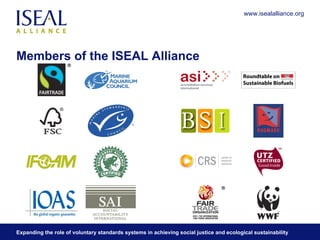
Members of the ISEAL Alliance Eight members in full compliance   with ISEAL Membership Criteria (including compliance with existing ISEAL Codes of Good Practice and other internationally recognised guidance including ISO Guide 17011 for Accreditation Members)  Eight newer members  have committed to demonstrate full compliance within three years from the date of membership approval.
Members of the ISEAL Alliance
ISEAL’s Strategic Plan 2009-2013 Purpose:  To ensure that voluntary standards systems play an expanding role in achieving social justice and ecological sustainability Outputs: Credible operating practices for social and environmental standards systems defined and maintained  Standards systems practitioners supported to use credible operating practices  Stakeholders supported to use credible operating practices Credible standards systems operate as an effective movement  ISEAL Alliance transformed into a strong and sustainable organisation
Output 1:  Defining Credibility Comprehensive suite of ISEAL Codes of Good Practice developed and maintained:  Revision of Standard-Setting Code by end 2009  Development of Impacts Code by end 2010 Development of Verification Code by end 2012 Stakeholder Council to oversee ISEAL Codes of Good Practice from end 2009 Credible operating practices for social and environmental standards systems defined and maintained
Output 2:  Creating Credible  Standards Systems Capacity building and shared learning in person and online to improve practices  of individual standards systems Application of Codes of Good Practice  leads to improved operating practices Independent evaluation mechanism for compliance with ISEAL Codes of Good Practice established by end 2010  Standards systems practitioners supported to use credible operating practices
Output 3:  Empowering the World to use  Credible Standards Standards Systems Academy to build capacity of stakeholders to engage with standards systems  Increased use of ISEAL Codes of Good Practice as international criteria to evaluate social and environmental standards systems  Increased year on year uptake of credible standards systems by governmental bodies, business and civil society Stakeholders supported to use credible operating practices
Output 4:  Scaling Up Standards systems agreement by end 2009 on their individual and collective contributions to sustainability outcomes Implementation of Strategy for Scaling Up from 2010 including: National platform pilots in place by 2010 to improve producer access and producer-driven demand Improved efficiency and effectiveness through coordination of standards systems Joint market offering to increase ability and commitment of business leaders to use standards systems as integral to their operations Credible standards systems operate as an effective movement
Output 5:  Building a strong and sustainable  organisation Financial sustainability allows ISEAL to grow at desired pace Membership reflects the diversity and growth of the standards system movement Operating systems in place that empower staff and strengthen organisational character and spirit ISEAL’s governance responds to stakeholders’ expectations and evolving best practice ISEAL Alliance transformed into a strong and sustainable organisation
We cannot do this alone. We need you to:  Contribute to the development of ISEAL’s Codes of Good Practice Learn how to build better standards systems Engage with us to scale up the impacts of social and environmental standards Buy and promote credible certified products and services Support credible standards systems in your work Shape the future of the ISEAL Alliance by participating in technical working groups and governance bodies
Thank you ISEAL Alliance Secretariat [email_address] www.isealalliance.org

E059 Strategic Plan Presentation

  • 1.
    Scaling up socialand environmental standards systems A presentation of the ISEAL Strategic Plan 2009-2013
  • 2.
    Social and EnvironmentalStandards Systems: A Success Model? Voluntary & market-based Applicable to many global sustainability challenges Unprecedented growth for established systems Emerging standards in new areas: Biofuels, mining, tourism, carbon offsets, … Increasing uptake by governmental bodies and civil society Growth in certified products (2002-2009) Marine Stewardship Council
  • 3.
    What is astandards system? Standard- Setter Certifier Accreditation Body Retailer Consumer Producer Label Buyer/ Manufacturer Supply Chain Capacity Building
  • 4.
    Challenges and OpportunitiesProliferation of standards and labels Growing demand for certified products with proven social and environmental impacts Increased interest by external stakeholders Credibility? Scale? Governance?
  • 5.
    The big question:How do we increase the impact that voluntary standards have in achieving social justice and ecological sustainability ?
  • 6.
    Introducing the ISEALAlliance Our focus: promoting and improving voluntary standards Our members: leading standards systems Our tools: ISEAL Codes of Good Practice Our strength: capacity building and coordination
  • 7.
    Members of theISEAL Alliance Eight members in full compliance with ISEAL Membership Criteria (including compliance with existing ISEAL Codes of Good Practice and other internationally recognised guidance including ISO Guide 17011 for Accreditation Members) Eight newer members have committed to demonstrate full compliance within three years from the date of membership approval.
  • 8.
    Members of theISEAL Alliance
  • 9.
    ISEAL’s Strategic Plan2009-2013 Purpose: To ensure that voluntary standards systems play an expanding role in achieving social justice and ecological sustainability Outputs: Credible operating practices for social and environmental standards systems defined and maintained Standards systems practitioners supported to use credible operating practices Stakeholders supported to use credible operating practices Credible standards systems operate as an effective movement ISEAL Alliance transformed into a strong and sustainable organisation
  • 10.
    Output 1: Defining Credibility Comprehensive suite of ISEAL Codes of Good Practice developed and maintained: Revision of Standard-Setting Code by end 2009 Development of Impacts Code by end 2010 Development of Verification Code by end 2012 Stakeholder Council to oversee ISEAL Codes of Good Practice from end 2009 Credible operating practices for social and environmental standards systems defined and maintained
  • 11.
    Output 2: Creating Credible Standards Systems Capacity building and shared learning in person and online to improve practices of individual standards systems Application of Codes of Good Practice leads to improved operating practices Independent evaluation mechanism for compliance with ISEAL Codes of Good Practice established by end 2010 Standards systems practitioners supported to use credible operating practices
  • 12.
    Output 3: Empowering the World to use Credible Standards Standards Systems Academy to build capacity of stakeholders to engage with standards systems Increased use of ISEAL Codes of Good Practice as international criteria to evaluate social and environmental standards systems Increased year on year uptake of credible standards systems by governmental bodies, business and civil society Stakeholders supported to use credible operating practices
  • 13.
    Output 4: Scaling Up Standards systems agreement by end 2009 on their individual and collective contributions to sustainability outcomes Implementation of Strategy for Scaling Up from 2010 including: National platform pilots in place by 2010 to improve producer access and producer-driven demand Improved efficiency and effectiveness through coordination of standards systems Joint market offering to increase ability and commitment of business leaders to use standards systems as integral to their operations Credible standards systems operate as an effective movement
  • 14.
    Output 5: Building a strong and sustainable organisation Financial sustainability allows ISEAL to grow at desired pace Membership reflects the diversity and growth of the standards system movement Operating systems in place that empower staff and strengthen organisational character and spirit ISEAL’s governance responds to stakeholders’ expectations and evolving best practice ISEAL Alliance transformed into a strong and sustainable organisation
  • 15.
    We cannot dothis alone. We need you to: Contribute to the development of ISEAL’s Codes of Good Practice Learn how to build better standards systems Engage with us to scale up the impacts of social and environmental standards Buy and promote credible certified products and services Support credible standards systems in your work Shape the future of the ISEAL Alliance by participating in technical working groups and governance bodies
  • 16.
    Thank you ISEALAlliance Secretariat [email_address] www.isealalliance.org

Editor's Notes

  • #2 Notes: This presentation can be used to present the ISEAL Strategic Plan 2009-2013, and as a basis for a discussion on the future of voluntary standards systems. The presenter should be familiar with the ISEAL Strategic Plan 2009-2013, available for download from www.isealalliance.org/strategicplan. The main points to bring across are the three challenges, and the related responses for the voluntary standards movement: Growth of the market: Increased coordination and collaboration in order to work as an effective movement Proliferation and new sectors: An international agreement on what makes standards credible, ie. ISEAL Codes of Good Practice (existing: Standard-Setting Code, to be developed: Impacts Code and Verification Code) Increased interest by external stakeholders: Solid and reliable multi-stakeholder governance systems, including a new ISEAL Stakeholder Council For questions on this presentation, please contact the ISEAL Secretariat at info@isealalliance.org