IOSR Journal of Mechanical and Civil Engineering (IOSR-JMCE)
e-ISSN: 2278-1684 Volume 5, Issue 4 (Jan. - Feb. 2013), PP 34-43
www.iosrjournals.org

     Effects On Compressive Strength When Cement Is Partially
                      Replaced By Fly-Ash
                        Aman Jatale1, Kartikey Tiwari2, Sahil Khandelwal3
     1,2,3
             (Department of Civil Engineering, Sanghvi Institute of Management & Science Behind IIM-Indore,
                                          Pigdambar, 453331, Indore, India)

Abstract: The present paper deals with the effect on strength and mechanical properties of cement concrete by
using fly ash.
          The utilization of fly-ash in concrete as partial replacement of cement is gaining immense importance
today, mainly on account of the improvement in the long term durability of concrete combined with ecological
benefits. Technological improvements in thermal power plant operations and fly-ash collection systems have
resulted in improving the consistency of fly-ash.
          To study the effect of partial replacement of cement by fly-ash , studies have been conducted on
concrete mixes with 300 to 500 kg/cum cementious materials at 20%, 40%, 60% replacement levels. In this
paper the effect of fly-ash on workability, setting time, density, air content, compressive strength, modulus of
elasticity are studied
          Based on this study compressive strength v/s W/C curves have been plotted so that concrete mix of
grades M 15, M 20,M 25 with difference percentage of fly-ash can be directly designed.
Keywords- Fly Ash, Compressive Strength, Grade of Concrete

                                               I.    Introduction
          In the view of global warming efforts are on to reduce the emission of CO2 to the environment. Cement
Industry is major in contributor in the emission of CO2 as well as using up high levels of energy resources in the
production of cement. By replacing cement with a material of pozzolanic characteristic, such as the fly ash, the
cement and the concrete industry together can meet the growing demand in the construction industry as well as
help in reducing the environmental pollution. India is a resourceful country for fly ash generation with an annual
output of over 110 millions tones, but utilization is still below 20% in spite of quantum jump in last three to four
years. Availability of consistent quality fly ash across the country and awareness of positive effect of using fly
ash in concrete are pre requisite for change of perception of fly ash from a waste material to a resource material.
          Technological efforts have been made to improve the quality of fly ash. At present most of the power
plants are using Electro Static Precipitators (ESP) through which fly ash is collected in different chambers
according to its particle size. Hence uniform good quality of fly ash can be collected from these power plants.
          To study the impact of partial replacement of cement by fly ash on the properties of concrete,
experiments were conducted on different concrete mixes. This paper present the detailed of experimental set up
and discussion on test results

                                             II.     Green Concrete
          Engineers and architects have choices of the material and products they use to design projects when it
comes to a building frame the choice is typically between concrete, steel and wood; for paving applications the
choice is generally between concrete and asphalt. Material choice depends on several factors including first cost,
life cycle cost and performance for a specific application. Due to growing interest in sustainable development
engineers and architects are motivated more than ever before to choose materials that are more sustainable.
However
this is not as straight forward as selecting an energy star rated appliance or a vehicle providing high gas
mileage.1 On what “measurement” basis can engineers and architects compare materials and choose one that is
more sustainable or specify a material in such a way as to minimize environmental impact?
          Life Cycle Assessment (LCA) seems to offer a solution. LCA considers materials over the course of
their entire life cycle including material extraction, manufacturing, construction, operations, and finally
reuse/recycling. LCA takes into account a full range of environmental impact indicators—including embodied
energy, air and water pollution (including greenhouse gases), potable water consumption, solid waste and
recycled content just to name a few. Building rating systems such as LEED and Green Globes are in various
stages of incorporating LCA so that they can help engineers and architects select materials based on their
environmental performance or specify materials in such a way as to minimize environmental impact.

                                              www.iosrjournals.org                                        34 | Page
Effects On Compressive Strength When Cement Is Partially Replaced By Fly-Ash

         One potential drawback of LCA however is that the person conducting the analysis often has discretion
to set which environmental impact indicator is most important. And often times conducting a full LCA is so
complex that only a partial LCA is conducted with a focus on one or two phases of the life cycle. Recent focus
on climate change and the impact of greenhouse gas emissions on our environment has caused many to focus on
CO2 emissions as the most critical environmental impact indicator. The problem with this approach is that it
forces engineers, architects and product manufacturers to focus their efforts on reducing greenhouse gas
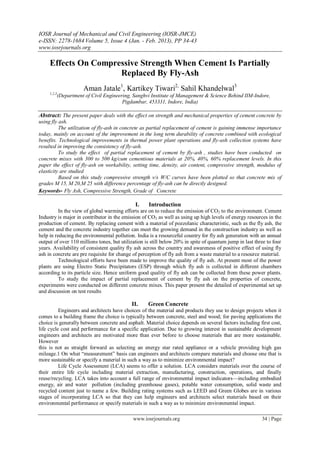
emissions without regard to other sustainable practices. Concrete and CO2 Every 1 ton of cement produced
leads to about 0.9 tons of CO2 emissions and a typical cubic yard (0.7643 m3) of concrete contains about 10%
by weight of cement.
         There have been a number of articles written about reducing the CO2 emissions from concrete
primarily through the use of lower amounts of cement and higher amounts of supplementary cementations
material (SCM) such as fly ash and slag. Table 1 has been developed based on data presented by Marceau et al.5
The following observations can be made: Since a cubic yard of concrete weighs about 2 tons, CO2 emissions
from 1 ton of concrete varies between 0.05 to 0.13 tons. Approximately 95% of all CO2 emissions from a cubic
yard of concrete is from cement manufacturing and so it is no wonder that much attention is paid.

                                       Traditional concrete                   Green concrete

Traditional structure                  Concrete with restricted amount of High amount of fly ash and
                                       fly ash and micro silica           micro silica
                                                                          Green types of cement
                                                                          Use of stone dust, slurry,
                                                                          waste incineration
Green structure                     Cladding with stainless steel         Green concrete (see above)
                                    Stainless steel reinforcement         plus stainless steel cladding
                                                                          or stainless steel
                                                                          reinforcement
                      Table 4: Combination of traditional and green concrete/concrete structures

                                                III.   FLY-ASH
         Fly ash is one of the residues generated in combustion, and comprises the fine particles that rise with
the flue gases. Ash which does not rise is termed bottom ash. In an industrial context, fly ash usually refers to
ash produced during combustion of coal. Fly ash is generally captured by precipitators or other particle filtration
equipment before the flue gases reach the chimneys of coal-fired power plants, and together with bottom
ash removed from the bottom of the furnace is in this case jointly known as coal ash. Depending upon the source
and makeup of the coal being burned, the components of fly ash vary considerably, but all fly ash includes
substantial amounts of silicon dioxide (SiO2) (both amorphous and crystalline) and calcium oxide (CaO), both
being endemic ingredients in many coal-bearing rock strata.
         Toxic constituents depend upon the specific coal bed makeup, but may include one or more of the
following      elements     or      substances    in    quantities    from      trace   amounts      to    several
percent: arsenic, beryllium, boron, cadmium, chromium, chromium, cobalt, lead, manganese, mercury,
molybdenum, selenium, strontium, thallium, and vanadium, along with dioxins and PAH compounds.
         In some cases, such as the burning of solid waste to create electricity ("resource recovery" facilities
a.k.a. waste-to-energy facilities), the fly ash may contain higher levels of contaminants than the bottom ash and
mixing the fly and bottom ash together brings the proportional levels of contaminants within the range to qualify
as nonhazardous waste in a given state, whereas, unmixed, the fly ash would be within the range to qualify as
hazardous waste.

                                        IV.      Chemical Composition
          Fly ash material solidifies while suspended in the exhaust gases and is collected by electrostatic
precipitators or filter bags. Since the particles solidify rapidly while suspended in the exhaust gases, fly ash
particles are generally spherical in shape and range in size from 0.5µm to 300 µm. The major consequence of
the rapid cooling is that only few minerals will have time to crystallize and that mainly amorphous, quenched
glass remains. Nevertheless, some refractory phases in the pulverized coal will not melt (entirely) and remain
crystalline. In consequence, fly ash is a heterogeneous material. SiO2, Al2O3, Fe2O3 and occasionally CaO are
the main chemical components present in fly ashes. The mineralogy of fly ashes is very diverse. The main
phases encountered are a glass phase, together with quartz, mullite and the iron oxides hematite, magnetite .


                                              www.iosrjournals.org                                       35 | Page
Effects On Compressive Strength When Cement Is Partially Replaced By Fly-Ash

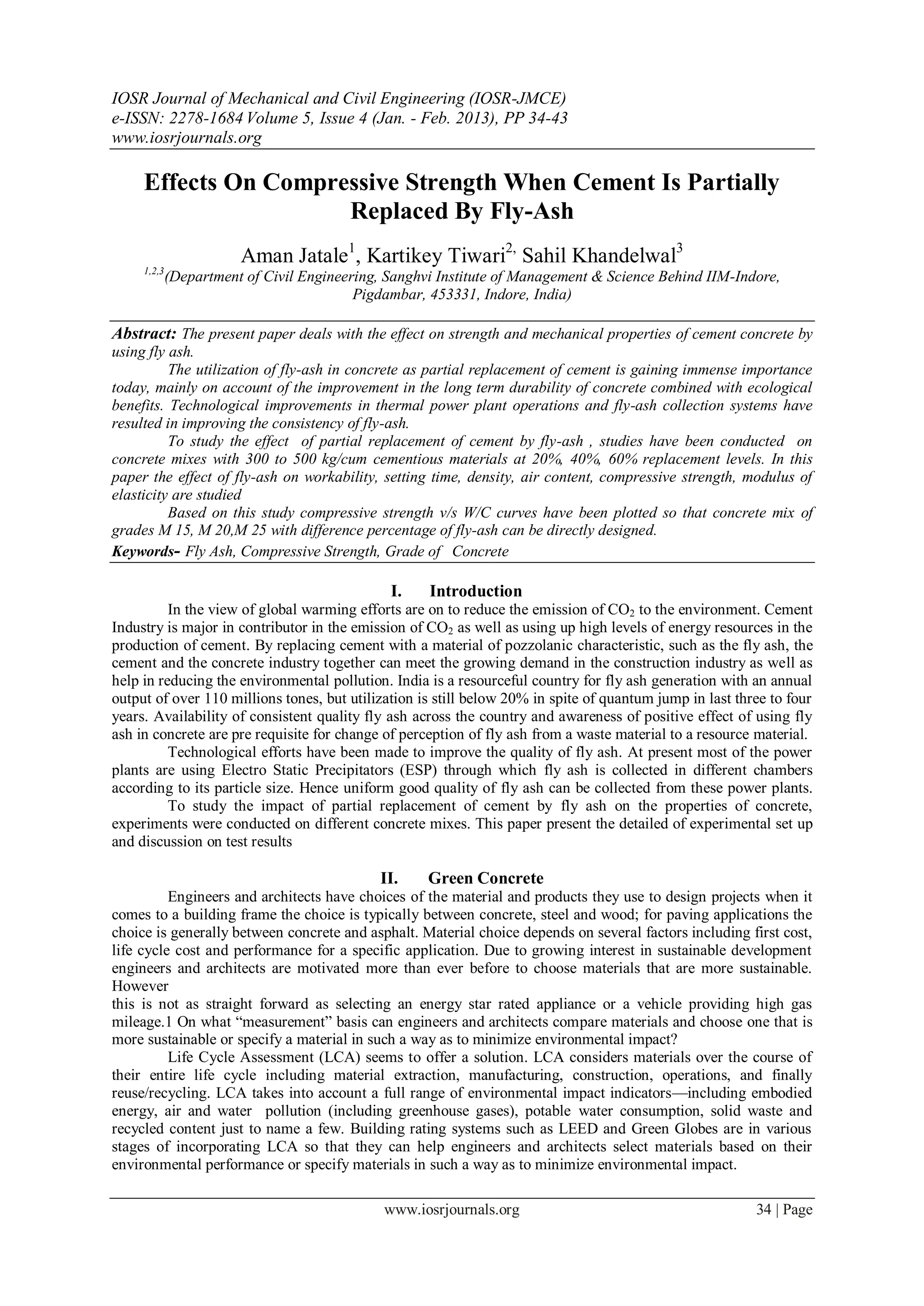
     Component                  Bituminous                  Sub bituminous                     Lignite
     SiO2 (%)                   20-60                       40-60                              15-45
     Al2O3 (%)                  5-35                        20-30                              20-25
     Fe2O3 (%)                  10-40                       4-10                               4-15
     CaO (%)                    1-12                        5-30                               15-40
     LOI (%)                    0-15                        0-3                                0-5
                                   Table 5:-Chemical Composition of fly ash

The above concentrations of trace elements vary according to the kind of coal combusted to form it. In fact, in
the case of bituminous coal, with the notable exception of boron, trace element concentrations are generally
similar to trace element concentrations in unpolluted soils.
           Two classes of fly ash are defined by ASTM C618: Class F fly ash and Class C fly ash. The chief
difference between these classes is the amount of calcium, silica, alumina, and iron content in the ash. The
chemical properties of the fly ash are largely influenced by the chemical content of the coal burned
(i.e., anthracite, bituminous, and lignite).
           Not all fly ashes meet ASTM C618 requirements, although depending on the application, this may not
be necessary. Ash used as a cement replacement must meet strict construction standards, but no standard
environmental regulations have been established in the United States. 75% of the ash must have a fineness of
45 µm or less, and have carbon content, measured by the loss on ignition (LOI), of less than 4%. In the U.S.,
LOI needs to be fewer than 6%. The particle size distribution of raw fly ash is very often fluctuating constantly,
due to changing performance of the coal mills and the boiler performance. This makes it necessary that, if fly
ash is used in an optimal way to replace cement in concrete production, it needs to be processed using
beneficiation methods like mechanical air classification. But if fly ash is used also as a filler to replace sand in
concrete production, unbeneficiated fly ash with higher LOI can be also used. Especially important is the
ongoing quality verification. This is mainly expressed by quality control seals like the Bureau of Indian
Standards mark or the DCL mark of the Dubai Municipality.

                                             V.       Types Of Fly-Ash
    Class F fly ash
         The burning of harder, older anthracite and bituminous coal typically produces Class F fly ash. This fly
ash is pozzolanic in nature, and contains less than 20% lime (CaO). Possessing pozzolanic properties, the glassy
silica and alumina of Class F fly ash requires a cementing agent, such as Portland cement, quicklime, or
hydrated lime, with the presence of water in order to react and produce cementations compounds. Alternatively,
the addition of a chemical activator such as sodium (water glass) to a Class F ash can leads to the formation of
a geopolymer.

    Class C fly ash
          Fly ash produced from the burning of younger lignite or sub bituminous coal, in addition to having
pozzolanic properties, also has some self-cementing properties. In the presence of water, Class C fly ash will
harden and gain strength over time. Class C fly ash generally contains more than 20% lime (CaO). Unlike Class
F, self-cementing Class C fly ash does not require an activator. Alkali and sulfate (SO4) contents are generally
higher in Class C fly ashes.

                                                VI.    Properties
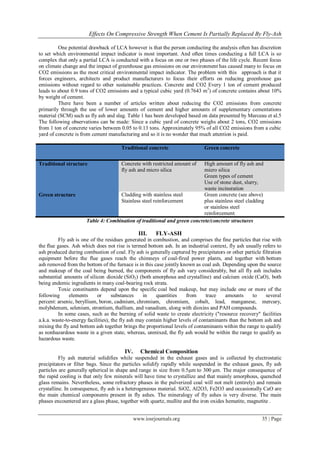
    Properties              Description                                               Requirement as
                                                                                      IS: 3812-2003
    Physical properties     Fineness- sp. Surface (m2/kg)                             > 320
                            Comp. strength at 28 days as % of cement mortar           > 80
                            cubes
                            Lime reactivity (MPa)                                     > 4.0
                            Drying shrinkage                                          < 0.15
                            Soundness by autoclaving Expansion Method                 < 0.8
                            Retention on 45 micron sieve (%)                          < 34


                                             www.iosrjournals.org                                         36 | Page
Effects On Compressive Strength When Cement Is Partially Replaced By Fly-Ash

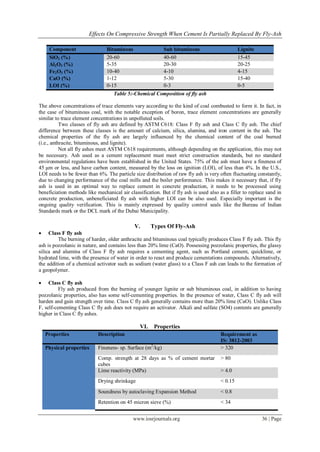
   Chemical properties      Loss on ignition (% by wt.)                               < 12
                            Silica as Sio2 (% by wt.)                                 > 35
                            Iron Oxide as Fe O (% by wt.)                             ---
                                                 2    3

                            Alumina as Al O (% by wt.)                                ---
                                             2    3

                            Total of SiO2, Fe O , Al O (% by wt.)                     > 70
                                                  2   3   2   3

                            Calcium Oxide CaO (% by wt.)                              ---
                            Magnesium Oxide MgO (% by wt.)                            < 5.0
                            Sulfur as SO (% by wt.)                                   < 2.75
                                         3

                            Alkalies (% by wt.) Sodium Oxide                          < 1.50

                                          Table 6:- Properties of fly ash

                                                      VII.        REUSE
The ways of fly ash utilization include (approximately in order of decreasing importance):
     Concrete production, as a substitute material for Portland cement and sand
     Embankments and other structural fills (usually for road construction)
     Grout and Flowable fill production
     Waste stabilization and solidification
     Cement clinkers production - (as a substitute material for clay)
     Mine reclamation
     Stabilization of soft soils
     Road sub base construction
     As Aggregate substitute material (e.g. for brick production)
     Mineral filler in asphaltic concrete
     Agricultural uses: soil amendment, fertilizer, cattle feeders, soil stabilization in stock feed yards, and
       agricultural stakes
     Loose application on rivers to melt ice
     Loose application on roads and parking lots for ice control

Other applications include cosmetics, toothpaste, kitchen counter tops, floor and ceiling tiles, bowling balls,
flotation devices, stucco, utensils, tool handles, picture frames, auto bodies and boat hulls, cellular
concrete, geopolymers, roofing tiles, roofing granules, decking, fireplace mantles, cinder block, PVC pipe,
Structural Insulated Panels, house siding and trim, running tracks, blasting grit, recycled plastic lumber, utility
poles and cross arms, railway sleepers, highway sound barriers, marine pilings, doors, window frames,
scaffolding, sign posts, crypts, columns, railroad ties, vinyl flooring, paving stones, shower stalls, garage doors,
park benches, landscape timbers, planters, pallet blocks, molding, mail boxes, artificial reef, binding
agent, paints and undercoating’s, metal castings, and filler in wood and plastic products.

                                                 VIII.        Methodology
VIII.1. Experimental Setup
         High range super plasticizer was used in all the concrete mixes to achieve good workability. A slump
of 200mm +mm was maintained in all the mixes to ensure that this mixes could be pumped and placed even in
the most congested areas. Unit water content was kept constant for a particular series of mixes of same
cementitious content. To achieve the uniform workability, the admixture dosage was adjusted without
changing the unit water content . this ensured the identical w/cm ratio for a particular cementitious content
and the effect of fly ash replacement can be directly studied on various properties of concrete.

VIII.2 Ingredients
Cement
         The ordinary Portland cement conforming to IS: 8112 was used. The specific surface of cement used in
this study was 60 N/mm2 and 295 m2/kg respectively.


                                                 www.iosrjournals.org                                     37 | Page
Effects On Compressive Strength When Cement Is Partially Replaced By Fly-Ash

Coarse Aggregate
The coarse aggregate from crushed basalt rock, conforming to IS: 383 were used. The flakiness and elongation
index were maintained well below 15%.

Fine Aggregate
The river sand and crushed sand was used in combination as fine aggregate conforming to the requirements of
IS: 383. The river sand was washed and screened, to eliminate deleterious material and over size particle.

Admixture
The high range water reducing and retarding super plasticizer conforming to ASTM C-494,
Type G was used. The base of admixture used in this study was sulphonated naphthalene formaldehyde and
water reduction of admixture was around 20%.

                                   VIIII.      Experimental Programm
          The test performed for testing the Compressive strength of concrete using fly ash. Various cubes are
made with various percentage of fly ash by weight of cement, tested and then analyzed for finding the effect of
using fly ash.
Three concrete cube specimens for the test is made for each M-15, M-20 and M-25 with 20%, 40% and 60% fly
ash composition.
          Compressive strength test is the most common test conducted on hardened concrete as it is an easy test
to perform and also most of the desirable characteristic properties of concrete are qualitatively related to its
compressive strength. The compression test is carried out on specimen cubical in shape .Prism is also sometimes
used, but it is not common in our country. Sometimes, the compressive strength of concrete is determined using
the parts of beam tested in flexure.
The cube specimen is of size 150*150*150mm.If the largest size of aggregate does not exceed 20mm,100mm
size cubes may also be used as an alternative.

Procedure
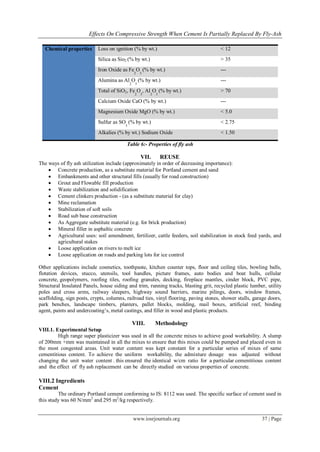
       First of all the mould preferably of cast iron, thick enough to prevent distortion, is used to prepare the
        specimen of size 150*150*150mm.


                                           Fig 9:- Cube Mould.
       During the placing of concrete in the moulds it is compacted with the tamping bar 16mm
        diameter,0.6mm long and bullet pointed at lower end, with not less than 25 strokes per layer.
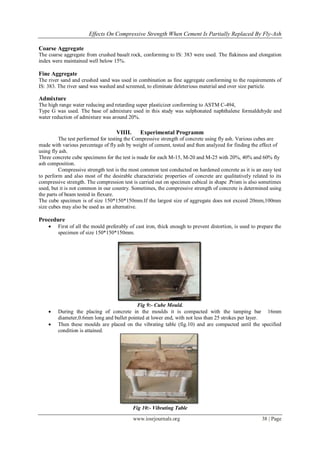
       Then these moulds are placed on the vibrating table (fig.10) and are compacted until the specified
        condition is attained.


                                            Fig 10:- Vibrating Table

                                            www.iosrjournals.org                                        38 | Page
Effects On Compressive Strength When Cement Is Partially Replaced By Fly-Ash

       The test specimens are stored in place free from vibration, in moist air of at least 90% relative humidity
        and at a temperature of 27degree +_2degree C for 24 hrs from the addition of water to the dry
        ingredients.
       After this period, the specimen is marked and submerged water and kept there until taken out just prior
        to test. The water in which the specimens are submerged , are renewed every 7 days .The specimens are
        not to be allowed to become dry at any time until they have been tested.


                                     Fig 11:- Cube After 7 Days Curing.


                                    Fig 12:- UTM machine during testing.

       The cube is then taken out of the curing tank and placed in the UTM machine (fig.12) so to find the
        maximum load at which the concrete fails by compression.

                                                X. RESULTS
         The results from the compression test are in the form of the maximum load the cube can carry before it
ultimately fails .The compressive stress can be found by dividing the maximum load by the area normal to it.
The results of compression test and the corresponding compressive stress is shown in table

Let,
F= maximum load carried by the cube before failure
A= area normal to load =150x150 mm2 = 22500 mm2

BLOCK A                                                                                     Date of experiment
27/9/12
Grade of concrete - M15 [1:2:4]                                                                    Reading date
11/10/12
Volume of concrete =3.375 x 10⁻³ m3
Weight =3.375x10-3 × 24
Volume of cement concrete =0.081 KN
Volume of Concrete = (0.081x1000)/ 9.81
Volume of Concrete =8.256 kg
Cement = 8.256/7
Cement=1.18 kg
80% Cement = 0.944 kg
                                           www.iosrjournals.org                                         39 | Page
Effects On Compressive Strength When Cement Is Partially Replaced By Fly-Ash

20% Fly ash = 0.236 kg
Water = 0.472 kg = 472 ml
Sand= 2.36 kg
Aggregate = 4.72 kg
After 7 day
Initial Load = 484.15 KN
Crack = 600KN
Fail = 810KN
Therefore,
Applied Load = 810-484.15 = 325.85 KN
Applied Load =325.85 x 10³ N

Area = 150x 150
Area = 22500 mm2


Strength of mould = 14.48 N/mm2

                    BLOCK B
         Grade of concrete - M20 [1:1.5:3]                      Date of experiment 27/9/12
               80% Cement = 1.8 kg
               20% Fly ash = 0.45 kg
         Strength of mould = 10.88 N/mm2                           Reading date 4/10/12

                    BLOCK C
          Grade of concrete-M25 [1:1:2]                         Date of experiment 27/9/12
              80% Cement = 1.65 kg
               20% Fly ash = 0.41 kg                              Reading date 11/10/12
         Strength of mould = 14.04 N/mm2

                    BLOCK D
           Grade of concrete-M15[1:2:4]
              60% Cement = 0.71 kg                             Date of experiment 04/10/12
              40% Fly ash = 0.427 kg
         Strength of mould = 12.80 N/mm2
                                                                  Reading date 17/10/12
                    BLOCK E
          Grade of concrete-M20[1:1.5:3]
               60% Cement = 0.9 kg                             Date of experiment 04/10/12
               40% Fly ash = 0.6 kg
         Strength of mould = 13.86 N/mm2
                                                                  Reading date 17/10/12
                    BLOCK F
           Grade of concrete-M25[1:1:2]
              60% Cement = 1.236 kg                            Date of experiment 04/10/12
              40% Fly ash = 0.824 kg
         Strength of mould = 13.90 N/mm2
                                                                  Reading date 17/10/12
                    BLOCK G
           Grade of concrete-M15[1:2:4]                        Date of experiment:- 11/10/12
              40% Cement = 0.472 kg
              60% Fly ash = 0.708 kg                             Reading date:- 02/10/12

                                        www.iosrjournals.org                                   40 | Page
Effects On Compressive Strength When Cement Is Partially Replaced By Fly-Ash

          Strength of mould = 11.90 N/mm2


                     BLOCK H
           Grade of concrete-M20[1:1.5:3]                        Date of experiment 11/10/12
                40% Cement = 0.6 kg
                60% Fly ash = 0.4 kg                                Reading date 02/11/12
               Water = 0.6 kg = 600 ml
          Strength of mould = 14.03 N/mm2

                      BLOCK I
            Grade of concrete-M25[1:1:2]                        Date of experiment:- 11/10/12
               40% Cement = 0.824 kg
                60% Fly ash = 1.24 kg                              Reading date:- 02/10/12
          Strength of mould = 12.70 N/mm2


                    Table 7:- Block wise Conc. mix, % fly Ash & Compressive strength
    Table 8 :-          Replacing 20% cement Fly Replacing 60% cement Replacing 40% cement
Comparative Results                Ash                by Fly Ash               by Fly Ash
Block Name
        M15          Concrete Mix 14.48  % Fly ash        13.8Compressive Strength11.9
A       M20          M15          10.88  20%             13.8614.48N/mm2         14.03
B       M25          M20          14.04  20%              13.910.88 N/mm2         12.7
C                    M25                 20%                  14.04 N/mm2
D                    M15                 40%                  13.80 N/mm2
E                    M20                 40%                  13.86 N/mm2
F                    M25                 40%                  13.90 N/mm2
G                    M15                 60%                  11.90 N/mm2
H                    M20                 60%                  14.03 N/mm2
I                    M25                 60%                  12.70 N/mm2

                               XI.     GRAPHICAL COMPARISON


Fig 4.1 Comparison of Compressive Strength of M-15 grade of concrete with varying Percentage of Fly-Ash.


                                        www.iosrjournals.org                                    41 | Page
Effects On Compressive Strength When Cement Is Partially Replaced By Fly-Ash


    Compressive Strength in     15
                              14.5                                             Replacing 20%
                                14
                              13.5                                             cement by Fly
                                13                                             Ash
           N/mm2


                              12.5                                             Replacing 40%
                                12
                                                                               cement by Fly
                              11.5
                                11                                             Ash
                              10.5                                             Replacing 60%
                                10                                             cement by Fly
                                                 M20                           Ash


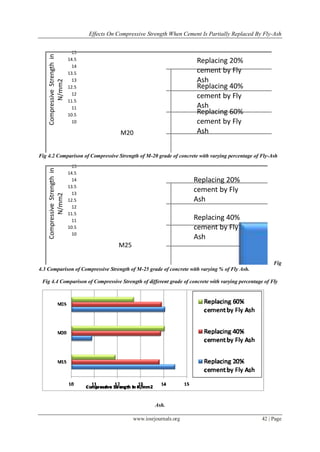
Fig 4.2 Comparison of Compressive Strength of M-20 grade of concrete with varying percentage of Fly-Ash
                                15
    Compressive Strength in


                              14.5
                                14                                            Replacing 20%
                              13.5
                                13
                                                                              cement by Fly
           N/mm2


                              12.5                                            Ash
                                12
                              11.5
                                11                                            Replacing 40%
                              10.5                                            cement by Fly
                                10
                                                                              Ash
                                                M25

                                                                                                              Fig
4.3 Comparison of Compressive Strength of M-25 grade of concrete with varying % of Fly Ash.

 Fig 4.4 Comparison of Compressive Strength of different grade of concrete with varying percentage of Fly


                                                               Ash.

                                                      www.iosrjournals.org                               42 | Page
Effects On Compressive Strength When Cement Is Partially Replaced By Fly-Ash

                                               XII.    Conclusion
         India has a vast resource of fly ash generation all across the country. This material if segregated,
collected and used properly can solve the major problem can solve the major problems of fly ash disposal and
reducing the use of cement, which consumes lot of energy and natural resources. Especially in India many
organizations are putting their efforts to promote the awareness of fly ash concrete and its advantages. Nuclear
Power Corporation of India Ltd (NPCIL) is also involved in R&D activities for development of fly ash concrete
and implementing it in construction of nuclear power structure.
The experimental exercise has helped to study the various properties of fly ash concrete and to develop the mix
design curves for concrete mix proportioning with various percentages of fly ash. Based on the studies
conducted by authors following conclusion are drawn on the fly ash concrete.

1.    Use of fly ash improves the workability of concrete. This phenomenon can be used either the unit water
      content of mix or to reduce the admixture dosage.
2.    Density and air content of concrete mix are generally unaffected with the use of fly ash.
3.    Normally use of fly ash slightly retards the setting time of concrete, but it is compensated by reduction in
      the admixture dosage to maintain the same workability.
4.    Bleeding in fly ash concrete is significantly reduced and other properties like cohesiveness, pumping
      characteristics and surface finish are improved.
5.    As the fly ash content increases there is reduction in the strength of concrete. This reduction is more at
      earlier ages as compared to later ages. This is expected, as the secondary hydration due to pozzolanic action
      is slower at initial stage for fly ash concrete.
6.    Rate of strength development at various ages is related to the W/Cm and percentages of fly ash in the
      concrete mix.
7.    Modulus of elasticity of fly ash concrete also reduces with the increase in fly ash percentage for a given
      W/Cm. Reduction in E value is much lower as compared to compressive strength.
8.    Shrinkage of fly ash concrete mix is similar to control concrete mix.
9.    Fly ash concrete is more durable as compare to OPC concrete. Significant reduction in RCPT values at 56
      days and 90 days indicates much lower permeability of fly ash concrete as compare to OPC concrete.

The time has come for appreciating the fact without any reservation that fly ashcan be gain fully used in
        Making concrete strong, durable, Eco-friendly and economical.

                                                             References

Journal Papers:
[1]     Vol. 3, No. 1, February 2008, Arpn Journal Of Engineering And Applied Sciences, Effect Of Concentration Of Alkaline Liquid An d
        Curing Time On Strength And Water Absorption Of Geopolymer Concrete.
[2]     Vol. 7, No. 1, January 2012, Arpn Journal Of Engineering And Applied Sciences, Recycled Aggregate Concrete Exposed To
        Elevated Temperature
[3]        Featured at the proceedings FIB-symposium "Concrete and environment" in Berlin, October 2001, Environmentally “Green”
        Concrete Structures.
Books:
[4]     Rangan, B. V., Hardjto, D. 2005. Development and properties of low calcium fly ash based geopolymer concrete. Research report
       GC-1, Faculty of Engineering, Curtins University of Technology, and Perth, Australia.
[5]     Van Jaarsveld, J. G. S., Van Deventer, J. S. J., Lorenzen, L. Factors affecting the immobilization of metals in Geopolymerized fly
       ash. Metallurgical and Material Transactions. B 29B (1): 283-291.
[6]    M.L., Concrete Technology
[7]    M.S. Shetty, Concrete Technology
[8]    R.S. Khurmi
[9]   IS Code 456:2000.
[10] Neville A.M. (1995), Properties of Concrete, Essex: Longman

Chapters in Books:
[11] Recommended guidelines for concrete mix design, IS 10262: 1982.Bureau of Indian Standards, New Delhi, India.
[12] ACI Committee 201. 1989. Guide to durable concrete. American Concrete Institute.
[13] Specification for fly ash for use as pozzolona and admixture IS 3812: 1981.Bureau of Indian Standards, New Delhi, India.
[14] Specification for Coarse & Fine Aggregates from Natural Sources for Concrete (2 nd Revision). IS:383: 1970, BIS, New Delhi.
[15] Specification for 53 grade ordinary Portland cement, IS 12269:1987, Bureau of Indian Standards, New Delhi, India.
Theses:
[16]   Applied Research Paper: Autoclaved Aerated Concrete as a Green Building Material Stefan Schnitzler October 2006.


                                                     www.iosrjournals.org                                                      43 | Page

E0543443

  • 1.
    IOSR Journal ofMechanical and Civil Engineering (IOSR-JMCE) e-ISSN: 2278-1684 Volume 5, Issue 4 (Jan. - Feb. 2013), PP 34-43 www.iosrjournals.org Effects On Compressive Strength When Cement Is Partially Replaced By Fly-Ash Aman Jatale1, Kartikey Tiwari2, Sahil Khandelwal3 1,2,3 (Department of Civil Engineering, Sanghvi Institute of Management & Science Behind IIM-Indore, Pigdambar, 453331, Indore, India) Abstract: The present paper deals with the effect on strength and mechanical properties of cement concrete by using fly ash. The utilization of fly-ash in concrete as partial replacement of cement is gaining immense importance today, mainly on account of the improvement in the long term durability of concrete combined with ecological benefits. Technological improvements in thermal power plant operations and fly-ash collection systems have resulted in improving the consistency of fly-ash. To study the effect of partial replacement of cement by fly-ash , studies have been conducted on concrete mixes with 300 to 500 kg/cum cementious materials at 20%, 40%, 60% replacement levels. In this paper the effect of fly-ash on workability, setting time, density, air content, compressive strength, modulus of elasticity are studied Based on this study compressive strength v/s W/C curves have been plotted so that concrete mix of grades M 15, M 20,M 25 with difference percentage of fly-ash can be directly designed. Keywords- Fly Ash, Compressive Strength, Grade of Concrete I. Introduction In the view of global warming efforts are on to reduce the emission of CO2 to the environment. Cement Industry is major in contributor in the emission of CO2 as well as using up high levels of energy resources in the production of cement. By replacing cement with a material of pozzolanic characteristic, such as the fly ash, the cement and the concrete industry together can meet the growing demand in the construction industry as well as help in reducing the environmental pollution. India is a resourceful country for fly ash generation with an annual output of over 110 millions tones, but utilization is still below 20% in spite of quantum jump in last three to four years. Availability of consistent quality fly ash across the country and awareness of positive effect of using fly ash in concrete are pre requisite for change of perception of fly ash from a waste material to a resource material. Technological efforts have been made to improve the quality of fly ash. At present most of the power plants are using Electro Static Precipitators (ESP) through which fly ash is collected in different chambers according to its particle size. Hence uniform good quality of fly ash can be collected from these power plants. To study the impact of partial replacement of cement by fly ash on the properties of concrete, experiments were conducted on different concrete mixes. This paper present the detailed of experimental set up and discussion on test results II. Green Concrete Engineers and architects have choices of the material and products they use to design projects when it comes to a building frame the choice is typically between concrete, steel and wood; for paving applications the choice is generally between concrete and asphalt. Material choice depends on several factors including first cost, life cycle cost and performance for a specific application. Due to growing interest in sustainable development engineers and architects are motivated more than ever before to choose materials that are more sustainable. However this is not as straight forward as selecting an energy star rated appliance or a vehicle providing high gas mileage.1 On what “measurement” basis can engineers and architects compare materials and choose one that is more sustainable or specify a material in such a way as to minimize environmental impact? Life Cycle Assessment (LCA) seems to offer a solution. LCA considers materials over the course of their entire life cycle including material extraction, manufacturing, construction, operations, and finally reuse/recycling. LCA takes into account a full range of environmental impact indicators—including embodied energy, air and water pollution (including greenhouse gases), potable water consumption, solid waste and recycled content just to name a few. Building rating systems such as LEED and Green Globes are in various stages of incorporating LCA so that they can help engineers and architects select materials based on their environmental performance or specify materials in such a way as to minimize environmental impact. www.iosrjournals.org 34 | Page
  • 2.
    Effects On CompressiveStrength When Cement Is Partially Replaced By Fly-Ash One potential drawback of LCA however is that the person conducting the analysis often has discretion to set which environmental impact indicator is most important. And often times conducting a full LCA is so complex that only a partial LCA is conducted with a focus on one or two phases of the life cycle. Recent focus on climate change and the impact of greenhouse gas emissions on our environment has caused many to focus on CO2 emissions as the most critical environmental impact indicator. The problem with this approach is that it forces engineers, architects and product manufacturers to focus their efforts on reducing greenhouse gas emissions without regard to other sustainable practices. Concrete and CO2 Every 1 ton of cement produced leads to about 0.9 tons of CO2 emissions and a typical cubic yard (0.7643 m3) of concrete contains about 10% by weight of cement. There have been a number of articles written about reducing the CO2 emissions from concrete primarily through the use of lower amounts of cement and higher amounts of supplementary cementations material (SCM) such as fly ash and slag. Table 1 has been developed based on data presented by Marceau et al.5 The following observations can be made: Since a cubic yard of concrete weighs about 2 tons, CO2 emissions from 1 ton of concrete varies between 0.05 to 0.13 tons. Approximately 95% of all CO2 emissions from a cubic yard of concrete is from cement manufacturing and so it is no wonder that much attention is paid. Traditional concrete Green concrete Traditional structure Concrete with restricted amount of High amount of fly ash and fly ash and micro silica micro silica Green types of cement Use of stone dust, slurry, waste incineration Green structure Cladding with stainless steel Green concrete (see above) Stainless steel reinforcement plus stainless steel cladding or stainless steel reinforcement Table 4: Combination of traditional and green concrete/concrete structures III. FLY-ASH Fly ash is one of the residues generated in combustion, and comprises the fine particles that rise with the flue gases. Ash which does not rise is termed bottom ash. In an industrial context, fly ash usually refers to ash produced during combustion of coal. Fly ash is generally captured by precipitators or other particle filtration equipment before the flue gases reach the chimneys of coal-fired power plants, and together with bottom ash removed from the bottom of the furnace is in this case jointly known as coal ash. Depending upon the source and makeup of the coal being burned, the components of fly ash vary considerably, but all fly ash includes substantial amounts of silicon dioxide (SiO2) (both amorphous and crystalline) and calcium oxide (CaO), both being endemic ingredients in many coal-bearing rock strata. Toxic constituents depend upon the specific coal bed makeup, but may include one or more of the following elements or substances in quantities from trace amounts to several percent: arsenic, beryllium, boron, cadmium, chromium, chromium, cobalt, lead, manganese, mercury, molybdenum, selenium, strontium, thallium, and vanadium, along with dioxins and PAH compounds. In some cases, such as the burning of solid waste to create electricity ("resource recovery" facilities a.k.a. waste-to-energy facilities), the fly ash may contain higher levels of contaminants than the bottom ash and mixing the fly and bottom ash together brings the proportional levels of contaminants within the range to qualify as nonhazardous waste in a given state, whereas, unmixed, the fly ash would be within the range to qualify as hazardous waste. IV. Chemical Composition Fly ash material solidifies while suspended in the exhaust gases and is collected by electrostatic precipitators or filter bags. Since the particles solidify rapidly while suspended in the exhaust gases, fly ash particles are generally spherical in shape and range in size from 0.5µm to 300 µm. The major consequence of the rapid cooling is that only few minerals will have time to crystallize and that mainly amorphous, quenched glass remains. Nevertheless, some refractory phases in the pulverized coal will not melt (entirely) and remain crystalline. In consequence, fly ash is a heterogeneous material. SiO2, Al2O3, Fe2O3 and occasionally CaO are the main chemical components present in fly ashes. The mineralogy of fly ashes is very diverse. The main phases encountered are a glass phase, together with quartz, mullite and the iron oxides hematite, magnetite . www.iosrjournals.org 35 | Page
  • 3.
    Effects On CompressiveStrength When Cement Is Partially Replaced By Fly-Ash Component Bituminous Sub bituminous Lignite SiO2 (%) 20-60 40-60 15-45 Al2O3 (%) 5-35 20-30 20-25 Fe2O3 (%) 10-40 4-10 4-15 CaO (%) 1-12 5-30 15-40 LOI (%) 0-15 0-3 0-5 Table 5:-Chemical Composition of fly ash The above concentrations of trace elements vary according to the kind of coal combusted to form it. In fact, in the case of bituminous coal, with the notable exception of boron, trace element concentrations are generally similar to trace element concentrations in unpolluted soils. Two classes of fly ash are defined by ASTM C618: Class F fly ash and Class C fly ash. The chief difference between these classes is the amount of calcium, silica, alumina, and iron content in the ash. The chemical properties of the fly ash are largely influenced by the chemical content of the coal burned (i.e., anthracite, bituminous, and lignite). Not all fly ashes meet ASTM C618 requirements, although depending on the application, this may not be necessary. Ash used as a cement replacement must meet strict construction standards, but no standard environmental regulations have been established in the United States. 75% of the ash must have a fineness of 45 µm or less, and have carbon content, measured by the loss on ignition (LOI), of less than 4%. In the U.S., LOI needs to be fewer than 6%. The particle size distribution of raw fly ash is very often fluctuating constantly, due to changing performance of the coal mills and the boiler performance. This makes it necessary that, if fly ash is used in an optimal way to replace cement in concrete production, it needs to be processed using beneficiation methods like mechanical air classification. But if fly ash is used also as a filler to replace sand in concrete production, unbeneficiated fly ash with higher LOI can be also used. Especially important is the ongoing quality verification. This is mainly expressed by quality control seals like the Bureau of Indian Standards mark or the DCL mark of the Dubai Municipality. V. Types Of Fly-Ash  Class F fly ash The burning of harder, older anthracite and bituminous coal typically produces Class F fly ash. This fly ash is pozzolanic in nature, and contains less than 20% lime (CaO). Possessing pozzolanic properties, the glassy silica and alumina of Class F fly ash requires a cementing agent, such as Portland cement, quicklime, or hydrated lime, with the presence of water in order to react and produce cementations compounds. Alternatively, the addition of a chemical activator such as sodium (water glass) to a Class F ash can leads to the formation of a geopolymer.  Class C fly ash Fly ash produced from the burning of younger lignite or sub bituminous coal, in addition to having pozzolanic properties, also has some self-cementing properties. In the presence of water, Class C fly ash will harden and gain strength over time. Class C fly ash generally contains more than 20% lime (CaO). Unlike Class F, self-cementing Class C fly ash does not require an activator. Alkali and sulfate (SO4) contents are generally higher in Class C fly ashes. VI. Properties Properties Description Requirement as IS: 3812-2003 Physical properties Fineness- sp. Surface (m2/kg) > 320 Comp. strength at 28 days as % of cement mortar > 80 cubes Lime reactivity (MPa) > 4.0 Drying shrinkage < 0.15 Soundness by autoclaving Expansion Method < 0.8 Retention on 45 micron sieve (%) < 34 www.iosrjournals.org 36 | Page
  • 4.
    Effects On CompressiveStrength When Cement Is Partially Replaced By Fly-Ash Chemical properties Loss on ignition (% by wt.) < 12 Silica as Sio2 (% by wt.) > 35 Iron Oxide as Fe O (% by wt.) --- 2 3 Alumina as Al O (% by wt.) --- 2 3 Total of SiO2, Fe O , Al O (% by wt.) > 70 2 3 2 3 Calcium Oxide CaO (% by wt.) --- Magnesium Oxide MgO (% by wt.) < 5.0 Sulfur as SO (% by wt.) < 2.75 3 Alkalies (% by wt.) Sodium Oxide < 1.50 Table 6:- Properties of fly ash VII. REUSE The ways of fly ash utilization include (approximately in order of decreasing importance):  Concrete production, as a substitute material for Portland cement and sand  Embankments and other structural fills (usually for road construction)  Grout and Flowable fill production  Waste stabilization and solidification  Cement clinkers production - (as a substitute material for clay)  Mine reclamation  Stabilization of soft soils  Road sub base construction  As Aggregate substitute material (e.g. for brick production)  Mineral filler in asphaltic concrete  Agricultural uses: soil amendment, fertilizer, cattle feeders, soil stabilization in stock feed yards, and agricultural stakes  Loose application on rivers to melt ice  Loose application on roads and parking lots for ice control Other applications include cosmetics, toothpaste, kitchen counter tops, floor and ceiling tiles, bowling balls, flotation devices, stucco, utensils, tool handles, picture frames, auto bodies and boat hulls, cellular concrete, geopolymers, roofing tiles, roofing granules, decking, fireplace mantles, cinder block, PVC pipe, Structural Insulated Panels, house siding and trim, running tracks, blasting grit, recycled plastic lumber, utility poles and cross arms, railway sleepers, highway sound barriers, marine pilings, doors, window frames, scaffolding, sign posts, crypts, columns, railroad ties, vinyl flooring, paving stones, shower stalls, garage doors, park benches, landscape timbers, planters, pallet blocks, molding, mail boxes, artificial reef, binding agent, paints and undercoating’s, metal castings, and filler in wood and plastic products. VIII. Methodology VIII.1. Experimental Setup High range super plasticizer was used in all the concrete mixes to achieve good workability. A slump of 200mm +mm was maintained in all the mixes to ensure that this mixes could be pumped and placed even in the most congested areas. Unit water content was kept constant for a particular series of mixes of same cementitious content. To achieve the uniform workability, the admixture dosage was adjusted without changing the unit water content . this ensured the identical w/cm ratio for a particular cementitious content and the effect of fly ash replacement can be directly studied on various properties of concrete. VIII.2 Ingredients Cement The ordinary Portland cement conforming to IS: 8112 was used. The specific surface of cement used in this study was 60 N/mm2 and 295 m2/kg respectively. www.iosrjournals.org 37 | Page
  • 5.
    Effects On CompressiveStrength When Cement Is Partially Replaced By Fly-Ash Coarse Aggregate The coarse aggregate from crushed basalt rock, conforming to IS: 383 were used. The flakiness and elongation index were maintained well below 15%. Fine Aggregate The river sand and crushed sand was used in combination as fine aggregate conforming to the requirements of IS: 383. The river sand was washed and screened, to eliminate deleterious material and over size particle. Admixture The high range water reducing and retarding super plasticizer conforming to ASTM C-494, Type G was used. The base of admixture used in this study was sulphonated naphthalene formaldehyde and water reduction of admixture was around 20%. VIIII. Experimental Programm The test performed for testing the Compressive strength of concrete using fly ash. Various cubes are made with various percentage of fly ash by weight of cement, tested and then analyzed for finding the effect of using fly ash. Three concrete cube specimens for the test is made for each M-15, M-20 and M-25 with 20%, 40% and 60% fly ash composition. Compressive strength test is the most common test conducted on hardened concrete as it is an easy test to perform and also most of the desirable characteristic properties of concrete are qualitatively related to its compressive strength. The compression test is carried out on specimen cubical in shape .Prism is also sometimes used, but it is not common in our country. Sometimes, the compressive strength of concrete is determined using the parts of beam tested in flexure. The cube specimen is of size 150*150*150mm.If the largest size of aggregate does not exceed 20mm,100mm size cubes may also be used as an alternative. Procedure  First of all the mould preferably of cast iron, thick enough to prevent distortion, is used to prepare the specimen of size 150*150*150mm. Fig 9:- Cube Mould.  During the placing of concrete in the moulds it is compacted with the tamping bar 16mm diameter,0.6mm long and bullet pointed at lower end, with not less than 25 strokes per layer.  Then these moulds are placed on the vibrating table (fig.10) and are compacted until the specified condition is attained. Fig 10:- Vibrating Table www.iosrjournals.org 38 | Page
  • 6.
    Effects On CompressiveStrength When Cement Is Partially Replaced By Fly-Ash  The test specimens are stored in place free from vibration, in moist air of at least 90% relative humidity and at a temperature of 27degree +_2degree C for 24 hrs from the addition of water to the dry ingredients.  After this period, the specimen is marked and submerged water and kept there until taken out just prior to test. The water in which the specimens are submerged , are renewed every 7 days .The specimens are not to be allowed to become dry at any time until they have been tested. Fig 11:- Cube After 7 Days Curing. Fig 12:- UTM machine during testing.  The cube is then taken out of the curing tank and placed in the UTM machine (fig.12) so to find the maximum load at which the concrete fails by compression. X. RESULTS The results from the compression test are in the form of the maximum load the cube can carry before it ultimately fails .The compressive stress can be found by dividing the maximum load by the area normal to it. The results of compression test and the corresponding compressive stress is shown in table Let, F= maximum load carried by the cube before failure A= area normal to load =150x150 mm2 = 22500 mm2 BLOCK A Date of experiment 27/9/12 Grade of concrete - M15 [1:2:4] Reading date 11/10/12 Volume of concrete =3.375 x 10⁻³ m3 Weight =3.375x10-3 × 24 Volume of cement concrete =0.081 KN Volume of Concrete = (0.081x1000)/ 9.81 Volume of Concrete =8.256 kg Cement = 8.256/7 Cement=1.18 kg 80% Cement = 0.944 kg www.iosrjournals.org 39 | Page
  • 7.
    Effects On CompressiveStrength When Cement Is Partially Replaced By Fly-Ash 20% Fly ash = 0.236 kg Water = 0.472 kg = 472 ml Sand= 2.36 kg Aggregate = 4.72 kg After 7 day Initial Load = 484.15 KN Crack = 600KN Fail = 810KN Therefore, Applied Load = 810-484.15 = 325.85 KN Applied Load =325.85 x 10³ N Area = 150x 150 Area = 22500 mm2 Strength of mould = 14.48 N/mm2 BLOCK B Grade of concrete - M20 [1:1.5:3] Date of experiment 27/9/12 80% Cement = 1.8 kg 20% Fly ash = 0.45 kg Strength of mould = 10.88 N/mm2 Reading date 4/10/12 BLOCK C Grade of concrete-M25 [1:1:2] Date of experiment 27/9/12 80% Cement = 1.65 kg 20% Fly ash = 0.41 kg Reading date 11/10/12 Strength of mould = 14.04 N/mm2 BLOCK D Grade of concrete-M15[1:2:4] 60% Cement = 0.71 kg Date of experiment 04/10/12 40% Fly ash = 0.427 kg Strength of mould = 12.80 N/mm2 Reading date 17/10/12 BLOCK E Grade of concrete-M20[1:1.5:3] 60% Cement = 0.9 kg Date of experiment 04/10/12 40% Fly ash = 0.6 kg Strength of mould = 13.86 N/mm2 Reading date 17/10/12 BLOCK F Grade of concrete-M25[1:1:2] 60% Cement = 1.236 kg Date of experiment 04/10/12 40% Fly ash = 0.824 kg Strength of mould = 13.90 N/mm2 Reading date 17/10/12 BLOCK G Grade of concrete-M15[1:2:4] Date of experiment:- 11/10/12 40% Cement = 0.472 kg 60% Fly ash = 0.708 kg Reading date:- 02/10/12 www.iosrjournals.org 40 | Page
  • 8.
    Effects On CompressiveStrength When Cement Is Partially Replaced By Fly-Ash Strength of mould = 11.90 N/mm2 BLOCK H Grade of concrete-M20[1:1.5:3] Date of experiment 11/10/12 40% Cement = 0.6 kg 60% Fly ash = 0.4 kg Reading date 02/11/12 Water = 0.6 kg = 600 ml Strength of mould = 14.03 N/mm2 BLOCK I Grade of concrete-M25[1:1:2] Date of experiment:- 11/10/12 40% Cement = 0.824 kg 60% Fly ash = 1.24 kg Reading date:- 02/10/12 Strength of mould = 12.70 N/mm2 Table 7:- Block wise Conc. mix, % fly Ash & Compressive strength Table 8 :- Replacing 20% cement Fly Replacing 60% cement Replacing 40% cement Comparative Results Ash by Fly Ash by Fly Ash Block Name M15 Concrete Mix 14.48 % Fly ash 13.8Compressive Strength11.9 A M20 M15 10.88 20% 13.8614.48N/mm2 14.03 B M25 M20 14.04 20% 13.910.88 N/mm2 12.7 C M25 20% 14.04 N/mm2 D M15 40% 13.80 N/mm2 E M20 40% 13.86 N/mm2 F M25 40% 13.90 N/mm2 G M15 60% 11.90 N/mm2 H M20 60% 14.03 N/mm2 I M25 60% 12.70 N/mm2 XI. GRAPHICAL COMPARISON Fig 4.1 Comparison of Compressive Strength of M-15 grade of concrete with varying Percentage of Fly-Ash. www.iosrjournals.org 41 | Page
  • 9.
    Effects On CompressiveStrength When Cement Is Partially Replaced By Fly-Ash Compressive Strength in 15 14.5 Replacing 20% 14 13.5 cement by Fly 13 Ash N/mm2 12.5 Replacing 40% 12 cement by Fly 11.5 11 Ash 10.5 Replacing 60% 10 cement by Fly M20 Ash Fig 4.2 Comparison of Compressive Strength of M-20 grade of concrete with varying percentage of Fly-Ash 15 Compressive Strength in 14.5 14 Replacing 20% 13.5 13 cement by Fly N/mm2 12.5 Ash 12 11.5 11 Replacing 40% 10.5 cement by Fly 10 Ash M25 Fig 4.3 Comparison of Compressive Strength of M-25 grade of concrete with varying % of Fly Ash. Fig 4.4 Comparison of Compressive Strength of different grade of concrete with varying percentage of Fly Ash. www.iosrjournals.org 42 | Page
  • 10.
    Effects On CompressiveStrength When Cement Is Partially Replaced By Fly-Ash XII. Conclusion India has a vast resource of fly ash generation all across the country. This material if segregated, collected and used properly can solve the major problem can solve the major problems of fly ash disposal and reducing the use of cement, which consumes lot of energy and natural resources. Especially in India many organizations are putting their efforts to promote the awareness of fly ash concrete and its advantages. Nuclear Power Corporation of India Ltd (NPCIL) is also involved in R&D activities for development of fly ash concrete and implementing it in construction of nuclear power structure. The experimental exercise has helped to study the various properties of fly ash concrete and to develop the mix design curves for concrete mix proportioning with various percentages of fly ash. Based on the studies conducted by authors following conclusion are drawn on the fly ash concrete. 1. Use of fly ash improves the workability of concrete. This phenomenon can be used either the unit water content of mix or to reduce the admixture dosage. 2. Density and air content of concrete mix are generally unaffected with the use of fly ash. 3. Normally use of fly ash slightly retards the setting time of concrete, but it is compensated by reduction in the admixture dosage to maintain the same workability. 4. Bleeding in fly ash concrete is significantly reduced and other properties like cohesiveness, pumping characteristics and surface finish are improved. 5. As the fly ash content increases there is reduction in the strength of concrete. This reduction is more at earlier ages as compared to later ages. This is expected, as the secondary hydration due to pozzolanic action is slower at initial stage for fly ash concrete. 6. Rate of strength development at various ages is related to the W/Cm and percentages of fly ash in the concrete mix. 7. Modulus of elasticity of fly ash concrete also reduces with the increase in fly ash percentage for a given W/Cm. Reduction in E value is much lower as compared to compressive strength. 8. Shrinkage of fly ash concrete mix is similar to control concrete mix. 9. Fly ash concrete is more durable as compare to OPC concrete. Significant reduction in RCPT values at 56 days and 90 days indicates much lower permeability of fly ash concrete as compare to OPC concrete. The time has come for appreciating the fact without any reservation that fly ashcan be gain fully used in Making concrete strong, durable, Eco-friendly and economical. References Journal Papers: [1] Vol. 3, No. 1, February 2008, Arpn Journal Of Engineering And Applied Sciences, Effect Of Concentration Of Alkaline Liquid An d Curing Time On Strength And Water Absorption Of Geopolymer Concrete. [2] Vol. 7, No. 1, January 2012, Arpn Journal Of Engineering And Applied Sciences, Recycled Aggregate Concrete Exposed To Elevated Temperature [3] Featured at the proceedings FIB-symposium "Concrete and environment" in Berlin, October 2001, Environmentally “Green” Concrete Structures. Books: [4] Rangan, B. V., Hardjto, D. 2005. Development and properties of low calcium fly ash based geopolymer concrete. Research report GC-1, Faculty of Engineering, Curtins University of Technology, and Perth, Australia. [5] Van Jaarsveld, J. G. S., Van Deventer, J. S. J., Lorenzen, L. Factors affecting the immobilization of metals in Geopolymerized fly ash. Metallurgical and Material Transactions. B 29B (1): 283-291. [6] M.L., Concrete Technology [7] M.S. Shetty, Concrete Technology [8] R.S. Khurmi [9] IS Code 456:2000. [10] Neville A.M. (1995), Properties of Concrete, Essex: Longman Chapters in Books: [11] Recommended guidelines for concrete mix design, IS 10262: 1982.Bureau of Indian Standards, New Delhi, India. [12] ACI Committee 201. 1989. Guide to durable concrete. American Concrete Institute. [13] Specification for fly ash for use as pozzolona and admixture IS 3812: 1981.Bureau of Indian Standards, New Delhi, India. [14] Specification for Coarse & Fine Aggregates from Natural Sources for Concrete (2 nd Revision). IS:383: 1970, BIS, New Delhi. [15] Specification for 53 grade ordinary Portland cement, IS 12269:1987, Bureau of Indian Standards, New Delhi, India. Theses: [16] Applied Research Paper: Autoclaved Aerated Concrete as a Green Building Material Stefan Schnitzler October 2006. www.iosrjournals.org 43 | Page