What is an e-Way Bill?
1. E-Way Bill is an electronic way bill for movement of goods which can be generated on the e-Way Bill
Portal.
2. Transport of goods of more than Rs 50,000 in value cannot be made by a registered person without an e-
way bill.
3. E-way bill can also be generated or cancelled through SMS.
4. When an e-way bill is generated a unique e-way bill number (EBN) is allocated and is available to the
supplier, recipient, and the transporter.
2. When Should e-Way Bill be issued?
E-way bill will be generated when there is a movement of goods of value more than Rs. 50,000 –
In relation to a ‘supply’
1. For reasons other than a ‘supply’ ( say a return)
2. Due to inward ‘supply’ from an unregistered person
3. For this purpose, a supply may be either of the following:
a) A supply made for a consideration (payment) in the course of business
b) A supply made for a consideration (payment) which may not be in the course of business
c) A supply without consideration (without payment)In simpler terms, the term ‘supply’ usually means a:
d) Sale – sale of goods and payment made
e) Transfer – branch transfers for instance
f) Barter/Exchange – where the payment is by goods instead of in money
g) Therefore, e-Way Bills must be generated on the common portal for all these types of movements.
3. Cases when e-Way bill is Not Required
In the following cases it is not necessary to generate e-Way Bill:
1. The mode of transport is non-motor vehicle
2. Goods transported from port, airport, air cargo complex or land customs station to Inland Container
Depot (ICD) or Container Freight Station (CFS) for clearance by Customs.
3. Transport of specified goods (PDF of List of Goods).
Note: Part B of e-Way Bill is not required to be filled where the distance between the consigner or
consignee and the transporter is less than 10 Kms and transport is within the same state.
4. Who should Generate an e-Way Bill?
1. Registered Person – E-way bill must be generated when there is a movement of goods of more than Rs
50,000 in value to or from a Registered Person. A Registered person or the transporter may choose to
generate and carry e-way bill even if the value of goods is less than Rs 50,000.
2. Unregistered Persons – Unregistered persons are also required to generate e-Way Bill. However,
where a supply is made by an unregistered person to a registered person, the receiver will have to
ensure all the compliances are met as if they were the supplier.
3. Transporter – Transporters carrying goods by road, air, rail, etc. also need to generate e-Way Bill if the
supplier has not generated an e-Way Bill.
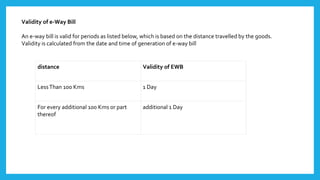
Validity of e-Way Bill
An e-way bill is valid for periods as listed below, which is based on the distance travelled by the goods.
Validity is calculated from the date and time of generation of e-way bill
distance Validity of EWB
LessThan 100 Kms 1 Day
For every additional 100 Kms or part
thereof
additional 1 Day
Documents or Details required to generate e-Way Bill
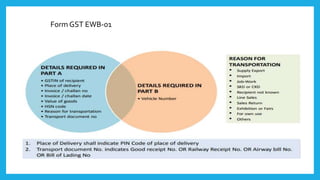
1. Invoice/ Bill of Supply/Challan related to the consignment of goods.
2. Transport by road –Transporter ID orVehicle number.
3. Transport by rail, air, or ship –Transporter ID,Transport document number, and date on the document.
Purpose of E-Way Bill
E-way bill is a mechanism to ensure that goods being transported comply with the GST Law and is an
effective tool to track movement of goods and check tax evasion
Enforcement
1. RFID readers to be installed at places meant for verification.
2. Physical verification to be by authorised proper officer.
3. On receipt of specific information of evasion of tax, physical verification of a specific conveyance …..
after obtaining necessary approval of the Commissioner or an officer authorized by him in this behalf
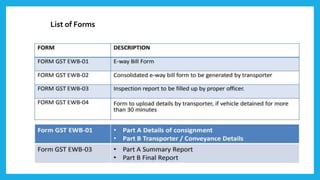
List of Forms
Form GST EWB-01

E way bill

  • 3.
    What is ane-Way Bill? 1. E-Way Bill is an electronic way bill for movement of goods which can be generated on the e-Way Bill Portal. 2. Transport of goods of more than Rs 50,000 in value cannot be made by a registered person without an e- way bill. 3. E-way bill can also be generated or cancelled through SMS. 4. When an e-way bill is generated a unique e-way bill number (EBN) is allocated and is available to the supplier, recipient, and the transporter.
  • 4.
    2. When Shoulde-Way Bill be issued? E-way bill will be generated when there is a movement of goods of value more than Rs. 50,000 – In relation to a ‘supply’ 1. For reasons other than a ‘supply’ ( say a return) 2. Due to inward ‘supply’ from an unregistered person 3. For this purpose, a supply may be either of the following: a) A supply made for a consideration (payment) in the course of business b) A supply made for a consideration (payment) which may not be in the course of business c) A supply without consideration (without payment)In simpler terms, the term ‘supply’ usually means a: d) Sale – sale of goods and payment made e) Transfer – branch transfers for instance f) Barter/Exchange – where the payment is by goods instead of in money g) Therefore, e-Way Bills must be generated on the common portal for all these types of movements.
  • 5.
    3. Cases whene-Way bill is Not Required In the following cases it is not necessary to generate e-Way Bill: 1. The mode of transport is non-motor vehicle 2. Goods transported from port, airport, air cargo complex or land customs station to Inland Container Depot (ICD) or Container Freight Station (CFS) for clearance by Customs. 3. Transport of specified goods (PDF of List of Goods). Note: Part B of e-Way Bill is not required to be filled where the distance between the consigner or consignee and the transporter is less than 10 Kms and transport is within the same state.
  • 6.
    4. Who shouldGenerate an e-Way Bill? 1. Registered Person – E-way bill must be generated when there is a movement of goods of more than Rs 50,000 in value to or from a Registered Person. A Registered person or the transporter may choose to generate and carry e-way bill even if the value of goods is less than Rs 50,000. 2. Unregistered Persons – Unregistered persons are also required to generate e-Way Bill. However, where a supply is made by an unregistered person to a registered person, the receiver will have to ensure all the compliances are met as if they were the supplier. 3. Transporter – Transporters carrying goods by road, air, rail, etc. also need to generate e-Way Bill if the supplier has not generated an e-Way Bill.
  • 7.
    Validity of e-WayBill An e-way bill is valid for periods as listed below, which is based on the distance travelled by the goods. Validity is calculated from the date and time of generation of e-way bill distance Validity of EWB LessThan 100 Kms 1 Day For every additional 100 Kms or part thereof additional 1 Day
  • 8.
    Documents or Detailsrequired to generate e-Way Bill 1. Invoice/ Bill of Supply/Challan related to the consignment of goods. 2. Transport by road –Transporter ID orVehicle number. 3. Transport by rail, air, or ship –Transporter ID,Transport document number, and date on the document.
  • 9.
    Purpose of E-WayBill E-way bill is a mechanism to ensure that goods being transported comply with the GST Law and is an effective tool to track movement of goods and check tax evasion
  • 10.
    Enforcement 1. RFID readersto be installed at places meant for verification. 2. Physical verification to be by authorised proper officer. 3. On receipt of specific information of evasion of tax, physical verification of a specific conveyance ….. after obtaining necessary approval of the Commissioner or an officer authorized by him in this behalf
  • 11.
  • 12.