INTERNETRESOURCESFORLIBRARIES
Prepaired by
Rajni Bala
M.Lib, M.Phil
Department of Library and Information
Sciences
Kurukshetra University
THE INTERNET
The Internet is a
worldwide network
connecting millions
of computers.
It is a way to get
information from all
around the world
through a computer.
Search engines (like
Google) are used to
find information.iGoogle
INTRODUCTION
 The use of Internet in the libraries is rapidly
increasing and is changing the traditional
functions and services of libraries as well as role
of the libraries. Internet is being used as an
efficient medium for accessing, storing and
disseminating of information worldwide.
INTERNET RESOURCES
The INTERNET and its World Wide Web (WWW)
have given a paradigm shift to information
management.
The information available on net is increasing rapidly
and the task of providing relevant information to
patrons is gaining paramount importance in all
types of libraries.
Most of the reputed publishers, learned and
commercial societies are hosting their products on
net and also all libraries are sharing their internal
and external information resources by means of
web pages and Web-OPACs. Various types of
resources is available on internet:
.
Electronic Resources
Now a days, majority of the print and Electronic
scholarly publishers and information disseminators
increasingly act globally to produce e-information
includes full text database of journals, books, patents,
standards or technical report, dissertations, theses,
annual report etc of a particular publisher or a group of
publishers.
The new information and communication technology
helps to produce a large number of electronic resources.
These are as described:-
ELECTRONIC JOURNALS
The advent of ICT has played a pivotal role in transforming the
conventional library into a digital library.
This has resulted in the proliferation of e-publishing, which provides
information in a digital form. The e-journals are fast becoming the
preferred format for information dissemination, especially in science
and technology.
The full-text e-journals can be viewed accessible via the World Wide
Web (WWW) as individual.
The e-journals are made available in various modes namely:
- Free with a print subscription
- At a nominal cost with a print subscription
- As web editions only with a paid subscription
Electronic books
 A book which is available in electronic format and which can be read
using a computer or a special reader.
 It contains the latest and most updated information.
It can be stored very easily and saves library space.
ELECTRONIC NEWSPAPERS
An Electronic newspaper is a self-contained, reusable and
refreshable version of a traditional newspaper that acquires
and holds all information in the newspaper electronically.
Electronic zine
Electronic zine means Electronic magazine and it is also
called web-zine. The articles that are stored on a file
server may be distributed or accessed via a computer
network. some sources of electronic zine are:
www.indiatoday.com.
www.musicindia.com.
www.news.site.com.
ONLINE DATABASE
• A database is collection of data files integrated and
organised in to single comprehensive file system. It is
a collection of data with a given structure for
accepting, storing and providing on demand, data for
multiple users.
Electronic theses and dissertation(ETD)
• Now a days, thesis is presented in an electronic
medium which is called an e- thesis.
• An Electronic theses and dissertation is an
electronic document that explains the intellectual
works or research of a researcher
REFERENCE SOURCES
DICTIONARY
The dictionary is a book that gives
definitions of words.
It lists words in ABC order
By using guide words found at the top of
each page, we can find the location of
the entry word. For example Oxford
English Dictionary is available on
internet.
Cambridge Dictionaries online is
completely free of charge since
1999.
ATLAS
 Online world atlas is a
convenient device that allows
users easy access and
navigation, along with other
things. These atlases are
available on different themes
such as – climate, geography,
natural disaster map, physical
geography etc. There is free
interactive world atlas available
on various sites; users can
easily download it for various
uses.
Encyclopedias are a set of books used to
find information.
Topics are listed in ABC order.
Articles provide basic information
about each topic.
The New Encyclopedia of
Britannica is available on internet
The phone book lists names of people
and businesses.
They are arranged in ABC order.
It includes their addresses and
phone numbers (and sometimes
their web sites or email addresses).
BIOGRAPHY
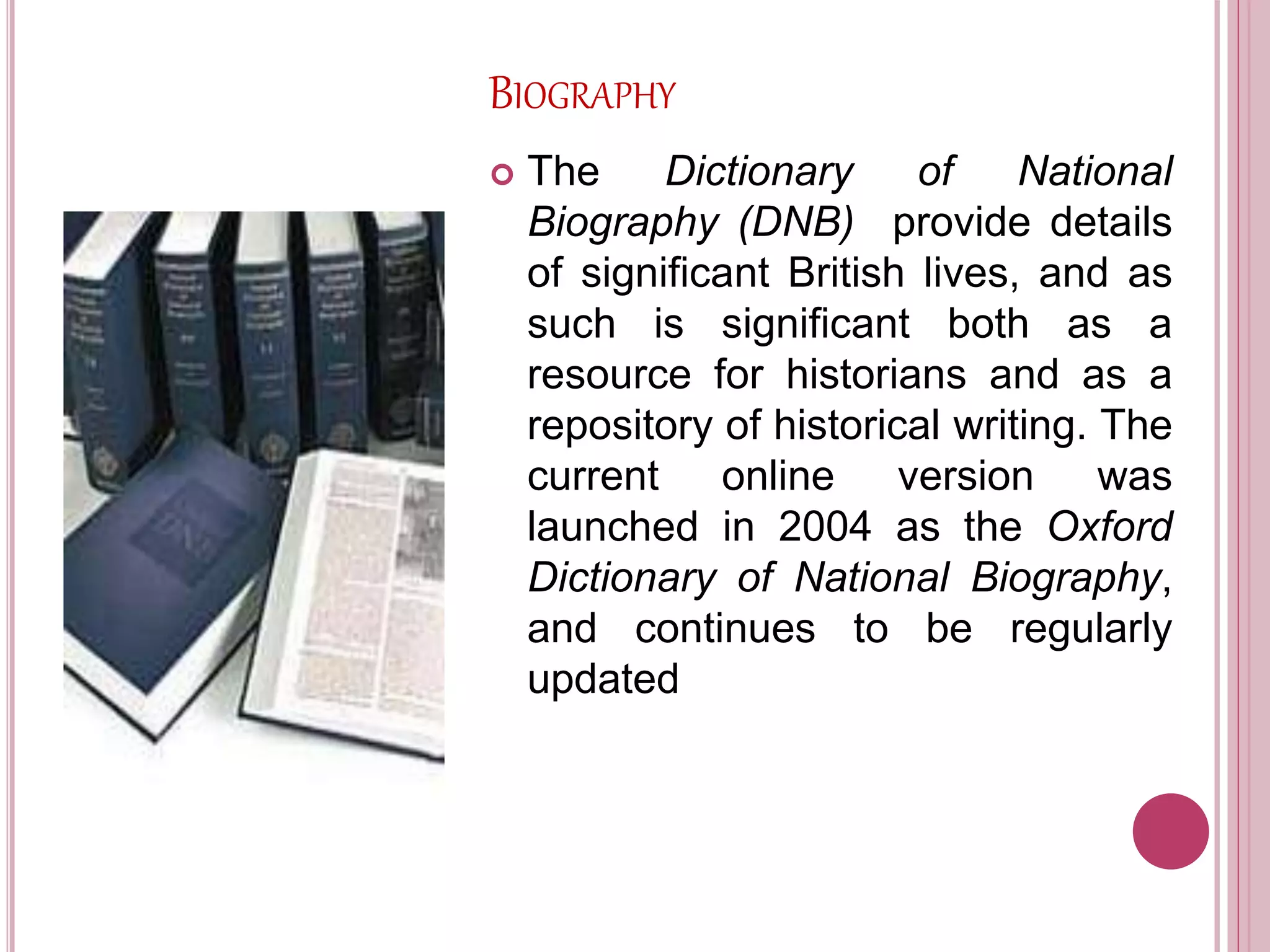
 The Dictionary of National
Biography (DNB) provide details
of significant British lives, and as
such is significant both as a
resource for historians and as a
repository of historical writing. The
current online version was
launched in 2004 as the Oxford
Dictionary of National Biography,
and continues to be regularly
updated
ADVANTAGE & DISADVANTAGE OF INTERNET RESOURCES
 Accessible
 Easily Searchable
 Speed
 Interactive
 Links
 Added value
 Inexpensive
 Difficulty reading computer
screens:
 limitations of computer
monitor
 read information in the
screen
 Often not included in
indexing and abstracting
services
 Search engines ignores PDF
files
 Format that a large
proportion of e-journal use
Advantage Disadvantage
Resoureces

Resoureces

  • 1.
    INTERNETRESOURCESFORLIBRARIES Prepaired by Rajni Bala M.Lib,M.Phil Department of Library and Information Sciences Kurukshetra University
  • 2.
    THE INTERNET The Internetis a worldwide network connecting millions of computers. It is a way to get information from all around the world through a computer. Search engines (like Google) are used to find information.iGoogle
  • 3.
    INTRODUCTION  The useof Internet in the libraries is rapidly increasing and is changing the traditional functions and services of libraries as well as role of the libraries. Internet is being used as an efficient medium for accessing, storing and disseminating of information worldwide.
  • 4.
    INTERNET RESOURCES The INTERNETand its World Wide Web (WWW) have given a paradigm shift to information management. The information available on net is increasing rapidly and the task of providing relevant information to patrons is gaining paramount importance in all types of libraries. Most of the reputed publishers, learned and commercial societies are hosting their products on net and also all libraries are sharing their internal and external information resources by means of web pages and Web-OPACs. Various types of resources is available on internet: .
  • 5.
    Electronic Resources Now adays, majority of the print and Electronic scholarly publishers and information disseminators increasingly act globally to produce e-information includes full text database of journals, books, patents, standards or technical report, dissertations, theses, annual report etc of a particular publisher or a group of publishers. The new information and communication technology helps to produce a large number of electronic resources. These are as described:-
  • 6.
    ELECTRONIC JOURNALS The adventof ICT has played a pivotal role in transforming the conventional library into a digital library. This has resulted in the proliferation of e-publishing, which provides information in a digital form. The e-journals are fast becoming the preferred format for information dissemination, especially in science and technology. The full-text e-journals can be viewed accessible via the World Wide Web (WWW) as individual. The e-journals are made available in various modes namely: - Free with a print subscription - At a nominal cost with a print subscription - As web editions only with a paid subscription Electronic books  A book which is available in electronic format and which can be read using a computer or a special reader.  It contains the latest and most updated information. It can be stored very easily and saves library space.
  • 7.
    ELECTRONIC NEWSPAPERS An Electronicnewspaper is a self-contained, reusable and refreshable version of a traditional newspaper that acquires and holds all information in the newspaper electronically. Electronic zine Electronic zine means Electronic magazine and it is also called web-zine. The articles that are stored on a file server may be distributed or accessed via a computer network. some sources of electronic zine are: www.indiatoday.com. www.musicindia.com. www.news.site.com.
  • 8.
    ONLINE DATABASE • Adatabase is collection of data files integrated and organised in to single comprehensive file system. It is a collection of data with a given structure for accepting, storing and providing on demand, data for multiple users. Electronic theses and dissertation(ETD) • Now a days, thesis is presented in an electronic medium which is called an e- thesis. • An Electronic theses and dissertation is an electronic document that explains the intellectual works or research of a researcher
  • 9.
    REFERENCE SOURCES DICTIONARY The dictionaryis a book that gives definitions of words. It lists words in ABC order By using guide words found at the top of each page, we can find the location of the entry word. For example Oxford English Dictionary is available on internet. Cambridge Dictionaries online is completely free of charge since 1999.
  • 10.
    ATLAS  Online worldatlas is a convenient device that allows users easy access and navigation, along with other things. These atlases are available on different themes such as – climate, geography, natural disaster map, physical geography etc. There is free interactive world atlas available on various sites; users can easily download it for various uses.
  • 11.
    Encyclopedias are aset of books used to find information. Topics are listed in ABC order. Articles provide basic information about each topic. The New Encyclopedia of Britannica is available on internet The phone book lists names of people and businesses. They are arranged in ABC order. It includes their addresses and phone numbers (and sometimes their web sites or email addresses).
  • 12.
    BIOGRAPHY  The Dictionaryof National Biography (DNB) provide details of significant British lives, and as such is significant both as a resource for historians and as a repository of historical writing. The current online version was launched in 2004 as the Oxford Dictionary of National Biography, and continues to be regularly updated
  • 13.
    ADVANTAGE & DISADVANTAGEOF INTERNET RESOURCES  Accessible  Easily Searchable  Speed  Interactive  Links  Added value  Inexpensive  Difficulty reading computer screens:  limitations of computer monitor  read information in the screen  Often not included in indexing and abstracting services  Search engines ignores PDF files  Format that a large proportion of e-journal use Advantage Disadvantage