Guideline Summary Updated US Public Health Service Guidelines for the Management of Occupational  Exposures to HIV and Recommendations  for Postexposure Prophylaxis
Guidelines for the Management of Occupational Exposures to HIV and Recommendations for Postexposure Prophylaxis   Developed by the Public Health Service Interagency Working Group, convened by National Center for Infectious Diseases, CDC
Guidelines Outline Introduction Health Care Personnel and Exposure Risk for Occupational Transmission of HIV ARV Agents for PEP ARV Drugs during Pregnancy Management of Occupational Exposure by Emergency Physicians Occupational HIV Exposure and PEP Use in U.S. Hospitals
Guidelines Outline  (2) Recommendations for the Management of HCP Potentially Exposed to HIV HIV PEP Timing and Duration  Selection of Drugs Follow-Up of Exposed HCP Postexposure Testing Monitoring and Management of PEP Toxicity
What the Guidelines Address ARV medications that can be used for PEP Prompt management of occupational exposures Selection of effective and tolerable PEP regimens Potential interactions of PEP with other drugs Continued
What the Guidelines Address  (2) Consultation with experts for postexposure management strategies Did an exposure actually occur? Use of HIV rapid testing Counseling and follow-up of exposed personnel
What the Guidelines DO NOT Address Managing exposure to hepatitis B and C (see previous guideline: CDC.  MMWR  2001;50(RR-11); online at  http://www.cdc.gov/mmwr/PDF/rr/rr5011.pdf Nonoccupational HIV exposure  (see separate guideline: CDC.  MMWR  2005;54(RR-9); online at  http://www.cdc.gov/mmwr/preview/mmwrhtml/rr5409a1.htm
Websites to Access the Guidelines http://www.aidsetc.org http://aidsinfo.nih.gov Websites to Access NY AIDS Inst Guidelines   http://www.hivguidelines.org/GuideLine.aspx?pageID=78&guideLineID=3 http://www.wnysmart.org/Documents/EM/pep_card.pdf
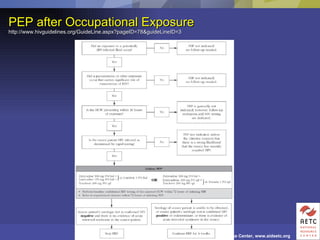
PEP after Occupational Exposure http://www.hivguidelines.org/GuideLine.aspx?pageID=78&guideLineID=3
Recommendation: recording information following occupational exposure When an occupational exposure occurs, the following information should be recorded in the HCW’s confidential medical record: date and time of the exposure  details of the procedure being performed and the use of protective equipment at the time of the exposure  the type, severity, and amount of fluid to which the HCW was exposed  details about the exposure source  medical documentation that provides details about post-exposure management  Specific OSHA requirements regarding documentation may be found at  http://www.osha-slc.gov/needlesticks/needlesticks-regtxtrev.html .
Occupational Risk Exposures in Health Care Personnel Percutaneous injury (needlestick, cut)  OR Contact of mucous membrane or nonintact skin WITH: Blood Tissue Other body fluids that are potentially infectious (cerebrospinal, synovial, pleural, pericardial, peritoneal, or amniotic fluids; semen or vaginal secretions)
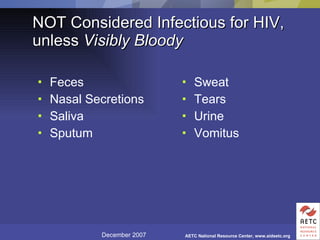
NOT Considered Infectious for HIV, unless  Visibly Bloody Feces Nasal Secretions Saliva Sputum Sweat  Tears Urine  Vomitus
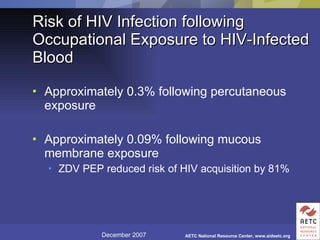
Risk of HIV Infection following Occupational Exposure to HIV-Infected Blood Approximately 0.3% following percutaneous exposure  Approximately 0.09% following mucous membrane exposure ZDV PEP reduced risk of HIV acquisition by 81%
 
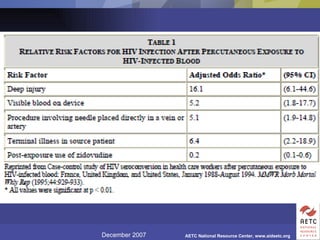
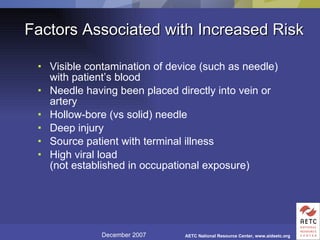
Factors Associated with Increased Risk Visible contamination of device (such as needle) with patient’s blood Needle having been placed directly into vein or artery Hollow-bore (vs solid) needle Deep injury Source patient with terminal illness High viral load (not established in occupational exposure)
GENERAL MANAGEMENT CONSIDERATIONS Wound and skin sites should be cleansed with soap and water immediately. The HCW should not attempt to squeeze the wound.  Exposed mucous membranes should be flushed with water.  PEP is recommended for exposure to blood or visibly bloody fluid or other potentially infectious material (e.g., semen; vaginal secretions; and cerebrospinal, synovial, pleural, peritoneal, pericardial, and amniotic fluids) associated with potential HIV transmission and in any of the exposure situations.  If HIV serostatus of the source is unknown, voluntary HIV testing of the source should be sought. In New York State, specific informed consent for HIV testing is required  (see Appendix C) .  Rapid testing is strongly recommended for the source patient, and for those organizations subject to OSHA regulations, rapid testing is mandated for occupational exposures.  Rules regarding confidentiality and consent for testing are identical to those for other HIV tests  (see Appendix C for a special consent form for testing the source patient) .  If the rapid test result is positive, the result should be given to the source patient.  To establish a diagnosis of HIV infection, the test must be confirmed by a Western blot assay, which should be performed as soon as possible.  If the result from testing the source patient is not immediately available and PEP is indicated based on assessment, the initiation of PEP should not be delayed pending the test result.
Exposures for which PEP is Indicated Break in the skin by a sharp object (including both hollow-bore & cutting needles or broken glassware) that is contaminated with blood, visibly bloody fluid or other potentially infectious material, or that has been in the source pt’s blood vessel Bite from an HIV-infected pt w/ visible bleeding in the mouth that causes bleeding in the HCW. Splash of blood, visibly bloody fluid,or other potentially infectious material to a mucosal surface (mouth, nose or eyes) A non-intact skin (dermatitis, chapped skin, abrasion or open wound) exposure to blood, visibly bloody fluid or other potentially infectious material
Toxicity of PEP Regimens PEP should be given for a full 4 weeks Side effects of ARV drugs are common, and a major reason for not completing PEP regimens Therefore, to the extent possible, regimens that are tolerable for short-term use should be selected
Interactions of ARV Agents ARVs can have serious interactions with other drugs Carefully evaluate concomitant medications, including over-the-counters, supplements, and herbals before prescribing PEP Consult package inserts or other resources on ARV drug-drug interactions Avoid interacting drugs and monitor carefully, as appropriate
Resistance to ARVs Resistant virus may be present in a treatment-experienced source patient Resistance testing at time of exposure is not practical, because results will not be available to influence choice of initial PEP regimen No data suggest that modifying regimen when resistance test results become available (typically 1-2 weeks) will improve PEP efficacy Expert consultation is recommended
IMPLEMENTING PEP  PEP should be initiated as soon as possible, ideally within 2 hours and generally no later than 36 hours post-exposure.  The prescribing provider should ensure that the HCW has access to the full course of ARV medications.  HAART is always recommended for at-risk exposures.  Any variance from the recommended regimens should be made in consultation with an HIV Specialist or an occupational health clinician experienced in providing PEP
Planning for PEP ARV medications for PEP should be readily available to HCWs who sustain a known or highly suspect occupational exposure to HIV.   PEP will be made available within 1 to 2 hours of an exposure  A 24- to 48-hour supply of PEP will be made available for urgent use  Authorized staff who can  give PEP Mechanism for HCW to obtain PEP drugs to complete the 4-week regimen (some individuals may be reluctant to go to their local pharmacy)
PEP considerations (cont’d) Confidential baseline HIV antibody testing of the HCW should be obtained at the time the occupational exposure is reported or within 72 hours of initiating PEP.  Confidential HIV testing of the source should be obtained as soon as possible after the exposure. A special consent form for testing the source patient is available and must be used  (see Appendix C) .  If the source patient's HIV test result is negative, the HCW should be informed of the small chance that it could be a false-negative result if the source patient has been recently infected. PEP should be recommended in situations when a significant risk exposure has occurred and the clinician suspects that the source patient has a strong likelihood of having recently acquired HIV infection.  If a recommendation to begin PEP is declined, this decision should be documented in the medical record of the HCW.  All patients placed on PEP should be re-evaluated within 72 hours of their exposure. This allows for further clarification of the nature of the exposure, review of available source patient serologies, and evaluation of adherence to and toxicities associated with the PEP regimen.  A total of 4 weeks of treatment is recommended. This treatment duration is based on animal data and is generally recommended by HIV Specialists.  If an HCW presents for evaluation of a high-risk exposure at a time >36 hours after the incident, rather than late initiation of PEP, close monitoring of the HCW for signs and symptoms of acute HIV infection is generally
Initiating PEP PEP should be started as soon as possible, preferably within (36) hours, rather than days, following exposure When uncertain as to which drugs to choose, start the basic regimen rather than delay PEP should be administered for 4 weeks, if tolerated
Initiating PEP  (2) Reevaluate exposed HCP within 72 hours of exposure, especially as additional information about the exposure or source patient becomes available  If the source is found to be, PEP should be discontinued Rapid HIV testing of the source patient can facilitate decisions regarding PEP when the source patient’s HIV status is unknown
Selecting the PEP Regimen Selection of number (2 or  ≥ 3) of drugs is based on assessment of  risk   for HIV infection Selection of which agents to use is based largely on potential  toxicity  of PEP drugs and on likelihood of  efficacy  (especially in the case of resistant virus) Few data on efficacy of individual ARV agents in PEP
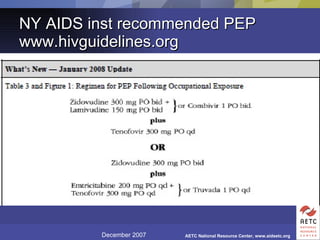
NY AIDS inst recommended PEP www.hivguidelines.org
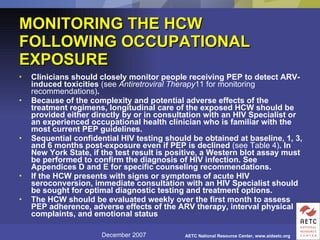
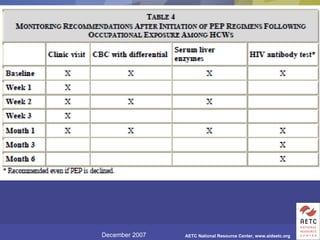
MONITORING THE HCW FOLLOWING OCCUPATIONAL EXPOSURE Clinicians should closely monitor people receiving PEP to detect ARV-induced toxicities  (see  Antiretroviral Therapy 11 for monitoring recommendations) .  Because of the complexity and potential adverse effects of the treatment regimens, longitudinal care of the exposed HCW should be provided either directly by or in consultation with an HIV Specialist or an experienced occupational health clinician who is familiar with the most current PEP guidelines.  Sequential confidential HIV testing should be obtained at baseline, 1, 3, and 6 months post-exposure even if PEP is declined  (see Table 4) . In New York State, if the test result is positive, a Western blot assay must be performed to confirm the diagnosis of HIV infection. See Appendices D and E for specific counseling recommendations.  If the HCW presents with signs or symptoms of acute HIV seroconversion, immediate consultation with an HIV Specialist should be sought for optimal diagnostic testing and treatment options.  The HCW should be evaluated weekly over the first month to assess PEP adherence, adverse effects of the ARV therapy, interval physical complaints, and emotional status
 
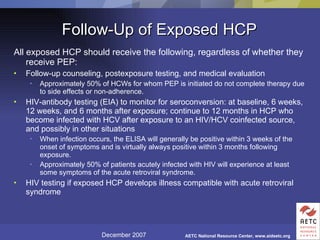
Follow-Up of Exposed HCP All exposed HCP should receive the following, regardless of whether they receive PEP: Follow-up counseling, postexposure testing, and medical evaluation Approximately 50% of HCWs for whom PEP is initiated do not complete therapy due to side effects or non-adherence. HIV-antibody testing (EIA) to monitor for seroconversion: at baseline, 6 weeks, 12 weeks, and 6 months after exposure; continue to 12 months in HCP who become infected with HCV after exposure to an HIV/HCV coinfected source, and possibly in other situations  When infection occurs, the ELISA will generally be positive within 3 weeks of the onset of symptoms and is virtually always positive within 3 months following exposure.  Approximately 50% of patients acutely infected with HIV will experience at least some symptoms of the acute retroviral syndrome.  HIV testing if exposed HCP develops illness compatible with acute retroviral syndrome
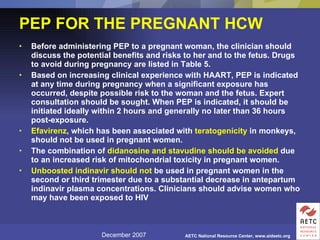
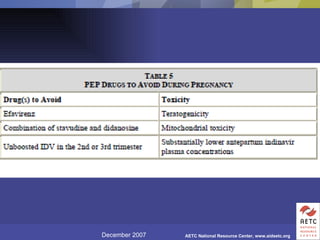
PEP FOR THE PREGNANT HCW   Before administering PEP to a pregnant woman, the clinician should discuss the potential benefits and risks to her and to the fetus. Drugs to avoid during pregnancy are listed in Table 5.  Based on increasing clinical experience with HAART, PEP is indicated at any time during pregnancy when a significant exposure has occurred, despite possible risk to the woman and the fetus. Expert consultation should be sought. When PEP is indicated, it should be initiated ideally within 2 hours and generally no later than 36 hours post-exposure.  Efavirenz , which has been associated with  teratogenicity  in monkeys, should not be used in pregnant women.  The combination of  didanosine and stavudine should be avoided  due to an increased risk of mitochondrial toxicity in pregnant women.  Unboosted indinavir should not  be used in pregnant women in the second or third trimester due to a substantial decrease in antepartum indinavir plasma concentrations. Clinicians should advise women who may have been exposed to HIV
 
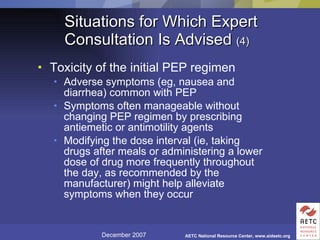
Situations for Which Expert Consultation Is Advised  (4) Toxicity of the initial PEP regimen Adverse symptoms (eg, nausea and diarrhea) common with PEP Symptoms often manageable without changing PEP regimen by prescribing antiemetic or antimotility agents Modifying the dose interval (ie, taking drugs after meals or administering a lower dose of drug more frequently throughout the day, as recommended by the manufacturer) might help alleviate symptoms when they occur
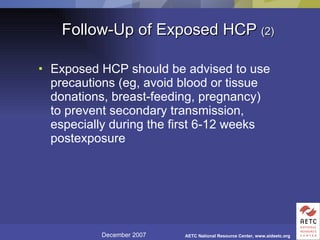
Follow-Up of Exposed HCP  (2) Exposed HCP should be advised to use precautions (eg, avoid blood or tissue donations, breast-feeding, pregnancy) to prevent secondary transmission, especially during the first 6-12 weeks postexposure
Follow-Up of Exposed HCP  (3) Psychologic impact of occupational exposure to HIV may be substantial; psychologic counseling should be an essential component of the management and care of exposed HCP
Follow-Up of Exposed HCP  (4) For PEP recipients, provide information on: Necessity of adherence to PEP and importance of completing prescribed regimen  Potential drug interactions, and drugs that should not be taken with PEP Side effects of prescribed drugs, measures to minimize side effects, and methods of monitoring for toxicity Symptoms to report to health care provider
Follow-Up of Exposed HCP  (5) HCP often stop PEP because of side effects; monitor closely for side effects, and manage them actively (eg, with medications that target specific symptoms); consider changing PEP regimen if side effects are not tolerable
Follow-Up of Exposed HCP  (6) Monitoring and management of PEP toxicity: Evaluation and laboratory testing at baseline and 2 weeks after starting PEP Laboratory tests: CBC, renal and hepatic function tests; glucose if patient is taking a PI Other tests depending on specific toxicities of the drugs in the PEP regimen and on the medical conditions of the HCP If toxicity noted, consult with expert; consider modification of PEP regimen
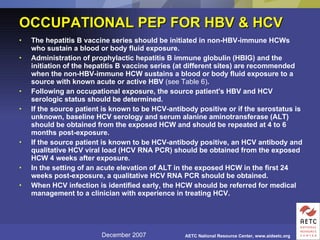
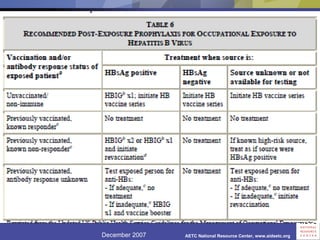
OCCUPATIONAL PEP FOR HBV & HCV The hepatitis B vaccine series should be initiated in non-HBV-immune HCWs who sustain a blood or body fluid exposure.  Administration of prophylactic hepatitis B immune globulin (HBIG) and the initiation of the hepatitis B vaccine series (at different sites) are recommended when the non-HBV-immune HCW sustains a blood or body fluid exposure to a source with known acute or active HBV  (see Table 6) .  Following an occupational exposure, the source patient's HBV and HCV serologic status should be determined.  If the source patient is known to be HCV-antibody positive or if the serostatus is unknown, baseline HCV serology and serum alanine aminotransferase (ALT) should be obtained from the exposed HCW and should be repeated at 4 to 6 months post-exposure.  If the source patient is known to be HCV-antibody positive, an HCV antibody and qualitative HCV viral load (HCV RNA PCR) should be obtained from the exposed HCW 4 weeks after exposure.  In the setting of an acute elevation of ALT in the exposed HCW in the first 24 weeks post-exposure, a qualitative HCV RNA PCR should be obtained.  When HCV infection is identified early, the HCW should be referred for medical management to a clinician with experience in treating HCV.
The risk of transmission of HBV and HCV from an occupational exposure is significantly greater than the risk of HIV transmission.  The risk of HCV infection following a needlestick is 1.8% The risk of HBV infection ranges from 6% to 30% depending on the presence of hepatitis e antigen. As a preventive (pre-exposure) measure, all employees with potential exposure to blood and body fluids should be immunized with the HBV vaccine.  Initiation of the HBV vaccine series within 12 to 24 hours of an exposure has been demonstrated to be 70% to 90% effective in preventing HBV infection. The combination of vaccine and HBIG achieves a similar level of efficacy.  Among known nonresponders to vaccination, one dose of HBIG is 70% to 90% effective in preventing HBV when administered within 7 days of percutaneous HBV exposure,and multiple doses have been shown to be 75% to 95% effective. Pregnant women can safely receive both the HBV vaccination and HBIG.  When considering PEP for HBV exposures, both the source HBsAg status and the exposed person's vaccination status and antibody response should be considered  Both HBIG and the hepatitis B vaccine should be ideally administered within 24 hours of exposure.  Hepatitis B antibodies should be drawn 1 to 2 months after completion of the third dose of the vaccine It is unreliable if the exposed person received HBIG within the past 3 to 4 months  HBV, HCV post-expos considerations
 
How Many Drugs to Use? 2-drug PEP regimens improve tolerability and therefore chances of completing full 4 weeks ≥ 3-drug PEP regimens provide potentially greater antiviral activity Guidelines recommend more drugs for higher-risk exposures
How Many Drugs to Use?  (2) Assess risk for HIV infection: Type of exposure Less severe: solid needle or superficial injury More severe: large-bore hollow needle, deep puncture, visible blood on device, needle used in patient’s artery or vein Infection status of source Class 1: asymptomatic HIV infection or known low viral load (<1,500 copies/mL)  Class 2: symptomatic HIV, AIDS, acute seroconversion, or known high viral load
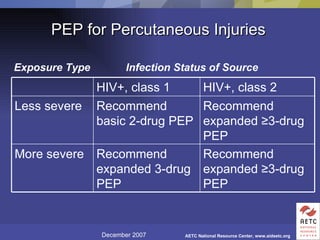
PEP for Percutaneous Injuries Exposure Type Infection Status of Source Recommend expanded  ≥ 3-drug PEP Recommend expanded 3-drug PEP More severe Recommend expanded  ≥ 3-drug PEP Recommend basic 2-drug PEP Less severe HIV+, class 2 HIV+, class 1
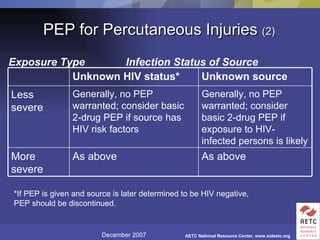
PEP for Percutaneous Injuries  (2)   Exposure Type Infection Status of Source *If PEP is given and source is later determined to be HIV negative, PEP should be discontinued. As above Generally, no PEP warranted; consider basic 2-drug PEP if exposure to HIV-infected persons is likely Unknown source As above More severe Generally, no PEP warranted; consider basic 2-drug PEP if source has HIV risk factors Less severe Unknown HIV status*
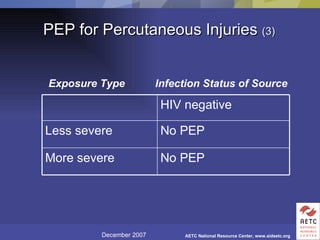
PEP for Percutaneous Injuries  (3)   Exposure Type Infection Status of Source No PEP More severe No PEP Less severe HIV negative
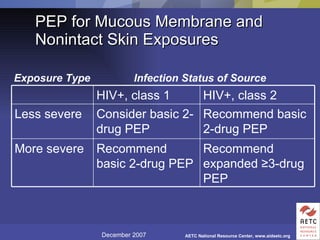
PEP for Mucous Membrane and Nonintact Skin Exposures Exposure Type Infection Status of Source Recommend expanded  ≥ 3-drug PEP Recommend basic 2-drug PEP More severe Recommend basic 2-drug PEP Consider basic 2-drug PEP Less severe HIV+, class 2 HIV+, class 1
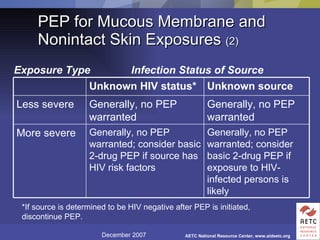
PEP for Mucous Membrane and Nonintact Skin Exposures  (2) Exposure Type Infection Status of Source *If source is determined to be HIV negative after PEP is initiated, discontinue PEP. Generally, no PEP warranted; consider basic 2-drug PEP if exposure to HIV-infected persons is likely Generally, no PEP warranted Unknown source Generally, no PEP warranted; consider basic 2-drug PEP if source has HIV risk factors More severe Generally, no PEP warranted Less severe Unknown HIV status*
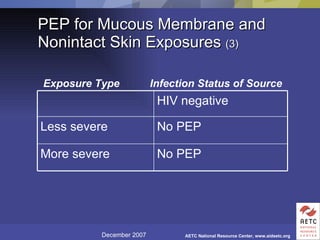
PEP for Mucous Membrane and Nonintact Skin Exposures  (3) Exposure Type Infection Status of Source No PEP More severe No PEP Less severe HIV negative
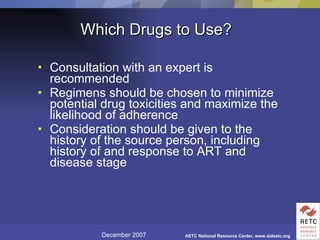
Which Drugs to Use? Consultation with an expert is recommended Regimens should be chosen to minimize potential drug toxicities and maximize the likelihood of adherence Consideration should be given to the history of the source person, including history of and response to ART and disease stage
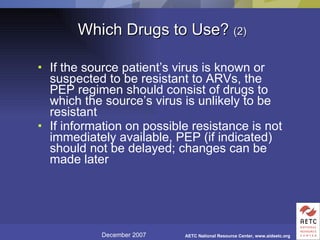
Which Drugs to Use?  (2) If the source patient’s virus is known or suspected to be resistant to ARVs, the PEP regimen should consist of drugs to which the source’s virus is unlikely to be resistant If information on possible resistance is not immediately available, PEP (if indicated) should not be delayed; changes can be made later
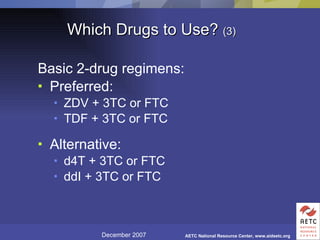
Which Drugs to Use?  (3) Basic 2-drug regimens: Preferred: ZDV + 3TC or FTC TDF + 3TC or FTC Alternative: d4T + 3TC or FTC ddI + 3TC or FTC
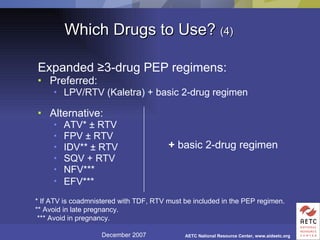
Which Drugs to Use?  (4) Expanded  ≥ 3-drug PEP regimens: Preferred: LPV/RTV (Kaletra) + basic 2-drug regimen Alternative: ATV*  ± RTV FPV ± RTV IDV** ± RTV SQV + RTV  NFV***  EFV***   +  basic 2-drug regimen * If ATV is coadmnistered with TDF, RTV must be included in the PEP regimen. ** Avoid in late pregnancy.  *** Avoid in pregnancy.
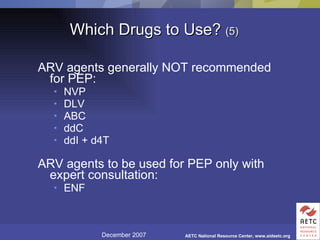
Which Drugs to Use?  (5) ARV agents generally NOT recommended for PEP: NVP DLV ABC ddC ddI + d4T ARV agents to be used for PEP only with expert consultation: ENF
Selection of  Drugs for PEP: Consultation Is Part of the Guidelines “ Because of the complexity of selecting HIV PEP regimens, when possible, these recommendations should be implemented in consultation with persons having expertise in antiretroviral therapy and HIV transmission”
Resources for Consultation Local experts identified for PEP (eg, ID consultant, hospital epidemiologist) National Clinicians’ Postexposure Prophylaxis Hotline (PEPline) 24-hour telephone consultation service: 888-448-4911
Situations for Which Expert Consultation Is Advised Delayed exposure report (ie, later than 24-36 hours) Interval after which lack of benefit from PEP undefined Unknown source (eg, needle in sharps disposal container or laundry) Use of PEP to be decided on case-by-case basis Consider severity of exposure and epidemiologic likelihood of HIV exposure Do not test needles or other sharp instruments for HIV Continued
Situations for Which Expert Consultation Is Advised  (2) Known or suspected pregnancy in the exposed person Use of optimal PEP regimens not precluded PEP not denied solely on basis of pregnancy Breast-feeding in the exposed person Use of optimal PEP regimens not precluded PEP not denied solely on basis of breast-feeding Continued
Situations for Which Expert Consultation Is Advised  (3) Resistance of the source virus to ARV agents Influence of drug resistance on transmission risk unknown If source person’s virus is known or suspected to be resistant to one or more of the drugs considered for PEP, selection of drugs to which the source person’s virus is unlikely to be resistant is recommended Resistance testing of the source person’s virus at the time of the exposure not recommended Initiation of PEP  not  to be delayed while awaiting any results of resistance testing
About This Slide Set This presentation was prepared by Susa Coffey, MD, and Laurence Peiperl, MD, for the AETC National Resource Center in October 2005, and updated December 2007  See the AETC NRC website for the most current version of this presentation: http://www.aidsetc.org
About This Presentation These slides were developed using the September 2005 guidelines on postexposure prophylaxis (PEP) following occupational exposure to HIV. The intended audience is clinicians involved in the care of health care personnel (HCP) with occupational exposure to HIV.  Users are cautioned that, because of the rapidly changing field of HIV care, this information could become out of date quickly. Finally, it is intended that these slides be used as prepared, without changes in either content or attribution. Users are asked to honor this intent. –  AETC NRC http://www.aidsetc.org

E R Pep Sept 2009

  • 1.
    Guideline Summary UpdatedUS Public Health Service Guidelines for the Management of Occupational Exposures to HIV and Recommendations for Postexposure Prophylaxis
  • 2.
    Guidelines for theManagement of Occupational Exposures to HIV and Recommendations for Postexposure Prophylaxis Developed by the Public Health Service Interagency Working Group, convened by National Center for Infectious Diseases, CDC
  • 3.
    Guidelines Outline IntroductionHealth Care Personnel and Exposure Risk for Occupational Transmission of HIV ARV Agents for PEP ARV Drugs during Pregnancy Management of Occupational Exposure by Emergency Physicians Occupational HIV Exposure and PEP Use in U.S. Hospitals
  • 4.
    Guidelines Outline (2) Recommendations for the Management of HCP Potentially Exposed to HIV HIV PEP Timing and Duration Selection of Drugs Follow-Up of Exposed HCP Postexposure Testing Monitoring and Management of PEP Toxicity
  • 5.
    What the GuidelinesAddress ARV medications that can be used for PEP Prompt management of occupational exposures Selection of effective and tolerable PEP regimens Potential interactions of PEP with other drugs Continued
  • 6.
    What the GuidelinesAddress (2) Consultation with experts for postexposure management strategies Did an exposure actually occur? Use of HIV rapid testing Counseling and follow-up of exposed personnel
  • 7.
    What the GuidelinesDO NOT Address Managing exposure to hepatitis B and C (see previous guideline: CDC. MMWR 2001;50(RR-11); online at http://www.cdc.gov/mmwr/PDF/rr/rr5011.pdf Nonoccupational HIV exposure (see separate guideline: CDC. MMWR 2005;54(RR-9); online at http://www.cdc.gov/mmwr/preview/mmwrhtml/rr5409a1.htm
  • 8.
    Websites to Accessthe Guidelines http://www.aidsetc.org http://aidsinfo.nih.gov Websites to Access NY AIDS Inst Guidelines http://www.hivguidelines.org/GuideLine.aspx?pageID=78&guideLineID=3 http://www.wnysmart.org/Documents/EM/pep_card.pdf
  • 9.
    PEP after OccupationalExposure http://www.hivguidelines.org/GuideLine.aspx?pageID=78&guideLineID=3
  • 10.
    Recommendation: recording informationfollowing occupational exposure When an occupational exposure occurs, the following information should be recorded in the HCW’s confidential medical record: date and time of the exposure details of the procedure being performed and the use of protective equipment at the time of the exposure the type, severity, and amount of fluid to which the HCW was exposed details about the exposure source medical documentation that provides details about post-exposure management Specific OSHA requirements regarding documentation may be found at http://www.osha-slc.gov/needlesticks/needlesticks-regtxtrev.html .
  • 11.
    Occupational Risk Exposuresin Health Care Personnel Percutaneous injury (needlestick, cut) OR Contact of mucous membrane or nonintact skin WITH: Blood Tissue Other body fluids that are potentially infectious (cerebrospinal, synovial, pleural, pericardial, peritoneal, or amniotic fluids; semen or vaginal secretions)
  • 12.
    NOT Considered Infectiousfor HIV, unless Visibly Bloody Feces Nasal Secretions Saliva Sputum Sweat Tears Urine Vomitus
  • 13.
    Risk of HIVInfection following Occupational Exposure to HIV-Infected Blood Approximately 0.3% following percutaneous exposure Approximately 0.09% following mucous membrane exposure ZDV PEP reduced risk of HIV acquisition by 81%
  • 14.
  • 15.
    Factors Associated withIncreased Risk Visible contamination of device (such as needle) with patient’s blood Needle having been placed directly into vein or artery Hollow-bore (vs solid) needle Deep injury Source patient with terminal illness High viral load (not established in occupational exposure)
  • 16.
    GENERAL MANAGEMENT CONSIDERATIONSWound and skin sites should be cleansed with soap and water immediately. The HCW should not attempt to squeeze the wound. Exposed mucous membranes should be flushed with water. PEP is recommended for exposure to blood or visibly bloody fluid or other potentially infectious material (e.g., semen; vaginal secretions; and cerebrospinal, synovial, pleural, peritoneal, pericardial, and amniotic fluids) associated with potential HIV transmission and in any of the exposure situations. If HIV serostatus of the source is unknown, voluntary HIV testing of the source should be sought. In New York State, specific informed consent for HIV testing is required (see Appendix C) . Rapid testing is strongly recommended for the source patient, and for those organizations subject to OSHA regulations, rapid testing is mandated for occupational exposures. Rules regarding confidentiality and consent for testing are identical to those for other HIV tests (see Appendix C for a special consent form for testing the source patient) . If the rapid test result is positive, the result should be given to the source patient. To establish a diagnosis of HIV infection, the test must be confirmed by a Western blot assay, which should be performed as soon as possible. If the result from testing the source patient is not immediately available and PEP is indicated based on assessment, the initiation of PEP should not be delayed pending the test result.
  • 17.
    Exposures for whichPEP is Indicated Break in the skin by a sharp object (including both hollow-bore & cutting needles or broken glassware) that is contaminated with blood, visibly bloody fluid or other potentially infectious material, or that has been in the source pt’s blood vessel Bite from an HIV-infected pt w/ visible bleeding in the mouth that causes bleeding in the HCW. Splash of blood, visibly bloody fluid,or other potentially infectious material to a mucosal surface (mouth, nose or eyes) A non-intact skin (dermatitis, chapped skin, abrasion or open wound) exposure to blood, visibly bloody fluid or other potentially infectious material
  • 18.
    Toxicity of PEPRegimens PEP should be given for a full 4 weeks Side effects of ARV drugs are common, and a major reason for not completing PEP regimens Therefore, to the extent possible, regimens that are tolerable for short-term use should be selected
  • 19.
    Interactions of ARVAgents ARVs can have serious interactions with other drugs Carefully evaluate concomitant medications, including over-the-counters, supplements, and herbals before prescribing PEP Consult package inserts or other resources on ARV drug-drug interactions Avoid interacting drugs and monitor carefully, as appropriate
  • 20.
    Resistance to ARVsResistant virus may be present in a treatment-experienced source patient Resistance testing at time of exposure is not practical, because results will not be available to influence choice of initial PEP regimen No data suggest that modifying regimen when resistance test results become available (typically 1-2 weeks) will improve PEP efficacy Expert consultation is recommended
  • 21.
    IMPLEMENTING PEP PEP should be initiated as soon as possible, ideally within 2 hours and generally no later than 36 hours post-exposure. The prescribing provider should ensure that the HCW has access to the full course of ARV medications. HAART is always recommended for at-risk exposures. Any variance from the recommended regimens should be made in consultation with an HIV Specialist or an occupational health clinician experienced in providing PEP
  • 22.
    Planning for PEPARV medications for PEP should be readily available to HCWs who sustain a known or highly suspect occupational exposure to HIV. PEP will be made available within 1 to 2 hours of an exposure A 24- to 48-hour supply of PEP will be made available for urgent use Authorized staff who can give PEP Mechanism for HCW to obtain PEP drugs to complete the 4-week regimen (some individuals may be reluctant to go to their local pharmacy)
  • 23.
    PEP considerations (cont’d)Confidential baseline HIV antibody testing of the HCW should be obtained at the time the occupational exposure is reported or within 72 hours of initiating PEP. Confidential HIV testing of the source should be obtained as soon as possible after the exposure. A special consent form for testing the source patient is available and must be used (see Appendix C) . If the source patient's HIV test result is negative, the HCW should be informed of the small chance that it could be a false-negative result if the source patient has been recently infected. PEP should be recommended in situations when a significant risk exposure has occurred and the clinician suspects that the source patient has a strong likelihood of having recently acquired HIV infection. If a recommendation to begin PEP is declined, this decision should be documented in the medical record of the HCW. All patients placed on PEP should be re-evaluated within 72 hours of their exposure. This allows for further clarification of the nature of the exposure, review of available source patient serologies, and evaluation of adherence to and toxicities associated with the PEP regimen. A total of 4 weeks of treatment is recommended. This treatment duration is based on animal data and is generally recommended by HIV Specialists. If an HCW presents for evaluation of a high-risk exposure at a time >36 hours after the incident, rather than late initiation of PEP, close monitoring of the HCW for signs and symptoms of acute HIV infection is generally
  • 24.
    Initiating PEP PEPshould be started as soon as possible, preferably within (36) hours, rather than days, following exposure When uncertain as to which drugs to choose, start the basic regimen rather than delay PEP should be administered for 4 weeks, if tolerated
  • 25.
    Initiating PEP (2) Reevaluate exposed HCP within 72 hours of exposure, especially as additional information about the exposure or source patient becomes available If the source is found to be, PEP should be discontinued Rapid HIV testing of the source patient can facilitate decisions regarding PEP when the source patient’s HIV status is unknown
  • 26.
    Selecting the PEPRegimen Selection of number (2 or ≥ 3) of drugs is based on assessment of risk for HIV infection Selection of which agents to use is based largely on potential toxicity of PEP drugs and on likelihood of efficacy (especially in the case of resistant virus) Few data on efficacy of individual ARV agents in PEP
  • 27.
    NY AIDS instrecommended PEP www.hivguidelines.org
  • 28.
    MONITORING THE HCWFOLLOWING OCCUPATIONAL EXPOSURE Clinicians should closely monitor people receiving PEP to detect ARV-induced toxicities (see Antiretroviral Therapy 11 for monitoring recommendations) . Because of the complexity and potential adverse effects of the treatment regimens, longitudinal care of the exposed HCW should be provided either directly by or in consultation with an HIV Specialist or an experienced occupational health clinician who is familiar with the most current PEP guidelines. Sequential confidential HIV testing should be obtained at baseline, 1, 3, and 6 months post-exposure even if PEP is declined (see Table 4) . In New York State, if the test result is positive, a Western blot assay must be performed to confirm the diagnosis of HIV infection. See Appendices D and E for specific counseling recommendations. If the HCW presents with signs or symptoms of acute HIV seroconversion, immediate consultation with an HIV Specialist should be sought for optimal diagnostic testing and treatment options. The HCW should be evaluated weekly over the first month to assess PEP adherence, adverse effects of the ARV therapy, interval physical complaints, and emotional status
  • 29.
  • 30.
    Follow-Up of ExposedHCP All exposed HCP should receive the following, regardless of whether they receive PEP: Follow-up counseling, postexposure testing, and medical evaluation Approximately 50% of HCWs for whom PEP is initiated do not complete therapy due to side effects or non-adherence. HIV-antibody testing (EIA) to monitor for seroconversion: at baseline, 6 weeks, 12 weeks, and 6 months after exposure; continue to 12 months in HCP who become infected with HCV after exposure to an HIV/HCV coinfected source, and possibly in other situations When infection occurs, the ELISA will generally be positive within 3 weeks of the onset of symptoms and is virtually always positive within 3 months following exposure. Approximately 50% of patients acutely infected with HIV will experience at least some symptoms of the acute retroviral syndrome. HIV testing if exposed HCP develops illness compatible with acute retroviral syndrome
  • 31.
    PEP FOR THEPREGNANT HCW Before administering PEP to a pregnant woman, the clinician should discuss the potential benefits and risks to her and to the fetus. Drugs to avoid during pregnancy are listed in Table 5. Based on increasing clinical experience with HAART, PEP is indicated at any time during pregnancy when a significant exposure has occurred, despite possible risk to the woman and the fetus. Expert consultation should be sought. When PEP is indicated, it should be initiated ideally within 2 hours and generally no later than 36 hours post-exposure. Efavirenz , which has been associated with teratogenicity in monkeys, should not be used in pregnant women. The combination of didanosine and stavudine should be avoided due to an increased risk of mitochondrial toxicity in pregnant women. Unboosted indinavir should not be used in pregnant women in the second or third trimester due to a substantial decrease in antepartum indinavir plasma concentrations. Clinicians should advise women who may have been exposed to HIV
  • 32.
  • 33.
    Situations for WhichExpert Consultation Is Advised (4) Toxicity of the initial PEP regimen Adverse symptoms (eg, nausea and diarrhea) common with PEP Symptoms often manageable without changing PEP regimen by prescribing antiemetic or antimotility agents Modifying the dose interval (ie, taking drugs after meals or administering a lower dose of drug more frequently throughout the day, as recommended by the manufacturer) might help alleviate symptoms when they occur
  • 34.
    Follow-Up of ExposedHCP (2) Exposed HCP should be advised to use precautions (eg, avoid blood or tissue donations, breast-feeding, pregnancy) to prevent secondary transmission, especially during the first 6-12 weeks postexposure
  • 35.
    Follow-Up of ExposedHCP (3) Psychologic impact of occupational exposure to HIV may be substantial; psychologic counseling should be an essential component of the management and care of exposed HCP
  • 36.
    Follow-Up of ExposedHCP (4) For PEP recipients, provide information on: Necessity of adherence to PEP and importance of completing prescribed regimen Potential drug interactions, and drugs that should not be taken with PEP Side effects of prescribed drugs, measures to minimize side effects, and methods of monitoring for toxicity Symptoms to report to health care provider
  • 37.
    Follow-Up of ExposedHCP (5) HCP often stop PEP because of side effects; monitor closely for side effects, and manage them actively (eg, with medications that target specific symptoms); consider changing PEP regimen if side effects are not tolerable
  • 38.
    Follow-Up of ExposedHCP (6) Monitoring and management of PEP toxicity: Evaluation and laboratory testing at baseline and 2 weeks after starting PEP Laboratory tests: CBC, renal and hepatic function tests; glucose if patient is taking a PI Other tests depending on specific toxicities of the drugs in the PEP regimen and on the medical conditions of the HCP If toxicity noted, consult with expert; consider modification of PEP regimen
  • 39.
    OCCUPATIONAL PEP FORHBV & HCV The hepatitis B vaccine series should be initiated in non-HBV-immune HCWs who sustain a blood or body fluid exposure. Administration of prophylactic hepatitis B immune globulin (HBIG) and the initiation of the hepatitis B vaccine series (at different sites) are recommended when the non-HBV-immune HCW sustains a blood or body fluid exposure to a source with known acute or active HBV (see Table 6) . Following an occupational exposure, the source patient's HBV and HCV serologic status should be determined. If the source patient is known to be HCV-antibody positive or if the serostatus is unknown, baseline HCV serology and serum alanine aminotransferase (ALT) should be obtained from the exposed HCW and should be repeated at 4 to 6 months post-exposure. If the source patient is known to be HCV-antibody positive, an HCV antibody and qualitative HCV viral load (HCV RNA PCR) should be obtained from the exposed HCW 4 weeks after exposure. In the setting of an acute elevation of ALT in the exposed HCW in the first 24 weeks post-exposure, a qualitative HCV RNA PCR should be obtained. When HCV infection is identified early, the HCW should be referred for medical management to a clinician with experience in treating HCV.
  • 40.
    The risk oftransmission of HBV and HCV from an occupational exposure is significantly greater than the risk of HIV transmission. The risk of HCV infection following a needlestick is 1.8% The risk of HBV infection ranges from 6% to 30% depending on the presence of hepatitis e antigen. As a preventive (pre-exposure) measure, all employees with potential exposure to blood and body fluids should be immunized with the HBV vaccine. Initiation of the HBV vaccine series within 12 to 24 hours of an exposure has been demonstrated to be 70% to 90% effective in preventing HBV infection. The combination of vaccine and HBIG achieves a similar level of efficacy. Among known nonresponders to vaccination, one dose of HBIG is 70% to 90% effective in preventing HBV when administered within 7 days of percutaneous HBV exposure,and multiple doses have been shown to be 75% to 95% effective. Pregnant women can safely receive both the HBV vaccination and HBIG. When considering PEP for HBV exposures, both the source HBsAg status and the exposed person's vaccination status and antibody response should be considered Both HBIG and the hepatitis B vaccine should be ideally administered within 24 hours of exposure. Hepatitis B antibodies should be drawn 1 to 2 months after completion of the third dose of the vaccine It is unreliable if the exposed person received HBIG within the past 3 to 4 months HBV, HCV post-expos considerations
  • 41.
  • 42.
    How Many Drugsto Use? 2-drug PEP regimens improve tolerability and therefore chances of completing full 4 weeks ≥ 3-drug PEP regimens provide potentially greater antiviral activity Guidelines recommend more drugs for higher-risk exposures
  • 43.
    How Many Drugsto Use? (2) Assess risk for HIV infection: Type of exposure Less severe: solid needle or superficial injury More severe: large-bore hollow needle, deep puncture, visible blood on device, needle used in patient’s artery or vein Infection status of source Class 1: asymptomatic HIV infection or known low viral load (<1,500 copies/mL) Class 2: symptomatic HIV, AIDS, acute seroconversion, or known high viral load
  • 44.
    PEP for PercutaneousInjuries Exposure Type Infection Status of Source Recommend expanded ≥ 3-drug PEP Recommend expanded 3-drug PEP More severe Recommend expanded ≥ 3-drug PEP Recommend basic 2-drug PEP Less severe HIV+, class 2 HIV+, class 1
  • 45.
    PEP for PercutaneousInjuries (2) Exposure Type Infection Status of Source *If PEP is given and source is later determined to be HIV negative, PEP should be discontinued. As above Generally, no PEP warranted; consider basic 2-drug PEP if exposure to HIV-infected persons is likely Unknown source As above More severe Generally, no PEP warranted; consider basic 2-drug PEP if source has HIV risk factors Less severe Unknown HIV status*
  • 46.
    PEP for PercutaneousInjuries (3) Exposure Type Infection Status of Source No PEP More severe No PEP Less severe HIV negative
  • 47.
    PEP for MucousMembrane and Nonintact Skin Exposures Exposure Type Infection Status of Source Recommend expanded ≥ 3-drug PEP Recommend basic 2-drug PEP More severe Recommend basic 2-drug PEP Consider basic 2-drug PEP Less severe HIV+, class 2 HIV+, class 1
  • 48.
    PEP for MucousMembrane and Nonintact Skin Exposures (2) Exposure Type Infection Status of Source *If source is determined to be HIV negative after PEP is initiated, discontinue PEP. Generally, no PEP warranted; consider basic 2-drug PEP if exposure to HIV-infected persons is likely Generally, no PEP warranted Unknown source Generally, no PEP warranted; consider basic 2-drug PEP if source has HIV risk factors More severe Generally, no PEP warranted Less severe Unknown HIV status*
  • 49.
    PEP for MucousMembrane and Nonintact Skin Exposures (3) Exposure Type Infection Status of Source No PEP More severe No PEP Less severe HIV negative
  • 50.
    Which Drugs toUse? Consultation with an expert is recommended Regimens should be chosen to minimize potential drug toxicities and maximize the likelihood of adherence Consideration should be given to the history of the source person, including history of and response to ART and disease stage
  • 51.
    Which Drugs toUse? (2) If the source patient’s virus is known or suspected to be resistant to ARVs, the PEP regimen should consist of drugs to which the source’s virus is unlikely to be resistant If information on possible resistance is not immediately available, PEP (if indicated) should not be delayed; changes can be made later
  • 52.
    Which Drugs toUse? (3) Basic 2-drug regimens: Preferred: ZDV + 3TC or FTC TDF + 3TC or FTC Alternative: d4T + 3TC or FTC ddI + 3TC or FTC
  • 53.
    Which Drugs toUse? (4) Expanded ≥ 3-drug PEP regimens: Preferred: LPV/RTV (Kaletra) + basic 2-drug regimen Alternative: ATV* ± RTV FPV ± RTV IDV** ± RTV SQV + RTV NFV*** EFV*** + basic 2-drug regimen * If ATV is coadmnistered with TDF, RTV must be included in the PEP regimen. ** Avoid in late pregnancy. *** Avoid in pregnancy.
  • 54.
    Which Drugs toUse? (5) ARV agents generally NOT recommended for PEP: NVP DLV ABC ddC ddI + d4T ARV agents to be used for PEP only with expert consultation: ENF
  • 55.
    Selection of Drugs for PEP: Consultation Is Part of the Guidelines “ Because of the complexity of selecting HIV PEP regimens, when possible, these recommendations should be implemented in consultation with persons having expertise in antiretroviral therapy and HIV transmission”
  • 56.
    Resources for ConsultationLocal experts identified for PEP (eg, ID consultant, hospital epidemiologist) National Clinicians’ Postexposure Prophylaxis Hotline (PEPline) 24-hour telephone consultation service: 888-448-4911
  • 57.
    Situations for WhichExpert Consultation Is Advised Delayed exposure report (ie, later than 24-36 hours) Interval after which lack of benefit from PEP undefined Unknown source (eg, needle in sharps disposal container or laundry) Use of PEP to be decided on case-by-case basis Consider severity of exposure and epidemiologic likelihood of HIV exposure Do not test needles or other sharp instruments for HIV Continued
  • 58.
    Situations for WhichExpert Consultation Is Advised (2) Known or suspected pregnancy in the exposed person Use of optimal PEP regimens not precluded PEP not denied solely on basis of pregnancy Breast-feeding in the exposed person Use of optimal PEP regimens not precluded PEP not denied solely on basis of breast-feeding Continued
  • 59.
    Situations for WhichExpert Consultation Is Advised (3) Resistance of the source virus to ARV agents Influence of drug resistance on transmission risk unknown If source person’s virus is known or suspected to be resistant to one or more of the drugs considered for PEP, selection of drugs to which the source person’s virus is unlikely to be resistant is recommended Resistance testing of the source person’s virus at the time of the exposure not recommended Initiation of PEP not to be delayed while awaiting any results of resistance testing
  • 60.
    About This SlideSet This presentation was prepared by Susa Coffey, MD, and Laurence Peiperl, MD, for the AETC National Resource Center in October 2005, and updated December 2007 See the AETC NRC website for the most current version of this presentation: http://www.aidsetc.org
  • 61.
    About This PresentationThese slides were developed using the September 2005 guidelines on postexposure prophylaxis (PEP) following occupational exposure to HIV. The intended audience is clinicians involved in the care of health care personnel (HCP) with occupational exposure to HIV. Users are cautioned that, because of the rapidly changing field of HIV care, this information could become out of date quickly. Finally, it is intended that these slides be used as prepared, without changes in either content or attribution. Users are asked to honor this intent. – AETC NRC http://www.aidsetc.org