Epigenetic enzymes as drugable
targets for neurological disease
Christopher Wynder
PTM Discoveries
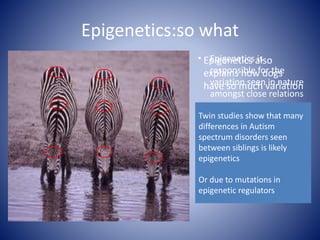
Epigenetics:so what
• Epigenetics is
responsible for the
variation seen in nature
amongst close relations
• Epigenetic regulation
also provides organisms
a mechanism to “tune”
gene expression based
environment (e.g. low
dietary fat and brain
development OR long
term injury-TBI, stroke)
Epigenetics also
explains how dogs
have so much variation
Twin studies show that many
differences in Autism
spectrum disorders seen
between siblings is likely
epigenetics
Or due to mutations in
epigenetic regulators
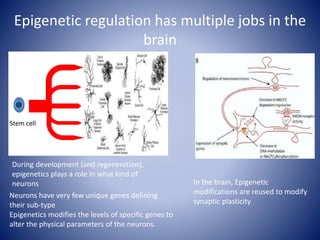
Epigenetic regulation has multiple jobs in the
brain
Stem cell
During development (and regeneration),
epigenetics plays a role in what kind of
neurons In the brain, Epigenetic
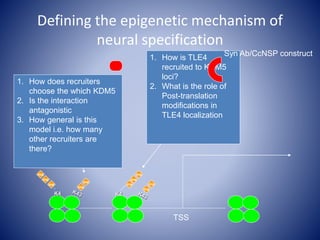
modifications are reused to modify
synaptic plasticity
Neurons have very few unique genes defining
their sub-type
Epigenetics modifies the levels of specific genes to
alter the physical parameters of the neurons.
Epigenetic definition
• “Non-genetic events” which result in stable
and inheritable gene expression patterns.
• Epigenetic changes are LONG term changes to
shape the portions of the genome that are
preferentially expressed
• Particularly relevant during development
• Regulation of histone modifications are a
significant and changeable example of an
epigenetic modification.
Epigenetic changes are about setting the
context for cell to nucleus signaling.
Limiting the response to any given stimuli
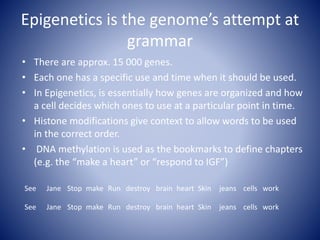
Epigenetics is the genome’s attempt at
grammar
• There are approx. 15 000 genes.
• Each one has a specific use and time when it should be used.
• In Epigenetics, is essentially how genes are organized and how
a cell decides which ones to use at a particular point in time.
• Histone modifications give context to allow words to be used
in the correct order.
• DNA methylation is used as the bookmarks to define chapters
(e.g. the “make a heart” or “respond to IGF”)
See Jane Stop make Run destroy brain Skinheart jeans workcells
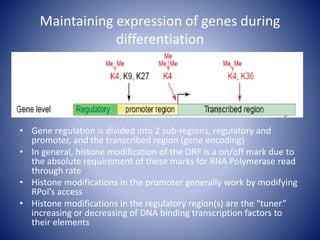
Maintaining expression of genes during
differentiation
• Gene regulation is divided into 2 sub-regions, regulatory and
promoter, and the transcribed region (gene encoding)
• In general, histone modification of the ORF is a on/off mark due to
the absolute requirement of these marks for RNA Polymerase read
through rate
• Histone modifications in the promoter generally work by modifying
RPol’s access
• Histone modifications in the regulatory region(s) are the “tuner”
increasing or decreasing of DNA binding transcription factors to
their elements
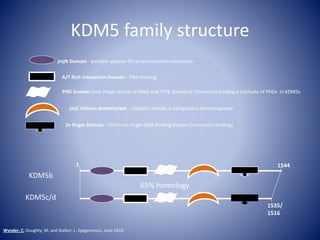
jmjN Domain - possible adaptor for protein-protein interaction
A/T Rich interaction Domain - DNA binding
PHD Domain (zinc finger similar to RING and FVYE domains)- Chromatin binding a triplicate of PHDs in KDM5s
jmjC histone demethylase - Catalytic domain a-ketoglutaric dehydrogenase
Zn finger Domain - C5H2 zinc finger DNA binding domain (chromatin binding)
KDM5b
KDM5c/d
65% Homology
1 1544
1535/
1516
KDM5 family structure
Wynder, C; Doughty, M; and Stalker, L. Epigenomics, June 2010
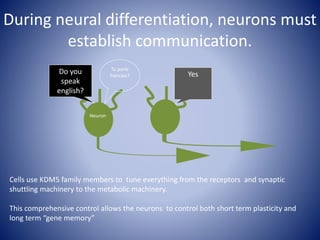
Neuron
During neural differentiation, neurons must
establish communication.
Tu parle
francais?
Do you
speak
english?
Yes
Cells use KDM5 family members to tune everything from the receptors and synaptic
shuttling machinery to the metabolic machinery.
This comprehensive control allows the neurons to control both short term plasticity and
long term “gene memory”
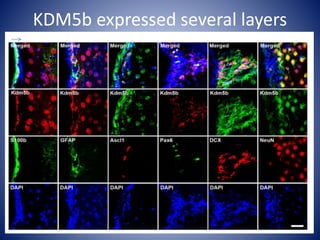
KDM5b expressed several layers
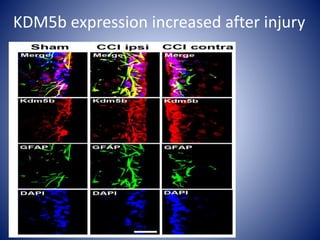
KDM5b expression increased after injury
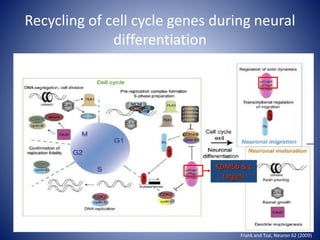
Recycling of cell cycle genes during neural
differentiation
KDM5b & c
targets
Frank and Tsai, Neuron 62 (2009)
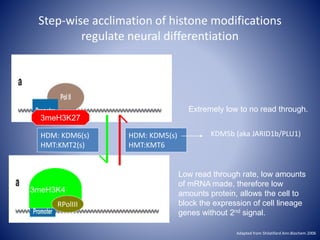
Step-wise acclimation of histone modifications
regulate neural differentiation
3meH3K4
RPolIII
Low read through rate, low amounts
of mRNA made, therefore low
amounts protein, allows the cell to
block the expression of cell lineage
genes without 2nd signal.
Extremely low to no read through.
3meH3K27
HDM: KDM5(s)
HMT:KMT6
HDM: KDM6(s)
HMT:KMT2(s)
KDM5b (aka JARID1b/PLU1)
Adapted from Shilatifard Ann.Biochem 2006
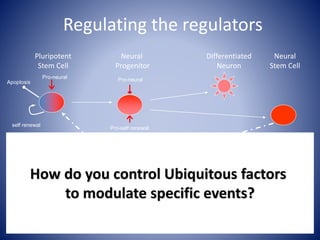
Regulating the regulators
Apoptosis
Pro-neural
Pro-self renewal
Pro-neural
self renewal
Stage specific:
Seq. specific TFs:
Oct4, Sox2, FoxD3 NeuroD2, Sox1, FoxG1 Sox17, NGN2 Sox1, FoxD3
Pluripotent
Stem Cell
Neural
Progenitor
Differentiated
Neuron
Neural
Stem Cell
Ubiquitous factors
Chromatin/histone
Regulators:
KDM5b, Ring6a KDM5b, KDM5c, Ring6a KDM5c, Ring6a KDM5b, Ring6a
How do you control Ubiquitous factors
to modulate specific events?
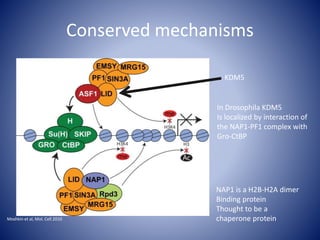
Conserved mechanisms
KDM5
Moshkin et al, Mol. Cell 2010
In Drosophila KDM5
Is localized by interaction of
the NAP1-PF1 complex with
Gro-CtBP
NAP1 is a H2B-H2A dimer
Binding protein
Thought to be a
chaperone protein
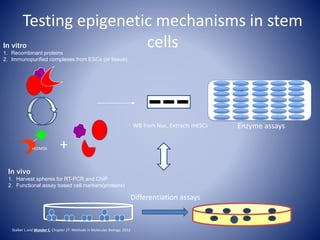
In vitro
1. Recombinant proteins
2. Immunopurified complexes from ESCs (or tissue)
Testing epigenetic mechanisms in stem
cells
rKDM5b
Enzyme assaysWB from Nuc. Extracts mESCs
+
In vivo
1. Harvest spheres for RT-PCR and ChIP
2. Functional assay based cell markers(proteins)
Differentiation assays
Stalker L and Wynder C. Chapter 27. Methods in Molecular Biology. 2012
TLE4
H3
H4 H2A
H2B
K4 K43
H3
H4 H2A
H2B
K4
me
me
me
K43
me
me
Stem Cell
Cell cycle
inhibitor
RERE
Pluripotent
Self-renewing, proliferative
KDM5b
H3
H4 H2A
H2B
K4
me
me
me
K43
H3
H4 H2A
H2B
K4
me
me
me
K43
Multipotent
Proliferative
e.g. Neural stem cell
Stem Cell
Cell cycle
inhibitor
KDM5b
?
KDM5b
Lineage Committed
e.g. neuron
H3
H4 H2A
H2B
K4
me
me
me
K43
me
me
Cell cycle
inhibitor
TLE4
H3
H4 H2A
H2B
K4 K43
Stem Cell
RERE
KDM5b
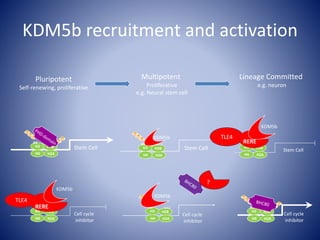
KDM5b recruitment and activation
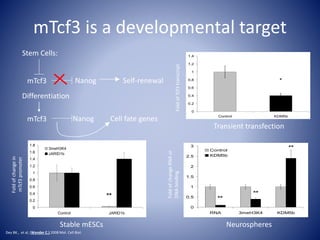
mTcf3 is a developmental target
FoldofTcf3transcript
**
0
0.2
0.4
0.6
0.8
1
1.2
1.4
1.6
1.8
Control JARID1b
3meH3K4
JARID1b
Foldofchangein
mTcf3promoter
*
0
0.2
0.4
0.6
0.8
1
1.2
1.4
Control KDM5b
**
**
**
0
0.5
1
1.5
2
2.5
3
RNA 3meH3K4 KDM5b
Control
KDM5b
FoldofchangeRNAor
DNAbinding
Stem Cells:
mTcf3 Nanog Self-renewal
Differentiation
mTcf3 Nanog Cell fate genes
Transient transfection
Stable mESCs Neurospheres
Dey BK., et al, (Wynder C.) 2008 Mol. Cell Biol.
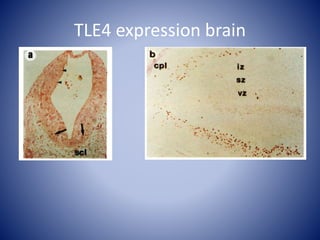
TLE4 expression brain
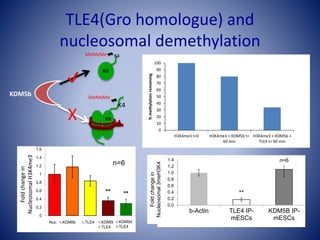
TLE4(Gro homologue) and
nucleosomal demethylation
n=3 ** **
0
0.2
0.4
0.6
0.8
1
1.2
1.4
1.6
n=6
Nuc. r.KDM5b r.TLE4 r.KDM5b
r.TLE4
Foldchangein
NucleosomalH3K4me3
r.KDM5d
r.TLE4
**
0.0
0.2
0.4
0.6
0.8
1.0
1.2
1.4
b-Actin TLE4 IP-
mESCs
KDM5B IP-
mESCs
n=6
Foldchangein
Nucleosomal3meH3K4
0
10
20
30
40
50
60
70
80
90
100
H3K4me3 t=0 H3K4me3 + KDM5b t=
60 min
H3K4me3 + KDM5b +
TLE4 t= 60 min
%methylationremaining
H3
K4
MeMeMe
KDM5b
MeMeMe K4
H3
X
0
0.2
0.4
0.6
0.8
1
1.2
Foldchangein
Nucleosomal3meH3K4
**
**
b-actin TLE4 IPCcNSP IP
**
n=3
0
0.2
0.4
0.6
0.8
1
1.2
Foldchangein
Nucleosomal3meH3K4
b-actin TLE4 IPTLE4 IP
mESCCcNSP
**
mESC
** n=3
Q GP CcN SP WD40
Repeat
CcN SP
Core
regulatory
domains
Potential inhibitor
Inhibiting KDM5 function
Transfect stable lines
mESCs (NSPC, iPSCs)
TLE4
0
0.2
0.4
0.6
0.8
1
1.2
1.4
2meK43-H2B 3meH3K4
Control
r.KDM5b n=9*
H2BK43me2 H3K4me3
**
**
HDMactivityonmixed
peptides
0
10
20
30
40
50
60
70
80
90
100
%substratedemethylation
KDM5b demethylase activity (60 min)
Control
(known substrates)
0
10
20
30
40
50
60
70
80
90
100
0 30 60 90 120 150 180 210
%demethylatedsubstrate
Time [min]
H3K4me3
H2BK43me2
r.KDM5b removes methyl groups from K43
faster than K4
K4
me
H3 H2B
me
me
me
me
KDM5b
TLE4
TSS
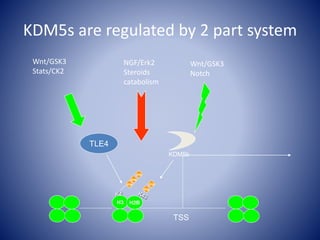
KDM5s are regulated by 2 part system
Wnt/GSK3
Notch
Wnt/GSK3
Stats/CK2
NGF/Erk2
Steroids
catabolism
KDM5b
2meK43
H2B
3Xflag
H2B
H2B
3XFl
H2B
mESC
3XFl
K43A-
mESC
3XFl
H2B
NS
3XFl
K43A-
NS
Flag M2
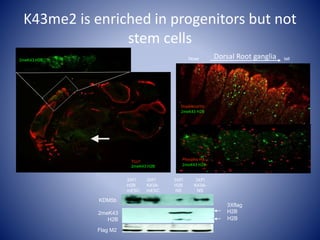
K43me2 is enriched in progenitors but not
stem cells
Doublecortin
2meK43 H2B
Nose tail
Phospho-H3
2meK43 H2B
TUJ1
2meK43 H2B
2meK43 H2B
Dorsal Root ganglia
3XFL-H2B3XFL-K43A
20mM
20mM 20mM
20mM100mM
100mM
Day 10Day 6 Day 10
DAPI
Sox1
DAPI
Sox1
hg
kj
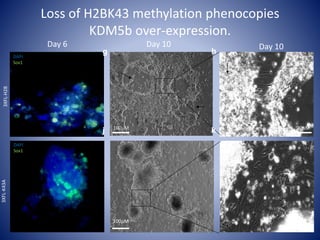
Loss of H2BK43 methylation phenocopies
KDM5b over-expression.
Linking biochemistry to biological
properties-Future directions
1. Define relationship between KDM5 and
cell signaling (MS sequencing and
verification)
2. Define the cell biology that is altered by
modulation of this system (Post injury
NSCs and iPSCs [NSCs v skin])
3. What is the role of these proteins in
both injury and recovery (mouse
models)
ROR
Ku70
DNA
Damage
TLE4 TLE4-s
ADAMST
8/12?
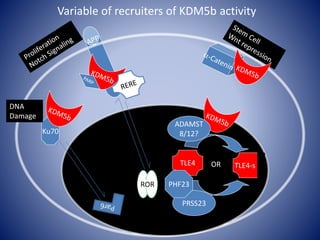
Variable of recruiters of KDM5b activity
OR
PRSS23
PHF23
K43
TLE4
Ku70
ROR
Akt
PKC
Neural differentiation
NICDWnt
Anti YFP
(TLE4)
FLAG RERE (FL)
FLAG-RERE
Yfp
FLAG-RERE
YfpKDM5b
FLAG-RERE
YfpTLE4
FLAG-RERE
alone
Anti KDM5b
IP:FLAG
RERE regulates KDM5b interactions
and localization
FLAG-RERE
YFP-KDM5b
YFP-TLE4
YFPC1
Whole cell Extract
Chromatin Pellet
antiKDM5b
antiKDM5b
antiGAPDH
antiH3
Linking biochemistry to biological
properties-Future directions
1. Define relationship between KDM5 and
cell signaling (MS sequencing and
verification)
2. Define the cell biology that is altered by
modulation of this system (Post injury
NSCs and iPSCs [NSCs v skin])
3. What is the role of these proteins in
both injury and recovery (mouse
models)
Why iPSCs?
• Stem cells have the ability to differentiate into all cell lineages and self renew
• Recent advances have allowed us to convert skin into stem cells
• Since Rett syndrome mutations happen in all cells we can take skin and make stem cells by
epigenetically re-programming the skin
• iPS can be used as a model system to monitor neural differentiation to test where the errors are
and possibly what effect therapeutics have on these errors
Endoderm
Mesoderm
Ectoderm
Neurons
RBC
Skeletal system
Pancreatic
cells
Skin cells
Stem cell
Stomach cell
Harvest spheres for RT-PCR and ChIP
Represents “Day 1” of neurodifferentiation assay
Harvest Day 3
Harvest Day 14
Harvest Day 10
Harvest Day 8
Harvest Day 6
Harvest Day 5
Harvest Day 4
Mainly
Neural Stem
Completely
Differentiated
mESCs or iPSCs
Testing epigenetic mechanisms
1
2
Abrogation of KDM5/Co-factor here to elucidate the role
of this complex in acquisition of neural lineage.
Epigenetics of differentiation, can transient expression
block/enhance terminal differentiation
(can use adult sphere forming cells including Breast, Prostate from human/mouse)
3
Cell lineage selection; can expression during terminal
differentiation, modify the type of neuron that is made
OR
Cause de-differentiation/proliferation (iPSC/Cancer)
K4
me
K4
me
me
me
me
me
me
me
me
me
KDM5
TLE4
TSS
Defining the epigenetic mechanism of
neural specification
1. How does recruiters
choose the which KDM5
2. Is the interaction
antagonistic
3. How general is this
model i.e. how many
other recruiters are
there?
1. How is TLE4
recruited to KDM5
loci?
2. What is the role of
Post-translation
modifications in
TLE4 localization
Syn Ab/CcNSP construct
*
**
0
1
2
3
4
5
6
7
8
9
10
Day 4
Foldchangeinnumberofspheresformed
n=3
TLE4 CcNSPControl
**
**
0%
20%
40%
60%
80%
100%
120%
140%
160%
1
Foldchangeinnumberofspheresplated
n=3
TLE4 CcNSPControl
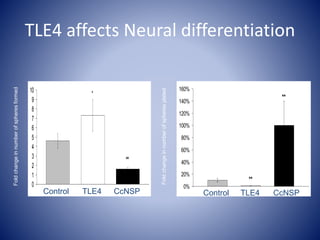
TLE4 affects Neural differentiation
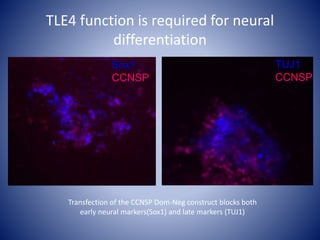
TLE4 function is required for neural
differentiation
TUJ1
CCNSP
Sox1
CCNSP
Transfection of the CCNSP Dom-Neg construct blocks both
early neural markers(Sox1) and late markers (TUJ1)
b c
feEYFP
EYFP
TLE4 CcNSP
TLE4 CcNSP
mCerulean TLE4 CcNSP
h iSox1
EYFP
Sox1
TLE4
Sox1
CcNSP
20 um
50 um
50 um
a
d
Day 4
Day 7
g
Day 2
0
0.5
1
1.5
2
Day Four Day Seven
Control
TLE4
CcNSP
NeuroD2 Expression
FoldChangeinExpression
Comparedtocontrol
j
**
** **
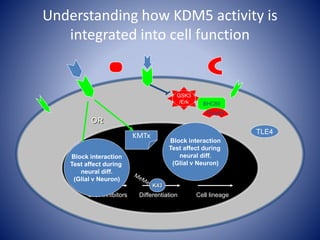
Understanding how KDM5 activity is
integrated into cell function
C.C. Inhibitors Differentiation Cell lineage
GSK3
/Erk BHC80
Ring6a
KMTx
K43
OR
TLE4
TLE4
Block interaction
Test affect during
neural diff.
(Glial v Neuron)
Block interaction
Test affect during
neural diff.
(Glial v Neuron)
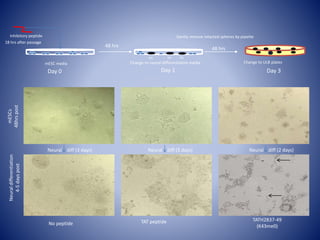
No peptide TAT peptide TATH2B37-49
(K43me0)
mESCs
48hrspost
Neural diff (3 days) Neural diff (3 days) Neural diff (2 days)
Neuraldifferentiation
4-5dayspost
18 hrs after passage
48 hrs
Change to neural differentiation mediamESC media
NS NS NS
Day 0 Day 1 Day 3
48 hrs
Inhibitory peptide Gently remove intacted spheres by pipette
Change to ULB plates
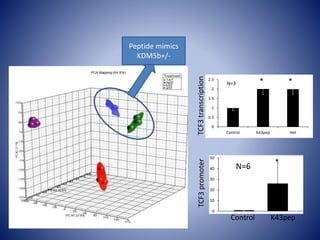
0
0.5
1
1.5
2
2.5
Control K43pep Het
TCF3transcriptionTCF3promoter
* *
0
10
20
30
40
50
*
Control K43pep
N=6
N=3
Peptide mimics
KDM5b+/-
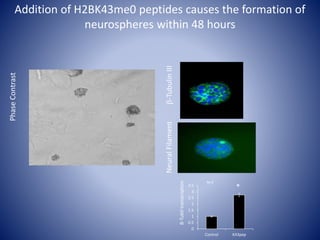
Addition of H2BK43me0 peptides causes the formation of
neurospheres within 48 hours
NeuralFilamentb-TubulinIII
PhaseContrast
0
0.5
1
1.5
2
2.5
3
3.5
Control K43pep
B-TubIItranscription
*
N=3
Linking biochemistry to biological
properties-Future directions
1. Define relationship between KDM5 and
cell signaling (MS sequencing and
verification)
2. Define the cell biology that is altered by
modulation of this system (Post injury
NSCs and iPSCs [NSCs v skin])
3. What is the role of these proteins in
both injury and recovery (mouse
models)
Epigenetic modifications during
programming
• In mESCs H3K4 demethylases can block
differentiation when exogenously expressed.
• They act by repressing cell lineage factors.
• In non-stem cells (e.g HEK293 or HeLa) they can
activate transcription of stem cell factors (Oct4,
Sox2 and Nanog).
This means that altering KDM5 function in cells
can coax stem cells towards a preferred lineage.
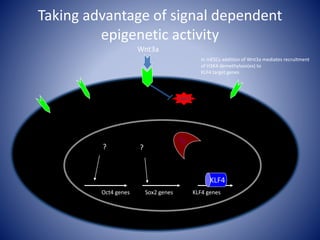
Oct4 genes Sox2 genes KLF4 genes
KLF4
Taking advantage of signal dependent
epigenetic activity
In mESCs addition of Wnt3a mediates recruitment
of H3K4 demethylase(es) to
KLF4 target genes
Wnt3a
GSK3
??
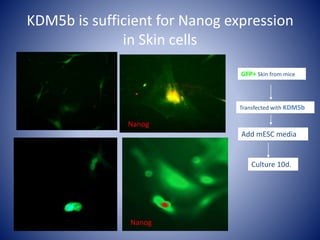
KDM5b is sufficient for Nanog expression
in Skin cells
GFP+ Skin from mice
Transfected with KDM5b
Add mESC media
Culture 10d.
Nanog
Nanog
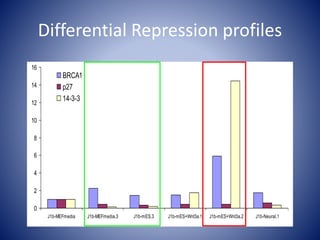
Differential Repression profiles
0
2
4
6
8
10
12
14
16
J1b-MEFmedia J1b-MEFmedia.3 J1b-mES.3 J1b-mES+Wnt3a.1 J1b-mES+Wnt3a.2 J1b-Neural.1
BRCA1
p27
14-3-3
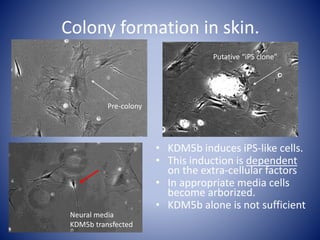
Colony formation in skin.
• KDM5b induces iPS-like cells.
• This induction is dependent
on the extra-cellular factors
• In appropriate media cells
become arborized.
• KDM5b alone is not sufficient
Putative “iPS clone”
Pre-colony
Neural media
KDM5b transfected
Therapeutic neural conversions
• KDM5b has the modulate the expression of a
variety of its target genes.
• The upstream signaling defines which targets.
• The changes do not appear to be permanent
suggesting that the loss of cell lineage markers is
insufficient for re-programming.
This may be advantageous for actually
regenerative medicine for direct to neural
conversion. Limiting the chance of transformation
(cancer).
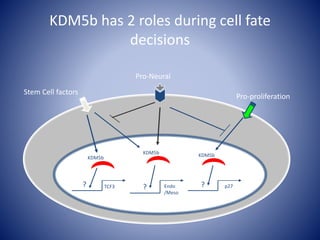
KDM5b has 2 roles during cell fate
decisions
TCF3 p27Endo
/Meso
KDM5b
Pro-Neural
??
Stem Cell factors
KDM5b
KDM5b
Pro-proliferation
?
KDM5b mechanism
• KDM5b regulates neural stem cells and potentially activity of
neurons through its target genes.
• KDM5b is regulated through both its localization and the
components of its complex.
• KDM5b is up-regulated in key populations after brain injury
Future Directions/Questions
 Is KDM5b localization and activity 2 separate signals?
 How do the components of the KDM5b complex effect post-
natal NSCs (i.e. differentiation, survival)?
 How does alteration of KDM5 activity (either positive or
negative) effect injury response of NSCs (in situ)
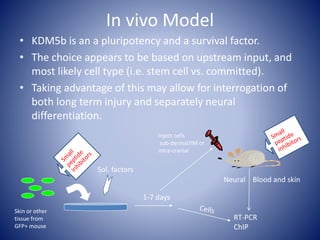
In vivo Model
• KDM5b is an a pluripotency and a survival factor.
• The choice appears to be based on upstream input, and
most likely cell type (i.e. stem cell vs. committed).
• Taking advantage of this may allow for interrogation of
both long term injury and separately neural
differentiation.
1-7 days
RT-PCR
ChIP
Inject cells
sub-dermal/IM or
intra-cranial
Skin or other
tissue from
GFP+ mouse
Sol. factors
Neural Blood and skin
Acknowledgements
Leanne Stalker
Bijan Dey
Sean Keating
Ramin Shiekhattar
Joyce Papadimitriou-Taylor
Jonathan Bramson
Willa Liao
Ajapal Bhangu
Martin Doughty
Marc Meneghini
Ray Truant
Lise Munsie
Shawn Li
Wendy Zhu
Marek Galka
Huadong Liu

KDM5 epigenetic modifiers as a focus for drug discovery

  • 1.
    Epigenetic enzymes asdrugable targets for neurological disease Christopher Wynder PTM Discoveries
  • 2.
    Epigenetics:so what • Epigeneticsis responsible for the variation seen in nature amongst close relations • Epigenetic regulation also provides organisms a mechanism to “tune” gene expression based environment (e.g. low dietary fat and brain development OR long term injury-TBI, stroke) Epigenetics also explains how dogs have so much variation Twin studies show that many differences in Autism spectrum disorders seen between siblings is likely epigenetics Or due to mutations in epigenetic regulators
  • 3.
    Epigenetic regulation hasmultiple jobs in the brain Stem cell During development (and regeneration), epigenetics plays a role in what kind of neurons In the brain, Epigenetic modifications are reused to modify synaptic plasticity Neurons have very few unique genes defining their sub-type Epigenetics modifies the levels of specific genes to alter the physical parameters of the neurons.
  • 4.
    Epigenetic definition • “Non-geneticevents” which result in stable and inheritable gene expression patterns. • Epigenetic changes are LONG term changes to shape the portions of the genome that are preferentially expressed • Particularly relevant during development • Regulation of histone modifications are a significant and changeable example of an epigenetic modification. Epigenetic changes are about setting the context for cell to nucleus signaling. Limiting the response to any given stimuli
  • 5.
    Epigenetics is thegenome’s attempt at grammar • There are approx. 15 000 genes. • Each one has a specific use and time when it should be used. • In Epigenetics, is essentially how genes are organized and how a cell decides which ones to use at a particular point in time. • Histone modifications give context to allow words to be used in the correct order. • DNA methylation is used as the bookmarks to define chapters (e.g. the “make a heart” or “respond to IGF”) See Jane Stop make Run destroy brain Skinheart jeans workcells See Jane Stop make Run destroy brain Skinheart jeans workcells
  • 6.
    Maintaining expression ofgenes during differentiation • Gene regulation is divided into 2 sub-regions, regulatory and promoter, and the transcribed region (gene encoding) • In general, histone modification of the ORF is a on/off mark due to the absolute requirement of these marks for RNA Polymerase read through rate • Histone modifications in the promoter generally work by modifying RPol’s access • Histone modifications in the regulatory region(s) are the “tuner” increasing or decreasing of DNA binding transcription factors to their elements
  • 7.
    jmjN Domain -possible adaptor for protein-protein interaction A/T Rich interaction Domain - DNA binding PHD Domain (zinc finger similar to RING and FVYE domains)- Chromatin binding a triplicate of PHDs in KDM5s jmjC histone demethylase - Catalytic domain a-ketoglutaric dehydrogenase Zn finger Domain - C5H2 zinc finger DNA binding domain (chromatin binding) KDM5b KDM5c/d 65% Homology 1 1544 1535/ 1516 KDM5 family structure Wynder, C; Doughty, M; and Stalker, L. Epigenomics, June 2010
  • 8.
    Neuron During neural differentiation,neurons must establish communication. Tu parle francais? Do you speak english? Yes Cells use KDM5 family members to tune everything from the receptors and synaptic shuttling machinery to the metabolic machinery. This comprehensive control allows the neurons to control both short term plasticity and long term “gene memory”
  • 9.
  • 10.
  • 11.
    Recycling of cellcycle genes during neural differentiation KDM5b & c targets Frank and Tsai, Neuron 62 (2009)
  • 12.
    Step-wise acclimation ofhistone modifications regulate neural differentiation 3meH3K4 RPolIII Low read through rate, low amounts of mRNA made, therefore low amounts protein, allows the cell to block the expression of cell lineage genes without 2nd signal. Extremely low to no read through. 3meH3K27 HDM: KDM5(s) HMT:KMT6 HDM: KDM6(s) HMT:KMT2(s) KDM5b (aka JARID1b/PLU1) Adapted from Shilatifard Ann.Biochem 2006
  • 13.
    Regulating the regulators Apoptosis Pro-neural Pro-selfrenewal Pro-neural self renewal Stage specific: Seq. specific TFs: Oct4, Sox2, FoxD3 NeuroD2, Sox1, FoxG1 Sox17, NGN2 Sox1, FoxD3 Pluripotent Stem Cell Neural Progenitor Differentiated Neuron Neural Stem Cell Ubiquitous factors Chromatin/histone Regulators: KDM5b, Ring6a KDM5b, KDM5c, Ring6a KDM5c, Ring6a KDM5b, Ring6a How do you control Ubiquitous factors to modulate specific events?
  • 14.
    Conserved mechanisms KDM5 Moshkin etal, Mol. Cell 2010 In Drosophila KDM5 Is localized by interaction of the NAP1-PF1 complex with Gro-CtBP NAP1 is a H2B-H2A dimer Binding protein Thought to be a chaperone protein
  • 15.
    In vitro 1. Recombinantproteins 2. Immunopurified complexes from ESCs (or tissue) Testing epigenetic mechanisms in stem cells rKDM5b Enzyme assaysWB from Nuc. Extracts mESCs + In vivo 1. Harvest spheres for RT-PCR and ChIP 2. Functional assay based cell markers(proteins) Differentiation assays Stalker L and Wynder C. Chapter 27. Methods in Molecular Biology. 2012
  • 16.
    TLE4 H3 H4 H2A H2B K4 K43 H3 H4H2A H2B K4 me me me K43 me me Stem Cell Cell cycle inhibitor RERE Pluripotent Self-renewing, proliferative KDM5b H3 H4 H2A H2B K4 me me me K43 H3 H4 H2A H2B K4 me me me K43 Multipotent Proliferative e.g. Neural stem cell Stem Cell Cell cycle inhibitor KDM5b ? KDM5b Lineage Committed e.g. neuron H3 H4 H2A H2B K4 me me me K43 me me Cell cycle inhibitor TLE4 H3 H4 H2A H2B K4 K43 Stem Cell RERE KDM5b KDM5b recruitment and activation
  • 17.
    mTcf3 is adevelopmental target FoldofTcf3transcript ** 0 0.2 0.4 0.6 0.8 1 1.2 1.4 1.6 1.8 Control JARID1b 3meH3K4 JARID1b Foldofchangein mTcf3promoter * 0 0.2 0.4 0.6 0.8 1 1.2 1.4 Control KDM5b ** ** ** 0 0.5 1 1.5 2 2.5 3 RNA 3meH3K4 KDM5b Control KDM5b FoldofchangeRNAor DNAbinding Stem Cells: mTcf3 Nanog Self-renewal Differentiation mTcf3 Nanog Cell fate genes Transient transfection Stable mESCs Neurospheres Dey BK., et al, (Wynder C.) 2008 Mol. Cell Biol.
  • 18.
  • 19.
    TLE4(Gro homologue) and nucleosomaldemethylation n=3 ** ** 0 0.2 0.4 0.6 0.8 1 1.2 1.4 1.6 n=6 Nuc. r.KDM5b r.TLE4 r.KDM5b r.TLE4 Foldchangein NucleosomalH3K4me3 r.KDM5d r.TLE4 ** 0.0 0.2 0.4 0.6 0.8 1.0 1.2 1.4 b-Actin TLE4 IP- mESCs KDM5B IP- mESCs n=6 Foldchangein Nucleosomal3meH3K4 0 10 20 30 40 50 60 70 80 90 100 H3K4me3 t=0 H3K4me3 + KDM5b t= 60 min H3K4me3 + KDM5b + TLE4 t= 60 min %methylationremaining H3 K4 MeMeMe KDM5b MeMeMe K4 H3 X
  • 20.
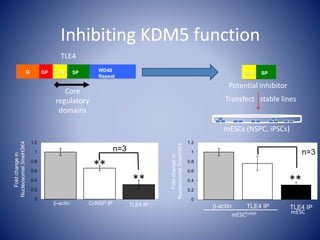
    0 0.2 0.4 0.6 0.8 1 1.2 Foldchangein Nucleosomal3meH3K4 ** ** b-actin TLE4 IPCcNSPIP ** n=3 0 0.2 0.4 0.6 0.8 1 1.2 Foldchangein Nucleosomal3meH3K4 b-actin TLE4 IPTLE4 IP mESCCcNSP ** mESC ** n=3 Q GP CcN SP WD40 Repeat CcN SP Core regulatory domains Potential inhibitor Inhibiting KDM5 function Transfect stable lines mESCs (NSPC, iPSCs) TLE4
  • 21.
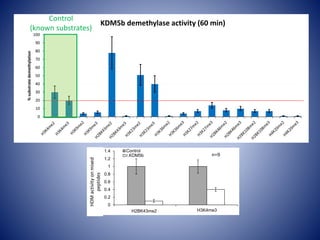
    0 0.2 0.4 0.6 0.8 1 1.2 1.4 2meK43-H2B 3meH3K4 Control r.KDM5b n=9* H2BK43me2H3K4me3 ** ** HDMactivityonmixed peptides 0 10 20 30 40 50 60 70 80 90 100 %substratedemethylation KDM5b demethylase activity (60 min) Control (known substrates)
  • 22.
    0 10 20 30 40 50 60 70 80 90 100 0 30 6090 120 150 180 210 %demethylatedsubstrate Time [min] H3K4me3 H2BK43me2 r.KDM5b removes methyl groups from K43 faster than K4
  • 23.
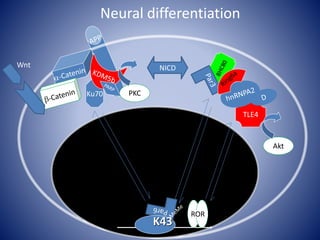
    K4 me H3 H2B me me me me KDM5b TLE4 TSS KDM5s areregulated by 2 part system Wnt/GSK3 Notch Wnt/GSK3 Stats/CK2 NGF/Erk2 Steroids catabolism
  • 24.
    KDM5b 2meK43 H2B 3Xflag H2B H2B 3XFl H2B mESC 3XFl K43A- mESC 3XFl H2B NS 3XFl K43A- NS Flag M2 K43me2 isenriched in progenitors but not stem cells Doublecortin 2meK43 H2B Nose tail Phospho-H3 2meK43 H2B TUJ1 2meK43 H2B 2meK43 H2B Dorsal Root ganglia
  • 25.
    3XFL-H2B3XFL-K43A 20mM 20mM 20mM 20mM100mM 100mM Day 10Day6 Day 10 DAPI Sox1 DAPI Sox1 hg kj Loss of H2BK43 methylation phenocopies KDM5b over-expression.
  • 26.
    Linking biochemistry tobiological properties-Future directions 1. Define relationship between KDM5 and cell signaling (MS sequencing and verification) 2. Define the cell biology that is altered by modulation of this system (Post injury NSCs and iPSCs [NSCs v skin]) 3. What is the role of these proteins in both injury and recovery (mouse models)
  • 27.
    ROR Ku70 DNA Damage TLE4 TLE4-s ADAMST 8/12? Variable ofrecruiters of KDM5b activity OR PRSS23 PHF23
  • 28.
  • 29.
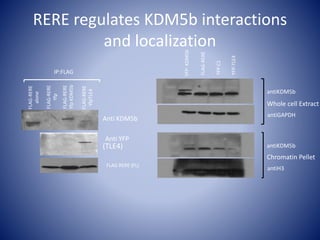
    Anti YFP (TLE4) FLAG RERE(FL) FLAG-RERE Yfp FLAG-RERE YfpKDM5b FLAG-RERE YfpTLE4 FLAG-RERE alone Anti KDM5b IP:FLAG RERE regulates KDM5b interactions and localization FLAG-RERE YFP-KDM5b YFP-TLE4 YFPC1 Whole cell Extract Chromatin Pellet antiKDM5b antiKDM5b antiGAPDH antiH3
  • 30.
    Linking biochemistry tobiological properties-Future directions 1. Define relationship between KDM5 and cell signaling (MS sequencing and verification) 2. Define the cell biology that is altered by modulation of this system (Post injury NSCs and iPSCs [NSCs v skin]) 3. What is the role of these proteins in both injury and recovery (mouse models)
  • 31.
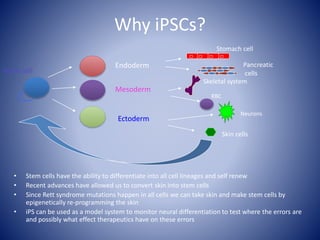
    Why iPSCs? • Stemcells have the ability to differentiate into all cell lineages and self renew • Recent advances have allowed us to convert skin into stem cells • Since Rett syndrome mutations happen in all cells we can take skin and make stem cells by epigenetically re-programming the skin • iPS can be used as a model system to monitor neural differentiation to test where the errors are and possibly what effect therapeutics have on these errors Endoderm Mesoderm Ectoderm Neurons RBC Skeletal system Pancreatic cells Skin cells Stem cell Stomach cell
  • 32.
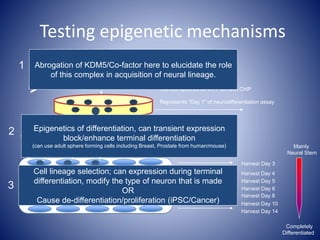
    Harvest spheres forRT-PCR and ChIP Represents “Day 1” of neurodifferentiation assay Harvest Day 3 Harvest Day 14 Harvest Day 10 Harvest Day 8 Harvest Day 6 Harvest Day 5 Harvest Day 4 Mainly Neural Stem Completely Differentiated mESCs or iPSCs Testing epigenetic mechanisms 1 2 Abrogation of KDM5/Co-factor here to elucidate the role of this complex in acquisition of neural lineage. Epigenetics of differentiation, can transient expression block/enhance terminal differentiation (can use adult sphere forming cells including Breast, Prostate from human/mouse) 3 Cell lineage selection; can expression during terminal differentiation, modify the type of neuron that is made OR Cause de-differentiation/proliferation (iPSC/Cancer)
  • 33.
    K4 me K4 me me me me me me me me me KDM5 TLE4 TSS Defining the epigeneticmechanism of neural specification 1. How does recruiters choose the which KDM5 2. Is the interaction antagonistic 3. How general is this model i.e. how many other recruiters are there? 1. How is TLE4 recruited to KDM5 loci? 2. What is the role of Post-translation modifications in TLE4 localization Syn Ab/CcNSP construct
  • 34.
  • 35.
    TLE4 function isrequired for neural differentiation TUJ1 CCNSP Sox1 CCNSP Transfection of the CCNSP Dom-Neg construct blocks both early neural markers(Sox1) and late markers (TUJ1)
  • 36.
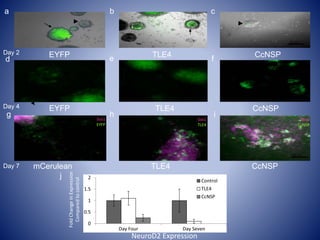
    b c feEYFP EYFP TLE4 CcNSP TLE4CcNSP mCerulean TLE4 CcNSP h iSox1 EYFP Sox1 TLE4 Sox1 CcNSP 20 um 50 um 50 um a d Day 4 Day 7 g Day 2 0 0.5 1 1.5 2 Day Four Day Seven Control TLE4 CcNSP NeuroD2 Expression FoldChangeinExpression Comparedtocontrol j ** ** **
  • 37.
    Understanding how KDM5activity is integrated into cell function C.C. Inhibitors Differentiation Cell lineage GSK3 /Erk BHC80 Ring6a KMTx K43 OR TLE4 TLE4 Block interaction Test affect during neural diff. (Glial v Neuron) Block interaction Test affect during neural diff. (Glial v Neuron)
  • 38.
    No peptide TATpeptide TATH2B37-49 (K43me0) mESCs 48hrspost Neural diff (3 days) Neural diff (3 days) Neural diff (2 days) Neuraldifferentiation 4-5dayspost 18 hrs after passage 48 hrs Change to neural differentiation mediamESC media NS NS NS Day 0 Day 1 Day 3 48 hrs Inhibitory peptide Gently remove intacted spheres by pipette Change to ULB plates
  • 39.
    0 0.5 1 1.5 2 2.5 Control K43pep Het TCF3transcriptionTCF3promoter ** 0 10 20 30 40 50 * Control K43pep N=6 N=3 Peptide mimics KDM5b+/-
  • 40.
    Addition of H2BK43me0peptides causes the formation of neurospheres within 48 hours NeuralFilamentb-TubulinIII PhaseContrast 0 0.5 1 1.5 2 2.5 3 3.5 Control K43pep B-TubIItranscription * N=3
  • 41.
    Linking biochemistry tobiological properties-Future directions 1. Define relationship between KDM5 and cell signaling (MS sequencing and verification) 2. Define the cell biology that is altered by modulation of this system (Post injury NSCs and iPSCs [NSCs v skin]) 3. What is the role of these proteins in both injury and recovery (mouse models)
  • 42.
    Epigenetic modifications during programming •In mESCs H3K4 demethylases can block differentiation when exogenously expressed. • They act by repressing cell lineage factors. • In non-stem cells (e.g HEK293 or HeLa) they can activate transcription of stem cell factors (Oct4, Sox2 and Nanog). This means that altering KDM5 function in cells can coax stem cells towards a preferred lineage.
  • 43.
    Oct4 genes Sox2genes KLF4 genes KLF4 Taking advantage of signal dependent epigenetic activity In mESCs addition of Wnt3a mediates recruitment of H3K4 demethylase(es) to KLF4 target genes Wnt3a GSK3 ??
  • 44.
    KDM5b is sufficientfor Nanog expression in Skin cells GFP+ Skin from mice Transfected with KDM5b Add mESC media Culture 10d. Nanog Nanog
  • 45.
    Differential Repression profiles 0 2 4 6 8 10 12 14 16 J1b-MEFmediaJ1b-MEFmedia.3 J1b-mES.3 J1b-mES+Wnt3a.1 J1b-mES+Wnt3a.2 J1b-Neural.1 BRCA1 p27 14-3-3
  • 46.
    Colony formation inskin. • KDM5b induces iPS-like cells. • This induction is dependent on the extra-cellular factors • In appropriate media cells become arborized. • KDM5b alone is not sufficient Putative “iPS clone” Pre-colony Neural media KDM5b transfected
  • 47.
    Therapeutic neural conversions •KDM5b has the modulate the expression of a variety of its target genes. • The upstream signaling defines which targets. • The changes do not appear to be permanent suggesting that the loss of cell lineage markers is insufficient for re-programming. This may be advantageous for actually regenerative medicine for direct to neural conversion. Limiting the chance of transformation (cancer).
  • 48.
    KDM5b has 2roles during cell fate decisions TCF3 p27Endo /Meso KDM5b Pro-Neural ?? Stem Cell factors KDM5b KDM5b Pro-proliferation ?
  • 49.
    KDM5b mechanism • KDM5bregulates neural stem cells and potentially activity of neurons through its target genes. • KDM5b is regulated through both its localization and the components of its complex. • KDM5b is up-regulated in key populations after brain injury Future Directions/Questions  Is KDM5b localization and activity 2 separate signals?  How do the components of the KDM5b complex effect post- natal NSCs (i.e. differentiation, survival)?  How does alteration of KDM5 activity (either positive or negative) effect injury response of NSCs (in situ)
  • 50.
    In vivo Model •KDM5b is an a pluripotency and a survival factor. • The choice appears to be based on upstream input, and most likely cell type (i.e. stem cell vs. committed). • Taking advantage of this may allow for interrogation of both long term injury and separately neural differentiation. 1-7 days RT-PCR ChIP Inject cells sub-dermal/IM or intra-cranial Skin or other tissue from GFP+ mouse Sol. factors Neural Blood and skin
  • 51.
    Acknowledgements Leanne Stalker Bijan Dey SeanKeating Ramin Shiekhattar Joyce Papadimitriou-Taylor Jonathan Bramson Willa Liao Ajapal Bhangu Martin Doughty Marc Meneghini Ray Truant Lise Munsie Shawn Li Wendy Zhu Marek Galka Huadong Liu