E-COMMERCE
WHAT IS E-COMMERCE
• Commonly known as Electronic Marketing.
• “It consist of buying and selling goods and services over an electronic
systems Such as the internet and other computer networks.”
• “E-commerce is the purchasing, selling and exchanging goods and
services over computer networks (internet) through which transaction
or terms of sale are performed Electronically.
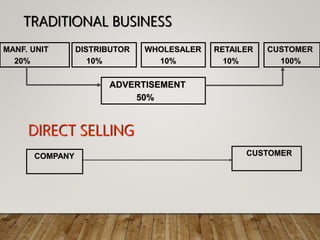
TRADITIONAL BUSINESS
DIRECT SELLING
MANF. UNIT
20%
DISTRIBUTOR
10%
WHOLESALER
10%
RETAILER
10%
CUSTOMER
100%
ADVERTISEMENT
50%
CUSTOMERCOMPANY
WHY TO USE E-COMMERCE
• LOW ENTRY COST
• REDUCES TRANSACTION COSTS
• ACCESS TO THE GLOBAL MARKET
• SECURE MARKET SHARE
THE PROCESS OF E-COMMERCE
• A consumer uses Web browser to connect to the home page of a
merchant's Web site on the Internet.
• The consumer browses the catalog of products featured on the site
and selects items to purchase. The selected items are placed in the
electronic equivalent of a shopping cart.
• When the consumer is ready to complete the purchase of selected
items, she provides a bill-to and ship-to address for purchase and
delivery
• When the merchant's Web server receives this
information, it computes the total cost of the
order--including tax, shipping, and handling
charges--and then displays the total to the
customer.
• The customer can now provide payment
information, such as a credit card number, and
then submit the order.
• When the credit card number is validated and the
order is completed at the Commerce Server site,
the merchant's site displays a receipt confirming
the customer's purchase.
• The Commerce Server site then forwards the
order to a Processing Network for payment
processing and fulfillment.
PROS AND CONS
OF
E-COMMERCE
PROS
• No checkout queues
• Reduce prices
• You can shop anywhere in the world
• Easy access 24 hours a day
• Wide selection to cater for all consumers
CONS
• Unable to examine products personally
• Not everyone is connected to the Internet
• There is the possibility of credit card number
theft
• On average only 1/9th of stock is available on the
net
FUTURE OF E-COMMERCE IN
INDIA
• According to business world estimate near about Sixty
thousand new jobs will be created for the internet world alone
in the next two years
• e-Commerce transactions are expected to cross the Rs. 3500
crore milestone in 2010-11, a jump of around 350 percent
from the 2008-09 figure of Rs. 1000 crore
• eBay said that consumers were trading goods worth almost
three crore rupees everyday, across the globe.
E commerce

E commerce

  • 1.
  • 2.
    WHAT IS E-COMMERCE •Commonly known as Electronic Marketing. • “It consist of buying and selling goods and services over an electronic systems Such as the internet and other computer networks.” • “E-commerce is the purchasing, selling and exchanging goods and services over computer networks (internet) through which transaction or terms of sale are performed Electronically.
  • 3.
    TRADITIONAL BUSINESS DIRECT SELLING MANF.UNIT 20% DISTRIBUTOR 10% WHOLESALER 10% RETAILER 10% CUSTOMER 100% ADVERTISEMENT 50% CUSTOMERCOMPANY
  • 4.
    WHY TO USEE-COMMERCE
  • 5.
    • LOW ENTRYCOST • REDUCES TRANSACTION COSTS • ACCESS TO THE GLOBAL MARKET • SECURE MARKET SHARE
  • 6.
    THE PROCESS OFE-COMMERCE
  • 7.
    • A consumeruses Web browser to connect to the home page of a merchant's Web site on the Internet. • The consumer browses the catalog of products featured on the site and selects items to purchase. The selected items are placed in the electronic equivalent of a shopping cart. • When the consumer is ready to complete the purchase of selected items, she provides a bill-to and ship-to address for purchase and delivery
  • 8.
    • When themerchant's Web server receives this information, it computes the total cost of the order--including tax, shipping, and handling charges--and then displays the total to the customer. • The customer can now provide payment information, such as a credit card number, and then submit the order.
  • 9.
    • When thecredit card number is validated and the order is completed at the Commerce Server site, the merchant's site displays a receipt confirming the customer's purchase. • The Commerce Server site then forwards the order to a Processing Network for payment processing and fulfillment.
  • 10.
  • 11.
  • 12.
    • No checkoutqueues • Reduce prices • You can shop anywhere in the world • Easy access 24 hours a day • Wide selection to cater for all consumers
  • 13.
  • 14.
    • Unable toexamine products personally • Not everyone is connected to the Internet • There is the possibility of credit card number theft • On average only 1/9th of stock is available on the net
  • 15.
    FUTURE OF E-COMMERCEIN INDIA • According to business world estimate near about Sixty thousand new jobs will be created for the internet world alone in the next two years • e-Commerce transactions are expected to cross the Rs. 3500 crore milestone in 2010-11, a jump of around 350 percent from the 2008-09 figure of Rs. 1000 crore • eBay said that consumers were trading goods worth almost three crore rupees everyday, across the globe.