Approach to dyspnea
Dr Rajashekhar Mulimani
Consultant Physician, Intensivist, Diabetologist
MD (UCMS delhi)
Fellow in Diabetes (CMC vellore)
Cardinal symptoms of cardiac disease
1. Dyspnea or breathlessness
2. Chest pain
3. Syncope
4. Palpitations
5. Edema / fatigue
Dyspnea
• Common and often debilitating symptom
• Affects up to 50% of patients admitted to acute, tertiary care
hospitals
• 25% of patients seeking care in OPD
• 7.4% of patients presenting to ER.
Dyspnea
• Derived from Greek - hard breathing
Dys – difficult; pnoia – breathing
• Often described as “shortness of breath”
• An indicator of “inadequate ventilation” or “insufficient oxygen in
the circulating blood
Definition
• Dyspnea is difficult and uncomfortable breathing.
• ATS definition : “subjective experience of breathing discomfort that is
comprised of qualitatively distinct sensations that vary in intensity”
• Dyspnea is a very debilitating symptom, whose impact is second to that of
pain.
• Why it is important ;
Predictor of quality of life
Exercise tolerance
mortality
Other definitions
• Abnormally uncomfortable
awareness of breathing
(subjective experience of
uncomfort breathing)
• Harrison manual of internal medicine till 20TH
edition
• Conscious sensation that results
from an unusual perception of
discomfort during breathing
• Heart failure – A companion to braunwald
• Normal resting person –
unaware of breathing
• Mild to moderate exertion –
become aware
• After heavy exertion –
unpleasant awareness,
transient.
• Dyspnea occurs after strenuous exertion in normal healthy, well-
conditioned subjects.
• Abormal – only when it occurs at a level of physical activity not
expected to cause dyspnea
• Depends on – normal physical activities
Dyspnea
• Depending on perception & reaction –
• Large number of verbal expressions
‘can not get enough air’
‘smothering feeling’
‘tightness or tiredness in chest’
‘choking sensation’
Air does not go all the way down’
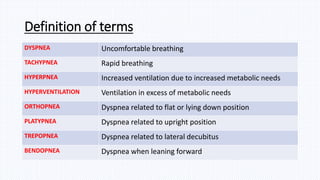
Definition of terms
DYSPNEA Uncomfortable breathing
TACHYPNEA Rapid breathing
HYPERPNEA Increased ventilation due to increased metabolic needs
HYPERVENTILATION Ventilation in excess of metabolic needs
ORTHOPNEA Dyspnea related to flat or lying down position
PLATYPNEA Dyspnea related to upright position
TREPOPNEA Dyspnea related to lateral decubitus
BENDOPNEA Dyspnea when leaning forward
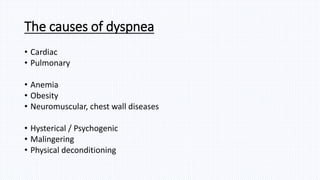
The causes of dyspnea
• Cardiac
• Pulmonary
• Anemia
• Obesity
• Neuromuscular, chest wall diseases
• Hysterical / Psychogenic
• Malingering
• Physical deconditioning
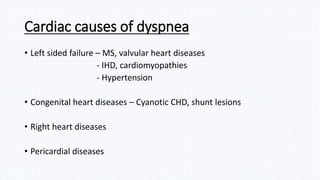
Cardiac causes of dyspnea
• Left sided failure – MS, valvular heart diseases
- IHD, cardiomyopathies
- Hypertension
• Congenital heart diseases – Cyanotic CHD, shunt lesions
• Right heart diseases
• Pericardial diseases
Pulmonary causes of dyspnea
• Airway causes:
• Parenchymal causes:
• Pulmonary vascular causes:
• Pleural causes:
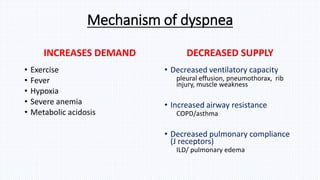
Mechanism of dyspnea
INCREASES DEMAND
• Exercise
• Fever
• Hypoxia
• Severe anemia
• Metabolic acidosis
DECREASED SUPPLY
• Decreased ventilatory capacity
pleural effusion, pneumothorax, rib
injury, muscle weakness
• Increased airway resistance
COPD/asthma
• Decreased pulmonary compliance
(J receptors)
ILD/ pulmonary edema
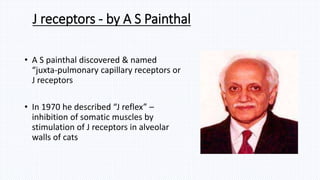
J receptors - by A S Painthal
• A S painthal discovered & named
“juxta-pulmonary capillary receptors or
J receptors
• In 1970 he described “J reflex” –
inhibition of somatic muscles by
stimulation of J receptors in alveolar
walls of cats
Question for you guys…..
Why dyspnea occurs in right
heart disease…??
Waiting for your response…….
Assessment of dyspnea
• What all you should know as a clinicians….?
• What all you should include in your HOPI during CCP…?
1. Is it dyspnea, or a condition simulating dyspnea…?
2. If dyspnea, is it cardiac or pulmonary cause…?
3. If cardiac, what is the grade of dyspnea…?
4. Is there Paroxysmal nocturnal dyspnea and orthopnea…?
5. What is the duration of these symptoms…?
6. what is the time interval between the onset of dyspnea and edema…?
7. Is the patient receiving drugs; if so what is the response…?
8. What are the associated symptoms..??
1. Is it dyspnea or a condition
simulating it…?
Conditions simulating dyspnea
• Dyspnea as angina equivalent
• Acidotic breathing (kussumaul’s breathing)
• Hysterical hyperventilation
• Malingering
• Central neurogenic hyperventilation
• Fever
• Pregnancy
• Septicemia
2..Dyspnea is cardiac or
respiratory……?
Dyspnea of pulmonary cause……
• Cough and expectoration
• Wheezing
• Dyspnea may not related to exertion
• Fever
• Pleuritic type of chest pain
• Loss of weight
• Seasonal variation
• Progressive increase over many years
• Prompt response to bronchodilators
• Prompt response to oxygen
• Paroxysmal nocturnal dyspnea and orthopnea
• Pink frothy sputum
• Rapid progression of symptoms
• Little or no cyanosis with severe dyspnea
• Response to diuretics and digoxin
• Cheyne stokes breathing
Dyspnea of cardiac cause……
3.. Grading of dyspnea….???
• The degree of disability by dyspnea can be graded semi-objectively.
• The dyspnea degree is directly proportional to severity of pulmonary
venous hypertension
• Various scales used;
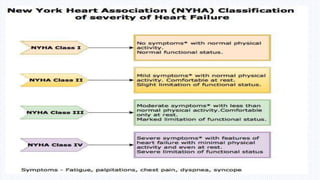
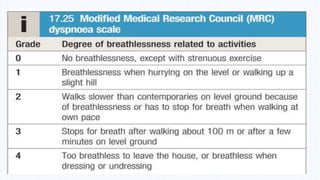
1. NYHA grading
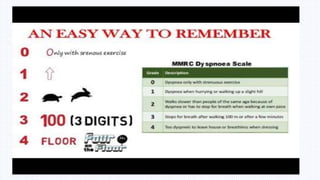
2. mMRC grading
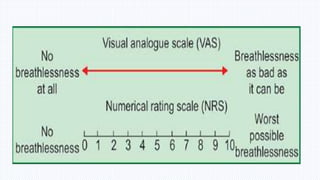
3. Visual analogue scale
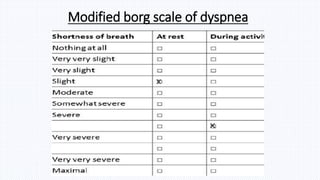
4. Borg scale
5. Canadian classification
6. 6- min walk test
Limitations of NYHA classification
• It is subjective
• Poor reproducibility
• Does not involve: PND, orthopnea, and other forms of dyspnea
• Cannot be reliable in children
• Does not involve beyond ordinary activity
NYHA classification
• Inspite of its limitations
• Strong & independent predictor of mortality.
• Most often used as prognostic marker
• Outcome measure
• Inclusion/exclusion criteria for clinical trials
• Indication for CRT, spironolactone
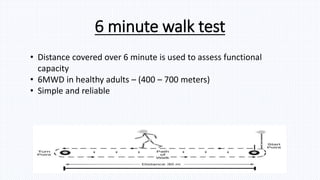
6 minute walk test
• Distance covered over 6 minute is used to assess functional
capacity
• 6MWD in healthy adults – (400 – 700 meters)
• Simple and reliable
Modified borg scale of dyspnea
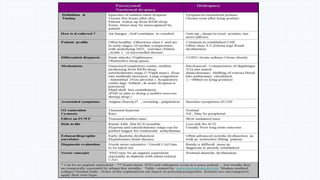
Paroxysmal nocturnal
dyspnea
• The patient wakes up 2-3 hours after going to sleep with shortness of
breath and cough, sits up on the bed or stands and opens the window
as if hungry for air. (dyspnea preceds cough and not vice-versa)
• Destiny: either dyspnea may subside spontaneously (15-30mins) or
sometimes may progress to frank pulmonary edema.
• Paroxysmal nocturnal dyspnea is related to interstitial pulmonary
edema.
Mechanisms of PND…..
1. Absorption of edema fluid with increase in RV output overfilling the
lungs (slow redistribution)
2. Diminished sympathetic drive of sleep decreasing LV contractility
3. Sleep induced dreams with attendant increase in emotional instability
4. Nocturnal arrythmias
5. Sleep apnea (central neurogenic hypoventilation)
Conditions mimicking PND….
• Nocturnal episodes of acute asthma
• Sleep apnea with arousal
• Postnasal discharge
• Nocturnal angina with dyspnea as angina equivalent
• Noctrnal aspiration in GERD.
• Nocturnal episodes of recurrent minute pulmonary emboli.
Answer…..
Why it is paroxysmal….?
Why not every night…..?
Why only nocturnal…..?
Second episode of PND in the same night…….????
PND vs Orthopnea….which is a reproducible symptom…???
What is the sensitivity and specificity of PND in predicting the heart
disease…???
PND…. Which NYHA class..???
Orthopnea
• Increase in dyspnea in supine posture and relief by sitting upright position.
• This is related to increased venous return (fast redistribution = 400ml) in
supine position with increase in RV output, further increasing the
pulmonary congestion
• Causes:
1. LV failure
2. COPD
3. Massive ascites
4. Constrictive pericarditis
5. Bilateral diaphragmatic paralysis. Find out – number of pillows
used under the head to sleep
• In ESCAPE trial in heart failure
• Orthopnea requiring >2 pillows predicted PCWP >30mmhg.
• Only feature in the history which predicted PVP.
Duration and onset of
dyspnea
Acute onset dyspnea
1. Acute LV failure
2. Acute pulmonary embolism
3. Tension pneumothorax
4. Cardiac tamponade
5. Acute airway obstruction
In chronic dyspnea due to cardiac diseases
• If the duration of dyspnea is longer than 5 years particularly with
PND, mitral stenosis is the most likely diagnosis.
• Other disorders like aortic valve diseases and coronary disease are
less likely as most patients do not survive longer than 3 years after
the onset of heart failure.
Time onset between dyspnea and RV failure
• Is usually longer in MS than in other causes of heart failure.
• In MS the Rv fails under high pressures of pulmonary artery, which is
develoing slowly.
• In other disorders like AV dieases and IHD, the pulmonary venous and
arterial pressures are suddenly elevated with the development of LV
failure on a right ventricle which was unprepared by prior
hypertrophy
Dyspnea in
diastolic vs systolic failure
• Very arbitrary and highly observational. No studies/ evidence
• For the same amount of stress or work load persons with systolic
dysfunction behave differently . However ,both will complete the
activity but the onset and perception of dyspnea is slightly different in
patients with predominant diastolic dysfunction.
In diastolic dysfunction…..
• Delayed dyspnea . It manifest well after the exertion is completed.
• It is more off a struggle to handle the venous return .The forward flow (Arterial circuit ) is
relatively well toned and tuned and hence fatigue is rare .
• Typically it has a prolonged recovery time .(? > 1-2 minutes )
• Is it less harmful in terms of longevity ? May be . . . since it is more related to
physical de-conditioning. Most of the physiological episodes of dyspnea are
probably diastolic dysfunction mediated .
• Dyspnea that is triggered in diastole is also dependent very much on the heart rate .If
the heart rate fail to reach the baseline the recovery of dyspnea is also delayed
• Some believe , physiological dyspnea should disappear within 30-60 seconds after
termination of activity. (Highly arbitrary!)
In systolic dysfunction…..
• Patients with primary systolic pump failure experience dyspnea very
early into exercise .
• Much of dyspnea occur during activity itself .
• Exercising muscles show hypoxia and hence fatigue is conspicuous .
• Recovery of dyspnea is relatively immediate as the activity is
stopped, Demand from exercising muscle is significantly dropped.
• If the venous return is well handled by the ventricles the recovery
phase is ore comfortable .
Dyspnea in various clinical
conditions
Coronary artery disease
• As an angina equivalent, all patients with risk factors and having
unexplained dyspnea should be evaluated for CAD.
• Dyspnea in CAD usually means a significant area of myocardium is at
risk,
• Dyspnea in MI usually suggest LV failure and a loss of 25% or more
myocardium and the EF is uaually less than 40%.
• Dyspnea is more common in AWMI than in IWMI.
Mitral stenosis
• Dyspnea is the first and most important symptom of mitral stenosis
in contrast to other valvular lesions where it is a late manifestation.
• As a general rule, if a patient has dyspnea with PND for more than 5
years, MS is most likely to be present and aortic valve disease is
unlikely.
• After the first episode of ARF, there is always a latent period of at
least 3 years before dyspnea appears in MS as mitral stenosis takes
time to develop.
Mitral regurgitation
• Dyspnea occur later in the course
• Usually due to LV dysfunction
• Causes of rapid progression of dyspnea in MR:
1. Recurrence of rheumatic activity (acute on chronic)
2. Chordal rupture
3. Infective endocarditis
4. Onset of AF
5. Hypertension
Aortic stenosis
• Angina + syncope + dyspnea.
• Dyspnea is the most menacing symptom of AS. Average survival after onset
of dyspnea in AS is only 1.5 years.
• Dyspnea in mild AS….. Always suspect underlying
HOCM
CAD
Mitral valve disease
Unrelated disorder (pulmonary)
Aortic regurgitation
• Occurs very late, slow progression
• Due to LV dysfunction
• If dyspnea occurs early in the course – suspect acute AR or an
associated MS
• Rapid progression of dyspnea – IE, HTN.
Bendopnea
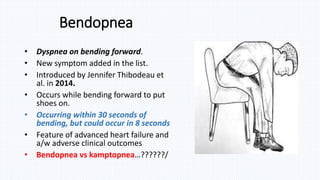
• Dyspnea on bending forward.
• New symptom added in the list.
• Introduced by Jennifer Thibodeau et
al. in 2014.
• Occurs while bending forward to put
shoes on.
• Occurring within 30 seconds of
bending, but could occur in 8 seconds
• Feature of advanced heart failure and
a/w adverse clinical outcomes
• Bendopnea vs kamptopnea…??????/
Trepopnea
• Dyspnea occurring on lying in lateral position.
• Can occur in asymmetric lung diseases when patient lies with more
affected lung down, because of gravitational redistribution of blood.
• Pleural effusion – patient experience less dyspnea when lying on the side of
pleural effusion
• Cardiac causes of trepopnea :
1. Decompensated HF – prefer to lie on right side, to enable better blood return
2. LA myxoma – dyspnea in left lateral position due to MV obstruction
Platypnea
• Dyspnea in upright posture, relieved by lying down
• Orthodeoxia is decrease in PaO2 in upright position.
• Can occur in:
1. PFO – shunting R to L
2. Pulmonary AVF
3. Hepatopulmonary syndrome
Cheyne – stokes breathing
• Peiodic breathing – cyclical episodes of apnea & hypeventilation
• Progressively deeper & sometimes faster breathing f/b gradual
decrease & apnea.
• Pattern repeats, with each cycle taking 30secs to 2 mins.
• Sign of CNS diseases.
• Also seen in advanced HF (due to prolonged circulation time)
• If CNS disease is excluded – diagnostic of LVF
• Often occurs during sleep, without patient awareness
• Predicts increased mortality.
Conclusion
• Most common causes _ cardiac and pulmonary
• PVH – the basis of dyspnea in most cardiac diseases
• Detailed history can differentiate various cardiac & non- cardiac
causes of dyspnea
• Newer inventions can never replace clinical acumen.

Approach to. . dyspnea.pptx

  • 1.
    Approach to dyspnea DrRajashekhar Mulimani Consultant Physician, Intensivist, Diabetologist MD (UCMS delhi) Fellow in Diabetes (CMC vellore)
  • 3.
    Cardinal symptoms ofcardiac disease 1. Dyspnea or breathlessness 2. Chest pain 3. Syncope 4. Palpitations 5. Edema / fatigue
  • 4.
    Dyspnea • Common andoften debilitating symptom • Affects up to 50% of patients admitted to acute, tertiary care hospitals • 25% of patients seeking care in OPD • 7.4% of patients presenting to ER.
  • 5.
    Dyspnea • Derived fromGreek - hard breathing Dys – difficult; pnoia – breathing • Often described as “shortness of breath” • An indicator of “inadequate ventilation” or “insufficient oxygen in the circulating blood
  • 6.
    Definition • Dyspnea isdifficult and uncomfortable breathing. • ATS definition : “subjective experience of breathing discomfort that is comprised of qualitatively distinct sensations that vary in intensity” • Dyspnea is a very debilitating symptom, whose impact is second to that of pain. • Why it is important ; Predictor of quality of life Exercise tolerance mortality
  • 7.
    Other definitions • Abnormallyuncomfortable awareness of breathing (subjective experience of uncomfort breathing) • Harrison manual of internal medicine till 20TH edition • Conscious sensation that results from an unusual perception of discomfort during breathing • Heart failure – A companion to braunwald • Normal resting person – unaware of breathing • Mild to moderate exertion – become aware • After heavy exertion – unpleasant awareness, transient.
  • 8.
    • Dyspnea occursafter strenuous exertion in normal healthy, well- conditioned subjects. • Abormal – only when it occurs at a level of physical activity not expected to cause dyspnea • Depends on – normal physical activities
  • 9.
    Dyspnea • Depending onperception & reaction – • Large number of verbal expressions ‘can not get enough air’ ‘smothering feeling’ ‘tightness or tiredness in chest’ ‘choking sensation’ Air does not go all the way down’
  • 10.
    Definition of terms DYSPNEAUncomfortable breathing TACHYPNEA Rapid breathing HYPERPNEA Increased ventilation due to increased metabolic needs HYPERVENTILATION Ventilation in excess of metabolic needs ORTHOPNEA Dyspnea related to flat or lying down position PLATYPNEA Dyspnea related to upright position TREPOPNEA Dyspnea related to lateral decubitus BENDOPNEA Dyspnea when leaning forward
  • 11.
    The causes ofdyspnea • Cardiac • Pulmonary • Anemia • Obesity • Neuromuscular, chest wall diseases • Hysterical / Psychogenic • Malingering • Physical deconditioning
  • 12.
    Cardiac causes ofdyspnea • Left sided failure – MS, valvular heart diseases - IHD, cardiomyopathies - Hypertension • Congenital heart diseases – Cyanotic CHD, shunt lesions • Right heart diseases • Pericardial diseases
  • 13.
    Pulmonary causes ofdyspnea • Airway causes: • Parenchymal causes: • Pulmonary vascular causes: • Pleural causes:
  • 14.
    Mechanism of dyspnea INCREASESDEMAND • Exercise • Fever • Hypoxia • Severe anemia • Metabolic acidosis DECREASED SUPPLY • Decreased ventilatory capacity pleural effusion, pneumothorax, rib injury, muscle weakness • Increased airway resistance COPD/asthma • Decreased pulmonary compliance (J receptors) ILD/ pulmonary edema
  • 15.
    J receptors -by A S Painthal • A S painthal discovered & named “juxta-pulmonary capillary receptors or J receptors • In 1970 he described “J reflex” – inhibition of somatic muscles by stimulation of J receptors in alveolar walls of cats
  • 16.
    Question for youguys….. Why dyspnea occurs in right heart disease…?? Waiting for your response…….
  • 17.
    Assessment of dyspnea •What all you should know as a clinicians….? • What all you should include in your HOPI during CCP…?
  • 18.
    1. Is itdyspnea, or a condition simulating dyspnea…? 2. If dyspnea, is it cardiac or pulmonary cause…? 3. If cardiac, what is the grade of dyspnea…? 4. Is there Paroxysmal nocturnal dyspnea and orthopnea…? 5. What is the duration of these symptoms…? 6. what is the time interval between the onset of dyspnea and edema…? 7. Is the patient receiving drugs; if so what is the response…? 8. What are the associated symptoms..??
  • 19.
    1. Is itdyspnea or a condition simulating it…?
  • 20.
    Conditions simulating dyspnea •Dyspnea as angina equivalent • Acidotic breathing (kussumaul’s breathing) • Hysterical hyperventilation • Malingering • Central neurogenic hyperventilation • Fever • Pregnancy • Septicemia
  • 21.
    2..Dyspnea is cardiacor respiratory……?
  • 22.
    Dyspnea of pulmonarycause…… • Cough and expectoration • Wheezing • Dyspnea may not related to exertion • Fever • Pleuritic type of chest pain • Loss of weight • Seasonal variation • Progressive increase over many years • Prompt response to bronchodilators • Prompt response to oxygen
  • 23.
    • Paroxysmal nocturnaldyspnea and orthopnea • Pink frothy sputum • Rapid progression of symptoms • Little or no cyanosis with severe dyspnea • Response to diuretics and digoxin • Cheyne stokes breathing Dyspnea of cardiac cause……
  • 24.
    3.. Grading ofdyspnea….???
  • 25.
    • The degreeof disability by dyspnea can be graded semi-objectively. • The dyspnea degree is directly proportional to severity of pulmonary venous hypertension • Various scales used; 1. NYHA grading 2. mMRC grading 3. Visual analogue scale 4. Borg scale 5. Canadian classification 6. 6- min walk test
  • 27.
    Limitations of NYHAclassification • It is subjective • Poor reproducibility • Does not involve: PND, orthopnea, and other forms of dyspnea • Cannot be reliable in children • Does not involve beyond ordinary activity
  • 28.
    NYHA classification • Inspiteof its limitations • Strong & independent predictor of mortality. • Most often used as prognostic marker • Outcome measure • Inclusion/exclusion criteria for clinical trials • Indication for CRT, spironolactone
  • 32.
    6 minute walktest • Distance covered over 6 minute is used to assess functional capacity • 6MWD in healthy adults – (400 – 700 meters) • Simple and reliable
  • 33.
  • 34.
  • 35.
    • The patientwakes up 2-3 hours after going to sleep with shortness of breath and cough, sits up on the bed or stands and opens the window as if hungry for air. (dyspnea preceds cough and not vice-versa) • Destiny: either dyspnea may subside spontaneously (15-30mins) or sometimes may progress to frank pulmonary edema. • Paroxysmal nocturnal dyspnea is related to interstitial pulmonary edema.
  • 36.
    Mechanisms of PND….. 1.Absorption of edema fluid with increase in RV output overfilling the lungs (slow redistribution) 2. Diminished sympathetic drive of sleep decreasing LV contractility 3. Sleep induced dreams with attendant increase in emotional instability 4. Nocturnal arrythmias 5. Sleep apnea (central neurogenic hypoventilation)
  • 37.
    Conditions mimicking PND…. •Nocturnal episodes of acute asthma • Sleep apnea with arousal • Postnasal discharge • Nocturnal angina with dyspnea as angina equivalent • Noctrnal aspiration in GERD. • Nocturnal episodes of recurrent minute pulmonary emboli.
  • 38.
    Answer….. Why it isparoxysmal….? Why not every night…..? Why only nocturnal…..? Second episode of PND in the same night…….???? PND vs Orthopnea….which is a reproducible symptom…??? What is the sensitivity and specificity of PND in predicting the heart disease…??? PND…. Which NYHA class..???
  • 39.
    Orthopnea • Increase indyspnea in supine posture and relief by sitting upright position. • This is related to increased venous return (fast redistribution = 400ml) in supine position with increase in RV output, further increasing the pulmonary congestion • Causes: 1. LV failure 2. COPD 3. Massive ascites 4. Constrictive pericarditis 5. Bilateral diaphragmatic paralysis. Find out – number of pillows used under the head to sleep
  • 40.
    • In ESCAPEtrial in heart failure • Orthopnea requiring >2 pillows predicted PCWP >30mmhg. • Only feature in the history which predicted PVP.
  • 42.
  • 43.
    Acute onset dyspnea 1.Acute LV failure 2. Acute pulmonary embolism 3. Tension pneumothorax 4. Cardiac tamponade 5. Acute airway obstruction
  • 44.
    In chronic dyspneadue to cardiac diseases • If the duration of dyspnea is longer than 5 years particularly with PND, mitral stenosis is the most likely diagnosis. • Other disorders like aortic valve diseases and coronary disease are less likely as most patients do not survive longer than 3 years after the onset of heart failure.
  • 45.
    Time onset betweendyspnea and RV failure • Is usually longer in MS than in other causes of heart failure. • In MS the Rv fails under high pressures of pulmonary artery, which is develoing slowly. • In other disorders like AV dieases and IHD, the pulmonary venous and arterial pressures are suddenly elevated with the development of LV failure on a right ventricle which was unprepared by prior hypertrophy
  • 46.
    Dyspnea in diastolic vssystolic failure
  • 47.
    • Very arbitraryand highly observational. No studies/ evidence • For the same amount of stress or work load persons with systolic dysfunction behave differently . However ,both will complete the activity but the onset and perception of dyspnea is slightly different in patients with predominant diastolic dysfunction.
  • 48.
    In diastolic dysfunction….. •Delayed dyspnea . It manifest well after the exertion is completed. • It is more off a struggle to handle the venous return .The forward flow (Arterial circuit ) is relatively well toned and tuned and hence fatigue is rare . • Typically it has a prolonged recovery time .(? > 1-2 minutes ) • Is it less harmful in terms of longevity ? May be . . . since it is more related to physical de-conditioning. Most of the physiological episodes of dyspnea are probably diastolic dysfunction mediated . • Dyspnea that is triggered in diastole is also dependent very much on the heart rate .If the heart rate fail to reach the baseline the recovery of dyspnea is also delayed • Some believe , physiological dyspnea should disappear within 30-60 seconds after termination of activity. (Highly arbitrary!)
  • 49.
    In systolic dysfunction….. •Patients with primary systolic pump failure experience dyspnea very early into exercise . • Much of dyspnea occur during activity itself . • Exercising muscles show hypoxia and hence fatigue is conspicuous . • Recovery of dyspnea is relatively immediate as the activity is stopped, Demand from exercising muscle is significantly dropped. • If the venous return is well handled by the ventricles the recovery phase is ore comfortable .
  • 50.
    Dyspnea in variousclinical conditions
  • 51.
    Coronary artery disease •As an angina equivalent, all patients with risk factors and having unexplained dyspnea should be evaluated for CAD. • Dyspnea in CAD usually means a significant area of myocardium is at risk, • Dyspnea in MI usually suggest LV failure and a loss of 25% or more myocardium and the EF is uaually less than 40%. • Dyspnea is more common in AWMI than in IWMI.
  • 52.
    Mitral stenosis • Dyspneais the first and most important symptom of mitral stenosis in contrast to other valvular lesions where it is a late manifestation. • As a general rule, if a patient has dyspnea with PND for more than 5 years, MS is most likely to be present and aortic valve disease is unlikely. • After the first episode of ARF, there is always a latent period of at least 3 years before dyspnea appears in MS as mitral stenosis takes time to develop.
  • 53.
    Mitral regurgitation • Dyspneaoccur later in the course • Usually due to LV dysfunction • Causes of rapid progression of dyspnea in MR: 1. Recurrence of rheumatic activity (acute on chronic) 2. Chordal rupture 3. Infective endocarditis 4. Onset of AF 5. Hypertension
  • 54.
    Aortic stenosis • Angina+ syncope + dyspnea. • Dyspnea is the most menacing symptom of AS. Average survival after onset of dyspnea in AS is only 1.5 years. • Dyspnea in mild AS….. Always suspect underlying HOCM CAD Mitral valve disease Unrelated disorder (pulmonary)
  • 55.
    Aortic regurgitation • Occursvery late, slow progression • Due to LV dysfunction • If dyspnea occurs early in the course – suspect acute AR or an associated MS • Rapid progression of dyspnea – IE, HTN.
  • 56.
    Bendopnea • Dyspnea onbending forward. • New symptom added in the list. • Introduced by Jennifer Thibodeau et al. in 2014. • Occurs while bending forward to put shoes on. • Occurring within 30 seconds of bending, but could occur in 8 seconds • Feature of advanced heart failure and a/w adverse clinical outcomes • Bendopnea vs kamptopnea…??????/
  • 57.
    Trepopnea • Dyspnea occurringon lying in lateral position. • Can occur in asymmetric lung diseases when patient lies with more affected lung down, because of gravitational redistribution of blood. • Pleural effusion – patient experience less dyspnea when lying on the side of pleural effusion • Cardiac causes of trepopnea : 1. Decompensated HF – prefer to lie on right side, to enable better blood return 2. LA myxoma – dyspnea in left lateral position due to MV obstruction
  • 58.
    Platypnea • Dyspnea inupright posture, relieved by lying down • Orthodeoxia is decrease in PaO2 in upright position. • Can occur in: 1. PFO – shunting R to L 2. Pulmonary AVF 3. Hepatopulmonary syndrome
  • 59.
    Cheyne – stokesbreathing • Peiodic breathing – cyclical episodes of apnea & hypeventilation • Progressively deeper & sometimes faster breathing f/b gradual decrease & apnea. • Pattern repeats, with each cycle taking 30secs to 2 mins. • Sign of CNS diseases. • Also seen in advanced HF (due to prolonged circulation time) • If CNS disease is excluded – diagnostic of LVF • Often occurs during sleep, without patient awareness • Predicts increased mortality.
  • 60.
    Conclusion • Most commoncauses _ cardiac and pulmonary • PVH – the basis of dyspnea in most cardiac diseases • Detailed history can differentiate various cardiac & non- cardiac causes of dyspnea • Newer inventions can never replace clinical acumen.