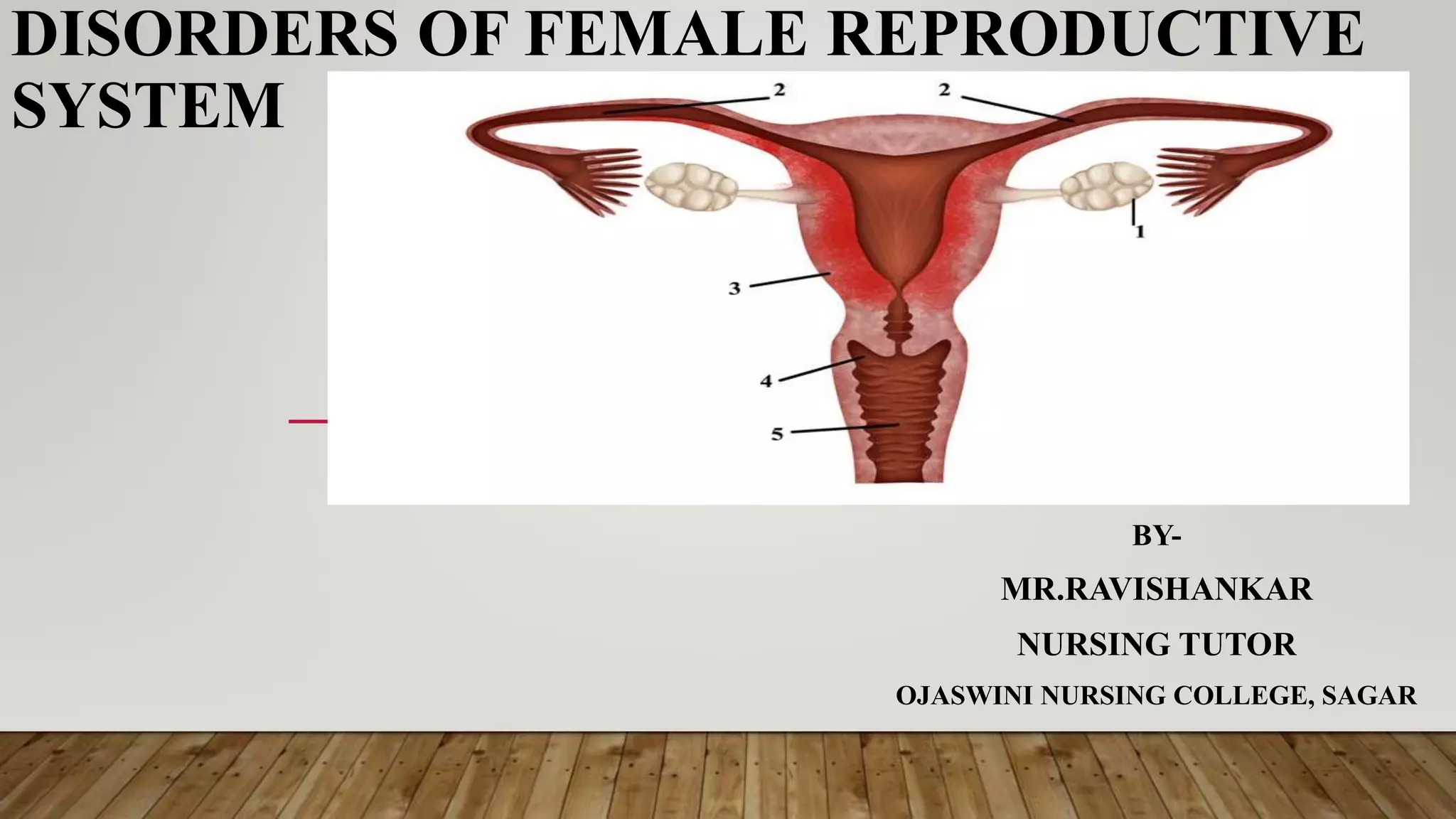
DISORDERS OF FEMALE REPRODUCTIVE
SYSTEM
BY-
MR.RAVISHANKAR
NURSING TUTOR
OJASWINI NURSING COLLEGE, SAGAR
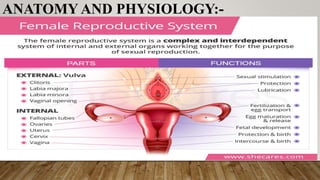
ANATOMY AND PHYSIOLOGY:-
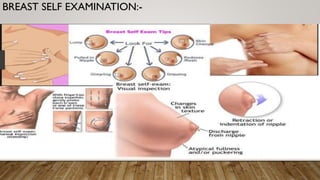
BREAST SELF EXAMINATION:-
STEPS OF BSE:-
Stand before the mirror and inspect both breast for anything
unusual dimpling or scaling of the skin.
Watch closely in the mirror, clasp your hand behind the head and
press hand forward. Note any change in the contour of the breast.
Press your hand on your hip and bow slightly towards mirror, pull
the shoulders and elbow forward.
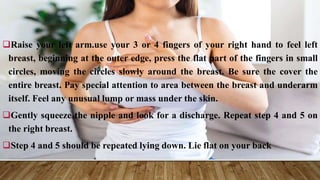
Raise your left arm.use your 3 or 4 fingers of your right hand to feel left
breast, beginning at the outer edge, press the flat part of the fingers in small
circles, moving the circles slowly around the breast. Be sure the cover the
entire breast. Pay special attention to area between the breast and underarm
itself. Feel any unusual lump or mass under the skin.
Gently squeeze the nipple and look for a discharge. Repeat step 4 and 5 on
the right breast.
Step 4 and 5 should be repeated lying down. Lie flat on your back
DYSMENORRHEA
INTRODUCTION:-
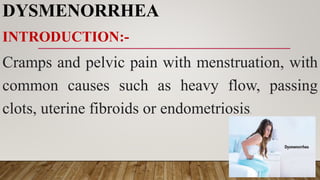
Cramps and pelvic pain with menstruation, with
common causes such as heavy flow, passing
clots, uterine fibroids or endometriosis.
DEFINITION:-
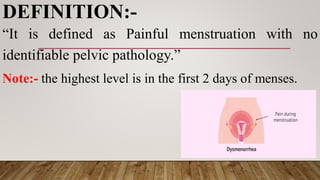
“It is defined as Painful menstruation with no
identifiable pelvic pathology.”
Note:- the highest level is in the first 2 days of menses.
TYPES:-
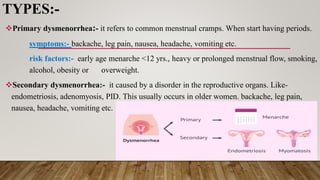
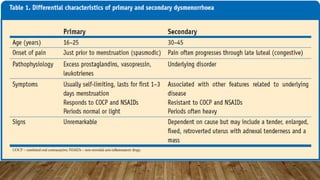
Primary dysmenorrhea:- it refers to common menstrual cramps. When start having periods.
symptoms:- backache, leg pain, nausea, headache, vomiting etc.
risk factors:- early age menarche <12 yrs., heavy or prolonged menstrual flow, smoking,
alcohol, obesity or overweight.
Secondary dysmenorrhea:- it caused by a disorder in the reproductive organs. Like-
endometriosis, adenomyosis, PID. This usually occurs in older women. backache, leg pain,
nausea, headache, vomiting etc.
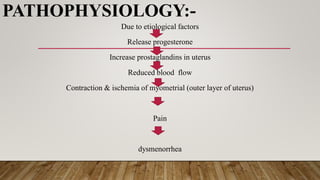
PATHOPHYSIOLOGY:-
Due to etiological factors
Release progesterone
Increase prostaglandins in uterus
Reduced blood flow
Contraction & ischemia of myometrial (outer layer of uterus)
Pain
dysmenorrhea
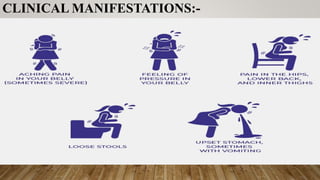
CLINICAL MANIFESTATIONS:-
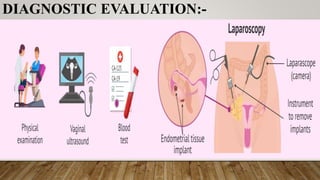
DIAGNOSTIC EVALUATION:-
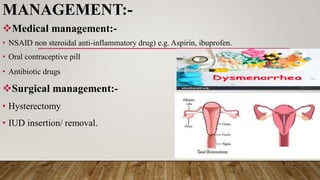
MANAGEMENT:-
Medical management:-
• NSAID non steroidal anti-inflammatory drug) e.g. Aspirin, ibuprofen.
• Oral contraceptive pill
• Antibiotic drugs
Surgical management:-
• Hysterectomy
• IUD insertion/ removal.
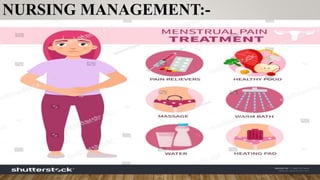
NURSING MANAGEMENT:-
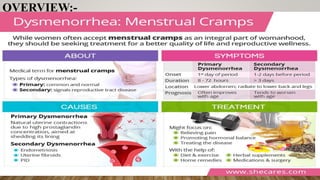
OVERVIEW:-
Dysmenorrhea.pdf

Dysmenorrhea.pdf

  • 1.
    DISORDERS OF FEMALEREPRODUCTIVE SYSTEM BY- MR.RAVISHANKAR NURSING TUTOR OJASWINI NURSING COLLEGE, SAGAR
  • 2.
  • 4.
  • 5.
    STEPS OF BSE:- Standbefore the mirror and inspect both breast for anything unusual dimpling or scaling of the skin. Watch closely in the mirror, clasp your hand behind the head and press hand forward. Note any change in the contour of the breast. Press your hand on your hip and bow slightly towards mirror, pull the shoulders and elbow forward.
  • 6.
    Raise your leftarm.use your 3 or 4 fingers of your right hand to feel left breast, beginning at the outer edge, press the flat part of the fingers in small circles, moving the circles slowly around the breast. Be sure the cover the entire breast. Pay special attention to area between the breast and underarm itself. Feel any unusual lump or mass under the skin. Gently squeeze the nipple and look for a discharge. Repeat step 4 and 5 on the right breast. Step 4 and 5 should be repeated lying down. Lie flat on your back
  • 8.
    DYSMENORRHEA INTRODUCTION:- Cramps and pelvicpain with menstruation, with common causes such as heavy flow, passing clots, uterine fibroids or endometriosis.
  • 9.
    DEFINITION:- “It is definedas Painful menstruation with no identifiable pelvic pathology.” Note:- the highest level is in the first 2 days of menses.
  • 10.
    TYPES:- Primary dysmenorrhea:- itrefers to common menstrual cramps. When start having periods. symptoms:- backache, leg pain, nausea, headache, vomiting etc. risk factors:- early age menarche <12 yrs., heavy or prolonged menstrual flow, smoking, alcohol, obesity or overweight. Secondary dysmenorrhea:- it caused by a disorder in the reproductive organs. Like- endometriosis, adenomyosis, PID. This usually occurs in older women. backache, leg pain, nausea, headache, vomiting etc.
  • 12.
    PATHOPHYSIOLOGY:- Due to etiologicalfactors Release progesterone Increase prostaglandins in uterus Reduced blood flow Contraction & ischemia of myometrial (outer layer of uterus) Pain dysmenorrhea
  • 13.
  • 14.
  • 15.
    MANAGEMENT:- Medical management:- • NSAIDnon steroidal anti-inflammatory drug) e.g. Aspirin, ibuprofen. • Oral contraceptive pill • Antibiotic drugs Surgical management:- • Hysterectomy • IUD insertion/ removal.
  • 16.
  • 17.