DLS
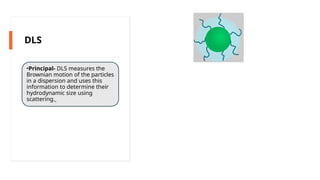
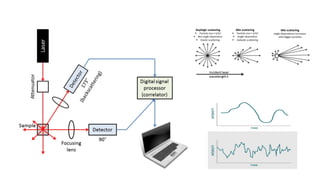
•Principal- DLS measuresthe
Brownian motion of the particles
in a dispersion and uses this
information to determine their
hydrodynamic size using
scattering.
4.
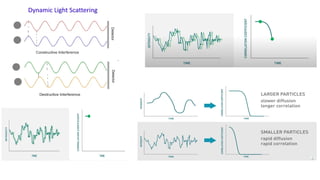
Autocorrelatio
n
• Measures howsimilar the
signal is to itself after a time
delay.
Where,
•I(t): Intensity of scattered light at time t.
•I(t+ τ) Intensity at later time, after delay
τ.
•⟨⋅⟩ Averaging over time.
•G(2)
(τ ): Autocorrelation function
Equation
G(2)
(τ)=⟨I(t) I(t+
⋅ τ)⟩/⟨I(t)⟩2
Decay of correlation
G(2)
(τ)=A[1+βe 2Γτ
−
]
Where,
•A: Baseline of the signal.
•β: Coherence factor (instrument-specific).
•Γ: Decay rate (related to diffusion).
•τ: Time delay.
Link to particle
Motion
Γ=Dq2
Where,
• D: Translational diffusion coefficient (how fast the particles
move).
• q: Scattering vector (depends on laser wavelength and
scattering angle).
q={4πn
sin(θ/2
)}/λ
• n: Refractive index of medium.
• λ: Laser wavelength.
• θ: Scattering angle.
5.
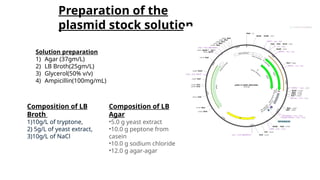
Preparation of the
plasmidstock solution.
Solution preparation
1) Agar (37gm/L)
2) LB Broth(25gm/L)
3) Glycerol(50% v/v)
4) Ampicillin(100mg/mL)
Composition of LB
Broth
1)10g/L of tryptone,
2) 5g/L of yeast extract,
3)10g/L of NaCl
Composition of LB
Agar
•5.0 g yeast extract
•10.0 g peptone from
casein
•10.0 g sodium chloride
•12.0 g agar-agar
6.
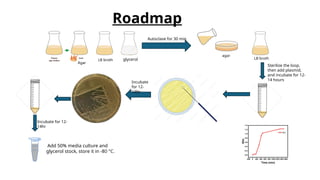
Roadmap
LB broth
Autoclave for30 min
agar
Sterilize the loop,
then add plasmid,
and incubate for 12-
14 hours
Incubate
for 12-
14hr
Incubate for 12-
14hr
glycerol LB broth
Agar
Add 50% media culture and
glycerol stock, store it in -80 °C.
![Autocorrelatio
n
• Measures how similar the
signal is to itself after a time
delay.
Where,
•I(t): Intensity of scattered light at time t.
•I(t+ τ) Intensity at later time, after delay
τ.
•⟨⋅⟩ Averaging over time.
•G(2)
(τ ): Autocorrelation function
Equation
G(2)
(τ)=⟨I(t) I(t+
⋅ τ)⟩/⟨I(t)⟩2
Decay of correlation
G(2)
(τ)=A[1+βe 2Γτ
−
]
Where,
•A: Baseline of the signal.
•β: Coherence factor (instrument-specific).
•Γ: Decay rate (related to diffusion).
•τ: Time delay.
Link to particle
Motion
Γ=Dq2
Where,
• D: Translational diffusion coefficient (how fast the particles
move).
• q: Scattering vector (depends on laser wavelength and
scattering angle).
q={4πn
sin(θ/2
)}/λ
• n: Refractive index of medium.
• λ: Laser wavelength.
• θ: Scattering angle.](https://image.slidesharecdn.com/dls123412311-250626123353-29340f05/85/DLS-instrumentaion-with-plasmid-stock-prepration-4-320.jpg)


![Polymer [ बहुलक ] Chemistry Notes PDF - Irfanullah Mehar - JJ Sir Chemistry.pdf](https://cdn.slidesharecdn.com/ss_thumbnails/polymerchemistrynotespdf-irfanullahmehar-jjsirchemistry-260210172118-3f9b37f7-thumbnail.jpg?width=640&height=640&fit=bounds)


