DURKHEIM – THE THEORY OF
SUICIDE
Dr.NC VAMSHI KRISHNA
FACULTY FOR SOCIOLOGY
BACKGROUND
• Durkheim saw the rise of Individualism
as a breaking down of the nature of
community, a negative repercussion of
capitalism and the industrial revolution.
• Durkheim celebrated the traditional,
small, close Knit communities that
provided people with strong moral
codes and solid social values.
• He believed humans were inseparable
from their social spheres and to remove
them from this sphere would lead to
self-destruction (Mueller, Abrutyn &
Osborne,2017).
• Durkheim became interested in changing
suicide rates in communities, societies and
countries.
• Durkheim began to look for explanations for
deviations in suicide rates and found that the
biggest shifts were seemingly due to the rise
of modernity.
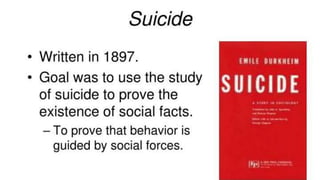
• Durkheim’s ‘Suicide’ was an practical
application of his dissertation ‘The Rules of
Sociological Method’, which he published with
the intention of making Sociology a definable,
empirical science
MULTIVARIATE ANALYSIS
• The text of Suicide offered an
examination of how suicide rates at the
time differed across religions.
• Specifically, Durkheim analyzed
differences between Protestants and
Catholics. He found a lower rate of
suicide among Catholics and theorized
that this was due to stronger forms of
social control and cohesion among them
than among Protestants.
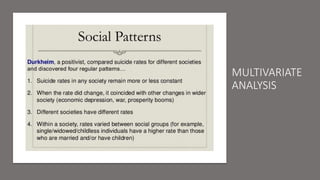
• Durkheim found that suicide was less common among women than men
• more common among single people than among those who are
romantically partnered
• less common among those who have children.
• Further, he found that soldiers commit suicide more often than civilians
and that curiously, rates of suicide are higher during peacetime than they
are during wars.
MULTIVARIATE
ANALYSIS
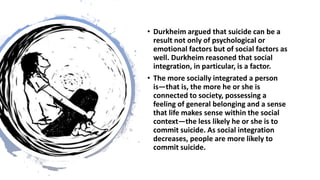
• Durkheim argued that suicide can be a
result not only of psychological or
emotional factors but of social factors as
well. Durkheim reasoned that social
integration, in particular, is a factor.
• The more socially integrated a person
is—that is, the more he or she is
connected to society, possessing a
feeling of general belonging and a sense
that life makes sense within the social
context—the less likely he or she is to
commit suicide. As social integration
decreases, people are more likely to
commit suicide.
TYPOLOGY
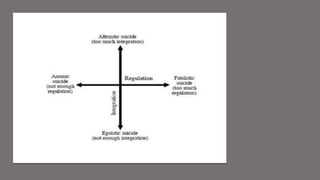
• Durkheim emphasized the importance of
finding the ‘Golden Mean’ between
Integration (connections to others within a
community) and Regulation (control of
society).
• Too much or too little of each resulted in
different types of suicide
ALTRUISTIC
SUICIDE
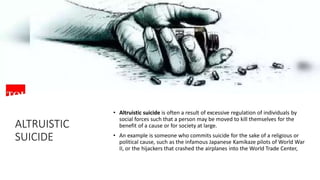
• Altruistic suicide is often a result of excessive regulation of individuals by
social forces such that a person may be moved to kill themselves for the
benefit of a cause or for society at large.
• An example is someone who commits suicide for the sake of a religious or
political cause, such as the infamous Japanese Kamikaze pilots of World War
II, or the hijackers that crashed the airplanes into the World Trade Center,
EGOISTIC SUICIDE
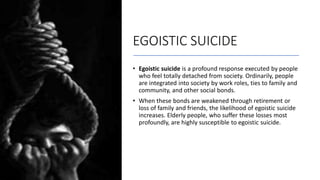
• Egoistic suicide is a profound response executed by people
who feel totally detached from society. Ordinarily, people
are integrated into society by work roles, ties to family and
community, and other social bonds.
• When these bonds are weakened through retirement or
loss of family and friends, the likelihood of egoistic suicide
increases. Elderly people, who suffer these losses most
profoundly, are highly susceptible to egoistic suicide.
FATALISITC
SUICIDE
• Fatalistic suicide occurs under conditions
of extreme social regulation resulting in
oppressive conditions and a denial of the
self and of agency.
• In such a situation a person may elect to
die rather than continue enduring the
oppressive conditions, such as the case of
suicide among prisoners.
ANOMIC SUICIDES
• According to Durkheim, the fourth type of suicide is Anomic. The
types of suicides are concerned with social disorganization and
imbalance.
• At the time when society is in a crisis, the social relations are
disturbed and even disrupted; and at such periods and under the
fluid and critical social conditions the personal and social ethics
both become causalities.
• The values crumble and life becomes devoid of its guiding light. At
such times the outlook of some persons suddenly undergoes
critical change and results in dangerous developments.
• In critical periods there are sudden changes and in the economic
fortunes of people; multi-millionaires may become pauper
overnight. Due loss of financial fortunes many persons commit
suicide.
CRITICISM
• Durkheim has been accused of
committing an ecological fallacy,since
Durkheim's conclusions are apparently
about individual behaviour (e.g.
suicide), although they are derived
from aggregate statistics (the suicide
rate among Protestants and Catholics).
• This type of inference, which explains
particular events (the "micro") in terms
of statistical data (the "macro"), is
often misleading.
• The functionalist sociologist Halbwachs (1930) criticized that Durkheim
has overestimated the role of religion in his study of suicide by exploring
the factors behind the Protestants and Catholics.
• He suggested that urban and rural differences are also a key factor that
contributed to suicide where he found that suicide rates were lower in rural
area compared to urban settings.
• Gibbs and Martin (1964) argued that Durkheim’s concept of social integration is
too vague and unclear and he did not properly define the concept of
integration.
• J. Douglas (1967) suggested that Durkheim did not give
enough consideration to how the official statistics on
suicide were collected.
• The investigation on one person’s death was influenced by
the person’s family members or the officials.
• Douglas pointed out that the role of the family of the dead
person and the investigation of the officials on the
particular death are crucial to define a person’s death
whether it was suicide or not.
• The unreliability of official statistics on suicide gives an
inadequate and misleading concept on the explanation of
suicide
• J. Maxwell Atkinson (1971) criticised on the Durkheim’s use of official statistics.
Atkinson questioned how a death is considered as a suicide. He suggested that the
suicide is an interpretation of a situation that is interpreted by the investigator of
the death.
• Atkinson claimed that Durkheim had stricken to the statistics which had the
reflection of coroner’s decisions and failed to understand that suicide is constructed
by coroners.
• S. Taylor (1982) showed that coroners who investigated the death of a person
construct a suicidal biography, negotiate and make judgement on the number of
deaths as what they want to be.
• After the investigation of officials or agency, the decision of a death whether
suicide or homicide has recorded on a death certificate and handed over to the
government statistical office for maintaining records
DGFFJGJ.pdf

DGFFJGJ.pdf

  • 1.
    DURKHEIM – THETHEORY OF SUICIDE Dr.NC VAMSHI KRISHNA FACULTY FOR SOCIOLOGY
  • 3.
    BACKGROUND • Durkheim sawthe rise of Individualism as a breaking down of the nature of community, a negative repercussion of capitalism and the industrial revolution. • Durkheim celebrated the traditional, small, close Knit communities that provided people with strong moral codes and solid social values. • He believed humans were inseparable from their social spheres and to remove them from this sphere would lead to self-destruction (Mueller, Abrutyn & Osborne,2017).
  • 4.
    • Durkheim becameinterested in changing suicide rates in communities, societies and countries. • Durkheim began to look for explanations for deviations in suicide rates and found that the biggest shifts were seemingly due to the rise of modernity. • Durkheim’s ‘Suicide’ was an practical application of his dissertation ‘The Rules of Sociological Method’, which he published with the intention of making Sociology a definable, empirical science
  • 5.
    MULTIVARIATE ANALYSIS • Thetext of Suicide offered an examination of how suicide rates at the time differed across religions. • Specifically, Durkheim analyzed differences between Protestants and Catholics. He found a lower rate of suicide among Catholics and theorized that this was due to stronger forms of social control and cohesion among them than among Protestants.
  • 6.
    • Durkheim foundthat suicide was less common among women than men • more common among single people than among those who are romantically partnered • less common among those who have children. • Further, he found that soldiers commit suicide more often than civilians and that curiously, rates of suicide are higher during peacetime than they are during wars.
  • 7.
  • 8.
    • Durkheim arguedthat suicide can be a result not only of psychological or emotional factors but of social factors as well. Durkheim reasoned that social integration, in particular, is a factor. • The more socially integrated a person is—that is, the more he or she is connected to society, possessing a feeling of general belonging and a sense that life makes sense within the social context—the less likely he or she is to commit suicide. As social integration decreases, people are more likely to commit suicide.
  • 10.
    TYPOLOGY • Durkheim emphasizedthe importance of finding the ‘Golden Mean’ between Integration (connections to others within a community) and Regulation (control of society). • Too much or too little of each resulted in different types of suicide
  • 11.
    ALTRUISTIC SUICIDE • Altruistic suicideis often a result of excessive regulation of individuals by social forces such that a person may be moved to kill themselves for the benefit of a cause or for society at large. • An example is someone who commits suicide for the sake of a religious or political cause, such as the infamous Japanese Kamikaze pilots of World War II, or the hijackers that crashed the airplanes into the World Trade Center,
  • 12.
    EGOISTIC SUICIDE • Egoisticsuicide is a profound response executed by people who feel totally detached from society. Ordinarily, people are integrated into society by work roles, ties to family and community, and other social bonds. • When these bonds are weakened through retirement or loss of family and friends, the likelihood of egoistic suicide increases. Elderly people, who suffer these losses most profoundly, are highly susceptible to egoistic suicide.
  • 13.
    FATALISITC SUICIDE • Fatalistic suicideoccurs under conditions of extreme social regulation resulting in oppressive conditions and a denial of the self and of agency. • In such a situation a person may elect to die rather than continue enduring the oppressive conditions, such as the case of suicide among prisoners.
  • 14.
    ANOMIC SUICIDES • Accordingto Durkheim, the fourth type of suicide is Anomic. The types of suicides are concerned with social disorganization and imbalance. • At the time when society is in a crisis, the social relations are disturbed and even disrupted; and at such periods and under the fluid and critical social conditions the personal and social ethics both become causalities. • The values crumble and life becomes devoid of its guiding light. At such times the outlook of some persons suddenly undergoes critical change and results in dangerous developments. • In critical periods there are sudden changes and in the economic fortunes of people; multi-millionaires may become pauper overnight. Due loss of financial fortunes many persons commit suicide.
  • 16.
    CRITICISM • Durkheim hasbeen accused of committing an ecological fallacy,since Durkheim's conclusions are apparently about individual behaviour (e.g. suicide), although they are derived from aggregate statistics (the suicide rate among Protestants and Catholics). • This type of inference, which explains particular events (the "micro") in terms of statistical data (the "macro"), is often misleading.
  • 17.
    • The functionalistsociologist Halbwachs (1930) criticized that Durkheim has overestimated the role of religion in his study of suicide by exploring the factors behind the Protestants and Catholics. • He suggested that urban and rural differences are also a key factor that contributed to suicide where he found that suicide rates were lower in rural area compared to urban settings. • Gibbs and Martin (1964) argued that Durkheim’s concept of social integration is too vague and unclear and he did not properly define the concept of integration.
  • 18.
    • J. Douglas(1967) suggested that Durkheim did not give enough consideration to how the official statistics on suicide were collected. • The investigation on one person’s death was influenced by the person’s family members or the officials. • Douglas pointed out that the role of the family of the dead person and the investigation of the officials on the particular death are crucial to define a person’s death whether it was suicide or not. • The unreliability of official statistics on suicide gives an inadequate and misleading concept on the explanation of suicide
  • 19.
    • J. MaxwellAtkinson (1971) criticised on the Durkheim’s use of official statistics. Atkinson questioned how a death is considered as a suicide. He suggested that the suicide is an interpretation of a situation that is interpreted by the investigator of the death. • Atkinson claimed that Durkheim had stricken to the statistics which had the reflection of coroner’s decisions and failed to understand that suicide is constructed by coroners. • S. Taylor (1982) showed that coroners who investigated the death of a person construct a suicidal biography, negotiate and make judgement on the number of deaths as what they want to be. • After the investigation of officials or agency, the decision of a death whether suicide or homicide has recorded on a death certificate and handed over to the government statistical office for maintaining records