
DUNKIN’ DONUTS
Indian Institute of Plantation Management
Company History
• In 1948, William Rosenberg opened Open Kettle, a restaurant selling donuts and
coffee in Quincy, Massachusetts
• In 1950, the restaurant was given the name Dunkin' Donuts
• In 1990, Allied Lyons( a spirits, wine, and quick service restaurant business), which
already owned Baskin-Robbins, purchased Dunkin' Donuts, and the two restaurants
merged operations.
• In December 2005 Pernod Ricard (Owner of Allied Lyons) sold of Dunkin' Donuts
and Baskin-Robbins as Dunkin' Brands to a consortium of three private-equity
firms: Bain Capital Partners, the Carlyle Group and Thomas H. Lee Partners.
• In August 2012, Dunkin' Brands became completely independent of the private
equity firms.
Indian Institute of Plantation Management
Company Background
• Dunkin' Donuts is an American global donut company and
coffeehouse based in Canton, Massachusetts, in Greater Boston.
• It was founded in 1950 by William Rosenberg in Quincy,
Massachusetts
• It is one of the largest coffee and baked goods chains in the world,
with more than 12,000 restaurants in 36 countries
• The chain's products include donuts, bagels, other baked goods, and a
wide variety of hot and iced beverages
Indian Institute of Plantation Management
Q1) Should Dunkin’ Donuts’ pursue a
single-segment or multiple-segment
strategy?
• Dunkin’ Donuts’ should pursue a multiple segment strategy i.e. coffee and donuts
business because both coffee and donuts runs each half of the unkin donuts
business.
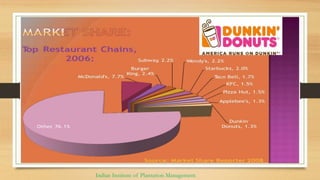
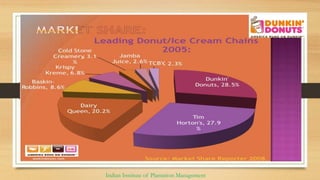
• One of the main competitors is Starbucks and Tim Hortons because they also focus
on coffee consumers. While Starbucks is known for its coffee, Tim Horton as
Canadian fast food casual restaurant also known for the coffee and donuts.
• John luther reimplemented certain qualities to out run their competitors by typing to
make Dunkin Donuts change to super fast service mistake proof while also focusing
on wellness mobility and profitability by changing the menu
Indian Institute of Plantation Management
Q2) Given Dunkin’ Donuts’ positioning,
what types of firms should be considered
competitors?
• Mostly the fast food chains and coffee selling firms are seen as a threat to their business
because also half of the dunkin donuts business is run by selling coffee.its importance can be
weighed by the statement of Jon luther when he set aside Krispy Kreme business by
explaining “ its not really in the coffee business”.
• Tim Horton, Starbucks, McDonalds and other convenience stores are viewed as their fierce
competitors. To out run them Jon Luther made some changes to dunking donuts.
• Main focus changes from giving meal to snacks. Changed to super fast , mistake proof,
installed espresso machines at various locations so people don’t have to wait in lines or pay
more as they do at Starbucks especially focusing on custumers that are developing newly taste
for coffee.
• They also centralized their kitchens that serves number of shops which benefited inconstant
quality, standardize freshness and less waste. And also combined few of their outletswith
Baskin-Robbins and Togo Sandwiches to increase sales
Indian Institute of Plantation Management
“YOU LEARN SOMETHING EVERYDAY
IF YOU PAY ATTENTION”
-By ReLeBlond
THANK YOU
Indian Institute of Plantation Management

A case study of Dunkin Donuts

  • 1.
    DUNKIN’ DONUTS Indian Instituteof Plantation Management
  • 2.
    Company History • In1948, William Rosenberg opened Open Kettle, a restaurant selling donuts and coffee in Quincy, Massachusetts • In 1950, the restaurant was given the name Dunkin' Donuts • In 1990, Allied Lyons( a spirits, wine, and quick service restaurant business), which already owned Baskin-Robbins, purchased Dunkin' Donuts, and the two restaurants merged operations. • In December 2005 Pernod Ricard (Owner of Allied Lyons) sold of Dunkin' Donuts and Baskin-Robbins as Dunkin' Brands to a consortium of three private-equity firms: Bain Capital Partners, the Carlyle Group and Thomas H. Lee Partners. • In August 2012, Dunkin' Brands became completely independent of the private equity firms. Indian Institute of Plantation Management
  • 3.
    Company Background • Dunkin'Donuts is an American global donut company and coffeehouse based in Canton, Massachusetts, in Greater Boston. • It was founded in 1950 by William Rosenberg in Quincy, Massachusetts • It is one of the largest coffee and baked goods chains in the world, with more than 12,000 restaurants in 36 countries • The chain's products include donuts, bagels, other baked goods, and a wide variety of hot and iced beverages Indian Institute of Plantation Management
  • 4.
    Indian Institute ofPlantation Management
  • 5.
    Indian Institute ofPlantation Management
  • 6.
    Indian Institute ofPlantation Management
  • 7.
    Indian Institute ofPlantation Management
  • 8.
    Q1) Should Dunkin’Donuts’ pursue a single-segment or multiple-segment strategy? • Dunkin’ Donuts’ should pursue a multiple segment strategy i.e. coffee and donuts business because both coffee and donuts runs each half of the unkin donuts business. • One of the main competitors is Starbucks and Tim Hortons because they also focus on coffee consumers. While Starbucks is known for its coffee, Tim Horton as Canadian fast food casual restaurant also known for the coffee and donuts. • John luther reimplemented certain qualities to out run their competitors by typing to make Dunkin Donuts change to super fast service mistake proof while also focusing on wellness mobility and profitability by changing the menu Indian Institute of Plantation Management
  • 9.
    Q2) Given Dunkin’Donuts’ positioning, what types of firms should be considered competitors? • Mostly the fast food chains and coffee selling firms are seen as a threat to their business because also half of the dunkin donuts business is run by selling coffee.its importance can be weighed by the statement of Jon luther when he set aside Krispy Kreme business by explaining “ its not really in the coffee business”. • Tim Horton, Starbucks, McDonalds and other convenience stores are viewed as their fierce competitors. To out run them Jon Luther made some changes to dunking donuts. • Main focus changes from giving meal to snacks. Changed to super fast , mistake proof, installed espresso machines at various locations so people don’t have to wait in lines or pay more as they do at Starbucks especially focusing on custumers that are developing newly taste for coffee. • They also centralized their kitchens that serves number of shops which benefited inconstant quality, standardize freshness and less waste. And also combined few of their outletswith Baskin-Robbins and Togo Sandwiches to increase sales Indian Institute of Plantation Management
  • 10.
    “YOU LEARN SOMETHINGEVERYDAY IF YOU PAY ATTENTION” -By ReLeBlond THANK YOU Indian Institute of Plantation Management