‘Dulce Et Decorum Est’
Analysis.
• This was written from Owen’s period at the war hospital in
Craiglockhart, Edinburgh. The poem is well known due to it’s
angry and bitter violence. Owen was anxious to describe the
way in a truthful way, as it really was, as he saw no point in
lying to the civilians at home. In a letter to his mother dated 16th
January 1917, he stated, ‘I can see no excuse for deceiving you
about these last three days. I have suffered seventh hell.’
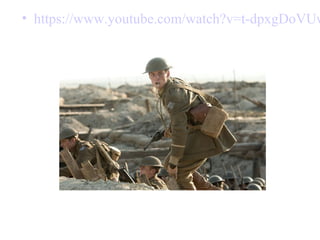
• https://www.youtube.com/watch?v=t-dpxgDoVUw
‘It is sweet and right to die for your
country’
Think about this statement and these questions:
• Is there honour in what they are doing?
• Why are they there in the first place?
• Are they heroes?
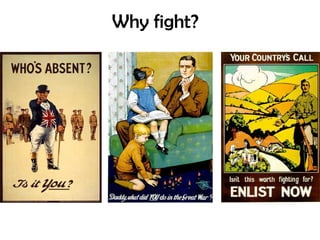
Why fight?
So, have attitudes towards war
changed? Are they more realistic?
Stanza One
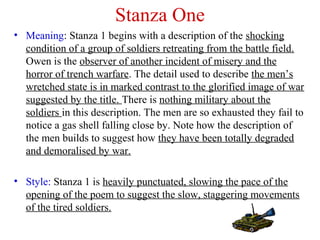
• Meaning: Stanza 1 begins with a description of the shocking
condition of a group of soldiers retreating from the battle field.
Owen is the observer of another incident of misery and the
horror of trench warfare. The detail used to describe the men’s
wretched state is in marked contrast to the glorified image of war
suggested by the title. There is nothing military about the
soldiers in this description. The men are so exhausted they fail to
notice a gas shell falling close by. Note how the description of
the men builds to suggest how they have been totally degraded
and demoralised by war.
• Style: Stanza 1 is heavily punctuated, slowing the pace of the
opening of the poem to suggest the slow, staggering movements
of the tired soldiers.
Stanza 1 Analysis
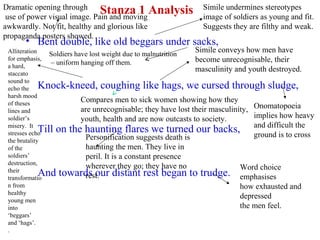
• Bent double, like old beggars under sacks,
Knock-kneed, coughing like hags, we cursed through sludge,
Till on the haunting flares we turned our backs,
And towards our distant rest began to trudge.
Dramatic opening through
use of power visual image. Pain and moving
awkwardly. Not fit, healthy and glorious like
propaganda posters showed.
Simile undermines stereotypes
image of soldiers as young and fit.
Suggests they are filthy and weak.
Alliteration
for emphasis,
a hard,
staccato
sound to
echo the
harsh mood
of theses
lines and
soldier’s
misery. It
stresses echo
the brutality
of the
soldiers’
destruction,
their
transformatio
n from
healthy
young men
into
‘beggars’
and ‘hags’.
.
Simile conveys how men have
become unrecognisable, their
masculinity and youth destroyed.
Onomatopoeia
implies how heavy
and difficult the
ground is to crossPersonification suggests death is
haunting the men. They live in
peril. It is a constant presence
wherever they go; they have no
rest.
Word choice
emphasises
how exhausted and
depressed
the men feel.
Compares men to sick women showing how they
are unrecognisable; they have lost their masculinity,
youth, health and are now outcasts to society.
Soldiers have lost weight due to malnutrition
– uniform hanging off them.
Stanza One Analysis Continued:
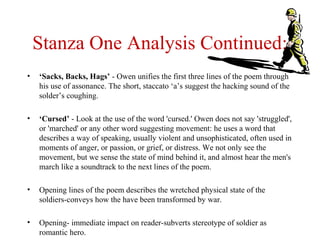
• ‘Sacks, Backs, Hags’ - Owen unifies the first three lines of the poem through
his use of assonance. The short, staccato ‘a’s suggest the hacking sound of the
solder’s coughing.
• ‘Cursed’ - Look at the use of the word 'cursed.' Owen does not say 'struggled',
or 'marched' or any other word suggesting movement: he uses a word that
describes a way of speaking, usually violent and unsophisticated, often used in
moments of anger, or passion, or grief, or distress. We not only see the
movement, but we sense the state of mind behind it, and almost hear the men's
march like a soundtrack to the next lines of the poem.
• Opening lines of the poem describes the wretched physical state of the
soldiers-conveys how the have been transformed by war.
• Opening- immediate impact on reader-subverts stereotype of soldier as
romantic hero.
Stanza One Analysis Continued:
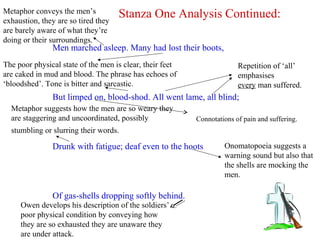
Men marched asleep. Many had lost their boots,
But limped on, blood-shod. All went lame, all blind;
Drunk with fatigue; deaf even to the hoots
Of gas-shells dropping softly behind.
Metaphor conveys the men’s
exhaustion, they are so tired they
are barely aware of what they’re
doing or their surroundings.
The poor physical state of the men is clear, their feet
are caked in mud and blood. The phrase has echoes of
‘bloodshed’. Tone is bitter and sarcastic.
Repetition of ‘all’
emphasises
every man suffered.
Metaphor suggests how the men are so weary they
are staggering and uncoordinated, possibly
stumbling or slurring their words.
Onomatopoeia suggests a
warning sound but also that
the shells are mocking the
men.
Owen develops his description of the soldiers’
poor physical condition by conveying how
they are so exhausted they are unaware they
are under attack.
Connotations of pain and suffering.
Stanza One Analysis Continued:
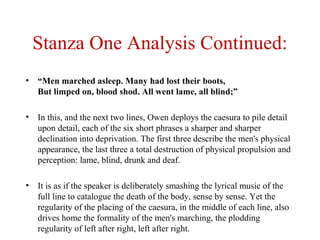
• “Men marched asleep. Many had lost their boots,
But limped on, blood shod. All went lame, all blind;”
• In this, and the next two lines, Owen deploys the caesura to pile detail
upon detail, each of the six short phrases a sharper and sharper
declination into deprivation. The first three describe the men's physical
appearance, the last three a total destruction of physical propulsion and
perception: lame, blind, drunk and deaf.
• It is as if the speaker is deliberately smashing the lyrical music of the
full line to catalogue the death of the body, sense by sense. Yet the
regularity of the placing of the caesura, in the middle of each line, also
drives home the formality of the men's marching, the plodding
regularity of left after right, left after right.
Stanza Two Analysis
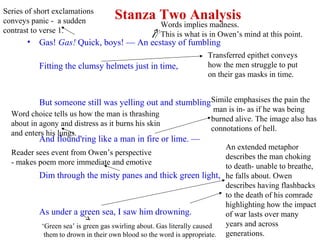
• Gas! Gas! Quick, boys! — An ecstasy of fumbling
Fitting the clumsy helmets just in time,
But someone still was yelling out and stumbling
And flound'ring like a man in fire or lime. —
Dim through the misty panes and thick green light,
As under a green sea, I saw him drowning.
Series of short exclamations
conveys panic - a sudden
contrast to verse 1.
Transferred epithet conveys
how the men struggle to put
on their gas masks in time.
Word choice tells us how the man is thrashing
about in agony and distress as it burns his skin
and enters his lungs.
Simile emphasises the pain the
man is in- as if he was being
burned alive. The image also has
connotations of hell.
Reader sees event from Owen’s perspective
- makes poem more immediate and emotive
An extended metaphor
describes the man choking
to death- unable to breathe,
he falls about. Owen
describes having flashbacks
to the death of his comrade
highlighting how the impact
of war lasts over many
years and across
generations.
Words implies madness.
This is what is in Owen’s mind at this point.
‘Green sea’ is green gas swirling about. Gas literally caused
them to drown in their own blood so the word is appropriate.
Stanza Two Analysis.
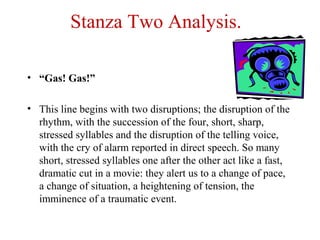
• “Gas! Gas!”
• This line begins with two disruptions; the disruption of the
rhythm, with the succession of the four, short, sharp,
stressed syllables and the disruption of the telling voice,
with the cry of alarm reported in direct speech. So many
short, stressed syllables one after the other act like a fast,
dramatic cut in a movie: they alert us to a change of pace,
a change of situation, a heightening of tension, the
imminence of a traumatic event.
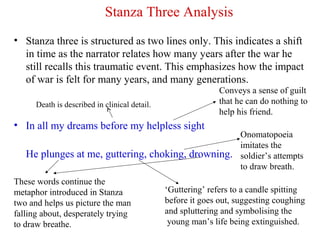
Stanza Three Analysis
• Stanza three is structured as two lines only. This indicates a shift
in time as the narrator relates how many years after the war he
still recalls this traumatic event. This emphasizes how the impact
of war is felt for many years, and many generations.
• In all my dreams before my helpless sight
He plunges at me, guttering, choking, drowning.
Conveys a sense of guilt
that he can do nothing to
help his friend.
These words continue the
metaphor introduced in Stanza
two and helps us picture the man
falling about, desperately trying
to draw breathe.
‘Guttering’ refers to a candle spitting
before it goes out, suggesting coughing
and spluttering and symbolising the
young man’s life being extinguished.
Onomatopoeia
imitates the
soldier’s attempts
to draw breath.
Death is described in clinical detail.
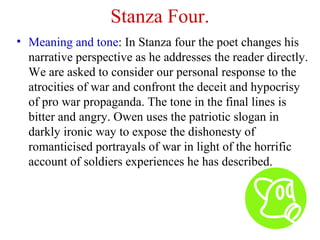
Stanza Four.
• Meaning and tone: In Stanza four the poet changes his
narrative perspective as he addresses the reader directly.
We are asked to consider our personal response to the
atrocities of war and confront the deceit and hypocrisy
of pro war propaganda. The tone in the final lines is
bitter and angry. Owen uses the patriotic slogan in
darkly ironic way to expose the dishonesty of
romanticised portrayals of war in light of the horrific
account of soldiers experiences he has described.
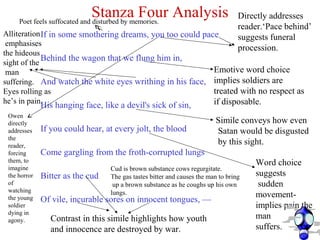
Stanza Four Analysis
If in some smothering dreams, you too could pace
Behind the wagon that we flung him in,
And watch the white eyes writhing in his face,
His hanging face, like a devil's sick of sin,
If you could hear, at every jolt, the blood
Come gargling from the froth-corrupted lungs
Bitter as the cud
Of vile, incurable sores on innocent tongues, —
Directly addresses
reader.‘Pace behind’
suggests funeral
procession.
Emotive word choice
implies soldiers are
treated with no respect as
if disposable.
Alliteration
emphasises
the hideous
sight of the
man
suffering.
Eyes rolling as
he’s in pain.
Simile conveys how even
Satan would be disgusted
by this sight.
Word choice
suggests
sudden
movement-
implies pain the
man
suffers.
Contrast in this simile highlights how youth
and innocence are destroyed by war.
Owen
directly
addresses
the
reader,
forcing
them, to
imagine
the horror
of
watching
the young
soldier
dying in
agony.
Cud is brown substance cows regurgitate.
The gas tastes bitter and causes the man to bring
up a brown substance as he coughs up his own
lungs.
Poet feels suffocated and disturbed by memories.
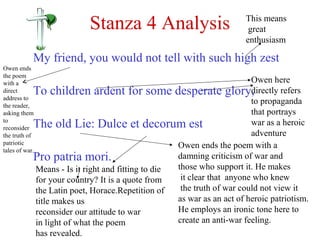
Stanza 4 Analysis
My friend, you would not tell with such high zest
To children ardent for some desperate glory,
The old Lie: Dulce et decorum est
Pro patria mori.
This means
great
enthusiasm
Owen here
directly refers
to propaganda
that portrays
war as a heroic
adventure
Owen ends the poem with a
damning criticism of war and
those who support it. He makes
it clear that anyone who knew
the truth of war could not view it
as war as an act of heroic patriotism.
He employs an ironic tone here to
create an anti-war feeling.
Means - Is it right and fitting to die
for your country? It is a quote from
the Latin poet, Horace.Repetition of
title makes us
reconsider our attitude to war
in light of what the poem
has revealed.
Owen ends
the poem
with a
direct
address to
the reader,
asking them
to
reconsider
the truth of
patriotic
tales of war.
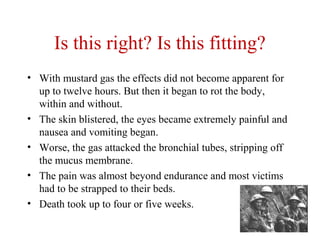
Is this right? Is this fitting?
• With mustard gas the effects did not become apparent for
up to twelve hours. But then it began to rot the body,
within and without.
• The skin blistered, the eyes became extremely painful and
nausea and vomiting began.
• Worse, the gas attacked the bronchial tubes, stripping off
the mucus membrane.
• The pain was almost beyond endurance and most victims
had to be strapped to their beds.
• Death took up to four or five weeks.
Is this right? Is this fitting?
• ‘I wish those people who write so glibly about this being
a holy war and the orators who talk so much about going
on no matter how long the war lasts and what it may
mean, could see a case -to say nothing of ten cases--of
mustard gas in its early stages -could see the poor things
burnt and blistered all over with great mustard-coloured
suppurating blisters, with blind eyes . . . all sticky and
stuck together, and always fighting for breath, with
voices a mere whisper, saying that their throats are
closing and they know they will choke.’
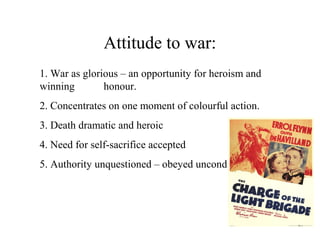
Attitude to war:
1. War as glorious – an opportunity for heroism and
winning honour.
2. Concentrates on one moment of colourful action.
3. Death dramatic and heroic
4. Need for self-sacrifice accepted
5. Authority unquestioned – obeyed unconditionally
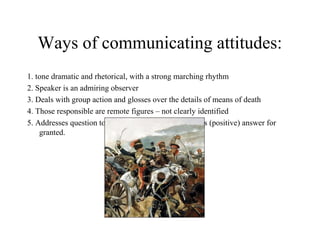
Ways of communicating attitudes:
1. tone dramatic and rhetorical, with a strong marching rhythm
2. Speaker is an admiring observer
3. Deals with group action and glosses over the details of means of death
4. Those responsible are remote figures – not clearly identified
5. Addresses question to reader in final stanza, but takes (positive) answer for
granted.
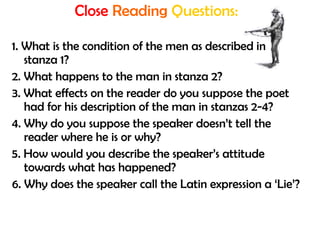
Close Reading Questions:
1. What is the condition of the men as described in
stanza 1?
2. What happens to the man in stanza 2?
3. What effects on the reader do you suppose the poet
had for his description of the man in stanzas 2-4?
4. Why do you suppose the speaker doesn’t tell the
reader where he is or why?
5. How would you describe the speaker’s attitude
towards what has happened?
6. Why does the speaker call the Latin expression a ‘Lie’?
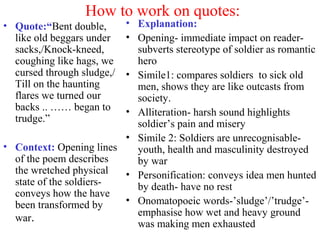
How to work on quotes:
• Quote:“Bent double,
like old beggars under
sacks,/Knock-kneed,
coughing like hags, we
cursed through sludge,/
Till on the haunting
flares we turned our
backs .. …… began to
trudge.”
• Context: Opening lines
of the poem describes
the wretched physical
state of the soldiers-
conveys how the have
been transformed by
war.
• Explanation:
• Opening- immediate impact on reader-
subverts stereotype of soldier as romantic
hero
• Simile1: compares soldiers to sick old
men, shows they are like outcasts from
society.
• Alliteration- harsh sound highlights
soldier’s pain and misery
• Simile 2: Soldiers are unrecognisable-
youth, health and masculinity destroyed
by war
• Personification: conveys idea men hunted
by death- have no rest
• Onomatopoeic words-’sludge’/’trudge’-
emphasise how wet and heavy ground
was making men exhausted

Dulce analysis

  • 1.
    ‘Dulce Et DecorumEst’ Analysis. • This was written from Owen’s period at the war hospital in Craiglockhart, Edinburgh. The poem is well known due to it’s angry and bitter violence. Owen was anxious to describe the way in a truthful way, as it really was, as he saw no point in lying to the civilians at home. In a letter to his mother dated 16th January 1917, he stated, ‘I can see no excuse for deceiving you about these last three days. I have suffered seventh hell.’
  • 2.
  • 3.
    ‘It is sweetand right to die for your country’ Think about this statement and these questions: • Is there honour in what they are doing? • Why are they there in the first place? • Are they heroes?
  • 4.
  • 5.
    So, have attitudestowards war changed? Are they more realistic?
  • 6.
    Stanza One • Meaning:Stanza 1 begins with a description of the shocking condition of a group of soldiers retreating from the battle field. Owen is the observer of another incident of misery and the horror of trench warfare. The detail used to describe the men’s wretched state is in marked contrast to the glorified image of war suggested by the title. There is nothing military about the soldiers in this description. The men are so exhausted they fail to notice a gas shell falling close by. Note how the description of the men builds to suggest how they have been totally degraded and demoralised by war. • Style: Stanza 1 is heavily punctuated, slowing the pace of the opening of the poem to suggest the slow, staggering movements of the tired soldiers.
  • 7.
    Stanza 1 Analysis •Bent double, like old beggars under sacks, Knock-kneed, coughing like hags, we cursed through sludge, Till on the haunting flares we turned our backs, And towards our distant rest began to trudge. Dramatic opening through use of power visual image. Pain and moving awkwardly. Not fit, healthy and glorious like propaganda posters showed. Simile undermines stereotypes image of soldiers as young and fit. Suggests they are filthy and weak. Alliteration for emphasis, a hard, staccato sound to echo the harsh mood of theses lines and soldier’s misery. It stresses echo the brutality of the soldiers’ destruction, their transformatio n from healthy young men into ‘beggars’ and ‘hags’. . Simile conveys how men have become unrecognisable, their masculinity and youth destroyed. Onomatopoeia implies how heavy and difficult the ground is to crossPersonification suggests death is haunting the men. They live in peril. It is a constant presence wherever they go; they have no rest. Word choice emphasises how exhausted and depressed the men feel. Compares men to sick women showing how they are unrecognisable; they have lost their masculinity, youth, health and are now outcasts to society. Soldiers have lost weight due to malnutrition – uniform hanging off them.
  • 8.
    Stanza One AnalysisContinued: • ‘Sacks, Backs, Hags’ - Owen unifies the first three lines of the poem through his use of assonance. The short, staccato ‘a’s suggest the hacking sound of the solder’s coughing. • ‘Cursed’ - Look at the use of the word 'cursed.' Owen does not say 'struggled', or 'marched' or any other word suggesting movement: he uses a word that describes a way of speaking, usually violent and unsophisticated, often used in moments of anger, or passion, or grief, or distress. We not only see the movement, but we sense the state of mind behind it, and almost hear the men's march like a soundtrack to the next lines of the poem. • Opening lines of the poem describes the wretched physical state of the soldiers-conveys how the have been transformed by war. • Opening- immediate impact on reader-subverts stereotype of soldier as romantic hero.
  • 9.
    Stanza One AnalysisContinued: Men marched asleep. Many had lost their boots, But limped on, blood-shod. All went lame, all blind; Drunk with fatigue; deaf even to the hoots Of gas-shells dropping softly behind. Metaphor conveys the men’s exhaustion, they are so tired they are barely aware of what they’re doing or their surroundings. The poor physical state of the men is clear, their feet are caked in mud and blood. The phrase has echoes of ‘bloodshed’. Tone is bitter and sarcastic. Repetition of ‘all’ emphasises every man suffered. Metaphor suggests how the men are so weary they are staggering and uncoordinated, possibly stumbling or slurring their words. Onomatopoeia suggests a warning sound but also that the shells are mocking the men. Owen develops his description of the soldiers’ poor physical condition by conveying how they are so exhausted they are unaware they are under attack. Connotations of pain and suffering.
  • 10.
    Stanza One AnalysisContinued: • “Men marched asleep. Many had lost their boots, But limped on, blood shod. All went lame, all blind;” • In this, and the next two lines, Owen deploys the caesura to pile detail upon detail, each of the six short phrases a sharper and sharper declination into deprivation. The first three describe the men's physical appearance, the last three a total destruction of physical propulsion and perception: lame, blind, drunk and deaf. • It is as if the speaker is deliberately smashing the lyrical music of the full line to catalogue the death of the body, sense by sense. Yet the regularity of the placing of the caesura, in the middle of each line, also drives home the formality of the men's marching, the plodding regularity of left after right, left after right.
  • 11.
    Stanza Two Analysis •Gas! Gas! Quick, boys! — An ecstasy of fumbling Fitting the clumsy helmets just in time, But someone still was yelling out and stumbling And flound'ring like a man in fire or lime. — Dim through the misty panes and thick green light, As under a green sea, I saw him drowning. Series of short exclamations conveys panic - a sudden contrast to verse 1. Transferred epithet conveys how the men struggle to put on their gas masks in time. Word choice tells us how the man is thrashing about in agony and distress as it burns his skin and enters his lungs. Simile emphasises the pain the man is in- as if he was being burned alive. The image also has connotations of hell. Reader sees event from Owen’s perspective - makes poem more immediate and emotive An extended metaphor describes the man choking to death- unable to breathe, he falls about. Owen describes having flashbacks to the death of his comrade highlighting how the impact of war lasts over many years and across generations. Words implies madness. This is what is in Owen’s mind at this point. ‘Green sea’ is green gas swirling about. Gas literally caused them to drown in their own blood so the word is appropriate.
  • 12.
    Stanza Two Analysis. •“Gas! Gas!” • This line begins with two disruptions; the disruption of the rhythm, with the succession of the four, short, sharp, stressed syllables and the disruption of the telling voice, with the cry of alarm reported in direct speech. So many short, stressed syllables one after the other act like a fast, dramatic cut in a movie: they alert us to a change of pace, a change of situation, a heightening of tension, the imminence of a traumatic event.
  • 13.
    Stanza Three Analysis •Stanza three is structured as two lines only. This indicates a shift in time as the narrator relates how many years after the war he still recalls this traumatic event. This emphasizes how the impact of war is felt for many years, and many generations. • In all my dreams before my helpless sight He plunges at me, guttering, choking, drowning. Conveys a sense of guilt that he can do nothing to help his friend. These words continue the metaphor introduced in Stanza two and helps us picture the man falling about, desperately trying to draw breathe. ‘Guttering’ refers to a candle spitting before it goes out, suggesting coughing and spluttering and symbolising the young man’s life being extinguished. Onomatopoeia imitates the soldier’s attempts to draw breath. Death is described in clinical detail.
  • 14.
    Stanza Four. • Meaningand tone: In Stanza four the poet changes his narrative perspective as he addresses the reader directly. We are asked to consider our personal response to the atrocities of war and confront the deceit and hypocrisy of pro war propaganda. The tone in the final lines is bitter and angry. Owen uses the patriotic slogan in darkly ironic way to expose the dishonesty of romanticised portrayals of war in light of the horrific account of soldiers experiences he has described.
  • 15.
    Stanza Four Analysis Ifin some smothering dreams, you too could pace Behind the wagon that we flung him in, And watch the white eyes writhing in his face, His hanging face, like a devil's sick of sin, If you could hear, at every jolt, the blood Come gargling from the froth-corrupted lungs Bitter as the cud Of vile, incurable sores on innocent tongues, — Directly addresses reader.‘Pace behind’ suggests funeral procession. Emotive word choice implies soldiers are treated with no respect as if disposable. Alliteration emphasises the hideous sight of the man suffering. Eyes rolling as he’s in pain. Simile conveys how even Satan would be disgusted by this sight. Word choice suggests sudden movement- implies pain the man suffers. Contrast in this simile highlights how youth and innocence are destroyed by war. Owen directly addresses the reader, forcing them, to imagine the horror of watching the young soldier dying in agony. Cud is brown substance cows regurgitate. The gas tastes bitter and causes the man to bring up a brown substance as he coughs up his own lungs. Poet feels suffocated and disturbed by memories.
  • 16.
    Stanza 4 Analysis Myfriend, you would not tell with such high zest To children ardent for some desperate glory, The old Lie: Dulce et decorum est Pro patria mori. This means great enthusiasm Owen here directly refers to propaganda that portrays war as a heroic adventure Owen ends the poem with a damning criticism of war and those who support it. He makes it clear that anyone who knew the truth of war could not view it as war as an act of heroic patriotism. He employs an ironic tone here to create an anti-war feeling. Means - Is it right and fitting to die for your country? It is a quote from the Latin poet, Horace.Repetition of title makes us reconsider our attitude to war in light of what the poem has revealed. Owen ends the poem with a direct address to the reader, asking them to reconsider the truth of patriotic tales of war.
  • 17.
    Is this right?Is this fitting? • With mustard gas the effects did not become apparent for up to twelve hours. But then it began to rot the body, within and without. • The skin blistered, the eyes became extremely painful and nausea and vomiting began. • Worse, the gas attacked the bronchial tubes, stripping off the mucus membrane. • The pain was almost beyond endurance and most victims had to be strapped to their beds. • Death took up to four or five weeks.
  • 18.
    Is this right?Is this fitting? • ‘I wish those people who write so glibly about this being a holy war and the orators who talk so much about going on no matter how long the war lasts and what it may mean, could see a case -to say nothing of ten cases--of mustard gas in its early stages -could see the poor things burnt and blistered all over with great mustard-coloured suppurating blisters, with blind eyes . . . all sticky and stuck together, and always fighting for breath, with voices a mere whisper, saying that their throats are closing and they know they will choke.’
  • 19.
    Attitude to war: 1.War as glorious – an opportunity for heroism and winning honour. 2. Concentrates on one moment of colourful action. 3. Death dramatic and heroic 4. Need for self-sacrifice accepted 5. Authority unquestioned – obeyed unconditionally
  • 20.
    Ways of communicatingattitudes: 1. tone dramatic and rhetorical, with a strong marching rhythm 2. Speaker is an admiring observer 3. Deals with group action and glosses over the details of means of death 4. Those responsible are remote figures – not clearly identified 5. Addresses question to reader in final stanza, but takes (positive) answer for granted.
  • 21.
    Close Reading Questions: 1.What is the condition of the men as described in stanza 1? 2. What happens to the man in stanza 2? 3. What effects on the reader do you suppose the poet had for his description of the man in stanzas 2-4? 4. Why do you suppose the speaker doesn’t tell the reader where he is or why? 5. How would you describe the speaker’s attitude towards what has happened? 6. Why does the speaker call the Latin expression a ‘Lie’?
  • 22.
    How to workon quotes: • Quote:“Bent double, like old beggars under sacks,/Knock-kneed, coughing like hags, we cursed through sludge,/ Till on the haunting flares we turned our backs .. …… began to trudge.” • Context: Opening lines of the poem describes the wretched physical state of the soldiers- conveys how the have been transformed by war. • Explanation: • Opening- immediate impact on reader- subverts stereotype of soldier as romantic hero • Simile1: compares soldiers to sick old men, shows they are like outcasts from society. • Alliteration- harsh sound highlights soldier’s pain and misery • Simile 2: Soldiers are unrecognisable- youth, health and masculinity destroyed by war • Personification: conveys idea men hunted by death- have no rest • Onomatopoeic words-’sludge’/’trudge’- emphasise how wet and heavy ground was making men exhausted

Editor's Notes

  • #6 https://www.youtube.com/watch?v=eZaWvE0xiB8