“Into Battle” by Julian
Grenfell
by: Victoria Quiroga
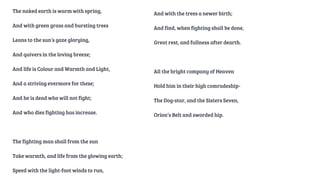
The naked earth is warm with spring,
And with green grass and bursting trees
Leans to the sun’s gaze glorying,
And quivers in the loving breeze;
And life is Colour and Warmth and Light,
And a striving evermore for these;
And he is dead who will not fight;
And who dies fighting has increase.
The fighting man shall from the sun
Take warmth, and life from the glowing earth;
Speed with the light-foot winds to run,
And with the trees a newer birth;
And find, when fighting shall be done,
Great rest, and fullness after dearth.
All the bright company of Heaven
Hold him in their high comradeship-
The Dog-star, and the Sisters Seven,
Orion’s Belt and sworded hip.
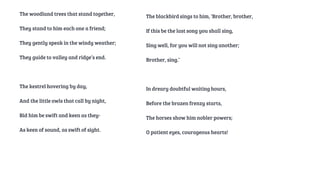
The woodland trees that stand together,
They stand to him each one a friend;
They gently speak in the windy weather;
They guide to valley and ridge’s end.
The kestrel hovering by day,
And the little owls that call by night,
Bid him be swift and keen as they-
As keen of sound, as swift of sight.
The blackbird sings to him, ‘Brother, brother,
If this be the last song you shall sing,
Sing well, for you will not sing another;
Brother, sing.’
In dreary doubtful waiting hours,
Before the brazen frenzy starts,
The horses show him nobler powers;
O patient eyes, courageous hearts!
And when the burning moment breaks,
And all things else are out of mind,
And Joy of Battle only takes
Him by the throat, and makes him blind-
Through joy and blindness he shall know,
Not caring much to know, that still
Nor lead nor steel shall reach him, so
That it be not the Destined Will.
The thundering line of battle stands,
And in the air death moans and sings;
But Day shall clasp him with strong hands,
And Night shall fold him in soft wings.
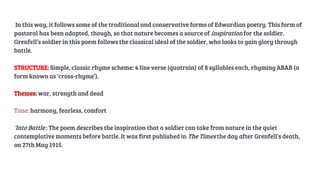
In this way, it follows some of the traditional and conservative forms of Edwardian poetry. This form of
pastoral has been adapted, though, so that nature becomes a source of inspiration for the soldier.
Grenfell’s soldier in this poem follows the classical ideal of the soldier, who looks to gain glory through
battle.
STRUCTURE: Simple, classic rhyme scheme: 4 line verse (quatrain) of 8 syllables each, rhyming ABAB (a
form known as ‘cross-rhyme’).
Themes: war, strength and dead
Tone: harmony, fearless, comfort
‘Into Battle’: The poem describes the inspiration that a soldier can take from nature in the quiet
contemplative moments before battle. It was first published in The Times the day after Grenfell’s death,
on 27th May 1915.
Analysis
“The naked earth is warm with spring…”: sets the pastoral scene of the poem.
“…who dies fighting has increase”: This shows a perverse declaration that war is life and that those who
die in battle have lived life to its fullest.
★ The description of nature seems to glorify war and it makes it sound like a pleasant place to be, and
that leaving home to fight for your country is such an amazing thing to do and that you will always
benefit somehow. To Grenfell war is part of the Earth’s natural cycle and war is full of colour and
life, in the poem this suggests the beauty in the battle and that anyone who dies at war has
increase.
“The fighting man shall from the sun / Take warmth…”: this is a key stanza in the poem. Because it
focuses on the ‘fighting man’ and his qualities, taken from nature. Grenfell tries to covey the feeling as he
was an exconvict that nature gives you power and strength to keep moving and never give up.
‘Speed with the light-foot winds to run”: the soldier appears to be an idealized warrior-god. Physical
exertion is given by nature (sun and wind). All the second stanza talks about empowering yourself from
nature.
❖ The second stanza describes how Earth’s nature is full of life and that nature will guide the soldier
and help him fight. The first 3 lines of this stanza states exactly what is meant by nature
supporting a soldier in battle.
“All the bright company of Heaven / Hold him in their high comradeship”: Here grenfell may be arguing
that the honour in soldiery is so much so that the stars are shining down on men in admiration and in
fact he mentions out the three most bright stars.
“The dog-star” is the colloquial name for sirius, the brightest star in the night sky.
“ orions belt” is a patyern of stars in the constellation orion. It contains three stars, Alnitak, alnilam and
Mintaka.
“Sworded hip” perhaps has connotations of hunting , knighthood, linking back to medieval times.
Stanzas 5, 6, 7, 8: the landscape / trees and animals are the soldier’s inspiration and friends. He has their
best qualities, follows their laws. The key line is “the horses show him nobler powers”– nature teaches the
man in war, and he in turn becomes one with nature (horses are traditional symbols of wisdom; hence
Blake’s ‘horses of
In the 6th stanza starts the poem becomes a little more serious. The poem begins to talk about death
although it is not making it out to be a bad thing the poem still takes a serious turn. The poem is talking
about everything that is going through this soldiers head and it states that when the battle finally starts
only the joy of battle will be left.
“The woodland trees that stand together,
They stand to him each one a friend;
They gently speak in the windy weather;
They guide to valley and ridge’s end.”
By this, Grenfell states that nature works in harmony with the soldier, suggesting that the trees provide
companionship and protection to them during battle. And by saying “friend” we can see that there is a
mutual affection.
They guide to valley and ridge’s end.” whit this I believe he tries to say that trees guide soldiers and want
them to keep them alive, out of danger “guide....ridge´s end.”
● “The blackbird sings to him, ‘Brother, brother,
If this be the last song you shall sing,
Sing well, for you will not sing another;
Brother, sing.’”
The blackbird is aware the soldier might die “If this be the last song you shall sing”
Also, Grenfell tries to transmit power “Sing well, for you will not sing another” and teaching people to give everything in
war and life because we only live once and we need to make the most of it.
● “In dreary doubtful waiting hours,
Before the brazen frenzy starts,
The horses show him nobler powers;
O patient eyes, courageous hearts!”
Here the hoses again give courage and strength to the soldiers. and the “brazen frenzy starts” shows the chaos of war
● “ And when the burning moment breaks,
And all things else are out of mind,
And Joy of Battle only takes
Him by the throat, and makes him blind- “
Here the poem has reached its climax that's why it says “burning moment breaks” and uses a fierce
image.
When it says “Makes him blind” it make reference to the fact that the soldiers could only focus on the
battle and how to win and survive.
Comparing of this poem to “Soldier , rest!” by Sir
Walter Scott
Both poems have themes in common which are war, and death and being comfort in war.
In both poems war is not shown as something bad, but something patriotic and heroic,
although it is full of chaos and death.
In both poems, death is not represented as something soldiers should fear, on the contrary
is something that would free the soldiers minds from fighting and danger .
In the case of the poem “into battle” the soldiers really enjoy fighting and war because they
connect with nature and they feel at harmony as well as in “Soldier, rest!”. And the animals
are helpful for them, they give the soldiers support and strength.
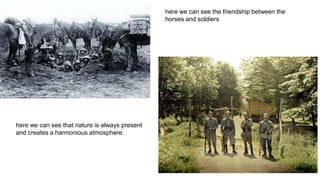
here we can see the friendship between the
horses and soldiers
here we can see that nature is always present
and creates a harmonious atmosphere.
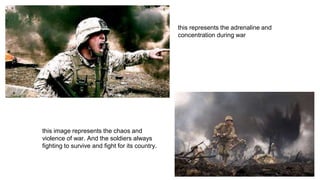
this represents the adrenaline and
concentration during war
this image represents the chaos and
violence of war. And the soldiers always
fighting to survive and fight for its country.

“Into battle” by julian grenfell

  • 1.
    “Into Battle” byJulian Grenfell by: Victoria Quiroga
  • 2.
    The naked earthis warm with spring, And with green grass and bursting trees Leans to the sun’s gaze glorying, And quivers in the loving breeze; And life is Colour and Warmth and Light, And a striving evermore for these; And he is dead who will not fight; And who dies fighting has increase. The fighting man shall from the sun Take warmth, and life from the glowing earth; Speed with the light-foot winds to run, And with the trees a newer birth; And find, when fighting shall be done, Great rest, and fullness after dearth. All the bright company of Heaven Hold him in their high comradeship- The Dog-star, and the Sisters Seven, Orion’s Belt and sworded hip.
  • 3.
    The woodland treesthat stand together, They stand to him each one a friend; They gently speak in the windy weather; They guide to valley and ridge’s end. The kestrel hovering by day, And the little owls that call by night, Bid him be swift and keen as they- As keen of sound, as swift of sight. The blackbird sings to him, ‘Brother, brother, If this be the last song you shall sing, Sing well, for you will not sing another; Brother, sing.’ In dreary doubtful waiting hours, Before the brazen frenzy starts, The horses show him nobler powers; O patient eyes, courageous hearts!
  • 4.
    And when theburning moment breaks, And all things else are out of mind, And Joy of Battle only takes Him by the throat, and makes him blind- Through joy and blindness he shall know, Not caring much to know, that still Nor lead nor steel shall reach him, so That it be not the Destined Will. The thundering line of battle stands, And in the air death moans and sings; But Day shall clasp him with strong hands, And Night shall fold him in soft wings.
  • 5.
    In this way,it follows some of the traditional and conservative forms of Edwardian poetry. This form of pastoral has been adapted, though, so that nature becomes a source of inspiration for the soldier. Grenfell’s soldier in this poem follows the classical ideal of the soldier, who looks to gain glory through battle. STRUCTURE: Simple, classic rhyme scheme: 4 line verse (quatrain) of 8 syllables each, rhyming ABAB (a form known as ‘cross-rhyme’). Themes: war, strength and dead Tone: harmony, fearless, comfort ‘Into Battle’: The poem describes the inspiration that a soldier can take from nature in the quiet contemplative moments before battle. It was first published in The Times the day after Grenfell’s death, on 27th May 1915.
  • 6.
    Analysis “The naked earthis warm with spring…”: sets the pastoral scene of the poem. “…who dies fighting has increase”: This shows a perverse declaration that war is life and that those who die in battle have lived life to its fullest. ★ The description of nature seems to glorify war and it makes it sound like a pleasant place to be, and that leaving home to fight for your country is such an amazing thing to do and that you will always benefit somehow. To Grenfell war is part of the Earth’s natural cycle and war is full of colour and life, in the poem this suggests the beauty in the battle and that anyone who dies at war has increase.
  • 7.
    “The fighting manshall from the sun / Take warmth…”: this is a key stanza in the poem. Because it focuses on the ‘fighting man’ and his qualities, taken from nature. Grenfell tries to covey the feeling as he was an exconvict that nature gives you power and strength to keep moving and never give up. ‘Speed with the light-foot winds to run”: the soldier appears to be an idealized warrior-god. Physical exertion is given by nature (sun and wind). All the second stanza talks about empowering yourself from nature. ❖ The second stanza describes how Earth’s nature is full of life and that nature will guide the soldier and help him fight. The first 3 lines of this stanza states exactly what is meant by nature supporting a soldier in battle. “All the bright company of Heaven / Hold him in their high comradeship”: Here grenfell may be arguing that the honour in soldiery is so much so that the stars are shining down on men in admiration and in fact he mentions out the three most bright stars.
  • 8.
    “The dog-star” isthe colloquial name for sirius, the brightest star in the night sky. “ orions belt” is a patyern of stars in the constellation orion. It contains three stars, Alnitak, alnilam and Mintaka. “Sworded hip” perhaps has connotations of hunting , knighthood, linking back to medieval times. Stanzas 5, 6, 7, 8: the landscape / trees and animals are the soldier’s inspiration and friends. He has their best qualities, follows their laws. The key line is “the horses show him nobler powers”– nature teaches the man in war, and he in turn becomes one with nature (horses are traditional symbols of wisdom; hence Blake’s ‘horses of In the 6th stanza starts the poem becomes a little more serious. The poem begins to talk about death although it is not making it out to be a bad thing the poem still takes a serious turn. The poem is talking about everything that is going through this soldiers head and it states that when the battle finally starts only the joy of battle will be left.
  • 9.
    “The woodland treesthat stand together, They stand to him each one a friend; They gently speak in the windy weather; They guide to valley and ridge’s end.” By this, Grenfell states that nature works in harmony with the soldier, suggesting that the trees provide companionship and protection to them during battle. And by saying “friend” we can see that there is a mutual affection. They guide to valley and ridge’s end.” whit this I believe he tries to say that trees guide soldiers and want them to keep them alive, out of danger “guide....ridge´s end.”
  • 10.
    ● “The blackbirdsings to him, ‘Brother, brother, If this be the last song you shall sing, Sing well, for you will not sing another; Brother, sing.’” The blackbird is aware the soldier might die “If this be the last song you shall sing” Also, Grenfell tries to transmit power “Sing well, for you will not sing another” and teaching people to give everything in war and life because we only live once and we need to make the most of it. ● “In dreary doubtful waiting hours, Before the brazen frenzy starts, The horses show him nobler powers; O patient eyes, courageous hearts!” Here the hoses again give courage and strength to the soldiers. and the “brazen frenzy starts” shows the chaos of war
  • 11.
    ● “ Andwhen the burning moment breaks, And all things else are out of mind, And Joy of Battle only takes Him by the throat, and makes him blind- “ Here the poem has reached its climax that's why it says “burning moment breaks” and uses a fierce image. When it says “Makes him blind” it make reference to the fact that the soldiers could only focus on the battle and how to win and survive.
  • 12.
    Comparing of thispoem to “Soldier , rest!” by Sir Walter Scott Both poems have themes in common which are war, and death and being comfort in war. In both poems war is not shown as something bad, but something patriotic and heroic, although it is full of chaos and death. In both poems, death is not represented as something soldiers should fear, on the contrary is something that would free the soldiers minds from fighting and danger . In the case of the poem “into battle” the soldiers really enjoy fighting and war because they connect with nature and they feel at harmony as well as in “Soldier, rest!”. And the animals are helpful for them, they give the soldiers support and strength.
  • 13.
    here we cansee the friendship between the horses and soldiers here we can see that nature is always present and creates a harmonious atmosphere.
  • 14.
    this represents theadrenaline and concentration during war this image represents the chaos and violence of war. And the soldiers always fighting to survive and fight for its country.