DUKE 4 STROKE AXIAL ENGINE
LAYOUT
 Introduction
 Flexibility in fuel
 Advantages
 Applications
WHAT TYPE OF ENGINE IS THE DUKE ENGINE
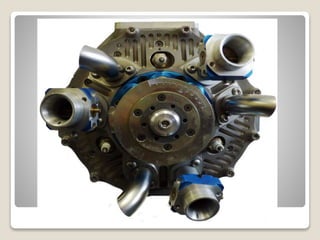
 The Duke engine is a four stroke "axial"
reciprocating engine. "Axial" because the
axis of each cylinder is aligned with the
axis of the output/crank shaft. Axial
engines are sometimes called 'barrel' and
'Z-crank' engines. The Barrel shape is a
result of the pistons being spaced evenly
around the central Crankshaft and aligned
parallel to the Crankshaft axis.
 The cylinder group rotates counter to the
crankshaft, at about 20 percent of crankshaft
rotational speed. The counter-rotating design
allows the engine to partially supresses
torque reaction and cancel vibration.
 The five cylinder engine requires only three
fuel injectors and three spark plugs. The
absence of exhaust valves reduces the
potential for pre-ignition or spark knock when
operating on low-octane pump gas.
OFFERS COMPLETE FLUE FLEXIBILITY
 Development will allow operation on all
appropriate fuels, including
ethanol/methanol and blends, bio-
ethanol, LPG, CNG, hydrogen, kerosene
and diesel. Spark ignition Duke engines
are currently successfully running on 91
octane gasoline and kerosene/jet-A1.
ADVANTAGES OF ENGINE
 The Duke engine is the world’s only viable
axial, 4 stroke, spark ignited piston engine.
 It is lightweight, small, valveless , vibration-
free, has very high power density, and runs
on most fuels, including kerosene/jet fuel.
 The Duke engine is a great fit for aerospace
applications, including ultralight,
experimental and UAV platforms.
APPLICATIONS
 MARINE
 The axial arrangement of the duke engine
lends itself well to marine
outboard(vertical shaft) and
inboard(horizontal) applications.
 In general, the Duke engine would be best
suited to marine applications with approx
50kW or greater, with the low vibration
providing good performance.
 LIGHT AIRCRAFT APPLICATIONS
 Aerodynamically friendly cylindrical shape,
with output shaft on centre line
 Simplicity of design
 Low weight
 Small size
 Near perfect balance for low vibration

Duke axial engine

  • 1.
    DUKE 4 STROKEAXIAL ENGINE
  • 2.
    LAYOUT  Introduction  Flexibilityin fuel  Advantages  Applications
  • 3.
    WHAT TYPE OFENGINE IS THE DUKE ENGINE  The Duke engine is a four stroke "axial" reciprocating engine. "Axial" because the axis of each cylinder is aligned with the axis of the output/crank shaft. Axial engines are sometimes called 'barrel' and 'Z-crank' engines. The Barrel shape is a result of the pistons being spaced evenly around the central Crankshaft and aligned parallel to the Crankshaft axis.
  • 4.
     The cylindergroup rotates counter to the crankshaft, at about 20 percent of crankshaft rotational speed. The counter-rotating design allows the engine to partially supresses torque reaction and cancel vibration.  The five cylinder engine requires only three fuel injectors and three spark plugs. The absence of exhaust valves reduces the potential for pre-ignition or spark knock when operating on low-octane pump gas.
  • 6.
    OFFERS COMPLETE FLUEFLEXIBILITY  Development will allow operation on all appropriate fuels, including ethanol/methanol and blends, bio- ethanol, LPG, CNG, hydrogen, kerosene and diesel. Spark ignition Duke engines are currently successfully running on 91 octane gasoline and kerosene/jet-A1.
  • 7.
    ADVANTAGES OF ENGINE The Duke engine is the world’s only viable axial, 4 stroke, spark ignited piston engine.  It is lightweight, small, valveless , vibration- free, has very high power density, and runs on most fuels, including kerosene/jet fuel.  The Duke engine is a great fit for aerospace applications, including ultralight, experimental and UAV platforms.
  • 8.
    APPLICATIONS  MARINE  Theaxial arrangement of the duke engine lends itself well to marine outboard(vertical shaft) and inboard(horizontal) applications.  In general, the Duke engine would be best suited to marine applications with approx 50kW or greater, with the low vibration providing good performance.
  • 9.
     LIGHT AIRCRAFTAPPLICATIONS  Aerodynamically friendly cylindrical shape, with output shaft on centre line  Simplicity of design  Low weight  Small size  Near perfect balance for low vibration