Hood
                  er the
            e U nd
    Sp ac
D


        How DSpace works
This presentation
• Purpose
  • You don’t need to be a mechanic to drive a car…
    …but it helps if you know how to top-up your oil, check
    your tyres and explain problems to your mechanic

• Two presentations
  • How DSpace Works
  • The DSpace Community Development Process (and
    YOUR role in it)

• The presenters
  • 3 repository managers / DGOC members
  • 3 developers / committers
  • 29 years of combined DSpace experience
                                                              ES
Contact details
• Leonie Hayes
  – Research Repository Manager, The University of Auckland Library
  – l.hayes@auckland.ac.nz (1.5)
• Richard Jones
  – Head of Repository Systems, Symplectic Ltd.
  – richard@symplectic.co.uk (1.0)
• Stuart Lewis
  – IT Innovations Analyst and Developer, The University of Auckland Library
  – s.lewis@auckland.ac.nz (1.2)
• Monica Roos
  – Special Librarian, The University of Bergen Library
  – monica.roos@ub.uib.no (1.4)
• Kim Shepherd
  – IT Software Analyst and Developer, The University of Auckland Library,
  – k.shepherd@auckland.ac.nz (1.5)
• Elin Stangeland
  – Repository Manager, Cambridge University Library
  – es444@cam.ac.uk (1.2)
                                                                               SL
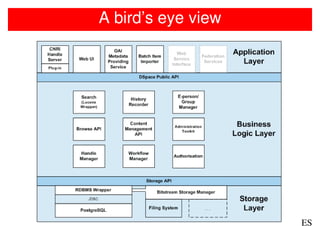
A bird’s eye view


                    ES
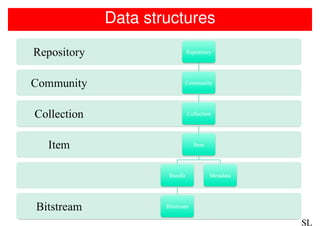
Data structures


                  SL
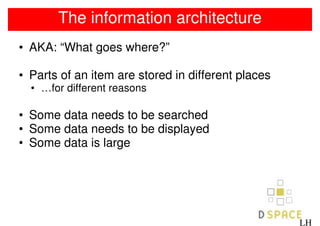
The information architecture
• AKA: “What goes where?”

• Parts of an item are stored in different places
  • …for different reasons

• Some data needs to be searched
• Some data needs to be displayed
• Some data is large


                                                    LH
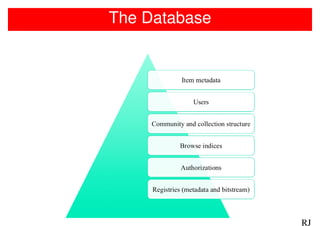
The Database


               RJ
Files on disk
• Files stored in the ‘asset store’
• Each bitstream has an internal id; a large integer derived from the
  date of submission and checksum
   o e.g. 908735856294756292618068267495783
• Files are stored in the directory ab/dc/ef, where abcdef are the first
  6 characters of the internal id
   o e.g 90/87/35
• Files are stored with the internal id as the filename
• All actual information about the file is in the "bitstream" table in the
  database, including internal id.


        908735856294756292618068267495783 ->
/dspace/[assetstore]/90/87/35/908735856294756292618068267495783


                                                                             ES
Configuration
• To make DSpace work in a local context
• Enable local settings – urls, links to physical
  storage etc.
   • dspace.cfg
   • Lots of settings – read it one day!

• Enable local configurations
  • Input forms
  • Metadata crosswalks
  • OAI-PMH configuration
  • Language packs

                                                    RJ
Lucene search indexes
• Maintained outside of the database

• Contains the search index

• Very fast for full text searching
  • Stop words and stemming

• A cached copy
  • Can be re-built or updated from the database
  • [dspace]/bin/dspace index-update


                                                   MR
Log files

• The dspace.log file performs several functions as:

   - Providing log information useful in debugging
   - Providing information about who has accessed the system
   - It generates the classic DSpace statistics
   - Contain error messages useful for fixing problems


                                                           LH
Solr statistics

•Classic statistics were derived from log files
  •Only generated once a day
  •Dependant on keeping all your old log files

•Solr stats
  •Statistical information entered real-time into solr index
     •Event-based, not log-based
  •Able to query statistics
  •Different views of statistics
     •Able to write new statistics reports


                                                               SL
Scheduled tasks
• Things need to happen in the background:
  – filter-media (generate full text search indexes, create
    image thumbnails)
  – sub-daily (send daily subscription emails)
  – stat-general / stat-monthly (generate classic statistics)
  – generate-sitemaps (creates search engine sitemaps)
  – checker (checksum checker)


                                                                LH
Authentication

• Authentication is about verifying who a user is
   • DSpace provides multiple options
     • In-built database of users and passwords
     • LDAP login (link to local LDAP or ActiveDirectory)
     • Shibboleth
     • IP authentication

  • Makes use of a plugin stack
     • You can chain authentication methods
     • You can create new authentication methods


                                                            ES
Authorization

• Authorization basics

  •   Resource policies

  •   EPeople - DSpace users
  •   Groups
       • Anonymous
       • Admin
  • Special groups

  •   Permissions
       •   READ / WRITE
       •   ADD / REMOVE

                                      RJ
JSPUI styling options
• All JSPs: dspace-jspui/dspace-
  jspui/webapp/src/main/webapp
• Main layout: [jsps]/layout and [jsps]/styles.css.jsp
• Page localisations should go in dspace/modules/jspui
  • Caveat: The more changes you make, the harder it is to upgrade


                                                                     MR
XMLUI styling options

• Composed of two components that control different
  part of the Manakin interface:

  • Aspects:
    • "plugins" that provide features for the repository

  • Themes:
    • "Rules" that defines where themes are installed in the
      repository.
    • Style the look-and-feel of the repository.


                                                               SL
Error messages

• Help – an error message!
  • To help you, we need to know exactly what went
    wrong
    • The easiest way to do this, is with a ‘stack trace’
  • XMLUI: Shown on the error page
  • JSPUI: Shown in the HTML source
  • All: In the dspace.log file


                                                            SL
Error messages

• Help – an error message!
    • To help you, we need to know exactly what went
      wrong
        • The easiest way to do this, is with a ‘stack trace’

2008-09-18 15 08:13
              :     ,263 INFO org  .dspace.app.xmlu .u i s Authent t
                                                     i tl .         ica ionUt l @ [EMAIL
                                                                             i
   PR OTECTED]   :
   sess ion_id=F1FB96AF6FA3464C393A3366621534A4:           ip_addr=139.147.66.108:
   l in type=exp i i java lang l in rExcept
     og :        l ct    .     .Nu lPo te         ion
at
   org .dspace.au hent te
                 t    ica .LDAPHierarch lAuthent t .getSpec lGroups(LDAPHie
                                           ica        ica ion         ia
   ra ica
      rch lAuthent t . :144)
                   ica ion java
at
   org .dspace.au hent te
                 t    ica .Authent tica ionManager tSpec l
                                                    .ge      ia Groups(Authentca ionMa
                                                                                i t
   nager java
         . :308)
at o .dspace.app.xmlu .u i s Authent t
    rg                 i tl .        ica ionUt llog (Authent t
                                              i. In           ica ionUtlja
                                                                       i. va:222)

                                                                                           RJ
Getting help from dspace-tech

To: dspace- tech @l ts.
                   is sourceforge.net
Subjec : Erro w th XYZ when ABC happens
      t      r i

 Dear dspace-tech,

  [Descr t on o your prob
        ip i f            lem]
  [Stack t ace and/or l fle ex r ]
          r            og i    t acts
  [DSpace ve ion
              rs ]
  [Env ronment OS favour
      i        :     l      ]
  [Any other relevant deta l ]
                          is

  Please he !
           lp

  Richard


                                          MR
Hood
                  er the
            e U nd
    Sp ac
D


            Any questions?      ES
Hood
                  er the
            e U nd
    Sp ac
D


The DSpace Community Development
    Process (and your role in it)   RJ
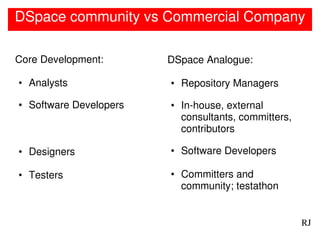
DSpace community vs Commercial Company

Core Development:       DSpace Analogue:

• Analysts              • Repository Managers

• Software Developers   • In-house, external
                          consultants, committers,
                          contributors

• Designers             • Software Developers

• Testers               • Committers and
                          community; testathon


                                                     RJ
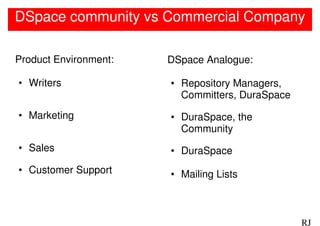
DSpace community vs Commercial Company

Product Environment:   DSpace Analogue:

• Writers              • Repository Managers,
                         Committers, DuraSpace
• Marketing            • DuraSpace, the
                         Community
• Sales                • DuraSpace
• Customer Support     • Mailing Lists


                                                 RJ
DSpace community vs Commercial Company

Organisational Support:   DSpace Analogue:

• Project Management      • Repository Managers,
                            DuraSpace

• Finance and HR          • Participating Institutions,
                            DuraSpace


                                                          ES
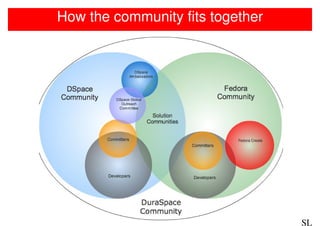
How the community fits together


                                  SL
DSpace committers group

• Committer = able to ‘commit’ code to the code repository
• General voting rights (usually opened to anyone)

• Becoming a committer
  •   Meritocracy
  •   Vote by current committers
  •   We keep an eye out for new potential committers
  •   You can suggest yourself as a new committer
  •   We need more committers!
  •   Some committers are not developers
  •   We like to see:
      –   Dedication to DSpace (usually via employment)
      –   Friendly and helpful (participate in email lists)
      –   Contributes code
      –   Joins in development dicussions
  • Some take years, some take only a few months
                                                              ES
DSpace Global Outreach Committee

• Repository managers group
• Current projects
  o DSUG meetings at Open Repository Conferences
  o Community requirements gathering
  o DSpace instance database development

• Engagement in development process


                                                   LH
DSpace Ambassadors
• A recent initiative with a focus on regional
networking

• Focusing on connecting DSpace users together

• Providing support, networking and mentoring for
new users

• Further details: Contact Valorie Hollister


                                                    MR
Developing code for DSpace

• Submit patches

• Follow guidelines
  https://wiki.duraspace.org/display/DSPACE/Guidelines+for+Committing


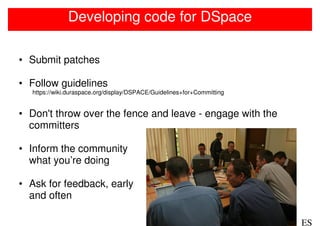
• Don't throw over the fence and leave - engage with the
  committers

• Inform the community
  what you’re doing

• Ask for feedback, early
  and often

                                                                        ES
JIRA
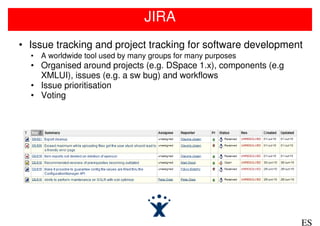
• Issue tracking and project tracking for software development
  • A worldwide tool used by many groups for many purposes
  • Organised around projects (e.g. DSpace 1.x), components (e.g
    XMLUI), issues (e.g. a sw bug) and workflows
  • Issue prioritisation
  • Voting


                                                                   ES
What goes in JIRA?

• Bug Reports
  o Supply as much information as possible
  o If you're not sure, email dspace-tech first

• Bug Fixes
  o If you think you've fixed a bug, attach a patch!
  o Encourage peer review and constructive suggestions

• New Features
  o JIRA helps manage collaborative work on new features
  o Make use of "sub-tasks" and relationships


                                                           ES
What doesn’t go in JIRA?

• Technical questions/problems. Better places to get help are:
   • dspace-tech mailing list
   • #dspace on IRC

• Suggestions/ideas not previously discussed
  • New ideas are always wanted, but...
  • Discuss them with the community first
  • Mailing lists, community surveys, IRC, conferences or
    user groups are good places to float new ideas


                                                             LH
Versions

• Major 1.0 (big changes, database changes)
  – Minor 1.6 (smaller changes)
     • Sub-minor 1.6.2 (bug fixes)


• Upgrades routes:
  – If I’m on 1.3.2 and I want to get to 1.6.2
     • 1.3.2 -> 1.4
     • 1.4 -> 1.5
     • 1.5 -> 1.6.2


                                                 SL
Release co-ordinator

• Co-ordinates the release
  – Sets deadlines
  – Manages processes
  – Public relations
  – Deciding vote (very rarely used)
  – Tries to encourage particiation


                                       MR
How development works

• Weekly IRC meetings
  • Anyone welcome
• DSpace-devel email list

• Processes continue to change and improve:
  – Recent changes:
    • No partial features in trunk
    • No new features without supporting documentation


                                                         RJ
Post-development / Pre-release
• Developer Testing
  • Eliminate the obvious code bugs

• Community Testathon
  • Find user experience bugs, less obvious problems

• Bug Fix
  • Not just for committers - contribute here too

• Create release candidate
  • Start with x.y (e.g. 1.5)

• Repeat as necessary
  • Increment sub-minor part of version number
  • (e.g. 1.5.2 is the second bugfix release for 1.5)

                                                        LH
DSpace email lists

• Send to an appropriate list
• Include enough useful information
• Leave it a while before prompting if no reply
• Please don’t email people directly


                                                  LH
DSpace email lists
• Who lives in which house?

• DSpace General (dspace-general)
  •   General community discussion around digital repositories and related
      applications
• DSpace Technical (dspace-tech)
  •   Technical discussion/support around DSpace installation, configuration
      and operation
• DSpace Development (dspace-devel)
  •   Discussion/support around developing DSpace
  •   Automated notices and alerts from JIRA
  •   Suggestions for new features/improvements
  •   Release announcements and updates


                                                                               MR
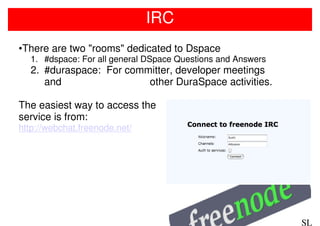
IRC
•There are two "rooms" dedicated to Dspace
  1. #dspace: For all general DSpace Questions and Answers
  2. #duraspace: For committer, developer meetings
     and                 other DuraSpace activities.

The easiest way to access the
service is from:
http://webchat.freenode.net/


                                                             SL
See also…


• The DSpace wiki resource page:
  • https://wiki.duraspace.org/display/DSPACE/DSpaceResources

• DSpace manual:
  •
  https://wiki.duraspace.org/display/DSPACE/DSpaceResources#DSpaceResource
  s-DSpaceSystemDocumentation

• The DSpace course:
  • http://hdl.handle.net/2160/615


                                                                         LH
How can you play a part?


  What are you interests?


  What are your passions?


    What could you do?


                            SL
Photo credits


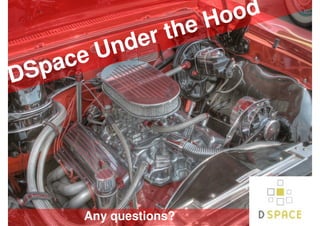
• Under the hood image:
  – http://www.flickr.com/photos/andrew_buckie/209493609/
Hood
                  er the
            e U nd
    Sp ac
D


            Any questions?
Contact details
• Leonie Hayes
  – Research Repository Manager, The University of Auckland Library
  – l.hayes@auckland.ac.nz (1.5)
• Richard Jones
  – Head of Repository Systems, Symplectic Ltd.
  – richard@symplectic.co.uk (1.0)
• Stuart Lewis
  – IT Innovations Analyst and Developer, The University of Auckland Library
  – s.lewis@auckland.ac.nz (1.2)
• Monica Roos
  – Special Librarian, The University of Bergen Library
  – monica.roos@ub.uib.no (1.4)
• Kim Shepherd
  – IT Software Analyst and Developer, The University of Auckland Library,
  – k.shepherd@auckland.ac.nz (1.5)
• Elin Stangeland
  – Repository Manager, Cambridge University Library
  – es444@cam.ac.uk (1.2)
                                                                               SL

DSpace Under the Hood

  • 1.
    Hood er the e U nd Sp ac D How DSpace works
  • 2.
    This presentation • Purpose • You don’t need to be a mechanic to drive a car… …but it helps if you know how to top-up your oil, check your tyres and explain problems to your mechanic • Two presentations • How DSpace Works • The DSpace Community Development Process (and YOUR role in it) • The presenters • 3 repository managers / DGOC members • 3 developers / committers • 29 years of combined DSpace experience ES
  • 3.
    Contact details • LeonieHayes – Research Repository Manager, The University of Auckland Library – l.hayes@auckland.ac.nz (1.5) • Richard Jones – Head of Repository Systems, Symplectic Ltd. – richard@symplectic.co.uk (1.0) • Stuart Lewis – IT Innovations Analyst and Developer, The University of Auckland Library – s.lewis@auckland.ac.nz (1.2) • Monica Roos – Special Librarian, The University of Bergen Library – monica.roos@ub.uib.no (1.4) • Kim Shepherd – IT Software Analyst and Developer, The University of Auckland Library, – k.shepherd@auckland.ac.nz (1.5) • Elin Stangeland – Repository Manager, Cambridge University Library – es444@cam.ac.uk (1.2) SL
  • 4.
  • 5.
  • 6.
    The information architecture •AKA: “What goes where?” • Parts of an item are stored in different places • …for different reasons • Some data needs to be searched • Some data needs to be displayed • Some data is large LH
  • 7.
  • 8.
    Files on disk •Files stored in the ‘asset store’ • Each bitstream has an internal id; a large integer derived from the date of submission and checksum o e.g. 908735856294756292618068267495783 • Files are stored in the directory ab/dc/ef, where abcdef are the first 6 characters of the internal id o e.g 90/87/35 • Files are stored with the internal id as the filename • All actual information about the file is in the "bitstream" table in the database, including internal id. 908735856294756292618068267495783 -> /dspace/[assetstore]/90/87/35/908735856294756292618068267495783 ES
  • 9.
    Configuration • To makeDSpace work in a local context • Enable local settings – urls, links to physical storage etc. • dspace.cfg • Lots of settings – read it one day! • Enable local configurations • Input forms • Metadata crosswalks • OAI-PMH configuration • Language packs RJ
  • 10.
    Lucene search indexes •Maintained outside of the database • Contains the search index • Very fast for full text searching • Stop words and stemming • A cached copy • Can be re-built or updated from the database • [dspace]/bin/dspace index-update MR
  • 11.
    Log files • Thedspace.log file performs several functions as: - Providing log information useful in debugging - Providing information about who has accessed the system - It generates the classic DSpace statistics - Contain error messages useful for fixing problems LH
  • 12.
    Solr statistics •Classic statisticswere derived from log files •Only generated once a day •Dependant on keeping all your old log files •Solr stats •Statistical information entered real-time into solr index •Event-based, not log-based •Able to query statistics •Different views of statistics •Able to write new statistics reports SL
  • 13.
    Scheduled tasks • Thingsneed to happen in the background: – filter-media (generate full text search indexes, create image thumbnails) – sub-daily (send daily subscription emails) – stat-general / stat-monthly (generate classic statistics) – generate-sitemaps (creates search engine sitemaps) – checker (checksum checker) LH
  • 14.
    Authentication • Authentication isabout verifying who a user is • DSpace provides multiple options • In-built database of users and passwords • LDAP login (link to local LDAP or ActiveDirectory) • Shibboleth • IP authentication • Makes use of a plugin stack • You can chain authentication methods • You can create new authentication methods ES
  • 15.
    Authorization • Authorization basics • Resource policies • EPeople - DSpace users • Groups • Anonymous • Admin • Special groups • Permissions • READ / WRITE • ADD / REMOVE RJ
  • 16.
    JSPUI styling options •All JSPs: dspace-jspui/dspace- jspui/webapp/src/main/webapp • Main layout: [jsps]/layout and [jsps]/styles.css.jsp • Page localisations should go in dspace/modules/jspui • Caveat: The more changes you make, the harder it is to upgrade MR
  • 17.
    XMLUI styling options •Composed of two components that control different part of the Manakin interface: • Aspects: • "plugins" that provide features for the repository • Themes: • "Rules" that defines where themes are installed in the repository. • Style the look-and-feel of the repository. SL
  • 18.
    Error messages • Help– an error message! • To help you, we need to know exactly what went wrong • The easiest way to do this, is with a ‘stack trace’ • XMLUI: Shown on the error page • JSPUI: Shown in the HTML source • All: In the dspace.log file SL
  • 19.
    Error messages • Help– an error message! • To help you, we need to know exactly what went wrong • The easiest way to do this, is with a ‘stack trace’ 2008-09-18 15 08:13 : ,263 INFO org .dspace.app.xmlu .u i s Authent t i tl . ica ionUt l @ [EMAIL i PR OTECTED] : sess ion_id=F1FB96AF6FA3464C393A3366621534A4: ip_addr=139.147.66.108: l in type=exp i i java lang l in rExcept og : l ct . .Nu lPo te ion at org .dspace.au hent te t ica .LDAPHierarch lAuthent t .getSpec lGroups(LDAPHie ica ica ion ia ra ica rch lAuthent t . :144) ica ion java at org .dspace.au hent te t ica .Authent tica ionManager tSpec l .ge ia Groups(Authentca ionMa i t nager java . :308) at o .dspace.app.xmlu .u i s Authent t rg i tl . ica ionUt llog (Authent t i. In ica ionUtlja i. va:222) RJ
  • 20.
    Getting help fromdspace-tech To: dspace- tech @l ts. is sourceforge.net Subjec : Erro w th XYZ when ABC happens t r i Dear dspace-tech, [Descr t on o your prob ip i f lem] [Stack t ace and/or l fle ex r ] r og i t acts [DSpace ve ion rs ] [Env ronment OS favour i : l ] [Any other relevant deta l ] is Please he ! lp Richard MR
  • 21.
    Hood er the e U nd Sp ac D Any questions? ES
  • 22.
    Hood er the e U nd Sp ac D The DSpace Community Development Process (and your role in it) RJ
  • 23.
    DSpace community vsCommercial Company Core Development: DSpace Analogue: • Analysts • Repository Managers • Software Developers • In-house, external consultants, committers, contributors • Designers • Software Developers • Testers • Committers and community; testathon RJ
  • 24.
    DSpace community vsCommercial Company Product Environment: DSpace Analogue: • Writers • Repository Managers, Committers, DuraSpace • Marketing • DuraSpace, the Community • Sales • DuraSpace • Customer Support • Mailing Lists RJ
  • 25.
    DSpace community vsCommercial Company Organisational Support: DSpace Analogue: • Project Management • Repository Managers, DuraSpace • Finance and HR • Participating Institutions, DuraSpace ES
  • 26.
    How the communityfits together SL
  • 27.
    DSpace committers group •Committer = able to ‘commit’ code to the code repository • General voting rights (usually opened to anyone) • Becoming a committer • Meritocracy • Vote by current committers • We keep an eye out for new potential committers • You can suggest yourself as a new committer • We need more committers! • Some committers are not developers • We like to see: – Dedication to DSpace (usually via employment) – Friendly and helpful (participate in email lists) – Contributes code – Joins in development dicussions • Some take years, some take only a few months ES
  • 28.
    DSpace Global OutreachCommittee • Repository managers group • Current projects o DSUG meetings at Open Repository Conferences o Community requirements gathering o DSpace instance database development • Engagement in development process LH
  • 29.
    DSpace Ambassadors • Arecent initiative with a focus on regional networking • Focusing on connecting DSpace users together • Providing support, networking and mentoring for new users • Further details: Contact Valorie Hollister MR
  • 30.
    Developing code forDSpace • Submit patches • Follow guidelines https://wiki.duraspace.org/display/DSPACE/Guidelines+for+Committing • Don't throw over the fence and leave - engage with the committers • Inform the community what you’re doing • Ask for feedback, early and often ES
  • 31.
    JIRA • Issue trackingand project tracking for software development • A worldwide tool used by many groups for many purposes • Organised around projects (e.g. DSpace 1.x), components (e.g XMLUI), issues (e.g. a sw bug) and workflows • Issue prioritisation • Voting ES
  • 32.
    What goes inJIRA? • Bug Reports o Supply as much information as possible o If you're not sure, email dspace-tech first • Bug Fixes o If you think you've fixed a bug, attach a patch! o Encourage peer review and constructive suggestions • New Features o JIRA helps manage collaborative work on new features o Make use of "sub-tasks" and relationships ES
  • 33.
    What doesn’t goin JIRA? • Technical questions/problems. Better places to get help are: • dspace-tech mailing list • #dspace on IRC • Suggestions/ideas not previously discussed • New ideas are always wanted, but... • Discuss them with the community first • Mailing lists, community surveys, IRC, conferences or user groups are good places to float new ideas LH
  • 34.
    Versions • Major 1.0(big changes, database changes) – Minor 1.6 (smaller changes) • Sub-minor 1.6.2 (bug fixes) • Upgrades routes: – If I’m on 1.3.2 and I want to get to 1.6.2 • 1.3.2 -> 1.4 • 1.4 -> 1.5 • 1.5 -> 1.6.2 SL
  • 35.
    Release co-ordinator • Co-ordinatesthe release – Sets deadlines – Manages processes – Public relations – Deciding vote (very rarely used) – Tries to encourage particiation MR
  • 36.
    How development works •Weekly IRC meetings • Anyone welcome • DSpace-devel email list • Processes continue to change and improve: – Recent changes: • No partial features in trunk • No new features without supporting documentation RJ
  • 37.
    Post-development / Pre-release •Developer Testing • Eliminate the obvious code bugs • Community Testathon • Find user experience bugs, less obvious problems • Bug Fix • Not just for committers - contribute here too • Create release candidate • Start with x.y (e.g. 1.5) • Repeat as necessary • Increment sub-minor part of version number • (e.g. 1.5.2 is the second bugfix release for 1.5) LH
  • 38.
    DSpace email lists •Send to an appropriate list • Include enough useful information • Leave it a while before prompting if no reply • Please don’t email people directly LH
  • 39.
    DSpace email lists •Who lives in which house? • DSpace General (dspace-general) • General community discussion around digital repositories and related applications • DSpace Technical (dspace-tech) • Technical discussion/support around DSpace installation, configuration and operation • DSpace Development (dspace-devel) • Discussion/support around developing DSpace • Automated notices and alerts from JIRA • Suggestions for new features/improvements • Release announcements and updates MR
  • 40.
    IRC •There are two"rooms" dedicated to Dspace 1. #dspace: For all general DSpace Questions and Answers 2. #duraspace: For committer, developer meetings and other DuraSpace activities. The easiest way to access the service is from: http://webchat.freenode.net/ SL
  • 41.
    See also… • TheDSpace wiki resource page: • https://wiki.duraspace.org/display/DSPACE/DSpaceResources • DSpace manual: • https://wiki.duraspace.org/display/DSPACE/DSpaceResources#DSpaceResource s-DSpaceSystemDocumentation • The DSpace course: • http://hdl.handle.net/2160/615 LH
  • 42.
    How can youplay a part? What are you interests? What are your passions? What could you do? SL
  • 43.
    Photo credits • Underthe hood image: – http://www.flickr.com/photos/andrew_buckie/209493609/
  • 44.
    Hood er the e U nd Sp ac D Any questions?
  • 45.
    Contact details • LeonieHayes – Research Repository Manager, The University of Auckland Library – l.hayes@auckland.ac.nz (1.5) • Richard Jones – Head of Repository Systems, Symplectic Ltd. – richard@symplectic.co.uk (1.0) • Stuart Lewis – IT Innovations Analyst and Developer, The University of Auckland Library – s.lewis@auckland.ac.nz (1.2) • Monica Roos – Special Librarian, The University of Bergen Library – monica.roos@ub.uib.no (1.4) • Kim Shepherd – IT Software Analyst and Developer, The University of Auckland Library, – k.shepherd@auckland.ac.nz (1.5) • Elin Stangeland – Repository Manager, Cambridge University Library – es444@cam.ac.uk (1.2) SL