Open Source Software: A Case Study
Scott A. James,
President
Computer Consulting Specialists, Inc.
Sarasota, Florida
Scott James Computer Consulting Specialists, Inc.
What is Open Source Software
• www.opensource.org says 10 things, but we summarize as:
• Software in a community that is:
• Freely Used (no warranty, no limits on usage)
• Freely Extended (must share source, represent original works and
owners)
• Many varieties of licenses, they ARE different.
Know what they mean.
• Check out www.opensource.org for large list and details of each.
Scott James Computer Consulting Specialists, Inc.
Summary
A case study of a project created with open source technology.
• Project analysis: Goals & Resources
• Technology: TCO, Evaluation & Decision
• Implementation: Building the project
• Lessons: What was learned
• Resources
Project Analysis
What are we doing? What do we have?
Scott James Computer Consulting Specialists, Inc.
Project Analysis: Goals
• Project – functional, scalable, simple.
• Timeline – when will each phase roll out?
• Budget – how much money do we have?
• Longevity – short term utility or long term application?
• Equity – invest time in ourselves, or dollars in outside vendors?
Inexpensive, Build Fast, Quality: pick any two.
Scott James Computer Consulting Specialists, Inc.
Project Analysis: Resources
• Staff Knowledge – what is current ability of staff?
• Time – how long do we have?
• Money – how much do we have?
• Technology – what is already in use?
Technology
An Evaluation of Open Source Software
Scott James Computer Consulting Specialists, Inc.
Technology: Total Cost of Ownership (TCO)
• Startup Time: days or weeks?
• Development Time: weeks, months, years?
• Startup Money: cost of acquisition
• Development Money: recurring costs and time.
• Equity: $ pay to outside, vs. pay to ourselves
• Risk: Dependency on outside trends?
• Support: availability? Cost?
Scott James Computer Consulting Specialists, Inc.
Technology: Investigation
• LAMP: Linux, Apache, MySQL, PHP
• Windows: ASP/ActiveX, .NET, SQL Server
• IBM WebSphere, Sun ONE, HP
Scott James Computer Consulting Specialists, Inc.
Technology: Evaluation for TCO
• Tech staff has both Windows and UNIX background
• We have time (several months ok)
• Low budget, little money to spend.
• Prefer to invest equity in ourselves.
• Would like to reduce risk from outside tech trends.
• Need solid, reliable server that requires little maintenance.
• Need development questions/problems solved, but not real time.
Scott James Computer Consulting Specialists, Inc.
Technology: Decision to use LAMP
• This is a new project (no migration necessary)
• Our staff has UNIX (Linux) experience
• Large user support community for core technology
• Invest into own technology equity
• Reduce risk of reliance on technology trends
• Low cost to entry (no license or hardware fees)
Implementation
Putting Open Source Software to Work
Scott James Computer Consulting Specialists, Inc.
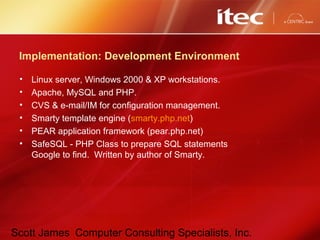
Implementation: Development Environment
• Linux server, Windows 2000 & XP workstations.
• Apache, MySQL and PHP.
• CVS & e-mail/IM for configuration management.
• Smarty template engine (smarty.php.net)
• PEAR application framework (pear.php.net)
• SafeSQL - PHP Class to prepare SQL statements
Google to find. Written by author of Smarty.
Scott James Computer Consulting Specialists, Inc.
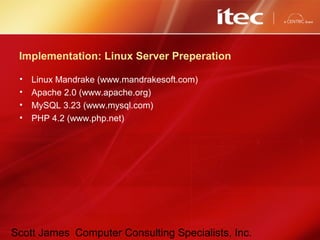
Implementation: Linux Server Preperation
• Linux Mandrake (www.mandrakesoft.com)
• Apache 2.0 (www.apache.org)
• MySQL 3.23 (www.mysql.com)
• PHP 4.2 (www.php.net)
Scott James Computer Consulting Specialists, Inc.
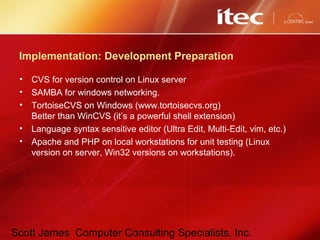
Implementation: Development Preparation
• CVS for version control on Linux server
• SAMBA for windows networking.
• TortoiseCVS on Windows (www.tortoisecvs.org)
Better than WinCVS (it’s a powerful shell extension)
• Language syntax sensitive editor (Ultra Edit, Multi-Edit, vim, etc.)
• Apache and PHP on local workstations for unit testing (Linux
version on server, Win32 versions on workstations).
Scott James Computer Consulting Specialists, Inc.
Implementation: Development
• Data model with subject matter experts, talk through 1-to-Many
relationships, sanity check.
• Design PHP class hierarchy for business N-tier layer.
• Create shim PHP classes for web designers to use while building
and testing HTML templates. This provides ability to develop GUI in
parallel.
• Smarty template syntax can be HTML syntax compliant for use with
Dreamweaver.
Scott James Computer Consulting Specialists, Inc.
Implementation: Open Source value, case in point
• We found a useful PHP class for preparing SQL statements called
SafeSQL.
• However, it did not provide all the functionality we wanted.
• In about 2 hours we modified the source to add our features.
• We then e-mailed a copy back to the author; that these features
may be included in future versions (as he my decide).
• We enjoy similar features added by other developers.
Scott James Computer Consulting Specialists, Inc.
Implementation: Use the Support Channels
• Docs (www.apache.org, www.php.net)
Save time with on-line look-up (MySQL, PHP)
RTFM (Read The Fine Manual)
• www.google.com - Best way to search the Internet.
Search for specifics like: functions, methods and error numbers
• Forums (www.phpinsider.com, www.devshed.com)
Register early, try to skim articles regularly.
• Wiki – web page self regulated by community, very useful.
The Smarty template engine has a great Wiki.
• Plan for time to interact with open source community
-- support is usually not real time.
Scott James Computer Consulting Specialists, Inc.
Implementation: Flexible environment for unit testing
• Perform unit testing on local Windows workstations using Windows
versions of Apache, PHP and MySQL.
• Regression testing is desirable, use automated methods as much
as possible.
• CVS provides “hooks” to execute scripts on files as they are
committed to repository.
Scott James Computer Consulting Specialists, Inc.
Implementation: Deployment on servers
• Deploy using automated script – fewer human actions means fewer
mistakes.
• Look at using SSH, TAR, RSYNC for ways to move software
between hosts.
• Use CVS to ‘tag’ releases for consistent software bundling. Avoid
temptation to copy individual files.
• Adopt versioning nomenclature like: 1.2.4.0-beta1
(major.minor.fix.build)
• Batch bugs/features into small groups of changes for frequent
(sometimes weekly) updates.
Lessons Learned
What have we learned from our experience?
Scott James Computer Consulting Specialists, Inc.
Lessons Learned: Support
• Subscribe to on-line newsletters early on. Look for digest versions
and skim for understanding of product and current support.
• Plan time for support from open source community. Response time
may be days.
• Don’t be afraid to ask for help. Be courteous to the open source
community.
Scott James Computer Consulting Specialists, Inc.
Lessons Learned: Development
• Do a small project (a prototype) to test development staff and
environment. Set goals, and track progress.
• Schedule tasks in parallel to allow for workflow snags and
interacting with open source community.
• Use in-source documentation tools (www.doxygen.org,
www.phpdoc.de) to aid staff and to monitor progress.
• Tap into local support network early in the project:
user groups, business associates, consultants.
Scott James Computer Consulting Specialists, Inc.
Lessons Learned: Configuration Management
• Frequently commit (check-in) files to CVS and tag frequently
(release).
• Goal: Only commit working code, and never tag broken code.
• Use CVS for all files, including docs, libraries, binaries. Makes for
easy reproduction of whole environment for reliable testing.
• Do unit testing on local workstations with Apache & PHP running
locally. Build this into the design.
• Have fun, and learn a lot!
Scott James Computer Consulting Specialists, Inc.
Resources
• Philosophy & Legal:
www.opensource.org
• Fun:
www.slashdot.org
For these slides and more visit:
Computer Consulting Specialists, Inc.
www.computercsi.com
Scott@computercsi.com
941-320-7937

Case study

  • 1.
    Open Source Software:A Case Study Scott A. James, President Computer Consulting Specialists, Inc. Sarasota, Florida
  • 2.
    Scott James ComputerConsulting Specialists, Inc. What is Open Source Software • www.opensource.org says 10 things, but we summarize as: • Software in a community that is: • Freely Used (no warranty, no limits on usage) • Freely Extended (must share source, represent original works and owners) • Many varieties of licenses, they ARE different. Know what they mean. • Check out www.opensource.org for large list and details of each.
  • 3.
    Scott James ComputerConsulting Specialists, Inc. Summary A case study of a project created with open source technology. • Project analysis: Goals & Resources • Technology: TCO, Evaluation & Decision • Implementation: Building the project • Lessons: What was learned • Resources
  • 4.
    Project Analysis What arewe doing? What do we have?
  • 5.
    Scott James ComputerConsulting Specialists, Inc. Project Analysis: Goals • Project – functional, scalable, simple. • Timeline – when will each phase roll out? • Budget – how much money do we have? • Longevity – short term utility or long term application? • Equity – invest time in ourselves, or dollars in outside vendors? Inexpensive, Build Fast, Quality: pick any two.
  • 6.
    Scott James ComputerConsulting Specialists, Inc. Project Analysis: Resources • Staff Knowledge – what is current ability of staff? • Time – how long do we have? • Money – how much do we have? • Technology – what is already in use?
  • 7.
    Technology An Evaluation ofOpen Source Software
  • 8.
    Scott James ComputerConsulting Specialists, Inc. Technology: Total Cost of Ownership (TCO) • Startup Time: days or weeks? • Development Time: weeks, months, years? • Startup Money: cost of acquisition • Development Money: recurring costs and time. • Equity: $ pay to outside, vs. pay to ourselves • Risk: Dependency on outside trends? • Support: availability? Cost?
  • 9.
    Scott James ComputerConsulting Specialists, Inc. Technology: Investigation • LAMP: Linux, Apache, MySQL, PHP • Windows: ASP/ActiveX, .NET, SQL Server • IBM WebSphere, Sun ONE, HP
  • 10.
    Scott James ComputerConsulting Specialists, Inc. Technology: Evaluation for TCO • Tech staff has both Windows and UNIX background • We have time (several months ok) • Low budget, little money to spend. • Prefer to invest equity in ourselves. • Would like to reduce risk from outside tech trends. • Need solid, reliable server that requires little maintenance. • Need development questions/problems solved, but not real time.
  • 11.
    Scott James ComputerConsulting Specialists, Inc. Technology: Decision to use LAMP • This is a new project (no migration necessary) • Our staff has UNIX (Linux) experience • Large user support community for core technology • Invest into own technology equity • Reduce risk of reliance on technology trends • Low cost to entry (no license or hardware fees)
  • 12.
  • 13.
    Scott James ComputerConsulting Specialists, Inc. Implementation: Development Environment • Linux server, Windows 2000 & XP workstations. • Apache, MySQL and PHP. • CVS & e-mail/IM for configuration management. • Smarty template engine (smarty.php.net) • PEAR application framework (pear.php.net) • SafeSQL - PHP Class to prepare SQL statements Google to find. Written by author of Smarty.
  • 14.
    Scott James ComputerConsulting Specialists, Inc. Implementation: Linux Server Preperation • Linux Mandrake (www.mandrakesoft.com) • Apache 2.0 (www.apache.org) • MySQL 3.23 (www.mysql.com) • PHP 4.2 (www.php.net)
  • 15.
    Scott James ComputerConsulting Specialists, Inc. Implementation: Development Preparation • CVS for version control on Linux server • SAMBA for windows networking. • TortoiseCVS on Windows (www.tortoisecvs.org) Better than WinCVS (it’s a powerful shell extension) • Language syntax sensitive editor (Ultra Edit, Multi-Edit, vim, etc.) • Apache and PHP on local workstations for unit testing (Linux version on server, Win32 versions on workstations).
  • 16.
    Scott James ComputerConsulting Specialists, Inc. Implementation: Development • Data model with subject matter experts, talk through 1-to-Many relationships, sanity check. • Design PHP class hierarchy for business N-tier layer. • Create shim PHP classes for web designers to use while building and testing HTML templates. This provides ability to develop GUI in parallel. • Smarty template syntax can be HTML syntax compliant for use with Dreamweaver.
  • 17.
    Scott James ComputerConsulting Specialists, Inc. Implementation: Open Source value, case in point • We found a useful PHP class for preparing SQL statements called SafeSQL. • However, it did not provide all the functionality we wanted. • In about 2 hours we modified the source to add our features. • We then e-mailed a copy back to the author; that these features may be included in future versions (as he my decide). • We enjoy similar features added by other developers.
  • 18.
    Scott James ComputerConsulting Specialists, Inc. Implementation: Use the Support Channels • Docs (www.apache.org, www.php.net) Save time with on-line look-up (MySQL, PHP) RTFM (Read The Fine Manual) • www.google.com - Best way to search the Internet. Search for specifics like: functions, methods and error numbers • Forums (www.phpinsider.com, www.devshed.com) Register early, try to skim articles regularly. • Wiki – web page self regulated by community, very useful. The Smarty template engine has a great Wiki. • Plan for time to interact with open source community -- support is usually not real time.
  • 19.
    Scott James ComputerConsulting Specialists, Inc. Implementation: Flexible environment for unit testing • Perform unit testing on local Windows workstations using Windows versions of Apache, PHP and MySQL. • Regression testing is desirable, use automated methods as much as possible. • CVS provides “hooks” to execute scripts on files as they are committed to repository.
  • 20.
    Scott James ComputerConsulting Specialists, Inc. Implementation: Deployment on servers • Deploy using automated script – fewer human actions means fewer mistakes. • Look at using SSH, TAR, RSYNC for ways to move software between hosts. • Use CVS to ‘tag’ releases for consistent software bundling. Avoid temptation to copy individual files. • Adopt versioning nomenclature like: 1.2.4.0-beta1 (major.minor.fix.build) • Batch bugs/features into small groups of changes for frequent (sometimes weekly) updates.
  • 21.
    Lessons Learned What havewe learned from our experience?
  • 22.
    Scott James ComputerConsulting Specialists, Inc. Lessons Learned: Support • Subscribe to on-line newsletters early on. Look for digest versions and skim for understanding of product and current support. • Plan time for support from open source community. Response time may be days. • Don’t be afraid to ask for help. Be courteous to the open source community.
  • 23.
    Scott James ComputerConsulting Specialists, Inc. Lessons Learned: Development • Do a small project (a prototype) to test development staff and environment. Set goals, and track progress. • Schedule tasks in parallel to allow for workflow snags and interacting with open source community. • Use in-source documentation tools (www.doxygen.org, www.phpdoc.de) to aid staff and to monitor progress. • Tap into local support network early in the project: user groups, business associates, consultants.
  • 24.
    Scott James ComputerConsulting Specialists, Inc. Lessons Learned: Configuration Management • Frequently commit (check-in) files to CVS and tag frequently (release). • Goal: Only commit working code, and never tag broken code. • Use CVS for all files, including docs, libraries, binaries. Makes for easy reproduction of whole environment for reliable testing. • Do unit testing on local workstations with Apache & PHP running locally. Build this into the design. • Have fun, and learn a lot!
  • 25.
    Scott James ComputerConsulting Specialists, Inc. Resources • Philosophy & Legal: www.opensource.org • Fun: www.slashdot.org For these slides and more visit: Computer Consulting Specialists, Inc. www.computercsi.com Scott@computercsi.com 941-320-7937